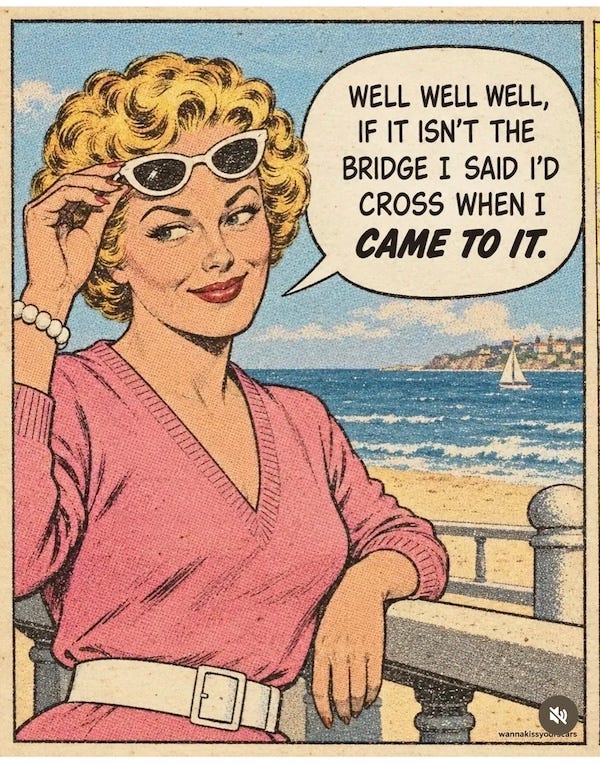
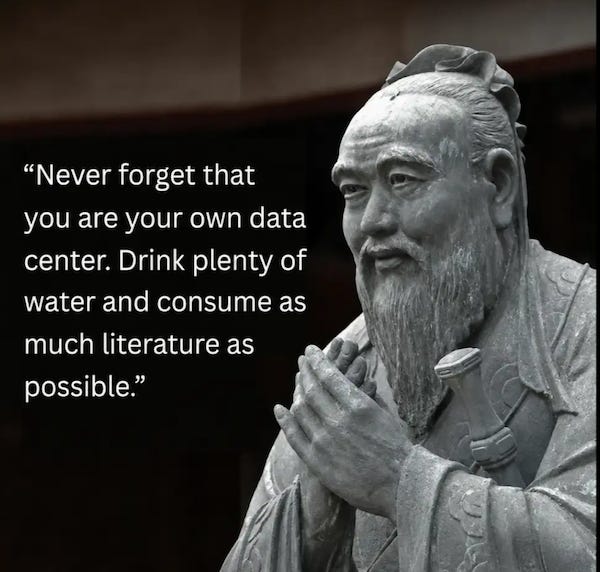
Because he is so deeply, irredeemably amoral and stupid
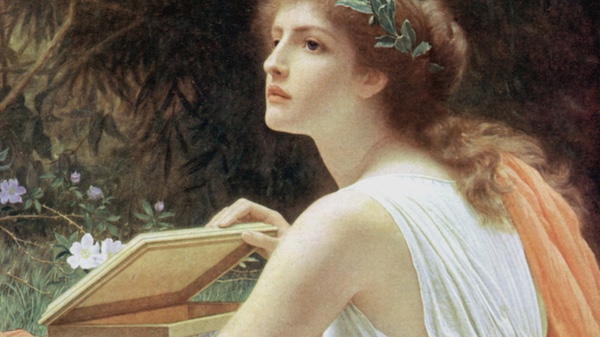
Hi, friend. Your Miss O’ awoke this morning, the first day since Saturday, October 3, on her own without an alarm and feeling not unwell. After ten days nursing a nasty respiratory infection, I found myself on waking thinking of a title, “Why the Sea Is Salt,” and another, “Snow White and Rose Red,” and visualizing a filmstrip called “Pandora,” accompanied by a cassette tape or record on which played a high “BEEP” when it was time to manually change the picture cell. (I was fortunate enough to be not only a student using such machines, but a teacher who used them even four or five years into my job.)
The titles, I realized, all came out of a foggy memory of fourth grade, the year I had a depressive young teacher named Miss Shelburn, whose unusual blond streak of hair and blotched skin meant, I realize now, that she had Vitiligo, a condition where the immune system causes lighter skin pigmentation to show up in patches. She spent most of her teaching time sitting at her desk, slightly slumped over. She liked that I read aloud with so much expression that I didn’t notice I said “lives” with a long i when it should have been “lives” with the short one, a mistake that made her snort, the only trace of a laugh in her I’d seen, more than worth a little personal embarrassment.
Miss Shelburn’s one day of true enthusiasm came the day she wheeled in a television set and turned on Princess Anne’s royal wedding live from England, and we watched it all day. (We watched a lot of television that year, Public Television, especially The Electric Company (starring Rita Moreno and Morgan Freeman) to help us learn the metric system, for all the good that did, but hey, Rita and Morgan!) Miss Shelburn was enchanted by this fairytale wedding.
That year of the stories, first, those myths and legends of salty seas and fairy tale castles and locked boxes, that came into my waking world this morning, and I’m not sure why.
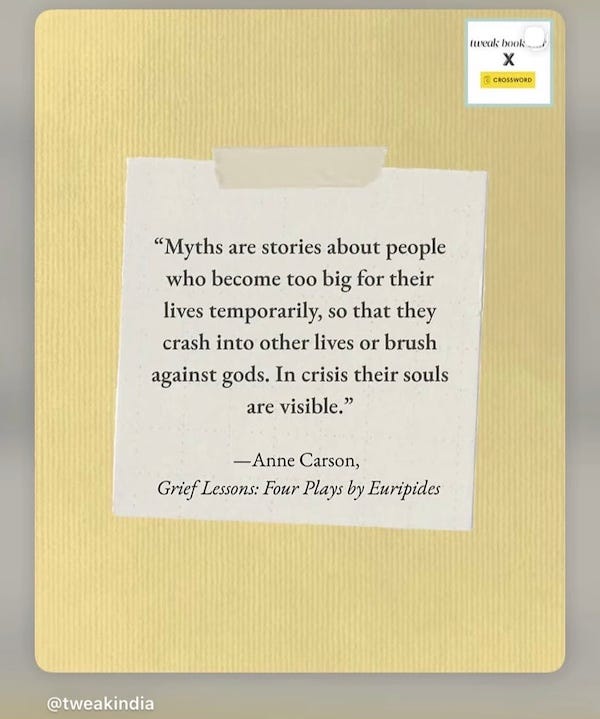
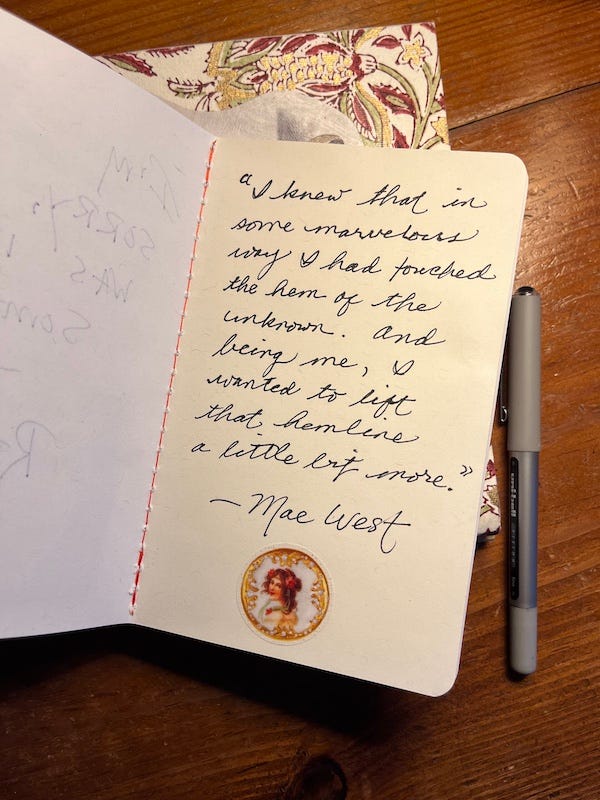
Anne Carson won the 2026 Nobel Prize for Literature. I’m still thinking about this quote. Have you ever felt too big for your life? I have. Temporarily. So I moved to New York City.
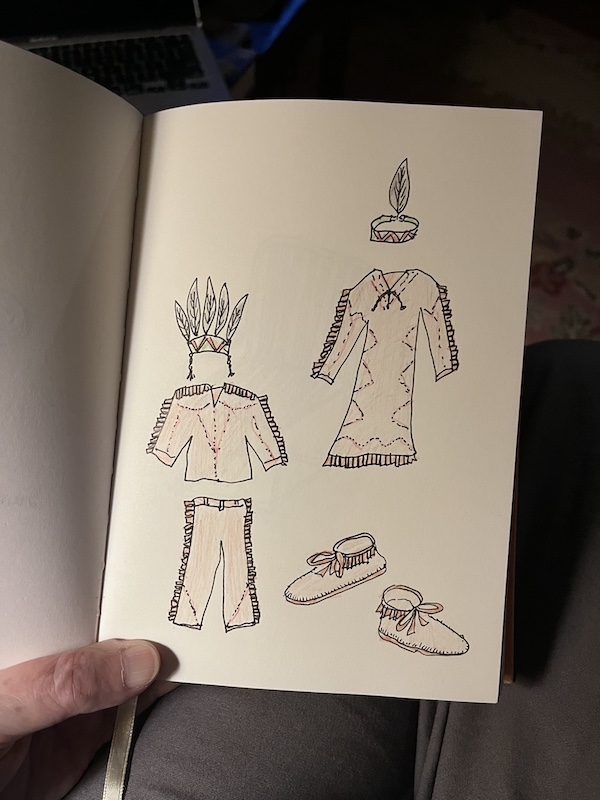
Fourth grade was also the year we learned American history, going so far as to spend a day out in the cold mist in “Pilgrim” clothes, and I think some “Indians,” in paper hats and no coats, roasting potatoes in a pit poor Mr. Westerberg, the custodian, had to dig. I mostly remember flying around on the blacktop looking out at bare gray trees and suburban houses, trying to imagine a log village and pretending this was fun.
One Thanksgiving my mom gave these costumes to me and my brother Pat. We went “hunting” in the backyard. Watching Westerns, Lynne taught us to root for the Indians.
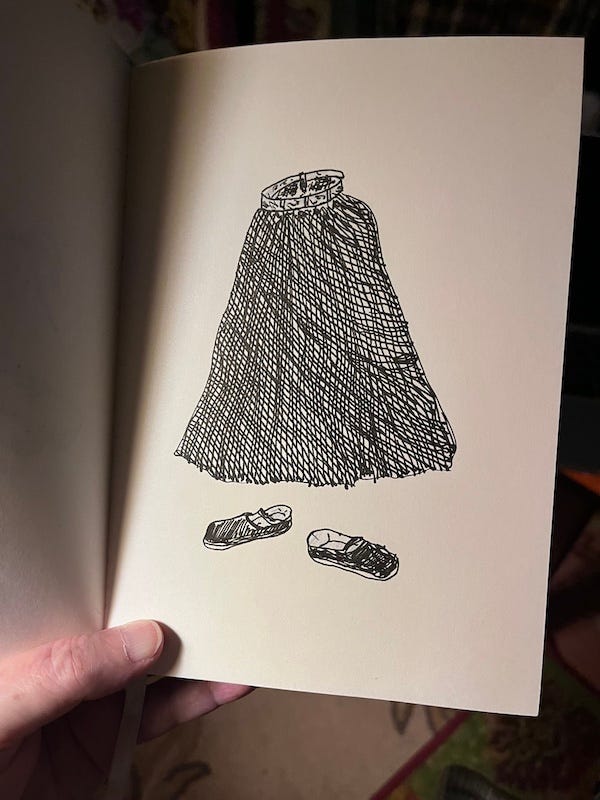
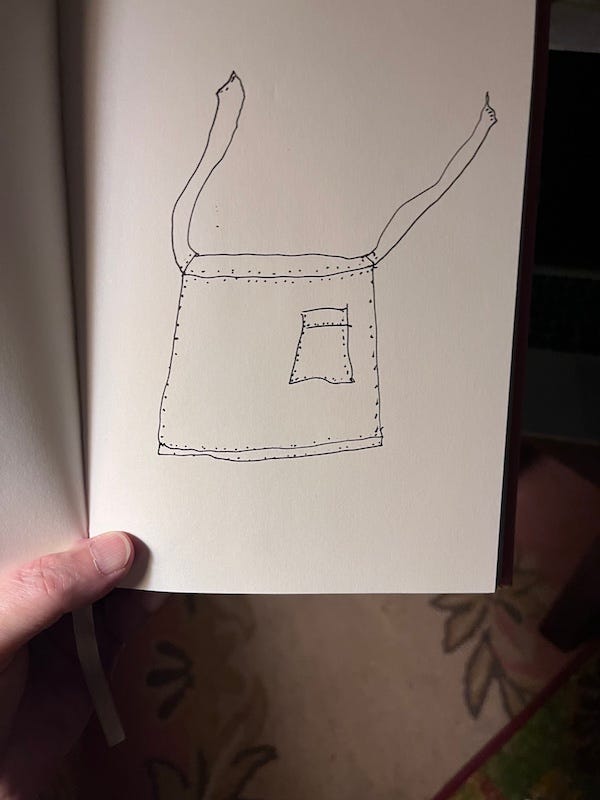
I still have the white Pilgrim apron my reluctant mom, Lynne, sewed for me by hand, which I wore over her 1950s tiny black and white check skirt, long then; a skirt I wore again, now knee-length, for the Junior Variety show in high school, and which we donated to the drama club along with several of her other skirts and dresses.
[We interrupt this letter to note that a search for the apron for a photo portrait was unsuccessful, because like a dope I moved it out of its drawer of 20 years when I reorganized some drawers this summer, but prayers to St. Anthony, the patron saint of lost objects, have been dispatched. -ed.]
The apron is a lot more gathered and nicer than this. As much as my mom hated sewing, she did a lot of it and all by hand, because the making mattered.
Fourth grade—for all the weirdness of Miss Shelburn, and my burgeoning hormones returning my hair to natural curl, and Billy Beard accidentally smearing India ink on my only white blouse (this being the time when art teachers let children use supplies like India ink), and learning about the happy slaves in the fields of our Southern plantations through the Ginn Reader (I wish I were kidding)—was the time when I think I discovered the real magic of fiction. The Scholastic Book Fair meant something better than candy. I could read whatever I wanted.
It was the 1970s, and all the girls and women, even teachers, wore miniskirts. My mom wore slacks. Both meant liberation.
Unfortunately for the species, far too many men do not experience women as beings.
We are [checks notes] “whores.”
How is this still the American female narrative for American men?
I’m sick of it.
I’m sick of stupid.
I’m sick of men.
We are bored.
There is not a moment of my life I have regretted living and sleeping alone. Not a minute.
All this comes to me full force from SNL standups and rape allegations and once more, with feeling (no, really, this time we mean it), “no more frat parties until further notice” and promises to “investigate.” Until the coup, of course.
How in the name of everything sacred in the universe is THIS where ostensibly sentient humans are?How is this the best we have to offer our creator? (How pathetic is it that a powerful man can only feel smart when represented by that sort of female?)
All that off my chest, it’s time for my nighttime antibiotics, inhaler, and Flonase, as I gratefully turn toward my very own bed in my very own home surrounded by collected things imbued with love and memory, a sacred place, free of collective human-made stupidity and frail-egoed men, and lift from my bedstand my reading glasses and a novel into which to sink, to sleep perchance to dream.
Americans, as if it’s not enough to have loved ones facing terrible illnesses and personal tragedies, we are daily perpetuating a hellscape for the nation, all of our own making. Bigotry and hatred and mass murder and rape cannot be The Story. We’ve done that to death. And it sucks. We have to write another story. Write your chapter. Have a reading. And Abolish ICE.
Sending love and reading among the evils (unleashed on us by men),
Miss O’
“Pandora. Pandora (the ‘all-gifted’) was the first mortal woman according to the Greek poet Hesiod. She was sent by Zeus as a gift to Epithemus. She brought a box (a jar in Hesiod’s original version) which, when opened, released all the world’s evils. Only Hope remained. After a Victorian painting (Photo by Ann Ronan Pictures/Print Collector/Getty Images)”
I think I mentioned I’ve been watching videos by music teacher Rick Beato (so many good ones). The most recent one I happened on was made in response to a commenter who suggested Mr. Beato knew nothing of real work. Gauntlet thrown.
As Beato offers his biography and resume, the stops along the way all featuring employment, it got me thinking about all my paying jobs. Here I go. At first I thought, How many could there be?
When I was about 12, I started babysitting in the neighborhood, an occasional cash gig ($1 to $3 an hour was a going rate, depending on how late at night I had to stay); I babysat all through high school and college, and for extra cash when I was a public high school teacher, supplementing my $17,500/ year income as I paid off a student loan and my truck;
When I was 14, I spent various hours of summer afternoons walking across the street to help my neighbor Mr. Flaherty, who owned and operated Woodbridge Driving School out of his basement (his wife taught special education in our county, and I babysat their three kids), and helped him file and organize his invoices (he taught me how the drive the summer I was 17—great teacher);
At 17 (now with a driver’s license) I got my first regular job as a cashier/stocker at Woolco, which job I had my senior year, all the summer before college, and my college Christmas break; this job paid for all my books, clothes, and toiletries for my freshman year, and luckily I didn’t have to work through the terms;
The summer after freshman year, Woolco had gone defunct, but I was able to get a job at Dart Drug, in the same plaza where my mom, Lynne, managed Crown Books. I remember filling out the application by hand, running across the street to the realtor’s to pay $1.00 to have it notarized, and returning to Dart where I was given a smock and told to start the next day. I worked as a cashier (which also meant washing windows, collecting carts from the parking lot, and other tasks) every summer, winter break, and spring break for the next two years of college;
Between my junior and senior years, I acted professionally ($75!) at the Virginia Tech Summer Arts Festival in Seamarks by Gardner McKay, a two-hander where I had half the lines, and that same summer I house sat for my costume design professor, Felice Proctor, while she spent the summer doing the costumes for the Utah Shakespeare Festival. I lived in a townhouse shared by theater students and rode my bike the few miles every day over to her place to collect and her mail and newspapers, empty the ever-running dehumidifier, and water her flower garden, all while attending summer school for education classes, and bike back to my place so I could catch the bus to rehearsals and performances; at summer’s end and the following Christmas, I spent a few weeks back at Dart;
During my senior year, I auditioned for and got a job as a telemarketer for the Virginia Tech athletic boosters, giving a survey to alumni and asking for money; I also babysat for assorted professors’s kids; during breaks I was back at Dart;
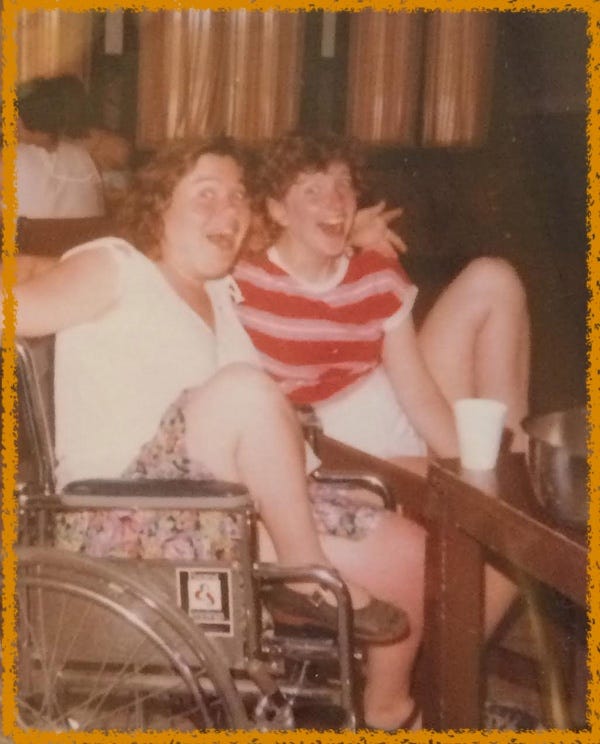
After graduation, I lived at the same townhouse for the summer and worked as a Christmas tree shearer in the Blue Ridge Mountains; getting picked up by a fellow college student at 5:00 AM every day for the 45-minute drive to Floyd County, where I learned to don chaps and shear pines with a long knife, pee outside, and eat ham sandwiches from my little bag that held my half-frozen gallon water jug; in the evenings I’d drive my friend Liz’s family station wagon over to her apartment, pick her up, lift her into the passenger seat and fold up her wheelchair and toss it in the back, drive over to the Performing Arts Building, park, get her out of the car, wheel her to the steps where some guys would come out and we’d get her chair up to room 204—I swear I have no memory of this, but I know we did it, and out again; I was her assistant as she stage managed the play Tennessee for the VT Summer Arts Festival; I’d drive her home at 10 PM, get myself home, no sooner hit the pillow then suddenly my 4:45 alarm would go off; I also acted in a show called Rich Lives: The Voices of American Homemakers as “The Woman from New Hampshire” for the 50th Anniversary of the Women’s Extension Service for 3,000 farm women from all over the United States, all while recovering from near-fatal blood poisoning due to poison ivy; I also realized too late that I was way over-extended taking care of Felice’s house again, so all her flowers died; at Christmas it was back to Dart;
With the late, stupendous Elizabeth Wills, ca. 1984, Virginia Tech, after the annual Theatre Spring Thing softball game. Ah, the energy of youth.
Between my student-loan backed 5th year—where I was a student aide, student taught, co-directed a local high school musical, and took a bunch of education classes in preparation for my Boards—and my first job as a paid schoolteacher, I once again acted in the VT Summer Arts Festival, this time as several characters in Andre Gregory’s adaptation of Alice in Wonderland; I did not house sit for Felice; at some point I got paid for doing a mime show at a nursing home. Possibly this event closed out the hardest total year of my life;
Next, I was, finally, a full-time public high school teacher, a job I got in a rural county where outsiders never came (I told you that story), and taught English 9, English 10, and Speech and Drama, and directed four plays my first year; I also had to host the VHSL (Virginia High School League) AA One-Act Play Competition, both District and Regional (meaning I did all the communications with the other competing schools, by phone, and had to procure all the judges, set the schedules, arrange dressing rooms for all the kids, figure out the lighting, sweet holy mother), in a town with nowhere for lunch so I got our Food Services class to cater (bless Tawana Lee); and I had to repeat all of this the next year while also co-sponsoring It’s Academic and Forensics; and then repeat all that in my third and final year sans the Christmas play and my drama class, instead being given a section of English 12—guess why I quit?;
My next jobs were in my year off (after my first summer of five in grad school at Bread Loaf), where I lived in the country and worked a little catering, did some babysitting, and was a reporter/photographer for the Virginia Farmer, a rural paper, writing feature articles and learning how to use a Pentax K-1000 SE (thanks to my professional photographer friend Jay’s over-the-phone tutorials);
My next job was to be found when I moved back home to Northern Virginia; while trying to get an interview with a school system (my letters of recommendation apparently sabotaged by a vindictive superintendent, is the best I can gather), I worked the weekly afternoon-to-evening shift at Minnieland Daycare for three months until I could land a job…
…which I did, partway into the year as a replacement teacher, at my second and final high school, where I went to high school (I told you that story) where I worked for twelve years, all told in my career maybe 2,500 students, before I…
Moved to NYC and was hired by an educational publisher, an entirely new career, where I still work 22 years later, having helped create (I think) eight full reading programs, Grades 5-12.
Here’s a challenge: if you are feeling a little lost, a little, “What have I even done with my life?”, take an idea from Rick Beato and Miss O’ and perform this service for yourself. Nobody comes from nowhere; nobody does nothing.
So. I’ll wait.
Would you look at that? Yes, you did that.
There is no doubt in my mind, none, that all our youth would be far happier, less depressed, more fulfilled, if they could point to an assortment of work they’ve done with their hands, out in public, something for others—you know what I mean? My god the miles I logged on foot, on my bike, on the boards of theaters, around stores and parking lots, in classrooms and down endless hallways. How did we do all that? And we did—and also went out with friends, did art, built stuff, listened to music, danced, made meals, had holidays with family, traveled, and moved, and moved again, and again.
Before beginning to write this at the witching hour of 3:00 AM (ah, the insomnia of post-menopause), I reread previous posts of appreciations I’d written for two Bread Loaf professors of mine who had died; I suspect the one person who liked those essays is the one person who actually finished reading them, so this latest is for that reader—thanks, Michele. Because here’s another one—and more backstory of Bread Loaf. (Note: part of my reason for writing blogs is to chronicle my life story, my history, so that when I’m senile, the collection might jar memories. And any time I reread a post, I’m so glad I wrote it—I wouldn’t remember any of that now, whatever it is. You might try this for yourself—it’s not about anyone else caring, though they might, and thanks if you do. Write for yourself. And save it somewhere besides online. -ed.)
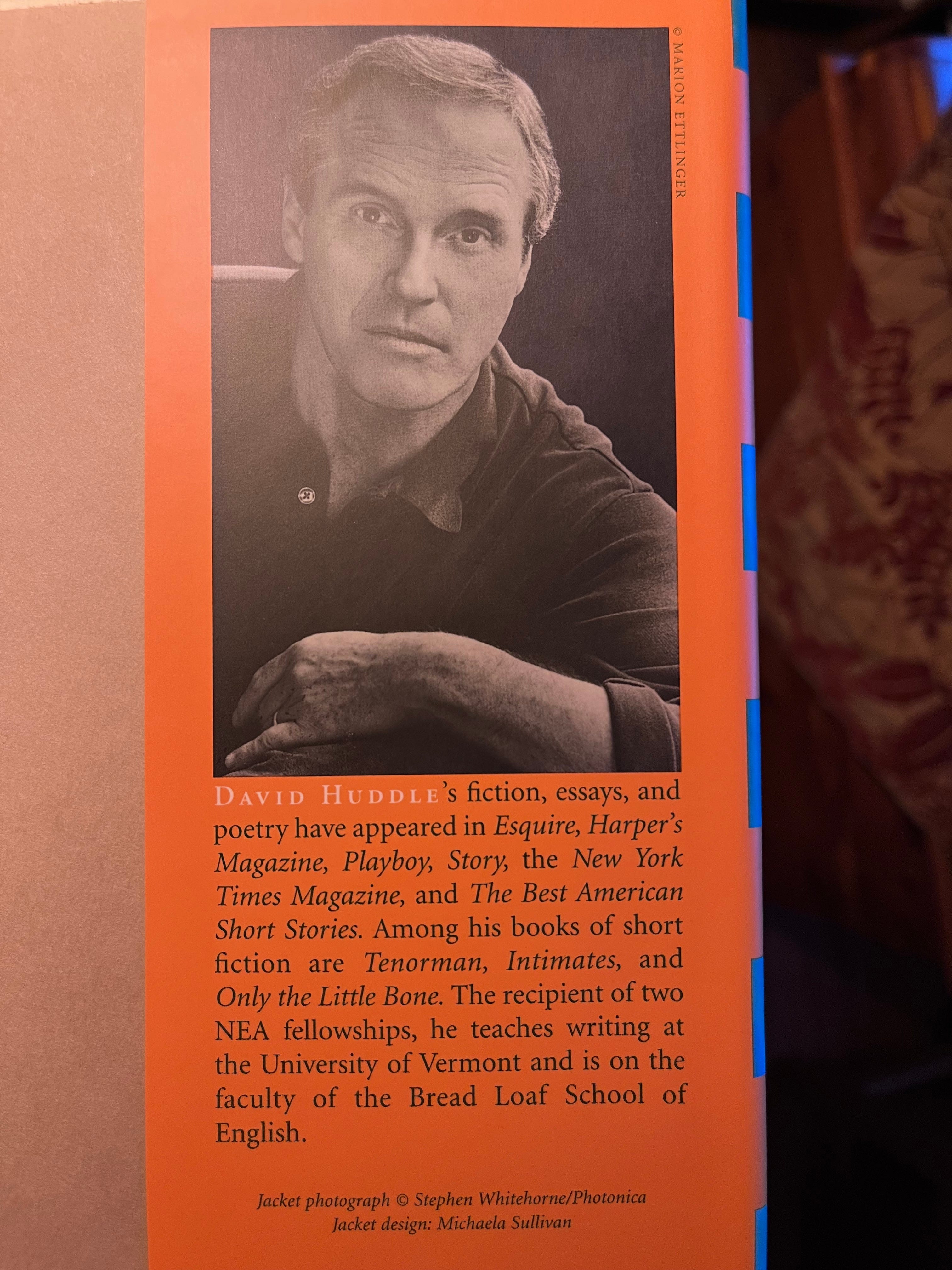
Like my feelings around the man himself, even in trying to write this I find myself self-conscious. Isn’t that funny? Here I am, age 62, around the age John V. Fleming of Princeton was the year I had him as a professor for Chaucer at the Bread Loaf School of English. I’ve mentioned him recently in a few posts, including my appreciations for the late Michael Armstrong and David Huddle. Back in June, in searching out Fleming’s blog “Gladly Lerne, Gladly Teche,” again, which I’ve followed on and off for years, I instead came upon his obituary, learning he’d died on May 30.
A little history first: The Bread Loaf School of English, as I may have told you, was created when a very rich man named Joseph Battell willed his summer resort in Ripton, Vermont, to Middlebury College ca. 1920—the idea to use it as a summer English master’s degree program was inspired, a place for teachers to gather in their off months, and, as they say, fill the well. (The famous Writer’s Conference came later.) Back then it was a kind of “gentleman’s degree,” I gather, a summer camp for (white male) elite private school teachers, the location of which assembled the finest (white male) English professors from around the country, with a promise of light courses, lots of reading, witty conversation, plenty of mountain air and fine walking, and a chance to get paid to hang out with like-minded, moldable fellows on expansive porches, smoke pipes, sip scotch, and sound like geniuses.
Like President Bill Clinton a decade after him, John Fleming was a Rhodes Scholar from Arkansas, though unlike Clinton he lost all traces of his regional accent. A legendary figure at Bread Loaf, Fleming famously didn’t come up every summer, so you had to grab one of his classes while you could. Curiously, Mr. Fleming made no secret that he found Bread Loaf “self-congratulatory” and too full of its own reputation; he said as much to my class. Yet I couldn’t help seeing that tension in himself—the conservative country boy who saw all this book learning for the intellectually masturbatory exercise it could be; and also the enthusiastic, wondering schoolboy scholar whose own small life was expanded and awakened through the world of books. Gladly would he learn, and gladly teach.
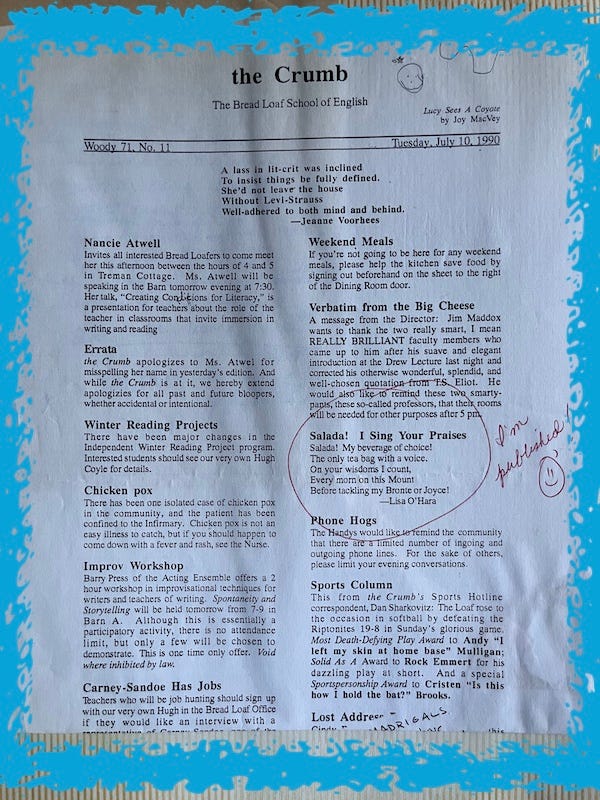
When he came back to Bread Loaf during my second summer of five, Fleming set to work to restore the little Printer’s Cabin across the road, used in the days before Xerox, boys and girls, to hand typeset the daily newsletter, “The Crumb” (all the puns of Bread Loaf—named after a mountain so called because its owner Battell though the mountain looked like a loaf of bread; the daycare was called Croutons), and literally print off copies to place at every lunch table in the dining hall. (Two “Crumb” authors I knew at Bread Loaf were children’s book author Sam Swope and then-editor of the New England Review, Hugh Coyle; I even wrote a couple of “guest pieces” in my time there.)
Ah, kids, there was a time one typed directly onto typing paper to make newsletters. This was the first year of the Apple Cellar, Bread Loaf’s new computer lab, and so was composed there and printed, I think, digitally. Big transition—I used a portable electric typewriter for four of five summers.
In this Brigadoon of a place where all electronics except typewriters were forbidden and no locks adorned the doors (heaven!), my roommate that second summer, Karen, was one of a few students who answered Fleming’s “Crumb” call to assist him and learn printing, and she’s the only one who stayed with his project. It never would have occurred to me to learn about printing; the next summer, when I would immerse myself in Virginia Woolf at Oxford, including learning that she and her husband, Leonard, started their own hand-printed Hogarth Press (the first press to publish T.S. Eliot, for example), I saw I’d missed a fine opportunity.
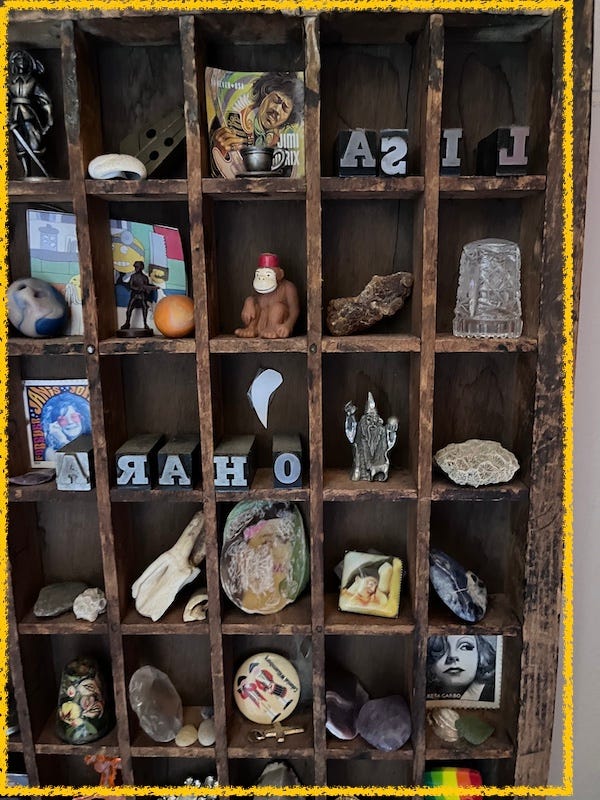
A printer’s box from the family-owned, now gone Poyer Press, Belvidere, NJ. My name letters are from that press, and try as they might, Bread Loaf friends George and Jeannie just could find me an apostrophe. Also, see that dashing knight in the upper left hand block? Bread Loaf fellow senior Anna picked that up for me at the Ben Franklin hardware store in Middlebury; she was heading to town and asked, “Can I bring you anything?” And I said, “Surprise me.” A Chaucerian knight.
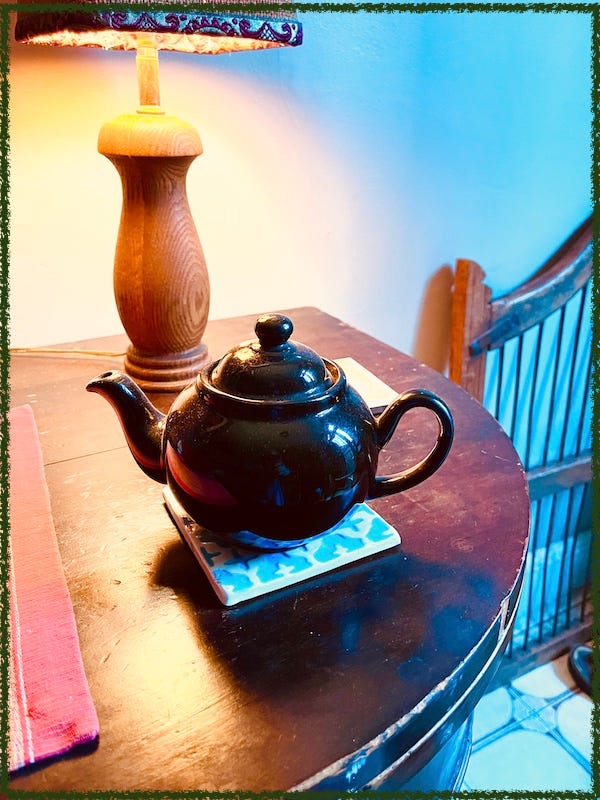
While she talked about the printing restoration, Karen didn’t say much about the man himself; I myself remember being quite struck by Fleming’s great height, his expressive face, and by his bringing a large “brown Betty” teapot to the dining hall every morning at breakfast and asking a waiter (it was a clique thing and also a way for some students to earn free room and board each summer) to fill it with hot water (I think with his own tea); I recall him being charming and grateful about it. I could relate, as I was a tea drinker, exclusively, back in those days—no coffee or soft drinks or hooch—black tea, hot and straight, and I wondered if only faculty could bring a tea pot like that.
You can also see the Brown Betty in Wallace and Gromit. LO’H collection.
Wonderful though my summer experiences were, Bread Loaf was a place divided very much by money and class: the students either came from personal money and Ivy League educations and became private school teachers in order to “give back” (private schools paid their graduate degree tuitions in full); or else they fell into the “other” category, the latest edition of students, as when I arrived in 1990 on a rural teacher scholarship, of working and middle class students who attended state colleges and taught public school. It was my first time being aware of class like that, though I had hints of it when I became friends in high school with people who lived in a (new, then) gated community called Montclair. Fancy, but we all attended the same public school.
Even without knowing anything about him beyond his legendary intellectual acumen (“brilliant,” “Princeton”), Fleming’s loping gate and careless (almost sloppy) way of wearing corduroys, unpressed button-down shirts, and shoes that suggested they had to be re-tied a lot, bespoke a man caught between worlds. Coming from three years teaching in rural Virginia after graduating Virginia Tech before finding myself in these rarified circumstances, I found Mr. Fleming’s presence both comforting and unsettling. He was a kind of mirror—as a man not quite of Bread Loaf, while also looked up to, I recognized myself in him (see: The Oracle). It made me think about myself, and no one likes to be self-conscious, though self-aware is always important.
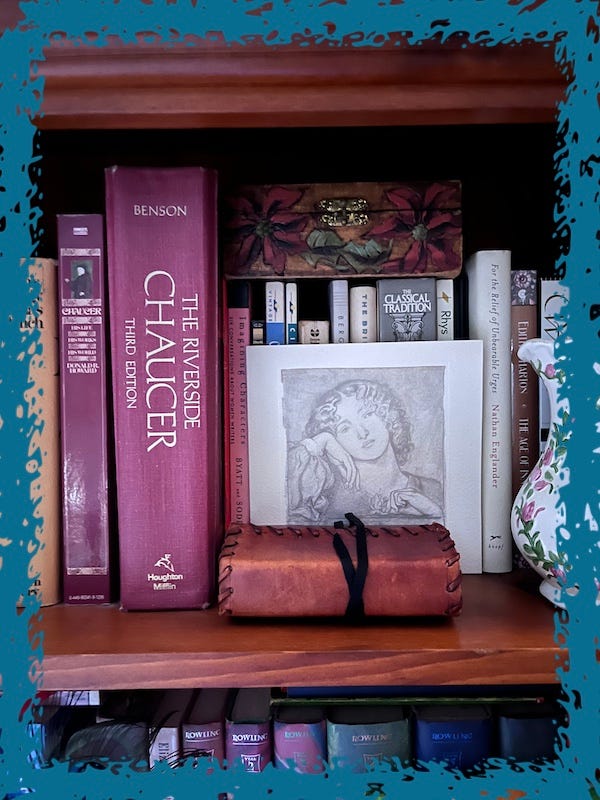
The textbook Fleming assigned was TheRiverside Chaucer, in Middle English; my mom, Lynne, manager of Crown Books in our town, stripped me a remainder Signet edition of The Canterbury Tales in both Middle and modern English, side by side, though I quickly found that because of Fleming’s teaching, I didn’t need it; I could (using the footnotes) soon read Middle English ca. 1390. He did afternoon tutorials to guide us in reading the work out loud, “Whan that Aprille with his shoures soote…”; since there were no tape recorders, he noted, it’s not possible to say how it sounded—another important reason for classes like this is historical perspective*—and Fleming guided us to see how only 200 years later, this version of English would become recognizable into the present era with Shakespeare ca. 1590—pretty amazing.
Still has pride of place on an upper shelf.
*[Sidebar: I recently watched a YouTube video by Rick Beato, a music scholar and teacher, where he demonstrated and explained how really wonderful Jim Croce’s 1972 song “Operator” is; very matter-of-factly, as he paused during moments of the song, Beato defined for his younger audience terms like “operator” and “matchbook,” explained what a pay phone was, how much it cost to place a call, and also explicated the events of the song—all things a modern young person who only texts could never recognize, not merely the mechanisms but the desire to hear a voice, all alien. In. My. Lifetime. As with listening to old songs, classes in Chaucer, say, remind you how far we’ve come, and also how recognizable we are in our humanity. -ed.]
After Day 1 of the class, though, I asked to meet with him. “Mr. Fleming,” I explained, “I’m a theater major from Virginia Tech with a 1970s suburban public school education, and I have no idea what you’re talking about. What do I need to read to succeed in your class?” He thanked me for letting him know, and gave me a reading list: stories in Ovid’s Metamorphoses, St. Augustine’s Confessions, various books of the Bible, all of which are alluded to in The Canterbury Tales. We would also be reading The Consolation of Philosophy by Boethius as part of the course. Time to get seriously to work.
The first time I practiced reading Chaucer aloud, by the way, I kept inflecting up at the end of every line, in my nervousness, I guess. Fleming stopped me after a few lines, “Miss O’Hara, every sentence is not a question,” to which I responded, in surprise, “Oh, my god? It’s like all my teenage girls? Who do that all the time?” And I giggled. He looked startled. I spent the summer deciding I could be myself—keep this Chaucer stuff real. I could tell he got a kick out of it, defying his scholarly approach with my realities of a public school classroom and today’s teens. I wrote Mr. Fleming a third essay, a personal one, at summer’s end to explain how I’d translate all this to my kids, giving him a copy of Paul Simon’s Graceland. “That longen folk to go on pilgrimages,” Elvis as our new Thomas à Becket.
When I look at the supposed miracle that is AI—no one has to read or think at all anymore!—I get sick. Physically sick. Back in my undergraduate days, because Aristotle’s Poetics is such a feature of the theater that was my major, I took Aristotelian philosophy as an elective. I struggled mightily with it, and I asked my professor, Dr. Nick Smith, why this was so hard to read. “Because the ideas are hard,” he said. There it is.
And taking that challenging class, along with being taught Chaucer in Mr. Corbin’s AP English 12 class, and learning through acting to read Shakespeare with relative ease, I was able to challenge myself and find not only increased knowledge but genuine pleasure in my success in a hard graduate course. And Chaucer is funny—really funny. And filthy as well as pious. Once a summer when he was there, Fleming read “The Miller’s Tale” aloud at the weekly Thursday bonfire, in Middle English, and he was a riot. (Give yourself a treat and read “The Miller’s Tale.”)
Given all his exacting Princeton expectations, you might wonder why I’d sign up for his class— for one thing, I needed that period of literature to graduate; for another it scared me, so I had to do it. One thing that took the big pressure off me when taking Fleming’s class, by the way, was finding out from students past that he never gave A’s. He didn’t believe that anyone in a summer course could possibly earn the top kind of grade he assigned at Princeton.
I got an A.
I have never valued a grade like I valued that A.
When I was graduating at the close of that summer, I learned that the tradition for our celebration dinner was to ask a professor to escort us to our tables. David Huddle was quickly snapped up, and my earlier beloved professors were quickly taken, too. I remember stopping Mr. Fleming in the Inn lobby to ask if he would consider doing it, and he was startled. “I’ll have to get back to you,” he said, because I believe his intention was to leave campus with his family before graduation. But he did indeed escort me, to the shock, I think, of many faculty and students, and to my infinite pride.
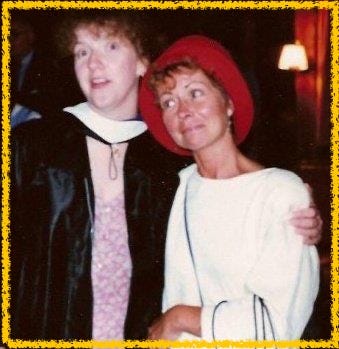
I don’t have any photos of my graduation, save one, taken with my friend Becca Cummins (the friend who inspired my eBook), who was also in David’s Fiction Writing. Somehow that feels about right—so much of our experiences are in the doing anyway.
To Mr. John Fleming of Princeton, I give thanks.
And I feel beyond lucky to have aged in a world that centered books, that three of my great mentors—David Huddle, Michael Armstrong, and John Fleming (all white men, to be sure, noting those first two were only ever first names with their students; but we can’t forget Maureen Shea and I hope it’s years and years before I have to memorialize Jacqueline Jones Royster and Felice Proctor) made reading and writing come alive for me, that I could pass that on to my students, maybe even to you.
We are now, sadly, post-reading, post-books. I could never have believed such a thing in my lifetime. It’s been deeply distressing to me to have to imagine a world without the wonder of reading, the deep intelligence that hands-on, eyes-on reading gives us as individuals and a society, not only culturally and intellectually, but emotionally. Reading is an education of the heart, more than anything else. Consider this tribute to Mr. John Fleming another shot in the dark to keep literacy alive. Tell the stories before our AI internet searches lead only to “PAGE NOT FOUND.”
Miss O’ with Rebecca Cummins, Bread Loaf, August 1994
Read all the things, and from a place of love, always choosing your words for their meaning, even as we forgive typos.
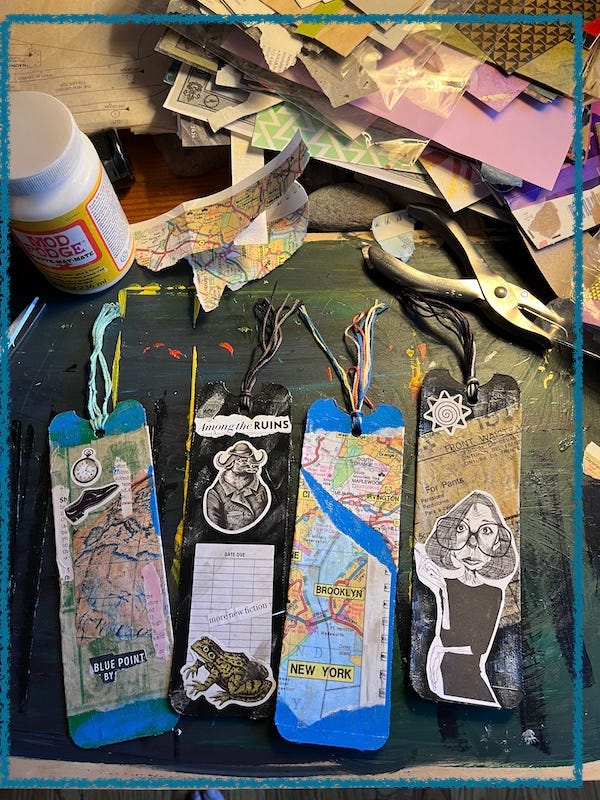
This morning being cool-ish and tolerable after last night’s storms over New York City, I walked to the farmer’s market early, picked up a few things at the grocery store, came home and make hummus and tabouli with the fruits of my purchases, and sat down at the ol’ desk to do a little art—the past few months, I’ve taken to making bookmarks using Kleenex box pull tabs as a base. It takes a while to gather materials, so no rush. Did I tell you this already?
Bookmarks by LO’H, 2026.
While working on those last two up there, I turned on PBS, where I found a rebroadcast of Bill Moyers’s wonderful 1988 series, The Power of Myth, with Joseph Campbell. I came in where Campbell is explaining that the desire of our lives is not meaning, or shouldn’t be, but rather “the experience of being alive,” and that this is the source of myth, “that which cannot be named”—“some call it God.”
I’ve been thinking a lot about something a content creator (there’s a weird title) said recently, that humans have a need to make, to create, and not merely to consume—we need to feel alive—and this connects to Joseph Campbell, too. (I think this is why, for example, we march when we feel helpless after consuming all that independent news content—and why we build cathedrals and temples and even office buildings, when we aren’t crafting little bookmarks—we have to make to feel alive.)
Campbell talked, too, about our Western trap of living in dichotomies:
Good and evil
Male and female
Being and nonbeing
Right and wrong
Dead and alive
Knowledge and ignorance
To which one might add…
Republicans and Democrats
Patriots and Fascists
The Old Man and The Sea
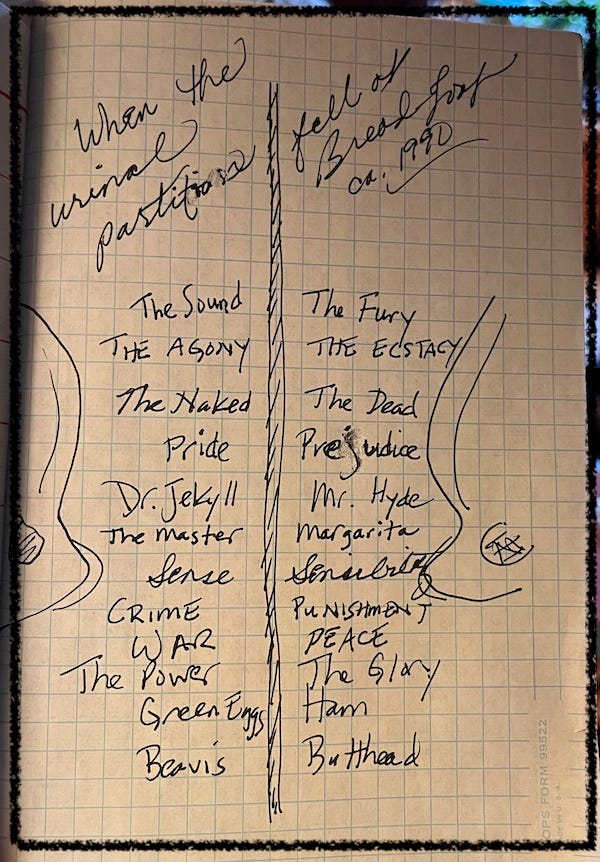
I told you about that fallen urinal divider at Bread Loaf, the Writer’s Conference and School of English in Vermont—some literary type started a trend that others followed, with a situation that looked something like this:
Author’s rendering from limited memory; my male friend who told me about it realized that the game had devolved past help with that last one.
Dualities—we love them in our literary titles as much as in our myths.
Man, Campbell points out, is “in the field of time”—good and evil are temporal (and some of us would like to move our awful times along already, but it doesn’t work that way), but our mythology is rooted in this duality—it’s ethical at its base, sin and atonement, right and wrong (the word versus apparently lives in our marrow); it all begins with us humans as creatures: god and man start out the same; man and woman eat of the tree of knowledge; god becomes God, and man and nature then become opposed, man and woman are opposed, God is against man—all this against-ness; we are not in accord: we fight with nature, we fight amongst ourselves (Christianity, Judaism, and Islam)—all of ourselves is corrupt; nature is corrupt—this myth of opposition has determined all of our Western civilization. (There is something to sit with.)
This oppositional view of being alive on earth, Campbell notes, is counter to all the Eastern religions (Hinduism, Buddhism), as well as to Native American religions, to take only a few examples. In Japan, for instance, there’s no idea of “a fall of man”—natural impulses are not to be defeated or fought but only acknowledged (at best) or sublimated (when hurtful or not useful).
We have only to look around America in 2026 to see where opposition as a lifestyle has gotten us. That’s all I could think as I tore up a map, opened the Mod Podge, took a paint brush, and started one more bookmark collage.
This life in the West, Campbell says, “is an opera”—we all choose the roles we play in it; and that this life is, in reality, our eternity; if you don’t get it here—“it” being whatever experience you will have as a being—you won’t get it anywhere; this life is a poem, our acts and adventures; a poem connotes something transcendent.
We have to acknowledge that this life is our only shot. Then what would mankind do? Imagine.
As Moyers questioned the validity of faith, Campbell insisted that every mythology and every religion is true—but don’t let it “get stuck in the metaphor”: Jesus didn’t physically ascend to heaven, he went into the heart, and to read that story in any other way is to get stuck in prose instead of transcending through poetry, Campbell says, getting caught in “denotation instead of connotation”—poetry gets past the concept of “reality”—it’s about connection.
And in the United States, we Americans have lost our connection, our mythology, and so, our moorings. I think this is why The Odyssey (which I still haven’t seen, but my classicist brother, Mike, went today and called it “good stuff”) is currently capturing the national imagination. We’re starving for a solid mythology.
Campbell, a true teacher and lover of learning and travel and discovery, says we are all manifestations of Buddha consciousness—the Gospel of Thomas (deliberately excised from the original Bible) says this, too— that we find the Jesus inside ourselves; heaven and hell are within ourselves; and the Upanishads said this in India, centuries ago—there are energies within us, in conflict with one another—brain wants one thing, heart another, intestines demanding attention. There are oppositions enough inside each human without adding oppositions to one another and to the earth.
At one point, Moyers talked about how Conservatives (and this was filmed during the end of Reagan’s presidency, remember) were demanding a return to old time religion, “a fixed star,” Moyers calls it; but times have changed—science and medicine changed the myths, and the moral order, Campbell says, must catch up with the moral necessities. There is no going back. What I heard is that we can’t let go, let God, but instead we have to look at the actual crisis of the climate that we humans are creating, for example, and solve for that. We live on a big planet now, and we can’t pretend we don’t: for most of human existence, most human centers around the world were unknown to one another—the Egyptians didn’t know about Aztecs—so of course, the more we learn, the more we affect one another, the more we change. We have to change.
The three religions—Judaism, Christianity, and Islam—fight because they “won’t give up the metaphor” and accept the need to find the truth, and to separate that metaphor from what Campbell calls “the temporal inflection,” our reality. Campbell notes that new metaphors are needed—Star Wars, for example, (kin to The Odyssey before it, with the focus on the father and the son, the hero’s quest and a people’s future) addresses the big question, Is the machine going to crush humanity or serve humanity? Darth Vader, more machine than man, is playing a state role, Campbell says, not a human role—when unmasked by his son, he is revealed to be a worm, really, unformed, malformed, no longer recognizable or powerful. We need metaphors to access truth—not to cling to a metaphor (Vader as machine of the state) for its own sake.
So I think we have to ask, today: Are corporations serving us, or are we serving them?
Machines are our new mythology, and there’s no turning back. Campbell and Moyers talk about President Eisenhower visiting a room-sized early computer. Eisenhower asked the computer, “Is there a God?” After a few minutes of lots of noise and beeping, a slip of paper printed out: “Now there is.”
The creation of computers, Campbell acknowledges, is astonishing, but there is “a determined code,” one we make. He finds a metaphor here: each religion is a kind of software—but a lot of codes won’t talk to each other. We have to talk to each other.
Our new mythology, whatever it is, has to incorporate the machine—not act the other way around, where the machine incorporates us. But as Campbell points out, while the world is changing too fast to have myths, still we can’t survive without them. This leaves all the work to the individual. And the artist.
Above all, myths serve “a pedagogical function”—they teach each of us how to live a life as a human. Watching this show again, I (a former teacher) was reminded how desperately we need teachers. At The Butcher Block this morning, I saw a New York Post headline that infuriated me—telling the Teacher’s Union that they had no business asking for raises when the kids can’t “reed.” And I was telling my friendly cashier what I did for a living and why headlines like that enrage me—that the problem is the goddamned technology forced on all of us by Big Tech, that all the studies show kids learn best with print books, pen, and paper; reading on screen affords almost zero comprehension—but Zuckerberg forbid we listen to actual reading experts.
We have a whole culture that attacks the educated, attacks the experts—Dr. Fauci is but the latest and most absurd example (the grandstanding Sen. Rand Paul (R-KY) not bothering to show up for the “contempt of Congress” vote he forced, his big show of knowing stupidity being over). Interestingly, we know this sort of thing happens because the ignorant are not only not curious, they are terrified of what they don’t know. Yet I have to point out, these same folks ironically embrace a fairy story in a book from 2,000 years ago, set in a totally different landscape and time, featuring no real technology beyond basic tools, ink and parchment, and the wheel, and call it reality. They say they hate being told what to do (wear a mask, distance socially), while demanding all of us follow their Ten Commandments, even as they all defy the very Commandments they say they revere—comfortable with molesting children, abusing wives, committing adultery, being greedy; to say nothing of the stuff in the red letters, like throwing those stones. How does anyone keep up with this?
I really like how Monte Mader explains about the myth that AI, that there really is no such thing as “artificial intelligence,” but only “human made intelligence,” fed into machines of human design (for corporate profit). As you saw if you watched the video, that is what true desecration looks like—the rape of our sources of knowledge, spine by spine, and tossed and lost forever like so much trash by Big Tech. And to what end?
Mythology—its creation and keeping—now is the job of artists—Campbell points out writers such as Joyce and Mann, artists such as Klee and Picasso, not a woman or non-European named, or anyone more recent than early 20th century, but you see the idea. And I was telling my dad, Bernie, only this very morning that I was thinking about how grateful I was that he and my mom Lynne were always creating—whether it was growing spring vegetable seedlings collected in containers set on a card table in the little upstairs living room at the bay window; or going to the nursery to buy shrubs for the yard; or building our toy boxes out of orange crates from his job at Safeway; or Mom making decoupage plaques and footstools for household art, and creating our Halloween costumes by hand; or even their cooking our meals from scratch, and me baking cookies—we were surrounded by making, always. And out of our making, we O’s became.
Thanks, internet.
Keep making and telling your stories, Americans. Make us US.
“Architecture needs more doodads. (That’s what my mom says, and she’s very aware of her built environment.)”
~ LuAnn Keller, Virginia Tech MFA theater grad student, on a flyer (I wish I’d saved) for a theater workshop she conducted with architecture students, ca. 1986
I always feel guilty when I’m not sharing political rage, but on this Sunday morning celebrating Pride in NYC I’d like to indulge a little in my personal interests, to share with you something on art and literature, knowing it will all lead to politics here in the end (and already has, look at that).
As a fan of HGTV—primarily because (and all due respect to the late Julia Child n PBS and the teaching of cooking and baking) it’s the only network that shows how nothing becomes not only something but also how it will now be inhabited (consumed, so to speak) by real people and for life—I have spent over a decade noticing how interior design became “Pottery Barn-inspired” as opposed to “collected and curated.” With the profound exceptions of Home Town and the lamentedly canceled Bargain Block, designing has become about creating neutral-feeling “spaces” rather than “rooms,” spaces that, sans walls, act more like furniture showrooms than homes. The “neutral” craze of whites, creams, and light wood tones, with the occasional splash of black in a feature wall or trim is not so much a backdrop for, say, colorful art (no walls means no art), as a merely open, blank canvas that will remain blank, if sometimes messier, for years to come. No amount of the show hosts saying, “Look how warm and inviting” will change the fact that every bathroom, bedroom, and living room—sorry, “space,”—is designed to mimic an impersonal hotel. I personally find the designs clean, sure, but sterile; there’s no question that what the hosts (the Property Brothers, Dave and Jenny Marrs, the Kleinschmidts, pick a show) create for homeowners is certainly nicer in the end than at the beginning, everything “updated” and tidy, “tons of storage,” etc. But you can’t help noticing that the people they are designing for will most likely never put any art on the walls that do exist (walls that sometimes get wood slats for “architectural detail” to fill the void), or set precious objects on the shelves, when there are shelves. And I can’t help wondering why.
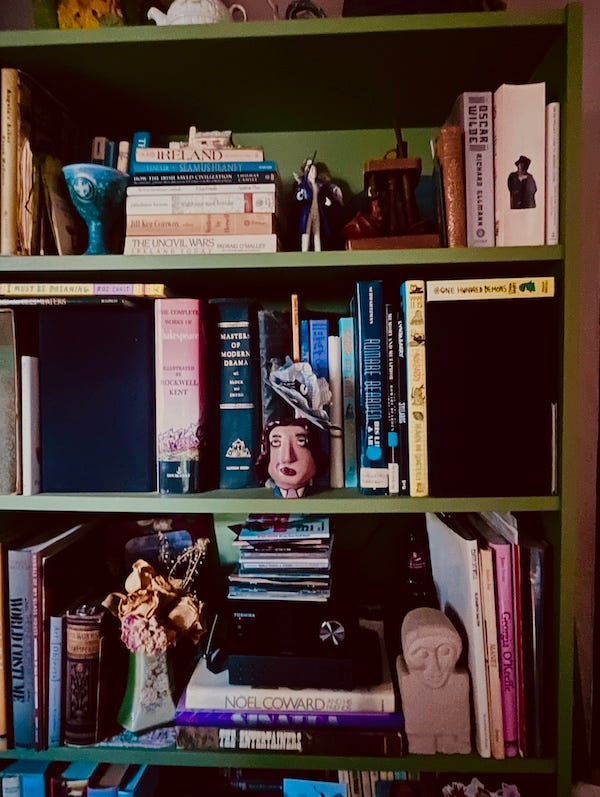
Never to be seen on HGTV. All of my friends have homes like mine, some far more sophisticated for sure, but all with the same feeling of life. I find this comforting.
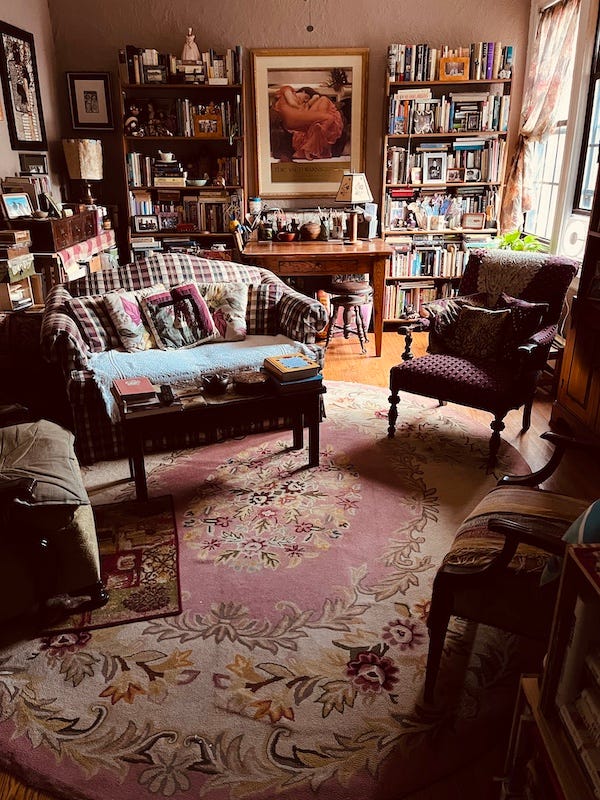
I know I’ve talked about this—people either love Miss O’s apartment on entering or get instant hives; there’s really no middle ground. I have lost my way, I think, in my collecting—now more cluttered studio than a home for hosting, but generally it works for me. This is because there’s not a single book, object, work of art, or furniture piece that is not the center of story. There’s no, “Oh, I bought that at IKEA” only; there was a specific time, reason, need, or person involved. Each piece is a memory, and I can tell you about it. I can’t really understand living any other way, and my way is definitely not trending. So what am I missing?
In my YouTube travels, when I’m not watching interviews with favorite musicians, I enjoy occasional episodes of HomeWorthy, wherein an unseen host takes viewers on guided tours of fabulous New York City apartments, led by the owners/renters themselves (who are collectors, designers, and artists). Their astonishing money-to-buy-stuff notwithstanding, even their paint color choices are inspired by, say, some historical place or painting; each object has a story. “I picked this up in a market in Bali in 1973,” a story begins, or “The creator of this piece was was a young weaver who…”; or “I bought these chairs at an auction in 1990, and they came from an estate in New Jersey; I needed a small sitting area, and look how perfectly they work by the window.” The people in these NYC apartments create rooms within rooms, areas for conversation, for office work, along with a bar, a library, hidden storage. No living room has only one function, what with space at a premium.
Miss O’ can relate. I can also relate to all the stories. I would love someone to film me giving a tour of my apartment as if I were a very important person; maybe it could inspire the white-walled, clear-spaced neutral people to reconsider their choices.
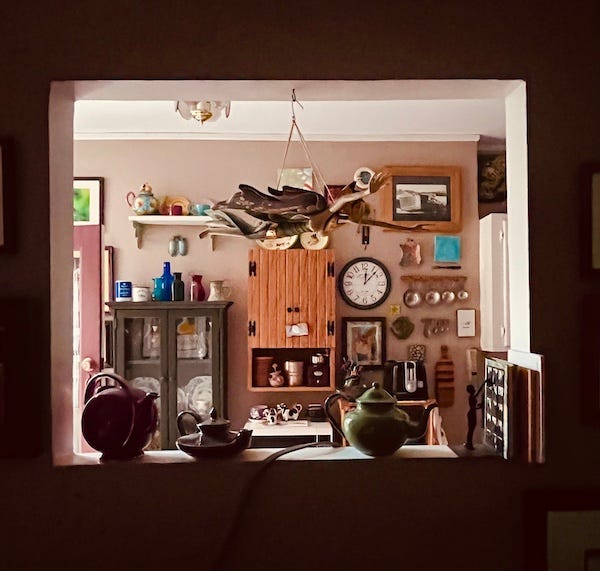
Ask me about my kitchen pass-through view.
Why do I say this? Come on, Miss Judgy O’Judger, I hear you say, shouldn’t people get to choose the way they live? Of course, as long as it is a choice, a conscious one, and brings joy. (I’d like to pause and judge one thing: I loathe and despise random and incessant gilding and calling it style. It’s not political.) What I’ve come to suspect is that the quiet, neutral furniture showroom aesthetic is a direct response to the little device we hold in our hands, the overstimulation that is doom scroll chic. They can look up from the screen and see blessed emptiness. I think even trees are too much for people anymore, and that’s just tragic.
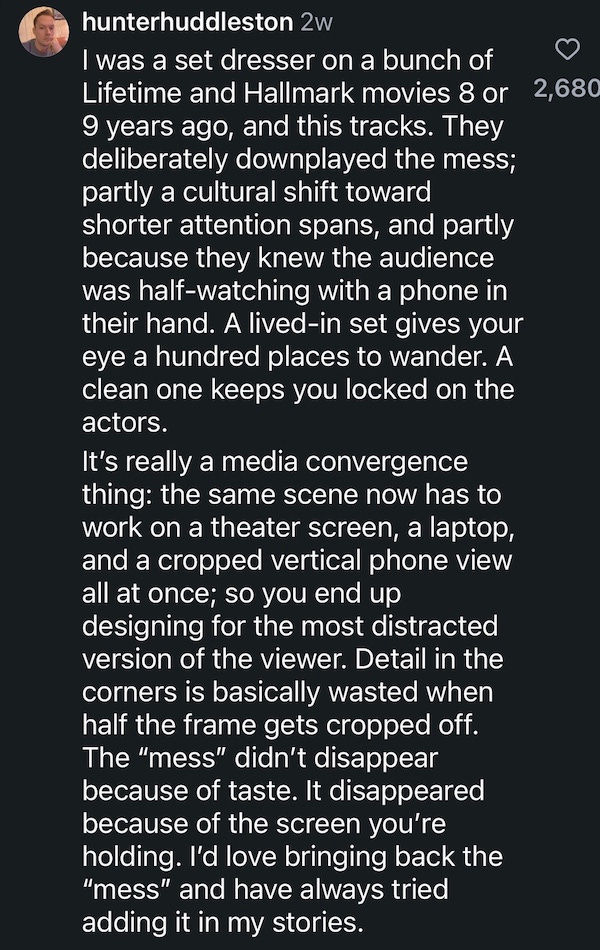
In my travels around my own doom scrolling, I saw this video on Instagram the other day:
Not only does this analysis acknowledge my questions, it also affirms some of my suspicions and adds more to my understanding of the way people live now. Here’s a comment on this same video:
So I can see the two-screens, various devices thing, the shorter attention spans of today, as part of this. But I got to wondering more about the role that story plays, or doesn’t, in our current culture. I know streaming and binge watching of fictional shows is wildly popular, but the reading of fiction (to say nothing of poetry) has dropped precipitously. I look at our educational system to point one finger: Common Core State Standards for ELA (English Language Arts) dictate that by the end of elementary school and into Grade 12, all reading in language arts classes should be 70% nonfiction.
Who decided this? I’ll tell you who: corporations (aligned with Christian Nationalists—oh, politics, are you never not around?). Why? Because the reading of fiction—even audio books, which is totally relevant as reading because humans were oral-based storytellers for millennia, and reading print has only been fairly commonplace for a century—creates empathy. As a student, for nonfiction I recall only humorous essays by Twain, say, or philosophy by Emerson and Thoreau; as a teacher, MLK’s “I Have a Dream” and Elie Wiesel’s Night were about it. The rest was short stories, novels, poetry, and drama. And here I am today, a big, educated, worldly heart. Fuck that?
Here’s another Instagram post on just this educational issue, and I could not agree more:
What the corporation head will say is that, today, they need readers who can process data. (Gee, what did we ever do without…data?) They need “readers” who can think critically about complex scientific, historical, and social problems.
They are lying.
What they really want are bored drones who generate revenue for invisible shareholders. They want brains that don’t work, eyes that don’t see, hearts that are empty. Lack of compassion makes workers easy to control. Here, buy this device, watch this show, hell, watch two or three at once. Wear beige. Turn all your books so the spines face the back. See how pretty that looks? Punch that laptop. (I learned all this from reading the Aldous Huxley novel Brave New World as a sophomore in high school. Dangerous, see?)
Oscar Wilde for Pride Weekend. Spines facing out, thanks.
I know I’ve said this before too—I’m old; I do a lot of that—but I’ve read (!) that fewer and fewer people have physical libraries in their homes, the wisdom being that if you’ve read it, why do you have to look at it? Books only collect dust. But I read some study that showed that people who have libraries (spines out) are frankly smarter than people who don’t. The reason is not based on IQ, but rather on the fact that seeing the books reminds your brain of what you read, when you read it, and what it was about, and as a result, neurons fire. You are simply more alive.
I think this must be the same for everyday living in homes (not spaces) with collected objects. Each picture, rock, vase, sculpture, card, tea tin reminds me, for example, of where I got it, who gave it to me, why it has meaning. I create and recall life narratives in my mind just by living in my house. You can’t do that in quite the same way with white walls and warm wood with an empty countertop, with built-in shelves that hold a white ceramic vase from Pottery Barn and maybe a plant next to a phone charging station.
This really isn’t about aesthetics. It’s about what happens to our souls when our minds and homes are sterile. For people who are poor, who are just starting out, who are scraping by, none of what I’m saying sounds like anything but privilege; but I’d argue that the same results of emptiness apply to anyone.
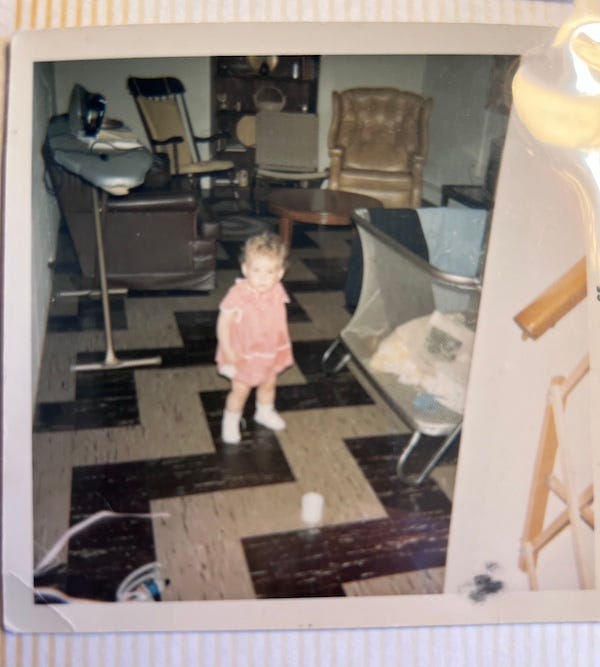
When I was a tiny child (the year the Voting Rights Act was signed into law), my parents, Bernie and Lynne, scraped up $50 for a house downpayment, because if you had a regular labor job (and were white—here comes more politics), you could do that. The house’s downstairs walls were white cinderblock for many years; the floors tan and black asbestos tile, no rugs; we had a round red-wood coffee table my mom bought when she was in the navy, and a couple of mid-century modern rope chairs. In the first year, together they bought a vinyl-covered loveseat, a wooden rocker, and an vinyl-covered recliner, and a small black and white TV along with a pressed wood end table for a stand. And that was our living room for at least five years.
But what I remember more than that is the portable hi-fi and record albums always playing on it; the Puerto Rican Pottery ashtrays, the diablo mask, the black Wedgwood tea set, the Israeli brass ashtray, the painting of a watchmaker upstairs, and volumes and volumes of books (the first thing they spent serious money on was a big custom bookcase for the otherwise empty upstairs living room, an odd feature of their house model)—all things Lynne had collected as a single woman in her twenties. I asked about all of them. I learned their stories, and also, then, the story of Lynne’s life before me, before marriage and children. (By contrast, my dad’s entire life fit into a small brown suitcase when he moved to marry my mom.)
It’s the objects, the books, the stories—it’s not about stuff for its own sake; not about constantly clean surfaces and a living room that looks unused and “ready for entertaining” in the abstract. It’s nice to have a tidy home, but a home—not a space—is to live in, to arrange memories, to build new ones. To be alive in.
A library, even a small one, matters. Novels are important. Poetry is important. Having volumes around you makes you a better, by which I mean a more feeling and aware, human. Remembering that our lives—all our lives—are connected stories is key to our humanity.
Our interiors reflect our interiors, if you see what I mean. Both interiors inform the way we curate our democracy, our earth, too. It must. I know I can’t control the world, can’t stop all the atrocities, but I can curate my stories, maybe share them, hope to spread a little encouragement for all of us to do that for ourselves, for each other. If you want.
Sending love and hopes for a better tomorrow,
Miss O’
So I went into my family photo album, and would you look at that accuracy of memory? (I’d forgotten the little bookcase—three painted versions later, it sits in the exact same spot by my dad’s chair today.) In terms of function, the room served as entertainment center, nursery, and laundry. Ca. 1965.
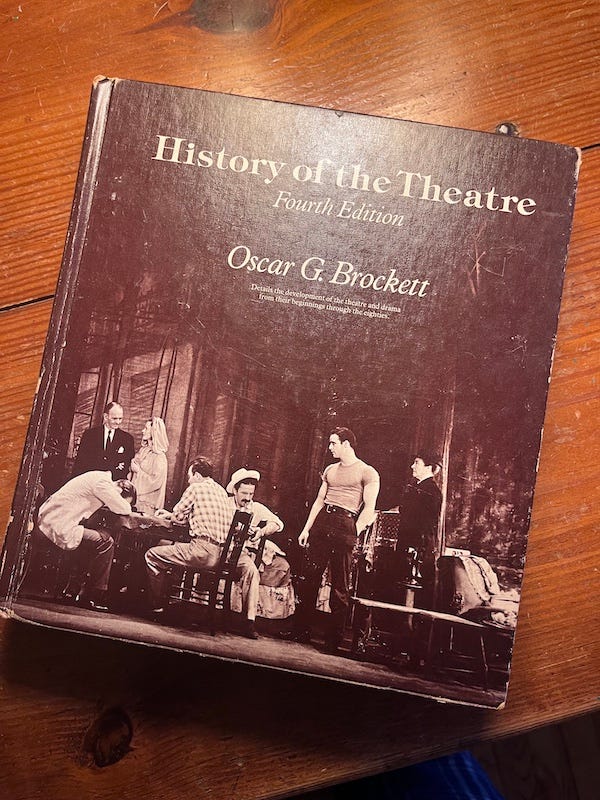
During my year of History of Theatre classes at Virginia Tech ca. 1983, Dept. Head Don Drapeau lectured about Western theater/re traditions that began in Greece, using the textbook History of Theatre (Fourth Edition, by the time I took the class) by Oscar G. Brockett. From the Greek and Roman multi-purpose arenas, we’d make our way through the Dark Ages to the Middle Ages and the Pageant Plays, where you’d come to realize that all theaters are essentially churches, which is to say, churches are theaters, built for audience and players. By the Renaissance, special buildings called theatres, (from the Greek amphitheatron, or “place with spectators all around”) were being constructed solely for the purpose of the thing that is a play. And at some point in a lecture, Don would intone, speaking about every theatre from the Rose to the Old Globe, “And it burned down.” Eventually, by the end of the second quarter, we students would complete his thought for him.
By the end of the third quarter, we could have changed it to “And it was demolished.”
This edition stopped being handed down with me, as I knew I would be a teacher and could use it. I never did get back any theater book I loaned to starving theatre majors, either because the concept of building a personal library didn’t occur to them or else it did and they kept them; or maybe they gave my books to someone else, or possibly sold them back to the Virginia Tech bookstore, or threw them out—as Americans do. I still miss my copy of Renaissance Drama, Kelly.
As a theater-going New Yorker, you start memorizing the locations of all the major houses, Shubert Alley, the re-namings of long-standing places (The Brooks Atkinson is now The Lena Horne, for example); you absorb the history, how a row of old, beautiful theaters, including the legendary Morosco, was demolished to make way for the Marriott Marquis Hotel—and no hotel could look more impersonal or corporate, including the fast the glass elevators that speed you to the top floors. (Its only redeeming feature, the ready availability of restrooms on the fourth floor, is now a thing of the past, the doors locked. Because America is punitive by design.)
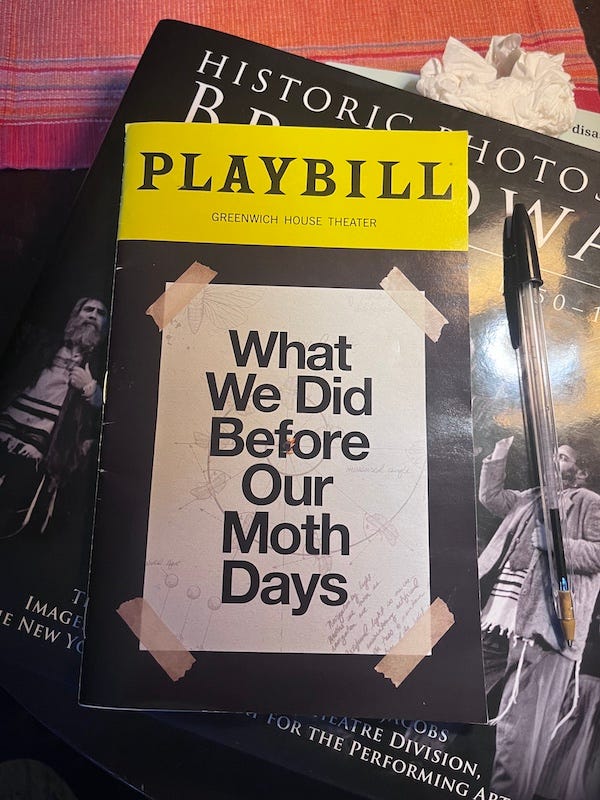
I have been revisiting theater history this week reading Historic Photos of Broadway: New York Theater, 1850-1970 by Leonard Jacobs, published in 2008. The book was given to me not long ago by my friend, Richard, a Broadway stage manager, when he saw me reading it at his house. (Lest I think he was being overly generous (or trying to dump a mediocre item), he told me that the year the book came out, two different people had gifted him a copy.) In photo after photo, you see old-time theater greats and photos of the theaters where they played, and the building narrative runs something like, “Built in 1926, demolished in 1936.” These stunning marble edifices, intricately carved, doodads all over, stunning interiors, painted ceilings (and you have to imagine the colors, as the photos are black and white)—each one gone inside of ten, twenty, or thirty years to make way for a concrete and glass office building.
So not only are the magnificent vessels of the performing arts built and demolished, when they were constructed at their height in the 1890s to the 1920s, America was both Gilded and also cultured; and then they all came down, the buildings and the people, in a crash with the Crash. Cue the wrecking balls.
The business of America is business. Really lousy business.
Page after page of these historic photos (along with captions heavy with dates and commentary, but oddly inconsistent in things like addresses or anecdotes), you see that only a few of these theater palaces survive and are still in use. “It was demolished.” And it got me wondering about the Western penchant for demolition—from Trump’s midnight teardown of White House East Wing and the coming teardown of The [Trump] Kennedy Center for the Performing Arts, to Israel’s U.S.-funded thermal bombing Gaza and the coming similar Israeli-U.S. treatment of Iran: what is it about Western culture that cannot bear the idea of anything as it is, taking its own time, whether it’s civilization or a meadow or The Morosco?
I think back to “It burned down.” With every innovation, from candles to gas lamps to limelight—theater owners saw money to be made by closing the roofs and playing both day and night; and with every chance of money to be made comes the risk of imminent destruction. Does this habit of money and tech rewire our brains? I think yes.
According to an article a friend sent me, the corporate-imposed use (by Microsoft and Google, etc.) of things like Copilot and ChatGPT and AI is also rewiring our brains to the point that very, very soon indeed humans will not be able to construct any original thought into a coherent sentence—even just the finishing of a text thought or correcting our spelling, via apps we didn’t ask for, is retraining us to rely on technology—demolishing us, as it were, to make way for data centers.
To what end? I ask this a lot.
All the nature, all the artistic work of architecture (as was), demolished by the Trumps of the world to make way for Towers in homage to themselves, wiping out what was, our history, our beauty, for ego. And we lose knowledge, too. Walking around Queens last weekend, my friend Cathy and I ran into our friends Lisa and Jodi, and Lisa remarked that something I once said about bricks got her paying attention to the way our many brick buildings are constructed. We pointed to the building across the street and showed Cathy. Here’s a photo to explain:
Note the running bond pattern is interrupted every five rows to place bricks turned the other direction. There’s a name for this, and I could look it up, and I used to know it, but you can find it if it interests you. It’s Sunday.
And I learned about this method of brick construction, done for stability, from my teacher friend Tommy many years ago. And from my friend Jim, who learned it from an architect friend, I learned that all the high-up doodads and sculptural features on fancy city buildings were created for the viewing pleasure of the people on the upper floors across the street. You know, with design and thought and attention to detail. I think about all these arts—carvings and mortar and bricks and marble and doodads in service to beauty as one enters a building devoted to other arts—and marvel at the cavalier attitude businessmen take to paying to demolish all this craft for the sake of a hideous concrete and glass tower to make money; I equally marvel that there are businesses devoted to doing this demolition without blinking. Money money.
Sitting on the 7 Train to and from Manhattan last evening (and the night return) to see a play, I was among the few people daydreaming or observing; everyone else was on their phones or listening to something in their earbuds, and I got to thinking about all the ways we are demolishing our innermost selves so someone we will never know can make a shit ton of money.
I never thought I’d see a performance of a new play written by Wallace Shawn and directed by Andre Gregory. Really involving. If you haven’t seen My Dinner with Andre, I recommend it. Like Shawn’s drama characters, Gregory talks about experiences and ideas, and people almost never talk about things like that anymore. When I eavesdrop, I mostly hear about meal services and TV shows people are streaming; consumption is our modern life.
One thing about this technology: I’m really glad that spellcheck often still misses “teh” and “aobut” for automated fixes. That will change. But I prefer to make my own corrections, and take my own daydream subway rides, and walk whenever possible to my destination—to feel that I still own my own mind, my own body, that I have a choice of experience and destiny. Until I, too, am demolished.
Sending love, somehow, on a Sunday morning from Queens,
Reflecting on the nearly ten years now since a dear teacher died
I’m writing an appreciation for a professor today, one who died in 2016, and whose life work was the elevation in adult minds of the worthiness of a child’s imagination. I started thinking of Michael Armstrong last night, without realizing it had been ten years, because I was remembering again how his work with children changed my own thinking about what gets lost as we “educate” our kids, to say nothing of how we are destroying all hope for their lives in America.
It’s what’s happening to the children in 2026 that is really killing me, the horrors of the kidnapping and no doubt sexual abuse and rape happening to brown children in American concentration camps at the hands of ICE. I know I’ve said this, but I finally realized that the reason Republicans never batted an eye as Sandy Hook was because as a party, I fear they do not see children as anything other than commodities, “resources” for war, toys for sex, punching bags, slaves for labor. It’s nothing I could ever have imagined until the Epstein Files. I think most of us still can’t. This evil simply should not be.
I’ve excerpted/edited for this post a letter I wrote to Michael’s widow, Isobel Armstrong, another of my favorite teachers at the Bread Load School of English (and the poetry scholar to whom A.S. Byatt’s novel Possession is dedicated; as of this writing, she’s still going strong in London at age 88). (Note: I’ve removed last names of friends, for example, but kept the spirit.) Writing appreciations is becoming a habit.
March 27, 2016, Easter Sunday
A bowl of magic stones from my travels.
Dear Isobel,
Of course I was just devastated to learn about Michael. And the first thing that I thought to do was to call Mark (who was kind enough to supply your email address last week), and then, of course, Anna (and we are sorry that we’ve lost touch with Ellen). Because that is Bread Loaf, isn’t it? Immediately reaching for community, to share the experience, seek out that support. And Michael was a searcher, a seeker—the finest model of teacher-as-learner I have met. The loss for you and your children is unimaginable, and no letter can assuage it, I know; but I wanted to share some memories with you and tell you something about Michael’s importance in my life.
First off: if I remember correctly my first summer at Bread Loaf, Michael came halfway into the term, co-teaching with or taking over a course for Jimmy Britton and Nancy Martin; and George had you for Romantic Poetry and was quite intimidated by you. So I think it was my first summer, 1990, that Alvin Kernan came to Bread Loaf to give the Elizabeth Drew Lecture on his book, The Death of Literature, to be published that same year. (Or it may have been the summer of ’91, after publication.) That lecture hit me and really got me thinking: Kernan was charming, a good speaker, and so sure of himself—his dismay at deconstruction, his perceived bastardization of the Canon, with a capital C, by the inclusion of women and minorities, etc. (as I heard him), had done, he said, irreparable damage to Literature, and now Academe was the lesser for it; nay, not lesser, but destroyed—something like that. I listened intently and then left and went directly to Jean’s room. She had skipped the lecture but let me recount it to her, and gradually I grew furious in my retelling, pacing, outraged, incensed. A day or so after, someone set up a panel discussion, pitting the traditionalists against the deconstructionists in Barn 5: Al Kernan, John Fleming, Walter Litz, Ed Lueders (who later confided to George, Jean, and me that really he wasn’t on any side) on one side (those are all I recall); and Michael, you, Dianne Sadoff, and others on the other side. People attended, but not as many as I thought should: And the moment I remember clearly, the one that completely transfixed me and corrected my self-doubt in the world of Bread Loaf was a moment when Kernan or Litz or Fleming explained that students were in school to learn an author’s intention in the text at hand, no more, no less (something like that), and this new teacher (to me) from Britain, Michael Armstrong, fairly flew across his desk and declared, angry to the point of spitting, “If YOU tell ME there’s only one way to read a text, I’m going to tell YOU to go to hell!” I was galvanized by this display of passion, especially given the self-satisfied air and calm of the Great White Men of Academe. You, Isobel, leaned in, putting a hand on Michael’s shoulder, and began in that arrestingly beautiful English voice of yours, “What Michael means, …”. I have to confess, in that moment I fell in love with the Armstrongs.
And yet I was afraid—you were both so fiercely intelligent, seeking, and knowledgeable, that I felt I needed to work up to you before taking your classes.
In the summer of 1992—when I decided to try Oxford because Anna, who was teaching at the American School in Turkey, was going there—I got to know Michael. Anna and Ellen were taking Michael’s class (I was studying Virginia Woolf with Jeri Johnson), and Michael was the only one of the professors who dined with us in Hall every morning. We four sat together, generally; one of the first mornings we did—diving into our toast, tea or coffee, and cereal—Michael caught my eye, and Anna’s, and Ellen’s, and declared in an “important” voice: “You know, jam is for the lower classes; marmalade is for the upper classes.” He paused significantly before demanding, “And by ALL MEANS pass the MARMALADE!” I collapsed with laughter. Michael showed only a little grin. Now I was less afraid, of course; and also, all summer, Anna and Ellen couldn’t stop talking about how much they were learning from him.
And so it was that the summer of 1993, I decided, would be my Armstrong Summer: I would take Michael’s class, Narrative and the Imagination (I think it was called) and your class, Women’s Writing from the Margins (or in my typical Malaprop-tinged description to Jean, who was also taking your course, “Women’s Writing ON the Margins”—sending Jean into a fit of laughter). My Malaprop-risk notwithstanding, it was perhaps the decision that saved my academic life: and now I have to tell you something rather personal, but it all connects to Michael in the end.
In the summer of 1993, I was in the midst of a profound depression—the worst of my life up to then, and even up to now, and suffice to say from a myriad of causes—and I really had no idea how I would get through my studies. I could not stop sleeping. Sometime in the second week, my roommate sat me down: “I know it’s not my business, but every time I come into the room you are sleeping….” She was right—and it was lucky I didn’t have a single room. As a result of this intervention, I made the decision to do all my reading, writing, and thinking outside my room—but it had to be in a PUBLIC area, so I didn’t nap. I chose the large Victorian sofa in front of the fireplace in Davison Library. I was there so often, in fact, that on seeing me enter through the door, people sitting on the sofa would get up! “No, no,” they would say when I begged them not to leave, “this is your office.” There was another “office” in the library—on the second floor, by a certain window: Michael’s. Everyone knew that was where Michael Armstrong sat to study and read all day long—a model scholar.
Michael Armstrong was awarded an endowed chair the summer of 1994, and I and other former students decorated his library desk (“so embarrassing”). We refused to take down the Ben Franklin Hardware Store frou-frou until he posed for a photograph by LO’H.
That summer, for some sadistic reason of his own, Michael assigned the class Paul Ricoeur’s Time and Narrative, all three volumes. I was utterly flummoxed by those texts. One afternoon, I heard loud footsteps flying down the library stairs, and turned to see Michael rushing toward my sofa-office: “Lisa! May I share something?” Please do! “I’ve just discovered something! I think I may have figured out something in Ricoeur!” He read a passage, and then he offered me his interpretation. I have no idea what passage it was, or what Michael said, or I said, but it was the shyness Michael showed that affected me; and I flashed back to the passionate man who announced to the most eminent Ivy League English scholars in America, “If YOU tell ME there’s only ONE way to read a text, I’m going to tell YOU to go to hell!” Michael was searching, too: He confessed later that summer that the only reason he’d assigned it was to try to figure it out. How wonderful is that? (I still dip into my Ricoeur volumes from time to time; I pick up a little more every year.) That connection, made almost daily, further incentivized me to keep to my sofa office and thus pass my courses.
The library sofa was a fortuitous choice for another reason: on Michael’s “reserve shelf” to the left of the fireplace sat John Berger’s A Fortunate Man, which Anna loved, and which Michael recommended to me. Despite all the other reading I had to do for both your classes (and not only was I a slow reader, but because of my intense 3-prep teaching schedule and three-shows-a-year life as a drama director, I could never get more than one and a half books read before the start of Bread Loaf), I read the entire book in a sitting on that sofa—one of the most marvelous reading experiences I’ve had, linking—so unexpectedly, but isn’t that Bread Loaf?—all the reading I was doing in both of your courses. A miracle.
And here is where I want to thank you both, Isobel: mine was not a dazzling intellect, as you know; and so, not being intellectually vain as a result, I was the person who happily opened every book talk. There is nothing more unnerving to me than a room full of silent students, so I said the first thing. (It was the astonishing students like Jean and Maggie who said the apt thing—the only thing worth hearing, but not until the end of class. Who has that kind of time?) You and Michael so very graciously indulged my need to start things off, however feebly, and never shamed me or made me feel foolish. I felt I was free to discover and to seek, and that summer of 1993 was perhaps the most fulfilling of my life as a student. Thank you so much for sharing your gifts.
A side note, Isobel: My friend, Hasan, who is a super in my neighborhood including part-time in my building here in Queens, New York City (where I’ve lived since 2003), just stopped by and shared a story that timed perfectly with this letter: He has been driving up to Poughkeepsie, NY, every night for the past three or four months, to visit his Albanian mother, who is dying, slowly, in a nursing home. He cannot bear the thought of her alone at night, and so he goes to sit beside her in her room, where he checks on her, or naps in a chair, or gives her a sip of water. They emigrated here (illegally, of course) from communist Yugoslavia back in the 1980s—it could be a movie. She speaks no English. Hasan, who is 62, is very sad, of course, and so tired. Last night, the floor nurse was being followed around by two little children—a niece and nephew, 3 and 4 years old, and of course they chatter, cheering Hasan very much. The little girl walked over to the bed of an old woman who shares the room with Hasan’s mother, and asked simply, “Why are you sick?” Hasan began chuckling. “Why are you sick?” she asked again. The old woman said, “I’m old. Too old. I don’t want to be here.” The little girl turned to her aunt, the nurse, who was trying to shoo her away, and said, “Why don’t you let her leave?” And Hasan began laughing, tears coming out of his eyes. “It hits you,” Hasan said, “like a cannon, right here,” pointing to his chest, “the way a child sees! And then the little girl, so cute my god, she said, ‘What do you eat? Where is your food?’ And she is accusing—you can tell—the girl look at her aunt, the nurse. And the nurse looked so guilty! Because this little girl sees this old woman is so sad. The old lady say, ‘How old are you?’ And the girl hold up some fingers. So sweet!” Hasan tells me this with tears in his eyes even as he laughs. “And I’m sitting there,” Hasan finishes, “thinking—cursing all the politicians of the world, wanting to give the White House to this little girl, let her clean up the world mess!”
And hearing this story, the first thing that came into my mind was Michael’s sharing of the stories of very young children. I thought instantly of “The Sparkling Star,” which I hadn’t thought of in years. I read the story to Hasan, and we teared up; so sweet. There is simply nothing like the unfiltered language of young children, and it was Michael who taught me to pay attention, to listen to children seriously when they speak and write.
THE SPARKLING STAR
One night I was in bed and I thought that it was a little bit hot. So I ran over to the window and opened it. In flew a star that was sparkling. I stood back and just looked. Then I started to stare very badly. Then the room went dark again and the room was the same. Because when the star flew in it just lit up the room. But now the star looked strange up against my spotty and stripy wallpaper. It was also multi-coloured, it had every colour of the rainbow. The star was glittering and sparkling worse than ever. It looked just like a very very precious jewel or diamond. I walked closer to the star. Suddenly it changed multi-coloured like my wallpaper. Then it started to flicker different colours. Now it blended in very very well. It looked like it was overheating. It flickered in time with saying Help Help Help. I thought it must be like a fish. Because a fish cannot go on land for a very long or it will die, and a star has to stay high in the sky. But if it is on the ground it will die. I was a little bit scared. But I closed my eyes and picked up the star and threw it out of the window.
(See also: THE MAGIC STONE in the same collection.)
I used “The Sparkling Star” in my teaching for years, had hundreds of copies…and of course, in the past two hours of scouring the two remaining boxes of my life in education—one from my 15 years in the classroom, and the other filled with bits of Bread Loaf—not one copy could I find, but I do have Michael’s book. I did find, believe it or not, notes I made from your fabulous Barn lecture on glass, in the summer of my senior summer of 1994—information that helped inform my final Chaucer paper, which I also discovered. Oh, dear.
One wonders why we keep such things, especially moving from place to place—and then we turn over the old stones and find out. Just now, I opened my inscribed copy of Michael’s Tolstoy on Education, in which he wrote: “Keep on finding & re-finding the magic stone. August 3, 1993”. Over twenty years ago: It hardly seems possible. I remember Michael reading “The Sparkling Star” at Gilmore that first summer—one of the best readings I heard there. And here I am trying to re-find that particular touchstone.
Anna and LO’H, our senior summer at Bread Loaf, 1994. The book’s title is an apt one. We still talk about Michael’s teaching. Really.
Isobel, please know how much Michael was loved, will always be loved, by every student whose life he touched. Please know how loved you are—and how the privilege of seeing your marriage, as well as your scholarship and teaching, was one of the joys of being on that mountain each summer.
Much, much love, and best wishes always,
Lisa O’Hara, Class of 1994
[End letter.]
Another memory, as a sort of coda: There was a professor I knew at Bread Loaf who had an air of self-importance that I found odd in that setting and more than a little silly. I was having lunch with several friends one day, including David Huddle. As this self-important professor walked past our table, one of my friends commented, “I just don’t like him; he thinks he’s the smartest boy in the room.” David instantly looked up. “Well, that’s ridiculous. Everyone knows the smartest person in any room is Michael Armstrong, who doesn’t know it himself.” So many reasons to love David.
The last time I saw Michael (and Isobel and David, too) was at Bread Loaf ca. 2005, on a visit, my last. He plunged into our reading lives. “Have you read Calvino’s Invisible Cities?” he asked. My eyes wide, I said, “Michael, I have, I bought it when I first moved to New York City!” Michael gave me that impish grin, “Of course you have,” he said. It felt like being anointed.
And here is hoping you, dear Reader, have good teachers and friends to appreciate in your lives, that you have the magic stone energy to promote the imaginations of children, the lives of children, and value all the good people. With thanks to all our teachers. Save the children.
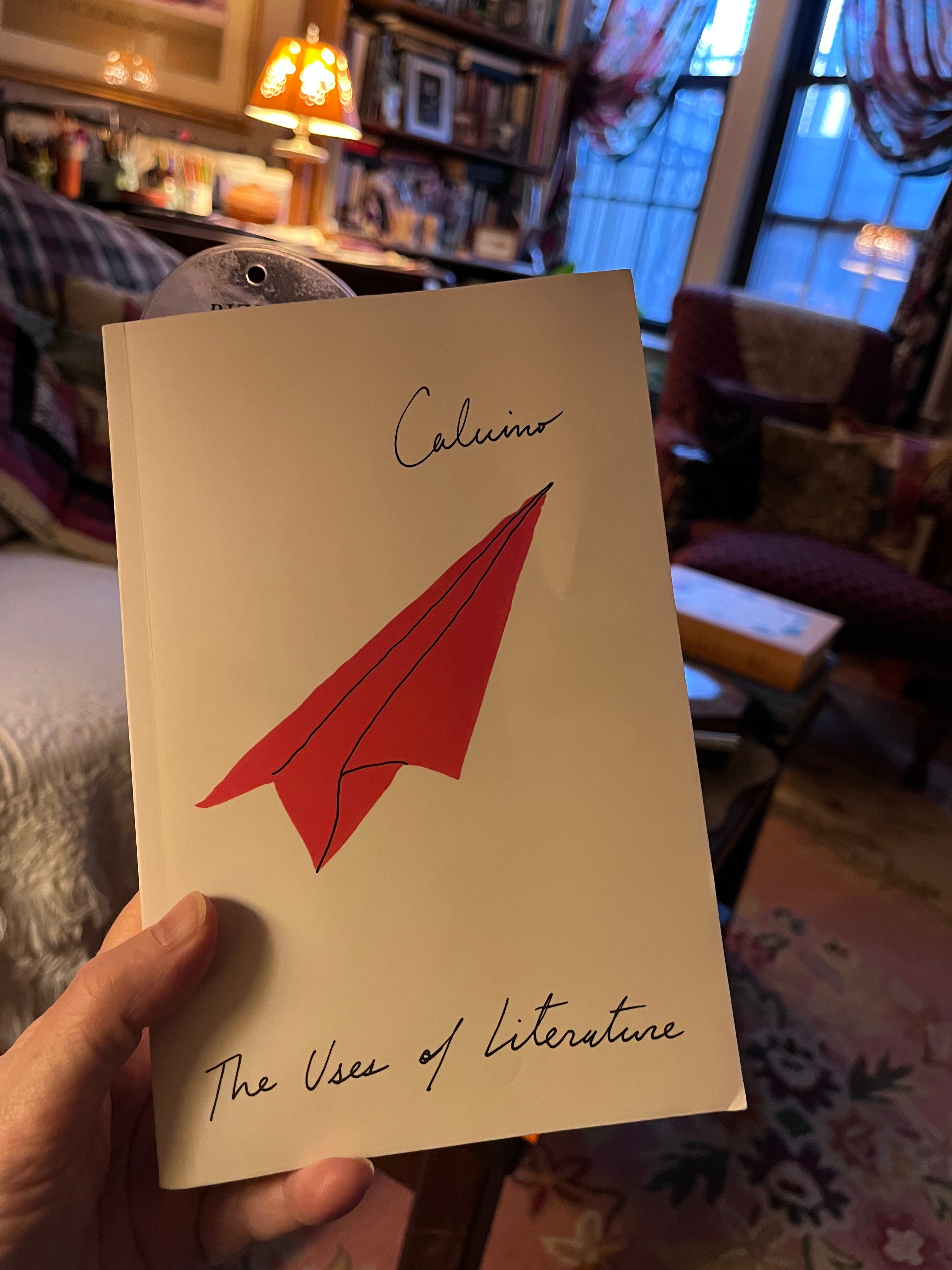
On this MLK Day in the year of our lord 2026, where only 16% of American adults read for pleasure and 40% of our nation’s children do not know how to read at all, not even their own notes from the board—it’s just symbols on a page to them—we really have to figure out a new world order. I’m thinking about reading today because my friend Steve just sent me The Uses of Literature, a collection of essays by Italo Calvino, ca. 1982, with a specific reference to part 2, “Why Read the Classics?”
Reason number 6: A classic is a book that hasn’t finished what it has to say.
Books are old friends, and we need our friends. With that in mind, I found myself shelf haunting (after a morning of chopping up ice and salting my co-op front sidewalk, followed by navigating lethal ice patches in two different directions for two sets of store runs—and those “ice” references can mean so many things now ) in my own library. Lots of associative tasks all around—ideas for little collages, fumbling into art materials I had no idea I even had, pulling out volumes to peruse. Interesting, luxurious really, to spend time off on a frigid day in a sick-ass national moment in memory of one of the best of us just letting my mind wander.
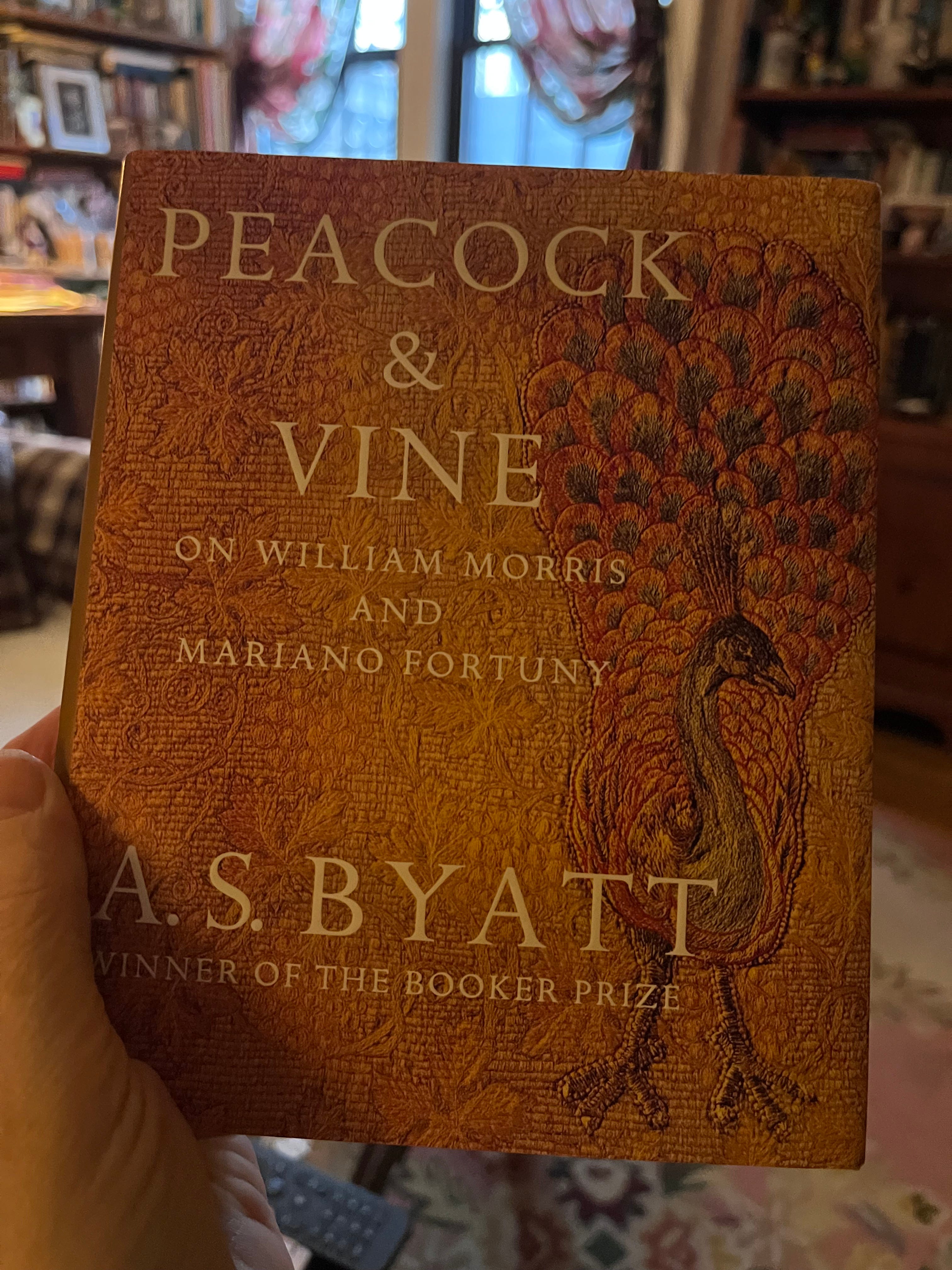
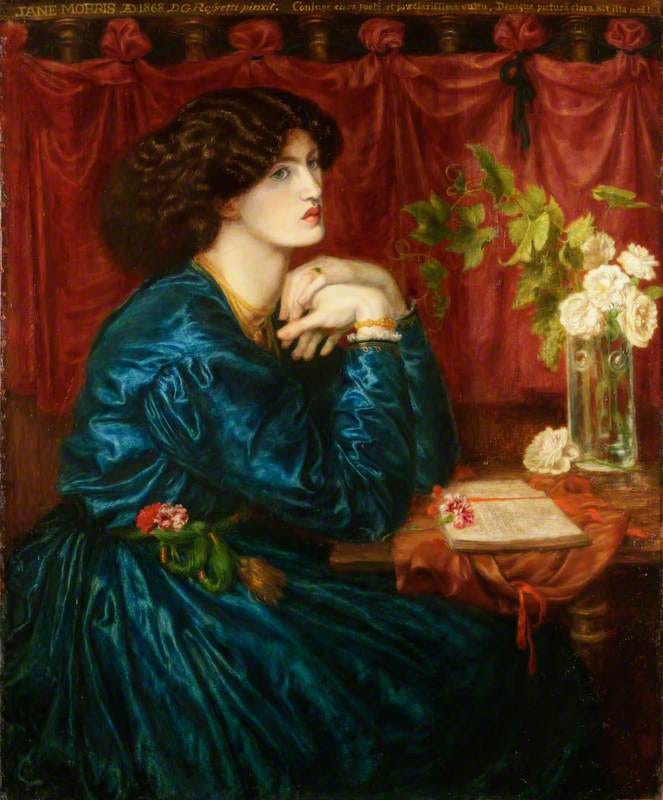
For example, I rediscovered this book, a gift from friend Tom Corbin in 2016—how is that ten years ago? This led me to learn more, again, about William Morris and his wife Jane Burden Morris, where I rediscovered a painting I used in an acting exercise ca. 1983, wherein I posed as and had to bring to life the character in the painting, as I felt her, and then participate in a class “interview” as this character. Harrowing.
Revisiting this painting (like a classic book, it’s never finished talking to us), I find I would like to hold this pose until 2029, but failing that dream, would like to suggest that we teach all our little ones to meditate in lieu of overstimulating them. I am so serious. Meditation and quiet, followed by reading, followed by walks in nature. Couldn’t school just be that for a few years? Starting now? Life is precious. Time is short. Quiet is a gift. I mean, look at her.
Sending love, quickly, because I have reading to do before the day is done, and one more walk in me, too.
A letter of gratitude for my friend and writing teacher
In July of 1991, writing professor David Huddle brought recently-published Allen Barnett to the campus of the Bread Loaf School of English, where I was a graduate student in my second summer. In 1990, Barnett’s debut collection of fiction, The Body and Its Dangers and Other Stories, was a critical smash; but a year later, Barnett was dying of complications from AIDS, a disease that features in his stories. David Huddle, a popular professor who taught the courses American Short Story and Fiction Writing, hosted an evening in the Burgess Meredith Theater on campus so that we all might hear Barnett read from his book.
The brown suit Allen Barnett wore, I remember, dwarfed his fragile body; as he took to the lectern, he said sincerely into the microphone, “I hope I don’t die while doing this.” He was not being histrionic; he would be dead in less than a month upon returning to New York City. I found the story he chose to read, “Snapshot,” devastating, and his reading was just beautiful. I still hear it in my mind. What struck me as much as Allen’s reading was the gravity, kindness, care, and sincere admiration that David showed in his introduction of Allen, his enthusiastically urging us to buy the book, and the way he showed Allen around the campus, that tender care at a time when AIDS freaked out many Americans.
The day following the reading, I found myself in Barn 5 (we literally had our classes in rooms annexed to a barn, and it was great), a basement area where there was a special seminar going on about literary theory, or something related. I’d sat in a desk in the back, the old-fashioned kind, ca. 1970, for the kids out there:
Professor Huddle and Mr. Barnett walked in, David guiding Allen’s elbow, and took desks right in front of mine. I leaned in, “Mr. Barnett, I want to tell you how much I loved your reading.” And David Huddle, a professor my grad school friend George had had for American Short Story in 1990, and now Jean had for Fiction Writing, whipped his head around and said, “Where did you get that accent?” A lifetime of living in Virginia even with parents from Iowa had given me some Southern.
“Yes,” Allen Barnett said, turning painfully, carefully to look at me, “where did you get your accent?”
“I’m from Virginia,” I explained.
David said, “I’m from Wythe County,” and I said I’d gone to Virginia Tech (also in Southwest Virginia), and taught in Appomattox. It was old home week. I know I said words, and heard some other words from Allen and David, but I was just astonished to be chatting with them, as if we all sort of knew each other.
That evening, I took up a yellow legal pad and I wrote a poem/letter to Allen Barnett, so clearly dying, to tell him what his story had meant to me, and even more than that, the fact that he took an interest in my accent of all things. Unwritten was, “and you are dying; how could you spend that kind of time on me?” I put the poem/letter in an envelope, with Allen’s name on it, and wrapped it in another note for David. “Mr. Huddle,” I wrote, explaining in some way or another that I wrote this letter to Mr. Barnett, and could he send it to him if he thought it was something to bother him with; and if not, just toss it.
The following Thursday evening was the weekly bonfire at Gilmore, a men’s dorm a half mile into the Green Mountains, one of the summer resort cabins that Joseph Battell willed to Middlebury back in 1920, causing the Battell-named “Bread Loaf Mountain” to become a century long (and counting) graduate English program for teachers as well as a famous Writer’s Conference. So on Thursdays, walking in the dark along the dirt road to Gilmore, you could hear the students and faculty gathering to pour a beer, sit outside, and stare into a fire (Vermont always has cool evenings) as a member of the faculty read a favorite story. It was sublime. That particular evening, still deeply sad about Allen’s fate, I sat by myself by the fire. Soon, David came over and knelt beside me. “I sent Allen your poem,” he said. I nodded. We held the space together for a few minutes, looking into the fire, and then David quietly got up and walked to greet others. I can’t remember if I learned from David when Allen died, two weeks later, but I don’t think I did.
But those few moments in a classroom and by the fire formed and sealed my mystical friendship with David Huddle forever. We never had long conversations, never spent long stretches of time together. One summer, he suggested that he, George, Jean, and I have pizza together, and thus began a tradition for us, once a summer for three or four summers, David would crank Steve Earle as he drove us into Middlebury down Rt 125 to Rt 7. I know he didn’t do that with anybody else, and we all knew not to tell anyone. It was our thing.
In the summer of ’93, my penultimate summer, I saw David at the annual summer cocktail party on the porch of Treman, a guest dorm with a kitchen that also served as an evening faculty hangout for The Eleven O’Clock Club, a legendary gathering of wits, to which I was never invited. The cocktail tradition was a rolling invitation list over the weeks, where one “dressed up,” and faculty and students could hobnob over alcohol. David, in his summer suit, walked over to me on the porch with his gin and tonic; I (a nondrinker at the time, I enjoyed a tonic water and lime, but who’s to know?) in my purple summer dress greeted him. He asked about my plans for my last summer. The rumor was John Fleming was coming up from Princeton one last time to teach Chaucer, and I needed that era of literature to graduate.
David asked, “Are you going to take my fiction workshop?” All these summers, it never even occurred to me to take a class with David. “Oh, no, David,” who always signed his most recent books for me, calling me “my sister Virginia” once. I explained that I wasn’t a writer but a drama director, George and Jean were the writers, that sort of thing. David looked tauntingly over his drink and said in his best kewpie doll voice, “Is the baby afwaid to take my workshop?” I glared at him. “Fuck you,” I said, “I’m taking your workshop.” He grinned. “Good,” he said, and sipped.
Bless that son of a bitch. Best decision I could have made. That last summer I took my two most challenging courses, challenging myself in ways I really hadn’t before, and David’s steady encouragement gave me the confidence to do it—that’s a longer story for another time.
My favorite greeting question of his, and I remember him once asking me this on his way to the tennis courts across from the library (not the best location), “How is your writing life?” David treated his students like fellow artists, and though I couldn’t be that, it helped me feel belonging.
David and I formally decided to have lunch together one day in the dining hall, and just as we’d sat down to talk, we were joined by another workshop student, a private school teacher (now the head of one of the most prestigious boys prep schools in the country) and a graduate of University of Virginia, like David. Tanned and dashing in his polo shirt, the fellow said, “May I join you?” and sat down without waiting for an answer. He immediately began schmoozing, complimenting David on a poetry reading he’d given with the likes of Donald Hall and others. David met my eye, which invisibly rolled, and I smiled; we shared this trap but it was David who was truly caught. My grin said, “You are on your own.” David’s gaze said, “I hate you.” Now that is love.
I believe that was the only time in four summers on the mountain that David Huddle and I ever tried to hang out, and it was not meant to be. David told George, Jean, and me that final summer, when they attended my graduation, that we would lose touch, as David said he never kept up with Bread Loafers. But he’d never reckoned with us. Over the years, I sent letters and cards to him, and he sent letters and poems in progress to me, to all three of us. Facebook later became the repository of greetings. George and Jean, who had married, remained in closer contact with David than I had, even visiting him in the hospital in Burlington as he was dying, complications of dementia. I knew something was wrong a few years ago when suddenly David left Facebook, where he had actively posted bird photos, shared poetry, including his own latest publications and readings, and boasted on his family. The onset must have been swift, is all I can say. Such a loss for his wife, daughters, and grandchildren, and a great loss too to his friends, readers, and fellow writers.
So I’m sharing this today because I finally found David’s obituary—he died in October; the obituary wasn’t published until November, and by then life happened and I didn’t search. George had let me know when he’d heard. I don’t know what made me think about David today, to decide I needed to write about him; coincidentally I got a brochure in the mail for the Bread Loaf Writer’s Conference just as I started typing this. Something in the air, I guess.
David’s poems, short stories, and novels are still in print. He’s one of those so-called “minor writers,” which is sort of ridiculous because his work is wonderful, and you realize these tiers, these hierarchies, are silly. What is better than David’s “ABC” from Story of a Million Years? What’s more moving and beautiful than Allen Barnett’s “Snapshot”? There’s so much wonder to find in the world, so many encounters that teach us about ourselves, that moor us in the most turbulent of times, you have to know it all counts big, however small or quiet.
Hoping you find any consolation you need for yourself today, that you might take a moment to think about the teachers in your life. Bless them.
P.S. I loved to show friends this author photo. “Here’s why I took his workshop,” I’d say. David would have choked, catching my eye. I will always miss him.
O, I have suffered With those that I saw suffer. (Miranda, The Tempest, Act I Scene 2)
I read this week that the tech bruhs, so called in current parlance, see the world as being divided into two classes of people: the thinkers and the scrollers. While they, the Thinking Class, devote themselves to higher learning, philosophy, and deep work, affording the same wealth of life experience and cashflow to their offspring, they themselves are engineering the planet so that the rest of us, by which I gather they mean the 99% and our offspring, are relegated to the Scrolling Class, those who work as drones and merely consume whatever they, the Thinkers, put out for profit.
It’s all very Brave New World, a novel I read in high school and can’t shake. Will you be made into an Alpha or an Epsilon? Will you even know? And even if you are an Alpha, watch out if you forget to take your soma (“the opiate of the masses” that replaces religion) and have an original thought. All hell will break loose, and the only antidote is a rebel copy of Shakespeare.
My library was dukedom large enough. (Prospero, The Tempest, Act 1 Scene 2)
This week the Trump Administration, illegally as usual, dismantled the U.S. Department of Education, spreading all the allocated funds around (which legally only Congress can do, but Republicans) to different departments, so K-12 education is now under the U.S. Department of Labor. Huh? In a seemingly unrelated development, the Trump Administration also demoted a bunch of educational degrees to “nonprofessional,” meaning people pursuing nursing, say, or teaching, will not be able to take out unlimited loans to attain a degree. Not only were the listed degrees for women-dominated professions, the professions listed were those whose members are legally bound to report suspected child abuse. If no one is educated to take those jobs…
Are you following? The Pedo-in-Chief is terrified of the release of the Epstein Files, and his Secretary of Education, Linda McMahon, whose husband Vince McMahon was set to go on trial amid accusations of child sexual abuse until a Chicago judge paused the case last December when Linda was announced as Trump’s pick for her new position. Meanwhile, Trump’s former “spiritual advisor” was arrested for child rape and plead guilty. In a call-in show I heard a snippet of this week, a caller demanded to know what was “wrong” about child rape.
The cumulative effect of all this during a single week has made me a bit of an emotional wreck, but it was an independent journalist on Instagram who formally linked all these pieces for me. From Love Ethic Yoga:
Moving K-12 education to the Department of Labor while red states are removing child labor laws & dropping the age of consent to 12 or 14 is a calculated move. The leaders of these departments are pedo📁files or pedo apologists. This is NOT coincidence.
Uneducated children are easy prey. Hungry children are easy prey. Homeless children are easy prey. Unaccompanied minors are easy prey.
These predators are baiting the water. They’re creating the proverbial “fish in a barrel”. Yes, privatization is part of this but we cannot forget how many pedos are in this current admin. We cannot let them get away with this.
I got ill—I mean, Trump and his people are transparently, openly constructing a world where child sexual abuse is normalized, institutionalized, and unstoppable. These “men” want all young women and girls (40% of whom between the ages of 15-44 want to leave the United States, I saw in a recent poll) under their complete control in order to force-breed children, for either labor on behalf of or the sexual pleasure of (white Christian) men. Once the children “age out,” a term I learned on Law and Order: SVU, they will be, one presumes, forced to push through their trauma with slave labor, living in one of the concentration camps being constructed all over the United States.
Utah’s planned mega-shelter should be like a jail for homeless people, one widely embraced group says
This is the Brave New United States of America, friends.
It’s more than hard to take—it’s impossible. This insanity has to stop. We need to see handcuffs and prison bars on the right people, and soon. We know this.
I can’t take in everything—you can’t either. So while I know there’s Israel’s defiance of the ceasefire, and Russia’s wish-list labeled a “peace agreement” by Trump and Rubio (rejected, thank goodness) by Zelensky; protests in Charlotte and Raleigh over ICE raids; so much, so much, my god, it was the children and their protectors I focused on, “offloading” the rest, more or less.
This week on a work Zoom call, a colleague mentioned that there is always work or training or something that we simply have to “offload.” It’s not a term I knew—but I got it. You just pass that conceptual understanding to someone, maybe a spouse who gets plumbing or a coworker who is good at Excel, and you don’t worry about trying to learn that thing, much less master it. You only have the capacity for so much, and recognizing that is not a bad thing. (That said, we all have to trust in our capacity to learn new things, and try to do that, even though in my early 60s I’m finding that I have to immerse myself with the focus of a monk to his devotions to do something as complex and unintuitive as Jira (if you don’t know, don’t ask), say, but it’s reassuring to know that I can still do it, if more painstakingly.)
Speaking of offloading: I no longer have a creative life in the recognizable sense. I’m sorry about it, but between taking care of family, holding grief, learning new things on the job, and this fucking administration’s atrocities, I had to let something go, and that was it—and it’s no great loss to the world, obviously. That out of the way, I’d like to celebrate the achievements of women artists whom I know as friends. In a world, and more specifically a nation, that doesn’t value women, children, innocence, creativity, or truth, here’s some art you need.
Read Amanda Quaid’s debut poetry collection No Obvious Distress, which explores her (still) young life with Stage IV metastatic mesenchymal chondrosarcoma (learning the pronunciation of which seems to be more trouble from some people than her years of treatment, so say the name) in all the ways;
Read Anna Citrino’s fourth collection, Stories We Didn’t Tell, which explores the unspeakable hardships and abuses of her American prairie women ancestors, based on the poet’s decades of research, in rich language;
Watch Patricia E. Gillespie’s documentary, The Secrets We Bury, which I saw at IFC here in New York in its premiere screening this week, about a true crime, told with love and empathy and not sensationalism;
Listen to Patti Smith’s Horses (1975). (Envy me my Row X seat at The Beacon Theater on Broadway Friday night in New York City to see Patti Smith and her Band play the shit out of Horses in its 50th Anniversary Year, plus encores of classics. Patti also spat, twice, and it was glorious.)
So lest you think Miss O’ has given up on art, I haven’t, and I hope you haven’t either. There is nothing on this earth as satisfying as a creative act, something you can point to and say, “I made that.” There was nothing, and now there’s something, and I did it. And the world is more colorful and right and full than it was before you created that thing, however small, even making a smile happen on a stranger’s face in a notebook store, which I did on Friday night before the concert. I did that. That thing, there? You did that. Not AI, not engineered by some tech bruh, or ordered on you by some basement-dwelling podcaster or a bottom feeder in Washington. You. Just you.
Let’s stop scrolling together and get seriously radical in creative community. Take a moment to read. To be quiet. And then connect.
Here’s Mr. Rogers on the value silence from Charlie Rose, which is a clip I hope you watch. “My, it’s a noisy world,” he says, and it is. There’s more he goes on to say from his 1994 book, You Are Special, including about his professor, Dr. William Orr, who told him, “You know Fred, there is one thing that evil cannot stand, and that is forgiveness.” Take a minute with that. As a reader, Rogers says that the white spaces between the paragraphs are more important than the text, by which he means that if you aren’t using silence to reflect on what you are reading, you are missing the point of the endeavor. You can see more clips of Fred Rogers here. “A great gift an adult can give to a child is to let the child see what you love in front of them.” Whether it’s car repair, lawn maintenance, playing cello, fixing things, reading, singing, cooking, telling stories, dancing, whatever it is (note: what you love, not what you exploit)—that is the gift. I think I try to do that in life—to show love of life in greeting others. It’s tiny—I’m not a worldwide creative power like Patti Smith—but really it’s about being present, as Rogers says, moment to moment (and it’s the most important work in rehearsing a show, as shown me by director Maureen Shea). Doing things even a little larger than ourselves, then, in presence, is the point. Mr. Rogers only cared to be recognized if it made a child feel special—Fred Rogers liked “not the fancy people,” but regular people, and he aspired to “be the best receiver I can ever be—graceful receiving of what someone gives us; we’ve given that person a wonderful gift.”
Miss O’ most gracefully received.
The play I’ve been quoting here interstitially, The Tempest, is my favorite Shakespeare play; in some ways it’s like a compilation reel of all his best ideas, and his final play and only original plot, his retirement play. I’ve seen four productions of it—at the Globe in London, with Vanessa Redgrave as Prospero (it was awful); at the Shakespeare Theater in Washington, D.C., directed by Garland Wright, which still ranks as the top theater experience of my life (even after seeing Hamilton and Gypsy with Patti LuPone); one at Classic Stage Company downtown, with Mandy Patinkin (okay); and the fourth at St. Ann’s Warehouse, an all-women cast set in a women’s prison, directed by Phyllida Lloyd, with Harriet Walter as Prospero (fantastic). The most famous speech of the play, by Prospero, comes in Act IV, and I always think of it when eras end, as well as even a simple good thing, and especially a life:
Our revels now are ended. These our actors, As I foretold you, were all spirits and Are melted into air, into thin air; And, like the baseless fabric of this vision, The cloud-capp’d towers, the gorgeous palaces, The solemn temples, the great globe itself, Yea, all which it inherit, shall dissolve, And, like this insubstantial pageant faded, Leave not a rack behind. We are such stuff As dreams are made on: and our little life Is rounded with a sleep. (Prospero, The Tempest, Act 4 Scene 1)
In the final act of the play, Prospero’s daughter newly in love sees all the possibility of life, and this is from where Aldous Huxley took his dystopian novel’s title:
O, wonder! How many goodly creatures are there here! How beauteous mankind is! O brave new world, That has such people in’t. (Miranda, The Tempest, Act 5, Scene 1)
Sure, love is wildly naive, but it’s the beginning of everything. There’s a new world to be made. Let’s stop the fucking fuckers and do that.
Sending love, philosophy, music, poetry, creativity, all the good church,
Miss O’
The People Have the Power: Patti Smith and her band, The Beacon Theater, NYC, 11/21/25, the 50th Anniversary of Horses. Photo by LO”H. This was church.