The Power of Our Myths

Waxing a little philosophical in the heat

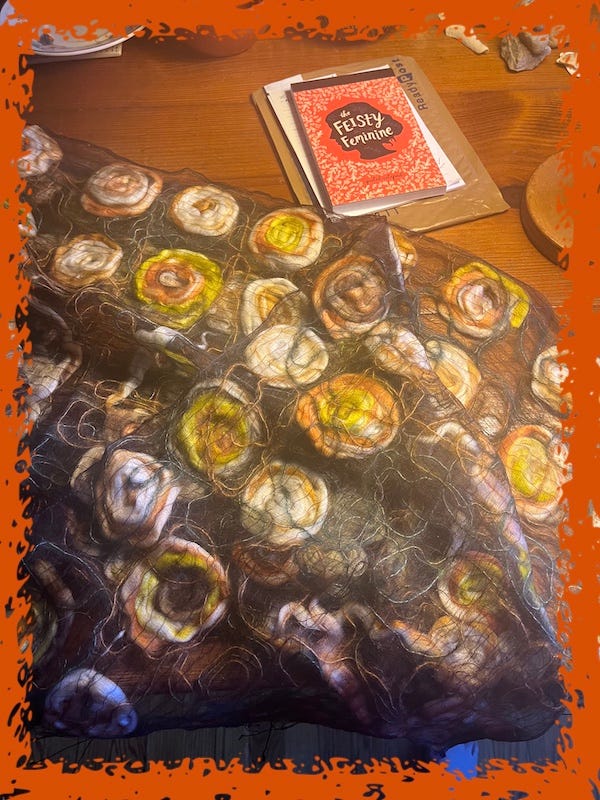
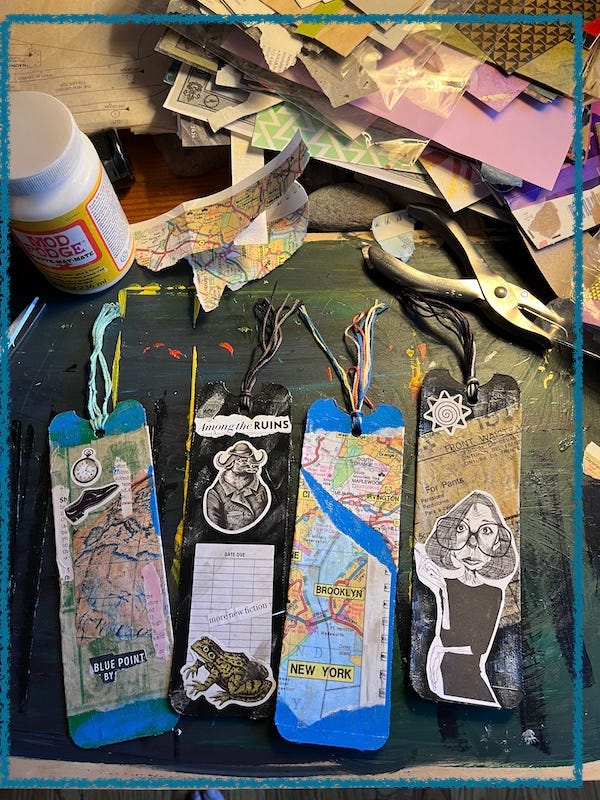
This morning being cool-ish and tolerable after last night’s storms over New York City, I walked to the farmer’s market early, picked up a few things at the grocery store, came home and make hummus and tabouli with the fruits of my purchases, and sat down at the ol’ desk to do a little art—the past few months, I’ve taken to making bookmarks using Kleenex box pull tabs as a base. It takes a while to gather materials, so no rush. Did I tell you this already?

Bookmarks by LO’H, 2026.

While working on those last two up there, I turned on PBS, where I found a rebroadcast of Bill Moyers’s wonderful 1988 series, The Power of Myth, with Joseph Campbell. I came in where Campbell is explaining that the desire of our lives is not meaning, or shouldn’t be, but rather “the experience of being alive,” and that this is the source of myth, “that which cannot be named”—“some call it God.”

I’ve been thinking a lot about something a content creator (there’s a weird title) said recently, that humans have a need to make, to create, and not merely to consume—we need to feel alive—and this connects to Joseph Campbell, too. (I think this is why, for example, we march when we feel helpless after consuming all that independent news content—and why we build cathedrals and temples and even office buildings, when we aren’t crafting little bookmarks—we have to make to feel alive.)

Campbell talked, too, about our Western trap of living in dichotomies:

Good and evil

Male and female

Being and nonbeing

Right and wrong

Dead and alive

Knowledge and ignorance

To which one might add…

Republicans and Democrats

Patriots and Fascists

The Old Man and The Sea

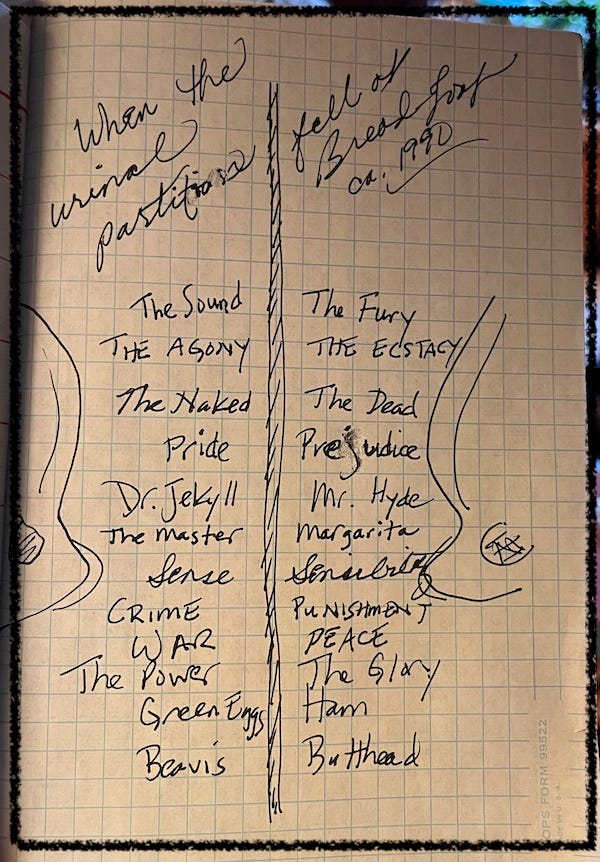
I told you about that fallen urinal divider at Bread Loaf, the Writer’s Conference and School of English in Vermont—some literary type started a trend that others followed, with a situation that looked something like this:

Author’s rendering from limited memory; my male friend who told me about it realized that the game had devolved past help with that last one.

Dualities—we love them in our literary titles as much as in our myths.

Man, Campbell points out, is “in the field of time”—good and evil are temporal (and some of us would like to move our awful times along already, but it doesn’t work that way), but our mythology is rooted in this duality—it’s ethical at its base, sin and atonement, right and wrong (the word versus apparently lives in our marrow); it all begins with us humans as creatures: god and man start out the same; man and woman eat of the tree of knowledge; god becomes God, and man and nature then become opposed, man and woman are opposed, God is against man—all this against-ness; we are not in accord: we fight with nature, we fight amongst ourselves (Christianity, Judaism, and Islam)—all of ourselves is corrupt; nature is corrupt—this myth of opposition has determined all of our Western civilization. (There is something to sit with.)

This oppositional view of being alive on earth, Campbell notes, is counter to all the Eastern religions (Hinduism, Buddhism), as well as to Native American religions, to take only a few examples. In Japan, for instance, there’s no idea of “a fall of man”—natural impulses are not to be defeated or fought but only acknowledged (at best) or sublimated (when hurtful or not useful).

We have only to look around America in 2026 to see where opposition as a lifestyle has gotten us. That’s all I could think as I tore up a map, opened the Mod Podge, took a paint brush, and started one more bookmark collage.

This life in the West, Campbell says, “is an opera”—we all choose the roles we play in it; and that this life is, in reality, our eternity; if you don’t get it here—“it” being whatever experience you will have as a being—you won’t get it anywhere; this life is a poem, our acts and adventures; a poem connotes something transcendent.

We have to acknowledge that this life is our only shot. Then what would mankind do? Imagine.

As Moyers questioned the validity of faith, Campbell insisted that every mythology and every religion is true—but don’t let it “get stuck in the metaphor”: Jesus didn’t physically ascend to heaven, he went into the heart, and to read that story in any other way is to get stuck in prose instead of transcending through poetry, Campbell says, getting caught in “denotation instead of connotation”—poetry gets past the concept of “reality”—it’s about connection.

And in the United States, we Americans have lost our connection, our mythology, and so, our moorings. I think this is why The Odyssey (which I still haven’t seen, but my classicist brother, Mike, went today and called it “good stuff”) is currently capturing the national imagination. We’re starving for a solid mythology.

Campbell, a true teacher and lover of learning and travel and discovery, says we are all manifestations of Buddha consciousness—the Gospel of Thomas (deliberately excised from the original Bible) says this, too— that we find the Jesus inside ourselves; heaven and hell are within ourselves; and the Upanishads said this in India, centuries ago—there are energies within us, in conflict with one another—brain wants one thing, heart another, intestines demanding attention. There are oppositions enough inside each human without adding oppositions to one another and to the earth.

At one point, Moyers talked about how Conservatives (and this was filmed during the end of Reagan’s presidency, remember) were demanding a return to old time religion, “a fixed star,” Moyers calls it; but times have changed—science and medicine changed the myths, and the moral order, Campbell says, must catch up with the moral necessities. There is no going back. What I heard is that we can’t let go, let God, but instead we have to look at the actual crisis of the climate that we humans are creating, for example, and solve for that. We live on a big planet now, and we can’t pretend we don’t: for most of human existence, most human centers around the world were unknown to one another—the Egyptians didn’t know about Aztecs—so of course, the more we learn, the more we affect one another, the more we change. We have to change.

The three religions—Judaism, Christianity, and Islam—fight because they “won’t give up the metaphor” and accept the need to find the truth, and to separate that metaphor from what Campbell calls “the temporal inflection,” our reality. Campbell notes that new metaphors are needed—Star Wars, for example, (kin to The Odyssey before it, with the focus on the father and the son, the hero’s quest and a people’s future) addresses the big question, Is the machine going to crush humanity or serve humanity? Darth Vader, more machine than man, is playing a state role, Campbell says, not a human role—when unmasked by his son, he is revealed to be a worm, really, unformed, malformed, no longer recognizable or powerful. We need metaphors to access truth—not to cling to a metaphor (Vader as machine of the state) for its own sake.

So I think we have to ask, today: Are corporations serving us, or are we serving them?

Machines are our new mythology, and there’s no turning back. Campbell and Moyers talk about President Eisenhower visiting a room-sized early computer. Eisenhower asked the computer, “Is there a God?” After a few minutes of lots of noise and beeping, a slip of paper printed out: “Now there is.”

The creation of computers, Campbell acknowledges, is astonishing, but there is “a determined code,” one we make. He finds a metaphor here: each religion is a kind of software—but a lot of codes won’t talk to each other. We have to talk to each other.

Our new mythology, whatever it is, has to incorporate the machine—not act the other way around, where the machine incorporates us. But as Campbell points out, while the world is changing too fast to have myths, still we can’t survive without them. This leaves all the work to the individual. And the artist.

Above all, myths serve “a pedagogical function”—they teach each of us how to live a life as a human. Watching this show again, I (a former teacher) was reminded how desperately we need teachers. At The Butcher Block this morning, I saw a New York Post headline that infuriated me—telling the Teacher’s Union that they had no business asking for raises when the kids can’t “reed.” And I was telling my friendly cashier what I did for a living and why headlines like that enrage me—that the problem is the goddamned technology forced on all of us by Big Tech, that all the studies show kids learn best with print books, pen, and paper; reading on screen affords almost zero comprehension—but Zuckerberg forbid we listen to actual reading experts.

We have a whole culture that attacks the educated, attacks the experts—Dr. Fauci is but the latest and most absurd example (the grandstanding Sen. Rand Paul (R-KY) not bothering to show up for the “contempt of Congress” vote he forced, his big show of knowing stupidity being over). Interestingly, we know this sort of thing happens because the ignorant are not only not curious, they are terrified of what they don’t know. Yet I have to point out, these same folks ironically embrace a fairy story in a book from 2,000 years ago, set in a totally different landscape and time, featuring no real technology beyond basic tools, ink and parchment, and the wheel, and call it reality. They say they hate being told what to do (wear a mask, distance socially), while demanding all of us follow their Ten Commandments, even as they all defy the very Commandments they say they revere—comfortable with molesting children, abusing wives, committing adultery, being greedy; to say nothing of the stuff in the red letters, like throwing those stones. How does anyone keep up with this?

I really like how Monte Mader explains about the myth that AI, that there really is no such thing as “artificial intelligence,” but only “human made intelligence,” fed into machines of human design (for corporate profit). As you saw if you watched the video, that is what true desecration looks like—the rape of our sources of knowledge, spine by spine, and tossed and lost forever like so much trash by Big Tech. And to what end?

Mythology—its creation and keeping—now is the job of artists—Campbell points out writers such as Joyce and Mann, artists such as Klee and Picasso, not a woman or non-European named, or anyone more recent than early 20th century, but you see the idea. And I was telling my dad, Bernie, only this very morning that I was thinking about how grateful I was that he and my mom Lynne were always creating—whether it was growing spring vegetable seedlings collected in containers set on a card table in the little upstairs living room at the bay window; or going to the nursery to buy shrubs for the yard; or building our toy boxes out of orange crates from his job at Safeway; or Mom making decoupage plaques and footstools for household art, and creating our Halloween costumes by hand; or even their cooking our meals from scratch, and me baking cookies—we were surrounded by making, always. And out of our making, we O’s became.

Thanks, internet.

Keep making and telling your stories, Americans. Make us US.

Sending love among the ruins,

Miss O’

Stories We Just Don’t Recall (till a poet shows you)

Disappointment and despair, everything secret
I believed I could never tell anyone, were single threads

in the prairie’s great cloak of grass and sky.

from “Standing in the Middle of a Great Field,” Cheyenne, Wyoming, 1983, Adah, age 94 (from Stories We Didn’t Tell by Anna Citrino, p. 238)

It’s always a surprise what hearing poetry gets you thinking about.

My mom, Lynne, died on Thursday evening, June 5, 2025, and Friday was all about the mortuary and paperwork. Saturday morning, around 4:00 AM, my sister and I found ourselves up at that witching hour with our dad, sitting in a small darkened living room, rocking in our respective chairs or sitting quietly, with coffee, when Dad suddenly blurted out all the traumas of Lynne’s childhood, traumas we knew nothing about, including the entire year, when Lynne was maybe seven, that her mom lived and worked in Omaha without even communicating with her daughter, who’d had to live with relatives. Bernie is crying, sobbing, for the pain this caused his beloved wife. My sister and I looked at each other, same thought, and I say, “Dad, was Grandma pregnant?” A divorced woman with child, especially with a daughter in Catholic school, would have been carrying more sins than any confessional could bear.

Dad looked at me, at us, uncomprehending. It’s funny what a woman understands, or is quick to suspect, things that a man wouldn’t even consider. In the end, we will never know, and my poor mom was abandoned by her mother and ignored by her father, who was quite possibly overseas in WWII at the time. That pain could never be made right.

Does it matter enough
that, if you could have the dead back

for an hour, these would be the questions
you would ask?


~ from “Our Family Tree and Other Myths” (from the collection of the same name by Jean LeBlanc, p. 37)

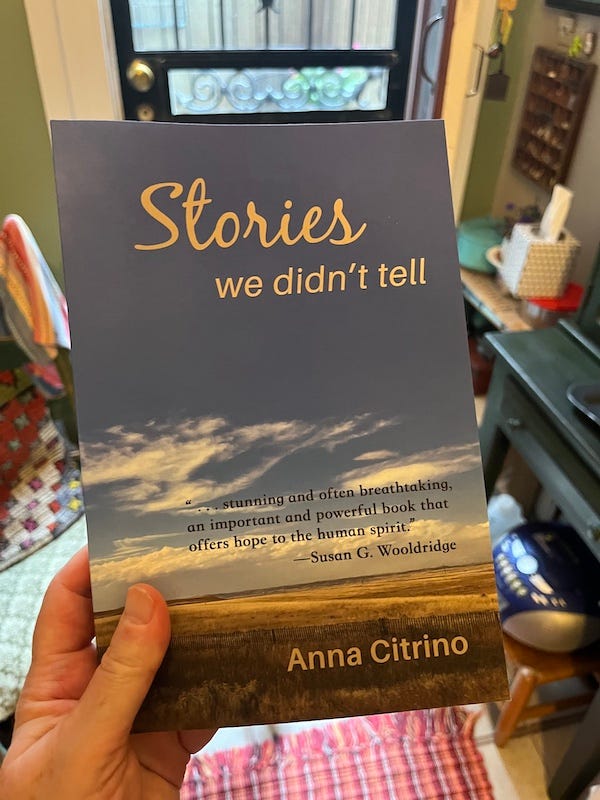
This event from last year rose in my chest as I listened to my poet friends Jean LeBlanc and Anna Citrino read from their latest collections via a Zoom event this evening, both poets published by Shanti Arts: Our Family Tree and Other Myths and Stories We Didn’t Tell.

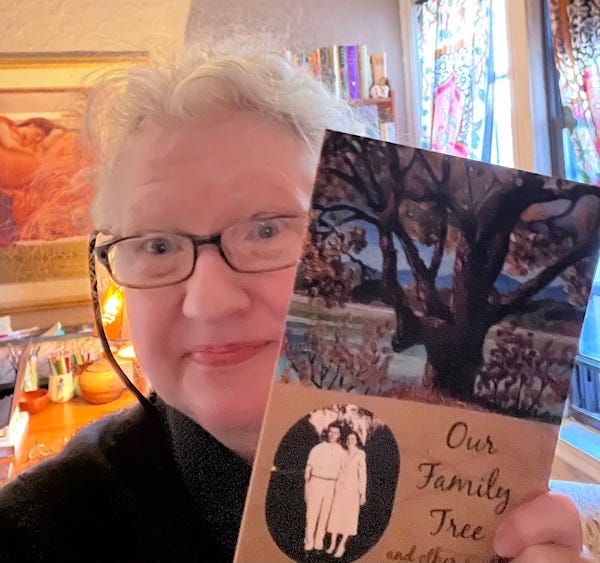
Our Family Tree and Other Myths by Jean LeBlanc. (These are the selfies I send my artist friends when their works arrive at my house.)
Glad I managed to get the title AND author’s name in this one.

Both poetry collections, which couldn’t be more different in terms of approach, style, and geography, are deeply connected in their subjects’ perseverance, struggles, and connection to the natural world.

Anna, Jeannie, and I met in 1990, the very first late June day on arriving at the Bread Loaf School of English to begin our MA program. From the first, it was clear these women were deeply soulful and talented—each in possession of great cameras, too, photographing the Vermont landscape from our first walk. I was a theater major and very lost English teacher, sans camera, still trying to find herself, no writer, but somehow I managed to get admitted on a “rural teacher scholarship” (the MA was geared to teachers). I took it on faith. One of the best joys of lifelong friendships, really, is evenings like tonight, where I listen to women I’ve known over 35 years grow into these astonishing artists. My degree has served to help me appreciate the great work they do, and therefore to open up my understanding of the world. Not bad.

This evening, as Anna and Jean read (via an app thingy none of us (as Jean said) could have imagined in 1990), something profound occurred to me: I have no home place. Whereas Anna is a product of California sky and eucalyptus (by way of Wyoming), and Jean is New England to the core (by way of Quebec), I’m, well, a sort of Virginian (though Northern Virginia (NOVA) really doesn’t count as Virginia), via the U.S. military (because my naval officer mom was stationed at Barracks K in Arlington) by way of Iowa (which my dad always called “home”). I didn’t really belong anywhere. The natural world encounters of my suburban childhood felt inadvertent. I’d meet kids whose families went back generations on farms in NOVA before it was NOVA, and they seemed vaguely alien to me, with their wild cedars for Christmas trees and lapses into Southern dialect at home, dialect they never used at school. I never knew how to feel about that.

Whatever I am, presently a New Yorker, and whatever my insoluble confusions over identity, it’s artists who shake us out of our stupors to look at our truths in the face. So let’s just say I have a lot of thinking to do, right after I reread (yet again) both collections.

You can find these wonderful poetry collections I mentioned at Shanti Arts, based in Brunswick, Maine. May I recommend them? I may. Consider adding Anna’s and Jeannie’s books to your library. Consider, in this our National Poetry Month, adding poetry to your life.

Happy April.

On What Occasion Do You Lie?

Telling truths on Presidents Day

“I cannot tell a lie.”

~ George Washington, First American President

Ironically, this famous quote is itself a lie (how American), but more on that later.

The magazine Vanity Fair (to which I no longer subscribe) includes, as the last page of each issue, The Proust Questionnaire, a set of questions originally asked and answered by novelist Marcel Proust and now used to learn more about the globe’s favorite obsession, celebrities. The questionnaire has some interesting questions, and some shallow ones, but the answers can be revealing. I’m often struck, for example, by the way powerful men, even decent ones like George Clooney, answer #12: What is the quality you most like in a man? “Loyalty.” As a woman I read this as, Truth telling is a deal breaker. As for #13, What is the quality you most like in woman? men generally respond, “Patience” or some other subservient thing. It’s interesting, if limited.

Interesting, If Limited could be the title of my memoir.

Walking around the neighborhood, I found myself thinking of Question #9, which is, On what occasion do you lie? Often the celebrity of the month who has chosen this particular question among the many, will respond, “To spare someone’s feelings.” Fair enough.

But speaking as a fairly honest person who has lied on numerous occasions while also valuing truth, I wondered if any of the situations in which I lied had something in common. I’d like to say something pithy, see, when it’s time for my Vanity Fair moment, so let me note just a few examples, categorize them, and see if I can find the common ground.

1. Once in second grade, Mrs. Angle—I’ve told you this story—asked us after nap time with our heads down on our desks if anyone had a dream they’d like to share. I raised my little hand and got up in front of the class and, making it all up (obviously) to entertain my friends, described how we all went to Egypt to see the tomb of Tutankhamen. I pointed, “Juanita was there,” and again, “Ingrid was there,” and Mrs. Angle snapped, “You’re lying. Sit down.”

2. On a high school field trip during my sophomore year, to take the singers and pit orchestra to a neighboring high school to perform scenes from South Pacific as a promotion for our production, our sponsors, Mrs. Combs and Mr. Carnohan, realized they’d forgotten to send home permission slips with us kids. Only when the bus driver asked if they had them did they realize. I stepped up quickly, “Give me ten minutes.” I had everyone write out a permission slip on paper we all collected from someone’s notebook, and I signed each slip in chameleon-like handwriting. Mrs. Combs looked stunned, but she took my pile and off we went.

3. When I’m late for something, like work, I have blamed the subway (and have been caught out by a colleague and supervisor on the same line) because I’d rather not say, “I have IBS and had to run back home halfway to the stop because I needed to shit again.” (Finally, I just told the truth. No one asked after that.)

4. I once helped make a company-wide Answer Key set, compiled for the whole floor of my 2 Penn Plaza office, when this one president took over and, to prove his power, spent easily $100K to create something like 30 separate “learning modules” complete with “tests” on corporate “life” and business, modules that included short films, voice overs, and reading material on slide presentations, and if you didn’t get all the answers correct on each test, you had to start over, the whole module. We had massive publishing deadlines at the time, our nerves hanging by a thread. To what end are we doing this? But your job was on the line. A few of us—no doubt my idea—began printing out all our 100% test answer sheets which we labeled by module, punched holes, and stuck them in an unmarked three-ring binder. and set it on a file cabinet in our pod We didn’t even hide it. Eventually even our supervisors, to say nothing of executives and vice presidents, began ambling and ultimately marching over our pod to get the book, because 1) these tests were useless to our work; 2) the president was doing it to be a dick; 3) he would be out on his ass soon enough (they always are) once he was eligible for that golden parachute—we endured a period of a few years in which a succession of dicks who were pushed out of one company division and over to ours until they could retire. It was not fun. And yet, our important work—work that corporate didn’t in the least understand—somehow went on, great as usual. Hmmm. Who’s the parasite, Elon? (And how do I really feel?)

5. When the famous Westway Diner on 9th Avenue was taken over by new management maybe six or eight years ago—all the old-school career waiters replaced, the desk staff and chefs gone, the classic booths and tiles plowed under for white and gray blah—I happened in to check it out, and in addition to the place being bereft of atmosphere, the food sucked. “How did you like it?” the aggressive manager asked me about inedible spinach pie, which was a block of bone dry phyllo with almost no filling. “Mmmm,” I said, not wanting the poor new chef to get canned. Let someone else tell them; consider this a funeral donation. (It’s since recovered.)

What do all these occasions have in common? Well, they are lies of convenience, I guess, trying to smooth something over, or using deceit to help out friends or struggling folks; on reflection, I tell few lies just to save my ass. That’s how I was brought up. But I’m not stupid enough to believe that always being honest is smart. As my friend’s Montenegrin immigrant father used to say, “Honest and stupid are two brothers.”

I’ll tell you what the lies don’t have in common: No lives are in the balance for the telling of them. While I don’t condone lying or deceit as a lifestyle, sometimes lies save lives, and you have to keep your hand in. Ask the enslaved; ask women being beaten by abusive husbands; ask Tina Turner running away from Ike. Ask Jews during the Holocaust. Ask the French Resistance. And as we are entering a different era now, hearkening back to those dark times, we all may need to reset our moral compasses. We are back to Nazi Germany, friends, and “truth” for them, ain’t truth for us.

Thinking about coded language and other “lies,” and this being Presidents Day, I recalled a Chaucer class I took in graduate school 30 years ago, and my professor, John Fleming of Princeton, wanted to teach the class about Medieval iconography—you know, the images in all those beautifully illuminated manuscripts with the stories in calligraphy and the illustrations in gold leaf and lapis blue. Those illustrations, we learned, were included not only for their beauty but to guide the illiterate, because unless you were nobility or clergy, you didn’t read. So, what did the images mean? You see a lion, a rose, stuff like that. How would anyone get a whole story from a picture?

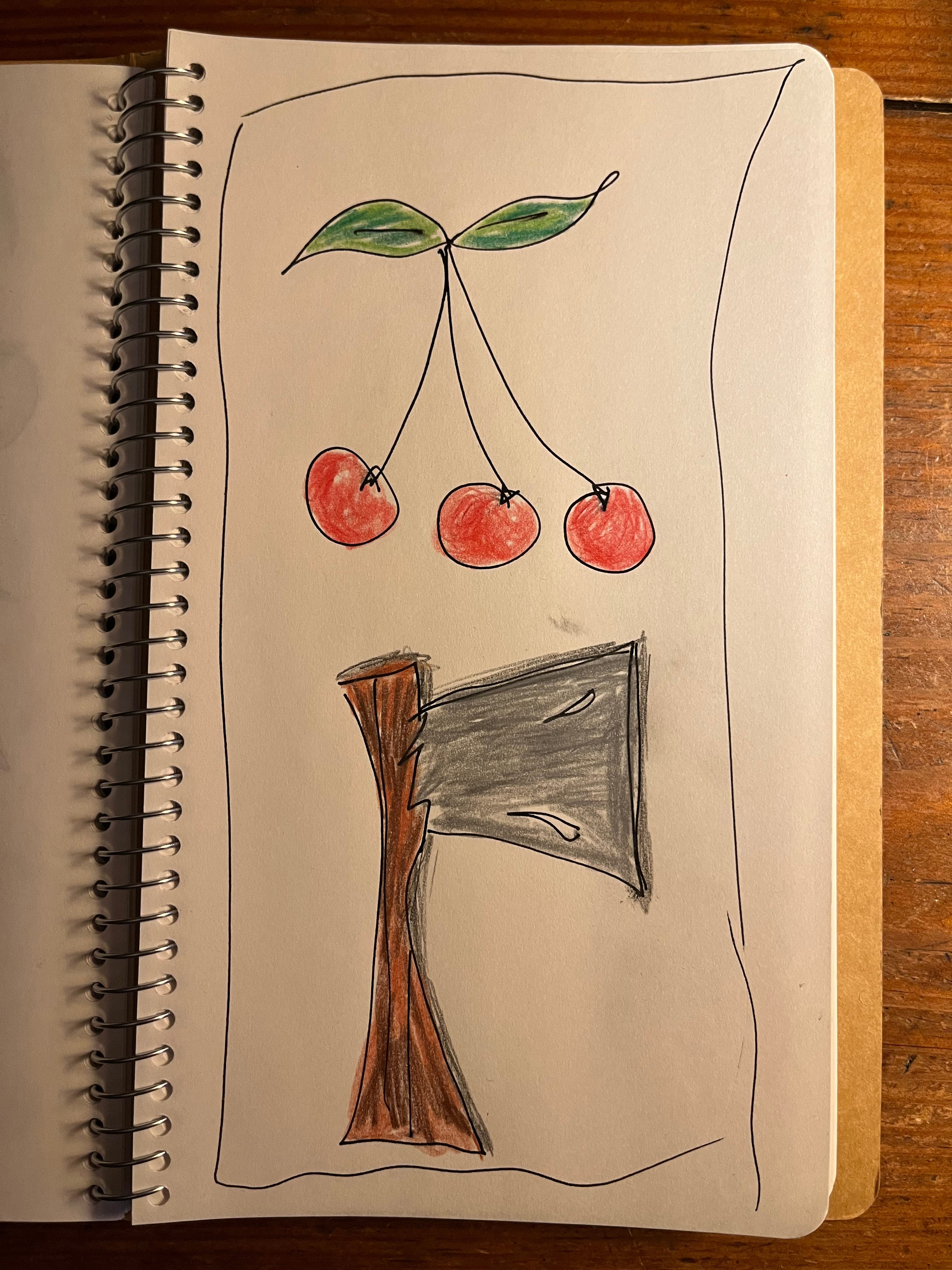
To demonstrate, Prof. Fleming drew these images in simple lines on the chalkboard:

“What is this story?” Fleming asked. My classmates, attending the Bread Loaf School of English from all over the country and the world, sat dumbfounded. I couldn’t believe it. See, I talked a lot, and I was practicing restraint, but finally I raised my hand.

“It’s George Washington and the cherry tree. I cannot tell a lie, Father, I chopped down that cherry tree.”

The class turned to me and looked at me like I had two heads. Fleming barked a happy laugh.

I explained to the still-lost class that I grew up in Virginia, up the highway from Parson Weems’s house, Weems being the man who wrote the fable about wee George, and a few miles down from Mount Vernon.

Fleming then went on to explain that this is a perfect example of how and why iconography—the use of simple symbolic images to represent a whole story—works in places that share a common culture.

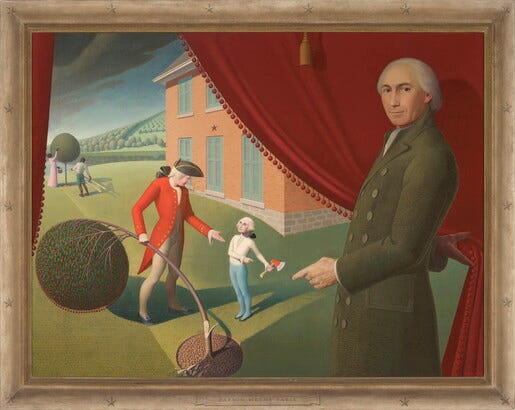
To learn more this Presidents Day about this fable, you can check out the Carter Museum and learn about Grant Wood’s portrait, pulling back the curtain on the myth. In 1800, Weems published The Life of Washington, which is well-known as the source for many myths about the first president. Written just a year after Washington’s death, it includes the story of six-year-old George admitting to chopping down a cherry tree and another about Washington praying at Valley Forge.

Who chopped down that cherry tree? asks George’s father, according to Parson Weems, who wrote, “Young George bravely said, ‘I cannot tell a lie… I did cut it with my hatchet.’ Washington’s father embraced him and declared that his son’s honesty was worth more than a thousand trees.”

Why create this myth about an already mythological figure, even by 1800? I guess to impress upon America’s youth the importance of honesty. But what to do when you learn the story is in fact made up?

Growing up as I say, along the Richmond Highway between the home of Parson Weems and Washington’s home of Mount Vernon, I learned this fable in elementary school, but I never learned about Washington, the enslaver. Not in high school, not in college. I remember a California friend visiting Mount Vernon with me and saying, “I thought this was just a myth,” meaning the whole plantation, the first American president, all of it. And it’s easy to see how anyone not from the historical grounds of colonial America might feel that way, or wouldn’t be shocked to see a slave auction block landmarked in Fredericksburg or Williamsburg, given the American tendency to mythologize the successes and sweep the ugly truths under our antique hooked rugs.

And really, the more we keep digging, and the more lenses we train on our history, the more truths we uncover, the more lies we reveal—the more interesting and complex and real our history becomes. It’s discomfiting, sure, horrifying at times, but isn’t it exciting, too? Isn’t truth worth seeking? How else to make this nation truly free?

This is where we turn to our artists.

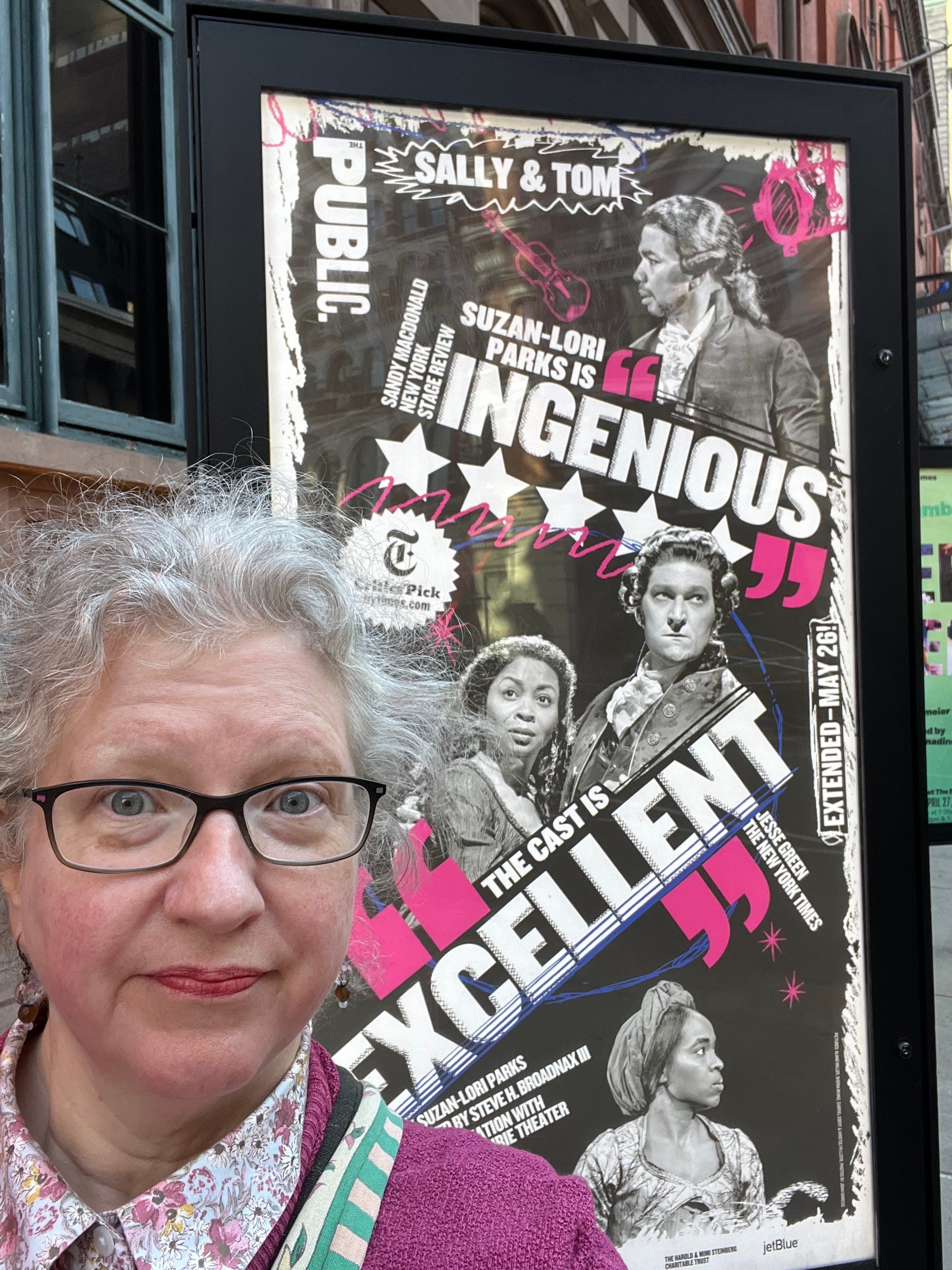
To explore perhaps America’s greatest “Lives of the Presidents” cover-ups, the relationship between Thomas Jefferson and his enslaved “mistress” Sally Hemings, Pulitzer Prize-winning playwright Suzan-Lori Parks premiered her play Sally and Tom at The Public Theater last year. The premise of the play is a community theater putting on a play about these historical figures while the leads are in a relationship. I loved the show, and I was fortunate enough to be there on a talk-back night. In attendance that night were several of the descendants of Thomas Jefferson and Sally Hemings and their families, as verified by DNA. I couldn’t believe I was having this chance to witness history. To watch as these family members meet one another after the show (many were sitting in the row in front of me) and walk up onto the stage—the set’s back wall covered in all of their names in the final reveal—to take photos with their phones, made me weep. (I think it would be a fascinating way to end the actual play.) It was wondrous, too seeing truth all up there like that. The theater was filled with love in the midst of revelations. That’s what art does.

Miss O’ outside The Public Theater, April, 2024.

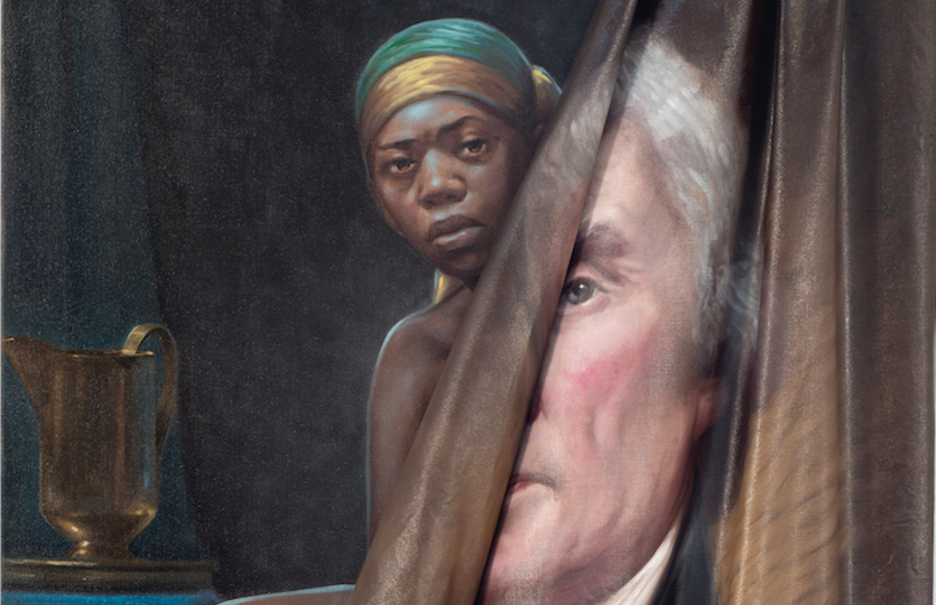
And I think also of that incredible painting by Titus Kaphar, “The Myth of Benevolence,” offering another way that art can reveal a deep truth in a way no historical record ever can, exposing long-hidden damage and forcing us to confront it. (Click on the link to see the entire painting and learn its story.)

A whole story from a picture. American iconography.

Detail, Titus Kaphar, “Behind the Myth of Benevolence” https://www.culturetype.com/2018/03/28/titus-kaphar-and-ken-gonzales-day-explore-unseen-narratives-in-historic-portraiture-in-new-national-portrait-gallery-exhibition/

On what occasion do you lie? I look at the American story, then and now, and it’s seeded with lies and corruption, so many lies, you have to wonder, Can it ever come clean? How do we answer for it? These are the questions we all should ask and answer now. If we don’t, whom do we think we’re protecting?

On what occasion do you lie? Ask Gil Scott Heron, famous for saying “the revolution will not be televised,” meaning it happens inside us, speaks volumes about the impact of lies in the linked poem; and Kendrick Lamar, whose brilliantly coded and performed all-Black Superbowl Halftime Show blew me away. The enslaved lived in world of code. They had to lie about learning to read, for godsakes. Pretend to go along, to get along.

On what occasion do you lie? Ask women who have been sexually assaulted and been made to keep quiet or lose their careers. Ask the men who keep pretending nothing happened. Ask Sally Hemings.

On what occasion do you lie? There are real reasons to lie, moral, ethical reasons. To protect the ones we love. To save our neighbors. We are having to think hard about that now.

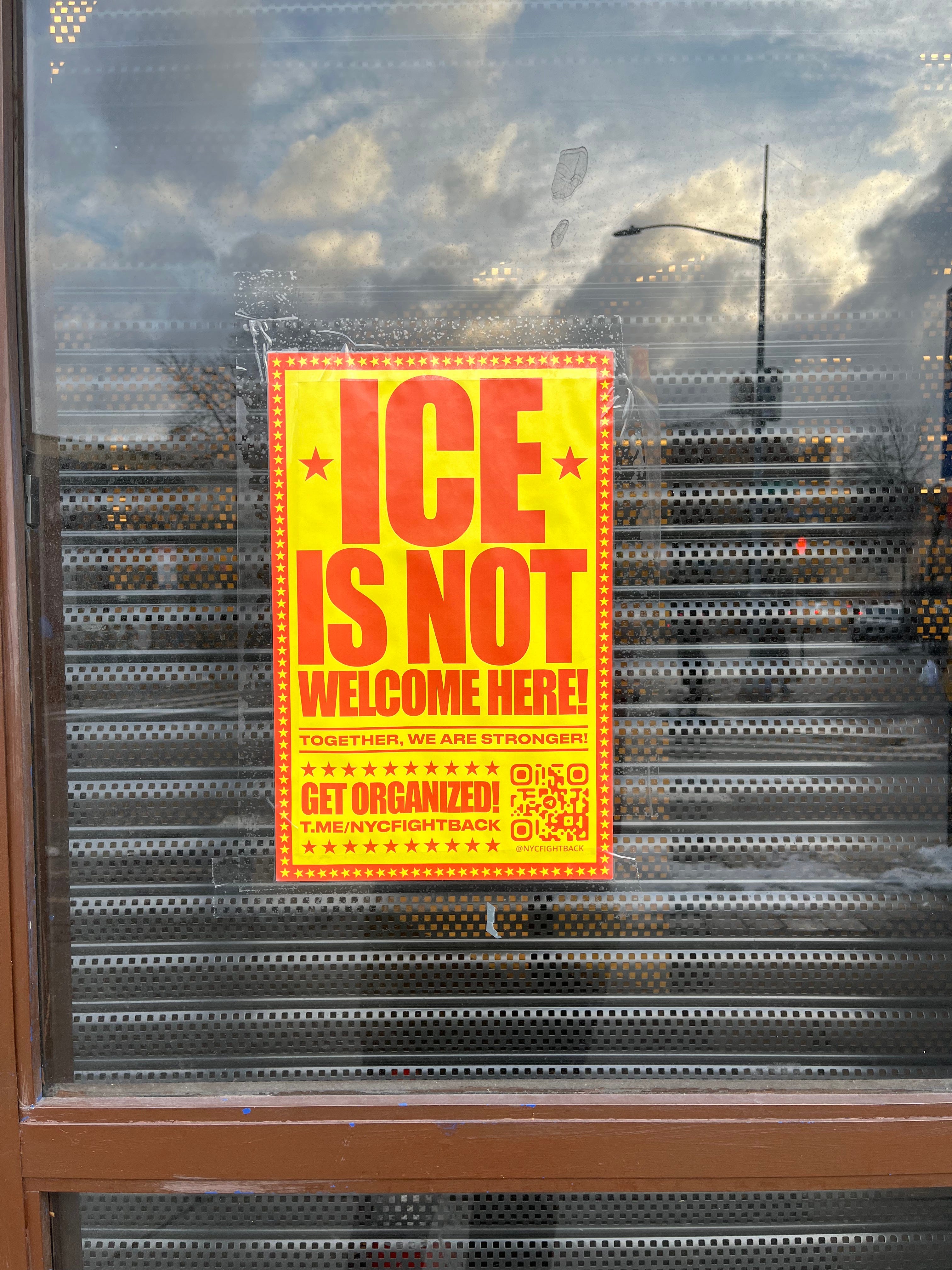
Republican lawmakers (that’s rich) want AOC arrested for teaching Americans and immigrants their rights. Photo by Miss O’ in her Queens neighborhood.

Because let’s face it: here in the United States, we are in a crisis of government amorality. We have a lying Republican party (no more rule of law); a lying president (pick a campaign promise, and yes, Project 2025 was the plan all along); a lying vice president (his autobiography exposed as a sham); a lying Supreme Court (see Roe v. Wade, which all declared, under oath, “settled law”); and liars heading every cabinet position (no, trans people are not the cause of America’s problems; and Putin is not America’s friend, Tulsi). We have liars in the Department of Justice and Homeland Security (immigrants are not remotely the cause of most crime; being brown is not a crime). We have liars heading the F.B.I. (the Democrats are not the enemies of America). It’s all lying all the time, now, and their truths are even worse. The freedom of Western Europe is now in the balance, as Vice President J.D. Vance admonished the “values” of those democratic nations this weekend, in essence praising the rise of fascism in France and Germany and also capitulating to Russia’s desire for empire. On the campaign trail, Vance said “democracy” but meant, we know now, “totalitarianism” (Europe is not America’s enemy, nor are Panama, Canada, or Greenland; our actual enemies are transparently heading our own government.)

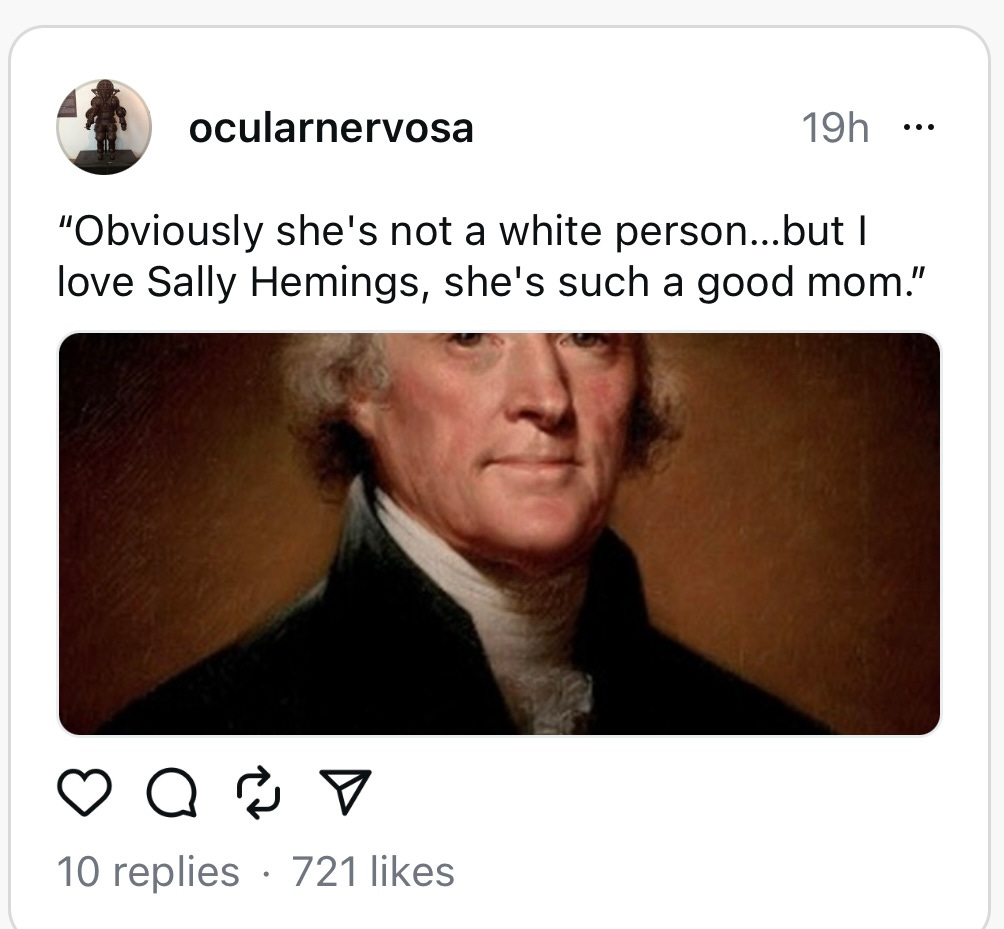
Past and present collide: JD Vance on his brown wife; I’ve heard Vance refer to their children as “her” kids. Look at the mental gymnastics and self-delusion of Vance, who denies his wife and children, and smiles.

To think that all of today’s stuff started with asking a simple question.

Identifying lies is not the same as responding to the world that supports those lies. There’s a very cool blog on Substack called The Pamphleteer by Lady Libertie, and she is focused on how we negotiate this new era. Check out “So You’ve Been Invaded: a French Resistance Guide for the U.S.” Pretending comes with the territory of survival. Marcel Marceau, for example, as a teenager pretended to be a camp leader, while his real job was to smuggle Jewish children across the border to freedom; he used the art of mime to teach the children silence as they walked. It’s not really lying if it’s saving lives, and the people you are lying to are venal.

Happy Presidents Day in America, 2025, everybody!

Sending love,

Miss O’