In memoriam, an appreciation, tinged with warning
Before beginning to write this at the witching hour of 3:00 AM (ah, the insomnia of post-menopause), I reread previous posts of appreciations I’d written for two Bread Loaf professors of mine who had died; I suspect the one person who liked those essays is the one person who actually finished reading them, so this latest is for that reader—thanks, Michele. Because here’s another one—and more backstory of Bread Loaf. (Note: part of my reason for writing blogs is to chronicle my life story, my history, so that when I’m senile, the collection might jar memories. And any time I reread a post, I’m so glad I wrote it—I wouldn’t remember any of that now, whatever it is. You might try this for yourself—it’s not about anyone else caring, though they might, and thanks if you do. Write for yourself. And save it somewhere besides online. -ed.)
Like my feelings around the man himself, even in trying to write this I find myself self-conscious. Isn’t that funny? Here I am, age 62, around the age John V. Fleming of Princeton was the year I had him as a professor for Chaucer at the Bread Loaf School of English. I’ve mentioned him recently in a few posts, including my appreciations for the late Michael Armstrong and David Huddle. Back in June, in searching out Fleming’s blog “Gladly Lerne, Gladly Teche,” again, which I’ve followed on and off for years, I instead came upon his obituary, learning he’d died on May 30.
A little history first: The Bread Loaf School of English, as I may have told you, was created when a very rich man named Joseph Battell willed his summer resort in Ripton, Vermont, to Middlebury College ca. 1920—the idea to use it as a summer English master’s degree program was inspired, a place for teachers to gather in their off months, and, as they say, fill the well. (The famous Writer’s Conference came later.) Back then it was a kind of “gentleman’s degree,” I gather, a summer camp for (white male) elite private school teachers, the location of which assembled the finest (white male) English professors from around the country, with a promise of light courses, lots of reading, witty conversation, plenty of mountain air and fine walking, and a chance to get paid to hang out with like-minded, moldable fellows on expansive porches, smoke pipes, sip scotch, and sound like geniuses.
Like President Bill Clinton a decade after him, John Fleming was a Rhodes Scholar from Arkansas, though unlike Clinton he lost all traces of his regional accent. A legendary figure at Bread Loaf, Fleming famously didn’t come up every summer, so you had to grab one of his classes while you could. Curiously, Mr. Fleming made no secret that he found Bread Loaf “self-congratulatory” and too full of its own reputation; he said as much to my class. Yet I couldn’t help seeing that tension in himself—the conservative country boy who saw all this book learning for the intellectually masturbatory exercise it could be; and also the enthusiastic, wondering schoolboy scholar whose own small life was expanded and awakened through the world of books. Gladly would he learn, and gladly teach.
When he came back to Bread Loaf during my second summer of five, Fleming set to work to restore the little Printer’s Cabin across the road, used in the days before Xerox, boys and girls, to hand typeset the daily newsletter, “The Crumb” (all the puns of Bread Loaf—named after a mountain so called because its owner Battell though the mountain looked like a loaf of bread; the daycare was called Croutons), and literally print off copies to place at every lunch table in the dining hall. (Two “Crumb” authors I knew at Bread Loaf were children’s book author Sam Swope and then-editor of the New England Review, Hugh Coyle; I even wrote a couple of “guest pieces” in my time there.)
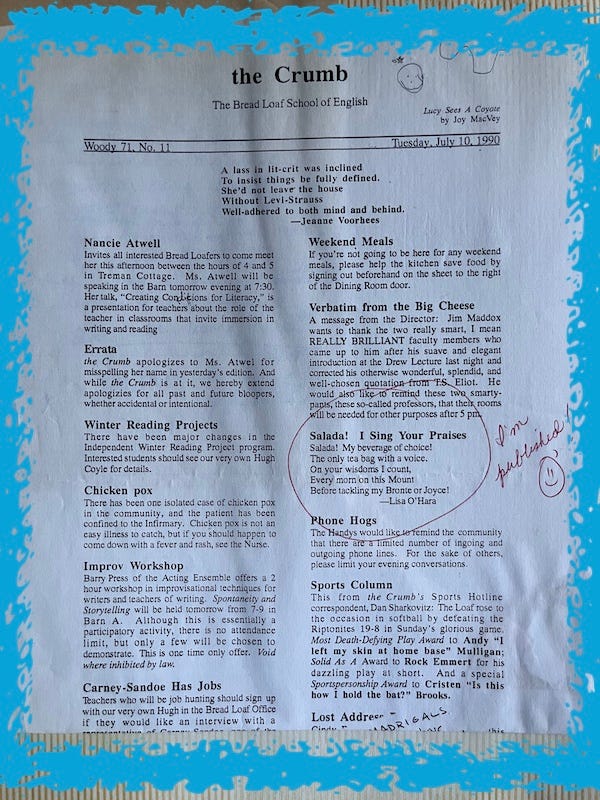
In this Brigadoon of a place where all electronics except typewriters were forbidden and no locks adorned the doors (heaven!), my roommate that second summer, Karen, was one of a few students who answered Fleming’s “Crumb” call to assist him and learn printing, and she’s the only one who stayed with his project. It never would have occurred to me to learn about printing; the next summer, when I would immerse myself in Virginia Woolf at Oxford, including learning that she and her husband, Leonard, started their own hand-printed Hogarth Press (the first press to publish T.S. Eliot, for example), I saw I’d missed a fine opportunity.
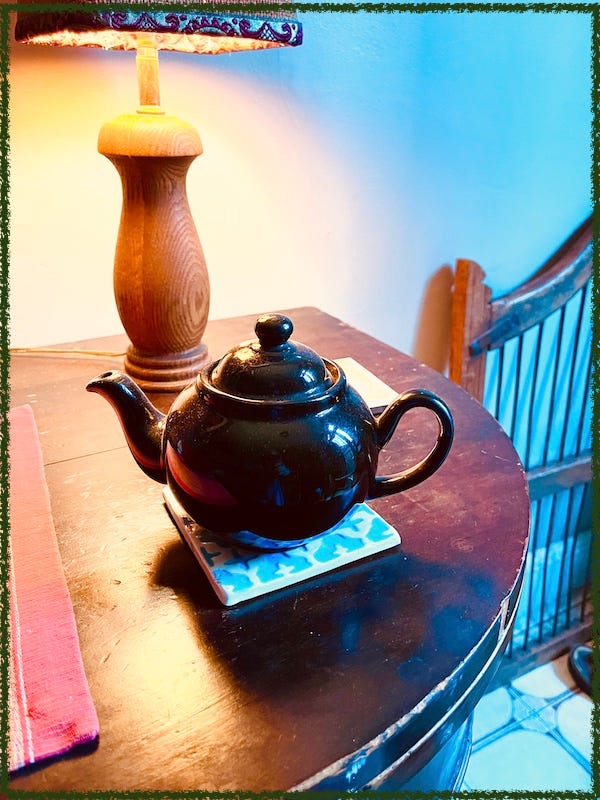
While she talked about the printing restoration, Karen didn’t say much about the man himself; I myself remember being quite struck by Fleming’s great height, his expressive face, and by his bringing a large “brown Betty” teapot to the dining hall every morning at breakfast and asking a waiter (it was a clique thing and also a way for some students to earn free room and board each summer) to fill it with hot water (I think with his own tea); I recall him being charming and grateful about it. I could relate, as I was a tea drinker, exclusively, back in those days—no coffee or soft drinks or hooch—black tea, hot and straight, and I wondered if only faculty could bring a tea pot like that.
Wonderful though my summer experiences were, Bread Loaf was a place divided very much by money and class: the students either came from personal money and Ivy League educations and became private school teachers in order to “give back” (private schools paid their graduate degree tuitions in full); or else they fell into the “other” category, the latest edition of students, as when I arrived in 1990 on a rural teacher scholarship, of working and middle class students who attended state colleges and taught public school. It was my first time being aware of class like that, though I had hints of it when I became friends in high school with people who lived in a (new, then) gated community called Montclair. Fancy, but we all attended the same public school.
Even without knowing anything about him beyond his legendary intellectual acumen (“brilliant,” “Princeton”), Fleming’s loping gate and careless (almost sloppy) way of wearing corduroys, unpressed button-down shirts, and shoes that suggested they had to be re-tied a lot, bespoke a man caught between worlds. Coming from three years teaching in rural Virginia after graduating Virginia Tech before finding myself in these rarified circumstances, I found Mr. Fleming’s presence both comforting and unsettling. He was a kind of mirror—as a man not quite of Bread Loaf, while also looked up to, I recognized myself in him (see: The Oracle). It made me think about myself, and no one likes to be self-conscious, though self-aware is always important.
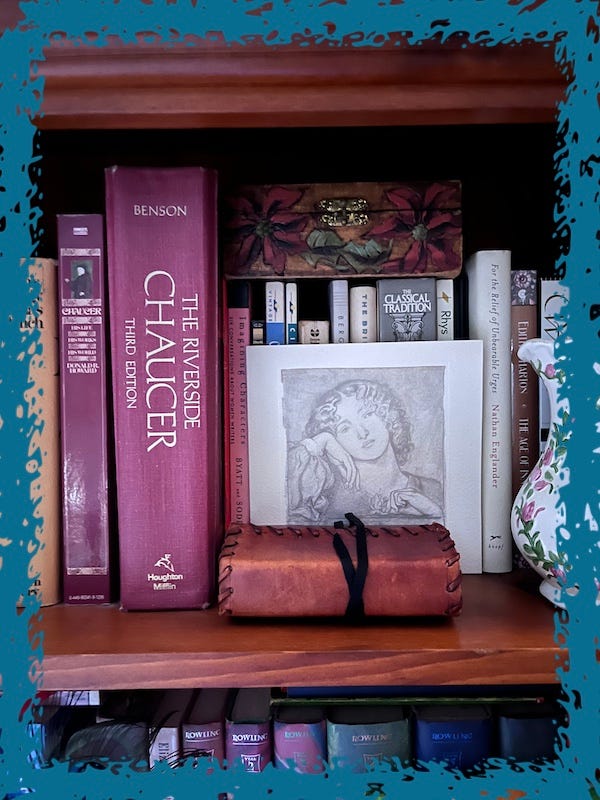
The textbook Fleming assigned was The Riverside Chaucer, in Middle English; my mom, Lynne, manager of Crown Books in our town, stripped me a remainder Signet edition of The Canterbury Tales in both Middle and modern English, side by side, though I quickly found that because of Fleming’s teaching, I didn’t need it; I could (using the footnotes) soon read Middle English ca. 1390. He did afternoon tutorials to guide us in reading the work out loud, “Whan that Aprille with his shoures soote…”; since there were no tape recorders, he noted, it’s not possible to say how it sounded—another important reason for classes like this is historical perspective*—and Fleming guided us to see how only 200 years later, this version of English would become recognizable into the present era with Shakespeare ca. 1590—pretty amazing.
*[Sidebar: I recently watched a YouTube video by Rick Beato, a music scholar and teacher, where he demonstrated and explained how really wonderful Jim Croce’s 1972 song “Operator” is; very matter-of-factly, as he paused during moments of the song, Beato defined for his younger audience terms like “operator” and “matchbook,” explained what a pay phone was, how much it cost to place a call, and also explicated the events of the song—all things a modern young person who only texts could never recognize, not merely the mechanisms but the desire to hear a voice, all alien. In. My. Lifetime. As with listening to old songs, classes in Chaucer, say, remind you how far we’ve come, and also how recognizable we are in our humanity. -ed.]
After Day 1 of the class, though, I asked to meet with him. “Mr. Fleming,” I explained, “I’m a theater major from Virginia Tech with a 1970s suburban public school education, and I have no idea what you’re talking about. What do I need to read to succeed in your class?” He thanked me for letting him know, and gave me a reading list: stories in Ovid’s Metamorphoses, St. Augustine’s Confessions, various books of the Bible, all of which are alluded to in The Canterbury Tales. We would also be reading The Consolation of Philosophy by Boethius as part of the course. Time to get seriously to work.
The first time I practiced reading Chaucer aloud, by the way, I kept inflecting up at the end of every line, in my nervousness, I guess. Fleming stopped me after a few lines, “Miss O’Hara, every sentence is not a question,” to which I responded, in surprise, “Oh, my god? It’s like all my teenage girls? Who do that all the time?” And I giggled. He looked startled. I spent the summer deciding I could be myself—keep this Chaucer stuff real. I could tell he got a kick out of it, defying his scholarly approach with my realities of a public school classroom and today’s teens. I wrote Mr. Fleming a third essay, a personal one, at summer’s end to explain how I’d translate all this to my kids, giving him a copy of Paul Simon’s Graceland. “That longen folk to go on pilgrimages,” Elvis as our new Thomas à Becket.
When I look at the supposed miracle that is AI—no one has to read or think at all anymore!—I get sick. Physically sick. Back in my undergraduate days, because Aristotle’s Poetics is such a feature of the theater that was my major, I took Aristotelian philosophy as an elective. I struggled mightily with it, and I asked my professor, Dr. Nick Smith, why this was so hard to read. “Because the ideas are hard,” he said. There it is.
And taking that challenging class, along with being taught Chaucer in Mr. Corbin’s AP English 12 class, and learning through acting to read Shakespeare with relative ease, I was able to challenge myself and find not only increased knowledge but genuine pleasure in my success in a hard graduate course. And Chaucer is funny—really funny. And filthy as well as pious. Once a summer when he was there, Fleming read “The Miller’s Tale” aloud at the weekly Thursday bonfire, in Middle English, and he was a riot. (Give yourself a treat and read “The Miller’s Tale.”)
Given all his exacting Princeton expectations, you might wonder why I’d sign up for his class— for one thing, I needed that period of literature to graduate; for another it scared me, so I had to do it. One thing that took the big pressure off me when taking Fleming’s class, by the way, was finding out from students past that he never gave A’s. He didn’t believe that anyone in a summer course could possibly earn the top kind of grade he assigned at Princeton.
I got an A.
I have never valued a grade like I valued that A.
When I was graduating at the close of that summer, I learned that the tradition for our celebration dinner was to ask a professor to escort us to our tables. David Huddle was quickly snapped up, and my earlier beloved professors were quickly taken, too. I remember stopping Mr. Fleming in the Inn lobby to ask if he would consider doing it, and he was startled. “I’ll have to get back to you,” he said, because I believe his intention was to leave campus with his family before graduation. But he did indeed escort me, to the shock, I think, of many faculty and students, and to my infinite pride.
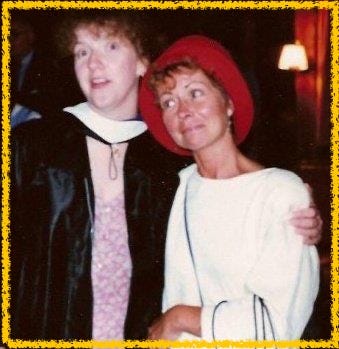
I don’t have any photos of my graduation, save one, taken with my friend Becca Cummins (the friend who inspired my eBook), who was also in David’s Fiction Writing. Somehow that feels about right—so much of our experiences are in the doing anyway.
To Mr. John Fleming of Princeton, I give thanks.
And I feel beyond lucky to have aged in a world that centered books, that three of my great mentors—David Huddle, Michael Armstrong, and John Fleming (all white men, to be sure, noting those first two were only ever first names with their students; but we can’t forget Maureen Shea and I hope it’s years and years before I have to memorialize Jacqueline Jones Royster and Felice Proctor) made reading and writing come alive for me, that I could pass that on to my students, maybe even to you.
We are now, sadly, post-reading, post-books. I could never have believed such a thing in my lifetime. It’s been deeply distressing to me to have to imagine a world without the wonder of reading, the deep intelligence that hands-on, eyes-on reading gives us as individuals and a society, not only culturally and intellectually, but emotionally. Reading is an education of the heart, more than anything else. Consider this tribute to Mr. John Fleming another shot in the dark to keep literacy alive. Tell the stories before our AI internet searches lead only to “PAGE NOT FOUND.”
Read all the things, and from a place of love, always choosing your words for their meaning, even as we forgive typos.