Not to be an alarmist in a country filled with every manner of horror, but I share an emergency call out here for my readers and book lovers. According to reporting from Aaron Parnas, AI companies are buying up as many antique and RARE BOOKS as they can find, as fast as they can find them, and once scanned, DESTROYING THEM.
I gather that this is so that AI can be used to scan historical and scientific texts of old in order that 1) they might be altered if it’s expedient; as well as 2) hidden at will.
It’s diseased. We live in lunatic times.
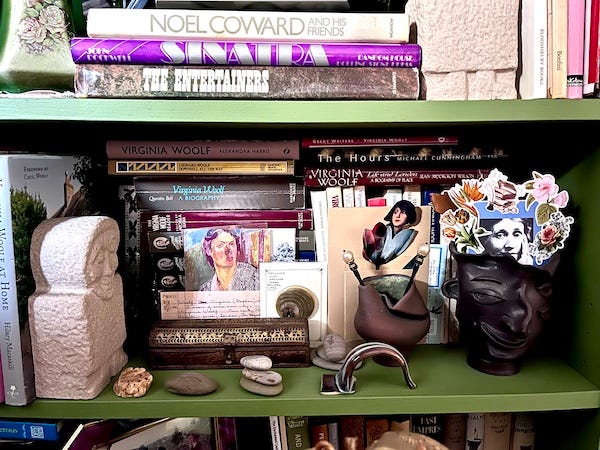
Please alert all your bookseller friends, put out the alert to every reader you know. We have to save our books.
We are at Brave New World level now.
I guess we also need some kind of plan for saving our own personal libraries. Share your ideas. We don’t have much time.
Meanwhile: We have tens of thousands of ICE thugs, police officers, and rogues going around killing indiscriminately and without consequences. We have concentration camps up everywhere. People are being arrested for SHOWING UP to meetings to protest data centers. Data centers are demonstrably drying up rivers and ground freshwater sources. It’s full on dystopia.
Don’t think just because we are, you know, keeping our doctor’s appointments and stocking up at the grocery store that our nation isn’t eroding all around us. I scream this with love.
And on August 3, Kentucky’s governor’s time expires to call a special election to replace Mitch McConnell, so no doubt Mitch’s death will be announced August 4. You heard it here first.
I am prepped for the onslaught of more flooding rains to fill my basement—can only hope for the best.
This is really hard—all of this. We have to figure this out. We have to.
In 2009, a dear friend of mine died unexpectedly. Her teenage sons asked Miss O’ to please please please get on Facebook so we could keep up; two longtime friends from grad school, a couple, had been pestering me about joining it since it launched ca. 2004, even though I saw them on a fairly regular basis. Finally, five years later, I joined, but I didn’t feel good about it.
I do not truck, as they say, in regret. (A dear writer friend told me that Miss O’s greatest flaw—I told you this—is that I have “too great a capacity to enjoy”; hers is unending regret, from deeds in the past to the restaurant she should have gone to as you are ordering appetizers in this one; her flaw is tougher for her than mine is for me, though I have been working on dialing back my big energy.)
But on reflection, since I left Facebook after Donald Trump’s “election” in 2024, I have fallen into depression, the sole cause of which I assumed was the daily erosion of democracy, institutions, and rule of law; and the transparent coup d’etat ignored by Congress; along with the death of my mom. And all that would be enough.
This morning, waking as I do now at 2:00 AM at least once of week, I began thinking about social media and its effects, realizing that I’ve spent a year and a half “coming down” from Facebook, with delirium tremors manifesting in doom scrolling my phone for “news.” And that led me to recall that growing up, we got news in two waves: the morning paper and the 6 o’clock news. It was the bookend of a day; you might also get a weekly magazine, or a twice-weekly local paper, too, but on a daily basis, assassinations and earthquakes notwithstanding, and a news break at noon on a local channel, the events of the nation and the world didn’t figure into our moment-to-moment lives. You simply lived, and that was hard enough.
With Facebook, I found myself checking in all the time—the site doing to me what it was designed to do; I never had the app on my phone, fortunately, but then Instagram was born—a cheerful place for photos until that, too, became all news all the time. I no longer post on Instagram, instead using it to amplify activist content that oligarch-owned television news and newspapers no longer touch or actively suppress. I’m miserable all the time, just as I was with Facebook, which I should have quit—and here’s where the regret kicks in—after Obama’s second inauguration in January of 2013. In 2012, I self-published my little eBook, Easier to Live Here: Miss O’ in New York City, a compilation of my daily posts, the ones limited to 140 characters, as requested by my friend Becca. That was a fun collaboration with my designer Magda (whose course in making eBooks caused her to ask me if I had material) and illustrator Lisa. And I could have said, “Cheers, friends,” and been free.
Still, good connections came out of it; the price was the loss of many deep friendships. No one had time for that anymore—skimming and scanning, dipping in and out, that’s all we could do, what with 700 friends, 3,000 or 4,000 even for some people I knew. I can’t tell you how often a version of, “How are you?” to a friend was met with, “Don’t you read my Facebook?” I couldn’t do that for 700 people every day, can you? Maybe it’s me.
What she said. I’ve had to learn to focus on books again.
There’s something more, though: as the nation shifted full-throttle is a race toward fascism, white supremacists led by Trump revving like monster trucks in their rage over a successful Black president, my engagement with social media became less about storytelling and more about soapboxing. I didn’t like who I was becoming, and who I became. And with the reboot of the whole shitshow, I knew my rants and raves and facts and arguments were less than useless: they were obnoxious. America was not mine to fix. It was arrogant and idiotic of me to think otherwise.
Via today’s TikTok (which app I do not have) and Instagram, I’ve found an array of genuinely informed and connected media people known as “influencers,” each with a special lens, and many are confident and caring and informed and wonderful without being arrogant or idiotic or obnoxious. Social media is not my medium, creatively. I’m still not sure what is.
Meanwhile, I’d like to think that a year and a half later, I’m nearly on the other side of that 15-year cycle of addiction; the next phase is to get off Instagram, but unfortunately, that’s where I get most of my news. Substack, where I publish this, has long been rumored to be a fascist platform, pretending to support independent thought so that dissenters will be easy for the regime to target and jail, because that’s here now. I remember my youngest brother’s friend Joe, whose father got out of communist Hungary, the USSR, intoning in a thick accent in imitation: “Trust no one, Joe, not even your best friend,” and you’d laugh. It’s not funny anymore.
I don’t truck in nostalgia, either, because my good times came alongside other people’s horrors, but I do miss not being in “breaking news” moments ad nauseam, miss feeling that smart, responsible people were running things, miss having the energy and imagination and drive of a creative life, barefoot and on swing sets, too, while I’m dreaming.

 The Miss O' Show (Teacher's Edition)