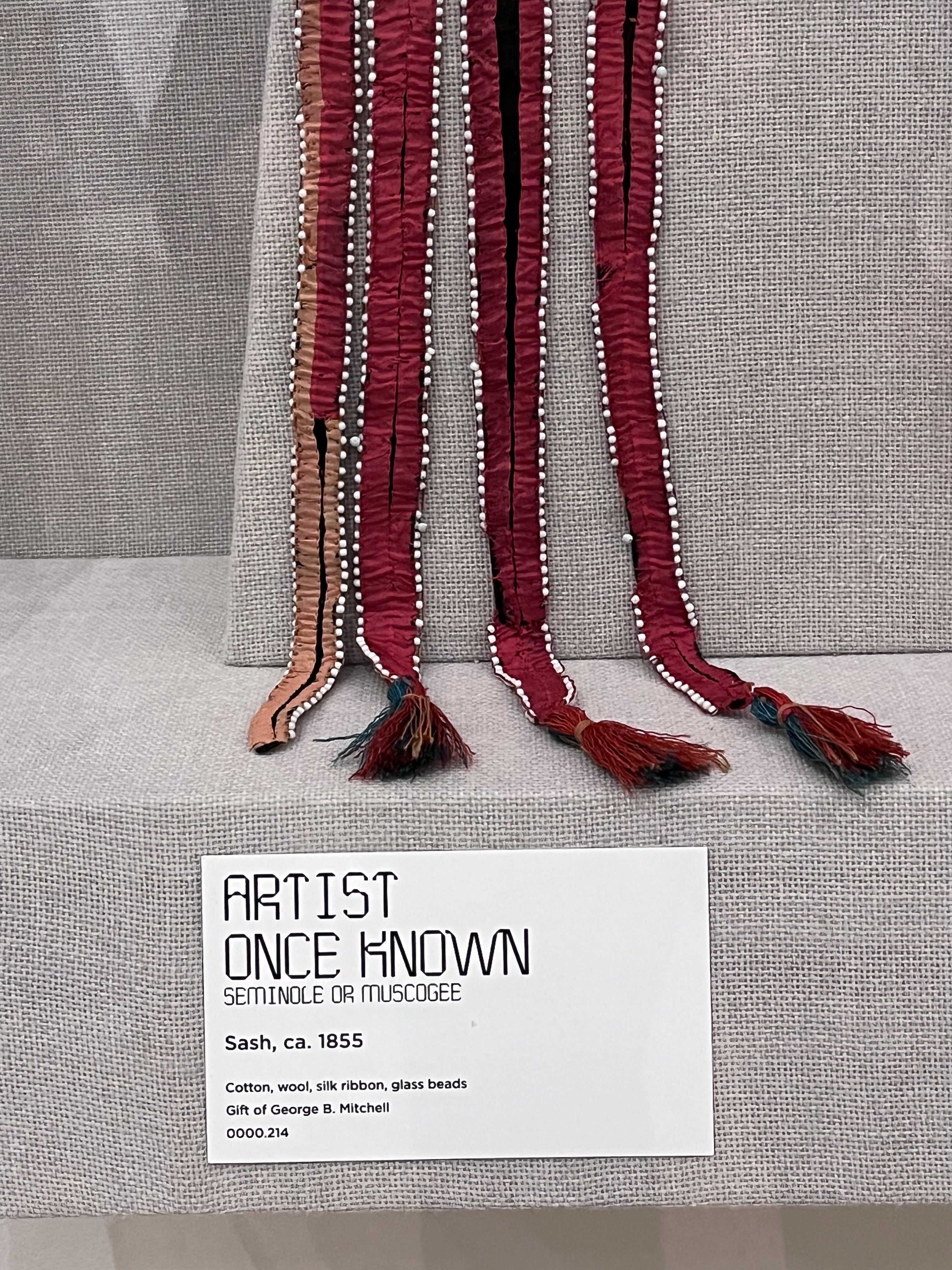
Fashion of the moment and what lasts
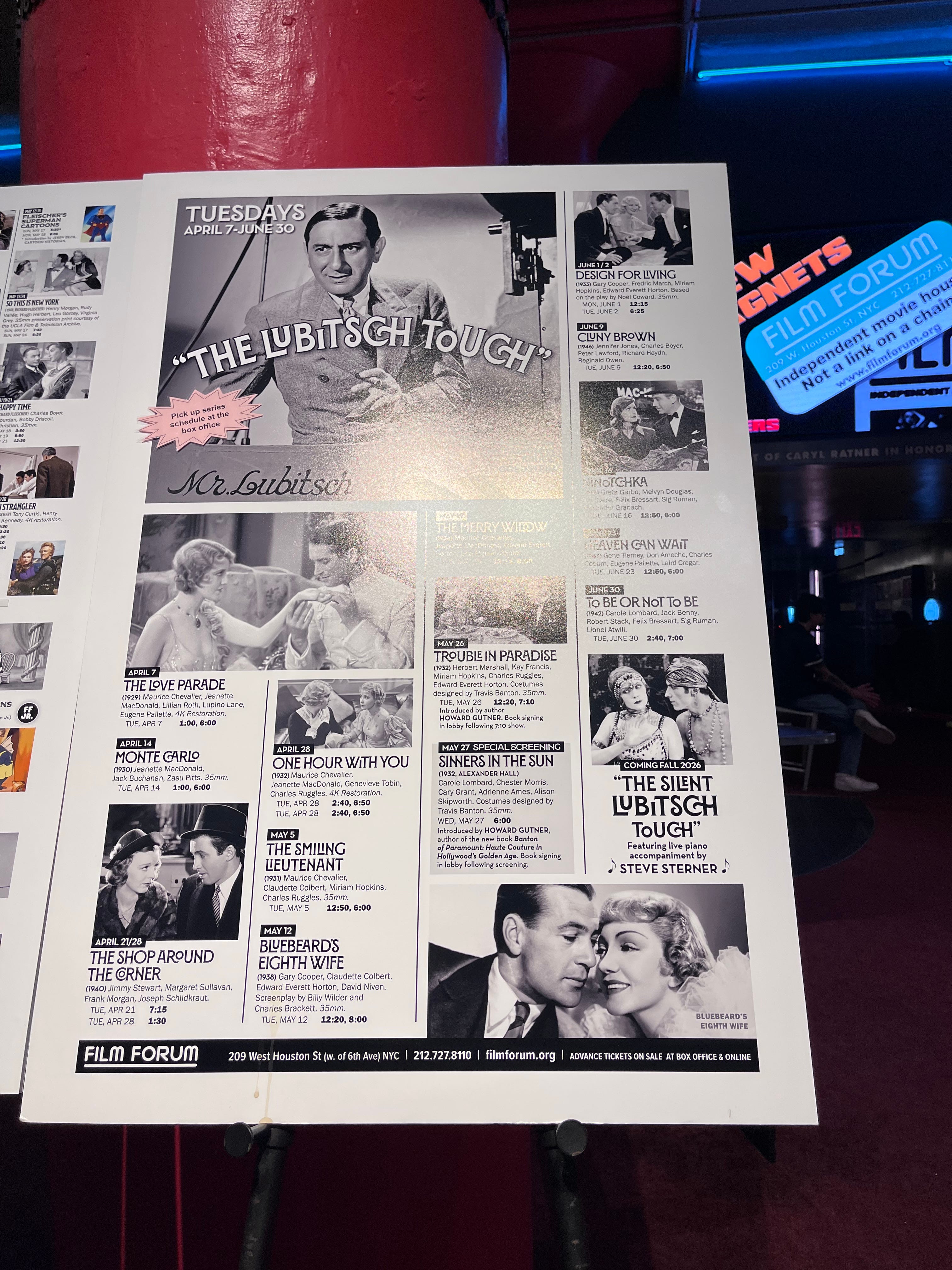
Last week as part of a month-long retrospective of the career of filmmaker Ernst Lubitsch (1892-1947) (think The Shop Around the Corner), Film Forum here in New York City showed two screenings of the movie Trouble in Paradise, starring Herbert Marshall, Miriam Hopkins, and Kay Francis. But wait, there’s more.
At both the 12:15 PM and the 7:00 PM showings, my old friend and colleague, Howard Gutner, introduced the film and showed slides of photos from his latest book on Hollywood’s Golden Age, Banton of Paramount, a deeply researched study of the work of costume designer Travis Banton (1894-1958), whose protegee, Edith Head (1887-1981), was the eight-time Oscar-winning designer of films such as All About Eve (1951, in the Black and White category, which category ended in 1970) and The Sting (1974, her last). Banton never won because awards for Best Costume Design weren’t introduced until 1949, and by that time his alcoholism got him forced out of studio work; I’d never heard of Banton until Howard told me about his book coming out.
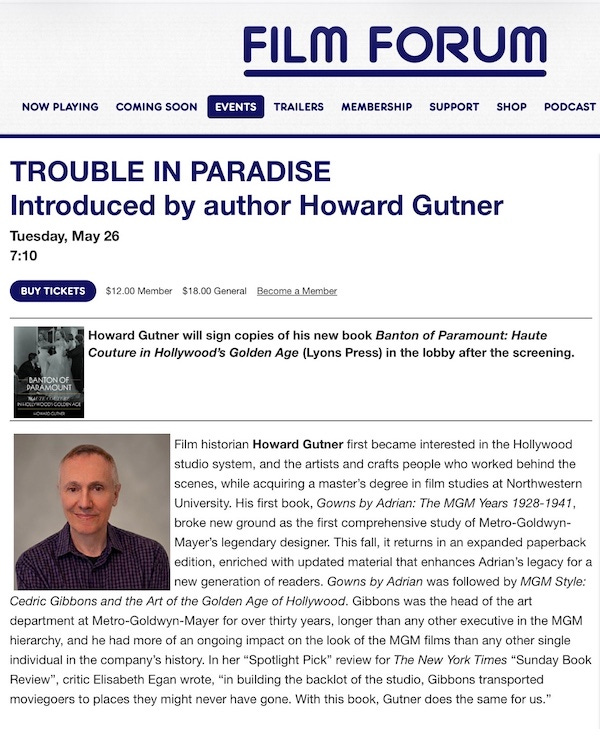
Howard’s introduction, which was delivered with real command of the material, a great voice, and wit and warmth, included slides of two gowns from Trouble in Paradise (which is just terrific, by the way): one worn by Miriam Hopkins shows a character who does not come from wealth, and the other, worn by Kay Francis, shows a temptress character with riches to burn. Both gowns, Howard explained, were sewn on Banton’s signature bias cut, where cutting the fabric on a 45-degree angle causes the dress to hug the body, thus showing a body’s true shape. Ah, the world of Pre-Code Hollywood. And this new knowledge, as it turned out, shaped the way I watched the movie—a new lens, if you will, that enhanced my viewing pleasure by heightening my awareness of craft beyond plot.
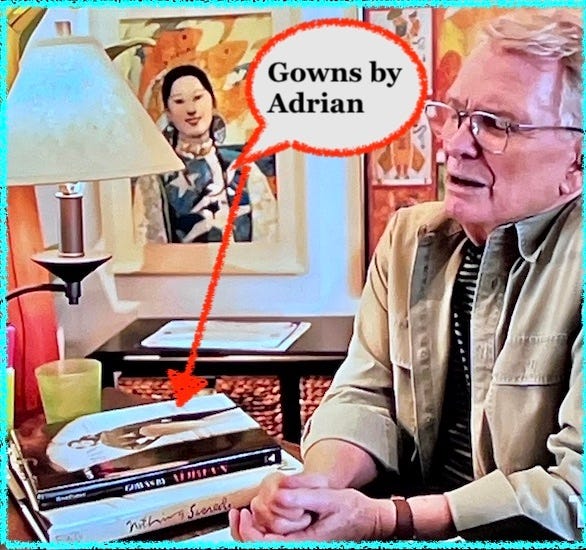
In addition to pitching Howard’s book, and I am, I want to praise the writers and archivists who keep our artistic histories alive. Howard’s other two books, Gowns by Adrian (long out of print, I see that Simon and Schuster is going to reissue it in November of 2026), about MGM costume designer Gilbert Adrian (you know him, yes you do, because he designed The Wizard of Oz), and MGM Style, about the work of MGM set designer Cedric Gibbons (The Wizard of Oz and so many more), along with the new book on Banton, provide backstories that had not been told; prior to Howard’s book, there were no books at all on Banton, for example. Following Howard’s lead, there are now other books on Adrian, but those writers didn’t get to interview Katharine Hepburn personally (as Howard did) as part of the research (Adrian designed Hepburn’s costumes for The Philadelphia Story). So important was Gowns by Adrian in design circles, I even caught a glimpse of it while watching 2024’s documentary about Bob Mackie, Naked Illusion:
Art isn’t easy.
The other night I asked a young waiter in my neighborhood haunt, Belo—a kid I know to love theater, literature, and film—“Do you like classic movies?” to which he eagerly replied, “Yes!” so I told him about Film Forum’s retrospective. He pulled out his phone, Googled Ernst Lubitsch, and winced. “These aren’t classic, they’re old.” And that was it, phone back in pocket, conversation over. In an American age where the president wants to either tear down a congressional cultural monument like The Kennedy Center or rebrand it as vulgar Trump real estate; in a nation in which everyone of note seemingly wants to erase the arts and entertainment they don’t care for—from Timothée Chalamet dismissing opera and ballet, to Meryl Streep doing the same to wrestling on the Golden Globes (I guess that UFC cage match on the White House lawn will show her)—I feel that Americans are being Meta-trained to consume, to criticize, to forget, to throw away, to wipe out everything at greater and greater rates, in larger and larger amounts, across all spectrums of our collective experience—all so we can’t and won’t learn our true and full history. I think it’s that dangerous—for with every bit of historical memory we give up or entertainment pastime we bury with derision, we come that much closer to erasing who we are, where we came from, and the more the oligarchs and freedom fuckers win. (I read that Peter Thiel, a principal architect of America’s apocalypse, has moved to Argentina; that should tell us something, and maybe it’s good.)
I heard a little kid ask his parent the other day, “Why is the Mona Lisa so famous still?” And it struck me that the real beauty of that painting is that the whole world knows of it and that the knowing started in the Renaissance. That said, so too will everyone remember Mar-a-Lago and for just as long, because the grotesque and the evil matter to our story as much as the beautiful and the great; after all, the Borges financed the Renaissance. Obama’s legacy, I hope, will outlast Trump’s for all the right reasons; Trump can build all the monuments to himself and generate all the AI superhero images of himself he wants, but you know the only thing that will really last? This POEM:

Here in my neighborhood on Friday evening, I stopped by the vintage clothing and gift shop Bliss and learned of owner Violet’s annual plant exchange (where we all can exchange cuttings to share with others) next weekend—and also the 8th anniversary of her store. She advertised for a band via Instagram and an Armenian guitarist said he could bring a tuba player and a violinist for a trio. Violet said, “Only in New York could I get world class musicians to come out to Queens for a plant exchange and face painting.” Now that is what I mean by collective culture.
I’ll leave you this Sunday with a couple of video essays by PissedMagistus on Instagram and Qasim Rashid on Substack, both on the sheer stupidity of racism, fascism, xenophobia, homophobia, and bigotry of all kinds—think of these clips as different kinds of bias cuts. No one should mind either high art, so-called, or low culture, so-called, just as they shouldn’t care what color someone’s skin is or what country they come from. With June starting tomorrow, I think of the Pride call, “We’re here, we’re queer,” and life goes on, right? What should never be stomached, though, are the dangerous people in power right now and the atrocities they are committing. Don’t drain your outrage, I keep telling myself, and while I’m upset over the Kennedy Center and glad a judge ordered Trump to remove his name, I’m saving my tight chest for Delaney Hall and my outrage for two Democratic women governors who are squandering their leadership—already. Spanberger vetoed a bill that would demand warrants for all ICE searches; Sherrill sent in troops to terrorize peaceful protestors yesterday. Shame, shame, shame, snatching defeat from the jaws of victory. So much work to do.
And don’t forget to make space for art.