I think I mentioned I’ve been watching videos by music teacher Rick Beato (so many good ones). The most recent one I happened on was made in response to a commenter who suggested Mr. Beato knew nothing of real work. Gauntlet thrown.
As Beato offers his biography and resume, the stops along the way all featuring employment, it got me thinking about all my paying jobs. Here I go. At first I thought, How many could there be?
When I was about 12, I started babysitting in the neighborhood, an occasional cash gig ($1 to $3 an hour was a going rate, depending on how late at night I had to stay); I babysat all through high school and college, and for extra cash when I was a public high school teacher, supplementing my $17,500/ year income as I paid off a student loan and my truck;
When I was 14, I spent various hours of summer afternoons walking across the street to help my neighbor Mr. Flaherty, who owned and operated Woodbridge Driving School out of his basement (his wife taught special education in our county, and I babysat their three kids), and helped him file and organize his invoices (he taught me how the drive the summer I was 17—great teacher);
At 17 (now with a driver’s license) I got my first regular job as a cashier/stocker at Woolco, which job I had my senior year, all the summer before college, and my college Christmas break; this job paid for all my books, clothes, and toiletries for my freshman year, and luckily I didn’t have to work through the terms;
The summer after freshman year, Woolco had gone defunct, but I was able to get a job at Dart Drug, in the same plaza where my mom, Lynne, managed Crown Books. I remember filling out the application by hand, running across the street to the realtor’s to pay $1.00 to have it notarized, and returning to Dart where I was given a smock and told to start the next day. I worked as a cashier (which also meant washing windows, collecting carts from the parking lot, and other tasks) every summer, winter break, and spring break for the next two years of college;
Between my junior and senior years, I acted professionally ($75!) at the Virginia Tech Summer Arts Festival in Seamarks by Gardner McKay, a two-hander where I had half the lines, and that same summer I house sat for my costume design professor, Felice Proctor, while she spent the summer doing the costumes for the Utah Shakespeare Festival. I lived in a townhouse shared by theater students and rode my bike the few miles every day over to her place to collect and her mail and newspapers, empty the ever-running dehumidifier, and water her flower garden, all while attending summer school for education classes, and bike back to my place so I could catch the bus to rehearsals and performances; at summer’s end and the following Christmas, I spent a few weeks back at Dart;
During my senior year, I auditioned for and got a job as a telemarketer for the Virginia Tech athletic boosters, giving a survey to alumni and asking for money; I also babysat for assorted professors’s kids; during breaks I was back at Dart;
After graduation, I lived at the same townhouse for the summer and worked as a Christmas tree shearer in the Blue Ridge Mountains; getting picked up by a fellow college student at 5:00 AM every day for the 45-minute drive to Floyd County, where I learned to don chaps and shear pines with a long knife, pee outside, and eat ham sandwiches from my little bag that held my half-frozen gallon water jug; in the evenings I’d drive my friend Liz’s family station wagon over to her apartment, pick her up, lift her into the passenger seat and fold up her wheelchair and toss it in the back, drive over to the Performing Arts Building, park, get her out of the car, wheel her to the steps where some guys would come out and we’d get her chair up to room 204—I swear I have no memory of this, but I know we did it, and out again; I was her assistant as she stage managed the play Tennessee for the VT Summer Arts Festival; I’d drive her home at 10 PM, get myself home, no sooner hit the pillow then suddenly my 4:45 alarm would go off; I also acted in a show called Rich Lives: The Voices of American Homemakers as “The Woman from New Hampshire” for the 50th Anniversary of the Women’s Extension Service for 3,000 farm women from all over the United States, all while recovering from near-fatal blood poisoning due to poison ivy; I also realized too late that I was way over-extended taking care of Felice’s house again, so all her flowers died; at Christmas it was back to Dart;
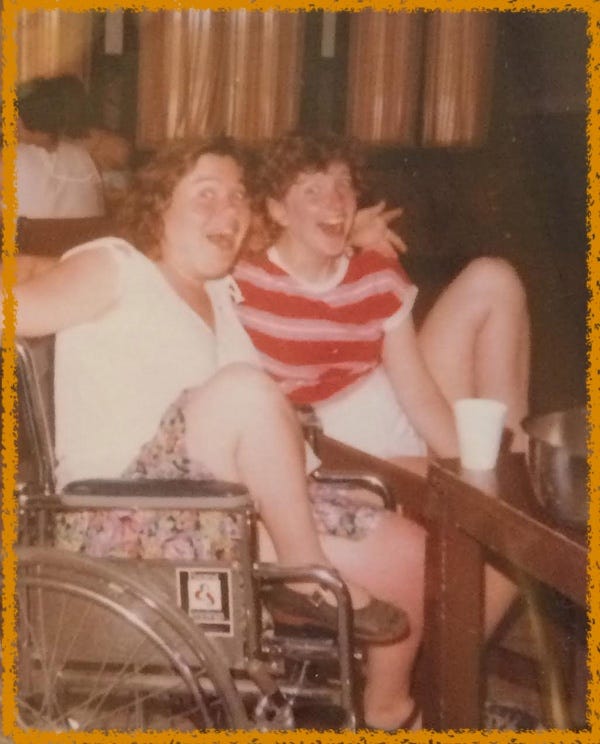
With the late, stupendous Elizabeth Wills, ca. 1984, Virginia Tech, after the annual Theatre Spring Thing softball game. Ah, the energy of youth.
Between my student-loan backed 5th year—where I was a student aide, student taught, co-directed a local high school musical, and took a bunch of education classes in preparation for my Boards—and my first job as a paid schoolteacher, I once again acted in the VT Summer Arts Festival, this time as several characters in Andre Gregory’s adaptation of Alice in Wonderland; I did not house sit for Felice; at some point I got paid for doing a mime show at a nursing home. Possibly this event closed out the hardest total year of my life;
Next, I was, finally, a full-time public high school teacher, a job I got in a rural county where outsiders never came (I told you that story), and taught English 9, English 10, and Speech and Drama, and directed four plays my first year; I also had to host the VHSL (Virginia High School League) AA One-Act Play Competition, both District and Regional (meaning I did all the communications with the other competing schools, by phone, and had to procure all the judges, set the schedules, arrange dressing rooms for all the kids, figure out the lighting, sweet holy mother), in a town with nowhere for lunch so I got our Food Services class to cater (bless Tawana Lee); and I had to repeat all of this the next year while also co-sponsoring It’s Academic and Forensics; and then repeat all that in my third and final year sans the Christmas play and my drama class, instead being given a section of English 12—guess why I quit?;
My next jobs were in my year off (after my first summer of five in grad school at Bread Loaf), where I lived in the country and worked a little catering, did some babysitting, and was a reporter/photographer for the Virginia Farmer, a rural paper, writing feature articles and learning how to use a Pentax K-1000 SE (thanks to my professional photographer friend Jay’s over-the-phone tutorials);
My next job was to be found when I moved back home to Northern Virginia; while trying to get an interview with a school system (my letters of recommendation apparently sabotaged by a vindictive superintendent, is the best I can gather), I worked the weekly afternoon-to-evening shift at Minnieland Daycare for three months until I could land a job…
…which I did, partway into the year as a replacement teacher, at my second and final high school, where I went to high school (I told you that story) where I worked for twelve years, all told in my career maybe 2,500 students, before I…
Moved to NYC and was hired by an educational publisher, an entirely new career, where I still work 22 years later, having helped create (I think) eight full reading programs, Grades 5-12.
Here’s a challenge: if you are feeling a little lost, a little, “What have I even done with my life?”, take an idea from Rick Beato and Miss O’ and perform this service for yourself. Nobody comes from nowhere; nobody does nothing.
So. I’ll wait.
Would you look at that? Yes, you did that.
There is no doubt in my mind, none, that all our youth would be far happier, less depressed, more fulfilled, if they could point to an assortment of work they’ve done with their hands, out in public, something for others—you know what I mean? My god the miles I logged on foot, on my bike, on the boards of theaters, around stores and parking lots, in classrooms and down endless hallways. How did we do all that? And we did—and also went out with friends, did art, built stuff, listened to music, danced, made meals, had holidays with family, traveled, and moved, and moved again, and again.
Reflecting on the nearly ten years now since a dear teacher died
I’m writing an appreciation for a professor today, one who died in 2016, and whose life work was the elevation in adult minds of the worthiness of a child’s imagination. I started thinking of Michael Armstrong last night, without realizing it had been ten years, because I was remembering again how his work with children changed my own thinking about what gets lost as we “educate” our kids, to say nothing of how we are destroying all hope for their lives in America.
It’s what’s happening to the children in 2026 that is really killing me, the horrors of the kidnapping and no doubt sexual abuse and rape happening to brown children in American concentration camps at the hands of ICE. I know I’ve said this, but I finally realized that the reason Republicans never batted an eye as Sandy Hook was because as a party, I fear they do not see children as anything other than commodities, “resources” for war, toys for sex, punching bags, slaves for labor. It’s nothing I could ever have imagined until the Epstein Files. I think most of us still can’t. This evil simply should not be.
I’ve excerpted/edited for this post a letter I wrote to Michael’s widow, Isobel Armstrong, another of my favorite teachers at the Bread Load School of English (and the poetry scholar to whom A.S. Byatt’s novel Possession is dedicated; as of this writing, she’s still going strong in London at age 88). (Note: I’ve removed last names of friends, for example, but kept the spirit.) Writing appreciations is becoming a habit.
March 27, 2016, Easter Sunday
A bowl of magic stones from my travels.
Dear Isobel,
Of course I was just devastated to learn about Michael. And the first thing that I thought to do was to call Mark (who was kind enough to supply your email address last week), and then, of course, Anna (and we are sorry that we’ve lost touch with Ellen). Because that is Bread Loaf, isn’t it? Immediately reaching for community, to share the experience, seek out that support. And Michael was a searcher, a seeker—the finest model of teacher-as-learner I have met. The loss for you and your children is unimaginable, and no letter can assuage it, I know; but I wanted to share some memories with you and tell you something about Michael’s importance in my life.
First off: if I remember correctly my first summer at Bread Loaf, Michael came halfway into the term, co-teaching with or taking over a course for Jimmy Britton and Nancy Martin; and George had you for Romantic Poetry and was quite intimidated by you. So I think it was my first summer, 1990, that Alvin Kernan came to Bread Loaf to give the Elizabeth Drew Lecture on his book, The Death of Literature, to be published that same year. (Or it may have been the summer of ’91, after publication.) That lecture hit me and really got me thinking: Kernan was charming, a good speaker, and so sure of himself—his dismay at deconstruction, his perceived bastardization of the Canon, with a capital C, by the inclusion of women and minorities, etc. (as I heard him), had done, he said, irreparable damage to Literature, and now Academe was the lesser for it; nay, not lesser, but destroyed—something like that. I listened intently and then left and went directly to Jean’s room. She had skipped the lecture but let me recount it to her, and gradually I grew furious in my retelling, pacing, outraged, incensed. A day or so after, someone set up a panel discussion, pitting the traditionalists against the deconstructionists in Barn 5: Al Kernan, John Fleming, Walter Litz, Ed Lueders (who later confided to George, Jean, and me that really he wasn’t on any side) on one side (those are all I recall); and Michael, you, Dianne Sadoff, and others on the other side. People attended, but not as many as I thought should: And the moment I remember clearly, the one that completely transfixed me and corrected my self-doubt in the world of Bread Loaf was a moment when Kernan or Litz or Fleming explained that students were in school to learn an author’s intention in the text at hand, no more, no less (something like that), and this new teacher (to me) from Britain, Michael Armstrong, fairly flew across his desk and declared, angry to the point of spitting, “If YOU tell ME there’s only one way to read a text, I’m going to tell YOU to go to hell!” I was galvanized by this display of passion, especially given the self-satisfied air and calm of the Great White Men of Academe. You, Isobel, leaned in, putting a hand on Michael’s shoulder, and began in that arrestingly beautiful English voice of yours, “What Michael means, …”. I have to confess, in that moment I fell in love with the Armstrongs.
And yet I was afraid—you were both so fiercely intelligent, seeking, and knowledgeable, that I felt I needed to work up to you before taking your classes.
In the summer of 1992—when I decided to try Oxford because Anna, who was teaching at the American School in Turkey, was going there—I got to know Michael. Anna and Ellen were taking Michael’s class (I was studying Virginia Woolf with Jeri Johnson), and Michael was the only one of the professors who dined with us in Hall every morning. We four sat together, generally; one of the first mornings we did—diving into our toast, tea or coffee, and cereal—Michael caught my eye, and Anna’s, and Ellen’s, and declared in an “important” voice: “You know, jam is for the lower classes; marmalade is for the upper classes.” He paused significantly before demanding, “And by ALL MEANS pass the MARMALADE!” I collapsed with laughter. Michael showed only a little grin. Now I was less afraid, of course; and also, all summer, Anna and Ellen couldn’t stop talking about how much they were learning from him.
And so it was that the summer of 1993, I decided, would be my Armstrong Summer: I would take Michael’s class, Narrative and the Imagination (I think it was called) and your class, Women’s Writing from the Margins (or in my typical Malaprop-tinged description to Jean, who was also taking your course, “Women’s Writing ON the Margins”—sending Jean into a fit of laughter). My Malaprop-risk notwithstanding, it was perhaps the decision that saved my academic life: and now I have to tell you something rather personal, but it all connects to Michael in the end.
In the summer of 1993, I was in the midst of a profound depression—the worst of my life up to then, and even up to now, and suffice to say from a myriad of causes—and I really had no idea how I would get through my studies. I could not stop sleeping. Sometime in the second week, my roommate sat me down: “I know it’s not my business, but every time I come into the room you are sleeping….” She was right—and it was lucky I didn’t have a single room. As a result of this intervention, I made the decision to do all my reading, writing, and thinking outside my room—but it had to be in a PUBLIC area, so I didn’t nap. I chose the large Victorian sofa in front of the fireplace in Davison Library. I was there so often, in fact, that on seeing me enter through the door, people sitting on the sofa would get up! “No, no,” they would say when I begged them not to leave, “this is your office.” There was another “office” in the library—on the second floor, by a certain window: Michael’s. Everyone knew that was where Michael Armstrong sat to study and read all day long—a model scholar.
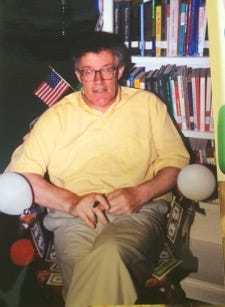
Michael Armstrong was awarded an endowed chair the summer of 1994, and I and other former students decorated his library desk (“so embarrassing”). We refused to take down the Ben Franklin Hardware Store frou-frou until he posed for a photograph by LO’H.
That summer, for some sadistic reason of his own, Michael assigned the class Paul Ricoeur’s Time and Narrative, all three volumes. I was utterly flummoxed by those texts. One afternoon, I heard loud footsteps flying down the library stairs, and turned to see Michael rushing toward my sofa-office: “Lisa! May I share something?” Please do! “I’ve just discovered something! I think I may have figured out something in Ricoeur!” He read a passage, and then he offered me his interpretation. I have no idea what passage it was, or what Michael said, or I said, but it was the shyness Michael showed that affected me; and I flashed back to the passionate man who announced to the most eminent Ivy League English scholars in America, “If YOU tell ME there’s only ONE way to read a text, I’m going to tell YOU to go to hell!” Michael was searching, too: He confessed later that summer that the only reason he’d assigned it was to try to figure it out. How wonderful is that? (I still dip into my Ricoeur volumes from time to time; I pick up a little more every year.) That connection, made almost daily, further incentivized me to keep to my sofa office and thus pass my courses.
The library sofa was a fortuitous choice for another reason: on Michael’s “reserve shelf” to the left of the fireplace sat John Berger’s A Fortunate Man, which Anna loved, and which Michael recommended to me. Despite all the other reading I had to do for both your classes (and not only was I a slow reader, but because of my intense 3-prep teaching schedule and three-shows-a-year life as a drama director, I could never get more than one and a half books read before the start of Bread Loaf), I read the entire book in a sitting on that sofa—one of the most marvelous reading experiences I’ve had, linking—so unexpectedly, but isn’t that Bread Loaf?—all the reading I was doing in both of your courses. A miracle.
And here is where I want to thank you both, Isobel: mine was not a dazzling intellect, as you know; and so, not being intellectually vain as a result, I was the person who happily opened every book talk. There is nothing more unnerving to me than a room full of silent students, so I said the first thing. (It was the astonishing students like Jean and Maggie who said the apt thing—the only thing worth hearing, but not until the end of class. Who has that kind of time?) You and Michael so very graciously indulged my need to start things off, however feebly, and never shamed me or made me feel foolish. I felt I was free to discover and to seek, and that summer of 1993 was perhaps the most fulfilling of my life as a student. Thank you so much for sharing your gifts.
A side note, Isobel: My friend, Hasan, who is a super in my neighborhood including part-time in my building here in Queens, New York City (where I’ve lived since 2003), just stopped by and shared a story that timed perfectly with this letter: He has been driving up to Poughkeepsie, NY, every night for the past three or four months, to visit his Albanian mother, who is dying, slowly, in a nursing home. He cannot bear the thought of her alone at night, and so he goes to sit beside her in her room, where he checks on her, or naps in a chair, or gives her a sip of water. They emigrated here (illegally, of course) from communist Yugoslavia back in the 1980s—it could be a movie. She speaks no English. Hasan, who is 62, is very sad, of course, and so tired. Last night, the floor nurse was being followed around by two little children—a niece and nephew, 3 and 4 years old, and of course they chatter, cheering Hasan very much. The little girl walked over to the bed of an old woman who shares the room with Hasan’s mother, and asked simply, “Why are you sick?” Hasan began chuckling. “Why are you sick?” she asked again. The old woman said, “I’m old. Too old. I don’t want to be here.” The little girl turned to her aunt, the nurse, who was trying to shoo her away, and said, “Why don’t you let her leave?” And Hasan began laughing, tears coming out of his eyes. “It hits you,” Hasan said, “like a cannon, right here,” pointing to his chest, “the way a child sees! And then the little girl, so cute my god, she said, ‘What do you eat? Where is your food?’ And she is accusing—you can tell—the girl look at her aunt, the nurse. And the nurse looked so guilty! Because this little girl sees this old woman is so sad. The old lady say, ‘How old are you?’ And the girl hold up some fingers. So sweet!” Hasan tells me this with tears in his eyes even as he laughs. “And I’m sitting there,” Hasan finishes, “thinking—cursing all the politicians of the world, wanting to give the White House to this little girl, let her clean up the world mess!”
And hearing this story, the first thing that came into my mind was Michael’s sharing of the stories of very young children. I thought instantly of “The Sparkling Star,” which I hadn’t thought of in years. I read the story to Hasan, and we teared up; so sweet. There is simply nothing like the unfiltered language of young children, and it was Michael who taught me to pay attention, to listen to children seriously when they speak and write.
THE SPARKLING STAR
One night I was in bed and I thought that it was a little bit hot. So I ran over to the window and opened it. In flew a star that was sparkling. I stood back and just looked. Then I started to stare very badly. Then the room went dark again and the room was the same. Because when the star flew in it just lit up the room. But now the star looked strange up against my spotty and stripy wallpaper. It was also multi-coloured, it had every colour of the rainbow. The star was glittering and sparkling worse than ever. It looked just like a very very precious jewel or diamond. I walked closer to the star. Suddenly it changed multi-coloured like my wallpaper. Then it started to flicker different colours. Now it blended in very very well. It looked like it was overheating. It flickered in time with saying Help Help Help. I thought it must be like a fish. Because a fish cannot go on land for a very long or it will die, and a star has to stay high in the sky. But if it is on the ground it will die. I was a little bit scared. But I closed my eyes and picked up the star and threw it out of the window.
(See also: THE MAGIC STONE in the same collection.)
I used “The Sparkling Star” in my teaching for years, had hundreds of copies…and of course, in the past two hours of scouring the two remaining boxes of my life in education—one from my 15 years in the classroom, and the other filled with bits of Bread Loaf—not one copy could I find, but I do have Michael’s book. I did find, believe it or not, notes I made from your fabulous Barn lecture on glass, in the summer of my senior summer of 1994—information that helped inform my final Chaucer paper, which I also discovered. Oh, dear.
One wonders why we keep such things, especially moving from place to place—and then we turn over the old stones and find out. Just now, I opened my inscribed copy of Michael’s Tolstoy on Education, in which he wrote: “Keep on finding & re-finding the magic stone. August 3, 1993”. Over twenty years ago: It hardly seems possible. I remember Michael reading “The Sparkling Star” at Gilmore that first summer—one of the best readings I heard there. And here I am trying to re-find that particular touchstone.
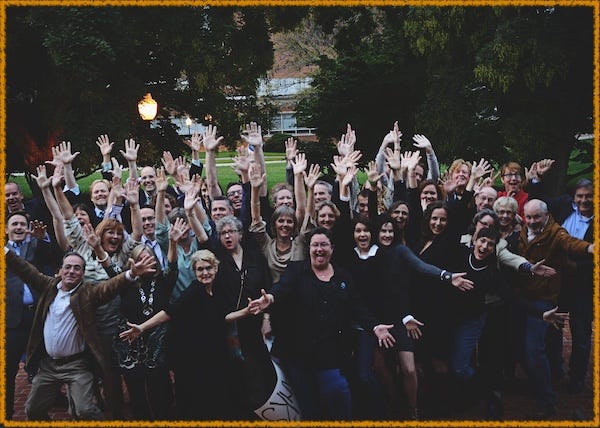
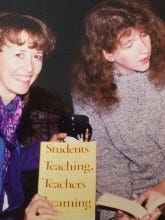
Anna and LO’H, our senior summer at Bread Loaf, 1994. The book’s title is an apt one. We still talk about Michael’s teaching. Really.
Isobel, please know how much Michael was loved, will always be loved, by every student whose life he touched. Please know how loved you are—and how the privilege of seeing your marriage, as well as your scholarship and teaching, was one of the joys of being on that mountain each summer.
Much, much love, and best wishes always,
Lisa O’Hara, Class of 1994
[End letter.]
Another memory, as a sort of coda: There was a professor I knew at Bread Loaf who had an air of self-importance that I found odd in that setting and more than a little silly. I was having lunch with several friends one day, including David Huddle. As this self-important professor walked past our table, one of my friends commented, “I just don’t like him; he thinks he’s the smartest boy in the room.” David instantly looked up. “Well, that’s ridiculous. Everyone knows the smartest person in any room is Michael Armstrong, who doesn’t know it himself.” So many reasons to love David.
The last time I saw Michael (and Isobel and David, too) was at Bread Loaf ca. 2005, on a visit, my last. He plunged into our reading lives. “Have you read Calvino’s Invisible Cities?” he asked. My eyes wide, I said, “Michael, I have, I bought it when I first moved to New York City!” Michael gave me that impish grin, “Of course you have,” he said. It felt like being anointed.
And here is hoping you, dear Reader, have good teachers and friends to appreciate in your lives, that you have the magic stone energy to promote the imaginations of children, the lives of children, and value all the good people. With thanks to all our teachers. Save the children.