“Architecture needs more doodads. (That’s what my mom says, and she’s very aware of her built environment.)”
~ LuAnn Keller, Virginia Tech MFA theater grad student, on a flyer (I wish I’d saved) for a theater workshop she conducted with architecture students, ca. 1986
I always feel guilty when I’m not sharing political rage, but on this Sunday morning celebrating Pride in NYC I’d like to indulge a little in my personal interests, to share with you something on art and literature, knowing it will all lead to politics here in the end (and already has, look at that).
As a fan of HGTV—primarily because (and all due respect to the late Julia Child n PBS and the teaching of cooking and baking) it’s the only network that shows how nothing becomes not only something but also how it will now be inhabited (consumed, so to speak) by real people and for life—I have spent over a decade noticing how interior design became “Pottery Barn-inspired” as opposed to “collected and curated.” With the profound exceptions of Home Town and the lamentedly canceled Bargain Block, designing has become about creating neutral-feeling “spaces” rather than “rooms,” spaces that, sans walls, act more like furniture showrooms than homes. The “neutral” craze of whites, creams, and light wood tones, with the occasional splash of black in a feature wall or trim is not so much a backdrop for, say, colorful art (no walls means no art), as a merely open, blank canvas that will remain blank, if sometimes messier, for years to come. No amount of the show hosts saying, “Look how warm and inviting” will change the fact that every bathroom, bedroom, and living room—sorry, “space,”—is designed to mimic an impersonal hotel. I personally find the designs clean, sure, but sterile; there’s no question that what the hosts (the Property Brothers, Dave and Jenny Marrs, the Kleinschmidts, pick a show) create for homeowners is certainly nicer in the end than at the beginning, everything “updated” and tidy, “tons of storage,” etc. But you can’t help noticing that the people they are designing for will most likely never put any art on the walls that do exist (walls that sometimes get wood slats for “architectural detail” to fill the void), or set precious objects on the shelves, when there are shelves. And I can’t help wondering why.
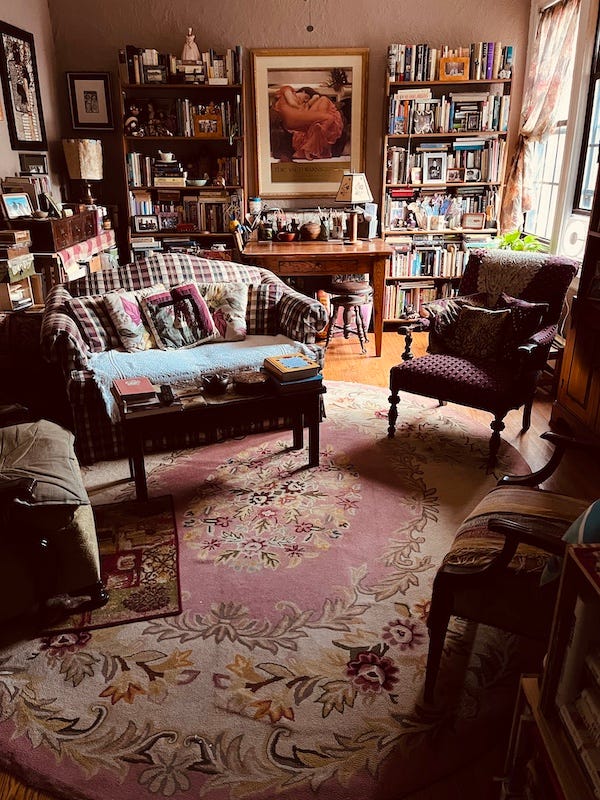
I know I’ve talked about this—people either love Miss O’s apartment on entering or get instant hives; there’s really no middle ground. I have lost my way, I think, in my collecting—now more cluttered studio than a home for hosting, but generally it works for me. This is because there’s not a single book, object, work of art, or furniture piece that is not the center of story. There’s no, “Oh, I bought that at IKEA” only; there was a specific time, reason, need, or person involved. Each piece is a memory, and I can tell you about it. I can’t really understand living any other way, and my way is definitely not trending. So what am I missing?
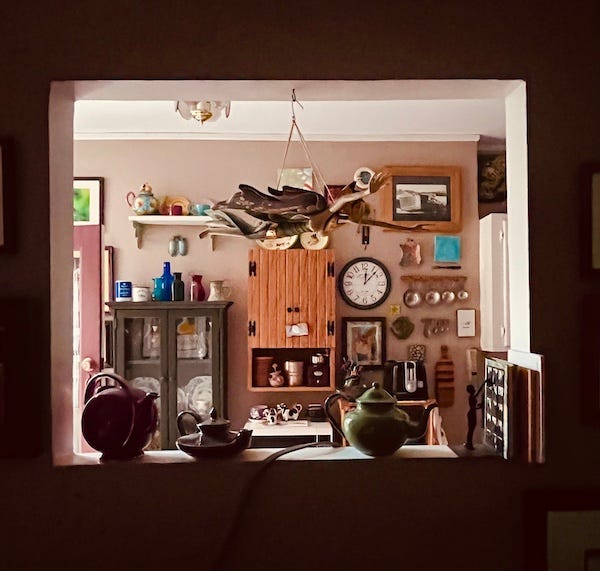
In my YouTube travels, when I’m not watching interviews with favorite musicians, I enjoy occasional episodes of HomeWorthy, wherein an unseen host takes viewers on guided tours of fabulous New York City apartments, led by the owners/renters themselves (who are collectors, designers, and artists). Their astonishing money-to-buy-stuff notwithstanding, even their paint color choices are inspired by, say, some historical place or painting; each object has a story. “I picked this up in a market in Bali in 1973,” a story begins, or “The creator of this piece was was a young weaver who…”; or “I bought these chairs at an auction in 1990, and they came from an estate in New Jersey; I needed a small sitting area, and look how perfectly they work by the window.” The people in these NYC apartments create rooms within rooms, areas for conversation, for office work, along with a bar, a library, hidden storage. No living room has only one function, what with space at a premium.
Miss O’ can relate. I can also relate to all the stories. I would love someone to film me giving a tour of my apartment as if I were a very important person; maybe it could inspire the white-walled, clear-spaced neutral people to reconsider their choices.
Why do I say this? Come on, Miss Judgy O’Judger, I hear you say, shouldn’t people get to choose the way they live? Of course, as long as it is a choice, a conscious one, and brings joy. (I’d like to pause and judge one thing: I loathe and despise random and incessant gilding and calling it style. It’s not political.) What I’ve come to suspect is that the quiet, neutral furniture showroom aesthetic is a direct response to the little device we hold in our hands, the overstimulation that is doom scroll chic. They can look up from the screen and see blessed emptiness. I think even trees are too much for people anymore, and that’s just tragic.
In my travels around my own doom scrolling, I saw this video on Instagram the other day:
Not only does this analysis acknowledge my questions, it also affirms some of my suspicions and adds more to my understanding of the way people live now. Here’s a comment on this same video:
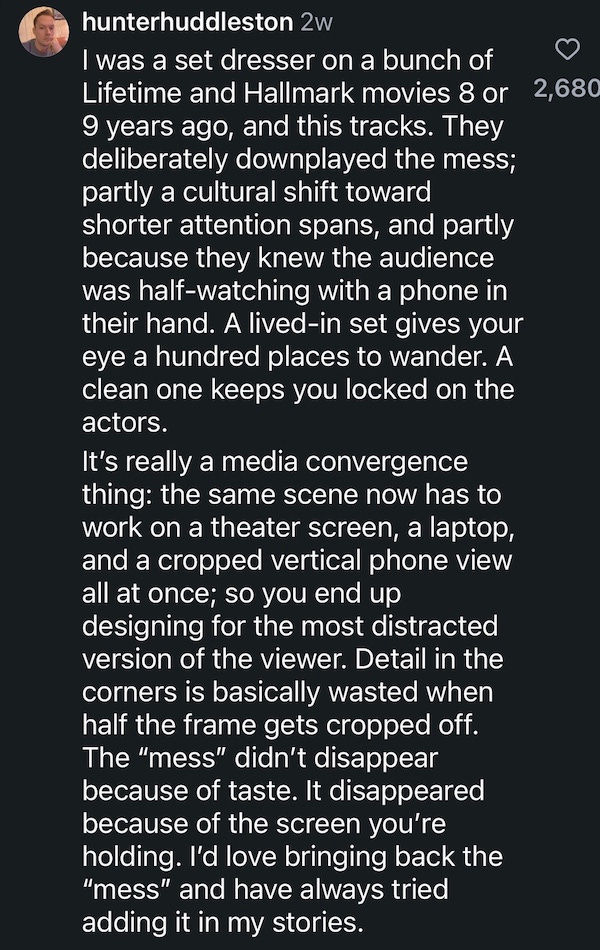
So I can see the two-screens, various devices thing, the shorter attention spans of today, as part of this. But I got to wondering more about the role that story plays, or doesn’t, in our current culture. I know streaming and binge watching of fictional shows is wildly popular, but the reading of fiction (to say nothing of poetry) has dropped precipitously. I look at our educational system to point one finger: Common Core State Standards for ELA (English Language Arts) dictate that by the end of elementary school and into Grade 12, all reading in language arts classes should be 70% nonfiction.
Who decided this? I’ll tell you who: corporations (aligned with Christian Nationalists—oh, politics, are you never not around?). Why? Because the reading of fiction—even audio books, which is totally relevant as reading because humans were oral-based storytellers for millennia, and reading print has only been fairly commonplace for a century—creates empathy. As a student, for nonfiction I recall only humorous essays by Twain, say, or philosophy by Emerson and Thoreau; as a teacher, MLK’s “I Have a Dream” and Elie Wiesel’s Night were about it. The rest was short stories, novels, poetry, and drama. And here I am today, a big, educated, worldly heart. Fuck that?
Here’s another Instagram post on just this educational issue, and I could not agree more:

What the corporation head will say is that, today, they need readers who can process data. (Gee, what did we ever do without…data?) They need “readers” who can think critically about complex scientific, historical, and social problems.
They are lying.
What they really want are bored drones who generate revenue for invisible shareholders. They want brains that don’t work, eyes that don’t see, hearts that are empty. Lack of compassion makes workers easy to control. Here, buy this device, watch this show, hell, watch two or three at once. Wear beige. Turn all your books so the spines face the back. See how pretty that looks? Punch that laptop. (I learned all this from reading the Aldous Huxley novel Brave New World as a sophomore in high school. Dangerous, see?)
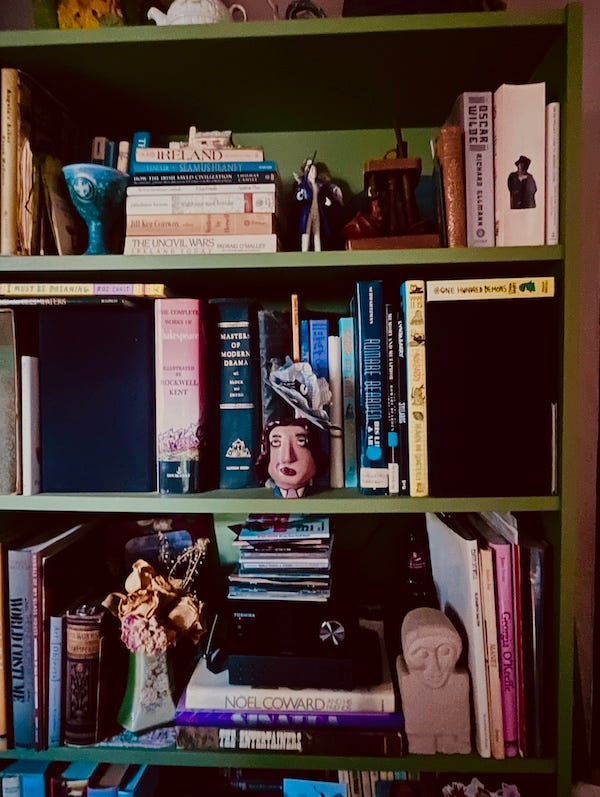
I know I’ve said this before too—I’m old; I do a lot of that—but I’ve read (!) that fewer and fewer people have physical libraries in their homes, the wisdom being that if you’ve read it, why do you have to look at it? Books only collect dust. But I read some study that showed that people who have libraries (spines out) are frankly smarter than people who don’t. The reason is not based on IQ, but rather on the fact that seeing the books reminds your brain of what you read, when you read it, and what it was about, and as a result, neurons fire. You are simply more alive.
I think this must be the same for everyday living in homes (not spaces) with collected objects. Each picture, rock, vase, sculpture, card, tea tin reminds me, for example, of where I got it, who gave it to me, why it has meaning. I create and recall life narratives in my mind just by living in my house. You can’t do that in quite the same way with white walls and warm wood with an empty countertop, with built-in shelves that hold a white ceramic vase from Pottery Barn and maybe a plant next to a phone charging station.
This really isn’t about aesthetics. It’s about what happens to our souls when our minds and homes are sterile. For people who are poor, who are just starting out, who are scraping by, none of what I’m saying sounds like anything but privilege; but I’d argue that the same results of emptiness apply to anyone.
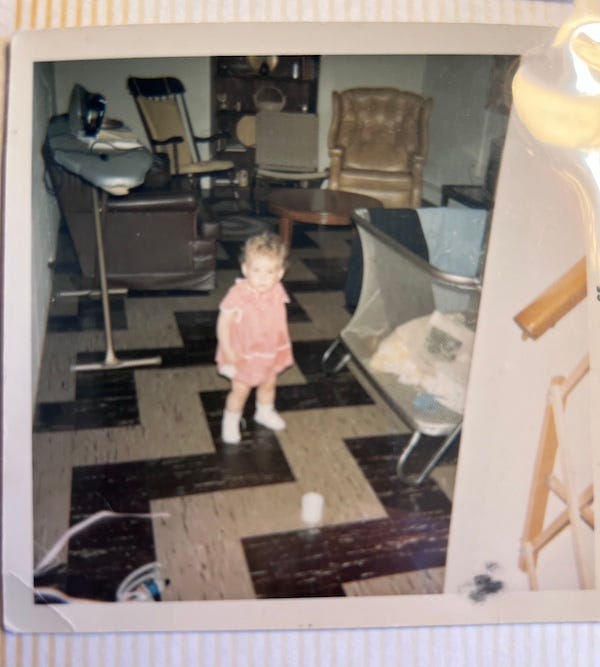
When I was a tiny child (the year the Voting Rights Act was signed into law), my parents, Bernie and Lynne, scraped up $50 for a house downpayment, because if you had a regular labor job (and were white—here comes more politics), you could do that. The house’s downstairs walls were white cinderblock for many years; the floors tan and black asbestos tile, no rugs; we had a round red-wood coffee table my mom bought when she was in the navy, and a couple of mid-century modern rope chairs. In the first year, together they bought a vinyl-covered loveseat, a wooden rocker, and an vinyl-covered recliner, and a small black and white TV along with a pressed wood end table for a stand. And that was our living room for at least five years.
But what I remember more than that is the portable hi-fi and record albums always playing on it; the Puerto Rican Pottery ashtrays, the diablo mask, the black Wedgwood tea set, the Israeli brass ashtray, the painting of a watchmaker upstairs, and volumes and volumes of books (the first thing they spent serious money on was a big custom bookcase for the otherwise empty upstairs living room, an odd feature of their house model)—all things Lynne had collected as a single woman in her twenties. I asked about all of them. I learned their stories, and also, then, the story of Lynne’s life before me, before marriage and children. (By contrast, my dad’s entire life fit into a small brown suitcase when he moved to marry my mom.)
It’s the objects, the books, the stories—it’s not about stuff for its own sake; not about constantly clean surfaces and a living room that looks unused and “ready for entertaining” in the abstract. It’s nice to have a tidy home, but a home—not a space—is to live in, to arrange memories, to build new ones. To be alive in.
A library, even a small one, matters. Novels are important. Poetry is important. Having volumes around you makes you a better, by which I mean a more feeling and aware, human. Remembering that our lives—all our lives—are connected stories is key to our humanity.
Our interiors reflect our interiors, if you see what I mean. Both interiors inform the way we curate our democracy, our earth, too. It must. I know I can’t control the world, can’t stop all the atrocities, but I can curate my stories, maybe share them, hope to spread a little encouragement for all of us to do that for ourselves, for each other. If you want.
Sending love and hopes for a better tomorrow,
Miss O’