A day in the life at the end of the world
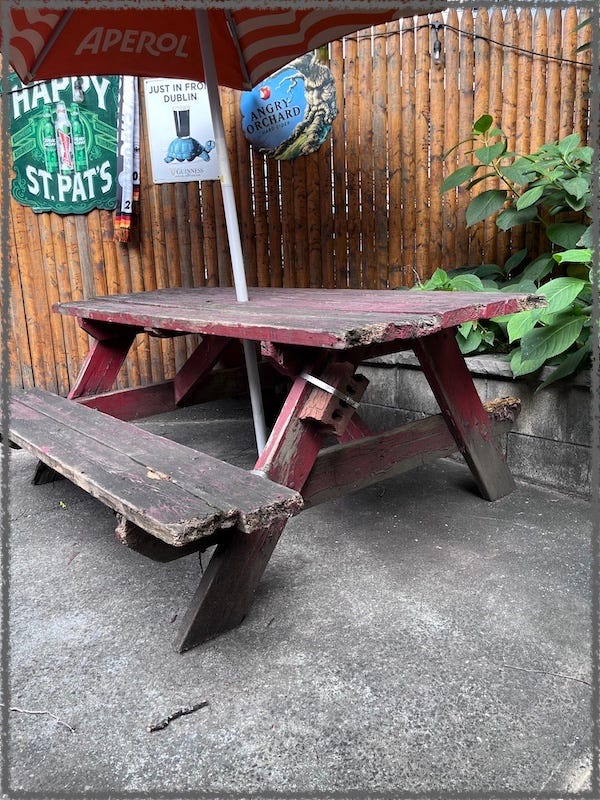
Over the past couple of weeks, I’ve found myself going over to Jar Bar, a local place nearly 100 years old (in location if not name) I’ve seen from the outside all my years here in Queens, but had never gone in. Learning a neighbor of mine is tending bar there some evenings, I started going, and have been over maybe four times, including a couple of weekend afternoons in the garden, where I met an Irishman whose sister—Marie of Dillon’s, that closed ca. 2006—was a bartender I’d known and loved. Jar Bar is filled with fascinating if sketchy characters—pool players, depressives, tightly wound young men, fighting old couples, laid back tokers. I listen; I watch. I have a pint. Here, I contrast the darkness of this dimly lit local bar with the world of The Alcove, a wonderful Colombian-infused bar and restaurant full of light and warmth I’ve frequented on the other side of Queens Boulevard for all of its eleven years, where everyone gets hugs from the owners. And while both places learn your name right away, the vibes could not be more starkly different.
Have you seen the movie Blue Velvet? At the movie’s end you have to accept, fully, that Isabella Rossellini and Laura Dern live in the same town, and that Kyle MacLachlan is equally drawn to the Dean Stockwell underbelly and to the domestic idyll that is the promise of marriage in the suburbs. Just so, I’ve found myself drawn into a sort of underbelly for heavy drink in my neighborhood as well and warm and light-hearted vibe of fellowship and food, and it’s hard to believe it’s the same town. Oddly, I find I enjoy both worlds and seem to navigate them easily. That’s Miss O’s Queens.
For my gorgeous Sunday on my long weekend off though, I eschewed an afternoon pub crawl for a morning at the Grand Bazaar Flea Market on Columbus Avenue. I stroll from booth to booth, tempted by interesting hooks, vintage jackets, costume jewelry brooches, and pottery if you can find it; I noticed a young white couple looking at Jacquard woven silk square pillow shams—from their conversation, I saw she wanted pink—or at least she wanted color (“I can see from your face you hate it,” she said to her husband, who did not disagree and nor did he help); even the dark blue, which they both seemed to like, was too much for him, and they agreed the brighter blue was a maybe. I spoke up (having said hello to the importer, whose wares I’d bought before): “I love that dark blue,” I said, and you saw this breath enter them both, a confidence. “I don’t mean to intrude,” I added, but the woman said eagerly, “No, I want another opinion. We just want to find a second one,” and I suggested they find a complimentary one instead, picking up the red accent, or the gray. “They don’t have to match.” Revelation! I’d heard them worry to the vendor about the right-sized pillow form, and so I said, “I put my covers over existing pillows; change it up.” The young man said, “We could do that,” and I felt his doubt lifting. “Enjoy your day,” I said, leaving, and they were no doubt relieved that old lady wasn’t going to follow them home.
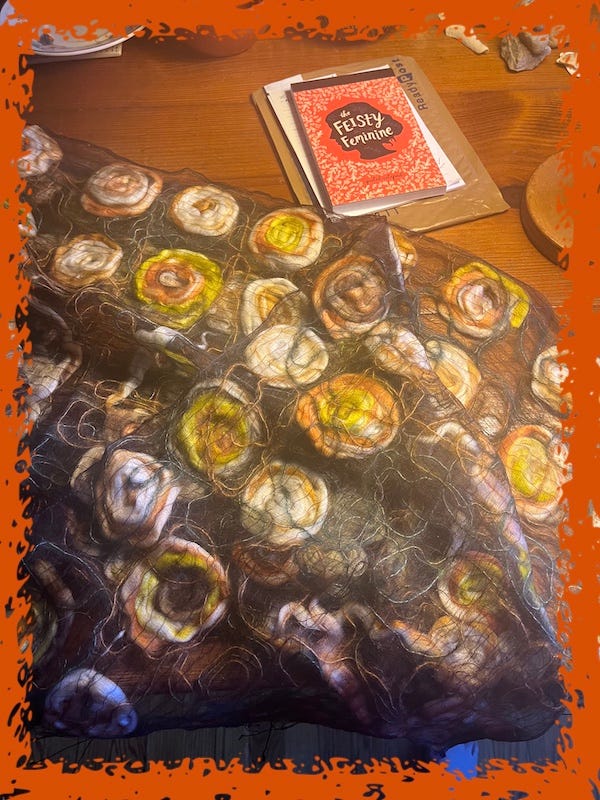
At another booth, an older Indian couple showed beautiful textile wares, and I’d been circling around their area and found myself loving a couple of scarves, especially one felted item. “These are scarves sold in museum gift shops,” designed by a woman in India, the woman said, and now they are here in a NYC flea market on clearance. I said to the woman, who helping two Black women buying a scarf for a birthday present, I didn’t interrupt, but sifted through two scarves; I realized there was a really a combination—the colors of the silk and the style of the felted, and I found it! When she came over to me, I said, “Here’s what I did,” and I showed her how I found the one I wanted, and her eyes saw and she said, “You created a middle,” and I said, “I have to tell you I feel sort of ridiculous buying a scarf with the world as it is,” and she instantly said, “Terrible things, terrible,” and I said, “But I guess we have to keep putting beauty out into the world,” and we agreed we do.
Following the market, I walked toward the American Museum of Natural History, where as a resident New Yorker I get in free. En route I saw the lavender lady at the sidewalk market and bought a pound of dried lavender flowers (I put them in sachets of my own and try to save my wool from moths). At the museum desk, I explained I only gain entrance to use their facilities on flea market Sundays; he refused to accept my dollar and handed me my ticket.
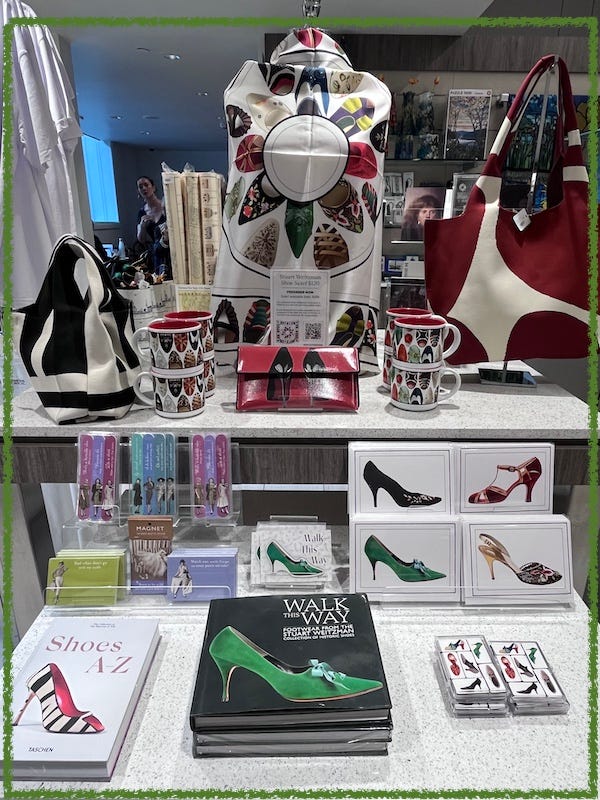
Once relieved, now where? I decided on the park, and en route I saw the New York Historical Society, where I hadn’t been in a few years. I first tooled around the gift shop, which merch makes it the best place to see what’s on exhibit, but there was an exhibition not featured there, as it turns out, for obvious reasons when out of context.
Black Dolls:
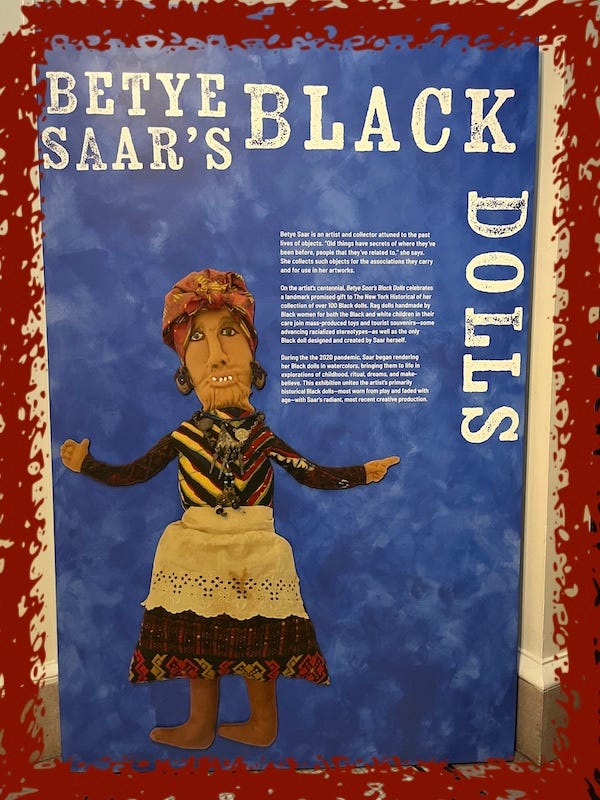
Assemblage artist Betye Saar, who died July 26 four days shy of her 100th birthday, is featured in an exhibition at the New York Historical Society’s second floor.
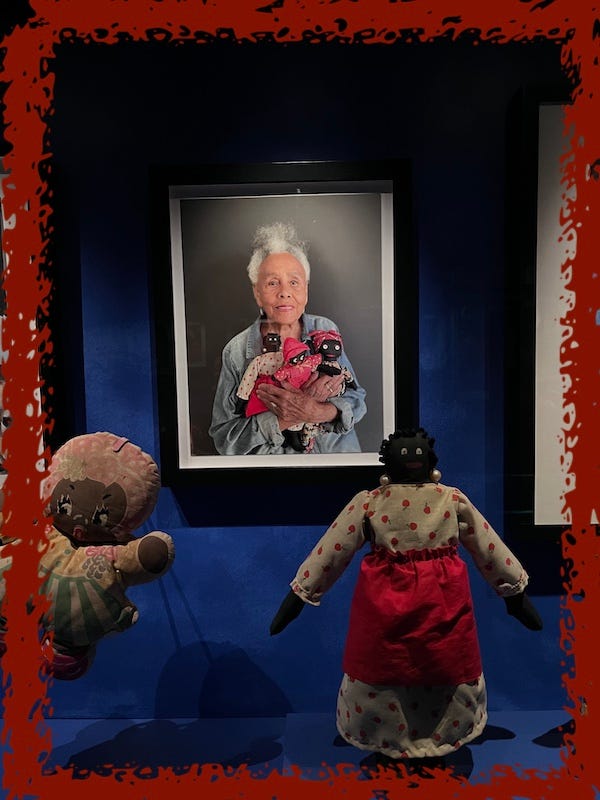
It was a small, beautiful, unnerving, unsettling exhibition for me; I also have a black doll:
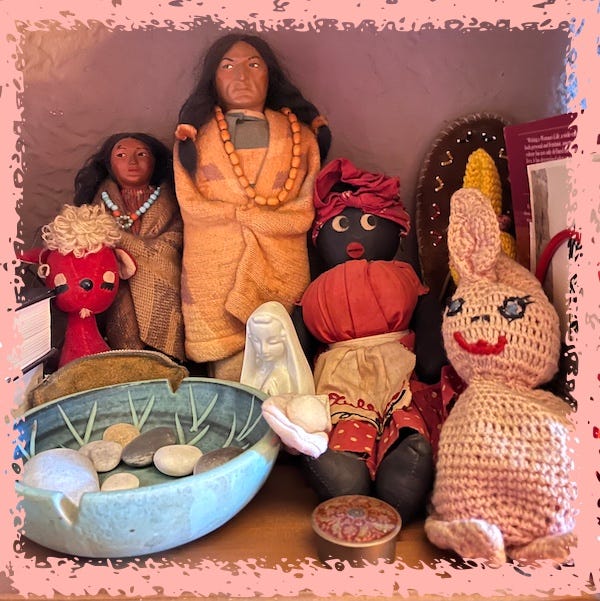
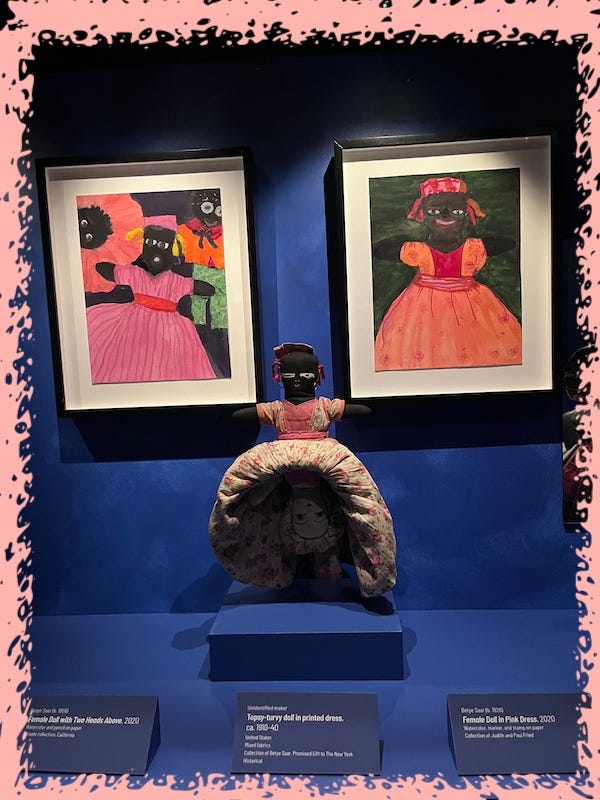
I was in tears throughout the exhibit, and I’m not sure how to put into words why—all this evil racism, the denial of Black little girls having pretty black dolls to call their own, without stereotyped big white eyes looking sideways, forced-laborer head scarves and aprons. More than that, it was Saar’s art, her paintings and collages that reimagine these dolls with love and joy, that moved the shit out me.
Heading down to the first floor, fairly gutted by now after three other floors of exhibits of all kinds of NYC and American history, I happened on an exhibition of women’s shoes and paused there before leaving. I’d no sooner begun looking than three early-college-age young women approached (whom I’ll call Elle (who was Black), Jaye (Chinese), and Cece (Indian or Pakistani, I think)), studying advertising and given the assignment to visit a museum and ask people what brought them to the museum, what emotional reactions they had, and anything else the interviewee wanted to share.
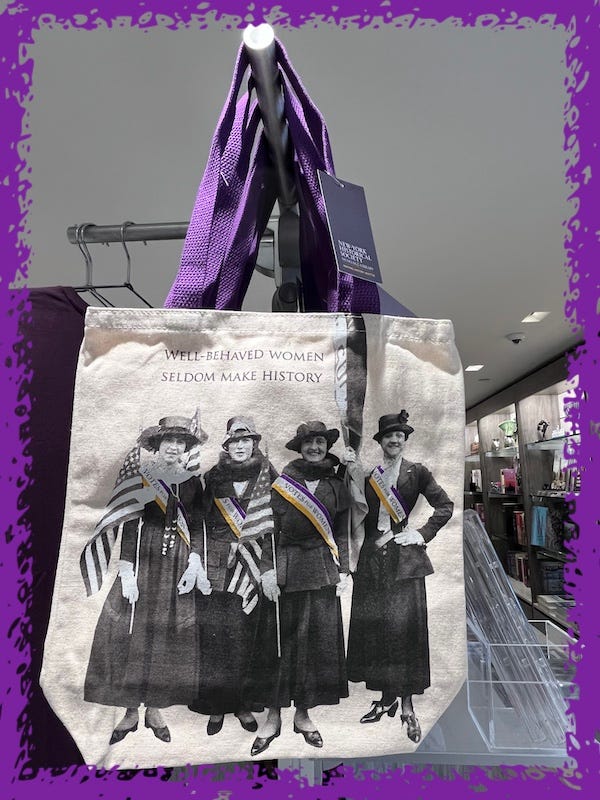
Elle said, “I saw your bag, and your necklace, and I knew we could ask you.” Schoolteacher vibe.
I said a lot of stuff, as you can imagine—they recorded me: I requested that in their careers they market curiosity instead of consumption; I said you can’t have emotional responses if you come into a cultural place with an agenda; I celebrated wandering; told them I loved the doll exhibit and about my own Mammy doll, how maybe my tears were coming from the artistry of Betye Saar, surely, but were also tied up in history—the unfairness, rank cruelty of slave systems, and that NYHS balances all our past pretty fabulously, I think.
I then pointed out the shoe exhibit, where we were standing, gesturing as I responded, “All this is foot binding, you know, just as surely as the literal binding of the feet of women in China,” heels so high you can’t run from an attacker, shapes that destroy the health of our feet. “But they’re beautiful,” I said, “I love looking at shoes.” You live inside these contradictions all the time.
I kept having to shift us out of the way so others could get at the views of the shoes; I took the students’ picture and we did a selfie for Elle. She put her information into my phone, and I sent the photos I took. I haven’t heard back, so I don’t know if she got them. (Telling my friend Colleen all this at dinner at The Alcove last evening, she said, referencing her grandchild, “Oh, she won’t get back to you, and if she does, it will be in a month. That’s how all the kids are now.”)
Finally, I mentioned to the gals that my next career plan was to put a sign around my neck, “ASK ME A GRAMMAR QUESTION,” and sit on benches around the city. Do you want to ask me a grammar question? Cece jumped for it. She wanted to better understand the semicolon. I WAS IN HEAVEN! Consider three versions of these same clause combinations, I said off the cuff.
Gloria Steinem was a great activist. [period] My mother never spoke of her. [period]
Gloria Steinem was a great activist; [semicolon] my mother never spoke of her. [period]
Gloria Steinem was a great activist , but [comma but] my mother never spoke of her. [period]
Cece, Jaye, and Elle said, “Ohhhh…,” as I demonstrated the contrasts: I asked them to consider the first independent clauses separated by a period—there’s an underlying weight to the (dis)connection which may or may not get explored. In the second example, with the semicolon, there’s an opening indicating the writer will say more, and this is created by suggesting a connection with that punctuation. The third, with the comma and coordinating conjunction but, has a kind of softer quality, almost dismissive or suggesting something that is part of a pattern that is explainable. All of this was to say: the meaning you want will dictate the way you punctuate and connect the clauses. It depends on what you’re going for.
From their reactions, I saw that it’s possible I taught them more about writing in that little “off the record” lesson than they’d had in all their years of school. Possibly not. But I had the time of my life. (I later heard a man in my neighborhood later talking on his phone sitting on a stoop, saying, “I’m doing the Socratic method here, just asking questions,” and I realized I’m no Socrates. I just love to lecture. Direct instruction is underrated. Look at all those lightbulbs.)
So the event of that interview had me looking at life in America: White people use periods; Black people use semicolons; moderate/liberal white people use the , but. Do with that observation what you will. When it comes to meting out justice, to changing this world, to making whatever it is to create our new world, what are you going for?
On the first floor, before leaving NYHS, I looked at an America 250 exhibition (and that this nation had no celebrations at all, none to speak of, is beyond depressing, and also an opportunity), featuring the contrast of slave and free in many Revolution art pieces. Among these installations was a booth that displayed a facsimile of the Declaration of Independence, and along the bottom were three clear tubes partially filled with little orange rubber balls, balls which could be procured from a box on the side. The balls were for taking a poll: LIFE – LIBERTY – PURSUIT OF HAPPINESS—of the three, where do you place your ball?
I chose LIFE.
Most balls were placed in LIBERTY, which I rejected because I don’t know how anyone defines that. All I know is the Fifth Circuit Court of Appeals in Mississippi, under a Trump-appointed judge, this week ruled that no citizen has the right to clean drinking water, and that the government has no obligation to inform anyone about the status of water quality. Full. Stop. And if we aren’t entitled to water, we get no life. Full. Stop. So what are we even doing in this country? No Life, no nothing.
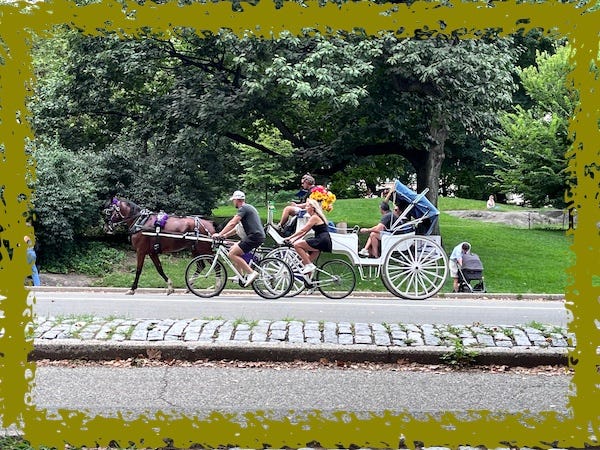
I continued my day with a walk through Central Park, including an extended bench sit to watch the scenes. My friend Colleen called as I sat there, and I ended my day meeting Colleen at The Alcove (I walked through the park to 57th Street to the N Train; she walked from Astoria. We arrived five minutes apart). Open windows, margaritas, chips and guac, sliders and fries. Hugs from the staff. Delicious.
We walked Skillman Avenue to the park, where the media swap tables are, and sat outside to watch the coming dusk. Magical light, my favorite time of year for light, hinting at the fall to come. Hmm.
We don’t have much time left on earth, our planet of hideous contradictions, of indescribable beauties; it will never be more temperate or lovelier than it is right now, this second. I’m trying to take it all in. I wish I knew what else to do.
Love, love,
Miss O’