As a kid, I remember my mom’s ca. 1960 “portable” hi-fi playing music a lot. My parents sought out music, even my mom, Lynne, who was admittedly tone-deaf and limited to smooth voices, like Harry Belafonte’s. (She was horrified by Bob Dylan, Tom Waits, Janis Joplin. “Have you heard of Adele?” she once asked me and my brother Mike, disgust in her voice. Mike said, gently, “Hush, Mom. She’s a genius.” Lynne looked at me. “She is,” I explained.) She really hated “country” music, but my dad, Bernie, loved Eddie Arnold; they both like Johnny Cash and Tennessee Ernie Ford. We all loved Nat King Cole and Burl Ives. It’s hard to imagine now, I guess, a family sitting together in a play room on a rainy day, the parents with beers, and four kids aged 5 to 13, sitting and playing with blocks, listening to Irish and American folks songs sung by Big Daddy in Cat on a Hot Tin Roof, but we did, and we all remember it fondly. My brother Pat and I to this day, 50 years later, will every once in a while break out in “Mrs. McGrath, the sergeant said, do you want to make a soldier out of your son Ted?”
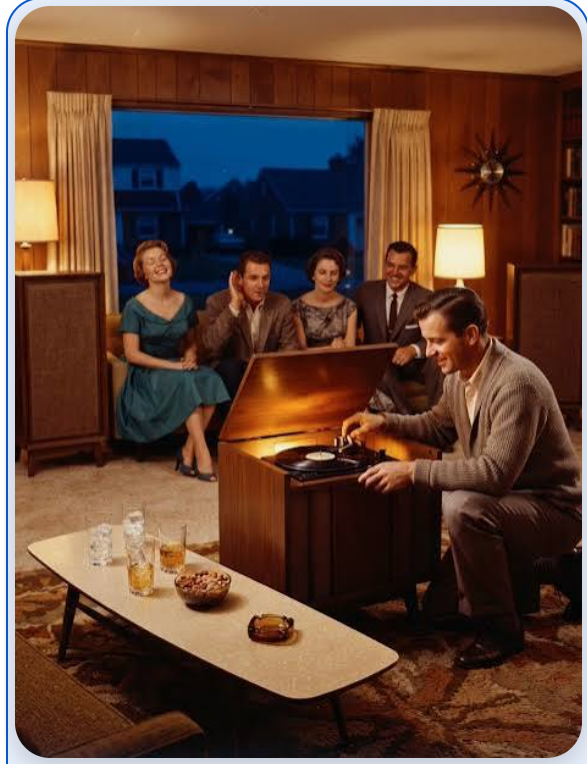
This internet photo is not quite it–my mom’s was more compact and was placed on a table–but it’s the general idea. All us kids learned how to work it.
Touchstones—the noises of growing up in the O’House, playing games, building forts, making cookies, and fighting, and there was always a soundtrack. I don’t turn on music enough. I’m listening to a shuffle of music as I type, and it’s nice.
Sitting out in my (now) dad’s yard the other week, in the swing he and my mom lived in for a few hours most days in her last years, watching clouds—and I have felt this for years—it’s been far too quiet. The chatter of birds notwithstanding, I’ve felt weird outside, something off. This past late September, during sunny and warm days, I realized what it was.
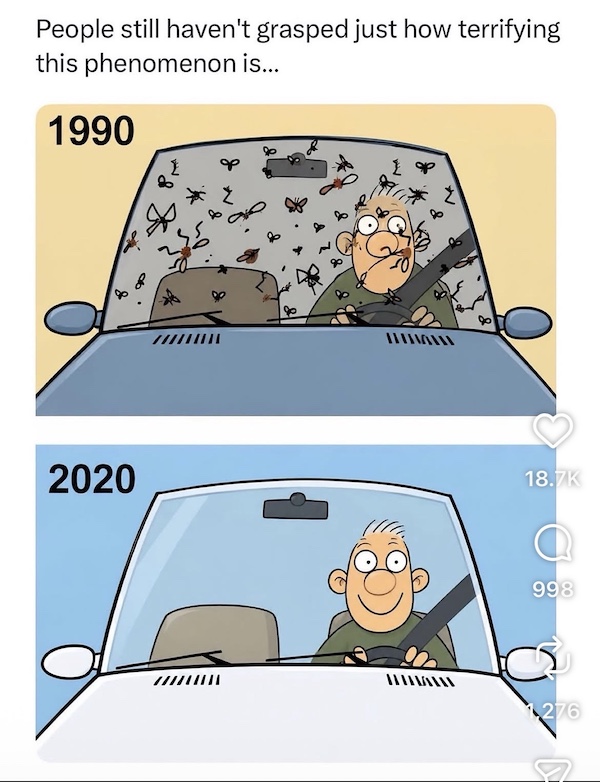
Back ca. 2012, I drove my mom’s truck to rural Central Virginia to see friends, as I did every summer, and realized for the first time since the 1980s I hadn’t had to stop at least twice at a filling station to scrape bugs off my windshield. I hadn’t had to scrape the windshield once after four hours driving through wilderness. Jesus. What have we done?
I am lonely for insects. Gnats, chiggers, crickets, grasshoppers, moths, butterflies, flies, mosquitoes—all the creatures of earth that vibrate, snack, annoy, announce their presence, and make being outside an athletic even in micro movements of swatting. I never thought I’d think of insects as a kind of hug. But they are. I miss them. The earth misses them.
This isn’t about aesthetics.
Music is another kind of hug, I think—and in this world of noise, where music might be a warm, nurturing thing, it seems to come off as another distraction. TVs, phones, screens of all kinds—sitting undistracted by visual stimulation, listening to music quietly or even present to it in the background while cooking or cleaning seems impossible to imagine for people, let alone sitting as a group of friends or a family, truly listening.
Music is not a luxury; it’s life.
My brother Jeff and I were talking about the reaction videos popular on YouTube now, where influencers pretend they are hearing a song for the first time, and stop it every five or six notes to comment, without listening; their individual facial expressions now are almost parodies of one another—the wide eyes, the closed eyes of supposed contemplation, the hands up-mouth open “wow.” These used to be fun, back before they became shows for sport and clicks. Jeff is like me, screaming at them when they hit stop without listening at all, and moving on to find another one. We’ve also noticed that they all seem to “react” to the exact same playlists out of millions of possible songs and thousands of artists: Karen Carpenter, “Superstar”; Jim Croce, “I’ve Got a Name”; Dolly Parton, “Jolene.” It’s silly now.
Do I sound grumpy? Yeah, well. It seems the loss of insects and the loss of shared songs (and high school dances, for that matter) are connected for me—something about a hug, a warmth of hum and thrum, vibrations of life—replaced with a silence that feels like solitary confinement.
Because he is so deeply, irredeemably amoral and stupid
Hi, friend. Your Miss O’ awoke this morning, the first day since Saturday, October 3, on her own without an alarm and feeling not unwell. After ten days nursing a nasty respiratory infection, I found myself on waking thinking of a title, “Why the Sea Is Salt,” and another, “Snow White and Rose Red,” and visualizing a filmstrip called “Pandora,” accompanied by a cassette tape or record on which played a high “BEEP” when it was time to manually change the picture cell. (I was fortunate enough to be not only a student using such machines, but a teacher who used them even four or five years into my job.)
The titles, I realized, all came out of a foggy memory of fourth grade, the year I had a depressive young teacher named Miss Shelburn, whose unusual blond streak of hair and blotched skin meant, I realize now, that she had Vitiligo, a condition where the immune system causes lighter skin pigmentation to show up in patches. She spent most of her teaching time sitting at her desk, slightly slumped over. She liked that I read aloud with so much expression that I didn’t notice I said “lives” with a long i when it should have been “lives” with the short one, a mistake that made her snort, the only trace of a laugh in her I’d seen, more than worth a little personal embarrassment.
Miss Shelburn’s one day of true enthusiasm came the day she wheeled in a television set and turned on Princess Anne’s royal wedding live from England, and we watched it all day. (We watched a lot of television that year, Public Television, especially The Electric Company (starring Rita Moreno and Morgan Freeman) to help us learn the metric system, for all the good that did, but hey, Rita and Morgan!) Miss Shelburn was enchanted by this fairytale wedding.
That year of the stories, first, those myths and legends of salty seas and fairy tale castles and locked boxes, that came into my waking world this morning, and I’m not sure why.
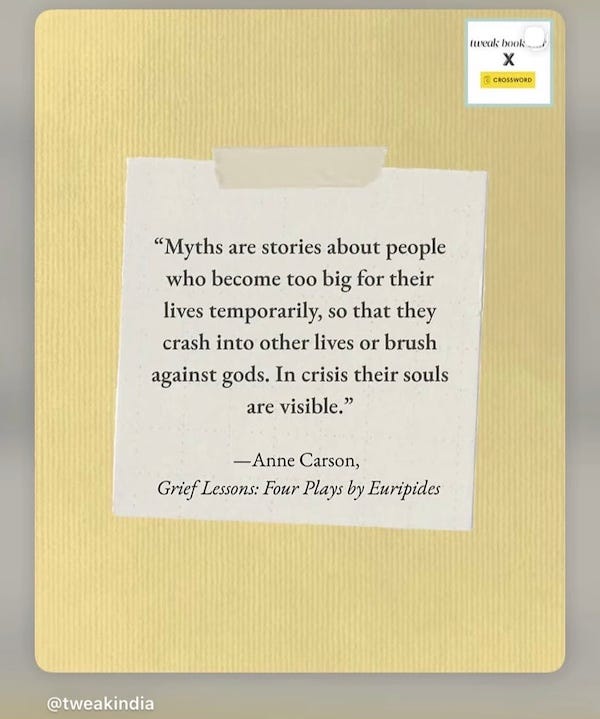
Anne Carson won the 2026 Nobel Prize for Literature. I’m still thinking about this quote. Have you ever felt too big for your life? I have. Temporarily. So I moved to New York City.
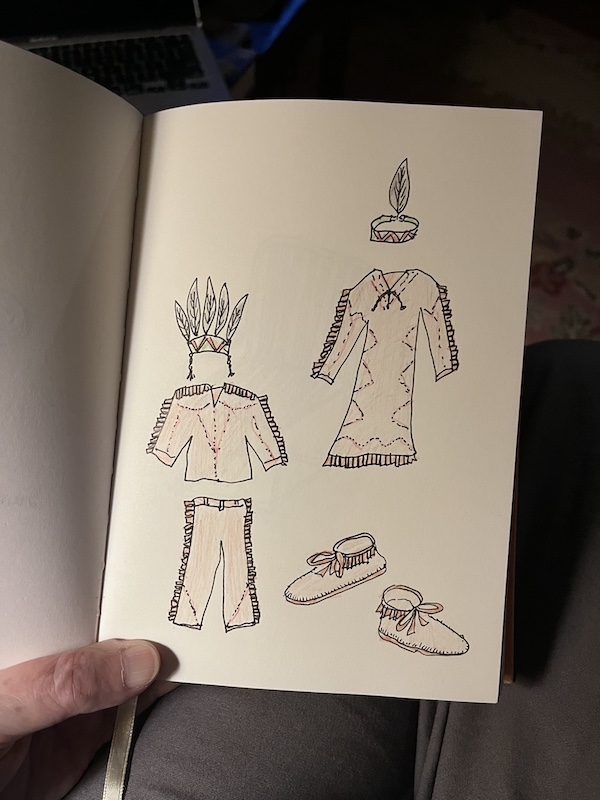
Fourth grade was also the year we learned American history, going so far as to spend a day out in the cold mist in “Pilgrim” clothes, and I think some “Indians,” in paper hats and no coats, roasting potatoes in a pit poor Mr. Westerberg, the custodian, had to dig. I mostly remember flying around on the blacktop looking out at bare gray trees and suburban houses, trying to imagine a log village and pretending this was fun.
One Thanksgiving my mom gave these costumes to me and my brother Pat. We went “hunting” in the backyard. Watching Westerns, Lynne taught us to root for the Indians.
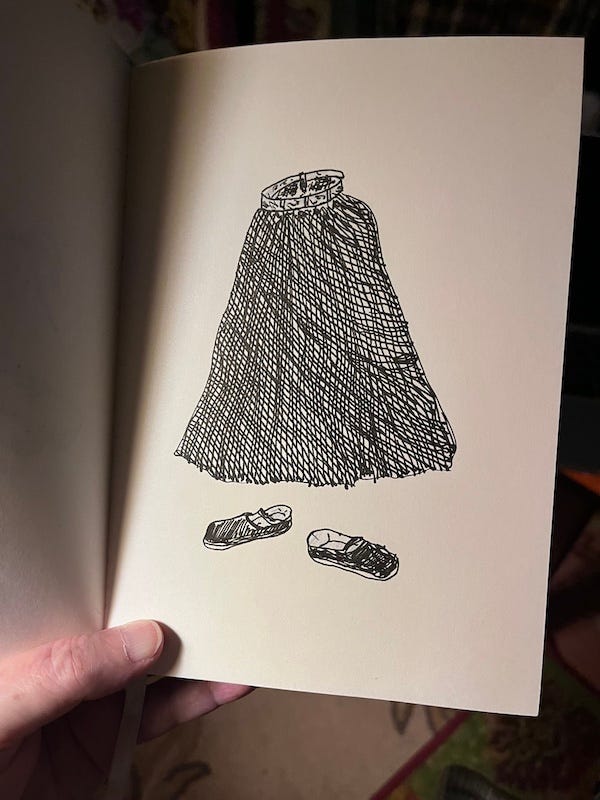
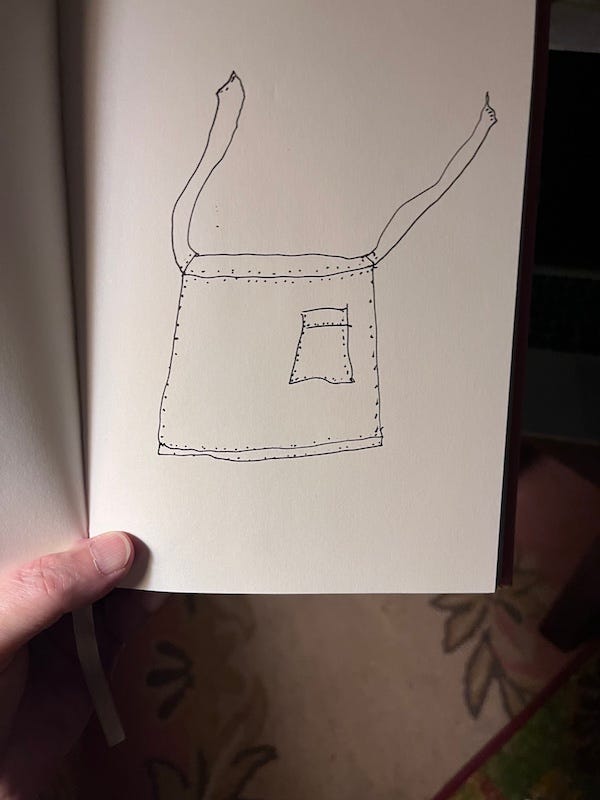
I still have the white Pilgrim apron my reluctant mom, Lynne, sewed for me by hand, which I wore over her 1950s tiny black and white check skirt, long then; a skirt I wore again, now knee-length, for the Junior Variety show in high school, and which we donated to the drama club along with several of her other skirts and dresses.
[We interrupt this letter to note that a search for the apron for a photo portrait was unsuccessful, because like a dope I moved it out of its drawer of 20 years when I reorganized some drawers this summer, but prayers to St. Anthony, the patron saint of lost objects, have been dispatched. -ed.]
The apron is a lot more gathered and nicer than this. As much as my mom hated sewing, she did a lot of it and all by hand, because the making mattered.
Fourth grade—for all the weirdness of Miss Shelburn, and my burgeoning hormones returning my hair to natural curl, and Billy Beard accidentally smearing India ink on my only white blouse (this being the time when art teachers let children use supplies like India ink), and learning about the happy slaves in the fields of our Southern plantations through the Ginn Reader (I wish I were kidding)—was the time when I think I discovered the real magic of fiction. The Scholastic Book Fair meant something better than candy. I could read whatever I wanted.
It was the 1970s, and all the girls and women, even teachers, wore miniskirts. My mom wore slacks. Both meant liberation.
Unfortunately for the species, far too many men do not experience women as beings.
We are [checks notes] “whores.”
How is this still the American female narrative for American men?
I’m sick of it.
I’m sick of stupid.
I’m sick of men.
We are bored.
There is not a moment of my life I have regretted living and sleeping alone. Not a minute.
All this comes to me full force from SNL standups and rape allegations and once more, with feeling (no, really, this time we mean it), “no more frat parties until further notice” and promises to “investigate.” Until the coup, of course.
How in the name of everything sacred in the universe is THIS where ostensibly sentient humans are?How is this the best we have to offer our creator? (How pathetic is it that a powerful man can only feel smart when represented by that sort of female?)
All that off my chest, it’s time for my nighttime antibiotics, inhaler, and Flonase, as I gratefully turn toward my very own bed in my very own home surrounded by collected things imbued with love and memory, a sacred place, free of collective human-made stupidity and frail-egoed men, and lift from my bedstand my reading glasses and a novel into which to sink, to sleep perchance to dream.
Americans, as if it’s not enough to have loved ones facing terrible illnesses and personal tragedies, we are daily perpetuating a hellscape for the nation, all of our own making. Bigotry and hatred and mass murder and rape cannot be The Story. We’ve done that to death. And it sucks. We have to write another story. Write your chapter. Have a reading. And Abolish ICE.
Sending love and reading among the evils (unleashed on us by men),
Miss O’
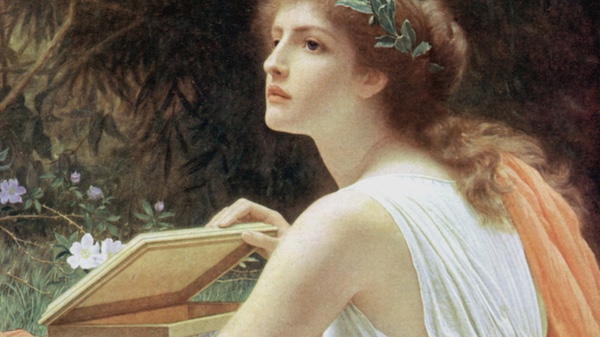
“Pandora. Pandora (the ‘all-gifted’) was the first mortal woman according to the Greek poet Hesiod. She was sent by Zeus as a gift to Epithemus. She brought a box (a jar in Hesiod’s original version) which, when opened, released all the world’s evils. Only Hope remained. After a Victorian painting (Photo by Ann Ronan Pictures/Print Collector/Getty Images)”
I think I mentioned I’ve been watching videos by music teacher Rick Beato (so many good ones). The most recent one I happened on was made in response to a commenter who suggested Mr. Beato knew nothing of real work. Gauntlet thrown.
As Beato offers his biography and resume, the stops along the way all featuring employment, it got me thinking about all my paying jobs. Here I go. At first I thought, How many could there be?
When I was about 12, I started babysitting in the neighborhood, an occasional cash gig ($1 to $3 an hour was a going rate, depending on how late at night I had to stay); I babysat all through high school and college, and for extra cash when I was a public high school teacher, supplementing my $17,500/ year income as I paid off a student loan and my truck;
When I was 14, I spent various hours of summer afternoons walking across the street to help my neighbor Mr. Flaherty, who owned and operated Woodbridge Driving School out of his basement (his wife taught special education in our county, and I babysat their three kids), and helped him file and organize his invoices (he taught me how the drive the summer I was 17—great teacher);
At 17 (now with a driver’s license) I got my first regular job as a cashier/stocker at Woolco, which job I had my senior year, all the summer before college, and my college Christmas break; this job paid for all my books, clothes, and toiletries for my freshman year, and luckily I didn’t have to work through the terms;
The summer after freshman year, Woolco had gone defunct, but I was able to get a job at Dart Drug, in the same plaza where my mom, Lynne, managed Crown Books. I remember filling out the application by hand, running across the street to the realtor’s to pay $1.00 to have it notarized, and returning to Dart where I was given a smock and told to start the next day. I worked as a cashier (which also meant washing windows, collecting carts from the parking lot, and other tasks) every summer, winter break, and spring break for the next two years of college;
Between my junior and senior years, I acted professionally ($75!) at the Virginia Tech Summer Arts Festival in Seamarks by Gardner McKay, a two-hander where I had half the lines, and that same summer I house sat for my costume design professor, Felice Proctor, while she spent the summer doing the costumes for the Utah Shakespeare Festival. I lived in a townhouse shared by theater students and rode my bike the few miles every day over to her place to collect and her mail and newspapers, empty the ever-running dehumidifier, and water her flower garden, all while attending summer school for education classes, and bike back to my place so I could catch the bus to rehearsals and performances; at summer’s end and the following Christmas, I spent a few weeks back at Dart;
During my senior year, I auditioned for and got a job as a telemarketer for the Virginia Tech athletic boosters, giving a survey to alumni and asking for money; I also babysat for assorted professors’s kids; during breaks I was back at Dart;
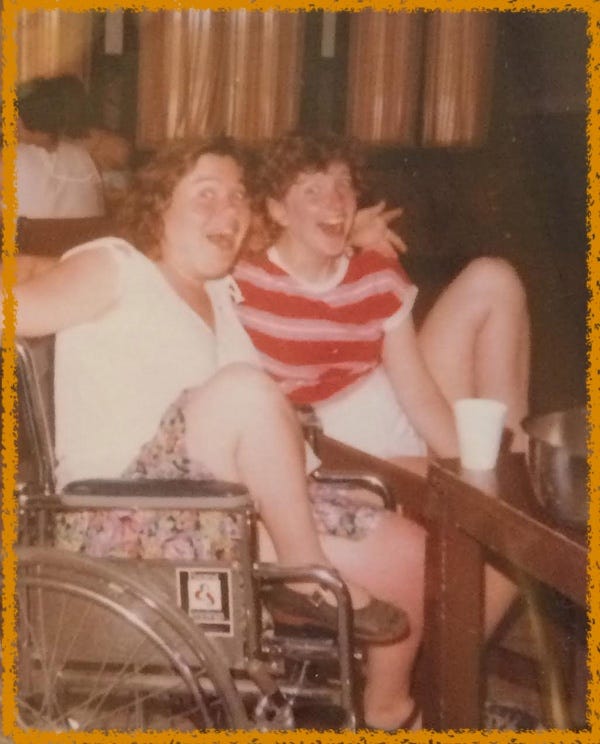
After graduation, I lived at the same townhouse for the summer and worked as a Christmas tree shearer in the Blue Ridge Mountains; getting picked up by a fellow college student at 5:00 AM every day for the 45-minute drive to Floyd County, where I learned to don chaps and shear pines with a long knife, pee outside, and eat ham sandwiches from my little bag that held my half-frozen gallon water jug; in the evenings I’d drive my friend Liz’s family station wagon over to her apartment, pick her up, lift her into the passenger seat and fold up her wheelchair and toss it in the back, drive over to the Performing Arts Building, park, get her out of the car, wheel her to the steps where some guys would come out and we’d get her chair up to room 204—I swear I have no memory of this, but I know we did it, and out again; I was her assistant as she stage managed the play Tennessee for the VT Summer Arts Festival; I’d drive her home at 10 PM, get myself home, no sooner hit the pillow then suddenly my 4:45 alarm would go off; I also acted in a show called Rich Lives: The Voices of American Homemakers as “The Woman from New Hampshire” for the 50th Anniversary of the Women’s Extension Service for 3,000 farm women from all over the United States, all while recovering from near-fatal blood poisoning due to poison ivy; I also realized too late that I was way over-extended taking care of Felice’s house again, so all her flowers died; at Christmas it was back to Dart;
With the late, stupendous Elizabeth Wills, ca. 1984, Virginia Tech, after the annual Theatre Spring Thing softball game. Ah, the energy of youth.
Between my student-loan backed 5th year—where I was a student aide, student taught, co-directed a local high school musical, and took a bunch of education classes in preparation for my Boards—and my first job as a paid schoolteacher, I once again acted in the VT Summer Arts Festival, this time as several characters in Andre Gregory’s adaptation of Alice in Wonderland; I did not house sit for Felice; at some point I got paid for doing a mime show at a nursing home. Possibly this event closed out the hardest total year of my life;
Next, I was, finally, a full-time public high school teacher, a job I got in a rural county where outsiders never came (I told you that story), and taught English 9, English 10, and Speech and Drama, and directed four plays my first year; I also had to host the VHSL (Virginia High School League) AA One-Act Play Competition, both District and Regional (meaning I did all the communications with the other competing schools, by phone, and had to procure all the judges, set the schedules, arrange dressing rooms for all the kids, figure out the lighting, sweet holy mother), in a town with nowhere for lunch so I got our Food Services class to cater (bless Tawana Lee); and I had to repeat all of this the next year while also co-sponsoring It’s Academic and Forensics; and then repeat all that in my third and final year sans the Christmas play and my drama class, instead being given a section of English 12—guess why I quit?;
My next jobs were in my year off (after my first summer of five in grad school at Bread Loaf), where I lived in the country and worked a little catering, did some babysitting, and was a reporter/photographer for the Virginia Farmer, a rural paper, writing feature articles and learning how to use a Pentax K-1000 SE (thanks to my professional photographer friend Jay’s over-the-phone tutorials);
My next job was to be found when I moved back home to Northern Virginia; while trying to get an interview with a school system (my letters of recommendation apparently sabotaged by a vindictive superintendent, is the best I can gather), I worked the weekly afternoon-to-evening shift at Minnieland Daycare for three months until I could land a job…
…which I did, partway into the year as a replacement teacher, at my second and final high school, where I went to high school (I told you that story) where I worked for twelve years, all told in my career maybe 2,500 students, before I…
Moved to NYC and was hired by an educational publisher, an entirely new career, where I still work 22 years later, having helped create (I think) eight full reading programs, Grades 5-12.
Here’s a challenge: if you are feeling a little lost, a little, “What have I even done with my life?”, take an idea from Rick Beato and Miss O’ and perform this service for yourself. Nobody comes from nowhere; nobody does nothing.
So. I’ll wait.
Would you look at that? Yes, you did that.
There is no doubt in my mind, none, that all our youth would be far happier, less depressed, more fulfilled, if they could point to an assortment of work they’ve done with their hands, out in public, something for others—you know what I mean? My god the miles I logged on foot, on my bike, on the boards of theaters, around stores and parking lots, in classrooms and down endless hallways. How did we do all that? And we did—and also went out with friends, did art, built stuff, listened to music, danced, made meals, had holidays with family, traveled, and moved, and moved again, and again.
I look around my kitchen, my living room, and I think, “You should leave this place to the world as a museum.” Because wow, are we going downhill fast.
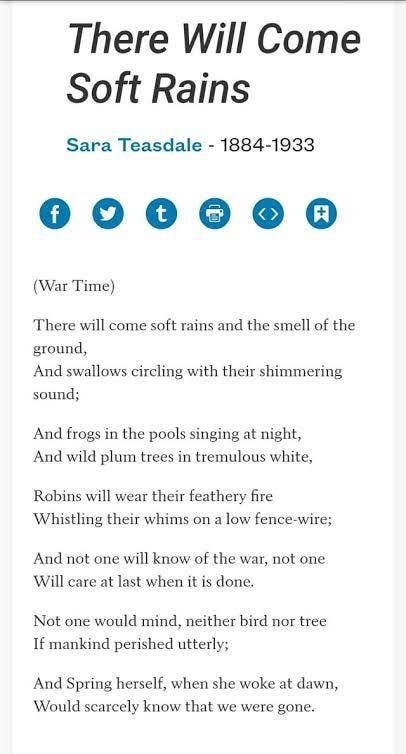
Ray Bradbury predicted the end of civilization in the AI-anticipating 1950 nuclear bomb classic story “There Will Come Soft Rains,” the title for which is taken from a 1918 Sara Teasdale poem (and takes place on August 4, 2026—wow); as well as his book-burning classic novel Fahrenheit 451, which I chose not to teach, favoring the Holocaust memoir Night, hoping to generate some empathy in my students. I guess I should have taught both, but world enough and time. You know.
I know I told you about that study I read, that having a library makes you smarter: by merely looking at the spines of books you have read, your brain recalls the book, details of its subject, and it stimulates memory. Though I haven’t read a study to this effect, I have no doubt the same is true of homes with collected objects vs. the past decade’s trend toward antiseptic white, neutrals, engineered wood, and surfaces devoid of objects. Built-ins, should they exist, house a few solid-color vases from a Marshall’s housewares section. Simple, simple, so as not to interfere with the stimulations from our phones.
As we eschew craftsmanship in everyday objects and our built environments and allow tech companies to plunder and destroy our antique and rare books, I freak out, to be simplistic about it. And it makes me wonder if we are being made smart with our smartphones or merely overwhelmed and anxious—and controllable. The constant flashes of phone “content” are ever new, require split-second processing, and cause our hearts to race. This is the opposite effect, I’d say, of the friendly nature of personal libraries and memory-filled collected objects.
Too much?
For years at my publishing job, a poster hung in the area of my cubicle that talked about the “reading food pyramid” by genre, of which Nonfiction was the base, with Poetry at the tippy top. I told an executive that that was wrong, it was the inverse: Poetry should be the big, solid base (think nursery rhymes and Shel Silverstein, to Shakespeare) followed quickly by Fiction (Dr. Seuss to YA to Dostoyevsky), with Nonfiction near the top. “But Common Core says,” and it does—that 70% of all reading in high school Language Arts should be nonfiction (as if social studies, science, and math weren’t enough); but it turns out Common Core was influenced by corporations who wanted their employees to make charts and feed data into systems; corporations don’t want empathetic, abstract thinkers. See? It’s why the people who work for Big Health Insurance feel nothing denying life-saving care; they only see bottom lines.
My dad, Bernie, a retired meat cutter and high school dropout, once asked his daughter the actor, director, and high school English teacher, “Why do I have to read Shakespeare?” And I said, “Dad, if you can read Hamlet, you can literally read anything.” This is true. What is missing most in our world, I think, is philosophy—and as smart as my dad is, he could very easily have become a MAGA without the education and influence of his wife and second daughter. I’ve always wondered why I have to occasionally pull him back from that rightwing abyss, and yesterday I happened on this video by scientist Lucas Bean, who explains on his Substack the key difference between MAGA brains and Liberal brains:
So you see what it is: children and adults who read poetry, philosophy, and challenging fiction, and who think critically and question, are more discerning and just plain smarter humans. And when people say, “You can’t change them,” referring to the MAGA-minded, the teacher in me knows (and the study Bean cites bears out) that given the freedom to unplug, to read poetry, to listen to music, to form an opinion or new idea in conversation with others, that “can’t” doesn’t have to be true. I also know that it’s never “one and done”; though my dad has read everything from the daily paper to Steinbeck to L’Engle to Bronte, he has to be continually challenged when he happens on rightwing pundits and even the president he despises. Trump always sounds so sure—the way our little toddlers are so sure they can do whatever it is. I told you that story, the way I went weak in the knees and doubled over laughing watching my then 3-year-old nephew peddling his trike for all it was worth down the sidewalk in front of us, and when his mom asked what was so funny, I said, “Like he knows where he’s going!” I see now that this is the appeal of Trump—we do love the confidence of toddlers, and too many of us confuse confidence with competence; sadly, we are about to lose life on earth because of our pleasure in being entertained by an idiot. Yesterday, (soon to be ex-) Rep. John Cornyn (R-TX), who has been screwed over by Trump but continues to do his bidding, said that there’s nothing anyone can do to stop Trump (he moves on you like a bitch). Congress should be the parental adult in this situation, but he’s just so darned cute, and threatening, that the parents are letting the psycho baby run wild.
To refresh our collective memories of the danger before us now, I’ll leave you with a timeline of Trump’s Covid Days, shared by Lucas Bean, from which I could not look away, even as I lived it for years here in New York City. You look too:
Given all this, it’s astounding to me that everything for MAGA remains the Black president’s fault, immigrants’ fault, Biden’s fault, abortion’s fault. It’s pitiful, really, when it’s not fucking deadly. But we can’t give up teaching.
My Rob Brezsny horoscope last week asked me to think about the word sanctuary and what it means to me. And I’ve thought about that: The most peaceful and hopeful and whole I’ve felt in my life occurred over a few summers I spent in Blacksburg, Virginia, at Virginia Tech, in summer school, working the Summer Arts Festivals, and living on my own off campus. I was young and healthy, studying subjects I loved; knew what I was going to do with my learning—teach English and direct a drama club in a Virginia public high school; I had money enough to buy food (though I have no memory of eating—that is how lucky I was); my parents, siblings, and extended family were alive and well; I was surrounded by adults whose knowledge and company I relished; and I felt I was living in a big green hug from the New River Valley. Life has never felt better than that—as good, amazingly enough, yes, sometimes. But that was peak sanctuary. Gladly would I learn and gladly teach.
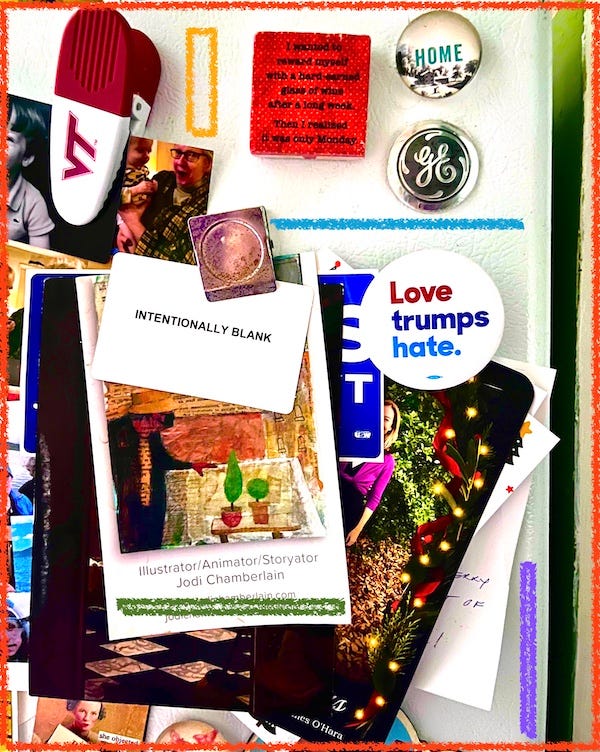
Fridge moment.
What is sanctuary for you?
And while you are thinking, how do we get out of this mess?
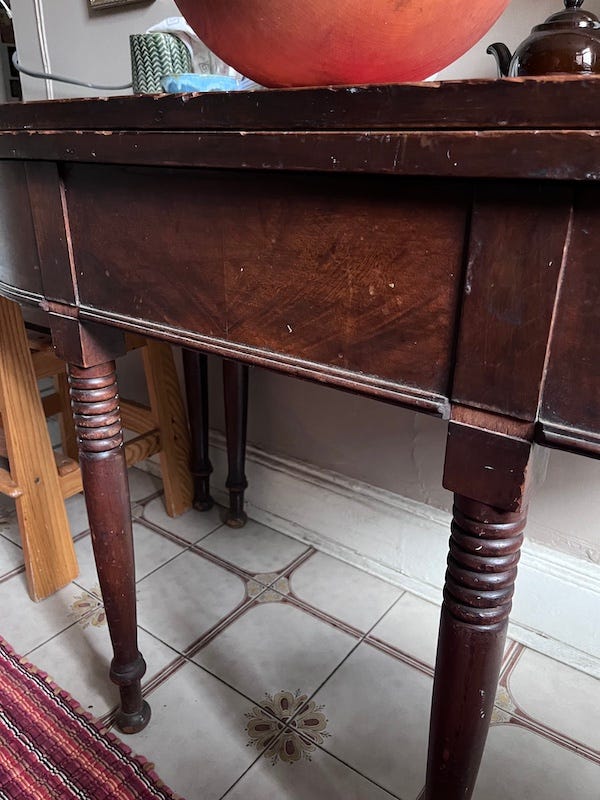
This morning I got to looking at my sideboard, a gateleg flip-top table, probably mahogany, maybe cherry, certainly hardwood; a fifth leg swings out. It was used in a barn as a sawhorse—you can see it it in marks all over it. I have this piece because it was in an apartment where I lived with a prickly roommate, whose previous roommate (a glorious human) got it from her mom’s thrift shop and told me I could have it. It’s at least 200 years old, full of damage (scotch staples held part of the top together till they fell off in the last move, and I put glued pencils in where pegs used to be underneath—it was an emergency fix when Rina from India was staying with me, and Mark and Steve and Flynn were coming over from New Jersey for a St. Patrick’s Day feast and I had to get us around some kind of table, and Rina said as I assessed, grabbled, and glued, “I am in awe of you right now”), not really practical, and surely not worth much money, but I love it. It’s the object I’d bring to Antiques Roadshow just to learn more about it.
When you watch Antiques Roadshow—and if you don’t, I recommend it, as it’s interesting, educational, curious, and also restful, so human and hopeful—do you look around your place and start wondering about things? What would you bring?
Antiques, a roadshow of the mind
This has been hanging over my mantle
I inherited this from my grandmother
These were in my mother’s attic
A man offered us a thousand for this set
This ring
This doll
These books
This sword
This poster
In a barn
This rug
In the garage
This
uniform
painting
embroidery
etching
lamp
vase
At a thrift store
Hopefully we can find out something more about it
Do you remember how much you paid for it?
The artist
The owner
Was born in 1888
Late 1920s
Late 1930s
Joined the militia at seventeen
The (pick a) war
The expedition
It’s a charming story
In the original box
We’ll obviously keep this
Bowl
Bracelet
Federal style table
Rookwood Pottery
It is Tiffany
A salesman’s sample
Tomb Trade Simulator
I’ve had it for about 30 years
The maker’s mark
At the folkart table
Not Tiffany
He was a coal miner turned photographer
She was a debutante turned painter
He was a mapmaker for the government
She was an itinerant artist at a time when
I heard they
Lived in France
Japan
Bali
Alaska
Massachusetts
Auction records are scarce
Look
glass
original frame
platinum gold copper
Great patina
The watch and the chain are like nothing I’ve seen
The sales receipt is incredibly complete
Intact
Like new
A diamond set in the center
It’s perfect
Not polished
A little wear which is to be expected
Something of this age
It’s unsigned
Not popular as it once was
Any idea of value?
For insurance purposes
And you hear the stories and the insurance appraisal
and you see the vintage episodes and hear the up or down sound effect
and sometimes you just want to step back and imagine it
In 2009, a dear friend of mine died unexpectedly. Her teenage sons asked Miss O’ to please please please get on Facebook so we could keep up; two longtime friends from grad school, a couple, had been pestering me about joining it since it launched ca. 2004, even though I saw them on a fairly regular basis. Finally, five years later, I joined, but I didn’t feel good about it.
I do not truck, as they say, in regret. (A dear writer friend told me that Miss O’s greatest flaw—I told you this—is that I have “too great a capacity to enjoy”; hers is unending regret, from deeds in the past to the restaurant she should have gone to as you are ordering appetizers in this one; her flaw is tougher for her than mine is for me, though I have been working on dialing back my big energy.)
But on reflection, since I left Facebook after Donald Trump’s “election” in 2024, I have fallen into depression, the sole cause of which I assumed was the daily erosion of democracy, institutions, and rule of law; and the transparent coup d’etat ignored by Congress; along with the death of my mom. And all that would be enough.
This morning, waking as I do now at 2:00 AM at least once of week, I began thinking about social media and its effects, realizing that I’ve spent a year and a half “coming down” from Facebook, with delirium tremors manifesting in doom scrolling my phone for “news.” And that led me to recall that growing up, we got news in two waves: the morning paper and the 6 o’clock news. It was the bookend of a day; you might also get a weekly magazine, or a twice-weekly local paper, too, but on a daily basis, assassinations and earthquakes notwithstanding, and a news break at noon on a local channel, the events of the nation and the world didn’t figure into our moment-to-moment lives. You simply lived, and that was hard enough.
With Facebook, I found myself checking in all the time—the site doing to me what it was designed to do; I never had the app on my phone, fortunately, but then Instagram was born—a cheerful place for photos until that, too, became all news all the time. I no longer post on Instagram, instead using it to amplify activist content that oligarch-owned television news and newspapers no longer touch or actively suppress. I’m miserable all the time, just as I was with Facebook, which I should have quit—and here’s where the regret kicks in—after Obama’s second inauguration in January of 2013. In 2012, I self-published my little eBook, Easier to Live Here: Miss O’ in New York City, a compilation of my daily posts, the ones limited to 140 characters, as requested by my friend Becca. That was a fun collaboration with my designer Magda (whose course in making eBooks caused her to ask me if I had material) and illustrator Lisa. And I could have said, “Cheers, friends,” and been free.
Still, good connections came out of it; the price was the loss of many deep friendships. No one had time for that anymore—skimming and scanning, dipping in and out, that’s all we could do, what with 700 friends, 3,000 or 4,000 even for some people I knew. I can’t tell you how often a version of, “How are you?” to a friend was met with, “Don’t you read my Facebook?” I couldn’t do that for 700 people every day, can you? Maybe it’s me.
What she said. I’ve had to learn to focus on books again.
There’s something more, though: as the nation shifted full-throttle is a race toward fascism, white supremacists led by Trump revving like monster trucks in their rage over a successful Black president, my engagement with social media became less about storytelling and more about soapboxing. I didn’t like who I was becoming, and who I became. And with the reboot of the whole shitshow, I knew my rants and raves and facts and arguments were less than useless: they were obnoxious. America was not mine to fix. It was arrogant and idiotic of me to think otherwise.
Via today’s TikTok (which app I do not have) and Instagram, I’ve found an array of genuinely informed and connected media people known as “influencers,” each with a special lens, and many are confident and caring and informed and wonderful without being arrogant or idiotic or obnoxious. Social media is not my medium, creatively. I’m still not sure what is.
Meanwhile, I’d like to think that a year and a half later, I’m nearly on the other side of that 15-year cycle of addiction; the next phase is to get off Instagram, but unfortunately, that’s where I get most of my news. Substack, where I publish this, has long been rumored to be a fascist platform, pretending to support independent thought so that dissenters will be easy for the regime to target and jail, because that’s here now. I remember my youngest brother’s friend Joe, whose father got out of communist Hungary, the USSR, intoning in a thick accent in imitation: “Trust no one, Joe, not even your best friend,” and you’d laugh. It’s not funny anymore.
I don’t truck in nostalgia, either, because my good times came alongside other people’s horrors, but I do miss not being in “breaking news” moments ad nauseam, miss feeling that smart, responsible people were running things, miss having the energy and imagination and drive of a creative life, barefoot and on swing sets, too, while I’m dreaming.
“Architecture needs more doodads. (That’s what my mom says, and she’s very aware of her built environment.)”
~ LuAnn Keller, Virginia Tech MFA theater grad student, on a flyer (I wish I’d saved) for a theater workshop she conducted with architecture students, ca. 1986
I always feel guilty when I’m not sharing political rage, but on this Sunday morning celebrating Pride in NYC I’d like to indulge a little in my personal interests, to share with you something on art and literature, knowing it will all lead to politics here in the end (and already has, look at that).
As a fan of HGTV—primarily because (and all due respect to the late Julia Child n PBS and the teaching of cooking and baking) it’s the only network that shows how nothing becomes not only something but also how it will now be inhabited (consumed, so to speak) by real people and for life—I have spent over a decade noticing how interior design became “Pottery Barn-inspired” as opposed to “collected and curated.” With the profound exceptions of Home Town and the lamentedly canceled Bargain Block, designing has become about creating neutral-feeling “spaces” rather than “rooms,” spaces that, sans walls, act more like furniture showrooms than homes. The “neutral” craze of whites, creams, and light wood tones, with the occasional splash of black in a feature wall or trim is not so much a backdrop for, say, colorful art (no walls means no art), as a merely open, blank canvas that will remain blank, if sometimes messier, for years to come. No amount of the show hosts saying, “Look how warm and inviting” will change the fact that every bathroom, bedroom, and living room—sorry, “space,”—is designed to mimic an impersonal hotel. I personally find the designs clean, sure, but sterile; there’s no question that what the hosts (the Property Brothers, Dave and Jenny Marrs, the Kleinschmidts, pick a show) create for homeowners is certainly nicer in the end than at the beginning, everything “updated” and tidy, “tons of storage,” etc. But you can’t help noticing that the people they are designing for will most likely never put any art on the walls that do exist (walls that sometimes get wood slats for “architectural detail” to fill the void), or set precious objects on the shelves, when there are shelves. And I can’t help wondering why.
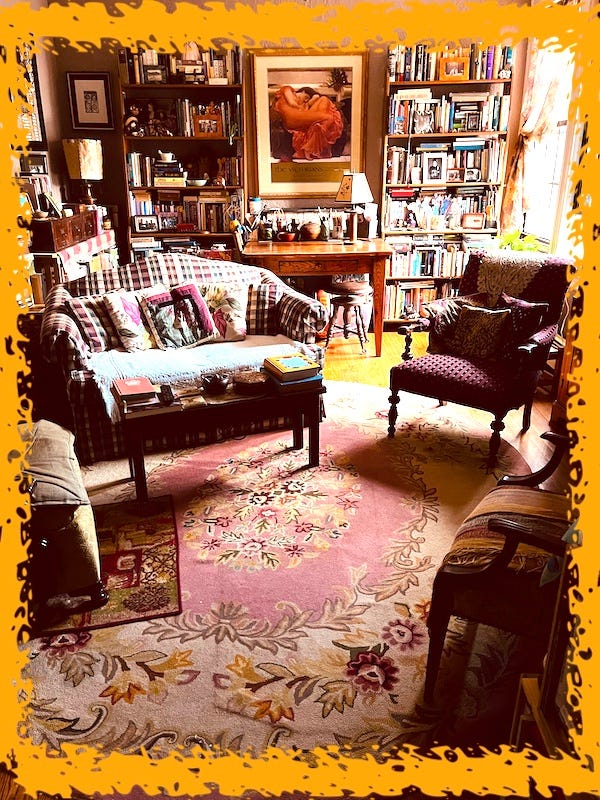
Never to be seen on HGTV. All of my friends have homes like mine, some far more sophisticated for sure, but all with the same feeling of life. I find this comforting.
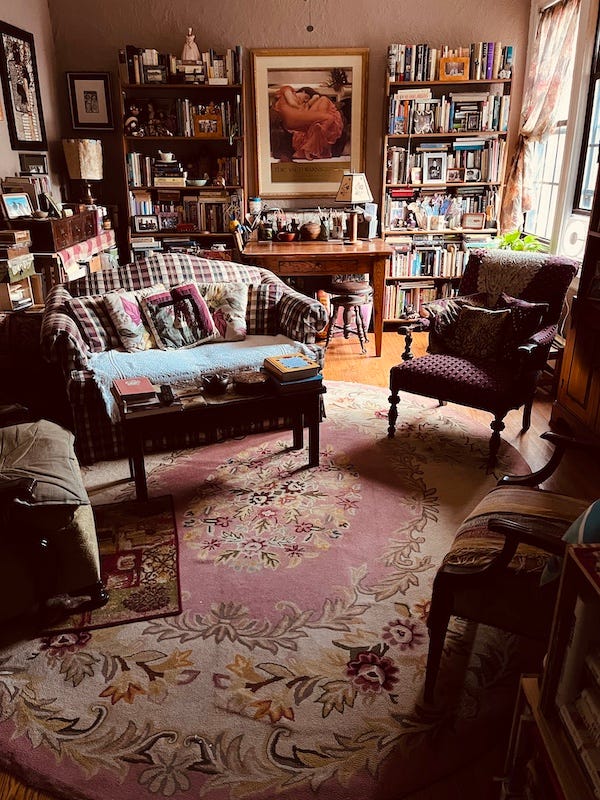
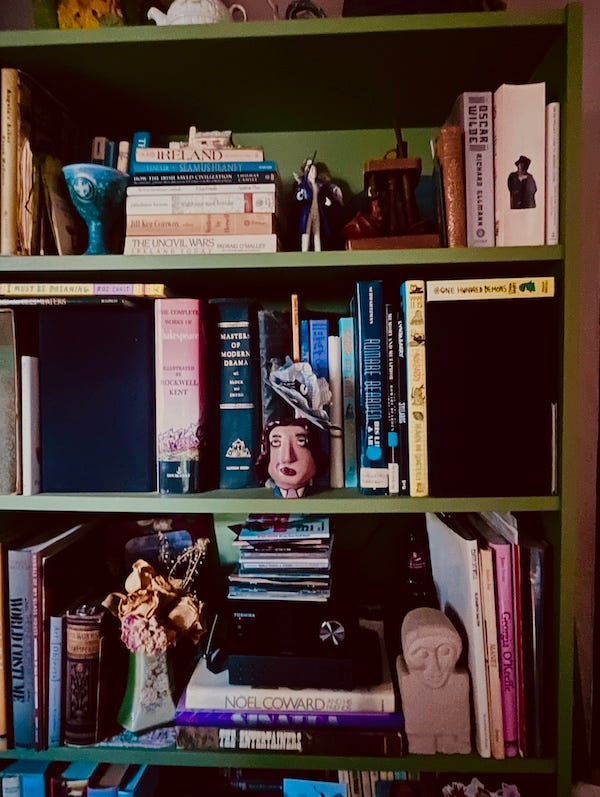
I know I’ve talked about this—people either love Miss O’s apartment on entering or get instant hives; there’s really no middle ground. I have lost my way, I think, in my collecting—now more cluttered studio than a home for hosting, but generally it works for me. This is because there’s not a single book, object, work of art, or furniture piece that is not the center of story. There’s no, “Oh, I bought that at IKEA” only; there was a specific time, reason, need, or person involved. Each piece is a memory, and I can tell you about it. I can’t really understand living any other way, and my way is definitely not trending. So what am I missing?
In my YouTube travels, when I’m not watching interviews with favorite musicians, I enjoy occasional episodes of HomeWorthy, wherein an unseen host takes viewers on guided tours of fabulous New York City apartments, led by the owners/renters themselves (who are collectors, designers, and artists). Their astonishing money-to-buy-stuff notwithstanding, even their paint color choices are inspired by, say, some historical place or painting; each object has a story. “I picked this up in a market in Bali in 1973,” a story begins, or “The creator of this piece was was a young weaver who…”; or “I bought these chairs at an auction in 1990, and they came from an estate in New Jersey; I needed a small sitting area, and look how perfectly they work by the window.” The people in these NYC apartments create rooms within rooms, areas for conversation, for office work, along with a bar, a library, hidden storage. No living room has only one function, what with space at a premium.
Miss O’ can relate. I can also relate to all the stories. I would love someone to film me giving a tour of my apartment as if I were a very important person; maybe it could inspire the white-walled, clear-spaced neutral people to reconsider their choices.
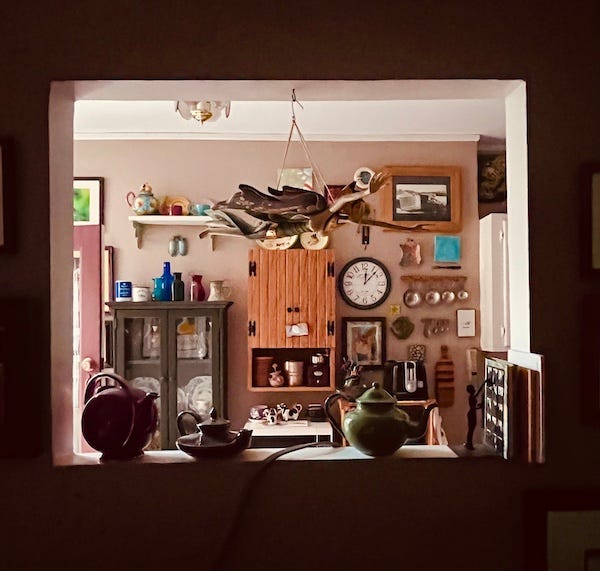
Ask me about my kitchen pass-through view.
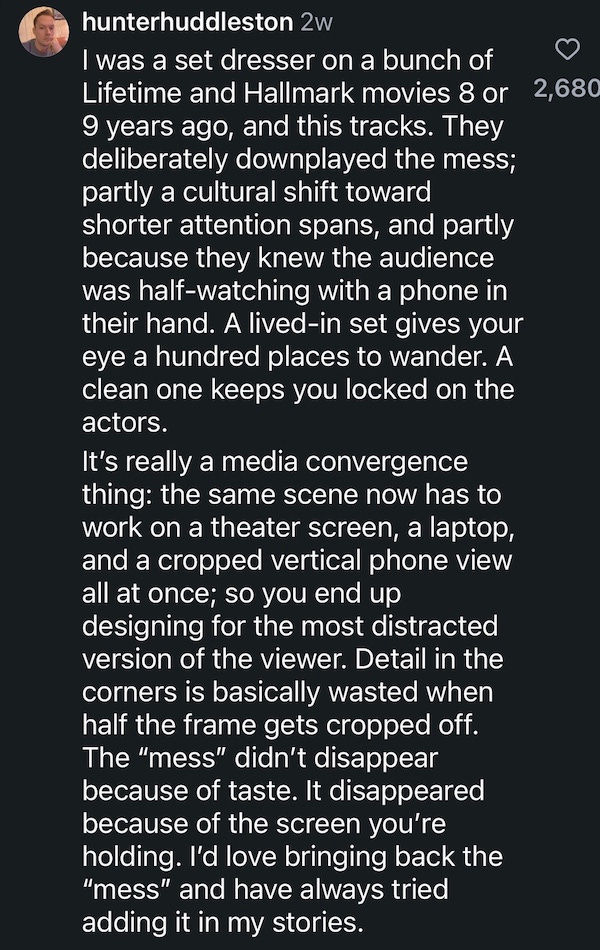
Why do I say this? Come on, Miss Judgy O’Judger, I hear you say, shouldn’t people get to choose the way they live? Of course, as long as it is a choice, a conscious one, and brings joy. (I’d like to pause and judge one thing: I loathe and despise random and incessant gilding and calling it style. It’s not political.) What I’ve come to suspect is that the quiet, neutral furniture showroom aesthetic is a direct response to the little device we hold in our hands, the overstimulation that is doom scroll chic. They can look up from the screen and see blessed emptiness. I think even trees are too much for people anymore, and that’s just tragic.
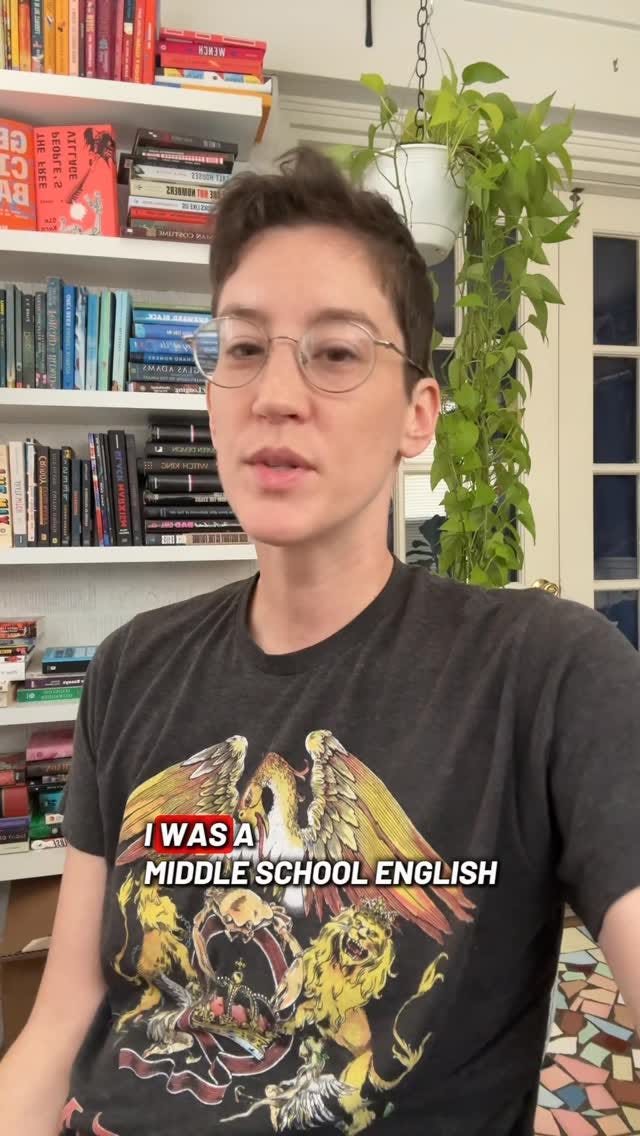
In my travels around my own doom scrolling, I saw this video on Instagram the other day:
Not only does this analysis acknowledge my questions, it also affirms some of my suspicions and adds more to my understanding of the way people live now. Here’s a comment on this same video:
So I can see the two-screens, various devices thing, the shorter attention spans of today, as part of this. But I got to wondering more about the role that story plays, or doesn’t, in our current culture. I know streaming and binge watching of fictional shows is wildly popular, but the reading of fiction (to say nothing of poetry) has dropped precipitously. I look at our educational system to point one finger: Common Core State Standards for ELA (English Language Arts) dictate that by the end of elementary school and into Grade 12, all reading in language arts classes should be 70% nonfiction.
Who decided this? I’ll tell you who: corporations (aligned with Christian Nationalists—oh, politics, are you never not around?). Why? Because the reading of fiction—even audio books, which is totally relevant as reading because humans were oral-based storytellers for millennia, and reading print has only been fairly commonplace for a century—creates empathy. As a student, for nonfiction I recall only humorous essays by Twain, say, or philosophy by Emerson and Thoreau; as a teacher, MLK’s “I Have a Dream” and Elie Wiesel’s Night were about it. The rest was short stories, novels, poetry, and drama. And here I am today, a big, educated, worldly heart. Fuck that?
Here’s another Instagram post on just this educational issue, and I could not agree more:
What the corporation head will say is that, today, they need readers who can process data. (Gee, what did we ever do without…data?) They need “readers” who can think critically about complex scientific, historical, and social problems.
They are lying.
What they really want are bored drones who generate revenue for invisible shareholders. They want brains that don’t work, eyes that don’t see, hearts that are empty. Lack of compassion makes workers easy to control. Here, buy this device, watch this show, hell, watch two or three at once. Wear beige. Turn all your books so the spines face the back. See how pretty that looks? Punch that laptop. (I learned all this from reading the Aldous Huxley novel Brave New World as a sophomore in high school. Dangerous, see?)
Oscar Wilde for Pride Weekend. Spines facing out, thanks.
I know I’ve said this before too—I’m old; I do a lot of that—but I’ve read (!) that fewer and fewer people have physical libraries in their homes, the wisdom being that if you’ve read it, why do you have to look at it? Books only collect dust. But I read some study that showed that people who have libraries (spines out) are frankly smarter than people who don’t. The reason is not based on IQ, but rather on the fact that seeing the books reminds your brain of what you read, when you read it, and what it was about, and as a result, neurons fire. You are simply more alive.
I think this must be the same for everyday living in homes (not spaces) with collected objects. Each picture, rock, vase, sculpture, card, tea tin reminds me, for example, of where I got it, who gave it to me, why it has meaning. I create and recall life narratives in my mind just by living in my house. You can’t do that in quite the same way with white walls and warm wood with an empty countertop, with built-in shelves that hold a white ceramic vase from Pottery Barn and maybe a plant next to a phone charging station.
This really isn’t about aesthetics. It’s about what happens to our souls when our minds and homes are sterile. For people who are poor, who are just starting out, who are scraping by, none of what I’m saying sounds like anything but privilege; but I’d argue that the same results of emptiness apply to anyone.
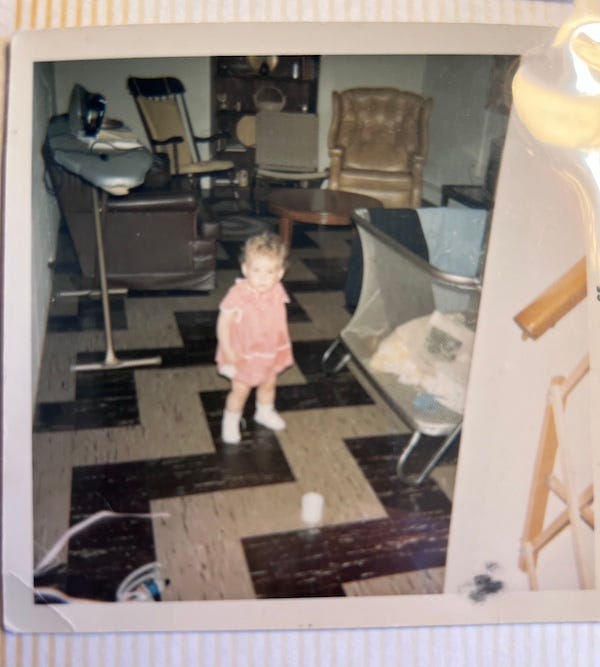
When I was a tiny child (the year the Voting Rights Act was signed into law), my parents, Bernie and Lynne, scraped up $50 for a house downpayment, because if you had a regular labor job (and were white—here comes more politics), you could do that. The house’s downstairs walls were white cinderblock for many years; the floors tan and black asbestos tile, no rugs; we had a round red-wood coffee table my mom bought when she was in the navy, and a couple of mid-century modern rope chairs. In the first year, together they bought a vinyl-covered loveseat, a wooden rocker, and an vinyl-covered recliner, and a small black and white TV along with a pressed wood end table for a stand. And that was our living room for at least five years.
But what I remember more than that is the portable hi-fi and record albums always playing on it; the Puerto Rican Pottery ashtrays, the diablo mask, the black Wedgwood tea set, the Israeli brass ashtray, the painting of a watchmaker upstairs, and volumes and volumes of books (the first thing they spent serious money on was a big custom bookcase for the otherwise empty upstairs living room, an odd feature of their house model)—all things Lynne had collected as a single woman in her twenties. I asked about all of them. I learned their stories, and also, then, the story of Lynne’s life before me, before marriage and children. (By contrast, my dad’s entire life fit into a small brown suitcase when he moved to marry my mom.)
It’s the objects, the books, the stories—it’s not about stuff for its own sake; not about constantly clean surfaces and a living room that looks unused and “ready for entertaining” in the abstract. It’s nice to have a tidy home, but a home—not a space—is to live in, to arrange memories, to build new ones. To be alive in.
A library, even a small one, matters. Novels are important. Poetry is important. Having volumes around you makes you a better, by which I mean a more feeling and aware, human. Remembering that our lives—all our lives—are connected stories is key to our humanity.
Our interiors reflect our interiors, if you see what I mean. Both interiors inform the way we curate our democracy, our earth, too. It must. I know I can’t control the world, can’t stop all the atrocities, but I can curate my stories, maybe share them, hope to spread a little encouragement for all of us to do that for ourselves, for each other. If you want.
Sending love and hopes for a better tomorrow,
Miss O’
So I went into my family photo album, and would you look at that accuracy of memory? (I’d forgotten the little bookcase—three painted versions later, it sits in the exact same spot by my dad’s chair today.) In terms of function, the room served as entertainment center, nursery, and laundry. Ca. 1965.
While the Frozen Left lets democracy slip away, a little talk in the heat of late spring
This morning, as I do at least two mornings a week, I awoke around 3 AM. I was sleeping in my own bed, in a room with a working lamp and fan, surrounded by two dressers, a stack of books, and art objects either gifted to me or purchased with money earned from work. I was able to get up on my own two legs and walk to a working indoor toilet, use it, and pad into my very own kitchen, take out my coffee maker, scoop local artisanal coffee into the filter, extract potable water from my own faucet and pour it into the drip coffeemaker on my own kitchen counter. Flip a switch, listen to the drip, pull down a mug.
These are no small things. Taken together, you realize, “In America, we live like kings.”
I saw a video the other day, though I didn’t save it and don’t know who said it, that in the 21st century, Americans, and indeed many, many people, live like kings for the just the situation and services I noted. And no one is happy.
And though the Big “Haves” as well as too many “haves in denial” are never satisfied, more of us could be living like kings if it weren’t for about 2,000 rich people (nearly all white men) who can’t bear the thought of you having anything, let alone Blacks having so much as a vote, or Hispanics and Muslims sending their children to school. These same oligarchs hate Jews even as they fund Israel’s genocide against Palestinians. To prevent you and me and anyone brown from having a goddamned thing, they will bomb every nation and even blow up the planet. This isn’t even hyperbole. When I read yesterday that Trump’s DOJ, now his personal police force, awarded $1.7 billion to the January 6 insurrectionists—shown in the Mueller Report to be crisis actors (the Republican term) transported to D.C. and housed in hotels paid for by a Trump SuperPAC—I realized how idiotic Democrats have been to “trust the system.” We also know those feces-smearing cop-killers will never see a dime; all the money will go into a Trump trust or some such. But it’s our money. Our money.
I don’t even know how to feel mad anymore. I read that we the sentient have what is called Compassion Fatigue, and Outrage Exhaustion, pick a syndrome borne out of this Theatre of the Absurd that celebrates and normalizes those who engage in pedophilia and rape and grift, gets incensed by the idea of universal healthcare, and chooses unchecked guns over school safety, book bans over public education.
[At 5:29 AM, my peace in typing this on my little porch was interrupted by a big truck’s deafening engine in idle somewhere nearby, for maybe ten minutes, and I thought, “Of course.” It’s the perfect metaphor for America.]
This past weekend, one of my former students, ca. 1997-98, was in town for a wedding in Brooklyn and was determined to visit me, even after multiple delays, changing hotels, and helping return tuxedos. My strongest memory of this student is the first week of school in my tenth grade Humanities class, when I had the kids introduce themselves to the class using a question they hated being asked. His question was, “Are you mixed?” and his answer was, “I am a beautiful mulatto.” I recounted this to him when I saw him, finally, late Sunday evening. He lives out West now with his wife and son, and his best friend came along to Queens with him—in fact, this kid said his main reason for accompanying his bff to this wedding was a chance to see me—and apologize.
In fact, his first words coming down the stairs from the el train and seeing me were, “I love you!” And over the course of tequila shots and beer at my favorite bar, he explained what a troubled teen he had been, and he said something I’d never heard: “You held me with different hands than anyone else,” and those hands were full of “culture.” He felt cared for in a way that was new.
This exchange—the great conversation in general—reminds me how vital education is for mind and spirit, for sustenance in a dry-as-bones corporate world. Of my former profession, I told him that I would love to teach again—all I ever wanted to be was a teacher and learner—but not the way education is now. “I’d like to sit on some steps, like Socrates,” I said, and his friend said, “And philosophize!” Yes. Talk, think, observe. Make learning fun and human again.
I want to say that I gave this kid every out, texting, “It’s okay if you can’t come out here,” and “I’m too tired to get out to you,” and in truth I was really tired, being old now and feeling it at 7 PM on a Sunday; but he was determined, so I did it. My point here: always make an effort.
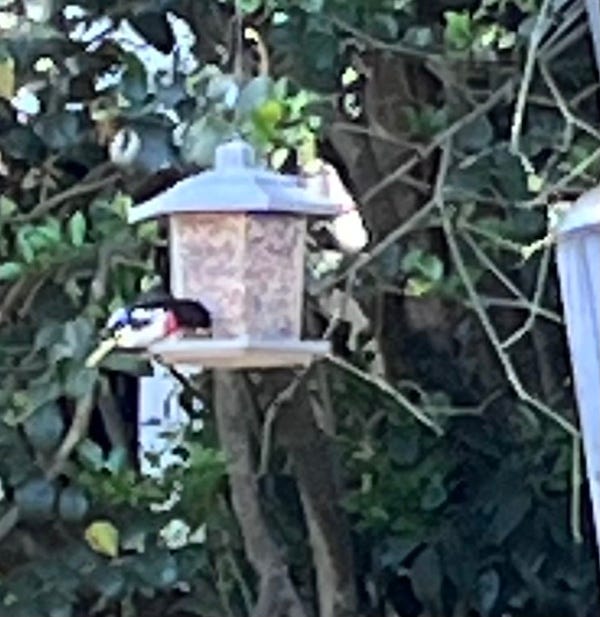
We can be surprised by visits, and we need to let visitors in. While I was home in Virginia the other week, my dad, Bernie, brother Jeff , and I were sitting outside on the little pea gravel patio, staring at sky and trees and the bird sanctuary that has formed around Bernie’s feeders, after a few hours of long-needed yard work. Suddenly a bird we’d never seen alighted on the feeder, wild black and white striped wings, a red breast, a golden beak. He was a vision. (I say “he” because any bird of colorful plumage is a male—to attract mates and distract predators from the nest, they say.) We all went crazy trying to identify it, commenting on the markings, watching the movements. Wow.
Google Lens identified the bird as an adult male Rose-breasted Grosbeak, and indeed the female is a simpler golden brown color. It turns out the bird should be in the mountains on his migration, some 50 miles west, but he stopped over for a meal.
This sighting got me thinking about female beauty. I remember by mom, Lynne, saying to me when I balked at wearing lipstick and mascara the year I’d lost my natural bloom and students wanted to give me a makeover, feeling as if it would call unnecessary attention to myself: “Honey, you don’t wear makeup so they notice you; you wear it so they don’t.” She was right.
“Beauty is invisibility,” I read on a post the other day, where men write in the radical female content creator’s comments, “You are so beautiful” in response to a video on social justice for women. I’ve had men do that to me—compliment my hair in mid-sentence. I’m not heard, not seen. So many ways for men to miss out through misogyny.
Years ago, my best friend at the time, a man, asked me what I wanted in a relationship. “Great conversations,” I said, and he snorted, “Yeah, you’re gonna be alone.” And I am. He was absolutely right. I cannot have great conversations with most men, or I can but only to a point, and right when I’m reaching a new understanding, or sharing one, or moving them so they might figure something out, they crack a joke. Every. Time. I’m sorry about that.
And so it was a delight to have a great and serious and also fun conversation with a former male student. Curiously, it’s not the drama students who seek me out to visit after many years so much as it is the language arts kids, like this student. While the intensity of a weeks-long rehearsal process in the drama club creates fast friends, perhaps it’s the 9-month incubation of a high school English class that births the real relationships.
We cannot have it all—in friends, in citizens, in a nation—but if we look around for a minute and make space for visitors, we already have more than we realize. Now, how to get people in power to see this, to want this for all of us? As theater legend Joseph Chaikin said, “I want to change my life and everyone else’s. I don’t know how to do it. And if not the life, then the day, the evening, the hour, the minute.” Chaikin also came to realize that change doesn’t happen “en masse,” but rather “one by one by one.” One conversation at a time, one tough year at a time.
Most every morning, I wake too early and in a panic about the planet, our country, and the next pandemic borne of idiots. Today, I enjoyed a little light. Hope you found some light, too.
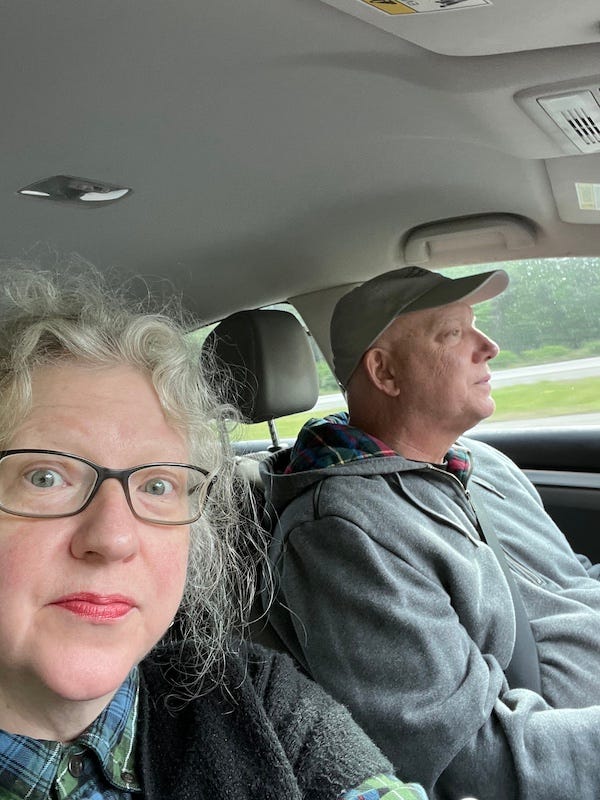
Coming back from quick trip down South to see my dad
Yesterday morning, en route to a stop at D.C.’s Union Station from Woodbridge (where I’d traveled to from New York last Friday), I sat next to a young Black man snoozing with sunglasses on. He was about the only person on that early morning train from Richmond not spread out while asleep, leaving space for a seat mate. He began waking when we got to Alexandria, and I asked where he was getting off—anticipating when we need to move out of the way for a seat mate’s disembarking is important train etiquette. “D.C.,” he said, and I asked where he was coming from. “Richmond, but I live in D.C.,” and I said, “Not a bad trip, but early,” and he said, “That’s why you caught me snoozing,” and he smiled, then asked where I was headed, and then if I’d been down for Mother’s Day. “My mom died last year,” I said; “Oh, I’m sorry,” he said, gently, and I said, “Thanks,” and explained that I wanted to be home for my dad. I didn’t get a chance to find out about his own mother, as we pulled into Union Station and he needed to get his bag. Such a nice guy.
I myself snoozed quite a bit on my journey from D.C. to my destination, when I wasn’t reading a 1967 Amanda Cross detective novel, The James Joyce Murder—highly academic and modeled on Peter Wimsey mysteries but with a female and radically feminist amateur sleuth. I haven’t felt much like murder mysteries, what with the world being full of murder, hate, mayhem, injustice, all that. Hence the naps, I guess.
Talking to new people on the train is a favorite pastime—but there was very little in the way of chatting with strangers going down or coming back. A youngish woman (tall, white, long strawberry blonde hair, maybe 40) got on in D.C. en route to New Brunswick (as it turned out), but we didn’t begin talking until Trenton, when we fell into a very deep conversation about her mom’s Alzheimer’s and my mom’s death (all this beginning with, “I’m going home for Mother’s Day” or some such), the difference between mental and physical decline—we agreed that the physical is less awful. Her 76-year-old mother is in great physical health right now, but calls this woman and her younger sister by the names of of her own younger sisters—the regression to youth is fascinating and also deeply sad (my half-sister’s mother called my sister “Becky” for a decade before she died, and my sister always answered, “Well, hey, Ann,” like it was normal—very hard). At New Brunswick, my seat mate departed and another youngish woman got on (50 to my 62, as it turns out) and sat beside me, beaming from this great road trip to four high school friends, she said. We too entered into this unexpectedly deep conversation on Mother’s Day, her own mom in Nepal, aged 82 and with the need for a heart procedure, and whom she can’t visit because of the Iran war now, given all the travel problems. We agreed, with an understanding beyond words, that the U.S. government is totally batshit now, I saying simply, “It’s all so awful and stupid,” and she nodding sadly. I talked of my mom’s death—it turns out my Nepalese companion is a doctor (she’d vaguely mentioned “the healthcare field” and I’m sure she’d been deliberately vague because people say, “Hey, let me ask you…,” and I clearly wasn’t going to do that). “I deal with that every day,” she said of death and dying, including families in denial, and spoke of the importance of hospice. In Nepal there is a form of hospice in the Temple, where the dying are taken to be attended by healers and shaman, and that sounded pretty good to me, but now there is a cost to be incurred even for that. (I see more clearly than ever that nothing is free in any village anymore; the triumph of Western corporate capitalism is that a few white men get rich off everyone’s paying them for what they, the villagers, used to get for free, thanks to the threat of weapons and the mercenaries who wield them.) In addition, her beloved family dog is seriously ill, and her children (ages 12 and 14) and worried. All that learning—about Nepal and dying and parents and lives— in the short run from New Brunswick to Newark to New York. I moved to get up when we entered the NJ-NY tunnel to get my backpack, as my new friend moved for me, and bade her a good trip back to Boston, wished her mother and her dog well. As we do.
I lined up in the aisle as others stood to get their bags and noticed a young white man reading an old Mickey Spillane paperback. “Mickey Spillane,” I said, and he looked up, telling me he was reading all those old-school writers now, like Spillane, Raymond Chandler and Dashiell Hammett, and I recommended The Maltese Falcon for a good movie version of Hammett. He was loving the language, including the new phrase “slopping beer,” and I found his enthusiasm heartening. Across the aisle from him was a short, round old lady with pageboy white hair and a visor, who was saying to the tall young black man next to her, moving into the aisle, “Tie your shoe,” and then, pointing, “Your shoe’s untied,” and the fellow obeyed her and he tied it, and she added, “Sorry, my retired vice-principal-of-an-elementary-school is showing,” and he smiled, and she said, “I can’t let you trip!” He asked, “Do you have a bag to get?” and she pointed to the front of the car, a pink rolling suitcase, and he said, “Easy to spot at the airport,” and she said, “That was the idea,” and he pulled it out and also got his own, and they worked out a system so he could help her get her suitcase off the train. How sweet was that?
There is something about the confinement of travel in short spaces that breaks us open, and I think the sentiment of Mother’s Day hovered over us, too, filled us all with an awareness of where we all come from. Everyone was birthed into this world through a mom, and so many of us seem like moms. (I myself was wished an enthusiastic “Happy Mother’s Day!” by no fewer than three (Black) women at various points this past week, and I just said, “Thank you! You too!”)
There aren’t many universals anymore, or so it seems—mothers, certainly, whatever the degree of influence over or care they gave us. Another, surely, is food. I would say a third universal is responding positively to cuteness, whether it’s dogs or cats or babies, and anyone who is ambivalent about or hostile toward moms, nourishment, or cuteness needs to work a hard, hideous job and live quietly in a hole without access to weapons of any kind.
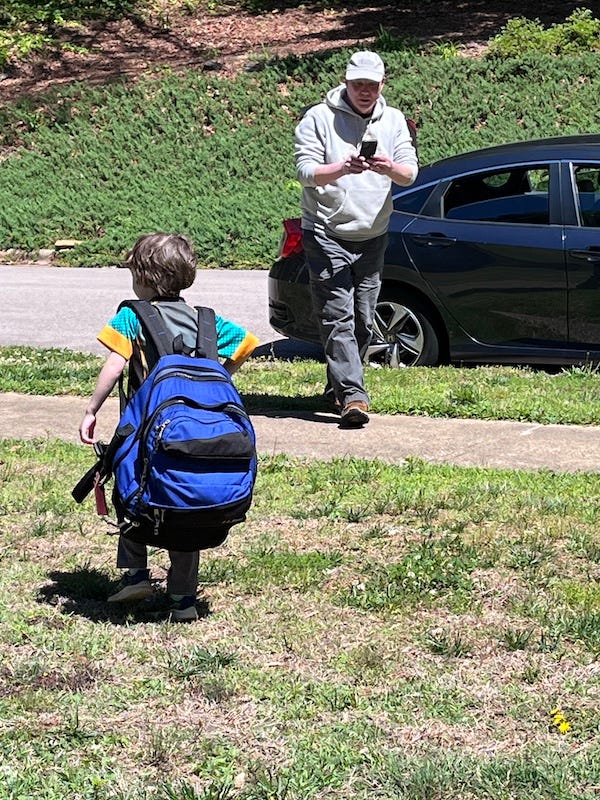
Cuteness: my 5-year-old nephew insisted on carrying my backpack.
During my stay in the South, my youngest brother, who lives in North Carolina with his family, introduced me and our brother Jeff to the series Tucci in Italy, and when we got back to Virginia, Jeff and I watched the other five episodes. We then received the “Recommended for You” idea to watch No Taste Like Home with Queer Eye’s Antoni Porowski, in which Antoni takes celebrities on a tour to discover their roots through family dishes they have always loved. In that way, Jeff and I traveled to Yorkshire, England, and again to Italy, thence to Germany, Senegal, and Malaysia. Everywhere Antoni goes are women and men preparing local food, and you get a chance to see how geography and colonization inform every aspect of their lives and, in turn, the lives of those who emigrated.
Something about a road trip. I was disgusted by Transportation Secretary Sean Duffy encouraging Americans to take summer road trips with gas at $5.00/gallon— for his own oil profit, no doubt. Jeff and i wanted to spare our brother the expense.
Back in Virginia, hanging out with my dad, we watched sports and walked the neighborhood, talked about how much we both miss Lynne, shared memories. Food was always important to my dad, a retired meat cutter and short order cook in the Air Force, but he said, “I just don’t feel like cooking anymore.” When we did set about making a meal, we both found ourselves looking up the stairs, wondering what Mom would like to eat. It’s been a year but it’s flown by, and last May’s ordeal feels like yesterday, and today.
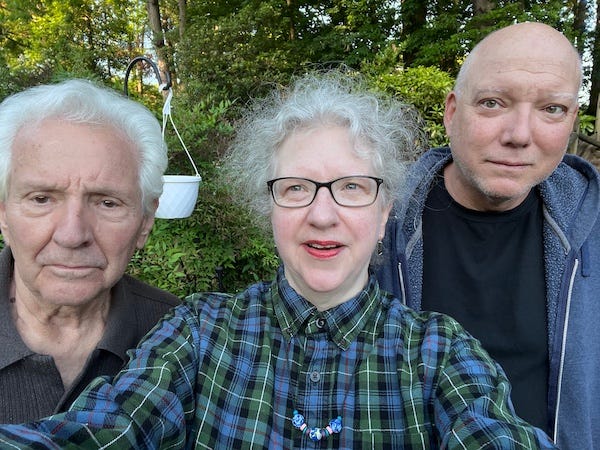
Awkward family photos. Bernie is 92.
Universals. We all thrive when we have shelter and access to nourishing food and clean water, but more than that, loving homes and creative community culture. And I couldn’t help thinking about how far America has pulled away from all this in favor of corporate structures, bottom lines, 401Ks, screen-screed loneliness, AI, and endless consumerism (says the woman who consumed 11 episodes of two shows on a paid subscription streaming network that still forces commercials on us because we accept it as normal).
I told you once about that professor I had at Virginia Tech, an old (my age now, no doubt) white-haired, deeply Southern white man named Byers (I think), who in his American Literature class asked us what was meant by the term universal. After some attempts from his students in answer, Prof. Byers intoned, “A good example of a universal is a warm [woah-um] shower [show-ah]. Everyone enjoys a whoa-um show-ah.” At the time of his pronouncement, ca. 1983, the only people “enjoying” a warm shower were almost exclusively Westerners, and only since around 1950. In any case, I remember finding his example weirdly specific, if not a little creepy. How about food? I thought. How about being birthed by moms?
I also think connection is vital to our universal survival, as I’ve previously noted, and I was touched to find how important that remains, even to strangers on a train.
Sending you love, this day after Mother’s Day,
Miss O’
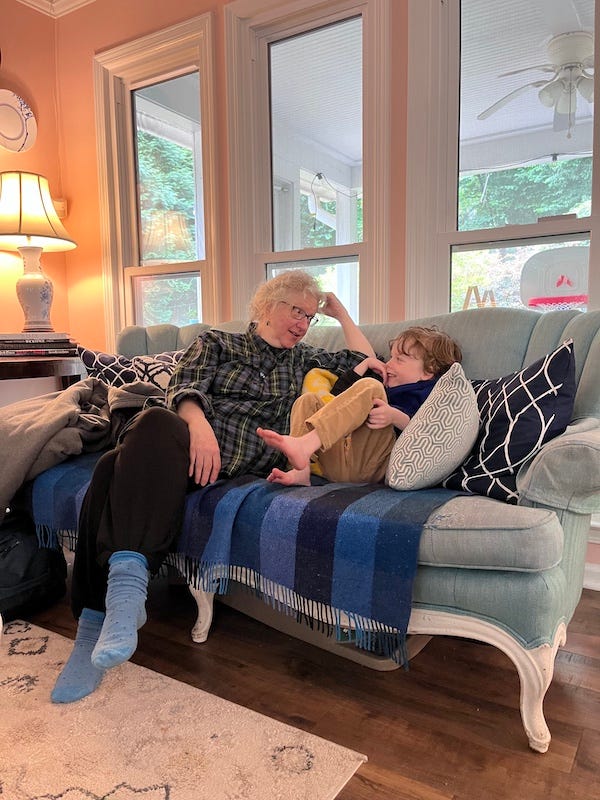
Aunt Lisa in conversation with a new generation. Photo by my nephew’s mom.
On the N Train downtown from Queens Friday evening, a man got on at 59th Street. He asked, “Does this go to 49th?” Yes, I said, but he didn’t hear. “49th?” he said again to an oblivious car. YES, I said louder. He waved a thanks and got on. I turned to a younger woman looking at me, and said, “At least, it’s supposed to,” as another little man got on, grinning with an accent, “Brooklyn? Brooklyn?” and I called out, YES, and he got on and the door closed. The younger woman said, “You’re the subway tour guide.” “I was a school teacher,” I said, “brought students here for field trips.” I paused. We were seated in those L-arrangements peculiar to the N-W-Q-R line, so we were catty corner facing one another. A story occurred to me. Do I throw the word?
I threw. “Years ago I got off an exit to use the bathroom at a Wendy’s,” I said, catching her eye and she was attentive, so I continued, “and inside there was this officious kind of woman directing people to the bathroom, explaining, ‘That first stall is broken, keep going,’ and I looked at her and said, ‘You’re a school teacher,’ and she said, ‘Second grade!’ Teachers are fearless like that, and we help.”
The young woman advised, “Wendy’s has the worst bathrooms,” and so it was we chatted at each stop until she got off at 34th St—I was headed to Union Square. We talked about how strangers on the subway don’t chat the way they used to, everyone looking down into their phones, for one thing. She got off at her stop, and I said something about how you never know when you’ll see someone again. She said, “I’m Anita,” and I said, “I’m Lisa.” We said farewell at 34th.
And in NYC, these connections, however tenuous, matter. You are reminding another person, yourself, and anyone listening in, “We are nice people. There are nice people, people who think about things, who observe the world around them, and connect to other people. You can do that too, if you want.”
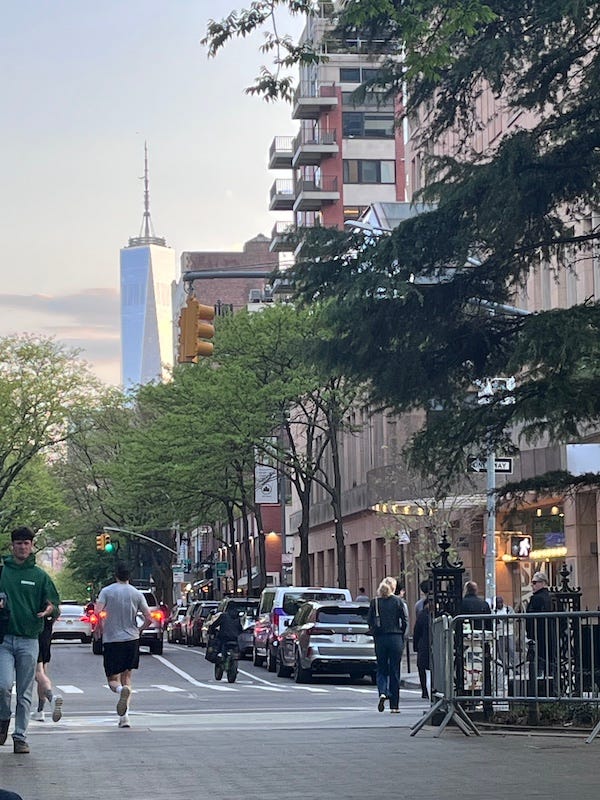
View from Union Square
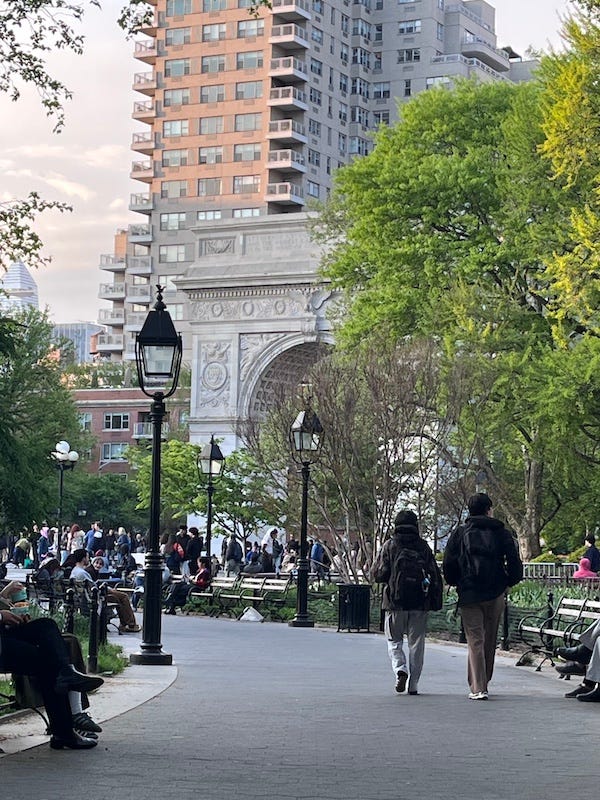
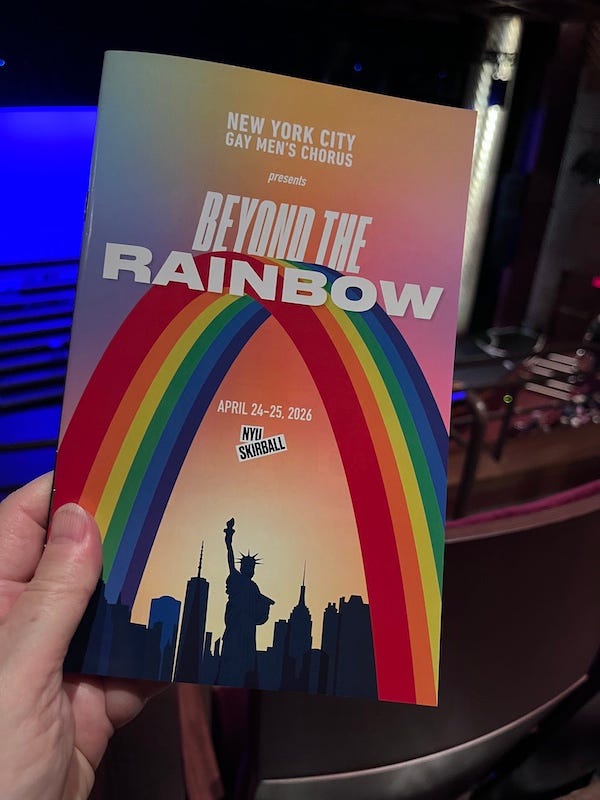
Outside at Union Square, I walked University Place toward Washington Square Park, heading to the Skirball Center to hear the New York City Gay Men’s Chorus, in its 45th year—one charter member still singing!—and gave myself time to wander Greenwich Village as dusk rolled in, the best time. In my walks I make a point of making eye contact, smiling—not idiotically, but because it’s a nice thing to do. It’s spring, be here, have this experience. The park is nice.
In the theater, I found my balcony seat. I’d never been to one of these concerts, but I’d learned that my boss was in the chorus, and I knew he’d be glad someone from the office came. Plus, it’s a chance to hear choral music, which I used to hear twice a year when I was a teacher going to high school seasonal choir concerts. I love choral music but never think to seek it out. Beside me to my right sat two young women, aged 30 at most. Like me, they were pouring over the list of names, and I found my boss listed in the basses, which surprised me—I took him for a tenor. Before the show, I’d asked the girls if they were visiting, and I got their stories: one had just moved here from Tennessee with a boyfriend, and the other was visiting because her best friend since preschool (!) was in the NYCGMC. Did I live here? Yes, for 23 years almost, and the recent arrival said, “If you don’t mind my asking, why did you move here?” And thence the story of losing my house to eminent domain, and she asked, “What is that?” And I explained eminent domain, and they were shocked. “They had to pay you, right?” Only because someone told me to ask about it. “What do you do here now?” I gave them every out, to be clear, so they didn’t have to listen to me, and tried to draw them out so they didn’t have to humor me in the story of my life, but weirdly they kept asking questions, learning about a life in textbooks—you’ve heard all this. But it was really sweet, this keen interest from the kids. Hopeful, I think.
The choir entered and arranged themselves on risers—some 250 men, all decked out in their own styles of white, gold, and silver. Long sleeves, short sleeves, net tops, sequined tops; accessories of gold and silver, the common ground the white pants. And I realized I had no idea where my boss would be, so I did what I had to do: I started at the bottom left and worked my way across the rows of faces, one by one by one, during the beautiful medley of “Pure Imagination” and “Over the Rainbow,” and the looking moved me as much as the listening—the unexpected specificity of all those faces, ages, races, sizes, heights, body types, styles of expression—all joined together by their shared struggle and triumph in the face of a hateful society, and meeting us all with love, dammit, love.
Finally, I found my boss, center, fourth row from the top, singing in his silver shirt. Next to me, I heard the girls finding their friend, “the brown shirt,” though there were a few fellows with golden brown tops. I was a little startled that the bff girl, during the performance, kept checking her texts; and at two or three moments she got up and went outside for several minutes at a time. At one point she returned and put her head on her friend’s shoulder. I’m glad I’d talked to them beforehand, because I might have been super annoyed and said something to her—but I couldn’t help feeling, because of our recent connection, that the bff girl had something very serious going on back in Knoxville, and she was only here in New York because she wanted to be here to support her friend. After the show, I never remarked on anything except to say, “I hope you gals have a great visit,” and off they went.
Out on the sidewalk, on the lookout, I saw my boss come outside looking for someone, turning to go back in when I caught him. He looked, his eyes got wide, and he embraced me—wouldn’t let go. Thanked me for coming, wanted to know how they sounded. “Great!” And they did. Then he said, “I have to thank you for being a rock on this project,” speaking of our work life, and it’s in these outside, joyful places we can tell people what we are thinking, what we don’t express. Nothing went to my head, believe me, and we parted with a wave as I set off back across Washington Square.
Back to a Queens-bound W Train at 14th St, a woman who looked like Taraji P. Henson (whom I’d just seen Monday in Joe Turner’s Come and Gone in the Broadway revival, and it’s splendid), in full glam mode, got on with her (I think) son; she sat down beside me, turned to me with her big lashed eyes and said, “You are so [unheard].” I said, “I’m sorry?” “Beautiful,” she said, “you are just beautiful.” Gray-haired ancient me said, “Thank you, so kind,” “I call what I see,” she said, and I added, truthfully, “You are gorgeous,” and she said, “I’ll take it.” We smiled. The young man, a big teddy bear, was standing with his phone, and I asked if he wanted to sit and I’d change seats—no, he’s good at the pole—and I admired his really cool green plaid coat.
And I share all these mundanities—here adding the glam woman’s call to me at 34th Street, where they were getting off (a lot of connecting trains lead there), “You have an amazing night,” and I said, “You too!”—because the whole evening had built to good fellow feeling, connections without fear, with compliments, good humor, hope; I was about as peaceful as I’d been in months.
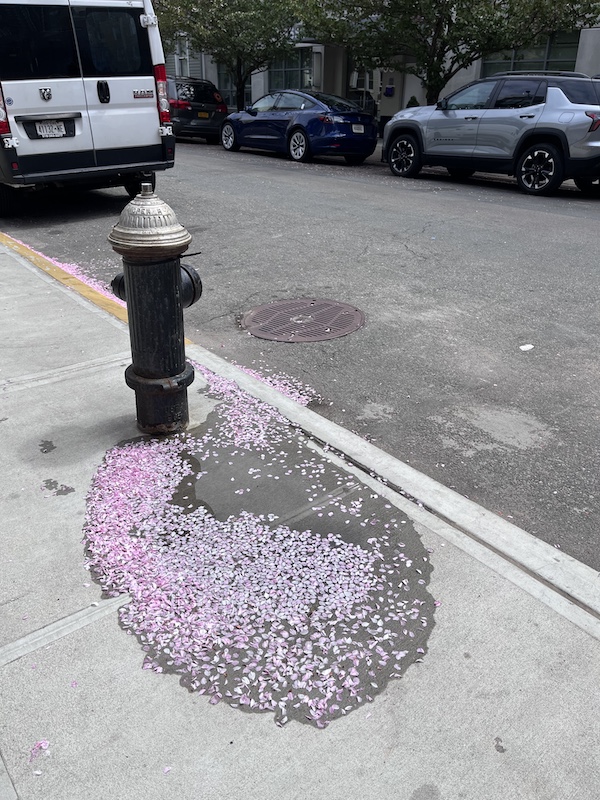
May all your puddles have petals. Queens
This afternoon I took a break from work to run to the post office to mail a friend a gift of notebooks I’d picked out for her at the MoMA P.S. 1 gift shop in Long Island City yesterday. There was a line—six or eight people, only one person working a window (of course), but it was that really nice Korean lady who is super efficient and helpful and unfazed by all the different needs—a little family of three finishing a passport application for their baby, a woman in need of a money order, artist-sellers with envelopes and packages with special needs for sending. The worker asked a woman customer if she wanted to pay for tracking, and she’d said no, but a woman three people behind me in line said something to her in Spanish, and the customer said, “Oh, si, si,” and this other woman called to the postal worker, “She does want the tracking, she didn’t understand,” and I smiled at her (I was next to go up) and she said, “I’m bilingual but I couldn’t think of the word for tracking,” and the woman just in front of her turned around and told her the word. She practiced it. Amazing. I said, “I only speak one language, and I lose words all the time,” I reached in the air, “Words!” and she smiled. I went up, got the package mailed, and as I left, the translating woman caught me with her voice, “Have a good day,” and I said, “You too!”
Now here’s the crazy thing: As I’m going out the door to the little alcove area, I held the door for a woman with packages, and another woman in sunglasses walked in behind her, and as I went through the alcove to the street door, I hear, “Lisa?” and the voice takes off her sunglasses and I look and she looks and she says, “The train,” and I say, “Anita?” We couldn’t believe it, each figuring the other lived in Astoria, where the N-W Trains originate. She said she couldn’t stop thinking about things I’d said, especially about how you never know when you’ll see people, and there we were. Turns out, we live a block from each other. Go know.
So here’s what I’m saying: I think the only way we beat these fucking corporate Republicans and Democrats at their stupid power and insider training games and actually get shit done for us, the People, is to 1) come out and vote in droves; and 2) connect, connect, connect, connect. Okay?
Sending love,
Miss O’
Word on the subway is, this is beautiful. And who isn’t really? Really. Except some people. You know who I mean.

 Lucas Bean Daily