For That Little Bit of Food

On the mess it takes to make

Years ago, my super (and friend) was at my apartment to make a repair, and he noticed my sink filled with dishes—I’d made a pasta salad, involving boiling and draining pasta, cutting vegetables (scallions, tomatoes, etc.), adding feta, and so on. Assorted pots, a colander, and cutting boards were piled in the sink, along with knives, forks, spoons.

On seeing the finished product, a medium sized pottery bowl with a nice few portions of pasta salad under plastic wrap heading into the fridge, he clucked his tongue. “All that mess for such a little bit of food.” Well, yes. Had this handy man never watched his wife or grown daughters cook or clean up?

But that moment stayed with me—sort of embarrassed me, the way he thought, “for that little bit of food.” Why had I felt embarrassed? I mean, I’d watched him pour out a half dozen tools, rags, and plumber’s sealing tape onto the floor to fix a leak, and it would never occur to me to say, “All that mess for such a tiny little leak.” Let’s face it: most things worth doing require making a mess. It’s the tragedy, and joy, of being human. Life is not gossamer; no amount of meditation and austerity changes the reality that, to start, 1) humans must eat and drink; and 2) humans must evacuate waste. Planting, growing, cooking, and plumbing of all kinds: life’s basics don’t do themselves.

I thought of this again this morning: I’d walked over to LabCorp to get bloodwork done after 12 hours of fasting, so on my way home, I stopped by The Sconery for a (savory) scone treat. At home, I got out my little coffee maker, scooped out coffee into the reusable filter, poured in water, and let it perk; I poured some half and half into a small cream pitcher (to better control the amount used); I made a quick one-egg omelet with the last half of a cheese slice, to eat on the cracked pepper scone.

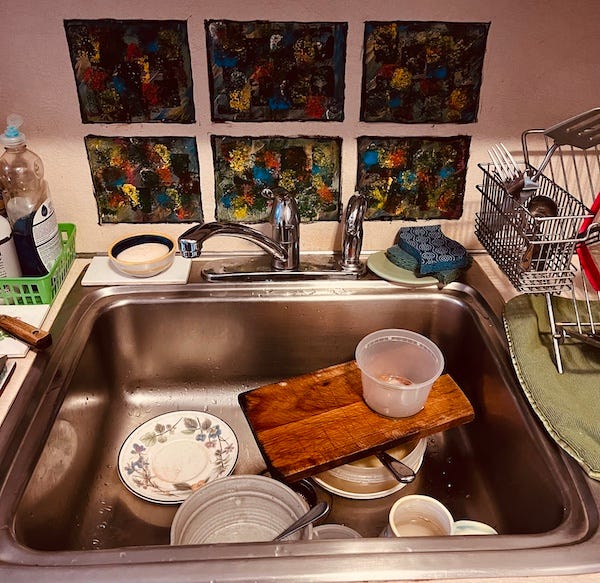
Following this little repast, a simple breakfast feeding just me (and I didn’t even have to make the scone), I had the following dishes in the sink:

  • Little bowl for scrambling the egg
  • Fork for the beating the egg
  • Small cast iron skillet for cooking the egg
  • Table knife to cut butter for the skillet
  • Coffee scoop
  • Small cream pitcher
  • Spoon for stirring
  • Plate
  • Coffee pot
  • Reusable filter and insert
  • Coffee mug
  • Water glass for taking my morning meds

All those dishes for a little bit of food, a cup of coffee, and a pill. That’s how it is.

And this was lunch.

Anyone who does projects knows this—to sew anything, say, I have to set up the sewing machine, get out the fabric scissors, the thread and bobbin, the seam ripper (always), all the stuff; whether this is making curtains or sewing a tiny seam split in a pair of pants, it’s the same drill. If you make collages or draw or paint or whatever, you have to get out all the stuff. Even to make a small card for a friend, or a bookmark, it’s all that mess to clean up and put away for a little bit of creative output. Even a bookshelf, when hung up, looks like “of course,” no one thinking about the sawdust.

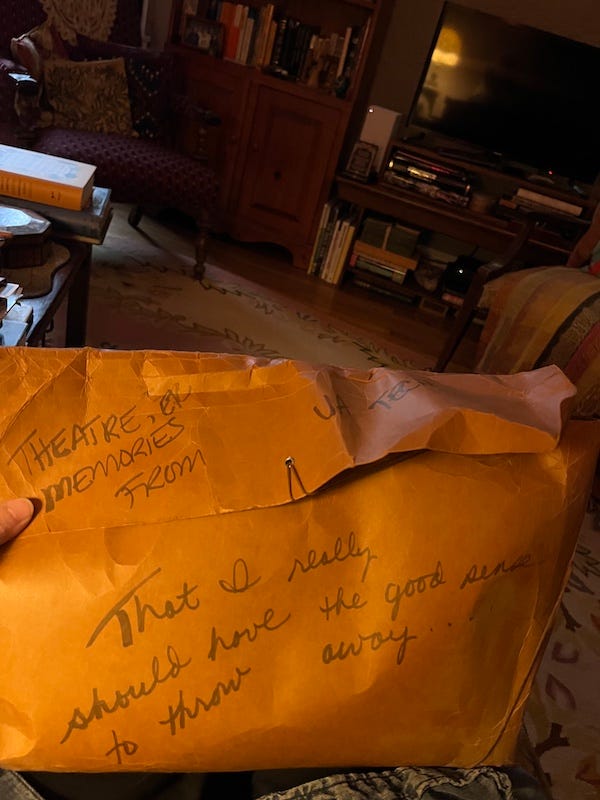
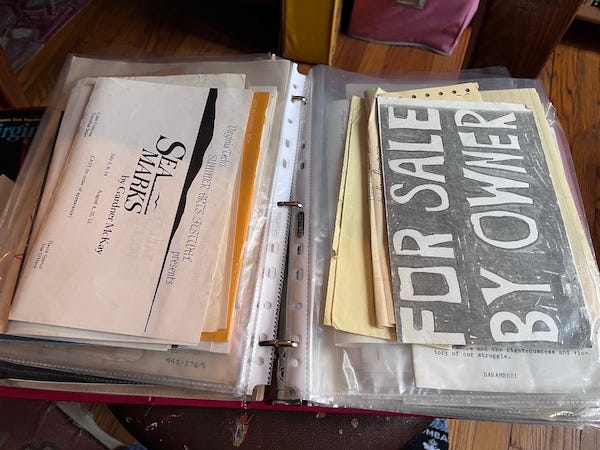
Last weekend, my best college buddy Richard came over with his two teenagers, who, after lunch, napped in various spots in the apartment while he and I went through a big envelope of theater memorabilia from our college days. I was cleaning out a closet last weekend when I happened on it, and thought, I need to make some kind of scrapbook or toss it. Being a BA theater major was, as I’ve said many times, the luckiest thing I could have been. (I distinguish this from a BFA—a bachelor of fine arts—which is narrow in focus, an actor never learning set design, for example; in our liberal arts program we did it all.) You learn all the theater trades, practice on many shows, from black box to main stage, and figure out what you like about it and what you are good at. It was awesome. Though you sure get tired doing all you do.

Theatre Arts-University Theatre is now The School of Performing Arts at Virginia Tech. I recommend it.

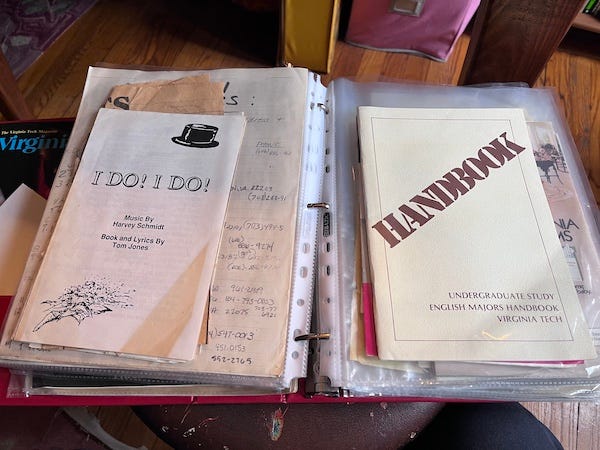
This sorting made us tired, too, program after program, script after script, party notices, “Break a leg!” cards, SETC (Southeastern Theater Conference) badges. “I was on the makeup crew for She Stoops to Conquer?” Richard asked, thumbing over the names in one program. “I did wardrobe for this?” I said, handing Richard a program for a show in which he got “special thanks.” We’d never heard of it, to see our reactions, let alone recalled working on it. And yet there our names were. Other times the programs brought back loads of memories, “Oh my god, remember that turntable that didn’t turn, and we all had to push it from backstage, in costume,” “…and the tech director got fired for buying cheap casters?” but most of them were fond memories. From hauling boards in from the truck to building stud walls and constructing flats; to measuring actors, to fabric shopping and cutting cloth from patterns; to putting makeup on faces and taking it off with cold cream afterward. “How did we do all that?” “And classes, and parties…?” To say nothing of hydrating.

I suppose one way of looking at it is, “All that mess for such a little bit of show.” But that’s never the whole story.

Ca. 1982-86; I just realized I graduated 40 years ago. [Insert popping eyes.]

I watched YouTube videos about photographers this week—I got on a Richard Avedon kick, thence to Henri Cartier-Bresson, Chuck Close, Mary Ellen Mark, always learning—and one commentator brought up how much paper and how many dark room supplies went into producing each large-scale photo that landed on museum walls. (So much mess for such a little bit of beauty? Yes.)

In further video travels, I watched Lucy Worsley Investigates: The American Revolution on PBS, and I admit that I thought, in passing, about the war, “All that mess for such a (little bit of?) new world order.” And really—when any act is all about money and power—it is a lot of mess, and for, too often, such a lot of nothing but destruction and misery. Worsley finds, for example (seeking the British view), that if King George III hadn’t had a huge 7 Years’ War debt to pay off, he wouldn’t have signed the Stamp Act, and if he’d listened to the colonists’ reasonable complaints about taxation without representation, they wouldn’t have revolted, and Britain’s Empire wouldn’t have fallen, and who knows? Still a mess, no doubt, and the mess continues amid the stabs at progress, and no use looking back.

The latest world order upset is Trump’s unstable, treacherous presidency, his support of Israel, and his attack on Iran—all that mess to distract from such a little bit, oh, wait, an ungodly amount of pedophilia and bribery and corruption.

Money and power, power and depravity. I’ve been reading a few articles during my doom scrolling hiatus, and the more investigating people do into Epstein (to take one example)—and loads of terrific independent journalists are doing just that, unrelentingly—the more horrible and seemingly unstoppable these diseased forces seemed to be; but they are stoppable. This is changeable.

But my god the mess in their wake. Their mess is vast and awful, but we gotta clean it up so we can start fresh. Again. Like doing the dishes. Like a set strike.

And how much better would we all be if our messy work were for creative, useful, and community purposes (with women to guide it)? So much better.

Sending love, all the detritus now in plastic sleeves in a tidy (ahem) binder,

Miss O’

Summer Arts Festival, 1985; Final Directing project 1986. How did l learn all those lines? And pass my classes? And have fun? And feed myself? It can be done. Also, I hope you are charmed by the handcrafted nature of that college program. I made it.

Stories We Just Don’t Recall (till a poet shows you)

Disappointment and despair, everything secret
I believed I could never tell anyone, were single threads

in the prairie’s great cloak of grass and sky.

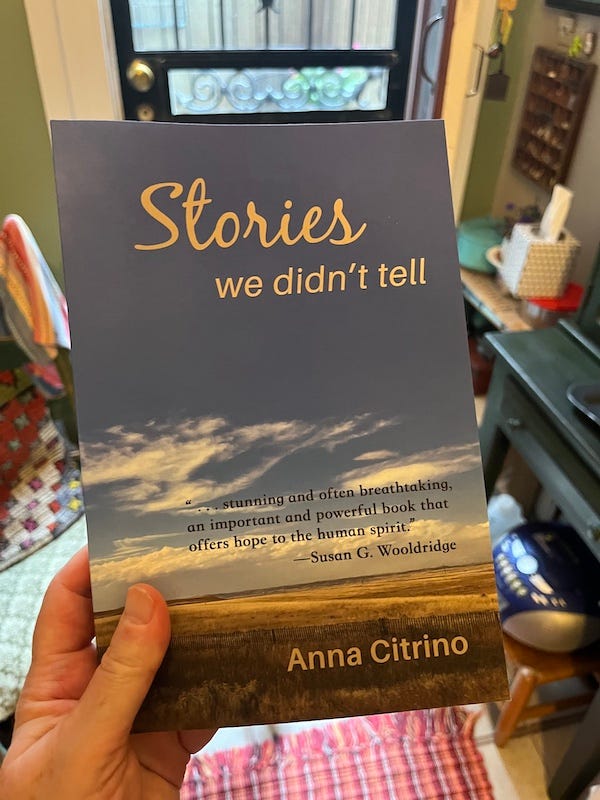
from “Standing in the Middle of a Great Field,” Cheyenne, Wyoming, 1983, Adah, age 94 (from Stories We Didn’t Tell by Anna Citrino, p. 238)

It’s always a surprise what hearing poetry gets you thinking about.

My mom, Lynne, died on Thursday evening, June 5, 2025, and Friday was all about the mortuary and paperwork. Saturday morning, around 4:00 AM, my sister and I found ourselves up at that witching hour with our dad, sitting in a small darkened living room, rocking in our respective chairs or sitting quietly, with coffee, when Dad suddenly blurted out all the traumas of Lynne’s childhood, traumas we knew nothing about, including the entire year, when Lynne was maybe seven, that her mom lived and worked in Omaha without even communicating with her daughter, who’d had to live with relatives. Bernie is crying, sobbing, for the pain this caused his beloved wife. My sister and I looked at each other, same thought, and I say, “Dad, was Grandma pregnant?” A divorced woman with child, especially with a daughter in Catholic school, would have been carrying more sins than any confessional could bear.

Dad looked at me, at us, uncomprehending. It’s funny what a woman understands, or is quick to suspect, things that a man wouldn’t even consider. In the end, we will never know, and my poor mom was abandoned by her mother and ignored by her father, who was quite possibly overseas in WWII at the time. That pain could never be made right.

Does it matter enough
that, if you could have the dead back

for an hour, these would be the questions
you would ask?


~ from “Our Family Tree and Other Myths” (from the collection of the same name by Jean LeBlanc, p. 37)

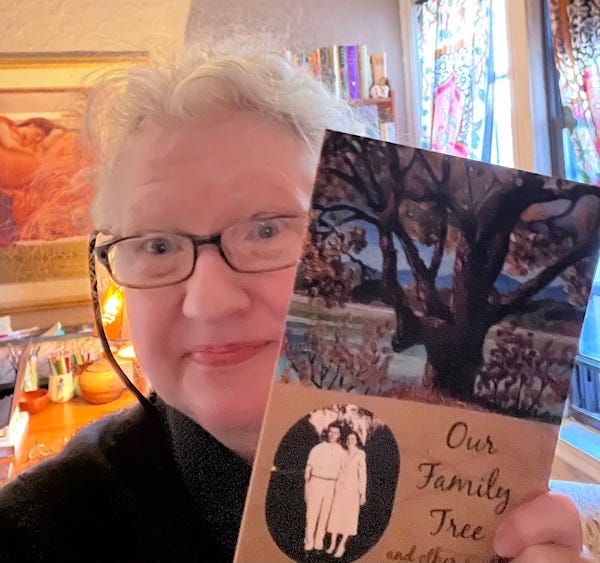
This event from last year rose in my chest as I listened to my poet friends Jean LeBlanc and Anna Citrino read from their latest collections via a Zoom event this evening, both poets published by Shanti Arts: Our Family Tree and Other Myths and Stories We Didn’t Tell.

Our Family Tree and Other Myths by Jean LeBlanc. (These are the selfies I send my artist friends when their works arrive at my house.)
Glad I managed to get the title AND author’s name in this one.

Both poetry collections, which couldn’t be more different in terms of approach, style, and geography, are deeply connected in their subjects’ perseverance, struggles, and connection to the natural world.

Anna, Jeannie, and I met in 1990, the very first late June day on arriving at the Bread Loaf School of English to begin our MA program. From the first, it was clear these women were deeply soulful and talented—each in possession of great cameras, too, photographing the Vermont landscape from our first walk. I was a theater major and very lost English teacher, sans camera, still trying to find herself, no writer, but somehow I managed to get admitted on a “rural teacher scholarship” (the MA was geared to teachers). I took it on faith. One of the best joys of lifelong friendships, really, is evenings like tonight, where I listen to women I’ve known over 35 years grow into these astonishing artists. My degree has served to help me appreciate the great work they do, and therefore to open up my understanding of the world. Not bad.

This evening, as Anna and Jean read (via an app thingy none of us (as Jean said) could have imagined in 1990), something profound occurred to me: I have no home place. Whereas Anna is a product of California sky and eucalyptus (by way of Wyoming), and Jean is New England to the core (by way of Quebec), I’m, well, a sort of Virginian (though Northern Virginia (NOVA) really doesn’t count as Virginia), via the U.S. military (because my naval officer mom was stationed at Barracks K in Arlington) by way of Iowa (which my dad always called “home”). I didn’t really belong anywhere. The natural world encounters of my suburban childhood felt inadvertent. I’d meet kids whose families went back generations on farms in NOVA before it was NOVA, and they seemed vaguely alien to me, with their wild cedars for Christmas trees and lapses into Southern dialect at home, dialect they never used at school. I never knew how to feel about that.

Whatever I am, presently a New Yorker, and whatever my insoluble confusions over identity, it’s artists who shake us out of our stupors to look at our truths in the face. So let’s just say I have a lot of thinking to do, right after I reread (yet again) both collections.

You can find these wonderful poetry collections I mentioned at Shanti Arts, based in Brunswick, Maine. May I recommend them? I may. Consider adding Anna’s and Jeannie’s books to your library. Consider, in this our National Poetry Month, adding poetry to your life.

Happy April.

The Mass of Men: Thoughts from a pagan on Good Friday

“The mass of men lead lives of quiet desperation.”
~ Henry David Thoreau, Walden

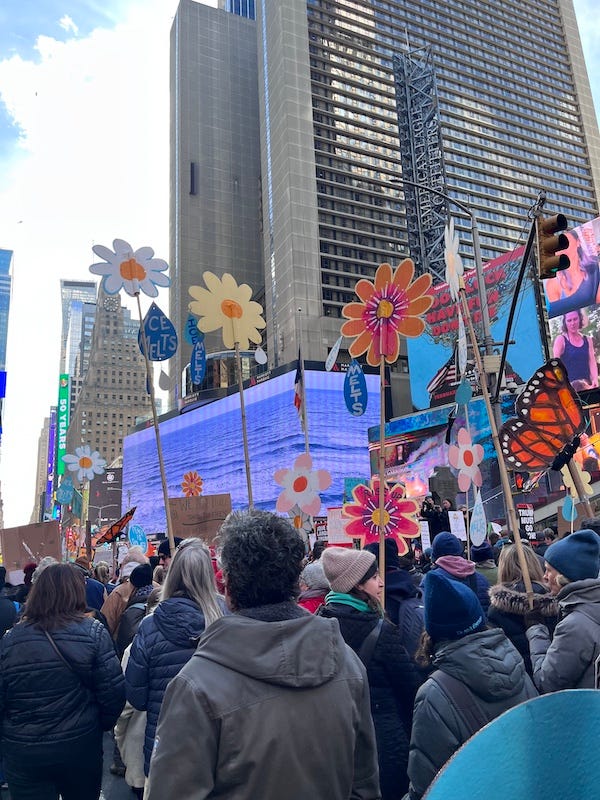
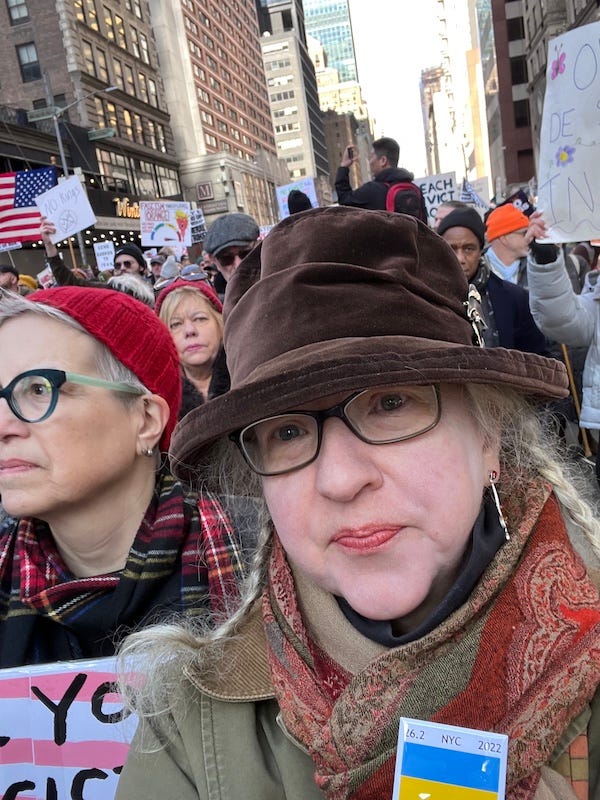
Last Saturday, March 28, around 2 PM, I made my way to Columbus Circle via the 7 and 1 Trains, avoiding barricades by walking along the sidewalk to 7th Avenue, where I easily slipped into the No Kings 3 March in New York City. I did the first march to Madison Square Park back in October, but missed No Kings 2 in January due to illness—but it’s when you see a woman with one leg use sticks to walk the full length of No Kings 3 that I feel embarrassed to have let a little flu and a sprained toe stop me last time.

There were many creative signs, but sometimes “literal” does the job. LO’H

The march this time included many young people—almost none were in the first No Kings march, and I didn’t blame them, this is on us, the old—because they have skin in the game now, what with the draft being reinstated to fight idiotic wars started to help a pedophile* avoid jail; and the march included almost no people of color outside of a few Chinese and other Asian Americans—and that is as it should be, because this whole mess of a nation, of a world, is the fault of white people, full stop. It’s our mess to fix.

I caught several shots of the national protest garden—one butterfly carrier explained to me, “This butterfly is the only orange monarch we want.” LO’H

“Let us not underrate the value of a fact; it will one day flower in a truth.” ~ Henry David Thoreau, “Natural History of Massachusetts.” The Dial (July 1842)

On Monday night, in ideal timing, PBS aired the first of three episodes of Thoreau, a Ken Burns-produced (but not really his) documentary of the 19th century New England writer, naturalist, and abolitionist Henry David Thoreau, the guy you read in American Literature in 11th grade, about whose work my high school classmate Scott declared, “If I read one more word of Walden I’m going to Thoreau up.” The documentary might change even Scott’s mind about the importance of, and prescience of, Thoreau, who saw the damage that industrialization and unfettered capitalism were doing to human beings and to the earth and was determined to do something. I recommend the three-part series, streaming for free on PBS (the funding of which was saved by an Obama-appointed judge this week, another reason elections matter).

Thoreau succumbed to tuberculosis at the age of 44, having written works that inspired Gandhi (in an ironic twist, as Thoreau himself was inspired by Eastern religions) and Martin Luther King, Jr. One of the commentators notes that tuberculosis is “a wasting disease,” and I remembered that it used to be called consumption—now I get it, as it consumes all your bodily abilities and functions. Curiously, it occurs to me, our national consumption—of resources and useless crap alike—via capitalism, is wasting our planet, and I wonder if HDT saw that parallel.

This week too, in media bingeing via YouTube, I happened on a 1971 Dick Cavett interview with the theater legend Zero Mostel, most famous for playing Tevye in the original Fiddler on the Roof as well as the original Max Bialystock in the 1967 movie The Producers. From his entrance prior to being introduced, antically looming over Cavett’s shoulder, Mostel showed himself to an ungovernable guest, Cavett spending the next hour and a half never sure what Mostel would say or do, where he would wander, whether or not he’d actually perform “If I Were a Rich Man,” or answer interview questions at all. It’s great television, and particularly interesting to me because crazy though Robin Williams was on talk shows, he wasn’t dangerous the way Mostel was—and Mostel’s timing was knife’s edge right—he’d pull back the peculiar just in the nick of time, right before it became disturbing.

As it turned out, Mostel proved to be a great guest and shared terrific insights and anecdotes about his creative life, which began as a painter, working on murals for the WPA (Works Progress Administration) in the 1930s. I also learned that he and actor-director Burgess Meredith (Penguin on the 1960s Batman television series) invented the concept of Storytime Theater, performing James Joyce’s novel Ulysses as monologues (Mostel does two selections from it during the show); the group Elevator Repair Service (ERS) here in New York carries on this legacy—go know.

Like Thoreau, Mostel died relatively young, of heart failure at age 62 (the age I turn in May, I can’t help thinking). In Walden, Thoreau begins, “I went to the woods because I wished to live deliberately, to front only the essential facts of life, and see if I could not learn what it had to teach, and not, when I came to die, discover that I had not lived.” He says, “I wanted to live deep and suck out all the marrow of life,” and watching Mostel, I thought that Henry David would be delighted to see an unlikely compatriot.

These two marvelous men and the Thoreau series got me thinking: 1) men, the cis-gender hetero male human animals, should either be artists, philosophers, performers, farmers, laborers, or craftsmen, and that is it; 2) women** and gay men should handle all the politics, education, fiscal management, and societal responsibilities, and do whatever else they want of the male activities listed; 3) children should be able to roam free in the woods; *I never want to hear the word “pedophile” again, goddammit. (**Bondi and Noem types should be farm laborers, if they are lucky.)

I saw Nathan Lane on Colbert’s Late Night this week, talking about returning to Broadway in Death of a Salesman. Zero Mostel told Dick Cavett, who’d asked him his opinion about towering performances like Lee J. Cobb’s in the original Death of a Salesman, that Miller had sent Mostel the script first. Mostel’s thought on reading it was that the great French comic actor Michel Roux could do something wonderful with the part. But of course, Mostel said, “it was a typical Group Theater production,” and here he bent over, “Doom at the entrance,” and Mostel stood up, slumped, “Doom,” and he leaned over the small table into Cavett’s face, “Doom.” I knew exactly what he meant—everyone plays the end right away; Mostel’s casting idea made me think of Michael Scott in The Office, an ace salesman who had the opposite fate, promoted via the Peter Principle to a role of incompetence in management, thus creating comedy out of tragedy. Actors who play the part of Willy Loman, from Cobb to Dustin Hoffman to Brian Dennehy, end up hospitalized or at least cutting back from 8 shows a week to 6. “I’m on a death watch,” joked Lane (coincidentally the original Max Bialystock in the 2001 Broadway musical version of The Producers), who is playing all 8 so far. So now I’m intrigued to see what the cast and director Joe Mantello are doing with the play (which I saw just a couple of years ago in a revival with Wendell Pierce, a great actor, who played Willie as mentally ill out of the gate). I’ll let you know.

Exhaustion is upon us all. I awoke this morning with memory flashes of the dozens and dozens of times throughout my life that friends have looked at me as if I were a laboratory experiment gone wrong—not unlike the way Cavett looked at Mostel, but without the gentle bemusement. I remembered a quote my mom, Lynne, was fond of:

“The world is a looking-glass, and gives back to every man the reflection of his own face.” ~ William Makepeace Thackery, Vanity Fair

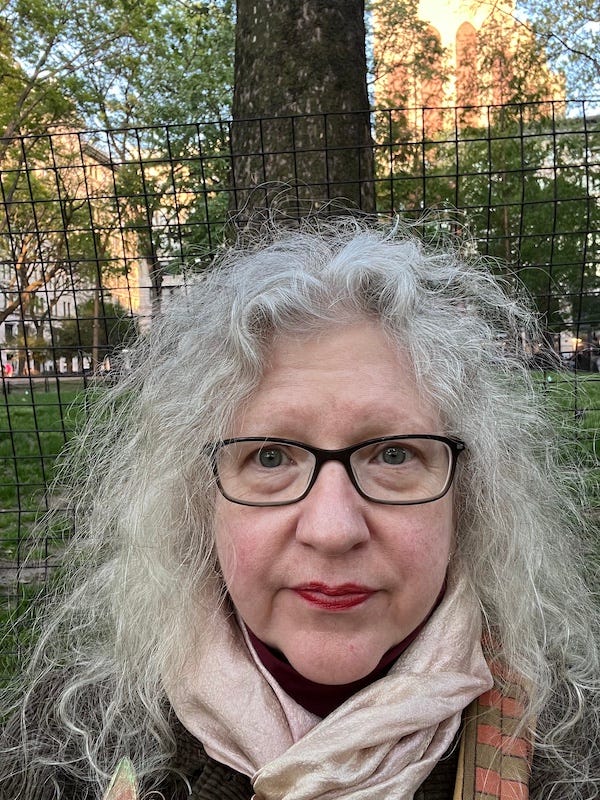
I don’t know what you see, but I see sad, tired, forced-bemused, old. And scene. We all are reflecting the weight of national insanity.

I wear my state of mind on my face, no question, and more often than not my mind is not the expected thing—it disturbs. It occurred to me, on waking and recalling the faces reflecting my face, that as April begins, your Miss O’ would do well to take a couple of weeks off the ol’ media, looking for some kind of resurrection of the soul. If I can’t find woods to walk in, I have the trees along 50th Avenue in Queens, anyway.

Hoping your spring brings you the renewal you need, with love,

Miss O’

P.S. I can’t believe I forgot this one:

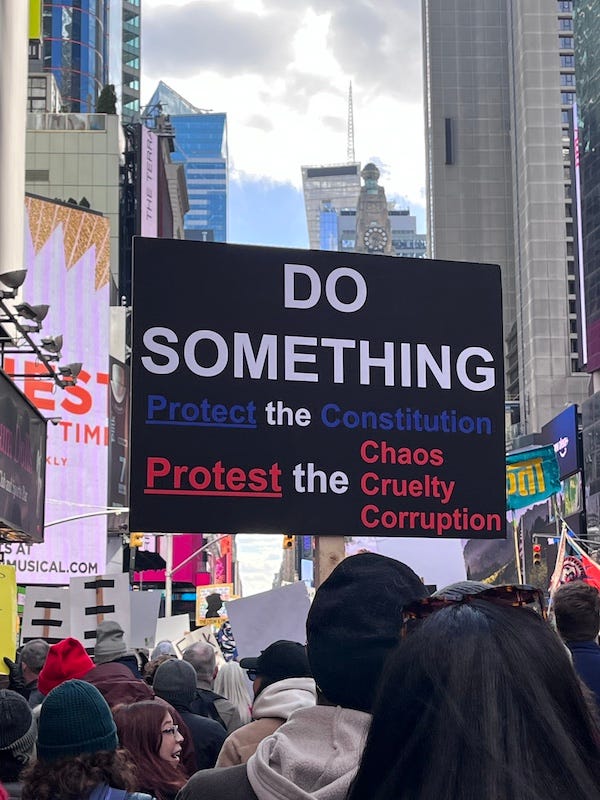
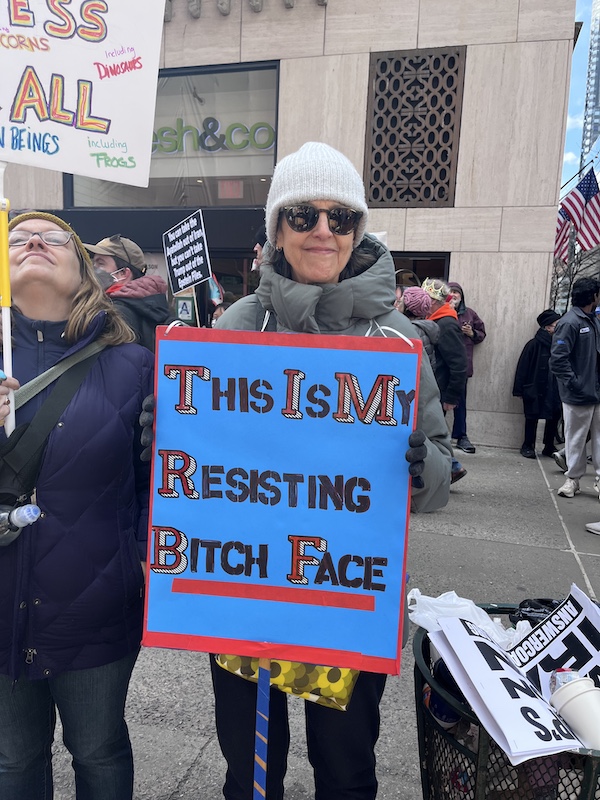
This woman speaks for all of us. Favorite sign at No Kings NYC. LO’H