
“Please don’t.” Her final t was hard, bitten, staccato. Rude. Entitled. I’ve heard that in my ear all day.

This morning around 7:45, walking down 7th Avenue in Chelsea to go to my ophthalmologist (yeah, dilation is a bitch in the morning, but if you wait till afternoon, when everyone else wants to go, you can’t get out of there before six, even if your appointment is at three). Beautiful morning—blue and cool, like fall almost.
Seventh Avenue, called “Fashion Avenue” and shown to be glamorous in shows like Project Runway, is a grim, grim stretch from 40th Street to Greenwich Village, where it becomes Varick. It’s possibly my least favorite street or avenue in New York. Just past the subway exit, I passed an unhoused Black man (note: I don’t care what term you use, the situation itself creates a human indignity for which the whole nation should be ashamed to allow) lying asleep on cardboard along a building façade; I soon passed another woman, maybe my age, Black, sitting on the sidewalk, short legged, short arms grasping “gimme,” mouth agape, chewing rhythmically, eating nothing. I walked past, reached into my bag to see if I had any singles, and gave her one. “Good luck to you,” I said, though whether she was even aware I don’t know. I always try to smile, but it hard.
“If you see someone without a smile, give ’em yours.”
~ Dolly Parton
I turned back to walk on when I saw a tall, lithe, long-iron-gray haired muscular white woman of maybe 45 heading into a fancy coffee shop, who said coldly into my face, “Please don’t,” the t especially harsh. My face wasn’t properly chastened apparently, because she added, and right in front of this woman, “You aren’t doing us any favors.” Her eyes said she wanted to fight me; I shook my head and walked on, trusting her morning latte was more important. It was.
Us and Them: The Great White (Supremacist) Hope.
I’m sorry Lorraine Hansberry didn’t live long enough to write a parody of her great play: To Be Middle-Aged, Privileged, and White. This afternoon, learning the news, I thought, What would Dolly do?
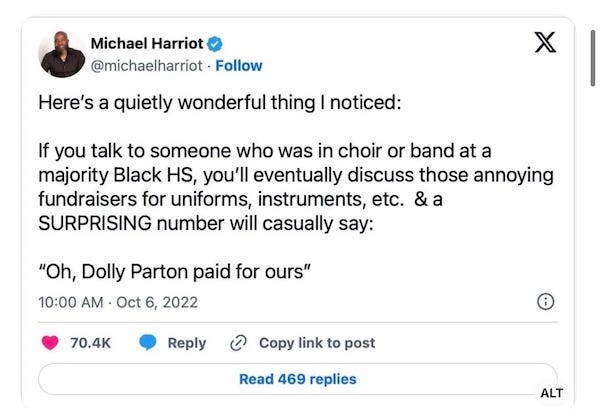
I guess that privileged latte white lady would have some words for Dolly, and not very nice ones, “You aren’t doing us any favors.” No, privileged middle-aged white lady, she’s not: she’s investing in the future. Just like I was. Dolly is lost on you.
Coming out of the subway up the stairs at 23rd Street, I was behind a man who had that odor, distinctly unwashed, almost fecal, long-soiled, that I think came from his shoes; he wore a black doorman or security sort of uniform, possibly in need of dry cleaning; his coat and backpack looked light but weighed down his shoulders as only working poverty can. I always want to help such a person get washed. But I don’t. Dolly would have.
All I thought about when learning Dolly Parton died was her heart. I remember her stories, the ones she told on herself, how she saw a woman all painted and tarted up in town and she thought it was the most beautiful thing she’d ever seen. Her mama said, “That woman is nothing but trash,” and Dolly said, dreamily, “I want to be trash!”
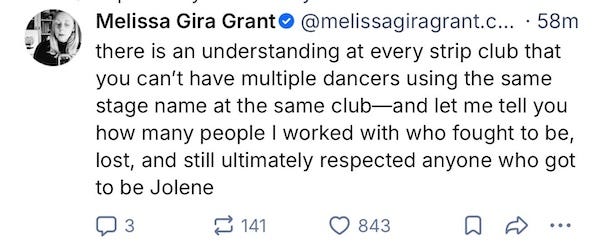
Killing time before my 8:30 AM eye appointment, I wandered into a Duane Reade drugstore, where I found a few “school supplies” on clearance. Alone in the store, I heard the familiar AI intercom voice, “Customer assistance needed in the laundry detergent aisle,” which I’ve learned in store code for “Possible shoplifter lurking about.” They’ve used that same code for years. It’s comical.
I used to wonder why all the detergents and shampoos and conditioners and deodorants and toothpastes were ending up behind locked plastic windows, until I saw two men walk into my local Walgreens in Queens, casual as you please, no masks, with giant blue canvas bags, striding into separate aisles and bagging shelves of merchandise with a sweep on their languorous arms; the floor manager, a short young woman, was on the phone with the police, standing right beside one of them, but he paid her no mind. The two men exited the store once their bags were full and entered a waiting van.
It’s not like they were robbing the rich to give to the poor; they were pulling a heist to put things on the black market. And what kind a world is it that we don’t share with one another what is needed? When I was a cashier during summers at Dart Drug, for several years, I saw these two little boys, brothers, maybe five and four, and then six and five, seven and six, shirtless and shoeless, who’d try to walk out with vitamins and other items. I would stop them, and the older one would say, “We’re waiting for our parents,” and I’d say, “Why don’t you leave these items with me until they come?” and they’d look at each other, and I was so worried they’d get caught by our manager or beaten by their parents, and it broke my heart. Vitamins, toothpaste. It shouldn’t be.
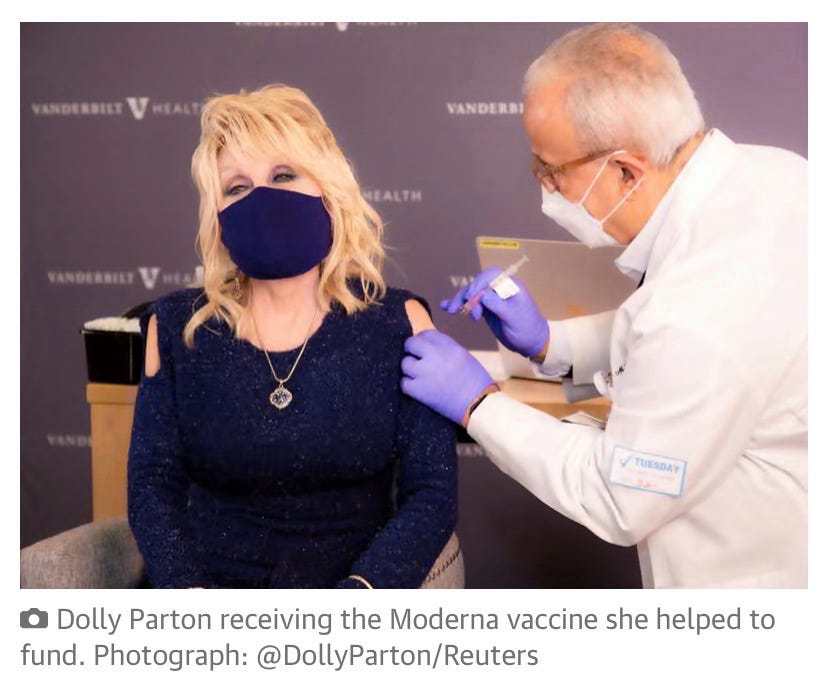
Without a word, Dolly Parton set up foundations, created jobs (that was behind Dollywood), distributed over one million books to children, and all the while wrote some of the most genius songs in our musical history, performed live worldwide, possibly the most recognizable singer on the whole globe. And she lived in Tennessee, married all her life to the same man, keeping her private life to herself.
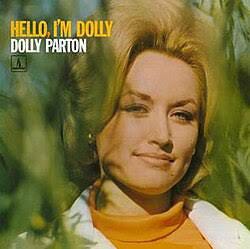
When I first saw Dolly Parton, I was maybe five, and it was on the syndicated Porter Wagoner Show, Wagoner a bit star at the Grand Ole Opry at the time, when she was only 19 or so; and I remember even my mom, Lynne—no country music lover—saying, “Well she’s obviously a lot more talented than he is,” and she wondered why Dolly stayed so long only on his show. Ah, contracts and the men who write them. But she was able to move on, writing “I Will Always Love You” as her farewell to Porter.
We’re all thinking the same thing—that God is taking all the wrong white people; and there’s another 80-year-old whom not one person on this entire earth will miss, but it’s not our call. You can’t blame anyone for calling Dolly. “Please don’t,” we say, but this is life.
Deep love and respect to the best of American artists and humans, the likes of which will never be again.
Finally, and I think I speak for Ms. Parton here, don’t be a privileged cunt.
Love to Dolly,
Miss O’
Do give Dolly’s live “Stairway to Heaven” a listen, and get out the tissues.

