
Disappointment and despair, everything secret
I believed I could never tell anyone, were single threads
in the prairie’s great cloak of grass and sky.
from “Standing in the Middle of a Great Field,” Cheyenne, Wyoming, 1983, Adah, age 94 (from Stories We Didn’t Tell by Anna Citrino, p. 238)
It’s always a surprise what hearing poetry gets you thinking about.
My mom, Lynne, died on Thursday evening, June 5, 2025, and Friday was all about the mortuary and paperwork. Saturday morning, around 4:00 AM, my sister and I found ourselves up at that witching hour with our dad, sitting in a small darkened living room, rocking in our respective chairs or sitting quietly, with coffee, when Dad suddenly blurted out all the traumas of Lynne’s childhood, traumas we knew nothing about, including the entire year, when Lynne was maybe seven, that her mom lived and worked in Omaha without even communicating with her daughter, who’d had to live with relatives. Bernie is crying, sobbing, for the pain this caused his beloved wife. My sister and I looked at each other, same thought, and I say, “Dad, was Grandma pregnant?” A divorced woman with child, especially with a daughter in Catholic school, would have been carrying more sins than any confessional could bear.
Dad looked at me, at us, uncomprehending. It’s funny what a woman understands, or is quick to suspect, things that a man wouldn’t even consider. In the end, we will never know, and my poor mom was abandoned by her mother and ignored by her father, who was quite possibly overseas in WWII at the time. That pain could never be made right.
Does it matter enough
that, if you could have the dead back
for an hour, these would be the questions
you would ask?
~ from “Our Family Tree and Other Myths” (from the collection of the same name by Jean LeBlanc, p. 37)
This event from last year rose in my chest as I listened to my poet friends Jean LeBlanc and Anna Citrino read from their latest collections via a Zoom event this evening, both poets published by Shanti Arts: Our Family Tree and Other Myths and Stories We Didn’t Tell.
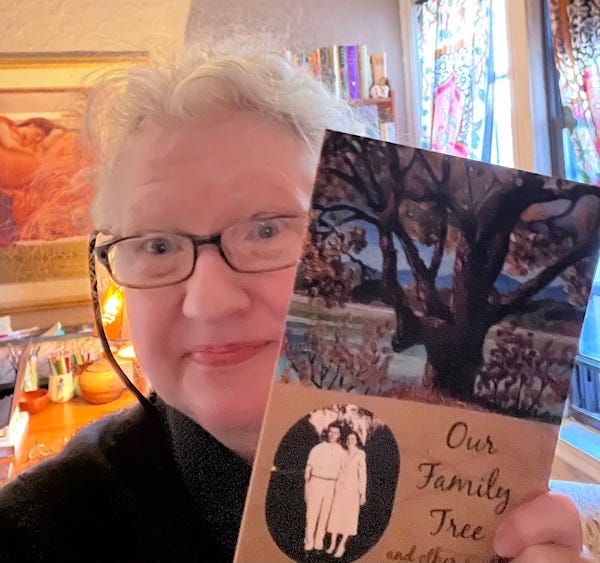
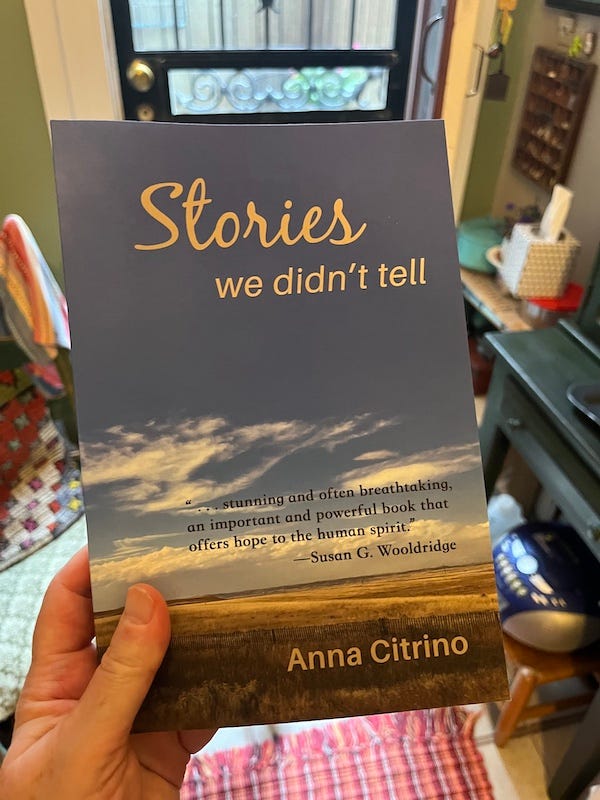
Both poetry collections, which couldn’t be more different in terms of approach, style, and geography, are deeply connected in their subjects’ perseverance, struggles, and connection to the natural world.
Anna, Jeannie, and I met in 1990, the very first late June day on arriving at the Bread Loaf School of English to begin our MA program. From the first, it was clear these women were deeply soulful and talented—each in possession of great cameras, too, photographing the Vermont landscape from our first walk. I was a theater major and very lost English teacher, sans camera, still trying to find herself, no writer, but somehow I managed to get admitted on a “rural teacher scholarship” (the MA was geared to teachers). I took it on faith. One of the best joys of lifelong friendships, really, is evenings like tonight, where I listen to women I’ve known over 35 years grow into these astonishing artists. My degree has served to help me appreciate the great work they do, and therefore to open up my understanding of the world. Not bad.
This evening, as Anna and Jean read (via an app thingy none of us (as Jean said) could have imagined in 1990), something profound occurred to me: I have no home place. Whereas Anna is a product of California sky and eucalyptus (by way of Wyoming), and Jean is New England to the core (by way of Quebec), I’m, well, a sort of Virginian (though Northern Virginia (NOVA) really doesn’t count as Virginia), via the U.S. military (because my naval officer mom was stationed at Barracks K in Arlington) by way of Iowa (which my dad always called “home”). I didn’t really belong anywhere. The natural world encounters of my suburban childhood felt inadvertent. I’d meet kids whose families went back generations on farms in NOVA before it was NOVA, and they seemed vaguely alien to me, with their wild cedars for Christmas trees and lapses into Southern dialect at home, dialect they never used at school. I never knew how to feel about that.
Whatever I am, presently a New Yorker, and whatever my insoluble confusions over identity, it’s artists who shake us out of our stupors to look at our truths in the face. So let’s just say I have a lot of thinking to do, right after I reread (yet again) both collections.
You can find these wonderful poetry collections I mentioned at Shanti Arts, based in Brunswick, Maine. May I recommend them? I may. Consider adding Anna’s and Jeannie’s books to your library. Consider, in this our National Poetry Month, adding poetry to your life.
Happy April.

