Markets, Museums, and New York City

A day in the life at the end of the world

Over the past couple of weeks, I’ve found myself going over to Jar Bar, a local place nearly 100 years old (in location if not name) I’ve seen from the outside all my years here in Queens, but had never gone in. Learning a neighbor of mine is tending bar there some evenings, I started going, and have been over maybe four times, including a couple of weekend afternoons in the garden, where I met an Irishman whose sister—Marie of Dillon’s, that closed ca. 2006—was a bartender I’d known and loved. Jar Bar is filled with fascinating if sketchy characters—pool players, depressives, tightly wound young men, fighting old couples, laid back tokers. I listen; I watch. I have a pint. Here, I contrast the darkness of this dimly lit local bar with the world of The Alcove, a wonderful Colombian-infused bar and restaurant full of light and warmth I’ve frequented on the other side of Queens Boulevard for all of its eleven years, where everyone gets hugs from the owners. And while both places learn your name right away, the vibes could not be more starkly different.

Have you seen the movie Blue Velvet? At the movie’s end you have to accept, fully, that Isabella Rossellini and Laura Dern live in the same town, and that Kyle MacLachlan is equally drawn to the Dean Stockwell underbelly and to the domestic idyll that is the promise of marriage in the suburbs. Just so, I’ve found myself drawn into a sort of underbelly for heavy drink in my neighborhood as well and warm and light-hearted vibe of fellowship and food, and it’s hard to believe it’s the same town. Oddly, I find I enjoy both worlds and seem to navigate them easily. That’s Miss O’s Queens.
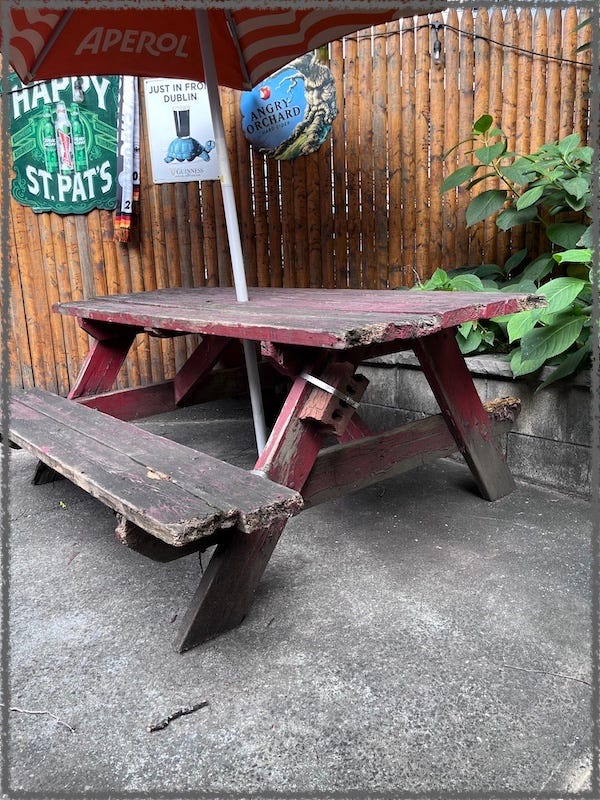
Jar Bar garden moment. Queens.

For my gorgeous Sunday on my long weekend off though, I eschewed an afternoon pub crawl for a morning at the Grand Bazaar Flea Market on Columbus Avenue. I stroll from booth to booth, tempted by interesting hooks, vintage jackets, costume jewelry brooches, and pottery if you can find it; I noticed a young white couple looking at Jacquard woven silk square pillow shams—from their conversation, I saw she wanted pink—or at least she wanted color (“I can see from your face you hate it,” she said to her husband, who did not disagree and nor did he help); even the dark blue, which they both seemed to like, was too much for him, and they agreed the brighter blue was a maybe. I spoke up (having said hello to the importer, whose wares I’d bought before): “I love that dark blue,” I said, and you saw this breath enter them both, a confidence. “I don’t mean to intrude,” I added, but the woman said eagerly, “No, I want another opinion. We just want to find a second one,” and I suggested they find a complimentary one instead, picking up the red accent, or the gray. “They don’t have to match.” Revelation! I’d heard them worry to the vendor about the right-sized pillow form, and so I said, “I put my covers over existing pillows; change it up.” The young man said, “We could do that,” and I felt his doubt lifting. “Enjoy your day,” I said, leaving, and they were no doubt relieved that old lady wasn’t going to follow them home.

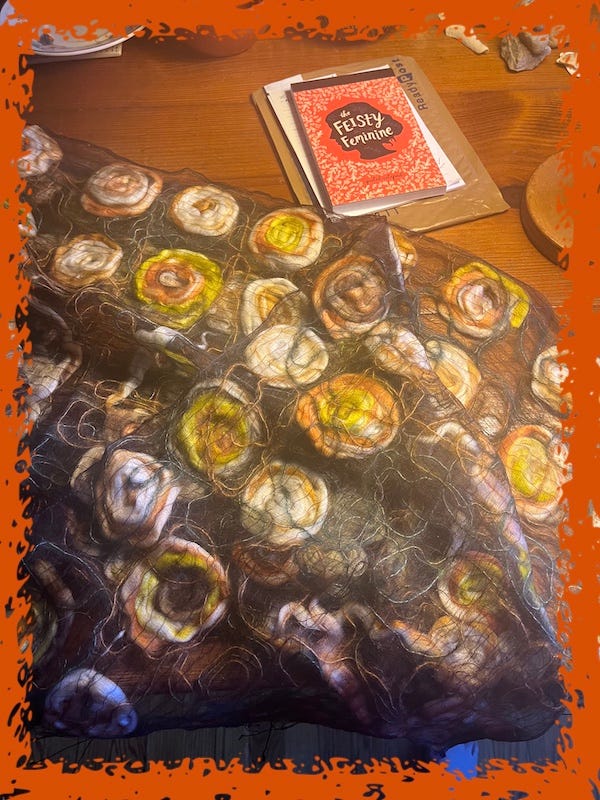
At another booth, an older Indian couple showed beautiful textile wares, and I’d been circling around their area and found myself loving a couple of scarves, especially one felted item. “These are scarves sold in museum gift shops,” designed by a woman in India, the woman said, and now they are here in a NYC flea market on clearance. I said to the woman, who helping two Black women buying a scarf for a birthday present, I didn’t interrupt, but sifted through two scarves; I realized there was a really a combination—the colors of the silk and the style of the felted, and I found it! When she came over to me, I said, “Here’s what I did,” and I showed her how I found the one I wanted, and her eyes saw and she said, “You created a middle,” and I said, “I have to tell you I feel sort of ridiculous buying a scarf with the world as it is,” and she instantly said, “Terrible things, terrible,” and I said, “But I guess we have to keep putting beauty out into the world,” and we agreed we do.
Following the market, I walked toward the American Museum of Natural History, where as a resident New Yorker I get in free. En route I saw the lavender lady at the sidewalk market and bought a pound of dried lavender flowers (I put them in sachets of my own and try to save my wool from moths). At the museum desk, I explained I only gain entrance to use their facilities on flea market Sundays; he refused to accept my dollar and handed me my ticket.

Once relieved, now where? I decided on the park, and en route I saw the New York Historical Society, where I hadn’t been in a few years. I first tooled around the gift shop, which merch makes it the best place to see what’s on exhibit, but there was an exhibition not featured there, as it turns out, for obvious reasons when out of context.

Black Dolls:
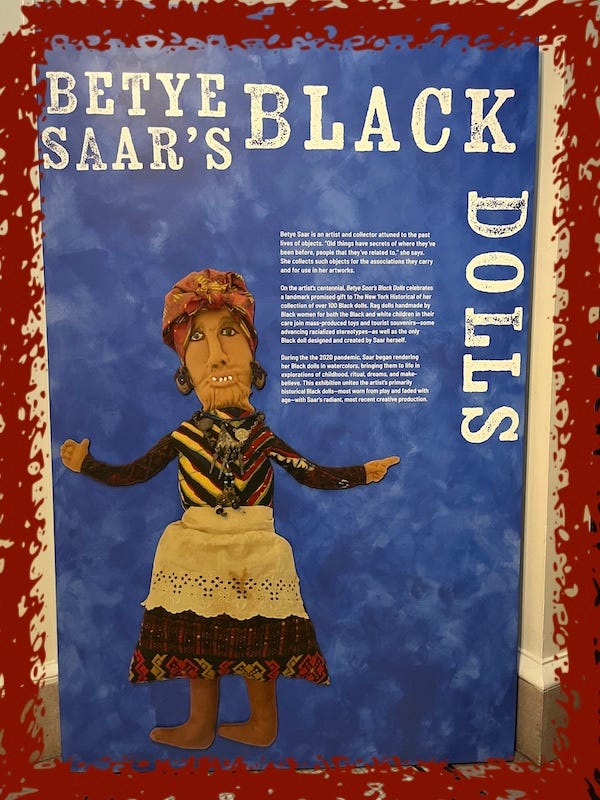
Assemblage artist Betye Saar, who died July 26 four days shy of her 100th birthday, is featured in an exhibition at the New York Historical Society’s second floor.
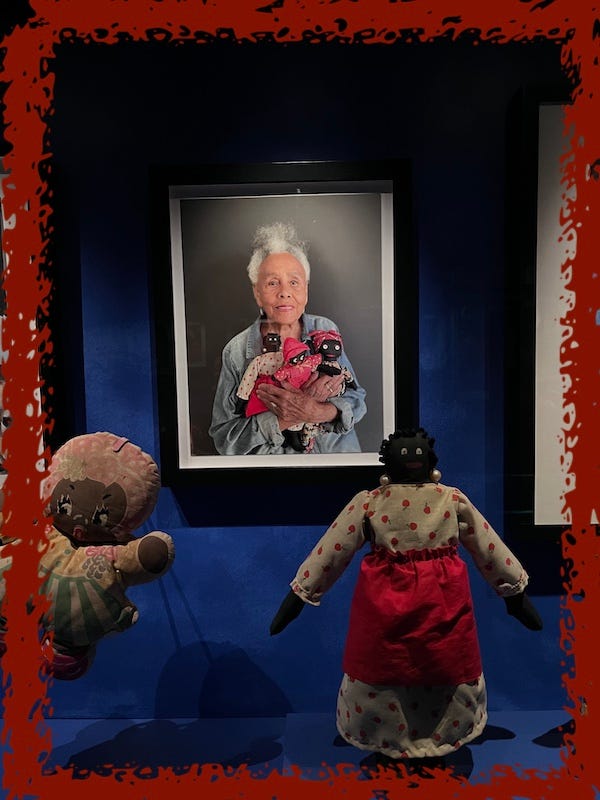
It was a small, beautiful, unnerving, unsettling exhibition for me; I also have a black doll:
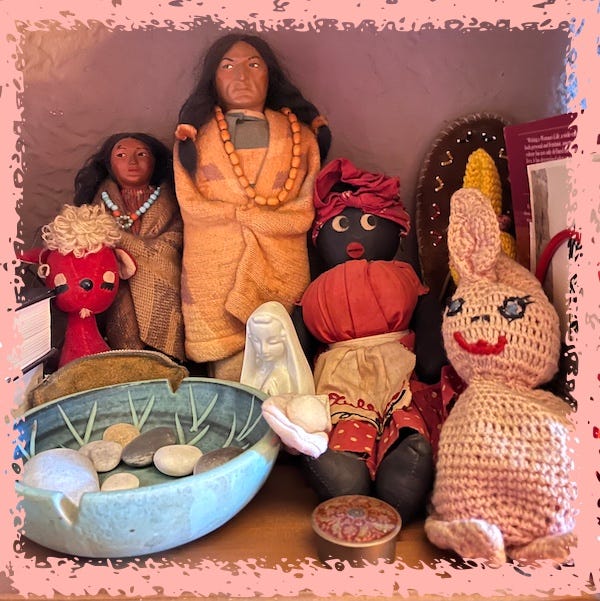
I know I told you this story: my mother’s friend Laura (a Navy WAVE like my mom) was raised in New Orleans by a “mammy.” Lynne said, “Laura was a great gal but my god, the racism.” Laura’s gift to toddler Lisa was a NOLA souvenir mammy doll, “and before I could stop her, Laura had given it to you and you wouldn’t let it go.” I still won’t let her go.

I was in tears throughout the exhibit, and I’m not sure how to put into words why—all this evil racism, the denial of Black little girls having pretty black dolls to call their own, without stereotyped big white eyes looking sideways, forced-laborer head scarves and aprons. More than that, it was Saar’s art, her paintings and collages that reimagine these dolls with love and joy, that moved the shit out me.
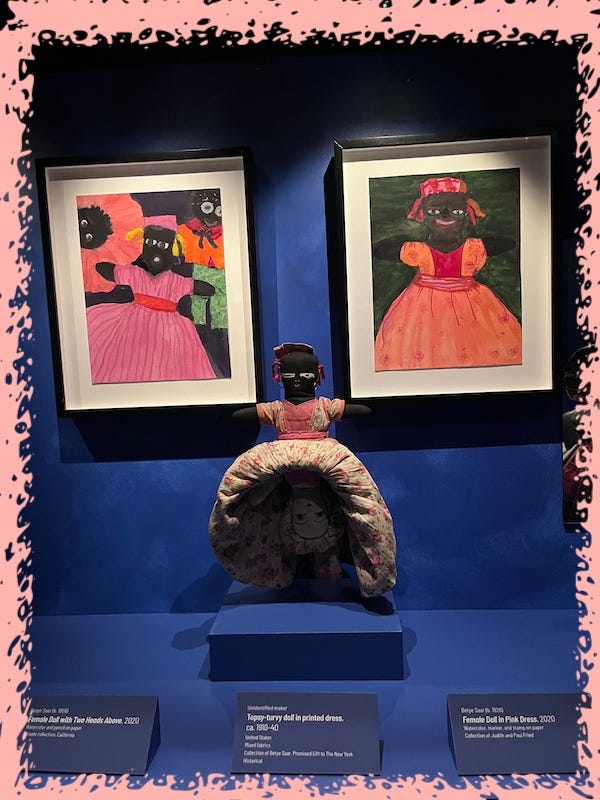
I also have a topsy-turvy doll. You see both the white doll and the black doll, part of one being, but never both together. And there it is.

Heading down to the first floor, fairly gutted by now after three other floors of exhibits of all kinds of NYC and American history, I happened on an exhibition of women’s shoes and paused there before leaving. I’d no sooner begun looking than three early-college-age young women approached (whom I’ll call Elle (who was Black), Jaye (Chinese), and Cece (Indian or Pakistani, I think)), studying advertising and given the assignment to visit a museum and ask people what brought them to the museum, what emotional reactions they had, and anything else the interviewee wanted to share.

Elle said, “I saw your bag, and your necklace, and I knew we could ask you.” Schoolteacher vibe.

I said a lot of stuff, as you can imagine—they recorded me: I requested that in their careers they market curiosity instead of consumption; I said you can’t have emotional responses if you come into a cultural place with an agenda; I celebrated wandering; told them I loved the doll exhibit and about my own Mammy doll, how maybe my tears were coming from the artistry of Betye Saar, surely, but were also tied up in history—the unfairness, rank cruelty of slave systems, and that NYHS balances all our past pretty fabulously, I think.

I then pointed out the shoe exhibit, where we were standing, gesturing as I responded, “All this is foot binding, you know, just as surely as the literal binding of the feet of women in China,” heels so high you can’t run from an attacker, shapes that destroy the health of our feet. “But they’re beautiful,” I said, “I love looking at shoes.” You live inside these contradictions all the time.

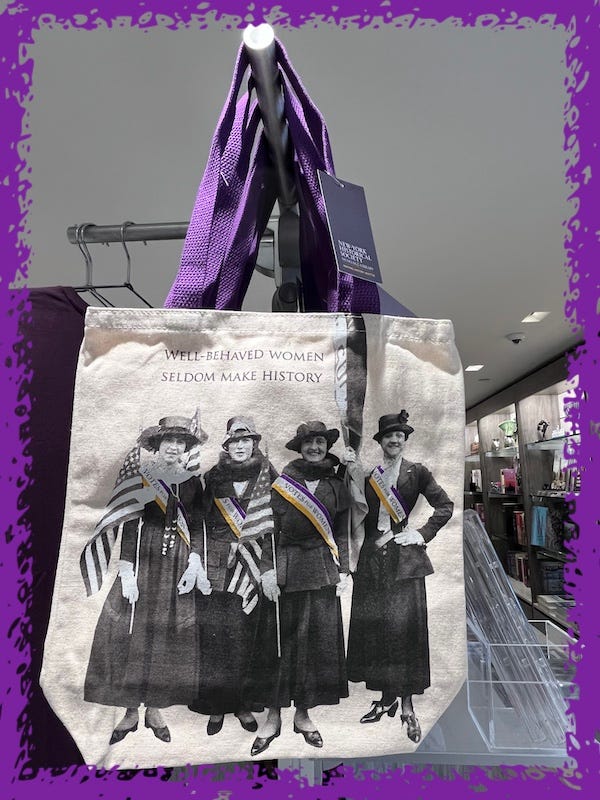
NYHS Merch #1
NYHS Merch #2 (ironic contrast to Merch #1)

I kept having to shift us out of the way so others could get at the views of the shoes; I took the students’ picture and we did a selfie for Elle. She put her information into my phone, and I sent the photos I took. I haven’t heard back, so I don’t know if she got them. (Telling my friend Colleen all this at dinner at The Alcove last evening, she said, referencing her grandchild, “Oh, she won’t get back to you, and if she does, it will be in a month. That’s how all the kids are now.”)

Finally, I mentioned to the gals that my next career plan was to put a sign around my neck, “ASK ME A GRAMMAR QUESTION,” and sit on benches around the city. Do you want to ask me a grammar question? Cece jumped for it. She wanted to better understand the semicolon. I WAS IN HEAVEN! Consider three versions of these same clause combinations, I said off the cuff.

Gloria Steinem was a great activist. [period] My mother never spoke of her. [period]

Gloria Steinem was a great activist; [semicolon] my mother never spoke of her. [period]

Gloria Steinem was a great activist , but [comma but] my mother never spoke of her. [period]

Cece, Jaye, and Elle said, “Ohhhh…,” as I demonstrated the contrasts: I asked them to consider the first independent clauses separated by a period—there’s an underlying weight to the (dis)connection which may or may not get explored. In the second example, with the semicolon, there’s an opening indicating the writer will say more, and this is created by suggesting a connection with that punctuation. The third, with the comma and coordinating conjunction but, has a kind of softer quality, almost dismissive or suggesting something that is part of a pattern that is explainable. All of this was to say: the meaning you want will dictate the way you punctuate and connect the clauses. It depends on what you’re going for.

From their reactions, I saw that it’s possible I taught them more about writing in that little “off the record” lesson than they’d had in all their years of school. Possibly not. But I had the time of my life. (I later heard a man in my neighborhood later talking on his phone sitting on a stoop, saying, “I’m doing the Socratic method here, just asking questions,” and I realized I’m no Socrates. I just love to lecture. Direct instruction is underrated. Look at all those lightbulbs.)

So the event of that interview had me looking at life in America: White people use periods; Black people use semicolons; moderate/liberal white people use the , but. Do with that observation what you will. When it comes to meting out justice, to changing this world, to making whatever it is to create our new world, what are you going for?

On the first floor, before leaving NYHS, I looked at an America 250 exhibition (and that this nation had no celebrations at all, none to speak of, is beyond depressing, and also an opportunity), featuring the contrast of slave and free in many Revolution art pieces. Among these installations was a booth that displayed a facsimile of the Declaration of Independence, and along the bottom were three clear tubes partially filled with little orange rubber balls, balls which could be procured from a box on the side. The balls were for taking a poll: LIFE – LIBERTY – PURSUIT OF HAPPINESS—of the three, where do you place your ball?

I chose LIFE.

Most balls were placed in LIBERTY, which I rejected because I don’t know how anyone defines that. All I know is the Fifth Circuit Court of Appeals in Mississippi, under a Trump-appointed judge, this week ruled that no citizen has the right to clean drinking water, and that the government has no obligation to inform anyone about the status of water quality. Full. Stop. And if we aren’t entitled to water, we get no life. Full. Stop. So what are we even doing in this country? No Life, no nothing.

I continued my day with a walk through Central Park, including an extended bench sit to watch the scenes. My friend Colleen called as I sat there, and I ended my day meeting Colleen at The Alcove (I walked through the park to 57th Street to the N Train; she walked from Astoria. We arrived five minutes apart). Open windows, margaritas, chips and guac, sliders and fries. Hugs from the staff. Delicious.

We walked Skillman Avenue to the park, where the media swap tables are, and sat outside to watch the coming dusk. Magical light, my favorite time of year for light, hinting at the fall to come. Hmm.

We don’t have much time left on earth, our planet of hideous contradictions, of indescribable beauties; it will never be more temperate or lovelier than it is right now, this second. I’m trying to take it all in. I wish I knew what else to do.

Love, love,

Miss O’
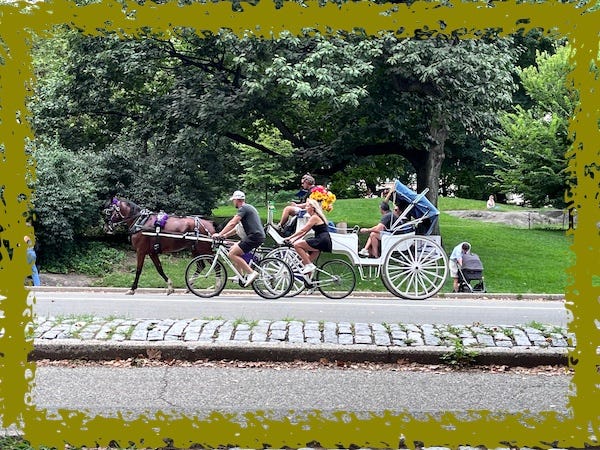
Central Park, Sunday in summer. LO’H

Wondering about stuff: something light

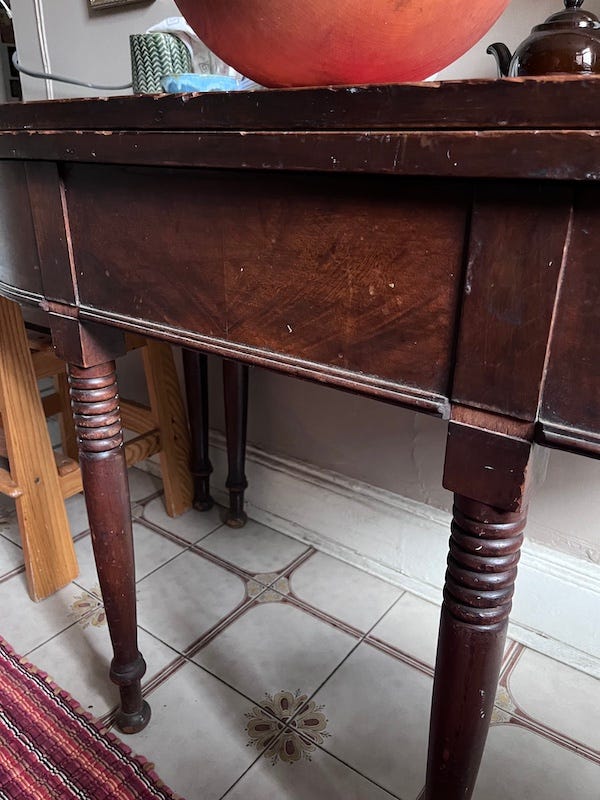
This morning I got to looking at my sideboard, a gateleg flip-top table, probably mahogany, maybe cherry, certainly hardwood; a fifth leg swings out. It was used in a barn as a sawhorse—you can see it it in marks all over it. I have this piece because it was in an apartment where I lived with a prickly roommate, whose previous roommate (a glorious human) got it from her mom’s thrift shop and told me I could have it. It’s at least 200 years old, full of damage (scotch staples held part of the top together till they fell off in the last move, and I put glued pencils in where pegs used to be underneath—it was an emergency fix when Rina from India was staying with me, and Mark and Steve and Flynn were coming over from New Jersey for a St. Patrick’s Day feast and I had to get us around some kind of table, and Rina said as I assessed, grabbled, and glued, “I am in awe of you right now”), not really practical, and surely not worth much money, but I love it. It’s the object I’d bring to Antiques Roadshow just to learn more about it.

When you watch Antiques Roadshow—and if you don’t, I recommend it, as it’s interesting, educational, curious, and also restful, so human and hopeful—do you look around your place and start wondering about things? What would you bring?

Antiques, a roadshow of the mind

This has been hanging over my mantle

I inherited this from my grandmother

These were in my mother’s attic

A man offered us a thousand for this set

This ring

This doll

These books

This sword

This poster

In a barn

This rug

In the garage

This

uniform

painting

embroidery

etching

lamp

vase

At a thrift store

Hopefully we can find out something more about it

Do you remember how much you paid for it?

The artist

The owner

Was born in 1888

Late 1920s

Late 1930s

Joined the militia at seventeen

The (pick a) war

The expedition

It’s a charming story

In the original box

We’ll obviously keep this

Bowl

Bracelet

Federal style table

Rookwood Pottery

It is Tiffany

A salesman’s sample

Tomb Trade Simulator

I’ve had it for about 30 years

The maker’s mark

At the folkart table

Not Tiffany

He was a coal miner turned photographer

She was a debutante turned painter

He was a mapmaker for the government

She was an itinerant artist at a time when

I heard they

Lived in France

Japan

Bali

Alaska

Massachusetts

Auction records are scarce

Look

glass

original frame

platinum gold copper

Great patina

The watch and the chain are like nothing I’ve seen

The sales receipt is incredibly complete

Intact

Like new

A diamond set in the center

It’s perfect

Not polished

A little wear which is to be expected

Something of this age

It’s unsigned

Not popular as it once was

Any idea of value?

For insurance purposes

And you hear the stories and the insurance appraisal

and you see the vintage episodes and hear the up or down sound effect

and sometimes you just want to step back and imagine it

As it once was

And the who had it

And the where it came from

That’s the value—

the pleasure of its company.

Here’s to Sunday.

Remembrance of Things Past: Are we only what we remember?

The title of Marcel Proust’s famous novel, À la recherche du temps perdu, was beautifully translated as Remembrance of Things Past, until some literal-minded academic pointed out that the literal translation, the actual title, taking it word by French word, was In Search of Lost Time. And I say, Is it? Which novel would you take down off the shelf? Exactly. Sometimes literal is not the way to go; sometimes essence gets more at meaning. Today I’m all about memory.

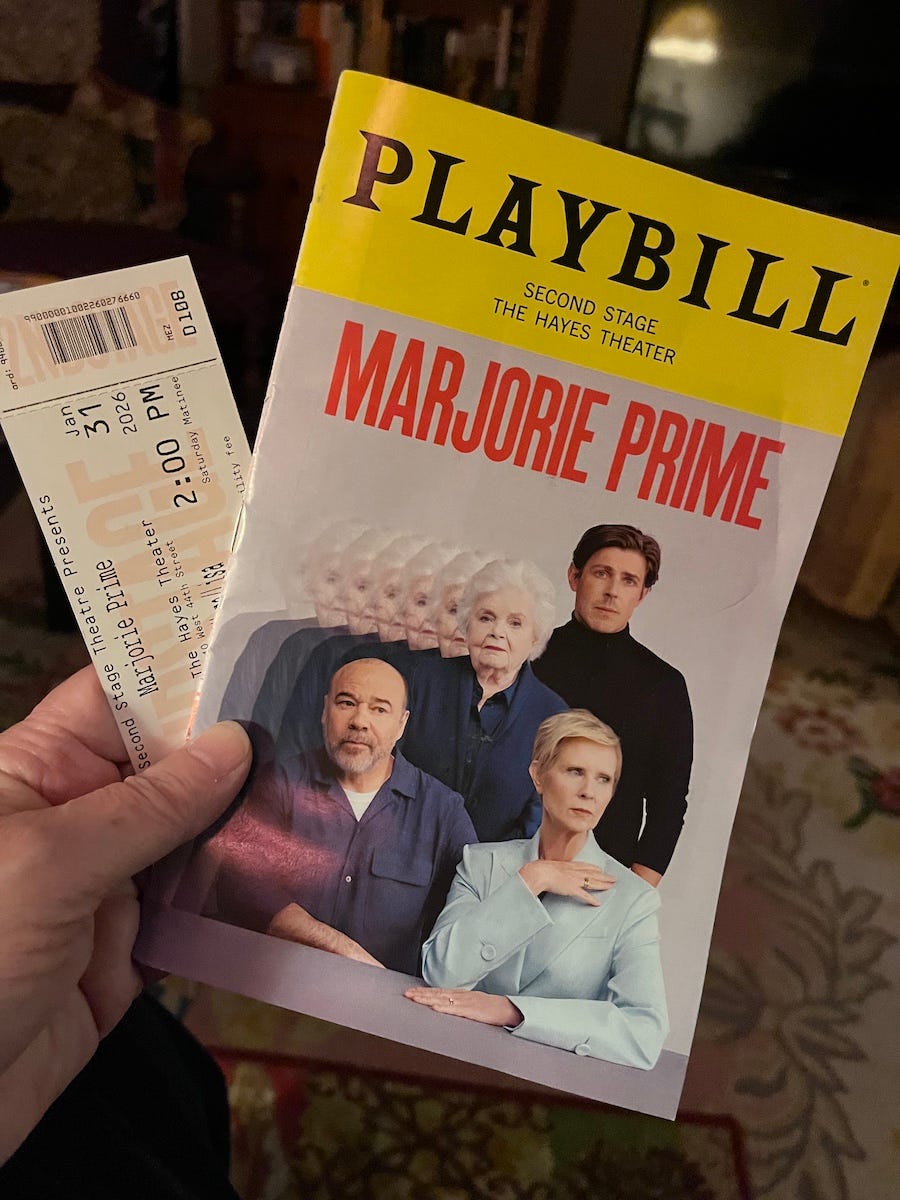
Yesterday I went to see Marjorie Prime at the Helen Hayes Theater on W. 44th St. here in New York. The play has been around since before Covid—my friend Colleen auditioned for it when it was starting a run at Playwrights Horizons, where our playwright friend Tom saw it. That’s how they remember it—an event before Covid. The play itself, by Jordan Harrison, concerns an 85-year-old woman (born in 1977, so we’re about forty years into the future) in the late beginnings of dementia, cared for by an unseen woman named Julia, and visited periodically by her daughter and son-in-law. At the opening, an oddly stiff, handsome young man (Christopher Lowell) is talking with Marjorie (96-year-old June Squibb, who is just remarkable; I first became aware of Squibb in the movie About Schmidt, where she played a Midwestern wife to Jack Nicholson’s Schmidt and was so good I thought they’d plucked an Iowa housewife off the street for the brief but pivotal part. Sidebar: I know he was nominated for an Oscar, but I thought Nicholson was all wrong for the part—it’s one that really belonged to a less complicated actor like Paul Dooley. I digress—and yet remembering our takes on things is also part of what I’m focused on this morning.)

To keep her mother company, Marjorie’s daughter and son-in-law (Cynthia Nixon and Danny Burstein) have purchased her a Prime, an android, this one in the form of Majorie’s husband, Walter, when he was young (as she requested)—so the oddly stiff companion is stiff for a reason. A Prime can be generated into any form, to be filled with whatever memories people give it; as a result it can converse by speaking only in programmed memories and saying comforting things. The play is asking us to consider what a person is. Is our worth, our existence, dependent on what we can remember, even in facsimile, and must what we remember be in terms of other people in our lives? Should trauma remain part of our memory? When we can’t stop remembering trauma, is therapy or forgetting harder the better way? What does it mean to truly live? Ultimately, Are we only what we can remember and who remembers us? For a relatively spare play, it does bring stuff up.

I found myself this morning asking, “Why do we remember?” And more than that, is memory the essence of humanity? It’s the first day of Black History Month, and I think of Alex Haley’s historical novel, Roots: The Saga of an American Family (1976), where Alex learns about his enslaved ancestor Kunta Kinte (his name and story passed through Haley’s family over generations), when in his research Alex travels to West Africa by the Gambian River and finds a griot, a storyteller who tells the history of all the people of a village, committed to memory, once a year, and it can take up to three days without stopping to do this. But when he hears “Kunta Kinte,” and learns of his capture by slave traders, Alex knows he’s found the complete history of his people, almost unheard of for African Americans (even finding the affirmative mark of a slave on a slave schedule, let alone the name of the ship, let alone the name of the African, as I’ve learned from Henry Louis Gates, Jr., and his PBS series Finding Your Roots, is beyond rare).

In 1977, when I was 12, ABC showed Roots, a miniseries based on the novel, that galvanized the whole nation (there being only three major networks and no cable), teaching white America about real enslavement for the first time. To quickly erase (again) that powerful, historically true narrative, NBC countered by showing Gone with the Wind on television for the first time (the “television event of a generation!”), so we could (mis)remember the real story, the glory we lost, I guess. Horrifying when you think about it. And here we are. (I remember my social studies and English teacher Miss Covington glossing past Roots and gushing about Gone with the Wind, her favorite movie, telling us the whole plot—and keep in mind she (no more than 30) could only have seen this 1939 movie once, or twice at most, in a revival at a movie theater, say, this being before VHS, let alone streaming; when she taught us about the Civil War, she minced no words: the North didn’t want slavery, but they didn’t want Black people there, either. I cannot imagine what the Black kids in her classes felt.)

Thinking more about ethnic generational memory, I remember seeing a David Mamet play maybe 25 years ago, The Old Neighborhood, where a Jewish man named Bobby Gould (played by Peter Riegert, who should have won a special Tony for his master class in active listening) who in three scenes visits 1) a childhood friend; 2) his sister; and 3) an old girlfriend. In each scene he says a few words at most, and listens to each of the others talk about the past, the “old neighborhood,” partly a shared history, partly revelations about things he didn’t know. While the play massively bored the three friends I was with, I found it galvanizing—the terrific performances (Patti LuPone played the sister), yes, but mainly the premise, that so much of our time spent with family and friends is absorbed in reviewing the past, our memories. Why is that? Why do we do that? What do we gain, or lose, from that act? In the first scene, Riegert’s character is visiting a childhood friend back in the city, staying at a hotel on a business trip. His buddy reflects at one point, “I could have made it in the camps,” and Riegert says, “You can’t know that,” and the friend insists he could. And that was the first time I became aware of the weight that Jews today carry when they had family die in the Holocaust.

Roots was the first time I had been shown anything about slavery, having grown up with text books that minimized the abuses of enslavement, and in a state with a state song, “Carry Me Back to Ole Virginny,” which says, “There’s where this old darkey’s heart am long’d to go.” (It’s credited to an African American minstrel, James Bland (1878), but its roots appear to go back to the 1840s, lyrics by Edward Christy and sung by Confederate soldiers; and in either case, yikes. It was not retired as Virginia’s state song until 1997.) In other words, the truth and memory of enslavement was not part of my white Virginia memory, so here I am in my sixties only now really reckoning with it, what with the Civil Rights Act and Voting Rights Act passed during my first year on earth, a seeming ]course correction. Wow have I been blind.

What am I on about? History—the importance of a shared and factually accurate history, one we learn all our lives, together as a people, revised and reflected upon rationally as new information comes to light. National, personal—all the history defines us. I saw a post by a Black woman—and I didn’t save it and I hate myself—who pointed out that in her view the core issue for white people is that whites have no home. Blacks have Africa and enslavement to root them; Native Americans are the indigenous people. But whites? A culture of constant colonization and conquest, from ancient Rome to the Nordic invasions all over what is now Europe, most whites, especially white Americans, have no real homeland (this term tied to Nazis and white supremacists features on MAGA propaganda posters to bolster their deeply false and hideous American narrative). Everything for whites has been about invasion, genocide, rich man-enforced patriarchal “Christianity,” and repression of The Other to the point that we, as whites, have no roots and no shared memory beyond war and domination and fear. We whites have been trained by the rich elites to stew in hatred or resentment, say, crying on about our disrespected primacy; or, by contrast (it seems to me), we whites may live in bland acceptance of our privilege exercising little agency beyond voting and saving for retirement. How can you root in that?

So after watching Marjorie Prime, where the only value the characters seemed to place on one another was in memory—forcing one shared memory while maintaining the repression of another one, both confining—I got to thinking about memory as a kind of cage, its relation to creativity and forward motion coming into question. The white people in that play were defined by, and at home in, the past, but a murky, unsettling past, often manipulated and limited through the use of the Prime by the stories it repeated, with no clear plans for, or authentic excitement over, a present or a future. Is traveling to Madagascar the answer? (No.) At one point, the son-in-law replaces a dying Ficus tree in the house with another Ficus tree that no one pays attention to, and how is that a useful creative act? He’s the only character trying to reintroduce life into a dead space, and futile though it is, he at least is trying.

Some of the last things I did with my mom, Lynne, involved me asking questions of her life and filming her in very short videos; collecting recipes; she and I sorting a box of linen for me to take, tatting done by her aunt and grandmother. Memories through things, new stories emerging using the objects as a prime. And if we aren’t maintaining and deepening connections to our loved ones and our history, who even are we in the world?

When I look at Minnesotans and their powerful resistance to authoritarian rule, I am struck by this happening collectively and also in winter. Garrison Keillor used to begin his weekly Lake Wobegon monologues on NPR’s A Prairie Home Companion, based in St. Paul, Minnesota, “It’s been a quiet week up in Lake Wobegon, my home town out on the edge of the prairie. It’s been cold this last week.” That natural bond between Minnesotans in their landscape was ever and remains the relentless cold, the snow and ice (followed by the muddy springs, hot summers, and the short growing season). Anyone who is brave enough to move from Europe, let alone Somalia, to that unforgiving winterscape would need good neighbors immediately; and it’s that culture that appears to have bound all these people to one another—winter warriors—in an essential goodness and clarity.

My sibling text thread all week has been filled with photos of snow, including a video of my Virginia brother Jeff walking on top of snow, so thick is the ice still.

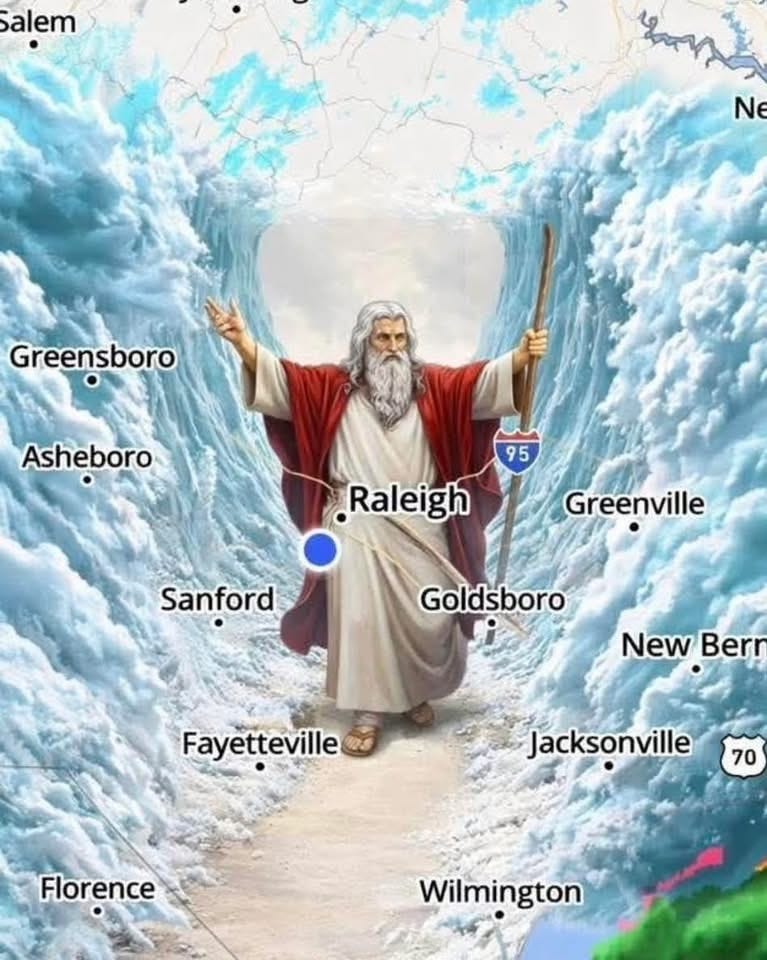
Dispatch from North Carolina, where three of our six siblings live, with humor.

Virginia just set a record for the most days in a row below freezing—a totally unnatural thing, so yes, Herr President, this is a result of global warming—and I’m thinking that it’s winter above all seasons that makes us reassess, remember, and also be present. Winter is never boring, even if it’s exhausting. Winter does not forgive. You can never let up, chopping wood or shoveling snow or suiting up to keep warm. Sometimes you have to wait for the melt. But waiting is for the old, the Marjorie Primes of the world, and only then if they are looked after. The rest of us still have to get to work.

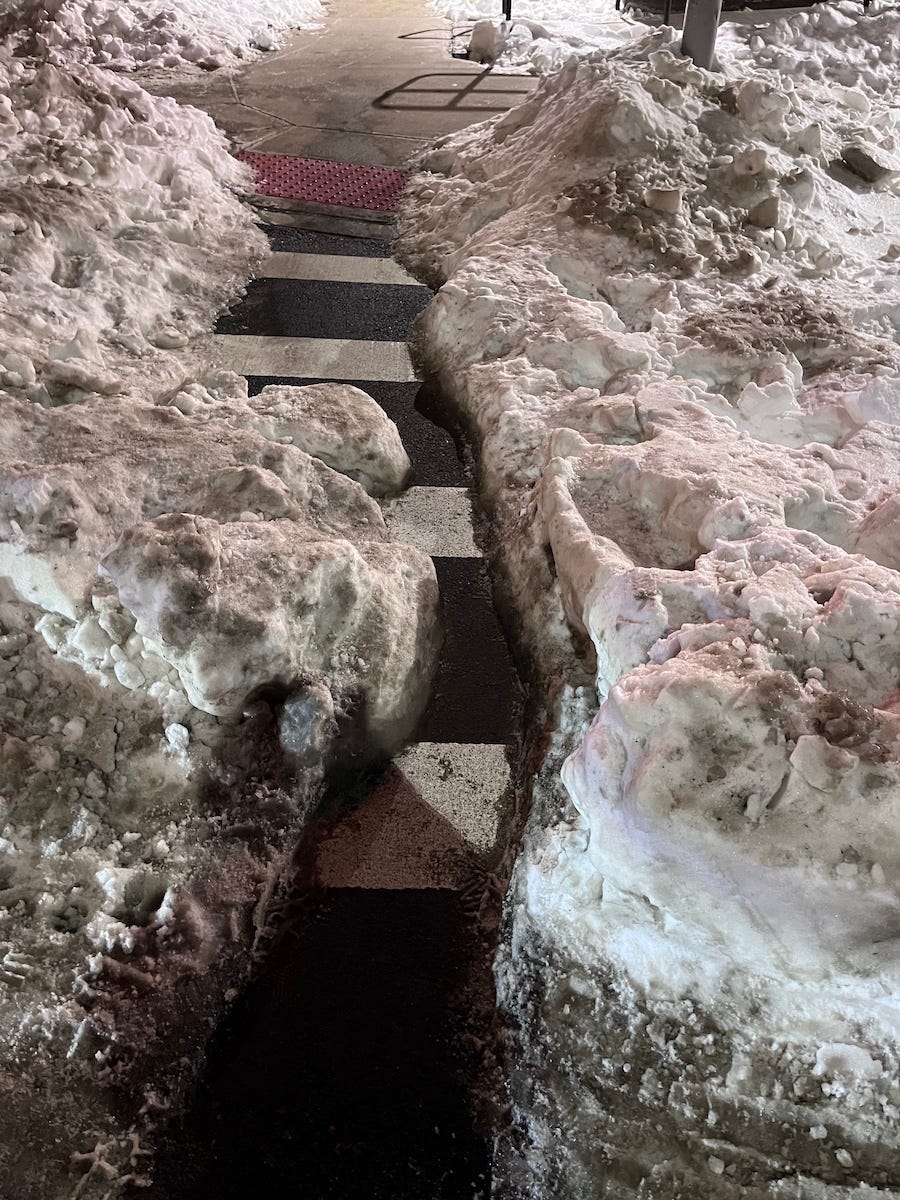
New York City, in my first decade, always looked like this from December to the end of March. I’m out of practice navigating the street, crossing obstacle courses of walking paths, walking with heartiness, but we all share it and roll with it. And it’s a comfort.

It’s history, people. It’s all about history. Let’s never forget this time, whatever happens, wherever we go from here.

And celebrate Black History Month. Learn all you can. As the snow deepens, as ICE expands, deepen and expand yourself.

Bucking the System: Revisiting an older post for newly horrific times

Two men were lynched, or at any rate found hanging from trees, in Mississippi yesterday, but given different treatment by the police and media. I became so sick when I read about Trey Reed, that sweet face, I physically cried out, convulsed, as the weight of the report erupted in me. I’ve seen several posts on it, and nothing on national news. The police quickly determined that a Black man lynched from a tree branch involved “no foul play,” as only cracker ass police right out of In the Heat of the Night can.

Today on Substack, Rashid spoke for me.

Here’s another hanging death, this of a white man, given very different treatment.

I also read that President Trump is forcing the removal of all photographic evidence of the torture of the enslaved to be removed from America’s museums, due its violent content. Again, I felt deeply sick. In 2016 for Black History Month, in light of candidate Trump’s transparent racism, I wrote a piece on WordPress, and repeat it here, slightly edited:

In honor of Black History Month, one of my former students posted a social media essay on “buck breaking.” I had never heard of that. Here is research I found, oral histories of former slaves recorded at the time of the WPA in 1937. The pieces require real concentration, as the chronicler honored the dialect of each speaker, but the stories are horrifying and make for utterly necessary reading.

On Slaveholders’ Sexual Abuse of Slaves Selections from 19th- & 20th-century Slave Narratives

AMERICA: As Miss O’ used to point out to the white students who would ask (and ask and ask and ask) why 1) blacks just don’t “get over it”; and 2) why we don’t have a WHITE History Month—I could only point out that we had 350 years of slavery, and (today) only 50 years of civil rights; the Voting Rights Act and the Civil Rights Act were passed in MY lifetime. But I didn’t know the half of it: THIS is the history of slavery that needs to be taught in every high school.

For your further edification, in case you missed it in your history classes, I am including photos and engravings I found on Google Images which further show the history of abuses chronicled at the time of slavery.

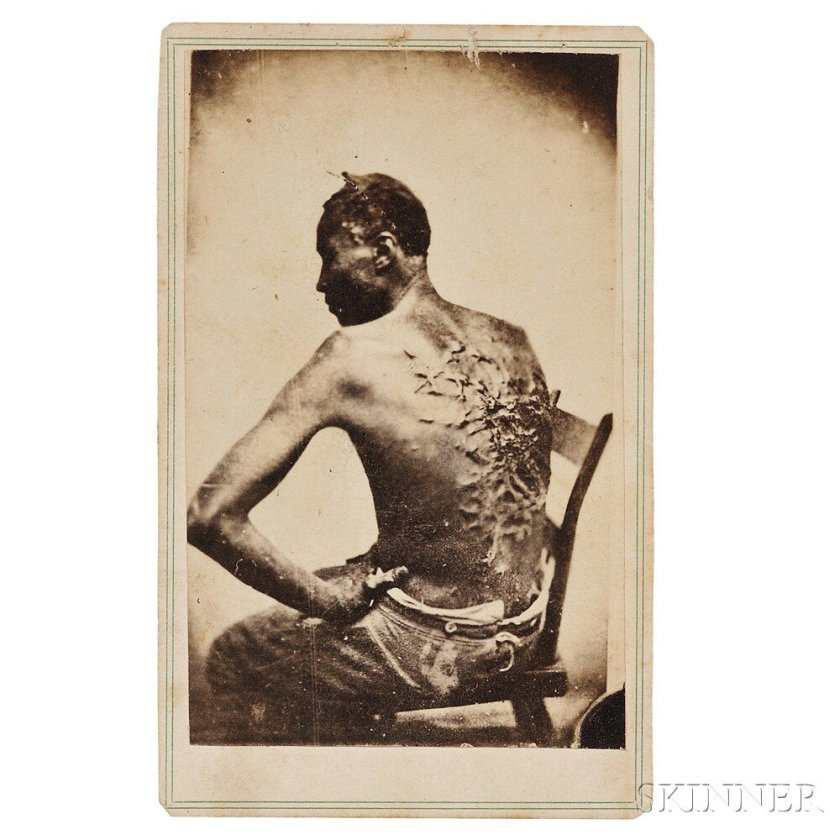
  1. This was the photo which appeared in a newspaper to galvanize the Abolitionist Movement in this country:
1095374

Prior to the publication of this story, most Americans at the time of the Civil War had no notion of the cruelties. These weren’t even the beginning of them–the accounts of sodomy (a white slave owner in front of his male slave’s family, to “break” his spirit) and rape, to say nothing of a white master standing over an unwilling “buck” and female slave to “breed” them. How does one recover from 7 or 8 or 9 GENERATIONS of this treatment in this country? HOW?

Scouraged-Back-Engraving-on-Paper-Harpers-Weekly-1863

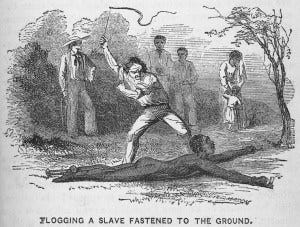
2. Slaveowners “broke” “bucks” in any number of ways—torturing strong black men into “complying” with the “system”.

buck-breaking

Did that look familiar? It should. Here is Eric Garner:

eric-garner-police-brutality-ramsey-orta

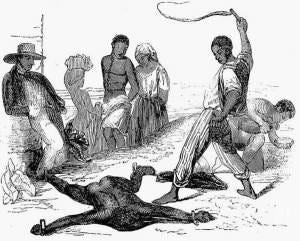
3. And white slave owners forced other slaves to do the breaking for them:

3750214_orig

A (now ex) friend of Miss O’s maintains to this day: “Lisa, slaves were lucky. How would they give up that way of life? They were nothing, and we took care of them.” And Miss O’ throws up a little in her mouth. Too many Southern whites (and other whites) feel this way—they dehumanize blacks and know nothing of the true history of slavery. Even in colleges and universities–particularly Southern ones–professors preach the old story of “states’ rights”, stating that the real cause of the Civil War was about state autonomy, though the South surely couldn’t have cared less about the North’s rights to house free men and women who made it North.

4. The above reasoning for the war’s cause is, frankly, BULLSHIT. The war was about slavery—the human rights abuses and the economic stranglehold the South held because of “free labor,” in the form of slaves. I hope that American schools today are teaching this, or will change if they have not already—to teach the truth of this horrifying practice of slavery as it really was, and then to acknowledge the PTSD suffered for generations. The police forces need this education, as do our politicians. ALL of us need this education, as ugly as it is—and at its ugliest.

afr-cof02s

Black History Month—and if for even a fleeting second you thought, “Why isn’t there a WHITE History Month, you need to read this piece more than anyone else. And also the ones I’m linking to below.)

Here’s a current piece that reflects the legacy of slavery, for as you ought to know, 42% of Black men are incarcerated, many for life. Read and contemplate, from The Guardian:

Albert Woodfox released from jail after 43 years in solitary confinement

From the article:

“Woodfox, who was kept in solitary following the 1972 murder of a prison guard for which he has always professed his innocence, marked his 69th birthday on Friday by being released from West Feliciana parish detention center. It was a bittersweet birthday present: the prisoner finally escaped a form of captivity that has widely been denounced as torture, and that has deprived him of all meaningful human contact for more than four decades.”

It’s worth noting:

“His murder conviction was twice overturned – once in 1992 on grounds that he had received ineffective defense representation, and again in 2008 because of racial discrimination in setting up the grand jury that indicted him. Last year, Louisiana announced it would put him through a third trial despite the fact that all the key witnesses to the killing have since died. Woodfox’s lawyers argued the lack of witnesses would render such a retrial a legal mockery.”

That’s right: TWICE overturned. Because white-owned and operated prisons don’t give two shits about justice, fairness, or following the law when it comes to Blacks. They don’t traditionally see Blacks as people. I say that with love, though Whites make it really hard.

So if you are a White person reading this, and especially if you count yourself among the White people who have been outraged by the very existence of #blacklivesmatter; or are incensed that Black people are upset about the murders of other black people at the hands of cops, just because they wouldn’t “comply”; or who agree that the police should never indicted (unless the cop is Asian) for such murders; and who cannot understand why Black people don’t get that Trayvon Martin was killed rightly for being male, black, young, and wearing a hoodie; and who think that Tamir Rice deserved to get shot dead for playing in a park with a BB gun, without warning, and in an open-carry state; and who found yourselves baffled or “turned off” by the brilliant Kendrick Lamar’s shattering performance at the Grammys–read every single thing I shared in this little post.

And then:

Watch Kendrick Lamar Own the Grammys With a Stellar Performance Honoring Trayvon Martin

Again. And again. And again. Until you are sobbing like the ignorant White person you have been all these years.

AND CHANGE THIS.

Miss O’s friend Sylvia saw a sign on a college campus: “Yes, all lives matter – so if your black brother feels his doesn’t, help him carry his sign.” This is your Miss O’ saying, “Make an effort.” For America.

Here’s to Black History Month.

Do i lose my job now for quoting Kirk’s political violence?

P.S.

With all this in mind, the contributions of Black artists to American and world culture are all the more extraordinary. For Black History Month, I would also like to honor poet Nikki Giovanni. Back in the summer 1987, just after my extra year at Virginia Tech for student teaching and education classes, and before becoming a teacher, I was recruited to do a couple of stand-up comedy routines to introduce sessions at a national Women’s Symposium held on the campus. Ms. Giovanni was the featured poet. I didn’t care much for poetry—maybe because I was limited, but I rarely understood a poem without help—but I decided to go. I sat in front of Nikki Giovanni, who directed her poems to three people, mainly: all the black woman poems were delivered to a young black woman behind me; the black man poems to a young black man to my right; and all the creative/lonely woman poems were directed to me, my eyes. She read “Cotton Candy on a Rainy Day” to my face, and she opened something in me–she opened all poetry for me. And that fall (I think it was), she began teaching at Virginia Tech, and is still there today. (Her poem in honor of the massacre, delivered to a stadium, helped heal the campus.) Thank you, Nikki Giovanni.

Pattern Cutting

Reflections on art and life in the age of American Surveillance

Today, in the wake of all the grave threats facing anyone opposed to the Trump administration—citizen or noncitizen, federal worker or civilian, famous or ordinary, —even normal people just traveling, like the just-released woman from British Columbia traveling to the US from Mexico detained in a cement cell with thirty women, fed on cold rice for the past two weeks, no regular access to a toilet, with no due process (one woman in her cell has been there for 10 months with no hope of leaving, no one to help her); or like the British tourist who was arrested while backpacking in Seattle, detained and still not charged (both women white, English-speaking, without criminal records)—in the wake of all this, as I say, a friend of mine asked me if I was going to continue to write my letters on Substack and WordPress.

Yes.

As Trump invokes the Enemy Aliens Act and carries out the wet dream of White Christian Nationalists that is Project 2025, no one is safe. Do or do not, be important or not, be famous or not, be humble or not, be a child or an adult, a Democrat or a Republican, pardoned or not, Trump friend or foe, literally no one is safe from all this. (Did you see Sophie’s Choice? How many times do you have to read the fucking “First They Came” poem?) The sadistic joys of kidnapping, detention, torture, and, no doubt, eventual killing are endorsed by fully 37% of American citizens. They are willing participants and apparently glorying in the promise of the end of the democratic republic. They whine when they are personally affected, sure, but as one Nebraska rancher I heard on Instagram said—and she is losing everything and voted for Trump—she’d do it all again. You cannot fix this level of stupid, you cannot fix sadists. All you can do is outnumber them, out kind them, out organize them. Outlove them. And die trying.

It’s the absurdity of it all I cannot fathom. In a recent episode of this season’s Finding Your Roots, Henry Louis Gates, Jr., reveals to actress Debra Messing the truth about the fate of her Jewish-Polish ancestors in Krakow. One such relative, a pattern cutter in a garment shop, was among those killed in the Holocaust. In a moment of what scholar and philosopher Hannah Arendt called “the banality of evil,” conscripted Nazi soldiers carried out orders and exterminated simple working people in Poland and elsewhere, people they didn’t know, for no particular reason other than they were told to. Ordinary working people.

A pattern cutter. In a little garment shop. In Krakow. And his wife, and his sister. Messing had no idea.

Tom Stoppard, in his Broadway play Leopoldstadt explored his own discovery of Eastern European uncles and aunts and cousins who were murdered in the Holocaust. The play, which I was lucky enough to see—it was stunning—was performed over two and half hours without intermission. Why no break? Because the audience would have walked out, baffled by banality, after Act I. The family, ca. late 1800s, was so…ordinary. Middle class, an affair maybe, a little business trouble; a simple holiday blending Christian and Jewish traditions, having dinner. That was the whole point. When the play shifts to 1955 in Act II, they are all dead. A relative is reckoning with this horror and the audience is, too.

It’s just insane.

No one could have been less important than a Romanian boy of 15, Elie Wiesel, and his family, as described in the memoir Night. The inhumanity and terror of the Holocaust has been so well-documented by survivors like Wiesel and others, like Primo Levi, that you cannot honestly believe we are reliving those exact times. And in the United States of America, too many of whose citizens died fighting Nazis, it’s unthinkable.

Yet here we are.

At 59E59 Theater in Manhattan before the election, I saw Mrs. Stern Wanders the Prussian State Library. (The promo material gives away the play’s surprise, that Mrs. Stern is Hannah Arendt, which is I guess because they didn’t trust the audience to know who she was.) The play gave me all the awful prescience that we were about to face the same interrogations Arendt endured; yet by gaining the empathy (there’s that evil word for which Elon Musk and his army of Christian white supremacists will have us all murdered) of her Nazi interrogator, Arendt was aided in an escape over the border. She famously went on to report on the Nuremberg Trials and warn us about how regimes like Trump’s form. Her books should have been text books in American high schools.

Screenshot

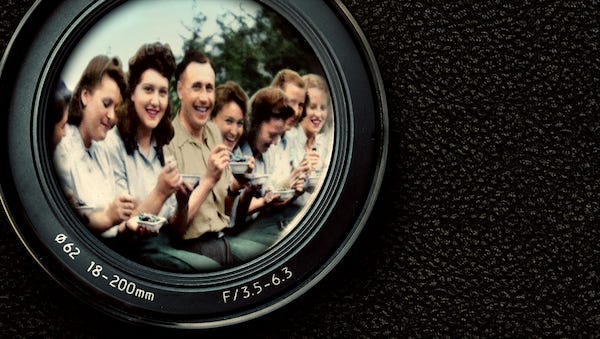
Last summer (I wrote about this somewhere already), I was lucky enough to see the play Here There Are Blueberries, a true story, wherein researchers at the National Holocaust Museum found themselves gifted, quite problematically, with a photo album of Nazi officers and their secretaries having the time of their lives at Auschwitz. Not an inmate in sight. The photo in the promo material is of a group eating blueberries, in a spot that was not far from the ever-burning crematorium, all smiles, not a conscience among them.

From Here There Are Blueberries by Moises Kaufman and Amanda Gronich, 2024, New York Theater Workshop, NYC

A few years back, I saw the final preview of a Taylor Mac comedy, Gary: A Sequel to Titus Andronicus, in which a Roman slave, played by Nathan Lane, begs his two fellow slaves to stop preparing all the dead for burial. Let them rot—how else will all these Romans quit having wars? If we keep doing the dirty work, if we don’t unionize and end this complicity, how will it ever stop?

The two women keep embalming. (I think our audience was the first one to get it, and maybe the first night the play fully came together, because you could see the cast was stunned at our screaming standing ovation; the critics panned it, having seen the play before it was ready to be seen. And wow is it timely now.)

I think also of a fabulous Broadway revival of a play in verse called La Bête, in which Mark Rylance played a charming, verbose rube who talks the king in a 17th century court into making him the new court playwright, and David Hyde Pierce played the snobbish playwright who is unseated. In the final moments of this hilarious and frenetic farce, the audience realizes that in fact Pierce’s character is right, and Rylance’s character is in fact a deceptive, cunning, dangerous beast who will bring down the order with his appointment.

And my god, here we are.

It’s through the theater that I process life, even prepare for life. The way some people look to scripture I look to playwrights, to the artists always, as guides on what was, what may be, what to do, how to behave, what to dare in our increasingly dark times, surrounded by confusion and cowards, facing unending threats and evils everywhere we look.

And these monsters are just getting started.

UNLESS. Unless. Unless. Unless.

It’s a big ask. But we can’t give up.

Love,

Miss O’

Quick Take, for Whites during Black History Month

A Condensed History of Whiteness in America

Hi, kids. If you are a friend of mine, I am not telling you something that you don’t already know; and I’ve written about this before. But a few years ago, my late super, who was from Eastern Europe under communism and who had never learned American history—not unlike contemporary whites in red states today—asked me, “Lisa, can you tell me please what it is about the Blacks?” I didn’t follow. “Why all the whites hate them. What did they do?”

Do you hear his question? Here’s a man who at that point had lived two decades in the United States, himself an immigrant working around every conceivable type of immigrant, from tenants to other supers to management, in the most diverse area of the world, my borough of Queens in New York City. He heard and saw all the racism, surely from the white men (because I still hear it now through their support of Trump), but he really didn’t know where it was coming from. “I have these Jamaican guys who do the electrical work for the building, there, and they are great. They smoke the marijuana, the smell, my god, I hate it, but they are great.”

And so it was that Miss O’ did a brief history for him.

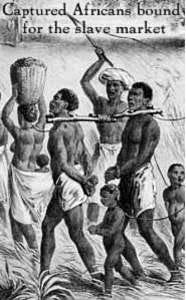
Black Africans were brought to the United States in chains beginning in 1619, if not earlier, men, women, and children captured by white European men or purchased as prisoners in their own land where there was no concept of enslavement for life let alone forever in perpetuity along with your families, which is what whites did in the United States. To justify this horrific practice, and to justify unlimited greed, whites started deciding that they were superior to all other colors of humans. They must be, because as the Puritan descendants of the Second Great Awakening said of being among the elect going to heaven (as explained to me by my 11th grade high school English teacher Chuck Edwards), “Surely, if you were not among the elect, surely God would not have blessed you with a Cadillac.” Or made you white.

The plantation system in the American South made each plantation owner a little king, a greedy little tyrant (just like the “farmer king,” King George III from whom we were emancipated, oh, irony), who kept all the money he made from his crops and made even more by working slave labor just about to death—no hope of leaving, no money, no say—morning, noon, and night, and forcing the strongest Black men to “breed” Black women as a bull would cows, when the tyrant wasn’t raping those same Black women for his pleasure and a stable of more (mulatto) slaves.

Meanwhile, the white people in the South who did not own land, and that was nearly all of them, had no work. They looked on, impoverished, as these Blacks were “given” houses and food in exchange for work, work which poor whites did not have, homes which poor white were not given (clearly not comprehending the horror). There was a growing (and understandable) resentment. To quell this, white tyrants told their legions of poor whites, “Always know that at least you are superior because you are not having to labor like these beasts.” To appease them, the tyrants dropped a nickel and handed a gun to any poor white man who was pissed off and said, “Guard my slaves.”

And so it was that for 400 years, poor, uneducated, angry whites came to believe that they themselves would have more if only those Blacks weren’t here, and that guns were identity. And they weren’t wrong, though their logic was. What these charming, charismatic white tyrants were able to convince these poor whites of was that he, the landowning rich tyrant, had no choice but to use “free labor” so that he could be rich and live like a king, that God had blessed him, and he had to fulfill this promise to God by being the richest one.

And despite a Civil War, despite education and marches and all of the hard work of generations of Blacks, Native Americans, and enlightened, moral whites (immigrants all), there are still vast swathes of white Americans who truly believe that IF ONLY there were no Blacks (and now browns, too), they themselves would have it so good.

The Donald Trumps of the world—the ones who deny wages, safe working conditions, clean air and water, and health care to anyone not them—have been such absolute geniuses at convincing poor white people to feel so sorry for them that these poor white people empty their pockets and do whatever it takes to prove their love to the rich white man God. And the poor white people still blame Blacks for their fate.

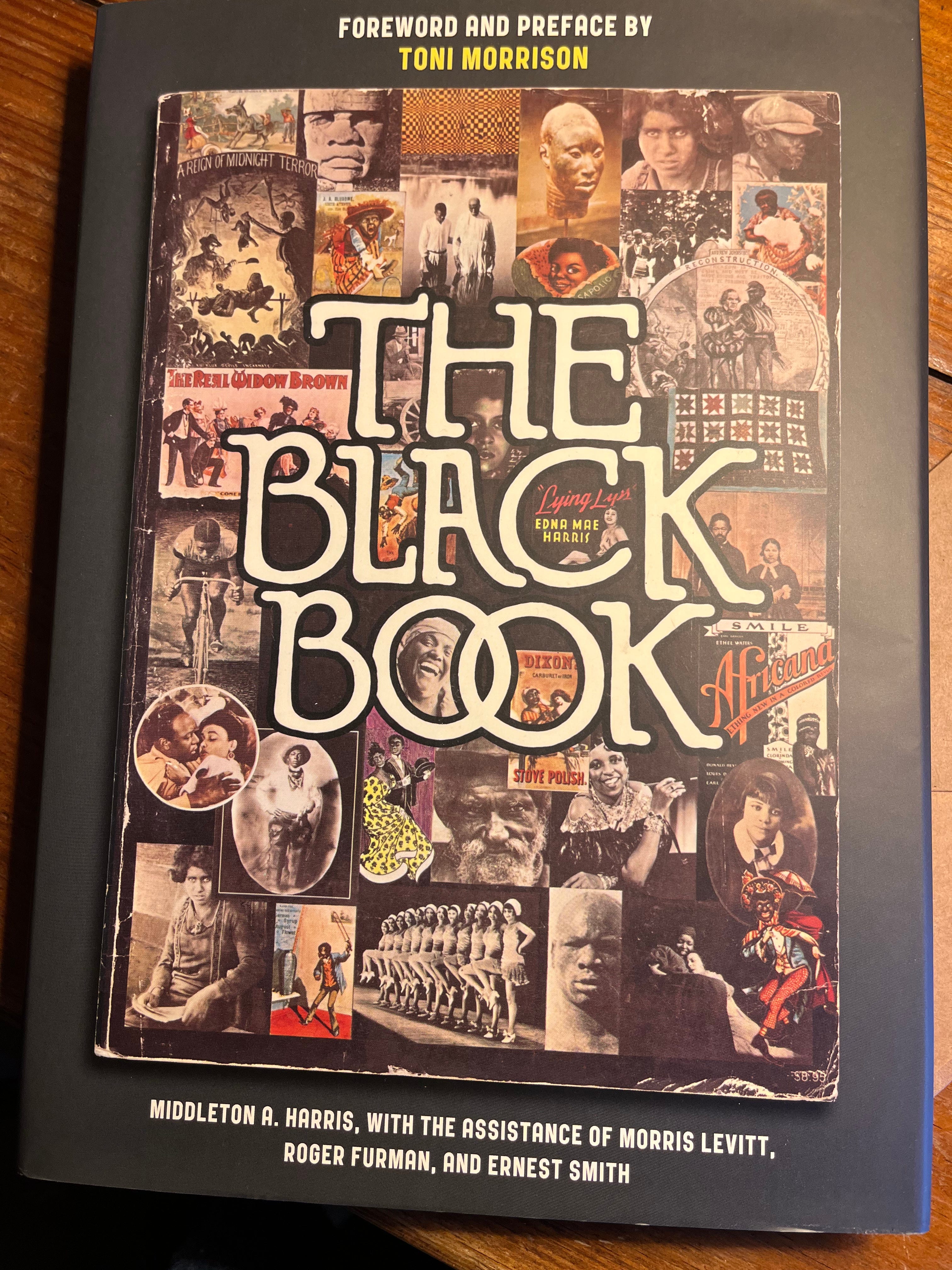
I learned about this book from the Toni Morrison documentary, The Pieces I Am. Recommended reading.

Following my quick take on the horrors of the Black experience and white supremacy, my building super from Eastern Europe was silent. He looked at me and said, “Why they don’t kill all of you?”

That’s the million-dollar question.

I’m about to make a couple of broad generalizations.

Black culture in America is a culture of love and faith. It’s a culture rooted in ebullience, joy, dance, music, energy, justice, hope, and deep, deep love despite deep trauma and great suffering. I have seen it and felt it all my life. Not that there aren’t assholes and tyrants; I’m talking about roots.

White culture in America, dating back to Puritans and colonizers, is a culture rooted in punishment, jealousy, cruelty, demands for some kind of Christian self-abnegation (that no one can achieve), faith in (one man’s) white superiority, and fear born of trauma, our original sins of Native genocide and Black enslavement. White is right. Spare the rod and spoil the child. “God’s will” is for me to lord it over you. I am God. Not that there aren’t lovely white people; I’m talking about roots.

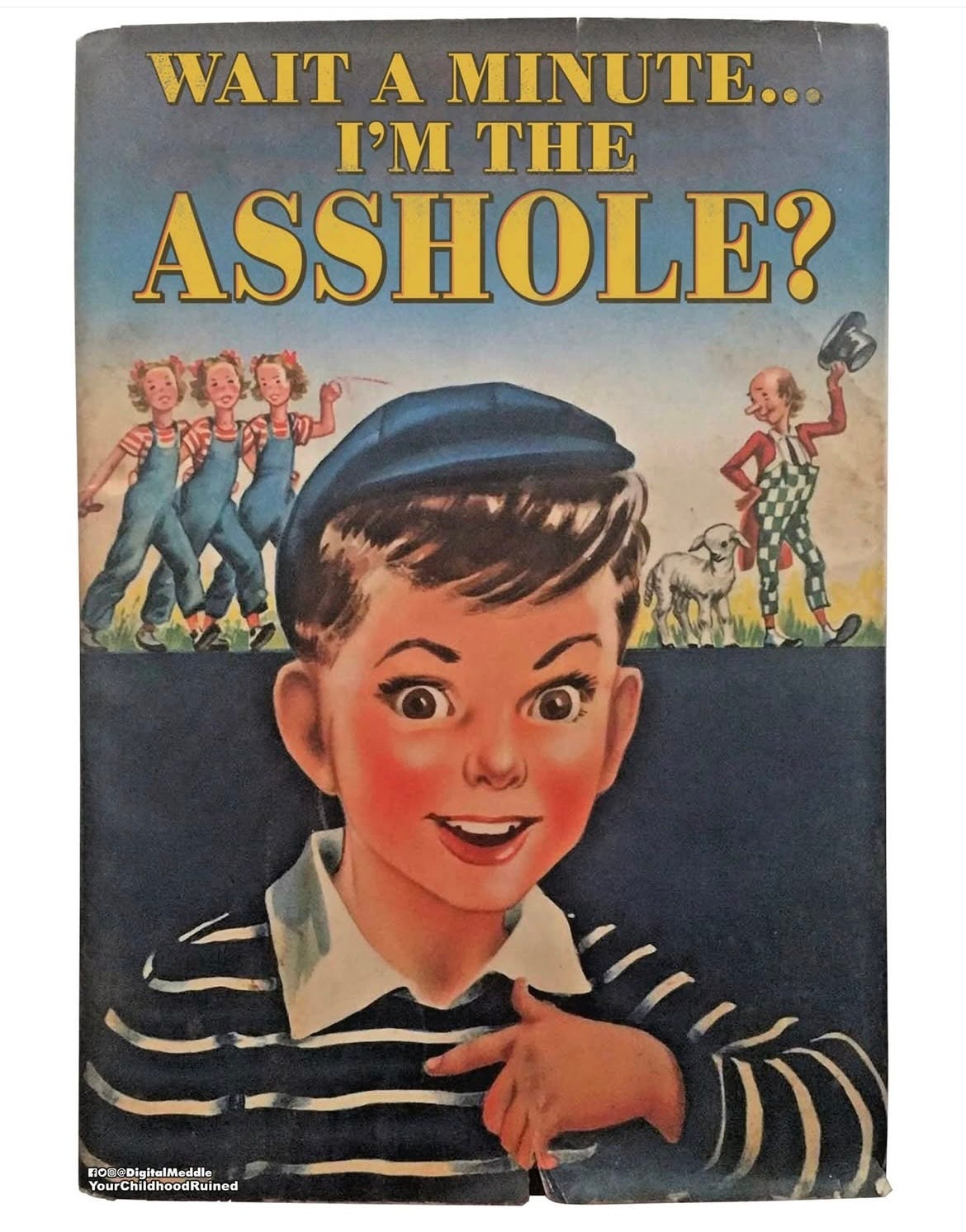
See how white supremacy works? Image from the web.

And I am so fucking sick of white culture—the good things whites bring to the table are, perhaps, irony, Greek logic, and wryness (all of which are embodied by The Onion), and of course Mary Oliver and Shakespeare and bagpipes. Right now, for me, that’s about it. Even the best of our white politicians play by the white tyrant’s rules without even realizing it. We all do.

You can follow Digital Meddle Your Childhood Ruined on Instagram.

“Mediocre white boys,” to borrow from the brilliant and righteous Rep. Jasmine Crockett (D-TX), have taught all of us whites—ALL of us—to feel sorry for them. To pity them, poor helpless things. To give them money and power. To give them a pass. Meanwhile, all that the rest of us sentient whites do for our entire lives is play that same old song, “RESIST,” and I am so fucking sick of it. These white men rape, they steal, they stiff, they destroy, and then they smile, and we pity them all over again, don’t we? And carry our clever signs to the latest march.

This is changing. I do see hope. But we have to crack it all open and drain out the rest of the pus. White culture as a whole, ultimately, must change, or else we take the planet down with us. And this Black History Month, we have to see the joy of embracing all the greatness that Blacks bring to the world. Celebrate. Emulate.

Love from her core of rage,

Miss O’

Wise words from t