On the mess it takes to make
Years ago, my super (and friend) was at my apartment to make a repair, and he noticed my sink filled with dishes—I’d made a pasta salad, involving boiling and draining pasta, cutting vegetables (scallions, tomatoes, etc.), adding feta, and so on. Assorted pots, a colander, and cutting boards were piled in the sink, along with knives, forks, spoons.
On seeing the finished product, a medium sized pottery bowl with a nice few portions of pasta salad under plastic wrap heading into the fridge, he clucked his tongue. “All that mess for such a little bit of food.” Well, yes. Had this handy man never watched his wife or grown daughters cook or clean up?
But that moment stayed with me—sort of embarrassed me, the way he thought, “for that little bit of food.” Why had I felt embarrassed? I mean, I’d watched him pour out a half dozen tools, rags, and plumber’s sealing tape onto the floor to fix a leak, and it would never occur to me to say, “All that mess for such a tiny little leak.” Let’s face it: most things worth doing require making a mess. It’s the tragedy, and joy, of being human. Life is not gossamer; no amount of meditation and austerity changes the reality that, to start, 1) humans must eat and drink; and 2) humans must evacuate waste. Planting, growing, cooking, and plumbing of all kinds: life’s basics don’t do themselves.
I thought of this again this morning: I’d walked over to LabCorp to get bloodwork done after 12 hours of fasting, so on my way home, I stopped by The Sconery for a (savory) scone treat. At home, I got out my little coffee maker, scooped out coffee into the reusable filter, poured in water, and let it perk; I poured some half and half into a small cream pitcher (to better control the amount used); I made a quick one-egg omelet with the last half of a cheese slice, to eat on the cracked pepper scone.
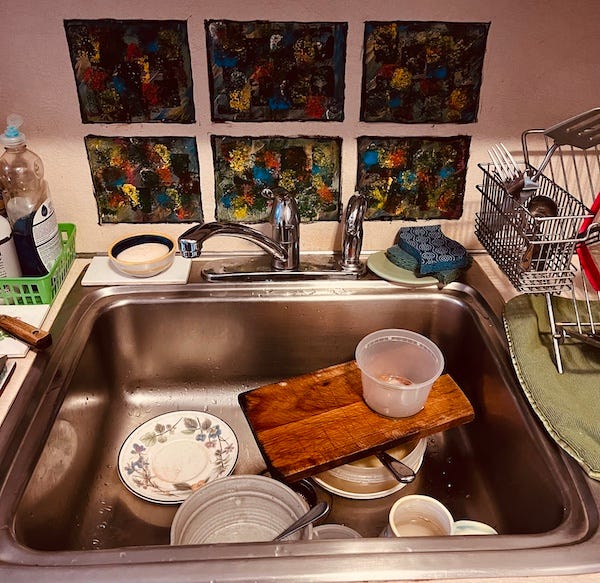
Following this little repast, a simple breakfast feeding just me (and I didn’t even have to make the scone), I had the following dishes in the sink:
- Little bowl for scrambling the egg
- Fork for the beating the egg
- Small cast iron skillet for cooking the egg
- Table knife to cut butter for the skillet
- Coffee scoop
- Small cream pitcher
- Spoon for stirring
- Plate
- Coffee pot
- Reusable filter and insert
- Coffee mug
- Water glass for taking my morning meds
All those dishes for a little bit of food, a cup of coffee, and a pill. That’s how it is.
Anyone who does projects knows this—to sew anything, say, I have to set up the sewing machine, get out the fabric scissors, the thread and bobbin, the seam ripper (always), all the stuff; whether this is making curtains or sewing a tiny seam split in a pair of pants, it’s the same drill. If you make collages or draw or paint or whatever, you have to get out all the stuff. Even to make a small card for a friend, or a bookmark, it’s all that mess to clean up and put away for a little bit of creative output. Even a bookshelf, when hung up, looks like “of course,” no one thinking about the sawdust.
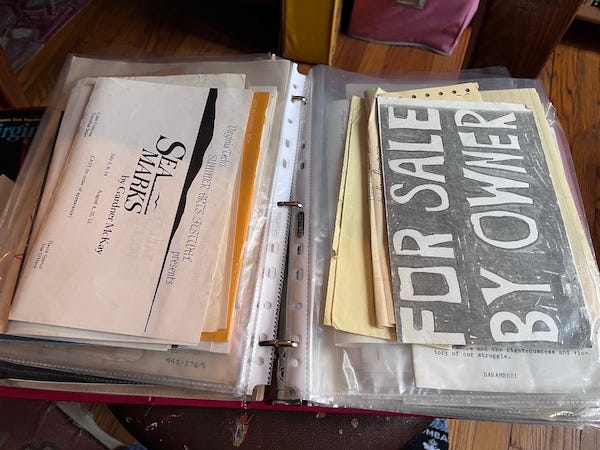
Last weekend, my best college buddy Richard came over with his two teenagers, who, after lunch, napped in various spots in the apartment while he and I went through a big envelope of theater memorabilia from our college days. I was cleaning out a closet last weekend when I happened on it, and thought, I need to make some kind of scrapbook or toss it. Being a BA theater major was, as I’ve said many times, the luckiest thing I could have been. (I distinguish this from a BFA—a bachelor of fine arts—which is narrow in focus, an actor never learning set design, for example; in our liberal arts program we did it all.) You learn all the theater trades, practice on many shows, from black box to main stage, and figure out what you like about it and what you are good at. It was awesome. Though you sure get tired doing all you do.
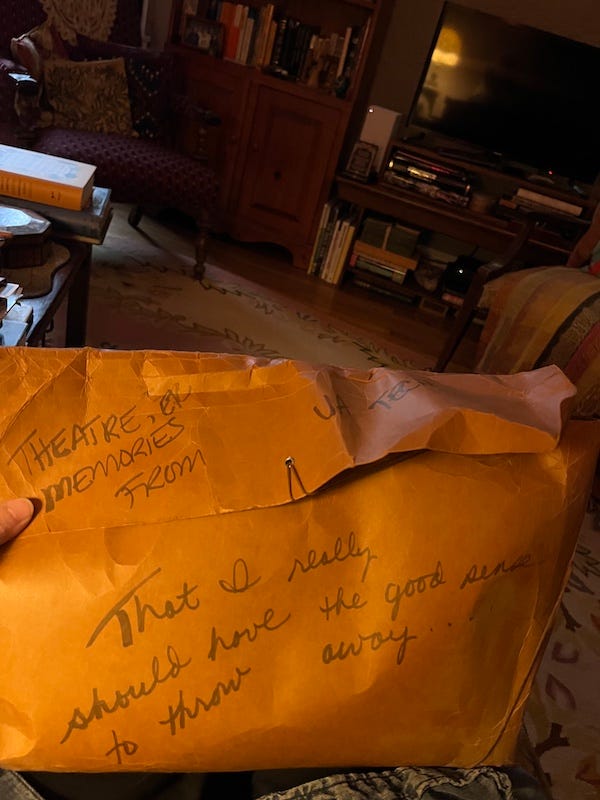
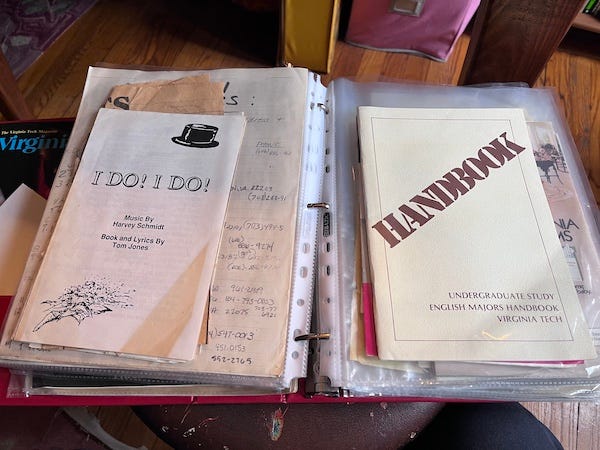
This sorting made us tired, too, program after program, script after script, party notices, “Break a leg!” cards, SETC (Southeastern Theater Conference) badges. “I was on the makeup crew for She Stoops to Conquer?” Richard asked, thumbing over the names in one program. “I did wardrobe for this?” I said, handing Richard a program for a show in which he got “special thanks.” We’d never heard of it, to see our reactions, let alone recalled working on it. And yet there our names were. Other times the programs brought back loads of memories, “Oh my god, remember that turntable that didn’t turn, and we all had to push it from backstage, in costume,” “…and the tech director got fired for buying cheap casters?” but most of them were fond memories. From hauling boards in from the truck to building stud walls and constructing flats; to measuring actors, to fabric shopping and cutting cloth from patterns; to putting makeup on faces and taking it off with cold cream afterward. “How did we do all that?” “And classes, and parties…?” To say nothing of hydrating.
I suppose one way of looking at it is, “All that mess for such a little bit of show.” But that’s never the whole story.
I watched YouTube videos about photographers this week—I got on a Richard Avedon kick, thence to Henri Cartier-Bresson, Chuck Close, Mary Ellen Mark, always learning—and one commentator brought up how much paper and how many dark room supplies went into producing each large-scale photo that landed on museum walls. (So much mess for such a little bit of beauty? Yes.)
In further video travels, I watched Lucy Worsley Investigates: The American Revolution on PBS, and I admit that I thought, in passing, about the war, “All that mess for such a (little bit of?) new world order.” And really—when any act is all about money and power—it is a lot of mess, and for, too often, such a lot of nothing but destruction and misery. Worsley finds, for example (seeking the British view), that if King George III hadn’t had a huge 7 Years’ War debt to pay off, he wouldn’t have signed the Stamp Act, and if he’d listened to the colonists’ reasonable complaints about taxation without representation, they wouldn’t have revolted, and Britain’s Empire wouldn’t have fallen, and who knows? Still a mess, no doubt, and the mess continues amid the stabs at progress, and no use looking back.
The latest world order upset is Trump’s unstable, treacherous presidency, his support of Israel, and his attack on Iran—all that mess to distract from such a little bit, oh, wait, an ungodly amount of pedophilia and bribery and corruption.
Money and power, power and depravity. I’ve been reading a few articles during my doom scrolling hiatus, and the more investigating people do into Epstein (to take one example)—and loads of terrific independent journalists are doing just that, unrelentingly—the more horrible and seemingly unstoppable these diseased forces seemed to be; but they are stoppable. This is changeable.
But my god the mess in their wake. Their mess is vast and awful, but we gotta clean it up so we can start fresh. Again. Like doing the dishes. Like a set strike.
And how much better would we all be if our messy work were for creative, useful, and community purposes (with women to guide it)? So much better.
Sending love, all the detritus now in plastic sleeves in a tidy (ahem) binder,
Miss O’