Offloading our hearts and minds, tempest-tossed, and the salve of art

O, I have suffered
With those that I saw suffer.

(Miranda, The Tempest, Act I Scene 2)

I read this week that the tech bruhs, so called in current parlance, see the world as being divided into two classes of people: the thinkers and the scrollers. While they, the Thinking Class, devote themselves to higher learning, philosophy, and deep work, affording the same wealth of life experience and cashflow to their offspring, they themselves are engineering the planet so that the rest of us, by which I gather they mean the 99% and our offspring, are relegated to the Scrolling Class, those who work as drones and merely consume whatever they, the Thinkers, put out for profit.

It’s all very Brave New World, a novel I read in high school and can’t shake. Will you be made into an Alpha or an Epsilon? Will you even know? And even if you are an Alpha, watch out if you forget to take your soma (“the opiate of the masses” that replaces religion) and have an original thought. All hell will break loose, and the only antidote is a rebel copy of Shakespeare.

My library was dukedom large enough.
(Prospero, The Tempest, Act 1 Scene 2)

This week the Trump Administration, illegally as usual, dismantled the U.S. Department of Education, spreading all the allocated funds around (which legally only Congress can do, but Republicans) to different departments, so K-12 education is now under the U.S. Department of Labor. Huh? In a seemingly unrelated development, the Trump Administration also demoted a bunch of educational degrees to “nonprofessional,” meaning people pursuing nursing, say, or teaching, will not be able to take out unlimited loans to attain a degree. Not only were the listed degrees for women-dominated professions, the professions listed were those whose members are legally bound to report suspected child abuse. If no one is educated to take those jobs…

Are you following? The Pedo-in-Chief is terrified of the release of the Epstein Files, and his Secretary of Education, Linda McMahon, whose husband Vince McMahon was set to go on trial amid accusations of child sexual abuse until a Chicago judge paused the case last December when Linda was announced as Trump’s pick for her new position. Meanwhile, Trump’s former “spiritual advisor” was arrested for child rape and plead guilty. In a call-in show I heard a snippet of this week, a caller demanded to know what was “wrong” about child rape.

The cumulative effect of all this during a single week has made me a bit of an emotional wreck, but it was an independent journalist on Instagram who formally linked all these pieces for me. From Love Ethic Yoga:

Moving K-12 education to the Department of Labor while red states are removing child labor laws & dropping the age of consent to 12 or 14 is a calculated move. The leaders of these departments are pedo📁files or pedo apologists. This is NOT coincidence.

Uneducated children are easy prey.
Hungry children are easy prey.
Homeless children are easy prey.
Unaccompanied minors are easy prey.


These predators are baiting the water. They’re creating the proverbial “fish in a barrel”. Yes, privatization is part of this but we cannot forget how many pedos are in this current admin. We cannot let them get away with this.

I got ill—I mean, Trump and his people are transparently, openly constructing a world where child sexual abuse is normalized, institutionalized, and unstoppable. These “men” want all young women and girls (40% of whom between the ages of 15-44 want to leave the United StatesI saw in a recent poll) under their complete control in order to force-breed children, for either labor on behalf of or the sexual pleasure of (white Christian) men. Once the children “age out,” a term I learned on Law and Order: SVU, they will be, one presumes, forced to push through their trauma with slave labor, living in one of the concentration camps being constructed all over the United States.

Utah’s planned mega-shelter should be like a jail for homeless people, one widely embraced group says

This is the Brave New United States of America, friends.

It’s more than hard to take—it’s impossible. This insanity has to stop. We need to see handcuffs and prison bars on the right people, and soon. We know this.

I can’t take in everything—you can’t either. So while I know there’s Israel’s defiance of the ceasefire, and Russia’s wish-list labeled a “peace agreement” by Trump and Rubio (rejected, thank goodness) by Zelensky; protests in Charlotte and Raleigh over ICE raids; so much, so much, my god, it was the children and their protectors I focused on, “offloading” the rest, more or less.

This week on a work Zoom call, a colleague mentioned that there is always work or training or something that we simply have to “offload.” It’s not a term I knew—but I got it. You just pass that conceptual understanding to someone, maybe a spouse who gets plumbing or a coworker who is good at Excel, and you don’t worry about trying to learn that thing, much less master it. You only have the capacity for so much, and recognizing that is not a bad thing. (That said, we all have to trust in our capacity to learn new things, and try to do that, even though in my early 60s I’m finding that I have to immerse myself with the focus of a monk to his devotions to do something as complex and unintuitive as Jira (if you don’t know, don’t ask), say, but it’s reassuring to know that I can still do it, if more painstakingly.)

Speaking of offloading: I no longer have a creative life in the recognizable sense. I’m sorry about it, but between taking care of family, holding grief, learning new things on the job, and this fucking administration’s atrocities, I had to let something go, and that was it—and it’s no great loss to the world, obviously. That out of the way, I’d like to celebrate the achievements of women artists whom I know as friends. In a world, and more specifically a nation, that doesn’t value women, children, innocence, creativity, or truth, here’s some art you need.

  • Read Amanda Quaid’s debut poetry collection No Obvious Distress, which explores her (still) young life with Stage IV metastatic mesenchymal chondrosarcoma (learning the pronunciation of which seems to be more trouble from some people than her years of treatment, so say the name) in all the ways;
  • Read Anna Citrino’s fourth collection, Stories We Didn’t Tell, which explores the unspeakable hardships and abuses of her American prairie women ancestors, based on the poet’s decades of research, in rich language;
  • Watch Patricia E. Gillespie’s documentary, The Secrets We Burywhich I saw at IFC here in New York in its premiere screening this week, about a true crime, told with love and empathy and not sensationalism;
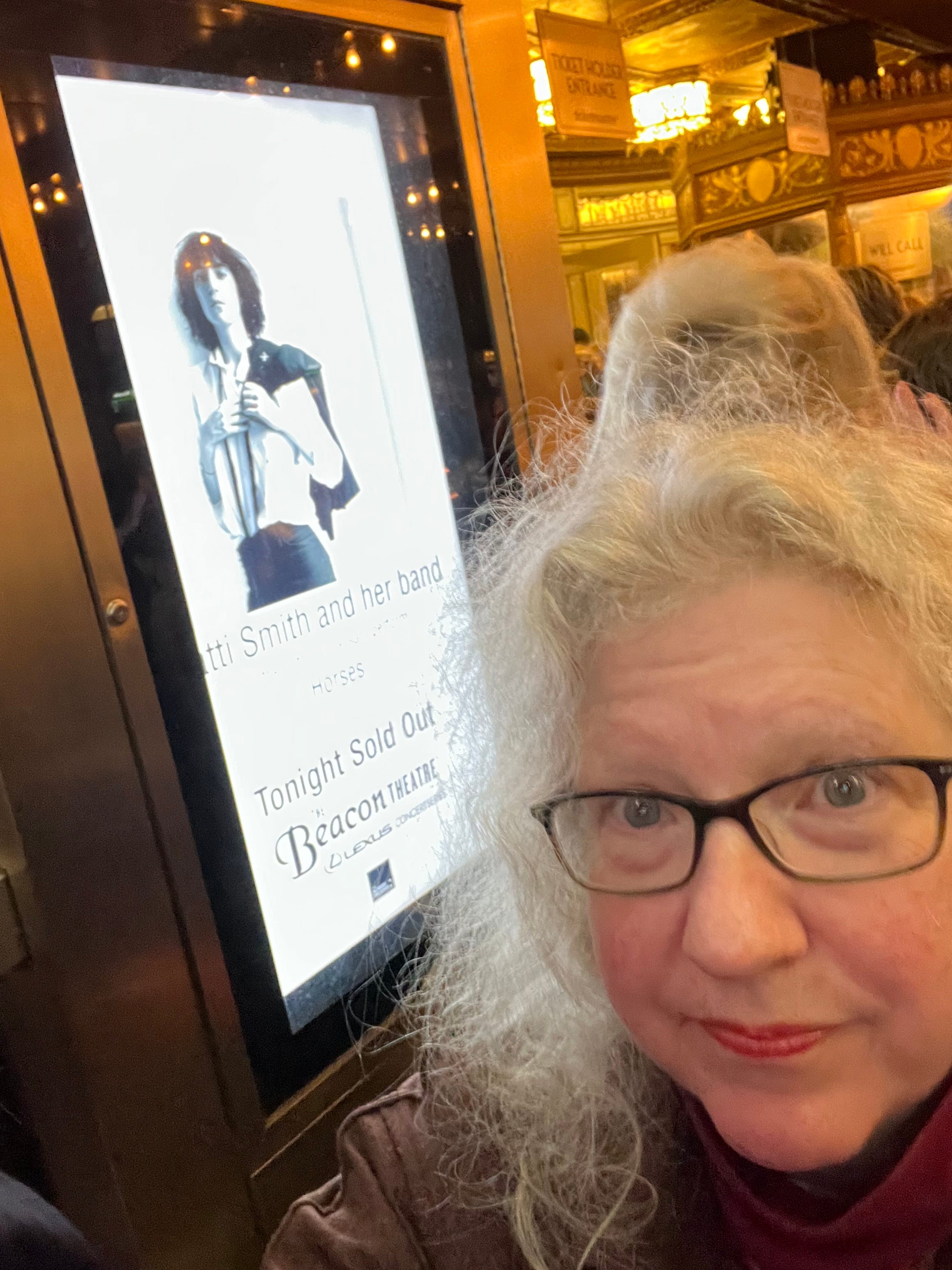
  • Listen to Patti Smith’s Horses (1975). (Envy me my Row X seat at The Beacon Theater on Broadway Friday night in New York City to see Patti Smith and her Band play the shit out of Horses in its 50th Anniversary Year, plus encores of classics. Patti also spat, twice, and it was glorious.)

So lest you think Miss O’ has given up on art, I haven’t, and I hope you haven’t either. There is nothing on this earth as satisfying as a creative act, something you can point to and say, “I made that.” There was nothing, and now there’s something, and I did it. And the world is more colorful and right and full than it was before you created that thing, however small, even making a smile happen on a stranger’s face in a notebook store, which I did on Friday night before the concert. I did that. That thing, there? You did that. Not AI, not engineered by some tech bruh, or ordered on you by some basement-dwelling podcaster or a bottom feeder in Washington. You. Just you.

Let’s stop scrolling together and get seriously radical in creative community. Take a moment to read. To be quiet. And then connect.

Here’s Mr. Rogers on the value silence from Charlie Rose, which is a clip I hope you watch. “My, it’s a noisy world,” he says, and it is. There’s more he goes on to say from his 1994 book, You Are Special, including about his professor, Dr. William Orr, who told him, “You know Fred, there is one thing that evil cannot stand, and that is forgiveness.” Take a minute with that. As a reader, Rogers says that the white spaces between the paragraphs are more important than the text, by which he means that if you aren’t using silence to reflect on what you are reading, you are missing the point of the endeavor. You can see more clips of Fred Rogers here. “A great gift an adult can give to a child is to let the child see what you love in front of them.” Whether it’s car repair, lawn maintenance, playing cello, fixing things, reading, singing, cooking, telling stories, dancing, whatever it is (note: what you love, not what you exploit)—that is the gift. I think I try to do that in life—to show love of life in greeting others. It’s tiny—I’m not a worldwide creative power like Patti Smith—but really it’s about being present, as Rogers says, moment to moment (and it’s the most important work in rehearsing a show, as shown me by director Maureen Shea). Doing things even a little larger than ourselves, then, in presence, is the point. Mr. Rogers only cared to be recognized if it made a child feel special—Fred Rogers liked “not the fancy people,” but regular people, and he aspired to “be the best receiver I can ever be—graceful receiving of what someone gives us; we’ve given that person a wonderful gift.”

Miss O’ most gracefully received.

The play I’ve been quoting here interstitially, The Tempest, is my favorite Shakespeare play; in some ways it’s like a compilation reel of all his best ideas, and his final play and only original plot, his retirement play. I’ve seen four productions of it—at the Globe in London, with Vanessa Redgrave as Prospero (it was awful); at the Shakespeare Theater in Washington, D.C., directed by Garland Wright, which still ranks as the top theater experience of my life (even after seeing Hamilton and Gypsy with Patti LuPone); one at Classic Stage Company downtown, with Mandy Patinkin (okay); and the fourth at St. Ann’s Warehouse, an all-women cast set in a women’s prison, directed by Phyllida Lloyd, with Harriet Walter as Prospero (fantastic). The most famous speech of the play, by Prospero, comes in Act IV, and I always think of it when eras end, as well as even a simple good thing, and especially a life:

Our revels now are ended. These our actors,
As I foretold you, were all spirits and
Are melted into air, into thin air;
And, like the baseless fabric of this vision,
The cloud-capp’d towers, the gorgeous palaces,
The solemn temples, the great globe itself,
Yea, all which it inherit, shall dissolve,
And, like this insubstantial pageant faded,
Leave not a rack behind. We are such stuff
As dreams are made on: and our little life
Is rounded with a sleep.

(Prospero, The Tempest, Act 4 Scene 1)

In the final act of the play, Prospero’s daughter newly in love sees all the possibility of life, and this is from where Aldous Huxley took his dystopian novel’s title:

O, wonder!
How many goodly creatures are there here!
How beauteous mankind is! O brave new world,
That has such people in’t.

(Miranda, The Tempest, Act 5, Scene 1)

Sure, love is wildly naive, but it’s the beginning of everything. There’s a new world to be made. Let’s stop the fucking fuckers and do that.

Sending love, philosophy, music, poetry, creativity, all the good church,

Miss O’

The People Have the Power: Patti Smith and her band, The Beacon Theater, NYC, 11/21/25, the 50th Anniversary of Horses. Photo by LO”H. This was church.

A Life in the Theater

On character, tragic flaws, and hope

Nov 09, 2025

On November 9, 2010, 1st Lt. Robert M. Kelly, USMC, was killed in Afghanistan. Robert had been a student of mine at Gar-Field High School in Woodbridge, Virginia, along with his older brother, John, both of them the sons of Gen. John Kelly (Maj. Kelly, when I first knew him; I attended the ceremony when he became Col. Kelly). Both John and Robert were in the Drama Club, and very different kids, John doing technical theater (lighting), Robert hanging around until he scored a legendary turn as Juliet in The Complete Works of William Shakespeare Abridged (with a cast not of three but of thousands) his senior year, a performance that caused his father to laugh harder than I’d ever seen him do. Interestingly, son John (now a colonel in the USMC himself) was naturally funnier, but ironically it was Robert’s relative seriousness and deeply felt empathy that made him a great comic actor.

I got the news of Robert’s death 15 years ago through missed connections all day, brother John trying to reach me, my return calls back going to voicemail; I thought something might have happened to Alan, another former student and John’s best friend; finally I got hold of Alan while at a play lab at the Pythian on the Upper West Side, where cell reception as terrible and I had to go out to the street to reckon with the truth. I didn’t know Robert had even been deployed; apparently it was a sudden decision to send his unit over, and maybe only a week had passed since his arrival, an IED doing the job.

Robert’s funeral and burial at Arlington, just eleven years after his graduation, seven years after I’d left teaching and had moved to New York, was attended by well over a hundred people, many from Gar-Field, teachers, students, friends, parents, along with his family. Hard to process even now. I was reminded of all this yesterday when my friend and retired department chair Tom texted to remind me, thinking only ten years had gone by. (I knew it was longer because my cell phone had been a flip phone. Isn’t that a particularly millennial reason to remember a date?)

So tragedy is on the brain this morning.

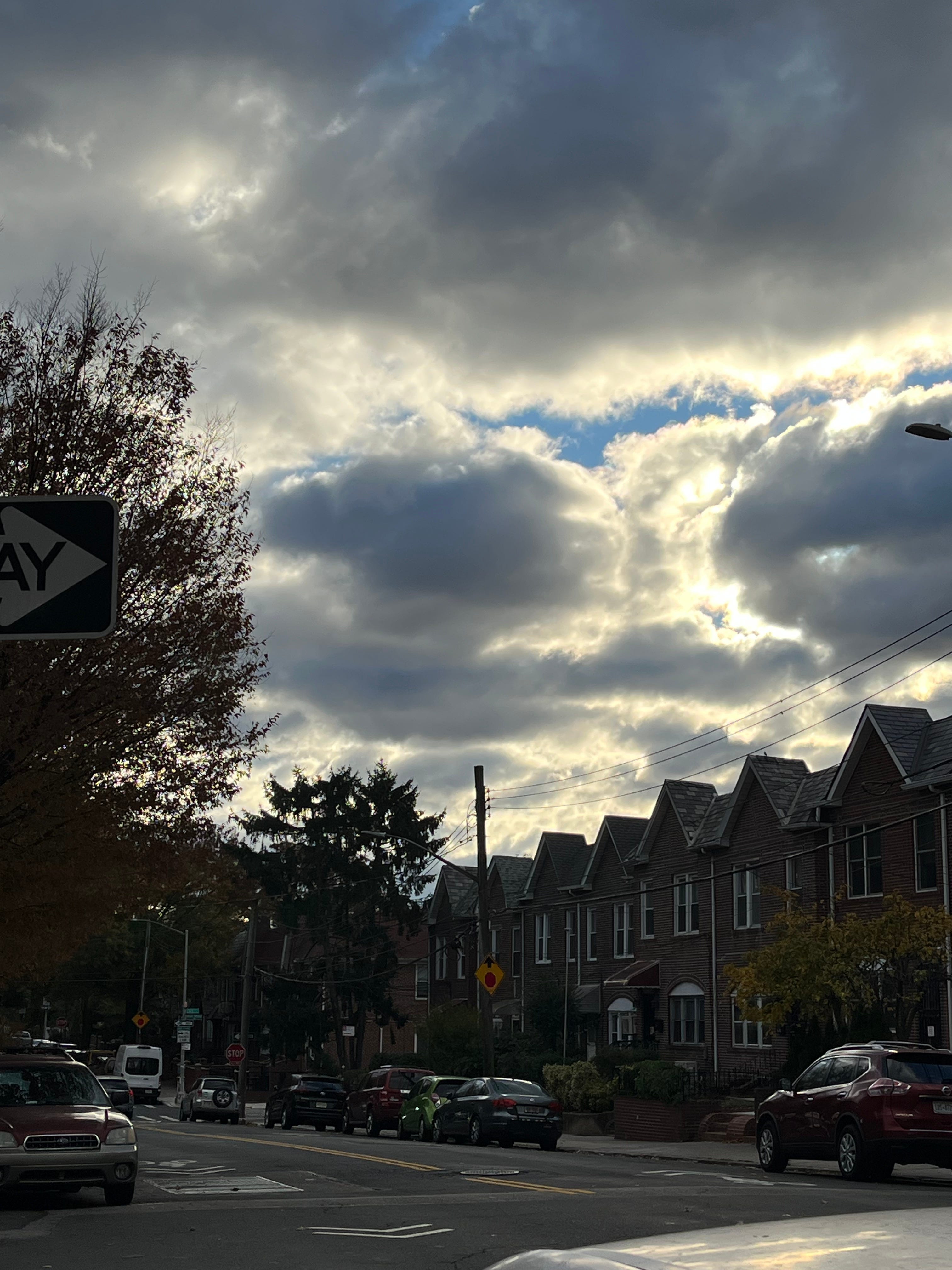
Biblical sky drama over Queens.

Last Saturday I went to see a West End-Broadway transfer production of Oedipus, a new adaptation and direction by Robert Icke (say Ike), with friends Frances and Jim, who got the tickets for us (or else I might have foolishly missed it). The lesson of Oedipus is, famously, “One always meets one’s fate in the path one takes to try to avoid it.” In the Greek version, the Oracle at Delphi prophesizes that the baby born to King Laius and Jocasta will one day kill his father and marry his mother; Jocasta then, to spare her son, orders her servant to kill the baby. Instead, the loving servant places the baby in the woods, where he is found by an older couple from the country who raise him as their own, no one the wiser. Until eighteen years go by…

In this update, Mark Strong plays Oedipus as a political candidate on the night of a highly consequential election (intimations of Trump v. Democracy), and all the action takes place during the two hours between polls closing and the announcement of the winner (a big clock on the stage counting down—Aristotle in Poetics says that any good drama should play out in no more nor less than two hours, and Icke takes on the challenge). In a filmed sequence as the show’s opening exposition, a confident, sexy Oedipus, standing outside what looks to be the British Parliament building, tells the press that he knows people question why he, a foreigner, should lead them, and he promises (without warning to anyone in his circle) to “release my birth certificate.” It brings up Obama, Mamdani, all the prejudices of our times, and if you know the story of Oedipus, it’s the perfect setup for an adaptation. (Icke must have shrieked and shaken with freakout when he thought of it—hoping no one else saw that obvious and genius connection up to now.)

Oedipus—handsome, smart, gifted, loving, and progressive—has one fatal flaw: hubris. He really believes he is in complete control, fully in possession of himself, knows who he is, knows who everyone is in his life. The next two hours unravel in the revelations we know from the Greek tragedy, all so believable and so timely, with Lesley Manville’s Jocasta ripping your heart out, her (updated for our more enlightened times, shades of Epstein) story of being raped by old Laius at 13, forced to give up the baby to die because he’s married; Laius later marrying her and leaving her a widow who later meets Oedipus, falls wildly in love, and marries him, giving him three children, she then in middle age. At the play’s opening, Oedipus is 52; Jocasta, we only later realize, is 65; their children are college age. In short order, despite a landslide victory, their children are about to lose everything, Jocasta her life, and the nation the promise of a brilliant leader. (The best part was sitting next to someone who didn’t know the story—lots of people don’t—and hearing the gasp.)

How does any brain process such a trauma? Frances and Jim and I staggered through the tourist minefield that is Times Square to the quiet of an Italian restaurant to process it, all of truly gutted, Aristotle’s catharsis manifest. In enduring tragedy, and in catharsis, we not only heal, we are cleansed.

A cleansing view, fall in Central Park.

This morning I watched a YouTube video sent by my friend Ryan last night of researcher and “No. 1 Brain Scientist” Jill Bolte Taylor in conversation with podcaster Steven Bartlett, talking about the “four characters” in our brain’s left and right hemispheres. As a result of a stroke at age 37 in 1996, Bolte Taylor’s Harvard-ladder academic career ended, and the next eight years were about recovering the functionality of her left hemisphere, the part of our brains that does numbers, controls language, helps us plan and think. During those eight years, she worked to use her right hemisphere to help her rebuild the cellular connections in the left, and the result was a huge new life focused on even deeper brain work while living on a boat and not in a lab, connected to nature and to the universe, using her whole brain. I highly recommend the video, which I watched at 4:30 this morning (because old), and her “four characters” of the brain put me in mind of not only all our society’s conflicts but also of all the characters necessary to have an effective drama:

1. Character One: Left side, thinking: the planner, analyzer, counter, linguist

2. Character Two: Left side, emotional: the grudge holder, trauma re-liver, pain protector

3. Character Three: Right side, emotional: the explorer, the curious one, the playful one

4. Character Four: Right side, thinking: the connector of experiences, keeper of wisdom

Just as a drama needs all these characters for conflict and resolution (my take), humans need all four in balance to be whole. I took loads of notes, and if you watch the video, you can too, but Bolte Taylor’s message of a society out of balance resonated most with me. Most of our lives seem to be spent lived only on the Left side, she says, holding grudges and reliving trauma as we strive for perfection and knock ourselves out to make money. It’s killing our brain cells, it’s killing us individually, and it’s killing the planet.

To wit: Sec. of Defense (he says “War” but it’s not official) Pete Hegseth announced this week that the United States is no longer a peace-seeking nation, but rather, our military preparation will be solely focused on wars. We know from Republican spokespeople, such as Russell Vought, JD Vance, and Elon Musk, that “empathy is weakness” (a negation of the brain’s right hemisphere) is a guiding principle for their politics. The Conservative Movement is totally, then, left-hemisphere in the brain, focused on self-interest, self-protection, generational trauma on a tape loop. It’s not sustainable, but it has to be gotten through and past, somehow.

What I think Conservatives fear most about education, about learning the truth about our history, is what the play Oedipus shows so shockingly: when you uncover the truth about yourself, you are destined for destruction. But what the audience learns is that no life is an honest life if it’s built on lies, when your armor is a birth certificate and the woman who raised you as your mother, and lied about it, thinks it’s “only paper.” And I’m struck by all these paradoxes—the fear we have of knowing the truth, and yet the impossibility of living an honest, full, happy life without it.

As your Miss O’ has long said, if your belief system cannot withstand challenges to the point that your response is to stifle and even kill to stop those challenges, you don’t have a belief system—you only have fear.

What Oedipus lacks is balance—for him, in his ignorance, life has been pretty great. He is empathetic but only intellectually. (I think this same hubris applies to a lot of America’s Liberals, if I’m honest.) Oedipus’s mistake, his hubris, was to be blindly fearless, blindly on the side of the common man (because he was raised by fine, working class parents) without knowing his own life’s truth—he was the product of rape by a lecherous pedophile of a king, and he married his own mother because of the coverup. At the end of the play, Oedipus blinds himself, and as the cult-prophet Teiresias tells him, when you learn, you will go blind; and when you are blind, you will see properly.

In a similar way, Jill Bolte Taylor’s stroke—the near-total collapse of the brain of a preeminent brain scientist—made her work expand into realms she could not have imagined during her eight years of recovery.

And this all got me thinking again:

We have to release the Epstein files. Virginia Giuffre’s death cannot be in vain.

We have to embrace our nation’s original sin, slavery, teach it properly, reckon with it, so our nation can progress in smarter, healthier ways.

We must demand the resignation of Pete Hegseth, and work to be a peaceable nation, so that there are no more 1st Lt. Robert Kellys dying on foreign soil; and you’ll pardon me for not grieving Dick Cheney.

This is a heavy lot for a Sunday morning.

I’m sitting here on this November day, in my kitchen rocker, worried again about whether or not I need a new refrigerator (thermostat being weird) and a new Mac (battery not fully charging), seeing it’s after 9 AM and I really need to dress and go out and about before it rains. And these mundanities of life require our attention, our presence, to live fully, ever balanced against all those huge mega truths.

On my personal day on Friday, I found myself in Saint Patrick’s Cathedral on Fifth Avenue, lighting candles (one for my mom, one for my friend Richard’s mom, and a third for the ancestors), which I hope was not hypocritical from irreligious me. It was nice to sit and meditate in the midst of the most famous cathedral in the biggest city with the most consequential mayoral election perhaps ever, and be present to my mom and memory.

The next time I’m there, I’ll light a candle for Robert.

Sending love and balance,

Miss O’

A Vision’s Just a Vision if It’s Only in Your Head

The state of the art of putting us (back) together

It’s Sunday in America, a new, greater America, where already thanks to tariffs, grocery and drugstore shelves are going bare, especially of paper products, because most of our wood for paper comes from (check notes) Canada. So. Fucking. Great. When I’m not freaking out about the country, I focus my mind on art. Then I remember that Trump, who is clearly not really running the country, decided to spend his valuable time to get “elected” by the “board” to head the Kennedy Center, which just two days ago quietly cancelled all LGBTQ+ Pride events for 2025. But because this is Trump, his own big Kennedy Center celebration of his First 100 Days sees him ousted from that same Kennedy Center for “contract violations.” You can make this up.

But really, this shit show is serious. In an interview on Democracy Now, Maria Ressa (6-minute mark), recipient of the Nobel Peace Prize, draws disturbingly urgent parallels between the behavior of the Trump and his administration and former president of the Philippines Rodrigo Duterte, now in the custody of the International Criminal Court (ICC). Trump only learns from the best people. Ressa concludes that if Trump and his FBI and his ICE aren’t reined in by summer, our democracy will be obliterated and most likely for good. She’s just following history.

And the more I read and listen, the more correct I feel I was back in 2020 when I told all the liberals, who are as addicted to Trump as the MAGA who drink his blood, that they/we need to ignore the Big (Burger) King and target the minions who do his bidding, target the structures, and more than that, message the alternatives in actionable, relatable ways, not from On High. For however well-meaning AOC and Bernie are in their Farewell to Democracy tours, and Cory Booker for his stand-ins and sit-ins, they have no actual strategy for saving the country; they do not think like generals, and we need generals right now.

I read about a recent viral Facebook post claiming that Liz Cheney penned a letter saying, “Dear Democratic Party, I need more from you. You keep sending emails begging for $15, while we’re watching fascism consolidate power in real time.” According to Snopes and PolitiFact, there’s no evidence that Cheney wrote it, but you can tell that the average Democrat who probably did is trying hard to get our party’s attention, because Democratic Leaders are so sure they don’t need We, the People, for advice, only cash.

I’ve been trying to understand the Democratic Leadership’s “vamp until ready” stasis. In the theater, the orchestra pit plays music over, and over, or “vamp,” at moments of a show, to cover a set change. In the case of the U.S., there’s a regime change, or a shift from a presidency to a regime, and if this were a show, it would be as if instead of playing bars of music on repeat, the orchestra itself was replacing instruments with jack hammers and table saws.

I mentioned in my last missive that I’ve been rereading Sondheim’s lyric memoirs, and the other night I came across this, and it made me think of the floundering Democrats:

“The point of a tryout is to fix a show, and by the end of the Chicago run, we should have been making changes in the scenes and the songs and the staging. But we couldn’t, because the day after the show opened, Hal [Prince, director] had to go to Germany to receive an award and then leave for vacation. Not that he thought the show was in perfect shape when he left; he simply felt that whatever changes we wanted to make could be accomplished on paper and put into practice later when we went back into rehearsal for the Washington engagement….

“It was a serious miscalculation. We were all experienced enough to know that the time to fix a show is when it’s still raw, before it has started to become slick and rigid, when no one, neither the creators nor the performers, not to mention the audience is satisfied. Without constant attention while a show is taking shape, it doesn’t need many performances before it becomes so efficient that what’s bad becomes acceptable.”

— Stephen Sondheim on the making of the show Bounce, 2003 (from Look, I Made a Hat, 2011, p. 270)

Kids, I think to myself, we don’t have a lot of time to fix this democracy. We have to attack now, while it’s all still raw, while the chaos is still real and awful. Do not relent. Call and email your representatives, keep talking to friends. I long for leadership, but it’s not forthcoming.

As we watch our prices rise and shelves empty because shipments cease, as more and more all of us can only focus on basic survival, the energy for revolution will wane—I think that’s what the MAGA Men and their little MAGA Barbies are banking on—and it can’t. We still have to do that work inside ourselves and push it out.

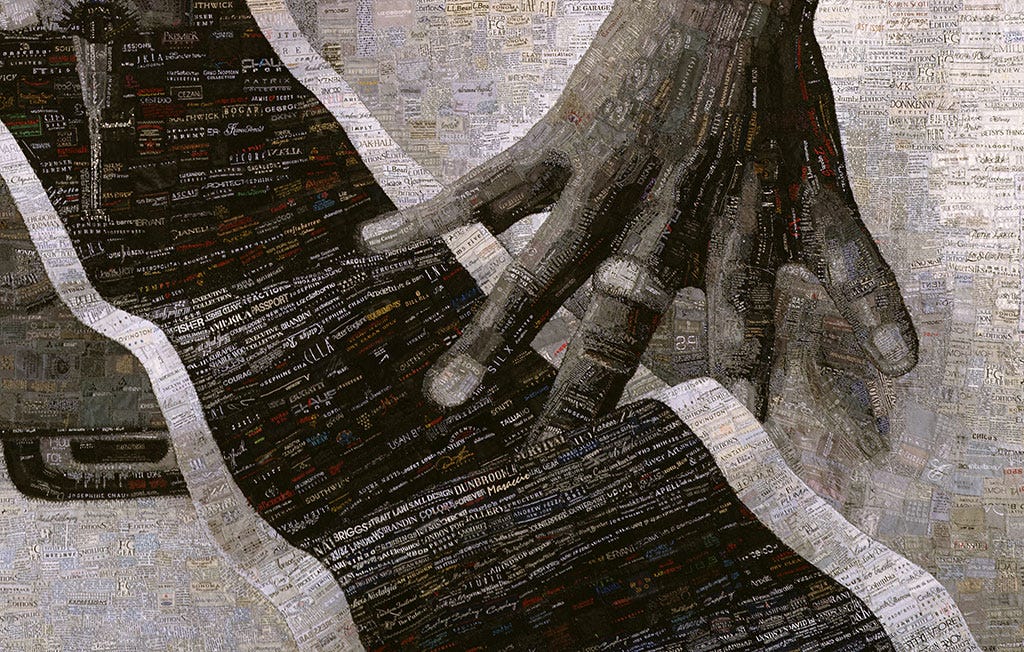
This week, I happened on an episode of Craft in America on Public Television (soon to be RIP unless we stop it, somehow), in which I saw a quilt artist—that’s right, the photo below is of a quilt. The quilt was based on a photograph of a Nicaraguan garment worker in a sweat shop.

Portrait of a Textile Worker, Quilt by Teresa Agnew

On artist Teresa Agnew, from Craft in America:

“Terese Agnew’s work has evolved from sculpture to densely embroidered quilts by a process she calls drawing with thread. Her themes are environmental and social. Her most notable quilt to date is the Portrait of a Textile Worker, constructed of thousands of clothing labels stitched together, contributed by hundreds of sympathetic individuals, labor organizations, Junior League members, students, retired and unemployed workers, friends, family and acquaintances worldwide. The resulting image is about the exploitation and abuse of laborers, the by-products of globalization and the insatiable American appetite for goods.”

The quilt was created using solely garment labels. Zoom in.

I learned that Agnew found her P.O. box filled day after day with volunteer labels, mostly from people she didn’t know, all women, all who believed in her vision for this piece, her purpose, her message, and in this art form. All these people came together, and Agnew didn’t even know how they learned she was working on the piece.

I think of that artist, and I think of Sondheim, on the road with three iterations of a show that started as Wise Guys, and become Bounce, a decade later finished as Road Show, bit by bit, putting it together, as it were, because it was something he and his collaborators believed in.

If so many people can work that hard to make art that matters, can’t we call work together to demand a nation, a planet, we all want to live on? As Sondheim says,

A vision’s just a vision if it’s only in your head.

If no one gets to see it, it’s as good as dead.

America, your Miss O’ is looking at all of us and thinking, “We need a do-over, a rethink.” Fast. We overproduce all the wrong stuff, overconsume the wrong stuff, overwork in the wrong ways, overpay for the most basic things, like healthcare and rent, and overthink everything about the past instead of overthinking for the present and the future. We need to take all these scattered feelings and thoughts and make, build a national living quilt from all the tattered bit and leftovers, craft it for warmth and strength and beauty for generations and generations.

How many metaphors can you handle this Sunday?

It’s still spring, we are still alive. More to do. Let’s do it.

Sending love to all,

Miss O’

Not Waiting for Directions (Home)

When you just want to do it yourself but can’t

“Dear Saint Anthony, look around, something’s lost and can’t be found.”

~ Catholic prayer to the patron saint of, among other things, lost objects

“When evil-doing comes like falling rain, nobody calls out ‘stop!’”

~ Bertolt Brecht

“Never start a piece with a quotation.”

~ Nora Ephron

Do you have the feeling that we are all living through a Kafka short story? “The Trial,” perhaps, or “The Refusal,” maybe? When I was home in Virginia the other week, I asked my brother Jeff if he’d ever read Ray Bradbury’s “The Sound of Thunder,” and when I recounted the plot, he realized he once saw a bad movie version; and it came up because, as we caught the latest news out of America, I mentioned that I keep looking for a smashed butterfly on my shoe.

For some reason, I got on a mailing list for Catholic charities and I often receive “free gifts” of amulets and charms and bracelets and necklaces of St. Anthony. Coincidentally, he’s my favorite patron saint.

Like me, in addition to those stories, maybe you are thinking of that Twilight Zone episode, “It’s a Good Life,” where that evil kid keeps wishing everyone who displeases him away to the cornfield, and no one will stop him out of fear, and also love, because his parents choose to save him and let the rest of the world disappear. In the same way, Trump bastardizes the Kennedy Center even as he plans to close or demolish the Museum of African American History, and Musk eyes selling off the National Gallery treasures to “save money.” Wishing all our history away to the cornfield. And, echoing Brecht, there’s no one to stop them.

Or is there? Reading historian Heather Cox Richardson the other day was a tiny balm, as she recounts recent events and sees shifting winds. I’ll take it.

Your Miss O’ has been lying low these past weeks, visiting aged parents, aging brothers, a young nephew and vibrant sister-in-law. Also watching birds, smelling lilac in bloom, watching red azaleas pop, walking around my childhood block in drizzle. In addition to watching classic movies and “Harriet Tubman” on PBS and “Poetry in America” episodes with brother Jeff during the week, I caught A Complete Unknown on my last night, the weekend nephew James visited. James just wouldn’t go to sleep in his designated living room, what with all the excitement generated by middle-aged relatives, so he happily sort of watched the movie with the grownups, not understanding any of it. Fortunately, there’s no nudity and little in the way of bad language, but at the point where Joan Baez gets out of her bed where Bobby Dylan is sleeping, only in her underwear and a tank top, four-year-old James commented, “She forgot to put on her pants.” Uncle Jeff chucked, “He doesn’t miss anything, does he?”

If you haven’t seen that Dylan bio pic, for me the most interesting storyline was the one featuring Pete Seeger, played beautifully by Edward Norton. The movie helped me understand this mystery surrounding the rift that formed between Dylan and his early supporter and champion Seeger. Their link was Woody Guthrie, suffering from Huntington’s chorea at the movie’s opening, the disease never named or explained, as Hollywood does. I won’t belabor the plot, but essentially when Dylan went electric at the Newport Folk Festival, Seeger was dismayed and dejected, not because he hated rock, but because it was the end of his dream. For years and years, Seeger saw in Guthrie, and in the work of folk musicologist Alan Lomax and in folk musicians like Joan Baez and Odetta, the opportunity to proclaim a unifying voice in American music. Amidst the turmoil of the civil rights movement and the communist accusations of HUAC, the folk music movement offered the possibility of a true common ground across race and social class and political affiliation, youth and old age. In Dylan, Seeger saw the last piece of his dream, a young, galvanizing voice, filled with unendingly creative songs of love and political revolution, fresh and original but also connected to our American past.

But Bob Dylan was an artist first, an individual all the way, with no interest in marches or politics, not really, and not at all interested in unifying a nation. The rest is history, Highway 61 Revisited, and unending tension and turmoil in America. This is not Bob Dylan’s fault. Pete Seeger meant well, too, but no single person can make us all believe one “us” to be true.

No one, alone, can fix it.

But if something can unify a people, it’s probably music that comes as close as anything. Music and food. Music and food and complaining about noise.

On Thursday morning this week, around 8:30, as I was working when I heard this high-pitched BEEP BEEP BEEP [beat] BEEP BEEP BEEP. Smoke alarm? Tow truck? Work truck backing up? After about 15 minutes of this blaring through my window, I decided to take a walk hoping the cause of the noise would resolve. One 20-minute walk later, I could still hear the beeps from two blocks away. I went on a fact-finding mission. Where I live is like a mixing bowl of sound—finding the source was a confusion to me. I called 311—a wasted half hour of the operator’s frustrated inability to locate where I was on the city map. Feeling crazy at this point, I texted my co-op group, and neighbor Chris took over, agreed with me it was in a trash bag, rummaged, found the culprit—a discarded smoke alarm!—and smashed it. Oh, blessed relief.

In the midst of ICE raids in America destroying families, there are still annoyances like that, you know what I mean? It’s the thing I’ve never understood, not since I watched the 6-day war on Walter Cronkite’s 6 o’clock news when I was James’s age: what are human beings thinking when they annihilate other humans? We have enough little daily problems, don’t we?

If noise rage occasionally unifies us, language never seems to be able to, because as poet Nikki Giovanni said, too many people try to speak English rather than speak through it. Saturday morning, I had to go get bloodwork and urine testing done for my physical this week. Earlier in the week, I’d received an email that my neighborhood LabCorp office “has closed.” Full stop. I was so bummed—the next closest one is in Jackson Heights, about five subway stops away. Instead, the email continued in the next paragraph, there will be a new office…wait. It’s the same address, but one floor up. God I hate it when people can’t fucking communicate. What the email should have said is, “The second floor LabCorp office is closing for two days in order to relocate to the third floor.” Do you see the difference? Why is this hard? Because it is.

When I arrived at 7:45 for my scheduled 8:00 AM appointment, I saw a packed waiting room—highly unusual, but the office is “new,” so one makes allowances. One man there had a son, probably eleven or twelve and clearly on the autism spectrum, chasing him around, keeping him out of lab rooms, out of the hallway. I went to self check in kiosk but saw this sign:

So I went to the window to check in, as directed. The nurse behind the glass, short, dyed black hair, officious—clearly overwhelmed (like her male counterpart) by the double duty of being a receptionist and the technician, came out to the kiosk and said, “Give me your ID, I’ll do it,” and I pointed to the sign, saying, “If it works, I can do it…,” but she was clearly focused on finishing the check in. Again, I pointed out the sign directing us to go to the window. Did she take it down? No. She straightened it. (My seat being nearby, I spent the next 45 minutes explaining to everyone who came in, “It works, ignore the sign.”)

Between the lying sign, the autistic child flying around, the woman who was denied a pregnancy blood test because she didn’t have a doctor’s order, the men needing drug tests for their jobs, and the seats all facing forward staring into the abyss, I felt I was in some kind of play. Not really Kafka, but rather, Samuel Beckett. I was in a Beckett play. I love to see plays but it’s not always great to live them.

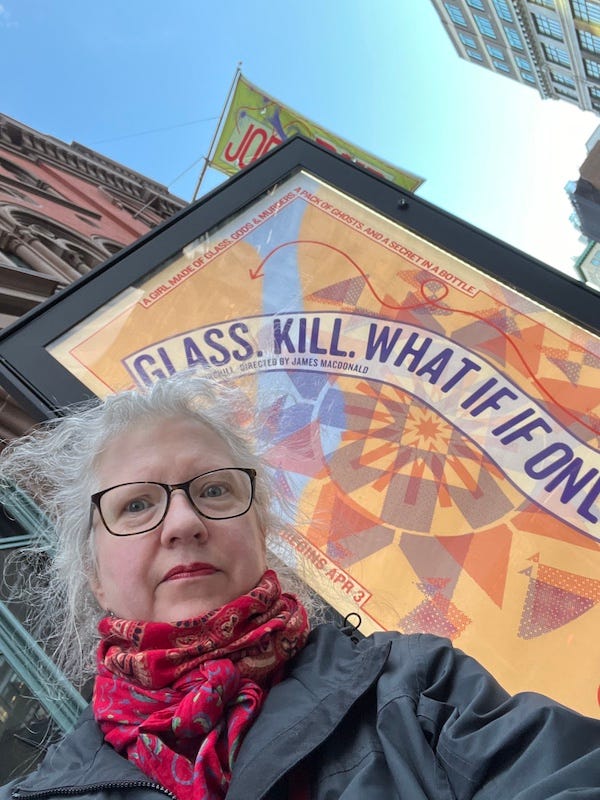
True to my heart, to cheer myself earlier this week, I went to The Public Theater to see a collection of short plays by one of my favorite playwrights, Caryl Churchill. As only an artist can, she captures me in this time, even in America. I think the titles say it all.

And that’s the latest. How’ve you been?

Love to all, somehow,

Miss O’

The Art of Making Art

A millimeter matters

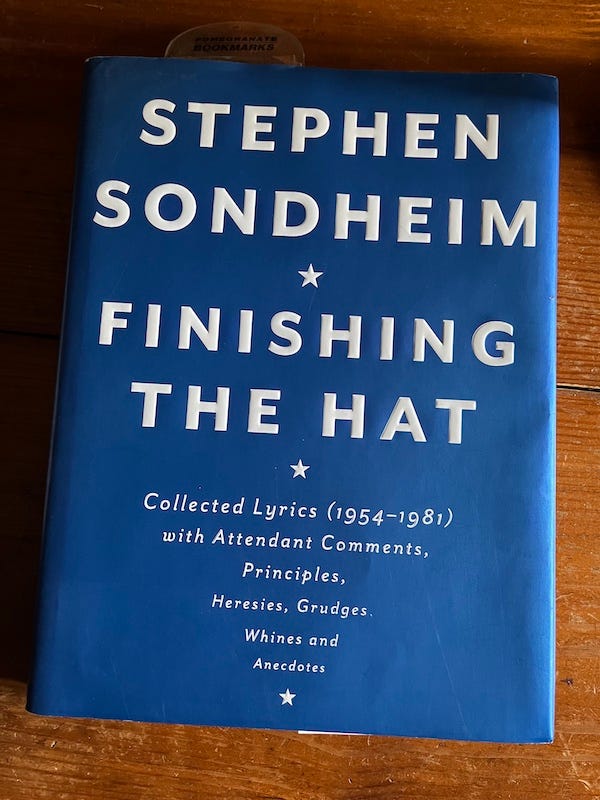
I just want to say that the luxury of owning a personal library is that not only do I feel cozy all the time, but I get to take evening tours and pick out volumes for bedtime reading. (Growing up, the O’Hara kids were about the only kids in the neighborhood with family bookcases, thanks to our mom, Lynne, having college textbooks, novels, and antique books to display and read.) Even now my number of volumes surprises some people, but I think, who wouldn’t want books around them? They are my closest friends. I saw an interview with Nora Ephron who said everyone asked of her family, “What are you doing with all these books?” (We live in a country like that now.) There’s no reason to finish a volume I peruse, or even read straight through. Sometimes I do that, but many times I just open a chapter and see what it says. If it’s not speaking to me, I flip around. Try another book. Like literary cocktails. It’s fun. This week I’ve been seriously rereading Finishing the Hat, Stephen Sondheim’s first volume of lyrics from his shows, 1953-1981, and so far I’m sticking with it.

When Stephen Sondheim died in 2021, I felt as if I’d lost a friend. Though I wasn’t sure how I felt about his work for a long time, you must know that the key to falling in love with a theater writer or composer is seeing the work, and in a splendid production. It really changes everything. He had three principles that guided his life’s work:

“God is in the details.”

“Less is more.”

“Content dictates form.”

I love that Stephen himself admittedly didn’t always follow them, but we give ourselves a little grace; nobody is perfect. And he himself had favorite lyrics that other people don’t seem to care for. He endured his share of flops and lousy reviews. And he just kept going. Thank god.

In an interesting coincidence, though sometimes I think it’s a bit more divine than that, these associative adventures, I’m also trolling PBS (while we have it) for documentaries and happened on two short ones. First, Marguerite: From the Bauhaus to Pond Farm about master potter Marguerite Wildenhain who, along with her husband, escaped the Nazis and made her way to California to teach pottery; and second, Finding Edna Lewis, about famed chef of 1950s Café Nicholas on E. 53rd St., cookbook author, and unsung mother of the farm-to-table movement, Edna Lewis.

And you might night think that Stephen Sondheim, Marguerite Wildenhain, and Edna Lewis couldn’t have much if anything in common, but you know what? God is in the details. Buckle up.

I’m not really going to recap all their work. But those rules up there apply.

“God is in the details.” Marguerite’s great contribution to many potters was, according to one student, “teaching us how to see.” For example, she’d have each potter make ten or twelve of the exact same pitcher or vase (since potters usually mass produce their work). The student would line them up on a board, and Marguerite of Pond Farm would walk and look and say, of maybe the third one, “This is good,” and of the eighth one, “This is good.” To the student they looked identical. Then she would point out a millimeter of difference in the rim, or the handle, the difference between being beautiful and merely serviceable (I think of the human face). God is in the details. It changed everything for students. (I’m obsessed by details when I direct a show, but not so much when I write, because I’m not an artist when I write.)

“Less is more.” Chef Edna Lewis grew up in Freetown, Virginia. In the Great Migration that took her to New York, she made a living cooking for artists, and word of her home cooking spread. She became an accidental star chef when she partnered (silently, as a Black woman) with two gay men to open Café Nicholas on E. 53rd Street, creating wonderful Southern cooking for writers like Truman Capote, Tennessee Williams, and Gore Vidal. Lewis believed that food should be seasonal and that the ingredients should speak for themselves. Nothing should be overly prepared, overly seasoned, or fancy. You might call it simple home cooking except that her dishes were both gorgeous and delicious, prepared by someone who knew what she was about.

“Content dictates form.” In the theater, the writing and the intent dictate whether something is a play or musical; or whether it’s theater at all. In pottery, the intended use of the vessel dictates the size and shape. In cooking, the ingredients at hand dictate the kind of meal it will be. I’ve been mulling that principle over, and not to get all metaphorical or analogous, but I have to go a little political here. Content (greedy, sociopathic, ignorant bastards) dictates (!) form (evil shit show).

Speaking for myself, I wish I had the talent to be a playwright or a novelist or a poet. I haven’t done theater in years because it’s a collaborative art (it’s not like I can walk around my apartment and “direct”), and collaborating is something I never have time to figure out. But for whatever reason, ever since I was a kid and started writing, I’ve felt I had an obligation to study news events, internalize them, and interpret them for everyone. I don’t enjoy it, necessarily, and will never make a living at it, but I can’t seem to help myself. When asked in high school by the “gifted and talented” program advisor, Mrs. Hubbard, why I kept a journal, I told her I saw myself as a chronicler of my time. She snorted disdain. Years later, when I related that anecdote to my first professor at the Bread Loaf School of English (a summer master’s program designed for teachers), Prof. Cazden snorted almost identically. It was uncanny.

Somewhere in our lives, no doubt, we’ve been made to feel less than. (Both teachers (graduates of Bryn Mawr and Radcliff, respectively) told me without apology, one overtly, the other hoping I’d take her meaning, that I just wasn’t smart enough to be there, whatever that meant. It’s not like I was stupid, exactly, but it’s annoying for brilliant educators like them, I guess, to be around the merely bright when there are geniuses to teach. You know how it is. My response was to say nothing, and my revenge was, I stayed and decided to belong. I really learned a lot. And it all worked out, because as it turns out, they were wrong. Never let them tell you not to dream.)

And so it is that, to this day, I keep feeling this pull to chronicle my times, though to what end I don’t know. I’m not smart enough to solve much—my teachers weren’t wrong about me not being a genius—but you can’t do nothing, in times like these. (Chuck Schumer, is this on?) I try to chronicle what I see and still hold on to the world I want to live in, the world I want us to build. First, obviously, it involves shipping all these the MAGA Nazis from their demented reality show, White House USA, to some tropical island where they live in golden mansions and go on staged hunts with all the guns of their wet dreams and watch all the porn they want without the Covenant Eyes app to pester them. And leave all of us sweet, normal people alone. And let us raise their children.

Until that blessed day, or until I get smarter, I read and write and dream. It’s what we do.

Once more, with feeling, something we can all learn from:

“God is in the details.”

“Less is more.”

“Content dictates form.”

~ The three guiding principles of genius Stephen Sondheim

Love or something like it,

Miss O’

Pattern Cutting

Reflections on art and life in the age of American Surveillance

Today, in the wake of all the grave threats facing anyone opposed to the Trump administration—citizen or noncitizen, federal worker or civilian, famous or ordinary, —even normal people just traveling, like the just-released woman from British Columbia traveling to the US from Mexico detained in a cement cell with thirty women, fed on cold rice for the past two weeks, no regular access to a toilet, with no due process (one woman in her cell has been there for 10 months with no hope of leaving, no one to help her); or like the British tourist who was arrested while backpacking in Seattle, detained and still not charged (both women white, English-speaking, without criminal records)—in the wake of all this, as I say, a friend of mine asked me if I was going to continue to write my letters on Substack and WordPress.

Yes.

As Trump invokes the Enemy Aliens Act and carries out the wet dream of White Christian Nationalists that is Project 2025, no one is safe. Do or do not, be important or not, be famous or not, be humble or not, be a child or an adult, a Democrat or a Republican, pardoned or not, Trump friend or foe, literally no one is safe from all this. (Did you see Sophie’s Choice? How many times do you have to read the fucking “First They Came” poem?) The sadistic joys of kidnapping, detention, torture, and, no doubt, eventual killing are endorsed by fully 37% of American citizens. They are willing participants and apparently glorying in the promise of the end of the democratic republic. They whine when they are personally affected, sure, but as one Nebraska rancher I heard on Instagram said—and she is losing everything and voted for Trump—she’d do it all again. You cannot fix this level of stupid, you cannot fix sadists. All you can do is outnumber them, out kind them, out organize them. Outlove them. And die trying.

It’s the absurdity of it all I cannot fathom. In a recent episode of this season’s Finding Your Roots, Henry Louis Gates, Jr., reveals to actress Debra Messing the truth about the fate of her Jewish-Polish ancestors in Krakow. One such relative, a pattern cutter in a garment shop, was among those killed in the Holocaust. In a moment of what scholar and philosopher Hannah Arendt called “the banality of evil,” conscripted Nazi soldiers carried out orders and exterminated simple working people in Poland and elsewhere, people they didn’t know, for no particular reason other than they were told to. Ordinary working people.

A pattern cutter. In a little garment shop. In Krakow. And his wife, and his sister. Messing had no idea.

Tom Stoppard, in his Broadway play Leopoldstadt explored his own discovery of Eastern European uncles and aunts and cousins who were murdered in the Holocaust. The play, which I was lucky enough to see—it was stunning—was performed over two and half hours without intermission. Why no break? Because the audience would have walked out, baffled by banality, after Act I. The family, ca. late 1800s, was so…ordinary. Middle class, an affair maybe, a little business trouble; a simple holiday blending Christian and Jewish traditions, having dinner. That was the whole point. When the play shifts to 1955 in Act II, they are all dead. A relative is reckoning with this horror and the audience is, too.

It’s just insane.

No one could have been less important than a Romanian boy of 15, Elie Wiesel, and his family, as described in the memoir Night. The inhumanity and terror of the Holocaust has been so well-documented by survivors like Wiesel and others, like Primo Levi, that you cannot honestly believe we are reliving those exact times. And in the United States of America, too many of whose citizens died fighting Nazis, it’s unthinkable.

Yet here we are.

At 59E59 Theater in Manhattan before the election, I saw Mrs. Stern Wanders the Prussian State Library. (The promo material gives away the play’s surprise, that Mrs. Stern is Hannah Arendt, which is I guess because they didn’t trust the audience to know who she was.) The play gave me all the awful prescience that we were about to face the same interrogations Arendt endured; yet by gaining the empathy (there’s that evil word for which Elon Musk and his army of Christian white supremacists will have us all murdered) of her Nazi interrogator, Arendt was aided in an escape over the border. She famously went on to report on the Nuremberg Trials and warn us about how regimes like Trump’s form. Her books should have been text books in American high schools.

Screenshot

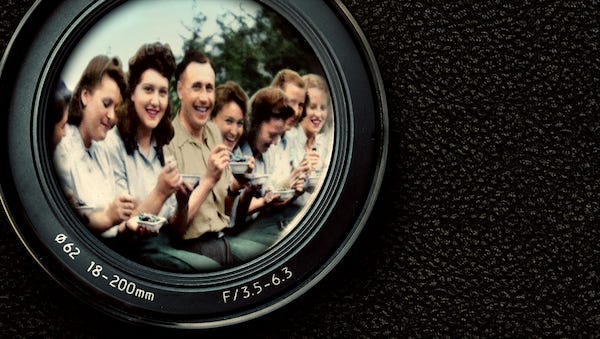
Last summer (I wrote about this somewhere already), I was lucky enough to see the play Here There Are Blueberries, a true story, wherein researchers at the National Holocaust Museum found themselves gifted, quite problematically, with a photo album of Nazi officers and their secretaries having the time of their lives at Auschwitz. Not an inmate in sight. The photo in the promo material is of a group eating blueberries, in a spot that was not far from the ever-burning crematorium, all smiles, not a conscience among them.

From Here There Are Blueberries by Moises Kaufman and Amanda Gronich, 2024, New York Theater Workshop, NYC

A few years back, I saw the final preview of a Taylor Mac comedy, Gary: A Sequel to Titus Andronicus, in which a Roman slave, played by Nathan Lane, begs his two fellow slaves to stop preparing all the dead for burial. Let them rot—how else will all these Romans quit having wars? If we keep doing the dirty work, if we don’t unionize and end this complicity, how will it ever stop?

The two women keep embalming. (I think our audience was the first one to get it, and maybe the first night the play fully came together, because you could see the cast was stunned at our screaming standing ovation; the critics panned it, having seen the play before it was ready to be seen. And wow is it timely now.)

I think also of a fabulous Broadway revival of a play in verse called La Bête, in which Mark Rylance played a charming, verbose rube who talks the king in a 17th century court into making him the new court playwright, and David Hyde Pierce played the snobbish playwright who is unseated. In the final moments of this hilarious and frenetic farce, the audience realizes that in fact Pierce’s character is right, and Rylance’s character is in fact a deceptive, cunning, dangerous beast who will bring down the order with his appointment.

And my god, here we are.

It’s through the theater that I process life, even prepare for life. The way some people look to scripture I look to playwrights, to the artists always, as guides on what was, what may be, what to do, how to behave, what to dare in our increasingly dark times, surrounded by confusion and cowards, facing unending threats and evils everywhere we look.

And these monsters are just getting started.

UNLESS. Unless. Unless. Unless.

It’s a big ask. But we can’t give up.

Love,

Miss O’

Slaying the Dragons

More thoughts on our national monsters

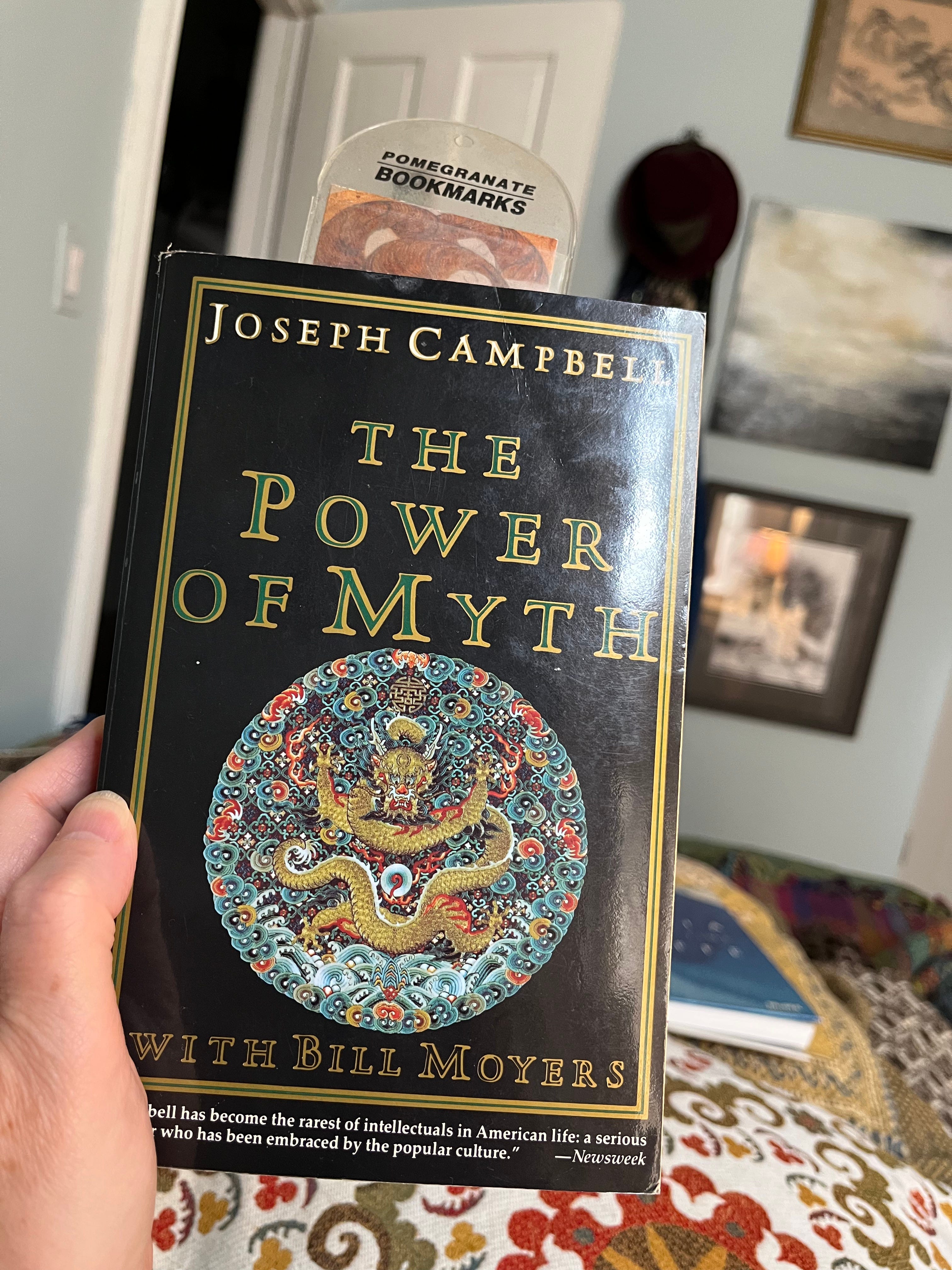
Hi, dear one. In my last post, I related how I’d recently read a book, Monsters: A Fan’s Dilemma by Claire Dederer, and this week, by a serendipitous coincidence, PBS streaming has rereleased a series from 1987, The Power of Myth, a conversation between Bill Moyers and the great mythologist Joseph Campbell, who sadly died not long after the final interview. You can also get the companion book, created because the 6-hour series (filmed at George Lucas’s Skywalker Ranch) couldn’t contain all the insights.

Moving from monsters to dragons felt like a natural progression. Also, in another moment of serendipity, I had a conversation this week about the work of Patsy Rodenburg, a voice teacher and acting coach, and her work The Second Circle. All of this makes sense together in my mind, so we’ll see how I do.

In a society such as ours in 2025, I wondered what Joseph Campbell might be able to help me with. As it turns out, plenty. Bill Moyers is a great host, comfortable asking naïve questions, and while for the intelligentsia it’s tempting to make fun of him, he gets wonderful answers. Moyers, by the way, was President Johnson’s Chief of Staff and later Press Secretary (he called Johnson “fifteen of the most interesting men I ever met”); he is smart and educated (and still with us at age 90) as well as attuned to society, but he’s at ease with not knowing and relishes seeking to understand (which I find are the key qualities missing from today’s journalists as well as citizens).

In one episode of The Power of Myth, Campbell explains Star Wars as one of the most recent (then) examples of the hero’s journey (there’s a whole episode on that; Campbell’s work inspired Lucas) and what that mythology tells us. Myths, he explains, including hero’s journeys, are not about seeking meaning in life, but rather about experiencing life. Moyers and Campbell talk of the ways in which people follow church doctrine, for example, to guide them, or follow strict rules and procedures rather than their own instincts. Often, heroes have to abandon what they thought they knew to get through the challenges.

They talk of the struggle with temptations presented by the serpents (found in every culture) where there is an expected way to live, the tension between the body and the mind, between desire and outside rules. At one point, Moyers reflects on ordinary people’s lives and the hero’s journey, especially the moment that Luke Skywalker, in a life and death struggle with Vader, chooses not to go over the dark side.

Of this dramatic choice of good over evil Moyers says, feeling secure in himself, “But that isn’t what happens in my life.”

And Campbell quickly counters, “You bet it does. If the person doesn’t listen to the demands of his own spiritual and heart life, and insists on a certain program, you’re gonna have a schizophrenic crack up. The person has put himself off-center. He has aligned himself with a programmatic life. And it’s not the one the body’s interested in at all. The world is full of people who have stopped listening to themselves.”

I don’t know about you, but it seemed to me this perfectly described this American moment.

Campbell and Moyers also talk about dragons, and Campbell’s take on dragons is fascinating to me—they guard. “The European dragon,” Campbell explains, “guards things in his cave, and what he guards are heaps of gold and virgins, two things, gold and virgins, and he can’t make use of either of them, but he just guards. There’s no vitality of experience…” In psychological terms, you’re binding yourself to your own ego, if you are dragon. (Campbell contrasts the negative European dragon with the “great and glorious” Chinese dragon—two very different things.) The dragon in us is our ego, “What I want, what I believe, what I see,” Campbell says, and “it might be too small.” To slay it, “you have to follow your bliss,” by which he means your true nature.

The Europeans, who colonized so much of earth, then, are based in a culture that fights those who hoard gold and virgins, and yet the heroes don’t fight the dragon for any other reason than to the take the gold and the virgins for themselves. Another perfect metaphor for America.

Campbell wouldn’t say that deciding to destroy others is anyone’s actual “bliss.” Annihilation of the innocent, the hoarding of gold, and rape of women cannot be bliss, because I see dead eyes in Trump, in Musk, in Speaker Johnson, in Vance. They are without souls let alone hearts. Anyone with access to their own hearts would follow President Zelenskyy anywhere because anyone can see Zelenskyy is Luke Skywalker; it’s not about him, this war, it’s about saving a country he loves. You may think that doing what you love “doesn’t save the world,” only yourself; but Campbell says that by saving yourself, you save the world. “An influence of a vital person vitalizes. There’s no doubt about it.” Otherwise, the world is a wasteland. Slava Ukraine.

“An ego that sees a ‘thou’ is not the same ego that sees an ‘it.’”

mythology scholar Joseph Campbell on the difference between the relationship Indigenous people had with buffalo (“thou”) and that which the white man had with buffalo (“it”); see also, Putin with Ukrainians

Last week my friend Keith, an actor and writer, was in town working on contract negotiations for his union, and we met for dinner on Third Avenue Thursday evening. The dinner time changed from 5:30 to 7:30, so around 6:40 I left Queens for Grand Central, going down toward the back of the 7 Train to be nearer the Third Avenue/42nd Street exit when I arrived at the station. When I entered the car, there in the corner was a bearded man, quite filthy and disheveled and resembling Rip Torn, a faded red towel safety pinned like a cape around a grimy white tee shirt fragment. He was talking to himself in animated tones about a woman who was in pain, her feet, I think, and the narrative was taking place at a hospital. He’d caused the car to reek, though not many people were bothered. I was, though, so when I sat down in the only available seat, I casually rummaged in my cloth sling bag for a mask. (Since Covid, the option of wearing a mask allows us to give smelly people some grace, to not embarrass them by pulling collars up over our noses, or to have to beat an exit to run to the next car at the next stop; in NYC in summer, it’s not uncommon for one person’s stench to clear out a subway car and leave it empty at every stop for a whole day. Pro tip: NEVER get on an empty subway car on an otherwise full train; everyone does it. Once.)

Over dinner, Keith and I talked about many subjects, from poetry to opera to politics, when he mentioned he was going to Portugal to study with renowned voice teacher and acting coach Patsy Rodenburg, whose work I love. In a quick but inadequate summary, I can tell you that Rodenburg (whom I first heard of in an interview on NPR and saw later on video from Michael Howard Studios in New York) noticed over the years that she could distill actors’ energy into three “circles”: inward directed (First Circle), outer directed (Third Circle), and perfectly present (Second Circle). We need all three circles, and all three circles have their uses, but to be an effective actor, you must live in the second circle of true intimacy, fully present.

You see this in life—First Circle, the people scrolling their phones, or the cashier who won’t look at you; and on the other extreme, Third Circle, the salesmen, politicians on the campaign trail, preachers greeting parishioners. Miss O’ lives in second circle, as do many of my friends. Second circle can be unnerving to people who are not, as Campbell would say, able to follow their bliss. People who need a doctrine to cling to—the Ten Commandments, Project 2025, even the Rule of Law. Any doctrine can be leveraged for good or evil when people are not in Second Circle. (Trump, I suspect, lunges between First and Third circles all the time, which creates a violent imbalance. He hasn’t been in Second since infancy, where we are all in harmony.)

And this brings me to a deeper truth, perhaps the most unsettling to me. In the United States, we have no more rituals (beyond, what, morning coffee?), no mythologies, no common culture to bind us together. If we could be honest, tell the truth about our origins, all the complexities of colonization, genocide, slavery, revolution, enlightenment, the uses and abuse of Christianity, all of it—we could formulate a national mythology and enact rituals to guide us to growth and build further understanding. American Idol is the best we can do? The spectacle of competing for money and fame? Has The Apprentice taught us nothing?

At one point, Campbell uses our architecture to tell us who we are in the U.S. in the modern age. In Salt Lake City, he notes by way of example, first the Temple was the tallest structure (religion), then the Capitol dome (politics), and now the Office Building that handles the economic affairs of both is the tallest and biggest edifice (commerce). It’s the Symbol of modern life. What does this mean for us? “You can’t predict what a myth is going to be any more than you can predict what you are going to dream tonight. Myths and dreams come from the same place.” What is the new American dream?

In six weeks, we citizens watched helplessly, and Democratic leadership spinelessly, as Donald Trump destroyed 250 years of American law and governance, wiping out the mythology of a nation. Listening to Campbell, I gained historical perspective. Though Moyers switches quickly, in editing, away from his point, Campbell does passionately remind us that Indigenous people, in a mere ten years, lost everything in the way of their rituals, their sacred dependence on the buffalo, their freedom, their land, and thousands of years of a way of life. Like that.

We’re in the process of losing a few hundred years’ worth. It’s nothing by comparison. It’s just ours. And “ours” was never “everyone’s.” If we are honest.

Our struggle now (if there is an “us”) is recognizing the difference between the seductive serpent, the dragon to slay, and the vital person. Everyone made fun of Hillary Clinton when she said, “We have to change hearts and minds,” mocking her with, “It can’t be done.” Of course it can be done. As my theater hero Joseph Chaikin said, it isn’t done “en masse, but one by one by one by one.” We each do our best to be alive, and our aliveness brings life to the world. Moyers brings this around to the importance of teachers, of which group Campbell was a member. The therapists, the storytellers, the healers, the helpers, the educators: we help bolster the world, prepare our heroes, vitalize the works.

Coda: Keith walked me to the Grand Central around 10:00 PM, and I descended the stairs from the Third Avenue entrance. Down on the platform, I walked to where an old man, a blues and rock electric guitarist, played a history of the Beatles and Jimi Hendrix as two other musicians looked on. We thanked him, gave him a few dollar bills. When the train pulled in, we got on the car, and I smelled a familiar smell. I looked down the car and there, in the same seat with the same two-liter bottle of Mountain Dew, was the same schizophrenic man. What are the odds? Weirdly, this sort of thing happens to me a lot in New York. But think of any number of small things that could have happened differently—the time I left home; or the time we left the restaurant; where I stood on the platform either way. It’s remarkable.

I pulled out my mask. The man sat alone, no longer chattering away but looking at us, lost; I think he vaguely recognized my hat. A needy citizen ignored, an “it” instead of a “thou,” someone else’s problem. The American ego.

I don’t know why, but thinking of all these stories and our ordinary workaday lives, I hear Pigpen’s voice in A Charlie Brown Christmas, when Linus points out that the dirt and dust on Pigpen could be from the soils carried across the ocean from ancient Egypt, to which Pigpen, adjusting his costume says, “Sorta makes you have a little more respect for me, doesn’t it?” Maybe Peanuts feels like it could be a start for our mythology, if we tried. We could do a lot worse.

(Thanks, internet.)

I do go on. Happy Sunday. I really should get out of bed.

Love,

Miss O’

On What Occasion Do You Lie?

Telling truths on Presidents Day

“I cannot tell a lie.”

~ George Washington, First American President

Ironically, this famous quote is itself a lie (how American), but more on that later.

The magazine Vanity Fair (to which I no longer subscribe) includes, as the last page of each issue, The Proust Questionnaire, a set of questions originally asked and answered by novelist Marcel Proust and now used to learn more about the globe’s favorite obsession, celebrities. The questionnaire has some interesting questions, and some shallow ones, but the answers can be revealing. I’m often struck, for example, by the way powerful men, even decent ones like George Clooney, answer #12: What is the quality you most like in a man? “Loyalty.” As a woman I read this as, Truth telling is a deal breaker. As for #13, What is the quality you most like in woman? men generally respond, “Patience” or some other subservient thing. It’s interesting, if limited.

Interesting, If Limited could be the title of my memoir.

Walking around the neighborhood, I found myself thinking of Question #9, which is, On what occasion do you lie? Often the celebrity of the month who has chosen this particular question among the many, will respond, “To spare someone’s feelings.” Fair enough.

But speaking as a fairly honest person who has lied on numerous occasions while also valuing truth, I wondered if any of the situations in which I lied had something in common. I’d like to say something pithy, see, when it’s time for my Vanity Fair moment, so let me note just a few examples, categorize them, and see if I can find the common ground.

1. Once in second grade, Mrs. Angle—I’ve told you this story—asked us after nap time with our heads down on our desks if anyone had a dream they’d like to share. I raised my little hand and got up in front of the class and, making it all up (obviously) to entertain my friends, described how we all went to Egypt to see the tomb of Tutankhamen. I pointed, “Juanita was there,” and again, “Ingrid was there,” and Mrs. Angle snapped, “You’re lying. Sit down.”

2. On a high school field trip during my sophomore year, to take the singers and pit orchestra to a neighboring high school to perform scenes from South Pacific as a promotion for our production, our sponsors, Mrs. Combs and Mr. Carnohan, realized they’d forgotten to send home permission slips with us kids. Only when the bus driver asked if they had them did they realize. I stepped up quickly, “Give me ten minutes.” I had everyone write out a permission slip on paper we all collected from someone’s notebook, and I signed each slip in chameleon-like handwriting. Mrs. Combs looked stunned, but she took my pile and off we went.

3. When I’m late for something, like work, I have blamed the subway (and have been caught out by a colleague and supervisor on the same line) because I’d rather not say, “I have IBS and had to run back home halfway to the stop because I needed to shit again.” (Finally, I just told the truth. No one asked after that.)

4. I once helped make a company-wide Answer Key set, compiled for the whole floor of my 2 Penn Plaza office, when this one president took over and, to prove his power, spent easily $100K to create something like 30 separate “learning modules” complete with “tests” on corporate “life” and business, modules that included short films, voice overs, and reading material on slide presentations, and if you didn’t get all the answers correct on each test, you had to start over, the whole module. We had massive publishing deadlines at the time, our nerves hanging by a thread. To what end are we doing this? But your job was on the line. A few of us—no doubt my idea—began printing out all our 100% test answer sheets which we labeled by module, punched holes, and stuck them in an unmarked three-ring binder. and set it on a file cabinet in our pod We didn’t even hide it. Eventually even our supervisors, to say nothing of executives and vice presidents, began ambling and ultimately marching over our pod to get the book, because 1) these tests were useless to our work; 2) the president was doing it to be a dick; 3) he would be out on his ass soon enough (they always are) once he was eligible for that golden parachute—we endured a period of a few years in which a succession of dicks who were pushed out of one company division and over to ours until they could retire. It was not fun. And yet, our important work—work that corporate didn’t in the least understand—somehow went on, great as usual. Hmmm. Who’s the parasite, Elon? (And how do I really feel?)

5. When the famous Westway Diner on 9th Avenue was taken over by new management maybe six or eight years ago—all the old-school career waiters replaced, the desk staff and chefs gone, the classic booths and tiles plowed under for white and gray blah—I happened in to check it out, and in addition to the place being bereft of atmosphere, the food sucked. “How did you like it?” the aggressive manager asked me about inedible spinach pie, which was a block of bone dry phyllo with almost no filling. “Mmmm,” I said, not wanting the poor new chef to get canned. Let someone else tell them; consider this a funeral donation. (It’s since recovered.)

What do all these occasions have in common? Well, they are lies of convenience, I guess, trying to smooth something over, or using deceit to help out friends or struggling folks; on reflection, I tell few lies just to save my ass. That’s how I was brought up. But I’m not stupid enough to believe that always being honest is smart. As my friend’s Montenegrin immigrant father used to say, “Honest and stupid are two brothers.”

I’ll tell you what the lies don’t have in common: No lives are in the balance for the telling of them. While I don’t condone lying or deceit as a lifestyle, sometimes lies save lives, and you have to keep your hand in. Ask the enslaved; ask women being beaten by abusive husbands; ask Tina Turner running away from Ike. Ask Jews during the Holocaust. Ask the French Resistance. And as we are entering a different era now, hearkening back to those dark times, we all may need to reset our moral compasses. We are back to Nazi Germany, friends, and “truth” for them, ain’t truth for us.

Thinking about coded language and other “lies,” and this being Presidents Day, I recalled a Chaucer class I took in graduate school 30 years ago, and my professor, John Fleming of Princeton, wanted to teach the class about Medieval iconography—you know, the images in all those beautifully illuminated manuscripts with the stories in calligraphy and the illustrations in gold leaf and lapis blue. Those illustrations, we learned, were included not only for their beauty but to guide the illiterate, because unless you were nobility or clergy, you didn’t read. So, what did the images mean? You see a lion, a rose, stuff like that. How would anyone get a whole story from a picture?

To demonstrate, Prof. Fleming drew these images in simple lines on the chalkboard:

“What is this story?” Fleming asked. My classmates, attending the Bread Loaf School of English from all over the country and the world, sat dumbfounded. I couldn’t believe it. See, I talked a lot, and I was practicing restraint, but finally I raised my hand.

“It’s George Washington and the cherry tree. I cannot tell a lie, Father, I chopped down that cherry tree.”

The class turned to me and looked at me like I had two heads. Fleming barked a happy laugh.

I explained to the still-lost class that I grew up in Virginia, up the highway from Parson Weems’s house, Weems being the man who wrote the fable about wee George, and a few miles down from Mount Vernon.

Fleming then went on to explain that this is a perfect example of how and why iconography—the use of simple symbolic images to represent a whole story—works in places that share a common culture.

To learn more this Presidents Day about this fable, you can check out the Carter Museum and learn about Grant Wood’s portrait, pulling back the curtain on the myth. In 1800, Weems published The Life of Washington, which is well-known as the source for many myths about the first president. Written just a year after Washington’s death, it includes the story of six-year-old George admitting to chopping down a cherry tree and another about Washington praying at Valley Forge.

Who chopped down that cherry tree? asks George’s father, according to Parson Weems, who wrote, “Young George bravely said, ‘I cannot tell a lie… I did cut it with my hatchet.’ Washington’s father embraced him and declared that his son’s honesty was worth more than a thousand trees.”

Why create this myth about an already mythological figure, even by 1800? I guess to impress upon America’s youth the importance of honesty. But what to do when you learn the story is in fact made up?

Growing up as I say, along the Richmond Highway between the home of Parson Weems and Washington’s home of Mount Vernon, I learned this fable in elementary school, but I never learned about Washington, the enslaver. Not in high school, not in college. I remember a California friend visiting Mount Vernon with me and saying, “I thought this was just a myth,” meaning the whole plantation, the first American president, all of it. And it’s easy to see how anyone not from the historical grounds of colonial America might feel that way, or wouldn’t be shocked to see a slave auction block landmarked in Fredericksburg or Williamsburg, given the American tendency to mythologize the successes and sweep the ugly truths under our antique hooked rugs.

And really, the more we keep digging, and the more lenses we train on our history, the more truths we uncover, the more lies we reveal—the more interesting and complex and real our history becomes. It’s discomfiting, sure, horrifying at times, but isn’t it exciting, too? Isn’t truth worth seeking? How else to make this nation truly free?

This is where we turn to our artists.

To explore perhaps America’s greatest “Lives of the Presidents” cover-ups, the relationship between Thomas Jefferson and his enslaved “mistress” Sally Hemings, Pulitzer Prize-winning playwright Suzan-Lori Parks premiered her play Sally and Tom at The Public Theater last year. The premise of the play is a community theater putting on a play about these historical figures while the leads are in a relationship. I loved the show, and I was fortunate enough to be there on a talk-back night. In attendance that night were several of the descendants of Thomas Jefferson and Sally Hemings and their families, as verified by DNA. I couldn’t believe I was having this chance to witness history. To watch as these family members meet one another after the show (many were sitting in the row in front of me) and walk up onto the stage—the set’s back wall covered in all of their names in the final reveal—to take photos with their phones, made me weep. (I think it would be a fascinating way to end the actual play.) It was wondrous, too seeing truth all up there like that. The theater was filled with love in the midst of revelations. That’s what art does.

Miss O’ outside The Public Theater, April, 2024.

And I think also of that incredible painting by Titus Kaphar, “The Myth of Benevolence,” offering another way that art can reveal a deep truth in a way no historical record ever can, exposing long-hidden damage and forcing us to confront it. (Click on the link to see the entire painting and learn its story.)

A whole story from a picture. American iconography.

Detail, Titus Kaphar, “Behind the Myth of Benevolence” https://www.culturetype.com/2018/03/28/titus-kaphar-and-ken-gonzales-day-explore-unseen-narratives-in-historic-portraiture-in-new-national-portrait-gallery-exhibition/

On what occasion do you lie? I look at the American story, then and now, and it’s seeded with lies and corruption, so many lies, you have to wonder, Can it ever come clean? How do we answer for it? These are the questions we all should ask and answer now. If we don’t, whom do we think we’re protecting?

On what occasion do you lie? Ask Gil Scott Heron, famous for saying “the revolution will not be televised,” meaning it happens inside us, speaks volumes about the impact of lies in the linked poem; and Kendrick Lamar, whose brilliantly coded and performed all-Black Superbowl Halftime Show blew me away. The enslaved lived in world of code. They had to lie about learning to read, for godsakes. Pretend to go along, to get along.

On what occasion do you lie? Ask women who have been sexually assaulted and been made to keep quiet or lose their careers. Ask the men who keep pretending nothing happened. Ask Sally Hemings.

On what occasion do you lie? There are real reasons to lie, moral, ethical reasons. To protect the ones we love. To save our neighbors. We are having to think hard about that now.

Republican lawmakers (that’s rich) want AOC arrested for teaching Americans and immigrants their rights. Photo by Miss O’ in her Queens neighborhood.

Because let’s face it: here in the United States, we are in a crisis of government amorality. We have a lying Republican party (no more rule of law); a lying president (pick a campaign promise, and yes, Project 2025 was the plan all along); a lying vice president (his autobiography exposed as a sham); a lying Supreme Court (see Roe v. Wade, which all declared, under oath, “settled law”); and liars heading every cabinet position (no, trans people are not the cause of America’s problems; and Putin is not America’s friend, Tulsi). We have liars in the Department of Justice and Homeland Security (immigrants are not remotely the cause of most crime; being brown is not a crime). We have liars heading the F.B.I. (the Democrats are not the enemies of America). It’s all lying all the time, now, and their truths are even worse. The freedom of Western Europe is now in the balance, as Vice President J.D. Vance admonished the “values” of those democratic nations this weekend, in essence praising the rise of fascism in France and Germany and also capitulating to Russia’s desire for empire. On the campaign trail, Vance said “democracy” but meant, we know now, “totalitarianism” (Europe is not America’s enemy, nor are Panama, Canada, or Greenland; our actual enemies are transparently heading our own government.)

Past and present collide: JD Vance on his brown wife; I’ve heard Vance refer to their children as “her” kids. Look at the mental gymnastics and self-delusion of Vance, who denies his wife and children, and smiles.

To think that all of today’s stuff started with asking a simple question.

Identifying lies is not the same as responding to the world that supports those lies. There’s a very cool blog on Substack called The Pamphleteer by Lady Libertie, and she is focused on how we negotiate this new era. Check out “So You’ve Been Invaded: a French Resistance Guide for the U.S.” Pretending comes with the territory of survival. Marcel Marceau, for example, as a teenager pretended to be a camp leader, while his real job was to smuggle Jewish children across the border to freedom; he used the art of mime to teach the children silence as they walked. It’s not really lying if it’s saving lives, and the people you are lying to are venal.

Happy Presidents Day in America, 2025, everybody!

Sending love,

Miss O’

The World of the Play in the World

Four Saints in Three Acts by Gertrude Stein,
performed by David Greenspan (photo by Miss O’)

Three Acts

“What is the world of the play?” Maureen Shea would ask in our Introduction to World Drama and Introduction to Directing classes at Virginia Tech, where she taught me back in the ’80s. Whatever you wanted to do to a play—change the location or time period, say, or modernize it, or cast it in a nontraditional way—you had to be true to the world the playwright created. Your first task as a director was to immerse yourself in that world. Even if something didn’t seem to make sense, you had to make it make sense. That was your job. The playwright as artist takes precedence; the director’s first job is to serve the play. The director’s next job is to guide and shape the actors’ performances in service to play; and then to negotiate a design plan with the scenographer and costume designer, the crew, the management. Directing is an interpretive art, and an interpreter has sometimes the hardest human job of all the artists, which is to put it all together so that the director’s work disappears. And yet, directors have a signature. There’s no way to hide it, not if you are an artist. 

Maureen Shea, who died unexpectedly on September 20, 2022, was an artist of the first rank. I’ve spent a week trying to process this loss. I’m writing this essay—what am I trying to put together? Here’s what I wrote on Facebook to our Virginia Tech theater page:

Lisa Novitsky and I talked this morning; I called Richard Rauscher, texted and got a message from Cindy Babson…it’s hard to process. Maureen taught us, drove us, called us out on anything that got in the way of our artistry. Moment-to-moment work, transitions, connection, authenticity—all of it mattered, every detail. I knocked myself OUT for her. Every time. (I was not always successful.) When we did Museum, I was cast in a couple of bit character parts, but I came every single night of rehearsal and sat and watched her work. I saw every performance of How I Got That Story; I auditioned for Fen because she asked me to, saying, “Lisa, you’re perfect for Fen“; and even though I was student teaching and losing my mind trying to finish my education classes, I did it—because Mo said I was perfect for something. My last week in Blacksburg in 1987, after doing Alice in Wonderland with her at the Summer Arts Festival and before heading off to my first teaching position, we went out one night and closed down Maxwell’s as she gave me a master class in how to teach poetry. I was lucky enough to see her in NYC in 2018 and caught her show, Sugar, on 19th St., and we had a long, leisurely brunch the following Sunday, one of the best talks I’d had in years. Loved her so. This is hard. Thanks to Bo Wilson for sharing the Mo Quotes. Miss and love you all. Lisa O’

P.S.  One more Mo Quote: Around 3 or 4 AM before leaving Maxwell’s, perhaps one scotch short of a DUI, Maureen riffed on Alice in Wonderland and my future career in education: “When you think about it, the only difference between a teacher and a mad person is that every once in a while, a teacher says, ‘You see?'”

Phrases and directives come back: The actor’s beat. The director’s beat. Beat change. The cap on the beat. Stakes and obstacles. Theater is life, life is theater.

Over the years I’ve realized that theater, for me, is church. I learned in this memoriam piece that Mo, who had spoken at a hearing in Boston to save a theater, saw it the same way.

“Maureen got up, had nothing prepared, and just started speaking from her heart. After she said something about responsibility of stewardship of these historic buildings, she started crying. She said, ‘I know you don’t understand, but for us, to turn a theater like that into a dining hall is like having to watch people eat french fries in church,” said Hickler. “And I watched the entire board … change their minds at the moment. Afterwards they were giving her hugs.”

When theater is your church, all the details of the show that is the service matter. I used to drive my old directing colleague, Ann, insane with my attention to details, but I knew they mattered. I always slicked down the boys’ hair with Knox gelatin for period shows, for example, and that detail is the difference between a Guys and Dolls that looks professional and one that looks like a high school show. (You might not even be able to put your finger on what’s wrong, but trust me, it was the dry hair.) “The coffee is hot,” Mo’s colleague and my acting teacher, Gregory Justice, would remind us. “The luggage is heavy.” Play that. “You are coming from somewhere.” 

These notes were given to me in rehearsals for a play, Bad Habits by Terrence McNally, one act of which, “Ravenswood,” takes place at a sort of mental health spa/asylum. At my first entrance, I was pushing the wheelchair of the head therapist of the place, as if we have been touring the grounds. We performed the play in a black box with only small screen from behind which to enter. (My acting teacher, Greg, directed the play, and told me “the coffee is hot” note so many times that finally, one morning when I had tea, I studied what happened to my lips, my face (from the steam), my hands, all of it, until I could do hot cold.) But the “you are coming from somewhere” was Maureen, from watching her direct. After seeing the play, my friend Scott asked, “Is there another room back there?” He was convinced I had walked a long distance before coming on stage. He also asked me, “How did they keep that coffee hot for you?” See? All that detail. Maureen took this teaching to her next gig, too, at Emerson College in Boston. One student shared this:

Deaderick remembers a classmate in Shea’s class directing a short piece that took place at a diner. A character ordered coffee with milk, but when the server came back she poured black coffee, brought no milk, and the character drank it anyway.

“’In the critique later, Maureen was livid about that: no one who takes coffee [with] milk would just drink it without! They’d remind the waitress,” Deaderick said. “The problem wasn’t one of realism. It wasn’t about being accurate. It was that the audience would keep wondering about the milk. Which I had when I watched. It was Chekov’s gun, but with dairy.

“I carry that lesson with me in all my storytelling. Never leave your audience wondering about the milk.”

If you don’t know about Chekhov’s gun, he famously said in a letter to a friend: “One must never place a loaded rifle on the stage if it isn’t going to go off. It’s wrong to make promises you don’t mean to keep.” This principle is often stated now as, “Don’t have a character handle a loaded gun in first act unless it’s going to go off in the third.” The audience worries, you see* (*Miss O’ as teacher, not mad person). And how irritating is it when you find you’ve worried through a whole show for nothing?

(Now you might think, But Miss O’, your friend Scott was wondering/worrying why the coffee stayed hot. He wondered/worried what on earth was back there. Actually, he didn’t think about any of it until afterward, when we were talking, when he realized how real it all seemed.) 

What seems unreal to me is Maureen not being here anymore. In this grief, I find gratitude that Greg was the one to message me on Facebook, and my dear friend and classmate Lisa Novitsky was the one to call first. Social media is only any social good at all if it’s about human connection. An emoji isn’t enough, a like, a heart—what I needed and found was the source, the authenticity, of our relationships, in the sharing of our common grief. That we could use words mattered. That we had details to share.

The world of our collective play didn’t change; a key character died. It doesn’t make sense. Now our job is to make it make sense. The playwright has spoken.

Four Saints

“There can be no peace on earth with calm with calm. There can be no peace on earth with calm with calm. There can be no peace on earth with calm with calm and with whom whose with calm and with whom whose when they well they well they call it there made message especial and come.”

~ Gertrude Stein, Four Saints in Three Acts

Stein said of her own play, “If you enjoy it you understand it.”

“There can be no peace on earth with calm with calm.”

If I were speaking this line, I’d score it thus: There can be no peace on earth / with calm / with calm. In other words, without a willingness to lose calm, we cannot create peace on earth. The making of peace, says Stein, is a noisy business. I think Stein says this. 

She goes on: “This amounts to Saint Therese. Saint Therese has been and has been.”

Has Saint Therese been peace on earth? Has she been calm? Without calm? Has she simply been and her being gone on and on, much like Celine Dion’s heart?

“It’s too easy to assume—we have to find out. Ask questions, nose around.”
~ Maureen Shea, ca. 1984 (as recorded by playwright Bo Wilson)

This week was the 100th anniversary of the publication of T.S. Eliot’s long, challenging poem The Waste Land. What does it mean? Why does it matter? To find out, I’ve been watching some old YouTube-sourced videos about it, and corresponding via email and enjoying a phone conversation with another beloved mentor, master English teacher Tom Corbin, on the effects of Eliot on poetry. Eliot and Stein were modernist contemporaries. Both writers, along with another contemporary, James Joyce, took pleasure in being unreadable. The boys, at any rate, relished the idea of academics chasing meaning for centuries, digging up all the clever literary allusions, writing the papers, making an industry of interpretation. Stein, by contrast, was trying to write in the complete present (something Joseph Chaikin and The Open Theater would try to replicate on stage in the 1960s in performance; it was Chaikin’s style that Maureen assigned to me for my final directing project my senior year, a style I found harmony with and used to create four original one-act plays with my students), allowing too for the ways in which humans continually repeat lines while telling a story (listen for it). 

Eliot “never repeated himself,” one scholar says, and in doing that he “made it a myth that this is how a poet should behave.” I started thinking of the idea of repetition—what it means to stay with an art form and still find something new to say within it, and a new way to say something.

And I think of living on earth. How we must continually find something new in it to enjoy—I mean, for example, the clouds always change; the sky is always changing. I saw a grasshopper on 44th Street in Queens the other day, first grasshopper sighting in nearly 20 years in New York. That was new. And when we are feeling untethered, that grasshopper on the cracked pavement by the rusted out car on 44th Street might be the only thing that keeps us from falling off the earth, at least in that moment.

When I went to see Stein’s rarely performed play Four Saints in Three Acts on Friday night, I found myself, after an hour of travel from Queens, at a subway stop for the R Train (en route to Bay Ridge); and that was new. To get to the theater, in Sunset Park, I walked a long residential block, crossed a 12-lane boulevard under a highway, and headed into warehouses, all at sunset in Sunset Park, curiously enough, where I managed to find a yellow door with an 8” x 10” paper stuck to it, that said, simply, “Four Saints in Three Acts.” It was a miracle I found it. That paper and the address. (Later they put out a little table; see opening photo.)

Sunset Park, Brooklyn (photo by Miss O’)

And it’s a miracle that I was lucky enough to see it, only because I was blind enough to order a ticket before I realized that while the Lucille Lortel Theater was presenting it, the show was not in fact in Greenwich Village but, as noted, in Sunset Park, because if I’d known I don’t know if I’d have gotten a ticket; and how stupid and lazy would that have been? What has happened to me? Covid agoraphobia? Age? I don’t know. But I don’t like it. 

There is no way to describe the work of David Greenspan, who performed this play as a one-man show, but the reviewer from this week’s New Yorker, Helen Shaw, pretty much nailed it. Her review ends,

All this means is that the show is occasionally difficult, just as a church service can be. Nearly a hundred years after Stein wrote it, “Saints” has not staled or softened. Even though I am bewitched by Stein, and by Greenspan, and by Greenspan doing Stein, I still found myself needing to enforce some mental discipline. About an hour into the performance, my attention started to slacken. (In my notes, I wrote, “Recommit!,” and then kept underlining it.) This is Stein’s and Greenspan’s way of using time, or, rather, of teaching us to use time. It’s theatre as meditative discipline. One must deliberately choose the show over other temptations: one must choose to listen. So we chose. We were choosing there. In a way, we are still choosing, with a great many saints there, who are choosing there together.

There is a point, isn’t there, in every sermon every play every workout every life, when the thing becomes hard. It’s hard. It’s too hard. It feels too hard and we just want it (the pain the grief the confusion the boredom the thing) to end, but it doesn’t end, and we have to keep doing it and staying with it and when we stay with it and the end does finally come, the reward comes. The joy comes. The reason comes. The arrival arrives. And we were there.

“It must become inevitable.” ~ Maureen Shea

To live in the world and in the play, attention must be paid. You must be here. Have this experience. Be in this world. Look up. (In how many blog posts have I pleaded for this? A prayer to myself.) The coffee is hot. Beat. The luggage is heavy. Beat. You are coming from somewhere. Do that. The cap on the beat.

The world of the play of the world was, in the early 20th century, a mess; the world of the play of the world in the early 21st century has also proved, also, to be a mess. Where people used to look to the saints and the poets for guidance, we seem to look instead to celebrities who most certainly aren’t artists or even very good people usually but are distractions from a with calm that is not the with calm we are supposed to be doing without to create peace on earth, if you see what I mean. (You see?)

The world of the play, this world play, our play, finally, has to be continually remade, and reinterpreted, and grieved, first of all, first and foremost, really; then connections must be reestablished, love renewed, our promises to one another recommitted, sinners and saints all; then if we are to repair this play on earth and ourselves on this earth, we have to give every moment the attention it must have. Before we can do that work, we also have to agree that this life on this earth, as it is, is the world of our play.

“We can find a million reasons for what’s wrong or why something doesn’t work, but that’s not our job. Our job is to make it work.”

~ Maureen Shea, Theater Artist (in memoriam)

Miss O’ and Mo Shea, 2018, New York City

(Let’s also leave off with life, Mo’s beloved Joni Mitchell in rebirth at this year’s Newport Festival, “The Circle Game.” Love to all. Miss O’)