
On libraries, reading, and living itself
I look around my kitchen, my living room, and I think, “You should leave this place to the world as a museum.” Because wow, are we going downhill fast.
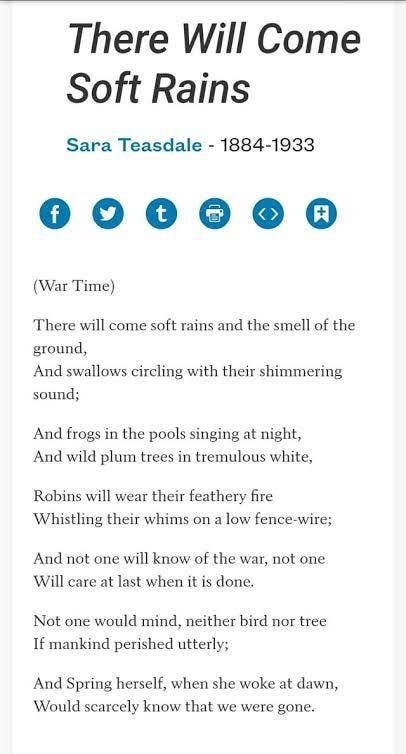
Ray Bradbury predicted the end of civilization in the AI-anticipating 1950 nuclear bomb classic story “There Will Come Soft Rains,” the title for which is taken from a 1918 Sara Teasdale poem (and takes place on August 4, 2026—wow); as well as his book-burning classic novel Fahrenheit 451, which I chose not to teach, favoring the Holocaust memoir Night, hoping to generate some empathy in my students. I guess I should have taught both, but world enough and time. You know.
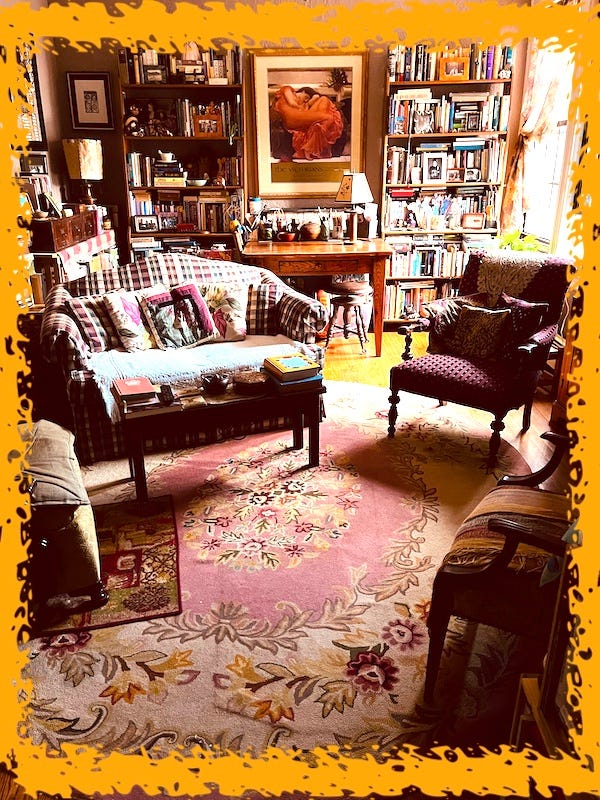
I know I told you about that study I read, that having a library makes you smarter: by merely looking at the spines of books you have read, your brain recalls the book, details of its subject, and it stimulates memory. Though I haven’t read a study to this effect, I have no doubt the same is true of homes with collected objects vs. the past decade’s trend toward antiseptic white, neutrals, engineered wood, and surfaces devoid of objects. Built-ins, should they exist, house a few solid-color vases from a Marshall’s housewares section. Simple, simple, so as not to interfere with the stimulations from our phones.
As we eschew craftsmanship in everyday objects and our built environments and allow tech companies to plunder and destroy our antique and rare books, I freak out, to be simplistic about it. And it makes me wonder if we are being made smart with our smartphones or merely overwhelmed and anxious—and controllable. The constant flashes of phone “content” are ever new, require split-second processing, and cause our hearts to race. This is the opposite effect, I’d say, of the friendly nature of personal libraries and memory-filled collected objects.
For years at my publishing job, a poster hung in the area of my cubicle that talked about the “reading food pyramid” by genre, of which Nonfiction was the base, with Poetry at the tippy top. I told an executive that that was wrong, it was the inverse: Poetry should be the big, solid base (think nursery rhymes and Shel Silverstein, to Shakespeare) followed quickly by Fiction (Dr. Seuss to YA to Dostoyevsky), with Nonfiction near the top. “But Common Core says,” and it does—that 70% of all reading in high school Language Arts should be nonfiction (as if social studies, science, and math weren’t enough); but it turns out Common Core was influenced by corporations who wanted their employees to make charts and feed data into systems; corporations don’t want empathetic, abstract thinkers. See? It’s why the people who work for Big Health Insurance feel nothing denying life-saving care; they only see bottom lines.
My dad, Bernie, a retired meat cutter and high school dropout, once asked his daughter the actor, director, and high school English teacher, “Why do I have to read Shakespeare?” And I said, “Dad, if you can read Hamlet, you can literally read anything.” This is true. What is missing most in our world, I think, is philosophy—and as smart as my dad is, he could very easily have become a MAGA without the education and influence of his wife and second daughter. I’ve always wondered why I have to occasionally pull him back from that rightwing abyss, and yesterday I happened on this video by scientist Lucas Bean, who explains on his Substack the key difference between MAGA brains and Liberal brains:
 Lucas Bean Daily
Why the MAGA Cult Thinks Like 10 Year Olds
Before the age of 11, the human brain cannot think abstractly…
5 days ago · 510 likes · 45 comments · Lucas Bean
So you see what it is: children and adults who read poetry, philosophy, and challenging fiction, and who think critically and question, are more discerning and just plain smarter humans. And when people say, “You can’t change them,” referring to the MAGA-minded, the teacher in me knows (and the study Bean cites bears out) that given the freedom to unplug, to read poetry, to listen to music, to form an opinion or new idea in conversation with others, that “can’t” doesn’t have to be true. I also know that it’s never “one and done”; though my dad has read everything from the daily paper to Steinbeck to L’Engle to Bronte, he has to be continually challenged when he happens on rightwing pundits and even the president he despises. Trump always sounds so sure—the way our little toddlers are so sure they can do whatever it is. I told you that story, the way I went weak in the knees and doubled over laughing watching my then 3-year-old nephew peddling his trike for all it was worth down the sidewalk in front of us, and when his mom asked what was so funny, I said, “Like he knows where he’s going!” I see now that this is the appeal of Trump—we do love the confidence of toddlers, and too many of us confuse confidence with competence; sadly, we are about to lose life on earth because of our pleasure in being entertained by an idiot. Yesterday, (soon to be ex-) Rep. John Cornyn (R-TX), who has been screwed over by Trump but continues to do his bidding, said that there’s nothing anyone can do to stop Trump (he moves on you like a bitch). Congress should be the parental adult in this situation, but he’s just so darned cute, and threatening, that the parents are letting the psycho baby run wild.
To refresh our collective memories of the danger before us now, I’ll leave you with a timeline of Trump’s Covid Days, shared by Lucas Bean, from which I could not look away, even as I lived it for years here in New York City. You look too:
Trump’s Failed Response During Pandemic: A timeline
The Timeline They Don’t Want You to See…
a day ago · 484 likes · 69 comments · Lucas Bean
Given all this, it’s astounding to me that everything for MAGA remains the Black president’s fault, immigrants’ fault, Biden’s fault, abortion’s fault. It’s pitiful, really, when it’s not fucking deadly. But we can’t give up teaching.
My Rob Brezsny horoscope last week asked me to think about the word sanctuary and what it means to me. And I’ve thought about that: The most peaceful and hopeful and whole I’ve felt in my life occurred over a few summers I spent in Blacksburg, Virginia, at Virginia Tech, in summer school, working the Summer Arts Festivals, and living on my own off campus. I was young and healthy, studying subjects I loved; knew what I was going to do with my learning—teach English and direct a drama club in a Virginia public high school; I had money enough to buy food (though I have no memory of eating—that is how lucky I was); my parents, siblings, and extended family were alive and well; I was surrounded by adults whose knowledge and company I relished; and I felt I was living in a big green hug from the New River Valley. Life has never felt better than that—as good, amazingly enough, yes, sometimes. But that was peak sanctuary. Gladly would I learn and gladly teach.
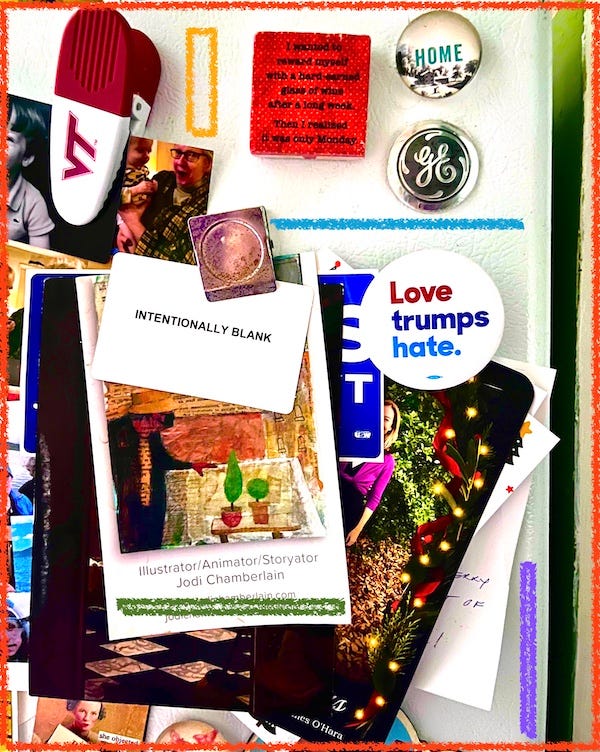
What is sanctuary for you?
And while you are thinking, how do we get out of this mess?


