On Orlando and Transitions

Meditations on Transgender Humans

From the NYPL exhibit on Virginia Woolf, 2023. Photo by LO’H

A couple of years ago, the social media posts of “Sam,” a young gay man in his 30s, the beloved former student of a late teacher friend of mine, began shifting from a fun social and work life to marking a life in transition. First, Sam shared multiple moves, the most alarming (to me) was a move (for work) to a dangerously bigoted Southern state, where he was determined to make a go, build a community, and change hearts and minds. As life there, despite his best efforts, became less and less tolerable, he found himself in transit yet again, back to a major city in his home state. Shortly after this move, about which he detailed his joyful creation of a new home with the help of many friends, he began including pictures of himself in “feminine” clothes and accessories (pictures that reminded me of Tom Wilkinson’s character in the landmark film Normal.) Not long after, Sam formally announced that he was beginning a formal transition from “male” (assigned at birth) to “female,” which Sam said was the gender he had always felt he was. What has followed includes his documenting phases of this journey, including legal name and gender changes on his/her/their identification cards, photo records of a shift from pants to dresses and in a face in full makeup, the results of their hormone treatments, and most recently and significantly, a diary of their gender reassignment surgery, their plastic surgery to make their face more feminine, and the post-op difficulties that are part of the process.

For my own part, as an advocate and ally of the LGBTQ+ community, I have found watching this process overall to be troubling. Because I haven’t understand the source of my feelings, and because I still don’t know how best to be supportive in an honest way, I made a decision not to “heart” Sam’s posts, but instead to follow them at a distance, as it were, while working on myself to get a handle on what “transgender” means and how best to understand my muddled response to it.

The start of my own encounters with this cultural shift began by seeing cabaret. One of my favorite live performers in New York is Justin Vivian Bond, who as Justin Bond made a name in the downtown cabaret scene (and later, on Broadway, where I first saw them) in the character of singer Kiki DuRane in the duo Kiki and Herb, with Kenny Mellman as the always supportive Herb on piano. When Bond made a decision to present as female and then transition (with hormone treatments, but forgoing gender reassignment surgery), I remember items in New York magazines taking the famously cross-dressing Bond to task, saying, “Vivian? Now you’re going too far,” that sort of thing. Mr. Bond became Mx. Bond, doubled down on their activism, and used music and humor to include the story of transition into their act. “Am I he, she? I don’t know what I am,” Mx. Viv said at Joe’s Pub one night during a tribute to Judy Collins, who was there to introduce Bond and their band; Judy had used feminine pronouns, asking, “Am I using the right ones?” and in response, Viv (who presents tipsy as part of the act) said he/she/they didn’t really care either way. At the time, the idea of changing pronouns was a fairly recent idea, and we were all on shaky ground. Why not acknowledge that?

Justin Vivian Bond in performance at Joe’s Pub, November 2023. Photo by LO’H.

As a society, we have all been, in fact, transitioning to a new, amorphous world where gender isn’t rigid. In response to this change I think (no doubt subconsciously), expectant parents began staging “gender reveal” parties, as if to say, “My child will know exactly who he, or she, is,” which we know now may or may not be the case. And sure, as with any movement, some kids may declare themselves to be other than the gender their genitals indicate, but the truth is nothing about gender fluidity is new. For example, as a child ca. 1920, and for at least two years until she was 14, actress Katharine Hepburn insisted that the family call her “Jimmy,” and she wore boys’ clothes and had her hair cut short. Her family just went along, and why not? But there is a darker side to this, too, because her older brother Tom (who wasn’t “manly” enough, some biographers have suggested, for Hepburn’s father) committed suicide at age 16; young Kath found him hanging in a closet. As a family, the Hepburns never spoke of it again. And I can’t help thinking that while a daughter, still, can present as a tomboy, there is, still, no society space for a young boy to present as a girl for a while, try that out; let alone for either to transition.

What was troubling me about Sam’s transition had to do with a vague feeling, and I mean to be honest here, of repulsion toward the idea. Why? Why was I feeling this? Did I not quite believe him, suspect he was being exhibitionistic to be, say, a sensational social media influencer? It crossed my mind. But I don’t think he’s lying. The problem was with me, and I decided I had to understand—what I could easily accept in Mx. Viv, I struggled with in Sam, I realized, because Sam is someone I have actually known since he was a teenager. My internal conflict was much closer to what the parents and friends of trans youth might feel than I at first acknowledged. All this is really to do with gender as a societal construct, which (I see now), I’d had the good luck never to have to worry about.

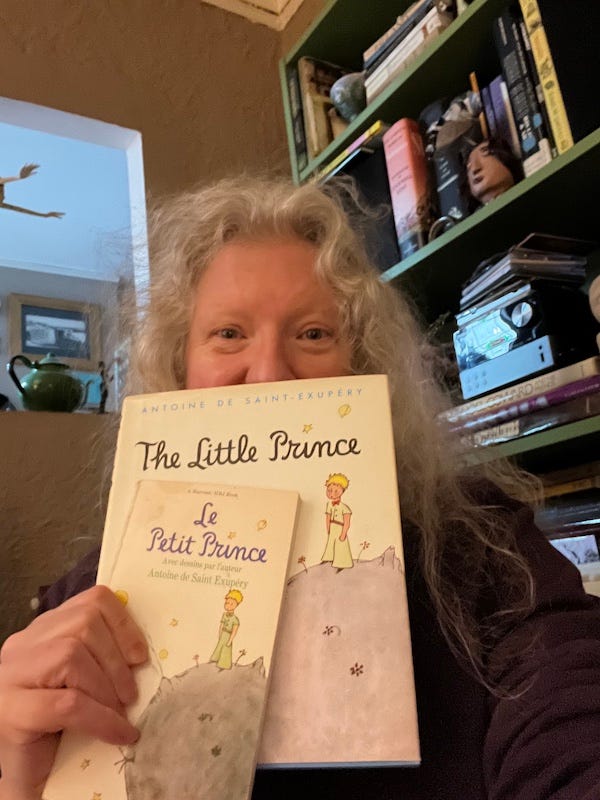
The well-worn copy itself.

The first novel I read that centered gender is Virginia Woolf’s Orlando: A Biography, which I decided to reread. Because I read with a pencil in hand, having conversations with my books, I see this must be my 6th reading of the full novel. (The only time I didn’t record impressions was in rereading it prior to studying in London in 2000, where I went three days ahead of classes so I might haunt Bloomsbury.) Each reading had a different purpose or at least caused me to come away with distinct, and distinctly limited, impressions. First, I was wowed by Woolf’s imagination—so different from that stultifying attempt to read To the Lighthouse in college; later, the more I learned about Woolf’s life, I was charmed by how her novel parodied her father’s profession as editor and writer of the Dictionary of National Biography in England. But more profoundly, Woolf’s novel was a deep reimagining of the life of her lover, for a brief period, and dear friend Vita Sackville-West. I’ve read the novel, then, over 30 years and with many discoveries, but this was the first time I read it with an intention: while I’d enjoyed the fantasy element of Orlando changing from a man to a woman over some 350 years, up the “present moment,” aged 36 in 1928, I had never thought about this gender change more than intellectually. Yes, we see what it’s like to be a woman vs. a man over time, and that somehow Orlando having had female lovers is still okay by the novel’s end, which is quite an achievement in modernism. But what am I missing?

The record of my rereadings. Do you do this?

Books become different because we become different readers, which is why rereading is so important. This particular revisiting was prompted by a movie. Back in the early winter I went to Film Forum here in New York to see Orlando: My Political Biography, a documentary in which several trans people were interviewed about their encounters with this novel, how it became their identity bible, how it helped them survive. Because I had no personal reason to connect with the novel on that level, I’d never read it that way (and these readers needed none of the backstory of Woolf and West to find the novel both revolutionary and comforting).

But now I had Sam and Mx. Viv (as well as my friend’s grandchild, now completing middle school as a boy); I’d seen the latest in a series of American horror stories, this the story of a nonbinary student in Oklahoma beaten to death in a high school restroom by (gender-assigned) girls, the student’s head smashed in over and over and over against the floor. Where does this hatred, this viciousness, come from? Where is all this fear coming from? Could reading Orlando again help me figure something out?

Woolf’s novel was (as Nigel Nicolson, the younger son of Vita Sackville-West, said) obviously a “love letter” to Virginia’s friend Vita, who when her father died learned she could not inherit the family estate Knole because she was a woman; so the famous estate went to her second cousin Edward (who had had nothing to do with the place unlike Vita, who’d loved and cared for it and kept it running all her life), who in turn sold it to the National Trust. Vita was bereft. In addition, Vita was bisexual, married to another bisexual, Harold Nicolson, and lived her life more or less as a man in her independence. Hers was quite a complicated life story in any era, but especially in 1928, when the book was published. Woolf’s novel was a spectacular best seller.

One might well ask, How did Woolf get away with it? In her infinite genius, she went full-on fantasy, beginning Orlando’s life back in time, when Queen Elizabeth I gifted Knole (fictionalized in the novel) to Thomas Sackville, Vita’s ancestor, and when Orlando (of the title) was a boy of 16. By taking Orlando through the ages—via the voice of a biographer-narrator who confesses to being as mystified as the reader at the changes, saying simply, “but that is what happened, what can I do”—Woolf subverts the gender transition though time transition. Readers are kept off balance through humorous descriptions of the awkwardness of the gender transition, exploring the mores and their differences for men and women through the ages. Orlando embraces, finally, her many selves, her genders, over all the centuries, coming to the present moment as a poet, a wife, a mother, a woman in the 20th Century.

The novel, as a note to those of you enticed (I hope) to read it, is not without ugliness—casual bigotry and acceptance of colonialism shockingly run throughout—which shows that no author, however enlightened in many areas, can be expected to be enlightened in all areas. But as Woolf’s biographer-narrator might say, “Difficult though this is, it’s what happened, and so we must record it.”

I must say, this journey of the past few years has been deeply affecting. I had never really thought about being a cisgender woman attracted to men since birth; I’ve had to ask myself if I was ever attracted to women, and yes, I have been—but only once I remember, as it happened oddly, suddenly, and then the feeling passed, in the audience of a theater maybe 15 years ago. I was in perimenopause at that time, I think, increasing in testosterone—was that it? Who knows? But it was real. Why did it hit me as something wrong? Why must anyone be tormented for having healthy sexual feelings, loving feelings, for our fellow beings; for wanting to express what is inside us in honest ways? Why do we continue to insist on gender reveals, coming outs? I used to wear dresses as well as pants; now I wear exclusively pants. I began dressing as a man, I guess, but with scarves and jewelry; and as a woman in America I can do this. Why can’t anyone of any gender simply discover and express themselves honestly?

“When this happened, Orlando heaved a sigh of relief, lit a cigarette, and puffed for a minute or two in silence. Then she called hesitatingly, as if the person she wanted might not be there, ‘Orlando?’ For if there are (at a venture) seventy-six different times all ticking in the mind at once, how many different people are there not— Heaven help us all having lodgment at one time or another in the human spirit? Some say two thousand and fifty-two. So that it is the most usual thing in the world for a person to say, directly they are alone, Orlando? (if that is one’s name) meaning by that, Come, come! I’m sick to death of this particular self. I want another.”
~ Orlando, page 308 (HBJ edition)

Miss O’s Woolf shelf, partial view. Essays, letters, diaries, and especially her fiction: Virginia Woolf remains my favorite writer. Orlando, taped and glued together many times over, was my gateway.

And this is where I am in this moment, today, the 10th of March in the year 2024, writer, artist, editor, daughter, sister, friend, woman. What about you?

Love, in all its forms,

Miss O’

Vamp Until Ready

Playing for Time

Covering a Change

Back when I was a drama director, my school’s orchestra teacher, Mr. T, had to fill in as the conductor of the orchestra for The Music Man when not one band director but two had to bow out (one for a family tragedy, the other because he’d been asked to be an interim principal at another high school). Mr. T, who had strenuously avoided conducting kids in a pit, was a terrific conductor and teacher, but knew nothing about musical theater. One day in the library, where he’d tracked me down, he asked me about a bunch of music on the sheet. Those marks (Greek to me) turned out to be the opening of “Wells Fargo Wagon,” and just as Mr. T knew nothing about putting on a show, I knew nothing about reading music.

He asked, “You don’t need all this music, do you?”

Oh, yes, we do.

“Why? It’s a lot of music.”

Because all this intro music is covering a set change.

“Covering?”

Right—the orchestra plays while we do all this work behind the curtain, or on a darkened stage, and when the lights come up, the music stops. In fact (I explained to the perplexed Mr. T) we will probably need more than that, so you will need to pick a spot you can back up to and play it again. It’s called, Vamp until ready. (And here I sang a little, “Bum, bum, bum, bum” [key change] “bum bum bum bum…” and then, “Now the lights come up and Marion enters…and music fades….”)

To his credit, Mr. T listened, learned, and got it. I was really happy to work with him, and he was in turn grateful to conduct the pit, though once was enough (it’s a 10-week after school time commitment for no pay), because he’d had no idea what went into it or how interesting it was to watch a show evolve in rehearsals to performance. And since pit orchestras are among the biggest employers of musicians, even a high school production of The Music Man is real world work experience for the kids.

I was thinking one morning this week about that expression, “vamp until ready,” which I learned in college as a theatre major under the direction of the late, great Maureen Shea. I used to watch her direct even on shows I had nothing to do with, only one of which was a musical during my four years. (Sometimes, you only need one strong experience to bank away knowledge for a lifetime.) I’ve noticed that “vamp until ready” applies to my corporate work life, and by extension to my life in general right now, but oddly enough, also to world leaders; the question is, How long can we keep this up?

“Figure It Out”

Among the looniest takeaways from all the years of public or private education for Americans in general over the past many decades is the notion that teachers had nothing to do with our learning. Instead, too many who go on to adulthood, especially those who become “leaders,” are under the delusion that they themselves figured out how to read, write, calculate, observe, and think irrespective of the educators they had over the years; indeed, some believe they learned in spite of them (and however much we may not like a teacher, we learn that, don’t we?). Ergo, when these former students go on to lead projects for, say, the government or a corporation, they begin by telling you, the workers, about a vision, the market, and the research, and to explain your titles and roles in the creation of this new initiative or project.

And when you ask, “What do you want me to do, or how can I best be of service?” their standard answer is, all too frequently, “Figure it out.”

Or, worse, “I’ll know it when I see it.”

I believe this is because they, the leaders, know we have to create something, but beyond a pillowy, sparkly dream, they more or less have no idea how to execute it. Or, by contrast, they know exactly what they want to do and give innumerable lectures in meetings trying to get your buy in. Talk, talk, talk, talk, talk until blue in the face. And after two decades in corporate life, where I moved from worker bee to senior whatever, the same thing holds true, whatever the leadership style: No one in leadership gives a tinker’s damn what anyone on my level “thinks.” Nothing we “do” or “make” will ever be what they want because they have zero curiosity about what we on the ground are going through. Life as Monty Python sketch. So, in order not to go mad and to keep your salary and benefits, you learn that the best thing to do is “look busy,” or as we say in show biz, vamp until ready.

And one day, suddenly, the curtain will open, the lights will come up, and the leader will shout, “I need everyone on stage NOW.” And with the wave of a wand, the leader will tell you what they want you to do. Only now, instead of 12 months to make the product, you have one. And you’d better not fuck it up.

Work Until Living

Everything on earth is in crisis—the climate, the untold effects of war and natural disaster, governments taken over by the right-wing march to fascism—and where once we had (we thought) plenty of lead time to solve everything, the time has been lost primarily due to lack of capable leadership, or because good leaders have been thwarted by others devoid of curiosity and compassion and belief in something true. I’m looking at free-press publishers as well as mayors and governors and representatives and presidents. Even good leaders can’t move forward when no one else is cooperating. How many times must we quote “The Second Coming”? The best lack all conviction, while the worst / Are filled with passionate intensity.

But being a lowly worker bee, I can’t lead the world to victory over the latest crises. As a result, I find myself stuck with my own life to figure out. That’s where most of us are.

Where is my leader, I wonder, the one who will announce to me what I’m supposed to do and how I’m supposed to do it and what the deadline is? A lot of us could use a purpose, not life and death, maybe, not with stakes beyond what we can handle and live in joy at the same time, but I mean some kind of purpose that makes the work of living each day something beyond mere survival. Many people have love in their lives, a mate or children, to give them that level of desire for living. Most of us, however, do not. And that’s when we look to art, I guess, whether or not we have talent or direction.

I think, in fact, the worlds of business and government (and even puny human life) would do well to take a cue from the world of musical theater.

At the first production meeting for an upcoming show, the director (in charge of the whole shebang) sits with the musical director, set designer, lighting designer, costume designer, choreographer, and stage manager (and if at all possible the original authors, but I was never that lucky director) around a big table, scripts in hand. First, a good director will share the vision she has for the production. A really good director will move forward by genuinely asking each of the players assembled what they think about the script and score, looking at their preliminary sketches and notes. Next, an even better director listens to each person in turn, not as a courtesy but because she really wants to know what they think. The stage manager takes notes. Perhaps they break for tea and donuts. And if a director is excellent, she will tell back to each of the players all the ideas they shared that she would really like to incorporate. Then she will give them an assignment, which is to take everything they’ve talked about today and make adjustments to their previous ideas; this includes the director. And so the work goes. Ultimately, the director decides on the production concept and must make sure that all the pieces of the production, including performances, are working in concert (the setting not modern when the costumes are 19th century, say). All this work evolves over the course of, say, ten weeks, leading to the technical rehearsal with the performers. The tickets are sold, the show must go on.

Unlike world leaders faced with the problem of war or global warming, or a CEO launching a new, useful product in corporate America, in theater a leader is not allowed to go into denial, sit around making speeches or ringing hands or having drinks with other theater folks before deciding to finally start rehearsals a week before opening night.

There is in the theater what Dr. King called “the fierce urgency of now.” (How is this not true for too many when it comes to war and the planet, when the stakes couldn’t be higher?)

In the months or weeks leading up to an opening night of a show, the work has to be ongoing and purposeful (the theater is booked), the collaborations real (the tickets are sold), the director clearly in charge of pulling it all together. That’s the deal. A show might succeed or flop, but no one is setting out to fail. And the work in any case will help everyone involved be better trained for the next one. And there will always be a next one.

The theater process is worth studying, I think, because while the stakes often feel like life and death, because artists care so deeply about success, the truth is no one dies. All we ever have against us, whatever our job, is time. In the theater, every show needs two more weeks. Because we don’t have it, we go on, we work, we do our best. We don’t give up.

Shouldn’t that be everywhere? With everyone?

More and more, I’m wondering if I’m feeling a crushing sense of my own life off the rails because all around me I sense the director left the building; I feel this enormous lack of sentience, wisdom, and leadership in the larger world. It’s hard to think of my little life having value or meaning when the highest of stakes, life and death issues, are being played for farce among, say, elected Republicans in our House of Representatives, where the instigators receive no rebuke in the headlines (while “the slap” gets unending coverage). How long can we keep up this vamp before the audience in fact dies?

Troubling Deaf Heaven

Yet in these thoughts myself almost despising,” haply I ran across this quote from my idol Katharine Hepburn via Instagram. She’s absolutely right—the only one who has to change in the above scenarios is I. Yet how, I wonder. And to what end?

Love or something like it, vamp 2-3-4,

Miss O’

Haven’t the Foggiest

On pleas, turnabouts, and new directions

Yesterday morning, Saturday, a week before I’m scheduled to return to New York (according to my latest in an ever-updating series of return Amtrak tickets), my mother, Lynne, still prone in bed in the playroom despite a light breakfast, sips of coffee, and blaring overheard lights, grumped to me and my dad from her near fetal position, “Would you leave me alone for a minute?” Sorry, Mom, I said, and out I went to get coffee; my dad remained, quiet, in a chair watching the very loud news. So it goes.

A few times during the last week, taking breaks from my own publishing job (where on Tuesday at the dining room table my computer died, had to order a new one via our help desk, get it FedExed to me, and return my old one, which I did, thanks to brother Jeff), I’d say, if I found her receptive, “You know, Mom, if you want to get dressed…,” and she’d say from under the covers, “Maybe tomorrow.” Friday evening, I’d told my dad and brother Jeff that I had a scheme: Since Dad O’ had bought bags of Halloween candy and baggies, and found the orange ribbon they always use, why don’t we set up in the dining room on Saturday morning and make the bags of treats they love to give out for Halloween, and make Mom O’ join us?

And, remarkably, we did that. (Generally, the jobs were as follows: Lynne (!) cut the lengths of ribbon, Bernie made the piles (one each of M & Ms, Snickers, KitKat, and Reece’s Cups), Jeff bagged, and Lisa tied them up. Sorry I couldn’t capture anything like fun, but we did have some nice little laughs, good memories. When sister Sherry called in the midst of this, Dad remembered Sherry and Craig (the children of my dad’s first marriage and who lived in Richmond) were in that house the first Halloween Bernie and Lynne and I lived there, in 1964, when county farmers (unbeknownst to my folks) would drop rural kids, piled into pick-up trucks, into all the new housing developments to trick-or-treat; as a result, the O’s quickly ran out of candy. Sherry (who was 7 or 8 then), who had a haul, said, “They can have some of mine,” and Dad wouldn’t let her. Sherry was born a doll. Dad said it’s the most kids they ever had for Halloween, even today.)

After we’d made 100 or so packets (my dad kept a tally sheet), my mom, Lynne, from this unaccustomed chair, said, “Now where do I go?” Her family had all gotten up to complete chores around the small house, my dad cooking up vegetables for ham and cabbage and peas porridge; Jeff to closet for the vacuum cleaner, I to the dust rag.

And in the midst of all this movement, Lynne made a decision. She decided to get dressed.

And, what is more significant, she wanted to get dressed in her room. Upstairs.

And she did that. For the first time in seven weeks, Lynne was in her room.

More astonishing, Lynne came back downstairs on her own, my dad bringing her walker as I watched her grab the railing with both hands, taking one step at a time, foot-foot, foot-foot.

She sat in her usual living room chair.

And it occurred to me later that that’s where her irritation had come from earlier in the morning—Lynne, whether she realized it or not, was making a Big Decision. And she chose life. At least, yesterday she did. We’ll see how it goes.

Anger Management

On Tuesday of this week, my brother Jeff texted me, “I’ll be home in a few minutes. Will explain when I get there.” As it turns out, he’d been fired, after 35 years, despite being the most skilled glass cutter in the shop, for mouthing off one too many times. Over a week of shock, sadness, back and forths with the HR guy, Jeff figuring out Cobra, etc., the shop boss (who’d overreacted and must have quickly realized the quality of worker he’d dismissed) told Jeff he maybe could come back, as a beginning apprentice (!), if he went to anger management. Of that suggestion, Jeff, who had expressed worry over what would happen to him at another job should he get one, was totally on board. “I’ve needed it for years,” he admitted. I told him how therapy saved my life 30 years ago, and Jeff has been looking into how to get started. (Sidebar: Bernie said to me yesterday, “Why does anyone need therapy? It’s common sense.” Says the man who screams at his family viciously at least once a week for no apparent reason. Jeff and Lisa come by their raging honestly, Pops—and I warned him not to therapy shame. “You’ve seen that commercial with the guy lifting weights who refuses help?” Yeah. “It’s like that.”) (Sidebar 2: I told Jeff I have an idea for a children’s book, Jeff Loses His Job, that could be one of a series to make our fortune, and we sat and thought of other possible titles to come. I’ll keep you posted.)

Meanwhile on the planet, the other day I read this headline:

Ukrainians Destroy Russian Tanks with Radio-controlled Toy Cars

And if this is how we can do war now, why not send toy cars and toy tanks into an arena, blow them up, and call it a war? Why are Israelis bombing real hospitals in Gaza? Why is Hamas carrying out real Jewish genocide in the name of the Palestinians? How in the actual fuck are the peoples of this earth STILL STILL STILL doing all this shit to one another, destroying Earth in the process? Do it with toys.

Given this week in life, I couldn’t help thinking that the humans of Earth could all use a course in Anger Management. I’m sending out this call for a global PSA.

Until everyone realizes life on Earth is about survival, cooperation, and governance (Republicans, is this on?), let’s let the monster trucks do all the destroying of one another, better still virtual trucks. What has been the point of any war on any scale in the past several thousand years but to assuage one man’s ego and make him feel a king? Because amid all that shit, we know that every single little human on this planet is fighting their own demons, their own personal battles, trying to survive as best they can.

Today, anyhow, let’s hear it for tiny victories, the small battles fought and won, without bloodshed and in the face of great uncertainty, one moment at a time.

Bread and the Body

The Body in Transition

A friend texted me Saturday afternoon to ask when I will be writing another blog installment, after the previous post about caring for my folks, and I texted back, “Lather. Rinse. Repeat. There’s your blog.” What else is there to say? Day melts into day into day into day, as the days go by, every problem you thought you’d resolved (meds, meals, moving through exercise) back to square one, recalcitrance.

Sunday was a fragile day. I’d awakened about 1 AM, weeping, realizing how impossible it is for me to leave, trying to figure out if I should just sell my New York apartment and the bulk of my possessions and just move here, or try to wait it out. I don’t want to move back here. But I’m not sure what choice I have. I somehow got back to sleep for a few hours. Later, taking my dinner plate out into the playroom (where my parents live now), I startled my dad, whose Coke flew into the air. I set down my plate, went into the kitchen, got a went rag, wiped down the rug, and then picked my plate back up and walked back into the other room to eat. “You’re not staying?” my mom said. “Oh, come on,” my dad said. I didn’t know how to explain that the combination of the relentless overhead lights and the TV blaring at 100 (I am not kidding) and my mom barely eating and my dad so easily startled had caused me to begin weeping again, the result of being trapped in a bad movie that can only end after much more suffering to come.

I keep trying to find the humor in all this.

On Friday afternoon, around 4 PM, my parents, who had gone to bed at their usual time of 3 PM, were startled when they heard a knock at the back door of the playroom (their new bedroom-normal), and it was Justin the physical therapist. (On Wednesday, Justin had left before I could write down the time of his next visit (I was on a Zoom work call in the dining room), and my parents had said that there wouldn’t be another visit until next week.) To my surprise, my mom rallied, put on her nice wig, and went on the walks through the laundry room and kitchen, did the band stretches, made humorous comments. My brother and I, meanwhile, stayed stretched out and prone, Jeff on my mom’s lounge chair and I on the loveseat, watching Midsomer Murders. Justin came in with my dad to write his next visit on the calendar while I recorded that date in my phone, and I said to Justin, “I know that my brother and I look to you like geezers in our 50s, but inside we are just teenagers in our parents’ house.”

Oh, look. Found some humor.

I suppose that fact, of being a perpetual child, is why I don’t fully know how to be here, having also to do with the fact that on Saturday and Sunday, after her Friday late afternoon rally, my mom stayed in bed and barely moved except to walk on her walker to the bathroom a couple of times, and to sit up to nibble on what is probably at most 700 calories a day; I figure it’s closer to 500. I don’t know what to do, or how to get her and my dad to see that this starvation is why she is so tired. I just sound like a scold.

Not What It Used to Be

Calls from friends matter more than I would have imagined, like pictures of her baby grandson to my mother. I missed a call earlier this week from my friend Mark, a retired schoolteacher approaching age 80; I texted him; he texted back Sunday about a good time to call; I texted him that 7 PM would be a good time to call, and he called. (It’s all so complicated now, isn’t it?) He’d recently driven down from his home New Jersey to North Carolina to play piano for a former student’s wedding, and since he’d gone that far, he decided to continue down to South Carolina to visit a 92-year-old writing professor, a woman often described by the former director of the Bread Loaf School of English as “indefatigable.” But now Dixie tires easily, Mark said, though they had a very nice visit. The subject they found themselves coming back to, however, was not so nice: the deterioration of the place we all thrived in back in the 1980s and ’90s, Bread Loaf.

Unlike Mark and other friends, once I got my master’s degree in ’94 (and only returned in the summer of ’96 on an NEH grant for theater teachers, a return that made me know I was done with higher education), I had no real desire to visit. I like seeing people I love, but truth to tell, when I graduate an institution, I move on. Just as some Virginia Tech grads I knew became townies, some Bread Loafers returned to the Mountain, as we called it, in Ripton, Vermont, summer after summer to work there. I never felt that kind of attachment, though I dearly loved my time there.

The magic for me started with a brochure in my Appomattox P.O. box, one that showed a 30-ish blonde and bearded guy sitting on an Adirondack chair in a green meadow. The Bread Loaf School of English, located at the site of the famous Bread Loaf Writers Conference, boasted a wide array of classes, and required no thesis for its master’s program. In addition, the program only took place in the summers (five of them for a master’s) so that it could fulfill its mission to continue the education of working English teachers as well as writers. From the first arrival in my pickup truck (on my rural teacher scholarship, the big push I needed to apply in the first place), the creamy yellow-orange buildings with forest green trim, the meadow, the Green Mountains—all of it made me feel home. The added contraband view of electronics, including radios and televisions, and the discovery that there were no locks on the doors, made me weep with gratitude. A dining hall bell rang for the three very hearty meals each day, a room to sleep and study in, classes to attend, porches to sit on—all this and the ability to focus on growth instead of world worry was beyond a privilege. It was a lifeline for a Miss O’ that was a very lost soul at the time.

Over the years, as Mark went from Bread Loaf graduate (class of ’89) to administrative assistant (up until about 20 years ago, when his own parents required constant care) to regular visitor every August to play graduation, he has had to witness what feels to him like the deterioration of our beloved institution, degraded by the unavoidable advent of the personal laptop, personal printer, demand for internet access, and cellular service, and all the infrastructure updates these modern needs entailed. A change in administration brought a more hands-off, corporatized approach to the school, less benevolent parent who wants to see you thrive creatively, and more an efficient parent who makes sure you have clean shirts but otherwise keeps their distance. (Optional locks came to the doors my senior summer of ’94, when personal computers became more popular; permanent locks came about the following summer, after my time. I think of Robert Frost’s “Mending Wall,” wondering what we are walling/locking in or walling out.)

Metaphor Alert

The change to Bread Loaf from a kind of Brigadoon for teachers and literati became, as I talked to Mark, sort of analogous to the deterioration of my mom’s body; and the (understandable) lack of her hands-on nourishment of her children struck me as analogous to the (less understandable) demise of spiritual, personal, and creative nourishment at Bread Loaf and its former feeling of family and welcome and love of the human enterprises of reading, writing, and theater, of storytelling, of good talks, good walks, joy in nature, sunrises and sunsets, the heavy dewy mists after a late night of storytelling around the bonfire. We were there at a magical time, Mark and I agreed; were lucky to have been part of it when we were (though today’s students won’t know the difference, or what a difference of perspective they could be enjoying, given that there is no substantial shift from their everyday lives and the summer retreat, phones ever in hand). To continue this analogy, my mom moved from poverty to middle class prosperity; did better than her forebears but not without working for it; and there was a golden time, sort of, but that time is gone.

The big analogous questions: 1) Do I corporatize the care of my mom and dad? 2) Do I keep trying to force feed my mom? Finally, 3) Do I keep sending yearly donations to a corporatized Bread Loaf? Clearly these aren’t the same things, as for one, in my mom’s case she’s my mom, for crying out loud, and for now I remain on site; in the case of my school, it’s a place I’m not really responsible for, however much I’d like to help keep it going, though I haven’t been to Bread Loaf in 20 years and have no desire to see it again. Still, I want never to lose the feeling of deep connection and gratitude I have to both my upbringing and my education.

The analogy continues: just as the internet is never off now at Bread Loaf, the TV at I never off at my parents’ house. Like the internet for today’s generations, the television is for my parents their company, their connection to the world. It blares around 100 because of my dad’s hearing loss, so every conversation has to be had over the television; and by contrast, because of the radio silence, one witnesses very little in the way of conversation these days at Bread Loaf. With all this change, I guess, I get weepy, at moments, or get the shakes, not because of the inevitable (there is only one way this is going to end, after all) so much as that any possibility of preparing for it in anything like a meditative way is off the table.

There are other significant differences between my mom’s bodily changes and those of my beloved Bread Loaf. While I encountered the necessity of change at my parents’ house because of old age (an old age many don’t have the privilege of reaching or reaching in the relative comfort of their own home), Mark walked into the Bread Loaf community Barn this past summer, with its empty chairs, or one or two individual students sitting with a phone, no one in conversation, no one playing the piano; the snack bar for coffee and tea closed long ago, no fires lit in the fireplace, and no more dances there on Saturday nights, since people leave campus on the long weekends—no more Friday classes or planned weekend events, because the new administration, it seems, encourages people to get away. Fewer people to cook and clean for, I guess. That’s a choice the school made not because of an aged 100 years of the school’s existence, but because the human race appears to be done with bucolic life and the philosophical reflection that allows, at least for now.

Miss O’ in Queens, but the message remains the same.

I guess it’s an odd analogy, these two things, but it’s helping me think through change and luck and the necessity of moving on, of carving out a creative spiritual life despite or even because of this decay. Something has to rise from the noise and the ashes. Doesn’t it?

Sending love to all.

Miss O’

How It’s Going: Adventures in Eldercare

You Are Here

You don’t know where they keep, say, the batteries, the dust rag, sure, but really it’s about the morning and evening meds for both of them, your dad and your mom, both 89; and about the bills they pay online and by check, and online are they automated or not? (Only the credit card isn’t, but the trash bill has to be paid by check, and while you found the updated auto insurance policy you can’t find the bill, and right now your mom can’t remember how she pays it and your dad has never written a check in his life, since he has mom for that). Last year when you and your brother Jeff had to get them a new computer, and it was a large laptop, for some reason your mom could not seem to understand that the keyboard on the laptop does exactly the same things as the freestanding keyboard did, the screen is a screen, and the mouse is the same mouse, whereas your dad, who had avoided all things computer except to check emails, sort of, while standing by your mom, is now the email guy, if barely, but he doesn’t know anything about the bills. You see the desk, piled with clusters of old envelopes of bills in blue rubber bands, just as the downstair buffet is, and the console behind your mom’s chair, all labeled in your mom’s neat, fine point, all-caps script, some with notes like “KEEP,” but that doesn’t tell you why they are being kept, and your dad as no idea.

You then can’t help but notice that the kitchen and bathrooms could do with a cleaning and subbing in of fresh towels. In the linen closet in the small upstairs bathroom is a helter-skelter collection of sheets, pillow cases, and towels of all sizes, in some shade of blue or pink, most all of them frayed from 30+ years of use, and at the bottom of the closet are baskets of cleaning products and small appliances and tools and boxed tissues and rolls of toilet paper, none of which you can use for cleaning the sink the way you want to, since there’s no rag or sponge, because of course there isn’t. “It’s hanging on the towel rack in the downstairs bathroom,” your dad says, because when your dad cleans the bathrooms (your mom hasn’t been able to scrub or get down on the floor for a decade), he does them at the same time, see, so the rag ends up downstairs because he starts upstairs, see?

So then the meds. Dear god the meds. The morning ones for your dad are downstairs in the kitchen hutch, in a lidless round tin that once held Danish cookies, whereas his evening ones are loose bottles resting on his low dresser by the mirror; and all of your mom’s, the morning and the evening, are in the old Easter basket, atop the tall dresser by the TV, labels so smeared by your dad’s hand oils (within a week or so) that you have to strain to read them, even under and lamp and with your low Rx reading glasses. You ask, “What are these for?” and your dad says, “I don’t even know anymore,” so you study them, make lists. With a Sharpie fine-tip you find in the console behind your mom’s chair downstairs, you label “A.M.” and “P.M.” on each bottle, separating the bottles (and they aren’t really “bottles”?) by parent. On Amazon you order AM and PM weekly meds sorters, and when they arrive you take a Sharpie and write on each side of one, “LYNNE” and on each side of the other “BERNIE” (and on the one you got for yourself “LISA” which is weird because you, Reader, have some other name, probably, as do your parents, for that matter). You will need to sit with your dad to organize them. Note: Without the muscle memory of opening plastic bottles and walking from upstairs to down at the same time every morning, and downstairs to up at the same time every evening, your dad will spend weeks figuring out the new system, and he will take his evening meds in the morning and to forget to give your mom her meds at all; you realize you have to check on this and coach him. And when he does finally get the hang of it, his OCD kicks in and he refills WED AM as soon as he’s taken it, so you can’t tell if has actually taken them or not, and it takes three tries to get him to see what you mean. Now you realize you will have to check and actually ask him every morning and every evening if he and your mom actually took their life-saving medicines. Check.

Backstory, or Why I’m Doing This

The routine, see, is all new, because your 89-year-old mom tripped on a bathroom rug (the rugs the doctor told you to get rid of years ago but they are so pretty, and small, and what could go wrong?) in one of the world’s tiniest full bathrooms (second only to yours in New York City) in the middle of the night, fell, and cracked her hip. The EMTs had to get her down the stairs of a split foyer using a wheelchair. Almost 24 hours and a few tests later, your mom is transported from the local hospital to a more advanced medical center, where neither your brother Jeff (who lives in) nor your dad visit her for three days because each morning they’d call, her ladyship would declare, “Don’t drive over here! They are transferring me to rehab today,” so they didn’t, even after the second day when she called again at noon and said, “Haven’t you left yet?” because men. And when you finally arrive on Amtrak via subway from New York City (taking two days to put up the storm door, take down the AC unit, clear out the fridge, arrange for your wonderful upstairs neighbor to get the mail, water your plants, flush the toilet, and run the faucets once a week, and pack your work and home laptops and chargers and meds and a few changes of clothes) on the fourth morning of her hospital visit, you all drive over and you track down her nurse and you explain, “I’m her daughter from New York, my father and brother actually listened to her, because she runs the show, and we need to understand what is happening, and I’m so sorry,” and you explain this because you realize the nurse and doctor have assumed she has no one who cares about her, and of course they assume that and this is so, so not the case. And everyone feels terrible. Your mom really doesn’t seem to know what is going on.

First things first, you replace her matted gray wig with a combed-out silver wig, and your mom instantly feels a little better. The nurse has told you how your mom put on lipstick every day because “my husband will be here soon,” and after two days, they thought she had a negligent husband. You toss her matted wig in her “go bag,” a bag that each parent has and has needed more than once over the past few years.

You meet with the doc, figure out next steps—the fracture is inside the bone so there’s no operating they can do, it just has to heal on its own, but your mom only weighs 88 lbs. and wasn’t in great physical shape in terms of muscle mass to begin with, but at a rehab facility you know they are only going to work with her for 15 minutes once or twice a day, and you can do that at home, and be with her. Now your role gets really interesting.

You spend your first days home fielding calls from equipment suppliers and a managing nurse and the home care company to arrange all the caregiving. You have to help your dad, who will be 90 in October (and you had to take him to the ER last Christmas because he had a TIA, or ministroke, right in front of you, you running upstairs first to tell your mom, who is napping, which she has to do a lot these days, where you are going; and then spend the day in the ER with him, finally having to call your sweet brother to take over when he gets home from work because your head is so sick from not eating all day you need three ibuprofen), figure out how to get her to the bathroom on her walker and onto the raised toilet seat; and then your wonderful half-sister who worked in a retirement community until she herself retired, tells you to order a commode to keep by her bed, which you do, and it comes the very next day thanks to Medicare and their managed health care (the result of benefits your dad had from his 42-year union job, and thank the gods of unions, and why don’t we all have this level of care?) and is a godsend.

Oh, and the first thing you all did, by the way, before your mom got home via ambulance transport, was to figure out how to get her onto the main floor of the house, which is a sort of half basement with five steps down (note: never buy a split foyer), bolstering the foldout couch in the playroom addition with cot mattresses (after first trying to arrange cots and an air mattress in the little living room, which is closer to the bathroom), and removing all obstacles that you can, finding the sheets, figuring out blankets and pillows and all that. Will this work?

Pardon the Lack of Narrative Cohesion

And if all this information isn’t chronological it’s because it’s a jumble in your mind and a jumble in routine almost immediately and consistently, and that’s because you must spend all the time you can in the dining room on your work computer having Zoom meetings and trying to work on this new project for your income to keeping coming, while also remembering to take walks (you’ve done three in three weeks) when you can because of your ever increasing stenosis, but you don’t dare leave your dad alone with your mom because he has this tendency to go into the kitchen to cook, say, or want to go to the store or run another errand, convincing himself that your mom will be fine for 10 or 20 minutes (I mean, she’d be alone in the hospital room, he says, and you say, monitored), but his 20 minutes usually stretches to 45), so you have to run into the other room to be with her when he leaves (she always needs something, like water, which you have to remind her to drink constantly (and she’ll only do it if you put in a straw), and that’s just what life in an invalid state is), so you handle it, and then help him with the groceries when he gets home, and pause to pick up your mom’s water cup again and push it over toward her with the straw as you say, “Have some water,” while she screws up her lips and sighs; you have learned by now that to get your mom to do anything, you have to suggest it, count to ten, and watch your suggestion become her idea before she does it, and you are once again beyond grateful for your theater training to carefully observe without judgment, as if you were your mom. Now drink this Ensure. Sigh. Mom, you point out, you are down to 83 pounds. She drinks.

Yesterday your mom’s doctor called, and you put her on speaker; since you can’t get your mom to get up and exercise so she is strong enough to get to and into the car, her doc puts in an order for a wheelchair, which is fully covered by Medicare (which you learn when the supplier calls later, but there’s this rental contract coming online that you have to sign, and if the link is expired you can call this 800 number and someone will assist you, and your brother says, “Thank god you know how to talk to people because I could never do that,” and it’s just what people have to do sometimes, another reason everyone should take an acting class or be a teacher for a minute).

Your mom’s doctor, by the way, says the key thing, the main thing, and it’s not about wheelchairs: You can fight like hell and do the exercises and work to get better, or you can stay in bed and not get up. Both are reasonable options. They are. And the next day your mom seems determined to try all the exercises with the OT and the PT, and then the day after that she stays in bed, slack jawed with eyes closed, and barely eats. And the day after that is a blend. But your dad, with all the love in the world and more energy than most men of 60, cleans out her commode and walks behind her on her walker on her way through the laundry room to the bathroom, when she’s up for it, and all you can hope is that he doesn’t get another hernia or have a stroke. And, in the words of the great Kurt Vonnegut, Jr., so it goes.

And in the meantime, you sleep in a room that was once your first bedroom which is now a dusty junk storage room with a bed in the corner, the bedpost serving as a closet and the front edge of an old book- and medicine- and tissue box- cluttered dresser for your toiletries, collecting your dirty clothes on the floor next to your backpack and purse. And you can’t help thinking, in passing, that this could be your life for years, your apartment in New York a distant memory, possibly a place you never again inhabit even as you pay your bills. But you can’t live thinking like that. Moment to moment, day to day. You can fight like hell and do the exercises and work to get better, or you can stay in bed and not get up. Both are reasonable options. But not, not now, for you; you have one option only because people are depending on you. And it could be so, so much worse. And it will be. Just a matter of time.

(Note: In this crazy world, it would have been easy just to come down here and not tell anyone besides your immediate neighbors in New York, not your friends, not the people at your job; you could literally live anywhere and under any circumstances with no one the wiser. But if you feel you have to hide and protect your friends from the complexities of your life, I hate to break this to you, but you don’t have friends. There are times when we all feel friendless, so ask yourself, “Have I shared my life?” and if the answer is no, you risk losing all connection, so for the love of god, share, and for the love of god ask them about their lives, and want to know.)

Love and kisses, with all the gratitude in the world to friends who text.

Miss O’

We’ve All Done It

A brief exploration of recent moral dilemmas

My friend Cathy uses a phrase that I have found one of the most reassuring in this American life: “We’ve all done it.”

For example, last February I slipped and fell down my spiral staircase to the basement of my Queens apartment. I am usually, always, really, until then, so careful it’s absurd: “don’t die, don’t die, don’t die,” I chant, as I carry down recycling. Then on that morning, for whatever reason, I held onto no rail and thought I’d just pop down there and bammo, bruise city, swollen ankle, trip to the ER.

“We’ve all done it.”

And let’s face it: before you judge the bonehead accident of another person, it would not kill you to take a breath, think to yourself, “Have I done that, or something like it?” And then, reassuringly say to your friend, not the judgy thing, but the true thing: “We’ve all done it.” This, I feel sure, would be a really helpful thing to do and go a long way to calming both you and your friend.

Breathe. Who among us hasn’t left a stove burner on, forgotten to time something in the oven, or left coffee in the microwave for three days? And who among us didn’t try to sneak at least once into a movie for free? “We’ve all done it.”

But there’s a limit that also might be constructive to consider.

It occurred to me as I was washing the dishes just now (I spend a lot of time in the kitchen), thinking about how we’ve all gone a whole day and not bothered to wash one dish, that surely this phrase of reassurance does not always apply to all missteps.

Murder, say. Or insurrection. Or violating another’s right to life, liberty and the pursuit of happiness.

No.

So I’m writing today because I think this phrase, “We’ve all done it”—the thinking of it and considering it—might help a bunch of Americans right now who are either undecided about or outraged over former President Trump’s 91 indictments, arrest, and, finally, mugshot. Or say, the painting of swastikas on the houses of Black people in Montgomery, Alabama. Or, perhaps, the mass murder of Black people by a racist white supremacist in a store in Jacksonville, Florida. Or the lackadaisical attitude of sportscasters as people and players ran screaming during a mass shooting during a high school football game.

That phrase, “We’ve all done it,” may be the test you need as to whether, or not, a big ass really criminal crime might have been perpetrated as opposed to the human mistake.

I, speaking as an occasionally above average, certainly flawed human being, can honestly say about the charges of voter fraud, treason, intimidation, etc., to say nothing of the weekend’s racist attacks and mass murder, that I cannot utter the reassuring phrase, “We’ve all done it,” with anything like conviction.

On the contrary, some major convictions are what we need.

And don’t get me started on that GOP “debate.”

This has been a public service announcement on behalf of sane and sentient citizens everywhere. We’ve all done it…or have we? If we haven’t, and it’s not art, chances are it’s a big ass crime. And if you can’t tell the difference, you are the problem. See your ass in court, no doubt sooner than later.

Kisses from Miss O’.

Miss O’ has no claims to perfection, but Jesus Christ already.

Surfacing

Seen in Queens. Photo by LO’H

Of the Surface of Things

by Wallace Stevens (1879 –1955)

I

In my room, the world is beyond my understanding;
But when I walk I see that it consists of three or four
hills and a cloud.

Surface Chair

Years ago, my friend Tom and his partner were moving and downsizing, and he sold me a delicious olive green wing chair (which I foolishly gave away when I later moved to New York and I miss it still). On first seeing the chair, which was solid and plain, in my house, my friend Chuck remarked, “Now it just needs a couple of bright pillows!” When walking the shops of Fredericksburg, Virginia, I found two expensive hand-painted pillows, with an accent of that very olive green, that did just the trick. I thought of all this just now as I pulled down my bed covers and shifted one of those very pillows to the side so as not to crush it in my sleep.

So much of life and living is surface, a chair you buy and lose, the bright pillows you spend so much money on to decorate the chair, the casual remark that caused you to elevate your home decorating aesthetic beyond solid colors into bright patterns of possibility. All surface thoughts, yes, but more than the surface shifts. Doesn’t it?

II 

From my balcony, I survey the yellow air,
Reading where I have written,
The spring is like a belle undressing.”

Surface Friend

Thursday afternoon, I texted my dear friend Cindy who lives on Maui to ask what was happening and if she and her family were safe, and they were, as the fires were not on her part of the island, but oh how she was grieving the loss of Lahaina. She then texted, “Did you know that Tammy [a fellow student and actor from Virginia Tech days in the 1980s] passed?” I did those things we do now: looked up Tammy’s obituary online; wrote a tribute memory; posted of her death in a social media alumni group. I really had only a surface relationship with Tammy, acting with her in a Summer Arts Festival production of Andre Gregory’s adaptation of Alice in Wonderland the few months before I started my teaching career. We took to walking home together on the nights after rehearsals and performances, as neither of us had cars, and her place was my halfway point. She’d kiss my cheek, wish me “safe home,” a phrase I didn’t know. She graduated the year I was a freshman, and by the summer I got to know her had waitressed and auditioned in New York City for three years and lived with a Russian boyfriend named Roman who wouldn’t go down on her because he didn’t understand what “the magic button” was, which was not where women bleed and pee, and her favorite city memory was Roman pushing her around the East Village in an abandoned shopping cart in the cold wee hours after the bar where they worked closed for the night, her legs sticking up out of the cart while he spun her around on the deserted streets and she screamed and laughed. That’s what I know about Tammy. And can’t forget.

Surface memories as lasting as love.

At the Planetarium, American Museum of Natural History. Photo by LO’H

III 

The gold tree is blue,
The singer has pulled his cloak over his head.
The moon is in the folds of the cloak.

Surface Life

Sometimes I think I have only ever known surfaces, surface friendships, surface news, surface travels, surface nature, surface career, surface artistry, surface feelings, surface disaster, surface stories. So of course I dread. I obsess over decorating a home, oddly, that almost no one sees, an art project for an audience of one, knowing it and I could be lost at any time, and it’s so much fog, really. I see spots I missed when I dusted today. And what should I have to show for all this care and attention? Is there anything inside me deeply affected by bright pillows on a muted chair? Is there anything that can emerge out of me that will deeply affect the world? And what of all this death?

Three or four memories and a cloud. Is there much more we can expect?

Sending love out to everyone who needs it, even from my surface, to help you absorb whatever was your loss in life this week.

Morning from the 82nd Street Subway Station. A couple of cars and a sun Photo by LO’H

Jazz Age

“I’m just going to read one of the things you said. You were talking about the evolution of science and then of physics in particular: ‘The deeper revelation’ of physics in our time — and it has just kept going in that way that was evolving right at the end of the 20th century — ‘The deeper revelation is one of undivided wholeness, in which the observer is not separable from what is observed. Or, in Heisenberg’s words, ‘‘The common division of the world into subject and object, inner world and outer world, body and soul is no longer adequate.”’ And then you said, ‘Is this physics or theology, science or religion? At the very least, it is poetry.’”

Krista Tippett, quoting her guest Barbara Brown Taylor, On Being, April 2, 2023

I haven’t written in a while. Right now, I’m busy cleaning my apartment in preparation for good company and being a sweat factory during the hottest days in the recorded history of the planet, and I’m finding it hard to get really excited about anything, and I don’t mean this meanly. I mean, we’re in the middle of the Sixth Mass Extinction, so if you, who are no doubt going about your business, have ever wondered whether or not people noticed the Roman Empire fall, we now know that the answer is, “Not really.”

View down W. 53rd Street during AQI 400 day in NYC. Photo by LO’H.

As a result of this hyper awareness of planetary death, this morning I had this sudden vision of Rep. Jim Jordan (R-OH)—the disrespectful wearer of shirt sleeves and insolent spewer of nonsense and censurer of Rep. Adam Schiff (D-CA)—standing waste deep in a raging flood, screaming above the din, “Hunter Biden!” followed by “Abortion!” followed by “No gays!” followed by “What abuse?” just as the waters reach his chin; he is circled by small rafts of the last of the eager reporters, holding out their recording iPhones to catch his every word as the last iceberg melts completely as they are all dragged under, disappearing into the muddy current.

What in the actual hell is the matter with these people?

To open up my heart to hope, I wash my kitchen floor and outer cabinets, sink, fridge, stove, reminding myself to be oh so grateful for the relative ease of my life, remembering how hard I try not to turn on my air conditioning to try to offer this to the planet. As I stream rivulets down my face and body through this work-as-prayer, I listen to episodes of On Being with Krista Tippett and learn something.

We all need a go-to for grounding. It’s philosophy and theatre that center me. My theatre this week was seeing the ballet Giselle performed by American Ballet Theater (ABT) at the Metropolitan Opera House at Lincoln Center. Too beautiful, and ballet is not the usual thing for me to see. I keep trying to expand my culture, so thanks to my friend Tom Miller for asking me to go. As for philosophy, On Being guests Barbara Brown Taylor and Ruth Wilson Gilmore were my philosopher activist humans for learning.

Other Ways of Seeing

Years ago, back in 2016, in the before times, I eagerly sought a documentary about one of my favorite writer-artist-critic-philosophers, John Berger, famous for this book and TV series Ways of Seeing. The film, made in part by and featuring Berger’s friend Tilda Swinton, was called The Seasons in Quincy. It was sort of not that good, as I recall, but surely made with love if not skill. (There is one sequence in particular that caused the audience at Film Forum in New York, where I saw it, to break into cascading “harumphs” and derisive chortles: Swinton, cutting and peeling apples for a pie, seems to be having a fluid conversation with Berger in his farmhouse kitchen in France, but each quick cut back to Swinton shows apples going from peeled to unpeeled, the bowl of slices one moment full, the next empty, then half full; continuity ain’t no joke to serious urban filmgoers.) Berger died shortly after it came out, aged 90, so it was good to have a love letter compendium of his greatest contributions to culture, and I’m not sorry I saw it. Possibly, too, were I watch it again, I would be less critical for that reason.

Sidebar about Tilda Swinton: her performance in Sally Potter’s Orlando is just a marvel. One of my favorite of Virginia Woolf’s novels, my gateway drug in fact, this is a singularly fascinating adaptation of Orlando (1928!). Gender is jazz now.

From the exhibition at the New York Public Library of Woolf items. Photo by LO’H

One moment in the documentary The Seasons in Quincy that stands out for me: Berger on music. The scene is odd, a contrived gathering of current, younger philosophers gathered seemingly to pay tribute to the old man (not that Berger sees it that way), Berger says that he sees salvation of the future happening through a surprising thing: “Maybe we live in a time when the truth is most easily told in song.” The others look at him, at each other (is it fair to say, with pity?), without assent, as I remember it. Well, their silence seems to say, the old man has finally lost it, still living in the ’60s.

I took from Berger’s comment something else, whatever he intended, which is that in song we find our truths, our joys and sorrows, and our collective experience most fully expressed and shared across generations and backgrounds—not that truth is easy, but that in genres from jazz to hip hop to rock, from protest ballads to power love ballads the truth of being human is most understandably told, making connection most universally possible, which is not to say most useful if changing the status quo legislatively is the aim of art. Sometimes you just need to dance it out.

I was reading and listening to blogs by Patti Smith on Substack, on poet musicians like Lou Reed—the innovator jazz artists like Coltrane, Pollack—all the theatrical forms, the rehearsed forms, forms she took part in with great collaborators. Smith—can I call her Patti?—is another philosopher artist who is helping me transition, I hope more gracefully than I might have, into old age.

Feeling the Rhythm

Look at our world now, our Earth—seasons are jazz—there’s a form we used to know, an expectation, an order, but depending on the results of the latest continued human interference, the changing weather patterns, daffodils can bloom in February. You know. The poems are changing, the dance, the music. Or they should.

The 20th Century was dedicated to the annihilation of man; the 21st Century to replacement of humans as a species. Might be good for the plants and animals.

The trouble with zoos.

And blogs.

And I wish I was a poet so I could stop writing long sentences about all this shit.

So much death and dying. Yet life, too. Promises of joy. The sweet Cochranes are coming from Scotland to stay for a couple of weeks. My friend Colleen wrote a play called Dickens Packs Her Bags, and I’m participating in the reading.

Jazz is life.

Why can’t I concentrate to read a book? (I did finish Harvey Fierstein’s memoir, I Was Better Last Night, and I’m rereading it. His life is inspiring art jazz.)

I can’t quite listen to The Velvet Underground this week for some reason, so I’m back to my Apple Music “Lisa O’s Ecclective Faves” Playlist. It’s pretty great.

Maybe I’ll reread Orlando. Right now, I’ll listen to Bruce.

I was tryin’ to find my way home
But all I heard was a drone
Bouncing off a satellite
Crushin’ the last lone American night
This is radio nowhere, is there anybody alive out there?
I was spinnin’ ’round a dead dial
Just another lost number in a file
Dancin’ down a dark hole
Just searchin’ for a world with some soul
This is radio nowhere, is there anybody alive out there?
Is there anybody alive out there?
I just want to hear some rhythm
I want a thousand guitars
I want pounding drums
I want a million different voices speaking in tongues
This is radio nowhere, is there anybody alive out there?
Is there anybody alive out there?
I was driving through the misty rain
Yeah searchin’ for a mystery train
Boppin’ through the wild blue
Tryin’ to make a connection with you
This is radio nowhere, is there anybody alive out there?
Is there anybody alive out there?
I just want to feel some rhythm
I just want to feel your rhythm

~ Bruce Springsteen, “Radio Nowhere,” from Magic

Here’s to whatever is giving you joy, purpose, meaning, love.

Notes from a Road Trip

The Decay of Living

Did you ever have one of those days (years, lives) when everything breaks? The one where you look at the pot handle lonely in your hand as the pot you wanted to fill with water clangs onto the kitchen floor, and you scream, “I’m so glad this is hard.” Dumb tasks that should take a second become all-day quests on the scale of Don Quixote. The other morning one of the little plastic doohickeys on the collapsible plastic tube that keeps the toilet paper attached to the porcelain thingy on the wall snapped off when I tried to replace the roll. My first instinct in cases like this is to try and fix it. So several squirts of epoxy and some duct tape later I realize, “For the love of god, Lisa, stick this in your bag and go to a hardware store.” $2.99 + tax later, all was mended. But the cost to my day? Priceless.

Everything, it seems to me lately, is breaking. The existential stuff, sure, but what about my parents’ yard? The other week when I visited Virginia, brother Jeff and I pulled into our parents’ driveway, and the first thing I noticed was all the chickweed in the flower beds. By this time of year, those beds are cleaned out, mulched, and planted with petunias, but ol’ Bernie in his 89th year has a hernia and was waiting for surgery, so all the planted beauty was on hold. Upon surveying the rest of “estate,” I noticed piles of oak tree spooj, er, “catkins,” in pond form on the driveway and pea gravel patio; periwinkle out of control; a dead dogwood. So after days of rain, during which I cleaned their house, stocked up at the grocery store, and did whatever other daughter stuff was needed, I set off for outside to pull chickweed and sweep up the driveway.

Within ten minutes of using the outside broom—mended at the bristle-handle connection several times over with Gorilla (TM) tape—it broke past repair. The handle coating was cracking in strips. The third time I used the dustpan it literally crumbled in my grasp.

WHAT IS HAPPENING?

I just turned 59, so you’d think I’d just roll with all this, but in truth I got weepy, not because of the broom and dustpan, though sure, it was an inconvenience (I texted Jeff to please buy one at Lowe’s while he was there picking up a new latch for the 50-year-old front storm door, the one that caused our father to get locked out the previous morning while out getting the paper at 4:30 AM—fortunately we are all early risers and I heard the knocking while Jeff was in the bathroom and our mother still in bed with her coffee). It’s that all this infrastructure breaking down mirrors my parents’ physical and mental deterioration; inevitable though it is, and tough old birds that they are, it’s not something you can just smile through. Though we do, often as not.

Couple this personal existential stuff with the coming end of the democratic experiment in America—and forget that, what about the EARTH?—and I have to ask, how are we all not losing our minds?

Blooms Buried

This spring, everything bloomed a full month early. (New York City—a city of subzero winters and months-long snowpack when I moved here 20 years ago, had the warmest winter I can remember, and sadly will probably never know such cold winters again in my lifetime; my co-op doesn’t even bother to order salt anymore, and we used to order a dozen bags a winter.) I do not celebrate this. Lilacs, a mid-May flower, were here and gone in early April; so were the daffodils, tulips, and azaleas (a late May bloom), all at once. I don’t know if you follow bloom schedules, or enjoy the unfolding of seasonal changes as I do, but last spring’s walks were simply miraculous, helping me emerge out of my Covid coma, spring taking its sweet time moving from crocuses, to daffodils, to tulips, to blossoming trees, to irises, right up to honeysuckle.

This year, it’s like the whole bloom gang showed up drunk to your spring party and passed out as they handed you their coat.

My friend Tom, a Virginia native, retired English teacher (mine, in high school), and avid gardener, called me from his Arlington home a week or so before my visit, freaking out about this seasonal disruption. “What is happening? Everything bloomed for a split second and was gone! I can’t keep up!” He was also freaking out because of the steady and unstoppable decline of his partner and spouse of fifty years, Ron, who was dying of cancer of the bile duct in a nearby nursing home. And as passionate about politics as he is about poetry, Tom was also having apoplexy over the Republican Party’s transparent policies to unapologetically end democracy. Death was in his garden, in his home, in his country. It was all just too much to handle all at once, and yet there he was, handling it.

Before I could visit, Ron died shortly after I arrived in Virginia, peacefully but still unexpectedly around noon on May 2, right there with Tom. It happened the day after the 50th anniversary of their meeting. EMTs, police, inquest, courthouse, death certificate, phone calls to insurance and Medicare and Social Security and Dominion Power and the bank…and not a second to grieve. Our whole American system is hurry-up heartless. Tom only spoke to one actual human, who was so kind, while the rest was AI simulation voices or operators from overseas reading from a script of “How can I help you today?” to “I am sorry I could not fulfill your request.” Fuck them all.

Tom’s obituary for his partner and spouse of 50 years, in my journal.
How do you measure a man’s life?

Today is Mother’s Day, and so far Lynne is hanging in there. On Thursday, May 18, the good lord willing and the creek don’t rise, my parents will celebrate their 60th wedding anniversary. On June 5, my dad is scheduled for outpatient hernia surgery. Meanwhile Jeff is cutting the grass and trimming out the lawn; we bought a hanging basket for the backyard while I was home. And Tom is trying to figure out a good time to have a gathering to remember Ron, at their home, maybe this June; and Democrats still use their elected offices for governance of and for the People, bless ’em.

Miss O’ and mom Lynne, May 2023
Miss O’ and brother Jeff O’, train station, Virginia
Bernie and Lynne with their oldest child and youngest grandchild (not Miss O’s)

Our Earth continues to warm at a beyond alarming rate. Republicans are breaking democracy. Declines happen. But the death of the Earth, the death of democracy, unlike human death, is not inevitable. We don’t have to lose them. We don’t have to annihilate all life as we know it just because a few people are having, I guess, really bad days (years, lives) and are taking it out on all of us.

This week I sent money to Biden to stop fascism and Brady to stop guns. At the farmer’s market on Saturday, I bought plants for the porch pots on my little deck over the trash alley here in Queens. Every little bloom counts. It has to.

Porch pots of Queens.

Somehow, we persist. You persist, too.

Showing Up

Leafing through social media, which I’ve returned to, post-Lent (and “leafing” makes it sound more tender than “scrolling”), I happened on a snippet of a YouTube clip of researcher and author Brené Brown, from her keynote address at 99U, an event series from Adobe for design and innovation. The clip was interesting, but not quite fulfilling, and I saw that it was in fact part of a 22-minute address that was filled with ideas that interested me even more.

Brown is addressing a room full of “creatives,” which she calls her tribe, though she isn’t sure she’s really a member. She points out that “creatives are the kids no one sat with in high school and then everybody wanted to be when they grow up,” but adds ruefully that as a researcher, still no one wants to sit with her. Nevertheless, she wants to be just who she is, doing the work she cares about. She entitled her talk, “Sweaty Creatives.”

I’m Nobody! Who are you?

“No one wants to sit next to you.” I started thinking about all the kids “no one” wanted to sit with in high school. (Miss O’ raises her hand.) And then I wondered, who were all the “no ones”? Remember them? Me, neither. Isn’t that great?

Brown’s field is “vulnerability and love,” which I didn’t know could be a field—and really, shouldn’t that be part of everything human? She recognized, as she reflected on the daunting task of her 99U keynote, that “design is a function of connection because there’s nothing more vulnerable than creativity, and what is art if it’s not love?” She says these beautiful things so conversationally, I nearly missed the radical. I had to turn on closed captioning and watch the video again, go moment to moment, and copy some of the words. Great words.

Brown talks about how a particular quotation, which she will come to, changed her, about the arrival of words “you’re ready to hear,” and how as a result, “something shifts inside of you.” First, for context, she talks about the comments sections that followed articles about her, the devastating personal attacks by “critics” (see also: those “no ones” above) who felt the need to bring her down for having the audacity to do a TED talk that went viral, for sharing her creative work with others. (In that talk her thesis is that we as a species are in great danger because we are “losing our tolerance for vulnerability.” It’s interesting to listen to her in some ways, because her examples of “foreboding joy” and “disappointment as a lifestyle” struck me as very must part of the makeup of historically oppressed people, who often turn this negativity into successful comedy. But I digress.)

Meet the Critics, Part 1

Years ago, when I started writing my first Miss O’ Show blog on Blogger, I did it because I had a lot to say about the importance of teacher training, which is almost nonexistent in the United States, especially and ironically in colleges of education. After 15 years in the classroom teaching English 9-12, Humanities, Speech and Drama, and Theater Production, I had created so many lessons, amassed so much technique, I couldn’t let it all languish in my file boxes after I’d moved to New York and another career. So I wrote. I wrote and wrote and wrote and wrote. A few former students followed me, a few friends followed me, and we had some lively conversations in the Comments section. I really enjoyed it.

A couple of close friends, I couldn’t help noticing—real writers, people who published beautiful writing in journals and even books—either didn’t read my work, stopped reading if they’d read at all, or else pointed out that my blogs were subpar, that I wrote without enough care for being artful. I had not stopped to think about what kind of writer I was, or how gorgeous I might make each sentence sound (I knew a writer once who said, “I’m physically incapable of writing an unlovely sentence” as his excuse for not rendering dialogue truthfully)—what I cared about was teacher training, to begin with; then it went to other, more personal stories, and perhaps I lost my way sometimes. One writer friend seemed to suggest I stop publishing, and I did, for a time.

So I was intrigued by the focus of Brown’s talk, which centered on a culled section of a quote by President Theodore Roosevelt from a speech known as “the man in the arena speech”:

“It is not the critic who counts; not the man who points out how the strong man stumbles, or where the doer of deeds could have done them better. The credit belongs to the man who is actually in the arena, whose face is marred by dust and sweat and blood; who strives valiantly; who errs, who comes short again and again, because there is no effort without error and shortcoming; but who does actually strive to do the deeds; who knows great enthusiasms, the great devotions; who spends himself in a worthy cause; who at the best knows in the end the triumph of high achievement, and who at the worst, if he fails, at least fails while daring greatly, so that his place shall never be with those cold and timid souls who neither know victory nor defeat.”

Three things shifted in Brown, she explains, when she read the quote, all having to do with her 12 years of research into vulnerability: 1) “It’s not about winning, it’s not about losing, it’s about showing up and being seen”; 2) “This is who I want to be; I want to be creative; I want to make things that didn’t exist before I touched them; I want to show up and be seen in my work and in my life…and there is only one guarantee [if you do this]: you will get your ass kicked…if courage is a value that we hold, this is a consequence;” 3) “If you’re not in the arena, also getting your ass kicked, I’m not interested in your feedback.” Can I hear an amen?

Speaking, however, of the friends who expressed unhappiness with my writing: they were and are, in fact, in the arena of publishing. They do the thing, and so their feedback is something I can’t discount. In addition, thinking of Oscar Wilde and his essay, “The Critic as Artist,” it’s obvious that a critic can also be a creative force, thereby getting his ass kicked. It’s not either/or, meaning you are a critic, or you are in the arena. The question any legitimate critic has to ask, though, is, What is the purpose of my critique? And the question an artist has to ask is, Do I listen to the criticism or do my work the best I can?

I think when it comes to critics to ignore, it’s about the critics in the Comments sections. We have all left comments, I’m guessing, on articles and essays, and some comments are very much worth listening to when they are genuine responses. But a lot of commenters are just out to be assholes. Brown is addressing the assholes. All those damaged, lonely assholes.

Armor Up

But something took a turn inside Miss O’ at another point in Brown’s talk, where I took a metaphor she used and made it literal. Brown said, talking about how to deal with the “self doubt, comparison, anxiety” that creatives feel before entering the arena, “You armor up, right?” Against uncertainty and fear, this is what most people do.

Brown meant this, as I say, metaphorically, but I took that and went full-blown NRA. America in the 21st century is all about fear and guns, and religious fervor as an excuse to kill. Fear and irrational hatred of the other as an excuse to kill. Literally “armoring up.”

Brown notes about the metaphorical armor (and Miss O’ echoes her on the literal armor): “But god that stuff is heavy, and that stuff is suffocating, and the problem is, when you armor up against vulnerability, you shut yourself off…from everything that you do and that you love.”

There it is. There it is. Brown points out that while vulnerability is about fear and uncertainty and shame and all that stuff, it’s also “the birthplace” of these other things, and she showed a list:

  • love
  • belonging
  • joy
  • trust
  • empathy
  • creativity
  • innovation

All this points to why I love the arts so much, and Brown’s list underscores my continual declaration that the arts are the great civilizers, the reason for all the work we do on earth. Whether it’s a Netflix binge or a trip to the Met or a podcast or a playlist, making theater or writing poems or knitting or making beads out of Sculpey, it’s the arts that feed us, that make life worth living.

And Brown’s talk also underscored for me the extent to which our society has lost its way as a civilization. Today in the United States, gun violence is the number one cause of death among children. How many mass shootings does it take to change this? Where does it end? Now random people, including children, are shot for simply ringing a doorbell, turning up the wrong driveway, retrieving a ball from a neighbor’s yard. Why are so many Americans feeling they must “armor up”? Why are they all feeling so vulnerable and afraid?

And why is one political party absolutely in denial that there is a gun death problem? Why does that same party rail against taxes on the rich for the public good, including funding the arts and building infrastructure, while at the same time using tax money to pay bounty hunters to stop abortions that are no one’s business but a woman’s? How can it be reasonable to think regulating guns is authoritarianism but forcing a woman to die in carrying a baby to term is justice?

Weirdly, a lot of gun owners identify as Christians. A lot of Christians freak out about children being molested, and while that is a legitimate concern, obviously, what’s not legitimate is blaming transexuals and drag queens. Many culprits, in fact, turn out to be priests and pastors. And it got me wondering if past abuses in the most sacred spaces have caused American Christians to assume that the whole country is even worse. Thieves live in a world of thieves, after all. Compound that damage with racism and misogyny and deep ignorance of humanity in general, and the easy answer is “armor up.”

Meet the Critics, Part 2

Brown talks about how when we enter the arena, there are lots of people in the seats, but we focus only on the critics. The three big ones are “shame, scarcity, and comparison.” Shame: who am I to create? Scarcity: how can I think that anything I’m doing is original? Comparison: how can I ever be as good as….? Speaking as a former teacher, I remember almost exclusively my failures to do my job well, for all three of the reasons up there, and rarely recall my reasons to feel successful. I agree with Brown that this is human—we want to be loved and rooted for and capable, and no one wants to feel they have failed someone. Our inner critic makes us nuts. And no one wants to hear the outside critics. We don’t want to sit with them, right? And they never wanted to sit with us.

But you don’t shoot them. You just don’t. Not in a sane world. Brown said she avoided doing things in her career, putting things out there, because she didn’t want any critics in the arena, but she knew she couldn’t control that. No one can. I think of the end of the movie Witness (spoiler coming), when Harrison Ford has killed off all the bad guys but one, and there the last bad guy is with a gun, and Harrison starts yelling at him, how many more are you going to kill? The killing would never end. You want every witness dead? You only create more witnesses as your crimes pile up. In American politics now, everyone wants the “other side” to just die already. Are they high?

At least three things are true in all this: 1) Living life is a creative act; 2) No one likes criticism; 3) Few people know how to give criticism in constructive and loving ways, I suspect because they often don’t know why they don’t like something. As to that third thing, I think that when people can’t exactly say why they are upset, it’s because a nerve was touched, a box in the attic of their mind was unexpectedly unlocked, and they want the lid to stay down. At other times, I think critics often project their own fears onto the creatives, resent a creative person’s willingness to reveal vulnerabilities that they themselves would never bring to light. (I remember poet Sonia Sanchez saying in the documentary The Pieces I Am that when she first read Toni Morrison’s novel The Bluest Eye, she would periodically throw it across the room.) Possibly, too, in the case of close friends, they can be hurt that we reveal something in a creative public space that we have not personally shared with them. Maybe a combination of all three. The fourth possibility is you do, in fact, suck at your art. But so what, really? You can still improve! And no one dies.

There’s a fourth critic’s seat in the arena, Brown says, after Shame, Scarcity, and Comparison—the teacher, the parent, the pastor, the person who made you feel less. The fifth seat, the final critic’s seat, is for you, or me, our personal self-criticism seat.

Damaged people, man. We are all damaged to an extent, but somehow we have to help one another to repair all this damage. The scary, confounding part? How to start. A famous (white) actress posted to social media to say, of the rise of fascism, that she didn’t know what to do, that she gives money, she makes videos, she calls her senators, and she’s feeling lost. She was taken down by another woman (a woman of color) who said she can’t understand why white women don’t understand they have all the power but don’t use it. And I, speaking as a white woman, still don’t know what I am supposed to do, either. That is how damaged and isolated many of us are. It’s hard to know how to show up, where to show up to, what showing up actually looks like sometimes. And that’s why I love good leaders, since most of us aren’t.

But the vast majority of us humans, fortunately, don’t see building a literal arsenal as an answer to all our power problems and struggles with others. But neither should we stop caring what other people think. Brown points out that “when we stop caring what people think, we lose our capacity for connection.” I think this is true: if shooting random people doesn’t shame you, you are diseased. If your answer to every criticism is to shoot (or shoot down) someone, you are diseased. On the other hand, Brown notes, “When we become defined by what people think, we lose our capacity to be vulnerable.” Artistically speaking, if I try to write something in order to please one person or to avoid criticism, the writing always fails. This is not a coincidence. When I am not vulnerable, I see now, I don’t write from an authentic place. When you aren’t authentic, the art fails. And the artist feels like shit.

But whatever else you feel, if you want to grow, you have to show up. As Brown says, “If courage is my value, I have to show up. Whether it’s successful or not is irrelevant.”

Seen on Skillman Avenue in Queens, 2023. Bless that literary Banksy. Photo by LO’H.
Artists Who Keep Showing Up.

Brown sees two crucial things to the life of a creative: 1) clarity of values; 2) one person in your corner to be there for you no matter what. I don’t have the second thing—I suspect most of us (looking at the numbers of single/never married/never partnered people, esp. women) really don’t have that second thing. Speaking artistically, I suspect I can’t really become anything like a true artist without that person. People who tell me otherwise always have that one person in their corner. They cannot imagine life any other way. They really can’t. And yet I persist. As most of us do.

I suspect that murderers and gun-clingers never had that one person in their corner, either, but something else is going on when the gun is their answer to every one of life’s questions. Even if we other the killers, we have to acknowledge that almost all our television shows, our “entertainments” on screen, feature guns. The only power is might. But in real life, we don’t live like that. Every moment is not about murder and terror. Why do we like watching it? Why do we all accept these mass deaths by guns? How damaged are we?

Brown closes her keynote with the importance of making a seat for yourself in the arena, noting that very often we have an ideal of ourselves, and in trying to reach that ideal, “we orphan all those parts of ourselves to fit what we think the ideal is supposed to be, and that just leaves the critic.” Creating is, after all, about self-discovery and connection, and who is anyone, really, to try to drive away that impulse? Unless, of course, a person’s “creative act” is about destroying others.

Most of us don’t have the quiet, the space, the health, or the support to reflect on our personal growth let alone create. And that shouldn’t be. So, if I have the privilege of the reflection that I can do in this creative act of a blog, I need to keep trying to do it well. As Brown says, “nothing is as scary as getting to the end of our lives and thinking, what if I would have shown up?”

Show up. Somehow.

Love to all.

Selfie taken after a day in which Miss O’ attended all-day corporate meetings, wrote a lesson on parallel structure, and (with her awesome upstairs neighbor, Debbie) buried a dead squirrel in full rigor, all in the same outfit. NYC 2023. If you can make it here…