If you’re around my age and had a television growing up, you remember Sunday nights on NBC with Mutual of Omaha’s Wild Kingdom, which premiered (I read) in 1963 (you can still see the modern take on Animal Planet). It came on before The Wonderful World of Disney, which didn’t interest me—I think we turned it over to Hee Haw. Anyway, the show presented visits to the wild places of Earth, and Marlin Perkins (the zoologist host) and Jim Fowler (who seemed to do the real work) offered insights and commentary. It filled you with wonder, but more than that, for me, danger. I contrast that experience with once I have had as an adult watching Sir David Attenborough on PBS’s Nature programs, where the presenter expresses awe, delight, curiosity, and gratitude, all at once. Both programs came of age during fairly early television, with black and white cameras (or, in my case, a black and white television) to color. In Attenborough’s case, I learned from a documentary I watched last night that he’s won awards for all the phases of camera technology development, up to age 88!, beginning with black and white cameras, followed by color photography, to HD, 3-D, and now 4DX—the most advanced technology we have, most recently using animations and acting to tell the story, ironically, of animals of the past.
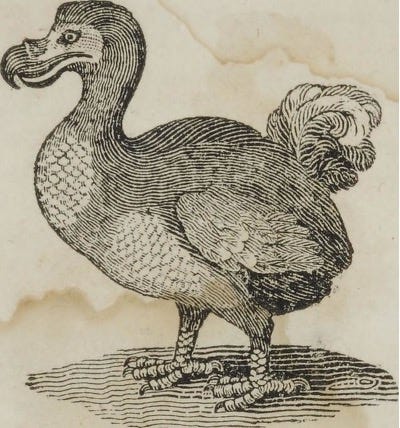
It’s here that I have to compare Attenborough to Thomas Bewick (say Buick), the 18th-19th century engraver whose engraved illustrations of British birds as well as many other animals gave the world its first affordable visuals, ones average people hadn’t had before. (I’ve mentioned in earlier posts that I recently read a book about Bewick’s life.) Watercolors and oil paintings of animals were in private collections and printed only in the most expensive editions, so common people in villages and towns might who had only heard about a camel for example, could see one. One famous flightless bird, the Dodo, for example was one such creature Bewick engraved. That bird of legend had gone extinct even before Bewick’s day, and it’s a bird that Attenborough also talks about in the 4DX in the last show he did in 2016, Museum Alive. (He’sstill alive, by the way, at 98. Bewick would be 271.)
Bewick’s Dodo, best guess based on maritime descriptions of the time and other people’s sketches. The one in the British Natural History Museum is a composite guess using the body and feathers of other birds. What is it about white men that their first impulse on seeing any unknown creature is to kill it?
Both Attenborough and Bewick love/loved wild places, wildlife. They love/loved working in their preferred mediums, television and engraving, respectively, and to use their arts to share this wonder with the world, with the common audience.
All this gets me thinking about all the ways we illustrate and instruct on the world around us, and how we used to unite around the common cause of our shared planet. When Rachel Carson’s book, Silent Spring, came out in the 1962, the one thing that everyone upset and focused them on ecology and caring was the possibility of the loss of songbirds.
Imagine that. If you have had the pleasure of sitting in my parents’ bird sanctuary of a suburban backyard, let me assure you can sit on that patio swing for hours and never be bored. Once all the birds forget you are there, it’s a party, the best kind of show.
Lately, America and the world have become focused on a collection of primates but not for the biodiversity and wonder and joy they bring. Instead, it’s a nature Reality Show from Hell.
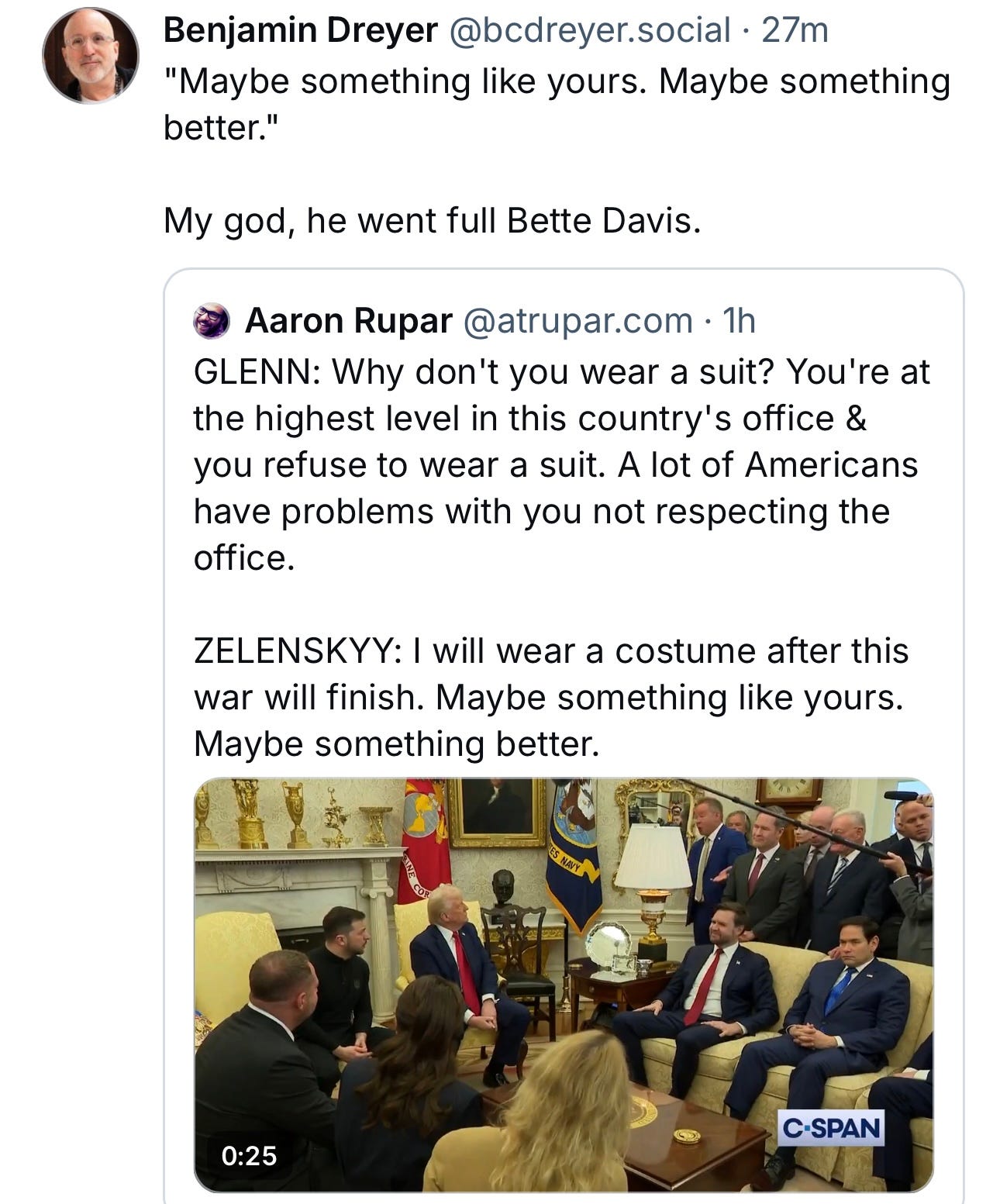
Yesterday, as the world watched, any sentient human cringed. Vance and Trump’s treatment of President Zelenskyy of Ukraine was beyond the beyond, trying to leverage their own favor-currying of Putin by placing the beholden Zelenskyy in front of right-wing American television cameras and reporters, to cow him, as if this man has not been enduring full-scale war for three years trying to save the democracy he loves. Lights,cameras? Bullying? 1) Have they no shame? 2) Are they high? 3) Fuck them.
Like nature at one time, democracy had been a common global cause for many, many years, but no more. President Zelenskyy is like the compelling, knowledgeable zoologist visiting a new kind of American wild kingdom in a television series, facing two aggressive and deeply stupid primates who exist only in captivity. It was, as you know, horrifying to watch.
President Zelenskyy prevailed. I hope he wins this war; he’s already won history. I don’t want Ukraine or him to go extinct.
All of this is just to say, Slava Earth, Slava Ukraine.
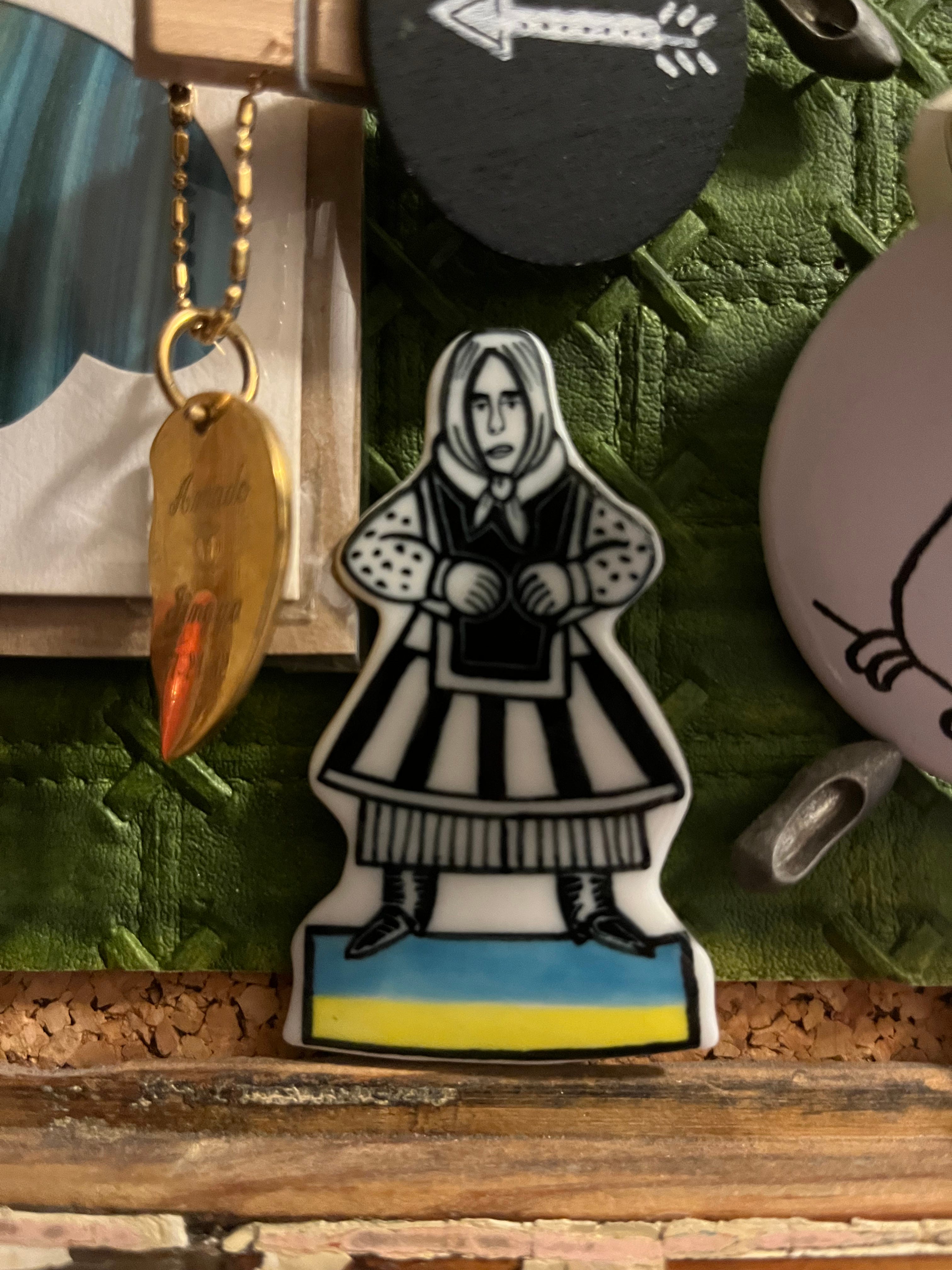
Home bulletin board detail. Queens kitchen.
Until the next episode of the Trump Wild Kingdom Shit Show, do beautiful things, somehow.
Ironically, this famous quote is itself a lie (how American), but more on that later.
The magazine Vanity Fair (to which I no longer subscribe) includes, as the last page of each issue, The Proust Questionnaire, a set of questions originally asked and answered by novelist Marcel Proust and now used to learn more about the globe’s favorite obsession, celebrities. The questionnaire has some interesting questions, and some shallow ones, but the answers can be revealing. I’m often struck, for example, by the way powerful men, even decent ones like George Clooney, answer #12: What is the quality you most like in a man? “Loyalty.” As a woman I read this as, Truth telling is a deal breaker. As for #13, What is the quality you most like in woman? men generally respond, “Patience” or some other subservient thing. It’s interesting, if limited.
Interesting, If Limited could be the title of my memoir.
Walking around the neighborhood, I found myself thinking of Question #9, which is, On what occasion do you lie? Often the celebrity of the month who has chosen this particular question among the many, will respond, “To spare someone’s feelings.” Fair enough.
But speaking as a fairly honest person who has lied on numerous occasions while also valuing truth, I wondered if any of the situations in which I lied had something in common. I’d like to say something pithy, see, when it’s time for my Vanity Fair moment, so let me note just a few examples, categorize them, and see if I can find the common ground.
1. Once in second grade, Mrs. Angle—I’ve told you this story—asked us after nap time with our heads down on our desks if anyone had a dream they’d like to share. I raised my little hand and got up in front of the class and, making it all up (obviously) to entertain my friends, described how we all went to Egypt to see the tomb of Tutankhamen. I pointed, “Juanita was there,” and again, “Ingrid was there,” and Mrs. Angle snapped, “You’re lying. Sit down.”
2. On a high school field trip during my sophomore year, to take the singers and pit orchestra to a neighboring high school to perform scenes from South Pacific as a promotion for our production, our sponsors, Mrs. Combs and Mr. Carnohan, realized they’d forgotten to send home permission slips with us kids. Only when the bus driver asked if they had them did they realize. I stepped up quickly, “Give me ten minutes.” I had everyone write out a permission slip on paper we all collected from someone’s notebook, and I signed each slip in chameleon-like handwriting. Mrs. Combs looked stunned, but she took my pile and off we went.
3. When I’m late for something, like work, I have blamed the subway (and have been caught out by a colleague and supervisor on the same line) because I’d rather not say, “I have IBS and had to run back home halfway to the stop because I needed to shit again.” (Finally, I just told the truth. No one asked after that.)
4. I once helped make a company-wide Answer Key set, compiled for the whole floor of my 2 Penn Plaza office, when this one president took over and, to prove his power, spent easily $100K to create something like 30 separate “learning modules” complete with “tests” on corporate “life” and business, modules that included short films, voice overs, and reading material on slide presentations, and if you didn’t get all the answers correct on each test, you had to start over, the whole module. We had massive publishing deadlines at the time, our nerves hanging by a thread. To what end are we doing this? But your job was on the line. A few of us—no doubt my idea—began printing out all our 100% test answer sheets which we labeled by module, punched holes, and stuck them in an unmarked three-ring binder. and set it on a file cabinet in our pod We didn’t even hide it. Eventually even our supervisors, to say nothing of executives and vice presidents, began ambling and ultimately marching over our pod to get the book, because 1) these tests were useless to our work; 2) the president was doing it to be a dick; 3) he would be out on his ass soon enough (they always are) once he was eligible for that golden parachute—we endured a period of a few years in which a succession of dicks who were pushed out of one company division and over to ours until they could retire. It was not fun. And yet, our important work—work that corporate didn’t in the least understand—somehow went on, great as usual. Hmmm. Who’s the parasite, Elon? (And how do I really feel?)
5. When the famous Westway Diner on 9th Avenue was taken over by new management maybe six or eight years ago—all the old-school career waiters replaced, the desk staff and chefs gone, the classic booths and tiles plowed under for white and gray blah—I happened in to check it out, and in addition to the place being bereft of atmosphere, the food sucked. “How did you like it?” the aggressive manager asked me about inedible spinach pie, which was a block of bone dry phyllo with almost no filling. “Mmmm,” I said, not wanting the poor new chef to get canned. Let someone else tell them; consider this a funeral donation. (It’s since recovered.)
What do all these occasions have in common? Well, they are lies of convenience, I guess, trying to smooth something over, or using deceit to help out friends or struggling folks; on reflection, I tell few lies just to save my ass. That’s how I was brought up. But I’m not stupid enough to believe that always being honest is smart. As my friend’s Montenegrin immigrant father used to say, “Honest and stupid are two brothers.”
I’ll tell you what the lies don’t have in common: No lives are in the balance for the telling of them. While I don’t condone lying or deceit as a lifestyle, sometimes lies save lives, and you have to keep your hand in. Ask the enslaved; ask women being beaten by abusive husbands; ask Tina Turner running away from Ike. Ask Jews during the Holocaust. Ask the French Resistance. And as we are entering a different era now, hearkening back to those dark times, we all may need to reset our moral compasses. We are back to Nazi Germany, friends, and “truth” for them, ain’t truth for us.
Thinking about coded language and other “lies,” and this being Presidents Day, I recalled a Chaucer class I took in graduate school 30 years ago, and my professor, John Fleming of Princeton, wanted to teach the class about Medieval iconography—you know, the images in all those beautifully illuminated manuscripts with the stories in calligraphy and the illustrations in gold leaf and lapis blue. Those illustrations, we learned, were included not only for their beauty but to guide the illiterate, because unless you were nobility or clergy, you didn’t read. So, what did the images mean? You see a lion, a rose, stuff like that. How would anyone get a whole story from a picture?
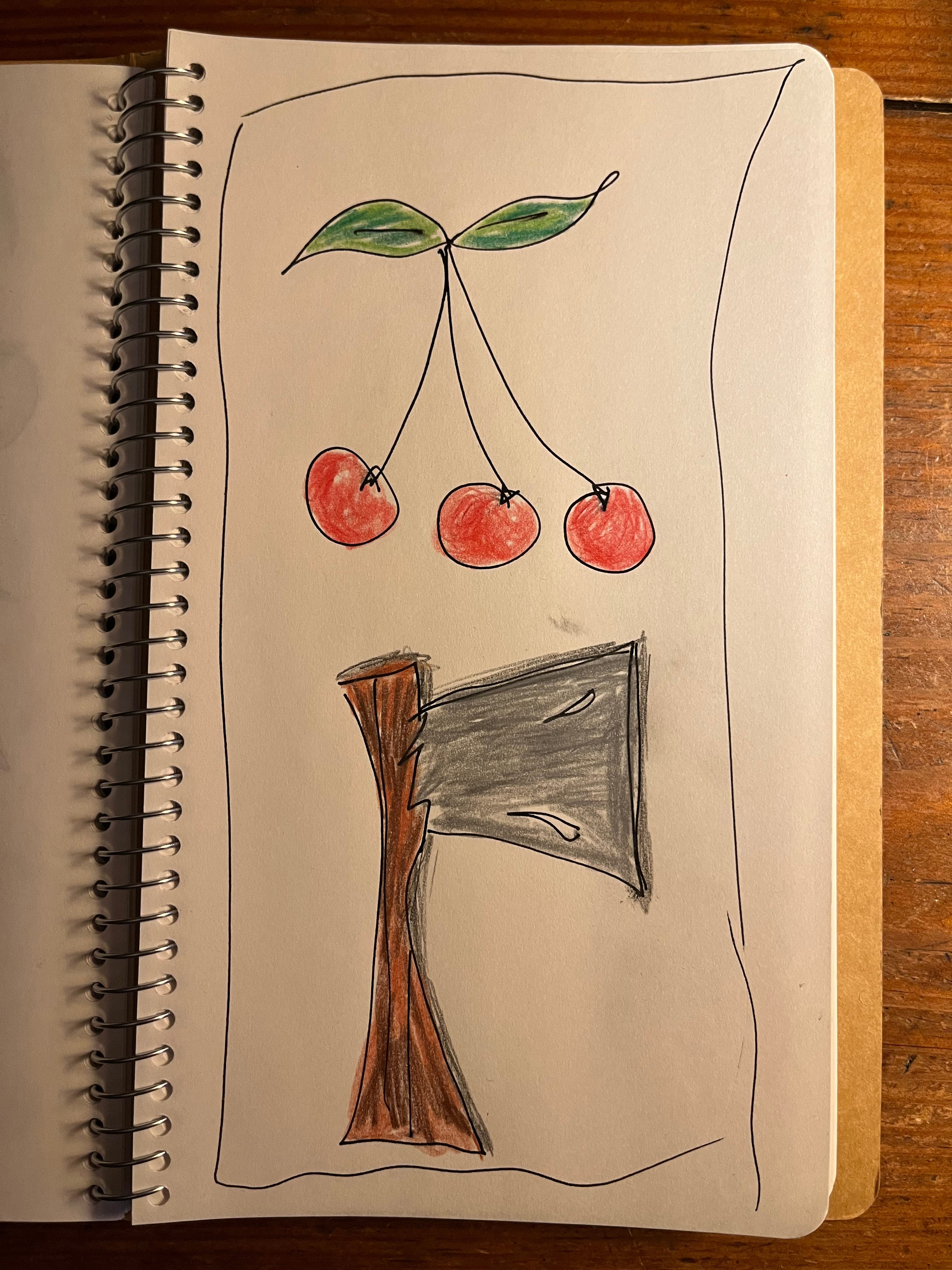
To demonstrate, Prof. Fleming drew these images in simple lines on the chalkboard:
“What is this story?” Fleming asked. My classmates, attending the Bread Loaf School of English from all over the country and the world, sat dumbfounded. I couldn’t believe it. See, I talked a lot, and I was practicing restraint, but finally I raised my hand.
“It’s George Washington and the cherry tree. I cannot tell a lie, Father, I chopped down that cherry tree.”
The class turned to me and looked at me like I had two heads. Fleming barked a happy laugh.
I explained to the still-lost class that I grew up in Virginia, up the highway from Parson Weems’s house, Weems being the man who wrote the fable about wee George, and a few miles down from Mount Vernon.
Fleming then went on to explain that this is a perfect example of how and why iconography—the use of simple symbolic images to represent a whole story—works in places that share a common culture.
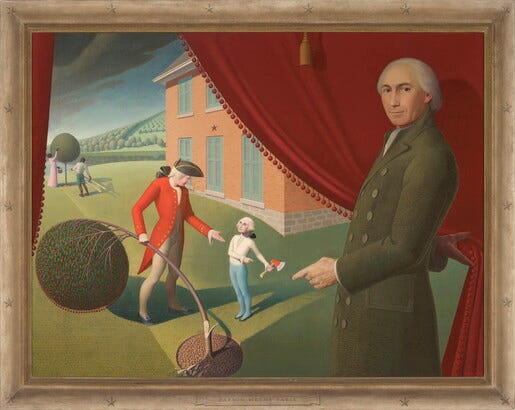
To learn more this Presidents Day about this fable, you can check out the Carter Museum and learn about Grant Wood’s portrait, pulling back the curtain on the myth. In 1800, Weems published The Life of Washington, which is well-known as the source for many myths about the first president. Written just a year after Washington’s death, it includes the story of six-year-old George admitting to chopping down a cherry tree and another about Washington praying at Valley Forge.
Who chopped down that cherry tree? asks George’s father, according to Parson Weems, who wrote, “Young George bravely said, ‘I cannot tell a lie… I did cut it with my hatchet.’ Washington’s father embraced him and declared that his son’s honesty was worth more than a thousand trees.”
Why create this myth about an already mythological figure, even by 1800? I guess to impress upon America’s youth the importance of honesty. But what to do when you learn the story is in fact made up?
Growing up as I say, along the Richmond Highway between the home of Parson Weems and Washington’s home of Mount Vernon, I learned this fable in elementary school, but I never learned about Washington, the enslaver. Not in high school, not in college. I remember a California friend visiting Mount Vernon with me and saying, “I thought this was just a myth,” meaning the whole plantation, the first American president, all of it. And it’s easy to see how anyone not from the historical grounds of colonial America might feel that way, or wouldn’t be shocked to see a slave auction block landmarked in Fredericksburg or Williamsburg, given the American tendency to mythologize the successes and sweep the ugly truths under our antique hooked rugs.
And really, the more we keep digging, and the more lenses we train on our history, the more truths we uncover, the more lies we reveal—the more interesting and complex and real our history becomes. It’s discomfiting, sure, horrifying at times, but isn’t it exciting, too? Isn’t truth worth seeking? How else to make this nation truly free?
This is where we turn to our artists.
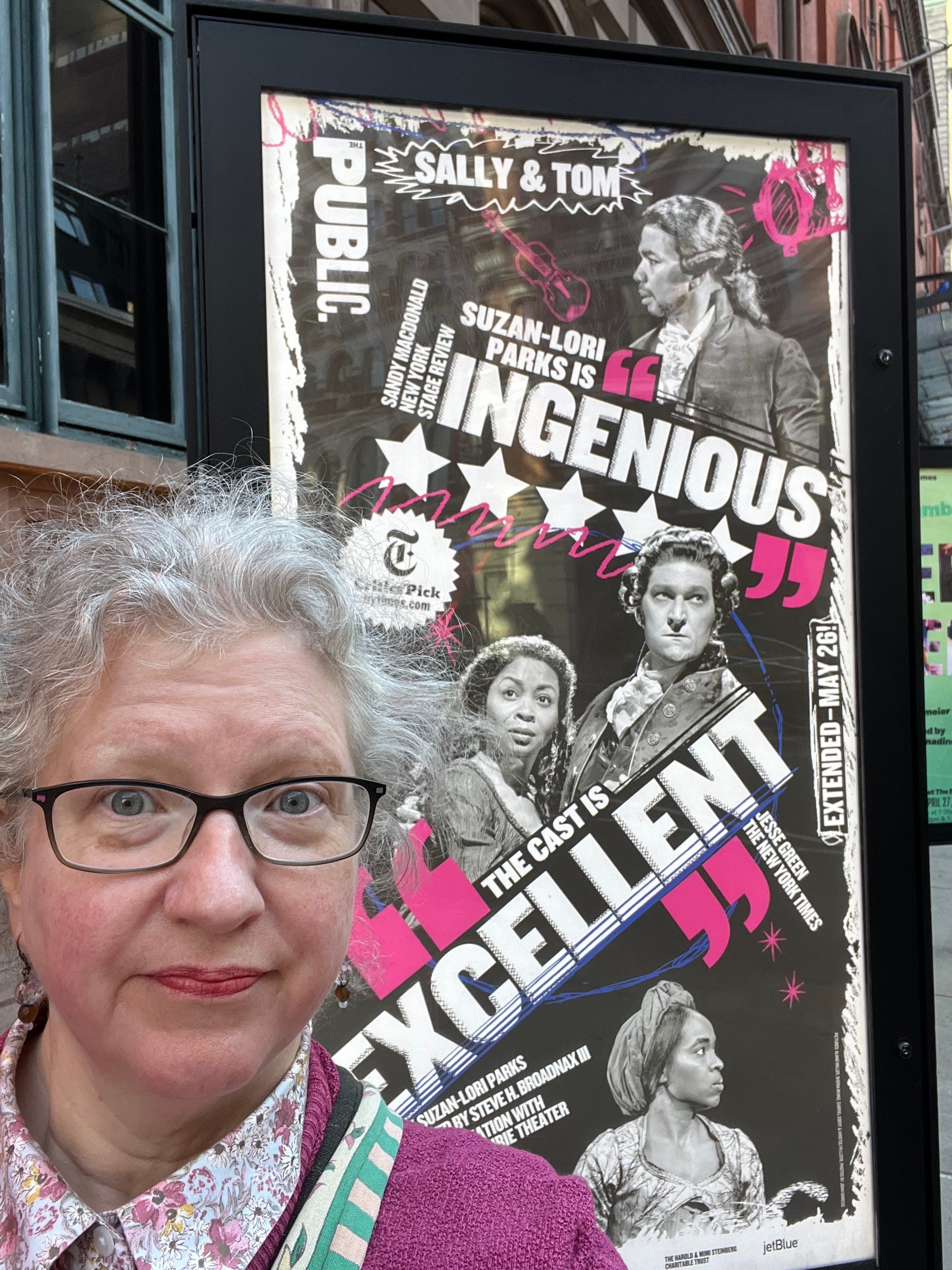
To explore perhaps America’s greatest “Lives of the Presidents” cover-ups, the relationship between Thomas Jefferson and his enslaved “mistress” Sally Hemings, Pulitzer Prize-winning playwright Suzan-Lori Parks premiered her play Sally and Tom at The Public Theater last year. The premise of the play is a community theater putting on a play about these historical figures while the leads are in a relationship. I loved the show, and I was fortunate enough to be there on a talk-back night. In attendance that night were several of the descendants of Thomas Jefferson and Sally Hemings and their families, as verified by DNA. I couldn’t believe I was having this chance to witness history. To watch as these family members meet one another after the show (many were sitting in the row in front of me) and walk up onto the stage—the set’s back wall covered in all of their names in the final reveal—to take photos with their phones, made me weep. (I think it would be a fascinating way to end the actual play.) It was wondrous, too seeing truth all up there like that. The theater was filled with love in the midst of revelations. That’s what art does.
Miss O’ outside The Public Theater, April, 2024.
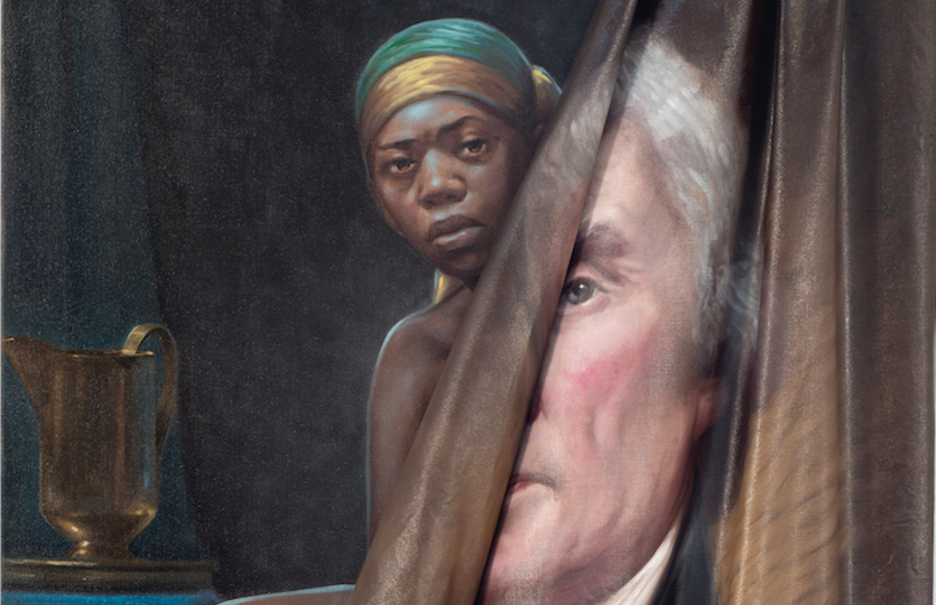
And I think also of that incredible painting by Titus Kaphar, “The Myth of Benevolence,” offering another way that art can reveal a deep truth in a way no historical record ever can, exposing long-hidden damage and forcing us to confront it. (Click on the link to see the entire painting and learn its story.)
A whole story from a picture. American iconography.
On what occasion do you lie? I look at the American story, then and now, and it’s seeded with lies and corruption, so many lies, you have to wonder, Can it ever come clean? How do we answer for it? These are the questions we all should ask and answer now. If we don’t, whom do we think we’re protecting?
On what occasion do you lie? Ask Gil Scott Heron, famous for saying “the revolution will not be televised,” meaning it happens inside us, speaks volumes about the impact of lies in the linked poem; and Kendrick Lamar, whose brilliantly coded and performed all-Black Superbowl Halftime Show blew me away. The enslaved lived in world of code. They had to lie about learning to read, for godsakes. Pretend to go along, to get along.
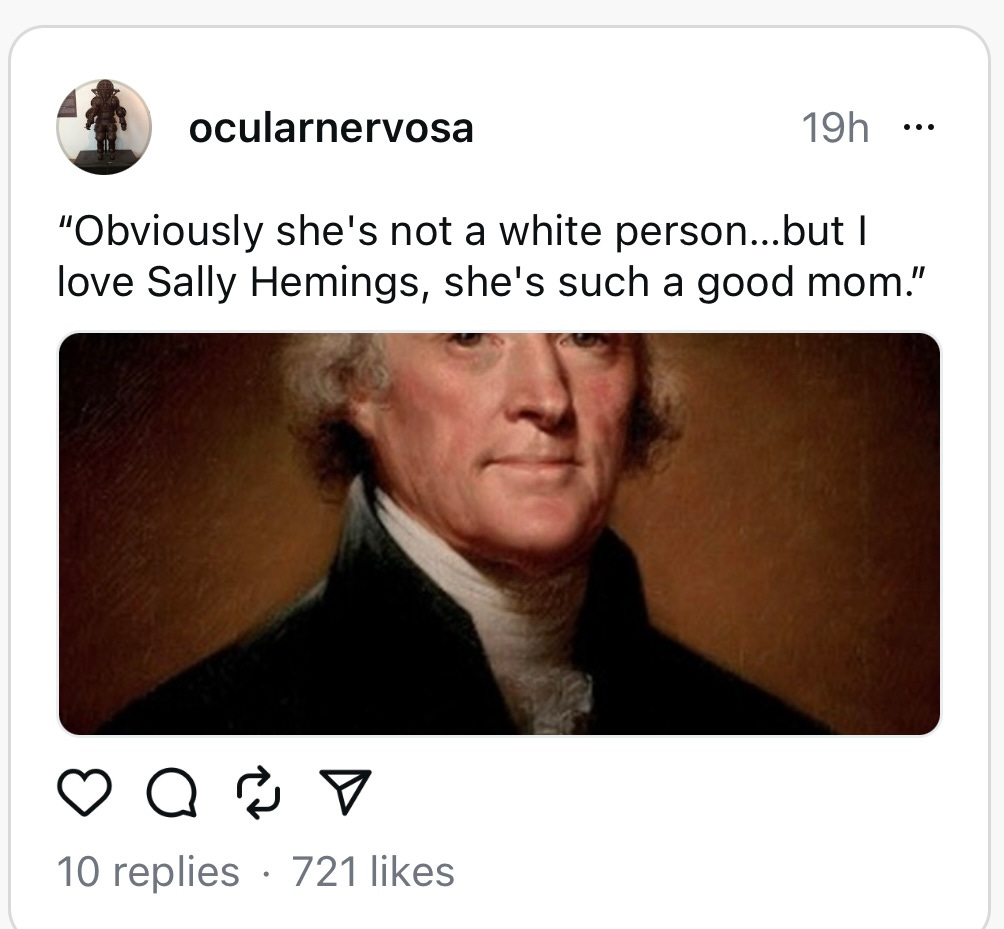
On what occasion do you lie? Ask women who have been sexually assaulted and been made to keep quiet or lose their careers. Ask the men who keep pretending nothing happened. Ask Sally Hemings.
On what occasion do you lie? There are real reasons to lie, moral, ethical reasons. To protect the ones we love. To save our neighbors. We are having to think hard about that now.
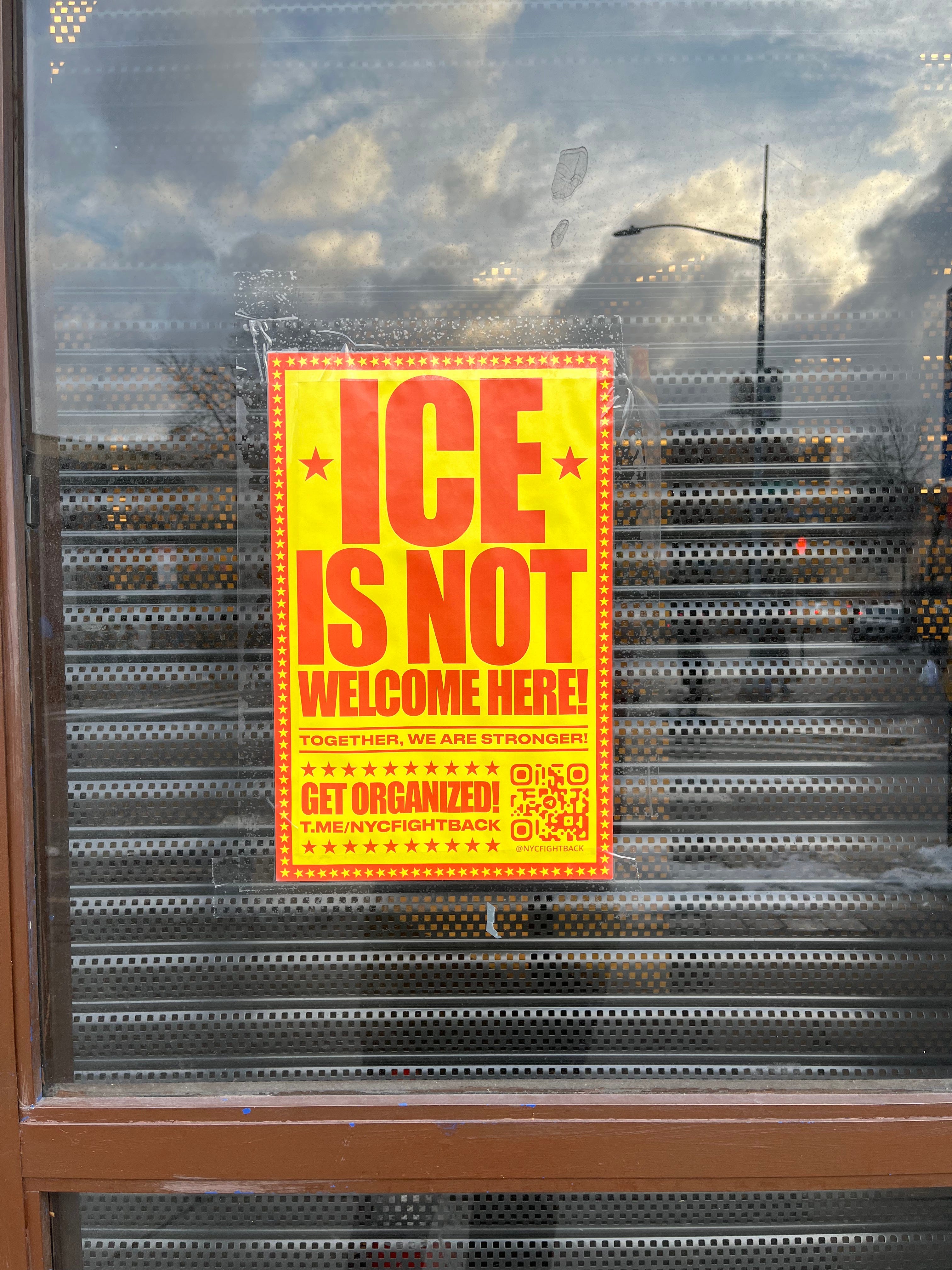
Republican lawmakers (that’s rich) want AOC arrested for teaching Americans and immigrants their rights. Photo by Miss O’ in her Queens neighborhood.
Because let’s face it: here in the United States, we are in a crisis of government amorality. We have a lying Republican party (no more rule of law); a lying president (pick a campaign promise, and yes, Project 2025 was the plan all along); a lying vice president (his autobiography exposed as a sham); a lying Supreme Court (see Roe v. Wade, which all declared, under oath, “settled law”); and liars heading every cabinet position (no, trans people are not the cause of America’s problems; and Putin is not America’s friend, Tulsi). We have liars in the Department of Justice and Homeland Security (immigrants are not remotely the cause of most crime; being brown is not a crime). We have liars heading the F.B.I. (the Democrats are not the enemies of America). It’s all lying all the time, now, and their truths are even worse. The freedom of Western Europe is now in the balance, as Vice President J.D. Vance admonished the “values” of those democratic nations this weekend, in essence praising the rise of fascism in France and Germany and also capitulating to Russia’s desire for empire. On the campaign trail, Vance said “democracy” but meant, we know now, “totalitarianism” (Europe is not America’s enemy, nor are Panama, Canada, or Greenland; our actual enemies are transparently heading our own government.)
Past and present collide: JD Vance on his brown wife; I’ve heard Vance refer to their children as “her” kids. Look at the mental gymnastics and self-delusion of Vance, who denies his wife and children, and smiles.
To think that all of today’s stuff started with asking a simple question.
Identifying lies is not the same as responding to the world that supports those lies. There’s a very cool blog on Substack called The Pamphleteer by Lady Libertie, and she is focused on how we negotiate this new era. Check out “So You’ve Been Invaded: a French Resistance Guide for the U.S.” Pretending comes with the territory of survival. Marcel Marceau, for example, as a teenager pretended to be a camp leader, while his real job was to smuggle Jewish children across the border to freedom; he used the art of mime to teach the children silence as they walked. It’s not really lying if it’s saving lives, and the people you are lying to are venal.
So all the ick news first, aside from all the Musk-Trump criminal dismantling of every living institution in America so that it’s close to unrecognizable (taking over the Kennedy Center? The National Archives? closing what Department?), I learned at work this week that the two editors I supervise applied for a transfer to another (lately resurrected) department where they’d previously worked because they can do what they are best at there (I choose to believe it’s not about me) and got it, and that I will have to finish a huge project probably alone, the timing being what it is; then, at my ophthalmologist’s office for a checkup, I learned that not only am I at the beginning (and still reversible) stages of diabetic retinopathy, but also that I owe an outstanding balance of nearly $500 (of deductible-meeting crap) from visits over the past four years because their billing department never sent me the bills; and then I learned from my CPA that my company inexplicably failed to take out the correct amount of tax (and all week I’ve tried to correct it for this year, but the system doesn’t work, and we no longer have humans working in HR (take that in) and I am screaming into screens) and so instead of getting a refund, I in fact owe some $1,500; and the tendinitis in my write-hand (punnyha ha) wrist is so bad still after three months, medicines, and PT, that I would have to spring for a cortisone shot (sweet, sweet relief after the injection site pain and, obviously, the bill). Poor fucking me.
Thank you, internet.
But one day this week—I think it was the eye appointment day, Wednesday, when I returned home with dilated eyes and shock at hemorrhaging money—on the way into the city, a Black female conductor announced at every stop (because the N-W-R-Q lines still do not have recorded voices to announce stops, and I love that) something to this effect: “Ladies and gentlemen, let the passengers off first, let’s help each other out, everybody, let the people off first before you try to get on. Move into the middle, people, help everyone out, we’re all together here.” Love her heart. On the way back to Queens that same day, a Black male conductor did much the same, adding on occasion, “It’s not about the price of groceries, everybody, just help each other out here and move all the way into the car.” This same conductor also used the intercom to explain the location of every staircase, connection, and elevator at every single stop. A total doll.
And if you are like me, you can’t help but look up and down the train car, men, women, children, every color and shape and gender and age and religion and background and profession, staring into phones, or not; bundled up, world weary, and it hits you all over again that the reason “white middle America” is afraid of brown and black shadows is because they literally have no idea how New York works. It’s not perfect, never that, but it works. Look at us. Us. Right here in this train car, crowded, or not, for miles of stops along our way. Not yelling at or killing each other. All of us just being.
Also in my travels, I found myself thinking about a poet friend who lives in a rural area, who years ago, when I mentioned how much I loved the movie Lost in Translation could only grunt in disgust. When I asked why, she said of the lead characters, “All they did was squander an opportunity to see Japan.” I had to think for a second, because I was remembering the filming of Bill Murray’s whisky commercial, the Tokyo karaoke bar, the hotel bar nights, Scarlett Johannson’s quiet excursion to a Japanese garden and learning flower arranging, and of course the hilarious trip to the ER so Bill Murray can get Scarlett’s broken toe seen to—all these relationships and stories they will have to tell about, or not, when they return home. What did my friend mean, “squandered”? I started thinking. I guess another view is they didn’t really do all that much…and then it hit me. I said, not at all angry, but with a sense of discovery, “You’ve never traveled outside the country, have you?” She looked at me suspiciously, and slowly shook her head, as if her response to a movie shouldn’t depend on having had the experience. More to the point, though, she had almost never, within or out of the country, traveled alone. And there it is.
What was lost in translation for her in watching Lost in Translation is the feeling of sudden paralysis brought on by the jetlag stupor you feel combined with being quickly overstimulated in a new place while on no sleep, while being both excited by the prospects and daunted by selecting the best thing to do right now. The one universal is a bed (never one you can check into before 3:00 PM) and a bar or cafe, and heading to either one can give you a chance to sort of recover your wits (if you know how to manage the currency), but when you are alone with no one to bounce ideas off of, being in a new city, whatever the language, can be pretty isolating. One time, visiting London, I spent nearly one entire first day just sitting alone on a bench in Tavistock Square, where Virginia and Leonard Woolf had lived (in a no longer existing building, bombed out in WWII), underdressed (a cold day for summer) and disoriented, and in those days, a teetotaler. I could barely make myself try to find a place to have tea. If I did eat or have tea, I don’t remember. I remember a white-gray sky, damp chill air, and just watching people against green trees and grass and gray buildings.
Did I squander my first day in London? Not at all. Oddly, that first day of “doing nothing” is still the one I remember most vividly and fondly, whatever the discomfort and confusion. I was there, in the heart of London, on my own, unremarkable, on an ordinary day. Not bad.
As a result of my many NYC train treks this week, it also dawned on me that perhaps the reason I needed to leave Facebook, finally, was that my life in New York can be one of overstimulation even on the dullest days, and that Facebook had become more overstimulation, not sure which way to look, who I’m forgetting to check in on, that sort of thing. Maybe I’m just not wired for all that anymore. I know that many people can simply sit on a virtual Facebook bench and do nothing, or idly and dispassionately watch the goings on, not unlike I did in Tavistock Square or Scarlett and Bill did in Tokyo. You do you, as the kids say. However we engage, or don’t, we are all in it together, so move to the middle of car and let everybody onto the train. And remember to give people their space (remarkably, New Yorkers do know how to give you yours, even by a fraction of an inch, and if only the whole country could cotton on, that would be great). After all, everyone here with you is simultaneously present in a pubic place and also living a very private drama of their own.
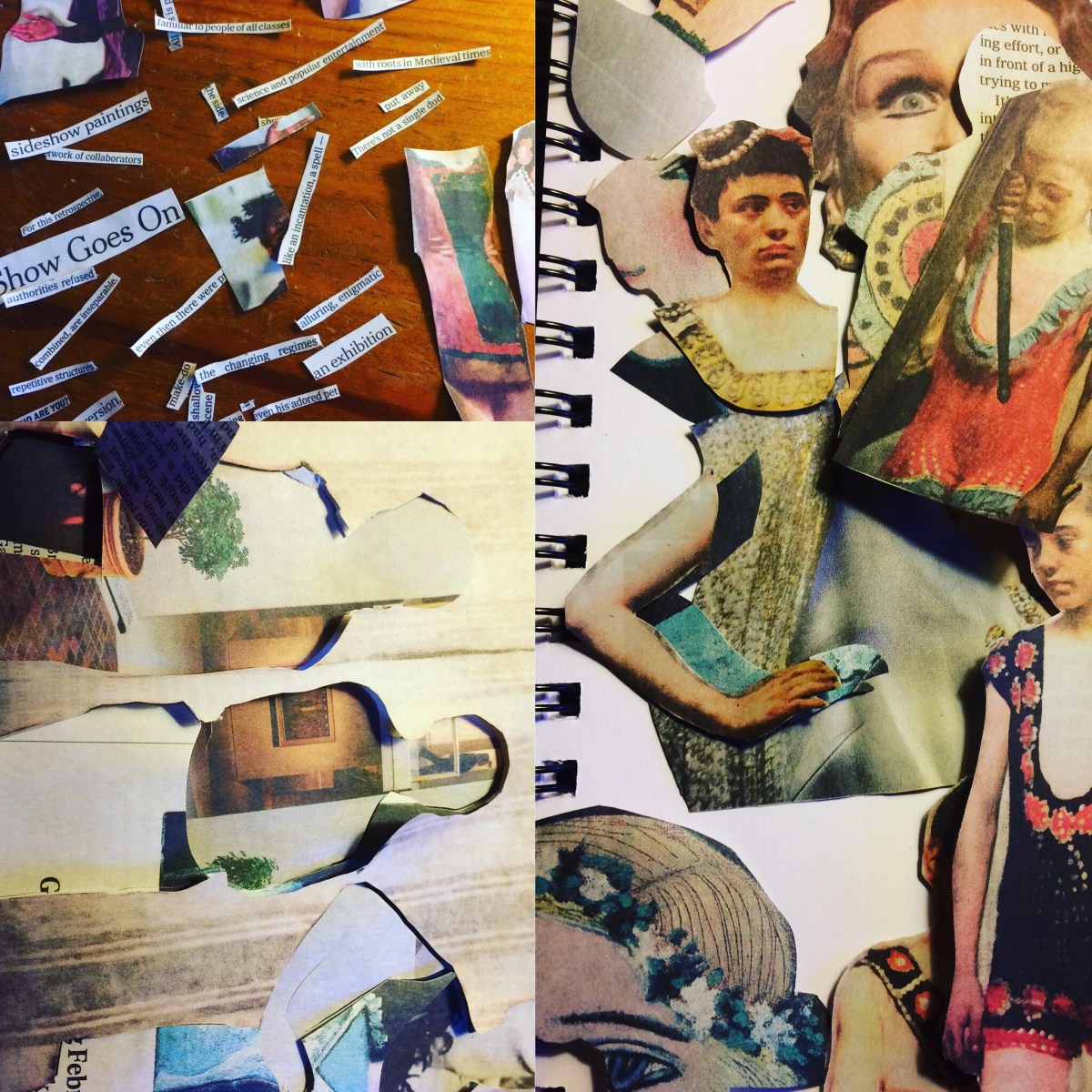
One of Miss O’s many, many notebooks.
All of this is just to say, dear friend, given all that you are going through in your personal life and against whatever landscape this letter finds you, I know that you may merely glance at or dip into this post, and I completely understand. Thanks for reading at all, and whatever you do, don’t strain yourself. Enjoy your Sunday. Let me hear from you when you get a chance.
P.S. A few weeks ago I published part of a play I’ve been working on, but I don’t know if WordPress is the best outlet for me. Thanks to all who read it, in any case!
Hi, kids. If you are a friend of mine, I am not telling you something that you don’t already know; and I’ve written about this before. But a few years ago, my late super, who was from Eastern Europe under communism and who had never learned American history—not unlike contemporary whites in red states today—asked me, “Lisa, can you tell me please what it is about the Blacks?” I didn’t follow. “Why all the whites hate them. What did they do?”
Do you hear his question? Here’s a man who at that point had lived two decades in the United States, himself an immigrant working around every conceivable type of immigrant, from tenants to other supers to management, in the most diverse area of the world, my borough of Queens in New York City. He heard and saw all the racism, surely from the white men (because I still hear it now through their support of Trump), but he really didn’t know where it was coming from. “I have these Jamaican guys who do the electrical work for the building, there, and they are great. They smoke the marijuana, the smell, my god, I hate it, but they are great.”
And so it was that Miss O’ did a brief history for him.
Black Africans were brought to the United States in chains beginning in 1619, if not earlier, men, women, and children captured by white European men or purchased as prisoners in their own land where there was no concept of enslavement for life let alone forever in perpetuity along with your families, which is what whites did in the United States. To justify this horrific practice, and to justify unlimited greed, whites started deciding that they were superior to all other colors of humans. They must be, because as the Puritan descendants of the Second Great Awakening said of being among the elect going to heaven (as explained to me by my 11th grade high school English teacher Chuck Edwards), “Surely, if you were not among the elect, surely God would not have blessed you with a Cadillac.” Or made you white.
The plantation system in the American South made each plantation owner a little king, a greedy little tyrant (just like the “farmer king,” King George III from whom we were emancipated, oh, irony), who kept all the money he made from his crops and made even more by working slave labor just about to death—no hope of leaving, no money, no say—morning, noon, and night, and forcing the strongest Black men to “breed” Black women as a bull would cows, when the tyrant wasn’t raping those same Black women for his pleasure and a stable of more (mulatto) slaves.
Meanwhile, the white people in the South who did not own land, and that was nearly all of them, had no work. They looked on, impoverished, as these Blacks were “given” houses and food in exchange for work, work which poor whites did not have, homes which poor white were not given (clearly not comprehending the horror). There was a growing (and understandable) resentment. To quell this, white tyrants told their legions of poor whites, “Always know that at least you are superior because you are not having to labor like these beasts.” To appease them, the tyrants dropped a nickel and handed a gun to any poor white man who was pissed off and said, “Guard my slaves.”
And so it was that for 400 years, poor, uneducated, angry whites came to believe that they themselves would have more if only those Blacks weren’t here, and that guns were identity. And they weren’t wrong, though their logic was. What these charming, charismatic white tyrants were able to convince these poor whites of was that he, the landowning rich tyrant, had no choice but to use “free labor” so that he could be rich and live like a king, that God had blessed him, and he had to fulfill this promise to God by being the richest one.
And despite a Civil War, despite education and marches and all of the hard work of generations of Blacks, Native Americans, and enlightened, moral whites (immigrants all), there are still vast swathes of white Americans who truly believe that IF ONLY there were no Blacks (and now browns, too), they themselves would have it so good.
The Donald Trumps of the world—the ones who deny wages, safe working conditions, clean air and water, and health care to anyone not them—have been such absolute geniuses at convincing poor white people to feel so sorry for them that these poor white people empty their pockets and do whatever it takes to prove their love to the rich white man God. And the poor white people stillblame Blacks for their fate.
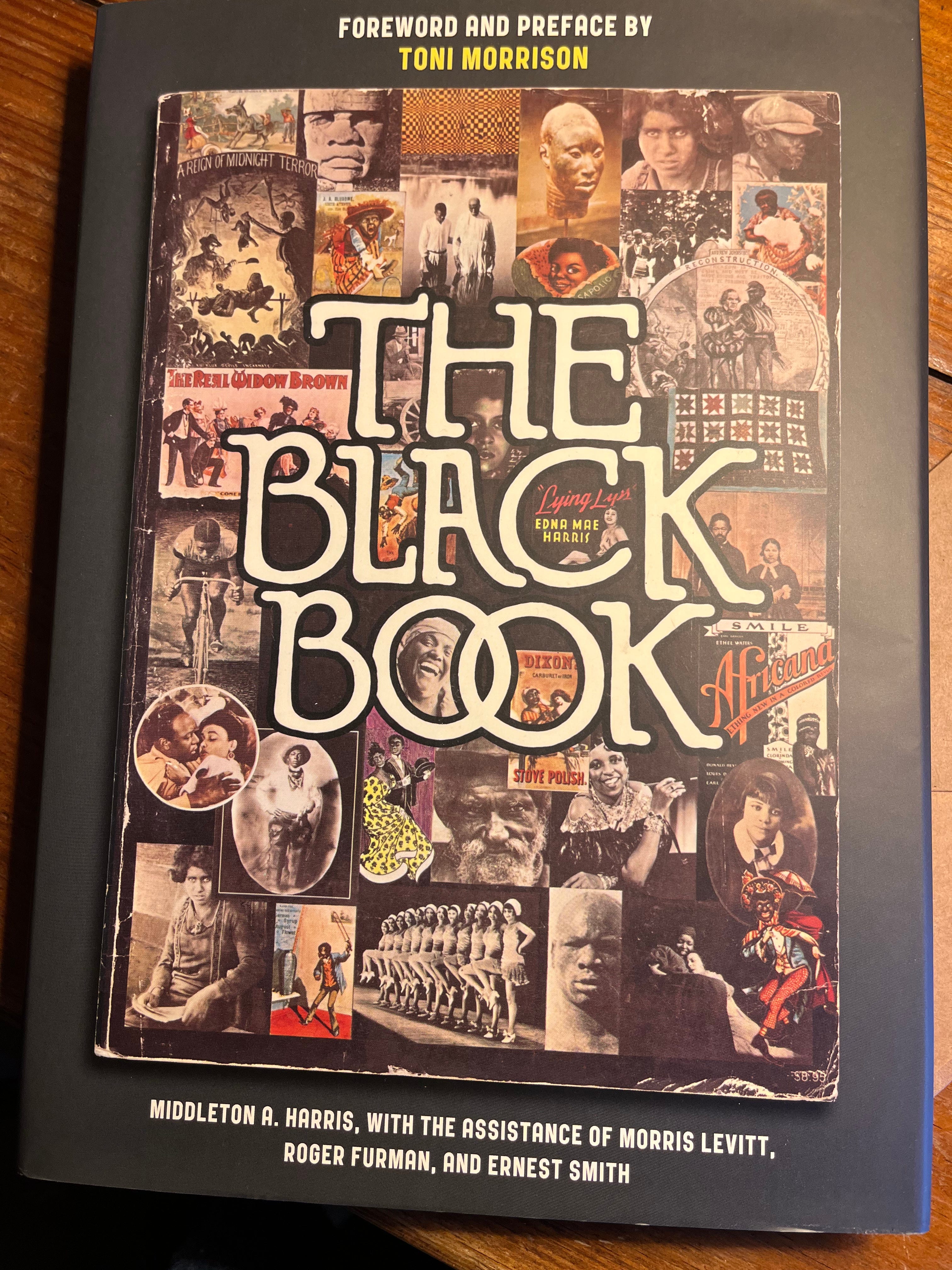
I learned about this book from the Toni Morrison documentary, The Pieces I Am. Recommended reading.
Following my quick take on the horrors of the Black experience and white supremacy, my building super from Eastern Europe was silent. He looked at me and said, “Why they don’t kill all of you?”
That’s the million-dollar question.
I’m about to make a couple of broad generalizations.
Black culture in America is a culture of love and faith. It’s a culture rooted in ebullience, joy, dance, music, energy, justice, hope, and deep, deep love despite deep trauma and great suffering. I have seen it and felt it all my life. Not that there aren’t assholes and tyrants; I’m talking about roots.
White culture in America, dating back to Puritans and colonizers, is a culture rooted in punishment, jealousy, cruelty, demands for some kind of Christian self-abnegation (that no one can achieve), faith in (one man’s) white superiority, and fear born of trauma, our original sins of Native genocide and Black enslavement. White is right. Spare the rod and spoil the child.“God’s will” is for me to lord it over you. I am God. Not that there aren’t lovely white people; I’m talking about roots.
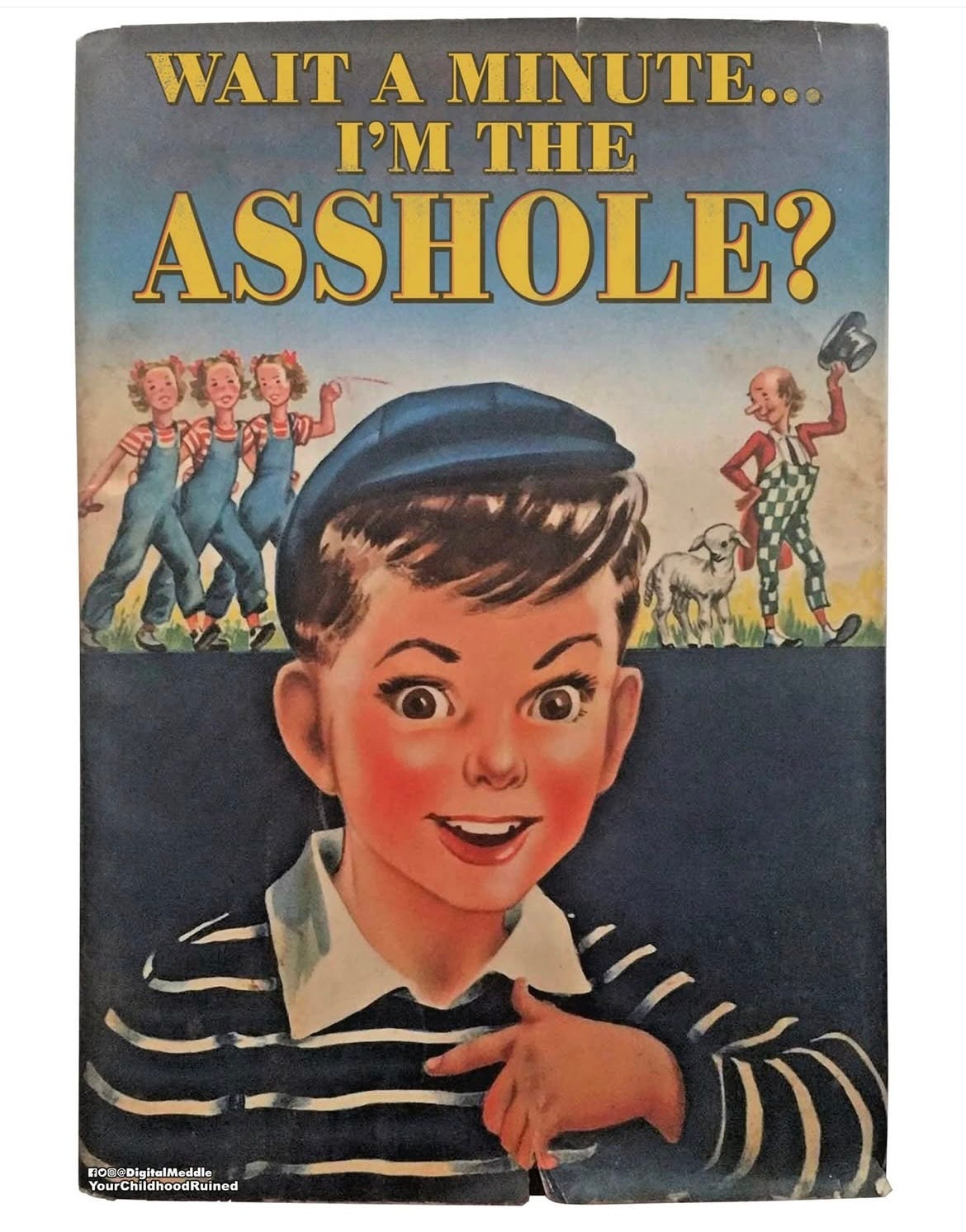
See how white supremacy works? Image from the web.
And I am so fucking sick of white culture—the good things whites bring to the table are, perhaps, irony, Greek logic, and wryness (all of which are embodied by The Onion), and of course Mary Oliver and Shakespeare and bagpipes. Right now, for me, that’s about it. Even the best of our white politicians play by the white tyrant’s rules without even realizing it. We all do.
You can follow Digital Meddle Your Childhood Ruined on Instagram.
“Mediocre white boys,” to borrow from the brilliant and righteous Rep. Jasmine Crockett (D-TX), have taught all of us whites—ALL of us—to feel sorry for them. To pity them, poor helpless things. To give them money and power. To give them a pass. Meanwhile, all that the rest of us sentient whites do for our entire lives is play that same old song, “RESIST,” and I am so fucking sick of it. These white men rape, they steal, they stiff, they destroy, and then they smile, and we pity them all over again, don’t we? And carry our clever signs to the latest march.
This is changing. I do see hope. But we have to crack it all open and drain out the rest of the pus. White culture as a whole, ultimately, must change, or else we take the planet down with us. And this Black History Month, we have to see the joy of embracing all the greatness that Blacks bring to the world. Celebrate. Emulate.
Reflections on democratic voting in a time of rising fascism
I Sit in My Kitchen Rocker Waiting…
As I Lay Dying, “I Stand Here Ironing”…I keep thinking of titles around the anxiety of working out our lives, and deaths, so much of which is out of our control. We have to, more often than not, depend on others, on the actions and emotions and convictions of others, to make our own lives bearable. And today I’m feeling how terrible that can be, and also how reassuring.
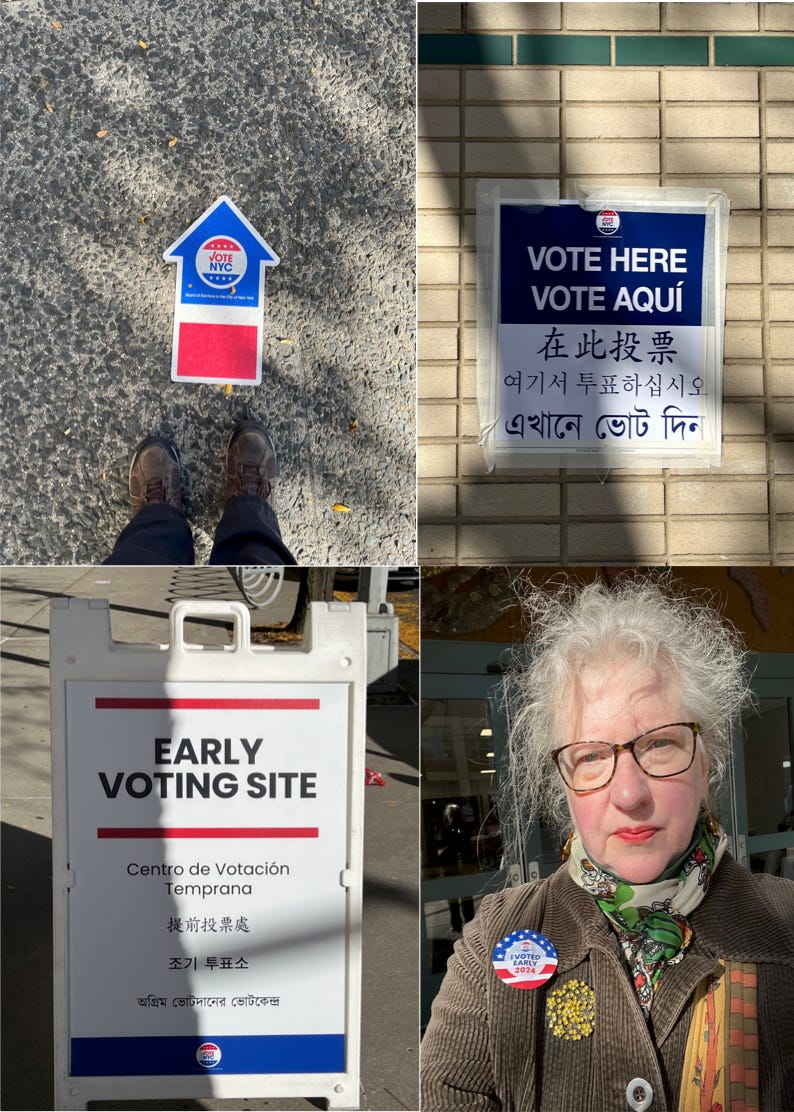
Today I “early voted” here in Queens, surprised by the lack of turnout, in some ways, but this being New York, local Democrats don’t have a lot of competition. (Still, I live in an area full of Trump voters, particularly Hispanics, too many of whom more or less worship the man (if tee shirts are evidence) who plans to deport them within days of returning to office, citizens or not, it won’t matter.) The poll workers gave me such heart, though, just to see them there, all caring so much about democracy.
Scenes from a day of early voting, Queens, NY
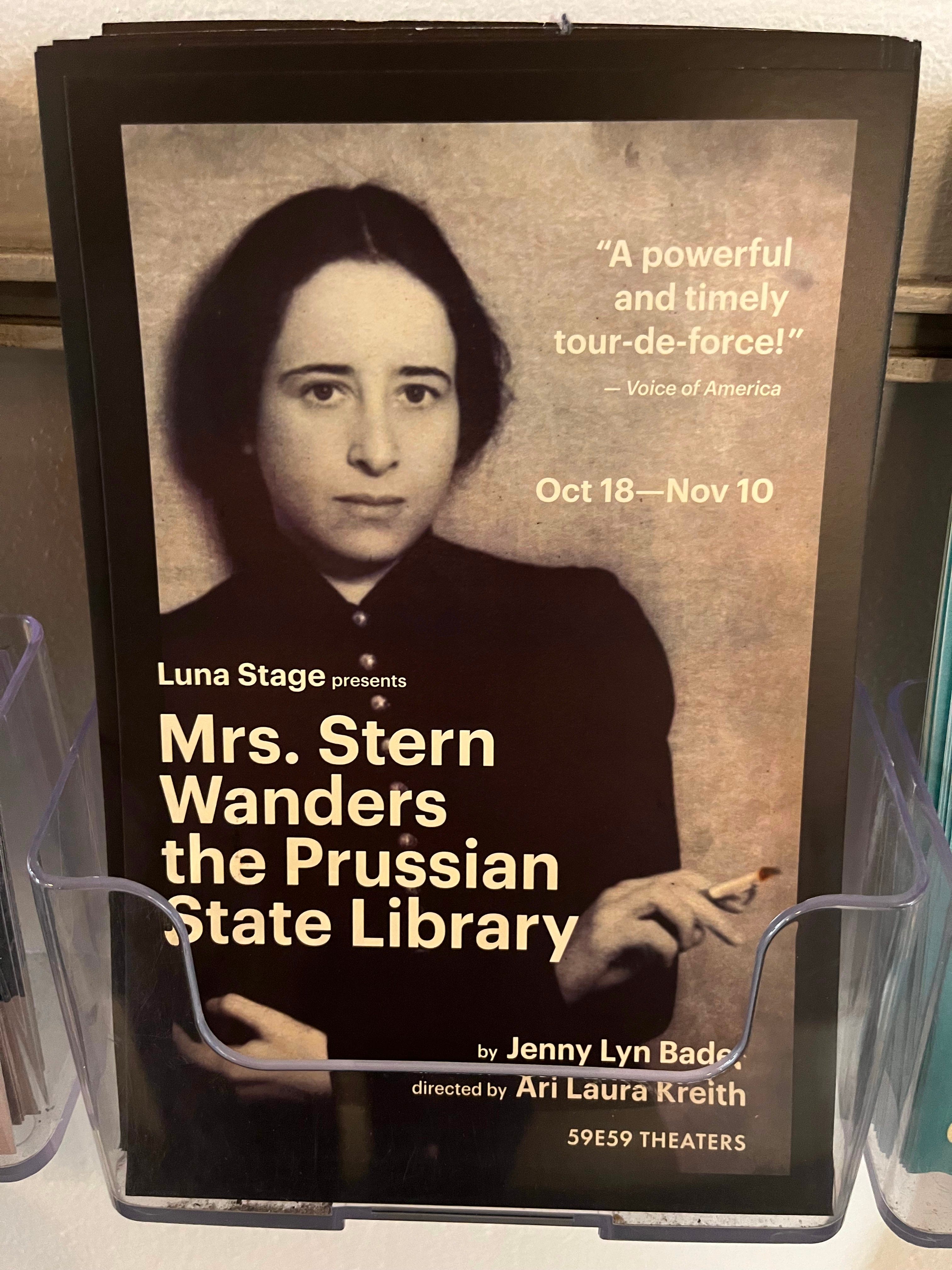
I’ve been imagining during my sleepless nights the consequences of a second Trump presidency—I cannot see how we are really here, but then no one imagined a Trump to begin with, so showered with love and celebrity coverage by a besotted press. Last night I went to see a play at 59E59 Theater here in New York called Mrs. Stern Wanders the Prussian State Library by Jenny Lyn Bader. The subject of the play is the period of days a young Hannah Arendt was imprisoned and interrogated by a Nazi officer (whom she ultimately convinces to help her) in Germany in 1933. The investigating Nazi officer in the early days of Hitler’s Chancellorship and martial law is convinced that Mrs. Stern, rather than working on her dissertation, is mimeographing and distributing overseas the antisemitic writings and cartoons in the German papers. Because of who she is, we know that Arendt gets out, since she will famously go on to cover the Nuremberg Trials, there to develop a philosophy around the nature of evil and the ordinary people who become complicit.
I became increasingly, deeply horrified watching this play as I realized that this is America’s future, quite literally, with camps and the rest of it, unless Harris is elected. And this time, no hyperbole.
The treacherous New York Times gets scared straight.
The consequences of this election will affect every citizen who is not rich and sociopathic in horrifying ways. Anyone who says we aren’t all in this together is a dope. Years ago (I probably told you this story), I was at a favorite bar in Midtown Manhattan, a great after work sort of bar, and there was a commuter from New Jersey there sometimes, if he had just missed a train. We would chat. When Obama was running for president, I said, “We are all in this together,” and the guy (white, 30s, business type), looked up from his scotch and smirked, “I’m not.” And I said, “Where do you think you got that drink? How do you think it showed up on that bar?” and he said, “I don’t give a shit.” And I got up and said, “You are despicable. I believe I’ll have my drink down here.” And he looked at me, stunned, as I moved. A few days later, he was at the bar again, and he tried to catch my eye. I cut him dead and walked on to the end of the bar for a seat. Returning from the restroom later, he paused and said, “Can a despicable person buy you a drink,” and I said, cold and hard, “No thanks.” Cheers.
Bars are equal opportunity institutions in society, as are commuter trains, and they don’t generally fail us. Two institutions that have failed the United States, however, and most decidedly in the past four decades are 1) the free press; and 2) the Christian Church. Both used to have one thing in common, in that (at their best) in their respective ways, through investigation and preaching, they existed to bring to the People the truth, the way, and the light. Today, both, at their worst, have one thing in common yet again: the love of money.
The love of money is the root of all evil, and if I hear one more ill-informed person of “faith” say even one more time, “I think Trump is better for the economy,” I may run naked and screaming into traffic on the Brooklyn-Queens Expressway (the “economy” under Trump was Obama’s until Trump wrecked it). Today’s Evangelical Christian churches, since the televangelism on TV in the 1980s to today, preach “send me, your pastor, a lot of cash, even if it means emptying your savings accounts.” The newspapers, bought out by billionaires with egos the size of Arnold Palmer’s junk (keeping it classy, Trump), want to curry favor for and provide support to other billionaires. The information printed in today’s newspapers is accidental and incidental to their owners’ true purpose. And yet journalists, as do some Christian pastors, try.
Sister Lisa and Brother Mike in conversation
Despite the quotation marks I use now—”free” press and “Christian” church—I try to remember that there are, really, so many good people. We cannot give up. Please vote. Encourage others to vote. As I walked home from my polling site this morning, a woman accompanying her (I think) elderly mother on a walker stopped me, pointed to my sticker, and asked where the polling site was. I told her, and she looked disappointed—it’s a bit of a walk—but she thanked me and turned to explain to her mother in their language. Because there really is plenty of room for all of us.
Yesterday walking from the farmer’s market My friend Who is Never wrong Unfortunately Asks me about the trip I’m taking home South To see A gang of friends All of us this year 60 My friend says “You need to be prepared For their health.” She says “Do you know about their health?” What the hell kind of thing is that to ask I become wobbly And I realize We are dying My friend who is never wrong Unfortunately needs me to face The inevitable Age and death Of friends, of myself, of all this.
Yesterday my friend who is Never wrong Unfortunately Tells me as we walk In her way That she has accepted Defeat and the end of the republic Tells me to be careful what I say In the South So I don’t get in trouble And I say fuck fear So loud That Appalachia can hear me Her lips purse,”Mmmm.”
At the kitchen table with her husband My friend who is never wrong Unfortunately says “I have sad news. All the morning Glories are gone. All of them are dead now.” And I know I saw some on my walk the other day Bursting in purple glory bloom still But I guess it’s today they stopped blooming And I missed it. I say nothing. “All of them are gone. Sad.” And I sit with my tea and my scone at My friend’s Formica table knowing I am wrong about Everything I guess And don’t know how to be With all this, all this death, all this unstoppable Ending “Sad.” Mmmm.
On my way hope I mean home I buy a bottle of good red wine “Hello, Sunshine,” says the employee Who says I bring the light Even as I wander out Wonder how I will live In red sips Of this dark world.
Today This new morning, blue sky and sun, I have a text from my friend Who is never wrong, “So I was wrong about one thing: I still saw some morning glories this morning— they’re there if they are facing East. The ones facing South were gone though— as they were gone yesterday.”
She was wrong about one thing. And if she was wrong about that One thing She could be wrong about (Fortunately) Almost everything And to everyone in America I say Like the faithful who practice In every faith Face East, not South And we, too, will not be gone.
Morning glories of Queens, facing east. Photo by Miss O’, fall, 2024
“I’m just going to read one of the things you said. You were talking about the evolution of science and then of physics in particular: ‘The deeper revelation’ of physics in our time — and it has just kept going in that way that was evolving right at the end of the 20th century — ‘The deeper revelation is one of undivided wholeness, in which the observer is not separable from what is observed. Or, in Heisenberg’s words, ‘‘The common division of the world into subject and object, inner world and outer world, body and soul is no longer adequate.”’ And then you said, ‘Is this physics or theology, science or religion? At the very least, it is poetry.’”
Krista Tippett, quoting her guest Barbara Brown Taylor, On Being, April 2, 2023
I haven’t written in a while. Right now, I’m busy cleaning my apartment in preparation for good company and being a sweat factory during the hottest days in the recorded history of the planet, and I’m finding it hard to get really excited about anything, and I don’t mean this meanly. I mean, we’re in the middle of the Sixth Mass Extinction, so if you, who are no doubt going about your business, have ever wondered whether or not people noticed the Roman Empire fall, we now know that the answer is, “Not really.”
View down W. 53rd Street during AQI 400 day in NYC. Photo by LO’H.
As a result of this hyper awareness of planetary death, this morning I had this sudden vision of Rep. Jim Jordan (R-OH)—the disrespectful wearer of shirt sleeves and insolent spewer of nonsense and censurer of Rep. Adam Schiff (D-CA)—standing waste deep in a raging flood, screaming above the din, “Hunter Biden!” followed by “Abortion!” followed by “No gays!” followed by “What abuse?” just as the waters reach his chin; he is circled by small rafts of the last of the eager reporters, holding out their recording iPhones to catch his every word as the last iceberg melts completely as they are all dragged under, disappearing into the muddy current.
What in the actual hell is the matter with these people?
To open up my heart to hope, I wash my kitchen floor and outer cabinets, sink, fridge, stove, reminding myself to be oh so grateful for the relative ease of my life, remembering how hard I try not to turn on my air conditioning to try to offer this to the planet. As I stream rivulets down my face and body through this work-as-prayer, I listen to episodes of On Being with Krista Tippett and learn something.
We all need a go-to for grounding. It’s philosophy and theatre that center me. My theatre this week was seeing the ballet Giselle performed by American Ballet Theater (ABT) at the Metropolitan Opera House at Lincoln Center. Too beautiful, and ballet is not the usual thing for me to see. I keep trying to expand my culture, so thanks to my friend Tom Miller for asking me to go. As for philosophy, On Being guests Barbara Brown Taylor and Ruth Wilson Gilmore were my philosopher activist humans for learning.
OtherWays of Seeing
Years ago, back in 2016, in the before times, I eagerly sought a documentary about one of my favorite writer-artist-critic-philosophers, John Berger, famous for this book and TV series Ways of Seeing. The film, made in part by and featuring Berger’s friend Tilda Swinton, was called The Seasons in Quincy. It was sort of not that good, as I recall, but surely made with love if not skill. (There is one sequence in particular that caused the audience at Film Forum in New York, where I saw it, to break into cascading “harumphs” and derisive chortles: Swinton, cutting and peeling apples for a pie, seems to be having a fluid conversation with Berger in his farmhouse kitchen in France, but each quick cut back to Swinton shows apples going from peeled to unpeeled, the bowl of slices one moment full, the next empty, then half full; continuity ain’t no joke to serious urban filmgoers.) Berger died shortly after it came out, aged 90, so it was good to have a love letter compendium of his greatest contributions to culture, and I’m not sorry I saw it. Possibly, too, were I watch it again, I would be less critical for that reason.
Sidebar about Tilda Swinton: her performance in Sally Potter’s Orlando is just a marvel. One of my favorite of Virginia Woolf’s novels, my gateway drug in fact, this is a singularly fascinating adaptation of Orlando (1928!). Gender is jazz now.
From the exhibition at the New York Public Library of Woolf items. Photo by LO’H
One moment in the documentary The Seasons in Quincy that stands out for me: Berger on music. The scene is odd, a contrived gathering of current, younger philosophers gathered seemingly to pay tribute to the old man (not that Berger sees it that way), Berger says that he sees salvation of the future happening through a surprising thing: “Maybe we live in a time when the truth is most easily told in song.” The others look at him, at each other (is it fair to say, with pity?), without assent, as I remember it. Well, their silence seems to say, the old man has finally lost it, still living in the ’60s.
I took from Berger’s comment something else, whatever he intended, which is that in song we find our truths, our joys and sorrows, and our collective experience most fully expressed and shared across generations and backgrounds—not that truth is easy, but that in genres from jazz to hip hop to rock, from protest ballads to power love ballads the truth of being human is most understandably told, making connection most universally possible, which is not to say most useful if changing the status quo legislatively is the aim of art. Sometimes you just need to dance it out.
I was reading and listening to blogs by Patti Smith on Substack, on poet musicians like Lou Reed—the innovator jazz artists like Coltrane, Pollack—all the theatrical forms, the rehearsed forms, forms she took part in with great collaborators. Smith—can I call her Patti?—is another philosopher artist who is helping me transition, I hope more gracefully than I might have, into old age.
Feeling the Rhythm
Look at our world now, our Earth—seasons are jazz—there’s a form we used to know, an expectation, an order, but depending on the results of the latest continued human interference, the changing weather patterns, daffodils can bloom in February. You know. The poems are changing, the dance, the music. Or they should.
The 20th Century was dedicated to the annihilation of man; the 21st Century to replacement of humans as a species. Might be good for the plants and animals.
The trouble with zoos.
And blogs.
And I wish I was a poet so I could stop writing long sentences about all this shit.
So much death and dying. Yet life, too. Promises of joy. The sweet Cochranes are coming from Scotland to stay for a couple of weeks. My friend Colleen wrote a play called Dickens Packs Her Bags, and I’m participating in the reading.
Jazz is life.
Why can’t I concentrate to read a book? (I did finish Harvey Fierstein’s memoir, I Was Better Last Night, and I’m rereading it. His life is inspiring art jazz.)
I can’t quite listen to The Velvet Underground this week for some reason, so I’m back to my Apple Music “Lisa O’s Ecclective Faves” Playlist. It’s pretty great.
Maybe I’ll reread Orlando. Right now, I’ll listen to Bruce.
I was tryin’ to find my way home But all I heard was a drone Bouncing off a satellite Crushin’ the last lone American night This is radio nowhere, is there anybody alive out there? This is radio nowhere, is there anybody alive out there? I was spinnin’ ’round a dead dial Just another lost number in a file Dancin’ down a dark hole Just searchin’ for a world with some soul This is radio nowhere, is there anybody alive out there? This is radio nowhere, is there anybody alive out there? Is there anybody alive out there? I just want to hear some rhythm I just want to hear some rhythm I just want to hear some rhythm I just want to hear some rhythm I want a thousand guitars I want pounding drums I want a million different voices speaking in tongues This is radio nowhere, is there anybody alive out there? This is radio nowhere, is there anybody alive out there? Is there anybody alive out there? I was driving through the misty rain Yeah searchin’ for a mystery train Boppin’ through the wild blue Tryin’ to make a connection with you This is radio nowhere, is there anybody alive out there? This is radio nowhere, is there anybody alive out there? Is there anybody alive out there? I just want to feel some rhythm I just want to feel some rhythm I just want to feel your rhythm I just want to feel your rhythm I just want to feel your rhythm I just want to feel your rhythm I just want to feel your rhythm I just want to feel your rhythm
Sunday morning around 9:30 AM, errands around Queens: An old Chinese woman in a wheelchair stuck in a groove of the automatic door of a grocery store, when the pusher popped the chair over it, and then I saw he was an old Chinese man, quite small, evidently her husband. How do we do it, we wretched creatures, I thought. And yet off they went, continuing to the next errand. Ahead was a 30-ish brown-skinned man, Arab maybe, with red highlights in his closely shorn hair, new-looking boots and navy pants, rubbing a scratcher with a coin, eagerly, turning this way and that as he scratched. What does he want the money for? Beyond him was an old fat lady like myself, except that her big hair, sans hat, was dyed brassy reddish brown, roots in her center part, and I wondered what kind of a person I would be if I were the sort who dyed her gray hair. (And when I saw this woman I experienced a rippling puddle of a memory of a dear poet friend, who had dyed her hair (this was years and years ago now) a dark brown before I arrived at her apartment, where I found her panicked with a violent rash around her neck and ears, and she needed me to take her to the Urgent Care clinic; and I remember being sort of relieved, because she was always so smart and strong-minded and perfect, that I finally got to see her humanized, even if only by an allergic reaction.)
Further walking for the second set of groceries (the first round involving a 5 pound sack of flour and chicken thighs and cans of broth) found me passing a tall, slender young man (gay, I’d say) upright in a navy pea coat, hands in pockets, and a young woman in a short parka and pom pom hat, both of them white, he talking of sound engineers and an orchestra, her saying “yeah.” As I passed them, I couldn’t help noticing that, between 50th Avenue and 48th Avenue, 45th Street looks a lot better than 46th Street, and I have to wonder why.
Sometimes I think in poems.
At the Liquors Store on Greenpoint
You know there’s a son in Italy, or a daughter
Trying to explain to their dad, or grandad,
That no one needs wine bottles this heavy,
That the same 750 ml of wine can be delivered
In bottles with a third the amount of green glass,
That it’s a waste of resources, a needless expense
For red wine $13.99 American,
And that the grandfather, or father, is misting over
For a time when the full weight of any endeavor was
Worth its weight in green glass, in wine, in gold.
Cracking Up 1, A Self Destroyed
Yesterday I learned that a dear old friend’s 48-year-old son took his own life on New Year’s Day. Nearly a decade ago he had a complete mental break, coincidentally occurring the day I was driving country roads out to visit them all from New York. It was a shocking episode that led, after a long hospitalization and months of tests, to a diagnosis of treatment-resistant schizophrenia. An author of a dozen books and hundreds of scholarly articles, a professor and head of an MFA writing program, a happily married husband and gentleman farmer from a great family, he showed no signs of anything like a coming collapse, simply no warning. The deterioration of his brain led him to, among many other awful changes, divorce his loving wife, who never knew what hit her; retreat to a cabin with a dog; try to write only to find the voices telling him to smash his laptop. There’s much more to this story, deeper, harder, uglier; also moments of great success, almost normalcy, too; until his brain became, according to the mutual friend who messaged me yesterday, a doctor herself, “treatment refractory.” I’m still in shock myself, and a few texts exchanged with his mom, my friend, after she didn’t answer the phone, told me she was still in shock, too, also full of rage over mental health services and the lack of them in our country, still after 100 years to know better we still don’t really act better on what we know. (Even in New York City, once again, the mayor has begun institutionalizing homeless people against their will based on nothing but, say, a police officer’s random gut reaction.) I think about how immediately all of the life you have known can be destroyed, and quickly; or horribly slowly; or in the blink of an eye at the hands of the ignorant and stupid.
Cracking Up 2, A Self Recovered
On the other side of that mountain, my friend Chuck Tripi, a poet, just published his third collection of poems, Wander Where They Will,and this is something to celebrate. Chuck himself has come through a great deal, and out of catastrophe many years ago, Chuck moved from airline pilot to poet, creating a wonderful poetry collective in the Paulinskill Poetry Project in New Jersey and publishing two collections I just love, Carlo and Sophia and Killer Pavement Ahead.
The year before Covid, Chuck’s beloved wife Barbara, a poet and photographer, died. After Barbara died, Chuck struggled in many ways while living in an assisted living facility when Covid hit. I spoke to him on the phone only once, and he was a shell of himself; he never thought he’d leave the place alive let alone write again. So this volume is nothing short of miraculous. I wouldn’t mention any of the particulars of Chuck’s life except that he has now poured his experience into this new volume, which is a heartbreaker because of the lucidity of his lines. Chuck’s is a soul that inspires me in its expansiveness and generosity, sure, but goddamn this man dives deep into every emotion that scares the shit out of most of us, and I love him for it.
Cracking Up 3, A House Divided
What is there to say about the Republican Party, so transparently craven, selfish, hateful, dangerous? A week of a shit show without shame that debased the United States in every new low, lows beyond what we thought was the nadir of January 6, 2020. But no. In his pursuit of the Speakership, Rep. Kevin McCarthy (R-CA) gave away whatever it took to win, including the dissolution of the House Ethics Committee, which promise didn’t seem to make the cut as of yet. The spectacle is only beginning, in that no one in the Republican Party is in office to serve anyone except themselves and to do whatever it takes to hurt Democrats. (I just don’t get why a Constitutionally guaranteed free press would deliver Republican lies as equivalent to Democratic facts.) The Republicans have created the wedge that is cracking us up. The press helps them, as does the worst of the Christian Church.
Here’s what makes me crazy: Like the Republican Party, the Church asks for your money to help them keep their institution going, while expecting you to solve all your problems with prayer. Why do so many people—who would have enough but don’t because they fall all over themselves to pour out all their tithes into the coffers of church pastors for whom no amount will ever be enough, apparently, to buy their flock into heaven—never learn? And they transfer that addiction to tithing over to their elected officials.
Deliver us from the ignorant and the stupid and the mean, those who would destroy because they can.
Here we are, after a month of binge eating and binge drinking, coupled with this desolation of spirit, and I can’t help wondering about why we think food will fill the well where a soul should be. For me, poetry is a balm. Why is it we keep failing to heed all those millennia of lessons and poems?
Cracking Up 4, Enough is not Enough
So many posts on social media, including my own, ask for nothing more out of 2023 than for everything to calm the fuck down. Just…boring. Be boring. Just for a while. Boring is not sustainable, of course, because boring makes us sleepy. I feel like there’s not enough energy to feed on right now. Why do nearly all the musical artists now sound like they are falling asleep in mid verse? Ref: See Billie Eilish and that cute trio on Instagram, great talents all but but but. I like my music to make me dance, to wake me up, to quicken my blood and mind. And I love a soft song as much as the next person, but mostly I enjoy music that makes me feel something, even sadness, but not music that makes me want to give up. As the poets show us, there is a needed tension between longing and fulfillment, catastrophe and recovery, repentance and redemption, Tom and Jerry. Where was I?
In my travels I came across this quote:
“The restlessness in the human heart will never be finally stilled by any person, project, or place. The longing is eternal. This is what constantly qualifies and enlarges our circles of belonging. There is a constant and vital tension between longing and belonging. Without the shelter of belonging, our longings would lack direction, focus, and context; they would be aimless and haunted, constantly tugging the heart in a myriad of opposing directions. Without belonging, our longing would be demented. As memory gathers and anchors time, so does belonging shelter longing. Belonging without longing would be empty and dead, a cold frame around emptiness. One often notices this in relationships where the longing has died; they have become arrangements, and there is no longer any shared or vital presence. When longing dies, creativity ceases. The arduous task of being a human is to balance longing and belonging so that they work with and against each other to ensure that all the potential and gifts that sleep in the clay of the heart may be awakened and realized in this one life.”
― John O’Donohue, Eternal Echoes
The way that Chuck was able to turn his tragedies into art, I want the nation to be reborn out of the dregs. I want to see myself and others find something deep in us to create something life affirming out of our shocks and agonies. Here’s my horoscope for December of 2022, and I want it to guide me into 2023.
Horoscopes by Rob Brezsny
Week of December 1st, 2022
TAURUS
(April 20-May 20)
Of all the objects on earth, which is most likely to be carelessly cast away and turned into litter? Cigarette butts, of course. That’s why an Indian entrepreneur named Naman Guota is such a revolutionary. Thus far, he has recycled and transformed over 300 million butts into mosquito repellant, toys, keyrings, and compost, which he and his company have sold for over a million dollars. I predict that in the coming weeks, you will have a comparable genius for converting debris and scraps into useful, valuable stuff. You will be skilled at recycling dross. Meditate on how you might accomplish this metaphorically and psychologically.
The year 2023 has already hit us with a lot of debris. I feel like our souls, like our earth and our politics, are stuffed with detritus that threatens to overwhelm us, and most of us don’t know what to do with it.
I shouldn’t presume—I guess I mean my soul feels sort of shredded up or filled with too much of the wrong stuff or distracted. It’s a shame and shock to let all the shit crack us, er me, into bits, if there is anything within out power to change that, because not everyone is given a choice. All we can do is use what we have and try to make something. I’ll keep you posted.
(FYI: I started my 2023 blog with a new web address, missoshow.com, committing to my WordPress experience by paying for the privilege of posting. It seems time. I thought about changing the blog name to The Miss O’ Show: Reading Glasses. We’ll see.)
I’m on Day 12 of Covid, contracted I think on the New York City Subway System, being the only masked person around coughers and sneezers; or else in the brief unmasked walk from Port Authority to the subway entrance on 7th Avenue. However one gets it (only 5 days into my bivalent vaccine, I wasn’t yet efficacious) it’s been a helluva bedridden ride of waves of all the various Covid symptoms I’ve read about. As a result of the positive test (taken a few days prior to heading to Virginia for my 40th high school reunion, with a sore throat and runny nose, oh shit), I’ve found myself living in bed and relying on the kindness of my friend Cathy and her husband and son, who check in daily, pick up takeout for me and a few groceries. I’ve been subsisting on V8, apples, brown rice, beans, some Chinese soups, and tea. And The Graham Norton Show via YouTube. I tested positive again after five days, and again after ten (though a lighter line), so I’ll try again on Wednesday, which will be a full two weeks plus one day. I’m running out of tests. But at least I’m dressing for the day again.
Recently I (in my return to social media after a three-month hiatus) saw that above quote on Harvey Fierstein’s Facebook wall in the context of gaining sobriety, but I truly appreciate this in the context of Covid recovery. I have not been living my life properly in the past few years. I am a recluse agonizing over rising fascism, without intelligence or talent enough to do anything useful to stop it. As of November 8, when the Republicans take over and impeach Biden and Harris, install the Speaker of the House as president, hang Pelosi, and deploy the military to overrun the liberal cities and imprison all of us…because I think that is more likely than not to happen should Republicans take the House and Senate…it will be too late to do more. Ain’t that a kick in the head?
Amidst the coming end of democracy as a concept, I’ve also been thinking about age, how we change, or don’t. It’s all part of the mix of my brain fog.
Reflections on the High School Reunion I Missed
My friends Mark and Carl urged me to go, so I signed up, and then I got Covid, as I somehow knew I would, so I kept myself awake that night to find out who they got to see.
The boys sweetly texted me pictures of the kids (who are all 58), many of whom I’ve known since childhood—the Arrington twins; Juanita the piano prodigy and probably the smartest kid I knew. Then there was Janet, who was voted most talented from a high school senior class of 1,000—still a tall drink of water, same long blonde hair, a toned and tan former gymnast who could still fit into her show choir ensemble and her high-kick team dress and wow them all with a smile, the one who gives you hope. Lots of people for whom high school may or may not have been a blast, as they say, were there, too.
Prior to the reunion, I posted on our page the following memory, wondering if everyone was hoping we’d “sing”:
Lisa O’ and Mark Robinson, ca. 1981, promoting the Junior Variety Show we hosted, and more recently.Friends since 2nd grade, or thereabouts, Mark and Carl and I were always somehow involved in music, our last outing together ca. 2018 found us singing karaoke, “I Love the Nightlife,” in Rehoboth Beach. As Mark reminds us, three separate people said we were great. So.
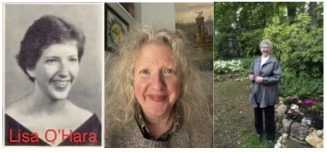
I sent along to them a sickbed selfie, and it caused me to reflect on aging; when I attended a group 50thbirthday party years ago, my brother Jeff took a photo. When I posted it on Facebook, my friend Jen said, “Don’t take this the wrong way, but you were born to be 50.” I think I was. However, it was the last photo in which I looked like myself, a Lisa O’ anyone would recognize. A couple of years ago I became old—see sickbed selfie. It was time.
Miss O’ at 18, 58, and 50. I blame lovers of Trump.
I loved all the pictures Mark was sending, but I didn’t understand his constant texts: “EVERYONE is asking about you!” I responded first with a “Ha!” comment thingy. But he persisted. And I couldn’t understand this sentiment because I was such a dull kid, not a standout at anything; just kinda skated through school, tried to be helpful, did my work, did a few plays, stayed out of trouble, head down, big laugher at the jokes of funnier people.
And you realize that all of us, whatever we thought ourselves, were part of one another’s stories, and that we are somehow still dear to one another, part of one another’s memories. We all can’t be beautiful or stay young, whatever that is, and what is even the point of the concern? In the end the Republicans will gun it down.
I recently read this definition of Beauty: “the adherence to the balance and structure of the Universe.” Seen that way, most of us can feel just fine.
Vanity: Reflections of a Royal Philosopher, from Ecclesiastes, 2-11
It’s Sunday, so here’s a little of the Bible that most American Christians (given their actions in favor of dead mothers and gunned down children and their worship of a narcissistic, unapologetic adulterer, conman, and cheat) clearly haven’t read, but a surprising number of my Jewish, agnostic, and atheist friends have.
1 The words of the Teacher, the son of David, king in Jerusalem.
2
Vanity of vanities, says the Teacher,
vanity of vanities! All is vanity.
3
What do people gain from all the toil
at which they toil under the sun?
4
A generation goes, and a generation comes,
but the earth remains for ever.
5
The sun rises and the sun goes down,
and hurries to the place where it rises.
6
The wind blows to the south,
and goes round to the north;
round and round goes the wind,
and on its circuits the wind returns.
7
All streams run to the sea,
but the sea is not full;
to the place where the streams flow,
there they continue to flow.
8
All things are wearisome;
more than one can express;
the eye is not satisfied with seeing,
or the ear filled with hearing.
9
What has been is what will be,
and what has been done is what will be done;
there is nothing new under the sun.
10
Is there a thing of which it is said,
‘See, this is new’?
It has already been,
in the ages before us.
11
The people of long ago are not remembered,
nor will there be any remembrance
of people yet to come
by those who come after them.
The friend who posted this on her wall asked: “So, like, what EVEN is the point.”
The existential questions are the worst. What I’ve never understood, when I look at all the guns and people threatening people over their race or gender, for example, is that if this is all we know—this time on earth, this life—why would anyone choose to spend it glorifying themselves, playing the lottery, and spreading misery? And that leaves the rest of us in a power struggle with those people, scratching for our bits of joy where we find them. There’s a great play called Every Brilliant Thing I saw a few years back at Barrow Street in Greenwich Village, about a little boy who goes on a quest to try to help his depressed mother—and he finds the joy in himself. Love people, find the joy, eat the chocolate. Do your best.
“We all have regrets and most of us know that those regrets, as excruciating as they can be, are the things that help us lead improved lives. Or, rather, there are certain regrets that, as they emerge, can accompany us on the incremental bettering of our lives. Regrets are forever floating to the surface… They require our attention. You have to do something with them. One way is to seek forgiveness by making what might be called living amends, by using whatever gifts you may have in order to help rehabilitate the world.” – Nick Cave
This quote can be found on the website The Marginalian, curated by Maria Popova. She shares ideas from artists, their quotes, and then her own reflections. What Cave got me longing for, or reminding me of, is the idea of being an artist. I really wonder what that must be like. (Whatever light I have in potential, I learned years ago, must be kept hidden or it upsets too many people; you have to trust me on this.) At least my one real joy as I age is that I can still enjoy art.
“Art does have the ability to save us, in so many different ways. It can act as a point of salvation, because it has the potential to put beauty back into the world. And that in itself is a way of making amends, of reconciling us with the world. Art has the power to redress the balance of things, of our wrongs, of our sins… By “sins,” I mean those acts that are an offence to God or, if you would prefer, the “good in us” — that live within us, and that if we pay them no heed, harden and become part of our character. They are forms of suffering that can weigh us down terribly and separate us from the world. I have found that the goodness of the work can go some way towards mitigating them.” – Nick Cave
In my search for more about suffering and surviving it, I happened on a couple of TED Talks that only pissed me off. On Being with Krista Tippett, now defunct in terms of its old format but still out there, is a good bet. Still, when I go hunting to try to understand all the shit, I find things that exhaust as well as inspire.
Ultimately, Bruno Latour (1947-2022), the scholar who passed last week, took nothing for granted: not science, not society, not even “reality” or “existence.”
– The Nation header on Facebook
And I realized, reading that banner, how TIRED I am of reality and the lunacy of existence—the realization that we’re all stuck in an overwhelming cycle of …
In the meantime, life goes on, somehow.
Preoccupations on Reflection
In my last blog post I paid tribute to the remarkable theater artist and teacher Maureen Shea, who died unexpectedly in September of this year. Shortly after posting, my old Virginia Tech friend Todd located and “liked” this Facebook post from 2020, I guess because of the attached photograph he must have recalled. Todd was very close to Maureen, too. Here is the post, in full:
Miss O’, ca. 1987. I’m posting it because I have always hated this picture, but kept it because mentor Maureen Shea is in the background, on the left on the hill, in a cast, and it does capture a moment in time. Oddly, this is often other people’s favorite photo of me whenever, back in the old days, we’d flip through one another’s photo albums. Similarly—and stay with me here—while I was the favorite and most beloved teacher of some students, I was just as often the most reviled and dreaded teacher of other students; and still others didn’t even remember being in my class when I’d say hello to them as seniors. Think of them as pro / no / undecided voters. Here’s my point: Yesterday I saw the “well, I’m not voting for Biden if it’s Harris” posts begin. Here we go, I thought, 2016 redux, “but her emails,” any excuse to not vote a woman into office. Because I believe, truly, however evolved people think they are, that that is what it comes down to. These folks can rationalize it all they want, but it comes down to misogyny. They’d rather end democracy, keep Bill Barr and Trump and Miller, and destroy the Supreme Court and even the planet, for the rest of their children’s natural lives, than vote for a woman—for whatever her “sin” is, it’s always one hundred times worse than the sins of the men who are caging children and denying a pandemic and allowing Russians to own our elections and put bounties on the heads of our soldiers in the field. America, don’t do that; don’t be that voter all over again. Because let’s face it: I’ve always hated this photo of myself, and yet I now have to admit I am adorable in it. All those years of self-loathing, and for what?
It’s 2022, and here we are AGAIN. Voters, Americans, for fuck’s sake: Do the work, love the people, be good to the earth, find a purpose, appreciate art. Get over yourself. And vote Democrat.
A commercial for an orange tube-y snack food shows a hip hop artist waving his fingers across bricks in an urban landscape and a colorful mural appears; he passes a child playing plastic buckets and the boy is now sitting at a red and chrome full drum kit. The plain glass buildings all begin shimmering in color.
Because in America, at least, you can’t enjoy anything, not even a junk food treat, unless you are changing the world. And it’s not enough to have a tasty bite. You have to gorge on a whole fucking bloomin’ onion, loaded nachos, and whipped cream on the dessert, with a table filled with family or friends, or why did you bother to go out?
And it’s not enough to enjoy the 4th of July with a sparkler; you need to listen to the incessant sounds of explosions all over Queens and watch the aftermath of a mass shooting of 30 spectators watching a parade in a small town in Illinois.
Art by Rebecca Morgan, as seen on Instagram
And I don’t know about you, but this kind of “go big or go home” bullshit is starting to give Miss O’ more than hives.
What’s the Meaning of All This?
Back in 1964, philosopher Marshall McLuhan famously said:
“The medium is the message. This is merely to say that the personal and social consequences of any medium – that is, of any extension of ourselves – result from the new scale that is introduced into our affairs by each extension of ourselves, or by any new technology.”
Fifty-eight years ago, McLuhan also said, “Ours is a brand-new world of all-at-onceness.” Director Mike Nichols, in an interview in the 1990s, talks about how much McLuhan got right, though McLuhan seemed to be dropped from our consciousness. (I say “to be dropped” because we live in a disposable culture.) People used to receive information at different times, Nichols noted, and in different forms—newspapers, letters, magazines, telegraph, newsreels. News used to reach people weeks or months, or years, after an event occurred. The Emancipation Proclamation, signed in 1863, did not reach enslaved people in Texas until June 19, 1865, and deliberately so—the goal being to keep this from them for as long as possible so the farmers could get another harvest out of the enslaved for free.
With TV, we all saw the Kennedy assassination aftermath play out immediately, for example. Nichols, speaking of the challenges of directing new scripts, pointed out that because exciting real events—from assassinations to the moon landing to wars—come to us in real time, fiction just can’t measure up. And so now instead of deep, simple human stories to sell tickets, we reach for Superheroes and Armageddon for entertainment.
Nothing seems to be enough to sate us. The news media and its audience now hear of mass shootings and barely register an “oh, god,” just before the yawn; you see that it’s getting increasingly harder to satisfy our sensory desires. Overloading on porn and all its vulgar unrealism is why all those Incels (involuntary celibates) can get no pleasure from sex with women. The medium is the message: sex isn’t about intimacy, but rather gratification and power.
“We shape our tools, and then our tools shape us.”
~ Marshall McLuhan
Understanding Media: The Extensions of Man 1964
Miss O’ Wonders
Query: What message are Americans told, by one another, is the message of America?
Response: Freedom.
Query: If your culture’s primary tools (or mediums) are guns, unmediated information highways, evangelical Christianity, and self-proclaimed “influencers,” what is the actual message?
Miss O’s Current Response: The message is that one ideology pushed by a lone individual’s power to kill or influence others is the single most valued aspect of the culture.
It’s a question of lenses.
A philosophy professor of mine once taught about hedonism. He said people misunderstand it, thinking a hedonist is someone who debauches and can’t get enough of pleasure. In fact, Prof. Smith said, “A hedonist is supposed to get an orgasm from bread and water.” Hedonists in fact set up a philosophy with forced, unsustainable expectations for actual humans. Bread and water will never be orgasmic, however nourishing, unless you are first dying of starvation and thirst.
From Instagram
In its latest attempt at a national philosophy, America has set up a forced, unsustainable set of messages for Americans through the medium of video, meaning we all see and hear these messages.
First, we are supposed to place the needs and desires of the individual above society, unless that individual is Black/brown, poor, and/or a woman.
Next, we must yield to the power of guns and ones who wield them over any individual’s freedom to speak, assemble, worship, or report news, unless that person is a white male with shit tons of money.
If the medium is an unmediated Medium, is the message that we are living in Babel?
I often spend whole mornings just deleting email junk so I can free up my email storage for more junk.
If the medium is an unstoppable garbage bin of random communications, is the message that there will be respite from the noise of humans and technology?
I have seen tweets of mine go mini-viral and had panic attacks.
I have tweeted, blogged, or posted on my wall things that I find vitally important and not one person agrees with me in even the form of a like.
I begin to value myself based on the mediums.
Which medium are we going to amplify? Which message will sound off and win in the end? Is there an end?
Is there anything duller and less surprising, however continually shocking, than American politics? Republicans can only stay on brand by grabbing power and rejecting anything democratic; the Democrats can only stay on brand by rejecting revolutionary progress and staying steady.
If the medium is the message, what is the proper medium for politics? What is the MESSAGE of our political life?
I keep getting stuck on these questions. “Stalemate” comes to mind. “Bartleby the Scrivener,” too.
Because a stable democracy is dull copy for our hundreds of 24-hour cycle “news” outlets, whether on a cable network, local television, or a newspaper, the Big Stories I see are almost never to do with public good so much as public titillation for ratings or sales. (And now this commercial message.)
The collective message is what exactly? Consume mass quantities and die already?
I awoke this morning, the Fourth of July, 2022, as I have every morning for months, in a pit of despair. Between the climate crisis-induced collapse of an Italian glacier and the invasion of Ukraine, along with the naked Republican attempt at every level of government over the past three years to end our constitutional democracy—and a press that does little more than pass the popcorn—it’s hard to write anything, create anything, feel there’s any point. And as I stood in my hallway after the coffee, half naked, holding a bra, vacillating between putting on real clothes to leave my apartment so as not to listen to the lone skateboarder on the asphalt playground who decided to practice his tricks right next to my little abutting porch (knowing that will also be in for an endless night of illegal fireworks); and falling into a ball of lonely weeping, as I do rather a lot these days; I mercifully remembered I have friends. I texted everyone I love and care about that piece of art by Rebecca Morgan, up there, because they all would instantly get it, and they did. And they answered.
My friends Carl and Mark, buddies of mine since 2nd grade wrote back too. Both of them are gay. Carl lives in our home town; Mark lives in Delaware with this husband. In response to our group, Carl said, “Not feeling celebratory. Low key chill here. Cleaning and organizing.” Mark said, “America doesn’t deserve a birthday celebration this year 😤.” I said, “I’m writing a blog.” Carl said, “Excellent. I hope you include my disappointment.” Mark sent his love, calling us, “MY FAMILY.” And that just broke me up. You know? That sudden burst or wave of love. And if I hadn’t broken the grip of depression, pushed past the despair by becoming outer directed, I suppose I would have started drinking wine at 10:30 AM and not really looked back.
And wine is a lousy medium for any message. Here are some better ones:
Honeysuckle
Photos by Miss O’
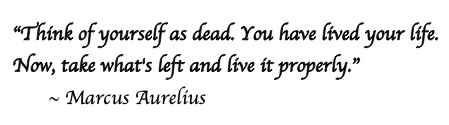
Postcards to SCOTUS
Miss O’ uses up some postcards.
Most of our important commentary anymore comes through in the medium of satire, including comics, cartoons, and Comedy Central’s The Daily Show and TBS’s Full Frontal. The medium is the message: We treat our existential truths like jokes. The “breaking news” of the NYT is often the equivalent of “What happens to Jolly Ranchers when they stay all day in a hot car?” The medium—the paper of record—is the message, and that message is “accentuate the trivial and don’t mess with existential truth in between.”
Like millions in the world, I write what’s on my mind and post these ideas for free for all to see. I have no mediators. No one, not a partner or friend and certainly not a paid editor, is around to read behind me, suggest where I might improve, strengthen, or refocus. Nor does any publisher or advertiser pay me for my thoughts.
And it’s still only one voice trying to mediate all the other voices and create a message that is coherent and true.
I still don’t know how to do it. Nevertheless I persist.