Spring Things

Oh what a tangled web

“Man did not weave the web of life, he is merely a strand in it. Whatever he does to the web he does to himself.

~ Chief Seattle, ca. 1885

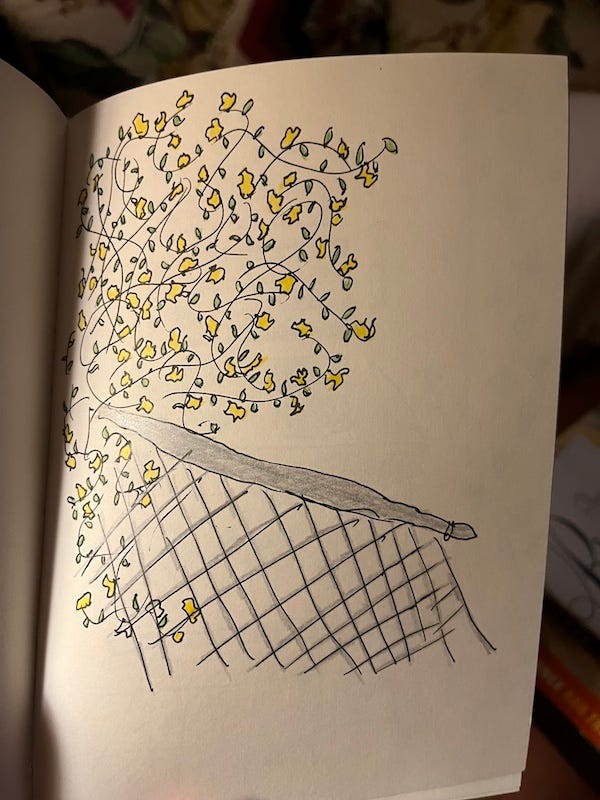
From one of my notebooks, a favorite memory of Miss O’s childhood springs.

Hey, dear. Just a few thoughts this first evening of spring. How is your Thursday?

In the PBS series The Power of Myth, Campbell opens one of the episodes (which I started watching again on television just now) by reading this letter.

Letter from Chief Seattle to President Pierce, 1885 (as read by Joseph Campbell)

The president in Washington sends word that he wishes to buy our land. But how can you buy or sell the sky; the land? The idea is strange to us. If we do not own the freshness of the air and the sparkle of the water how can you buy them? Every part of this earth is sacred to my people. Every shining pine needle, every sandy shore, every mist in the dark woods, every meadow, every humming insect, all are holy in the memory and experience of my people. We know the sap that courses through the tree as we know the blood that courses through our veins. We are part of the earth and it is part of us. Perfumed flowers are our sisters; the bear, the deer, the great eagle – these are our brothers. The rocky crests; the juices in the meadow; the body heat of the pony and man all belong to the same family. The shining water that moves in the streams and rivers is not just water but the blood of our ancestors. If we sell you the land you must remember that it is sacred. Each ghostly reflection in the clear water of the lakes tells of events and memories in the life of my people. The water murmurs with the voice of my father’s father. The rivers are our brothers. They quench our thirst, they carry our canoes and feed our children so you must give to the rivers the kindness you would give any brother.

If we sell you our land remember that the air is precious to us; that the air shares its spirit with all the life that it is supports. The wind that gave our grandfather his first breath also receives his last sigh. The wind also gives our children the spirit of life. So if we sell you our land you must keep it apart and sacred as a place where man can go to taste the wind that is sweetened by the meadow flowers. Will you teach your children what we have taught our children – that the earth is our Mother? What befalls the earth befalls all the sons of the earth. This we know: that the Earth does not belong to man; man belongs to the Earth. All things are connected like the blood that unites us all. Man did not weave the web of life, he is merely a strand in it. Whatever he does to the web he does to himself. One thing we know; our god is also your god. The Earth is precious to him and to harm the Earth is to heap contempt on its creator.

Your destiny is a mystery to us. What will have happen when the buffalo are all slaughtered and the wild horses tamed. What will happen when the secret corners of the forest are heavy with the scent of many men and the view of the ripe hills is blotted by talking wires? Where will the thicket be? Gone. Where will the eagle be? Gone. And what is it to say goodbye to the swift pony and the hunt? The end of living and the beginning of survival.

When the last red man has vanished with his wilderness and his memory is only the shadow of a cloud moving across the prairie, will these shores and forests still be here? Will there be any of the spirit of my people left? We love this land as a newborn loves his mother’s heartbeat. So if we sell you our land, love it as we have loved it. Care for it as we have cared for it. Hold in your mind the memory of the land as it is when you have receive it. Preserve the land for all children and love it as god loves us all. We are part of the land. You too are part of the land. This Earth is precious to us. It is also precious to you. One thing we know; there is only one god. No man, be he red man or white, can be apart. We are brothers after all.

This postcard arrived today from my friend Anna in California. How lovely is this?

I was thinking today, for some reason, about how President Biden’s dream, “a cancer moonshot,” he called it, the super-funding of cancer research, was one of the first things Musk’s DOGE defunded; how one of the first of Trump’s deportees was a ten-year-old girl with brain cancer, arrested in an ER in Texas before she could be treated.

If there is a web of life—if what men do to the web, they do to themselves—then perhaps Republicans are a cancer disintegrating the web. Are Republicans a living cancer? Cancer cells, after all, were all once healthy cells. Once a cancer cell begins to convince other cells to join the cancer train, they kill the host. How to convince healthy cells not to turn to cancer? How to convince sick-minded humans to join the planetary brotherhood? How do we enact this cancer moonshot?

Can town halls be a start? Can our voices, together, mend us? How to find our voice?

Campbell tells us that everyone needs a certain hour of day, a certain place, where you can “simply experience and bring forth who you are and what you might be.” A sacred place of incubation. The Native Americans thought of all this earth as a sacred place, all of earth as a place for incubation. Most of us settle for a chair.

It occurs to me on this first day of spring that we all need a breath, a chance to replenish. I hope all these American town halls during the congressional recess are healing some of these wounds, or bringing all this cancer to the fore so the therapy and medicine of sense and empathy can be applied.

Musk and Trump and their acolytes consider anyone who is imperfect, ill, disabled, infirm, aged, or in need in any way to be simply unworthy of life, “parasites,” Musk calls them. It’s a stupid thing to say, especially from a man whose faulty Tesla tanks are being recalled all over the world. After all, everyone is only temporarily healthy, everyone has limitations, but Musk and Christian White Nationalists preach that “empathy is weakness.” In the real world, in real life, empathy is strength, connection, depth of soul, necessary for our mutual survival. Duh.

We know this. We have to cure this cancer.

NYT reporter Serge Kovaleski and the moment Trump’s presidential bid should have ended. I’ll never understand how it didn’t. (“Friends” came on my Facebook wall to defend Trump using their Christianity. “Lisa, I’m a Christian.” I didn’t have any idea how to respond beyond, “Are you high?”)

For a little refresh, let me leave you on the equinox with an affirming poem by an old, white, actual Christian man who knew how to love of all things on earth.

Pied Beauty

By Gerard Manley Hopkins

Glory be to God for dappled things –

For skies of couple-colour as a brinded cow;

For rose-moles all in stipple upon trout that swim;

Fresh-firecoal chestnut-falls; finches’ wings;

Landscape plotted and pieced – fold, fallow, and plough;

And áll trádes, their gear and tackle and trim.

All things counter, original, spare, strange;

Whatever is fickle, freckled (who knows how?)

With swift, slow; sweet, sour; adazzle, dim;

He fathers-forth whose beauty is past change:

Praise him.

Source: Gerard Manley Hopkins: Poems and Prose (Penguin Classics, 1985)

We have to love the dappled things, and also the cancerous ones, the dangerous, the cruel. It’s the hardest part of being human. Suffering is life, after all. Transformation takes time. But there is, somehow, transformation.

Crocuses of Queens, March 20, 2025

Hoping for all good things for your spring,

Miss O’

Erase

When your government wipes your history from its sites

Good morning, sweetie. At 5 AM I saw a text from my friend Susan, a humor piece from McSweeney’s:

IT’S A SHAME WE HAVE TO BETRAY OUR ALLIES, STARVE THE POOR, HALT SCIENTIFIC PROGRESS, DESTROY THE ENVIRONMENT, AND ELIMINATE THE FREEDOMS ENSHRINED IN THE BILL OF RIGHTS, BUT AT LEAST MY INVESTMENT PORTFOLIO IS ALSO TANKING

by TALIA ARGONDEZZI

It would be truly laughable if it weren’t really happening.

From one of Miss O’s little notebooks. Musings.

As you know, I live with a disturbed mind, born as I was a middle brow Cassandra, driven mad at times by unwanted prescience, the way (for example) even as I was moved by and marveling at Hamilton and Suffs on Broadway (some ten years apart), I knew they were not celebrations but elegies. It’s not for no reason that I felt that way: those shows bookended the beginnings of not one but two Trump terms.

As testament to my madness, I’ve found myself laughing at our Senate all these weeks, both Democrats as well as Republicans, holding all those “confirmation hearings,” because somehow the Democrats couldn’t see (and still can’t) what all the rest of us outside the Capitol Bubble could and can, that these nominees are being sent in to dismantle and erase our democratic republic. Senate Minority “Leader” and traitor Chuck Schumer (D-NY) is genuinely baffled as to why he had to cancel his “book tour” due to threats. House Minority “Leader” Hakeem “I don’t know” Jeffries (D-NY) had to cancel his little book tour, too. These two “leaders” haven’t been successfully doing shit to defend the republic for years (what did they even write about?), and yet think now is the time to take victory laps. They have, essentially, erased themselves from history even as Trump’s minions of white supremacy literally erase the achievements of women, Blacks, Native Americans, and all other minorities from all government databases.

In further erasure, Secretary of Defense Pete Hegseth has fired all women and Blacks from senior military leadership. Today I read that the Dept. of “Justice” has given President Trump the green light to fire all women from leadership positions in government. Trump humpers have no sense of history. It’s so childish, isn’t it—like the way kids think their mom won’t notice the broken vase if they put a tee shirt over it—only now the stakes are life and death, civilization vs. barbarism.

There is a poetic technique called erasure, in which the poet takes an existing text—something out-of-print, say, an old book, or a magazine—and maybe circles the words that strike her fancy or uses a pen to mark out words she isn’t drawn to. Whatever words remain can be shaped into a poem, using the words in the order she finds them, or rearranged. (Poet Amanda Gorman has a section of her collection, Call Us What We Carry, dedicated to this technique.)

My friend Katrinka Moore has a collection of poems inspired by this technique, and it’s still my favorite of her many books, Thief. In a few places, she reveals not only the found poem but the process.

From Thief by Katrinka Moore BlazeVOX [books], Buffalo, NY, excerpted here to encourage you to buy it.

I think a technique like erasure shows us that do what we will to erase a text, there is something still to draw us in, a word we simply cannot let go of, another word, language that helps us reveal something new. The text is not the same, but nor is it lost.

Aren’t there parts of your life you’d like to erase? I have quite a list. Or have you thought you’d erased something, and then one morning, out of a dream, or from a knock on the door or a text on the phone, there it is, the past? Because that’s how life works, isn’t it?

Reading Joseph Campbell, as you know I have been, I’m reminded how mythology teaches us that no amount of annihilation, erasure, or running away can move us past the past, or past guilt, or spare us a reckoning. The story of Oedipus (whom the Oracle of Delphi prophesied would kill his father and marry his mother, and so whose parents cast him out as a baby, only to have him adopted and live to do that very thing), to take one example, teaches that one meets one’s fate in the path one takes to try to avoid it. You’d think humans would catch on; but in the West we have lost our mythologies.

To take another example, the First Council at Nicaea in 325 A.D. tried to force Christianity into tight constraints of how to believe and worship, and cast out and buried the so-called Gnostic Gospels, especially the Gospels of Thomas and Mary Magdalene, whose testimonies of Jesus’s teachings could not have run more in opposition to the Nicene religious oppression that is what the world now knows as Christianity. (If God is in your pocket, and if everyday men and women can equally teach and preach, you don’t need a patriarchy or a church; and you realize how truly radical Jesus was, and how close to the Buddha, to erase authoritarianism.)

But those Gnostic Gospels were uncovered in 1945 in Nag Hammadi, Egypt, because you know what? Try to erase what you will, the truth surfaces. Anyone who has suffered a trauma knows it has to be dealt with someday. There are only so many boxes you can keep putting in the closet before the closet explodes. Pick a metaphor.

Like Christianity, whatever was intended, our democracy (however imaginative) was founded on genocide, on slavery, on the subjugation of women. Do what they can to erase a people and history, people survive, history will out. Do what they can to shackle, people break free. You can’t erase that spirit. How is it that oppressors still think, in 2025, that erasure means obliteration? Yet we can’t quite erase authoritarians, either. We are all thieves, I guess, stealing what we can to make our worlds, always a price to be paid. Ask Prometheus. But some thieves are righteous. Ask Jean Valjean.

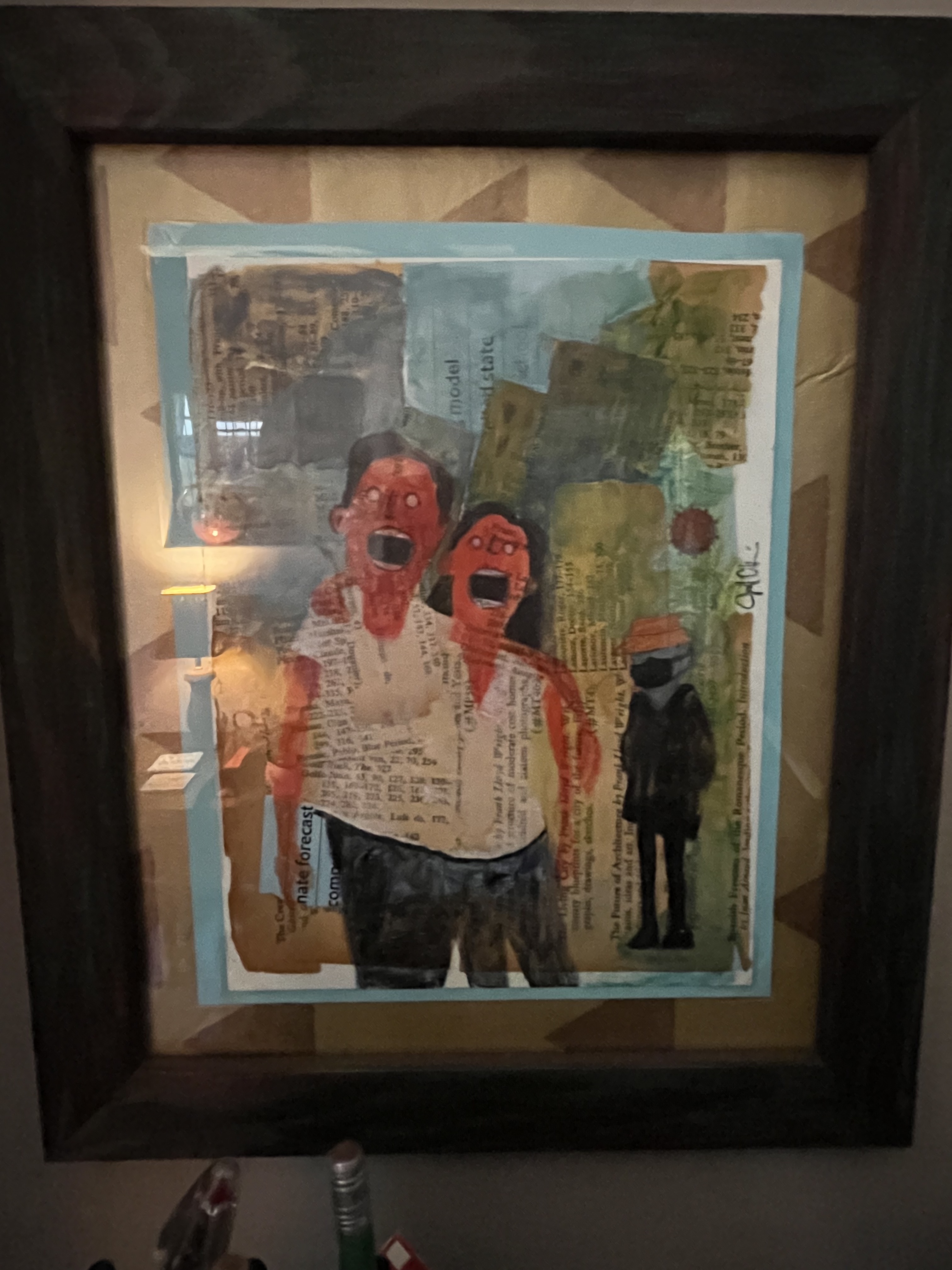
In one of my little notebooks, I took an erasure poem I made and illustrated it; I did a second one with cut out words. There’s something calming about the process, I think, because of what is revealed in our attraction to certain words. Should you try it, and I hope you do, let me know what you reveal.

Sending love, unerasable,

Miss O’

Pattern Cutting

Reflections on art and life in the age of American Surveillance

Today, in the wake of all the grave threats facing anyone opposed to the Trump administration—citizen or noncitizen, federal worker or civilian, famous or ordinary, —even normal people just traveling, like the just-released woman from British Columbia traveling to the US from Mexico detained in a cement cell with thirty women, fed on cold rice for the past two weeks, no regular access to a toilet, with no due process (one woman in her cell has been there for 10 months with no hope of leaving, no one to help her); or like the British tourist who was arrested while backpacking in Seattle, detained and still not charged (both women white, English-speaking, without criminal records)—in the wake of all this, as I say, a friend of mine asked me if I was going to continue to write my letters on Substack and WordPress.

Yes.

As Trump invokes the Enemy Aliens Act and carries out the wet dream of White Christian Nationalists that is Project 2025, no one is safe. Do or do not, be important or not, be famous or not, be humble or not, be a child or an adult, a Democrat or a Republican, pardoned or not, Trump friend or foe, literally no one is safe from all this. (Did you see Sophie’s Choice? How many times do you have to read the fucking “First They Came” poem?) The sadistic joys of kidnapping, detention, torture, and, no doubt, eventual killing are endorsed by fully 37% of American citizens. They are willing participants and apparently glorying in the promise of the end of the democratic republic. They whine when they are personally affected, sure, but as one Nebraska rancher I heard on Instagram said—and she is losing everything and voted for Trump—she’d do it all again. You cannot fix this level of stupid, you cannot fix sadists. All you can do is outnumber them, out kind them, out organize them. Outlove them. And die trying.

It’s the absurdity of it all I cannot fathom. In a recent episode of this season’s Finding Your Roots, Henry Louis Gates, Jr., reveals to actress Debra Messing the truth about the fate of her Jewish-Polish ancestors in Krakow. One such relative, a pattern cutter in a garment shop, was among those killed in the Holocaust. In a moment of what scholar and philosopher Hannah Arendt called “the banality of evil,” conscripted Nazi soldiers carried out orders and exterminated simple working people in Poland and elsewhere, people they didn’t know, for no particular reason other than they were told to. Ordinary working people.

A pattern cutter. In a little garment shop. In Krakow. And his wife, and his sister. Messing had no idea.

Tom Stoppard, in his Broadway play Leopoldstadt explored his own discovery of Eastern European uncles and aunts and cousins who were murdered in the Holocaust. The play, which I was lucky enough to see—it was stunning—was performed over two and half hours without intermission. Why no break? Because the audience would have walked out, baffled by banality, after Act I. The family, ca. late 1800s, was so…ordinary. Middle class, an affair maybe, a little business trouble; a simple holiday blending Christian and Jewish traditions, having dinner. That was the whole point. When the play shifts to 1955 in Act II, they are all dead. A relative is reckoning with this horror and the audience is, too.

It’s just insane.

No one could have been less important than a Romanian boy of 15, Elie Wiesel, and his family, as described in the memoir Night. The inhumanity and terror of the Holocaust has been so well-documented by survivors like Wiesel and others, like Primo Levi, that you cannot honestly believe we are reliving those exact times. And in the United States of America, too many of whose citizens died fighting Nazis, it’s unthinkable.

Yet here we are.

At 59E59 Theater in Manhattan before the election, I saw Mrs. Stern Wanders the Prussian State Library. (The promo material gives away the play’s surprise, that Mrs. Stern is Hannah Arendt, which is I guess because they didn’t trust the audience to know who she was.) The play gave me all the awful prescience that we were about to face the same interrogations Arendt endured; yet by gaining the empathy (there’s that evil word for which Elon Musk and his army of Christian white supremacists will have us all murdered) of her Nazi interrogator, Arendt was aided in an escape over the border. She famously went on to report on the Nuremberg Trials and warn us about how regimes like Trump’s form. Her books should have been text books in American high schools.

Screenshot

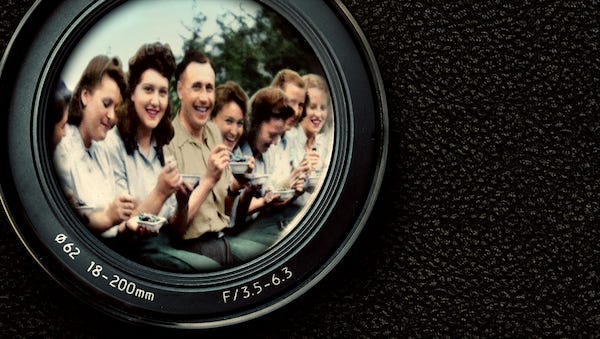
Last summer (I wrote about this somewhere already), I was lucky enough to see the play Here There Are Blueberries, a true story, wherein researchers at the National Holocaust Museum found themselves gifted, quite problematically, with a photo album of Nazi officers and their secretaries having the time of their lives at Auschwitz. Not an inmate in sight. The photo in the promo material is of a group eating blueberries, in a spot that was not far from the ever-burning crematorium, all smiles, not a conscience among them.

From Here There Are Blueberries by Moises Kaufman and Amanda Gronich, 2024, New York Theater Workshop, NYC

A few years back, I saw the final preview of a Taylor Mac comedy, Gary: A Sequel to Titus Andronicus, in which a Roman slave, played by Nathan Lane, begs his two fellow slaves to stop preparing all the dead for burial. Let them rot—how else will all these Romans quit having wars? If we keep doing the dirty work, if we don’t unionize and end this complicity, how will it ever stop?

The two women keep embalming. (I think our audience was the first one to get it, and maybe the first night the play fully came together, because you could see the cast was stunned at our screaming standing ovation; the critics panned it, having seen the play before it was ready to be seen. And wow is it timely now.)

I think also of a fabulous Broadway revival of a play in verse called La Bête, in which Mark Rylance played a charming, verbose rube who talks the king in a 17th century court into making him the new court playwright, and David Hyde Pierce played the snobbish playwright who is unseated. In the final moments of this hilarious and frenetic farce, the audience realizes that in fact Pierce’s character is right, and Rylance’s character is in fact a deceptive, cunning, dangerous beast who will bring down the order with his appointment.

And my god, here we are.

It’s through the theater that I process life, even prepare for life. The way some people look to scripture I look to playwrights, to the artists always, as guides on what was, what may be, what to do, how to behave, what to dare in our increasingly dark times, surrounded by confusion and cowards, facing unending threats and evils everywhere we look.

And these monsters are just getting started.

UNLESS. Unless. Unless. Unless.

It’s a big ask. But we can’t give up.

Love,

Miss O’

Slaying the Dragons

More thoughts on our national monsters

Hi, dear one. In my last post, I related how I’d recently read a book, Monsters: A Fan’s Dilemma by Claire Dederer, and this week, by a serendipitous coincidence, PBS streaming has rereleased a series from 1987, The Power of Myth, a conversation between Bill Moyers and the great mythologist Joseph Campbell, who sadly died not long after the final interview. You can also get the companion book, created because the 6-hour series (filmed at George Lucas’s Skywalker Ranch) couldn’t contain all the insights.

Moving from monsters to dragons felt like a natural progression. Also, in another moment of serendipity, I had a conversation this week about the work of Patsy Rodenburg, a voice teacher and acting coach, and her work The Second Circle. All of this makes sense together in my mind, so we’ll see how I do.

In a society such as ours in 2025, I wondered what Joseph Campbell might be able to help me with. As it turns out, plenty. Bill Moyers is a great host, comfortable asking naïve questions, and while for the intelligentsia it’s tempting to make fun of him, he gets wonderful answers. Moyers, by the way, was President Johnson’s Chief of Staff and later Press Secretary (he called Johnson “fifteen of the most interesting men I ever met”); he is smart and educated (and still with us at age 90) as well as attuned to society, but he’s at ease with not knowing and relishes seeking to understand (which I find are the key qualities missing from today’s journalists as well as citizens).

In one episode of The Power of Myth, Campbell explains Star Wars as one of the most recent (then) examples of the hero’s journey (there’s a whole episode on that; Campbell’s work inspired Lucas) and what that mythology tells us. Myths, he explains, including hero’s journeys, are not about seeking meaning in life, but rather about experiencing life. Moyers and Campbell talk of the ways in which people follow church doctrine, for example, to guide them, or follow strict rules and procedures rather than their own instincts. Often, heroes have to abandon what they thought they knew to get through the challenges.

They talk of the struggle with temptations presented by the serpents (found in every culture) where there is an expected way to live, the tension between the body and the mind, between desire and outside rules. At one point, Moyers reflects on ordinary people’s lives and the hero’s journey, especially the moment that Luke Skywalker, in a life and death struggle with Vader, chooses not to go over the dark side.

Of this dramatic choice of good over evil Moyers says, feeling secure in himself, “But that isn’t what happens in my life.”

And Campbell quickly counters, “You bet it does. If the person doesn’t listen to the demands of his own spiritual and heart life, and insists on a certain program, you’re gonna have a schizophrenic crack up. The person has put himself off-center. He has aligned himself with a programmatic life. And it’s not the one the body’s interested in at all. The world is full of people who have stopped listening to themselves.”

I don’t know about you, but it seemed to me this perfectly described this American moment.

Campbell and Moyers also talk about dragons, and Campbell’s take on dragons is fascinating to me—they guard. “The European dragon,” Campbell explains, “guards things in his cave, and what he guards are heaps of gold and virgins, two things, gold and virgins, and he can’t make use of either of them, but he just guards. There’s no vitality of experience…” In psychological terms, you’re binding yourself to your own ego, if you are dragon. (Campbell contrasts the negative European dragon with the “great and glorious” Chinese dragon—two very different things.) The dragon in us is our ego, “What I want, what I believe, what I see,” Campbell says, and “it might be too small.” To slay it, “you have to follow your bliss,” by which he means your true nature.

The Europeans, who colonized so much of earth, then, are based in a culture that fights those who hoard gold and virgins, and yet the heroes don’t fight the dragon for any other reason than to the take the gold and the virgins for themselves. Another perfect metaphor for America.

Campbell wouldn’t say that deciding to destroy others is anyone’s actual “bliss.” Annihilation of the innocent, the hoarding of gold, and rape of women cannot be bliss, because I see dead eyes in Trump, in Musk, in Speaker Johnson, in Vance. They are without souls let alone hearts. Anyone with access to their own hearts would follow President Zelenskyy anywhere because anyone can see Zelenskyy is Luke Skywalker; it’s not about him, this war, it’s about saving a country he loves. You may think that doing what you love “doesn’t save the world,” only yourself; but Campbell says that by saving yourself, you save the world. “An influence of a vital person vitalizes. There’s no doubt about it.” Otherwise, the world is a wasteland. Slava Ukraine.

“An ego that sees a ‘thou’ is not the same ego that sees an ‘it.’”

mythology scholar Joseph Campbell on the difference between the relationship Indigenous people had with buffalo (“thou”) and that which the white man had with buffalo (“it”); see also, Putin with Ukrainians

Last week my friend Keith, an actor and writer, was in town working on contract negotiations for his union, and we met for dinner on Third Avenue Thursday evening. The dinner time changed from 5:30 to 7:30, so around 6:40 I left Queens for Grand Central, going down toward the back of the 7 Train to be nearer the Third Avenue/42nd Street exit when I arrived at the station. When I entered the car, there in the corner was a bearded man, quite filthy and disheveled and resembling Rip Torn, a faded red towel safety pinned like a cape around a grimy white tee shirt fragment. He was talking to himself in animated tones about a woman who was in pain, her feet, I think, and the narrative was taking place at a hospital. He’d caused the car to reek, though not many people were bothered. I was, though, so when I sat down in the only available seat, I casually rummaged in my cloth sling bag for a mask. (Since Covid, the option of wearing a mask allows us to give smelly people some grace, to not embarrass them by pulling collars up over our noses, or to have to beat an exit to run to the next car at the next stop; in NYC in summer, it’s not uncommon for one person’s stench to clear out a subway car and leave it empty at every stop for a whole day. Pro tip: NEVER get on an empty subway car on an otherwise full train; everyone does it. Once.)

Over dinner, Keith and I talked about many subjects, from poetry to opera to politics, when he mentioned he was going to Portugal to study with renowned voice teacher and acting coach Patsy Rodenburg, whose work I love. In a quick but inadequate summary, I can tell you that Rodenburg (whom I first heard of in an interview on NPR and saw later on video from Michael Howard Studios in New York) noticed over the years that she could distill actors’ energy into three “circles”: inward directed (First Circle), outer directed (Third Circle), and perfectly present (Second Circle). We need all three circles, and all three circles have their uses, but to be an effective actor, you must live in the second circle of true intimacy, fully present.

You see this in life—First Circle, the people scrolling their phones, or the cashier who won’t look at you; and on the other extreme, Third Circle, the salesmen, politicians on the campaign trail, preachers greeting parishioners. Miss O’ lives in second circle, as do many of my friends. Second circle can be unnerving to people who are not, as Campbell would say, able to follow their bliss. People who need a doctrine to cling to—the Ten Commandments, Project 2025, even the Rule of Law. Any doctrine can be leveraged for good or evil when people are not in Second Circle. (Trump, I suspect, lunges between First and Third circles all the time, which creates a violent imbalance. He hasn’t been in Second since infancy, where we are all in harmony.)

And this brings me to a deeper truth, perhaps the most unsettling to me. In the United States, we have no more rituals (beyond, what, morning coffee?), no mythologies, no common culture to bind us together. If we could be honest, tell the truth about our origins, all the complexities of colonization, genocide, slavery, revolution, enlightenment, the uses and abuse of Christianity, all of it—we could formulate a national mythology and enact rituals to guide us to growth and build further understanding. American Idol is the best we can do? The spectacle of competing for money and fame? Has The Apprentice taught us nothing?

At one point, Campbell uses our architecture to tell us who we are in the U.S. in the modern age. In Salt Lake City, he notes by way of example, first the Temple was the tallest structure (religion), then the Capitol dome (politics), and now the Office Building that handles the economic affairs of both is the tallest and biggest edifice (commerce). It’s the Symbol of modern life. What does this mean for us? “You can’t predict what a myth is going to be any more than you can predict what you are going to dream tonight. Myths and dreams come from the same place.” What is the new American dream?

In six weeks, we citizens watched helplessly, and Democratic leadership spinelessly, as Donald Trump destroyed 250 years of American law and governance, wiping out the mythology of a nation. Listening to Campbell, I gained historical perspective. Though Moyers switches quickly, in editing, away from his point, Campbell does passionately remind us that Indigenous people, in a mere ten years, lost everything in the way of their rituals, their sacred dependence on the buffalo, their freedom, their land, and thousands of years of a way of life. Like that.

We’re in the process of losing a few hundred years’ worth. It’s nothing by comparison. It’s just ours. And “ours” was never “everyone’s.” If we are honest.

Our struggle now (if there is an “us”) is recognizing the difference between the seductive serpent, the dragon to slay, and the vital person. Everyone made fun of Hillary Clinton when she said, “We have to change hearts and minds,” mocking her with, “It can’t be done.” Of course it can be done. As my theater hero Joseph Chaikin said, it isn’t done “en masse, but one by one by one by one.” We each do our best to be alive, and our aliveness brings life to the world. Moyers brings this around to the importance of teachers, of which group Campbell was a member. The therapists, the storytellers, the healers, the helpers, the educators: we help bolster the world, prepare our heroes, vitalize the works.

Coda: Keith walked me to the Grand Central around 10:00 PM, and I descended the stairs from the Third Avenue entrance. Down on the platform, I walked to where an old man, a blues and rock electric guitarist, played a history of the Beatles and Jimi Hendrix as two other musicians looked on. We thanked him, gave him a few dollar bills. When the train pulled in, we got on the car, and I smelled a familiar smell. I looked down the car and there, in the same seat with the same two-liter bottle of Mountain Dew, was the same schizophrenic man. What are the odds? Weirdly, this sort of thing happens to me a lot in New York. But think of any number of small things that could have happened differently—the time I left home; or the time we left the restaurant; where I stood on the platform either way. It’s remarkable.

I pulled out my mask. The man sat alone, no longer chattering away but looking at us, lost; I think he vaguely recognized my hat. A needy citizen ignored, an “it” instead of a “thou,” someone else’s problem. The American ego.

I don’t know why, but thinking of all these stories and our ordinary workaday lives, I hear Pigpen’s voice in A Charlie Brown Christmas, when Linus points out that the dirt and dust on Pigpen could be from the soils carried across the ocean from ancient Egypt, to which Pigpen, adjusting his costume says, “Sorta makes you have a little more respect for me, doesn’t it?” Maybe Peanuts feels like it could be a start for our mythology, if we tried. We could do a lot worse.

(Thanks, internet.)

I do go on. Happy Sunday. I really should get out of bed.

Love,

Miss O’

Wild Kingdom

Thoughts on the state of things in the state

Mar 01, 2025

If you’re around my age and had a television growing up, you remember Sunday nights on NBC with Mutual of Omaha’s Wild Kingdom, which premiered (I read) in 1963 (you can still see the modern take on Animal Planet). It came on before The Wonderful World of Disney, which didn’t interest me—I think we turned it over to Hee Haw. Anyway, the show presented visits to the wild places of Earth, and Marlin Perkins (the zoologist host) and Jim Fowler (who seemed to do the real work) offered insights and commentary. It filled you with wonder, but more than that, for me, danger. I contrast that experience with once I have had as an adult watching Sir David Attenborough on PBS’s Nature programs, where the presenter expresses awe, delight, curiosity, and gratitude, all at once. Both programs came of age during fairly early television, with black and white cameras (or, in my case, a black and white television) to color. In Attenborough’s case, I learned from a documentary I watched last night that he’s won awards for all the phases of camera technology development, up to age 88!, beginning with black and white cameras, followed by color photography, to HD, 3-D, and now 4DX—the most advanced technology we have, most recently using animations and acting to tell the story, ironically, of animals of the past.

It’s here that I have to compare Attenborough to Thomas Bewick (say Buick), the 18th-19th century engraver whose engraved illustrations of British birds as well as many other animals gave the world its first affordable visuals, ones average people hadn’t had before. (I’ve mentioned in earlier posts that I recently read a book about Bewick’s life.) Watercolors and oil paintings of animals were in private collections and printed only in the most expensive editions, so common people in villages and towns might who had only heard about a camel for example, could see one. One famous flightless bird, the Dodo, for example was one such creature Bewick engraved. That bird of legend had gone extinct even before Bewick’s day, and it’s a bird that Attenborough also talks about in the 4DX in the last show he did in 2016, Museum Alive. (He’s still alive, by the way, at 98. Bewick would be 271.)

Bewick’s Dodo, best guess based on maritime descriptions of the time and other people’s sketches. The one in the British Natural History Museum is a composite guess using the body and feathers of other birds. What is it about white men that their first impulse on seeing any unknown creature is to kill it?

Both Attenborough and Bewick love/loved wild places, wildlife. They love/loved working in their preferred mediums, television and engraving, respectively, and to use their arts to share this wonder with the world, with the common audience.

All this gets me thinking about all the ways we illustrate and instruct on the world around us, and how we used to unite around the common cause of our shared planet. When Rachel Carson’s book, Silent Spring, came out in the 1962, the one thing that everyone upset and focused them on ecology and caring was the possibility of the loss of songbirds.

Imagine that. If you have had the pleasure of sitting in my parents’ bird sanctuary of a suburban backyard, let me assure you can sit on that patio swing for hours and never be bored. Once all the birds forget you are there, it’s a party, the best kind of show.

Lately, America and the world have become focused on a collection of primates but not for the biodiversity and wonder and joy they bring. Instead, it’s a nature Reality Show from Hell.

Yesterday, as the world watched, any sentient human cringed. Vance and Trump’s treatment of President Zelenskyy of Ukraine was beyond the beyond, trying to leverage their own favor-currying of Putin by placing the beholden Zelenskyy in front of right-wing American television cameras and reporters, to cow him, as if this man has not been enduring full-scale war for three years trying to save the democracy he loves. Lights, cameras? Bullying? 1) Have they no shame? 2) Are they high? 3) Fuck them.

Like nature at one time, democracy had been a common global cause for many, many years, but no more. President Zelenskyy is like the compelling, knowledgeable zoologist visiting a new kind of American wild kingdom in a television series, facing two aggressive and deeply stupid primates who exist only in captivity. It was, as you know, horrifying to watch.

President Zelenskyy prevailed. I hope he wins this war; he’s already won history. I don’t want Ukraine or him to go extinct.

All of this is just to say, Slava Earth, Slava Ukraine.

Home bulletin board detail. Queens kitchen.

Until the next episode of the Trump Wild Kingdom Shit Show, do beautiful things, somehow.

Sending love from Queens,

Miss O’

On What Occasion Do You Lie?

Telling truths on Presidents Day

“I cannot tell a lie.”

~ George Washington, First American President

Ironically, this famous quote is itself a lie (how American), but more on that later.

The magazine Vanity Fair (to which I no longer subscribe) includes, as the last page of each issue, The Proust Questionnaire, a set of questions originally asked and answered by novelist Marcel Proust and now used to learn more about the globe’s favorite obsession, celebrities. The questionnaire has some interesting questions, and some shallow ones, but the answers can be revealing. I’m often struck, for example, by the way powerful men, even decent ones like George Clooney, answer #12: What is the quality you most like in a man? “Loyalty.” As a woman I read this as, Truth telling is a deal breaker. As for #13, What is the quality you most like in woman? men generally respond, “Patience” or some other subservient thing. It’s interesting, if limited.

Interesting, If Limited could be the title of my memoir.

Walking around the neighborhood, I found myself thinking of Question #9, which is, On what occasion do you lie? Often the celebrity of the month who has chosen this particular question among the many, will respond, “To spare someone’s feelings.” Fair enough.

But speaking as a fairly honest person who has lied on numerous occasions while also valuing truth, I wondered if any of the situations in which I lied had something in common. I’d like to say something pithy, see, when it’s time for my Vanity Fair moment, so let me note just a few examples, categorize them, and see if I can find the common ground.

1. Once in second grade, Mrs. Angle—I’ve told you this story—asked us after nap time with our heads down on our desks if anyone had a dream they’d like to share. I raised my little hand and got up in front of the class and, making it all up (obviously) to entertain my friends, described how we all went to Egypt to see the tomb of Tutankhamen. I pointed, “Juanita was there,” and again, “Ingrid was there,” and Mrs. Angle snapped, “You’re lying. Sit down.”

2. On a high school field trip during my sophomore year, to take the singers and pit orchestra to a neighboring high school to perform scenes from South Pacific as a promotion for our production, our sponsors, Mrs. Combs and Mr. Carnohan, realized they’d forgotten to send home permission slips with us kids. Only when the bus driver asked if they had them did they realize. I stepped up quickly, “Give me ten minutes.” I had everyone write out a permission slip on paper we all collected from someone’s notebook, and I signed each slip in chameleon-like handwriting. Mrs. Combs looked stunned, but she took my pile and off we went.

3. When I’m late for something, like work, I have blamed the subway (and have been caught out by a colleague and supervisor on the same line) because I’d rather not say, “I have IBS and had to run back home halfway to the stop because I needed to shit again.” (Finally, I just told the truth. No one asked after that.)

4. I once helped make a company-wide Answer Key set, compiled for the whole floor of my 2 Penn Plaza office, when this one president took over and, to prove his power, spent easily $100K to create something like 30 separate “learning modules” complete with “tests” on corporate “life” and business, modules that included short films, voice overs, and reading material on slide presentations, and if you didn’t get all the answers correct on each test, you had to start over, the whole module. We had massive publishing deadlines at the time, our nerves hanging by a thread. To what end are we doing this? But your job was on the line. A few of us—no doubt my idea—began printing out all our 100% test answer sheets which we labeled by module, punched holes, and stuck them in an unmarked three-ring binder. and set it on a file cabinet in our pod We didn’t even hide it. Eventually even our supervisors, to say nothing of executives and vice presidents, began ambling and ultimately marching over our pod to get the book, because 1) these tests were useless to our work; 2) the president was doing it to be a dick; 3) he would be out on his ass soon enough (they always are) once he was eligible for that golden parachute—we endured a period of a few years in which a succession of dicks who were pushed out of one company division and over to ours until they could retire. It was not fun. And yet, our important work—work that corporate didn’t in the least understand—somehow went on, great as usual. Hmmm. Who’s the parasite, Elon? (And how do I really feel?)

5. When the famous Westway Diner on 9th Avenue was taken over by new management maybe six or eight years ago—all the old-school career waiters replaced, the desk staff and chefs gone, the classic booths and tiles plowed under for white and gray blah—I happened in to check it out, and in addition to the place being bereft of atmosphere, the food sucked. “How did you like it?” the aggressive manager asked me about inedible spinach pie, which was a block of bone dry phyllo with almost no filling. “Mmmm,” I said, not wanting the poor new chef to get canned. Let someone else tell them; consider this a funeral donation. (It’s since recovered.)

What do all these occasions have in common? Well, they are lies of convenience, I guess, trying to smooth something over, or using deceit to help out friends or struggling folks; on reflection, I tell few lies just to save my ass. That’s how I was brought up. But I’m not stupid enough to believe that always being honest is smart. As my friend’s Montenegrin immigrant father used to say, “Honest and stupid are two brothers.”

I’ll tell you what the lies don’t have in common: No lives are in the balance for the telling of them. While I don’t condone lying or deceit as a lifestyle, sometimes lies save lives, and you have to keep your hand in. Ask the enslaved; ask women being beaten by abusive husbands; ask Tina Turner running away from Ike. Ask Jews during the Holocaust. Ask the French Resistance. And as we are entering a different era now, hearkening back to those dark times, we all may need to reset our moral compasses. We are back to Nazi Germany, friends, and “truth” for them, ain’t truth for us.

Thinking about coded language and other “lies,” and this being Presidents Day, I recalled a Chaucer class I took in graduate school 30 years ago, and my professor, John Fleming of Princeton, wanted to teach the class about Medieval iconography—you know, the images in all those beautifully illuminated manuscripts with the stories in calligraphy and the illustrations in gold leaf and lapis blue. Those illustrations, we learned, were included not only for their beauty but to guide the illiterate, because unless you were nobility or clergy, you didn’t read. So, what did the images mean? You see a lion, a rose, stuff like that. How would anyone get a whole story from a picture?

To demonstrate, Prof. Fleming drew these images in simple lines on the chalkboard:

“What is this story?” Fleming asked. My classmates, attending the Bread Loaf School of English from all over the country and the world, sat dumbfounded. I couldn’t believe it. See, I talked a lot, and I was practicing restraint, but finally I raised my hand.

“It’s George Washington and the cherry tree. I cannot tell a lie, Father, I chopped down that cherry tree.”

The class turned to me and looked at me like I had two heads. Fleming barked a happy laugh.

I explained to the still-lost class that I grew up in Virginia, up the highway from Parson Weems’s house, Weems being the man who wrote the fable about wee George, and a few miles down from Mount Vernon.

Fleming then went on to explain that this is a perfect example of how and why iconography—the use of simple symbolic images to represent a whole story—works in places that share a common culture.

To learn more this Presidents Day about this fable, you can check out the Carter Museum and learn about Grant Wood’s portrait, pulling back the curtain on the myth. In 1800, Weems published The Life of Washington, which is well-known as the source for many myths about the first president. Written just a year after Washington’s death, it includes the story of six-year-old George admitting to chopping down a cherry tree and another about Washington praying at Valley Forge.

Who chopped down that cherry tree? asks George’s father, according to Parson Weems, who wrote, “Young George bravely said, ‘I cannot tell a lie… I did cut it with my hatchet.’ Washington’s father embraced him and declared that his son’s honesty was worth more than a thousand trees.”

Why create this myth about an already mythological figure, even by 1800? I guess to impress upon America’s youth the importance of honesty. But what to do when you learn the story is in fact made up?

Growing up as I say, along the Richmond Highway between the home of Parson Weems and Washington’s home of Mount Vernon, I learned this fable in elementary school, but I never learned about Washington, the enslaver. Not in high school, not in college. I remember a California friend visiting Mount Vernon with me and saying, “I thought this was just a myth,” meaning the whole plantation, the first American president, all of it. And it’s easy to see how anyone not from the historical grounds of colonial America might feel that way, or wouldn’t be shocked to see a slave auction block landmarked in Fredericksburg or Williamsburg, given the American tendency to mythologize the successes and sweep the ugly truths under our antique hooked rugs.

And really, the more we keep digging, and the more lenses we train on our history, the more truths we uncover, the more lies we reveal—the more interesting and complex and real our history becomes. It’s discomfiting, sure, horrifying at times, but isn’t it exciting, too? Isn’t truth worth seeking? How else to make this nation truly free?

This is where we turn to our artists.

To explore perhaps America’s greatest “Lives of the Presidents” cover-ups, the relationship between Thomas Jefferson and his enslaved “mistress” Sally Hemings, Pulitzer Prize-winning playwright Suzan-Lori Parks premiered her play Sally and Tom at The Public Theater last year. The premise of the play is a community theater putting on a play about these historical figures while the leads are in a relationship. I loved the show, and I was fortunate enough to be there on a talk-back night. In attendance that night were several of the descendants of Thomas Jefferson and Sally Hemings and their families, as verified by DNA. I couldn’t believe I was having this chance to witness history. To watch as these family members meet one another after the show (many were sitting in the row in front of me) and walk up onto the stage—the set’s back wall covered in all of their names in the final reveal—to take photos with their phones, made me weep. (I think it would be a fascinating way to end the actual play.) It was wondrous, too seeing truth all up there like that. The theater was filled with love in the midst of revelations. That’s what art does.

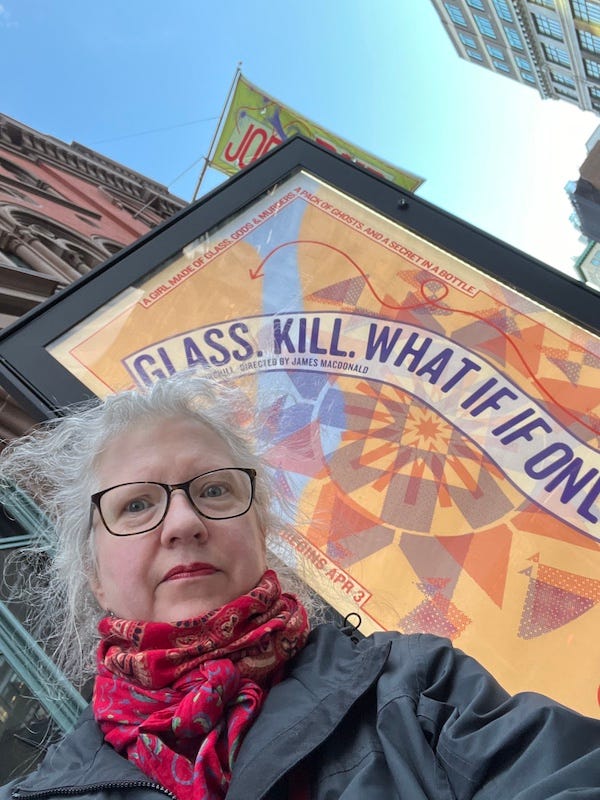
Miss O’ outside The Public Theater, April, 2024.

And I think also of that incredible painting by Titus Kaphar, “The Myth of Benevolence,” offering another way that art can reveal a deep truth in a way no historical record ever can, exposing long-hidden damage and forcing us to confront it. (Click on the link to see the entire painting and learn its story.)

A whole story from a picture. American iconography.

Detail, Titus Kaphar, “Behind the Myth of Benevolence” https://www.culturetype.com/2018/03/28/titus-kaphar-and-ken-gonzales-day-explore-unseen-narratives-in-historic-portraiture-in-new-national-portrait-gallery-exhibition/

On what occasion do you lie? I look at the American story, then and now, and it’s seeded with lies and corruption, so many lies, you have to wonder, Can it ever come clean? How do we answer for it? These are the questions we all should ask and answer now. If we don’t, whom do we think we’re protecting?

On what occasion do you lie? Ask Gil Scott Heron, famous for saying “the revolution will not be televised,” meaning it happens inside us, speaks volumes about the impact of lies in the linked poem; and Kendrick Lamar, whose brilliantly coded and performed all-Black Superbowl Halftime Show blew me away. The enslaved lived in world of code. They had to lie about learning to read, for godsakes. Pretend to go along, to get along.

On what occasion do you lie? Ask women who have been sexually assaulted and been made to keep quiet or lose their careers. Ask the men who keep pretending nothing happened. Ask Sally Hemings.

On what occasion do you lie? There are real reasons to lie, moral, ethical reasons. To protect the ones we love. To save our neighbors. We are having to think hard about that now.

Republican lawmakers (that’s rich) want AOC arrested for teaching Americans and immigrants their rights. Photo by Miss O’ in her Queens neighborhood.

Because let’s face it: here in the United States, we are in a crisis of government amorality. We have a lying Republican party (no more rule of law); a lying president (pick a campaign promise, and yes, Project 2025 was the plan all along); a lying vice president (his autobiography exposed as a sham); a lying Supreme Court (see Roe v. Wade, which all declared, under oath, “settled law”); and liars heading every cabinet position (no, trans people are not the cause of America’s problems; and Putin is not America’s friend, Tulsi). We have liars in the Department of Justice and Homeland Security (immigrants are not remotely the cause of most crime; being brown is not a crime). We have liars heading the F.B.I. (the Democrats are not the enemies of America). It’s all lying all the time, now, and their truths are even worse. The freedom of Western Europe is now in the balance, as Vice President J.D. Vance admonished the “values” of those democratic nations this weekend, in essence praising the rise of fascism in France and Germany and also capitulating to Russia’s desire for empire. On the campaign trail, Vance said “democracy” but meant, we know now, “totalitarianism” (Europe is not America’s enemy, nor are Panama, Canada, or Greenland; our actual enemies are transparently heading our own government.)

Past and present collide: JD Vance on his brown wife; I’ve heard Vance refer to their children as “her” kids. Look at the mental gymnastics and self-delusion of Vance, who denies his wife and children, and smiles.

To think that all of today’s stuff started with asking a simple question.

Identifying lies is not the same as responding to the world that supports those lies. There’s a very cool blog on Substack called The Pamphleteer by Lady Libertie, and she is focused on how we negotiate this new era. Check out “So You’ve Been Invaded: a French Resistance Guide for the U.S.” Pretending comes with the territory of survival. Marcel Marceau, for example, as a teenager pretended to be a camp leader, while his real job was to smuggle Jewish children across the border to freedom; he used the art of mime to teach the children silence as they walked. It’s not really lying if it’s saving lives, and the people you are lying to are venal.

Happy Presidents Day in America, 2025, everybody!

Sending love,

Miss O’

What’s Not Lost in Translation

Moments in my chaotic New York City week

So all the ick news first, aside from all the Musk-Trump criminal dismantling of every living institution in America so that it’s close to unrecognizable (taking over the Kennedy Center? The National Archivesclosing what Department?), I learned at work this week that the two editors I supervise applied for a transfer to another (lately resurrected) department where they’d previously worked because they can do what they are best at there (I choose to believe it’s not about me) and got it, and that I will have to finish a huge project probably alone, the timing being what it is; then, at my ophthalmologist’s office for a checkup, I learned that not only am I at the beginning (and still reversible) stages of diabetic retinopathy, but also that I owe an outstanding balance of nearly $500 (of deductible-meeting crap) from visits over the past four years because their billing department never sent me the bills; and then I learned from my CPA that my company inexplicably failed to take out the correct amount of tax (and all week I’ve tried to correct it for this year, but the system doesn’t work, and we no longer have humans working in HR (take that in) and I am screaming into screens) and so instead of getting a refund, I in fact owe some $1,500; and the tendinitis in my write-hand (punny ha ha) wrist is so bad still after three months, medicines, and PT, that I would have to spring for a cortisone shot (sweet, sweet relief after the injection site pain and, obviously, the bill). Poor fucking me.

Thank you, internet.

But one day this week—I think it was the eye appointment day, Wednesday, when I returned home with dilated eyes and shock at hemorrhaging money—on the way into the city, a Black female conductor announced at every stop (because the N-W-R-Q lines still do not have recorded voices to announce stops, and I love that) something to this effect: “Ladies and gentlemen, let the passengers off first, let’s help each other out, everybody, let the people off first before you try to get on. Move into the middle, people, help everyone out, we’re all together here.” Love her heart. On the way back to Queens that same day, a Black male conductor did much the same, adding on occasion, “It’s not about the price of groceries, everybody, just help each other out here and move all the way into the car.” This same conductor also used the intercom to explain the location of every staircase, connection, and elevator at every single stop. A total doll.

And if you are like me, you can’t help but look up and down the train car, men, women, children, every color and shape and gender and age and religion and background and profession, staring into phones, or not; bundled up, world weary, and it hits you all over again that the reason “white middle America” is afraid of brown and black shadows is because they literally have no idea how New York works. It’s not perfect, never that, but it works. Look at us. Us. Right here in this train car, crowded, or not, for miles of stops along our way. Not yelling at or killing each other. All of us just being.

Also in my travels, I found myself thinking about a poet friend who lives in a rural area, who years ago, when I mentioned how much I loved the movie Lost in Translation could only grunt in disgust. When I asked why, she said of the lead characters, “All they did was squander an opportunity to see Japan.” I had to think for a second, because I was remembering the filming of Bill Murray’s whisky commercial, the Tokyo karaoke bar, the hotel bar nights, Scarlett Johannson’s quiet excursion to a Japanese garden and learning flower arranging, and of course the hilarious trip to the ER so Bill Murray can get Scarlett’s broken toe seen to—all these relationships and stories they will have to tell about, or not, when they return home. What did my friend mean, “squandered”? I started thinking. I guess another view is they didn’t really do all that much…and then it hit me. I said, not at all angry, but with a sense of discovery, “You’ve never traveled outside the country, have you?” She looked at me suspiciously, and slowly shook her head, as if her response to a movie shouldn’t depend on having had the experience. More to the point, though, she had almost never, within or out of the country, traveled alone. And there it is.

What was lost in translation for her in watching Lost in Translation is the feeling of sudden paralysis brought on by the jetlag stupor you feel combined with being quickly overstimulated in a new place while on no sleep, while being both excited by the prospects and daunted by selecting the best thing to do right now. The one universal is a bed (never one you can check into before 3:00 PM) and a bar or cafe, and heading to either one can give you a chance to sort of recover your wits (if you know how to manage the currency), but when you are alone with no one to bounce ideas off of, being in a new city, whatever the language, can be pretty isolating. One time, visiting London, I spent nearly one entire first day just sitting alone on a bench in Tavistock Square, where Virginia and Leonard Woolf had lived (in a no longer existing building, bombed out in WWII), underdressed (a cold day for summer) and disoriented, and in those days, a teetotaler. I could barely make myself try to find a place to have tea. If I did eat or have tea, I don’t remember. I remember a white-gray sky, damp chill air, and just watching people against green trees and grass and gray buildings.

Did I squander my first day in London? Not at all. Oddly, that first day of “doing nothing” is still the one I remember most vividly and fondly, whatever the discomfort and confusion. I was there, in the heart of London, on my own, unremarkable, on an ordinary day. Not bad.

As a result of my many NYC train treks this week, it also dawned on me that perhaps the reason I needed to leave Facebook, finally, was that my life in New York can be one of overstimulation even on the dullest days, and that Facebook had become more overstimulation, not sure which way to look, who I’m forgetting to check in on, that sort of thing. Maybe I’m just not wired for all that anymore. I know that many people can simply sit on a virtual Facebook bench and do nothing, or idly and dispassionately watch the goings on, not unlike I did in Tavistock Square or Scarlett and Bill did in Tokyo. You do you, as the kids say. However we engage, or don’t, we are all in it together, so move to the middle of car and let everybody onto the train. And remember to give people their space (remarkably, New Yorkers do know how to give you yours, even by a fraction of an inch, and if only the whole country could cotton on, that would be great). After all, everyone here with you is simultaneously present in a pubic place and also living a very private drama of their own.

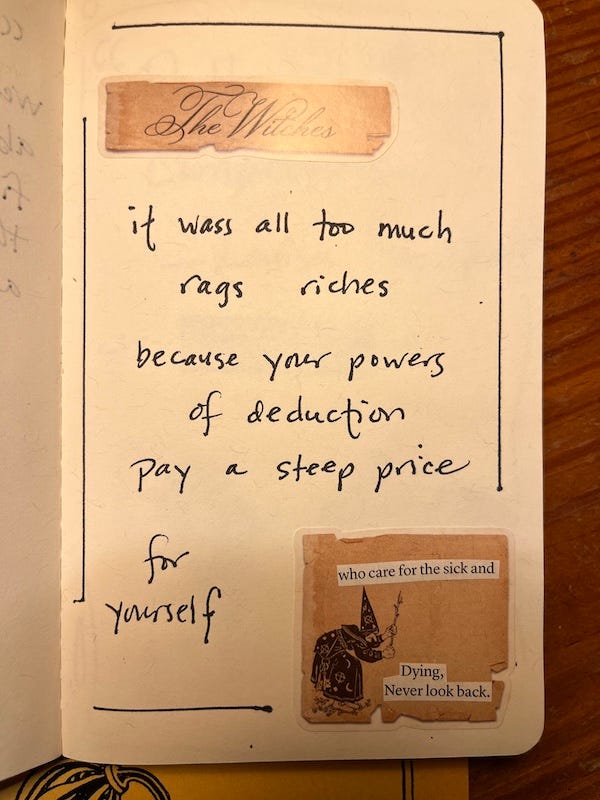
One of Miss O’s many, many notebooks.

All of this is just to say, dear friend, given all that you are going through in your personal life and against whatever landscape this letter finds you, I know that you may merely glance at or dip into this post, and I completely understand. Thanks for reading at all, and whatever you do, don’t strain yourself. Enjoy your Sunday. Let me hear from you when you get a chance.

It’s been a long three weeks. Encouragement!

I keep humming, all the time lately, “It’s You I Like.” Like a mantra.

Love,

Miss O’
P.S. A few weeks ago I published part of a play I’ve been working on, but I don’t know if WordPress is the best outlet for me. Thanks to all who read it, in any case!

Quick Take, for Whites during Black History Month

A Condensed History of Whiteness in America

Hi, kids. If you are a friend of mine, I am not telling you something that you don’t already know; and I’ve written about this before. But a few years ago, my late super, who was from Eastern Europe under communism and who had never learned American history—not unlike contemporary whites in red states today—asked me, “Lisa, can you tell me please what it is about the Blacks?” I didn’t follow. “Why all the whites hate them. What did they do?”

Do you hear his question? Here’s a man who at that point had lived two decades in the United States, himself an immigrant working around every conceivable type of immigrant, from tenants to other supers to management, in the most diverse area of the world, my borough of Queens in New York City. He heard and saw all the racism, surely from the white men (because I still hear it now through their support of Trump), but he really didn’t know where it was coming from. “I have these Jamaican guys who do the electrical work for the building, there, and they are great. They smoke the marijuana, the smell, my god, I hate it, but they are great.”

And so it was that Miss O’ did a brief history for him.

Black Africans were brought to the United States in chains beginning in 1619, if not earlier, men, women, and children captured by white European men or purchased as prisoners in their own land where there was no concept of enslavement for life let alone forever in perpetuity along with your families, which is what whites did in the United States. To justify this horrific practice, and to justify unlimited greed, whites started deciding that they were superior to all other colors of humans. They must be, because as the Puritan descendants of the Second Great Awakening said of being among the elect going to heaven (as explained to me by my 11th grade high school English teacher Chuck Edwards), “Surely, if you were not among the elect, surely God would not have blessed you with a Cadillac.” Or made you white.

The plantation system in the American South made each plantation owner a little king, a greedy little tyrant (just like the “farmer king,” King George III from whom we were emancipated, oh, irony), who kept all the money he made from his crops and made even more by working slave labor just about to death—no hope of leaving, no money, no say—morning, noon, and night, and forcing the strongest Black men to “breed” Black women as a bull would cows, when the tyrant wasn’t raping those same Black women for his pleasure and a stable of more (mulatto) slaves.

Meanwhile, the white people in the South who did not own land, and that was nearly all of them, had no work. They looked on, impoverished, as these Blacks were “given” houses and food in exchange for work, work which poor whites did not have, homes which poor white were not given (clearly not comprehending the horror). There was a growing (and understandable) resentment. To quell this, white tyrants told their legions of poor whites, “Always know that at least you are superior because you are not having to labor like these beasts.” To appease them, the tyrants dropped a nickel and handed a gun to any poor white man who was pissed off and said, “Guard my slaves.”

And so it was that for 400 years, poor, uneducated, angry whites came to believe that they themselves would have more if only those Blacks weren’t here, and that guns were identity. And they weren’t wrong, though their logic was. What these charming, charismatic white tyrants were able to convince these poor whites of was that he, the landowning rich tyrant, had no choice but to use “free labor” so that he could be rich and live like a king, that God had blessed him, and he had to fulfill this promise to God by being the richest one.

And despite a Civil War, despite education and marches and all of the hard work of generations of Blacks, Native Americans, and enlightened, moral whites (immigrants all), there are still vast swathes of white Americans who truly believe that IF ONLY there were no Blacks (and now browns, too), they themselves would have it so good.

The Donald Trumps of the world—the ones who deny wages, safe working conditions, clean air and water, and health care to anyone not them—have been such absolute geniuses at convincing poor white people to feel so sorry for them that these poor white people empty their pockets and do whatever it takes to prove their love to the rich white man God. And the poor white people still blame Blacks for their fate.

I learned about this book from the Toni Morrison documentary, The Pieces I Am. Recommended reading.

Following my quick take on the horrors of the Black experience and white supremacy, my building super from Eastern Europe was silent. He looked at me and said, “Why they don’t kill all of you?”

That’s the million-dollar question.

I’m about to make a couple of broad generalizations.

Black culture in America is a culture of love and faith. It’s a culture rooted in ebullience, joy, dance, music, energy, justice, hope, and deep, deep love despite deep trauma and great suffering. I have seen it and felt it all my life. Not that there aren’t assholes and tyrants; I’m talking about roots.

White culture in America, dating back to Puritans and colonizers, is a culture rooted in punishment, jealousy, cruelty, demands for some kind of Christian self-abnegation (that no one can achieve), faith in (one man’s) white superiority, and fear born of trauma, our original sins of Native genocide and Black enslavement. White is right. Spare the rod and spoil the child. “God’s will” is for me to lord it over you. I am God. Not that there aren’t lovely white people; I’m talking about roots.

See how white supremacy works? Image from the web.

And I am so fucking sick of white culture—the good things whites bring to the table are, perhaps, irony, Greek logic, and wryness (all of which are embodied by The Onion), and of course Mary Oliver and Shakespeare and bagpipes. Right now, for me, that’s about it. Even the best of our white politicians play by the white tyrant’s rules without even realizing it. We all do.

You can follow Digital Meddle Your Childhood Ruined on Instagram.

“Mediocre white boys,” to borrow from the brilliant and righteous Rep. Jasmine Crockett (D-TX), have taught all of us whites—ALL of us—to feel sorry for them. To pity them, poor helpless things. To give them money and power. To give them a pass. Meanwhile, all that the rest of us sentient whites do for our entire lives is play that same old song, “RESIST,” and I am so fucking sick of it. These white men rape, they steal, they stiff, they destroy, and then they smile, and we pity them all over again, don’t we? And carry our clever signs to the latest march.

This is changing. I do see hope. But we have to crack it all open and drain out the rest of the pus. White culture as a whole, ultimately, must change, or else we take the planet down with us. And this Black History Month, we have to see the joy of embracing all the greatness that Blacks bring to the world. Celebrate. Emulate.

Love from her core of rage,

Miss O’

Wise words from t

Don’t Let It Be the Last Dance

Reflections on democratic voting in a time of rising fascism

I Sit in My Kitchen Rocker Waiting…

As I Lay Dying, “I Stand Here Ironing”…I keep thinking of titles around the anxiety of working out our lives, and deaths, so much of which is out of our control. We have to, more often than not, depend on others, on the actions and emotions and convictions of others, to make our own lives bearable. And today I’m feeling how terrible that can be, and also how reassuring.

Today I “early voted” here in Queens, surprised by the lack of turnout, in some ways, but this being New York, local Democrats don’t have a lot of competition. (Still, I live in an area full of Trump voters, particularly Hispanics, too many of whom more or less worship the man (if tee shirts are evidence) who plans to deport them within days of returning to office, citizens or not, it won’t matter.) The poll workers gave me such heart, though, just to see them there, all caring so much about democracy.

Scenes from a day of early voting, Queens, NY

I’ve been imagining during my sleepless nights the consequences of a second Trump presidency—I cannot see how we are really here, but then no one imagined a Trump to begin with, so showered with love and celebrity coverage by a besotted press. Last night I went to see a play at 59E59 Theater here in New York called Mrs. Stern Wanders the Prussian State Library by Jenny Lyn BaderThe subject of the play is the period of days a young Hannah Arendt was imprisoned and interrogated by a Nazi officer (whom she ultimately convinces to help her) in Germany in 1933. The investigating Nazi officer in the early days of Hitler’s Chancellorship and martial law is convinced that Mrs. Stern, rather than working on her dissertation, is mimeographing and distributing overseas the antisemitic writings and cartoons in the German papers. Because of who she is, we know that Arendt gets out, since she will famously go on to cover the Nuremberg Trials, there to develop a philosophy around the nature of evil and the ordinary people who become complicit.

I became increasingly, deeply horrified watching this play as I realized that this is America’s future, quite literally, with camps and the rest of it, unless Harris is elected. And this time, no hyperbole.

The treacherous New York Times gets scared straight.

The consequences of this election will affect every citizen who is not rich and sociopathic in horrifying ways. Anyone who says we aren’t all in this together is a dope. Years ago (I probably told you this story), I was at a favorite bar in Midtown Manhattan, a great after work sort of bar, and there was a commuter from New Jersey there sometimes, if he had just missed a train. We would chat. When Obama was running for president, I said, “We are all in this together,” and the guy (white, 30s, business type), looked up from his scotch and smirked, “I’m not.” And I said, “Where do you think you got that drink? How do you think it showed up on that bar?” and he said, “I don’t give a shit.” And I got up and said, “You are despicable. I believe I’ll have my drink down here.” And he looked at me, stunned, as I moved. A few days later, he was at the bar again, and he tried to catch my eye. I cut him dead and walked on to the end of the bar for a seat. Returning from the restroom later, he paused and said, “Can a despicable person buy you a drink,” and I said, cold and hard, “No thanks.” Cheers.

Bars are equal opportunity institutions in society, as are commuter trains, and they don’t generally fail us. Two institutions that have failed the United States, however, and most decidedly in the past four decades are 1) the free press; and 2) the Christian Church. Both used to have one thing in common, in that (at their best) in their respective ways, through investigation and preaching, they existed to bring to the People the truth, the way, and the light. Today, both, at their worst, have one thing in common yet again: the love of money.

The love of money is the root of all evil, and if I hear one more ill-informed person of “faith” say even one more time, “I think Trump is better for the economy,” I may run naked and screaming into traffic on the Brooklyn-Queens Expressway (the “economy” under Trump was Obama’s until Trump wrecked it). Today’s Evangelical Christian churches, since the televangelism on TV in the 1980s to today, preach “send me, your pastor, a lot of cash, even if it means emptying your savings accounts.” The newspapers, bought out by billionaires with egos the size of Arnold Palmer’s junk (keeping it classy, Trump), want to curry favor for and provide support to other billionaires. The information printed in today’s newspapers is accidental and incidental to their owners’ true purpose. And yet journalists, as do some Christian pastors, try.

Sister Lisa and Brother Mike in conversation

Despite the quotation marks I use now—”free” press and “Christian” church—I try to remember that there are, really, so many good people. We cannot give up. Please vote. Encourage others to vote. As I walked home from my polling site this morning, a woman accompanying her (I think) elderly mother on a walker stopped me, pointed to my sticker, and asked where the polling site was. I told her, and she looked disappointed—it’s a bit of a walk—but she thanked me and turned to explain to her mother in their language. Because there really is plenty of room for all of us.

With freedom and justice for all, dammit.

Love,

Miss O’

Share

Morning Glory, Message from a Friend in America


Yesterday walking from the farmer’s market
My friend
Who is
Never wrong
Unfortunately
Asks me about the trip
I’m taking home
South
To see
A gang of friends
All of us this year 60
My friend says “You need to be prepared
For their health.” 
She says
“Do you know about their health?”
What the hell kind of thing is that to ask
I become wobbly
And I realize
We are dying
My friend who is never wrong
Unfortunately needs me to face
The inevitable
Age and death
Of friends, of myself, of all this.

Yesterday my friend who is
Never wrong
Unfortunately
Tells me as we walk
In her way
That she has accepted
Defeat and the end of the republic
Tells me to be careful what I say
In the South
So I don’t get in trouble
And I say
fuck fear
So loud
That Appalachia can hear me
Her lips purse,”Mmmm.”

At the kitchen table with her husband
My friend who is never wrong
Unfortunately says
“I have sad news. All the morning
Glories are gone. All of them are dead now.”
And I know I saw some on my walk the other day
Bursting in purple glory bloom still
But I guess it’s today they stopped blooming
And I missed it. I say nothing.
“All of them are gone. Sad.”
And I sit with my tea and my scone at
My friend’s
Formica table knowing I am wrong about
Everything
I guess
And don’t know how to be
With all this, all this death, all this unstoppable
Ending
“Sad.”
Mmmm.

On my way hope
I mean home
I buy a bottle of good red wine
“Hello, Sunshine,” says the employee
Who says I bring the light
Even as I wander out
Wonder how I will live
In red sips
Of this dark world.

Today
This new morning,
blue sky and sun,
I have a text from my friend
Who is never wrong,
“So I was wrong about one thing:
I still saw some morning glories this morning—
they’re there if they are facing East.
The ones facing South were gone though—
as they were gone yesterday.”

She was wrong about one thing.
And if she was wrong about that
One thing
She could be wrong about
(Fortunately)
Almost everything
And to everyone in America I say
Like the faithful who practice
In every faith
Face East, not South
And we, too, will not be gone.

Morning glories of Queens, facing east. Photo by Miss O’, fall, 2024