The View Beyond a Sky That Stops

Swearing to serve and protect

This New Year’s evening at 12:01 AM, newly elected New York City mayor Zohran Mamdani will be sworn into office by New York Attorney General Letitia James. I cannot recall the world watching a New York City mayoral election before, but then, America has not been engaged in a civil war since 1865, this time with a transparently corrupt U.S. president trying to break up the union, smashing it into pieces using a Bible as a cudgel.

Mayor-elect Mamdani will swear in on a holy Quran, and our treasured Under the Desk News correspondent V Spehar explains what you can say to your MAGA community as they freak out:

@underthedesknews

Following her list of all the various volumes politicians have chosen to swear in on, V asks us what we would swear in on, and there is no question that I would swear in on my boxed edition of Truman Capote’s personal story “A Christmas Memory.” I can’t imagine a more American story, centering on a young queer white boy in Alabama, abandoned by his divorced mother and being raised by evangelical relatives. The one true protection he has is his cousin, a much older woman, a bit balmy and childlike, who truly loves and cares for young Truman, known to her as Buddy.

The memory set around Christmas, from the baking of fruitcakes to the finding of a tree, couldn’t be more Hallmark on its surface, but far less shiny and much more emotionally complicated, particularly the details of abject poverty that most Americans would fail to understand today. Back then, and this was my parents’ time, being poor was nothing to be ashamed of (though what would be familiar is the forces of corporations doing everything possible to keep Americans as down as was possible and still get them into the factories and mines to work, but this isn’t part of the story).

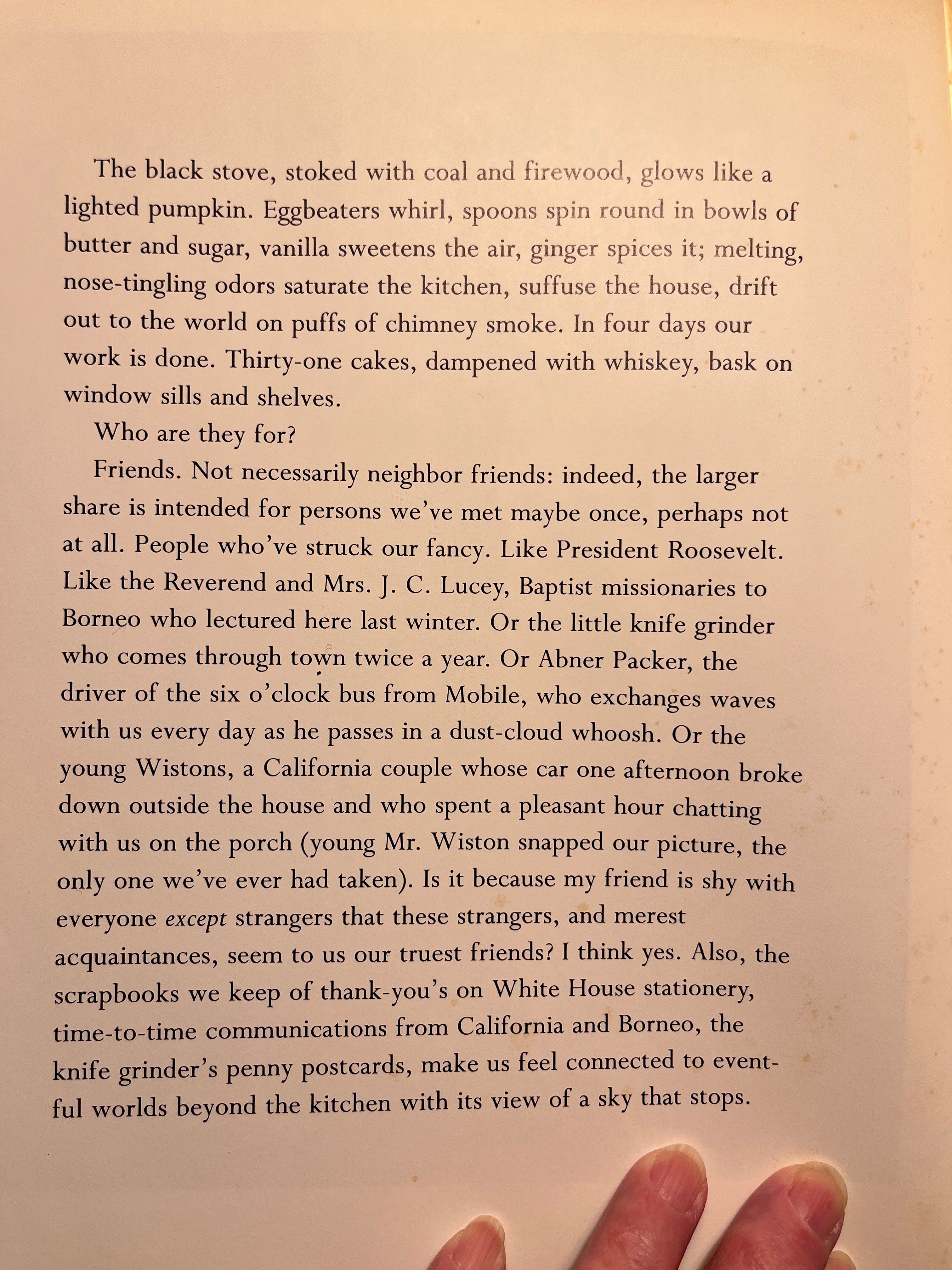
Below is a selection after the baking has commenced (with whiskey for the soaking obtained earlier in the story from Mr. Haha Jones, a Native American riverside cafe owner who sells moonshine illegally (this being Prohibition), Capote casually revealing more complexities and hypocrisies of life in the United States).

Strangers “seem to us our truest friends.” That, to me, is a kind of American ideal, born out of the hatred too many of us experience from those closest to us. Connections to distant places, gratitude to presidents and knife grinders and passers-through equally, Indian or Black or white—all the people of their lives, accepted and shown appreciation, despite the despotic rule of the Christian relatives they try to forget. And their little dog, Queenie, is unforgettable, too.

It’s a beautiful, human story, focused on love between friends. Every year for many Decembers, my friend Barry Hoff would stage “A Lovely Little Reading” of this story, complete with fruitcake he baked himself, for a gathering of friends on the third floor of the now closed Hourglass Tavern on W. 46th Street, shuttered by extortionist rent, something we are counting on Mayor Mamdani to address for the good of all of us.

I always took for granted the tradition of swearing on a book, a bible, though I never realized I could choose what book I wanted (I hope you watch V’s video). Were you to take office, what book would you swear on?

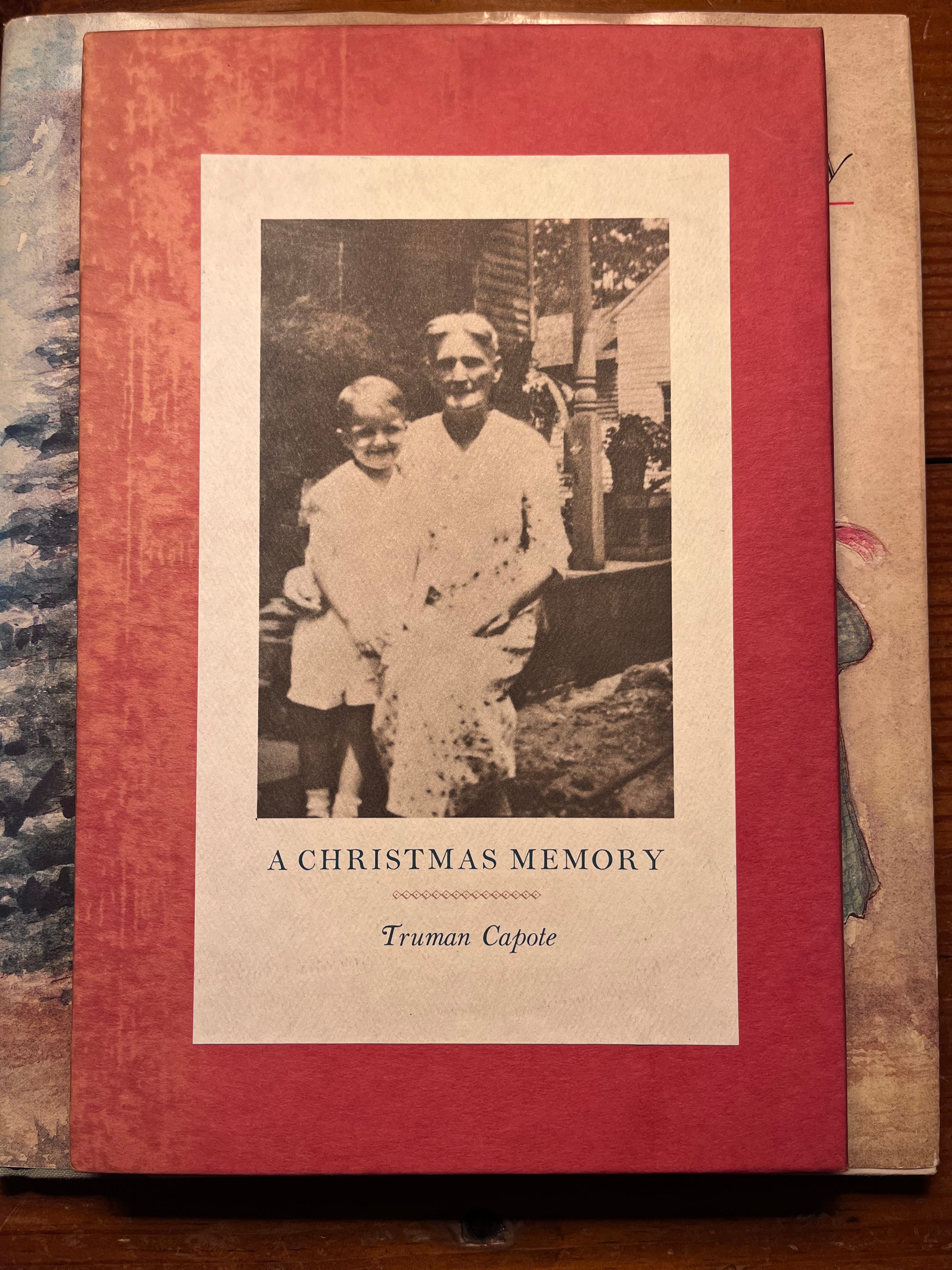
“The only photo we ever had taken”: Truman Capote was friends with Nell Harper Lee, a neighbor, who used him as model for Dill in her novel To Kill a Mockingbird, and helped Truman do his research for his classic true crime story In Cold Blood.

Sending out love and high hopes this New Year’s Eve, as I fittingly watch a Marx Brothers Marathon on TCM, the absurdity of which satire is all too contemporary,

Miss O’
Gratitude

(Even when you keep missing a beat)

How have you been? How was Thanksgiving? Mine was really nice, thanks, celebrating with friends (my age) who also lost their mom, two days before last Christmas. In honor of my mom, I made a version of Lynne’s homemade stuffing, and my dad and Jeff tried to make a version, too. Foods are touchstones. I hope you were able to make and enjoy some delicious touchstones, too, in the midst of feelings.

This year has been hard, hard, hard on far too many people on this earth and much of the world suffering is the hands of three white male power mongering thugs in their 70s (Trump, Putin, Netanyahu), and their minions, and I have this problem where I feel guilty even thinking about personal joy or grief amidst all the suffering. (As you know, I live alone for a reason.) And I’m struggling with myself, as we do. It’s funny to keep doing this at 61, but here we are.

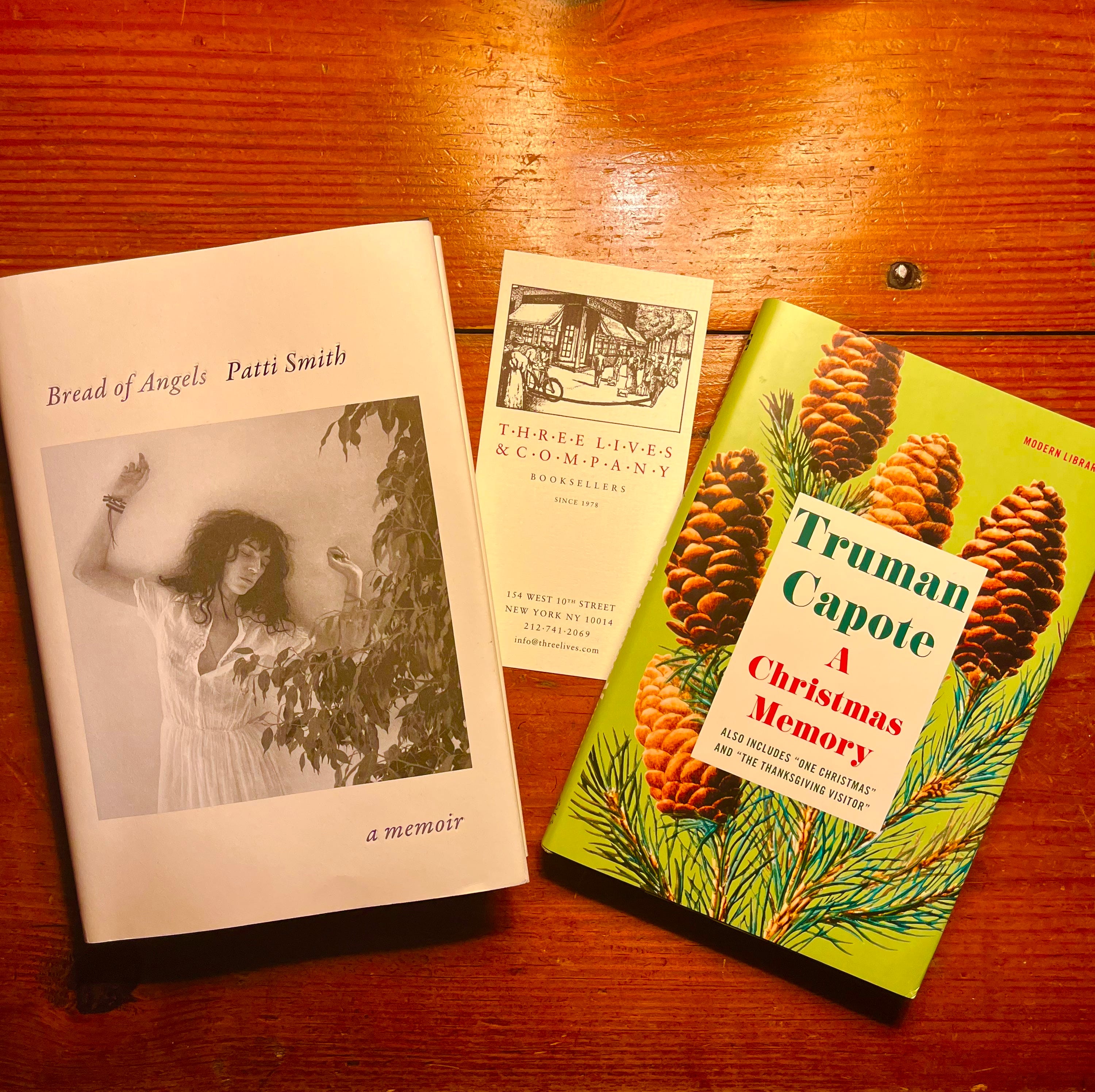
To calm myself and try to recover a sense of why I’m alive, on the Monday for part of my time before reflection week over Thanksgiving (see what we might call “The White Blog”), I spent a day bookstore haunting, walking from W. 10th Street in Greenwich Village over to E. 2nd Street and Avenue B in the East Village (Alphabet City). At my first stop, the Three Lives & Company Booksellers, a lovely small corner door shop, I found and bought Patti Smith’s latest memoir, as well as another copy of Truman Capote’s Christmas classic in case, as the store manager agreed, “In case you need a gift in the hopper.”

Book store people get you. The same woman who rang me up helped a man whose female partner brought him in to help him take up reading as a hobby. (I had to sit with that, like reading was a rarefied activity.) He liked war and history; I wanted to recommend the Capote, but I didn’t interfere. I recently read that in the United States, only around 14% of adults read for pleasure. That really hurts me. Even my dad, Bernie, who didn’t graduate from high school, read the newspaper every day. I told you this: My mom, Lynne, bought him Travels with Charlie, and he liked it, but The Godfather was the book that hooked him. And this lack of American reading reminded me of something back nearly thirty years ago, in summer, a cousin and his wife and four kids were visiting, staying in the upstairs rooms in my parents’ small house—this was back when I was still teaching in Virginia, and my brother Pat lived there too. My brother Jeff lived in an apartment then and took the day off, and we all gathered to take my relatives into D.C. for the day. While we waited for them to come downstairs, my mom sat in her chair, my dad in his, Pat on the loveseat, Jeff in the corner chair, I in a side chair, each of us with a section or pages of The Washington Post (back when it was a real newspaper). We read. My cousin came downstairs into the little living room and stood still. Gradually, we looked up, “Oh, hey, John,” and he stood staring. I asked, “What’s wrong?” And he said, “I’ve never seen anything like this.” What? “A family reading.” Though this was a weekday, we knew such times generally and all of my growing up as “Sunday.” (At Christmastime, we all listened together, “A Child’s Christmas in Wales.” That would’ve made his head explode.)

Patti’s memoir (I’m up to page 113, savoring it each night so as not to have it end) is essentially a beautiful love letter filled with gratitude to everyone who helped her become. And Patti (I feel I can call her that) has made videos on Substack, posted also on Instagram, and she talks about living in gratitude. I feel every word. In her latest (hyperlinked above) she talks about finishing her tour for the 50th Anniversary of Horses, which I told you I was lucky enough to see at the Beacon here in New York.

One of the first people to help Patti Smith find her voice in the early years after she came to New York at age 19 was the budding playwright and musician Sam Shepard. I remember reading Shepard’s plays in college, after he’d won the 1979 Pulitzer Prize for Drama for Buried Child. I realize now that he’d only been a real voice in the theater for ten years when I first read him—that’s wild to me. He seemed so old and established. But then, when I saw Patti Smith’s cover for the album Horses, I couldn’t have known she was only 28 to my 11. She was worlds away.

In truth, I didn’t discover or really attend to Patti Smith at all until reading her memoir Just Kids. I’d heard “Gloria,” and “Because the Night,” and of course I knew who she was, had seen Robert Mapplethorpe’s photos of her, but she scared me. Sam Shepard scared me too—I designed costumes for of his two one-acts, Cowboys #2 and Red Cross, when I was in college, ca. 1984, and his writing was out there. (I was part of an acting ensemble for Savage/Love, a play he wrote with Joseph Chaikin, but we never got to perform it.) Smith’s memoir/fantasia The Year of the Monkey in part chronicles her time nursing Shepard as he was dying of ALS, spending days typing up his final book as he dictated it from a wheelchair. (I told you about his observation, “Patti Lee, we are a Beckett play.”)

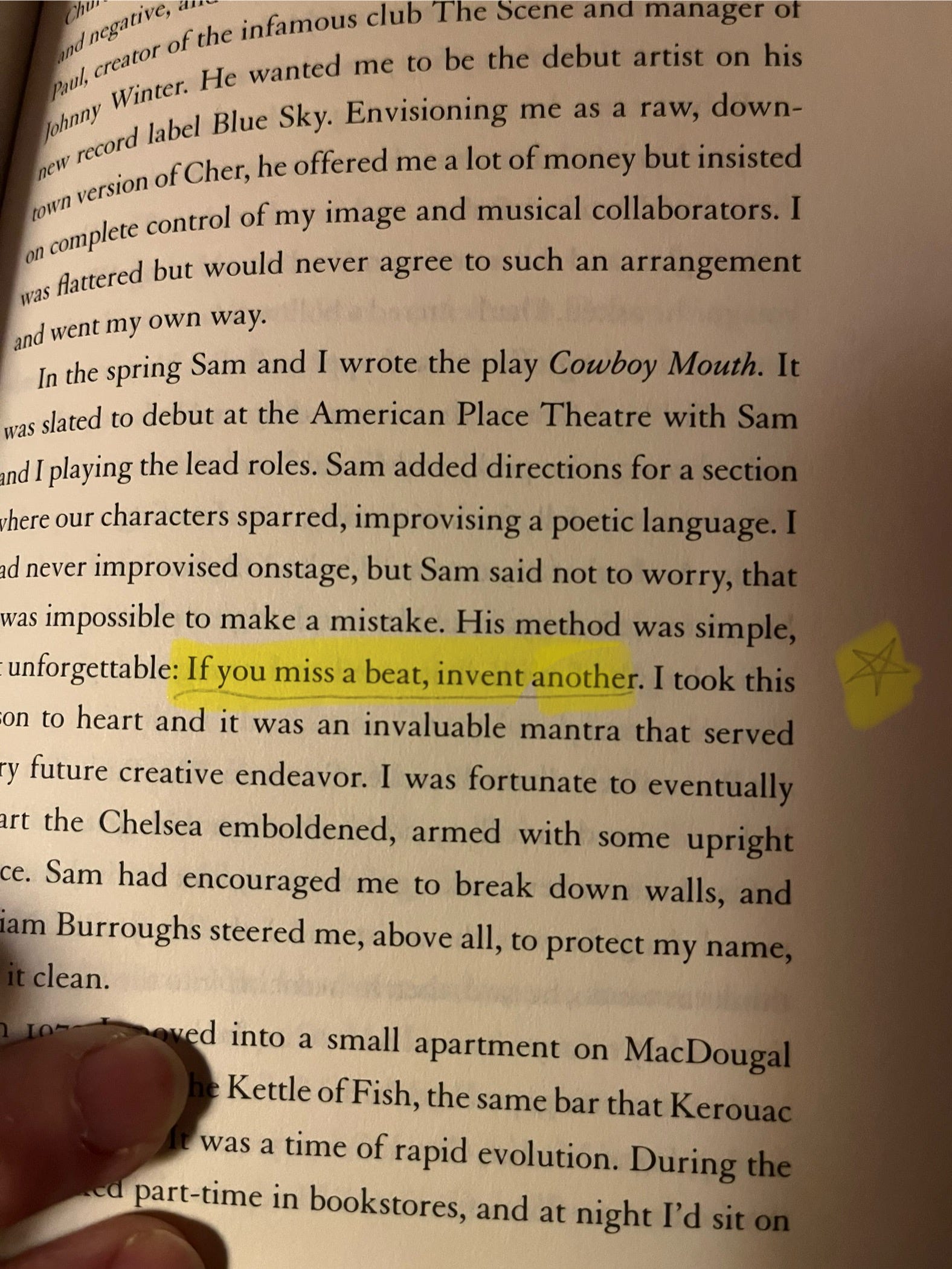
Sam Shepard’s advice that has served her a lifetime. We could all take a memo.

When I read of Patti’s childhood, I feel embraced by love, recalling my own best parts of childhood. She writes like no one I’ve read—she’s as idiosyncratic on the page as on vinyl, and it’s just wonderful.

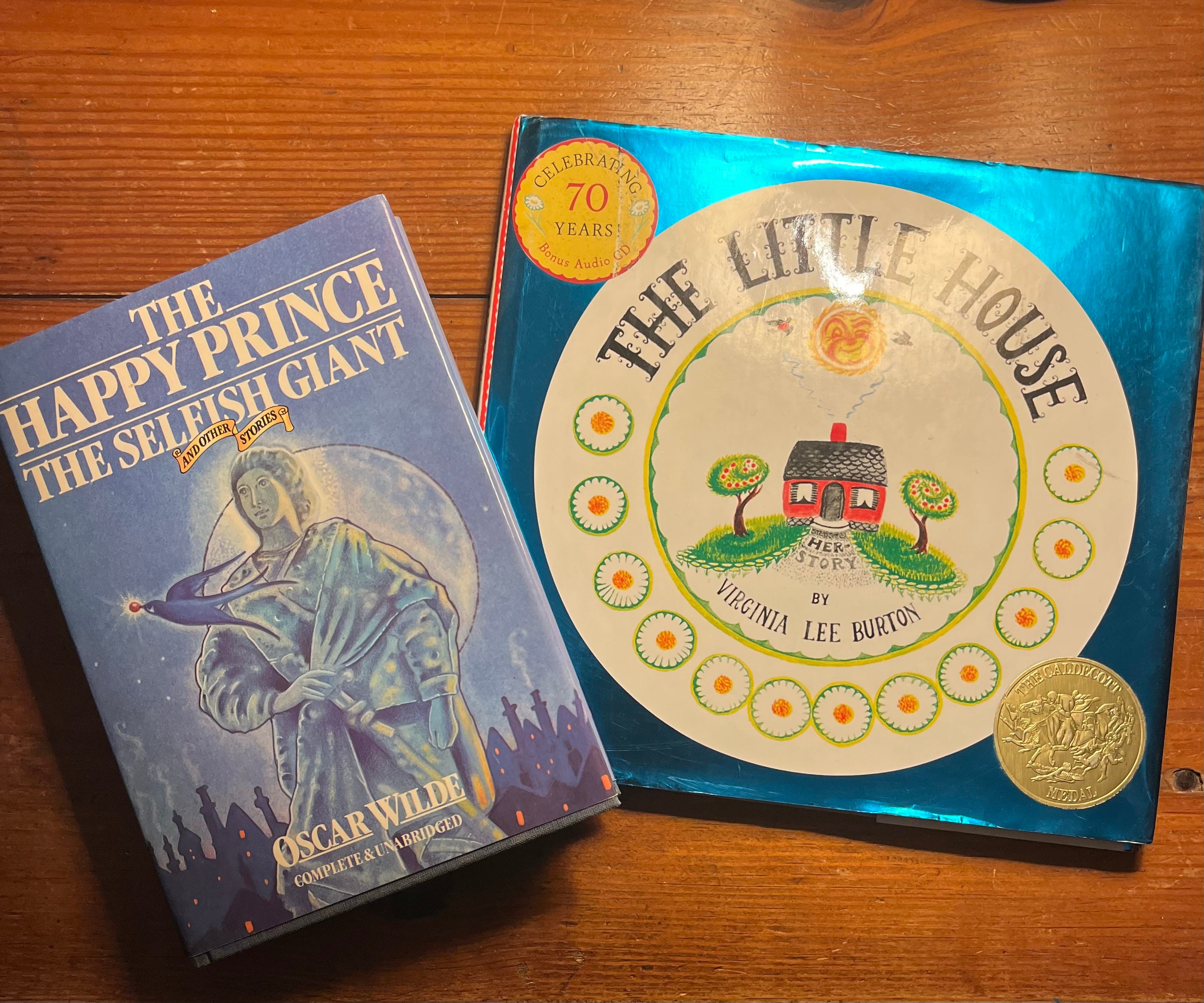
One of Smith’s childhood memories is of reading Oscar Wilde’s “fairy tale,” “The Selfish Giant.” When I became obsessed with Oscar Wilde at age 15, my mom gave me a collection of his stories for children, so I reread this particular tale the other night. I remember that I was turned off by the religious turn the tale took; but Smith spent part of her youth as a Jehovah’s Witness and took religion seriously, until she couldn’t anymore. By contrast, I grew up free from religion as a part of my life but still had questions about God. (Are You There, God? It’s Me, Margaret was a favorite book.) But I knew the feeling of that first book, that first story, the one that sparked the love of reading, the need to read more.

Patti Smith’s favorite story, “The Selfish Giant,” and mine, The Little House.. What’s yours?

I know, I feel, I see how important reading is—for so many reasons beyond the stuff you learn. I was thinking about my cousin’s surprise at seeing a family reading together; now I imagine it’s families scrolling on phones, and while that is not dissimilar, the act is different. Scrolling is not meditation, somehow, but something that distances people. (There’s data on this.) There’s a calmness that comes when engaging quietly with print text. Something in the tactile element and the way our brains have spent centuries adjusting to the act of reading, and even better, surrounded by some books that everyone can see on display—it’s a shared experience even when it’s solitary. It’s not about algorithms, is what I mean.

And Patti Smith is so different from me, reading her memoir reminds me that sharing the particulars of our lives can lead to universals, in that we see ourselves as human. But I can love that Patti and I share a love of something Wildean, even if mine is his whole creative life. And like me, Smith has touchstone artists—hers Diego Rivera and Arthur Rimbaud; mine Katharine Hepburn and Virginia Woolf. Their art gave us our own humanity, opened the gate, turned on a light, pick a metaphor.

It’s such a lousy time to be human right now—“lousy” is hardly the word—and yet I know I need to walk around grateful. By some miracle on Friday, for example, I found my way through to finishing a major project at work, could see my way to the end, I mean, and was so relieved, that as I took my afternoon walk I fairly floated. It’s such a human thing. Even Patti Smith makes the finishing of her tour—a 50th anniversary tour as a superstar—sound so human, and then she had a tooth seen to at the dentist, talked about moderating a talk back after the opening of the new Frankenstein and talking to Guillermo Del Toro like he’s a person, because he is, an artist like her, but a person. Creatives living their creative lives pausing at moments to scream, “Fuck Trump.” Like the rest of us.

We’re all doing our best, getting on with the work of our worlds. Loving our friends, our families, telling them that. Expressing gratitude for a good chair, a coat that keeps us warm, a hat that stays on in the wind. An orange. A book.

I’ll ruminate on all the horrors of our country again soon—I think I’m waiting for an idea of what we need to do, besides not quit. Remember was Sam said to Patti, “If you miss a beat, invent another.”

Sending love,

Miss O’

East 3rd Street, NYC, should you like to visit there.

Offloading our hearts and minds, tempest-tossed, and the salve of art

O, I have suffered
With those that I saw suffer.

(Miranda, The Tempest, Act I Scene 2)

I read this week that the tech bruhs, so called in current parlance, see the world as being divided into two classes of people: the thinkers and the scrollers. While they, the Thinking Class, devote themselves to higher learning, philosophy, and deep work, affording the same wealth of life experience and cashflow to their offspring, they themselves are engineering the planet so that the rest of us, by which I gather they mean the 99% and our offspring, are relegated to the Scrolling Class, those who work as drones and merely consume whatever they, the Thinkers, put out for profit.

It’s all very Brave New World, a novel I read in high school and can’t shake. Will you be made into an Alpha or an Epsilon? Will you even know? And even if you are an Alpha, watch out if you forget to take your soma (“the opiate of the masses” that replaces religion) and have an original thought. All hell will break loose, and the only antidote is a rebel copy of Shakespeare.

My library was dukedom large enough.
(Prospero, The Tempest, Act 1 Scene 2)

This week the Trump Administration, illegally as usual, dismantled the U.S. Department of Education, spreading all the allocated funds around (which legally only Congress can do, but Republicans) to different departments, so K-12 education is now under the U.S. Department of Labor. Huh? In a seemingly unrelated development, the Trump Administration also demoted a bunch of educational degrees to “nonprofessional,” meaning people pursuing nursing, say, or teaching, will not be able to take out unlimited loans to attain a degree. Not only were the listed degrees for women-dominated professions, the professions listed were those whose members are legally bound to report suspected child abuse. If no one is educated to take those jobs…

Are you following? The Pedo-in-Chief is terrified of the release of the Epstein Files, and his Secretary of Education, Linda McMahon, whose husband Vince McMahon was set to go on trial amid accusations of child sexual abuse until a Chicago judge paused the case last December when Linda was announced as Trump’s pick for her new position. Meanwhile, Trump’s former “spiritual advisor” was arrested for child rape and plead guilty. In a call-in show I heard a snippet of this week, a caller demanded to know what was “wrong” about child rape.

The cumulative effect of all this during a single week has made me a bit of an emotional wreck, but it was an independent journalist on Instagram who formally linked all these pieces for me. From Love Ethic Yoga:

Moving K-12 education to the Department of Labor while red states are removing child labor laws & dropping the age of consent to 12 or 14 is a calculated move. The leaders of these departments are pedo📁files or pedo apologists. This is NOT coincidence.

Uneducated children are easy prey.
Hungry children are easy prey.
Homeless children are easy prey.
Unaccompanied minors are easy prey.


These predators are baiting the water. They’re creating the proverbial “fish in a barrel”. Yes, privatization is part of this but we cannot forget how many pedos are in this current admin. We cannot let them get away with this.

I got ill—I mean, Trump and his people are transparently, openly constructing a world where child sexual abuse is normalized, institutionalized, and unstoppable. These “men” want all young women and girls (40% of whom between the ages of 15-44 want to leave the United StatesI saw in a recent poll) under their complete control in order to force-breed children, for either labor on behalf of or the sexual pleasure of (white Christian) men. Once the children “age out,” a term I learned on Law and Order: SVU, they will be, one presumes, forced to push through their trauma with slave labor, living in one of the concentration camps being constructed all over the United States.

Utah’s planned mega-shelter should be like a jail for homeless people, one widely embraced group says

This is the Brave New United States of America, friends.

It’s more than hard to take—it’s impossible. This insanity has to stop. We need to see handcuffs and prison bars on the right people, and soon. We know this.

I can’t take in everything—you can’t either. So while I know there’s Israel’s defiance of the ceasefire, and Russia’s wish-list labeled a “peace agreement” by Trump and Rubio (rejected, thank goodness) by Zelensky; protests in Charlotte and Raleigh over ICE raids; so much, so much, my god, it was the children and their protectors I focused on, “offloading” the rest, more or less.

This week on a work Zoom call, a colleague mentioned that there is always work or training or something that we simply have to “offload.” It’s not a term I knew—but I got it. You just pass that conceptual understanding to someone, maybe a spouse who gets plumbing or a coworker who is good at Excel, and you don’t worry about trying to learn that thing, much less master it. You only have the capacity for so much, and recognizing that is not a bad thing. (That said, we all have to trust in our capacity to learn new things, and try to do that, even though in my early 60s I’m finding that I have to immerse myself with the focus of a monk to his devotions to do something as complex and unintuitive as Jira (if you don’t know, don’t ask), say, but it’s reassuring to know that I can still do it, if more painstakingly.)

Speaking of offloading: I no longer have a creative life in the recognizable sense. I’m sorry about it, but between taking care of family, holding grief, learning new things on the job, and this fucking administration’s atrocities, I had to let something go, and that was it—and it’s no great loss to the world, obviously. That out of the way, I’d like to celebrate the achievements of women artists whom I know as friends. In a world, and more specifically a nation, that doesn’t value women, children, innocence, creativity, or truth, here’s some art you need.

  • Read Amanda Quaid’s debut poetry collection No Obvious Distress, which explores her (still) young life with Stage IV metastatic mesenchymal chondrosarcoma (learning the pronunciation of which seems to be more trouble from some people than her years of treatment, so say the name) in all the ways;
  • Read Anna Citrino’s fourth collection, Stories We Didn’t Tell, which explores the unspeakable hardships and abuses of her American prairie women ancestors, based on the poet’s decades of research, in rich language;
  • Watch Patricia E. Gillespie’s documentary, The Secrets We Burywhich I saw at IFC here in New York in its premiere screening this week, about a true crime, told with love and empathy and not sensationalism;
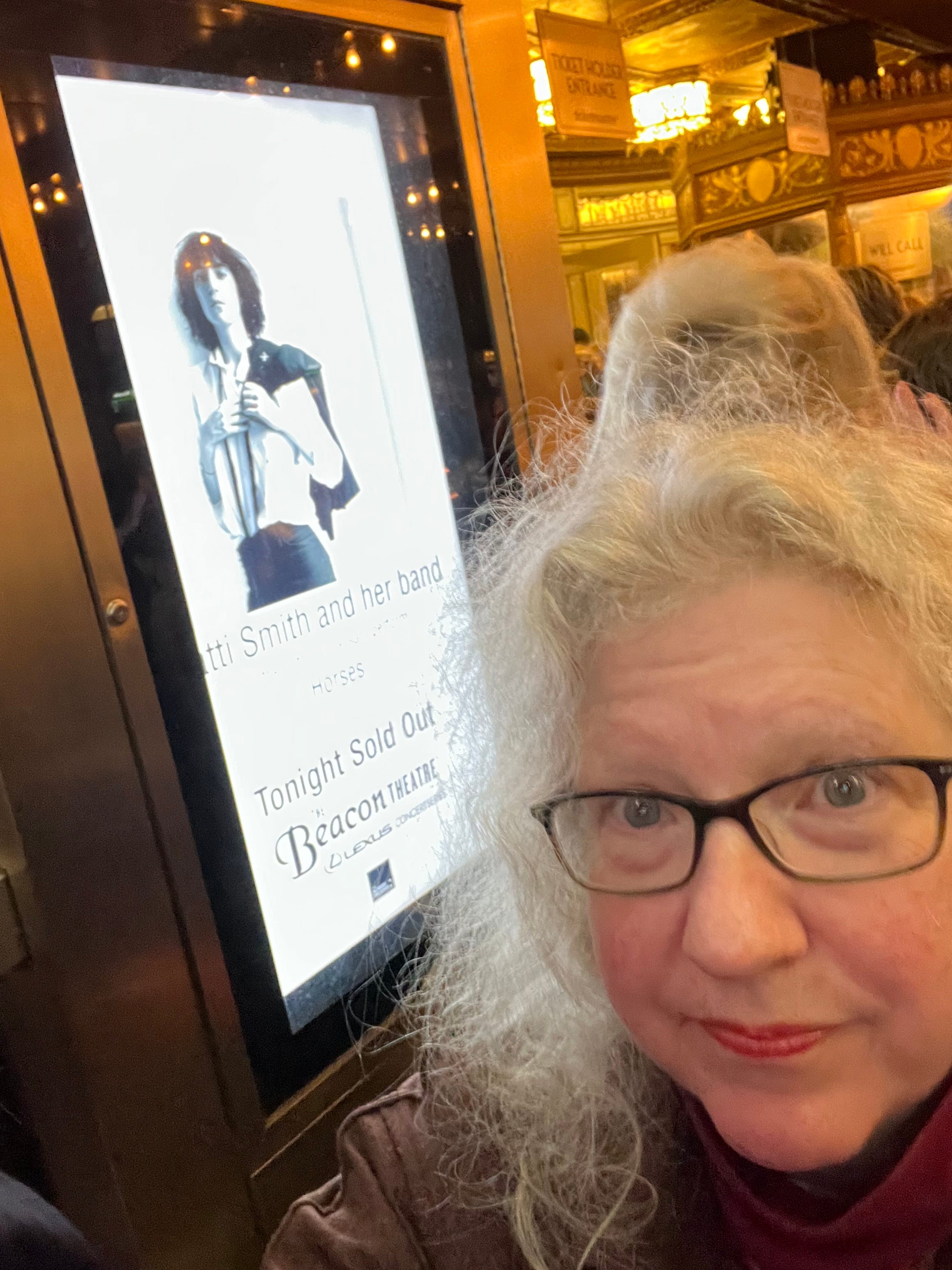
  • Listen to Patti Smith’s Horses (1975). (Envy me my Row X seat at The Beacon Theater on Broadway Friday night in New York City to see Patti Smith and her Band play the shit out of Horses in its 50th Anniversary Year, plus encores of classics. Patti also spat, twice, and it was glorious.)

So lest you think Miss O’ has given up on art, I haven’t, and I hope you haven’t either. There is nothing on this earth as satisfying as a creative act, something you can point to and say, “I made that.” There was nothing, and now there’s something, and I did it. And the world is more colorful and right and full than it was before you created that thing, however small, even making a smile happen on a stranger’s face in a notebook store, which I did on Friday night before the concert. I did that. That thing, there? You did that. Not AI, not engineered by some tech bruh, or ordered on you by some basement-dwelling podcaster or a bottom feeder in Washington. You. Just you.
Let’s stop scrolling together and get seriously radical in creative community. Take a moment to read. To be quiet. And then connect.

Here’s Mr. Rogers on the value silence from Charlie Rose, which is a clip I hope you watch. “My, it’s a noisy world,” he says, and it is. There’s more he goes on to say from his 1994 book, You Are Special, including about his professor, Dr. William Orr, who told him, “You know Fred, there is one thing that evil cannot stand, and that is forgiveness.” Take a minute with that. As a reader, Rogers says that the white spaces between the paragraphs are more important than the text, by which he means that if you aren’t using silence to reflect on what you are reading, you are missing the point of the endeavor. You can see more clips of Fred Rogers here. “A great gift an adult can give to a child is to let the child see what you love in front of them.” Whether it’s car repair, lawn maintenance, playing cello, fixing things, reading, singing, cooking, telling stories, dancing, whatever it is (note: what you love, not what you exploit)—that is the gift. I think I try to do that in life—to show love of life in greeting others. It’s tiny—I’m not a worldwide creative power like Patti Smith—but really it’s about being present, as Rogers says, moment to moment (and it’s the most important work in rehearsing a show, as shown me by director Maureen Shea). Doing things even a little larger than ourselves, then, in presence, is the point. Mr. Rogers only cared to be recognized if it made a child feel special—Fred Rogers liked “not the fancy people,” but regular people, and he aspired to “be the best receiver I can ever be—graceful receiving of what someone gives us; we’ve given that person a wonderful gift.”

Miss O’ most gracefully received.
The play I’ve been quoting here interstitially, The Tempest, is my favorite Shakespeare play; in some ways it’s like a compilation reel of all his best ideas, and his final play and only original plot, his retirement play. I’ve seen four productions of it—at the Globe in London, with Vanessa Redgrave as Prospero (it was awful); at the Shakespeare Theater in Washington, D.C., directed by Garland Wright, which still ranks as the top theater experience of my life (even after seeing Hamilton and Gypsy with Patti LuPone); one at Classic Stage Company downtown, with Mandy Patinkin (okay); and the fourth at St. Ann’s Warehouse, an all-women cast set in a women’s prison, directed by Phyllida Lloyd, with Harriet Walter as Prospero (fantastic). The most famous speech of the play, by Prospero, comes in Act IV, and I always think of it when eras end, as well as even a simple good thing, and especially a life:

Our revels now are ended. These our actors,
As I foretold you, were all spirits and
Are melted into air, into thin air;
And, like the baseless fabric of this vision,
The cloud-capp’d towers, the gorgeous palaces,
The solemn temples, the great globe itself,
Yea, all which it inherit, shall dissolve,
And, like this insubstantial pageant faded,
Leave not a rack behind. We are such stuff
As dreams are made on: and our little life
Is rounded with a sleep.

(Prospero, The Tempest, Act 4 Scene 1)

In the final act of the play, Prospero’s daughter newly in love sees all the possibility of life, and this is from where Aldous Huxley took his dystopian novel’s title:

O, wonder!
How many goodly creatures are there here!
How beauteous mankind is! O brave new world,
That has such people in’t.

(Miranda, The Tempest, Act 5, Scene 1)

Sure, love is wildly naive, but it’s the beginning of everything. There’s a new world to be made. Let’s stop the fucking fuckers and do that.

Sending love, philosophy, music, poetry, creativity, all the good church,

Miss O’

The People Have the Power: Patti Smith and her band, The Beacon Theater, NYC, 11/21/25, the 50th Anniversary of Horses. Photo by LO”H. This was church.

A Life in the Theater

On character, tragic flaws, and hope

Nov 09, 2025

On November 9, 2010, 1st Lt. Robert M. Kelly, USMC, was killed in Afghanistan. Robert had been a student of mine at Gar-Field High School in Woodbridge, Virginia, along with his older brother, John, both of them the sons of Gen. John Kelly (Maj. Kelly, when I first knew him; I attended the ceremony when he became Col. Kelly). Both John and Robert were in the Drama Club, and very different kids, John doing technical theater (lighting), Robert hanging around until he scored a legendary turn as Juliet in The Complete Works of William Shakespeare Abridged (with a cast not of three but of thousands) his senior year, a performance that caused his father to laugh harder than I’d ever seen him do. Interestingly, son John (now a colonel in the USMC himself) was naturally funnier, but ironically it was Robert’s relative seriousness and deeply felt empathy that made him a great comic actor.

I got the news of Robert’s death 15 years ago through missed connections all day, brother John trying to reach me, my return calls back going to voicemail; I thought something might have happened to Alan, another former student and John’s best friend; finally I got hold of Alan while at a play lab at the Pythian on the Upper West Side, where cell reception as terrible and I had to go out to the street to reckon with the truth. I didn’t know Robert had even been deployed; apparently it was a sudden decision to send his unit over, and maybe only a week had passed since his arrival, an IED doing the job.

Robert’s funeral and burial at Arlington, just eleven years after his graduation, seven years after I’d left teaching and had moved to New York, was attended by well over a hundred people, many from Gar-Field, teachers, students, friends, parents, along with his family. Hard to process even now. I was reminded of all this yesterday when my friend and retired department chair Tom texted to remind me, thinking only ten years had gone by. (I knew it was longer because my cell phone had been a flip phone. Isn’t that a particularly millennial reason to remember a date?)

So tragedy is on the brain this morning.

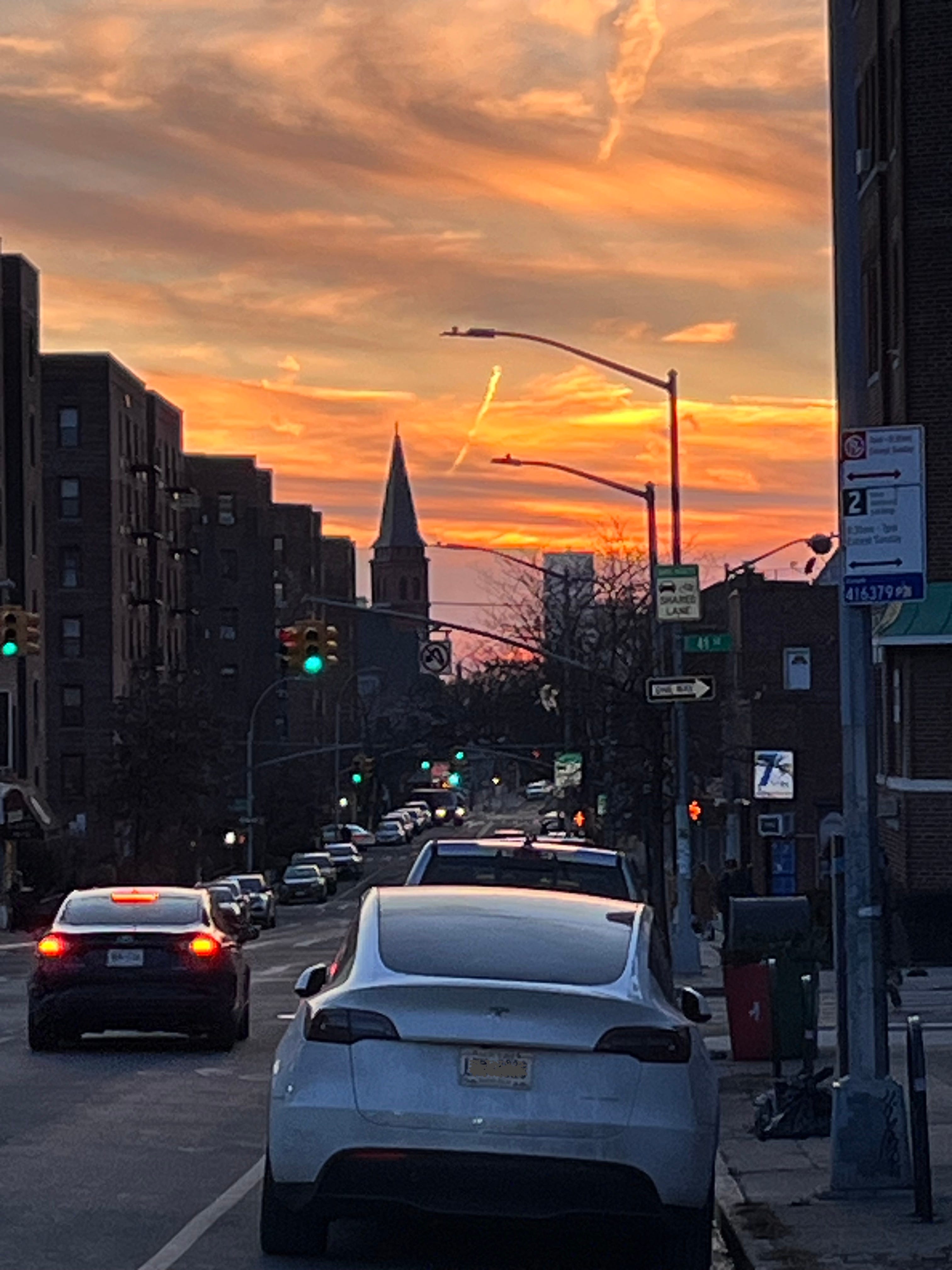
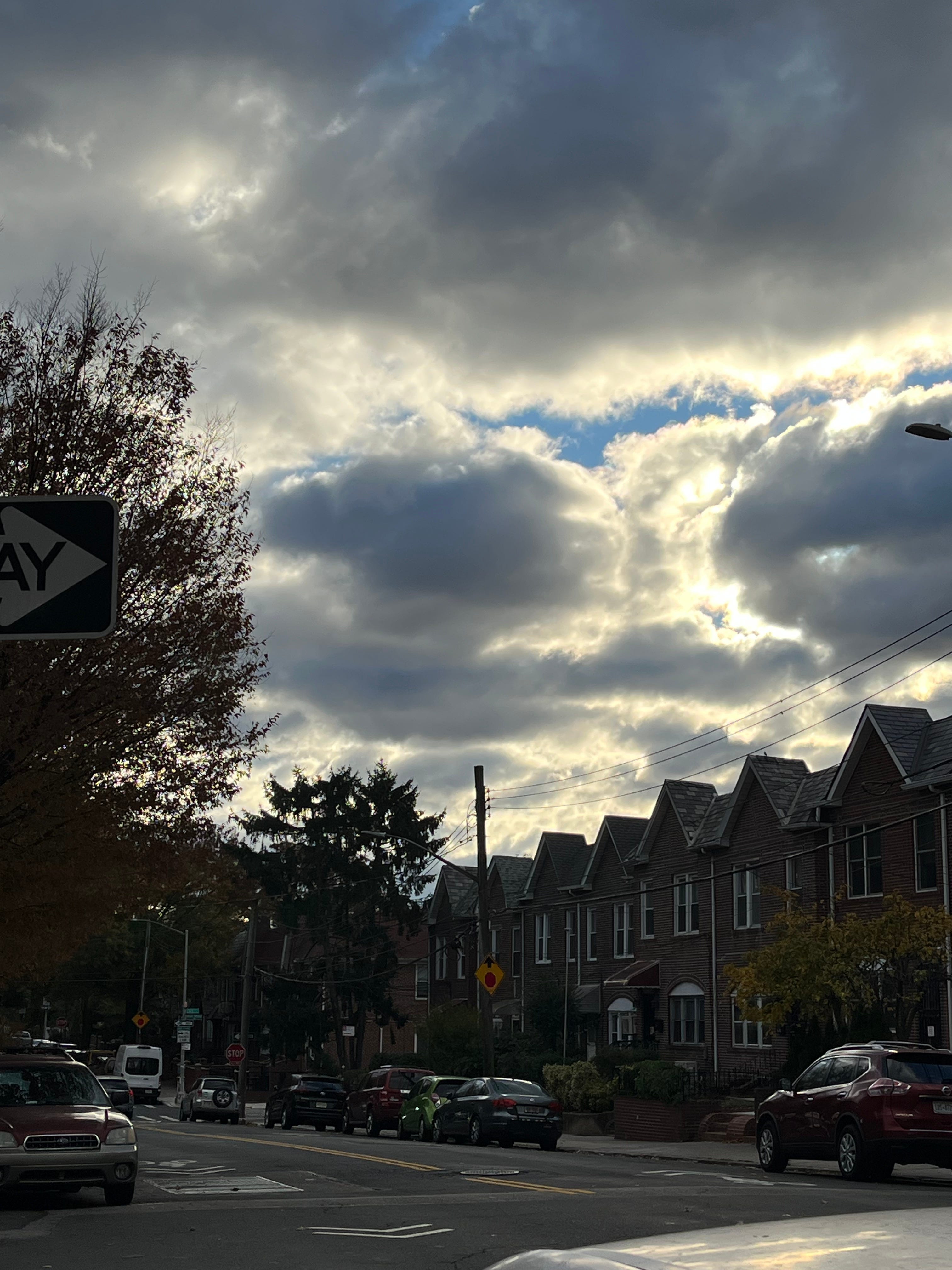
Biblical sky drama over Queens.

Last Saturday I went to see a West End-Broadway transfer production of Oedipus, a new adaptation and direction by Robert Icke (say Ike), with friends Frances and Jim, who got the tickets for us (or else I might have foolishly missed it). The lesson of Oedipus is, famously, “One always meets one’s fate in the path one takes to try to avoid it.” In the Greek version, the Oracle at Delphi prophesizes that the baby born to King Laius and Jocasta will one day kill his father and marry his mother; Jocasta then, to spare her son, orders her servant to kill the baby. Instead, the loving servant places the baby in the woods, where he is found by an older couple from the country who raise him as their own, no one the wiser. Until eighteen years go by…

In this update, Mark Strong plays Oedipus as a political candidate on the night of a highly consequential election (intimations of Trump v. Democracy), and all the action takes place during the two hours between polls closing and the announcement of the winner (a big clock on the stage counting down—Aristotle in Poetics says that any good drama should play out in no more nor less than two hours, and Icke takes on the challenge). In a filmed sequence as the show’s opening exposition, a confident, sexy Oedipus, standing outside what looks to be the British Parliament building, tells the press that he knows people question why he, a foreigner, should lead them, and he promises (without warning to anyone in his circle) to “release my birth certificate.” It brings up Obama, Mamdani, all the prejudices of our times, and if you know the story of Oedipus, it’s the perfect setup for an adaptation. (Icke must have shrieked and shaken with freakout when he thought of it—hoping no one else saw that obvious and genius connection up to now.)

Oedipus—handsome, smart, gifted, loving, and progressive—has one fatal flaw: hubris. He really believes he is in complete control, fully in possession of himself, knows who he is, knows who everyone is in his life. The next two hours unravel in the revelations we know from the Greek tragedy, all so believable and so timely, with Lesley Manville’s Jocasta ripping your heart out, her (updated for our more enlightened times, shades of Epstein) story of being raped by old Laius at 13, forced to give up the baby to die because he’s married; Laius later marrying her and leaving her a widow who later meets Oedipus, falls wildly in love, and marries him, giving him three children, she then in middle age. At the play’s opening, Oedipus is 52; Jocasta, we only later realize, is 65; their children are college age. In short order, despite a landslide victory, their children are about to lose everything, Jocasta her life, and the nation the promise of a brilliant leader. (The best part was sitting next to someone who didn’t know the story—lots of people don’t—and hearing the gasp.)

How does any brain process such a trauma? Frances and Jim and I staggered through the tourist minefield that is Times Square to the quiet of an Italian restaurant to process it, all of truly gutted, Aristotle’s catharsis manifest. In enduring tragedy, and in catharsis, we not only heal, we are cleansed.

A cleansing view, fall in Central Park.

This morning I watched a YouTube video sent by my friend Ryan last night of researcher and “No. 1 Brain Scientist” Jill Bolte Taylor in conversation with podcaster Steven Bartlett, talking about the “four characters” in our brain’s left and right hemispheres. As a result of a stroke at age 37 in 1996, Bolte Taylor’s Harvard-ladder academic career ended, and the next eight years were about recovering the functionality of her left hemisphere, the part of our brains that does numbers, controls language, helps us plan and think. During those eight years, she worked to use her right hemisphere to help her rebuild the cellular connections in the left, and the result was a huge new life focused on even deeper brain work while living on a boat and not in a lab, connected to nature and to the universe, using her whole brain. I highly recommend the video, which I watched at 4:30 this morning (because old), and her “four characters” of the brain put me in mind of not only all our society’s conflicts but also of all the characters necessary to have an effective drama:

1. Character One: Left side, thinking: the planner, analyzer, counter, linguist

2. Character Two: Left side, emotional: the grudge holder, trauma re-liver, pain protector

3. Character Three: Right side, emotional: the explorer, the curious one, the playful one

4. Character Four: Right side, thinking: the connector of experiences, keeper of wisdom

Just as a drama needs all these characters for conflict and resolution (my take), humans need all four in balance to be whole. I took loads of notes, and if you watch the video, you can too, but Bolte Taylor’s message of a society out of balance resonated most with me. Most of our lives seem to be spent lived only on the Left side, she says, holding grudges and reliving trauma as we strive for perfection and knock ourselves out to make money. It’s killing our brain cells, it’s killing us individually, and it’s killing the planet.

To wit: Sec. of Defense (he says “War” but it’s not official) Pete Hegseth announced this week that the United States is no longer a peace-seeking nation, but rather, our military preparation will be solely focused on wars. We know from Republican spokespeople, such as Russell Vought, JD Vance, and Elon Musk, that “empathy is weakness” (a negation of the brain’s right hemisphere) is a guiding principle for their politics. The Conservative Movement is totally, then, left-hemisphere in the brain, focused on self-interest, self-protection, generational trauma on a tape loop. It’s not sustainable, but it has to be gotten through and past, somehow.

What I think Conservatives fear most about education, about learning the truth about our history, is what the play Oedipus shows so shockingly: when you uncover the truth about yourself, you are destined for destruction. But what the audience learns is that no life is an honest life if it’s built on lies, when your armor is a birth certificate and the woman who raised you as your mother, and lied about it, thinks it’s “only paper.” And I’m struck by all these paradoxes—the fear we have of knowing the truth, and yet the impossibility of living an honest, full, happy life without it.

As your Miss O’ has long said, if your belief system cannot withstand challenges to the point that your response is to stifle and even kill to stop those challenges, you don’t have a belief system—you only have fear.

What Oedipus lacks is balance—for him, in his ignorance, life has been pretty great. He is empathetic but only intellectually. (I think this same hubris applies to a lot of America’s Liberals, if I’m honest.) Oedipus’s mistake, his hubris, was to be blindly fearless, blindly on the side of the common man (because he was raised by fine, working class parents) without knowing his own life’s truth—he was the product of rape by a lecherous pedophile of a king, and he married his own mother because of the coverup. At the end of the play, Oedipus blinds himself, and as the cult-prophet Teiresias tells him, when you learn, you will go blind; and when you are blind, you will see properly.

In a similar way, Jill Bolte Taylor’s stroke—the near-total collapse of the brain of a preeminent brain scientist—made her work expand into realms she could not have imagined during her eight years of recovery.

And this all got me thinking again:

We have to release the Epstein files. Virginia Giuffre’s death cannot be in vain.

We have to embrace our nation’s original sin, slavery, teach it properly, reckon with it, so our nation can progress in smarter, healthier ways.

We must demand the resignation of Pete Hegseth, and work to be a peaceable nation, so that there are no more 1st Lt. Robert Kellys dying on foreign soil; and you’ll pardon me for not grieving Dick Cheney.

This is a heavy lot for a Sunday morning.

I’m sitting here on this November day, in my kitchen rocker, worried again about whether or not I need a new refrigerator (thermostat being weird) and a new Mac (battery not fully charging), seeing it’s after 9 AM and I really need to dress and go out and about before it rains. And these mundanities of life require our attention, our presence, to live fully, ever balanced against all those huge mega truths.

On my personal day on Friday, I found myself in Saint Patrick’s Cathedral on Fifth Avenue, lighting candles (one for my mom, one for my friend Richard’s mom, and a third for the ancestors), which I hope was not hypocritical from irreligious me. It was nice to sit and meditate in the midst of the most famous cathedral in the biggest city with the most consequential mayoral election perhaps ever, and be present to my mom and memory.

The next time I’m there, I’ll light a candle for Robert.

Sending love and balance,

Miss O’

How to Say Grace

“You pollute the air.”

~ the blind Hamm after blowing his whistle, greeting the entrance of his servant, Clov, Endgame by Samuel Beckett

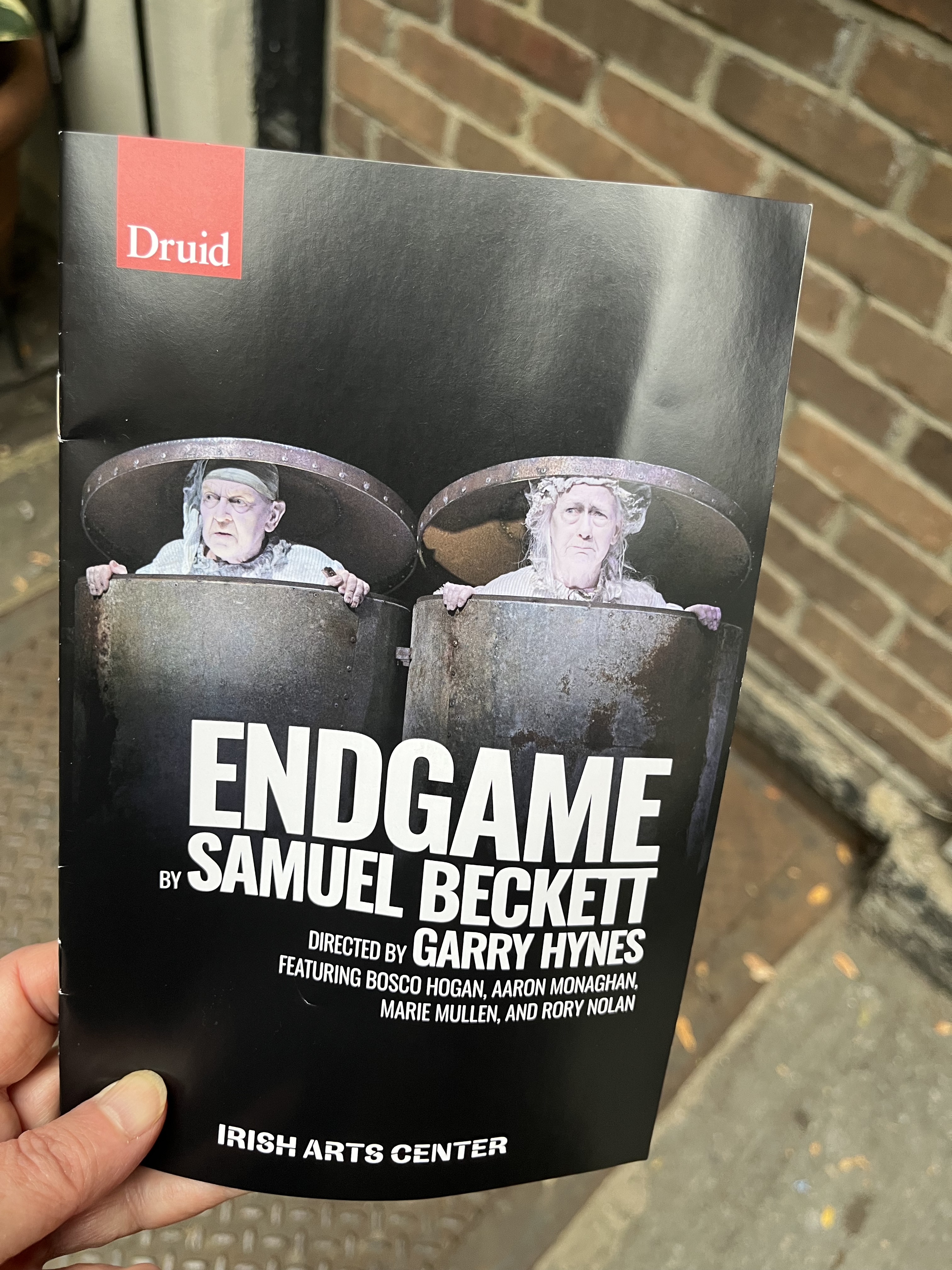
The characters in Beckett’s Endgame, which I saw Saturday at Irish Arts Center here in New York, presented by Druid, a theater company based in Ireland, are in an apocalyptic waiting game in some kind of shelter, starving, without painkillers, waiting for death. Hamm’s blindness and lameness keep him confined to a lounge chair, while his parents, Nagg and Nell, are confined to separate rusty garbage cans, waiting for death like their son.

It’s a funny play, and compelling, and of course, sadly, perfectly appropriate for the American moment. I look at Trump of the shit-filled diapers, bloated and slurring, demented and wobbly, barking orders to tear down the East Wing and kill fisherman at sea and send $40 billion of our taxpayer dollars to bail out Argentina even as he bars the release of any of the $6 billion in reserve for SNAP in case of government shutdown and oversees the tripling of our health insurance premiums, causing millions to lose coverage. His spending so much waste, the Republicans so much garbage.

“You pollute the air,” says Trump of our nation’s workers and immigrants and women, as he orders the dumping of toxic East Wing waste onto a public park golf course outside D.C., to prevent regular people from golfing, and distracts from the Epstein files, so shocked was he that his best friend of 15 years, Jeffrey Epstein, kept files on his best friend Donald J. Trump.

SNAP benefits are set to expire November 1, and without a deal from the Republicans, all working Americans will struggle to afford not only food but also any health insurance at all. To provide help for this coming starvation and health apocalypse, your Miss O’ wants to encourage you to donate to your local food pantries, if you can, whatever you can afford. Here in New York City, where I can only hope Mamdani wins the mayoral race, I gave a bunch more bucks to the following organizations. You can check your local areas for similar opportunities, if you want. The worst thing you can do is nothing.

  • City Harvest
  • City Meals on Wheels
  • Bowery Mission
  • God’s Love We Deliver
  • Sunnyside Community Center

While visiting my dad in Virginia a couple of weeks ago for the first time since my mom, Lynne, died, I gathered up all her clothes, shoes, and accessories in the closets and drawers, and Bernie (who was so sad looking at them) and I donated them. We do what we can, whatever our griefs.

I haven’t published on WordPress for some time—I haven’t been of a mind to play the role of teacher, each day being the next level of crazy in America. I’m sickened and lost most of the time. It’s hard to imagine Thanksgiving and Christmas, let alone my favorite, Halloween, what with ICE agents throwing teargas at children in a Halloween parade in Chicago. How is any of this happening? It appears that the Washington Post is this close to shuttering its print division, hastened along by owner Bezos, the slogan “Democracy dies in darkness” turning out to be a promise. After 60+ years as a subscriber, my dad sees his morning paper razor thin, formerly robust Metro, Sports, and Style sections combined into one slender one, few ads; his delivery lady has gone from dozens of deliveries, to ten, to two in our entire neighborhood since Bezos took over the paper. This seems to be intentional: Bezos’s lost 75,000 digital subscribers, too. It’s just a matter of time now, the owner ready to light his big cigar with the last of the masthead as he boards his newest yacht.

The billionaires are the 1% that are bringing our country, our world, down. Full stop. Blackout the system, give to your food banks, save all your pennies, tighten the belts, hunker down. It’s gonna be a long, hard winter.

But you know what? We can do this. Bernie and Lynne were born into the Great Depression. We always cut our toothpaste tubes in half to scrape the last of the paste onto brushes, had leftover night on Fridays, lived on peanut butter and jelly when we had to. You can do it too. And you can have laughs and play cards and read books rather than use power on devices. And say grace. The real kind.

Love your neighbors through this crazy Republican endgame.

And vote while you still can.

Bucking the System: Revisiting an older post for newly horrific times

Two men were lynched, or at any rate found hanging from trees, in Mississippi yesterday, but given different treatment by the police and media. I became so sick when I read about Trey Reed, that sweet face, I physically cried out, convulsed, as the weight of the report erupted in me. I’ve seen several posts on it, and nothing on national news. The police quickly determined that a Black man lynched from a tree branch involved “no foul play,” as only cracker ass police right out of In the Heat of the Night can.

Today on Substack, Rashid spoke for me.

Here’s another hanging death, this of a white man, given very different treatment.

I also read that President Trump is forcing the removal of all photographic evidence of the torture of the enslaved to be removed from America’s museums, due its violent content. Again, I felt deeply sick. In 2016 for Black History Month, in light of candidate Trump’s transparent racism, I wrote a piece on WordPress, and repeat it here, slightly edited:

In honor of Black History Month, one of my former students posted a social media essay on “buck breaking.” I had never heard of that. Here is research I found, oral histories of former slaves recorded at the time of the WPA in 1937. The pieces require real concentration, as the chronicler honored the dialect of each speaker, but the stories are horrifying and make for utterly necessary reading.

On Slaveholders’ Sexual Abuse of Slaves Selections from 19th- & 20th-century Slave Narratives

AMERICA: As Miss O’ used to point out to the white students who would ask (and ask and ask and ask) why 1) blacks just don’t “get over it”; and 2) why we don’t have a WHITE History Month—I could only point out that we had 350 years of slavery, and (today) only 50 years of civil rights; the Voting Rights Act and the Civil Rights Act were passed in MY lifetime. But I didn’t know the half of it: THIS is the history of slavery that needs to be taught in every high school.

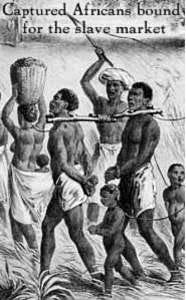
For your further edification, in case you missed it in your history classes, I am including photos and engravings I found on Google Images which further show the history of abuses chronicled at the time of slavery.

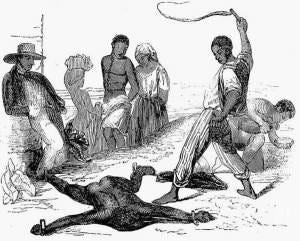
  1. This was the photo which appeared in a newspaper to galvanize the Abolitionist Movement in this country:
1095374

Prior to the publication of this story, most Americans at the time of the Civil War had no notion of the cruelties. These weren’t even the beginning of them–the accounts of sodomy (a white slave owner in front of his male slave’s family, to “break” his spirit) and rape, to say nothing of a white master standing over an unwilling “buck” and female slave to “breed” them. How does one recover from 7 or 8 or 9 GENERATIONS of this treatment in this country? HOW?

Scouraged-Back-Engraving-on-Paper-Harpers-Weekly-1863

2. Slaveowners “broke” “bucks” in any number of ways—torturing strong black men into “complying” with the “system”.

buck-breaking

Did that look familiar? It should. Here is Eric Garner:

eric-garner-police-brutality-ramsey-orta

3. And white slave owners forced other slaves to do the breaking for them:

3750214_orig

A (now ex) friend of Miss O’s maintains to this day: “Lisa, slaves were lucky. How would they give up that way of life? They were nothing, and we took care of them.” And Miss O’ throws up a little in her mouth. Too many Southern whites (and other whites) feel this way—they dehumanize blacks and know nothing of the true history of slavery. Even in colleges and universities–particularly Southern ones–professors preach the old story of “states’ rights”, stating that the real cause of the Civil War was about state autonomy, though the South surely couldn’t have cared less about the North’s rights to house free men and women who made it North.

4. The above reasoning for the war’s cause is, frankly, BULLSHIT. The war was about slavery—the human rights abuses and the economic stranglehold the South held because of “free labor,” in the form of slaves. I hope that American schools today are teaching this, or will change if they have not already—to teach the truth of this horrifying practice of slavery as it really was, and then to acknowledge the PTSD suffered for generations. The police forces need this education, as do our politicians. ALL of us need this education, as ugly as it is—and at its ugliest.

afr-cof02s

Black History Month—and if for even a fleeting second you thought, “Why isn’t there a WHITE History Month, you need to read this piece more than anyone else. And also the ones I’m linking to below.)

Here’s a current piece that reflects the legacy of slavery, for as you ought to know, 42% of Black men are incarcerated, many for life. Read and contemplate, from The Guardian:

Albert Woodfox released from jail after 43 years in solitary confinement

From the article:

“Woodfox, who was kept in solitary following the 1972 murder of a prison guard for which he has always professed his innocence, marked his 69th birthday on Friday by being released from West Feliciana parish detention center. It was a bittersweet birthday present: the prisoner finally escaped a form of captivity that has widely been denounced as torture, and that has deprived him of all meaningful human contact for more than four decades.”

It’s worth noting:

“His murder conviction was twice overturned – once in 1992 on grounds that he had received ineffective defense representation, and again in 2008 because of racial discrimination in setting up the grand jury that indicted him. Last year, Louisiana announced it would put him through a third trial despite the fact that all the key witnesses to the killing have since died. Woodfox’s lawyers argued the lack of witnesses would render such a retrial a legal mockery.”

That’s right: TWICE overturned. Because white-owned and operated prisons don’t give two shits about justice, fairness, or following the law when it comes to Blacks. They don’t traditionally see Blacks as people. I say that with love, though Whites make it really hard.

So if you are a White person reading this, and especially if you count yourself among the White people who have been outraged by the very existence of #blacklivesmatter; or are incensed that Black people are upset about the murders of other black people at the hands of cops, just because they wouldn’t “comply”; or who agree that the police should never indicted (unless the cop is Asian) for such murders; and who cannot understand why Black people don’t get that Trayvon Martin was killed rightly for being male, black, young, and wearing a hoodie; and who think that Tamir Rice deserved to get shot dead for playing in a park with a BB gun, without warning, and in an open-carry state; and who found yourselves baffled or “turned off” by the brilliant Kendrick Lamar’s shattering performance at the Grammys–read every single thing I shared in this little post.

And then:

Watch Kendrick Lamar Own the Grammys With a Stellar Performance Honoring Trayvon Martin

Again. And again. And again. Until you are sobbing like the ignorant White person you have been all these years.

AND CHANGE THIS.

Miss O’s friend Sylvia saw a sign on a college campus: “Yes, all lives matter – so if your black brother feels his doesn’t, help him carry his sign.” This is your Miss O’ saying, “Make an effort.” For America.

Here’s to Black History Month.

Do i lose my job now for quoting Kirk’s political violence?

P.S.

With all this in mind, the contributions of Black artists to American and world culture are all the more extraordinary. For Black History Month, I would also like to honor poet Nikki Giovanni. Back in the summer 1987, just after my extra year at Virginia Tech for student teaching and education classes, and before becoming a teacher, I was recruited to do a couple of stand-up comedy routines to introduce sessions at a national Women’s Symposium held on the campus. Ms. Giovanni was the featured poet. I didn’t care much for poetry—maybe because I was limited, but I rarely understood a poem without help—but I decided to go. I sat in front of Nikki Giovanni, who directed her poems to three people, mainly: all the black woman poems were delivered to a young black woman behind me; the black man poems to a young black man to my right; and all the creative/lonely woman poems were directed to me, my eyes. She read “Cotton Candy on a Rainy Day” to my face, and she opened something in me–she opened all poetry for me. And that fall (I think it was), she began teaching at Virginia Tech, and is still there today. (Her poem in honor of the massacre, delivered to a stadium, helped heal the campus.) Thank you, Nikki Giovanni.

Muses of Madness

Art Spiegelman, Mad Magazine, and my childhood

It’s a pretty wacky Sunday in America in May of 2025. I’m fidgity. Any piece of music I turn on only irritates me—everything sounds too bland, not vital enough, not insistent enough, not loud enough. I feel like I’m turning into a punk teenager at age 60. Even punk feels passe. I’m looking for a revolution.

I turned again to the PBS American Masters episode Art Spiegelman: Disaster Is My Muse, in which the Maus creator talks about EC (short for Educational Comics, later rebranded as Entertaining Comics), which published not only Mad Magazine but also horror comics like Tales from the Crypt, science fiction by Ray Bradbury, and pulp comics. Spiegelman realized that the horror comics were often by Jewish artists, and that this art was a way of responding to the Holocaust, a Holocaust that no one outside of the Jewish community knew about until the televised Adolf Eichmann trials in 1961. Spiegelman remarks that the key message of EC comics was, “Kid, the adults are lying to you.” This work gave Spiegelman the inspiration to write his classic Maus, using comics to relate the Holocaust experiences of his father. Access to EC and the way it reframed the world, Spiegelman concludes, most likely led directly to students his age protesting against the Vietnam War.

If you are wondering why Trump and his White Christian Nationalist MAGA want to end PBS and all art generally, look no further.

Now, I’m a radical sort of person, but a less assuming, duller radical you won’t find than Miss O’. It’s sad how boring we’ve all become in the white world. Still, the Spiegelman documentary got me thinking about the influences on my own thinking as a child of the 1970s. I’ve told you this. Born in 1964, I remember watching All in the Family when it debuted in 1971, Rowan and Martin’s Laugh-In in the late 1960s to early 70s, as well as the CBS news with Walter Cronkite every night and The Brady Bunch on Fridays. My family talked about every subject raised on these shows, including the “insipidity” of said Bunch, over dinner or between commercials. In addition to being the only kids in the neighborhood with bookcases, the O’Kids were, should they choose to be, informed. I chose to be, as best I could. And talk about a gamut of subject matter to assimilate—seriously, the 1970s was a great time for me to be a kid, though that wasn’t the case for plenty of other kids. That’s something I learned as I grew. As we do.

And I know I told you this story, how around 1976 or ’77, when I was eleven or twelve, and my tipsy parents would go up to bed on Saturday nights, I was allowed to stay up and watch The Carol Burnett Show by myself. I preferred to watch it with my parents, since they knew all the movie references and explained that the sketch “Funt and Mundane” was a parody of the Broadway legendary couple Lunt and Fontanne, stuff like that, but they gave me great tools to ask questions.

Around that time older boys in the neighborhood, the ones who turned me on to Mad Magazine, told me about other shows, late night fare, daring shows like Monty Python’s Flying Circus on Channel 5 at 11:00 PM; soon I discovered SCTV on my own on Channel 26 (PBS) at 11:30, adjusting the rabbit ears on the set; and then at midnight, I’d physically change the channel to 4 over to NBC’s Saturday Night Live in time for Weekend Update. At 1:00 AM, when many stations went to a test pattern, I’d go to bed. I had a good a thing going until my mom, Lynne, wandered downstairs one night to find me in the dark watching Monty Python. I felt like a criminal. My heart raced.

Lynne, taking over the yellow plaid lounge chair, lit a Salem from her ever-present pack and flicked the top back on her lighter (I can still smell the aromas of menthol and singed lighter fluid). “What are you watching?” she asked. I stammered out the title, trying to shrink on the herculon-upholstered loveseat in the plastic-paneled living room, staring hard at the black and white TV screen. “It’s from England,” I explained. The running sketch of this particular episode was called “Dennis Moore,” about an 18th century bandit who steals lupins from rich people in horse-drawn coaches. The theme song, my mother noted, was from the 1950s TV show, Robin Hood. Oh. By the end, Dennis Moore has taken all that the rich have and given it all to the poor, so the theme song changes from “he steals from rich, and gives to poor, Dennis Moore” to “he steals from the poor, and gives to the rich, stupid bitch.” When I heard “bitch” I thought, “OH NO, this is it, I am in so much trouble,” but Lynne was roaring. “What a brilliant satire of the British tax system,” she said, stubbing out her third or fourth cigarette. “You can watch this show whenever you want.” And she went back upstairs to bed.

And that was it. As a child, as you can see, I didn’t have much to rebel against. My only oppression was the constant fights over my looks—I didn’t have any, and let’s face it, few women do and we look just fine, and my mother was a great beauty. For all her feminism, my mom still fell into that trap of cosmetics and clothes make the woman, thinness is more important than intelligence, “you could be pretty if you tried.” I suffered emotionally over all this nonsense for far too many decades, until my early 30s, when thanks to my therapist I made peace with this particular impasse. I learned that the real sufferer was not me, but my mom. The 1950s did a number on too many women for too many years, oppressing them by making them insecure over their face, hair, nails, weight; but I am beyond fortunate that the artificial beauty thing was the only part of female silliness my mom bought into. Hence, Monty Python and an allowance to buy Mad Magazine.

Sidebar: I told you this story too, probably, how at 32 I lost my natural bloom. I realized this when female students started approaching me, “Miss O’Hara, can we give you a makeover?” When it reached the point of borderline harassment, I mentioned it to my mother (no longer a smoker, but you can picture the cigarette), who said in her sharp, firm voice, “I know you don’t want to hear this, but if you’d wear a little mascara and lipstick, they’d leave you alone.” I thought about it. To press the point, Lynne pointed out and really quite sagely, “Honey, you don’t wear makeup so people notice you, you wear it so they don’t.” Yes, that made total sense.

Oddly enough, I’d created a similar but differently angled line even in my late twenties. I was reminded of it this week when a friend visiting Virginia ran into one of my former students. She recalled the line I gave her when she’d asked why I don’t wear makeup. I said, “I’d rather stun them when I wear it than shock them when I don’t.” Lynne and I were both right. But I learned to keep lipstick in my pocket to refresh between classes (and I do that to this day), and sure enough, the kids never bothered me about my face again. (My hair is another story.)

That dark, twisted humor I loved—a humor that meant I gravitated more to boys than girls for friendship—drew me to a Topps bubblegum series called Wacky Packs, which my brother Pat also collected. I was obsessed with them, as the kids would say.

In the Spiegelman American Masters documentary, I learnedthat Art Spiegelman, who worked for Topps, created Wacky Packs! Wacky Packs was his art, his jokes. What a discovery! I figured I’d ruined my original Barbie and Francie suitcase by plastering the back of the suitcase with those stickers, but I now see it’s even better—and absolutely me, the girl who loved All in the Family and The Brady Bunch, Monty Python and Carol Burnett, Mad Magazine comics and Barbie.

We are, unbelievably, once again living in Holocaust-level dark times, this time in the United States, with Trump openly setting the timer on 250 years of American independence, and on Constitutional Democracy, to end on July 4, 2026, when DOGE expires, and when the 250th anniversary celebration committee expires; and the countdown clock will presumably be reset to 000 to mark the Trump takeover of America. Trump openly denies adherence to the Constitution, flaunts his freedom from the constraints of law, even spreads his lunatic desire to be Pope as well as president. This insanity is beyond the bounds even of The Onion, the inheritor of all the “Kid, the adults are lying to you” Spiegelman-era art.

Addendum to my last post’s prescient Onion headline.

And without artists like Art Spiegelman and the Monty Python troupe and Mad Magazine and Norman Lear, and contemporary creators like the Onion staff and Alison Bechdel, without that satire, that bite, these swipes at the sources of our dysfunction and the most horrific of status quos, I couldn’t survive. No one with sense and decency could.

I hope you are finding your solace on this Sunday, the art that soothes even as it steadies, energizes, and ignites you.

Sending love,

Miss O’

The Art of Making Art

A millimeter matters

I just want to say that the luxury of owning a personal library is that not only do I feel cozy all the time, but I get to take evening tours and pick out volumes for bedtime reading. (Growing up, the O’Hara kids were about the only kids in the neighborhood with family bookcases, thanks to our mom, Lynne, having college textbooks, novels, and antique books to display and read.) Even now my number of volumes surprises some people, but I think, who wouldn’t want books around them? They are my closest friends. I saw an interview with Nora Ephron who said everyone asked of her family, “What are you doing with all these books?” (We live in a country like that now.) There’s no reason to finish a volume I peruse, or even read straight through. Sometimes I do that, but many times I just open a chapter and see what it says. If it’s not speaking to me, I flip around. Try another book. Like literary cocktails. It’s fun. This week I’ve been seriously rereading Finishing the Hat, Stephen Sondheim’s first volume of lyrics from his shows, 1953-1981, and so far I’m sticking with it.

When Stephen Sondheim died in 2021, I felt as if I’d lost a friend. Though I wasn’t sure how I felt about his work for a long time, you must know that the key to falling in love with a theater writer or composer is seeing the work, and in a splendid production. It really changes everything. He had three principles that guided his life’s work:

“God is in the details.”

“Less is more.”

“Content dictates form.”

I love that Stephen himself admittedly didn’t always follow them, but we give ourselves a little grace; nobody is perfect. And he himself had favorite lyrics that other people don’t seem to care for. He endured his share of flops and lousy reviews. And he just kept going. Thank god.

In an interesting coincidence, though sometimes I think it’s a bit more divine than that, these associative adventures, I’m also trolling PBS (while we have it) for documentaries and happened on two short ones. First, Marguerite: From the Bauhaus to Pond Farm about master potter Marguerite Wildenhain who, along with her husband, escaped the Nazis and made her way to California to teach pottery; and second, Finding Edna Lewis, about famed chef of 1950s Café Nicholas on E. 53rd St., cookbook author, and unsung mother of the farm-to-table movement, Edna Lewis.

And you might night think that Stephen Sondheim, Marguerite Wildenhain, and Edna Lewis couldn’t have much if anything in common, but you know what? God is in the details. Buckle up.

I’m not really going to recap all their work. But those rules up there apply.

“God is in the details.” Marguerite’s great contribution to many potters was, according to one student, “teaching us how to see.” For example, she’d have each potter make ten or twelve of the exact same pitcher or vase (since potters usually mass produce their work). The student would line them up on a board, and Marguerite of Pond Farm would walk and look and say, of maybe the third one, “This is good,” and of the eighth one, “This is good.” To the student they looked identical. Then she would point out a millimeter of difference in the rim, or the handle, the difference between being beautiful and merely serviceable (I think of the human face). God is in the details. It changed everything for students. (I’m obsessed by details when I direct a show, but not so much when I write, because I’m not an artist when I write.)

“Less is more.” Chef Edna Lewis grew up in Freetown, Virginia. In the Great Migration that took her to New York, she made a living cooking for artists, and word of her home cooking spread. She became an accidental star chef when she partnered (silently, as a Black woman) with two gay men to open Café Nicholas on E. 53rd Street, creating wonderful Southern cooking for writers like Truman Capote, Tennessee Williams, and Gore Vidal. Lewis believed that food should be seasonal and that the ingredients should speak for themselves. Nothing should be overly prepared, overly seasoned, or fancy. You might call it simple home cooking except that her dishes were both gorgeous and delicious, prepared by someone who knew what she was about.

“Content dictates form.” In the theater, the writing and the intent dictate whether something is a play or musical; or whether it’s theater at all. In pottery, the intended use of the vessel dictates the size and shape. In cooking, the ingredients at hand dictate the kind of meal it will be. I’ve been mulling that principle over, and not to get all metaphorical or analogous, but I have to go a little political here. Content (greedy, sociopathic, ignorant bastards) dictates (!) form (evil shit show).

Speaking for myself, I wish I had the talent to be a playwright or a novelist or a poet. I haven’t done theater in years because it’s a collaborative art (it’s not like I can walk around my apartment and “direct”), and collaborating is something I never have time to figure out. But for whatever reason, ever since I was a kid and started writing, I’ve felt I had an obligation to study news events, internalize them, and interpret them for everyone. I don’t enjoy it, necessarily, and will never make a living at it, but I can’t seem to help myself. When asked in high school by the “gifted and talented” program advisor, Mrs. Hubbard, why I kept a journal, I told her I saw myself as a chronicler of my time. She snorted disdain. Years later, when I related that anecdote to my first professor at the Bread Loaf School of English (a summer master’s program designed for teachers), Prof. Cazden snorted almost identically. It was uncanny.

Somewhere in our lives, no doubt, we’ve been made to feel less than. (Both teachers (graduates of Bryn Mawr and Radcliff, respectively) told me without apology, one overtly, the other hoping I’d take her meaning, that I just wasn’t smart enough to be there, whatever that meant. It’s not like I was stupid, exactly, but it’s annoying for brilliant educators like them, I guess, to be around the merely bright when there are geniuses to teach. You know how it is. My response was to say nothing, and my revenge was, I stayed and decided to belong. I really learned a lot. And it all worked out, because as it turns out, they were wrong. Never let them tell you not to dream.)

And so it is that, to this day, I keep feeling this pull to chronicle my times, though to what end I don’t know. I’m not smart enough to solve much—my teachers weren’t wrong about me not being a genius—but you can’t do nothing, in times like these. (Chuck Schumer, is this on?) I try to chronicle what I see and still hold on to the world I want to live in, the world I want us to build. First, obviously, it involves shipping all these the MAGA Nazis from their demented reality show, White House USA, to some tropical island where they live in golden mansions and go on staged hunts with all the guns of their wet dreams and watch all the porn they want without the Covenant Eyes app to pester them. And leave all of us sweet, normal people alone. And let us raise their children.

Until that blessed day, or until I get smarter, I read and write and dream. It’s what we do.

Once more, with feeling, something we can all learn from:

“God is in the details.”

“Less is more.”

“Content dictates form.”

~ The three guiding principles of genius Stephen Sondheim

Love or something like it,

Miss O’

Erase

When your government wipes your history from its sites

Good morning, sweetie. At 5 AM I saw a text from my friend Susan, a humor piece from McSweeney’s:

IT’S A SHAME WE HAVE TO BETRAY OUR ALLIES, STARVE THE POOR, HALT SCIENTIFIC PROGRESS, DESTROY THE ENVIRONMENT, AND ELIMINATE THE FREEDOMS ENSHRINED IN THE BILL OF RIGHTS, BUT AT LEAST MY INVESTMENT PORTFOLIO IS ALSO TANKING

by TALIA ARGONDEZZI

It would be truly laughable if it weren’t really happening.

From one of Miss O’s little notebooks. Musings.

As you know, I live with a disturbed mind, born as I was a middle brow Cassandra, driven mad at times by unwanted prescience, the way (for example) even as I was moved by and marveling at Hamilton and Suffs on Broadway (some ten years apart), I knew they were not celebrations but elegies. It’s not for no reason that I felt that way: those shows bookended the beginnings of not one but two Trump terms.

As testament to my madness, I’ve found myself laughing at our Senate all these weeks, both Democrats as well as Republicans, holding all those “confirmation hearings,” because somehow the Democrats couldn’t see (and still can’t) what all the rest of us outside the Capitol Bubble could and can, that these nominees are being sent in to dismantle and erase our democratic republic. Senate Minority “Leader” and traitor Chuck Schumer (D-NY) is genuinely baffled as to why he had to cancel his “book tour” due to threats. House Minority “Leader” Hakeem “I don’t know” Jeffries (D-NY) had to cancel his little book tour, too. These two “leaders” haven’t been successfully doing shit to defend the republic for years (what did they even write about?), and yet think now is the time to take victory laps. They have, essentially, erased themselves from history even as Trump’s minions of white supremacy literally erase the achievements of women, Blacks, Native Americans, and all other minorities from all government databases.

In further erasure, Secretary of Defense Pete Hegseth has fired all women and Blacks from senior military leadership. Today I read that the Dept. of “Justice” has given President Trump the green light to fire all women from leadership positions in government. Trump humpers have no sense of history. It’s so childish, isn’t it—like the way kids think their mom won’t notice the broken vase if they put a tee shirt over it—only now the stakes are life and death, civilization vs. barbarism.

There is a poetic technique called erasure, in which the poet takes an existing text—something out-of-print, say, an old book, or a magazine—and maybe circles the words that strike her fancy or uses a pen to mark out words she isn’t drawn to. Whatever words remain can be shaped into a poem, using the words in the order she finds them, or rearranged. (Poet Amanda Gorman has a section of her collection, Call Us What We Carry, dedicated to this technique.)

My friend Katrinka Moore has a collection of poems inspired by this technique, and it’s still my favorite of her many books, Thief. In a few places, she reveals not only the found poem but the process.

From Thief by Katrinka Moore BlazeVOX [books], Buffalo, NY, excerpted here to encourage you to buy it.

I think a technique like erasure shows us that do what we will to erase a text, there is something still to draw us in, a word we simply cannot let go of, another word, language that helps us reveal something new. The text is not the same, but nor is it lost.

Aren’t there parts of your life you’d like to erase? I have quite a list. Or have you thought you’d erased something, and then one morning, out of a dream, or from a knock on the door or a text on the phone, there it is, the past? Because that’s how life works, isn’t it?

Reading Joseph Campbell, as you know I have been, I’m reminded how mythology teaches us that no amount of annihilation, erasure, or running away can move us past the past, or past guilt, or spare us a reckoning. The story of Oedipus (whom the Oracle of Delphi prophesied would kill his father and marry his mother, and so whose parents cast him out as a baby, only to have him adopted and live to do that very thing), to take one example, teaches that one meets one’s fate in the path one takes to try to avoid it. You’d think humans would catch on; but in the West we have lost our mythologies.

To take another example, the First Council at Nicaea in 325 A.D. tried to force Christianity into tight constraints of how to believe and worship, and cast out and buried the so-called Gnostic Gospels, especially the Gospels of Thomas and Mary Magdalene, whose testimonies of Jesus’s teachings could not have run more in opposition to the Nicene religious oppression that is what the world now knows as Christianity. (If God is in your pocket, and if everyday men and women can equally teach and preach, you don’t need a patriarchy or a church; and you realize how truly radical Jesus was, and how close to the Buddha, to erase authoritarianism.)

But those Gnostic Gospels were uncovered in 1945 in Nag Hammadi, Egypt, because you know what? Try to erase what you will, the truth surfaces. Anyone who has suffered a trauma knows it has to be dealt with someday. There are only so many boxes you can keep putting in the closet before the closet explodes. Pick a metaphor.

Like Christianity, whatever was intended, our democracy (however imaginative) was founded on genocide, on slavery, on the subjugation of women. Do what they can to erase a people and history, people survive, history will out. Do what they can to shackle, people break free. You can’t erase that spirit. How is it that oppressors still think, in 2025, that erasure means obliteration? Yet we can’t quite erase authoritarians, either. We are all thieves, I guess, stealing what we can to make our worlds, always a price to be paid. Ask Prometheus. But some thieves are righteous. Ask Jean Valjean.

In one of my little notebooks, I took an erasure poem I made and illustrated it; I did a second one with cut out words. There’s something calming about the process, I think, because of what is revealed in our attraction to certain words. Should you try it, and I hope you do, let me know what you reveal.

Sending love, unerasable,

Miss O’

Dabble

Ramblings from around the apartment

Hello, angel. How are you today? This morning I water-colored a card for a friend and mailed it at the post office, stopped by the store for a few items, and picked up 2-for-1 day-old cheese danishes at the Romanian bakery. A chilly, soft, overcast morning, nothing to rush for. I think the saddest part of any day for me—when I’m standing in the kitchen, making coffee maybe, or in my rocker starting to write in my journal—is the moment I remember I have a phone, and I have to check it. (That said, I called by parents, Bernie and Lynne, for our weekly Saturday morning visit. Grateful to still be able to do that.)

I miss landlines and answering machines, before telemarketers and scammers, of course. I miss being unreachable. I miss quiet. That said, the other day I happened on a documentary called The Miracle of The Little Prince, about the ways in which the book by Antoine de Saint-Exupéry provides a universal story that is being translated into languages that are facing extinction. The cultures where this is happening, not identified except by languages, include lives in landscapes from deep desert to heavy snows of the north, near Finland. The filmmaker focuses long on the landscapes, the quiet, an unending quiet, the monotony of caring for a few animals, searching for water, making tea. I don’t know if I could do that kind of quiet anymore.

If you haven’t read The Little Prince, I recommend it. I’ve found that there are two kinds of people (though as the late Tom Robbins said, “There are two kinds of people: people who believe in two kinds of people, and people who don’t”): Little Prince people and Winnie-the-Pooh people. I think pretty much everyone relates to Charlie Brown, but those other two philosophical guys are extremes. I know people who love neither, but there’s usually a line over which they step in favor of one or the other. Dorothy Parker summed it up for me in her New Yorker column “The Constant Reader” when, in her review of The House at Pooh Corner, the reviewer wrote,

“ ‘Tiddely what?’ said Piglet.” (He took, as you might say, the very words out of your correspondent’s mouth.)

“ ‘Pom,’ said Pooh. ‘I put that in to make it more hummy.’ ”

And it is that word “hummy,” my darlings, that marks the first place in “The House at Pooh Corner” at which Tonstant Weader Fwowed up.

The adorable and hummy Loggins and Messina song notwithstanding, I’m with Dot.

I first read Le Petit Prince in my French class my senior year of high school, in the original French, bien sur, and I was enchanted. (I bought a hard copy in English around the same time, 1982, and know this because neither book has a universal price code on it, so they’re pretty old.) Essentially the character of the Little Prince is a desert hallucination by the writer and pilot Saint-Exupéry, who was persuaded to write a children’s book when he lived in Quebec. His books, by the way, were banned in Occupied France; he died in a crash during the war in 1944, when his plane went down for unknown reasons. I like to think the Little Prince greeted him.

A pilot who writes books, or a writer who pilots planes. I was thinking today about the habits we dabble in, like writing, water coloring, or collecting books. Preparing to draw my friend’s card to watercolor, I reached for this pencil holder that holds my art pencils I got for Scenic Design in college. One year, my dad made us kids (or maybe just me and Pat) pencil holder out of the trunk of the Christmas tree. I don’t know how he got the idea. But he drilled holes for pencils, stained it and varnished it (preventing shedding and splinters), and I still use it.

Another time he made all my brothers Zorro swords, and I didn’t get one because I’m a girl, so he whittled me a dagger. My mom painted the handle black and the blade red (for Halloween); I later repainted it silver to use a prop in a play, I think. I still have that, too.

In those years, my mom was doing a lot of decoupages. Little of it survives, unfortunately. She started by making a plaque for her Uncle Phil, a recovered alcoholic, whiskey bottle collector, and former bootlegger (along with his two brothers, including my grandfather) in the 1920s. She made one for us, too, this one antiqued green to go with our house’s color palette. It’s currently rotting in my brother Jeff’s storage unit, but I remember it well.

I love how my mom burned the edges. She made all kinds of things back then, all atop our washing machine covered in newspaper. Ca. 1975

So this is Miss O’ giving my mind a rest from the world today, mostly. What are you taking stabs at this Ides of March?

Hello? Brutus?

Sending love from Queens,

Miss O’