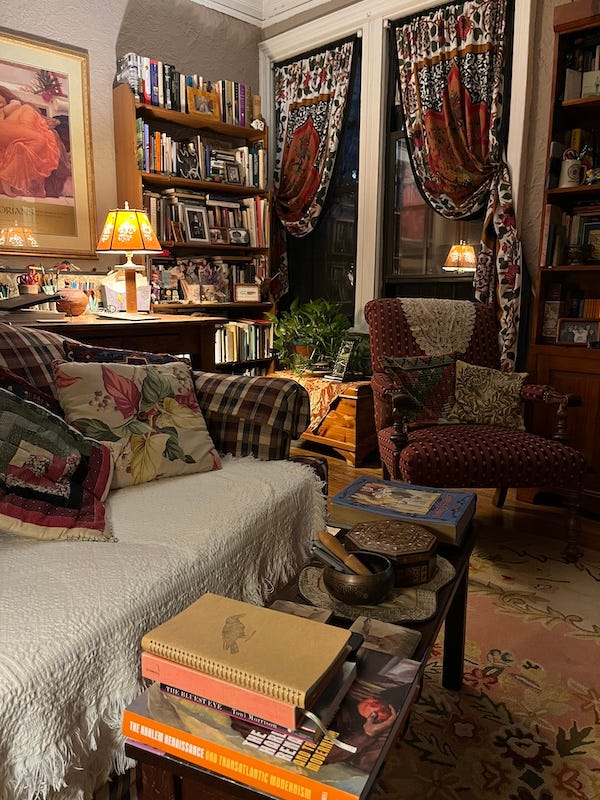
Dabble

Ramblings from around the apartment

Hello, angel. How are you today? This morning I water-colored a card for a friend and mailed it at the post office, stopped by the store for a few items, and picked up 2-for-1 day-old cheese danishes at the Romanian bakery. A chilly, soft, overcast morning, nothing to rush for. I think the saddest part of any day for me—when I’m standing in the kitchen, making coffee maybe, or in my rocker starting to write in my journal—is the moment I remember I have a phone, and I have to check it. (That said, I called by parents, Bernie and Lynne, for our weekly Saturday morning visit. Grateful to still be able to do that.)

I miss landlines and answering machines, before telemarketers and scammers, of course. I miss being unreachable. I miss quiet. That said, the other day I happened on a documentary called The Miracle of The Little Prince, about the ways in which the book by Antoine de Saint-Exupéry provides a universal story that is being translated into languages that are facing extinction. The cultures where this is happening, not identified except by languages, include lives in landscapes from deep desert to heavy snows of the north, near Finland. The filmmaker focuses long on the landscapes, the quiet, an unending quiet, the monotony of caring for a few animals, searching for water, making tea. I don’t know if I could do that kind of quiet anymore.

If you haven’t read The Little Prince, I recommend it. I’ve found that there are two kinds of people (though as the late Tom Robbins said, “There are two kinds of people: people who believe in two kinds of people, and people who don’t”): Little Prince people and Winnie-the-Pooh people. I think pretty much everyone relates to Charlie Brown, but those other two philosophical guys are extremes. I know people who love neither, but there’s usually a line over which they step in favor of one or the other. Dorothy Parker summed it up for me in her New Yorker column “The Constant Reader” when, in her review of The House at Pooh Corner, the reviewer wrote,

“ ‘Tiddely what?’ said Piglet.” (He took, as you might say, the very words out of your correspondent’s mouth.)

“ ‘Pom,’ said Pooh. ‘I put that in to make it more hummy.’ ”

And it is that word “hummy,” my darlings, that marks the first place in “The House at Pooh Corner” at which Tonstant Weader Fwowed up.

The adorable and hummy Loggins and Messina song notwithstanding, I’m with Dot.

I first read Le Petit Prince in my French class my senior year of high school, in the original French, bien sur, and I was enchanted. (I bought a hard copy in English around the same time, 1982, and know this because neither book has a universal price code on it, so they’re pretty old.) Essentially the character of the Little Prince is a desert hallucination by the writer and pilot Saint-Exupéry, who was persuaded to write a children’s book when he lived in Quebec. His books, by the way, were banned in Occupied France; he died in a crash during the war in 1944, when his plane went down for unknown reasons. I like to think the Little Prince greeted him.

A pilot who writes books, or a writer who pilots planes. I was thinking today about the habits we dabble in, like writing, water coloring, or collecting books. Preparing to draw my friend’s card to watercolor, I reached for this pencil holder that holds my art pencils I got for Scenic Design in college. One year, my dad made us kids (or maybe just me and Pat) pencil holder out of the trunk of the Christmas tree. I don’t know how he got the idea. But he drilled holes for pencils, stained it and varnished it (preventing shedding and splinters), and I still use it.

Another time he made all my brothers Zorro swords, and I didn’t get one because I’m a girl, so he whittled me a dagger. My mom painted the handle black and the blade red (for Halloween); I later repainted it silver to use a prop in a play, I think. I still have that, too.

In those years, my mom was doing a lot of decoupages. Little of it survives, unfortunately. She started by making a plaque for her Uncle Phil, a recovered alcoholic, whiskey bottle collector, and former bootlegger (along with his two brothers, including my grandfather) in the 1920s. She made one for us, too, this one antiqued green to go with our house’s color palette. It’s currently rotting in my brother Jeff’s storage unit, but I remember it well.

I love how my mom burned the edges. She made all kinds of things back then, all atop our washing machine covered in newspaper. Ca. 1975

So this is Miss O’ giving my mind a rest from the world today, mostly. What are you taking stabs at this Ides of March?

Hello? Brutus?

Sending love from Queens,

Miss O’

Slaying the Dragons

More thoughts on our national monsters

Hi, dear one. In my last post, I related how I’d recently read a book, Monsters: A Fan’s Dilemma by Claire Dederer, and this week, by a serendipitous coincidence, PBS streaming has rereleased a series from 1987, The Power of Myth, a conversation between Bill Moyers and the great mythologist Joseph Campbell, who sadly died not long after the final interview. You can also get the companion book, created because the 6-hour series (filmed at George Lucas’s Skywalker Ranch) couldn’t contain all the insights.

Moving from monsters to dragons felt like a natural progression. Also, in another moment of serendipity, I had a conversation this week about the work of Patsy Rodenburg, a voice teacher and acting coach, and her work The Second Circle. All of this makes sense together in my mind, so we’ll see how I do.

In a society such as ours in 2025, I wondered what Joseph Campbell might be able to help me with. As it turns out, plenty. Bill Moyers is a great host, comfortable asking naïve questions, and while for the intelligentsia it’s tempting to make fun of him, he gets wonderful answers. Moyers, by the way, was President Johnson’s Chief of Staff and later Press Secretary (he called Johnson “fifteen of the most interesting men I ever met”); he is smart and educated (and still with us at age 90) as well as attuned to society, but he’s at ease with not knowing and relishes seeking to understand (which I find are the key qualities missing from today’s journalists as well as citizens).

In one episode of The Power of Myth, Campbell explains Star Wars as one of the most recent (then) examples of the hero’s journey (there’s a whole episode on that; Campbell’s work inspired Lucas) and what that mythology tells us. Myths, he explains, including hero’s journeys, are not about seeking meaning in life, but rather about experiencing life. Moyers and Campbell talk of the ways in which people follow church doctrine, for example, to guide them, or follow strict rules and procedures rather than their own instincts. Often, heroes have to abandon what they thought they knew to get through the challenges.

They talk of the struggle with temptations presented by the serpents (found in every culture) where there is an expected way to live, the tension between the body and the mind, between desire and outside rules. At one point, Moyers reflects on ordinary people’s lives and the hero’s journey, especially the moment that Luke Skywalker, in a life and death struggle with Vader, chooses not to go over the dark side.

Of this dramatic choice of good over evil Moyers says, feeling secure in himself, “But that isn’t what happens in my life.”

And Campbell quickly counters, “You bet it does. If the person doesn’t listen to the demands of his own spiritual and heart life, and insists on a certain program, you’re gonna have a schizophrenic crack up. The person has put himself off-center. He has aligned himself with a programmatic life. And it’s not the one the body’s interested in at all. The world is full of people who have stopped listening to themselves.”

I don’t know about you, but it seemed to me this perfectly described this American moment.

Campbell and Moyers also talk about dragons, and Campbell’s take on dragons is fascinating to me—they guard. “The European dragon,” Campbell explains, “guards things in his cave, and what he guards are heaps of gold and virgins, two things, gold and virgins, and he can’t make use of either of them, but he just guards. There’s no vitality of experience…” In psychological terms, you’re binding yourself to your own ego, if you are dragon. (Campbell contrasts the negative European dragon with the “great and glorious” Chinese dragon—two very different things.) The dragon in us is our ego, “What I want, what I believe, what I see,” Campbell says, and “it might be too small.” To slay it, “you have to follow your bliss,” by which he means your true nature.

The Europeans, who colonized so much of earth, then, are based in a culture that fights those who hoard gold and virgins, and yet the heroes don’t fight the dragon for any other reason than to the take the gold and the virgins for themselves. Another perfect metaphor for America.

Campbell wouldn’t say that deciding to destroy others is anyone’s actual “bliss.” Annihilation of the innocent, the hoarding of gold, and rape of women cannot be bliss, because I see dead eyes in Trump, in Musk, in Speaker Johnson, in Vance. They are without souls let alone hearts. Anyone with access to their own hearts would follow President Zelenskyy anywhere because anyone can see Zelenskyy is Luke Skywalker; it’s not about him, this war, it’s about saving a country he loves. You may think that doing what you love “doesn’t save the world,” only yourself; but Campbell says that by saving yourself, you save the world. “An influence of a vital person vitalizes. There’s no doubt about it.” Otherwise, the world is a wasteland. Slava Ukraine.

“An ego that sees a ‘thou’ is not the same ego that sees an ‘it.’”

mythology scholar Joseph Campbell on the difference between the relationship Indigenous people had with buffalo (“thou”) and that which the white man had with buffalo (“it”); see also, Putin with Ukrainians

Last week my friend Keith, an actor and writer, was in town working on contract negotiations for his union, and we met for dinner on Third Avenue Thursday evening. The dinner time changed from 5:30 to 7:30, so around 6:40 I left Queens for Grand Central, going down toward the back of the 7 Train to be nearer the Third Avenue/42nd Street exit when I arrived at the station. When I entered the car, there in the corner was a bearded man, quite filthy and disheveled and resembling Rip Torn, a faded red towel safety pinned like a cape around a grimy white tee shirt fragment. He was talking to himself in animated tones about a woman who was in pain, her feet, I think, and the narrative was taking place at a hospital. He’d caused the car to reek, though not many people were bothered. I was, though, so when I sat down in the only available seat, I casually rummaged in my cloth sling bag for a mask. (Since Covid, the option of wearing a mask allows us to give smelly people some grace, to not embarrass them by pulling collars up over our noses, or to have to beat an exit to run to the next car at the next stop; in NYC in summer, it’s not uncommon for one person’s stench to clear out a subway car and leave it empty at every stop for a whole day. Pro tip: NEVER get on an empty subway car on an otherwise full train; everyone does it. Once.)

Over dinner, Keith and I talked about many subjects, from poetry to opera to politics, when he mentioned he was going to Portugal to study with renowned voice teacher and acting coach Patsy Rodenburg, whose work I love. In a quick but inadequate summary, I can tell you that Rodenburg (whom I first heard of in an interview on NPR and saw later on video from Michael Howard Studios in New York) noticed over the years that she could distill actors’ energy into three “circles”: inward directed (First Circle), outer directed (Third Circle), and perfectly present (Second Circle). We need all three circles, and all three circles have their uses, but to be an effective actor, you must live in the second circle of true intimacy, fully present.

You see this in life—First Circle, the people scrolling their phones, or the cashier who won’t look at you; and on the other extreme, Third Circle, the salesmen, politicians on the campaign trail, preachers greeting parishioners. Miss O’ lives in second circle, as do many of my friends. Second circle can be unnerving to people who are not, as Campbell would say, able to follow their bliss. People who need a doctrine to cling to—the Ten Commandments, Project 2025, even the Rule of Law. Any doctrine can be leveraged for good or evil when people are not in Second Circle. (Trump, I suspect, lunges between First and Third circles all the time, which creates a violent imbalance. He hasn’t been in Second since infancy, where we are all in harmony.)

And this brings me to a deeper truth, perhaps the most unsettling to me. In the United States, we have no more rituals (beyond, what, morning coffee?), no mythologies, no common culture to bind us together. If we could be honest, tell the truth about our origins, all the complexities of colonization, genocide, slavery, revolution, enlightenment, the uses and abuse of Christianity, all of it—we could formulate a national mythology and enact rituals to guide us to growth and build further understanding. American Idol is the best we can do? The spectacle of competing for money and fame? Has The Apprentice taught us nothing?

At one point, Campbell uses our architecture to tell us who we are in the U.S. in the modern age. In Salt Lake City, he notes by way of example, first the Temple was the tallest structure (religion), then the Capitol dome (politics), and now the Office Building that handles the economic affairs of both is the tallest and biggest edifice (commerce). It’s the Symbol of modern life. What does this mean for us? “You can’t predict what a myth is going to be any more than you can predict what you are going to dream tonight. Myths and dreams come from the same place.” What is the new American dream?

In six weeks, we citizens watched helplessly, and Democratic leadership spinelessly, as Donald Trump destroyed 250 years of American law and governance, wiping out the mythology of a nation. Listening to Campbell, I gained historical perspective. Though Moyers switches quickly, in editing, away from his point, Campbell does passionately remind us that Indigenous people, in a mere ten years, lost everything in the way of their rituals, their sacred dependence on the buffalo, their freedom, their land, and thousands of years of a way of life. Like that.

We’re in the process of losing a few hundred years’ worth. It’s nothing by comparison. It’s just ours. And “ours” was never “everyone’s.” If we are honest.

Our struggle now (if there is an “us”) is recognizing the difference between the seductive serpent, the dragon to slay, and the vital person. Everyone made fun of Hillary Clinton when she said, “We have to change hearts and minds,” mocking her with, “It can’t be done.” Of course it can be done. As my theater hero Joseph Chaikin said, it isn’t done “en masse, but one by one by one by one.” We each do our best to be alive, and our aliveness brings life to the world. Moyers brings this around to the importance of teachers, of which group Campbell was a member. The therapists, the storytellers, the healers, the helpers, the educators: we help bolster the world, prepare our heroes, vitalize the works.

Coda: Keith walked me to the Grand Central around 10:00 PM, and I descended the stairs from the Third Avenue entrance. Down on the platform, I walked to where an old man, a blues and rock electric guitarist, played a history of the Beatles and Jimi Hendrix as two other musicians looked on. We thanked him, gave him a few dollar bills. When the train pulled in, we got on the car, and I smelled a familiar smell. I looked down the car and there, in the same seat with the same two-liter bottle of Mountain Dew, was the same schizophrenic man. What are the odds? Weirdly, this sort of thing happens to me a lot in New York. But think of any number of small things that could have happened differently—the time I left home; or the time we left the restaurant; where I stood on the platform either way. It’s remarkable.

I pulled out my mask. The man sat alone, no longer chattering away but looking at us, lost; I think he vaguely recognized my hat. A needy citizen ignored, an “it” instead of a “thou,” someone else’s problem. The American ego.

I don’t know why, but thinking of all these stories and our ordinary workaday lives, I hear Pigpen’s voice in A Charlie Brown Christmas, when Linus points out that the dirt and dust on Pigpen could be from the soils carried across the ocean from ancient Egypt, to which Pigpen, adjusting his costume says, “Sorta makes you have a little more respect for me, doesn’t it?” Maybe Peanuts feels like it could be a start for our mythology, if we tried. We could do a lot worse.

(Thanks, internet.)

I do go on. Happy Sunday. I really should get out of bed.

Love,

Miss O’

What’s Not Lost in Translation

Moments in my chaotic New York City week

So all the ick news first, aside from all the Musk-Trump criminal dismantling of every living institution in America so that it’s close to unrecognizable (taking over the Kennedy Center? The National Archivesclosing what Department?), I learned at work this week that the two editors I supervise applied for a transfer to another (lately resurrected) department where they’d previously worked because they can do what they are best at there (I choose to believe it’s not about me) and got it, and that I will have to finish a huge project probably alone, the timing being what it is; then, at my ophthalmologist’s office for a checkup, I learned that not only am I at the beginning (and still reversible) stages of diabetic retinopathy, but also that I owe an outstanding balance of nearly $500 (of deductible-meeting crap) from visits over the past four years because their billing department never sent me the bills; and then I learned from my CPA that my company inexplicably failed to take out the correct amount of tax (and all week I’ve tried to correct it for this year, but the system doesn’t work, and we no longer have humans working in HR (take that in) and I am screaming into screens) and so instead of getting a refund, I in fact owe some $1,500; and the tendinitis in my write-hand (punny ha ha) wrist is so bad still after three months, medicines, and PT, that I would have to spring for a cortisone shot (sweet, sweet relief after the injection site pain and, obviously, the bill). Poor fucking me.

Thank you, internet.

But one day this week—I think it was the eye appointment day, Wednesday, when I returned home with dilated eyes and shock at hemorrhaging money—on the way into the city, a Black female conductor announced at every stop (because the N-W-R-Q lines still do not have recorded voices to announce stops, and I love that) something to this effect: “Ladies and gentlemen, let the passengers off first, let’s help each other out, everybody, let the people off first before you try to get on. Move into the middle, people, help everyone out, we’re all together here.” Love her heart. On the way back to Queens that same day, a Black male conductor did much the same, adding on occasion, “It’s not about the price of groceries, everybody, just help each other out here and move all the way into the car.” This same conductor also used the intercom to explain the location of every staircase, connection, and elevator at every single stop. A total doll.

And if you are like me, you can’t help but look up and down the train car, men, women, children, every color and shape and gender and age and religion and background and profession, staring into phones, or not; bundled up, world weary, and it hits you all over again that the reason “white middle America” is afraid of brown and black shadows is because they literally have no idea how New York works. It’s not perfect, never that, but it works. Look at us. Us. Right here in this train car, crowded, or not, for miles of stops along our way. Not yelling at or killing each other. All of us just being.

Also in my travels, I found myself thinking about a poet friend who lives in a rural area, who years ago, when I mentioned how much I loved the movie Lost in Translation could only grunt in disgust. When I asked why, she said of the lead characters, “All they did was squander an opportunity to see Japan.” I had to think for a second, because I was remembering the filming of Bill Murray’s whisky commercial, the Tokyo karaoke bar, the hotel bar nights, Scarlett Johannson’s quiet excursion to a Japanese garden and learning flower arranging, and of course the hilarious trip to the ER so Bill Murray can get Scarlett’s broken toe seen to—all these relationships and stories they will have to tell about, or not, when they return home. What did my friend mean, “squandered”? I started thinking. I guess another view is they didn’t really do all that much…and then it hit me. I said, not at all angry, but with a sense of discovery, “You’ve never traveled outside the country, have you?” She looked at me suspiciously, and slowly shook her head, as if her response to a movie shouldn’t depend on having had the experience. More to the point, though, she had almost never, within or out of the country, traveled alone. And there it is.

What was lost in translation for her in watching Lost in Translation is the feeling of sudden paralysis brought on by the jetlag stupor you feel combined with being quickly overstimulated in a new place while on no sleep, while being both excited by the prospects and daunted by selecting the best thing to do right now. The one universal is a bed (never one you can check into before 3:00 PM) and a bar or cafe, and heading to either one can give you a chance to sort of recover your wits (if you know how to manage the currency), but when you are alone with no one to bounce ideas off of, being in a new city, whatever the language, can be pretty isolating. One time, visiting London, I spent nearly one entire first day just sitting alone on a bench in Tavistock Square, where Virginia and Leonard Woolf had lived (in a no longer existing building, bombed out in WWII), underdressed (a cold day for summer) and disoriented, and in those days, a teetotaler. I could barely make myself try to find a place to have tea. If I did eat or have tea, I don’t remember. I remember a white-gray sky, damp chill air, and just watching people against green trees and grass and gray buildings.

Did I squander my first day in London? Not at all. Oddly, that first day of “doing nothing” is still the one I remember most vividly and fondly, whatever the discomfort and confusion. I was there, in the heart of London, on my own, unremarkable, on an ordinary day. Not bad.

As a result of my many NYC train treks this week, it also dawned on me that perhaps the reason I needed to leave Facebook, finally, was that my life in New York can be one of overstimulation even on the dullest days, and that Facebook had become more overstimulation, not sure which way to look, who I’m forgetting to check in on, that sort of thing. Maybe I’m just not wired for all that anymore. I know that many people can simply sit on a virtual Facebook bench and do nothing, or idly and dispassionately watch the goings on, not unlike I did in Tavistock Square or Scarlett and Bill did in Tokyo. You do you, as the kids say. However we engage, or don’t, we are all in it together, so move to the middle of car and let everybody onto the train. And remember to give people their space (remarkably, New Yorkers do know how to give you yours, even by a fraction of an inch, and if only the whole country could cotton on, that would be great). After all, everyone here with you is simultaneously present in a pubic place and also living a very private drama of their own.

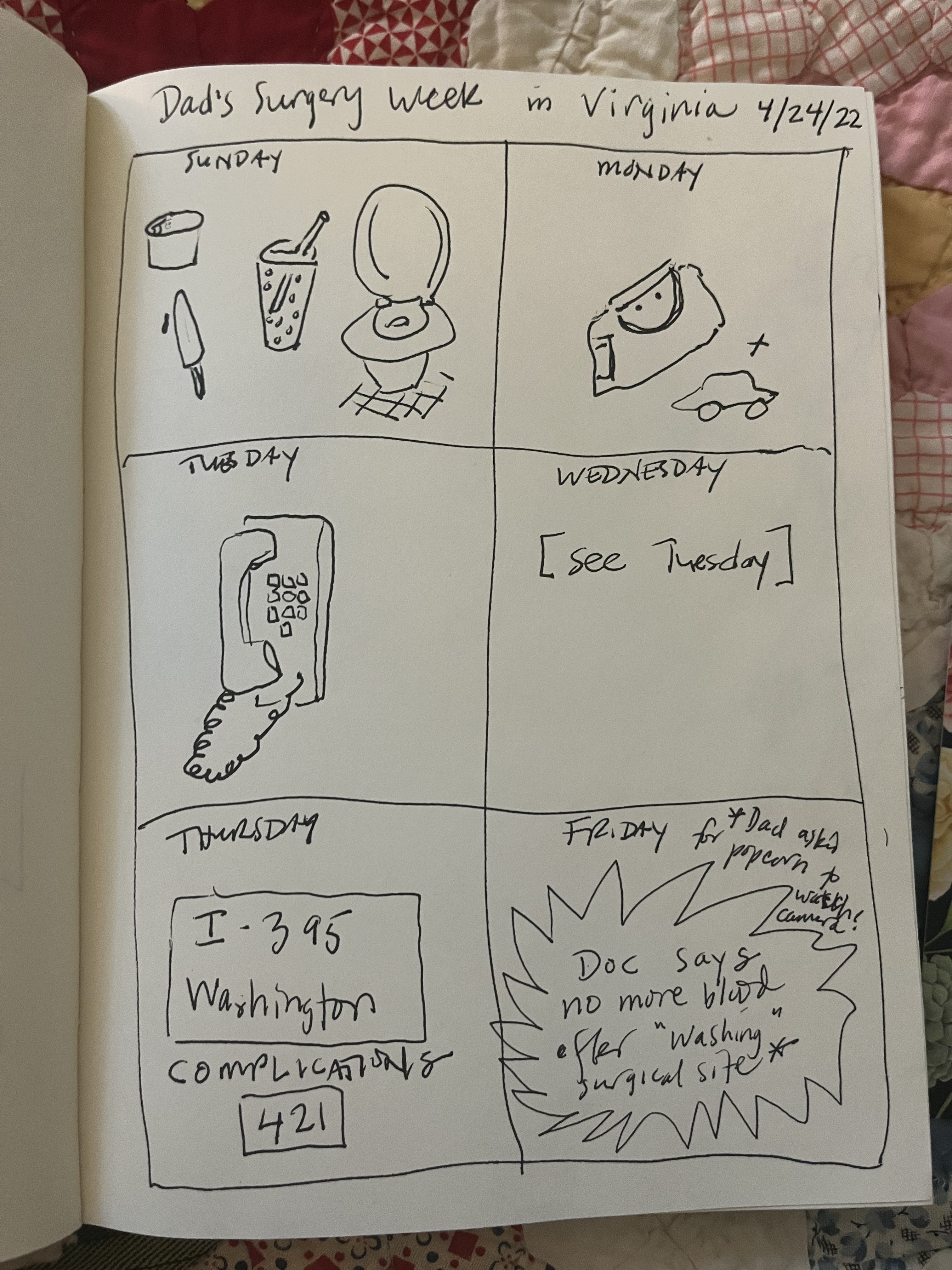
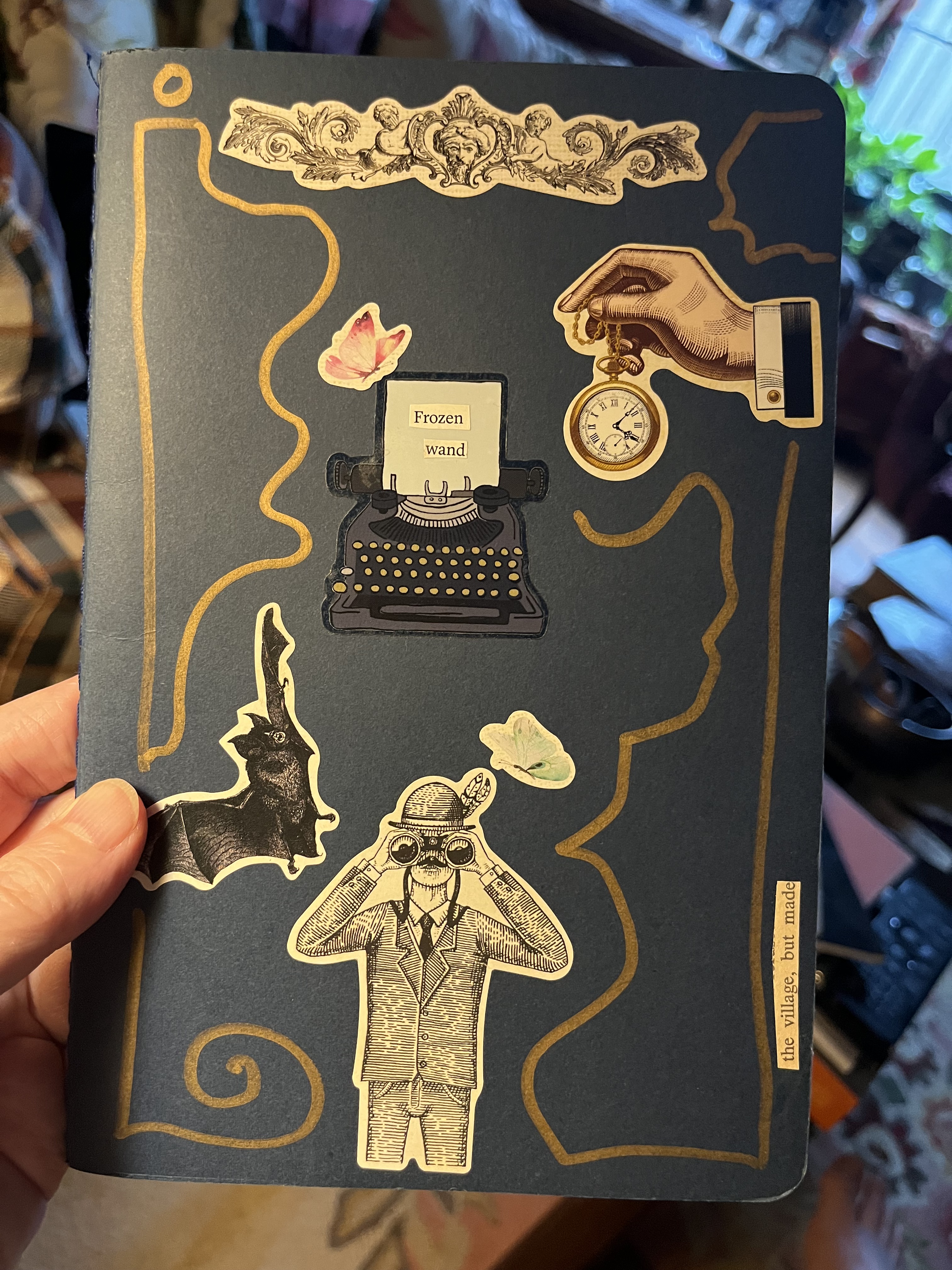
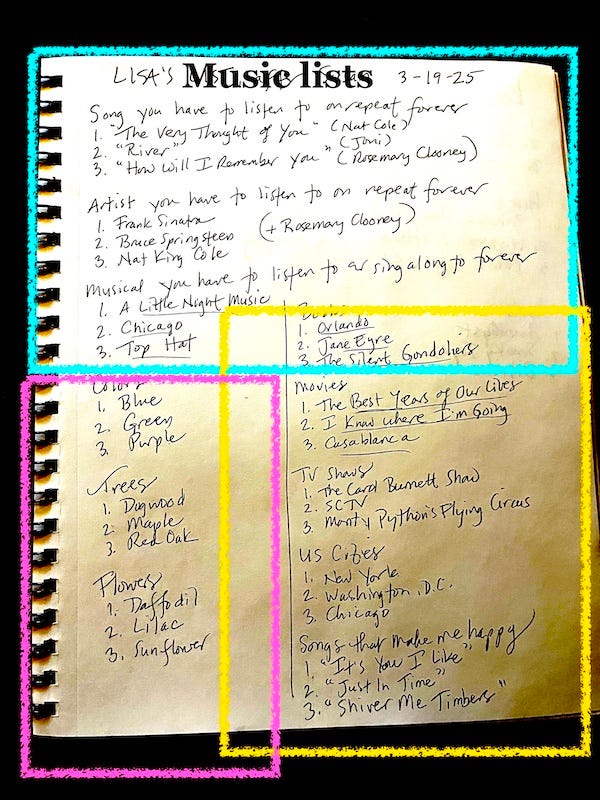
One of Miss O’s many, many notebooks.

All of this is just to say, dear friend, given all that you are going through in your personal life and against whatever landscape this letter finds you, I know that you may merely glance at or dip into this post, and I completely understand. Thanks for reading at all, and whatever you do, don’t strain yourself. Enjoy your Sunday. Let me hear from you when you get a chance.

It’s been a long three weeks. Encouragement!

I keep humming, all the time lately, “It’s You I Like.” Like a mantra.

Love,

Miss O’

P.S. A few weeks ago I published part of a play I’ve been working on, but I don’t know if WordPress is the best outlet for me. Thanks to all who read it, in any case!

Quick Take, for Whites during Black History Month

A Condensed History of Whiteness in America

Hi, kids. If you are a friend of mine, I am not telling you something that you don’t already know; and I’ve written about this before. But a few years ago, my late super, who was from Eastern Europe under communism and who had never learned American history—not unlike contemporary whites in red states today—asked me, “Lisa, can you tell me please what it is about the Blacks?” I didn’t follow. “Why all the whites hate them. What did they do?”

Do you hear his question? Here’s a man who at that point had lived two decades in the United States, himself an immigrant working around every conceivable type of immigrant, from tenants to other supers to management, in the most diverse area of the world, my borough of Queens in New York City. He heard and saw all the racism, surely from the white men (because I still hear it now through their support of Trump), but he really didn’t know where it was coming from. “I have these Jamaican guys who do the electrical work for the building, there, and they are great. They smoke the marijuana, the smell, my god, I hate it, but they are great.”

And so it was that Miss O’ did a brief history for him.

Black Africans were brought to the United States in chains beginning in 1619, if not earlier, men, women, and children captured by white European men or purchased as prisoners in their own land where there was no concept of enslavement for life let alone forever in perpetuity along with your families, which is what whites did in the United States. To justify this horrific practice, and to justify unlimited greed, whites started deciding that they were superior to all other colors of humans. They must be, because as the Puritan descendants of the Second Great Awakening said of being among the elect going to heaven (as explained to me by my 11th grade high school English teacher Chuck Edwards), “Surely, if you were not among the elect, surely God would not have blessed you with a Cadillac.” Or made you white.

The plantation system in the American South made each plantation owner a little king, a greedy little tyrant (just like the “farmer king,” King George III from whom we were emancipated, oh, irony), who kept all the money he made from his crops and made even more by working slave labor just about to death—no hope of leaving, no money, no say—morning, noon, and night, and forcing the strongest Black men to “breed” Black women as a bull would cows, when the tyrant wasn’t raping those same Black women for his pleasure and a stable of more (mulatto) slaves.

Meanwhile, the white people in the South who did not own land, and that was nearly all of them, had no work. They looked on, impoverished, as these Blacks were “given” houses and food in exchange for work, work which poor whites did not have, homes which poor white were not given (clearly not comprehending the horror). There was a growing (and understandable) resentment. To quell this, white tyrants told their legions of poor whites, “Always know that at least you are superior because you are not having to labor like these beasts.” To appease them, the tyrants dropped a nickel and handed a gun to any poor white man who was pissed off and said, “Guard my slaves.”

And so it was that for 400 years, poor, uneducated, angry whites came to believe that they themselves would have more if only those Blacks weren’t here, and that guns were identity. And they weren’t wrong, though their logic was. What these charming, charismatic white tyrants were able to convince these poor whites of was that he, the landowning rich tyrant, had no choice but to use “free labor” so that he could be rich and live like a king, that God had blessed him, and he had to fulfill this promise to God by being the richest one.

And despite a Civil War, despite education and marches and all of the hard work of generations of Blacks, Native Americans, and enlightened, moral whites (immigrants all), there are still vast swathes of white Americans who truly believe that IF ONLY there were no Blacks (and now browns, too), they themselves would have it so good.

The Donald Trumps of the world—the ones who deny wages, safe working conditions, clean air and water, and health care to anyone not them—have been such absolute geniuses at convincing poor white people to feel so sorry for them that these poor white people empty their pockets and do whatever it takes to prove their love to the rich white man God. And the poor white people still blame Blacks for their fate.

I learned about this book from the Toni Morrison documentary, The Pieces I Am. Recommended reading.

Following my quick take on the horrors of the Black experience and white supremacy, my building super from Eastern Europe was silent. He looked at me and said, “Why they don’t kill all of you?”

That’s the million-dollar question.

I’m about to make a couple of broad generalizations.

Black culture in America is a culture of love and faith. It’s a culture rooted in ebullience, joy, dance, music, energy, justice, hope, and deep, deep love despite deep trauma and great suffering. I have seen it and felt it all my life. Not that there aren’t assholes and tyrants; I’m talking about roots.

White culture in America, dating back to Puritans and colonizers, is a culture rooted in punishment, jealousy, cruelty, demands for some kind of Christian self-abnegation (that no one can achieve), faith in (one man’s) white superiority, and fear born of trauma, our original sins of Native genocide and Black enslavement. White is right. Spare the rod and spoil the child. “God’s will” is for me to lord it over you. I am God. Not that there aren’t lovely white people; I’m talking about roots.

See how white supremacy works? Image from the web.

And I am so fucking sick of white culture—the good things whites bring to the table are, perhaps, irony, Greek logic, and wryness (all of which are embodied by The Onion), and of course Mary Oliver and Shakespeare and bagpipes. Right now, for me, that’s about it. Even the best of our white politicians play by the white tyrant’s rules without even realizing it. We all do.

You can follow Digital Meddle Your Childhood Ruined on Instagram.

“Mediocre white boys,” to borrow from the brilliant and righteous Rep. Jasmine Crockett (D-TX), have taught all of us whites—ALL of us—to feel sorry for them. To pity them, poor helpless things. To give them money and power. To give them a pass. Meanwhile, all that the rest of us sentient whites do for our entire lives is play that same old song, “RESIST,” and I am so fucking sick of it. These white men rape, they steal, they stiff, they destroy, and then they smile, and we pity them all over again, don’t we? And carry our clever signs to the latest march.

This is changing. I do see hope. But we have to crack it all open and drain out the rest of the pus. White culture as a whole, ultimately, must change, or else we take the planet down with us. And this Black History Month, we have to see the joy of embracing all the greatness that Blacks bring to the world. Celebrate. Emulate.

Love from her core of rage,

Miss O’

Wise words from t

A Work in Progress, Part 1

To my three readers–Hi, Anna!–I’ve been working on a play for a couple of years that I think would actually make a good TV series in these seriously troubled times. The title is up for grabs. Here’s part of Act 1.

Love, Lisa

WAVY DAVY’S PERPETUAL SOUP HOUSE KITCHEN

A PLAY by Lisa O’Hara

ACT I, SCENE 1

[AT RISE: Marv is typing at a laptop in a coffee shop. PHIL is sitting at the table sipping coffee and reading a book. They are in their 60s.]

MARV: I want to tell this story with unflinching honesty.

PHIL: “Unflinching honesty.” So, what is “flinching honesty”?

MARV: [beat] Why do you do this, Phil?

PHIL: [beat] Because I care about meaning, Marv. What is “unflinching” honesty if there’s no opposite? If you are honest, you are honest. Why do you qualify it like a Book World critic? Are you worried what they will think? There’s no they, Marv. Only the truth.

MARV: There you go, Phil. [picking up an old argument, not necessarily his] We all know there’s a They and you know who they are, but you don’t really, do you, and that’s the maddening part. No, it’s not them [pointing] though that would be convenient for your politics, right? And how can They be playing you and playing them, those others on the opposite side as you…

PHIL: …the flinching ones…

MARV: …all the while taking all the fucking money? It’s like the aliens we all know exist, and so how is it no one has ever spilled that secret? So that’s how They operate, and it’s so fucking pissing fucked up. [MUSIC, good blues rock]

PHIL: Who are you right now? [MARV smiles. So does PHIL.]

SCENE 2

[Projected: 1988]

JUNIE: [outside the scene, stirring a big pot of soup, tasting, adding spices] Marv pulled up to the curb of the Leave It to Beaver street in Annandale, Virginia, in his used Ford Grenada, a color of brown no car should come in, and I remember he put it in park though he was always unsure about turning off the engine because of the other times it cut out, or just didn’t go, like when we were on Rt. 123 with our friends Gary and Phil, Marv flooring the gas for uphill acceleration and didn’t nothin’ happen, and he was screaming…

MARV: [looking up from laptop] Here’s some advice, kids. If you have to buy a car, don’t buy a used car, and if you have to buy a used car, don’t buy a Ford, and if you have to buy a Ford, don’t by a Grenada, and if you have to buy a Grenada, don’t buy a brown one!

JUNIE: But on this day, a humid but decent early summer day perfumed by freshly mown grass, Marv was not terrified we’d get rundown by a semi. He was beaming, glowing, about to show his bride, his love, me, their, our, new house. [MARV beams] Yes, on this July day in 1988, at the age of 38, he, Marvin Allen Frischberg, had done the thing he’d sworn on his bell-bottom jeans and tie-dye tee shirt at the 1968 Democratic National Convention he’d never do: use his earnings from a steady job in American government

MARV: …all this, thanks to the fuckin’ man, of all things…

JUNIE: … to further suckle on the teat of American corporate capitalism by entering into a life phase of home ownership with a woman to whom he was wed. But there we were. And Marv was exhilarated.

[In shadow, a jubilant MAN gets out of a car; a WOMAN next to him stares out.]

JUNIE: Next to Marv in the used brown Ford Grenada was that very bride, aptly named June, Junie to everyone; together, what thirteen, fourteen years, married by our friend Kenny, dead of AIDS four years that August, who’d gotten a Universal Life certification out of the back of Rolling Stone to perform the ceremony, was it really nine years before, in the backyard of Gary’s “communal” house on Glebe Road…

MARV: [typing in cafe] …just a few miles outside the District. When Junie said, “Where are we?” I said, “Our house,” thinking total Graham Nash, and my Joni, my Junie, unclicked the barely operational seat belt, opened the passenger door, and…I shit you not, she began vomiting to the point of dry heaves…

JUNIE: And I was thinking, The Dry Heaves would be a great name for a band.

MARV: I was sure that Junie was really pregnant this time, and I was overcome with joy.

JUNIE: [lifting a ladle] Who wants soup?

SCENE 3

[Music. Projected:] 1973

[PHIL and MARV, aged 23 or so, are playing chess at the kitchen table in the Arlington, Virginia, kitchen on Glebe Road. It’s the first Watergate Summer. PHIL has just check-mated MARV again. GARY, also 23, who owns the house with his mother, enters from the kitchen with a bowl of soup and a stack of saltines.]

GARY: [setting down his bowl and crackers on a TV tray] You know who they are? I am they. I run the fucking world. I’ll prove it. [GARY uses the remote to turn off the Watergate hearings on television; he turns to flip on PHIL’s remote control stereo invention to turn on the radio, then flips it off. He then flips on another remote control to pull down the shade on the west-setting sun.]

PHIL: My inventions are useful.

GARY: I read all about this stuff! [GARY points to his stacks of Popular Mechanics magazines, his copies of National Review, his stack of articles from the Washington Star; possibly these are projected.] You think none of this matters, and that these bogus Senate hearings matter, okay, you’re wrong, but okay. You know what really runs all this? [gestures to room, to the world] Computers! Have you seen Phil’s computer room? Everything in the world will be run from those computers if we aren’t careful.

MARV: [lifting a pawn to move into position, first using it as a microphone] But who’s the man behind the computer? Who are you, Phil? What is your agenda?

PHIL: [into the “microphone” before Marv places it in position on the board; speaking now into his knight before positioning it] I’m nobody, frankly. I have no agenda. Just chaos for its own sake. That’s your they, Gary. And you can’t stop me, I mean them, I mean us. I’m two moves away from “check” for those playing at home. And so are the Watergate prosecutors. [Slams the knight onto the board. Marv quickly moves to capture the knight.]

GARY: Fuck you. [He turns on a tall, loud metal standing fan, directs it toward his chair, sits and eats.]

PHIL: [moving his queen] Language. Check.

[The phone rings, a ring in the living room and another ring from the kitchen, behind them. Note: All telephones of this period are black, heavy, rotary, and land lines. The kitchen phone is a wall unit.]

JUNIE: [from the kitchen; remains offstage until entrance] Hello?

[Beat, as Phil, listening, turns off the loud fan with another remote, Marv studies the board, and Gary stuffs crackers and soup.]

JUNIE: [gently, really asking] Davy, sweetie, are you high?

[PHIL laughs so hard he tips the whole board over. Marv moves to clean it up.]

CAROL ONE: [entering from hall wearing a mini dress and block heels and carrying a pocketbook, calls] Gary! Gary, I had to walk from the bus stop. Walk, Gary, again. God it’s hot. [Kicks off her shoes, throwing one at Gary; sees game.] Gee, I wonder who’s winning, Phil? Marv, why do you even try? Seriously, Gary, this is bullshit. Are you enjoying your late lunch?

GARY: [eats, hasn’t looked up] You. Said. Five. It’s three.

CAROL ONE: The firm closed early today, the bosses are taking a long weekend on the Eastern Shore.

GARY: And I would divine this how exactly? Why didn’t you call?

CAROL ONE: The line was busy all day. And I told you yesterday. Twice.

GARY: That motherfucking party line. I’m so sick of it.

JUNIE: Okay. Just a second. [calling out from kitchen] Can anyone drive me to the restaurant?

PHIL: I would but I won’t have time, sorry.

MARV: I would but no car. [ALL look at GARY, who doesn’t look up.]

JUNIE: Davy, no one is going to drive into the District now. I can try a bus. [beat] Okay, I’ll be ready.

[JUNIE enters. She is a Breck girl, an earth mother, Joni, and Janis, and Georgia O’Keeffe, depending on the lighting of the moment and who is looking.]

JUNIE: [going to the basement door] Darnell’s coming to get me in Davy’s car. Can someone get me later?

MARV: [gets up after placing chess pieces in a box, goes to Junie, presses into her and kisses her neck; she yields instantly] Come here for a minute. [They disappear into the basement, shutting the door.]

CAROL ONE: Give you any ideas, lover? [CAROL unbuttons her dress, straddles Gary in his chair. PHIL takes no notice as he checks his watch, finds his keys.]

GARY: Come off it, Carol! My mother will be home any minute.

PHIL: Okay, kids, time for my shift. Enjoy your Friday evening not having to write tomorrow’s top headlines.

GARY: For that rag that has it out for Nixon. What other lies are you going to print about him tonight?

PHIL: Gary, until you can admit you are bent, you will always be an angry little fascist.

GARY: Take it back.

PHIL: Which part?

GARY: Fuck you. Carol, let’s go. [Grabs her hand, heads upstairs. Carol squeals.]

[Screen door slamming is heard. GLADYS, a woman in her 50s, but with a full embrace of polyester, enters, carrying groceries, goes into the kitchen.]

GLADYS: Hi, Phil. Heading off? [PHIL kisses her cheek, jangles keys, and exits; GLADYS from kitchen.] What’s all this soup? It’s maybe a hundred degrees out there. Who’s watching the stove? Where is everyone? [Vague sounds of pounding, mattress springs, faint moans emerge from upstairs and basement; GLADYS, appearing oblivious, goes to living room and uses the remote to turn on radio full blast, and scene. The song is, perhaps, Charlie Rich “Behind Closed Doors” or Marvin Gaye “Let’s Get It On” or David Bowie “Space Oddity” or Barry White “I’m Gonna Love You Just a Little More, Baby” or another hit of the summer that you think fits the mood.]

SCENE 4

[The bustling kitchen of a restaurant, same late afternoon of 1973, a small black and white TV set with antennae shows Watergate hearings, end of day reportage, muffled sound. Two assistants, MARTIN and FRANKIE, watch as they chop vegetables, etc., and DAVY prepares to show JUNIE how to pull pin bones from fish. DAVY is a white man of 24 or so, in chef attire, a shorter Rock Hudson-meets-rock star whom his friends call “artistic.” DARNELL, a sweet, observant Black man, about 19, comes from the back carrying a white coat or apron, which he puts on.]

JUNIE: [standing amidst the chaos] Why am I here, sweetie? I don’t understand fine dining.

DAVY: [handing Junie an apron and guiding her to the sink] You are tonight’s pin bone wizard. Wash your hands. Mike’s out sick, and of all nights it’s a fish Friday, but here we are, and you are an artist, an angel with a needle, I need an artist. There are your tweezers, down there is the prepared fish—all you do is pull out the bones.

JUNIE: [putting on apron, walking over from the sink with dish cloth] Davy, sweetie, you do know that I push a needle in

DAVY: [takes dish cloth from her] But you also take the pins out, and hurry, dear one, hurry, dinner starts at 6 PM. Chop, chop. [Turns off television set, demands] Martin! Frankie! Those Jell-O salads won’t unmold themselves! [They follow Davy into the next room.]

JUNIE: [opens the cooler and screams] Holy mother of pearl, my poor fingers…

DARNELL: I can help you. [They begin removing bones.] Each filet has about ten. Or twenty. [DARNELL smiles. JUNIE is meticulous, like an artist, as DARNELL points, supervises. Beat. Beat.]

DAVY: [offstage] Faster, faster, faster!

[JUNIE pulls a final bone as DARNELL transfers that fish to a waiting cooler and then lifts a new fish onto the board for JUNIE to attack. DAVY enters. He looks around, and plants a kiss on DARNELL’s neck as DARNELL turns and gives DAVY his lips. JUNIE, laser focused and very quick now, doesn’t notice. They separate as MARTIN and FRANKIE push backwards through the swinging doors bearing trays of perfectly molded green Jell-O with cabbage and carrots. Scene.]

SCENE 5

Davy’s Soup Rules [Projected, with music, and VO possibly.]

  1. READ THE RULES BEFORE YOU FUCKING TOUCH THIS POT.
  2. I AM NOT FUCKING KIDDING.
  3. Keep stove burner on LOW!
  4. Use the stainless steel pot only!
  5. Water only!
  6. Fresh vegetables only!
  7. NO MEAT! NO FISH! NO POULTRY! NO!
  8. NO STARCH! That includes NO POTATOES, NO PEAS, NO BEANS. NO!
  9. Herbs and salt OK.
  10. Stir occasionally.
  11. Keep lid on when not stirring or serving.
  12. Serve soup atop whatever starch or fish or meat makes you horny for life.

Act I, Scene 6

[SCENE: Kitchen table on Glebe, 1974; linoleum and chrome and four matching chairs and three mismated ones. MARV, PHIL, GARY, and DAVY sit with various mugs and Tupperware glasses. PHIL with a national paper, reading, begins to snort out a chuckle.]

PHIL: [reading] “Spiro Agnew disbarred.”

DAVY: Was he now.

GARY: I think Agnew got a rotten deal.

PHIL: The Maryland appeals court called him, “morally obtuse.”

MARV: [a mock scolding] Language, Phil!

DAVY: But can a sitting elected official really be the subject of an indictment? Isn’t a president, or a vice president, the moral equivalent of a king?

MARV: The morally obtuse equivalent. Yes. [DAVY and PHIL chuckle.]

GARY: This nonsense is spiraling out of control. If they can come after Nixon, and Agnew, they can come after anyone…

PHIL: Maybe. If I made enough money to pay taxes, I’d pay them.

MARV: Except for the war taxes.

DAVY: Fuck the war taxes.

PHIL: Do you, Gary?

GARY: Do I what? [beat as others look at him] Any money I make is money I earn.

MARV: In cash, who’s to know?

[Junie interrupts waving an envelope.]

JUNIE: Hey, Gary.

GARY: Is that the rent?

PHIL: Your tax-free rent, oh Landlord.

DAVY: Do we Deep Throat him?

GARY: That’s your department.

DAVY: I’m here, I’m queer, but at least I pay my taxes. Mostly.

JUNIE: [observing; giggles] I… [stops her thought] … who wants soup?

DAVY: You what? You what? I saw that giggly gleam in your eye. You have the best face when you get an idea.

MARV: I feel art coming.

PHIL: [reaches to press MARV toward table, looks behind him] Art? Art who?

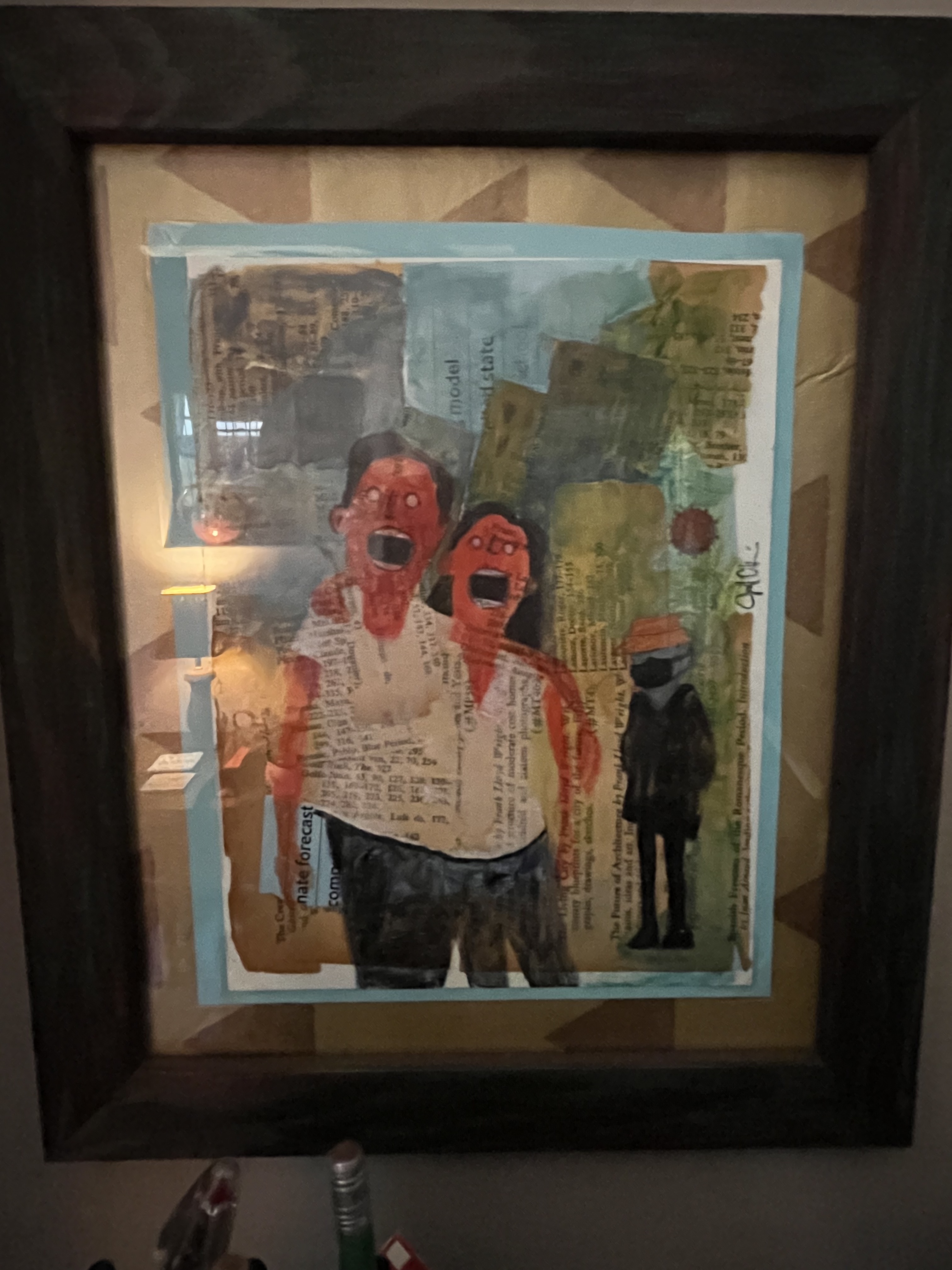
[Lights change, special light on JUNIE. VOICES fade out as music rises, e.g., “Eve of Destruction.” Collage art with painted photo or painting of the four friends around the kitchen table; gradually superimposed on each face are high school photos, ca. 1965. MARV, PHIL, GARY, and DAVY are fifteen years old.]

PHIL: [reading] The British Invasion is upon us.

DAVY: To say nothing of the Russians and the North Vietnamese.

GARY: You’re saying we shouldn’t fight the commies? The commies can go to hell.

MARV: [imitating GLADYS] Language!

PHIL: Now, boys, no politics at the table. [He gives a sieg heil, glances toward GARY while looking at MARV; locates a deck of cards.]

GARY: [looks under table] Mom?

DAVY: Beatles or Stones?

ALL: Beatles.

MARV: Acoustic Dylan or electric Dylan?

ALL: All the Dylans!

 [PHIL deals cards; Davy takes out a baggy of weed as Gary finds rolling papers, if possible, Dylan’s “Subterranean Homesick Blues” comes up, possibly a record put on by one of them.]

ALL: [singing as they pass a joint, play poker] “Look out kid
It’s somethin’ you did
God knows when
But you’re doin’ it again
You better duck down the alley way
Lookin’ for a new friend
The man in the coon-skin cap
By the big pen
Wants eleven dollar bills
You only got ten”

[Light shifts to JUNIE. VOICES fade out as music rises, Chubby Checker “The Twist,” lights change. Art montage superimposes school photos, ca. 1960. MARV, PHIL, GARY, and DAVY are ten years old.]

PHIL: [reading, carefully] “Richard Leaky…”

MARV: “Leaking?”

PHIL: [giggles, repeats] “Leaky… discovers our human ancestors in Africa.”

DAVY: [drawing his idea of one] And they are really, really old. [Shows picture to PHIL]

MARV: Not as old as dinosaurs. [Looks at Davy’s drawing.]

GARY: My dad says I am not a Negro.

MARV: What does that mean?

GARY: [shrugs] Dad says we are Americans and not Negroes from Africa.

PHIL: They don’t want you anyway, Gary. You can’t even twist. [twists]

MARV: [imitating his mother] Now, boys! That dance is immoral!

DAVY: How can anyone know where humans came from?

GARY: My dad says it’s aliens.

PHIL: So are we Americans or aliens?

DAVY: I think it could be aliens. I must be an alien. I just know it.

MARV: Where did the aliens come from?

[Light on JUNIE. Music changes. Tennessee Ernie Ford, “Ballad of Davy Crockett.” Montage: Collage art with photo or painting of the four friends around the kitchen table; gradually superimposed on each face is a first grade black and white photo ca. 1955. Lights change. MARV, PHIL, GARY, and DAVY are now six years old.]

PHIL: [looking at a comic book] My dad says they are cancelling Red Ryder.

DAVY: They are? How come?

GARY: My dad says Red Ryder got a rotten deal.

PHIL: My dad said Red got “damn boring.”

MARV: [imitating his mother] Language! [The boys giggle.]

GARY: This comic cancelling stuff is crazy! It’s not fair. It’s all gonna be like Batman, and I can’t stand Batman. Stupid capes!

DAVY: I only like comics where the men wear capes.

PHIL: You like the capes!

MARV: I think a man in a mask and a cape fighting crime is neato.

GARY: Matt Dillon wears a mask, but he doesn’t wear a cape, and Gunsmoke is still neat.

DAVY: You mean the Long [sic] Ranger wears a mask.

[Lights out on BOYS and up on table in 1974, the MEN playing cards, smoking, changing the lyrics to songs, perhaps. Lights separately on JUNIE gazing on finished work of a large, full collage of the eras of friendship. Song collage, closing perhaps with Joni Mitchell’s “The Circle Game”: “And the seasons they go round and round/ And the painted ponies go up and down/ We’re captive on a carousel of time…”]

DAVY: [entering with a bowl of munchies; to “My Boyfriend’s Back”] “My boyfriend’s black and there’s gonna be trouble, hey ma, hey ma, my boyfriend’s black…”

[CAROL ONE, enters with Lysol.]

CAROL ONE: You are terrible.

PHIL: [entering with a bong; to “Hey, Jude”] “Hey, doob, I want you bad,/ take my dad’s bong, and make it better…”

CAROL ONE: You think you are so cute.

GARY: [sees clock; grabbing bong and waving away smoke, takes Lysol from CAROL ONE.] My mom’s gonna be home soon, you guys.

MARV: [Three Dog Night’s “Mama Told Me Not to Come,” to GARY] “Mama told me not to come…” [MARV, PHIL, and DAVY join in, dancing, as music gains in volume.]

[JUNIE, smiling, holds her gaze on this scene as BLACKOUT.]

Act I, Scene 7

[Kitchen at Glebe Road, 1977. At table are two Vietnam vets, ROGER and MARK, both white men around age 30, in motorcycle gear. JUNIE ladles out soup into mismated mugs and brings them to the table where spoons and napkins are placed. GLADYS enters, smoking a cigarette, coughing, greeting the men.]

GLADYS: So how does Junie know you?

ROGER: Well, she was at one of our gatherings, to help veterans. Junie offered to do a poster for our meetings. And then we saw her at Safeway that time. Started talking.

GLADYS: You both live in Arlington?

MARK: Yes, ma’am. Appreciate the soup.

ROGER: Well, Mark’s closer to D.C. than I am. You know, a lot of people spit on the veterans.

GLADYS: Well, not Junie, she lost a brother, you know.

MARK: That’s what we hear.

GLADYS: That was 1966, ’67, wasn’t it? I mean, no sooner shipped over, wasn’t it?

[Lights up on area, living room, somewhere in Arlington, Virginia, ca. 1965, TIM MACNEIL in uniform, his father COL. DONALD MACNEIL in khakis, and his mother VIVIAN MACNEIL pose for a photograph. His sister JUNE, aged 17, takes the photo. After the flash goes off, VIVIAN begins weeping; TIM comforts her. COL. MACNEIL pats his son’s shoulder, picks up his kit; TIM hugs JUNE, goes with his father. VIVIAN pours a drink.]

MARK: So during Rolling Thunder, huh.

JUNIE: 1967. Yeah. [She pauses, only continues as others look to her for more information.] Tim enlisted as soon as war was declared. [Adding, unusually] Our dad was career Army.

ROGER: How old?

JUNIE: Eighteen, almost nineteen.

MARK: How old were you?

JUNIE: Seventeen.

GLADYS: Irish twins.

JUNIE: [picking up a loaf] Bread?

[MARV enters with satchel.]

MARV: Hello.

GLADYS: We have company. Marvin, meet Roger and Mark.

JUNIE: Soup?

MARV: Oh, right, the guys from the meeting. How ya doin’?

GLADYS: [to MARV] You know, it’s odd, isn’t it, that none of you boys served. [To MARK and ROGER, who pause in their eating.]

MARV: We didn’t. [Taking soup from JUNIE, to MARK and ROGER] I know I said this the other week, but I protested against the war. Our friend Phil was 4F for his flat feet. Davy was queer, but they wouldn’t believe him, so he went to school and was an art teacher for a while. I went to college and taught math—my parents came over during the Holocaust, and my mom would’ve gone nuts if I’d gone off to fight, but even still….

ROGER: What’s the Holocaust?

MARV: [patiently, instructively] Hitler’s genocide of Jews. Mostly Jews, but also homosexuals, resistance fighters…obviously not as known as it should be. Something like six million Jews were killed.

MARK: So you’re a Jew? [MARV looks up.] It’s cool. I don’t think I’ve, you know, ever talked to one before. That I knew of.

[PHIL enters, followed by GARY, in mid-discussion.]

GARY: So you’re saying that you actually think Carter has any fucking shot at all of getting peace in the…

PHIL: Oh, hello.

GLADYS: Gary, language, not in front of company. [PHIL and MARV grin without looking at each other.]

Copyright Lisa L. O’Hara 2023-2025. All rights reserved.

On the Decision to Leave Facebook

Searching for My Sanity

I’m sitting in my kitchen this Sunday, January 12, 2025, a week before the inauguration of the End of Times, feeling lucky and grateful to have a kitchen, and a rocker, and coffee, and art supplies; and despite some aches and pains (and as far as I know), my health. I was able to take a warm shower last night, and sleep in a warm bed covered in Irish knitted blankets and clean sheets. I awoke a little late this weekend morning because I could. The day is a cold, crisp, blue sky winter day in New York City, and by the grace of a good job (still in education after 37 years) and having bought my apartment 20 years ago instead of, say, last week, I get to live here, and affordably. Knock wood.

What I’m wondering about today, all these blessings notwithstanding given the wretched suffering of humans and the planet’s ecosystems as a result of sociopathic, capitalist policies and general stupidity, is whether or not I should continue using social media to communicate. (How privileged am I?) But really what I’m wondering is to do with the point of this whole tower of Babel, all of us voicing our views all the time via TikTok, Facebook, Twitter (X), Instagram, BlueSky, Substack, Medium, Blogger, WordPress, pick a platform. We can write, text, photograph, video, podcast, share it out en masse. So many of us with so much to say. Who is the audience? And to what end? I’m probably overthinking this.

I know from “stats,” for example, that after roughly 24 people “open” this post, approximately two people will read past the first two paragraphs. Possibly one person will finish the whole post. I suspect that person is almost always the same person, occasionally joined by one or two others. One occasional reader will “like” this post on Facebook without having read it (I know because the “like” comes within seconds of posting it) so as to be encouraging. One person may “like” the post at the source, such as on Substack or WordPress. I have “followers” on these sites, and “likes” are swell, but I have to say that none of this is what I’m after when I publish a piece.

Love Letters

As I’ve written before in many blog posts few have read, I write blogs because I miss writing longform letters. Whenever I was feeling really lost and out of sorts back in my youthful teaching days, for example, I would reflect on how many letters I’d sent and received in recent weeks. This would lead to me sitting down to type letters on my Smith-Corona (no carbons, so none of my long letters survive, I suspect), one to four pages, maybe six, single-spaced, on colorful letter paper, to five or six recipients at a go. Every letter had a different voice, subject, and slant, given the audience. Sometimes I included a folded article from The New Yorker or the Washington Post. By Sunday evening, after writing letters between grading stacks of papers—those letters addressed, stamped, and stickered with a return address and something pretty—I was a new girl. Monday morning I’d mail the letters from the school office where I taught, and I could feel breath return to my body. Letters meant connection to the wider world, to the hearts of my friends. I gave them pieces of my heart, and when I posted, I felt that my heart regenerated, times two.

The coming weeks ensured a return post from nearly all the recipients, from, say, my one living grandmother in Council Bluffs, Iowa; my former landlady and other friends in Central Virginia; my former costume design professor at Virginia Tech; my Bread Loaf friends in Massachusetts, New Jersey, Vermont, Tennessee, and Kuwait (or wherever she was teaching internationally that year). I no longer recall what I wrote in those letters, but I still have all the letters I received back. They fill half a closet, shoe boxes within boxes, and I treasure them as one would rare artifacts. I suspect that my trove may well be the last of the letters that humans will ever see, certainly over 60 years in America in the late 20th to 21st centuries. But that isn’t why I keep them. They are reminders of the ways we filled one another’s hearts, and deeply, once. To me every letter is a love letter.

The Social Network

One thing I’ve become sad about in the past decade is how social media, including texting, has been used as a replacement for letters and personal conversations. I no longer get that Pavlov’s dogs “warm feeling” when I hear the arrival of mail dropping through the slot. Junk in the form of requests from charities, a catalog, a flyer from a theater, a medical bill—these are all I can expect. When I do get personal mail—as small package, a postcard, or a card for an occasion—I do relish the note, usually very short, and mostly respond in kind. And I do love my sibling text threads; and some texting is an important way of writing brief letters with some old friends, so there is that.

We all have shorter attention spans, of course, technological “advances” being what they are, causing our brains to have been rewired to be more in line with ADHD tech developers (my personal theory) and less so with the slower and more deeply thinking (though not necessarily genius-level) people like me. Still, I think there is something to be said for being able to be quiet, and deep, and I miss it.

But what I am missing, more specifically, is the forging and maintaining of intimacy.

Instead of enjoying deep communion with friends, I, more often than not, provide and receive sound bites and sermons and memes. It’s all fun and games, however deeply felt our stories and rants, however witty or sweet or artful the picture posts. Less and less, I’m feeling that my life can be “both/and” when it comes to deep connection and social media on a platform. My brain and my heart feel frayed, like an old quilt, maybe, that I stopped really valuing and only look at out of habit.

Time Travels

I look at how the letters my parents received dwindled once they reached their 40s, when they and all their friends “back home” became busy with lots of children, school programs, second jobs; when aunts and uncles began dying. Distance and lack of time prevent us from keeping up with everyone; it’s life, and “everyone” is too many. It’s why we have reunions every decade or make special trips once or twice in our lives, or every Christmas, to reconnect with old friends. We also used to call people on the phone for a daily chat, or to faraway relatives on special occasions, but those calls were rare. I think my dad only called his mother two or three times a year, families then still mindful of the Depression and the charges for long distance. By contrast, when I was a teenager, I could stay on the phone for hours with a friend I’d seen all day at school. You remember.

While the invention of social media has afforded us a chance to quickly and easily locate, “friend,” and play voyeur into the lives of dozens, hundreds, thousands of long-lost chums and recent acquaintances, and to share our own photos and points of view, I’m wondering if it has been worth sacrificing depth for breadth, or when it started to feel like a sacrifice. I ask because I have never been lonelier in my life.

Possibly this is because I am sixty, and live alone (I am self-aware enough to realize I’m too odd to live any other way), and even if I weren’t single, I would be right back where my parents were, never hearing from anyone either, even if this isn’t 1973. I don’t want to devolve into nostalgia.

But what has happened in the past decade is that too many formerly intimate friends have relied on their social media posts—posts sent out to dozens, hundreds, and even thousands of friends or followers—as their sole means of communication with me, Miss O’ lumped among the throng. I stopped even texting some friends when the reply became, “Don’t you read by Facebook?” or took the form of an emoji, a heart or a unicorn, say, as if to express, “What makes you think you are so special that I would take time out of my active life to respond only to you personally?”

I had become a unicorn, but not special in the way of that creature so that anyone would want to seek me out. Have I done this to other friends? (Was it something I said?) A few years ago, I withdrew myself from a group text thread of friends when I realized that no one responded to anything I wrote. One friend said later, “I’m sorry that’s your perception.” No, that was the reality, as I saw the receipts. The good thing that came out of it was a restored one-on-one friendship with two of those people, much more personal and real, if you know what I mean. And more me, more fulfilling.

I will say, as far as media goes, the technology that is Zoom has been a godsend, and was especially so during Covid. Two couples, Anna and Michael in California and Frances and Jim in New Jersey, joined me for long, long conversations every few weeks during all those unlimited-use months during 2020-2021. We talked, read excerpts of books aloud, moved our computers to the kitchen to fix dinner or experiment with new cocktails, gave each other tours of our homes. In a culture that really isn’t into letter writing that much, now me included, Zoom became our way of sharing and connecting when there was no other way to get together.

So My Friend Susan Announced She’s Leaving Facebook

This was the spark of today’s blog. Susan is the kind of person who uses social media in the best way. She shares her family stories and adventures with the perfect amount of wit and detail that it’s like you are sitting at the kitchen table with her. She makes 2,000 people at a time feel that way, and it’s a real gift. I used to share fun little moments in New York City, and even self-published a little eBook to compile them (at the request of my friend Becca), but more and more my own use of the platform has turned into political screeds against stupidity. To the two-dozen sweet people who regularly nod in agreement with one or more of those posts, I am glad we can commiserate.

Because of the current state of society and disappearance of anything resembling an objective corporate press, we currently have political reasons for questioning the use of social media. “Meta,” for example, has announced this new “anti-censorship” policy, as “X” has done, which really boils down to “Feel free to yell ‘Fire!’ in a crowded theater” (which I learned as a student in Mr. Hart’s fifth grade class is illegal as well as immoral). This is why Susan is leaving. I asked, “Have you considered writing a blog?”

The Open Blog Culture

Blog culture can be so much pissing in the wind, I guess, but there’s something rather dear about it, I think. Those of us so inclined can pour out our hearts in longform letters without postage. (Note: several of my artistic writer friends find my blogs unreadable or disappointingly un-writerly, etc., and my view is that they wouldn’t send back a critique of a letter, now, would they? So. Maybe sit on that and spin. I say that with love.) And while I still make personal cards with collages and quotations, and send short notes periodically, I will say writing a blog post fills the need I feel (mostly, though I feel it less and less, finding I have less and less to say, or at any rate to say to you, my friend(s)) to write a complete idea, or to explore an idea as completely as I have the mind to in the moment. However, while this act sorts my brain, my heart does not regenerate, not exactly. I do miss that.

Let me hear from you, should you feel that, too, but not on Facebook. I think that one will have to go. I will do a gradual release, though; it’s the only way I hear about deaths, for example, or childhood friends and former students in success or distress. I like Instagram, but the only posts I see in my feed—all my own doing because I “followed” them—include political news about He That Shall Not Be Named, and only one or two sweet photos from actual dear friends. I tried BlueSky, but it’s become all-HTSNBN-all-the-time, too. No one, it seems, knows how to get off that ride, and no amount of posting my distress about that is going to change anything. I feel my brain atrophying just thinking about it.

All that time I spend worrying on social media—what else might I be doing instead?

Now it’s noon, and I need to go for a long walk and see what’s doing in the neighborhood. Maybe I’ll call somebody later, who knows. What about you?

Sending love,

Miss O’
P.S. I have another blog on Substack, and have duplicated the posts. However, I think I will use this space to do more creative work. Will see what happens–and thanks for reading, in any case.

Morning Glory, Message from a Friend in America


Yesterday walking from the farmer’s market
My friend
Who is
Never wrong
Unfortunately
Asks me about the trip
I’m taking home
South
To see
A gang of friends
All of us this year 60
My friend says “You need to be prepared
For their health.” 
She says
“Do you know about their health?”
What the hell kind of thing is that to ask
I become wobbly
And I realize
We are dying
My friend who is never wrong
Unfortunately needs me to face
The inevitable
Age and death
Of friends, of myself, of all this.

Yesterday my friend who is
Never wrong
Unfortunately
Tells me as we walk
In her way
That she has accepted
Defeat and the end of the republic
Tells me to be careful what I say
In the South
So I don’t get in trouble
And I say
fuck fear
So loud
That Appalachia can hear me
Her lips purse,”Mmmm.”

At the kitchen table with her husband
My friend who is never wrong
Unfortunately says
“I have sad news. All the morning
Glories are gone. All of them are dead now.”
And I know I saw some on my walk the other day
Bursting in purple glory bloom still
But I guess it’s today they stopped blooming
And I missed it. I say nothing.
“All of them are gone. Sad.”
And I sit with my tea and my scone at
My friend’s
Formica table knowing I am wrong about
Everything
I guess
And don’t know how to be
With all this, all this death, all this unstoppable
Ending
“Sad.”
Mmmm.

On my way hope
I mean home
I buy a bottle of good red wine
“Hello, Sunshine,” says the employee
Who says I bring the light
Even as I wander out
Wonder how I will live
In red sips
Of this dark world.

Today
This new morning,
blue sky and sun,
I have a text from my friend
Who is never wrong,
“So I was wrong about one thing:
I still saw some morning glories this morning—
they’re there if they are facing East.
The ones facing South were gone though—
as they were gone yesterday.”

She was wrong about one thing.
And if she was wrong about that
One thing
She could be wrong about
(Fortunately)
Almost everything
And to everyone in America I say
Like the faithful who practice
In every faith
Face East, not South
And we, too, will not be gone.

Morning glories of Queens, facing east. Photo by Miss O’, fall, 2024

Last-Minute Saves: Completing the Assignment

On Friday at work, on a Zoom call with the “team” and managers and the director of the division and a program “author” who is guiding our work, there was a pause after 40 minutes of presentation and feedback from the author to ask questions. I asked a good question, one I really wanted the answer to. The author relished answering it. I asked clarifying questions, and he answered those. It was hard to read my director’s face, but I know the team was glad of the questions, given the “Directly to you” notes on the Chat feature of Zoom, “Great question,” “I’m so glad you asked that,” etc.

When I left the meeting, I said to myself, “Well, Lisa, once again you may have saved your job.” What I asked—after months of keeping my head down and being quiet as we embarked on this new project—and how the author answered, may well indeed have provided a breakthrough for what will make the next version of the product really special and useful for teachers and students.

My whole life, I reflected this afternoon, has been a series of last-minute saves.

When I was a Christmas tree shearer one summer in the Blue Ridge Mountains, for example, I was having a hard time keeping up, and my rows, though sheared well enough, took me twice as long as others on the crew to complete. After several days of this that first week, I determined to keep pace with a woman next to me, because she was a good shearer and very fast. And keep pace I did. I learned the next day that one of our other crew members had been fired for slow work and because “his trees weren’t good enough.” The crew chief, Sharon, I’m sure would have fired me too, and it would have killed my spirit. Something inside me saved me from this fate.

In a writing workshop in my senior summer of graduate school, after a mediocre first attempt at a short story, and a second attempt that my professor felt was as good as it would get and not in need of a workshop, I wondered if I’d ever write a third and final piece worthy of the work everyone else was doing. I was certainly vocal—participating, challenging, encouraging—and if I’m going to talk that much about how I receive writing, surely I should write something worth reading. And one evening in my dorm room overlooking the lawns at sunset just after supper, I found myself writing in a blaze, a fictional account of my great grandmother’s life in Iowa. It all came in one night, with a crucial misspelling my professor mentioned in the dining hall at breakfast after he’d read the story prior to the day’s workshop. I raced to the computer lab and did the ol’ Control/Find, and I could tell he was pleased by my passion. A student in the workshop gave me a bottle of wine before class, “For the best story of the summer.” How did this happen?

I had a similar save in my second summer of graduate school at the Oxford campus. I was studying Virginia Woolf with an eminent Exeter College scholar who also taught James Joyce. After reading a collection of short fiction, Jacob’s Room, and Mrs. Dalloway, I had to produce my first paper. What would I write about? I decided it had to be Mrs. Dalloway, but what about it? I had no idea. I just couldn’t think. That evening, my friend Anna, who was taking a different course focus that summer, came by my room to see if I still wanted to go to the cinemas and see Howards End, just released, starring Emma Thompson, Anthony Hopkins, and Helena Bonham Carter. I told her my dilemma. “When is it due?” she asked. “Tomorrow,” I said. I sighed. “Let’s just go to the movies.” She was stunned. “No, really,” I said, gathering my things, getting my keys, “because I’m not going to figure it out just sitting here.”

We went to an 8 PM showing, I’m sure, because dinner in Hall was at 6 PM. And it was there, at Howards End, that the key to Mrs. Dalloway unlocked: Emma Thompson and her now husband Anthony Hopkins have learned that Emma’s sister Helena Bonham Carter is pregnant out of wedlock. In the garden, Emma is seated as Anthony paces, determining what is best to do. Emma keeps trying to get up, to go to her sister, to try to take action based on her own conscience. To stop her, to take control, the paternal hands of Anthony Hopkins press and press on his wife’s shoulders to keep her seated, to keep her in the garden.

And my mind exploded: there is a scene in Mrs. Dalloway that had puzzled me as to why it was there at all, which is a luncheon to which a certain Lady Bruton has invited Richard Dalloway, Clarissa’s husband, and a doctor (who is treating Clarissa’s nerves). Lady Bruton has a letter she wants to write to the London Times, and her point of view on the issue is liberal, one might say, and feminist. Yet by the end of lunch, the two men have explained to her what she really means, “Oh, do I?” she says, which is the opposite of her original point, and they write the letter for her. Those paternal hands pressing her feminist shoulders to keep her in the chair in the garden. I was saved.

You might look at these saves and think, it’s just a job, or just a class, or just a paper—it’s easy to diminish the experiences, I guess, but that’s not fair to anyone living this life. This is about that thing inside us, the thing that knows and opens and doesn’t fear, that does the work but also lets go to allow the “thing” to come, to be.

It was this that I witnessed in the person of Vice President Kamala Harris at the Presidential Debate on Tuesday night, September 12, 2024. She found the “thing” to rattle the motherfucker Donald Trump: the small size and demonstrable boredom attending his rallies. And from that moment on he was toast.

Lost because of that moment and its aftermath of verbal carnage, lost on the American press, as usual, was Harris’s masterful grasp of complex policy issues, foreign and domestic, none with easy solutions but with clear and important ideas to address and solve problems. After nine years, on the other hand, a clearly demented Trump revealed that as to replacing Obamacare, he has “concepts of a plan.” (As veteran retired high school teacher Tim Walz recounted this at a rally in Grand Rapids, Michigan, “My students had better excuses than that for not doing the work.”) Harris laughed.

Kamala Harris, Tim Walz, and I are all the same age. Born in 1964, we are the last year of the Baby Boom, the year before Gen X. As a result, we were both the responsible adults in the room even as children and also the last feral children out playing till dark all summer long; and, in addition, we get all the Monty Python jokes. I feel this in them, the kinship of that cross-section, people who do the work of the grownups but are loose enough to allow the realness to be and with humor. It’s helped sustain Harris and Walz in their brilliant and varied careers, I have no doubt. It’s done the same for me in my less brilliant but no less varied careers, too. Being adult and being real and being funny: it’s saved us.

With Harris and Walz and that generational realness, we have a chance to save this country. We can save it. Let’s save it.

Love,

Miss O’
Miss O’ recognizes, nay, feels, all these teacher faces. Credit to @AnandWrites
Summer Stock in a Heat Wave

First of all, I have come to love this movie. Second of all, whenever Summer Stock, an MGM musical from 1950, appears on TCM the host always notes that 1) it’s Judy Garland’s last MGM musical; 2) this is one of the lesser MGM musicals; 3) Gene Kelly signed on in a less prominent role as a favor to his friend Judy who gave him his start; 4) Judy was obese at the time of filming; and 5) Judy’s iconic “Get Happy” number was filmed after production closed, and she’d “slimmed down.” It really sets you up to watch the film with a “pity” and “I guess I have nothing better to do” mindset, right? The movie deserves so much more of an intro boost, and maybe someday Miss O’ will be famous enough to be a guest who can explain all this to Ben Mankiewicz; in the meantime, I’ll introduce it to you.

Get Happy

When I was a kid in the 1970s, I fell in love with movie musicals that showed up on TV on the weekends, usually on syndicated channels, and spent hours and hours memorizing them. This was a confusing exercise. Interrupted as they were with commercials every three to five minutes, the movie plots were pretty much impossible to follow. For example, the opening song of Summer Stock, “If You Feel Like Singing, Sing,” follows the camera over “Falbury Farm” to Judy in her room to singing in the shower to putting on her farm clothes, and as she makes her bed, she learns from her housekeeper Marjorie Main that “Frank and Zeb” are “dressed in their Sunday clothes,” and…cue commercial for Ginsu knives. The next scene was probably Judy going to the kitchen, saying, “I don’t blame them,” and you think, “Huh?” Years later, watching the film uncut on TCM you realize that the network cut out the scene where Frank and Zeb quit their jobs, and how unsuccessful the farm has been, in order to make room for more commercials while my child head spun.

Another plot point that made the movie impossible for a kid to follow on syndicated Sundays is that Judy’s character, Jane Falbury, changes her mind solidly three times about allowing the show to continue in her barn. It’s totally reasonable that she does this, unless between mind changes a network cuts dialogue to insert commercials for Koons Ford used trucks, Ding Dongs, and Aqua Net.

As a result, Summer Stock was lost on me on my first viewing, whereas musicals like The Wizard of Oz, Anchors Aweigh, and Singin’ in the Rain, though no more complicated in their plots, had more understandable and entertaining musical numbers for a kid like me.

What led to me write about this little musical gem (because it is) has to do with summer boredom during a heatwave her in New York City. Right now my job is really slow, and I’m not ungrateful for that, but it’s hard to concentrate on anything with little in the way of deadlines attached while still being tethered to my laptop. To give myself some company, I look for movies to run on a loop when I can’t find procedurals like Law and Order in reruns, and Summer Stock came up On Demand. Over a dozen viewings later, I have this mature, wonderfully acted movie memorized, and more than that, I watched it with different lenses trained on it that might be interesting to, I don’t know, someone. Here we go.

Judy Garland’s Body

Here are a couple of photo stills from the film to help you understand how fat Judy was during filming:

If, like me, you are squinting to see a woman whose body is listing toward morbid obesity, welcome to seeing a normal woman like a normal person. Since The Wizard of Oz, during the filming of which MGM Studios put their young star on a diet of amphetamines, it’s the first movie where Judy’s body is what I’d call womanly. Healthy, even. In her many films, from The Harvey Girls to Meet Me in St. Louis, from The Pirate to Easter Parade to The Good Old Summertime, I see a Judy who is thin, and it’s a little unnerving how thin when you see her body is also covered in layers of period garb. In fact, not really since For Me and My Gal, her first picture playing an “adult” woman character (opposite Gene Kelly, whom she’d seen on Broadway in Pal Joey and championed to be her leading man in that film, thus starting his career), could I recall seeing Judy Garland in modern dress. Summer Stock is also the first movie in years with Judy in short hair—a hint of the hair she will style in more elegant ways in the 1960s. In Summer Stock, the body type works since Judy plays a farmer and a sort of old maid, and after filming completed and her contract was up, Judy’s career came to standstill, morbidly obese by studio standards and washed up at age 27.

The MGM Circle Game

Judy started out her career proper has Andy Hardy’s love interest in the Mickey Rooney franchise of movies in the 1930s, most famously Babes in Arms, where the kids entered the realm of movie legend when they found a barn and put on a spectacular show despite the town’s disapproval and the doubt of their families. I don’t know if it was deliberate that Judy Garland ended her MGM career on a farm set, hearkening back to where she found stardom in The Wizard of Oz, and inside a plot with a “let’s get ourselves a barn and put on a show” where she got her start, but it’s really kinda nice.

In Summer Stock, Judy Garland is no longer a sidekick ingenue in search of a show, or a waif who dreams of a world beyond the rainbow over Kansas. This Judy plays Jane Falbury, and she owns the farm (in a small community in what appears to be Upstate New York or Connecticut). Early on, we learn that the farm has been unsuccessful, Jane is engaged to Orville (son of the farm supply store owner Mr. Wingait), and her younger sister Abigail is due back from New York City that afternoon. And what do you know, Abigail surprises her sister with Joe Ross (Gene Kelly), the director of a new Broadway show looking for an out-of-town place to play, along with all his cast, crew, and sets. In the process of figuring out whether the show folk will get to make this happen, Jane’s housekeeper Ess (Marjorie Main) reveals that Jane and Abigail had dance lessons all their young lives, and Gene sees Judy do a little dance in the kitchen. Fireworks ensue!

Why Watch It?

Sure, there’s a predictable plot, tempers flare, people burst into song, love ensues, and a star is born, but the emotional world of this musical is more mature than in other movies, a maturity that resonates with the Miss O’ who still loves musicals a grown-up. This movie opens to reveal a woman who is comfortable in her body, who loves to sing and sings great, who without question runs a farm, and who genuinely loves her life. She is independent in the important ways and wants no rescue, no change. But you get the feeling that despite her four-year engagement to childhood friend Eddie Bracken, Judy/Jane has never known love. Orphaned young at some point, her entire life has been devoted to raising her sister and keeping the farm going. She doesn’t resent it. And she doesn’t realize that she’s been missing a thing until that devilish smile in the form of Gene Kelly arrives to shake her up. Gene and Judy are emotional equals. They spar, they compromise, they fall in love, sure.

But what strikes me most in this movie is that leading man Gene Kelly is a supporting player. The film is totally Judy’s. And the result is an uncharacteristically light and lovely Gene Kelly. Not that he isn’t wonderful in his films. But here he is not wildly aggressive or ego-driven, he has nothing to prove, and he doesn’t have to carry the picture. He’s not a ham. The dances are staged by Nick Castle, though Gene probably choreographed his solo routines, so he’s not carrying that load, either. His role as the show’s director Joe Ross is totally believable, and Gene plays his rages and fibs and falling in love with a master’s touch of humanity. He’s totally equal to Judy on screen, but it’s Judy’s movie, and his performance is the better for it. I think it’s one of his best.

In addition, it seems to me that however “lesser” this musical is in the canon, this is an important film in Gene Kelly’s development as a choreographer. In some of the dance numbers you can see the seeds of even more iconic numbers to come. For example, the staging of “You Wonderful You” with Judy presages “Our Love Is Here to Stay” with Leslie Caron in An American in Paris (1951) and “You Were Meant for Me” with Debbie Reynolds in Singin’ in the Rain (1952). Other dances in the film show classic Kelly moves he will use even more imaginatively in those later films, like the matador move, the airplane move. It’s fun when you realize this because of the order the movies come in. And you are a total movie musical nerd recalling these notes from memory.

Judy’s range as Jane is something she usually doesn’t get to display in other films—fully human, grown up, shifting from joy to concern to rage to apology to thoughtfulness to bargaining, with ease. And what makes Judy such a superb actress is that she is fully present in every scene, with every actor, no matter the roll. Her emotions are both raw and in control, and as a woman in late middle age, I connected with this character as I don’t generally get to do in musicals. Twelve-year-old me would never have enjoyed the vulnerable and tender moments between Judy and Gene, especially in “You Wonderful You” and “Friendly Star.”

The supporting cast is a Who’s Who of some of the finest character actors ever on screen: Ray Collins, Eddie Bracken, Phil Silvers, Marjorie Main, and Hans Conreid, as well as up-and-comers Gloria De Haven and Carleton Carpenter, and an ensemble of wonderful dancers. (One of those key dancers is Jeanne Coyne, married then to Stanley Donen (who will go on to co-direct Singin’ in the Rain with Kelly two years later), who was one of Gene Kelly’s dance assistants. Both people divorced by the late 1950s, Kelly and Coyne married in 1960. I think that’s sweet.)

Still, there are curious things in the filming that make me realize Summer Stock was not a top priority in the MGM perfection department. Charles Walters’s fine direction notwithstanding, there are couple of clumsy edits, unusually sloppy for MGM, both featuring Judy. In addition, as I mentioned, “Get Happy” was added in a re-edit of the film post-production, and great as that number is—possibly her best on screen—it doesn’t quite jibe with the rest of the proceedings. Also, after several viewings I finally paid attention to the final credits, where a noticed an actress named Nita Bieber “as Sarah Higgins.” And I’m like, who? So I deduced in subsequent viewings that this was the dancer who wears glasses and is always reading and has one featured dance moment; and I inferred there was probably a story for her that ended up on the cutting room floor, surely for the best. Her screen card may have remained for contractual reasons, or possibly out of laziness.

And when critics all point out that Garland is “obviously” thinner in the added number (and I noticed that the scenic background at least is in an earlier part of the film), I have to say I don’t see it. “Get Happy” is the only number where we see Judy’s legs, and on a 4’11” frame even five pounds would be a lot, as if it matters. And throughout the film, Judy dances like a dream, and dances a lot, and is clearly in great physical shape. I don’t know why critics feel compelled to talk about her weight. I really hate that. Judy Garland is simply great.

You might think Judy deserved a better or more glamorous movie send-off as her contract expired. The studio, which her talent literally helped make great, got her hooked on pills and then got mad when their work horse wasn’t able to perform and had no-show days on films such as The Barkleys of Broadway, where she was replaced by Ginger Rogers (in her last appearance, and only one in color, with Fred Astaire), and Annie Get Your Gun, where she was replaced by Betty Hutton. (Hutton told TCM host Robert Osborne that the crew of that film resented her terribly for taking Judy’s part, which is unfair, of course; by all accounts I’ve read, the crew at MGM loved Judy Garland.)

But I’d like to say that I think this lovely, mature, sweet, goofy musical treat, a kind of retrospective of all the films of Judy’s great MGM career, is a perfect movie for the middle aged, for the summer. If you need something to take your mind off the unutterable evils swirling nonstop around us, you might try the pretty, tender, talented world of Summer Stock (commercial-free on TCM). In the meantime, you might take a look at the duet arrangement Judy made of her iconic “Get Happy” with Barbra Streisand’s “Happy Days Are Here Again.” The number that keeps on giving.

Love to all.

Adventures in Pearl Clutching, Summer 2024

Fuck The New Yorker

Following a lousy debate “performance” by President Joe Biden—over tired, overworked, over-traveled, and (worst case for a stutterer) over-prepared (to talk policy, of all things, in two minutes or less, against a drugged-up lying sack of shit)—The New Yorker, to which I have subscribed since 1993 or so, ran not one, not two, but three long pieces, complete with photos right out of a Psycho ad, in self-satisfied, “final arbiter” prose, that President Biden must step away from the Democratic nomination. I searched for but could not find one, not one, request for actual psycho Donald Trump, belching lies at a record pace, to step away from the Republican nomination. (Nor could I find this in one publication in the American press, not even after 34 felony convictions, to say nothing of stealing documents, selling secrets, or buying the Supreme Court.) I was so livid I couldn’t sleep all night, heart palpitating, hardly able to breathe.

At 8 AM I called the first of two 1-800 numbers for Conde Nast to cancel my subscriptions to two publications. (Note: I speak not of the New York Times, which had their entire op-ed page, entirely anti-Biden, already written and ready for the presses before the debate even began, apparently, shilling for Trump since 2015; my subscription to them was canceled after their front page “But her emails” bullshit that may well prove to have cost America its democracy.) On the Conde Nast magazine sites, by the way, it’s impossible to “Manage My Subscription” because it falls into endless loops of signing in, then telling you, “You are already signed in,” in red font, and no escape. First, I canceled my subscription to Vanity Fair, whose covers alone have become so predictably insipid I can’t rationalize even using the magazine for collage material. (To wit: Anne Hathaway in black leather bustier, severe red bob, hands on hips, in Batman green lighting, and all I could think was, “Oh, look who must have turned 40 and has to prove she’s still ‘got it.’” And that, it turns out, was the story. That was a story? Sheesh. Any woman on the cover, even now, screams, “Lay me.” Fuck that.) After all the auto-voice hoops, pushing the correct numbers on the keypad, saying my subscription number, then pushing 7, I got an agent immediately, said I wanted to cancel, did (also remembering to log onto PayPal and cancel the “autopay” option for both publications), and when asked why, simply said, “I can no longer afford it.” What does a phone agent care about insipid covers? All done.

Next, I called another number to cancel The New Yorker. I followed the same auto-voice routine, said my subscription number, pushed 7, heard the ring for the agent, but didn’t get one right away. In fact, after 5 minutes passed, I was a little baffled and nearly hung up. A couple minutes later a woman named Kristen answered, and very quickly and without questions canceled my subscription. “Is there anything else I can help you with today?” she asked, nervously. Nope. Hmmm.

Then I happened to look on my Instagram feed, and first up was the New Yorker (note: Unfollow) Joe Biden from Psycho story, and I saw that there were over 4,000 comments. I clicked on those. And they were all variations on my own feelings, condensed here: “For fuck’s sake, call on Trump to step down you fucks,” and I scrolled to see, in addition, “I’m canceling my subscription…” many, many times. Hence that harried operator, who’d been fielding these calls since 8 AM. I did a quick bit of math, and if even 2,000 people decided to end their subscriptions following that totally irresponsible set of stories, The New Yorker quite possibly lost nearly a half million dollars in revenue in a single morning.

Is this “cancel culture”? You’re damn right it is. And for all the right reasons.

All the so-called “left” or “progressive” publications—and there are few if any in the form of daily newspapers now—are long-form publications, heavily researched, overly long, in small font, full of self-righteous beautifully written hand wringing but proffering no solutions to our existential crises. Not one of these publications has reported at all, or in anything like detail, on the transformational nature of the Biden presidency. Here’s a handy meme:

I read last week that under President Biden, the U.S. economy, for people who care about these things, which had so weakened under former President Trump, had recovered and even surpassed its strength in former years, making it the strongest in the world. (If you Google anything about the economy, what comes up first is the lie of The Heritage Foundation.) Biden has gotten tons of good stuff done despite the obstruction and waste of our Republican House. Biden pulled America back from the brink of collapse on every front, by his fingernails, and triumphed. Crickets from our press.

But I defy you to find that front-page story.

And worst of all—and predictably—many of my liberal friends are doing the “Joe’s gotta go” shuffle in lockstep, because it’s more important to look righteous than be politically savvy. I say this because no one offers a suggestion for a replacement or even knows how that would work. (MSNBC’s Lawrence O’Donnell did a great explanation of how impossible and also unnecessary and even dangerous it is, at this point.) Should Dems have a bigger stable of viable candidates? Sure. But doing right by the American people and also wanting to be president, and win, requires an almost impossible combination of intelligence, experience, an ego the size of Alaska hidden behind casual charisma, behind-the-scenes meanness toward rivals, big money connections masked by grassroots donors, a strong stomach beyond courage, and, hardest of all, a demonstrable ability to walk on water, at least till midterms. Libs can’t settle for less.

It’s July 7, four months out from the actual election, and Democrats are already giving up. “Ol’ Joe” aside, you hear the murmurs, “rigged electoral college,” “18-55 year-olds polling as nonvoters,” paving the way for that big shrug that follows the laughably predictable pearl clutch, “voting does matter.” (Cue knee-slaps of Republicans.) But who gets involved to try to change that? Who even uses a voice against the horrors of Donald Trump, the Heritage Foundation, and Project 2025? Who in America is running those stories? Who is even sharing them on social media?

Miss O’ is, anyway. I know I sound like a dick. I know that. But I am so fucking sick and tired of all the whining, the “You should be terrified!!!!!!” bullshit, the colossal waste of energy. Fuck fear. Fuck rumors. Fuck the fucking fuckers. Get mad at the right people. Act on that. I scream this with love.

Clutch no pearls! Instead, wear magical beads, and Lisa DiPetto’s sticker found at PencilIsland on Etsy.

It’s Democracy v. Fascism, fellow motherfuckers, and if it goes Fascism, we have only the weak of will to blame.

I’m looking at YOU. I’m looking at ME.

Love and kisses and BUCK UP,

Miss O’