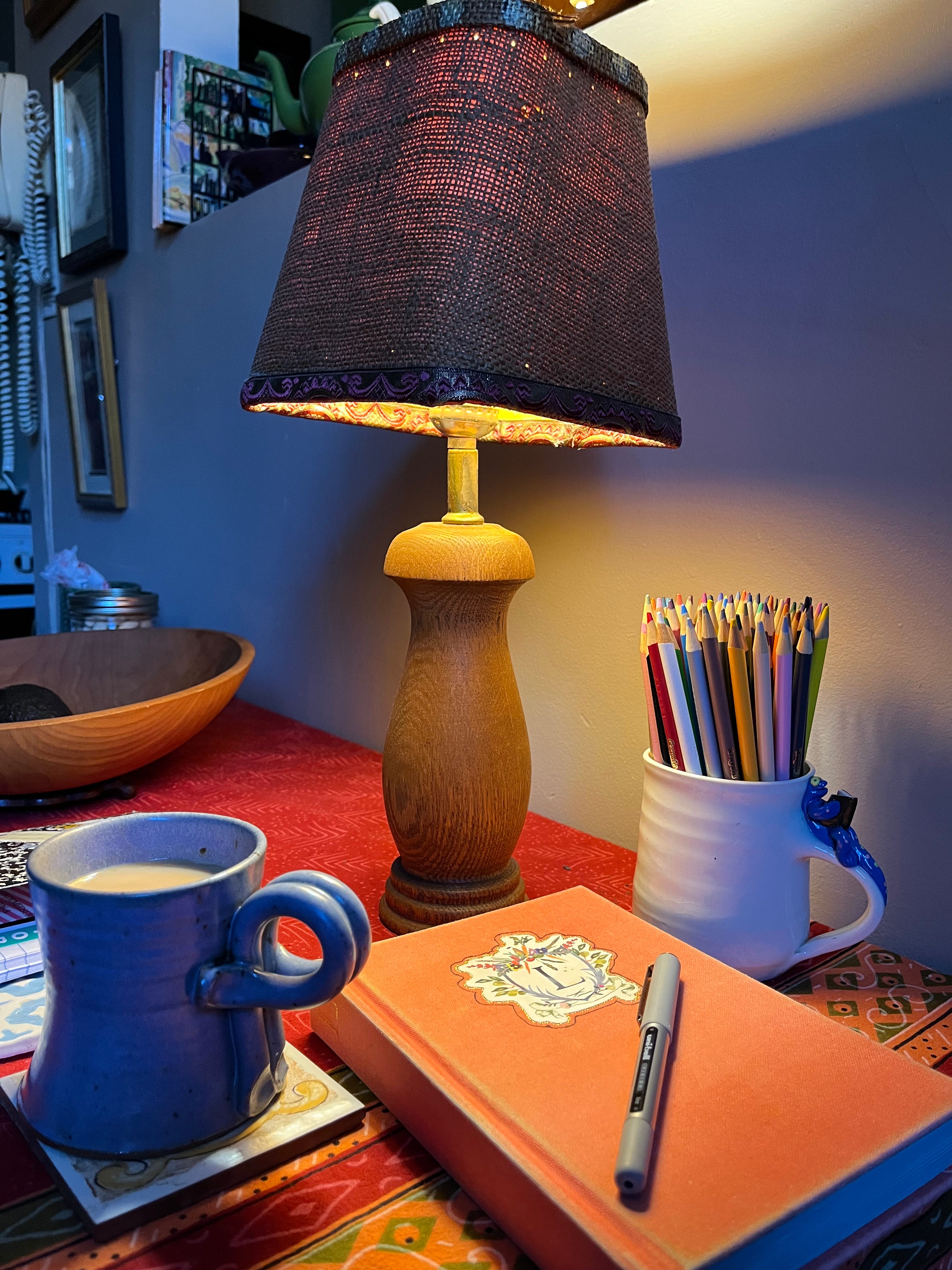
A Work in Progress, Part 1

To my three readers–Hi, Anna!–I’ve been working on a play for a couple of years that I think would actually make a good TV series in these seriously troubled times. The title is up for grabs. Here’s part of Act 1.

Love, Lisa

WAVY DAVY’S PERPETUAL SOUP HOUSE KITCHEN

A PLAY by Lisa O’Hara

ACT I, SCENE 1

[AT RISE: Marv is typing at a laptop in a coffee shop. PHIL is sitting at the table sipping coffee and reading a book. They are in their 60s.]

MARV: I want to tell this story with unflinching honesty.

PHIL: “Unflinching honesty.” So, what is “flinching honesty”?

MARV: [beat] Why do you do this, Phil?

PHIL: [beat] Because I care about meaning, Marv. What is “unflinching” honesty if there’s no opposite? If you are honest, you are honest. Why do you qualify it like a Book World critic? Are you worried what they will think? There’s no they, Marv. Only the truth.

MARV: There you go, Phil. [picking up an old argument, not necessarily his] We all know there’s a They and you know who they are, but you don’t really, do you, and that’s the maddening part. No, it’s not them [pointing] though that would be convenient for your politics, right? And how can They be playing you and playing them, those others on the opposite side as you…

PHIL: …the flinching ones…

MARV: …all the while taking all the fucking money? It’s like the aliens we all know exist, and so how is it no one has ever spilled that secret? So that’s how They operate, and it’s so fucking pissing fucked up. [MUSIC, good blues rock]

PHIL: Who are you right now? [MARV smiles. So does PHIL.]

SCENE 2

[Projected: 1988]

JUNIE: [outside the scene, stirring a big pot of soup, tasting, adding spices] Marv pulled up to the curb of the Leave It to Beaver street in Annandale, Virginia, in his used Ford Grenada, a color of brown no car should come in, and I remember he put it in park though he was always unsure about turning off the engine because of the other times it cut out, or just didn’t go, like when we were on Rt. 123 with our friends Gary and Phil, Marv flooring the gas for uphill acceleration and didn’t nothin’ happen, and he was screaming…

MARV: [looking up from laptop] Here’s some advice, kids. If you have to buy a car, don’t buy a used car, and if you have to buy a used car, don’t buy a Ford, and if you have to buy a Ford, don’t by a Grenada, and if you have to buy a Grenada, don’t buy a brown one!

JUNIE: But on this day, a humid but decent early summer day perfumed by freshly mown grass, Marv was not terrified we’d get rundown by a semi. He was beaming, glowing, about to show his bride, his love, me, their, our, new house. [MARV beams] Yes, on this July day in 1988, at the age of 38, he, Marvin Allen Frischberg, had done the thing he’d sworn on his bell-bottom jeans and tie-dye tee shirt at the 1968 Democratic National Convention he’d never do: use his earnings from a steady job in American government

MARV: …all this, thanks to the fuckin’ man, of all things…

JUNIE: … to further suckle on the teat of American corporate capitalism by entering into a life phase of home ownership with a woman to whom he was wed. But there we were. And Marv was exhilarated.

[In shadow, a jubilant MAN gets out of a car; a WOMAN next to him stares out.]

JUNIE: Next to Marv in the used brown Ford Grenada was that very bride, aptly named June, Junie to everyone; together, what thirteen, fourteen years, married by our friend Kenny, dead of AIDS four years that August, who’d gotten a Universal Life certification out of the back of Rolling Stone to perform the ceremony, was it really nine years before, in the backyard of Gary’s “communal” house on Glebe Road…

MARV: [typing in cafe] …just a few miles outside the District. When Junie said, “Where are we?” I said, “Our house,” thinking total Graham Nash, and my Joni, my Junie, unclicked the barely operational seat belt, opened the passenger door, and…I shit you not, she began vomiting to the point of dry heaves…

JUNIE: And I was thinking, The Dry Heaves would be a great name for a band.

MARV: I was sure that Junie was really pregnant this time, and I was overcome with joy.

JUNIE: [lifting a ladle] Who wants soup?

SCENE 3

[Music. Projected:] 1973

[PHIL and MARV, aged 23 or so, are playing chess at the kitchen table in the Arlington, Virginia, kitchen on Glebe Road. It’s the first Watergate Summer. PHIL has just check-mated MARV again. GARY, also 23, who owns the house with his mother, enters from the kitchen with a bowl of soup and a stack of saltines.]

GARY: [setting down his bowl and crackers on a TV tray] You know who they are? I am they. I run the fucking world. I’ll prove it. [GARY uses the remote to turn off the Watergate hearings on television; he turns to flip on PHIL’s remote control stereo invention to turn on the radio, then flips it off. He then flips on another remote control to pull down the shade on the west-setting sun.]

PHIL: My inventions are useful.

GARY: I read all about this stuff! [GARY points to his stacks of Popular Mechanics magazines, his copies of National Review, his stack of articles from the Washington Star; possibly these are projected.] You think none of this matters, and that these bogus Senate hearings matter, okay, you’re wrong, but okay. You know what really runs all this? [gestures to room, to the world] Computers! Have you seen Phil’s computer room? Everything in the world will be run from those computers if we aren’t careful.

MARV: [lifting a pawn to move into position, first using it as a microphone] But who’s the man behind the computer? Who are you, Phil? What is your agenda?

PHIL: [into the “microphone” before Marv places it in position on the board; speaking now into his knight before positioning it] I’m nobody, frankly. I have no agenda. Just chaos for its own sake. That’s your they, Gary. And you can’t stop me, I mean them, I mean us. I’m two moves away from “check” for those playing at home. And so are the Watergate prosecutors. [Slams the knight onto the board. Marv quickly moves to capture the knight.]

GARY: Fuck you. [He turns on a tall, loud metal standing fan, directs it toward his chair, sits and eats.]

PHIL: [moving his queen] Language. Check.

[The phone rings, a ring in the living room and another ring from the kitchen, behind them. Note: All telephones of this period are black, heavy, rotary, and land lines. The kitchen phone is a wall unit.]

JUNIE: [from the kitchen; remains offstage until entrance] Hello?

[Beat, as Phil, listening, turns off the loud fan with another remote, Marv studies the board, and Gary stuffs crackers and soup.]

JUNIE: [gently, really asking] Davy, sweetie, are you high?

[PHIL laughs so hard he tips the whole board over. Marv moves to clean it up.]

CAROL ONE: [entering from hall wearing a mini dress and block heels and carrying a pocketbook, calls] Gary! Gary, I had to walk from the bus stop. Walk, Gary, again. God it’s hot. [Kicks off her shoes, throwing one at Gary; sees game.] Gee, I wonder who’s winning, Phil? Marv, why do you even try? Seriously, Gary, this is bullshit. Are you enjoying your late lunch?

GARY: [eats, hasn’t looked up] You. Said. Five. It’s three.

CAROL ONE: The firm closed early today, the bosses are taking a long weekend on the Eastern Shore.

GARY: And I would divine this how exactly? Why didn’t you call?

CAROL ONE: The line was busy all day. And I told you yesterday. Twice.

GARY: That motherfucking party line. I’m so sick of it.

JUNIE: Okay. Just a second. [calling out from kitchen] Can anyone drive me to the restaurant?

PHIL: I would but I won’t have time, sorry.

MARV: I would but no car. [ALL look at GARY, who doesn’t look up.]

JUNIE: Davy, no one is going to drive into the District now. I can try a bus. [beat] Okay, I’ll be ready.

[JUNIE enters. She is a Breck girl, an earth mother, Joni, and Janis, and Georgia O’Keeffe, depending on the lighting of the moment and who is looking.]

JUNIE: [going to the basement door] Darnell’s coming to get me in Davy’s car. Can someone get me later?

MARV: [gets up after placing chess pieces in a box, goes to Junie, presses into her and kisses her neck; she yields instantly] Come here for a minute. [They disappear into the basement, shutting the door.]

CAROL ONE: Give you any ideas, lover? [CAROL unbuttons her dress, straddles Gary in his chair. PHIL takes no notice as he checks his watch, finds his keys.]

GARY: Come off it, Carol! My mother will be home any minute.

PHIL: Okay, kids, time for my shift. Enjoy your Friday evening not having to write tomorrow’s top headlines.

GARY: For that rag that has it out for Nixon. What other lies are you going to print about him tonight?

PHIL: Gary, until you can admit you are bent, you will always be an angry little fascist.

GARY: Take it back.

PHIL: Which part?

GARY: Fuck you. Carol, let’s go. [Grabs her hand, heads upstairs. Carol squeals.]

[Screen door slamming is heard. GLADYS, a woman in her 50s, but with a full embrace of polyester, enters, carrying groceries, goes into the kitchen.]

GLADYS: Hi, Phil. Heading off? [PHIL kisses her cheek, jangles keys, and exits; GLADYS from kitchen.] What’s all this soup? It’s maybe a hundred degrees out there. Who’s watching the stove? Where is everyone? [Vague sounds of pounding, mattress springs, faint moans emerge from upstairs and basement; GLADYS, appearing oblivious, goes to living room and uses the remote to turn on radio full blast, and scene. The song is, perhaps, Charlie Rich “Behind Closed Doors” or Marvin Gaye “Let’s Get It On” or David Bowie “Space Oddity” or Barry White “I’m Gonna Love You Just a Little More, Baby” or another hit of the summer that you think fits the mood.]

SCENE 4

[The bustling kitchen of a restaurant, same late afternoon of 1973, a small black and white TV set with antennae shows Watergate hearings, end of day reportage, muffled sound. Two assistants, MARTIN and FRANKIE, watch as they chop vegetables, etc., and DAVY prepares to show JUNIE how to pull pin bones from fish. DAVY is a white man of 24 or so, in chef attire, a shorter Rock Hudson-meets-rock star whom his friends call “artistic.” DARNELL, a sweet, observant Black man, about 19, comes from the back carrying a white coat or apron, which he puts on.]

JUNIE: [standing amidst the chaos] Why am I here, sweetie? I don’t understand fine dining.

DAVY: [handing Junie an apron and guiding her to the sink] You are tonight’s pin bone wizard. Wash your hands. Mike’s out sick, and of all nights it’s a fish Friday, but here we are, and you are an artist, an angel with a needle, I need an artist. There are your tweezers, down there is the prepared fish—all you do is pull out the bones.

JUNIE: [putting on apron, walking over from the sink with dish cloth] Davy, sweetie, you do know that I push a needle in

DAVY: [takes dish cloth from her] But you also take the pins out, and hurry, dear one, hurry, dinner starts at 6 PM. Chop, chop. [Turns off television set, demands] Martin! Frankie! Those Jell-O salads won’t unmold themselves! [They follow Davy into the next room.]

JUNIE: [opens the cooler and screams] Holy mother of pearl, my poor fingers…

DARNELL: I can help you. [They begin removing bones.] Each filet has about ten. Or twenty. [DARNELL smiles. JUNIE is meticulous, like an artist, as DARNELL points, supervises. Beat. Beat.]

DAVY: [offstage] Faster, faster, faster!

[JUNIE pulls a final bone as DARNELL transfers that fish to a waiting cooler and then lifts a new fish onto the board for JUNIE to attack. DAVY enters. He looks around, and plants a kiss on DARNELL’s neck as DARNELL turns and gives DAVY his lips. JUNIE, laser focused and very quick now, doesn’t notice. They separate as MARTIN and FRANKIE push backwards through the swinging doors bearing trays of perfectly molded green Jell-O with cabbage and carrots. Scene.]

SCENE 5

Davy’s Soup Rules [Projected, with music, and VO possibly.]

  1. READ THE RULES BEFORE YOU FUCKING TOUCH THIS POT.
  2. I AM NOT FUCKING KIDDING.
  3. Keep stove burner on LOW!
  4. Use the stainless steel pot only!
  5. Water only!
  6. Fresh vegetables only!
  7. NO MEAT! NO FISH! NO POULTRY! NO!
  8. NO STARCH! That includes NO POTATOES, NO PEAS, NO BEANS. NO!
  9. Herbs and salt OK.
  10. Stir occasionally.
  11. Keep lid on when not stirring or serving.
  12. Serve soup atop whatever starch or fish or meat makes you horny for life.

Act I, Scene 6

[SCENE: Kitchen table on Glebe, 1974; linoleum and chrome and four matching chairs and three mismated ones. MARV, PHIL, GARY, and DAVY sit with various mugs and Tupperware glasses. PHIL with a national paper, reading, begins to snort out a chuckle.]

PHIL: [reading] “Spiro Agnew disbarred.”

DAVY: Was he now.

GARY: I think Agnew got a rotten deal.

PHIL: The Maryland appeals court called him, “morally obtuse.”

MARV: [a mock scolding] Language, Phil!

DAVY: But can a sitting elected official really be the subject of an indictment? Isn’t a president, or a vice president, the moral equivalent of a king?

MARV: The morally obtuse equivalent. Yes. [DAVY and PHIL chuckle.]

GARY: This nonsense is spiraling out of control. If they can come after Nixon, and Agnew, they can come after anyone…

PHIL: Maybe. If I made enough money to pay taxes, I’d pay them.

MARV: Except for the war taxes.

DAVY: Fuck the war taxes.

PHIL: Do you, Gary?

GARY: Do I what? [beat as others look at him] Any money I make is money I earn.

MARV: In cash, who’s to know?

[Junie interrupts waving an envelope.]

JUNIE: Hey, Gary.

GARY: Is that the rent?

PHIL: Your tax-free rent, oh Landlord.

DAVY: Do we Deep Throat him?

GARY: That’s your department.

DAVY: I’m here, I’m queer, but at least I pay my taxes. Mostly.

JUNIE: [observing; giggles] I… [stops her thought] … who wants soup?

DAVY: You what? You what? I saw that giggly gleam in your eye. You have the best face when you get an idea.

MARV: I feel art coming.

PHIL: [reaches to press MARV toward table, looks behind him] Art? Art who?

[Lights change, special light on JUNIE. VOICES fade out as music rises, e.g., “Eve of Destruction.” Collage art with painted photo or painting of the four friends around the kitchen table; gradually superimposed on each face are high school photos, ca. 1965. MARV, PHIL, GARY, and DAVY are fifteen years old.]

PHIL: [reading] The British Invasion is upon us.

DAVY: To say nothing of the Russians and the North Vietnamese.

GARY: You’re saying we shouldn’t fight the commies? The commies can go to hell.

MARV: [imitating GLADYS] Language!

PHIL: Now, boys, no politics at the table. [He gives a sieg heil, glances toward GARY while looking at MARV; locates a deck of cards.]

GARY: [looks under table] Mom?

DAVY: Beatles or Stones?

ALL: Beatles.

MARV: Acoustic Dylan or electric Dylan?

ALL: All the Dylans!

 [PHIL deals cards; Davy takes out a baggy of weed as Gary finds rolling papers, if possible, Dylan’s “Subterranean Homesick Blues” comes up, possibly a record put on by one of them.]

ALL: [singing as they pass a joint, play poker] “Look out kid
It’s somethin’ you did
God knows when
But you’re doin’ it again
You better duck down the alley way
Lookin’ for a new friend
The man in the coon-skin cap
By the big pen
Wants eleven dollar bills
You only got ten”

[Light shifts to JUNIE. VOICES fade out as music rises, Chubby Checker “The Twist,” lights change. Art montage superimposes school photos, ca. 1960. MARV, PHIL, GARY, and DAVY are ten years old.]

PHIL: [reading, carefully] “Richard Leaky…”

MARV: “Leaking?”

PHIL: [giggles, repeats] “Leaky… discovers our human ancestors in Africa.”

DAVY: [drawing his idea of one] And they are really, really old. [Shows picture to PHIL]

MARV: Not as old as dinosaurs. [Looks at Davy’s drawing.]

GARY: My dad says I am not a Negro.

MARV: What does that mean?

GARY: [shrugs] Dad says we are Americans and not Negroes from Africa.

PHIL: They don’t want you anyway, Gary. You can’t even twist. [twists]

MARV: [imitating his mother] Now, boys! That dance is immoral!

DAVY: How can anyone know where humans came from?

GARY: My dad says it’s aliens.

PHIL: So are we Americans or aliens?

DAVY: I think it could be aliens. I must be an alien. I just know it.

MARV: Where did the aliens come from?

[Light on JUNIE. Music changes. Tennessee Ernie Ford, “Ballad of Davy Crockett.” Montage: Collage art with photo or painting of the four friends around the kitchen table; gradually superimposed on each face is a first grade black and white photo ca. 1955. Lights change. MARV, PHIL, GARY, and DAVY are now six years old.]

PHIL: [looking at a comic book] My dad says they are cancelling Red Ryder.

DAVY: They are? How come?

GARY: My dad says Red Ryder got a rotten deal.

PHIL: My dad said Red got “damn boring.”

MARV: [imitating his mother] Language! [The boys giggle.]

GARY: This comic cancelling stuff is crazy! It’s not fair. It’s all gonna be like Batman, and I can’t stand Batman. Stupid capes!

DAVY: I only like comics where the men wear capes.

PHIL: You like the capes!

MARV: I think a man in a mask and a cape fighting crime is neato.

GARY: Matt Dillon wears a mask, but he doesn’t wear a cape, and Gunsmoke is still neat.

DAVY: You mean the Long [sic] Ranger wears a mask.

[Lights out on BOYS and up on table in 1974, the MEN playing cards, smoking, changing the lyrics to songs, perhaps. Lights separately on JUNIE gazing on finished work of a large, full collage of the eras of friendship. Song collage, closing perhaps with Joni Mitchell’s “The Circle Game”: “And the seasons they go round and round/ And the painted ponies go up and down/ We’re captive on a carousel of time…”]

DAVY: [entering with a bowl of munchies; to “My Boyfriend’s Back”] “My boyfriend’s black and there’s gonna be trouble, hey ma, hey ma, my boyfriend’s black…”

[CAROL ONE, enters with Lysol.]

CAROL ONE: You are terrible.

PHIL: [entering with a bong; to “Hey, Jude”] “Hey, doob, I want you bad,/ take my dad’s bong, and make it better…”

CAROL ONE: You think you are so cute.

GARY: [sees clock; grabbing bong and waving away smoke, takes Lysol from CAROL ONE.] My mom’s gonna be home soon, you guys.

MARV: [Three Dog Night’s “Mama Told Me Not to Come,” to GARY] “Mama told me not to come…” [MARV, PHIL, and DAVY join in, dancing, as music gains in volume.]

[JUNIE, smiling, holds her gaze on this scene as BLACKOUT.]

Act I, Scene 7

[Kitchen at Glebe Road, 1977. At table are two Vietnam vets, ROGER and MARK, both white men around age 30, in motorcycle gear. JUNIE ladles out soup into mismated mugs and brings them to the table where spoons and napkins are placed. GLADYS enters, smoking a cigarette, coughing, greeting the men.]

GLADYS: So how does Junie know you?

ROGER: Well, she was at one of our gatherings, to help veterans. Junie offered to do a poster for our meetings. And then we saw her at Safeway that time. Started talking.

GLADYS: You both live in Arlington?

MARK: Yes, ma’am. Appreciate the soup.

ROGER: Well, Mark’s closer to D.C. than I am. You know, a lot of people spit on the veterans.

GLADYS: Well, not Junie, she lost a brother, you know.

MARK: That’s what we hear.

GLADYS: That was 1966, ’67, wasn’t it? I mean, no sooner shipped over, wasn’t it?

[Lights up on area, living room, somewhere in Arlington, Virginia, ca. 1965, TIM MACNEIL in uniform, his father COL. DONALD MACNEIL in khakis, and his mother VIVIAN MACNEIL pose for a photograph. His sister JUNE, aged 17, takes the photo. After the flash goes off, VIVIAN begins weeping; TIM comforts her. COL. MACNEIL pats his son’s shoulder, picks up his kit; TIM hugs JUNE, goes with his father. VIVIAN pours a drink.]

MARK: So during Rolling Thunder, huh.

JUNIE: 1967. Yeah. [She pauses, only continues as others look to her for more information.] Tim enlisted as soon as war was declared. [Adding, unusually] Our dad was career Army.

ROGER: How old?

JUNIE: Eighteen, almost nineteen.

MARK: How old were you?

JUNIE: Seventeen.

GLADYS: Irish twins.

JUNIE: [picking up a loaf] Bread?

[MARV enters with satchel.]

MARV: Hello.

GLADYS: We have company. Marvin, meet Roger and Mark.

JUNIE: Soup?

MARV: Oh, right, the guys from the meeting. How ya doin’?

GLADYS: [to MARV] You know, it’s odd, isn’t it, that none of you boys served. [To MARK and ROGER, who pause in their eating.]

MARV: We didn’t. [Taking soup from JUNIE, to MARK and ROGER] I know I said this the other week, but I protested against the war. Our friend Phil was 4F for his flat feet. Davy was queer, but they wouldn’t believe him, so he went to school and was an art teacher for a while. I went to college and taught math—my parents came over during the Holocaust, and my mom would’ve gone nuts if I’d gone off to fight, but even still….

ROGER: What’s the Holocaust?

MARV: [patiently, instructively] Hitler’s genocide of Jews. Mostly Jews, but also homosexuals, resistance fighters…obviously not as known as it should be. Something like six million Jews were killed.

MARK: So you’re a Jew? [MARV looks up.] It’s cool. I don’t think I’ve, you know, ever talked to one before. That I knew of.

[PHIL enters, followed by GARY, in mid-discussion.]

GARY: So you’re saying that you actually think Carter has any fucking shot at all of getting peace in the…

PHIL: Oh, hello.

GLADYS: Gary, language, not in front of company. [PHIL and MARV grin without looking at each other.]

Copyright Lisa L. O’Hara 2023-2025. All rights reserved.

On the Decision to Leave Facebook

Searching for My Sanity

I’m sitting in my kitchen this Sunday, January 12, 2025, a week before the inauguration of the End of Times, feeling lucky and grateful to have a kitchen, and a rocker, and coffee, and art supplies; and despite some aches and pains (and as far as I know), my health. I was able to take a warm shower last night, and sleep in a warm bed covered in Irish knitted blankets and clean sheets. I awoke a little late this weekend morning because I could. The day is a cold, crisp, blue sky winter day in New York City, and by the grace of a good job (still in education after 37 years) and having bought my apartment 20 years ago instead of, say, last week, I get to live here, and affordably. Knock wood.

What I’m wondering about today, all these blessings notwithstanding given the wretched suffering of humans and the planet’s ecosystems as a result of sociopathic, capitalist policies and general stupidity, is whether or not I should continue using social media to communicate. (How privileged am I?) But really what I’m wondering is to do with the point of this whole tower of Babel, all of us voicing our views all the time via TikTok, Facebook, Twitter (X), Instagram, BlueSky, Substack, Medium, Blogger, WordPress, pick a platform. We can write, text, photograph, video, podcast, share it out en masse. So many of us with so much to say. Who is the audience? And to what end? I’m probably overthinking this.

I know from “stats,” for example, that after roughly 24 people “open” this post, approximately two people will read past the first two paragraphs. Possibly one person will finish the whole post. I suspect that person is almost always the same person, occasionally joined by one or two others. One occasional reader will “like” this post on Facebook without having read it (I know because the “like” comes within seconds of posting it) so as to be encouraging. One person may “like” the post at the source, such as on Substack or WordPress. I have “followers” on these sites, and “likes” are swell, but I have to say that none of this is what I’m after when I publish a piece.

Love Letters

As I’ve written before in many blog posts few have read, I write blogs because I miss writing longform letters. Whenever I was feeling really lost and out of sorts back in my youthful teaching days, for example, I would reflect on how many letters I’d sent and received in recent weeks. This would lead to me sitting down to type letters on my Smith-Corona (no carbons, so none of my long letters survive, I suspect), one to four pages, maybe six, single-spaced, on colorful letter paper, to five or six recipients at a go. Every letter had a different voice, subject, and slant, given the audience. Sometimes I included a folded article from The New Yorker or the Washington Post. By Sunday evening, after writing letters between grading stacks of papers—those letters addressed, stamped, and stickered with a return address and something pretty—I was a new girl. Monday morning I’d mail the letters from the school office where I taught, and I could feel breath return to my body. Letters meant connection to the wider world, to the hearts of my friends. I gave them pieces of my heart, and when I posted, I felt that my heart regenerated, times two.

The coming weeks ensured a return post from nearly all the recipients, from, say, my one living grandmother in Council Bluffs, Iowa; my former landlady and other friends in Central Virginia; my former costume design professor at Virginia Tech; my Bread Loaf friends in Massachusetts, New Jersey, Vermont, Tennessee, and Kuwait (or wherever she was teaching internationally that year). I no longer recall what I wrote in those letters, but I still have all the letters I received back. They fill half a closet, shoe boxes within boxes, and I treasure them as one would rare artifacts. I suspect that my trove may well be the last of the letters that humans will ever see, certainly over 60 years in America in the late 20th to 21st centuries. But that isn’t why I keep them. They are reminders of the ways we filled one another’s hearts, and deeply, once. To me every letter is a love letter.

The Social Network

One thing I’ve become sad about in the past decade is how social media, including texting, has been used as a replacement for letters and personal conversations. I no longer get that Pavlov’s dogs “warm feeling” when I hear the arrival of mail dropping through the slot. Junk in the form of requests from charities, a catalog, a flyer from a theater, a medical bill—these are all I can expect. When I do get personal mail—as small package, a postcard, or a card for an occasion—I do relish the note, usually very short, and mostly respond in kind. And I do love my sibling text threads; and some texting is an important way of writing brief letters with some old friends, so there is that.

We all have shorter attention spans, of course, technological “advances” being what they are, causing our brains to have been rewired to be more in line with ADHD tech developers (my personal theory) and less so with the slower and more deeply thinking (though not necessarily genius-level) people like me. Still, I think there is something to be said for being able to be quiet, and deep, and I miss it.

But what I am missing, more specifically, is the forging and maintaining of intimacy.

Instead of enjoying deep communion with friends, I, more often than not, provide and receive sound bites and sermons and memes. It’s all fun and games, however deeply felt our stories and rants, however witty or sweet or artful the picture posts. Less and less, I’m feeling that my life can be “both/and” when it comes to deep connection and social media on a platform. My brain and my heart feel frayed, like an old quilt, maybe, that I stopped really valuing and only look at out of habit.

Time Travels

I look at how the letters my parents received dwindled once they reached their 40s, when they and all their friends “back home” became busy with lots of children, school programs, second jobs; when aunts and uncles began dying. Distance and lack of time prevent us from keeping up with everyone; it’s life, and “everyone” is too many. It’s why we have reunions every decade or make special trips once or twice in our lives, or every Christmas, to reconnect with old friends. We also used to call people on the phone for a daily chat, or to faraway relatives on special occasions, but those calls were rare. I think my dad only called his mother two or three times a year, families then still mindful of the Depression and the charges for long distance. By contrast, when I was a teenager, I could stay on the phone for hours with a friend I’d seen all day at school. You remember.

While the invention of social media has afforded us a chance to quickly and easily locate, “friend,” and play voyeur into the lives of dozens, hundreds, thousands of long-lost chums and recent acquaintances, and to share our own photos and points of view, I’m wondering if it has been worth sacrificing depth for breadth, or when it started to feel like a sacrifice. I ask because I have never been lonelier in my life.

Possibly this is because I am sixty, and live alone (I am self-aware enough to realize I’m too odd to live any other way), and even if I weren’t single, I would be right back where my parents were, never hearing from anyone either, even if this isn’t 1973. I don’t want to devolve into nostalgia.

But what has happened in the past decade is that too many formerly intimate friends have relied on their social media posts—posts sent out to dozens, hundreds, and even thousands of friends or followers—as their sole means of communication with me, Miss O’ lumped among the throng. I stopped even texting some friends when the reply became, “Don’t you read by Facebook?” or took the form of an emoji, a heart or a unicorn, say, as if to express, “What makes you think you are so special that I would take time out of my active life to respond only to you personally?”

I had become a unicorn, but not special in the way of that creature so that anyone would want to seek me out. Have I done this to other friends? (Was it something I said?) A few years ago, I withdrew myself from a group text thread of friends when I realized that no one responded to anything I wrote. One friend said later, “I’m sorry that’s your perception.” No, that was the reality, as I saw the receipts. The good thing that came out of it was a restored one-on-one friendship with two of those people, much more personal and real, if you know what I mean. And more me, more fulfilling.

I will say, as far as media goes, the technology that is Zoom has been a godsend, and was especially so during Covid. Two couples, Anna and Michael in California and Frances and Jim in New Jersey, joined me for long, long conversations every few weeks during all those unlimited-use months during 2020-2021. We talked, read excerpts of books aloud, moved our computers to the kitchen to fix dinner or experiment with new cocktails, gave each other tours of our homes. In a culture that really isn’t into letter writing that much, now me included, Zoom became our way of sharing and connecting when there was no other way to get together.

So My Friend Susan Announced She’s Leaving Facebook

This was the spark of today’s blog. Susan is the kind of person who uses social media in the best way. She shares her family stories and adventures with the perfect amount of wit and detail that it’s like you are sitting at the kitchen table with her. She makes 2,000 people at a time feel that way, and it’s a real gift. I used to share fun little moments in New York City, and even self-published a little eBook to compile them (at the request of my friend Becca), but more and more my own use of the platform has turned into political screeds against stupidity. To the two-dozen sweet people who regularly nod in agreement with one or more of those posts, I am glad we can commiserate.

Because of the current state of society and disappearance of anything resembling an objective corporate press, we currently have political reasons for questioning the use of social media. “Meta,” for example, has announced this new “anti-censorship” policy, as “X” has done, which really boils down to “Feel free to yell ‘Fire!’ in a crowded theater” (which I learned as a student in Mr. Hart’s fifth grade class is illegal as well as immoral). This is why Susan is leaving. I asked, “Have you considered writing a blog?”

The Open Blog Culture

Blog culture can be so much pissing in the wind, I guess, but there’s something rather dear about it, I think. Those of us so inclined can pour out our hearts in longform letters without postage. (Note: several of my artistic writer friends find my blogs unreadable or disappointingly un-writerly, etc., and my view is that they wouldn’t send back a critique of a letter, now, would they? So. Maybe sit on that and spin. I say that with love.) And while I still make personal cards with collages and quotations, and send short notes periodically, I will say writing a blog post fills the need I feel (mostly, though I feel it less and less, finding I have less and less to say, or at any rate to say to you, my friend(s)) to write a complete idea, or to explore an idea as completely as I have the mind to in the moment. However, while this act sorts my brain, my heart does not regenerate, not exactly. I do miss that.

Let me hear from you, should you feel that, too, but not on Facebook. I think that one will have to go. I will do a gradual release, though; it’s the only way I hear about deaths, for example, or childhood friends and former students in success or distress. I like Instagram, but the only posts I see in my feed—all my own doing because I “followed” them—include political news about He That Shall Not Be Named, and only one or two sweet photos from actual dear friends. I tried BlueSky, but it’s become all-HTSNBN-all-the-time, too. No one, it seems, knows how to get off that ride, and no amount of posting my distress about that is going to change anything. I feel my brain atrophying just thinking about it.

All that time I spend worrying on social media—what else might I be doing instead?

Now it’s noon, and I need to go for a long walk and see what’s doing in the neighborhood. Maybe I’ll call somebody later, who knows. What about you?

Sending love,

Miss O’
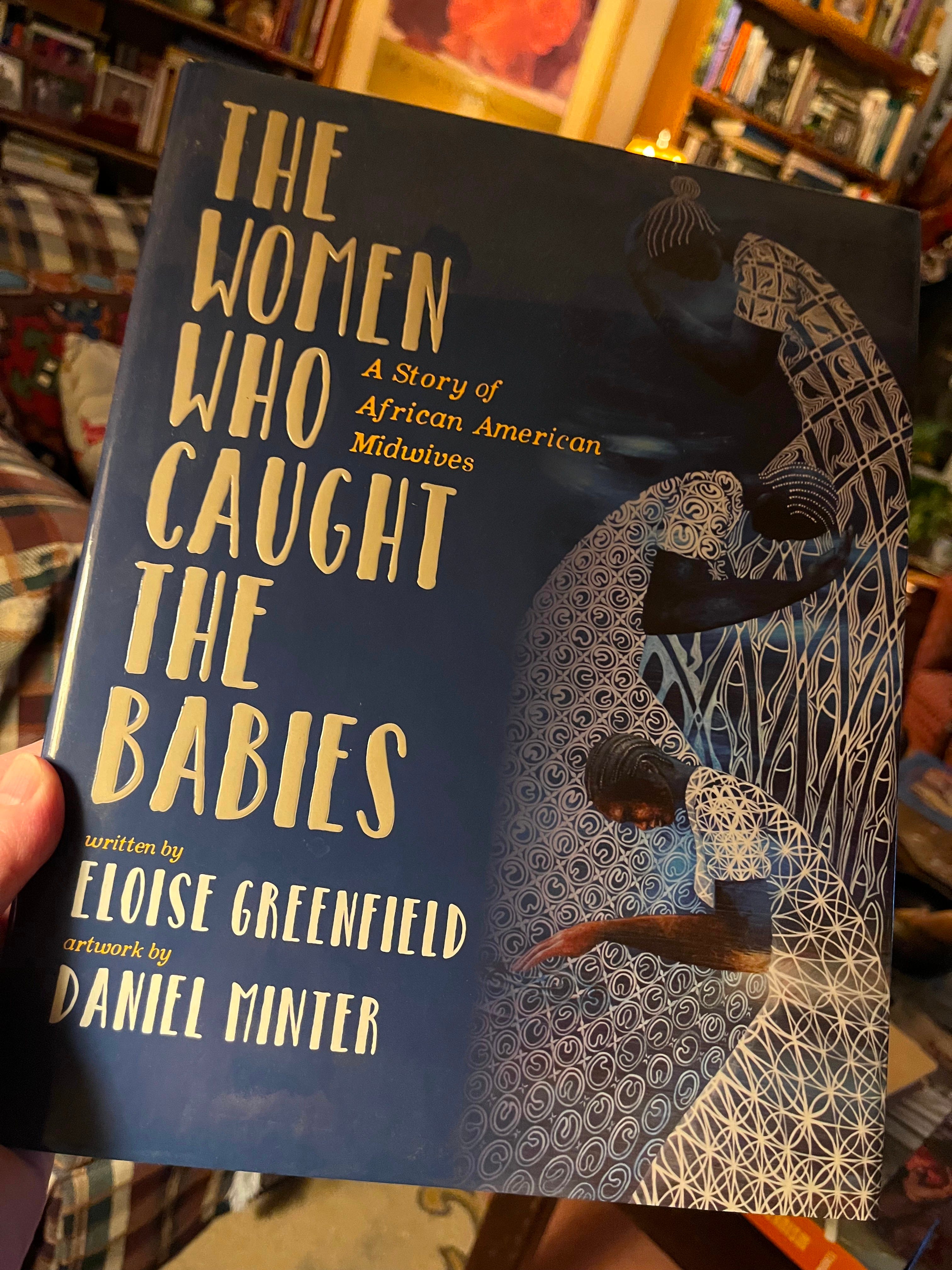
P.S. I have another blog on Substack, and have duplicated the posts. However, I think I will use this space to do more creative work. Will see what happens–and thanks for reading, in any case.

Don’t Let It Be the Last Dance

Reflections on democratic voting in a time of rising fascism

I Sit in My Kitchen Rocker Waiting…

As I Lay Dying, “I Stand Here Ironing”…I keep thinking of titles around the anxiety of working out our lives, and deaths, so much of which is out of our control. We have to, more often than not, depend on others, on the actions and emotions and convictions of others, to make our own lives bearable. And today I’m feeling how terrible that can be, and also how reassuring.

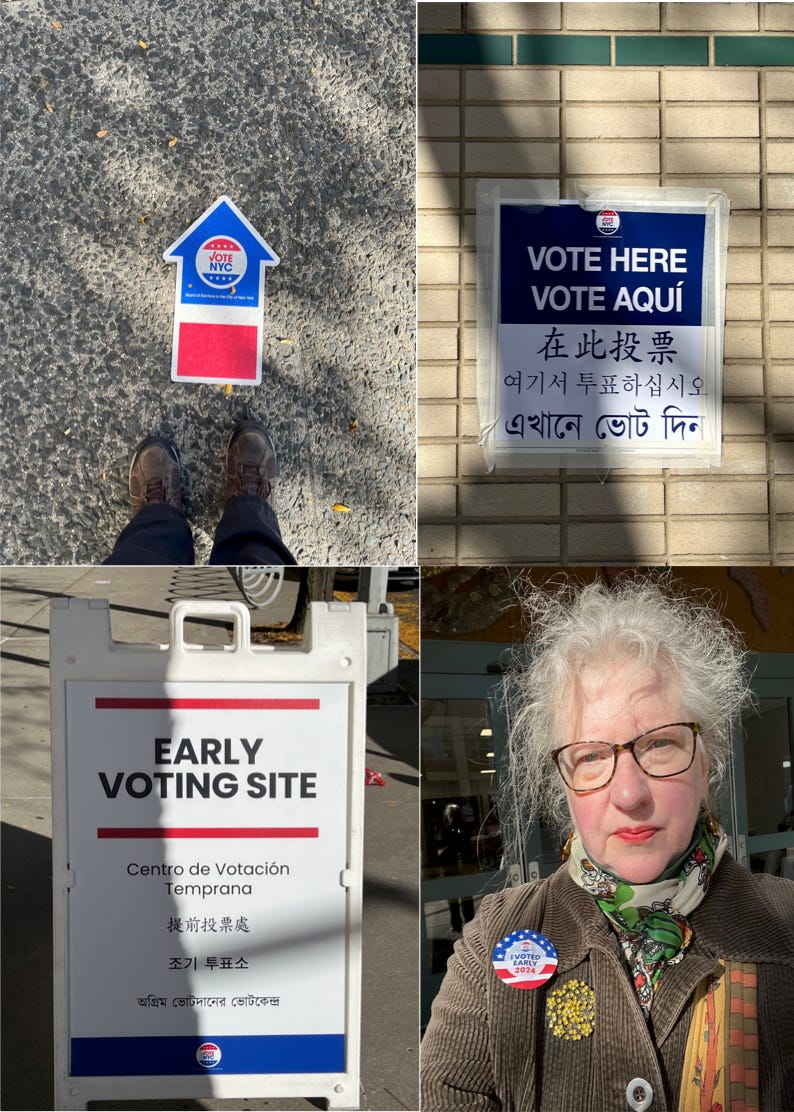
Today I “early voted” here in Queens, surprised by the lack of turnout, in some ways, but this being New York, local Democrats don’t have a lot of competition. (Still, I live in an area full of Trump voters, particularly Hispanics, too many of whom more or less worship the man (if tee shirts are evidence) who plans to deport them within days of returning to office, citizens or not, it won’t matter.) The poll workers gave me such heart, though, just to see them there, all caring so much about democracy.

Scenes from a day of early voting, Queens, NY

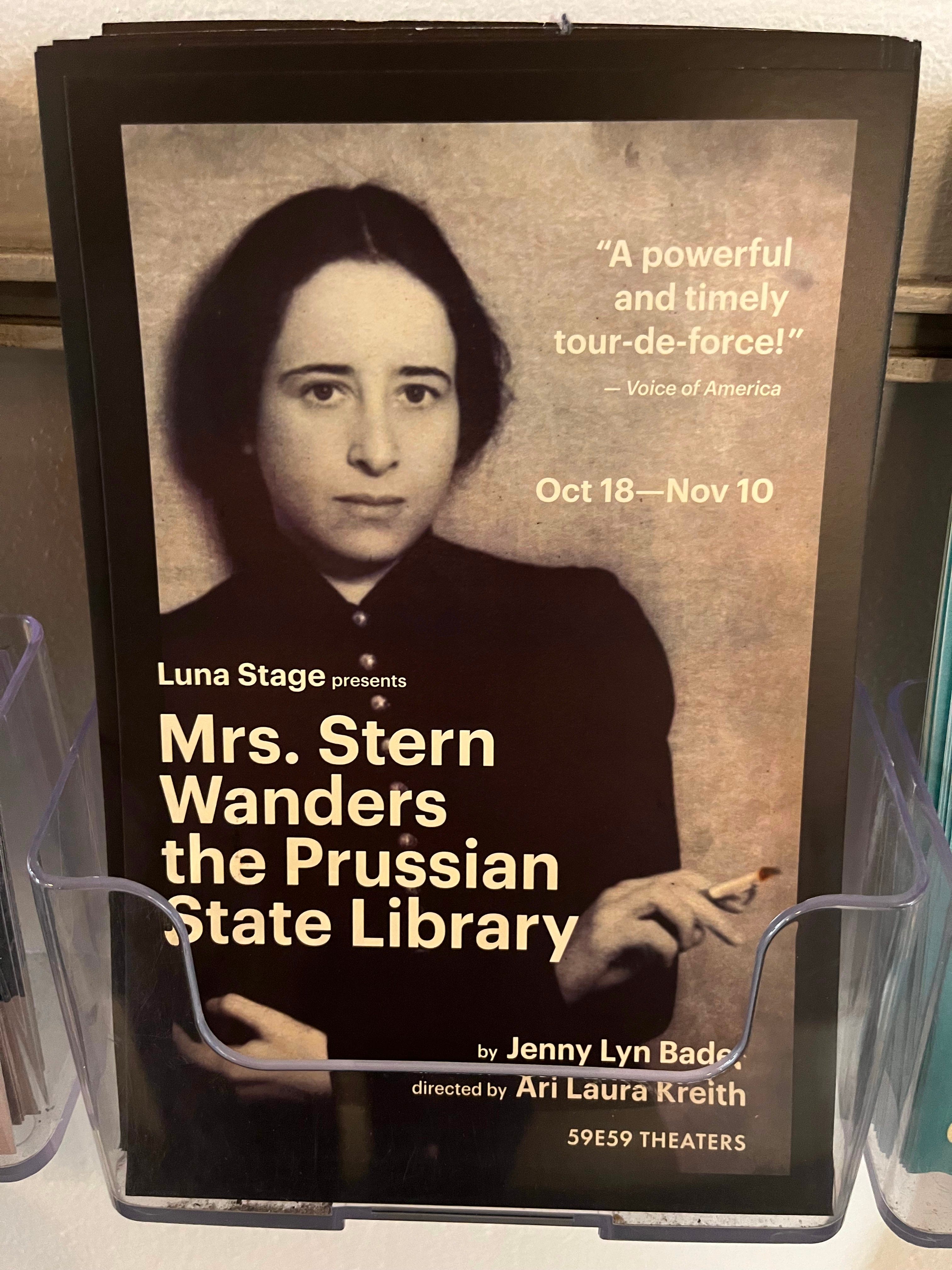
I’ve been imagining during my sleepless nights the consequences of a second Trump presidency—I cannot see how we are really here, but then no one imagined a Trump to begin with, so showered with love and celebrity coverage by a besotted press. Last night I went to see a play at 59E59 Theater here in New York called Mrs. Stern Wanders the Prussian State Library by Jenny Lyn BaderThe subject of the play is the period of days a young Hannah Arendt was imprisoned and interrogated by a Nazi officer (whom she ultimately convinces to help her) in Germany in 1933. The investigating Nazi officer in the early days of Hitler’s Chancellorship and martial law is convinced that Mrs. Stern, rather than working on her dissertation, is mimeographing and distributing overseas the antisemitic writings and cartoons in the German papers. Because of who she is, we know that Arendt gets out, since she will famously go on to cover the Nuremberg Trials, there to develop a philosophy around the nature of evil and the ordinary people who become complicit.

I became increasingly, deeply horrified watching this play as I realized that this is America’s future, quite literally, with camps and the rest of it, unless Harris is elected. And this time, no hyperbole.

The treacherous New York Times gets scared straight.

The consequences of this election will affect every citizen who is not rich and sociopathic in horrifying ways. Anyone who says we aren’t all in this together is a dope. Years ago (I probably told you this story), I was at a favorite bar in Midtown Manhattan, a great after work sort of bar, and there was a commuter from New Jersey there sometimes, if he had just missed a train. We would chat. When Obama was running for president, I said, “We are all in this together,” and the guy (white, 30s, business type), looked up from his scotch and smirked, “I’m not.” And I said, “Where do you think you got that drink? How do you think it showed up on that bar?” and he said, “I don’t give a shit.” And I got up and said, “You are despicable. I believe I’ll have my drink down here.” And he looked at me, stunned, as I moved. A few days later, he was at the bar again, and he tried to catch my eye. I cut him dead and walked on to the end of the bar for a seat. Returning from the restroom later, he paused and said, “Can a despicable person buy you a drink,” and I said, cold and hard, “No thanks.” Cheers.

Bars are equal opportunity institutions in society, as are commuter trains, and they don’t generally fail us. Two institutions that have failed the United States, however, and most decidedly in the past four decades are 1) the free press; and 2) the Christian Church. Both used to have one thing in common, in that (at their best) in their respective ways, through investigation and preaching, they existed to bring to the People the truth, the way, and the light. Today, both, at their worst, have one thing in common yet again: the love of money.

The love of money is the root of all evil, and if I hear one more ill-informed person of “faith” say even one more time, “I think Trump is better for the economy,” I may run naked and screaming into traffic on the Brooklyn-Queens Expressway (the “economy” under Trump was Obama’s until Trump wrecked it). Today’s Evangelical Christian churches, since the televangelism on TV in the 1980s to today, preach “send me, your pastor, a lot of cash, even if it means emptying your savings accounts.” The newspapers, bought out by billionaires with egos the size of Arnold Palmer’s junk (keeping it classy, Trump), want to curry favor for and provide support to other billionaires. The information printed in today’s newspapers is accidental and incidental to their owners’ true purpose. And yet journalists, as do some Christian pastors, try.

Sister Lisa and Brother Mike in conversation

Despite the quotation marks I use now—”free” press and “Christian” church—I try to remember that there are, really, so many good people. We cannot give up. Please vote. Encourage others to vote. As I walked home from my polling site this morning, a woman accompanying her (I think) elderly mother on a walker stopped me, pointed to my sticker, and asked where the polling site was. I told her, and she looked disappointed—it’s a bit of a walk—but she thanked me and turned to explain to her mother in their language. Because there really is plenty of room for all of us.

With freedom and justice for all, dammit.

Love,

Miss O’
Share

Morning Glory, Message from a Friend in America


Yesterday walking from the farmer’s market
My friend
Who is
Never wrong
Unfortunately
Asks me about the trip
I’m taking home
South
To see
A gang of friends
All of us this year 60
My friend says “You need to be prepared
For their health.” 
She says
“Do you know about their health?”
What the hell kind of thing is that to ask
I become wobbly
And I realize
We are dying
My friend who is never wrong
Unfortunately needs me to face
The inevitable
Age and death
Of friends, of myself, of all this.

Yesterday my friend who is
Never wrong
Unfortunately
Tells me as we walk
In her way
That she has accepted
Defeat and the end of the republic
Tells me to be careful what I say
In the South
So I don’t get in trouble
And I say
fuck fear
So loud
That Appalachia can hear me
Her lips purse,”Mmmm.”

At the kitchen table with her husband
My friend who is never wrong
Unfortunately says
“I have sad news. All the morning
Glories are gone. All of them are dead now.”
And I know I saw some on my walk the other day
Bursting in purple glory bloom still
But I guess it’s today they stopped blooming
And I missed it. I say nothing.
“All of them are gone. Sad.”
And I sit with my tea and my scone at
My friend’s
Formica table knowing I am wrong about
Everything
I guess
And don’t know how to be
With all this, all this death, all this unstoppable
Ending
“Sad.”
Mmmm.

On my way hope
I mean home
I buy a bottle of good red wine
“Hello, Sunshine,” says the employee
Who says I bring the light
Even as I wander out
Wonder how I will live
In red sips
Of this dark world.

Today
This new morning,
blue sky and sun,
I have a text from my friend
Who is never wrong,
“So I was wrong about one thing:
I still saw some morning glories this morning—
they’re there if they are facing East.
The ones facing South were gone though—
as they were gone yesterday.”

She was wrong about one thing.
And if she was wrong about that
One thing
She could be wrong about
(Fortunately)
Almost everything
And to everyone in America I say
Like the faithful who practice
In every faith
Face East, not South
And we, too, will not be gone.

Morning glories of Queens, facing east. Photo by Miss O’, fall, 2024

Last-Minute Saves: Completing the Assignment

On Friday at work, on a Zoom call with the “team” and managers and the director of the division and a program “author” who is guiding our work, there was a pause after 40 minutes of presentation and feedback from the author to ask questions. I asked a good question, one I really wanted the answer to. The author relished answering it. I asked clarifying questions, and he answered those. It was hard to read my director’s face, but I know the team was glad of the questions, given the “Directly to you” notes on the Chat feature of Zoom, “Great question,” “I’m so glad you asked that,” etc.

When I left the meeting, I said to myself, “Well, Lisa, once again you may have saved your job.” What I asked—after months of keeping my head down and being quiet as we embarked on this new project—and how the author answered, may well indeed have provided a breakthrough for what will make the next version of the product really special and useful for teachers and students.

My whole life, I reflected this afternoon, has been a series of last-minute saves.

When I was a Christmas tree shearer one summer in the Blue Ridge Mountains, for example, I was having a hard time keeping up, and my rows, though sheared well enough, took me twice as long as others on the crew to complete. After several days of this that first week, I determined to keep pace with a woman next to me, because she was a good shearer and very fast. And keep pace I did. I learned the next day that one of our other crew members had been fired for slow work and because “his trees weren’t good enough.” The crew chief, Sharon, I’m sure would have fired me too, and it would have killed my spirit. Something inside me saved me from this fate.

In a writing workshop in my senior summer of graduate school, after a mediocre first attempt at a short story, and a second attempt that my professor felt was as good as it would get and not in need of a workshop, I wondered if I’d ever write a third and final piece worthy of the work everyone else was doing. I was certainly vocal—participating, challenging, encouraging—and if I’m going to talk that much about how I receive writing, surely I should write something worth reading. And one evening in my dorm room overlooking the lawns at sunset just after supper, I found myself writing in a blaze, a fictional account of my great grandmother’s life in Iowa. It all came in one night, with a crucial misspelling my professor mentioned in the dining hall at breakfast after he’d read the story prior to the day’s workshop. I raced to the computer lab and did the ol’ Control/Find, and I could tell he was pleased by my passion. A student in the workshop gave me a bottle of wine before class, “For the best story of the summer.” How did this happen?

I had a similar save in my second summer of graduate school at the Oxford campus. I was studying Virginia Woolf with an eminent Exeter College scholar who also taught James Joyce. After reading a collection of short fiction, Jacob’s Room, and Mrs. Dalloway, I had to produce my first paper. What would I write about? I decided it had to be Mrs. Dalloway, but what about it? I had no idea. I just couldn’t think. That evening, my friend Anna, who was taking a different course focus that summer, came by my room to see if I still wanted to go to the cinemas and see Howards End, just released, starring Emma Thompson, Anthony Hopkins, and Helena Bonham Carter. I told her my dilemma. “When is it due?” she asked. “Tomorrow,” I said. I sighed. “Let’s just go to the movies.” She was stunned. “No, really,” I said, gathering my things, getting my keys, “because I’m not going to figure it out just sitting here.”

We went to an 8 PM showing, I’m sure, because dinner in Hall was at 6 PM. And it was there, at Howards End, that the key to Mrs. Dalloway unlocked: Emma Thompson and her now husband Anthony Hopkins have learned that Emma’s sister Helena Bonham Carter is pregnant out of wedlock. In the garden, Emma is seated as Anthony paces, determining what is best to do. Emma keeps trying to get up, to go to her sister, to try to take action based on her own conscience. To stop her, to take control, the paternal hands of Anthony Hopkins press and press on his wife’s shoulders to keep her seated, to keep her in the garden.

And my mind exploded: there is a scene in Mrs. Dalloway that had puzzled me as to why it was there at all, which is a luncheon to which a certain Lady Bruton has invited Richard Dalloway, Clarissa’s husband, and a doctor (who is treating Clarissa’s nerves). Lady Bruton has a letter she wants to write to the London Times, and her point of view on the issue is liberal, one might say, and feminist. Yet by the end of lunch, the two men have explained to her what she really means, “Oh, do I?” she says, which is the opposite of her original point, and they write the letter for her. Those paternal hands pressing her feminist shoulders to keep her in the chair in the garden. I was saved.

You might look at these saves and think, it’s just a job, or just a class, or just a paper—it’s easy to diminish the experiences, I guess, but that’s not fair to anyone living this life. This is about that thing inside us, the thing that knows and opens and doesn’t fear, that does the work but also lets go to allow the “thing” to come, to be.

It was this that I witnessed in the person of Vice President Kamala Harris at the Presidential Debate on Tuesday night, September 12, 2024. She found the “thing” to rattle the motherfucker Donald Trump: the small size and demonstrable boredom attending his rallies. And from that moment on he was toast.

Lost because of that moment and its aftermath of verbal carnage, lost on the American press, as usual, was Harris’s masterful grasp of complex policy issues, foreign and domestic, none with easy solutions but with clear and important ideas to address and solve problems. After nine years, on the other hand, a clearly demented Trump revealed that as to replacing Obamacare, he has “concepts of a plan.” (As veteran retired high school teacher Tim Walz recounted this at a rally in Grand Rapids, Michigan, “My students had better excuses than that for not doing the work.”) Harris laughed.

Kamala Harris, Tim Walz, and I are all the same age. Born in 1964, we are the last year of the Baby Boom, the year before Gen X. As a result, we were both the responsible adults in the room even as children and also the last feral children out playing till dark all summer long; and, in addition, we get all the Monty Python jokes. I feel this in them, the kinship of that cross-section, people who do the work of the grownups but are loose enough to allow the realness to be and with humor. It’s helped sustain Harris and Walz in their brilliant and varied careers, I have no doubt. It’s done the same for me in my less brilliant but no less varied careers, too. Being adult and being real and being funny: it’s saved us.

With Harris and Walz and that generational realness, we have a chance to save this country. We can save it. Let’s save it.

Love,

Miss O’
Miss O’ recognizes, nay, feels, all these teacher faces. Credit to @AnandWrites

Summer Stock in a Heat Wave

First of all, I have come to love this movie. Second of all, whenever Summer Stock, an MGM musical from 1950, appears on TCM the host always notes that 1) it’s Judy Garland’s last MGM musical; 2) this is one of the lesser MGM musicals; 3) Gene Kelly signed on in a less prominent role as a favor to his friend Judy who gave him his start; 4) Judy was obese at the time of filming; and 5) Judy’s iconic “Get Happy” number was filmed after production closed, and she’d “slimmed down.” It really sets you up to watch the film with a “pity” and “I guess I have nothing better to do” mindset, right? The movie deserves so much more of an intro boost, and maybe someday Miss O’ will be famous enough to be a guest who can explain all this to Ben Mankiewicz; in the meantime, I’ll introduce it to you.

Get Happy

When I was a kid in the 1970s, I fell in love with movie musicals that showed up on TV on the weekends, usually on syndicated channels, and spent hours and hours memorizing them. This was a confusing exercise. Interrupted as they were with commercials every three to five minutes, the movie plots were pretty much impossible to follow. For example, the opening song of Summer Stock, “If You Feel Like Singing, Sing,” follows the camera over “Falbury Farm” to Judy in her room to singing in the shower to putting on her farm clothes, and as she makes her bed, she learns from her housekeeper Marjorie Main that “Frank and Zeb” are “dressed in their Sunday clothes,” and…cue commercial for Ginsu knives. The next scene was probably Judy going to the kitchen, saying, “I don’t blame them,” and you think, “Huh?” Years later, watching the film uncut on TCM you realize that the network cut out the scene where Frank and Zeb quit their jobs, and how unsuccessful the farm has been, in order to make room for more commercials while my child head spun.

Another plot point that made the movie impossible for a kid to follow on syndicated Sundays is that Judy’s character, Jane Falbury, changes her mind solidly three times about allowing the show to continue in her barn. It’s totally reasonable that she does this, unless between mind changes a network cuts dialogue to insert commercials for Koons Ford used trucks, Ding Dongs, and Aqua Net.

As a result, Summer Stock was lost on me on my first viewing, whereas musicals like The Wizard of Oz, Anchors Aweigh, and Singin’ in the Rain, though no more complicated in their plots, had more understandable and entertaining musical numbers for a kid like me.

What led to me write about this little musical gem (because it is) has to do with summer boredom during a heatwave her in New York City. Right now my job is really slow, and I’m not ungrateful for that, but it’s hard to concentrate on anything with little in the way of deadlines attached while still being tethered to my laptop. To give myself some company, I look for movies to run on a loop when I can’t find procedurals like Law and Order in reruns, and Summer Stock came up On Demand. Over a dozen viewings later, I have this mature, wonderfully acted movie memorized, and more than that, I watched it with different lenses trained on it that might be interesting to, I don’t know, someone. Here we go.

Judy Garland’s Body

Here are a couple of photo stills from the film to help you understand how fat Judy was during filming:

If, like me, you are squinting to see a woman whose body is listing toward morbid obesity, welcome to seeing a normal woman like a normal person. Since The Wizard of Oz, during the filming of which MGM Studios put their young star on a diet of amphetamines, it’s the first movie where Judy’s body is what I’d call womanly. Healthy, even. In her many films, from The Harvey Girls to Meet Me in St. Louis, from The Pirate to Easter Parade to The Good Old Summertime, I see a Judy who is thin, and it’s a little unnerving how thin when you see her body is also covered in layers of period garb. In fact, not really since For Me and My Gal, her first picture playing an “adult” woman character (opposite Gene Kelly, whom she’d seen on Broadway in Pal Joey and championed to be her leading man in that film, thus starting his career), could I recall seeing Judy Garland in modern dress. Summer Stock is also the first movie in years with Judy in short hair—a hint of the hair she will style in more elegant ways in the 1960s. In Summer Stock, the body type works since Judy plays a farmer and a sort of old maid, and after filming completed and her contract was up, Judy’s career came to standstill, morbidly obese by studio standards and washed up at age 27.

The MGM Circle Game

Judy started out her career proper has Andy Hardy’s love interest in the Mickey Rooney franchise of movies in the 1930s, most famously Babes in Arms, where the kids entered the realm of movie legend when they found a barn and put on a spectacular show despite the town’s disapproval and the doubt of their families. I don’t know if it was deliberate that Judy Garland ended her MGM career on a farm set, hearkening back to where she found stardom in The Wizard of Oz, and inside a plot with a “let’s get ourselves a barn and put on a show” where she got her start, but it’s really kinda nice.

In Summer Stock, Judy Garland is no longer a sidekick ingenue in search of a show, or a waif who dreams of a world beyond the rainbow over Kansas. This Judy plays Jane Falbury, and she owns the farm (in a small community in what appears to be Upstate New York or Connecticut). Early on, we learn that the farm has been unsuccessful, Jane is engaged to Orville (son of the farm supply store owner Mr. Wingait), and her younger sister Abigail is due back from New York City that afternoon. And what do you know, Abigail surprises her sister with Joe Ross (Gene Kelly), the director of a new Broadway show looking for an out-of-town place to play, along with all his cast, crew, and sets. In the process of figuring out whether the show folk will get to make this happen, Jane’s housekeeper Ess (Marjorie Main) reveals that Jane and Abigail had dance lessons all their young lives, and Gene sees Judy do a little dance in the kitchen. Fireworks ensue!

Why Watch It?

Sure, there’s a predictable plot, tempers flare, people burst into song, love ensues, and a star is born, but the emotional world of this musical is more mature than in other movies, a maturity that resonates with the Miss O’ who still loves musicals a grown-up. This movie opens to reveal a woman who is comfortable in her body, who loves to sing and sings great, who without question runs a farm, and who genuinely loves her life. She is independent in the important ways and wants no rescue, no change. But you get the feeling that despite her four-year engagement to childhood friend Eddie Bracken, Judy/Jane has never known love. Orphaned young at some point, her entire life has been devoted to raising her sister and keeping the farm going. She doesn’t resent it. And she doesn’t realize that she’s been missing a thing until that devilish smile in the form of Gene Kelly arrives to shake her up. Gene and Judy are emotional equals. They spar, they compromise, they fall in love, sure.

But what strikes me most in this movie is that leading man Gene Kelly is a supporting player. The film is totally Judy’s. And the result is an uncharacteristically light and lovely Gene Kelly. Not that he isn’t wonderful in his films. But here he is not wildly aggressive or ego-driven, he has nothing to prove, and he doesn’t have to carry the picture. He’s not a ham. The dances are staged by Nick Castle, though Gene probably choreographed his solo routines, so he’s not carrying that load, either. His role as the show’s director Joe Ross is totally believable, and Gene plays his rages and fibs and falling in love with a master’s touch of humanity. He’s totally equal to Judy on screen, but it’s Judy’s movie, and his performance is the better for it. I think it’s one of his best.

In addition, it seems to me that however “lesser” this musical is in the canon, this is an important film in Gene Kelly’s development as a choreographer. In some of the dance numbers you can see the seeds of even more iconic numbers to come. For example, the staging of “You Wonderful You” with Judy presages “Our Love Is Here to Stay” with Leslie Caron in An American in Paris (1951) and “You Were Meant for Me” with Debbie Reynolds in Singin’ in the Rain (1952). Other dances in the film show classic Kelly moves he will use even more imaginatively in those later films, like the matador move, the airplane move. It’s fun when you realize this because of the order the movies come in. And you are a total movie musical nerd recalling these notes from memory.

Judy’s range as Jane is something she usually doesn’t get to display in other films—fully human, grown up, shifting from joy to concern to rage to apology to thoughtfulness to bargaining, with ease. And what makes Judy such a superb actress is that she is fully present in every scene, with every actor, no matter the roll. Her emotions are both raw and in control, and as a woman in late middle age, I connected with this character as I don’t generally get to do in musicals. Twelve-year-old me would never have enjoyed the vulnerable and tender moments between Judy and Gene, especially in “You Wonderful You” and “Friendly Star.”

The supporting cast is a Who’s Who of some of the finest character actors ever on screen: Ray Collins, Eddie Bracken, Phil Silvers, Marjorie Main, and Hans Conreid, as well as up-and-comers Gloria De Haven and Carleton Carpenter, and an ensemble of wonderful dancers. (One of those key dancers is Jeanne Coyne, married then to Stanley Donen (who will go on to co-direct Singin’ in the Rain with Kelly two years later), who was one of Gene Kelly’s dance assistants. Both people divorced by the late 1950s, Kelly and Coyne married in 1960. I think that’s sweet.)

Still, there are curious things in the filming that make me realize Summer Stock was not a top priority in the MGM perfection department. Charles Walters’s fine direction notwithstanding, there are couple of clumsy edits, unusually sloppy for MGM, both featuring Judy. In addition, as I mentioned, “Get Happy” was added in a re-edit of the film post-production, and great as that number is—possibly her best on screen—it doesn’t quite jibe with the rest of the proceedings. Also, after several viewings I finally paid attention to the final credits, where a noticed an actress named Nita Bieber “as Sarah Higgins.” And I’m like, who? So I deduced in subsequent viewings that this was the dancer who wears glasses and is always reading and has one featured dance moment; and I inferred there was probably a story for her that ended up on the cutting room floor, surely for the best. Her screen card may have remained for contractual reasons, or possibly out of laziness.

And when critics all point out that Garland is “obviously” thinner in the added number (and I noticed that the scenic background at least is in an earlier part of the film), I have to say I don’t see it. “Get Happy” is the only number where we see Judy’s legs, and on a 4’11” frame even five pounds would be a lot, as if it matters. And throughout the film, Judy dances like a dream, and dances a lot, and is clearly in great physical shape. I don’t know why critics feel compelled to talk about her weight. I really hate that. Judy Garland is simply great.

You might think Judy deserved a better or more glamorous movie send-off as her contract expired. The studio, which her talent literally helped make great, got her hooked on pills and then got mad when their work horse wasn’t able to perform and had no-show days on films such as The Barkleys of Broadway, where she was replaced by Ginger Rogers (in her last appearance, and only one in color, with Fred Astaire), and Annie Get Your Gun, where she was replaced by Betty Hutton. (Hutton told TCM host Robert Osborne that the crew of that film resented her terribly for taking Judy’s part, which is unfair, of course; by all accounts I’ve read, the crew at MGM loved Judy Garland.)

But I’d like to say that I think this lovely, mature, sweet, goofy musical treat, a kind of retrospective of all the films of Judy’s great MGM career, is a perfect movie for the middle aged, for the summer. If you need something to take your mind off the unutterable evils swirling nonstop around us, you might try the pretty, tender, talented world of Summer Stock (commercial-free on TCM). In the meantime, you might take a look at the duet arrangement Judy made of her iconic “Get Happy” with Barbra Streisand’s “Happy Days Are Here Again.” The number that keeps on giving.

Love to all.

Adventures in Pearl Clutching, Summer 2024

Fuck The New Yorker

Following a lousy debate “performance” by President Joe Biden—over tired, overworked, over-traveled, and (worst case for a stutterer) over-prepared (to talk policy, of all things, in two minutes or less, against a drugged-up lying sack of shit)—The New Yorker, to which I have subscribed since 1993 or so, ran not one, not two, but three long pieces, complete with photos right out of a Psycho ad, in self-satisfied, “final arbiter” prose, that President Biden must step away from the Democratic nomination. I searched for but could not find one, not one, request for actual psycho Donald Trump, belching lies at a record pace, to step away from the Republican nomination. (Nor could I find this in one publication in the American press, not even after 34 felony convictions, to say nothing of stealing documents, selling secrets, or buying the Supreme Court.) I was so livid I couldn’t sleep all night, heart palpitating, hardly able to breathe.

At 8 AM I called the first of two 1-800 numbers for Conde Nast to cancel my subscriptions to two publications. (Note: I speak not of the New York Times, which had their entire op-ed page, entirely anti-Biden, already written and ready for the presses before the debate even began, apparently, shilling for Trump since 2015; my subscription to them was canceled after their front page “But her emails” bullshit that may well prove to have cost America its democracy.) On the Conde Nast magazine sites, by the way, it’s impossible to “Manage My Subscription” because it falls into endless loops of signing in, then telling you, “You are already signed in,” in red font, and no escape. First, I canceled my subscription to Vanity Fair, whose covers alone have become so predictably insipid I can’t rationalize even using the magazine for collage material. (To wit: Anne Hathaway in black leather bustier, severe red bob, hands on hips, in Batman green lighting, and all I could think was, “Oh, look who must have turned 40 and has to prove she’s still ‘got it.’” And that, it turns out, was the story. That was a story? Sheesh. Any woman on the cover, even now, screams, “Lay me.” Fuck that.) After all the auto-voice hoops, pushing the correct numbers on the keypad, saying my subscription number, then pushing 7, I got an agent immediately, said I wanted to cancel, did (also remembering to log onto PayPal and cancel the “autopay” option for both publications), and when asked why, simply said, “I can no longer afford it.” What does a phone agent care about insipid covers? All done.

Next, I called another number to cancel The New Yorker. I followed the same auto-voice routine, said my subscription number, pushed 7, heard the ring for the agent, but didn’t get one right away. In fact, after 5 minutes passed, I was a little baffled and nearly hung up. A couple minutes later a woman named Kristen answered, and very quickly and without questions canceled my subscription. “Is there anything else I can help you with today?” she asked, nervously. Nope. Hmmm.

Then I happened to look on my Instagram feed, and first up was the New Yorker (note: Unfollow) Joe Biden from Psycho story, and I saw that there were over 4,000 comments. I clicked on those. And they were all variations on my own feelings, condensed here: “For fuck’s sake, call on Trump to step down you fucks,” and I scrolled to see, in addition, “I’m canceling my subscription…” many, many times. Hence that harried operator, who’d been fielding these calls since 8 AM. I did a quick bit of math, and if even 2,000 people decided to end their subscriptions following that totally irresponsible set of stories, The New Yorker quite possibly lost nearly a half million dollars in revenue in a single morning.

Is this “cancel culture”? You’re damn right it is. And for all the right reasons.

All the so-called “left” or “progressive” publications—and there are few if any in the form of daily newspapers now—are long-form publications, heavily researched, overly long, in small font, full of self-righteous beautifully written hand wringing but proffering no solutions to our existential crises. Not one of these publications has reported at all, or in anything like detail, on the transformational nature of the Biden presidency. Here’s a handy meme:

I read last week that under President Biden, the U.S. economy, for people who care about these things, which had so weakened under former President Trump, had recovered and even surpassed its strength in former years, making it the strongest in the world. (If you Google anything about the economy, what comes up first is the lie of The Heritage Foundation.) Biden has gotten tons of good stuff done despite the obstruction and waste of our Republican House. Biden pulled America back from the brink of collapse on every front, by his fingernails, and triumphed. Crickets from our press.

But I defy you to find that front-page story.

And worst of all—and predictably—many of my liberal friends are doing the “Joe’s gotta go” shuffle in lockstep, because it’s more important to look righteous than be politically savvy. I say this because no one offers a suggestion for a replacement or even knows how that would work. (MSNBC’s Lawrence O’Donnell did a great explanation of how impossible and also unnecessary and even dangerous it is, at this point.) Should Dems have a bigger stable of viable candidates? Sure. But doing right by the American people and also wanting to be president, and win, requires an almost impossible combination of intelligence, experience, an ego the size of Alaska hidden behind casual charisma, behind-the-scenes meanness toward rivals, big money connections masked by grassroots donors, a strong stomach beyond courage, and, hardest of all, a demonstrable ability to walk on water, at least till midterms. Libs can’t settle for less.

It’s July 7, four months out from the actual election, and Democrats are already giving up. “Ol’ Joe” aside, you hear the murmurs, “rigged electoral college,” “18-55 year-olds polling as nonvoters,” paving the way for that big shrug that follows the laughably predictable pearl clutch, “voting does matter.” (Cue knee-slaps of Republicans.) But who gets involved to try to change that? Who even uses a voice against the horrors of Donald Trump, the Heritage Foundation, and Project 2025? Who in America is running those stories? Who is even sharing them on social media?

Miss O’ is, anyway. I know I sound like a dick. I know that. But I am so fucking sick and tired of all the whining, the “You should be terrified!!!!!!” bullshit, the colossal waste of energy. Fuck fear. Fuck rumors. Fuck the fucking fuckers. Get mad at the right people. Act on that. I scream this with love.

Clutch no pearls! Instead, wear magical beads, and Lisa DiPetto’s sticker found at PencilIsland on Etsy.

It’s Democracy v. Fascism, fellow motherfuckers, and if it goes Fascism, we have only the weak of will to blame.

I’m looking at YOU. I’m looking at ME.

Love and kisses and BUCK UP,

Miss O’

On Orlando and Transitions

Meditations on Transgender Humans

From the NYPL exhibit on Virginia Woolf, 2023. Photo by LO’H

A couple of years ago, the social media posts of “Sam,” a young gay man in his 30s, the beloved former student of a late teacher friend of mine, began shifting from a fun social and work life to marking a life in transition. First, Sam shared multiple moves, the most alarming (to me) was a move (for work) to a dangerously bigoted Southern state, where he was determined to make a go, build a community, and change hearts and minds. As life there, despite his best efforts, became less and less tolerable, he found himself in transit yet again, back to a major city in his home state. Shortly after this move, about which he detailed his joyful creation of a new home with the help of many friends, he began including pictures of himself in “feminine” clothes and accessories (pictures that reminded me of Tom Wilkinson’s character in the landmark film Normal.) Not long after, Sam formally announced that he was beginning a formal transition from “male” (assigned at birth) to “female,” which Sam said was the gender he had always felt he was. What has followed includes his documenting phases of this journey, including legal name and gender changes on his/her/their identification cards, photo records of a shift from pants to dresses and in a face in full makeup, the results of their hormone treatments, and most recently and significantly, a diary of their gender reassignment surgery, their plastic surgery to make their face more feminine, and the post-op difficulties that are part of the process.

For my own part, as an advocate and ally of the LGBTQ+ community, I have found watching this process overall to be troubling. Because I haven’t understand the source of my feelings, and because I still don’t know how best to be supportive in an honest way, I made a decision not to “heart” Sam’s posts, but instead to follow them at a distance, as it were, while working on myself to get a handle on what “transgender” means and how best to understand my muddled response to it.

The start of my own encounters with this cultural shift began by seeing cabaret. One of my favorite live performers in New York is Justin Vivian Bond, who as Justin Bond made a name in the downtown cabaret scene (and later, on Broadway, where I first saw them) in the character of singer Kiki DuRane in the duo Kiki and Herb, with Kenny Mellman as the always supportive Herb on piano. When Bond made a decision to present as female and then transition (with hormone treatments, but forgoing gender reassignment surgery), I remember items in New York magazines taking the famously cross-dressing Bond to task, saying, “Vivian? Now you’re going too far,” that sort of thing. Mr. Bond became Mx. Bond, doubled down on their activism, and used music and humor to include the story of transition into their act. “Am I he, she? I don’t know what I am,” Mx. Viv said at Joe’s Pub one night during a tribute to Judy Collins, who was there to introduce Bond and their band; Judy had used feminine pronouns, asking, “Am I using the right ones?” and in response, Viv (who presents tipsy as part of the act) said he/she/they didn’t really care either way. At the time, the idea of changing pronouns was a fairly recent idea, and we were all on shaky ground. Why not acknowledge that?

Justin Vivian Bond in performance at Joe’s Pub, November 2023. Photo by LO’H.

As a society, we have all been, in fact, transitioning to a new, amorphous world where gender isn’t rigid. In response to this change I think (no doubt subconsciously), expectant parents began staging “gender reveal” parties, as if to say, “My child will know exactly who he, or she, is,” which we know now may or may not be the case. And sure, as with any movement, some kids may declare themselves to be other than the gender their genitals indicate, but the truth is nothing about gender fluidity is new. For example, as a child ca. 1920, and for at least two years until she was 14, actress Katharine Hepburn insisted that the family call her “Jimmy,” and she wore boys’ clothes and had her hair cut short. Her family just went along, and why not? But there is a darker side to this, too, because her older brother Tom (who wasn’t “manly” enough, some biographers have suggested, for Hepburn’s father) committed suicide at age 16; young Kath found him hanging in a closet. As a family, the Hepburns never spoke of it again. And I can’t help thinking that while a daughter, still, can present as a tomboy, there is, still, no society space for a young boy to present as a girl for a while, try that out; let alone for either to transition.

What was troubling me about Sam’s transition had to do with a vague feeling, and I mean to be honest here, of repulsion toward the idea. Why? Why was I feeling this? Did I not quite believe him, suspect he was being exhibitionistic to be, say, a sensational social media influencer? It crossed my mind. But I don’t think he’s lying. The problem was with me, and I decided I had to understand—what I could easily accept in Mx. Viv, I struggled with in Sam, I realized, because Sam is someone I have actually known since he was a teenager. My internal conflict was much closer to what the parents and friends of trans youth might feel than I at first acknowledged. All this is really to do with gender as a societal construct, which (I see now), I’d had the good luck never to have to worry about.

The well-worn copy itself.

The first novel I read that centered gender is Virginia Woolf’s Orlando: A Biography, which I decided to reread. Because I read with a pencil in hand, having conversations with my books, I see this must be my 6th reading of the full novel. (The only time I didn’t record impressions was in rereading it prior to studying in London in 2000, where I went three days ahead of classes so I might haunt Bloomsbury.) Each reading had a different purpose or at least caused me to come away with distinct, and distinctly limited, impressions. First, I was wowed by Woolf’s imagination—so different from that stultifying attempt to read To the Lighthouse in college; later, the more I learned about Woolf’s life, I was charmed by how her novel parodied her father’s profession as editor and writer of the Dictionary of National Biography in England. But more profoundly, Woolf’s novel was a deep reimagining of the life of her lover, for a brief period, and dear friend Vita Sackville-West. I’ve read the novel, then, over 30 years and with many discoveries, but this was the first time I read it with an intention: while I’d enjoyed the fantasy element of Orlando changing from a man to a woman over some 350 years, up the “present moment,” aged 36 in 1928, I had never thought about this gender change more than intellectually. Yes, we see what it’s like to be a woman vs. a man over time, and that somehow Orlando having had female lovers is still okay by the novel’s end, which is quite an achievement in modernism. But what am I missing?

The record of my rereadings. Do you do this?

Books become different because we become different readers, which is why rereading is so important. This particular revisiting was prompted by a movie. Back in the early winter I went to Film Forum here in New York to see Orlando: My Political Biography, a documentary in which several trans people were interviewed about their encounters with this novel, how it became their identity bible, how it helped them survive. Because I had no personal reason to connect with the novel on that level, I’d never read it that way (and these readers needed none of the backstory of Woolf and West to find the novel both revolutionary and comforting).

But now I had Sam and Mx. Viv (as well as my friend’s grandchild, now completing middle school as a boy); I’d seen the latest in a series of American horror stories, this the story of a nonbinary student in Oklahoma beaten to death in a high school restroom by (gender-assigned) girls, the student’s head smashed in over and over and over against the floor. Where does this hatred, this viciousness, come from? Where is all this fear coming from? Could reading Orlando again help me figure something out?

Woolf’s novel was (as Nigel Nicolson, the younger son of Vita Sackville-West, said) obviously a “love letter” to Virginia’s friend Vita, who when her father died learned she could not inherit the family estate Knole because she was a woman; so the famous estate went to her second cousin Edward (who had had nothing to do with the place unlike Vita, who’d loved and cared for it and kept it running all her life), who in turn sold it to the National Trust. Vita was bereft. In addition, Vita was bisexual, married to another bisexual, Harold Nicolson, and lived her life more or less as a man in her independence. Hers was quite a complicated life story in any era, but especially in 1928, when the book was published. Woolf’s novel was a spectacular best seller.

One might well ask, How did Woolf get away with it? In her infinite genius, she went full-on fantasy, beginning Orlando’s life back in time, when Queen Elizabeth I gifted Knole (fictionalized in the novel) to Thomas Sackville, Vita’s ancestor, and when Orlando (of the title) was a boy of 16. By taking Orlando through the ages—via the voice of a biographer-narrator who confesses to being as mystified as the reader at the changes, saying simply, “but that is what happened, what can I do”—Woolf subverts the gender transition though time transition. Readers are kept off balance through humorous descriptions of the awkwardness of the gender transition, exploring the mores and their differences for men and women through the ages. Orlando embraces, finally, her many selves, her genders, over all the centuries, coming to the present moment as a poet, a wife, a mother, a woman in the 20th Century.

The novel, as a note to those of you enticed (I hope) to read it, is not without ugliness—casual bigotry and acceptance of colonialism shockingly run throughout—which shows that no author, however enlightened in many areas, can be expected to be enlightened in all areas. But as Woolf’s biographer-narrator might say, “Difficult though this is, it’s what happened, and so we must record it.”

I must say, this journey of the past few years has been deeply affecting. I had never really thought about being a cisgender woman attracted to men since birth; I’ve had to ask myself if I was ever attracted to women, and yes, I have been—but only once I remember, as it happened oddly, suddenly, and then the feeling passed, in the audience of a theater maybe 15 years ago. I was in perimenopause at that time, I think, increasing in testosterone—was that it? Who knows? But it was real. Why did it hit me as something wrong? Why must anyone be tormented for having healthy sexual feelings, loving feelings, for our fellow beings; for wanting to express what is inside us in honest ways? Why do we continue to insist on gender reveals, coming outs? I used to wear dresses as well as pants; now I wear exclusively pants. I began dressing as a man, I guess, but with scarves and jewelry; and as a woman in America I can do this. Why can’t anyone of any gender simply discover and express themselves honestly?

“When this happened, Orlando heaved a sigh of relief, lit a cigarette, and puffed for a minute or two in silence. Then she called hesitatingly, as if the person she wanted might not be there, ‘Orlando?’ For if there are (at a venture) seventy-six different times all ticking in the mind at once, how many different people are there not— Heaven help us all having lodgment at one time or another in the human spirit? Some say two thousand and fifty-two. So that it is the most usual thing in the world for a person to say, directly they are alone, Orlando? (if that is one’s name) meaning by that, Come, come! I’m sick to death of this particular self. I want another.”
~ Orlando, page 308 (HBJ edition)

Miss O’s Woolf shelf, partial view. Essays, letters, diaries, and especially her fiction: Virginia Woolf remains my favorite writer. Orlando, taped and glued together many times over, was my gateway.

And this is where I am in this moment, today, the 10th of March in the year 2024, writer, artist, editor, daughter, sister, friend, woman. What about you?

Love, in all its forms,

Miss O’

Caution Tape

Thinking about how things land where they do

Years ago, my friend MB was invited to a costume dance but had no idea what to wear. A few days before the event, he got inspiration from a construction zone in his Manhattan neighborhood. Late one night, he crept out onto the street and tore down a big length of “Caution” tape along the sidewalk, his heart beating like mad as he raced back into his building, terrified he would be caught (he had no idea where one bought Caution tape or he would have). The next day he went to a thrift store and found a short pink dress and a blonde wig. Before the dance, he put on the wig, applied lipstick with a trowel, arranged the Caution tape over his dress like a Miss America sash, and voila: Streetwalker Barbie!

I’d love to be that inspired by the detritus of Caution tape outside my apartment building over the past two weeks. The city is completing “emergency repairs” (the notice taped to door said) of the sewer along part of our building past the elementary school. The yellow tape and tall orange barrels prevent parking for now (who put it all there?), the street organized to prepare to dig up a city block to replace perhaps a dozen or more giant concrete barrel-tubes, whatever they are called (how did they get there?), taking up those parking spaces-in-waiting, and I had to wonder, “Emergency repair?” Yikes. But this work is meaningful work. Look at all that equipment, crew, the purpose: I understand the kind of impact this work has. Results you can see, work you can use.

There’s something magical about construction like this, isn’t there? Photo by LO’H, Queens.
Sometimes, it’s needed. Photo by LO’H, Queens.

This morning early, I emptied out the corner cabinet in my small apartment kitchen to disgorge it of plastic storage containers. Call it an emergency repair. I don’t know why I live like this, saving every single plastic container that once held takeout shrimp and broccoli from Ten Full around the corner, but I do. I stuff them in, harder and harder, until one late winter morning, usually during Lent, I can’t take it anymore and I go in for the big clean-up and reorganizing. I hate being this all-or-nothing-at-all person. I would like to be a flowingly tidy person, who effortlessly tidies as she goes.

I look at just the surfaces of my place and see 1) a financial packet (I really mean to make that phone call, so it’s on my desk in the living room); a notice from Con Ed (since I have to make sure I schedule the natural gas detector installation, this is taped to the back of my front door); 3) a request for a proxy vote from another financial institution that holds the keys to my retirement (and since I’m not sure what to do, it’s on the kitchen sideboard to think on). Do you place things like this? And why? And for how long? How do these locations gain meaning?

I don’t know about you, but I also tend to be a person who creates in bursts, writing or drawing or making collages daily, for a week or three. And then I seem to crash; my creativity may lie fallow for months at a time. This manic-depressive quality is what drew me to theater, I think, beginning back in middle school, because after you’d rehearsed a show every day for eight or ten weeks, performed it three or four times, and stayed after school the next week (or in college, all night after the final performance) to strike the set, you were done! (The appearance of the final ghost light, literally and figuratively, remains one of the most satisfying feelings I know.) You then spent the next month catching up on all the stuff you’d neglected, like housework, paperwork, grocery shopping, or, when aged 12, cleaning your room and finishing those two big school projects. And after all that, you could dream again.

What has to happen to make this repair an emergency repair? What makes that place the place to put something? What causes inspiration to strike just then?

O park of wondrous flowing green
And more than passing fair,
We wonder if you would mind if we
Walk barefoot through your hair.

~ by Lois Oberdin, a great friend of my mom’s when they were about 16; this poem created and recited in situ while crossing Bayliss Park, Council Bluffs, Iowa, ca. 1950.

I share that poem up there, by my mom’s friend Lois, because when all else fails or seems merely duty-bound and cold, poetry cares (as Naomi Shihab Nye says). Poets feel. Of the poem’s creation, my mom said of Lois, “She’d do things like that all the time.” Mom then told me that her friend, around the age of 18 or 19, was institutionalized for schizophrenia; my mom never saw her again. When I learned that (I was maybe twelve), I made it a point to memorize Lois’s impromptu poem, and I am glad I did, because this beautiful, unusual girl never had a chance to live a full, creative life or grow up to loathe a corporate job, or make her home and papers disorganized, or stare from her stoop at Caution tape along her street. It’s terrible to think about. But we have a poem, at least one poem, a creative act to recall, to celebrate Lois.

And when you stop to think about it—all of us, our habits, our anxieties, our personalities; all the messes in our houses, in our heads, under our streets— maybe everything and everyone should come equipped with a roll of Caution tape, you know? Just throw on a Caution sash as a warning of our own emergency repairs.

You’ve been warned. And yes, that is a Chia Pet on my shelf.

Always a work in progress,

Miss O’

Bowl Picks

Random talks with my dad, Bernie

Over Christmas I was sitting in the living room watching a bowl game with my dad, Bernie. All the O’Haras print out a sheet of the bowl game contenders, make our picks, and keep score. (Fun fact: I won this year—just picking schools I “liked.”) That evening, I don’t remember who was playing, but the winner had become obvious, so during the commercials, we’d flip the channel to see what was playing on TCM. Dad and I started watching the last part of I Remember Mama, where Irene Dunne’s brother is dying, and Barbara Bel Geddes writes her story, and Mama reveals her big secret, and I looked over and my dad is weeping, and I’m weeping, and then we see each other doing this.

I remember my mom (I tell my dad)—who had already gone up to bed this bowl evening—coming downstairs years ago to tell me, “Lisa, at eight o’clock on TCM, I Remember Mama is on. Now, watch it.” I had neglected to do it for years, sure that it would be super sentimental and make me cry, and I hate crying—or do I? Anyway, I watched it, I wept happy tears; and every time I watch it now, I start crying at the very beginning and weep, more or less all the way through. (The same is true of the 1939 Goodbye, Mr. Chips, which I watch any time I notice it’s on, crying right away.)

I tell my dad about this, as I say, as we dry our tears from I Remember Mama, all these movies that make me ball, how I still watch them knowing I’ll be crying all the way through them, and then Dad’s talking about movies like that for him too; and I look at him, because he and I have started crying just talking about these movies, and then we look at each other and we begin laughing so hard, I mean shoulder shaking, helpless laughter—the depth of emotion in us O’Haras is so huge, running the gamut from A to Q to Z and back to fast it makes your head hurt, but I gotta say, my heart is always lighter for these wild expressions of emotion, in a span of a few minutes at most.

And in that exchange up there you might better understand why my dad, Bernie, who is 90 now, is the parent I always had the deep talks with. Politics, religion, societal changes, boyfriends, school. I told you this story, how once we had a deep argument about homosexuality, which concept Bernie couldn’t get on board with or begin to understand, but I his college-age daughter felt compelled to push him on because being in the theater, I now had so many male friends who were gay. “What is your problem, Dad?” And he finally admitted, “I don’t like to picture those people having sex.”  “Okay Dad,” I replied, thrusting my arm to point across the street, “Bob and Hazel Hunnicutt, Dad, you want to picture them having sex?” He quickly made an ick face. “Ew, ew, my God no.” I looked at him, “Dad, how many people do you really want to picture having sex?” He thought about it and couldn’t think of any. And scene.

Years later, my friend Richard and his partner (now husband) John were finally having a child via surrogate (and got twins!)—I shared this news with my folks on a Sunday morning phone call, since they’d known and loved Richard since our college days. My dad couldn’t understand it. “I got on board with the gay marriage thing,” he said, my mom recalling the time then-Mayor Gavin Newsome made the case on the Today show and my parents had no arguments, “but why do they want to bring kids into it?” They want to be parents, I explained. My dad’s voice softened, “Oh, oh. I understand that.” And I said, flatly, “I don’t.” Beat. “You don’t?” he said. Nope, I never wanted to be a parent. I have no idea what that feels like, that desire, though I’ve seen it often enough in other people. Like my parents. And…scene.

I’ve written about my mom a lot in recent blogs, probably too much or too personally for public enjoyment, but it’s what I’ve needed to write; publishing helps me not lose my memories. And while I’ve never had perfect relationships with either parent, I can’t help thinking about the ways in which all of us relate to our parents, if we are lucky enough to know parents who love us, who sacrifice for us, who rear us. This is about my dad.

Miss O’ with dad, ca. 1975.

When I came home after my first year at Virginia Tech, I was sitting there in the living room, talking intently about all the learning I’d amassed in my three quarters of classes, 18 and 19 hours’ worth of courses each quarter, the shows I’d worked on in the theater department, my new friends. I don’t know what exact smart thing I’d said to trigger his move, but my dad got up and went into the kitchen. I followed him. I continued educating him as he pulled out a whole roasting chicken from the fridge and put it on the counter. “Clean it,” he said. I just stared at it. He looked hard at me, saying, “You still can’t clean a chicken, can you.” No sir, I can’t. That shut me up.

Miss O’s graduation from Virginia Tech, June 1986, made possible by Bernie’s union meat cutter job. Hardest working human I’ve ever known. And glad to do it.

And I know I told you that story, what Bernie told me after my first serious breakup, with the guy I thought I would marry. I’d been quiet, depressed for months. My dad asked me if I wanted to come to Springfield Mall with him to pick up my mom’s Christmas present. I did. We didn’t speak the whole ride. When he pulled into the parking space, as I took off my seatbelt, he said, sharply, “I know you’re upset. But a boy like that, he’ll always have a harem. You didn’t lose nothin’.” Over time, that observation saved my heart. When I recalled that story to my dad recently, my mom said, “Did he tell you that?” And I said yes, and my dad nodded, and my mom said, “That’s good,” because I know she had been charmed by the boy too—and now she realized, I think for the first time, that Dad was absolutely right. (Note: said boy went on to live with no fewer than a half dozen women, possibly more, and enter into dozens and dozens of relationships in between; many of these women I met, including his wife; and it might interest you to know that the boy recently divorced her after nearly 20 years of marriage and four children, whom he raised while she worked—funny how all the women he leaves (I broke it off with him, for the record, because I just knew this couldn’t end well) have the same common fault: they get “angry” with him, “throw things,” and he “will not be yelled at” (how many times did I hear that and shut up; and I will not be shut up). All these breakups in an endless loop, as he repeated his habit of luring in attractive, smart, industrious, dynamic, multitalented, independent-minded women and then, as his gift, moving them into a ready-made box to try to contain them, limit them, redirect them for his pleasure, and then becoming disappointed when they’d “rebel.” You didn’t lose nothin’. You said it, Bernie.)

Bernie O’Hara, aged 90. in his natural habitat. Photo by LO’H 2023.

Sending love to all of you who could use parental advice, maybe, via parents or surrogates, to have good cry, enjoy a shoulder-shaking laugh, or hear the truth.

Love,

Miss O’