Bucking the System

Recently, in honor of Black History Month, one of my former students posted an essay on “buck breaking.” I had never heard of that. Here is research I found, oral histories of former slaves recorded at the time of the WPA in 1937. The pieces require real concentration, as the chronicler honored the dialect of each speaker, but the stories are horrifying and make for utterly necessary reading.

AMERICA: As Miss O’ used to point out to the white students who would ask (and ask and ask and ask) why 1) blacks just don’t “get over it”; and 2) why we don’t have a WHITE History Month–I could only point out that we had 350 years of slavery, and (today) only 50 years of civil rights; the Voting Rights Act and the Civil Rights Act were passed in MY lifetime. But I didn’t know the half of it: THIS is the history of slavery that needs to be taught in every high school. 

For your further edification, in case you missed it in your history classes, I am including photos and engravings I found on Google Images which further show the history of abuses chronicled at the time of slavery.

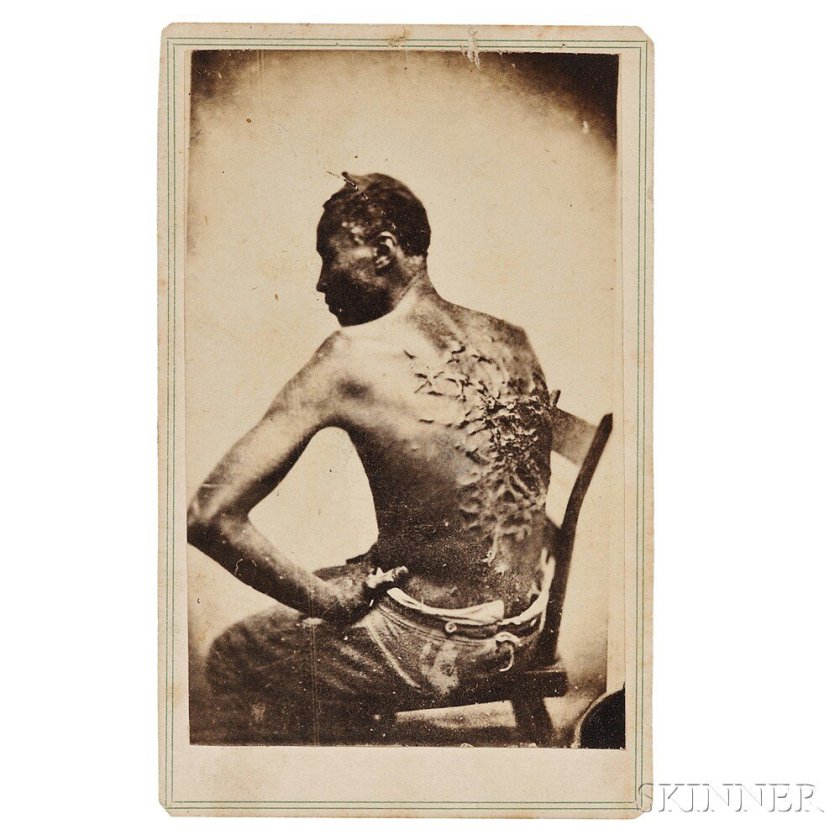
  1. This was the photo which appeared in a newspaper to galvanize the Abolitionist Movement in this country:1095374

Prior to the publication of this story, Americans at the time of the Civil War had no notion of the cruelties. These weren’t even the beginning of them–the accounts of sodomy (a white slave owner in front of his male slave’s family, to “break” his spirit) and rape, to say nothing of a white master standing over an unwilling “buck” and female slave to “breed” them. How does one recover from 7 or 8 or 9 GENERATIONS of this treatment in this country? HOW?

Scouraged-Back-Engraving-on-Paper-Harpers-Weekly-1863

2. Slaveowners “broke” “bucks” in any number of ways–torturing strong black men into “complying” with the “system”.

buck-breaking

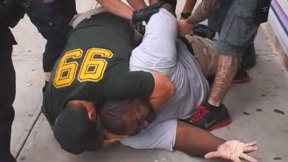
Did that look familiar? It should:

eric-garner-police-brutality-ramsey-orta

3. And white slave owners forced other slaves to do the breaking for them:

3750214_orig

A friend of Miss O’s maintains to this day: “Lisa, slaves were lucky. How would they give up that way of life? They were nothing, and we took care of them.” And Miss O’ throws up a little in her mouth. Too many Southern whites (and other whites) feel this way–they dehumanize blacks and know nothing of the true history of slavery. Even in colleges and universities–particularly Southern ones–professors preach the old story of “states’ rights”, stating that the real cause of the Civil War was about state autonomy, though the South surely couldn’t have cared less about the North’s rights to house free men and women who made it North.

4. The above reasoning for the war’s cause is, frankly, BULLSHIT. The war was about slavery–the human rights abuses and the economic stranglehold the South held because of “free labor,” in the form of slaves. I hope that American schools today are teaching this, or will change if they have not already–to teach the truth of this horrifying practice of slavery as it really was, and then to acknowledge the PTSD suffered for generations. The police forces need this education, as do our politicians. ALL of us need this education, as ugly as it is–and at its ugliest.

afr-cof02s

It’s Black History Month. (And if for even a fleeting second you thought, “Why isn’t there a WHITE History Month, you need to read this piece more than anyone else. And also the ones I’m linking to below.)

Here’s a current piece that reflects the legacy of slavery, for as you ought to know, 42% of Black men are incarcerated, many for life. Read and contemplate, from The Guardian:

Albert Woodfox released from jail after 43 years in solitary confinement

From the article:

“Woodfox, who was kept in solitary following the 1972 murder of a prison guard for which he has always professed his innocence, marked his 69th birthday on Friday by being released from West Feliciana parish detention center. It was a bittersweet birthday present: the prisoner finally escaped a form of captivity that has widely been denounced as torture, and that has deprived him of all meaningful human contact for more than four decades.”

It’s worth noting:

“His murder conviction was twice overturned – once in 1992 on grounds that he had received ineffective defense representation, and again in 2008 because of racial discrimination in setting up the grand jury that indicted him. Last year, Louisiana announced it would put him through a third trial despite the fact that all the key witnesses to the killing have since died. Woodfox’s lawyers argued the lack of witnesses would render such a retrial a legal mockery.”

That’s right: TWICE overturned. Because white-owned and operated prisons don’t give two shits about justice, fairness, or following the law when it comes to Blacks. They don’t traditionally see Blacks as people. I say that with love, though Whites make it really hard.

So if you are a White person reading this, and especially if you count yourself among the  White people who have been outraged by the very existence of #blacklivesmatter; or are incensed that Black people are upset about the murders of other black people at the hands of cops, just because they wouldn’t “comply”; or who agree that the police should never indicted (unless the cop is Asian) for such murders; and who cannot understand why Black people don’t get that Trayvon Martin was killed rightly for being male, black, young, and wearing a hoodie; and who think that Tamir Rice deserved to get shot dead for playing in a park with a BB gun, without warning, and in an open-carry state; and who found yourselves baffled or “turned off” by the brilliant Kendrick Lamar’s shattering performance at the Grammys–read every single thing I shared in this little post.

And then:

Watch Kendrick Lamar Own the Grammys With a Stellar Performance Honoring Trayvon Martin

Again. And again. And again. Until you are sobbing like the ignorant White person you have been all these years.

AND CHANGE THIS.

Miss O’s friend Sylvia saw a sign on a college campus:  “Yes, all lives matter – so if your black brother feels his doesn’t, help him carry his sign.” This is your Miss O’ saying, “Make an effort.” For America.

Here’s to Black History Month.

P.S.

With all this in mind, the contributions of Black artists to American and world culture are all the more extraordinary. For Black History Month, I would also like to honor poet Nikki Giovanni. Back in the summer 1987, just after my extra year at Virginia Tech for student teaching and education classes, and before becoming a teacher, I was recruited to do a couple of stand-up comedy routines to introduce sessions at a national Women’s Symposium held on the campus. Ms. Giovanni was the featured poet. I didn’t care much for poetry–maybe because I was limited, but I rarely understood a poem without help–but I decided to go. I sat in front of Nikki Giovanni, who directed her poems to three people, mainly: all the black woman poems were delivered to a young black woman behind me; the black man poems to a young black man to my right; and all the creative/lonely woman poems were directed to me, my eyes. She read “Cotton Candy on a Rainy Day” to my face, and she opened something in me–she opened all poetry for me. And that fall (I think it was), she began teaching at Virginia Tech, and is still there today. (Her poem in honor of the massacre, delivered to a stadium, helped heal the campus.) Thank you, Nikki Giovanni.

Cotton Candy on a Rainy Day  (thanks to the the Tumblr “A Poem a Day” for posting)

It’s Only My Hair

For as long as I can remember, I’ve had an innate sense of justice and fairness. It’s obnoxious. I think the feminist mantra, “The personal is political,” got into my consciousness around the time it was coined, ca. 1969. I was five years old, living in a new-ish suburb of D.C., a working class kid with Depression-era parents who were moving into the middle class thanks to unions. I think my sense of justice came about because, almost from the time it came on TV, I was watching Rowan and Martin’s Laugh-In. Even the slapstick taught me that life is unfair, often cruel, but can be redeemed with a  hearty laugh at yourself. I also watched All in the Family from its first airing in 1971, when I was seven. And I even watched the Maude abortion episode in its original two-part airing in 1972 when I was 8. (My mom, Lynne, explained abortion to me, as simply as possible, and while I may be sketchy on her wording, I know it came down to a hard decision that a woman who is pregnant has to make for herself.) The Vietnam War was on television for the first ten years of my life (The year I was born, 1964, was the last year of the Baby Boom), and so were hippies, sit-ins, The Smothers Brothers, and Nixon. Public Service Announcements affected me deeply, however righteous or even absurd, as did School House Rock, where I learned to sing the Preamble of the U.S. Constitution in true folk singer tradition—with repetition, so we could all sing along. The phrase “establish justice” always stood out for me. I don’t know why.

It was in first grade that I first remember putting my hands on my hips and yelling at a peer, a white boy, to tell him to behave. I don’t know where I got that voice, exactly, from inside myself, because I was a rather shy child and very nice. But when I saw things I thought were wrong, I couldn’t stop myself from voicing my outrage. Naturally, my friends loved it. It didn’t embarrass them at all. And all those shows I watched? The ones that none of my friends were allowed to watch? Well, it was my job to retell them as stories. Surely this made me popular with their parents.

When I was in 7th grade, a teacher I adored didn’t like me much, and I chalk it up to that voice of mine. The great leveler—the event that should have knocked me and my voice down a peg or ten—came in the form of a haircut my mom gave me. My mom, Lynne, really had no business with a pair of scissors in her hand (see attending photo, pre-cut story), but we just didn’t have the money for haircuts. At this time, my mom hated my wavy long hair, and thought—oh, how wrongly she believed—that cutting it short would remove the curls. Instead I turned into Orphan Annie. It was all Miss C., the teacher, could do not to snort. And in that moment, far from losing all confidence, I lost instead all vanity, which is just what any 7th grade girl needs to do if she is to forge an independent life. Braces, freckles, clown hair: “I look surprising, and I know it,” my flashing eyes said. And then I laughed. I think it was then I settled into myself, that essence. It turned me into a teacher.

Who are you essentially? When did you know it? How have you used it? Let me hear a story from you.

Easier to Live Here

A Note to Readers of the Miss O’ Show (Teacher’s Edition) Site

Back in 2012, my friend Rebecca Cummins invited me up to Montgomery, Vermont, to read at her Celebration of Expressive Arts. “Read what?” I asked. Dispatches from New York City, posted on a certain social media site. Um, well, sure, if you really think people might enjoy it.

The dispatches (in the form of status updates) were downloaded–all 50 pages of them–printed out, triple-hole punched, placed in a binder, and then selected and rehearsed, enough for 2 sets of 15 minutes, during the 9-hour train trip to Burlington. Coincidentally, my colleague Magda Misiuna was looking for an opportunity to create an eBook, having just taken classes to learn the process. Her first one had gone well, and she wanted to turn it into a side business. “Do you have anything we could turn into a book?” she asked. Well, I guess I did.

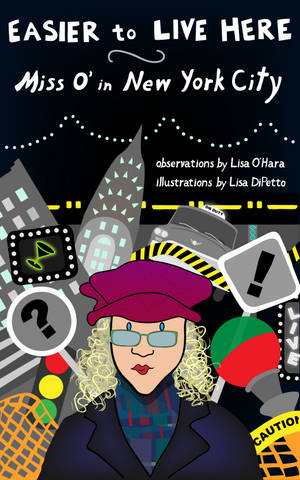
While discussing this at the neighborhood watering hole with my artist friends Jodi Chamberlain and her partner Lisa DiPetto, Lisa said, “You know, I keep a sketchbook of a lot of your posts.” And so it was that the idea of illustrating the book was born. I selected and arranged posts by season, around 50 pages’  worth; paid Magda and Lisa for their work; and the book , Easier to Live Here: Miss O’ in New York City, debuted on Amazon and on Barnes and Noble for $2.99 on December 12, 2012, where it surpassed Tina Fey’s Bossy Pants as a best seller for about one hour. Foolishly, I failed to make a screen shot.

Since then, of course, a certain marvel named Brandon Stanton started a website and Facebook page, Humans of New York, which has generated three books, global fame, and done a real service to the world via photographs and then stories, too.

Ah, well.

Still, I think there is something to my tiny observations in words.

The New York adventure continues–with the dispatches to be posted right here on WordPress. Since its initial publication, however modest, Easier to Live Here has racked up very little return on my investment, financially speaking, but on the sweet side, I’ve very happily amassed 20 encouraging reviews from readers, who are all friends. And still I do wonder if it might have a wider reading public, untapped.

For the uninitiated: You can find the original book on Amazon and Barnes and Noble. If Miss O’ could sell, say, 50,000 copies, she could take off a year and not only revise and expand the book and pay Lisa for more awesome art, but she could ALSO finish and mount her one-woman show. (Sure, it sounds mercenary, I’d so much rather sell something I made than start a crowd-source fund. Shall we dance?)

More stories to come.

With thanks, and love,

Miss O’

http://www.amazon.com/Easier-Live-Here-Miss-York-ebook/dp/B00AJLW7Z6

Miss O’ Arrives

cropped-318052_103905473121841_194011374_n.jpg

“The only difference between a teacher and a mad person is that every once in a while a teacher says, ‘You see?'” ~ Maureen Shea, Miss O’s one-time director and theatre professor, after a summer of doing Alice in Wonderland, and by way of sending Miss O’ off to her first teaching job in rural Virginia, over drinks at Maxwell’s in Blacksburg. Thanks, Mo.