Thoughts from the produce aisle of a grocery store
Yesterday after I published my latest post, I walked to the grocery store to pick up vegetables for some kind of Italian wedding soup I had an idea for as a meal for my friends on Sunday (today). I took a hand basket and walked the outer aisle for celery (check), carrots (check), spinach (check), and was turning to find an onion when I noticed a young man (Black, slender) putting back a prewashed spinach container when he saw the expiration date. “Too soon?” I asked, as I do. “I can’t eat all that by tomorrow,” he said. “You know,” I said, and he turned to listen because I do have an arresting teacher voice, “you can always blanche what’s left, now you can’t do that with these other lettuces,” I gestured, “and put in a baggie and freeze it.” He tilted his head thoughtfully, “I never knew that.” I said, my gray braids on full display as it was too warm for a hat, “That is what the age buys you.” I could see there was no more to be said. Would he do it? Who knows. I turned to find my onion.
I also wanted to pick up unsalted pistachios. In this store, the nuts are in not one, not two, but five different locations (at least) in the produce section. I think the idea is to surprise you everywhere with a nutty idea, or maybe it’s just easier to stash them under the fruit and vegetable displays, but it took me several trips around to find the right stand. I saw the young man walked back and forth looking at the prewashed leafy greens, and just before I located my nuts, the man made a point of walking by me to say, “I’m going to try it,” and I raised my arms high and cried, “Success!”
Here’s what I know about learning after 38 years in education and editing: learning never happens at the moment of impact. I’ve told you this many times, but as with all wisdom, it bears repeating. You tell someone something, teach it, and then you have to allow the student to sort of internalize it, reflect on it, and decide how they will respond. We are a very impatient society, we want it all now, in America. I was like that as a young teacher, expecting that because I told them, whatever it was, it would stick. Later you learn that because you are rushing on to another concept, you have to repeat the lesson, on whatever it was, periodically, just to jar a student’s memory.
And it got me thinking how neither Republicans nor Democrats leave time for reflection. What Republicans do is pick one or two messages and repeat, repeat, repeat, repeat, repeat. They hammer those two messages home for a month; once implanted, they pick two more messages and repeat and repeat until those are implanted. After a short time, their base has four or six messages—blame Blacks, blame Democrats, no taxes, no abortions, no schools, no immigrants—to glom onto until the election cycle is over.
Democrats, by contrast, have a more nuanced base, and they don’t appreciate that enough. Repeated messages on a finite number of things—Trump is unhinged, Project 2025 is bad, women need bodily autonomy—don’t land because they are not elaborated on sufficiently, but also because Dem leaders don’t remember that the base is also being bombarded with lies that they have to think about how to counter.
No one has time for reflection in either political scenario.
A good politician, I think, needs to behave like an experienced teacher. Miss O’ didn’t just say to the young man, “You can freeze it.” I explained how: “You can blanche it, and put it in a baggy, and freeze it.” And because we both had shopping to do, and no lives were in the balance, I left it at that. He had time to reflect, and I suspect Miss O’s continued presence in the produce department, on the hunt for what he had no idea, but still present, reminded him he could keep thinking about what he’d been taught.
Telling anyone once, without reinforcement, is like not telling them at all.
Telling them too many times, without evidence or example, is propaganda.
If this democracy is to survive—and it all hinges on Ukraine, one Eastern European nation, defeating not one but two allied superpowers—the United States and Russia—we have to figure out how to message to the American people.
Our legacy press, now almost fully allied with Trump, is useless.
Independents on social media can only do so much.
But I keep remembering that the American Revolution was won on horseback, word by word by word, passed along when people had time to think, when they weren’t distracted by anything that didn’t mean survival.
If you’re around my age and had a television growing up, you remember Sunday nights on NBC with Mutual of Omaha’s Wild Kingdom, which premiered (I read) in 1963 (you can still see the modern take on Animal Planet). It came on before The Wonderful World of Disney, which didn’t interest me—I think we turned it over to Hee Haw. Anyway, the show presented visits to the wild places of Earth, and Marlin Perkins (the zoologist host) and Jim Fowler (who seemed to do the real work) offered insights and commentary. It filled you with wonder, but more than that, for me, danger. I contrast that experience with once I have had as an adult watching Sir David Attenborough on PBS’s Nature programs, where the presenter expresses awe, delight, curiosity, and gratitude, all at once. Both programs came of age during fairly early television, with black and white cameras (or, in my case, a black and white television) to color. In Attenborough’s case, I learned from a documentary I watched last night that he’s won awards for all the phases of camera technology development, up to age 88!, beginning with black and white cameras, followed by color photography, to HD, 3-D, and now 4DX—the most advanced technology we have, most recently using animations and acting to tell the story, ironically, of animals of the past.
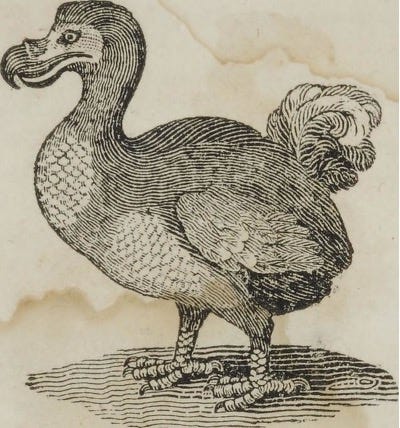
It’s here that I have to compare Attenborough to Thomas Bewick (say Buick), the 18th-19th century engraver whose engraved illustrations of British birds as well as many other animals gave the world its first affordable visuals, ones average people hadn’t had before. (I’ve mentioned in earlier posts that I recently read a book about Bewick’s life.) Watercolors and oil paintings of animals were in private collections and printed only in the most expensive editions, so common people in villages and towns might who had only heard about a camel for example, could see one. One famous flightless bird, the Dodo, for example was one such creature Bewick engraved. That bird of legend had gone extinct even before Bewick’s day, and it’s a bird that Attenborough also talks about in the 4DX in the last show he did in 2016, Museum Alive. (He’sstill alive, by the way, at 98. Bewick would be 271.)
Bewick’s Dodo, best guess based on maritime descriptions of the time and other people’s sketches. The one in the British Natural History Museum is a composite guess using the body and feathers of other birds. What is it about white men that their first impulse on seeing any unknown creature is to kill it?
Both Attenborough and Bewick love/loved wild places, wildlife. They love/loved working in their preferred mediums, television and engraving, respectively, and to use their arts to share this wonder with the world, with the common audience.
All this gets me thinking about all the ways we illustrate and instruct on the world around us, and how we used to unite around the common cause of our shared planet. When Rachel Carson’s book, Silent Spring, came out in the 1962, the one thing that everyone upset and focused them on ecology and caring was the possibility of the loss of songbirds.
Imagine that. If you have had the pleasure of sitting in my parents’ bird sanctuary of a suburban backyard, let me assure you can sit on that patio swing for hours and never be bored. Once all the birds forget you are there, it’s a party, the best kind of show.
Lately, America and the world have become focused on a collection of primates but not for the biodiversity and wonder and joy they bring. Instead, it’s a nature Reality Show from Hell.
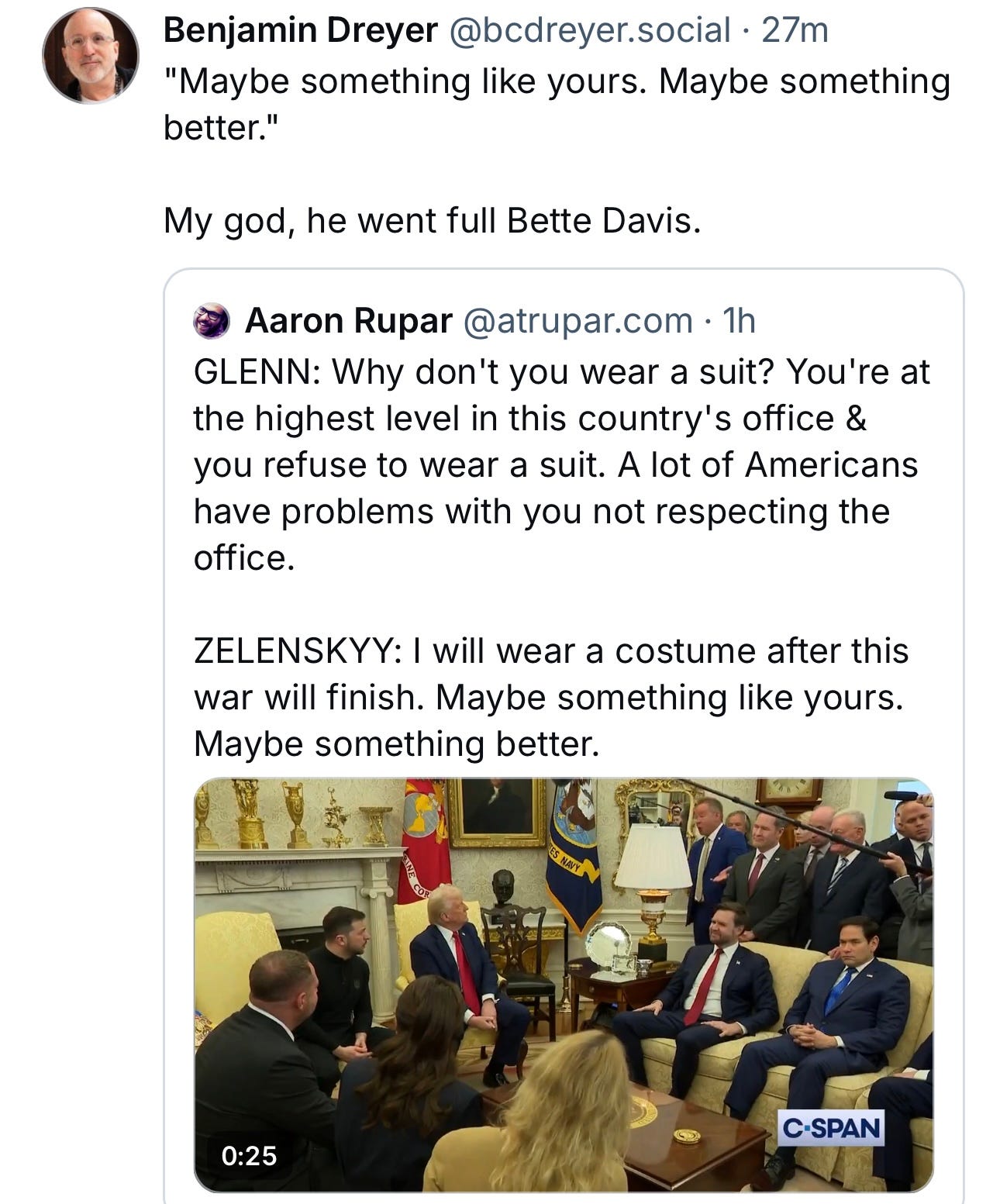
Yesterday, as the world watched, any sentient human cringed. Vance and Trump’s treatment of President Zelenskyy of Ukraine was beyond the beyond, trying to leverage their own favor-currying of Putin by placing the beholden Zelenskyy in front of right-wing American television cameras and reporters, to cow him, as if this man has not been enduring full-scale war for three years trying to save the democracy he loves. Lights,cameras? Bullying? 1) Have they no shame? 2) Are they high? 3) Fuck them.
Like nature at one time, democracy had been a common global cause for many, many years, but no more. President Zelenskyy is like the compelling, knowledgeable zoologist visiting a new kind of American wild kingdom in a television series, facing two aggressive and deeply stupid primates who exist only in captivity. It was, as you know, horrifying to watch.
President Zelenskyy prevailed. I hope he wins this war; he’s already won history. I don’t want Ukraine or him to go extinct.
All of this is just to say, Slava Earth, Slava Ukraine.
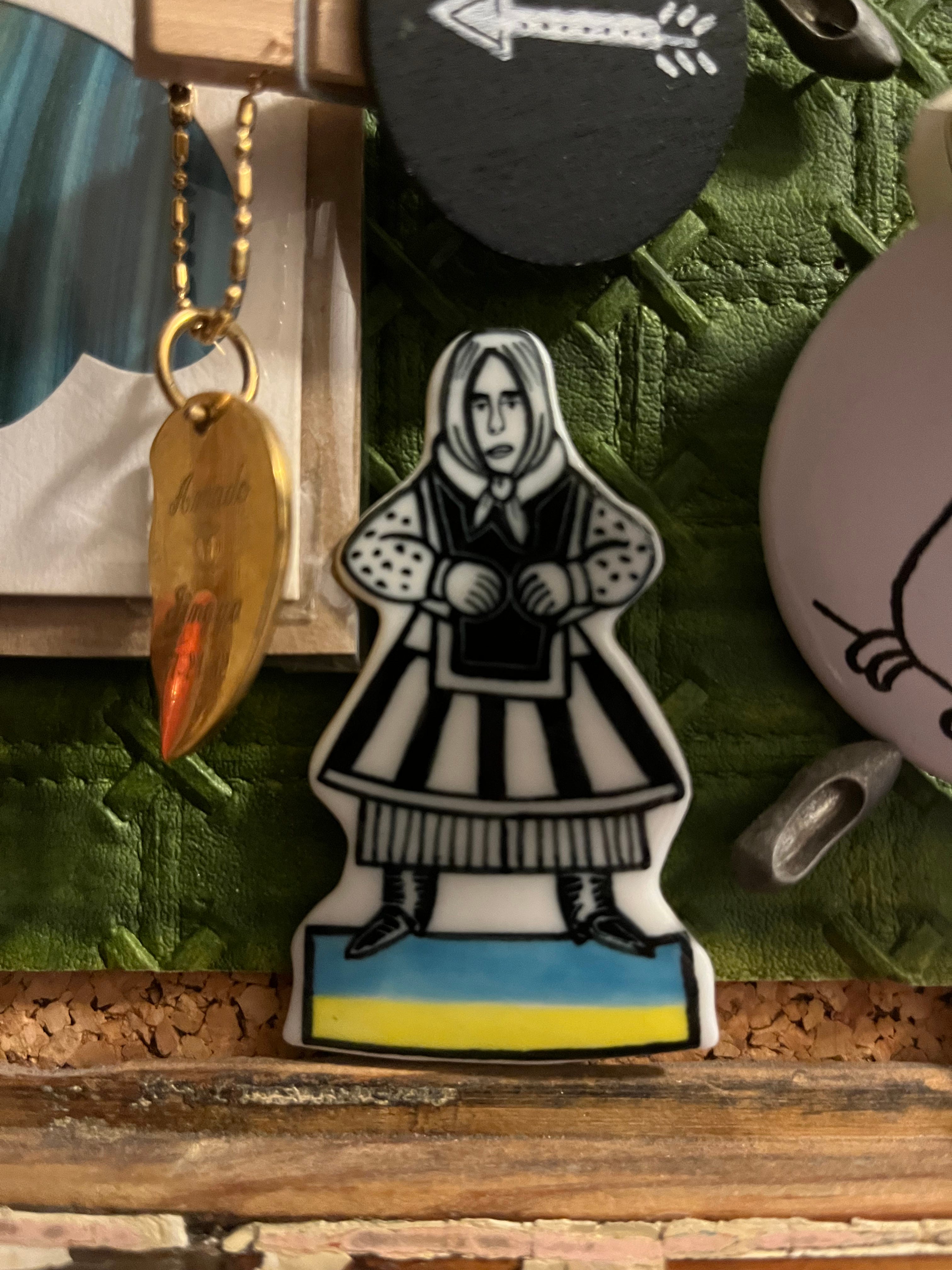
Home bulletin board detail. Queens kitchen.
Until the next episode of the Trump Wild Kingdom Shit Show, do beautiful things, somehow.
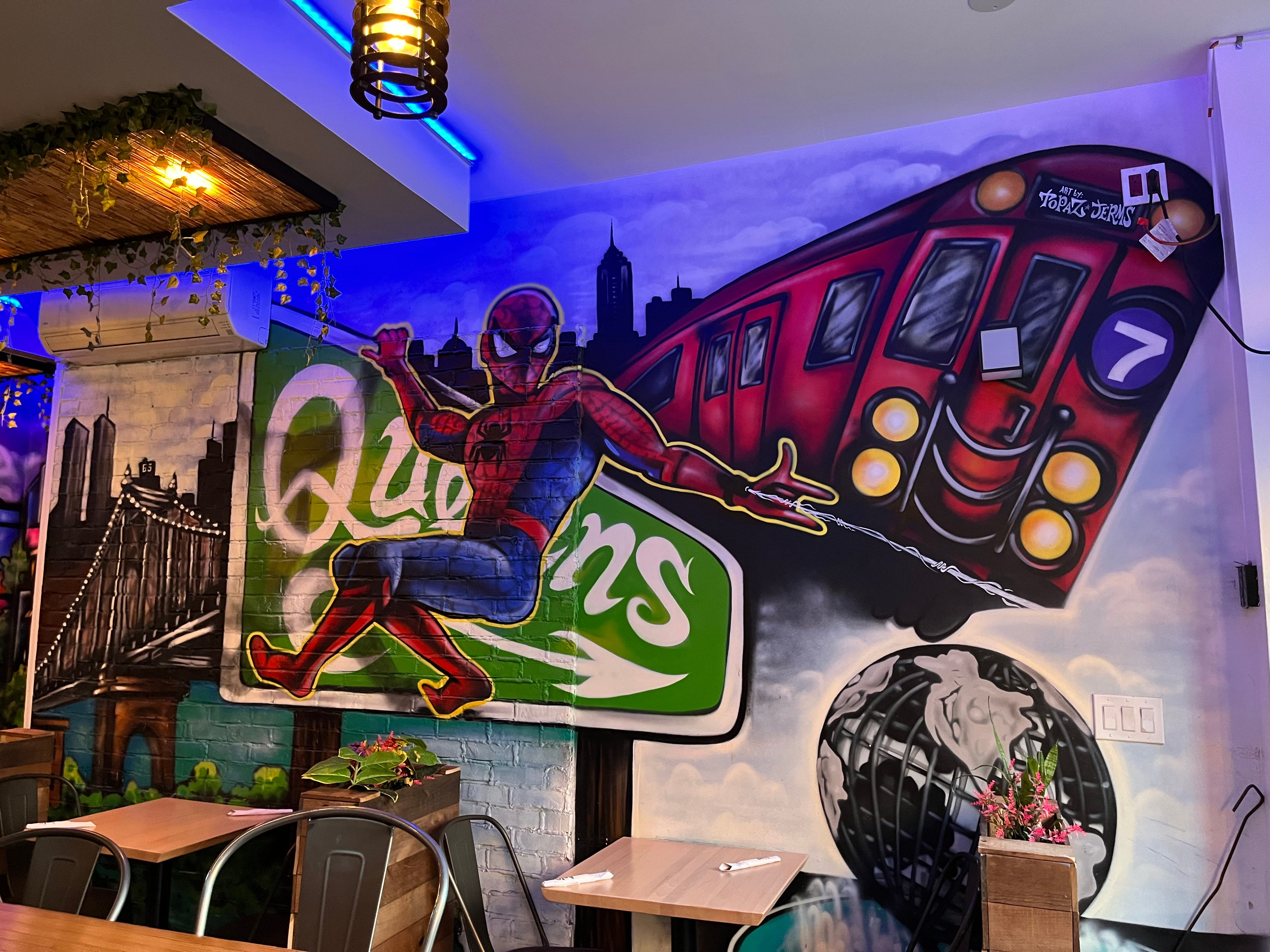
It’s an ordinary Saturday in Queens, which is to say “ordinary” if you aren’t thinking about the fascism. (I really can’t get over the way that Meta bleeps “Nazi” and “swastika” from videos, or that posters have to insert an * somewhere in each of those words so the post passes muster, even as Elon’s and Bannon’s sieg heils are fine.) I am waiting on a 7 Train, only to learn it’s not going all the way to Manhattan, so I have to switch the N or W, so my mind does a little adjustment. It’s all good.
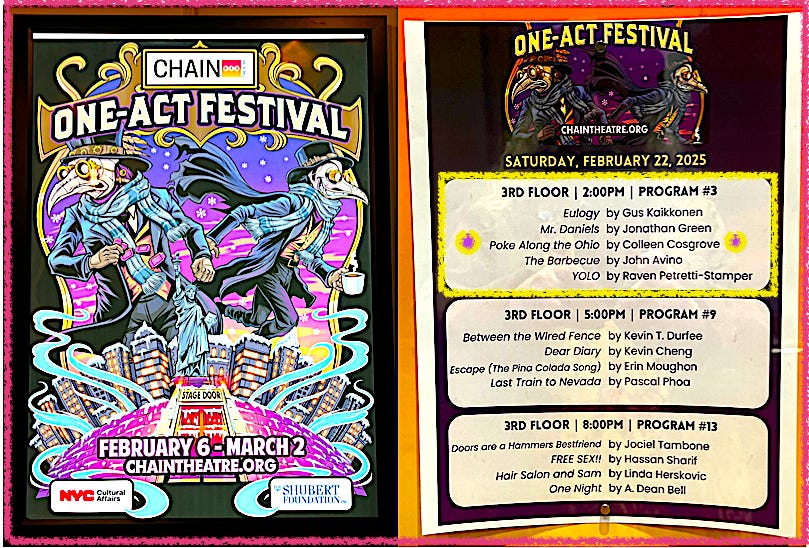
There used to be moments when, as my friend George puts it, it seems Americans are simply going to be inconvenienced to death. Now, unfortunately, and for a long foreseeable future, we are under threat of annihilation. But today, I’m heading to The Chain Theater at 312 W. 36th Street in Manhattan to see the 2 PM installment of their rolling rep One Act Play Festival, and today I don’t want to think about annihilation.
When I arrived at Times Square/42nd Street, I walked through Golda Meir Plaza, struck again that in the 1970s we had female leaders like Meir of Israel and Indira Gandhi of India, Thatcher in ’80s Britain, and that the United States couldn’t even manage one woman in 250 years, choosing an avowed white supremacist dictator, twice, over a highly qualified, democratic woman. And here we are, I think, wondering as I keep walking what will happen to the bust of Meir.
First, I have to go to the ATM, and for some reason my card chip will never work to open the door; another customer, a man in a hood, has a card that opens the door; he engages in no talk. I go in behind him, and I realize I’m shaking. I find I’m afraid to use the machine until I see him at the other machine, and really getting money; I finish before he does, even having to enter my PIN twice to get it right. Odd, having the shakes like that. Or not so odd. Frankly, that’s as fearful as I want to be in life.
It’s nice out, 40s, sun. I walk down 7th Avenue, taking it in, struck again how I can always spot a tourist. I am of New York City, I move that way, more grounded, a bubble of insulation and also awareness. I was a tourist for 20 years before I moved here, so I don’t mean this as criticism or praise; it just is.
I arrive a half hour before the play festival is to start. I see Mary, the director of my friend Colleen’s play, in the crowded lobby, and we hug. I check in at the desk, my friend Tom having bought our tickets online. Our friends David and Barry are also coming, and learning the afternoon is sold out, I go in when the house opens and save us a row, as it’s general seating. An older woman in the row behind me is doing the same thing. (It’s always funny to me how everyone who enters a general seating situation somehow believes they will get to sit alone, empty of audience members around them, and they look at my saved seats with resentment.) The boys show up just before 2 PM, so we don’t get to visit much, and they don’t have time to go out after. I seem to be the only person I know in the city who has nothing but time. Ah, well. Still, being in this community even for a brief time is comforting and energizing. Hopeful.
For the uninitiated: Attending a play festival of new work, especially one-acts, can be a crapshoot. I’ve attended many of these, both as a high school director and as an audience member in New York, and too often only two out of the five or six are well-written, and only one or two are well-acted and directed, and often it’s not the same set of two. So imagine my delight—I knew Colleen’s would be adorable because I’d read the stage directions for it at a workshop—when all five were simply excellent.
The common theme—and this was a really thoughtful grouping—was aging and death. This might sound awfully close to that annihilation I was avoiding, but it wasn’t the case. The first play was a monologue, a 60-year-old son eulogizing his father at the funeral; the second, two old people on the E Train platform; the third an older man trying to make a deal with Death; the fourth was Colleen’s (a play inspired by seeing a plaque in Evanston, Indiana, along the Ohio River, where President-elect James K. Polk was to have stopped his steamship and didn’t disembark), with an old woman (Colleen) and her grandson in 1854, the year Lincoln was really getting started; and the last a gay couple, older men, one who has, we see gradually, dementia. And all of these were by turns serious, funny, sweet, surprising. And ultimately, ordinary, in the best sense. Life lived.
I’ve realized lately that what I crave most in my music, my art, my nature, and my life, even, is ordinariness. I don’t want the surreal, the challenging, the wildly surprising. I get too much of that in unending loops in American society now, breathless, mean, chaotic, and all that hate and chaos, while not remotely sustainable, will be unending for four years at the very least, and if we all don’t stroke out and live to see another election, we may see a divine revolution. Until then, I want mundanity as a life theme.
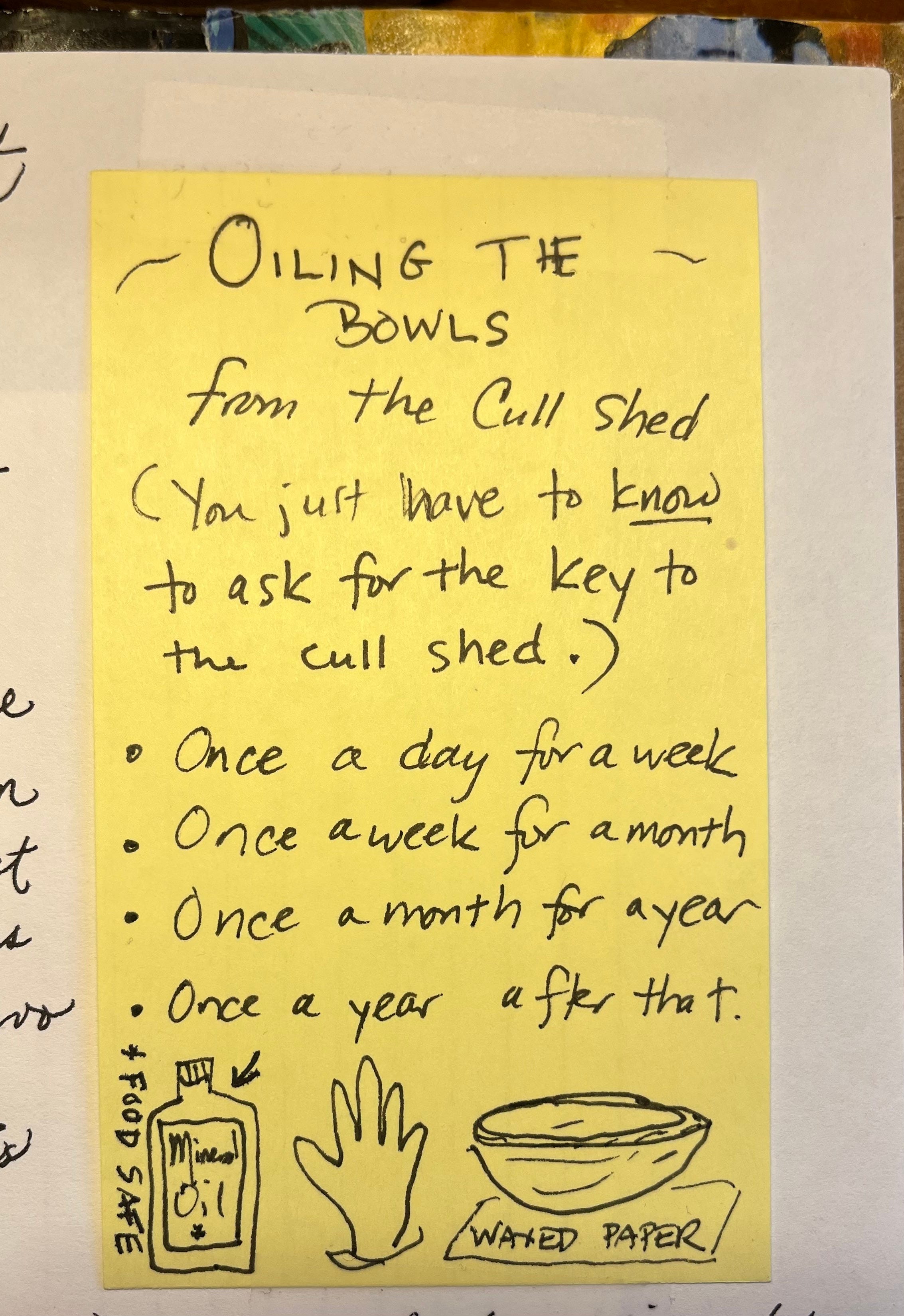
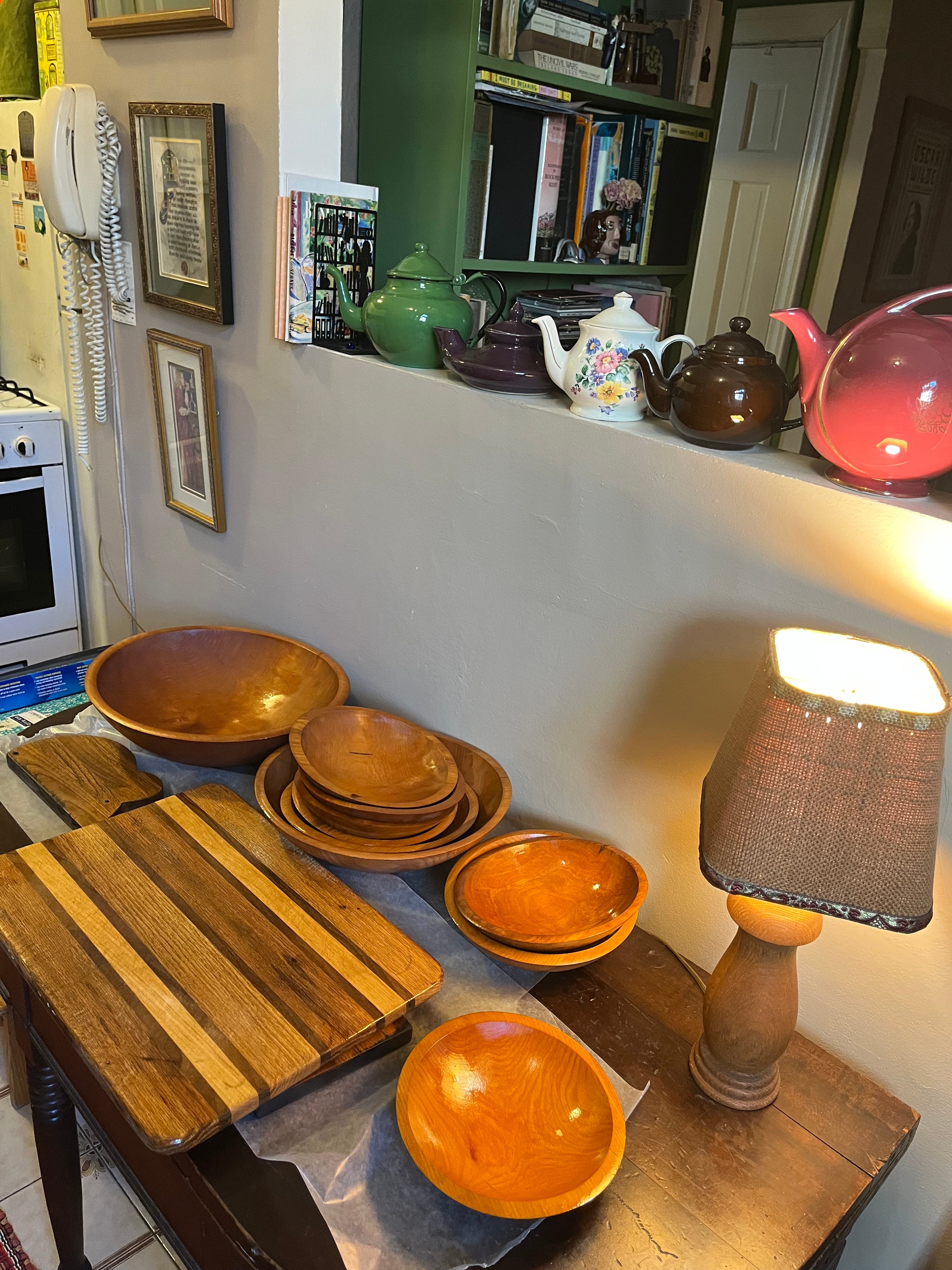
For example, here’s a task of basic maintenance.Simple chores. I did the annual bowl oiling during my lunch break one day since I work from home. So restful. Once the oil soaks in, they’re good to go for a year. I oil the cutting boards at least twice a year. Isn’t it nice to focus on that?
As another mundane activity, before leaving for the subway with a half hour to spare once dressed (I took care to pick my ensemble and accessories, knowing no one else would actually care, but it’s my inside feeling that counts), I noticed that I have a lot of loose knobs on my two dressers. One dresser requires a Philips head and one a flathead screwdriver. I keep these in a pitcher by the door—I like to have my tools ready at hand. Knob by knob, I tightened them. In doing this I noticed a few scratches, so I went to my tool closet and found the wax wood filler pencil. And I filled the scratches, and it’s funny how the more you fix the more you see.
And this by the way task was really satisfying. You know what I mean? And centering, before heading out into the chaos of New York’s mass transit.
Why do we have to exist in all this rage and war and hate and aggression and greed and chaos? We all have knobs that need tightening. Why, just because of a few psychotic, damaged men who cannot be satisfied or fulfilled by all the money and power in the world, do all the rest of us have to suffer for all time? Why do other people, people with absolutely no hope at all of either wealth or power, follow them, go psycho with them, and go after all the rest of us? Don’t THEY have knobs?
From the web.
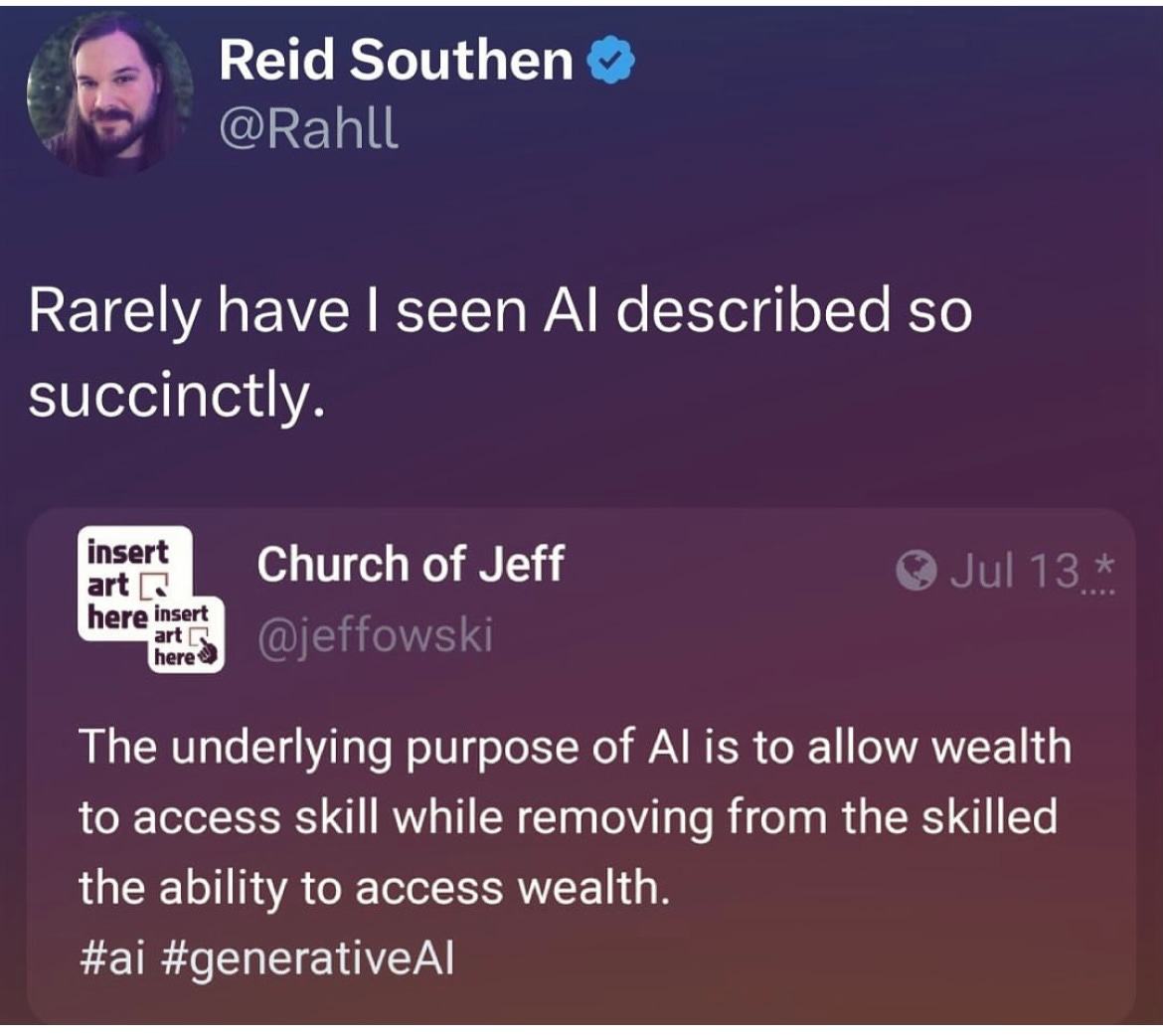
I was thinking too about AI, how the goal is to replace humans, to erase humanity, and that AI cannot tighten knobs. How are we to cope with the attempted erasure of culture, of women’s sovereignty, of black and brown people, of the earth itself, when this desire for annihilation is beyond lunacy? Why can’t we be? Being is hard enough. Knobs come loose. Why can’t we work together to solve real problems?
From the web.
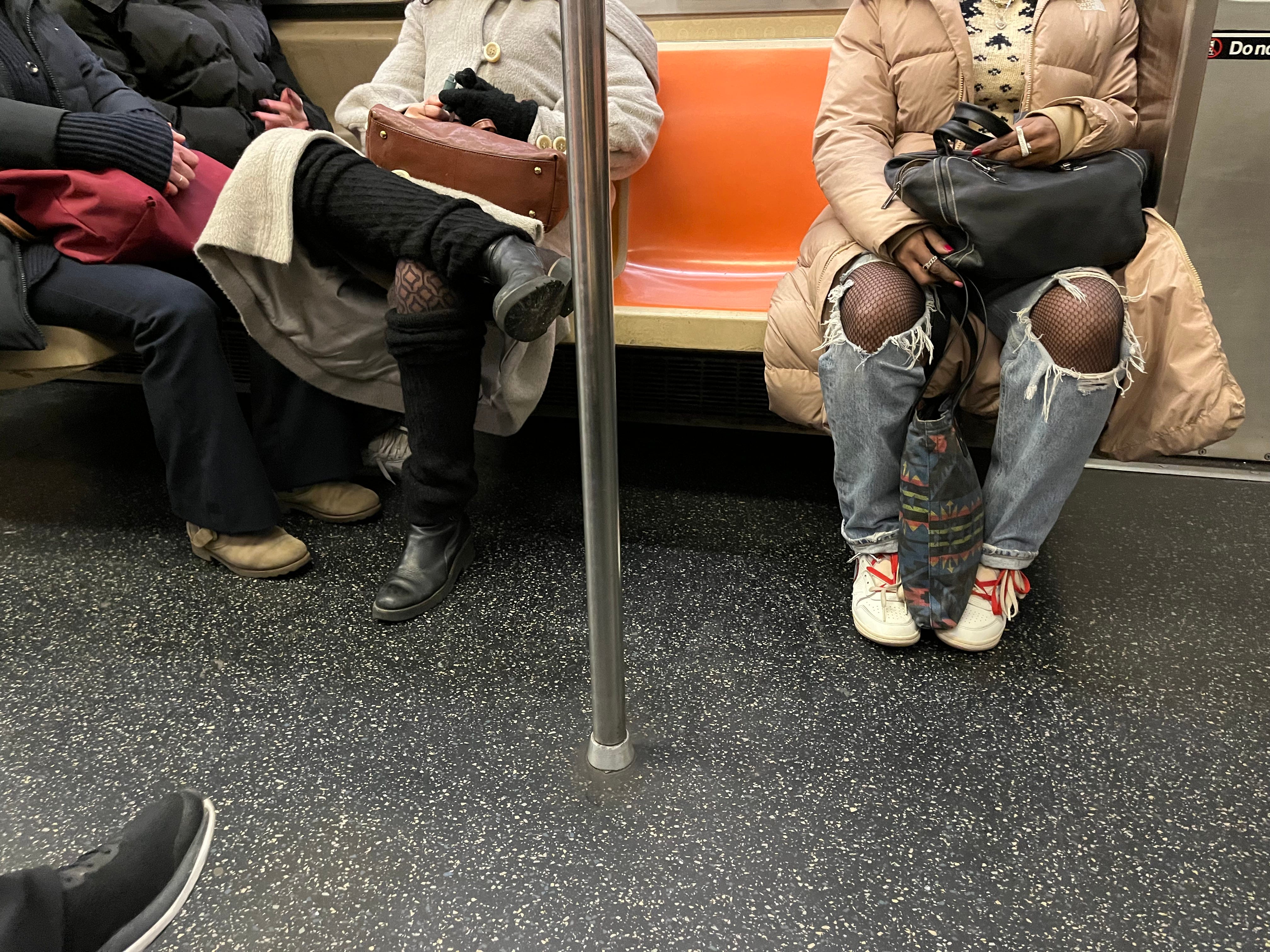
To cope with the whole mess, as I brace for some kind of war, I’m taking more and more pleasure in the very ordinary, like watching people on the subway.
A Study of Knees and Nylons. N Train to Queens. LO’H 2025
I know I can’t be alone in these chaotic feelings. How are you coping? In addition to doing chores, seeing art, and attending the occasional rally, I’m calling politicians and listening to Nina Simone. Followed by Yo-Yo Ma. You?
I am a 60-year-old American white woman who has been steadily listening to Nina Simone and Miriam Makeba for months now, and today find that I have turned my Apple music subscription to Chappell Roan’s The Rise and Fall of a Midwest Princess. White girl voices are often too breathy and whiny for my taste (so, bless Adele), and the lyrical complaints about girls and boys and coffee date ghosting don’t exactly feel vital or resonant, but there is something compelling about Roan.
It’s good to know I can still be surprised by an artist, especially a white one, because lately I’m not surprised my much else white people do.
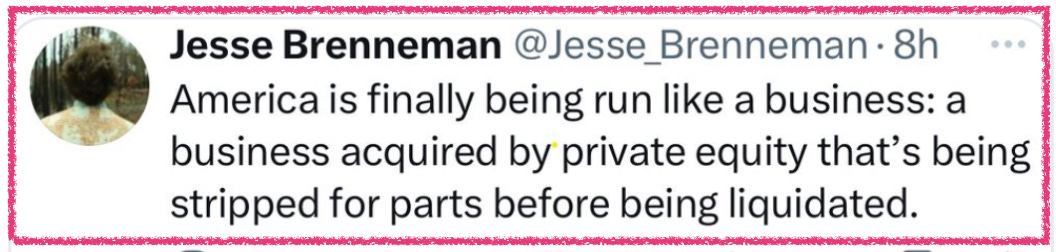
Anyone in America who works somewhere has probably been “acquired” by “a firm” of some sort for their “portfolio”; and as a result, we all of us feel this chapter of American democracy, as was, all too keenly: the Musk acquisition of America. I’ve read that the Republican voters who work in civil service never thought that the people they supported for office—that is, the venture capitalists and hedge fund managers and private equity firms—would actually strip the government and its Constitution and sell it for parts, and fire them, but they voted for Donald “You’re Fired” Trump despite all the evidence and have found out why he’s been bankrupt six times and still standing. Musk had swooped in and destroyed Twitter and it meant nothing to these voters, either. What did they think? Well, unlike Captain Renault in Casablanca, “a poor corrupt official” who knows full well how the game is played when he says, “I’m shocked, shocked to find gambling going on here” as he collects his winnings—these earnest civil servants living in their paper pushing D.C. bubble lack a social safety net moral compass. When you think life is only money, only “savings,” you may be missing, I don’t know, a heart. Or basic life experience. (And they are about to find out what unemployment looks like when there’s no money for them to claim, and no jobs to be found except the ones all those poor, now-deported undocumented people did. Godspeed.)
For anyone who needs a personal testimony of this process, the publishing house I work for was taken over, the first time, by finance people who quickly eliminated the Editorial Services Group (ESG) because they didn’t know what ESG meant. And they never asked us before handing out the pink slips and severance packages. The ESG, as it turned out, were the COPY EDITORS and FACT CHECKERS for our textbooks. Our product. Our source of revenue. And even after learning this, the financial overlords just shrugged. Who needs copy that is correct and makes sense in educational materials for America’s students? Who will really notice? $$$ (Now I do my job and their job.)
These are, after all, people who don’t believe in textbooks, obviously; we now formally live in a nation of capitalists who don’t value education because somehow they think they learned everything (and they think, everything) through osmosis.
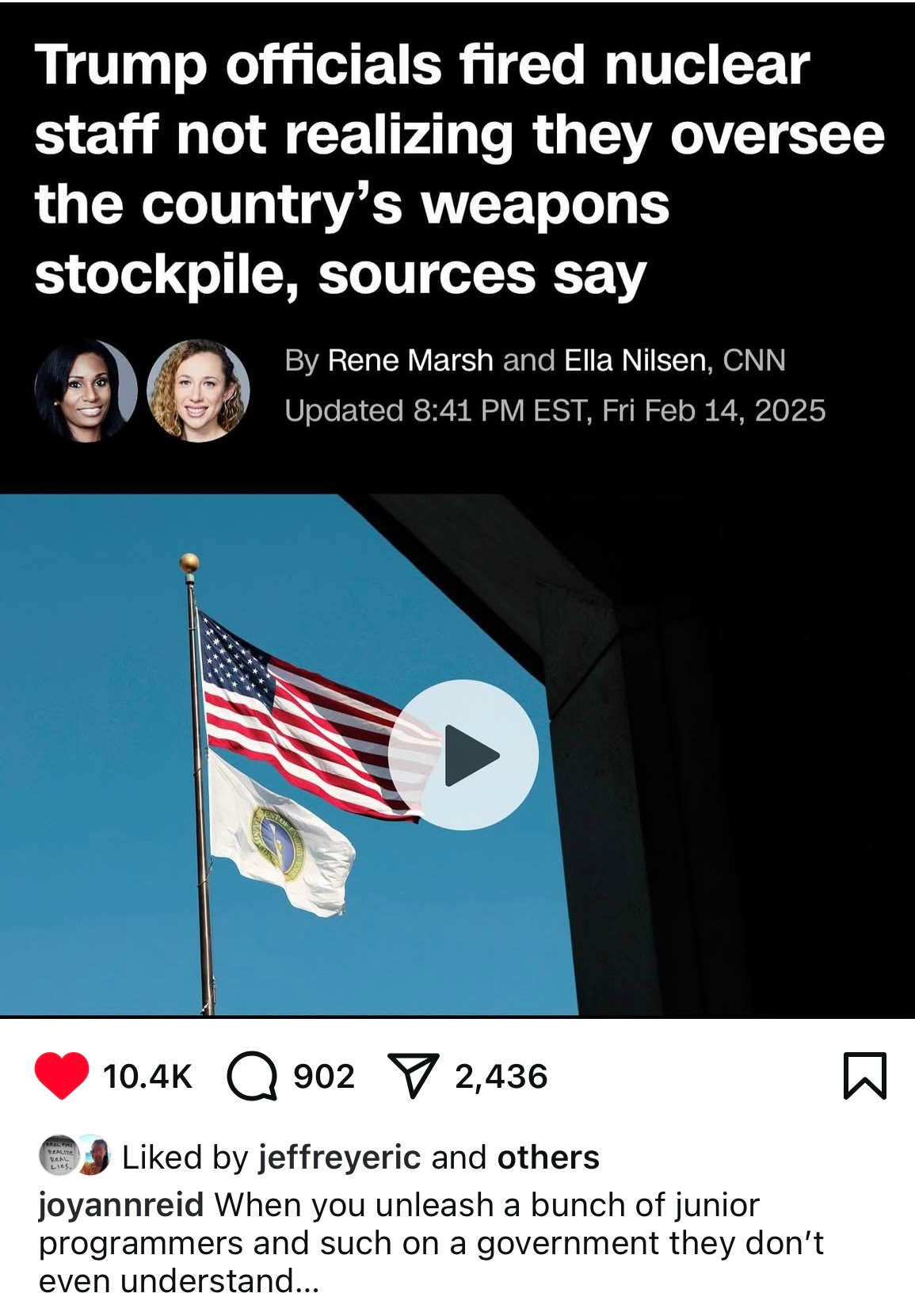
Cue today’s lethal gem of a typical private equity business slash move:
There’s not an American office worker in existence, or factory worker, or cashier, for that matter, who didn’t read that headline and nod.
Why do you need refrigerators? It’s a grocery store. No more refrigerators.
That kind of thing. Only now our entire nation’s security, health and safety, and economy are in the hands of, quite frankly, money fiends devoid of vision, purpose, or shame, let alone the “common sense” Trump claims to have. (Emerson called common sense “genius dressed in plain clothes.” Take a memo.)
In another example, I read that some 1.7 million HOMES around the country are vacant, sitting empty since being acquired by private equity firms, either for the land or the tax write-offs, with no interest in the communities in which the houses sit. Freeing these homes to be sold to people could end the housing crisis, maybe. At this rate we’ll never know. $$$?
My go-to comfort viewing during all this mess has been rewatching the 2019 documentary Toni Morrison: The Pieces I Am, directed by Timothy Greenfield-Sanders, like, a dozen times. I read a review that referred to the documentary as “flat,” and it occurs to me that it’s hard for the newer critic folks to enjoy being brought fully into a world as thoughtfully as this film brings you into a teacher and book creator’s life. The subject, Nobel Prize winning novelist Toni Morrison, is as great a subject as a literate viewer might want, unless what you want is a subject like Hemingway, who beat his four wives and fought to the death in wars and bars; or Pablo Picasso, who screwed two women on the same day and then painted them both, as a habit. I’ll take Morrison’s strong sense of self, her moral compass, unflashy living, artistry, deep humanity, and humor, thanks. And she has great literary company for additional commentary. It’s all about the love of language, and the way we use language to tell about life.
Morrison recalls a time in her early childhood where her sister was teaching her letters, and they would use pebbles to scratch the letters on the sidewalk. One day they saw a new word down the block, and they began copying, F…U…, and suddenly her mother ran out of the house and yelled at them, they were crying, they didn’t know what they’d done. In that moment, Morrison says, “I learned, words have power.” (I had a similar experience when a neighbor up the street taught tiny me and my brother Pat, “Eenie, meenie, minee, moe, catch a n***er by the toe.” Not knowing that word, I substituted one I did know, but when I used that word within earshot of my mother, it sounded bad, too, and I got yelled at. So I tried, “Eenie, meeie, minee, moe, catch a quarter by the toe.” Because I couldn’t say “nickel” anymore. My mother, realizing what she thought she’d heard, said that was fine. Even though coins don’t have toes. I learned that language can surprise you, that language is invention.)
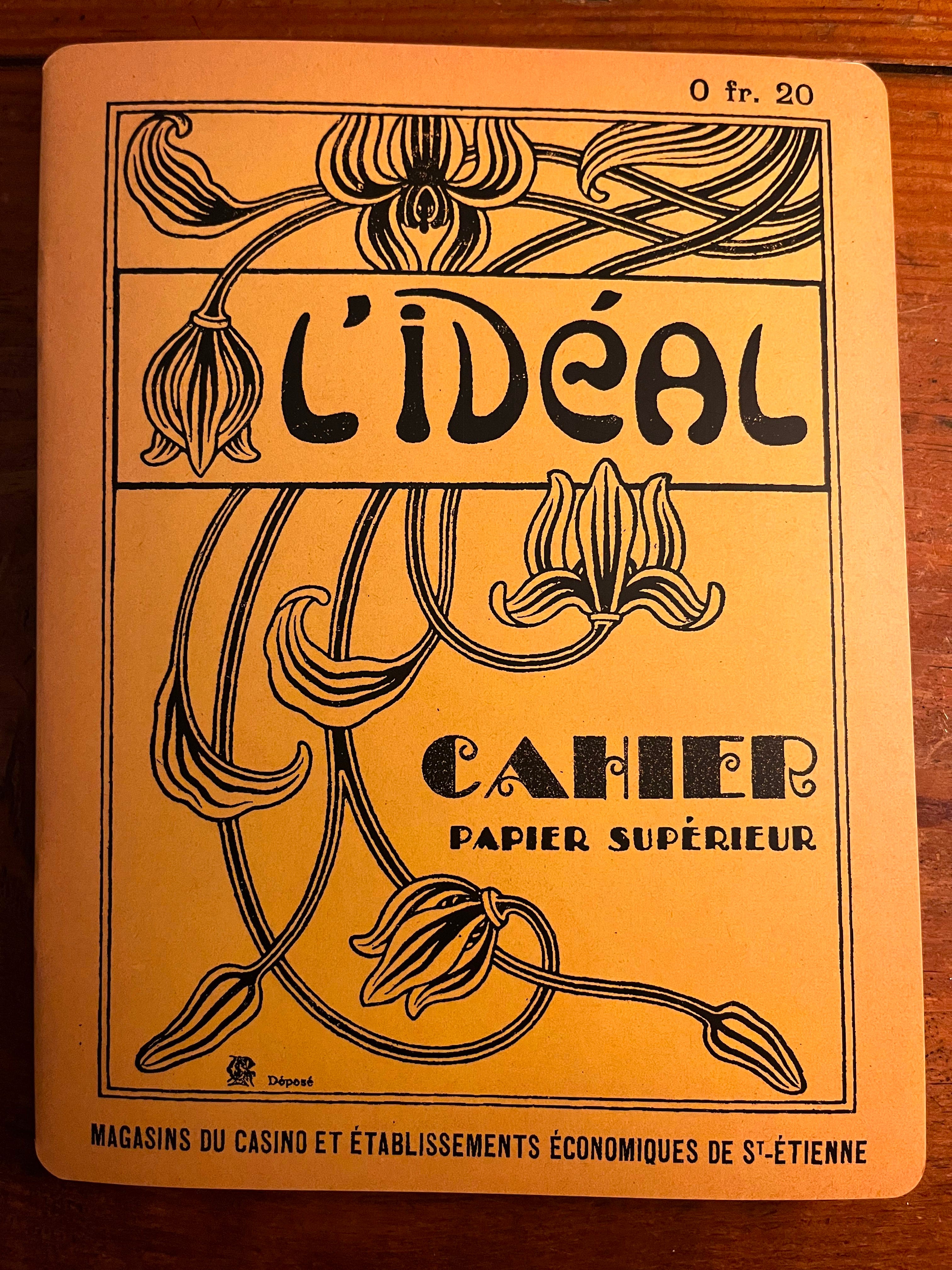
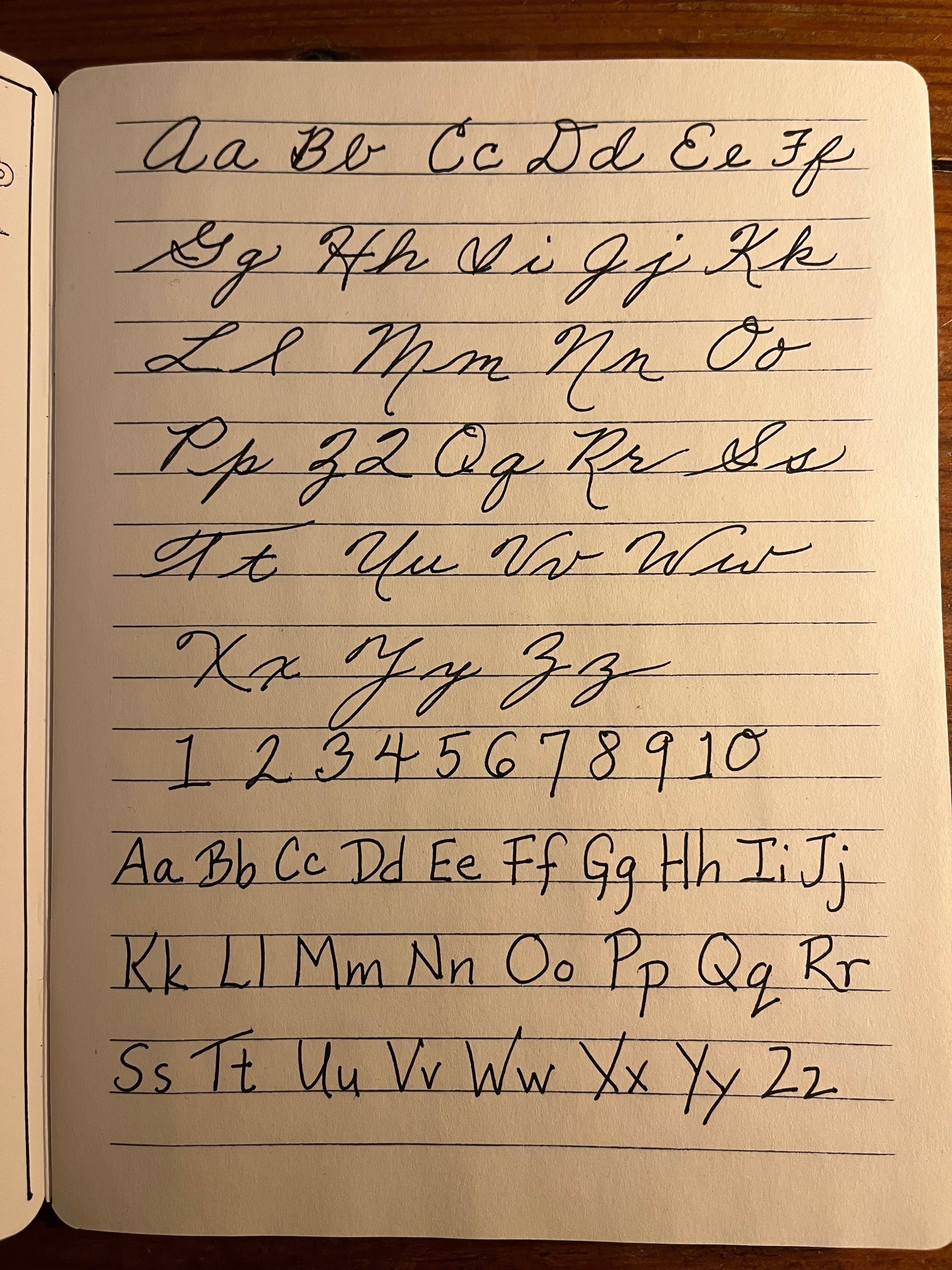
I bought this latest notebook at McNally’s on 8th Street yesterday.My first desire for this notebook, after placing impressions from all my rubber stamps on the inside cover, was to write all my letter forms and numbers. And it really got me into a sense memory of how much work it took to learn penmanship, to practice spacing, use the lines, to be able to form words to communicate. And I was impressed with my young self. I really was. Education is wonderful.
The opening credits for the film show an artist putting together an ever-changing collage of black and white photos of Morrison’s face, pieces from the many stages of her life, along with patterned paper, to jazz music, and I could watch that over and over just by itself.
But on this day of Black History Month, I want to share this observation Morrison makes about her growing up in Lorain, Ohio, a background woven throughout the film to create a familiar texture, one that grounds the artist in a relatable experience for most of us. “It was a melting pot, it really was,” Morrison says of the Blacks, Italians, Poles, and other working-class migrants who came to this steel town along Lake Erie, where “there was no shame in being poor.” Having enough to get by, pay the bills, have a roof, meals, your people—you know, you were good. (I grew up that way, to start. My parents were working class and moved to the middle class, and it was a big deal; values started changing, more materialism, fitting in, all that. Poverty stood out. As a nation of billionaire worshipers, we need to think on that.)
But more interesting to me this time is when she says that she had come to realize that the melting pot, “the cauldron”—and here she makes the pot with the hands—“is Black people. We are the pot.”
The United States of America would not exist at all without the slave labor of Black people, and we know that; and more than that, there would not be a culture without Black people, or at least not a culture I’d want to live in. Along with our Indigenous roots, Black music, dance, energy, love, drive, gospel, wisdom, persistence; Black love, righteousness, and willingness to throw their bodies at justice, at life, to boycott the bus lines of Montgomery, Alabama, for thirteen months—all this holds the rest of the (white) country together, makes this a democratic nation, and one I can stand to live in, if not be always proud to live in. Morrison’s late life understanding that Black people were the holders of what was melting in that pot, that they were the pot, hit me hard when I watched the documentary again last night. They were our models for the fights for justice.
I read this on Friday morning on the Instagram account of my favorite trans performer, 2024 McArthur Fellow Justin Vivian Bond. I went to the Stonewall website several times, where they also removed the “Q,” and when I scrolled down and it said, “Was this information helpful?” I chose NO, and a box asked for tips. Oh, I gave some tips. “Where’s the T? Where’s the Q? For shame.” Times 10.
On Friday, which I’d taken off to have a four-day mini break, I’d planned to spend the cold winter day at the Met Museum but instead took a detour to the Trans Rights Rally at the Stonewall National Monument at Christopher Street. I want to be an ally. Standing with all these people, where it all began, is a little surreal. “Let’s go get coffee,” one person said to a partner part way through, checking his phone. Stonewall made that possible—to just live your life.
And really, face it, without gay men, there is no Hollywood, no theater, no fashion, no clubs, no fun. Without lesbians there is no feminism, no suffrage. These are small examples, broad strokes, but you see what I mean.
American rock music—our greatest export—has its roots in American Indigenous music as well as African music. It’s not that there are no contributions by white artists, it’s just that this country would be unrecognizable, and without doubt way less interesting or dynamic, if left only to cisgender, straight whites. (Lawrence Welk, anyone? At least there’d be no Kid Rock, what with rap off his radar.) Watch what Trump does to the Kennedy Center, if you can. You know it’s cringe.
The ironic wit and hijinks of The Onion and improv theater notwithstanding, white culture has lately been elbowing out any good stuff in order to put that glaring spotlight on capitalism, our god; private equity, individualism, willful ignorance, winner take all, white supremacy, oh, and fuck you, parasite, should there be a fuck left to give. If you see what I mean. And porn. And rape. And brews for bros.
Time to melt that into the pot. And keep it melted.
Meanwhile, keep the faith, show up, find the joy somehow. That’s what I think today. I’m trying to listen to more music. Dance. And you might watch The Pieces I Am, especially if you feel like all this fragmentation of America is making you fall to pieces. It’s so hopeful. And read Beloved.
Love,
Miss O’
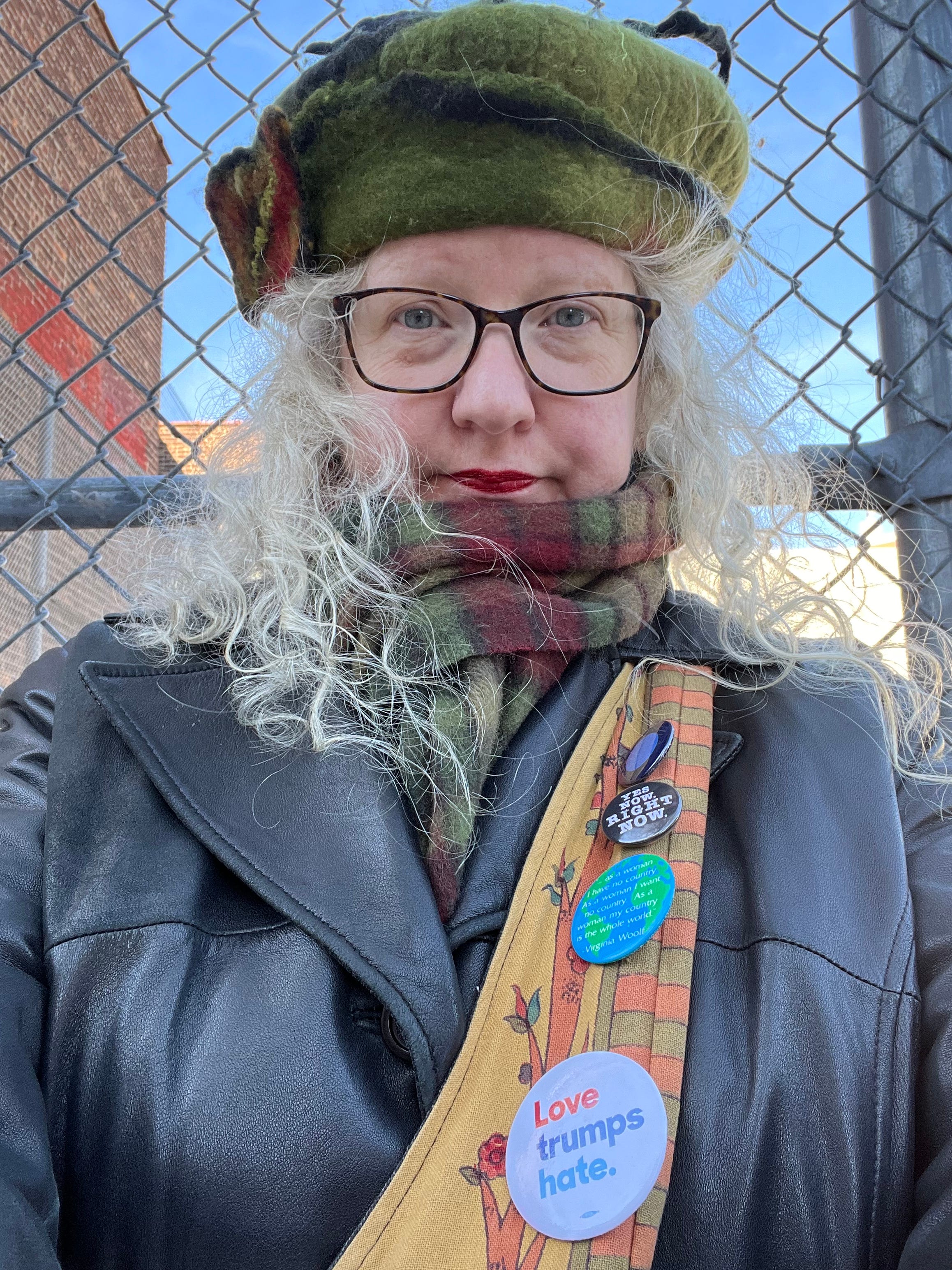
“As a woman I have no country. As a woman I want no country. As a woman, my country is the whole world.” ~ Virginia Woolf, paraphrased. Blue button and “Yes Now Right Now” button by Lisa DiPetto and available on Etsy. I had really hoped my Love trumps hate button would be a relic by now. P.S. Red lipstick was a sign of resistance against Nazis, fyi. Nous continuons.
Reflections on democratic voting in a time of rising fascism
I Sit in My Kitchen Rocker Waiting…
As I Lay Dying, “I Stand Here Ironing”…I keep thinking of titles around the anxiety of working out our lives, and deaths, so much of which is out of our control. We have to, more often than not, depend on others, on the actions and emotions and convictions of others, to make our own lives bearable. And today I’m feeling how terrible that can be, and also how reassuring.
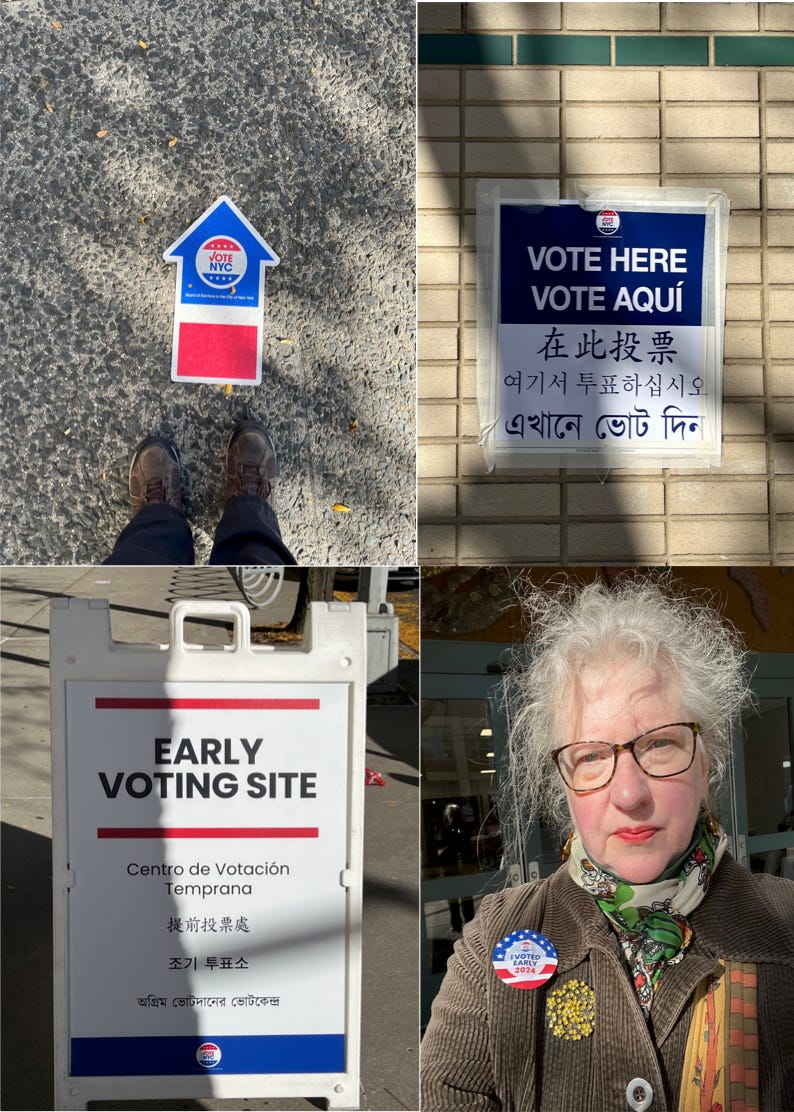
Today I “early voted” here in Queens, surprised by the lack of turnout, in some ways, but this being New York, local Democrats don’t have a lot of competition. (Still, I live in an area full of Trump voters, particularly Hispanics, too many of whom more or less worship the man (if tee shirts are evidence) who plans to deport them within days of returning to office, citizens or not, it won’t matter.) The poll workers gave me such heart, though, just to see them there, all caring so much about democracy.
Scenes from a day of early voting, Queens, NY
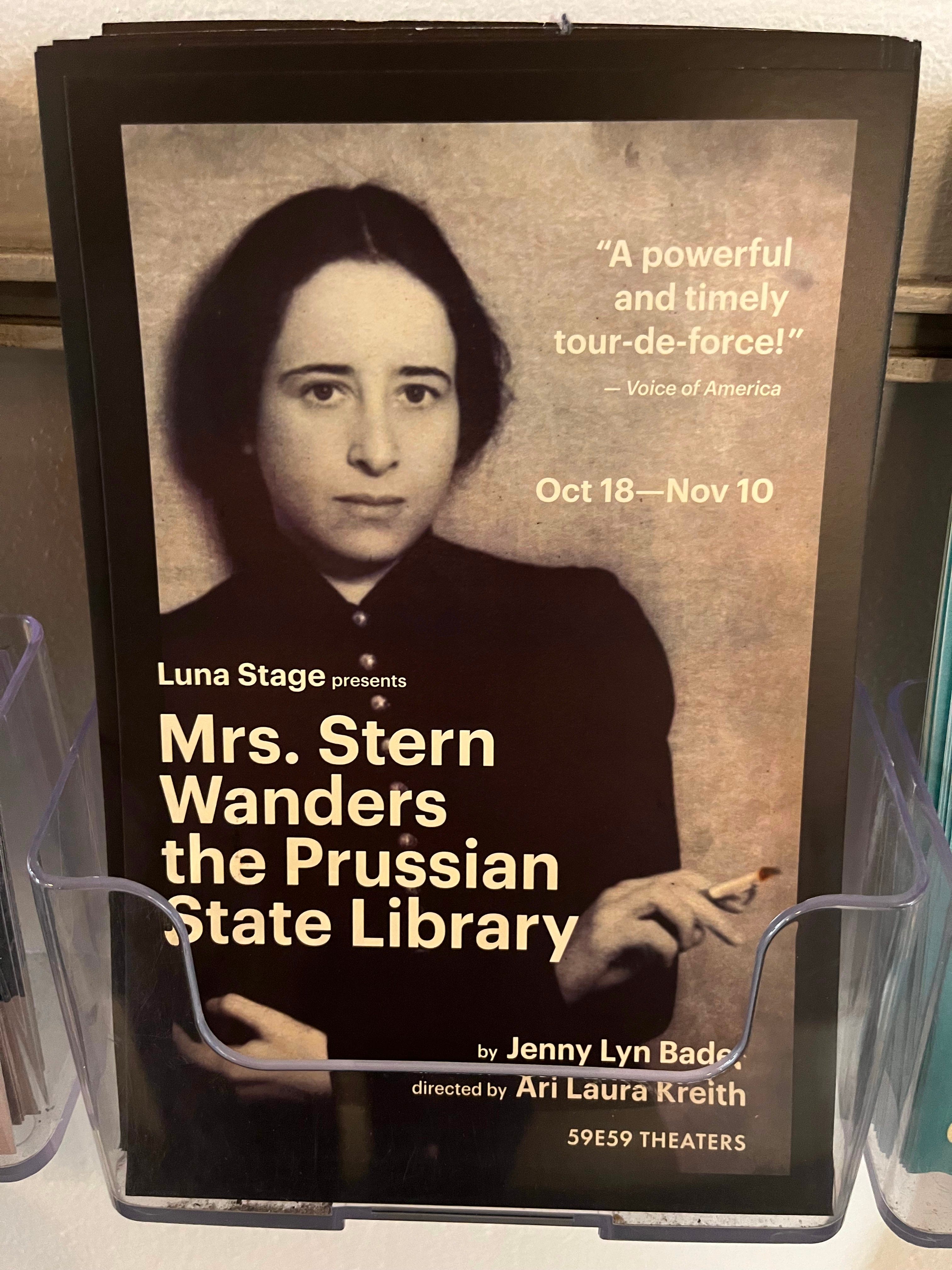
I’ve been imagining during my sleepless nights the consequences of a second Trump presidency—I cannot see how we are really here, but then no one imagined a Trump to begin with, so showered with love and celebrity coverage by a besotted press. Last night I went to see a play at 59E59 Theater here in New York called Mrs. Stern Wanders the Prussian State Library by Jenny Lyn Bader. The subject of the play is the period of days a young Hannah Arendt was imprisoned and interrogated by a Nazi officer (whom she ultimately convinces to help her) in Germany in 1933. The investigating Nazi officer in the early days of Hitler’s Chancellorship and martial law is convinced that Mrs. Stern, rather than working on her dissertation, is mimeographing and distributing overseas the antisemitic writings and cartoons in the German papers. Because of who she is, we know that Arendt gets out, since she will famously go on to cover the Nuremberg Trials, there to develop a philosophy around the nature of evil and the ordinary people who become complicit.
I became increasingly, deeply horrified watching this play as I realized that this is America’s future, quite literally, with camps and the rest of it, unless Harris is elected. And this time, no hyperbole.
The treacherous New York Times gets scared straight.
The consequences of this election will affect every citizen who is not rich and sociopathic in horrifying ways. Anyone who says we aren’t all in this together is a dope. Years ago (I probably told you this story), I was at a favorite bar in Midtown Manhattan, a great after work sort of bar, and there was a commuter from New Jersey there sometimes, if he had just missed a train. We would chat. When Obama was running for president, I said, “We are all in this together,” and the guy (white, 30s, business type), looked up from his scotch and smirked, “I’m not.” And I said, “Where do you think you got that drink? How do you think it showed up on that bar?” and he said, “I don’t give a shit.” And I got up and said, “You are despicable. I believe I’ll have my drink down here.” And he looked at me, stunned, as I moved. A few days later, he was at the bar again, and he tried to catch my eye. I cut him dead and walked on to the end of the bar for a seat. Returning from the restroom later, he paused and said, “Can a despicable person buy you a drink,” and I said, cold and hard, “No thanks.” Cheers.
Bars are equal opportunity institutions in society, as are commuter trains, and they don’t generally fail us. Two institutions that have failed the United States, however, and most decidedly in the past four decades are 1) the free press; and 2) the Christian Church. Both used to have one thing in common, in that (at their best) in their respective ways, through investigation and preaching, they existed to bring to the People the truth, the way, and the light. Today, both, at their worst, have one thing in common yet again: the love of money.
The love of money is the root of all evil, and if I hear one more ill-informed person of “faith” say even one more time, “I think Trump is better for the economy,” I may run naked and screaming into traffic on the Brooklyn-Queens Expressway (the “economy” under Trump was Obama’s until Trump wrecked it). Today’s Evangelical Christian churches, since the televangelism on TV in the 1980s to today, preach “send me, your pastor, a lot of cash, even if it means emptying your savings accounts.” The newspapers, bought out by billionaires with egos the size of Arnold Palmer’s junk (keeping it classy, Trump), want to curry favor for and provide support to other billionaires. The information printed in today’s newspapers is accidental and incidental to their owners’ true purpose. And yet journalists, as do some Christian pastors, try.
Sister Lisa and Brother Mike in conversation
Despite the quotation marks I use now—”free” press and “Christian” church—I try to remember that there are, really, so many good people. We cannot give up. Please vote. Encourage others to vote. As I walked home from my polling site this morning, a woman accompanying her (I think) elderly mother on a walker stopped me, pointed to my sticker, and asked where the polling site was. I told her, and she looked disappointed—it’s a bit of a walk—but she thanked me and turned to explain to her mother in their language. Because there really is plenty of room for all of us.
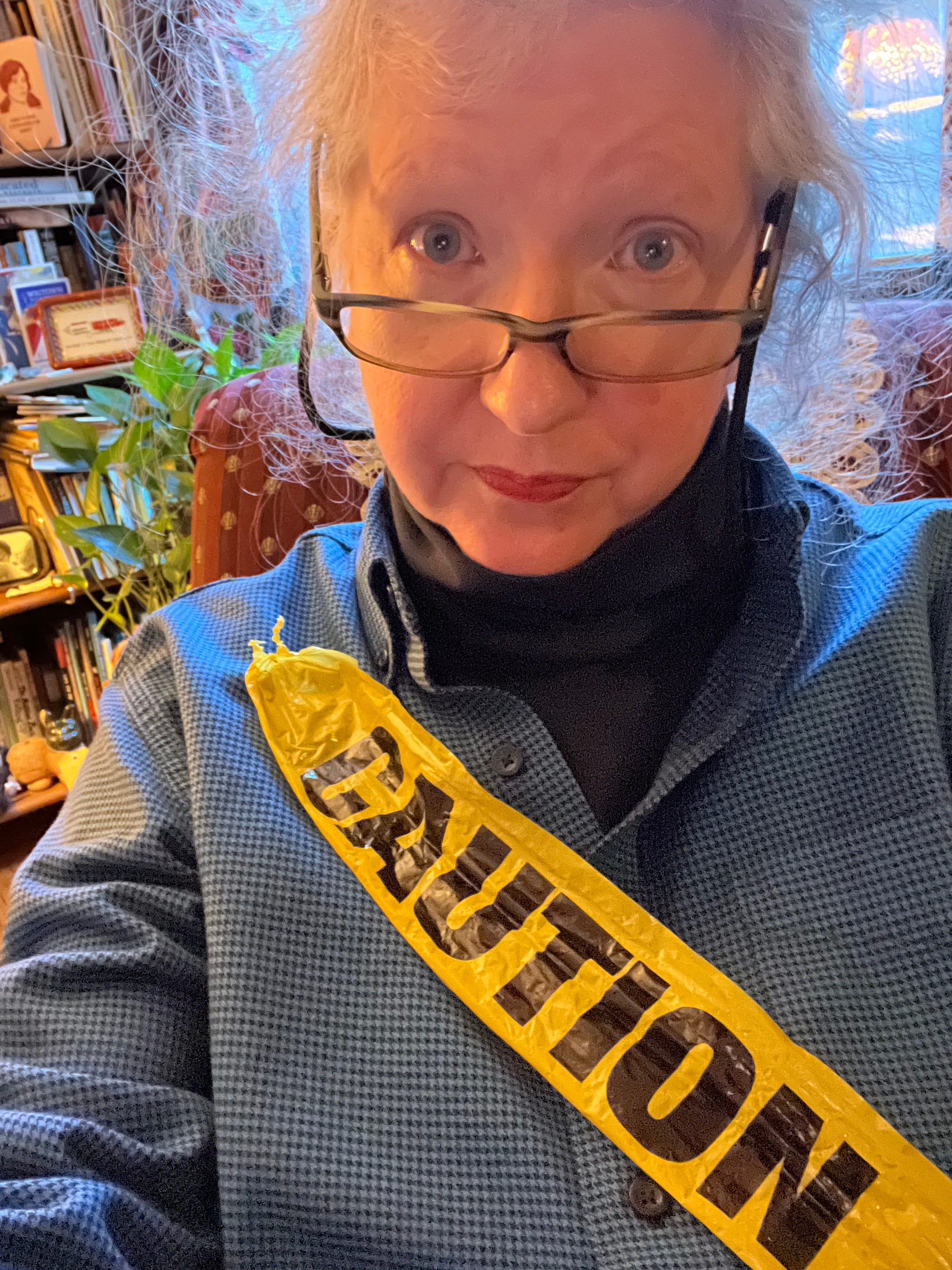
Years ago, my friend MB was invited to a costume dance but had no idea what to wear. A few days before the event, he got inspiration from a construction zone in his Manhattan neighborhood. Late one night, he crept out onto the street and tore down a big length of “Caution” tape along the sidewalk, his heart beating like mad as he raced back into his building, terrified he would be caught (he had no idea where one bought Caution tape or he would have). The next day he went to a thrift store and found a short pink dress and a blonde wig. Before the dance, he put on the wig, applied lipstick with a trowel, arranged the Caution tape over his dress like a Miss America sash, and voila: Streetwalker Barbie!
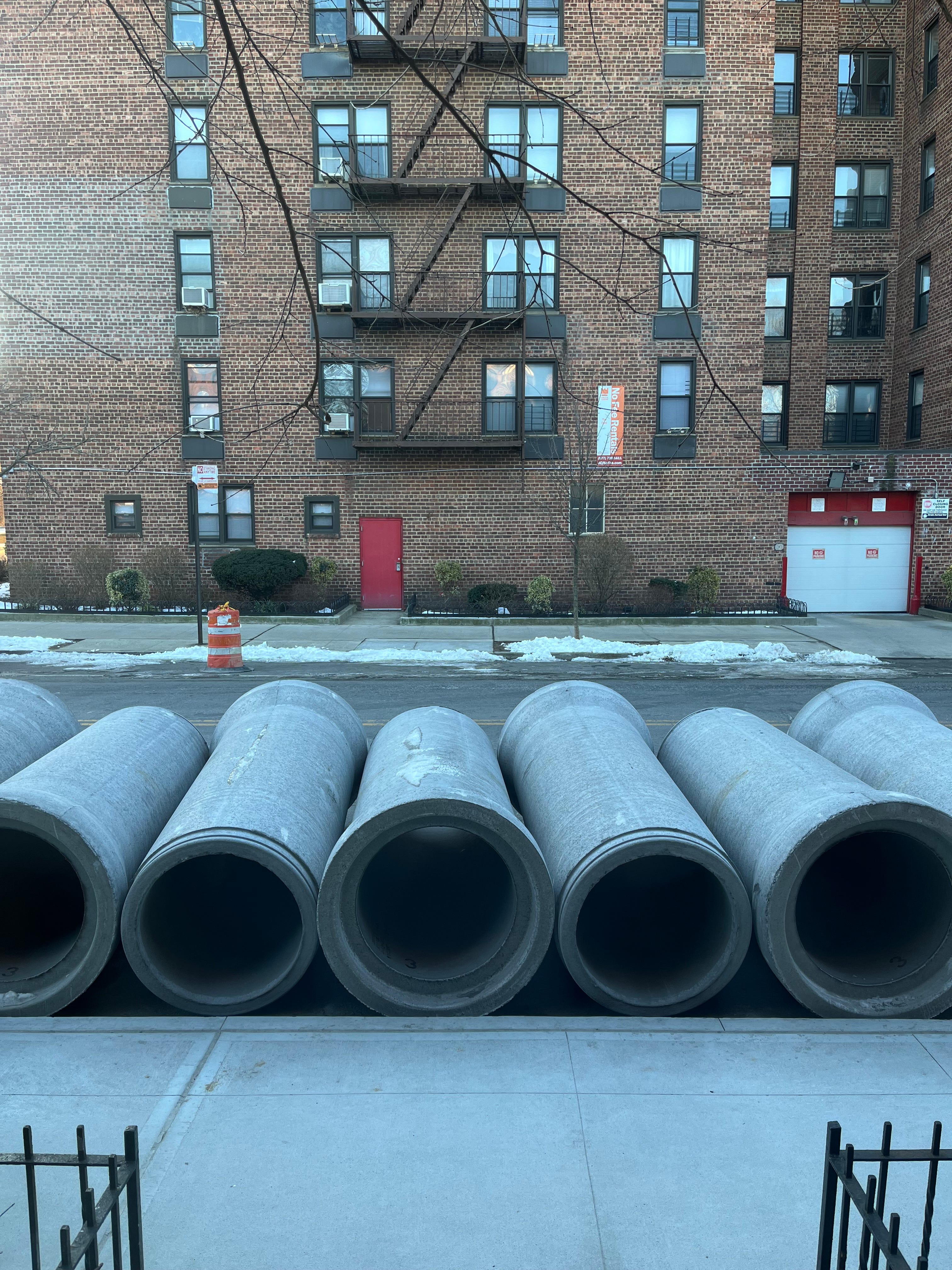
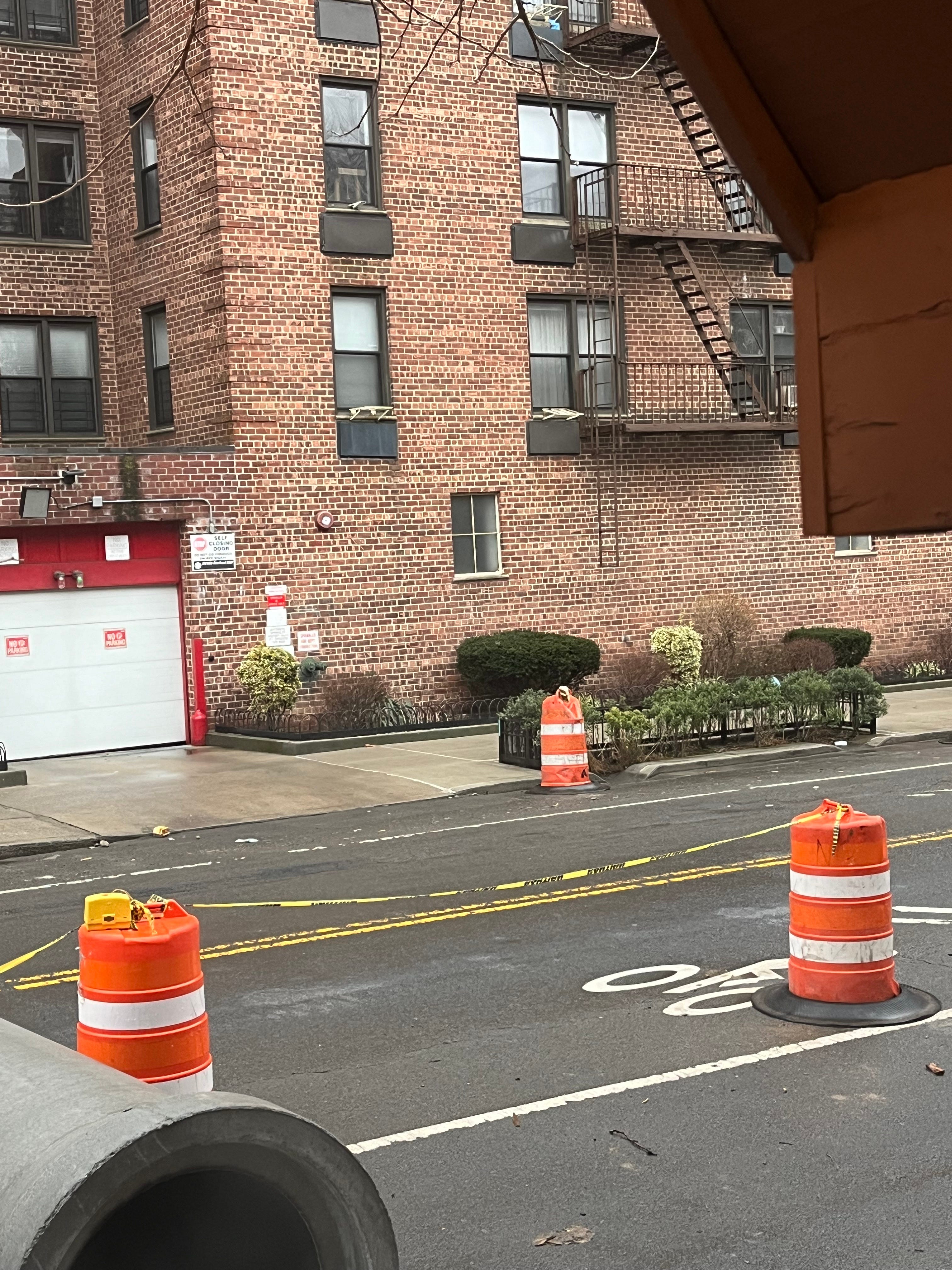
I’d love to be that inspired by the detritus of Caution tape outside my apartment building over the past two weeks. The city is completing “emergency repairs” (the notice taped to door said) of the sewer along part of our building past the elementary school. The yellow tape and tall orange barrels prevent parking for now (who put it all there?), the street organized to prepare to dig up a city block to replace perhaps a dozen or more giant concrete barrel-tubes, whatever they are called (how did they get there?), taking up those parking spaces-in-waiting, and I had to wonder, “Emergency repair?” Yikes. But this work is meaningful work. Look at all that equipment, crew, the purpose: I understand the kind of impact this work has. Results you can see, work you can use.
There’s something magical about construction like this, isn’t there? Photo by LO’H, Queens.Sometimes, it’s needed. Photo by LO’H, Queens.
This morning early, I emptied out the corner cabinet in my small apartment kitchen to disgorge it of plastic storage containers. Call it an emergency repair. I don’t know why I live like this, saving every single plastic container that once held takeout shrimp and broccoli from Ten Full around the corner, but I do. I stuff them in, harder and harder, until one late winter morning, usually during Lent, I can’t take it anymore and I go in for the big clean-up and reorganizing. I hate being this all-or-nothing-at-all person. I would like to be a flowingly tidy person, who effortlessly tidies as she goes.
I look at just the surfaces of my place and see 1) a financial packet (I really mean to make that phone call, so it’s on my desk in the living room); a notice from Con Ed (since I have to make sure I schedule the natural gas detector installation, this is taped to the back of my front door); 3) a request for a proxy vote from another financial institution that holds the keys to my retirement (and since I’m not sure what to do, it’s on the kitchen sideboard to think on). Do you place things like this? And why? And for how long? How do these locations gain meaning?
I don’t know about you, but I also tend to be a person who creates in bursts, writing or drawing or making collages daily, for a week or three. And then I seem to crash; my creativity may lie fallow for months at a time. This manic-depressive quality is what drew me to theater, I think, beginning back in middle school, because after you’d rehearsed a show every day for eight or ten weeks, performed it three or four times, and stayed after school the next week (or in college, all night after the final performance) to strike the set, you were done! (The appearance of the final ghost light, literally and figuratively, remains one of the most satisfying feelings I know.) You then spent the next month catching up on all the stuff you’d neglected, like housework, paperwork, grocery shopping, or, when aged 12, cleaning your room and finishing those two big school projects. And after all that, you could dream again.
What has to happen to make this repair an emergency repair? What makes that place the place to put something? What causes inspiration to strike just then?
O park of wondrous flowing green And more than passing fair, We wonder if you would mind if we Walk barefoot through your hair.
~ by Lois Oberdin, a great friend of my mom’s when they were about 16; this poem created and recited in situ while crossing Bayliss Park, Council Bluffs, Iowa, ca. 1950.
I share that poem up there, by my mom’s friend Lois, because when all else fails or seems merely duty-bound and cold, poetry cares (as Naomi Shihab Nye says). Poets feel. Of the poem’s creation, my mom said of Lois, “She’d do things like that all the time.” Mom then told me that her friend, around the age of 18 or 19, was institutionalized for schizophrenia; my mom never saw her again. When I learned that (I was maybe twelve), I made it a point to memorize Lois’s impromptu poem, and I am glad I did, because this beautiful, unusual girl never had a chance to live a full, creative life or grow up to loathe a corporate job, or make her home and papers disorganized, or stare from her stoop at Caution tape along her street. It’s terrible to think about. But we have a poem, at least one poem, a creative act to recall, to celebrate Lois.
And when you stop to think about it—all of us, our habits, our anxieties, our personalities; all the messes in our houses, in our heads, under our streets— maybe everything and everyone should come equipped with a roll of Caution tape, you know? Just throw on a Caution sash as a warning of our own emergency repairs.
You’ve been warned. And yes, that is a Chia Pet on my shelf.
I was sitting here thinking of my mom, Lynne, a couple of years back, before she fell and started a slow downhill slide, which continues, tough old bird of 90 that she now is.
I think this was a year ago, we were out in the playroom, an addition to our small but sturdy house that was put on when I was in fourth grade. To access it you have to walk through the utility room from the little alcove by the kitchen. The kitchen ever was and remains comically small and impractical by HGTV standards. I watched my now 80-lb. mother determinedly making her famous lasagna in an oddly small Pyrex rectangular dish, with the intention of feeding a family of seven adults and a toddler. I don’t know if the bigger dish had broken or what; but she spent all morning at it before my brother Mike, his wife, and the newest grandchild, and our other out-of-state brother Pat arrived to visit from North Carolina and Florida for a weekend. Mom had sent my dad to the store for lasagna noodles, cheeses; they boiled and drained the noodles, cooked al dente; she painstakingly opened the various packages of cheeses, using a knife, so slowly; she had her signature tomato sauce on the stove to warm up from the freezer. The slowness of her movements just hurt to watch. I think I was the only on watching. See, no one asked for this lasagna, one of her handful of truly great dishes, but you could see she felt she should make it, perhaps for one last time, who knows, age being what it is, for her family. She didn’t look happy about it, but neither did she want my help.
When they all arrived, my mother was still putting the lasagna together. As I say, this seemed to go on for hours. She was missing the action, you know, the way mothers do, alone in kitchens. Finally, I went in and tried to get her to come out to the playroom to be with all of us, with the son and grandson and her other son, and me and Jeff, there to see her. At some point, she and my dad decided to put the lasagna in the oven, even though it was too early to eat, even for an early dinner.
The upshot is, it way overbaked, shriveled into a barely edible shadow of its former self; and it seemed to be a couple of layers lower than usual, as it was, as if she’d forgotten something. We ate it; I remember my mother’s face, her shoulders shrunk, all that work, the end without the joy and plumpness of abundance. And for some reason, just now, it came back to me, that moment, and I fell to weeping. Now I have to think about why.
Well Butters
I’ve written about this before, my invented term for people who cannot accept a story that you tell on your terms. They have to correct you. Sometimes they are correcting a story they were never part of in the first place, which is a trait my mom has. Sometimes they correct your memory of time in a certain geography, because they share that geography and don’t have the memory you do, or experience a place or event in a way different from you.
My mom, Lynne, for example, is a story corrector, a well-butter. I was telling her once about visiting a retired teacher-scientist friend who’d built a cabin in the woods on her family’s farm. Her kids were grown and gone, her husband ran the farm as usual, and she lived alone with her dog in the cabin, which she did for a year. She kept a journal, spent her days studying the ecosystem, reading Thoreau and Edward Abbey, doing experiments, and simply living. When I returned from my first visit, my mom wanted to know how she bathed. “Oh, she doesn’t. She might go for two weeks not washing at all,” and my mom admonished, “Well, but that’s a lie. Now, Lisa, don’t say things like that. Of course she bathes!” Mom left the room, a well-butter: “Well, but that’s a lie…,” and I turned to my brother Jeff: “No it’s not.” I know, he said.
Now, do I contradict my mother? No, I do not. I think about it, I reflect on it. I try to understand it. Because I’m insane, and a writer.
To take another example: if I say to a New Yorker friend, “I love New York! I love the energy, the art, the theater, the people watching,” that friend may quickly interrupt to say, “Well, but Lisa, the city is filthy, people are homeless, some can barely make rent, and who has money to see shows?” It’s Yes And. It’s both. This doesn’t have to be an argument.
And so, I do not argue with this well-butter. I say, “So where do you want to eat?”
Sometimes it’s just about differences in lived experience. The other day, I said to my friend Colleen, who has been a constant resident of two NYC boroughs since the late 1970s, that I missed snow, lost now to global warming. She looked puzzled, saying, “Well, but it’s not like New York was ever a snow city,” and I disagreed. “My whole memory of living here is that from December to April there’s snowpack,” I said, and Colleen looked at me like I had two heads. I didn’t argue, but instead asked, “Would you like some tea?”
The Snows of Memory
Now, why are our memories of snow in New York City so different, Colleen’s and mine? I’ve been reflecting, because I am insane, because I am a writer.
For one, I lived my first 39 years in Virginia, where there is maybe one big snow storm every few years, a little ice once in a while (I was a student and a teacher and lived for snow days in both iterations of my life, and we didn’t get to use that many), so that might account for some of the difference—that by comparison, any regularity of snow seems like “a lot.”
But I think another reason is more practical: Colleen has only ever rented her apartments, and so there is staff to shovel and salt (which is not to say reliably), and New York City is mad efficient at this in most places, especially Manhattan (it blew my mind when I first experienced it, how most everything still runs no matter what). By contrast, my tiny Queens co-op apartment building (since I bought in 2005) has never had a super who could be relied on to shovel snow, so (to avoid a citation) I and my upstairs neighbor Debbie used our own shovels and did it ourselves. As a board member, I ordered 12 bags of salt a year, for a solid 8 years, and we used nearly all of it every year, and I know this because I spread the salt myself. (By comparison, one or two bags of salt have held for the last three winters.)
In addition, I have muscle memory, walking the half mile to the subway every morning for 16 winters (before Covid), navigating the corner of 40th Street and 47th Avenue with great care because that building’s landlord never shoveled; and I constantly had my boots repaired at Drago Shoe Repair in Penn Station because of salt damage and puddle leaks. I felt every inch of the winters, and I also loved it, because I love winter. I am crazy about cold temperatures, battling the subzero winds, and I find snowfall a reason for rejoicing, at least when I’m not battling depression (always not wanting people to die). Colleen, by contrast, finds winter a misery, hates snow, hates cold, lives for summer heat; and I would suggest that a healthy mind like hers might slip into denial of weather you hate while you wait for the green splendors of summer. And because, in addition to all of the above, I can say with certainty that our last major snowstorm of any duration took place in 2016, and that was 8 years ago, I can also say with confidence that I am not crazy to say, I miss snow.
Back to Lasagna
So why was it so painful to remember my mom’s failed lasagna one winter ago? It’s one meal. No one else who was there may remember it at all, including the hunched shoulders, the strain of it, the sad face, all that work only to end up overcooked out of confusion, a change in routine. Like you, I’m sure, I’m starting to see her lasagna as a metaphor for a life lived, a life ending.
I have almost continuous memories of my mom making lasagna, or feel I do, because I loved it and enjoyed it so much—all the leftover noodles, the extra cheese I ate with them. But in truth, it was a dish she couldn’t have made above two or three times a year. For one, it was labor intensive, and there were four kids at home, she babysat neighbor kids, and by the time I was 15 she was back working full time (as a bookstore manager); next, it was expensive (with all her specific cheeses and special sauce—a secret), growing in size from a square Pyrex pan to a large rectangular one; and because we all loved it, there was almost none left over, and leftovers were always the Saturday night meal. So in actuality, in my 18 years under that roof, I had at most 40 large servings of lasagna. Is that enough? Never.
When I was home at Christmas, working from there for one week and on vacation for two, my mom spent a lot of time going through her recipe folder. She made her perfect macaroni and cheese for me—another agonizing effort, but she was determined. She showed me where all the important recipes were. (She also showed me where all the important sentimental things were in her dresser.) These things have to be done if we are to keep any family traditions going; I’m the only one who is interested, really, but that is only because I am the one preparing for the end. In time, my younger brothers will care, too. For now, I’m the keeper of the recipes.
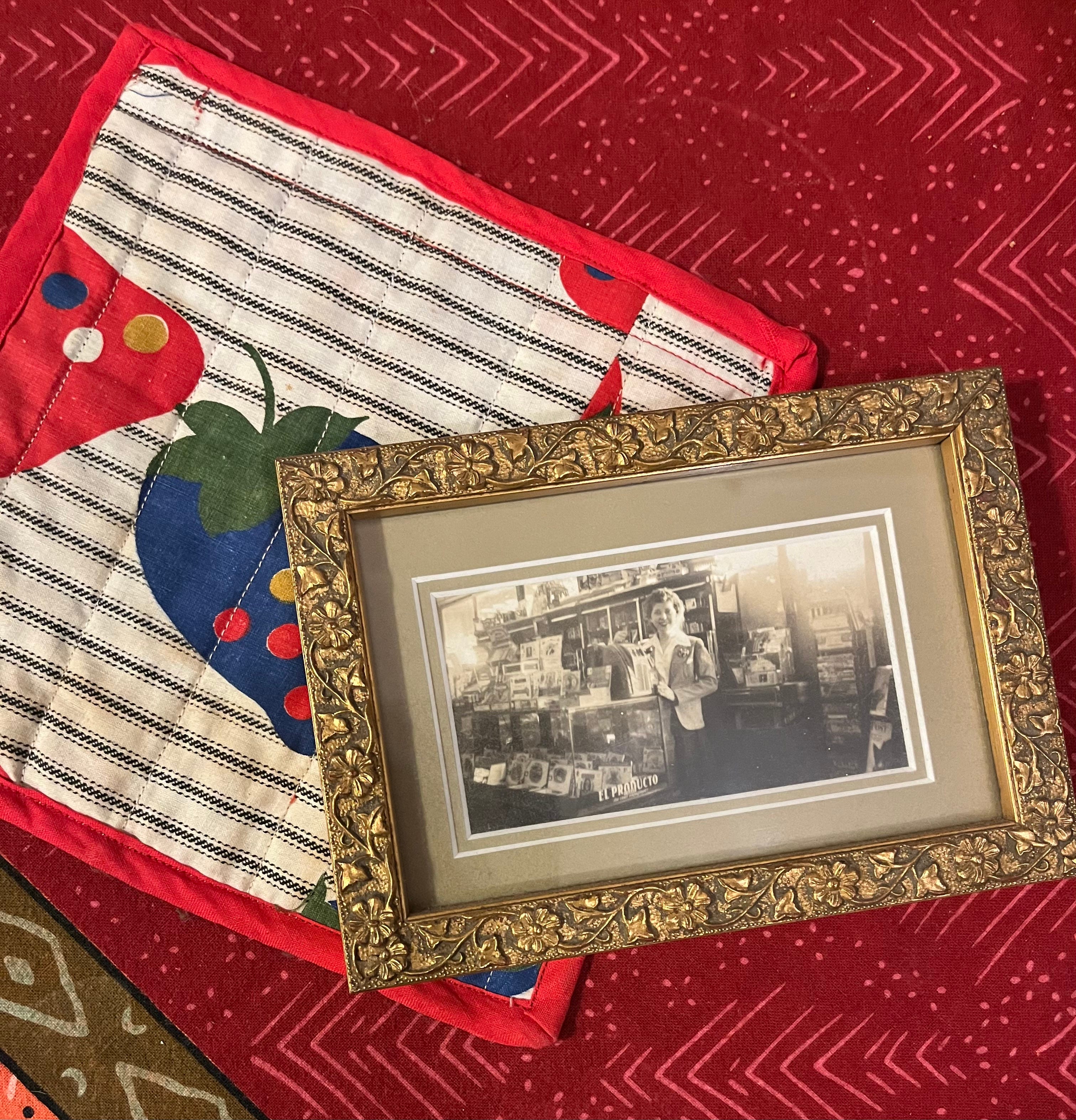
No one’s memory is perfect—I’d never pretend it was. But there is a decline that is sad and scary to see: one more was my mom holding a worn, torn potholder she wouldn’t let me throw out, saying, “My mother made this.” I looked at my brother Jeff. Idiotically, I said, “No, Mom, she didn’t make that one; I have the ones she made at my house.” She stared at the generic blue potholder again. “No,” she insisted, “my mother made this.” And she gripped it so tight it brought tears to my eyes, but only later when I recalled it, because I realized, My mom needed to touch her mom again, even if she’s spent most of her life saying she hated her; they are so close to meeting again, you see; amends need to be made, memories held.
Still life with potholder and my grandma, ca. 1945. Photo by LO’H
What am I on about? Life ends in old age if we are lucky. See it for what it is. We remember what we need to remember, okay? And we can tell our own stories, thanks, and we don’t need anyone correcting us. Watch, listen. And just say, “Oh.”
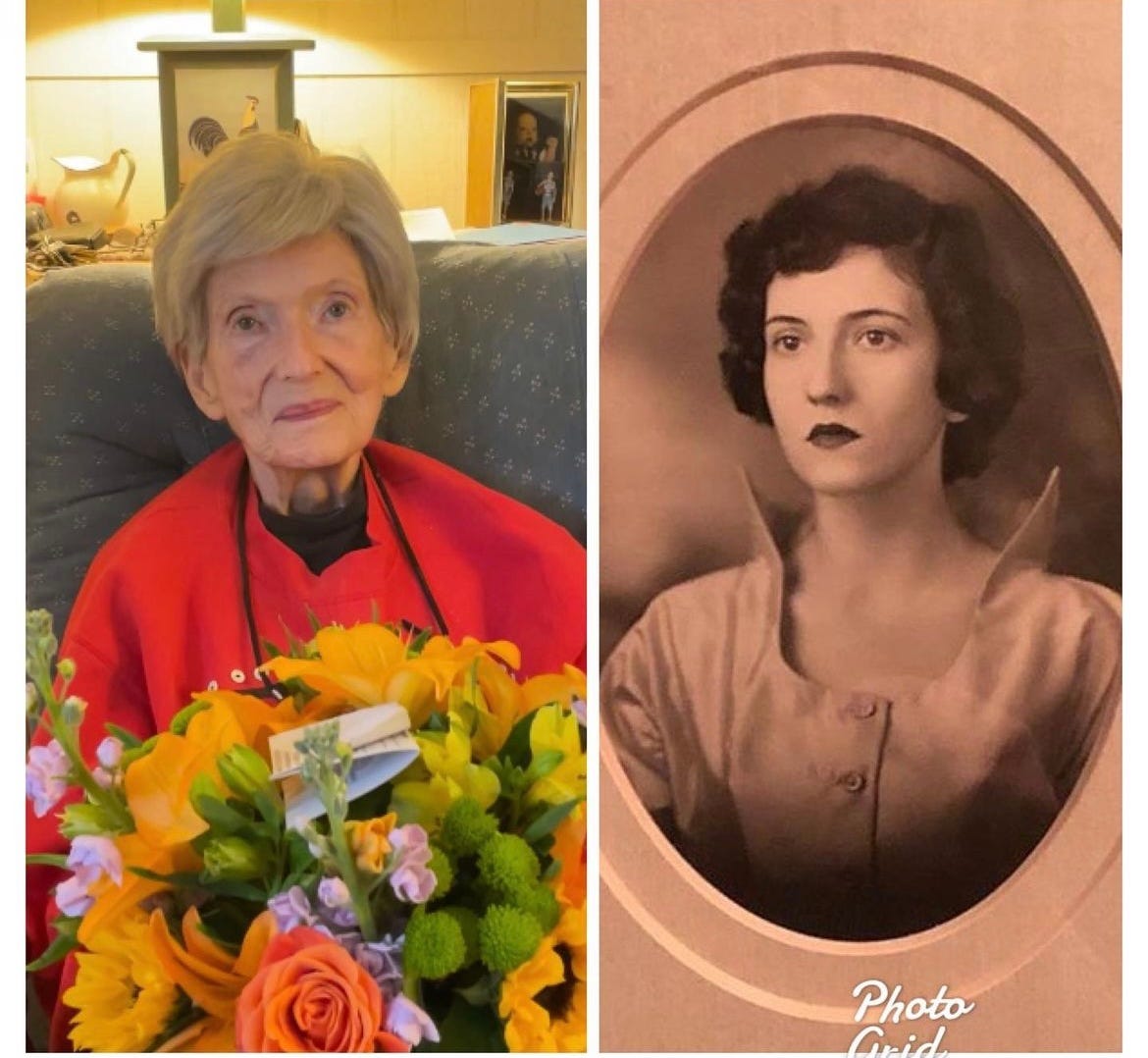
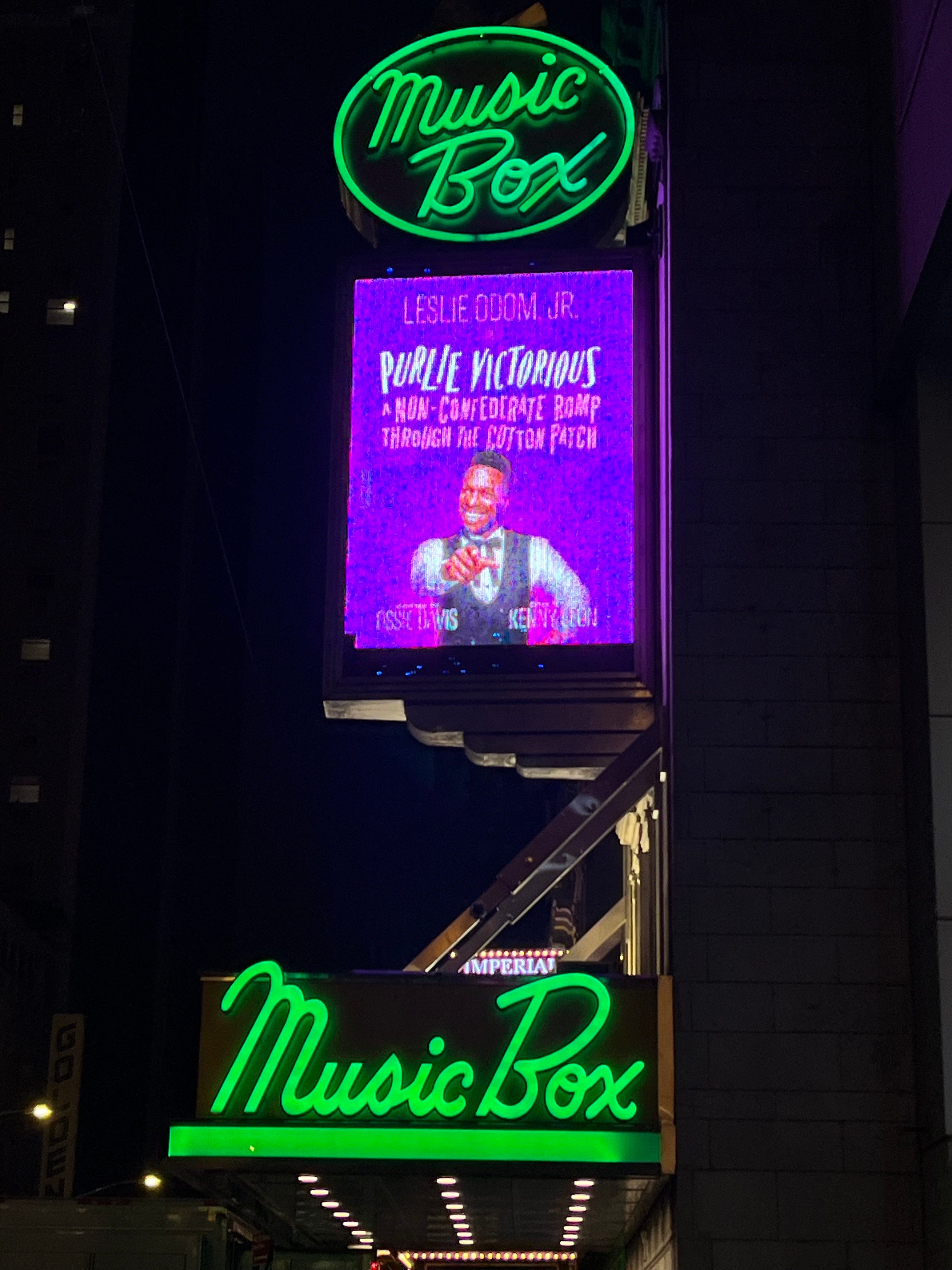
§ My mom, Lynne, is 90 years old today. Last night I forced myself to get out of the house on a damp, raw New York City evening and head to the theater to see Purlie Victorious before it closes, showing up at the Box Office at 5:45 PM or so to see if they had “anything for tonight,” and I indeed got a center orchestra seat. Magic. This morning I am thinking about transformation: how actors transform into characters; how young people transform into old people; how oppressed Black people transform into autonomous Black people; how racist white people too often never transform. But more to the point, how my depressed soul transforms in the presence of great art. How does this happen? Why is undergoing as well as witnessing transformation so necessary to our humanity? And why do we resist transformation?
My mom, 2024 and 1952.Perfection, the first Broadway revival of this play in 62 years.
§ Memories of transformation are often curious ones. When I was in 2nd grade, for example, Daphne O’Keefe brought in a Gallo wine jug melted over with rainbows of crayons. She was so proud of this show-and-tell object, explaining how she made it. She passed it round the class, and all I could think, confused, was, “What a waste of crayons.” Some transformations both small (see that wine jug) and large (see Tucker Carlson’s from “entitled Swanson Food trust-fund baby” turned “even richer Fox News personality” to “radicalized Russian-Putin ass kisser”) are lost on me. If transformations aren’t increasing your humanity or expanding your soul, what is the point? One woman’s wasted crayons may be another woman’s art (one man’s patriotism is another man’s treason?), and if the melting crayons make you happy, and you aren’t lying to yourself or hurting anyone in the process, melt way.
§ On my mind: Years ago, the now-famous comedian, podcaster, actor, and producer Tig Notaro was kind of doing okay as a mid-level comic, respected by her peers, booking enough gigs to make a living; one day she was diagnosed with Stage II breast cancer, and that evening she went on stage, “Hi, I have cancer…,” and her whole career changed. Soon after the diagnosis, her mother fell, hit her head, and died. Between a middling career, a double mastectomy, and burying her beloved mother, you’d think, “How did she keep going?” But it was the beginning of a transformational phase in Notaro’s life, one in which she became widely known and successful, met her wife, had a family, and is happier than she has ever been. Go know.
(Note: image found on the web..-ed.)
§ Scaffolding: It’s everywhere in New York City. You can’t walk a block or a street without walking under some at least once; I used to jokingly ask my friend, Richard, back when I visited the city, “When will it be done?” I return and return to this image of crumbling, but also of trying to repair—it takes such an absurdly long time; I want to walk around the city with a bull horn, “TRANSFORM ALREADY! BE DONE!” New York City’s Times Square was once glamorous and exciting, and then it became derelict and dirty, and then Disney moved in and transformed it into a theme park for tourists that makes me want to stab myself in the arm every time I walk through it, just to feel something more elevated than pissed off. Then I look around at the endless scaffolding in these high traffic areas, and “pissed off” is about all I will manage for a long time to come.
February, 2024
§ Since mid-January, my left eye has been arcing light, flashing, and also numb; in fact that quadrant of my head and face is sorta numb, too. I went to a neuro ophthalmologist today (after my regular ophthalmologist and primary care docs were stumped, and thank goodness a colleague had one, and that I talk about my life to other people who then often have suggestions, because appointments with specialists like that can take a year to get). This special eye-brain doctor (and I can’t believe how easily I spell “ophthalmologist” now) can determine for sure that your eye is in fact numb by sticking a sort of blunt pin in it and you not knowing she did that. She said, “I don’t like that.” She is, as promised by my colleague, a total doll, and has a very busy but well-run clinic; we scheduled the MRI (it’s in a month, the earliest appointment (which can take many months to get sometimes) and bloodwork, and follow up. “I don’t like that your eye is numb and that you have headaches,” she said, and then she looked into my face, “but we will solve it.” My life is either about to transform completely (my maternal grandmother died of a brain tumor at 60; I’m 60 in May), or just be inconvenienced. But it’s scary. I still haven’t told my family (older half-brother and sister caring for their mom with Alzheimer’s; my brother Jeff looking after 90-year-old parents; my brother Pat just lost his father-in-law), except for my youngest brother who also has eye issues, just in case I collapse or something so at least one person knows what’s going on. (I think six people read my blog, and none of them family.) My upstairs neighbor also knows, a few friends, and one colleague, so I’m covered. Will tell all.
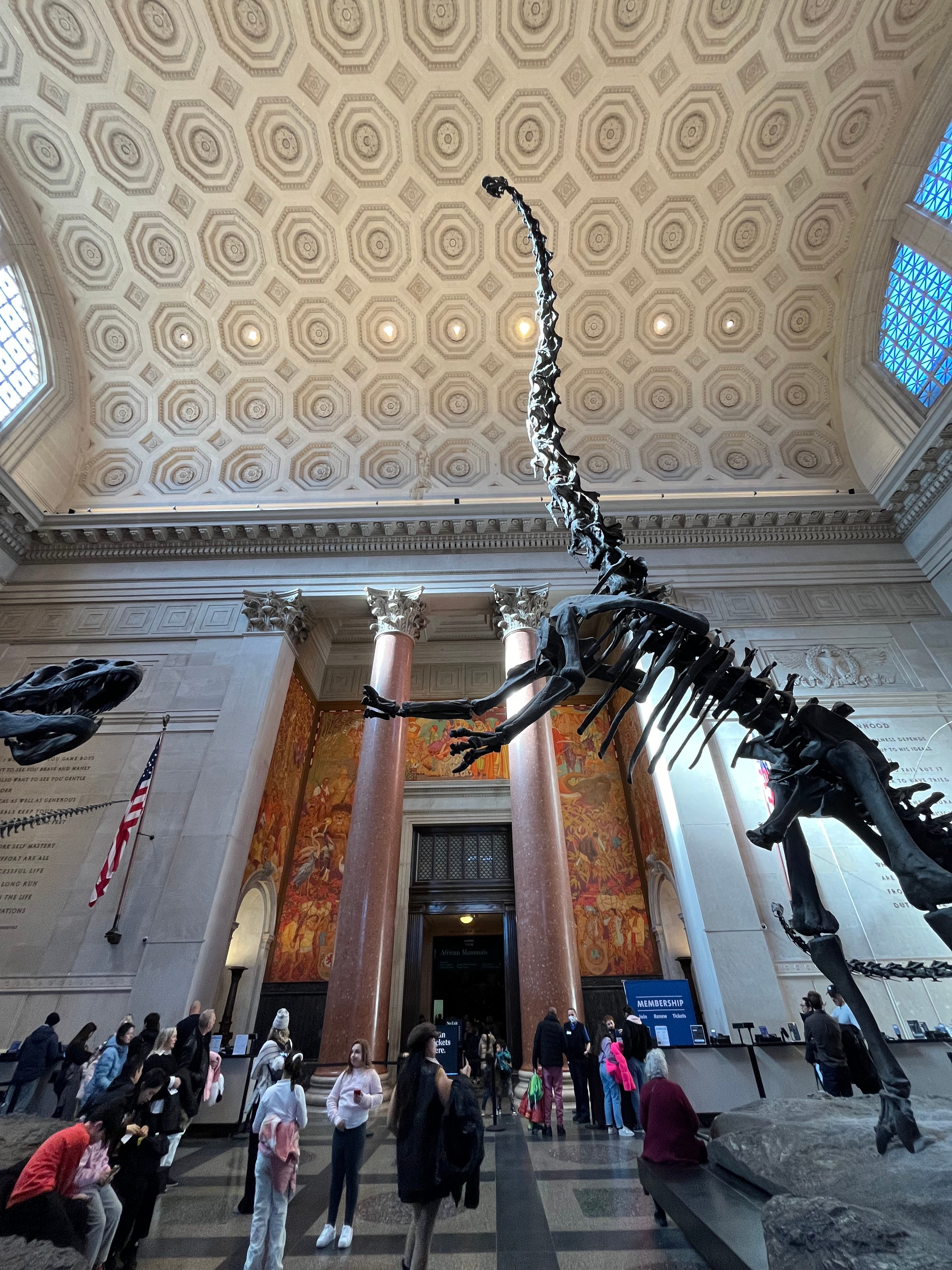
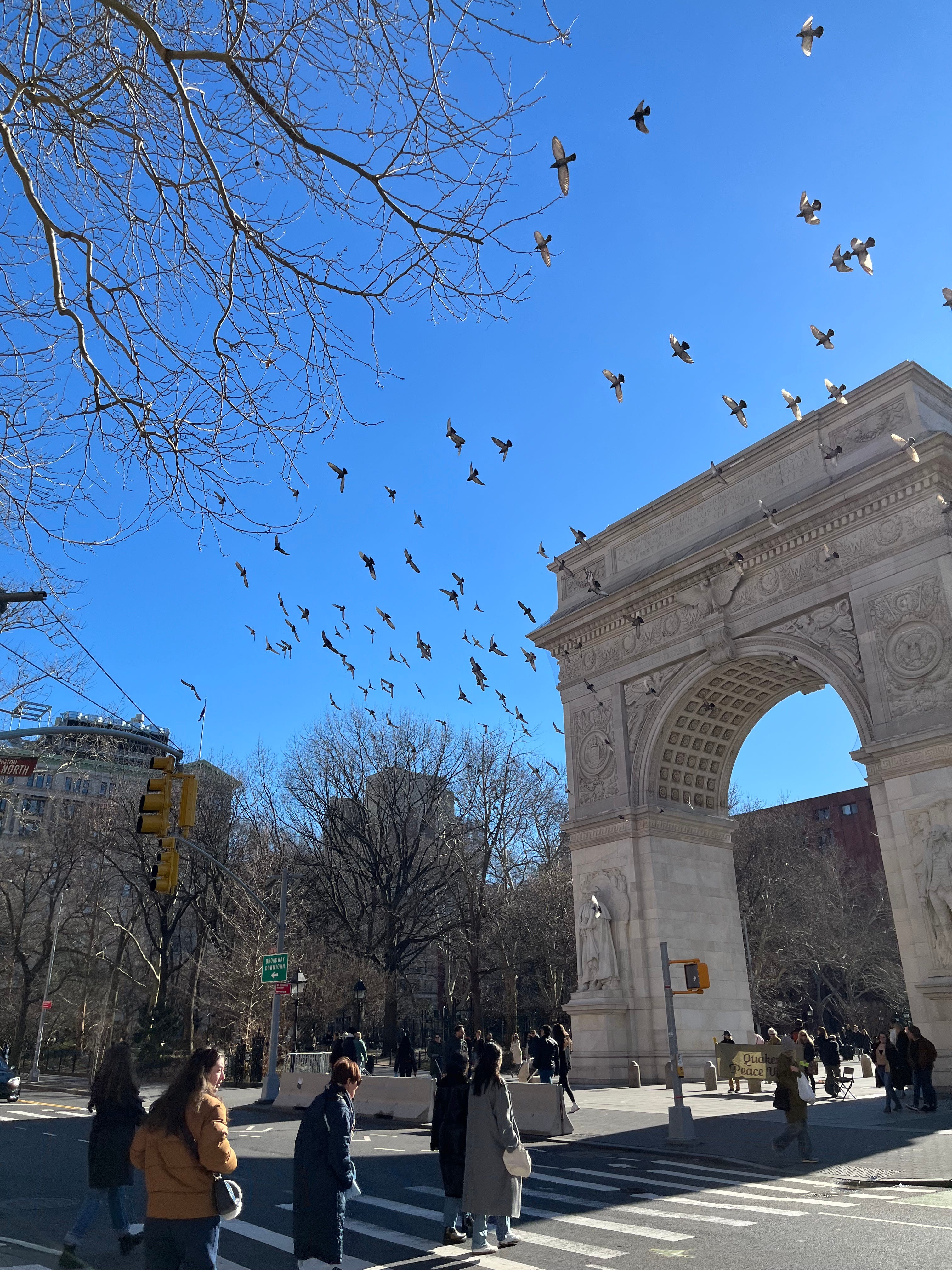
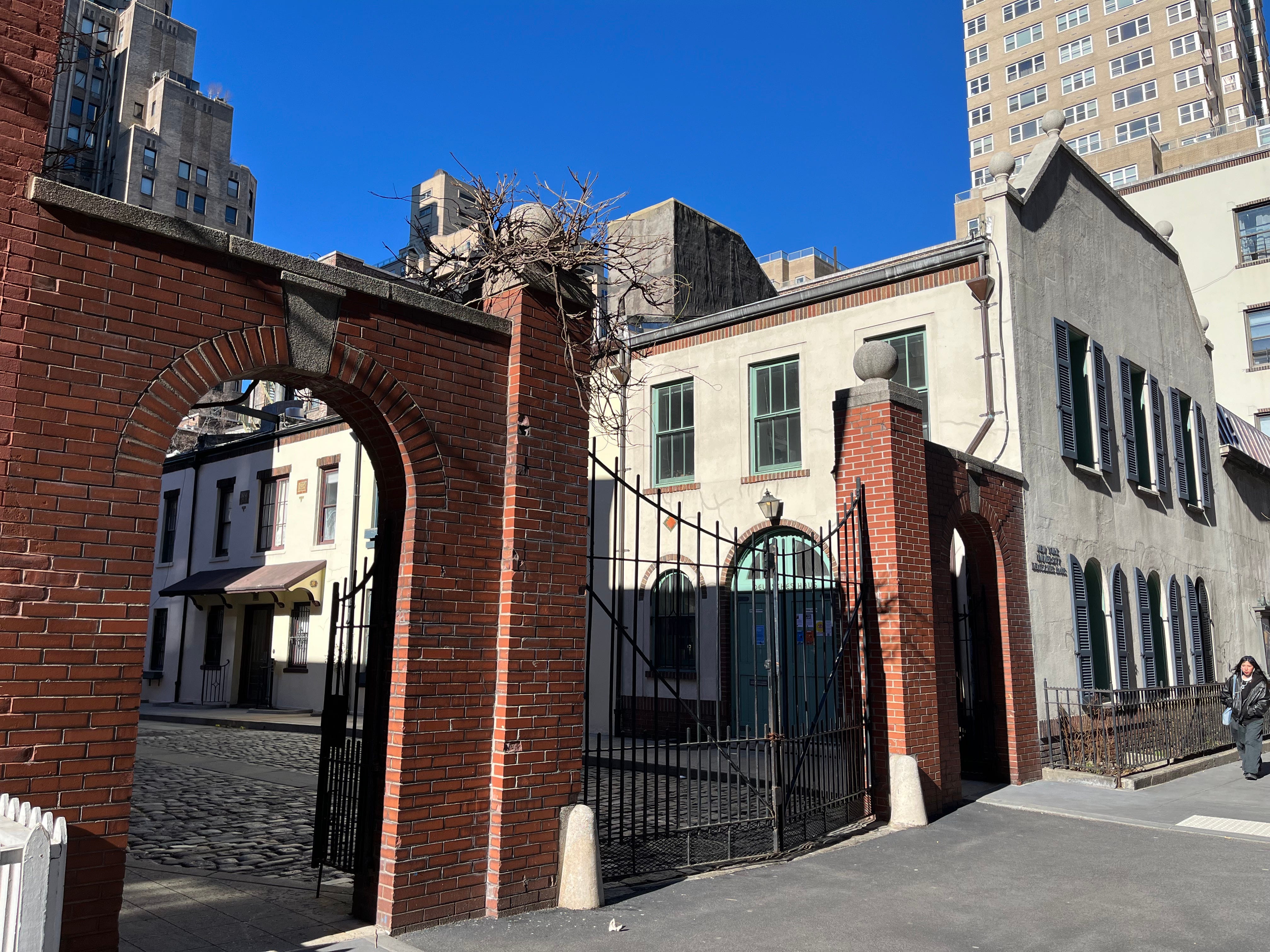
§ Sunday in New York, with photos: Grand Bazaar Flea Market (art purchase), American Museum of Natural History, Washington Square Park (with birds), Washington Square Mews (my favorite spot in New York, maybe), past Cooper Union, with lunch at Little Poland while you wait for the Rubber Stamp Store to open on East 11th St, near St. Mark’s Church, where you talk to Jimmy the owner, who has made all his own stamps since he became interested in coins in Ireland some 70 years ago, followed by a return to Queens and a binge of cocktails at Belo with the Cordero brothers Spencer, bartender, and Jonathan, owner. And all this, all this connection, is why we are alive, right? Republican motherfuckers be damned: we are here to transform each other and ourselves in creative, joyful ways. What else is the fucking point?
I love meeting new artists. Akasa was a doll.AMNH is always cool.Quite a show by pigeons.The Mews make me calm.Casey’s Rubber Stamp Store, E. 11th Street, NYCThe possibilities.Belo, a fabulous Brazilian-American restaurant in Sunnyside, Queens. (All photos by LO’H)
§ My Aunt Lorraine died on Valentine’s Day. She was 98, my dad’s oldest sister, the second oldest in a complicated family. Lorraine was my Grandma Fern’s daughter from her first marriage; Fern married Frank O’Hara, a widower with four sons, two daughters dead in infancy, and his wife dead in childbirth with the second daughter. (Fern and Frank only married because she was three months pregnant with what would be the first of five children, my Uncle Don.) When Lorraine died, various siblings and cousins speculated on the order of the kids, so I clarified: Chet, Lorraine, Bob (note: Chet and Bob were sent to an orphanage after their mom died; then returned when Fern (not that much older than Chet) became their stepmother), the twins Alfred and Alvin (who were adopted by Frank’s childless sister Emily and her husband Walter Smith), Don, Nadine, Bernie (my dad), Mary, and Francis, Jr. Of the ten children in all (not counting Grandpa’s baby girls), then, my dad is the last survivor. (For reference, they were all alive but Bob when Obama was elected president in 2008; I remember this because I called Uncle Chet on his birthday just after the election, and I told him I was happy about the outcome. “So that’s the way you went, huh?” he asked. I did. “Well, I did too,” he said. “Now I loved Hillary, loved her,” and he had even driven her around Omaha when she came to campaign. And I expressed my condolences about Uncle Bob. If anyone tries to tell you that American families should be “traditional,” you just point them to Frank and Fern in Council Bluffs, Iowa, ca. 1930. Oh, and Lorraine and Chet were best friends all his life (he died over ten years ago), and no relation to one another at all; my dad was a half-brother to each. Got that?) Families are living, breathing, ever-changing, and eventually dying, ecosystems, transforming all the time. Or they are if they are healthy, even if they sometimes put the “fun” in “dysfunction.”
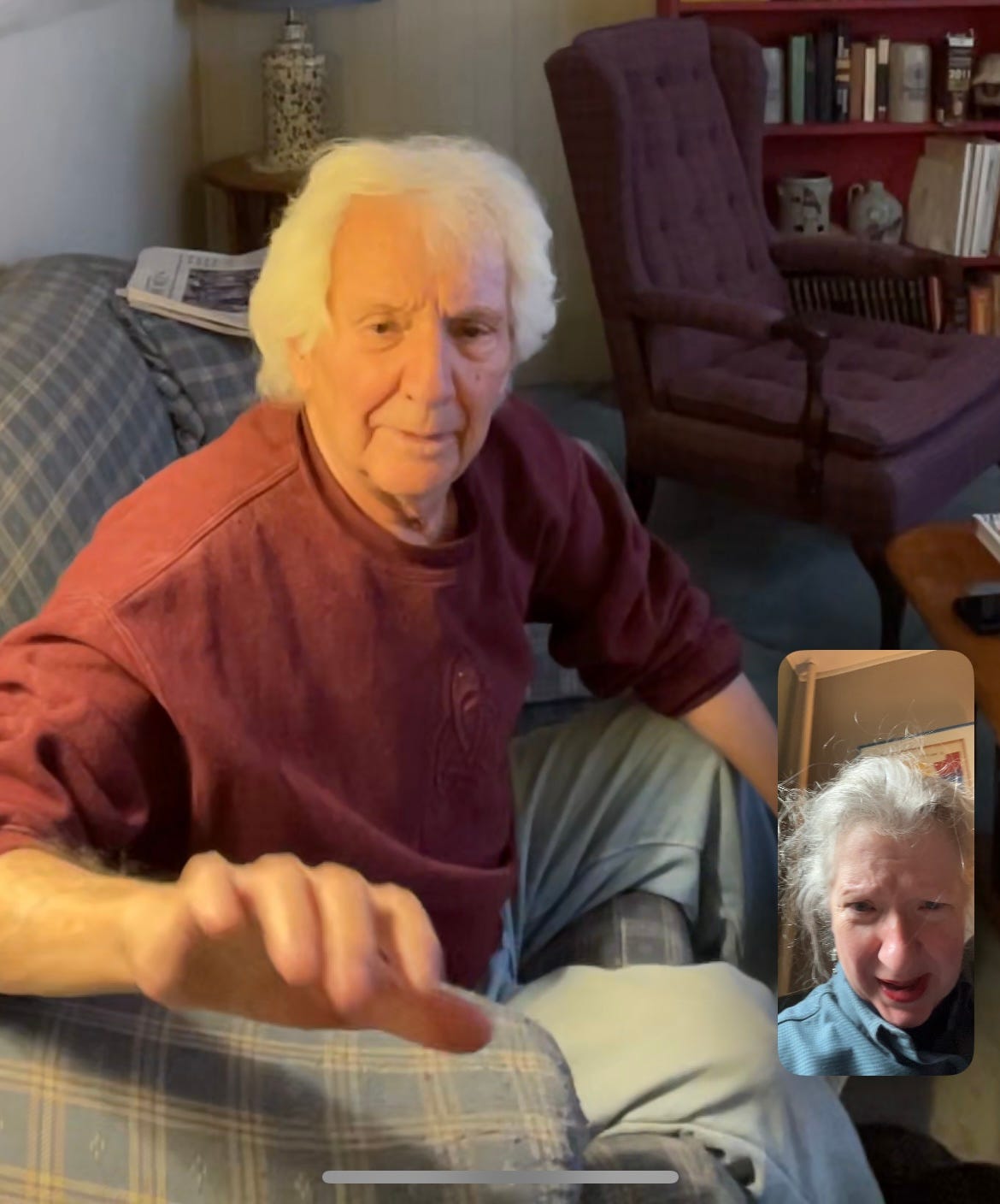
Over the phone this past week, I asked my dad, who turned 90 last October, for his memories of Lorraine, and he told me what he remembered. “When I was little,” he said, “Lorraine used to take me to over to Broadway [in Council Bluffs], when we lived on Avenue E, at Christmastime, when Santa came down. He always threw candy, and she’d help me, we’d run around and gather up all the candy we could. I think about that memory a lot, I don’t know why.” Here he laughed. “And it’s funny, because Santa was in a pick-up truck or something, and he threw hard candy, really threw it, and you wonder how nobody got hurt.”
Another memory: “I told you that story, about the time Dad [my Grandpa O’Hara], he worked on the railroad, you know, and they had a wine car there that was leaking, and all the men were catching that wine and drinking it all day. Dad came home smashed, yelling that he was gonna do this, gonna do that. And Lorraine—she was working at the bomber plant at the time, and muscular—she laid him out on his back in nothin’ flat and said, ‘You aren’t doin’ nothin’,’ and we all just cracked up.” And Lorraine’s first child, Patty (one of ten, two deceased), and my dad’s first niece (or nephew for that matter—is their a general term for that?), just celebrated her 77th birthday; my dad was 13, and he remembers coming home from school one day and seeing Lorraine holding her in her arms.
My cousin Kerry (Don’s older daughter) and I (Bernie’s younger daughter), I think, are the only ones who know who everyone is and the order they come in, from aunts and uncles to cousins; maybe my cousin Liz (Mary’s oldest daughter) knows. Lorraine’s daughter, Rita (one of twins, children 6 & 7 in the lineup), who called last week to tell me that her mom was in hospice care, confessed that she had no idea who any of my siblings were. (“How do you know everyone?” she asked. Because every Christmas the relatives put school pictures, labeled on the back, in the cards; and I memorized them, because I thought I was supposed to.) Rita and I became friends the year I went out for our Aunt Mary’s funeral (2012, I think), and her twin sister Ruthie had coincidentally just moved to the street where my Uncle Denny, my mom’s cousin (with whom I was staying), lived (are you following?), so Rita started giving me rides after gatherings, dropping off first me and then Ruthie. (Ruthie, by the way, has moved back to Kansas City to be near her kids; I have a nephew living there, but since no one would know him because they don’t know my half-sister, Sherry, why mention it?) Sending love to all of Aunt Lorraine’s loved ones in our ever-transfiguring families.
FaceTime with Bernie
§ Surprised by snow. Brown desolation to cheering plush white happens less and less frequently here in New York, and what does fall melts right away, so I went on walkabout and took photos. I was surprised how many folks were out doing just that on that chilly Saturday. I love when spring makes you beg for it.
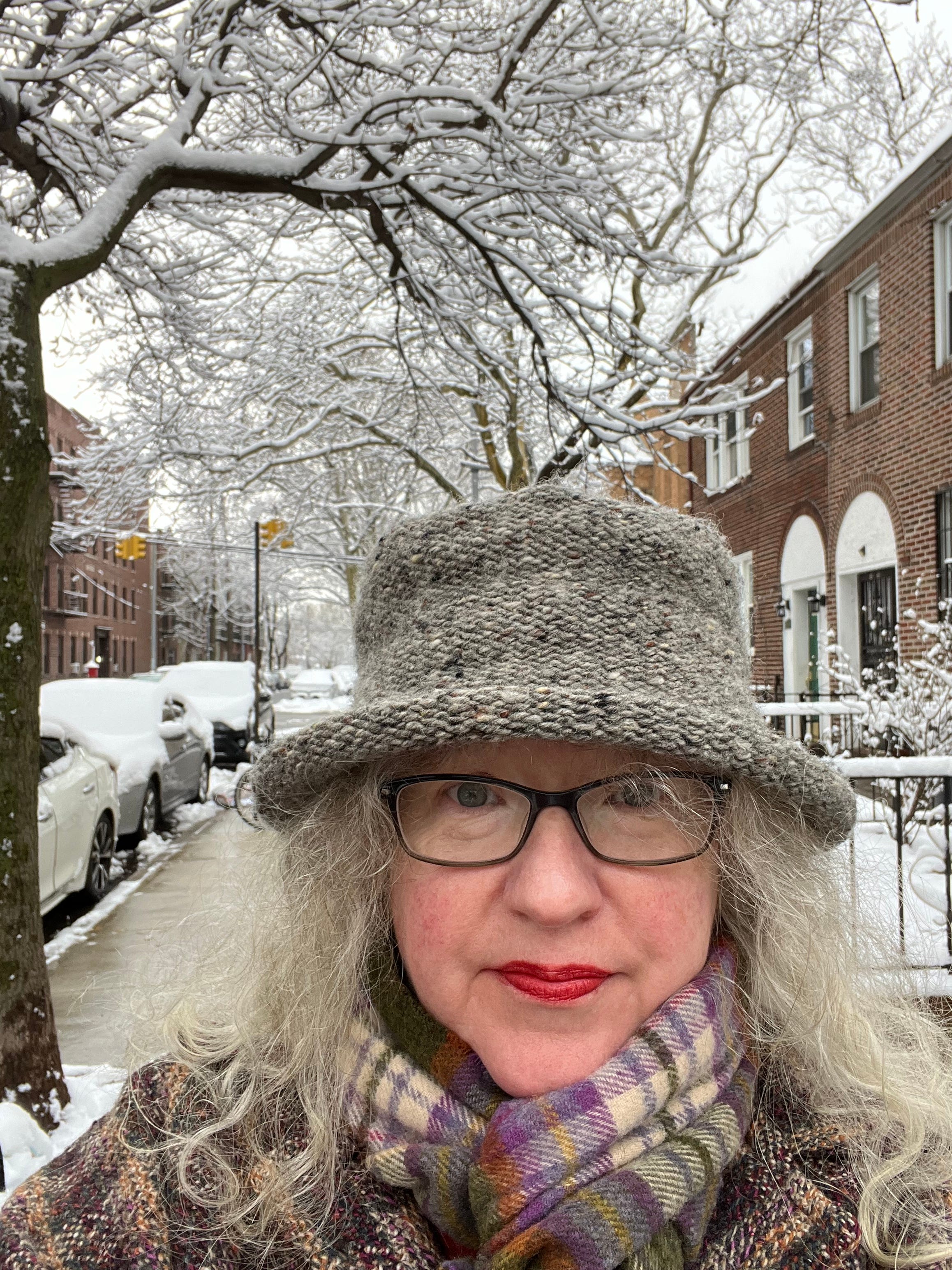
Miss O’ in Queens
§ Sunday morning, bright blue and sunny, but chilly as winter should be. Time to head to the city, I think, to City Papery and buy some blank card stock, maybe spend the rest of President’s Weekend making some original cards for people using those rubber stamps up there for inspiration. First, I’ll post this blog. Love, Miss O’
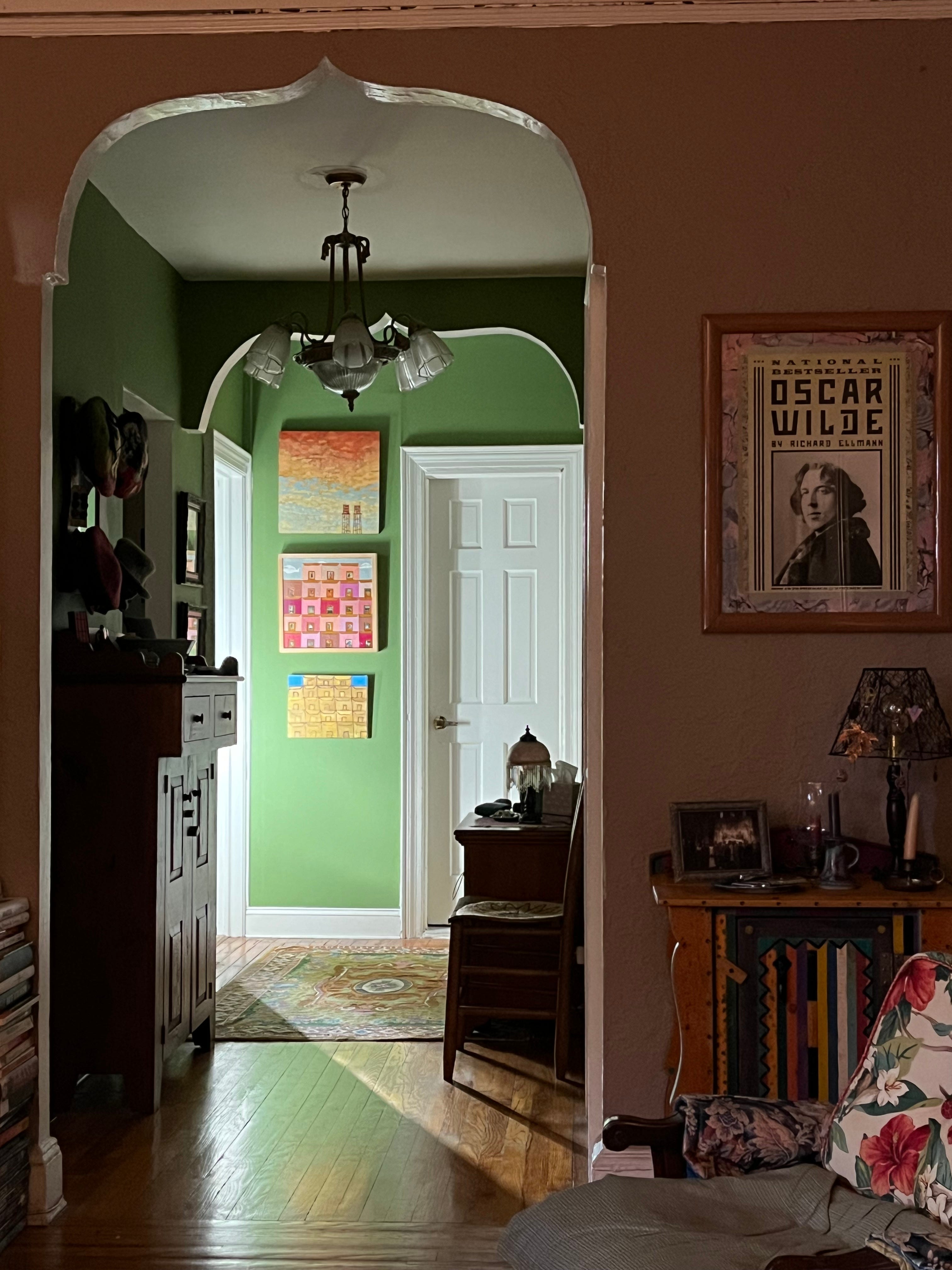
Miss O’s hallway, transformed each morning, when it’s sunny, by that shaft of light. Color me grateful.
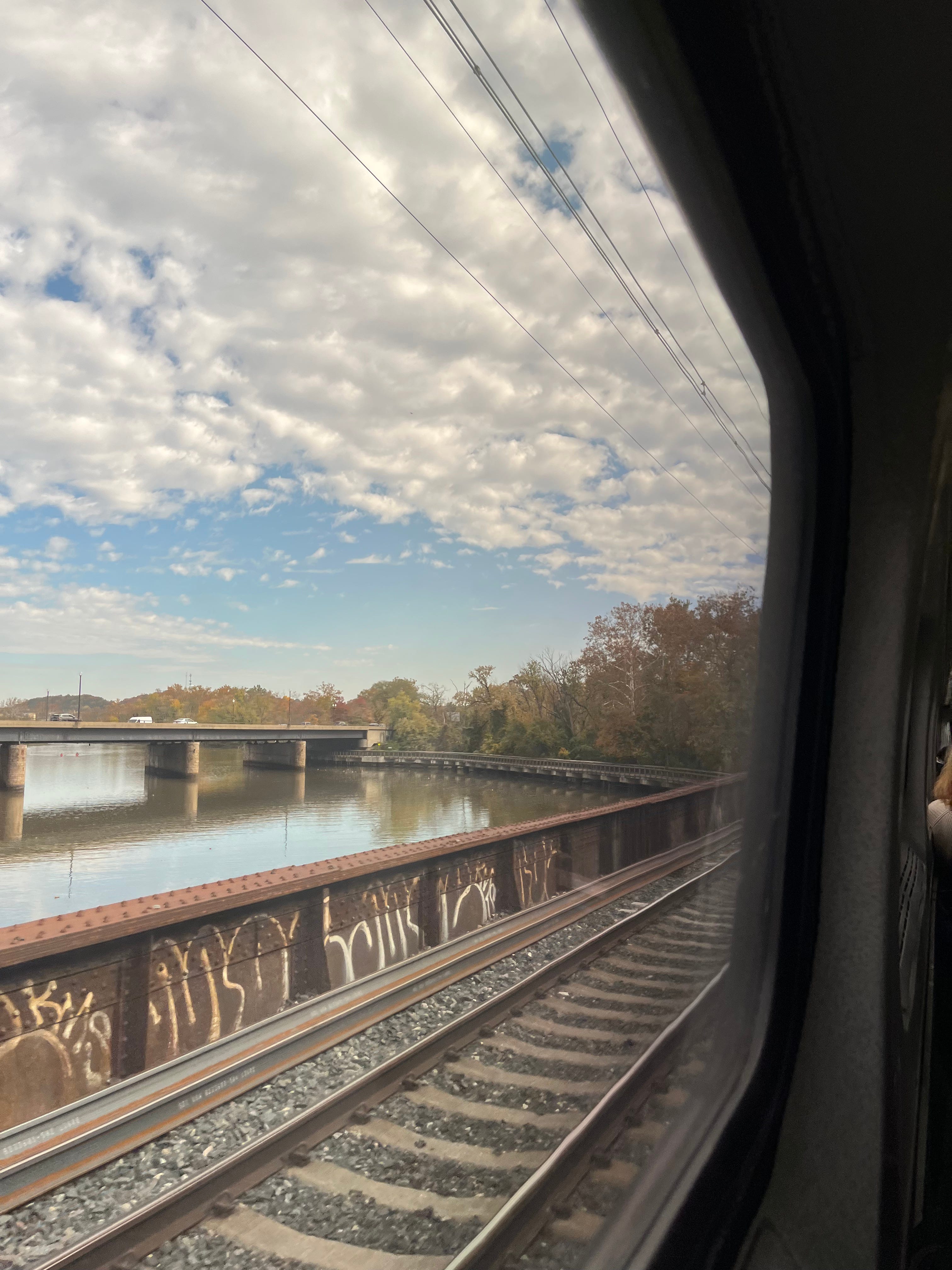
Yesterday, I took Amtrak from Virginia to New York City, after two full months living in my parents’ house. (Bernie and Lynne are coming along, for however long they can.) Even though theirs is the house I grew up in, nearly all the aspects of it that made it home are gone or changed so significantly that it really feels like a different house. The 1960s offered a white house with green shutters, exposed asbestos tile floors on the half-basement level of the split foyer. During my growing up, when harvest gold industrial carpet took over the floors and steps and upstairs living room, so did the 1970s palette expand to bring in orange and avocado green and brown. In truth, my mom did this palette really tastefully and artfully, refinishing now tossed furniture pieces that I really miss, replaced in the late 1980s country makeover—suddenly a windfall of cash with no kids in college and two incomes allowed my mom to indulge her passion for blue and natural wood. The result is that I’ve known the present incarnation of their house only as a self-supported adult, so whatever there was of my home (my bedroom stuff pared down to a single large box back when I went to college), it’s no longer a built environment (objects of deep memory and family history notwithstanding) that I feel particular warmth for.
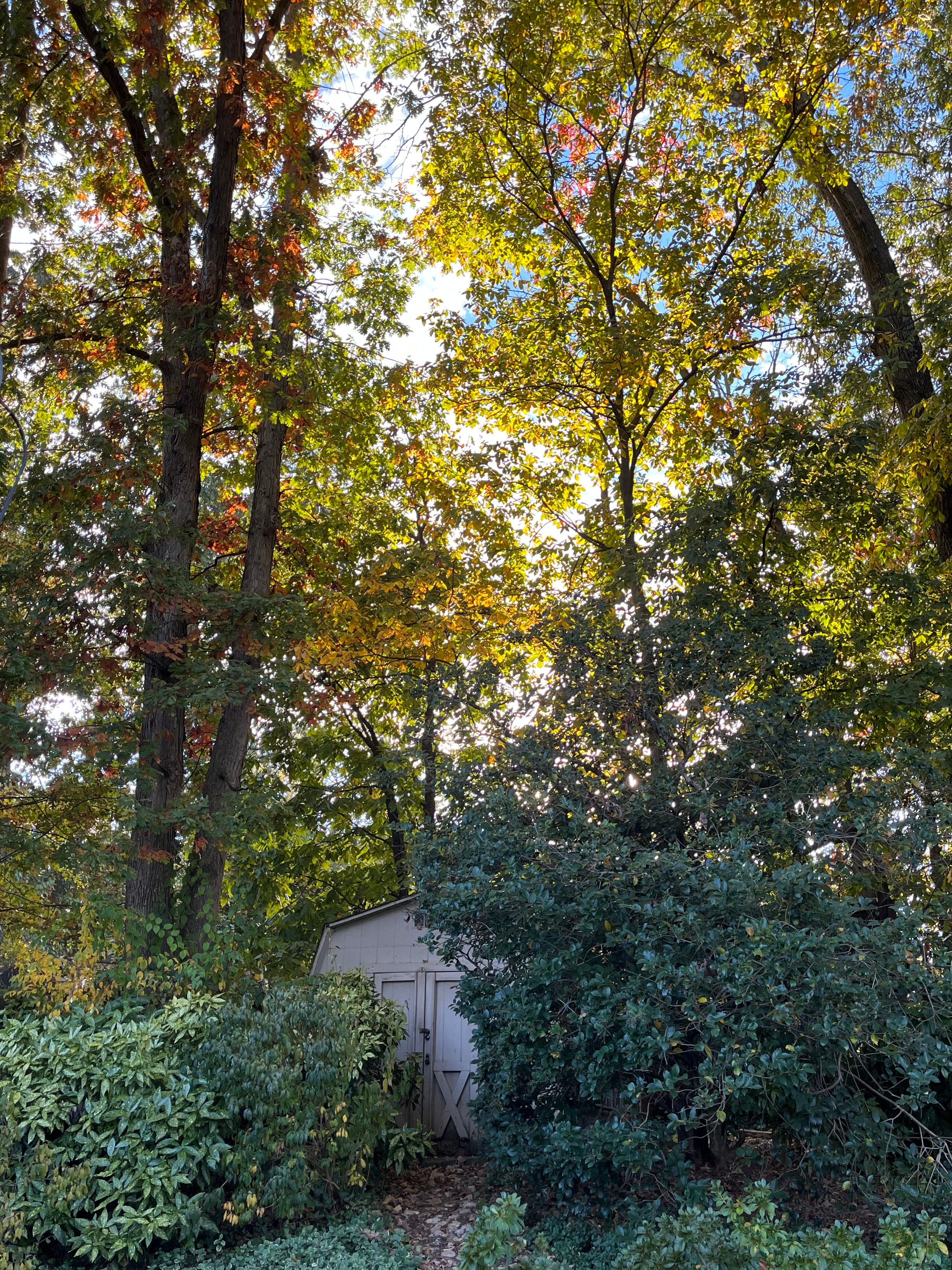
The curious thing is that my connection to the yard runs as deep as ever. The majority of my accessible childhood memories are tied up in grass, dirt, shrubs, trees; often, too, a swing set, a shed, a playhouse, a fort, though gone, appear as ghosts. I am always barefoot. The maple in the front yard has been my constant greeter for 59 years; the crepe myrtle, too. The oaks of various species in the backyard were there for decades before I was born, and the hickories have grown up with me. The holly trees, shrouded by the taller deciduous trees, have never gotten really large, but they are my age, at least. (I can still feel the prickly fallen leaves lodge in my heels.) It is to the yard that I want to go when I get home, to feel that I’m home.
Backyard. Photo by LO’H.
You Can Be Anyone You Want to Here
My Aunt Mary from Iowa said the above when she was standing on Canal Street, her first visit to New York, in 2004. I would add, “If you can make it here.” My home for the past 20 years has been a co-op apartment in a 90-year-old building in New York City’s borough of Queens. Coming off the train into Penn Station yesterday, wearing an air cast on my left leg (over my black travel slacks, to prevent a rash from the plastic—menopause has a been a blast, you guys) and a gray combat boot over my slacks on my right leg (for not one but two sprained ankles!), carrying a large sling bag, full backpack, and computer tote bag, not a single person gave a flying fuck. And that is the price you pay for all that freedom to be you doing you: supreme indifference to my personal human plight. I’m always agonizingly aware of my own complicity in this survival game as I pass homeless people without giving alms, in my rush, I think, which is really avoidance of culpability. For that reason, I don’t begrudge anyone racing past me up or down the dozen flights of stairs I had to take to find a working subway going in my direction (midtown was pure gridlock so any cab or Uber was pointless, unless I wanted to spend three hours getting back to Queens). All I know is that as I trudged past construction on 7th Avenue and 33rd Street that has literally been in progress for SEVEN FUCKING YEARS, with no end in sight; past orange cones and trash and and scaffolding and pilings and strollers and tourists walking past all the chain store banality that is 7th Avenue four abreast, down steps (foot-foot, foot-foot) where I have to inch past guys blissed out on weed; into the bowels of Times Square only to find out the 7 Train is not running; up the four flights of stairs (foot-foot, foot-foot) to the N Train (because the escalator up starts down by the 7 Train, and those stairs are blocked off and are being policed); and by now in the global warming October heat with the schlepping and the sore ankles and endless walking, shoved or ignored, and feeling by this point a little weepy, I really had to ask myself, seriously, “Why the fuck do I live here?”
And later, in my own bed, unable to sleep from ankle pain and the chill and recalling the stack of mail and all the unpacking and plugging in of laptops and texting people I’m back—I realized I really do hate living here. I have, as of November 1, been living in this apartment for 20 years. Of those two decades, only the first one was good. In 2013, my play lab ended, my work role changed to working essentially for a partner start-up, I had a miserable month of grand jury duty, and I met a man who gave me the deepest love and caused me more grief over the next decade than I want to speak about. And, post Covid, I have accomplished exactly zero as a creative person. As I now work exclusively “from home” (great for flexibility if not sociability), I see almost no one—a dinner here and there once or twice a month. My old building needs too much work. Global warming is creating a flood plain out of the city. And I’m going to be 60.
I turned on the light then, because I had this flash of memory, of going with my college friend Richard as his plus-one to his cousin’s wedding in New Hope, Pennsylvania, back in 1985 or so. The downtown was lit up at night, even in summer, with white fairy lights strung here and there. Everything about the place was joyful and cozy, people out and about, shop windows so inviting. This was like Blacksburg, home of our college, Virginia Tech, without the carousing drunk frat boys. Ever since, I have dreamed of living in a town that felt like that—creative and joyful and pleasant, but with diversity, room for the middle class, and lots of live music and dancing in parks and plazas in the summers. A community theater, concerts, art for people who lived where they worked.
I realize now that those places don’t exist ready made for me to walk into—an enchanted village in a story book that become real, like Brigadoon. Community like that, place like that, has to be built, and not presented as a gift. I have always worked very hard to create a life for myself everywhere I’ve lived. What is different now? I guess, looking at 60 and returning from nursing my parents as best I could, faced with two square feet of junk mail to sort (with unending gratitude to my upstairs neighbor, Debbie, who built that pile of junk mail, watered the plants, and ran the taps AND cleaned up my basement after it (mildly, mercifully) flooded with the remnants of Ian—see Brooklyn for reference)—I guess I’m really wondering about where I belong, what I do next, and how I do it. I feel, weirdly, totally lost.
On my way down the sidewalk near my apartment (all my gear by now giving me its full weight) past the playground, my eye caught a shiny object in the leaves along the chain-link—a New York driver’s license. I picked it up, someone on 41st Street. I’ll try to find him tomorrow, I thought. (This morning I strapped on my “casts” and went out in the rain over to his apartment building, buzzed his number, no answer, so I left it on the ledge above the buzzers—and then I spent the next two hours beating myself up for not thinking of MAILING it back to him.) It’s a small but common event for me in this vast city, helping a stranger in an odd way. Sometimes I wonder, given the last decade of my life, if all I’m really here for is not to be an “artist,” but really to be a clean-up crew of one, one human accident at a time. Maybe that’s who I am, and these notions that I should accomplish more are foolish expressions of ego.
View from the 7 Train Platform, Queens. Photo by LO’H.
After all, unlike too many people, I have not one but two roofs to shelter under, at least for now. Trees to visit. Good neighbors. Friends, however much they are only available via text. It’s a crazy modern world, and there’s no good where to be unless we make it the way we like it. Where my next home will be or how I remake the one I’m in, I can’t know, but in my heart I know the search is on.
Hope you are feeling home in your own heart. I saw this quote on a meme recently, and it hit…home:
Home is not where you were born; home is where all your attempts to escape cease.
In my room, the world is beyond my understanding; But when I walk I see that it consists of three or four hills and a cloud.
Surface Chair
Years ago, my friend Tom and his partner were moving and downsizing, and he sold me a delicious olive green wing chair (which I foolishly gave away when I later moved to New York and I miss it still). On first seeing the chair, which was solid and plain, in my house, my friend Chuck remarked, “Now it just needs a couple of bright pillows!” When walking the shops of Fredericksburg, Virginia, I found two expensive hand-painted pillows, with an accent of that very olive green, that did just the trick. I thought of all this just now as I pulled down my bed covers and shifted one of those very pillows to the side so as not to crush it in my sleep.
So much of life and living is surface, a chair you buy and lose, the bright pillows you spend so much money on to decorate the chair, the casual remark that caused you to elevate your home decorating aesthetic beyond solid colors into bright patterns of possibility. All surface thoughts, yes, but more than the surface shifts. Doesn’t it?
II
From my balcony, I survey the yellow air, Reading where I have written, “The spring is like a belle undressing.”
Surface Friend
Thursday afternoon, I texted my dear friend Cindy who lives on Maui to ask what was happening and if she and her family were safe, and they were, as the fires were not on her part of the island, but oh how she was grieving the loss of Lahaina. She then texted, “Did you know that Tammy [a fellow student and actor from Virginia Tech days in the 1980s] passed?” I did those things we do now: looked up Tammy’s obituary online; wrote a tribute memory; posted of her death in a social media alumni group. I really had only a surface relationship with Tammy, acting with her in a Summer Arts Festival production of Andre Gregory’s adaptation of Alice in Wonderland the few months before I started my teaching career. We took to walking home together on the nights after rehearsals and performances, as neither of us had cars, and her place was my halfway point. She’d kiss my cheek, wish me “safe home,” a phrase I didn’t know. She graduated the year I was a freshman, and by the summer I got to know her had waitressed and auditioned in New York City for three years and lived with a Russian boyfriend named Roman who wouldn’t go down on her because he didn’t understand what “the magic button” was, which was not where women bleed and pee, and her favorite city memory was Roman pushing her around the East Village in an abandoned shopping cart in the cold wee hours after the bar where they worked closed for the night, her legs sticking up out of the cart while he spun her around on the deserted streets and she screamed and laughed. That’s what I know about Tammy. And can’t forget.
Surface memories as lasting as love.
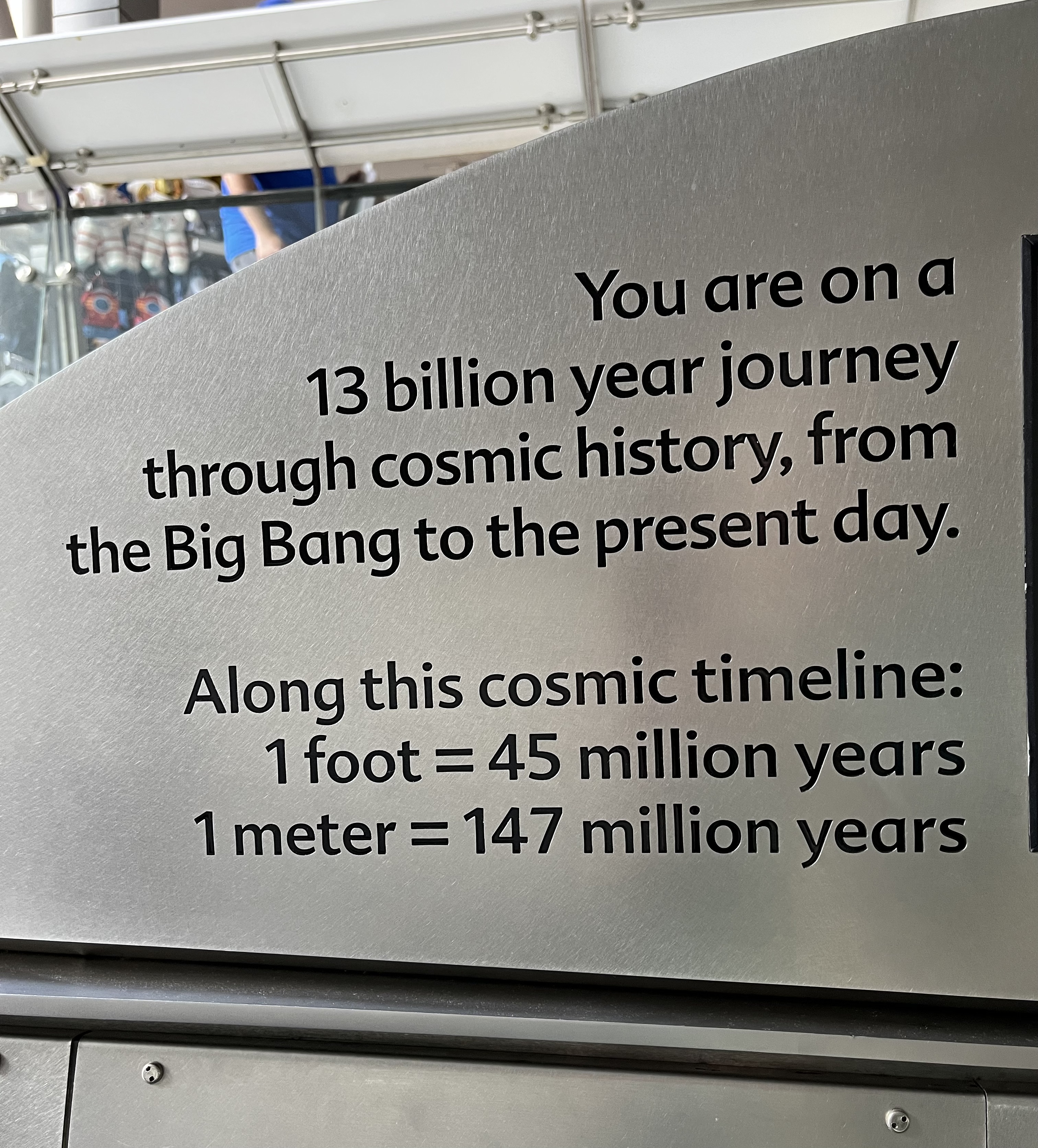
At the Planetarium, American Museum of Natural History. Photo by LO’H
III
The gold tree is blue, The singer has pulled his cloak over his head. The moon is in the folds of the cloak.
Surface Life
Sometimes I think I have only ever known surfaces, surface friendships, surface news, surface travels, surface nature, surface career, surface artistry, surface feelings, surface disaster, surface stories. So of course I dread. I obsess over decorating a home, oddly, that almost no one sees, an art project for an audience of one, knowing it and I could be lost at any time, and it’s so much fog, really. I see spots I missed when I dusted today. And what should I have to show for all this care and attention? Is there anything inside me deeply affected by bright pillows on a muted chair? Is there anything that can emerge out of me that will deeply affect the world? And what of all this death?
Three or four memories and a cloud. Is there much more we can expect?
Sending love out to everyone who needs it, even from my surface, to help you absorb whatever was your loss in life this week.
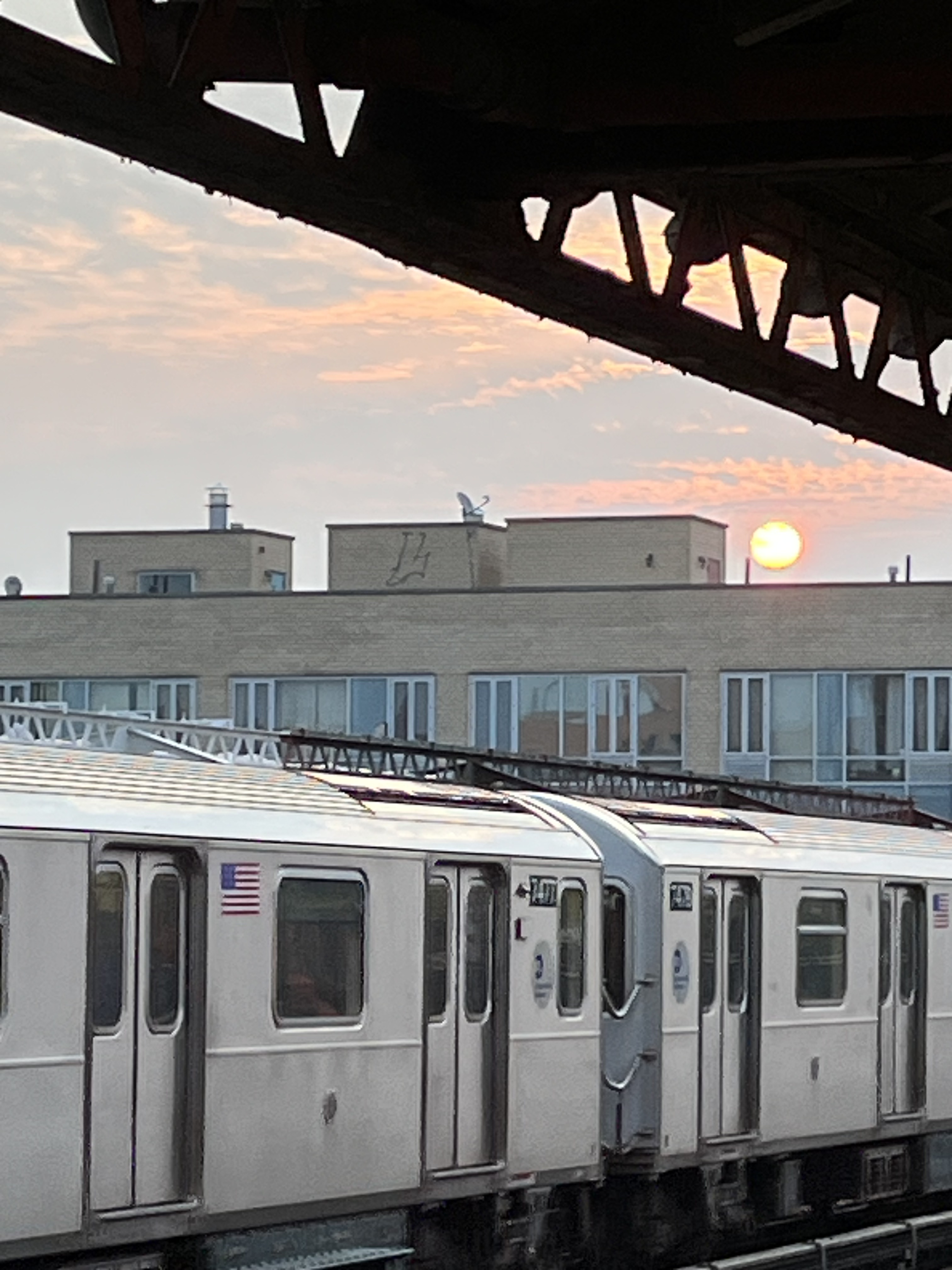
Morning from the 82nd Street Subway Station. A couple of cars and a sun Photo by LO’H
















 The Miss O' Show (Teacher's Edition)