
Random fragments from a charged week
“I got a job for which I was ill-prepared and unqualified. That’s the American Dream right there: anything can happen to anyone. It’s random.”
~ Nellie (played by Catherine Tate), who stole the Sabre manager’s job from Andy on The Office, Season 8, the most prescient show ever, our true Zeitgeist
Random 1: Have you had those times when you know you need to go out, do something, but there’s no place you really feel you can be? You get an idea…no, not that. Turn around. Well, turn left. Wait. No. Just go home. No, you put on nice clothes. You have to try. For example, this evening after my work-from-home day, as a cold front moved into Queens, I thought I’d go to one of my favorite bars. Both of my two places are about ¾ of a mile away, and the winds of fool’s spring March began making me doubt my choices; so instead, I found myself randomly heading north to Queens Boulevard to the Irish Butcher Block. I reasoned, I can get fish and chips, maybe a bottle of Guinness or Smithwick’s, and be cozy at home. But when I arrived, the shop was packed; so I thought, okay, I need a walk, so I’ll walk over to my friend Violet’s shop. On arrival, I looked in the store door to see her shop was packed, and that’s fantastic for her, but I’m still not belonging anywhere. I turned around. Despite the increasing feeling that I should just go home, I walked on to my bars, as I say, despite myself. Not a stool was open, not a greeting to be had, not meant to be. Both places. Right? So I keep walking, circling back, as it turned out, to the Butcher Block, now without a line, for the fish and chips, and thence to the liquor store and Italian Rosso.
Sometimes you take a circuitous route to end up where you needed to be, but now you have had exercise and gained a fresh perspective.
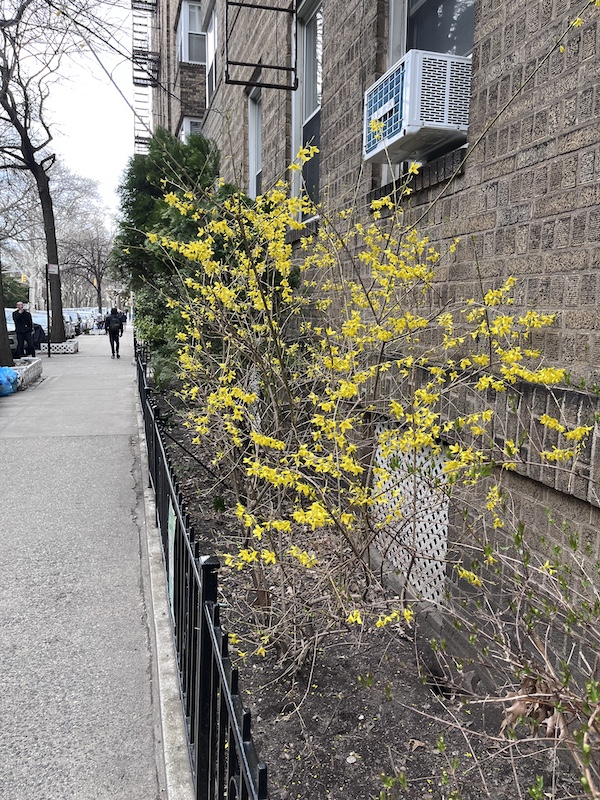
Random 2: When I was in kindergarten, I came home one day to the smell of new carpet stretched over the first-floor asbestos black and tan tile in our little split-level house. Harvest gold industrial. One day early in its new life, the carpet by the laundry room door was damaged—not sure how, some kind of tear and a stain maybe. Around this time on TV, ca. 1969, was this advertisement for a magic fabric repair powder—it involved rubbing fibers into the powder and ironing the mixture onto damaged area, and POOF! like new. What my mom, Lynne, actually got, instead of a smooth “repair,” was a scorch mark on a new carpet they could barely afford: the mark shaped perfectly like the bottom of the iron, brown and indelible. Irreparable.
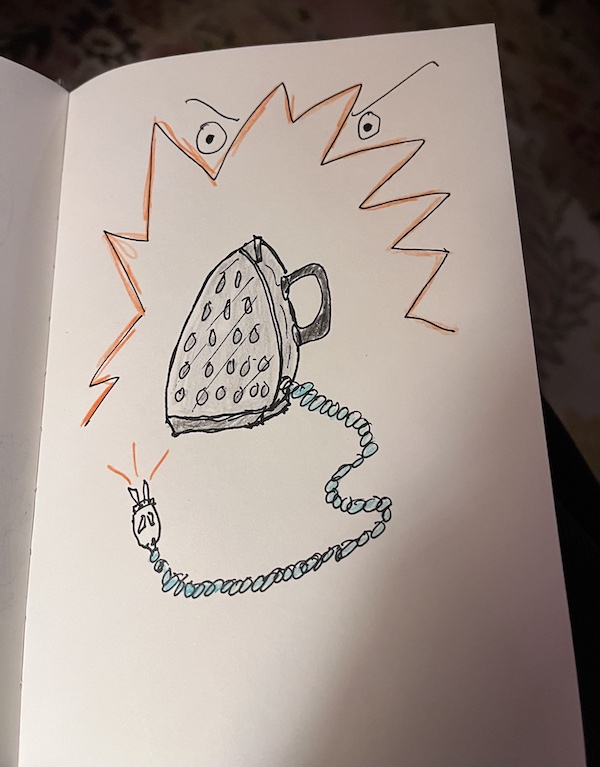
To cover the scorch, my mom found a rug at a store somewhere, a 2’ x 3’ area rug, like a doormat, and so for all those years there was this little rug that scooted always over to the right at an angle, as we came and went through the laundry room to the back door (really a side door), and out of habit all of us just scooched the rug back to the center of the door, making sure the scorch stayed covered.
When some 20 years later my parents were able to afford to replace the carpet, this time blue plush, they also found a small complementary doormat-type rug to put in front of the laundry room. For the next decades, then, we all endured the same irritation of watching the rug scooch over as people went in and out of the doorway, each of us moving it slightly back to center. Day in, day out. Not until my mom had the first big fall in 2023 did I just roll it up and hide it (I’d been proposing its removal for years; I performed this “disappearing” act with every single area rug in every room, too, afterwards, and no one questioned). But when my mom asked, “Where’s the rug?” pointing to the area by the laundry room, I asked in return, “Mom, why was there a rug there at all?” And that’s when she realized, “Do you know what? I put it there to hide the scorch”—the scorch that disappeared with the removal of the old carpet some 30 years before.
Random 3: Do you know that story—I think it was in Reader’s Digest, or from a local paper, maybe, back when they all had a feature called “Bits ‘n’ Pieces,” and I really miss local papers, but my old Appomattox landlady recounted it to me: One Thanksgiving, a man sees his wife preparing a ham, and just before she puts it in the pan, she cuts the end of the ham off. “Why did you do that?” “I don’t know,” his wife replies, “my mother always did it.” So that man asks his mother-in-law, and she says, “I don’t know, my mother always did it.” So the man finds his wife’s grandma, sitting in a chair, explains his observation, and asks her, “Why did you cut off the end of the ham?” And she looks at him, “To fit it in the pan.”
We humans do a lot of things because we’ve always done it that way. How did it start? Why do we still do it? Unless you can answer that, you really have to question, and keep at it until you realize, “There’s no scorch mark anymore.”

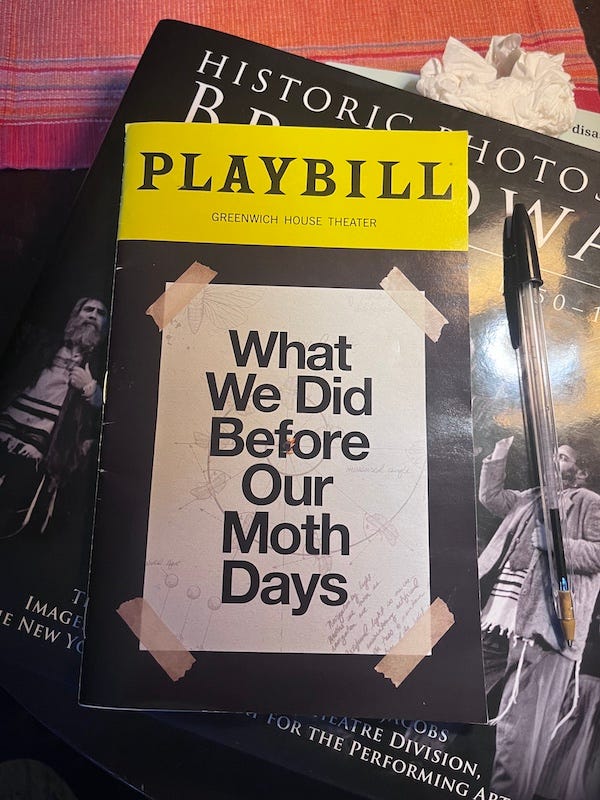
Random 4: “It’s policy. The government runs on policy. Without policy it all comes apart.” Words to that effect greet Secretary of State Hillary Clinton’s newest deputy, Julissa Reynoso, a naturalized citizen from the Dominican Republic, by a seasoned State Department veteran, in the play Public Charge, which I saw last night at The Public Theater in New York. Things are only done a certain way, Reynosa (who co-wrote the play, with the endorsement of Clinton) is told, and no other way. In order to get a wrongly imprisoned USAID worker out of a Cuban prison, a duty charged to her by Sec. Clinton (unseen and largely unnamed), while also working to free the remaining prisoners in Guantanamo Bay, Reynoso spends five years, 2009-2014, under her boss and President Obama achieving the impossible, upending business as usual, with their full support. It’s exhausting and crazy-making. The play closes with footage of President Obama’s address that the U.S. would be returning to normalized relations with Cuba, and Reynosa leaving her post to begin work on the campaign of a lifetime, the promise of our first woman president.
We all know what happened. What is happening now.
And you sit with this. And sit with this.
Random 5: I was watching a rerun of The Office tonight and not really thinking about anything, and it was the episode where Nellie simply decides she’s the new manager of Sabre (see that quote up there), and Robert California, the CEO who is all talk and no ability, just lets her do it. Jim says to the camera, “What is happening?!” And all I could think was, “I don’t know, but here we are.”
TV ratings for reality shows notwithstanding, it’s no good to shake things up just to shake ’em up—putting morons in the highest offices is never going to yield good results. People DIE. Life and death. Morality matters, ethics matters, and so does humanity: sometimes a smart woman—and smart is key, woman is key; who is a moral person—and moral is key; and who is not molded by what has always been and is also highly educated and imaginative (no small things) with a complex immigrant background (so underrated) that affords her a global perspective—and supported by reasonable and daring leaders, can to shake up a years’ long, idiotic stalemate to reconcile many factions, save some lives, and make change for the better. It’s work, and it’s hard and frustrating, totally unsung (no statues or commemorative coins), and the key to success is not to quit—because right when you think you have to give up (as my old therapist told me about psychic breakthroughs), you get the big idea.
The United States cannot survive another year on Celebrity Apprentice faking greatness, or exist in perpetuity as a weird Season 8 arc on The Office. Shit is real.
But goddamn, this country, man.
Racism. Misogyny. White male fragility. Greed. Power. All the ills. It’s all so much bullshit.
We American humans are so far out of touch with our natural world, with anything like roots, that our collective nervous breakdown must be due in large part to that loss. (I stood in Astor Place last evening en route to The Public, looking at all the dead-eyed faces of skinny NYU students with earbuds and fast fashion and too much money, and the speeding e-bikes of food delivery guys talking on cellphones, and no one is happy and no one looks present, and I’m thinking how I don’t want to perpetuate this AI bullshit world, and now what?) Hillary Clinton understood that it is through person to person connection that we change hearts and minds, and that until you change those you change nothing. I get really pissed off when liberals and progressives make fun of the notion of changing hearts and minds, and it’s deeply ironic when conservatives make fun of Hillary—what do all these lefties think Turning Points U.S.A. is all about? Reprogramming hearts and minds, people, and not for the good. Conservatives just don’t want the Libs to figure out that Hillary has been right all along.
There are some mistakes you can’t throw a rug over. Not to bludgeon this metaphor but how long have we been scooching little (law) rugs over our racism, classism, sexism, homophobia, xenophobia, pedophilia, greed; our history; our abuses of all kinds? It’s time to replace that carpet, and one hopes without burning down the house.
And take a fucking walk. Cults aren’t culture. See you at No Kings.



 The Miss O' Show (Teacher's Edition)