It’s an ordinary Saturday in Queens, which is to say “ordinary” if you aren’t thinking about the fascism. (I really can’t get over the way that Meta bleeps “Nazi” and “swastika” from videos, or that posters have to insert an * somewhere in each of those words so the post passes muster, even as Elon’s and Bannon’s sieg heils are fine.) I am waiting on a 7 Train, only to learn it’s not going all the way to Manhattan, so I have to switch the N or W, so my mind does a little adjustment. It’s all good.
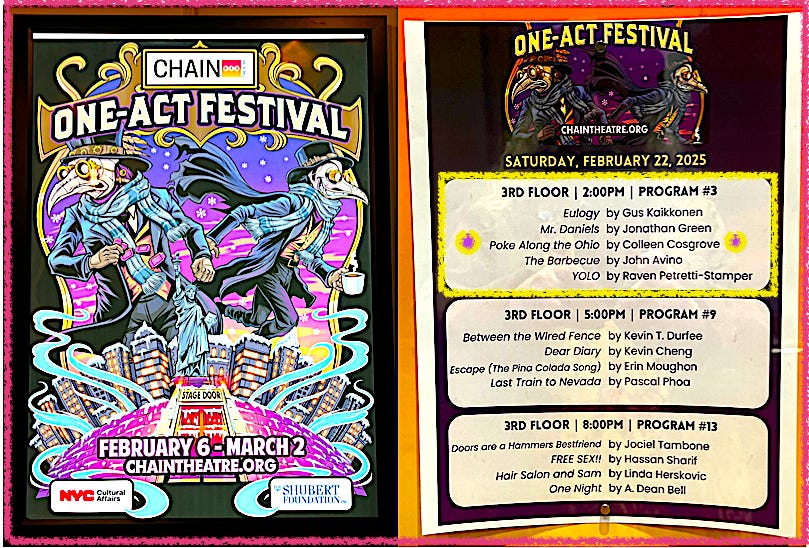
There used to be moments when, as my friend George puts it, it seems Americans are simply going to be inconvenienced to death. Now, unfortunately, and for a long foreseeable future, we are under threat of annihilation. But today, I’m heading to The Chain Theater at 312 W. 36th Street in Manhattan to see the 2 PM installment of their rolling rep One Act Play Festival, and today I don’t want to think about annihilation.
When I arrived at Times Square/42nd Street, I walked through Golda Meir Plaza, struck again that in the 1970s we had female leaders like Meir of Israel and Indira Gandhi of India, Thatcher in ’80s Britain, and that the United States couldn’t even manage one woman in 250 years, choosing an avowed white supremacist dictator, twice, over a highly qualified, democratic woman. And here we are, I think, wondering as I keep walking what will happen to the bust of Meir.
First, I have to go to the ATM, and for some reason my card chip will never work to open the door; another customer, a man in a hood, has a card that opens the door; he engages in no talk. I go in behind him, and I realize I’m shaking. I find I’m afraid to use the machine until I see him at the other machine, and really getting money; I finish before he does, even having to enter my PIN twice to get it right. Odd, having the shakes like that. Or not so odd. Frankly, that’s as fearful as I want to be in life.
It’s nice out, 40s, sun. I walk down 7th Avenue, taking it in, struck again how I can always spot a tourist. I am of New York City, I move that way, more grounded, a bubble of insulation and also awareness. I was a tourist for 20 years before I moved here, so I don’t mean this as criticism or praise; it just is.
I arrive a half hour before the play festival is to start. I see Mary, the director of my friend Colleen’s play, in the crowded lobby, and we hug. I check in at the desk, my friend Tom having bought our tickets online. Our friends David and Barry are also coming, and learning the afternoon is sold out, I go in when the house opens and save us a row, as it’s general seating. An older woman in the row behind me is doing the same thing. (It’s always funny to me how everyone who enters a general seating situation somehow believes they will get to sit alone, empty of audience members around them, and they look at my saved seats with resentment.) The boys show up just before 2 PM, so we don’t get to visit much, and they don’t have time to go out after. I seem to be the only person I know in the city who has nothing but time. Ah, well. Still, being in this community even for a brief time is comforting and energizing. Hopeful.
For the uninitiated: Attending a play festival of new work, especially one-acts, can be a crapshoot. I’ve attended many of these, both as a high school director and as an audience member in New York, and too often only two out of the five or six are well-written, and only one or two are well-acted and directed, and often it’s not the same set of two. So imagine my delight—I knew Colleen’s would be adorable because I’d read the stage directions for it at a workshop—when all five were simply excellent.
The common theme—and this was a really thoughtful grouping—was aging and death. This might sound awfully close to that annihilation I was avoiding, but it wasn’t the case. The first play was a monologue, a 60-year-old son eulogizing his father at the funeral; the second, two old people on the E Train platform; the third an older man trying to make a deal with Death; the fourth was Colleen’s (a play inspired by seeing a plaque in Evanston, Indiana, along the Ohio River, where President-elect James K. Polk was to have stopped his steamship and didn’t disembark), with an old woman (Colleen) and her grandson in 1854, the year Lincoln was really getting started; and the last a gay couple, older men, one who has, we see gradually, dementia. And all of these were by turns serious, funny, sweet, surprising. And ultimately, ordinary, in the best sense. Life lived.
I’ve realized lately that what I crave most in my music, my art, my nature, and my life, even, is ordinariness. I don’t want the surreal, the challenging, the wildly surprising. I get too much of that in unending loops in American society now, breathless, mean, chaotic, and all that hate and chaos, while not remotely sustainable, will be unending for four years at the very least, and if we all don’t stroke out and live to see another election, we may see a divine revolution. Until then, I want mundanity as a life theme.
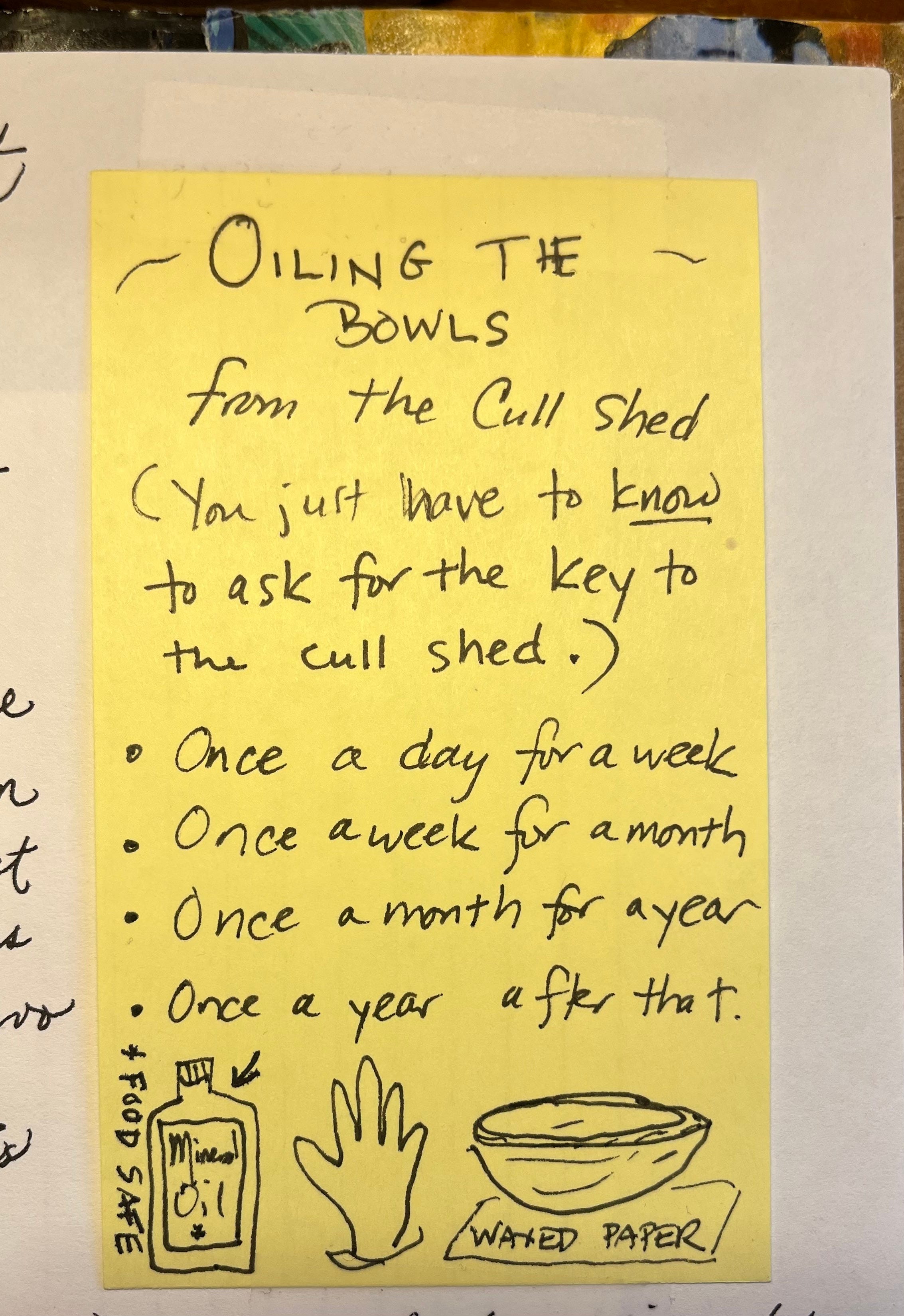
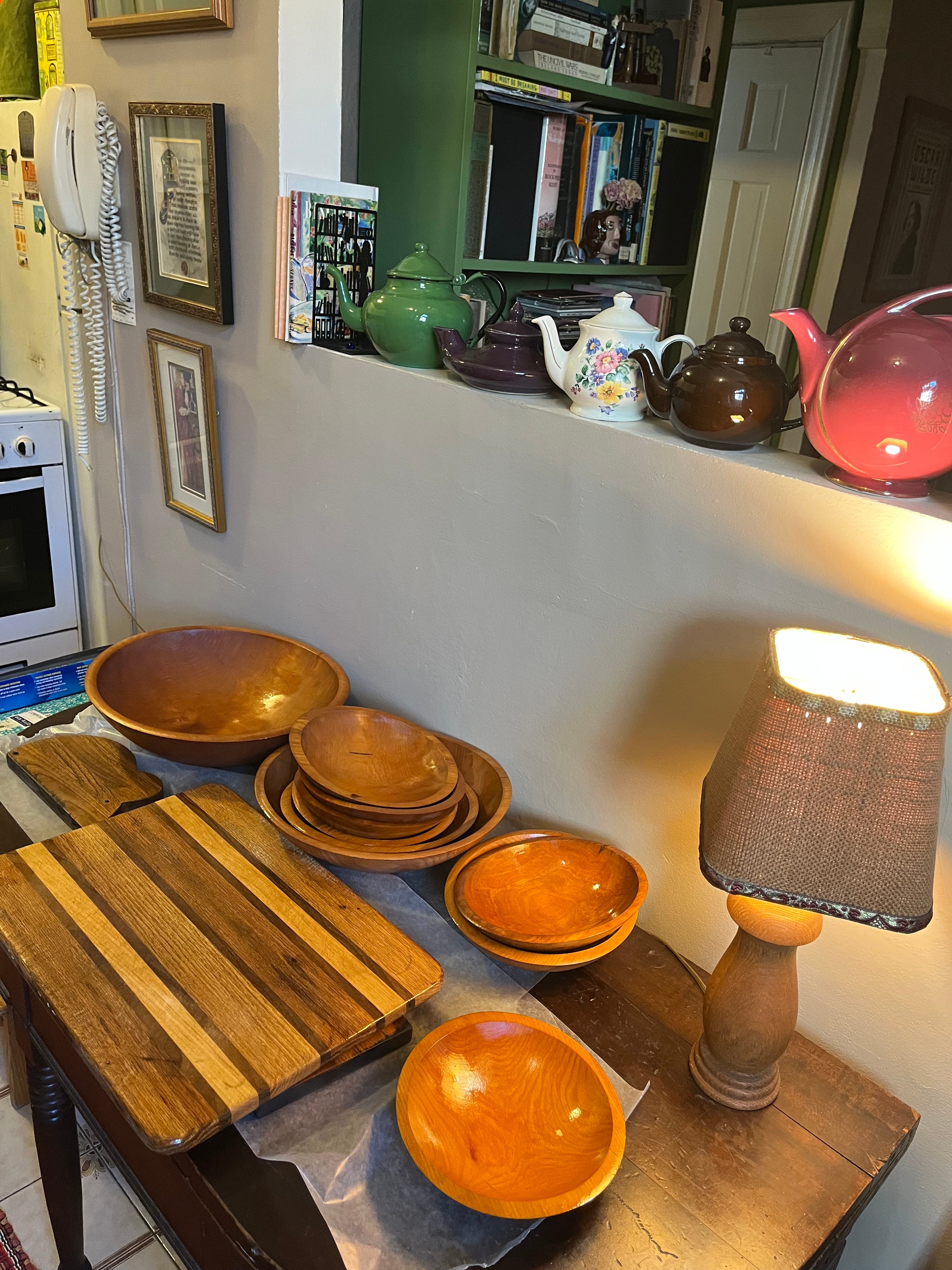
For example, here’s a task of basic maintenance.Simple chores. I did the annual bowl oiling during my lunch break one day since I work from home. So restful. Once the oil soaks in, they’re good to go for a year. I oil the cutting boards at least twice a year. Isn’t it nice to focus on that?
As another mundane activity, before leaving for the subway with a half hour to spare once dressed (I took care to pick my ensemble and accessories, knowing no one else would actually care, but it’s my inside feeling that counts), I noticed that I have a lot of loose knobs on my two dressers. One dresser requires a Philips head and one a flathead screwdriver. I keep these in a pitcher by the door—I like to have my tools ready at hand. Knob by knob, I tightened them. In doing this I noticed a few scratches, so I went to my tool closet and found the wax wood filler pencil. And I filled the scratches, and it’s funny how the more you fix the more you see.
And this by the way task was really satisfying. You know what I mean? And centering, before heading out into the chaos of New York’s mass transit.
Why do we have to exist in all this rage and war and hate and aggression and greed and chaos? We all have knobs that need tightening. Why, just because of a few psychotic, damaged men who cannot be satisfied or fulfilled by all the money and power in the world, do all the rest of us have to suffer for all time? Why do other people, people with absolutely no hope at all of either wealth or power, follow them, go psycho with them, and go after all the rest of us? Don’t THEY have knobs?
From the web.
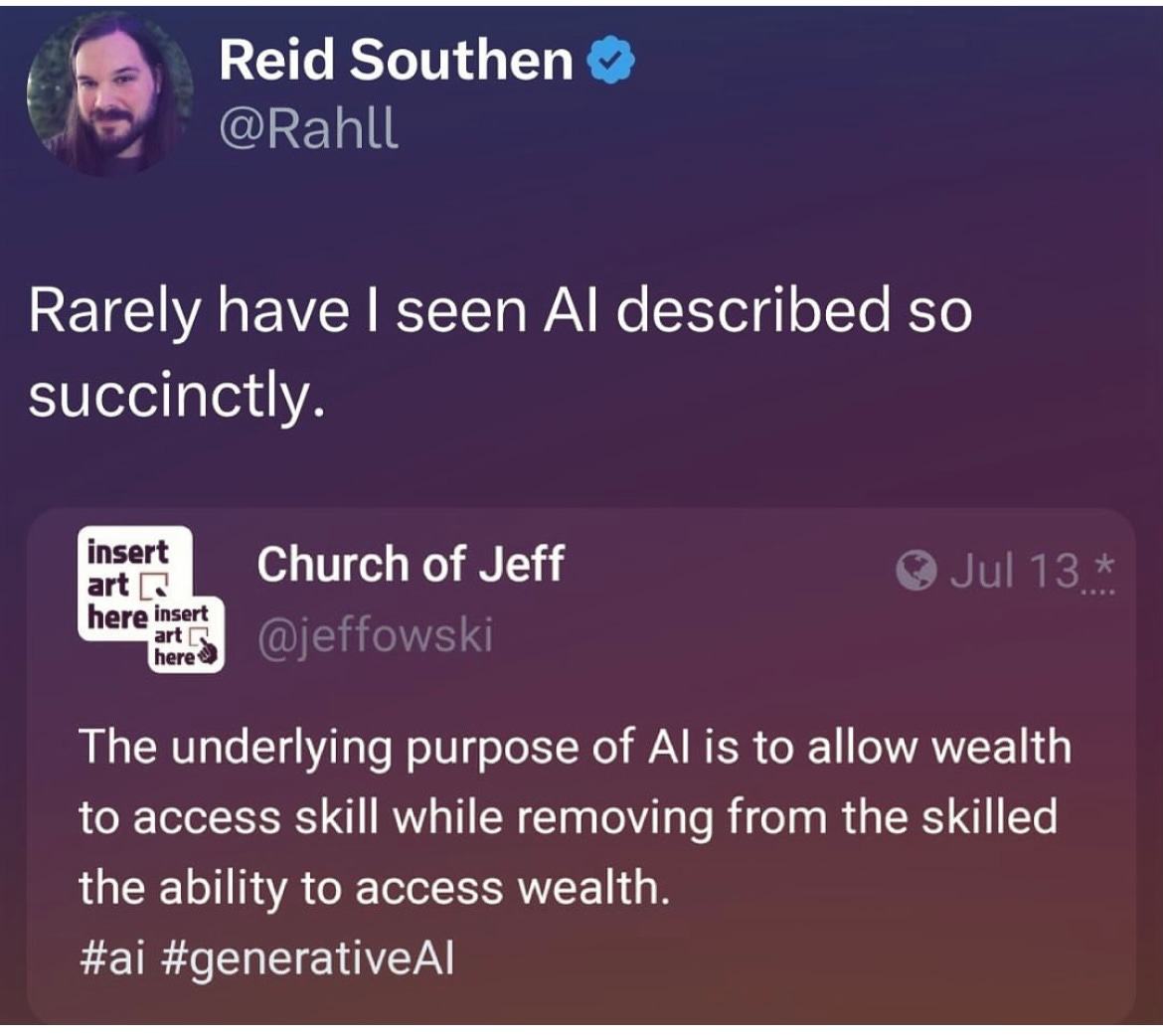
I was thinking too about AI, how the goal is to replace humans, to erase humanity, and that AI cannot tighten knobs. How are we to cope with the attempted erasure of culture, of women’s sovereignty, of black and brown people, of the earth itself, when this desire for annihilation is beyond lunacy? Why can’t we be? Being is hard enough. Knobs come loose. Why can’t we work together to solve real problems?
From the web.
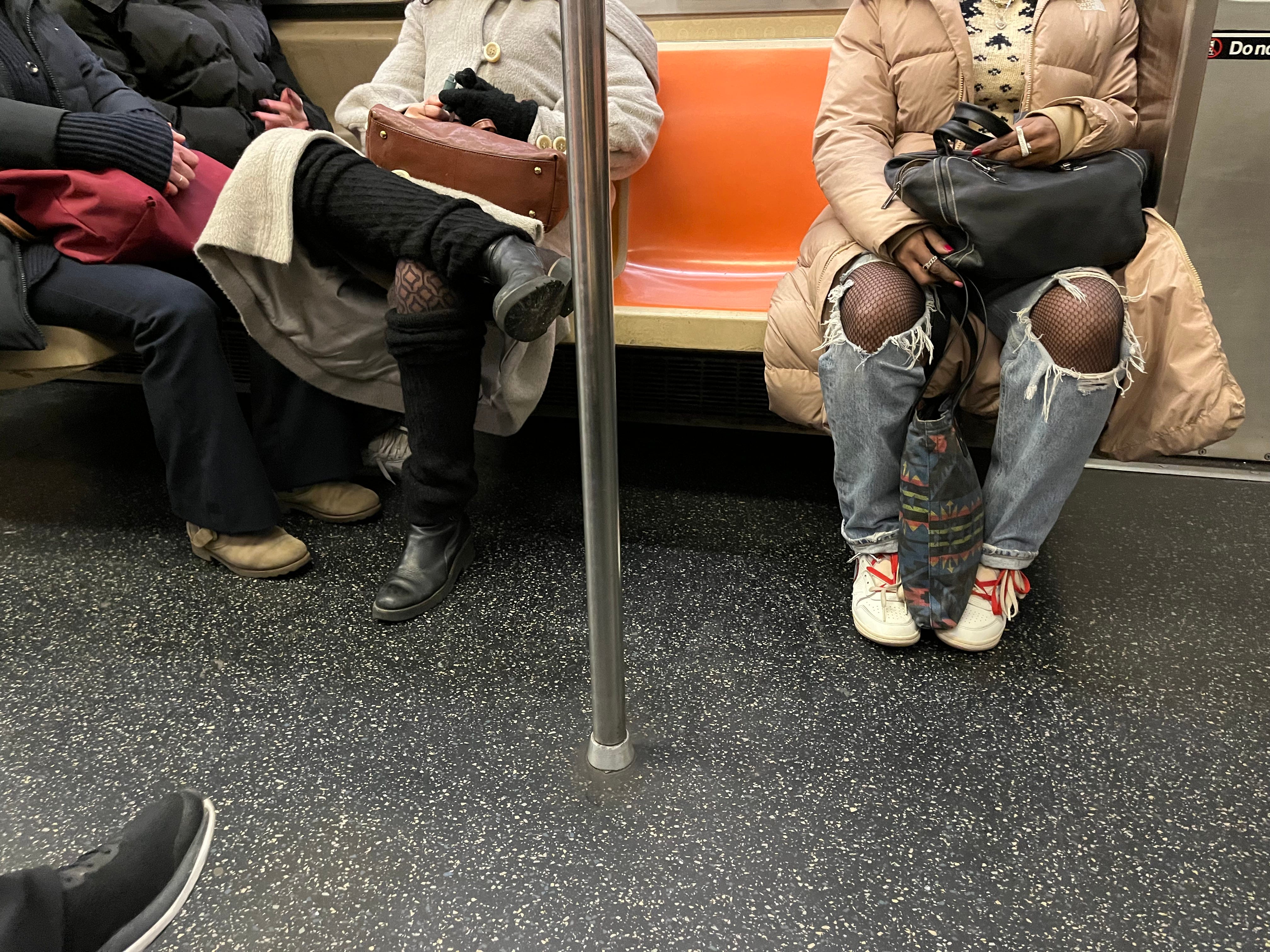
To cope with the whole mess, as I brace for some kind of war, I’m taking more and more pleasure in the very ordinary, like watching people on the subway.
A Study of Knees and Nylons. N Train to Queens. LO’H 2025
I know I can’t be alone in these chaotic feelings. How are you coping? In addition to doing chores, seeing art, and attending the occasional rally, I’m calling politicians and listening to Nina Simone. Followed by Yo-Yo Ma. You?
Ironically, this famous quote is itself a lie (how American), but more on that later.
The magazine Vanity Fair (to which I no longer subscribe) includes, as the last page of each issue, The Proust Questionnaire, a set of questions originally asked and answered by novelist Marcel Proust and now used to learn more about the globe’s favorite obsession, celebrities. The questionnaire has some interesting questions, and some shallow ones, but the answers can be revealing. I’m often struck, for example, by the way powerful men, even decent ones like George Clooney, answer #12: What is the quality you most like in a man? “Loyalty.” As a woman I read this as, Truth telling is a deal breaker. As for #13, What is the quality you most like in woman? men generally respond, “Patience” or some other subservient thing. It’s interesting, if limited.
Interesting, If Limited could be the title of my memoir.
Walking around the neighborhood, I found myself thinking of Question #9, which is, On what occasion do you lie? Often the celebrity of the month who has chosen this particular question among the many, will respond, “To spare someone’s feelings.” Fair enough.
But speaking as a fairly honest person who has lied on numerous occasions while also valuing truth, I wondered if any of the situations in which I lied had something in common. I’d like to say something pithy, see, when it’s time for my Vanity Fair moment, so let me note just a few examples, categorize them, and see if I can find the common ground.
1. Once in second grade, Mrs. Angle—I’ve told you this story—asked us after nap time with our heads down on our desks if anyone had a dream they’d like to share. I raised my little hand and got up in front of the class and, making it all up (obviously) to entertain my friends, described how we all went to Egypt to see the tomb of Tutankhamen. I pointed, “Juanita was there,” and again, “Ingrid was there,” and Mrs. Angle snapped, “You’re lying. Sit down.”
2. On a high school field trip during my sophomore year, to take the singers and pit orchestra to a neighboring high school to perform scenes from South Pacific as a promotion for our production, our sponsors, Mrs. Combs and Mr. Carnohan, realized they’d forgotten to send home permission slips with us kids. Only when the bus driver asked if they had them did they realize. I stepped up quickly, “Give me ten minutes.” I had everyone write out a permission slip on paper we all collected from someone’s notebook, and I signed each slip in chameleon-like handwriting. Mrs. Combs looked stunned, but she took my pile and off we went.
3. When I’m late for something, like work, I have blamed the subway (and have been caught out by a colleague and supervisor on the same line) because I’d rather not say, “I have IBS and had to run back home halfway to the stop because I needed to shit again.” (Finally, I just told the truth. No one asked after that.)
4. I once helped make a company-wide Answer Key set, compiled for the whole floor of my 2 Penn Plaza office, when this one president took over and, to prove his power, spent easily $100K to create something like 30 separate “learning modules” complete with “tests” on corporate “life” and business, modules that included short films, voice overs, and reading material on slide presentations, and if you didn’t get all the answers correct on each test, you had to start over, the whole module. We had massive publishing deadlines at the time, our nerves hanging by a thread. To what end are we doing this? But your job was on the line. A few of us—no doubt my idea—began printing out all our 100% test answer sheets which we labeled by module, punched holes, and stuck them in an unmarked three-ring binder. and set it on a file cabinet in our pod We didn’t even hide it. Eventually even our supervisors, to say nothing of executives and vice presidents, began ambling and ultimately marching over our pod to get the book, because 1) these tests were useless to our work; 2) the president was doing it to be a dick; 3) he would be out on his ass soon enough (they always are) once he was eligible for that golden parachute—we endured a period of a few years in which a succession of dicks who were pushed out of one company division and over to ours until they could retire. It was not fun. And yet, our important work—work that corporate didn’t in the least understand—somehow went on, great as usual. Hmmm. Who’s the parasite, Elon? (And how do I really feel?)
5. When the famous Westway Diner on 9th Avenue was taken over by new management maybe six or eight years ago—all the old-school career waiters replaced, the desk staff and chefs gone, the classic booths and tiles plowed under for white and gray blah—I happened in to check it out, and in addition to the place being bereft of atmosphere, the food sucked. “How did you like it?” the aggressive manager asked me about inedible spinach pie, which was a block of bone dry phyllo with almost no filling. “Mmmm,” I said, not wanting the poor new chef to get canned. Let someone else tell them; consider this a funeral donation. (It’s since recovered.)
What do all these occasions have in common? Well, they are lies of convenience, I guess, trying to smooth something over, or using deceit to help out friends or struggling folks; on reflection, I tell few lies just to save my ass. That’s how I was brought up. But I’m not stupid enough to believe that always being honest is smart. As my friend’s Montenegrin immigrant father used to say, “Honest and stupid are two brothers.”
I’ll tell you what the lies don’t have in common: No lives are in the balance for the telling of them. While I don’t condone lying or deceit as a lifestyle, sometimes lies save lives, and you have to keep your hand in. Ask the enslaved; ask women being beaten by abusive husbands; ask Tina Turner running away from Ike. Ask Jews during the Holocaust. Ask the French Resistance. And as we are entering a different era now, hearkening back to those dark times, we all may need to reset our moral compasses. We are back to Nazi Germany, friends, and “truth” for them, ain’t truth for us.
Thinking about coded language and other “lies,” and this being Presidents Day, I recalled a Chaucer class I took in graduate school 30 years ago, and my professor, John Fleming of Princeton, wanted to teach the class about Medieval iconography—you know, the images in all those beautifully illuminated manuscripts with the stories in calligraphy and the illustrations in gold leaf and lapis blue. Those illustrations, we learned, were included not only for their beauty but to guide the illiterate, because unless you were nobility or clergy, you didn’t read. So, what did the images mean? You see a lion, a rose, stuff like that. How would anyone get a whole story from a picture?
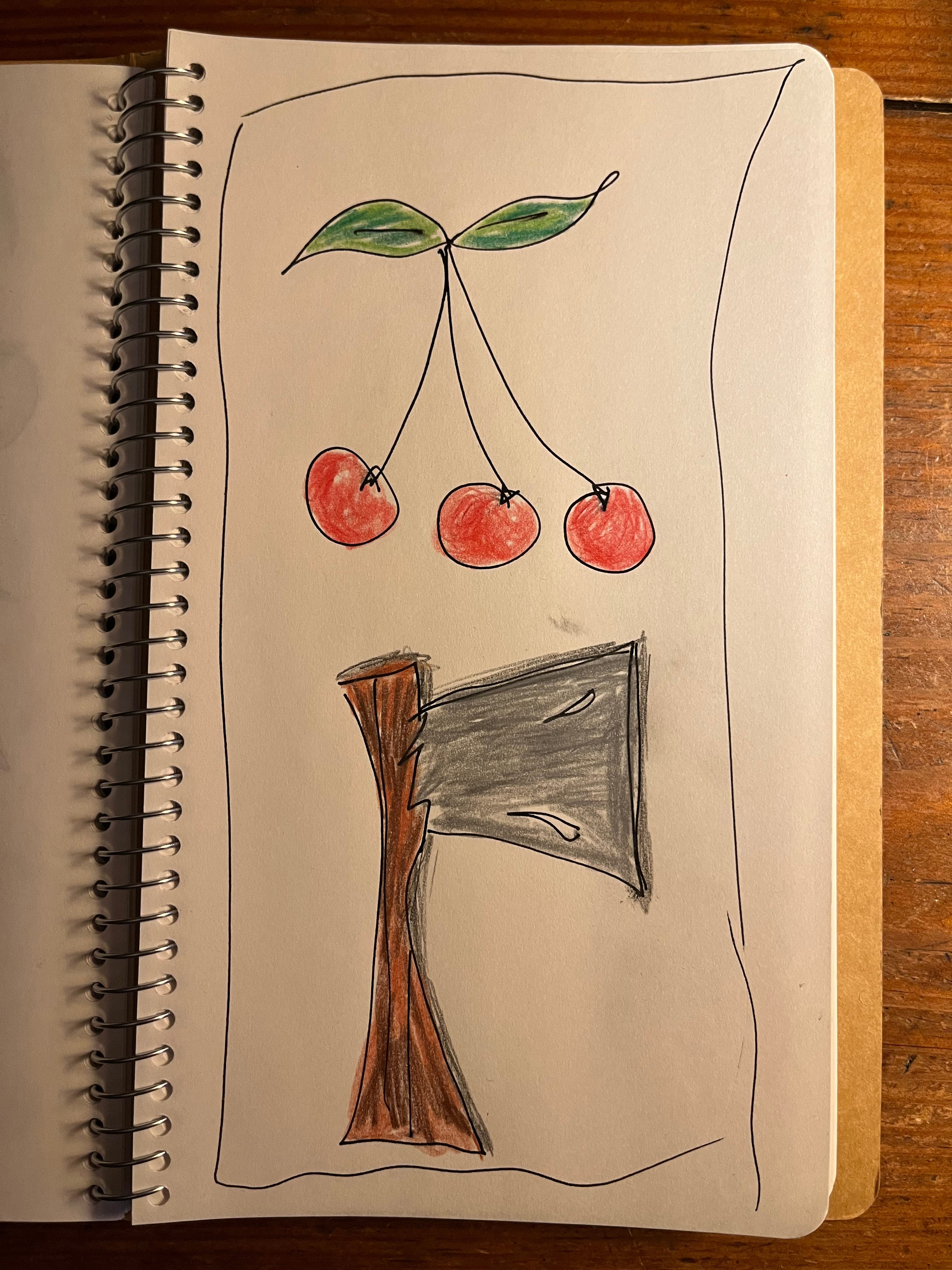
To demonstrate, Prof. Fleming drew these images in simple lines on the chalkboard:
“What is this story?” Fleming asked. My classmates, attending the Bread Loaf School of English from all over the country and the world, sat dumbfounded. I couldn’t believe it. See, I talked a lot, and I was practicing restraint, but finally I raised my hand.
“It’s George Washington and the cherry tree. I cannot tell a lie, Father, I chopped down that cherry tree.”
The class turned to me and looked at me like I had two heads. Fleming barked a happy laugh.
I explained to the still-lost class that I grew up in Virginia, up the highway from Parson Weems’s house, Weems being the man who wrote the fable about wee George, and a few miles down from Mount Vernon.
Fleming then went on to explain that this is a perfect example of how and why iconography—the use of simple symbolic images to represent a whole story—works in places that share a common culture.
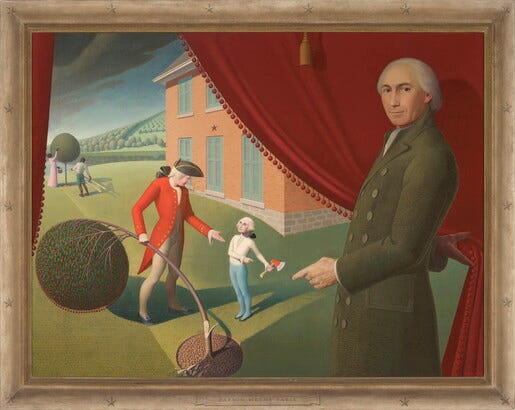
To learn more this Presidents Day about this fable, you can check out the Carter Museum and learn about Grant Wood’s portrait, pulling back the curtain on the myth. In 1800, Weems published The Life of Washington, which is well-known as the source for many myths about the first president. Written just a year after Washington’s death, it includes the story of six-year-old George admitting to chopping down a cherry tree and another about Washington praying at Valley Forge.
Who chopped down that cherry tree? asks George’s father, according to Parson Weems, who wrote, “Young George bravely said, ‘I cannot tell a lie… I did cut it with my hatchet.’ Washington’s father embraced him and declared that his son’s honesty was worth more than a thousand trees.”
Why create this myth about an already mythological figure, even by 1800? I guess to impress upon America’s youth the importance of honesty. But what to do when you learn the story is in fact made up?
Growing up as I say, along the Richmond Highway between the home of Parson Weems and Washington’s home of Mount Vernon, I learned this fable in elementary school, but I never learned about Washington, the enslaver. Not in high school, not in college. I remember a California friend visiting Mount Vernon with me and saying, “I thought this was just a myth,” meaning the whole plantation, the first American president, all of it. And it’s easy to see how anyone not from the historical grounds of colonial America might feel that way, or wouldn’t be shocked to see a slave auction block landmarked in Fredericksburg or Williamsburg, given the American tendency to mythologize the successes and sweep the ugly truths under our antique hooked rugs.
And really, the more we keep digging, and the more lenses we train on our history, the more truths we uncover, the more lies we reveal—the more interesting and complex and real our history becomes. It’s discomfiting, sure, horrifying at times, but isn’t it exciting, too? Isn’t truth worth seeking? How else to make this nation truly free?
This is where we turn to our artists.
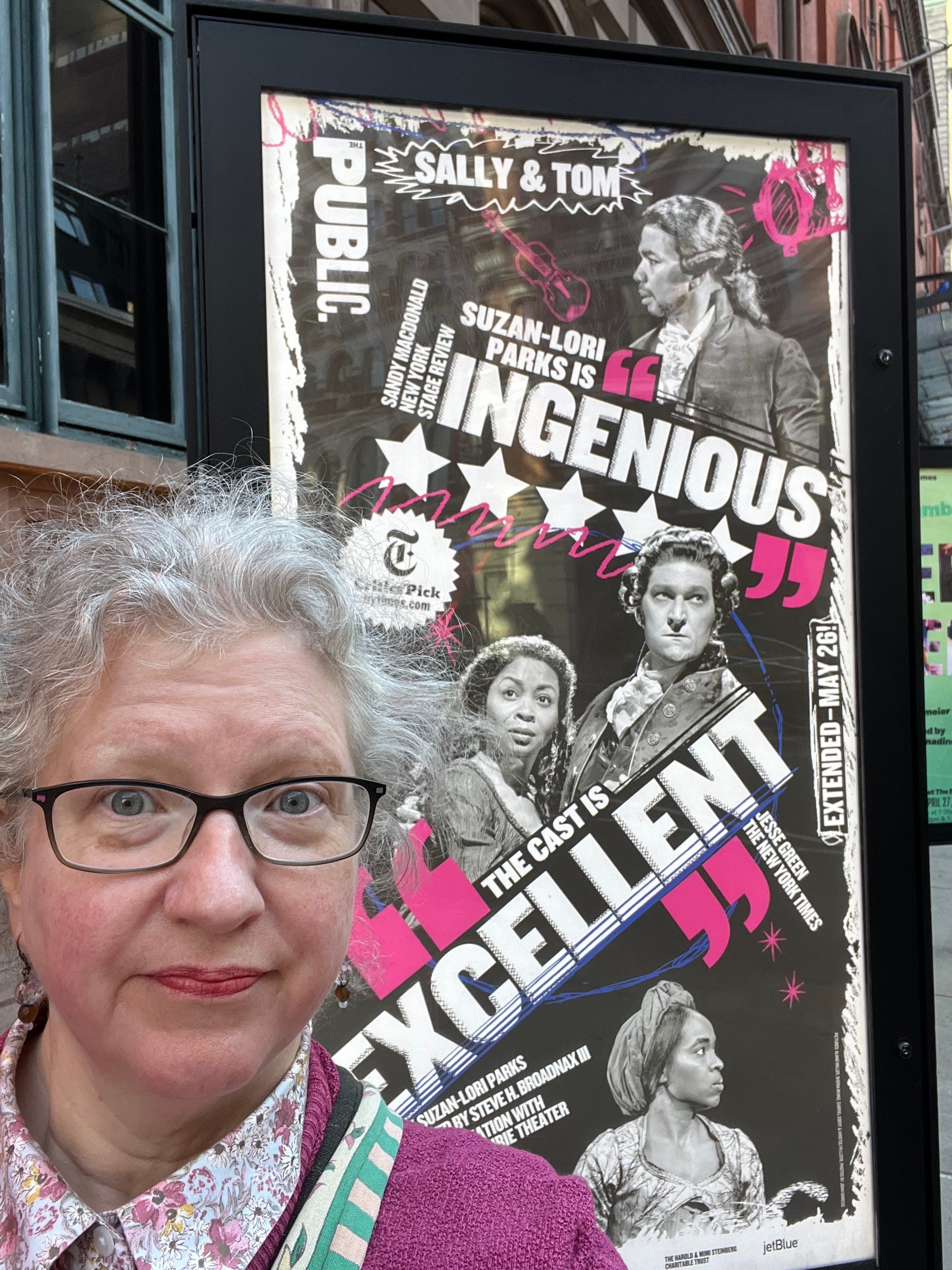
To explore perhaps America’s greatest “Lives of the Presidents” cover-ups, the relationship between Thomas Jefferson and his enslaved “mistress” Sally Hemings, Pulitzer Prize-winning playwright Suzan-Lori Parks premiered her play Sally and Tom at The Public Theater last year. The premise of the play is a community theater putting on a play about these historical figures while the leads are in a relationship. I loved the show, and I was fortunate enough to be there on a talk-back night. In attendance that night were several of the descendants of Thomas Jefferson and Sally Hemings and their families, as verified by DNA. I couldn’t believe I was having this chance to witness history. To watch as these family members meet one another after the show (many were sitting in the row in front of me) and walk up onto the stage—the set’s back wall covered in all of their names in the final reveal—to take photos with their phones, made me weep. (I think it would be a fascinating way to end the actual play.) It was wondrous, too seeing truth all up there like that. The theater was filled with love in the midst of revelations. That’s what art does.
Miss O’ outside The Public Theater, April, 2024.
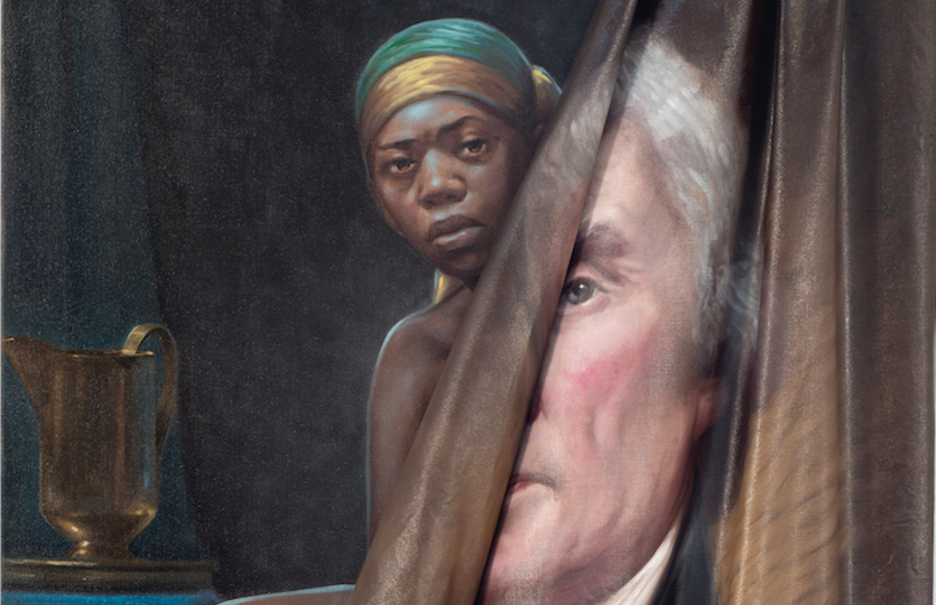
And I think also of that incredible painting by Titus Kaphar, “The Myth of Benevolence,” offering another way that art can reveal a deep truth in a way no historical record ever can, exposing long-hidden damage and forcing us to confront it. (Click on the link to see the entire painting and learn its story.)
A whole story from a picture. American iconography.
On what occasion do you lie? I look at the American story, then and now, and it’s seeded with lies and corruption, so many lies, you have to wonder, Can it ever come clean? How do we answer for it? These are the questions we all should ask and answer now. If we don’t, whom do we think we’re protecting?
On what occasion do you lie? Ask Gil Scott Heron, famous for saying “the revolution will not be televised,” meaning it happens inside us, speaks volumes about the impact of lies in the linked poem; and Kendrick Lamar, whose brilliantly coded and performed all-Black Superbowl Halftime Show blew me away. The enslaved lived in world of code. They had to lie about learning to read, for godsakes. Pretend to go along, to get along.
On what occasion do you lie? Ask women who have been sexually assaulted and been made to keep quiet or lose their careers. Ask the men who keep pretending nothing happened. Ask Sally Hemings.
On what occasion do you lie? There are real reasons to lie, moral, ethical reasons. To protect the ones we love. To save our neighbors. We are having to think hard about that now.
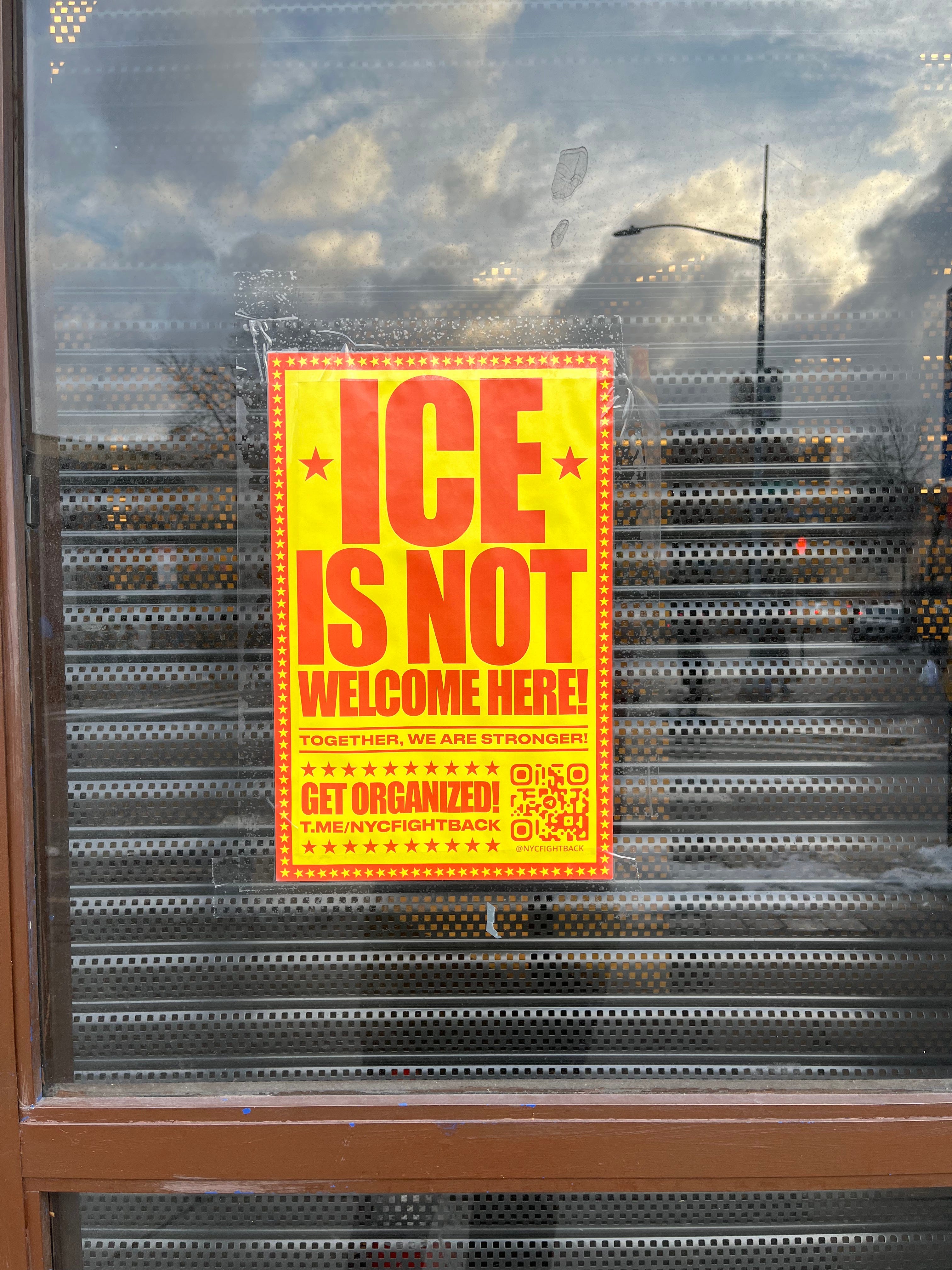
Republican lawmakers (that’s rich) want AOC arrested for teaching Americans and immigrants their rights. Photo by Miss O’ in her Queens neighborhood.
Because let’s face it: here in the United States, we are in a crisis of government amorality. We have a lying Republican party (no more rule of law); a lying president (pick a campaign promise, and yes, Project 2025 was the plan all along); a lying vice president (his autobiography exposed as a sham); a lying Supreme Court (see Roe v. Wade, which all declared, under oath, “settled law”); and liars heading every cabinet position (no, trans people are not the cause of America’s problems; and Putin is not America’s friend, Tulsi). We have liars in the Department of Justice and Homeland Security (immigrants are not remotely the cause of most crime; being brown is not a crime). We have liars heading the F.B.I. (the Democrats are not the enemies of America). It’s all lying all the time, now, and their truths are even worse. The freedom of Western Europe is now in the balance, as Vice President J.D. Vance admonished the “values” of those democratic nations this weekend, in essence praising the rise of fascism in France and Germany and also capitulating to Russia’s desire for empire. On the campaign trail, Vance said “democracy” but meant, we know now, “totalitarianism” (Europe is not America’s enemy, nor are Panama, Canada, or Greenland; our actual enemies are transparently heading our own government.)
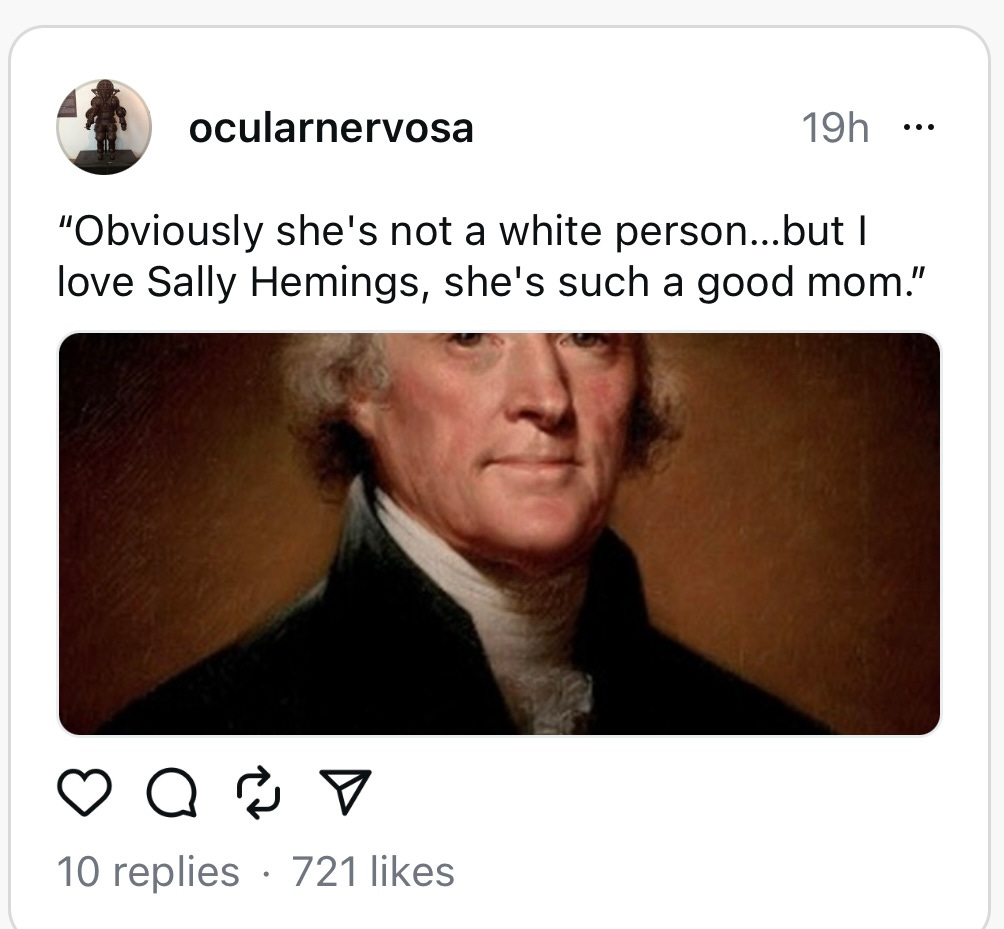
Past and present collide: JD Vance on his brown wife; I’ve heard Vance refer to their children as “her” kids. Look at the mental gymnastics and self-delusion of Vance, who denies his wife and children, and smiles.
To think that all of today’s stuff started with asking a simple question.
Identifying lies is not the same as responding to the world that supports those lies. There’s a very cool blog on Substack called The Pamphleteer by Lady Libertie, and she is focused on how we negotiate this new era. Check out “So You’ve Been Invaded: a French Resistance Guide for the U.S.” Pretending comes with the territory of survival. Marcel Marceau, for example, as a teenager pretended to be a camp leader, while his real job was to smuggle Jewish children across the border to freedom; he used the art of mime to teach the children silence as they walked. It’s not really lying if it’s saving lives, and the people you are lying to are venal.
I am a 60-year-old American white woman who has been steadily listening to Nina Simone and Miriam Makeba for months now, and today find that I have turned my Apple music subscription to Chappell Roan’s The Rise and Fall of a Midwest Princess. White girl voices are often too breathy and whiny for my taste (so, bless Adele), and the lyrical complaints about girls and boys and coffee date ghosting don’t exactly feel vital or resonant, but there is something compelling about Roan.
It’s good to know I can still be surprised by an artist, especially a white one, because lately I’m not surprised my much else white people do.
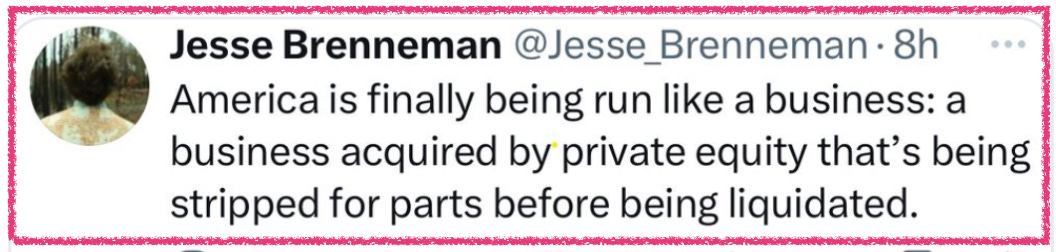
Anyone in America who works somewhere has probably been “acquired” by “a firm” of some sort for their “portfolio”; and as a result, we all of us feel this chapter of American democracy, as was, all too keenly: the Musk acquisition of America. I’ve read that the Republican voters who work in civil service never thought that the people they supported for office—that is, the venture capitalists and hedge fund managers and private equity firms—would actually strip the government and its Constitution and sell it for parts, and fire them, but they voted for Donald “You’re Fired” Trump despite all the evidence and have found out why he’s been bankrupt six times and still standing. Musk had swooped in and destroyed Twitter and it meant nothing to these voters, either. What did they think? Well, unlike Captain Renault in Casablanca, “a poor corrupt official” who knows full well how the game is played when he says, “I’m shocked, shocked to find gambling going on here” as he collects his winnings—these earnest civil servants living in their paper pushing D.C. bubble lack a social safety net moral compass. When you think life is only money, only “savings,” you may be missing, I don’t know, a heart. Or basic life experience. (And they are about to find out what unemployment looks like when there’s no money for them to claim, and no jobs to be found except the ones all those poor, now-deported undocumented people did. Godspeed.)
For anyone who needs a personal testimony of this process, the publishing house I work for was taken over, the first time, by finance people who quickly eliminated the Editorial Services Group (ESG) because they didn’t know what ESG meant. And they never asked us before handing out the pink slips and severance packages. The ESG, as it turned out, were the COPY EDITORS and FACT CHECKERS for our textbooks. Our product. Our source of revenue. And even after learning this, the financial overlords just shrugged. Who needs copy that is correct and makes sense in educational materials for America’s students? Who will really notice? $$$ (Now I do my job and their job.)
These are, after all, people who don’t believe in textbooks, obviously; we now formally live in a nation of capitalists who don’t value education because somehow they think they learned everything (and they think, everything) through osmosis.
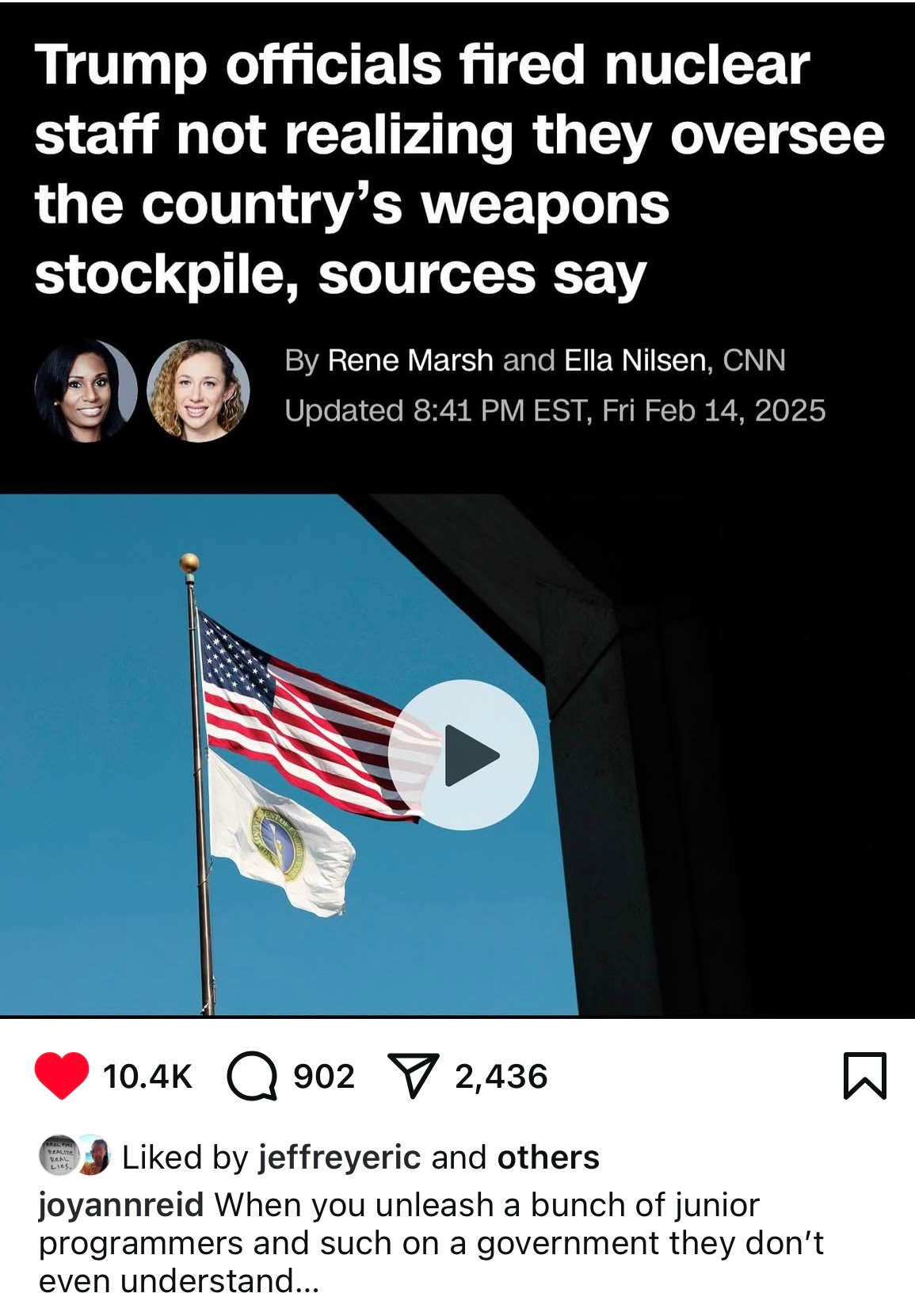
Cue today’s lethal gem of a typical private equity business slash move:
There’s not an American office worker in existence, or factory worker, or cashier, for that matter, who didn’t read that headline and nod.
Why do you need refrigerators? It’s a grocery store. No more refrigerators.
That kind of thing. Only now our entire nation’s security, health and safety, and economy are in the hands of, quite frankly, money fiends devoid of vision, purpose, or shame, let alone the “common sense” Trump claims to have. (Emerson called common sense “genius dressed in plain clothes.” Take a memo.)
In another example, I read that some 1.7 million HOMES around the country are vacant, sitting empty since being acquired by private equity firms, either for the land or the tax write-offs, with no interest in the communities in which the houses sit. Freeing these homes to be sold to people could end the housing crisis, maybe. At this rate we’ll never know. $$$?
My go-to comfort viewing during all this mess has been rewatching the 2019 documentary Toni Morrison: The Pieces I Am, directed by Timothy Greenfield-Sanders, like, a dozen times. I read a review that referred to the documentary as “flat,” and it occurs to me that it’s hard for the newer critic folks to enjoy being brought fully into a world as thoughtfully as this film brings you into a teacher and book creator’s life. The subject, Nobel Prize winning novelist Toni Morrison, is as great a subject as a literate viewer might want, unless what you want is a subject like Hemingway, who beat his four wives and fought to the death in wars and bars; or Pablo Picasso, who screwed two women on the same day and then painted them both, as a habit. I’ll take Morrison’s strong sense of self, her moral compass, unflashy living, artistry, deep humanity, and humor, thanks. And she has great literary company for additional commentary. It’s all about the love of language, and the way we use language to tell about life.
Morrison recalls a time in her early childhood where her sister was teaching her letters, and they would use pebbles to scratch the letters on the sidewalk. One day they saw a new word down the block, and they began copying, F…U…, and suddenly her mother ran out of the house and yelled at them, they were crying, they didn’t know what they’d done. In that moment, Morrison says, “I learned, words have power.” (I had a similar experience when a neighbor up the street taught tiny me and my brother Pat, “Eenie, meenie, minee, moe, catch a n***er by the toe.” Not knowing that word, I substituted one I did know, but when I used that word within earshot of my mother, it sounded bad, too, and I got yelled at. So I tried, “Eenie, meeie, minee, moe, catch a quarter by the toe.” Because I couldn’t say “nickel” anymore. My mother, realizing what she thought she’d heard, said that was fine. Even though coins don’t have toes. I learned that language can surprise you, that language is invention.)
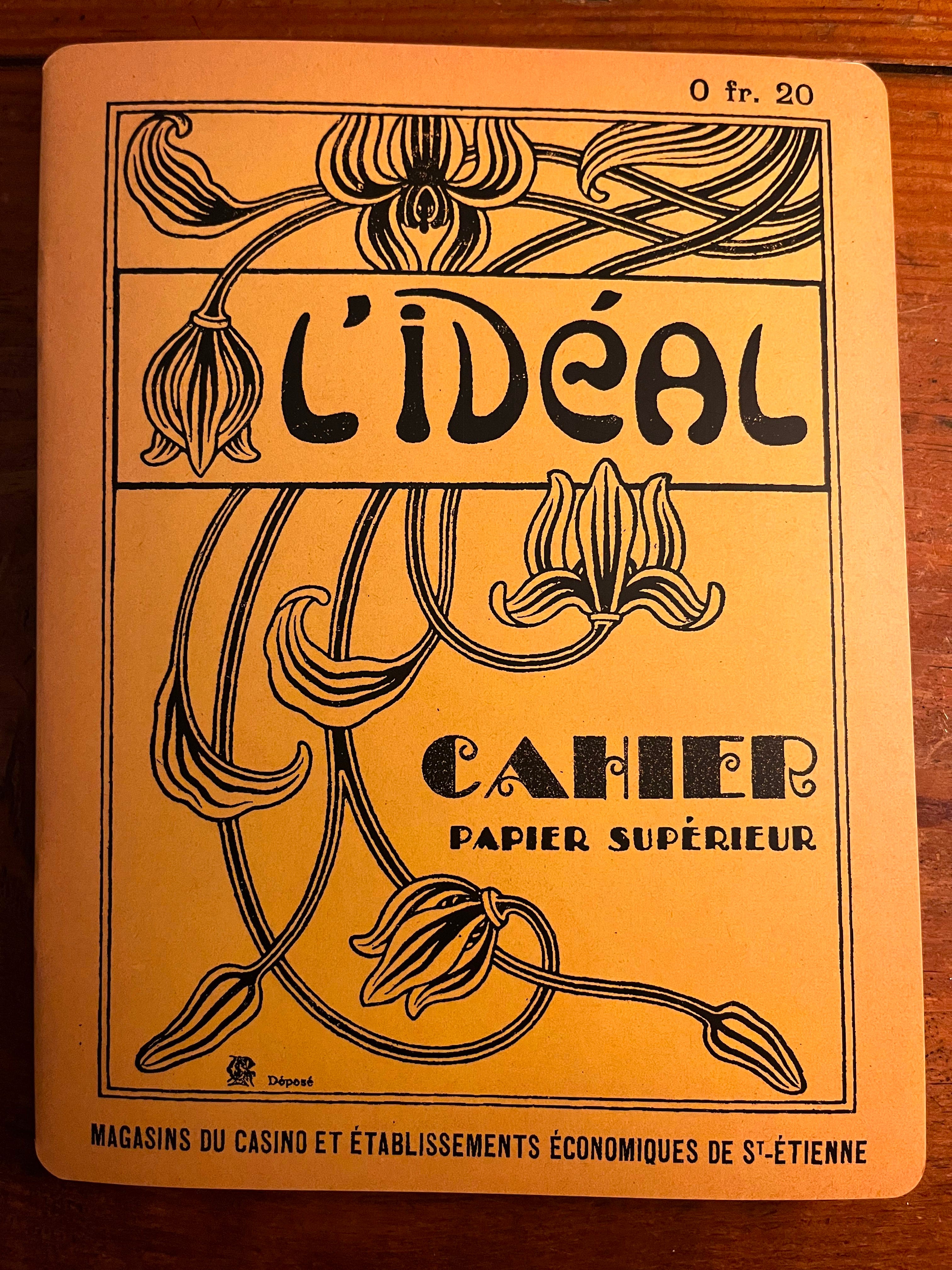
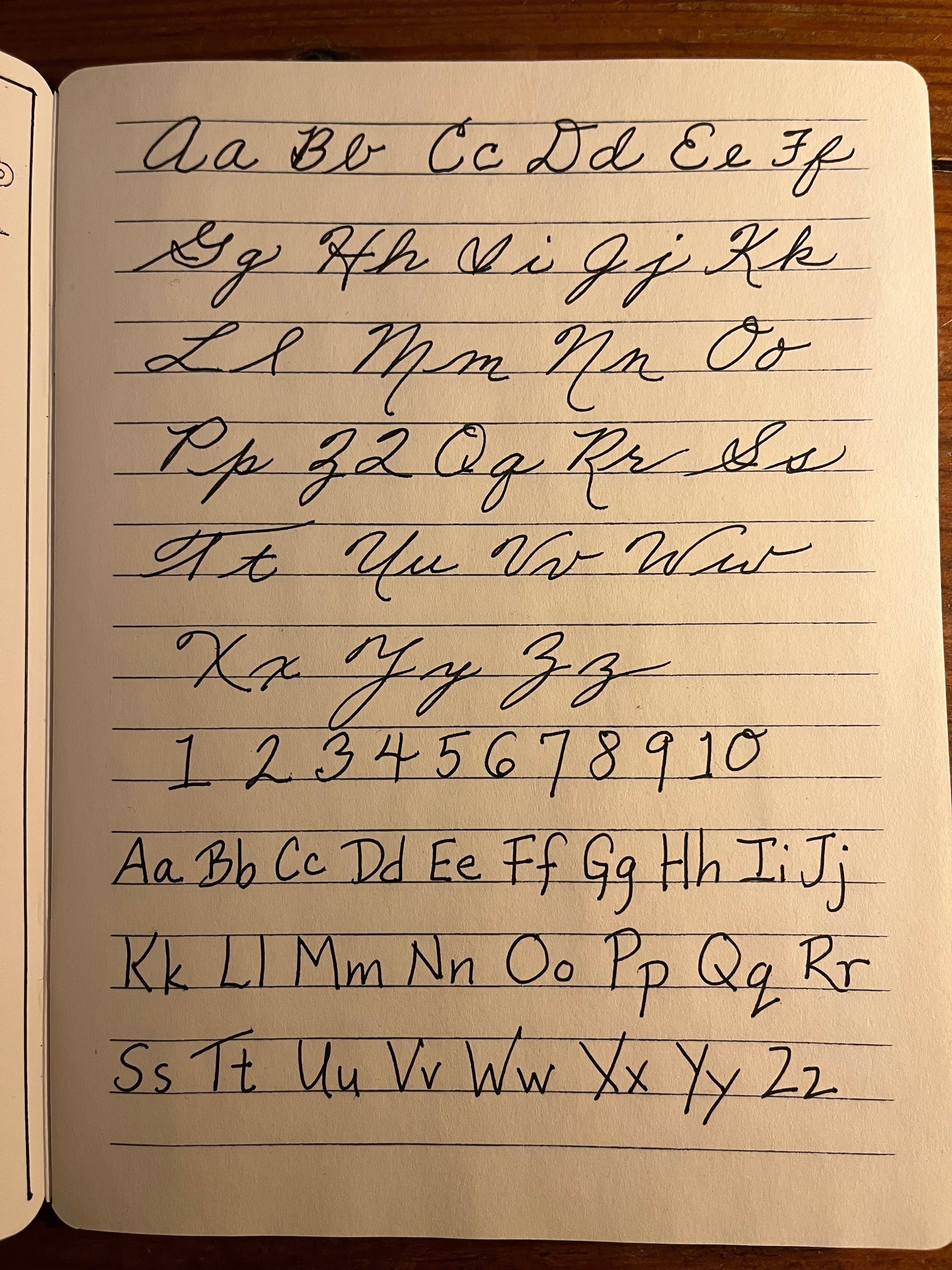
I bought this latest notebook at McNally’s on 8th Street yesterday.My first desire for this notebook, after placing impressions from all my rubber stamps on the inside cover, was to write all my letter forms and numbers. And it really got me into a sense memory of how much work it took to learn penmanship, to practice spacing, use the lines, to be able to form words to communicate. And I was impressed with my young self. I really was. Education is wonderful.
The opening credits for the film show an artist putting together an ever-changing collage of black and white photos of Morrison’s face, pieces from the many stages of her life, along with patterned paper, to jazz music, and I could watch that over and over just by itself.
But on this day of Black History Month, I want to share this observation Morrison makes about her growing up in Lorain, Ohio, a background woven throughout the film to create a familiar texture, one that grounds the artist in a relatable experience for most of us. “It was a melting pot, it really was,” Morrison says of the Blacks, Italians, Poles, and other working-class migrants who came to this steel town along Lake Erie, where “there was no shame in being poor.” Having enough to get by, pay the bills, have a roof, meals, your people—you know, you were good. (I grew up that way, to start. My parents were working class and moved to the middle class, and it was a big deal; values started changing, more materialism, fitting in, all that. Poverty stood out. As a nation of billionaire worshipers, we need to think on that.)
But more interesting to me this time is when she says that she had come to realize that the melting pot, “the cauldron”—and here she makes the pot with the hands—“is Black people. We are the pot.”
The United States of America would not exist at all without the slave labor of Black people, and we know that; and more than that, there would not be a culture without Black people, or at least not a culture I’d want to live in. Along with our Indigenous roots, Black music, dance, energy, love, drive, gospel, wisdom, persistence; Black love, righteousness, and willingness to throw their bodies at justice, at life, to boycott the bus lines of Montgomery, Alabama, for thirteen months—all this holds the rest of the (white) country together, makes this a democratic nation, and one I can stand to live in, if not be always proud to live in. Morrison’s late life understanding that Black people were the holders of what was melting in that pot, that they were the pot, hit me hard when I watched the documentary again last night. They were our models for the fights for justice.
I read this on Friday morning on the Instagram account of my favorite trans performer, 2024 McArthur Fellow Justin Vivian Bond. I went to the Stonewall website several times, where they also removed the “Q,” and when I scrolled down and it said, “Was this information helpful?” I chose NO, and a box asked for tips. Oh, I gave some tips. “Where’s the T? Where’s the Q? For shame.” Times 10.
On Friday, which I’d taken off to have a four-day mini break, I’d planned to spend the cold winter day at the Met Museum but instead took a detour to the Trans Rights Rally at the Stonewall National Monument at Christopher Street. I want to be an ally. Standing with all these people, where it all began, is a little surreal. “Let’s go get coffee,” one person said to a partner part way through, checking his phone. Stonewall made that possible—to just live your life.
And really, face it, without gay men, there is no Hollywood, no theater, no fashion, no clubs, no fun. Without lesbians there is no feminism, no suffrage. These are small examples, broad strokes, but you see what I mean.
American rock music—our greatest export—has its roots in American Indigenous music as well as African music. It’s not that there are no contributions by white artists, it’s just that this country would be unrecognizable, and without doubt way less interesting or dynamic, if left only to cisgender, straight whites. (Lawrence Welk, anyone? At least there’d be no Kid Rock, what with rap off his radar.) Watch what Trump does to the Kennedy Center, if you can. You know it’s cringe.
The ironic wit and hijinks of The Onion and improv theater notwithstanding, white culture has lately been elbowing out any good stuff in order to put that glaring spotlight on capitalism, our god; private equity, individualism, willful ignorance, winner take all, white supremacy, oh, and fuck you, parasite, should there be a fuck left to give. If you see what I mean. And porn. And rape. And brews for bros.
Time to melt that into the pot. And keep it melted.
Meanwhile, keep the faith, show up, find the joy somehow. That’s what I think today. I’m trying to listen to more music. Dance. And you might watch The Pieces I Am, especially if you feel like all this fragmentation of America is making you fall to pieces. It’s so hopeful. And read Beloved.
Love,
Miss O’
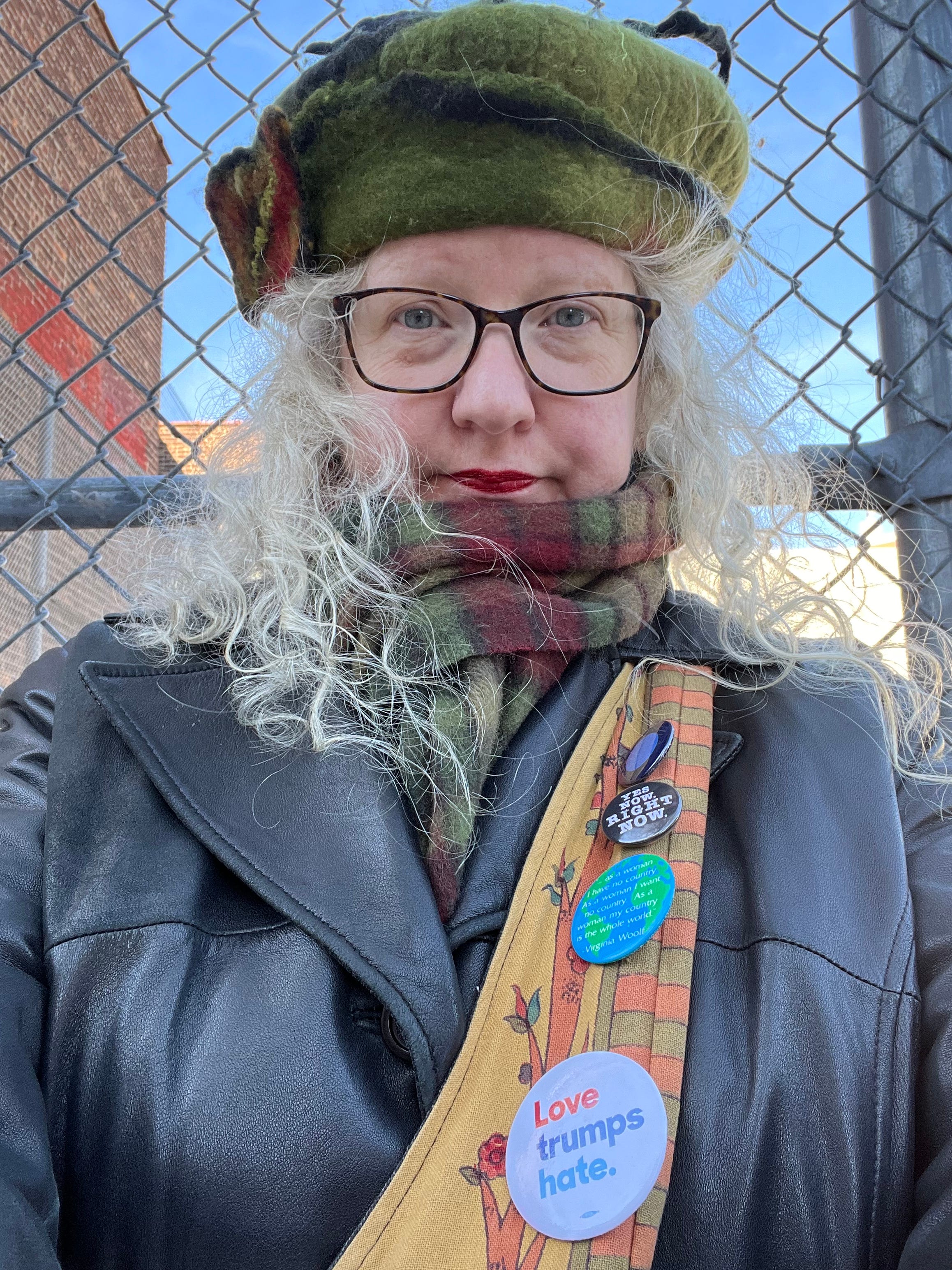
“As a woman I have no country. As a woman I want no country. As a woman, my country is the whole world.” ~ Virginia Woolf, paraphrased. Blue button and “Yes Now Right Now” button by Lisa DiPetto and available on Etsy. I had really hoped my Love trumps hate button would be a relic by now. P.S. Red lipstick was a sign of resistance against Nazis, fyi. Nous continuons.
So all the ick news first, aside from all the Musk-Trump criminal dismantling of every living institution in America so that it’s close to unrecognizable (taking over the Kennedy Center? The National Archives? closing what Department?), I learned at work this week that the two editors I supervise applied for a transfer to another (lately resurrected) department where they’d previously worked because they can do what they are best at there (I choose to believe it’s not about me) and got it, and that I will have to finish a huge project probably alone, the timing being what it is; then, at my ophthalmologist’s office for a checkup, I learned that not only am I at the beginning (and still reversible) stages of diabetic retinopathy, but also that I owe an outstanding balance of nearly $500 (of deductible-meeting crap) from visits over the past four years because their billing department never sent me the bills; and then I learned from my CPA that my company inexplicably failed to take out the correct amount of tax (and all week I’ve tried to correct it for this year, but the system doesn’t work, and we no longer have humans working in HR (take that in) and I am screaming into screens) and so instead of getting a refund, I in fact owe some $1,500; and the tendinitis in my write-hand (punnyha ha) wrist is so bad still after three months, medicines, and PT, that I would have to spring for a cortisone shot (sweet, sweet relief after the injection site pain and, obviously, the bill). Poor fucking me.
Thank you, internet.
But one day this week—I think it was the eye appointment day, Wednesday, when I returned home with dilated eyes and shock at hemorrhaging money—on the way into the city, a Black female conductor announced at every stop (because the N-W-R-Q lines still do not have recorded voices to announce stops, and I love that) something to this effect: “Ladies and gentlemen, let the passengers off first, let’s help each other out, everybody, let the people off first before you try to get on. Move into the middle, people, help everyone out, we’re all together here.” Love her heart. On the way back to Queens that same day, a Black male conductor did much the same, adding on occasion, “It’s not about the price of groceries, everybody, just help each other out here and move all the way into the car.” This same conductor also used the intercom to explain the location of every staircase, connection, and elevator at every single stop. A total doll.
And if you are like me, you can’t help but look up and down the train car, men, women, children, every color and shape and gender and age and religion and background and profession, staring into phones, or not; bundled up, world weary, and it hits you all over again that the reason “white middle America” is afraid of brown and black shadows is because they literally have no idea how New York works. It’s not perfect, never that, but it works. Look at us. Us. Right here in this train car, crowded, or not, for miles of stops along our way. Not yelling at or killing each other. All of us just being.
Also in my travels, I found myself thinking about a poet friend who lives in a rural area, who years ago, when I mentioned how much I loved the movie Lost in Translation could only grunt in disgust. When I asked why, she said of the lead characters, “All they did was squander an opportunity to see Japan.” I had to think for a second, because I was remembering the filming of Bill Murray’s whisky commercial, the Tokyo karaoke bar, the hotel bar nights, Scarlett Johannson’s quiet excursion to a Japanese garden and learning flower arranging, and of course the hilarious trip to the ER so Bill Murray can get Scarlett’s broken toe seen to—all these relationships and stories they will have to tell about, or not, when they return home. What did my friend mean, “squandered”? I started thinking. I guess another view is they didn’t really do all that much…and then it hit me. I said, not at all angry, but with a sense of discovery, “You’ve never traveled outside the country, have you?” She looked at me suspiciously, and slowly shook her head, as if her response to a movie shouldn’t depend on having had the experience. More to the point, though, she had almost never, within or out of the country, traveled alone. And there it is.
What was lost in translation for her in watching Lost in Translation is the feeling of sudden paralysis brought on by the jetlag stupor you feel combined with being quickly overstimulated in a new place while on no sleep, while being both excited by the prospects and daunted by selecting the best thing to do right now. The one universal is a bed (never one you can check into before 3:00 PM) and a bar or cafe, and heading to either one can give you a chance to sort of recover your wits (if you know how to manage the currency), but when you are alone with no one to bounce ideas off of, being in a new city, whatever the language, can be pretty isolating. One time, visiting London, I spent nearly one entire first day just sitting alone on a bench in Tavistock Square, where Virginia and Leonard Woolf had lived (in a no longer existing building, bombed out in WWII), underdressed (a cold day for summer) and disoriented, and in those days, a teetotaler. I could barely make myself try to find a place to have tea. If I did eat or have tea, I don’t remember. I remember a white-gray sky, damp chill air, and just watching people against green trees and grass and gray buildings.
Did I squander my first day in London? Not at all. Oddly, that first day of “doing nothing” is still the one I remember most vividly and fondly, whatever the discomfort and confusion. I was there, in the heart of London, on my own, unremarkable, on an ordinary day. Not bad.
As a result of my many NYC train treks this week, it also dawned on me that perhaps the reason I needed to leave Facebook, finally, was that my life in New York can be one of overstimulation even on the dullest days, and that Facebook had become more overstimulation, not sure which way to look, who I’m forgetting to check in on, that sort of thing. Maybe I’m just not wired for all that anymore. I know that many people can simply sit on a virtual Facebook bench and do nothing, or idly and dispassionately watch the goings on, not unlike I did in Tavistock Square or Scarlett and Bill did in Tokyo. You do you, as the kids say. However we engage, or don’t, we are all in it together, so move to the middle of car and let everybody onto the train. And remember to give people their space (remarkably, New Yorkers do know how to give you yours, even by a fraction of an inch, and if only the whole country could cotton on, that would be great). After all, everyone here with you is simultaneously present in a pubic place and also living a very private drama of their own.
One of Miss O’s many, many notebooks.
All of this is just to say, dear friend, given all that you are going through in your personal life and against whatever landscape this letter finds you, I know that you may merely glance at or dip into this post, and I completely understand. Thanks for reading at all, and whatever you do, don’t strain yourself. Enjoy your Sunday. Let me hear from you when you get a chance.
P.S. A few weeks ago I published part of a play I’ve been working on, but I don’t know if WordPress is the best outlet for me. Thanks to all who read it, in any case!
Hi, kids. If you are a friend of mine, I am not telling you something that you don’t already know; and I’ve written about this before. But a few years ago, my late super, who was from Eastern Europe under communism and who had never learned American history—not unlike contemporary whites in red states today—asked me, “Lisa, can you tell me please what it is about the Blacks?” I didn’t follow. “Why all the whites hate them. What did they do?”
Do you hear his question? Here’s a man who at that point had lived two decades in the United States, himself an immigrant working around every conceivable type of immigrant, from tenants to other supers to management, in the most diverse area of the world, my borough of Queens in New York City. He heard and saw all the racism, surely from the white men (because I still hear it now through their support of Trump), but he really didn’t know where it was coming from. “I have these Jamaican guys who do the electrical work for the building, there, and they are great. They smoke the marijuana, the smell, my god, I hate it, but they are great.”
And so it was that Miss O’ did a brief history for him.
Black Africans were brought to the United States in chains beginning in 1619, if not earlier, men, women, and children captured by white European men or purchased as prisoners in their own land where there was no concept of enslavement for life let alone forever in perpetuity along with your families, which is what whites did in the United States. To justify this horrific practice, and to justify unlimited greed, whites started deciding that they were superior to all other colors of humans. They must be, because as the Puritan descendants of the Second Great Awakening said of being among the elect going to heaven (as explained to me by my 11th grade high school English teacher Chuck Edwards), “Surely, if you were not among the elect, surely God would not have blessed you with a Cadillac.” Or made you white.
The plantation system in the American South made each plantation owner a little king, a greedy little tyrant (just like the “farmer king,” King George III from whom we were emancipated, oh, irony), who kept all the money he made from his crops and made even more by working slave labor just about to death—no hope of leaving, no money, no say—morning, noon, and night, and forcing the strongest Black men to “breed” Black women as a bull would cows, when the tyrant wasn’t raping those same Black women for his pleasure and a stable of more (mulatto) slaves.
Meanwhile, the white people in the South who did not own land, and that was nearly all of them, had no work. They looked on, impoverished, as these Blacks were “given” houses and food in exchange for work, work which poor whites did not have, homes which poor white were not given (clearly not comprehending the horror). There was a growing (and understandable) resentment. To quell this, white tyrants told their legions of poor whites, “Always know that at least you are superior because you are not having to labor like these beasts.” To appease them, the tyrants dropped a nickel and handed a gun to any poor white man who was pissed off and said, “Guard my slaves.”
And so it was that for 400 years, poor, uneducated, angry whites came to believe that they themselves would have more if only those Blacks weren’t here, and that guns were identity. And they weren’t wrong, though their logic was. What these charming, charismatic white tyrants were able to convince these poor whites of was that he, the landowning rich tyrant, had no choice but to use “free labor” so that he could be rich and live like a king, that God had blessed him, and he had to fulfill this promise to God by being the richest one.
And despite a Civil War, despite education and marches and all of the hard work of generations of Blacks, Native Americans, and enlightened, moral whites (immigrants all), there are still vast swathes of white Americans who truly believe that IF ONLY there were no Blacks (and now browns, too), they themselves would have it so good.
The Donald Trumps of the world—the ones who deny wages, safe working conditions, clean air and water, and health care to anyone not them—have been such absolute geniuses at convincing poor white people to feel so sorry for them that these poor white people empty their pockets and do whatever it takes to prove their love to the rich white man God. And the poor white people stillblame Blacks for their fate.
I learned about this book from the Toni Morrison documentary, The Pieces I Am. Recommended reading.
Following my quick take on the horrors of the Black experience and white supremacy, my building super from Eastern Europe was silent. He looked at me and said, “Why they don’t kill all of you?”
That’s the million-dollar question.
I’m about to make a couple of broad generalizations.
Black culture in America is a culture of love and faith. It’s a culture rooted in ebullience, joy, dance, music, energy, justice, hope, and deep, deep love despite deep trauma and great suffering. I have seen it and felt it all my life. Not that there aren’t assholes and tyrants; I’m talking about roots.
White culture in America, dating back to Puritans and colonizers, is a culture rooted in punishment, jealousy, cruelty, demands for some kind of Christian self-abnegation (that no one can achieve), faith in (one man’s) white superiority, and fear born of trauma, our original sins of Native genocide and Black enslavement. White is right. Spare the rod and spoil the child.“God’s will” is for me to lord it over you. I am God. Not that there aren’t lovely white people; I’m talking about roots.
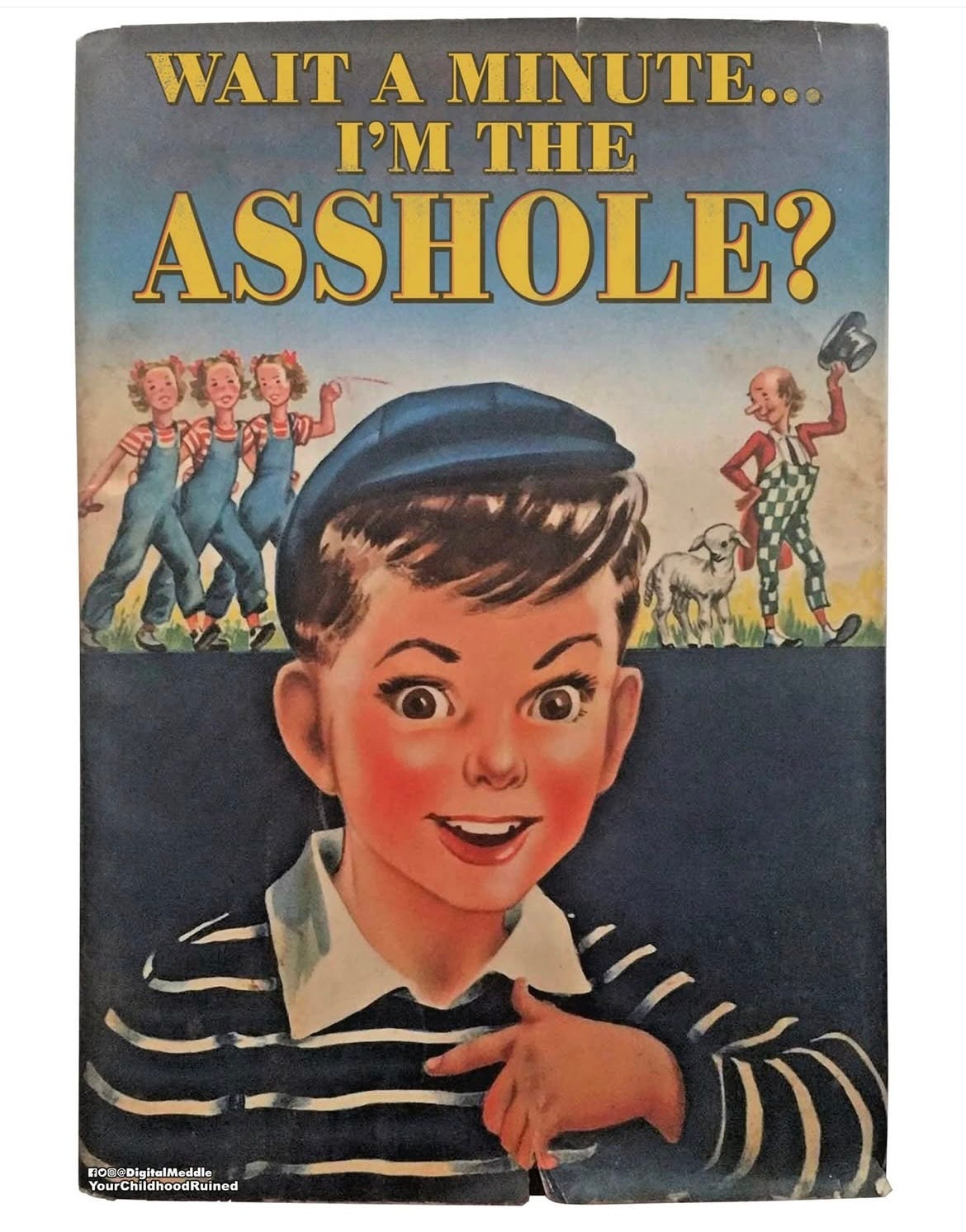
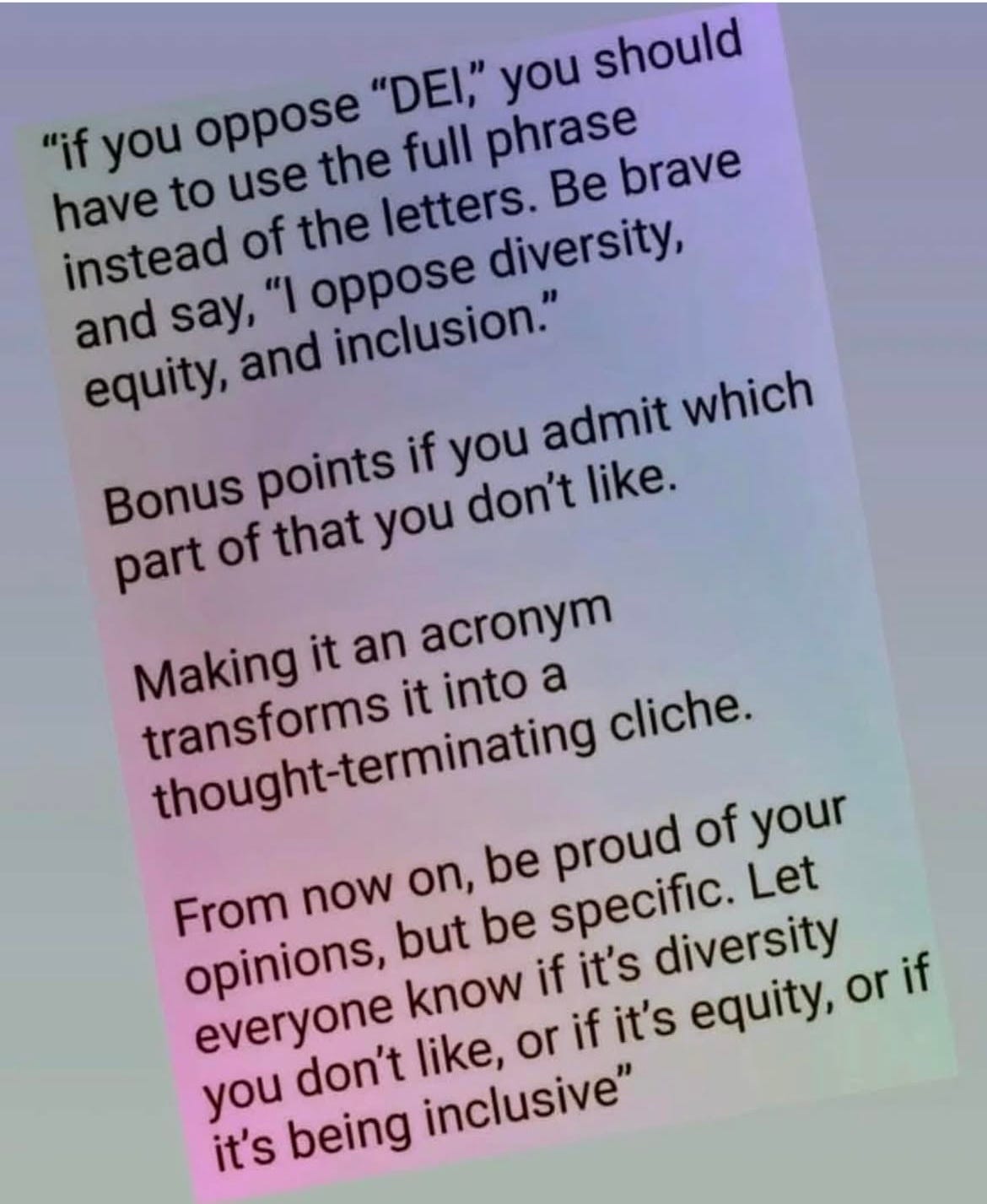
See how white supremacy works? Image from the web.
And I am so fucking sick of white culture—the good things whites bring to the table are, perhaps, irony, Greek logic, and wryness (all of which are embodied by The Onion), and of course Mary Oliver and Shakespeare and bagpipes. Right now, for me, that’s about it. Even the best of our white politicians play by the white tyrant’s rules without even realizing it. We all do.
You can follow Digital Meddle Your Childhood Ruined on Instagram.
“Mediocre white boys,” to borrow from the brilliant and righteous Rep. Jasmine Crockett (D-TX), have taught all of us whites—ALL of us—to feel sorry for them. To pity them, poor helpless things. To give them money and power. To give them a pass. Meanwhile, all that the rest of us sentient whites do for our entire lives is play that same old song, “RESIST,” and I am so fucking sick of it. These white men rape, they steal, they stiff, they destroy, and then they smile, and we pity them all over again, don’t we? And carry our clever signs to the latest march.
This is changing. I do see hope. But we have to crack it all open and drain out the rest of the pus. White culture as a whole, ultimately, must change, or else we take the planet down with us. And this Black History Month, we have to see the joy of embracing all the greatness that Blacks bring to the world. Celebrate. Emulate.
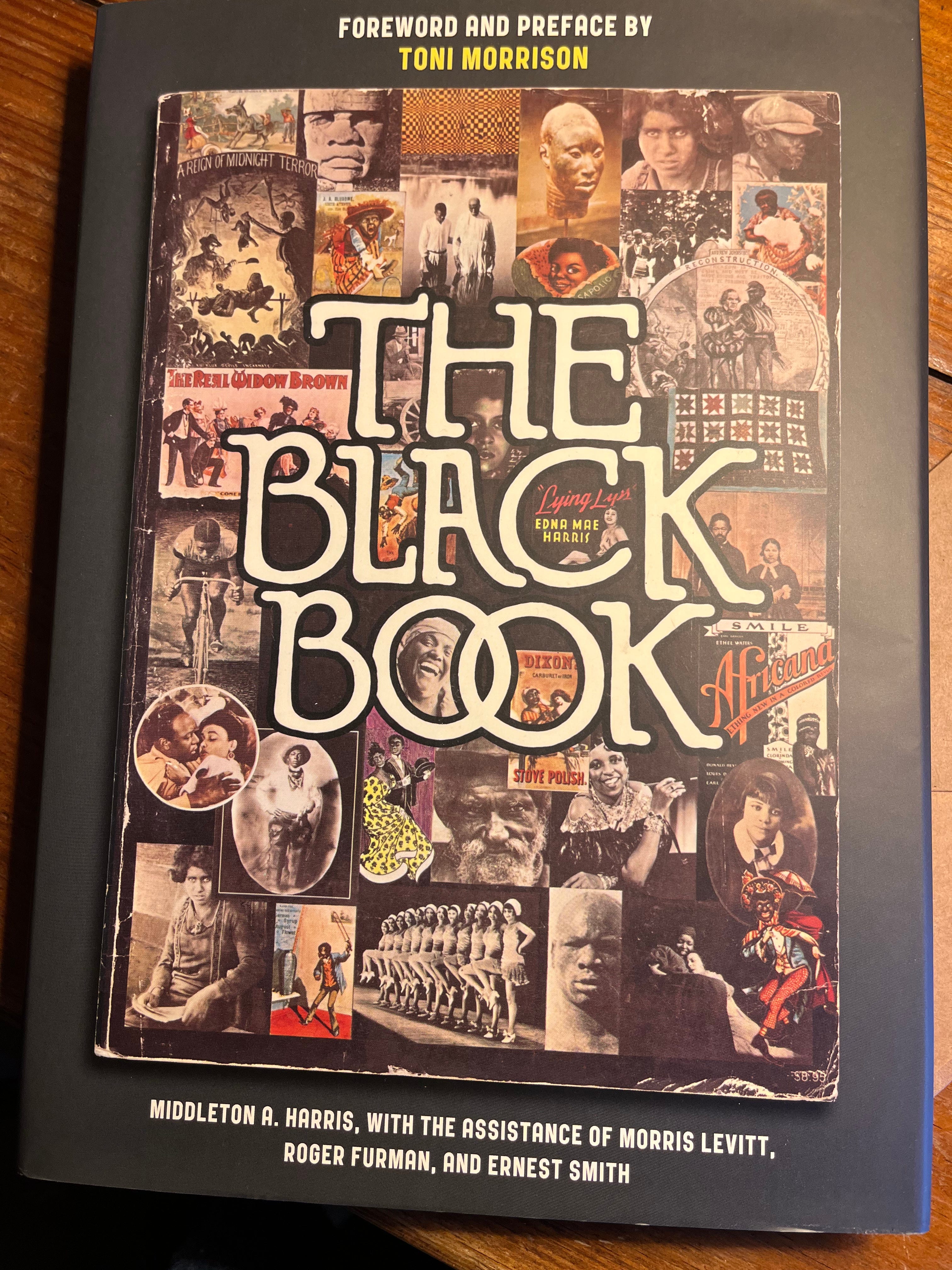
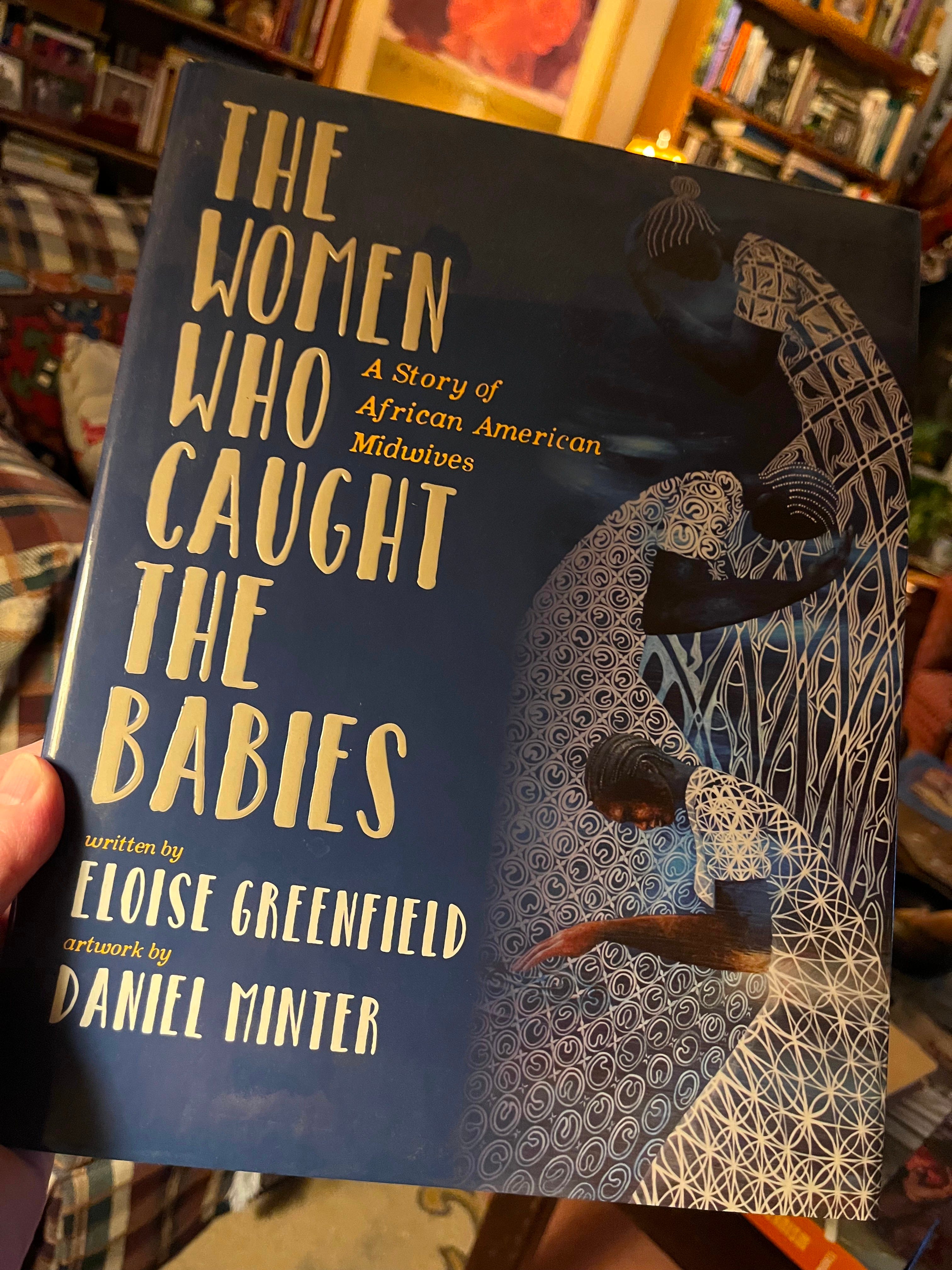
Last night I looked around at my personal library, and I decided that for Black History Month, I will post pictures of the books I own, starting with children’s books I love.
I can’t explain how the story, the format, and the pictures accomplish their miracle, but I cannot read this book without laughing and ugly crying. It’s beautifulSuch a surprising and wonderful subject, beautifully told and rendered.What we as humans should all share. Come on, now.
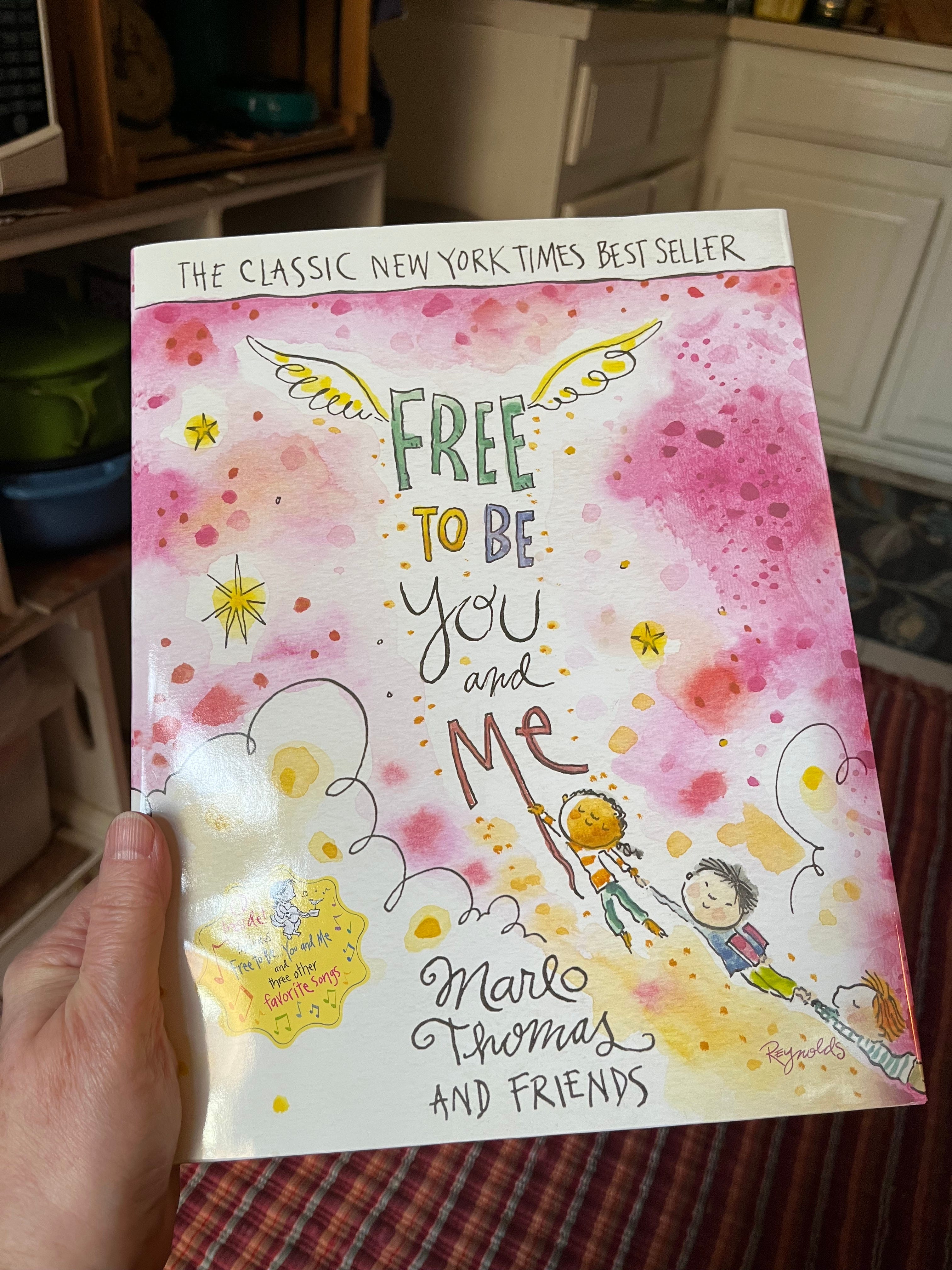
In pulling these wonderful books out to reread (and I’ve never understood why great books have to be categorized into “children’s books”) and suggest for you, I also happened on my 50th anniversary copy of Free to Be You and Me.
Back in 1972, Free to Be You and Me, both a record album and book, became national bestsellers. I know I’ve written about this before: the album, played in elementary and middle school classrooms all over, the book on library shelves, featured “Marlo Thomas and Friends,” and her friends included Mel Brooks, Alan Alda, Lucille Clifton, Judy Blume, Carl Reiner, Shel Silverstein, and many other wonderful talents. In 2002, however, about the 50th anniversary of this remarkable celebration of diversity in community, the publisher was silent. Why? Because the MAGA millions would have demanded the banning of the book, would have stormed the publisher’s offices, maybe, so ignorant, angry, and fanatical in their hatred of anyone not white and male, had this group become.
I don’t know about you, but today, February 2, 2025, I feel like I’m living through the classic American movie Groundhog Day.This lunatic country can’t seem to move the hell on, grow up, be joyful, and get a goddamned grip on itself. In 1972, coming out of the peace and love movements that emerged out of civil rights and voting rights struggles, antiwar protests, extreme violence by our police and military on peaceful American citizens, Free to Be You and Me was this joyful, light, funny, and also serious clarion call for all of us to see the wisdom, really, of children, of artists. Love people. Learn about them. Celebrate the good. Sing, read, play, dance it out. Do you work. Have fun doing it. Look at us now.
In my Creative Drama class in middle school, Miss Graves played this record over and over, using it to teach about the many ways to tell a story.
When Ronald Reagan was elected to the presidency in 1980 (ironically, his catch phrase was “There you go again”), all the promise of progress embodied by President Jimmy Carter not only came to a screeching halt, but we went back 80 years. Groundhog Day, all over again. The journey of Phil Connors (Bill Murray) is our American story.
When President Barack Obama was elected by a solid majority in 2008, and his inauguration was attended by the largest crowd ever seen, then and to this day, I ugly cried with relief. Finally, I hoped, we were moving on, like that time Bill Murray’s Phil finally has a great date with Andie MacDowell.
But it doesn’t take, that great date, and Phil just fucks it all up again, day after Groundhog Day, because he can’t seem to learn anything about how to be a better man.
We elected Trump. Twice. See what I mean?
All of President Joe Biden’s progress is being undone. Trump’s administration and all federal offices will no longer celebrate Black History Month or Juneteenth; the CDC has taken down all information about LGBTQ+ acceptance or health; these fuckers think they can simply erase all the progress, all the humanity, all the education of two generations.
Phil’s fucked up Groundhog Day yet again. “I got you, babe.”
But you know what? Remember in that movie how Phil has to go to rock bottom, to day after day after repeated day including numerous violent attempts at suicide, before it finally occurs to him that aside from feeling like a hopeless immortal god, he might, you know, use this gift of eternal life to learn piano, say, to save lives, to make friends, to bring his coworkers coffee, to invest in the community?
I think it’s vital to our survival to remember the message of that perfect movie, that for each of us, life is Groundhog Day. You wake up, you begin, and you can live it the same way you did yesterday and the day before that, or you can begin anew, grow, find joy, and have a good time in your personal hell. I’m not saying it’s easy.
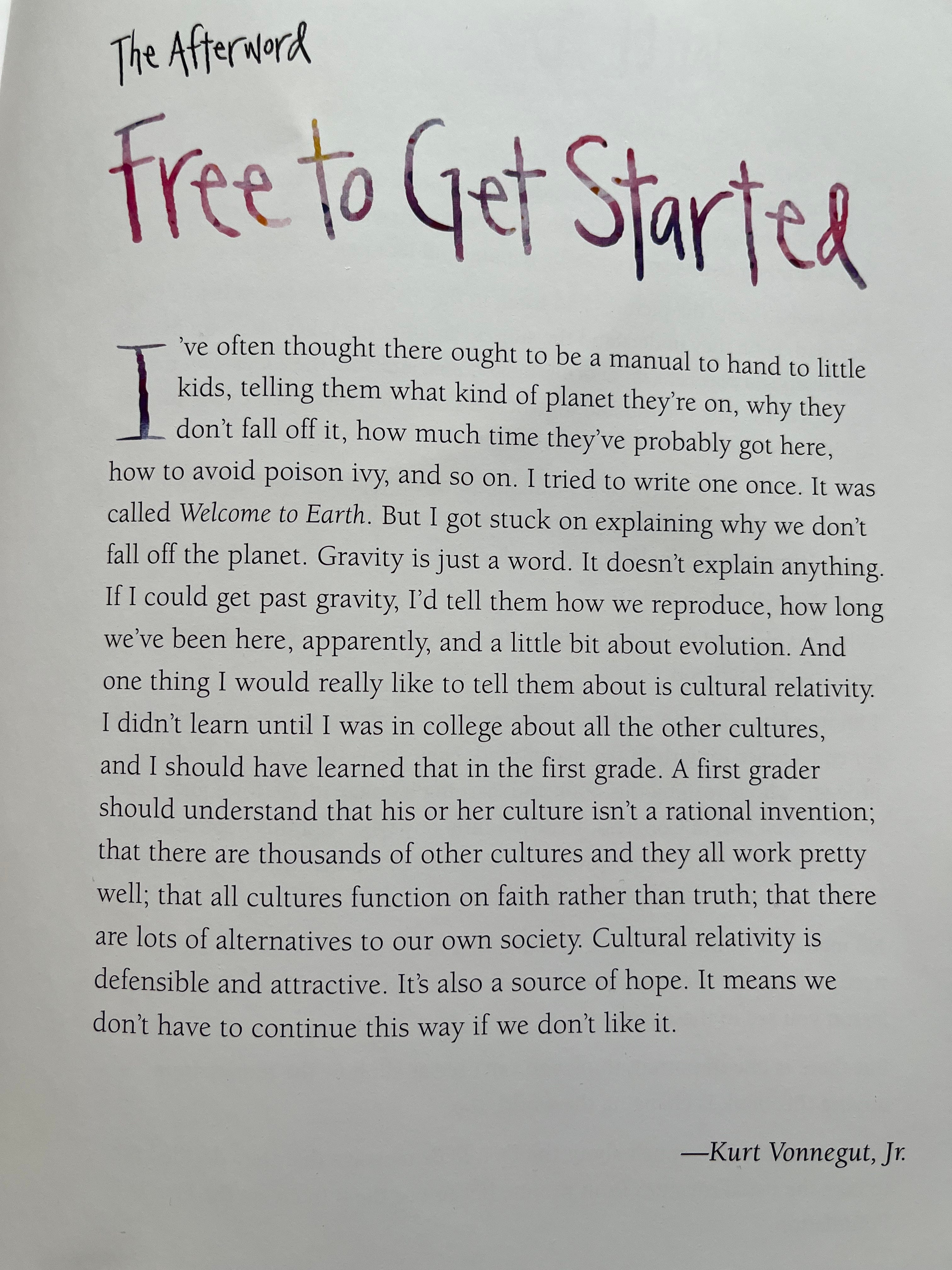
Kurt Vonnegut, Jr., one of the finest writers and minds this country ever produced, lived through the horrors of WWII and produced Slaughterhouse-Five, or, The Children’s Crusade: A Duty-Dance with Death in 1969, five years after I was born and three years before Free to Be You and Me, for which he wrote the afterword:
Into the second day of this Black History Month, on this Groundhog Day, I hope we realize we don’t have to continue this way if we don’t like it.
Sending love,
Miss O’
P.S. The Ed Sullivan Show, on the air from 1948 until 1971, when I was 7, was this marvelous compendium and showcase of all the wacky and beautiful and radiant stuff what was our common culture. For Black History Month, I’d like to close with “Pata Pata” by Miriam Makeba, should you need to celebrate living.













 The Miss O' Show (Teacher's Edition)