Gratitude

(Even when you keep missing a beat)

How have you been? How was Thanksgiving? Mine was really nice, thanks, celebrating with friends (my age) who also lost their mom, two days before last Christmas. In honor of my mom, I made a version of Lynne’s homemade stuffing, and my dad and Jeff tried to make a version, too. Foods are touchstones. I hope you were able to make and enjoy some delicious touchstones, too, in the midst of feelings.

This year has been hard, hard, hard on far too many people on this earth and much of the world suffering is the hands of three white male power mongering thugs in their 70s (Trump, Putin, Netanyahu), and their minions, and I have this problem where I feel guilty even thinking about personal joy or grief amidst all the suffering. (As you know, I live alone for a reason.) And I’m struggling with myself, as we do. It’s funny to keep doing this at 61, but here we are.

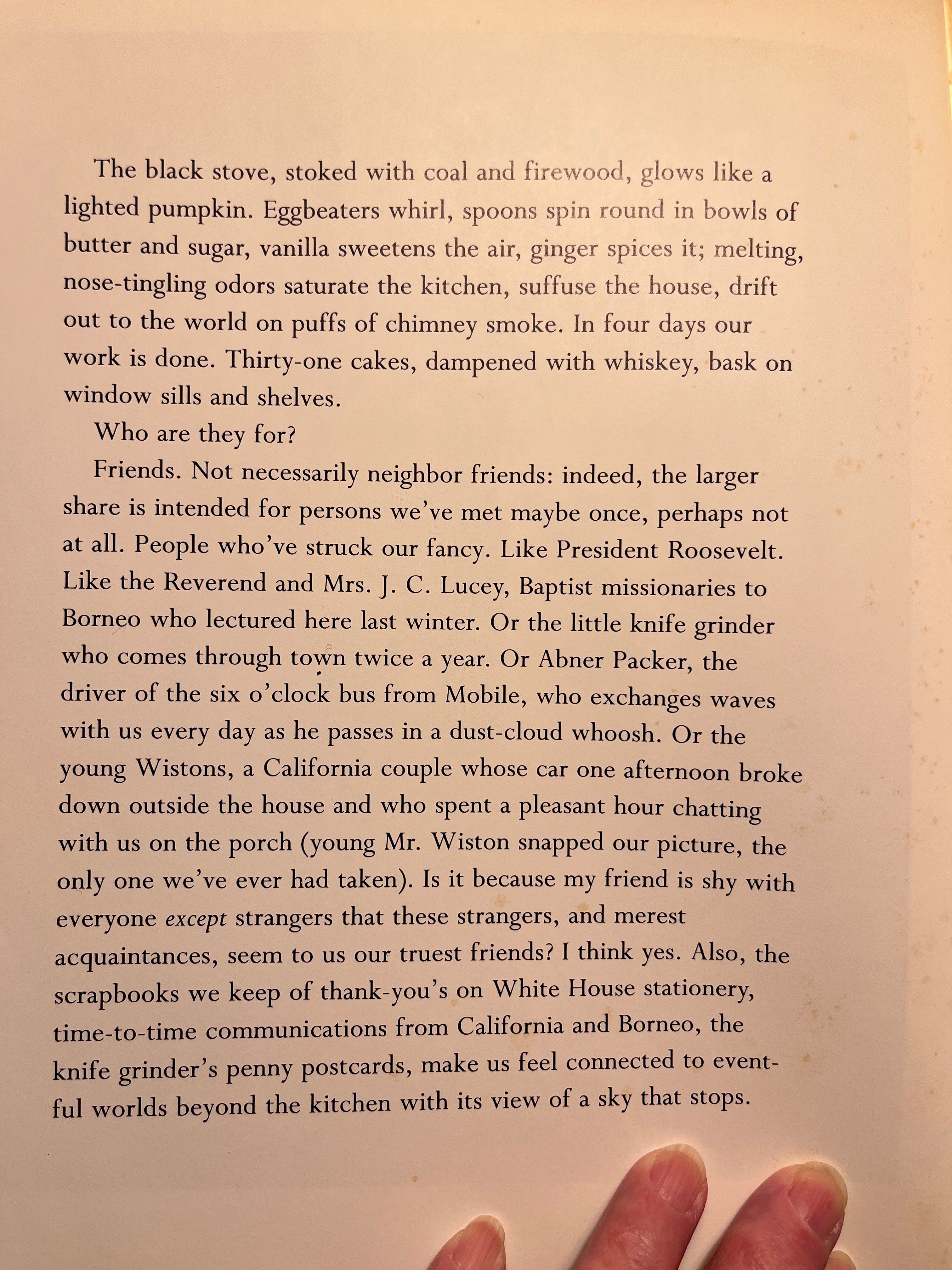
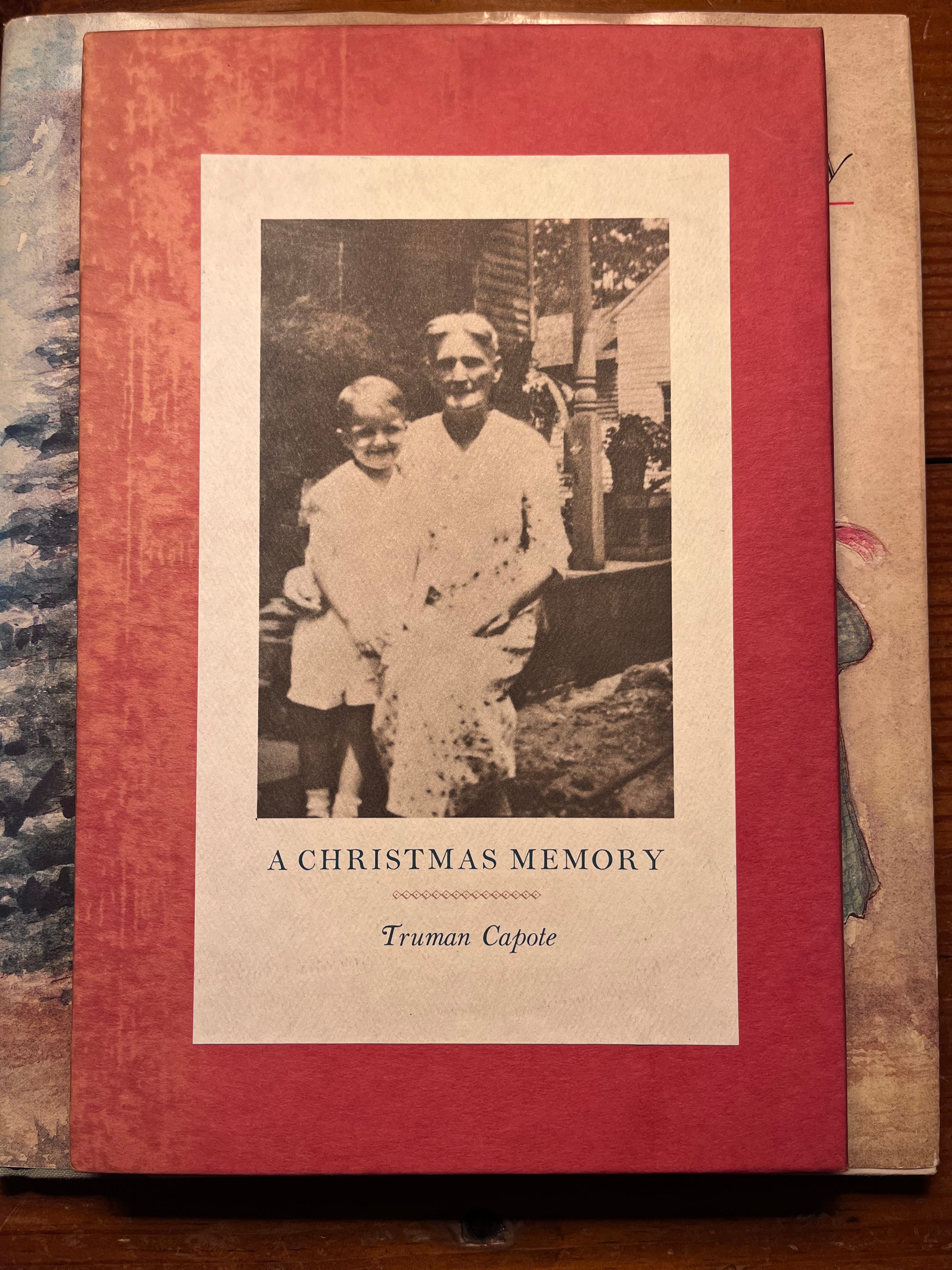
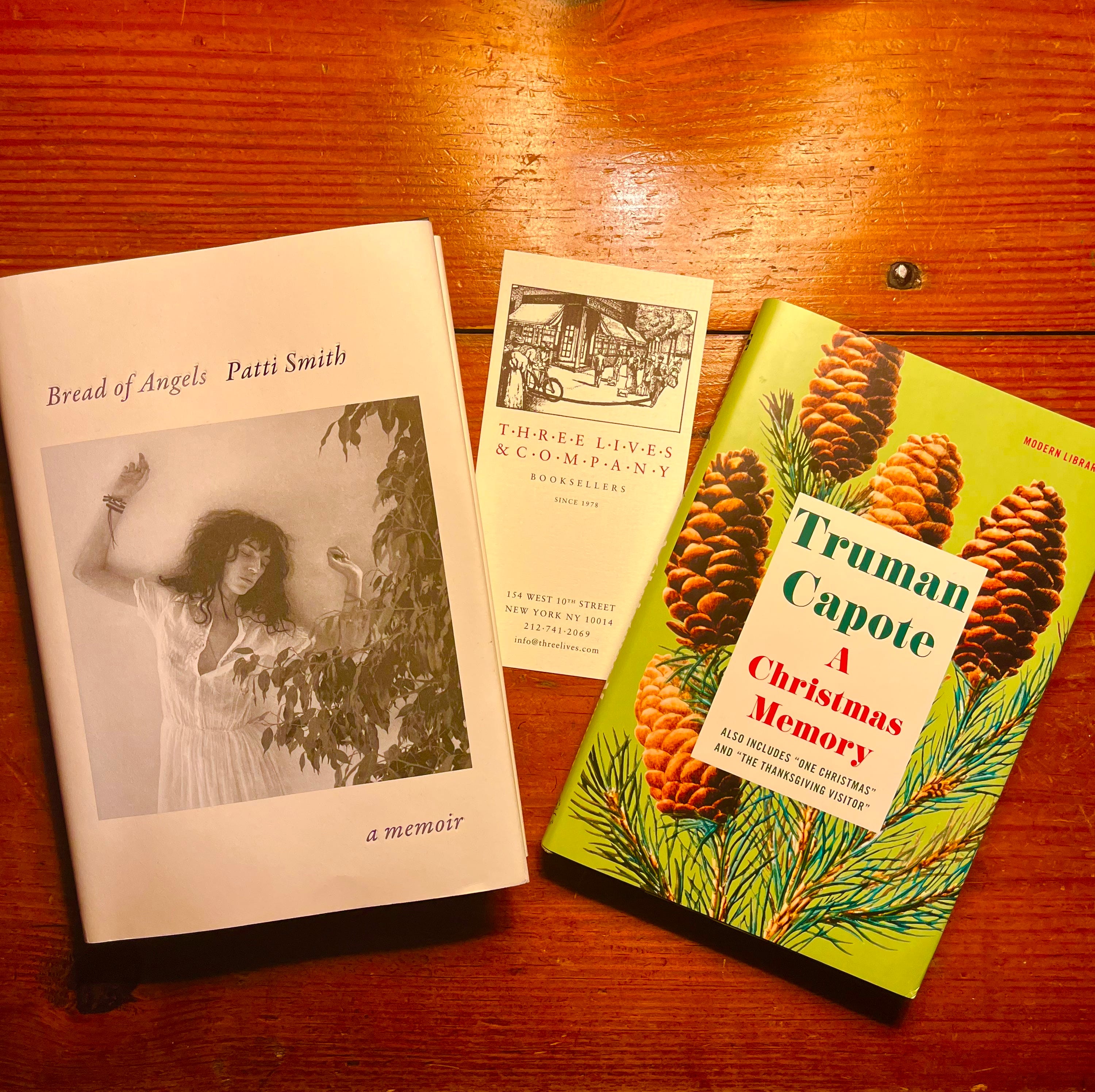
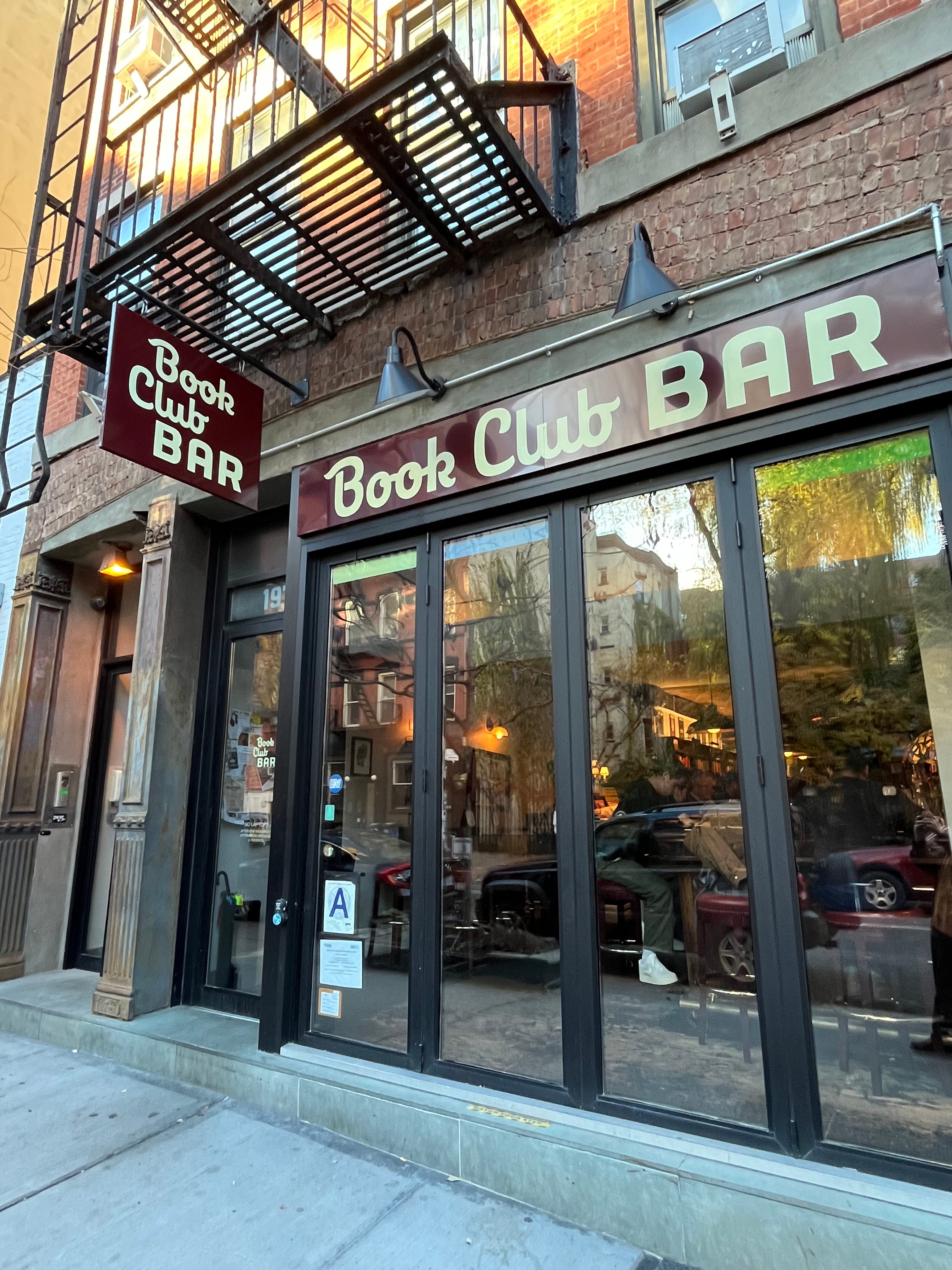
To calm myself and try to recover a sense of why I’m alive, on the Monday for part of my time before reflection week over Thanksgiving (see what we might call “The White Blog”), I spent a day bookstore haunting, walking from W. 10th Street in Greenwich Village over to E. 2nd Street and Avenue B in the East Village (Alphabet City). At my first stop, the Three Lives & Company Booksellers, a lovely small corner door shop, I found and bought Patti Smith’s latest memoir, as well as another copy of Truman Capote’s Christmas classic in case, as the store manager agreed, “In case you need a gift in the hopper.”

Book store people get you. The same woman who rang me up helped a man whose female partner brought him in to help him take up reading as a hobby. (I had to sit with that, like reading was a rarefied activity.) He liked war and history; I wanted to recommend the Capote, but I didn’t interfere. I recently read that in the United States, only around 14% of adults read for pleasure. That really hurts me. Even my dad, Bernie, who didn’t graduate from high school, read the newspaper every day. I told you this: My mom, Lynne, bought him Travels with Charlie, and he liked it, but The Godfather was the book that hooked him. And this lack of American reading reminded me of something back nearly thirty years ago, in summer, a cousin and his wife and four kids were visiting, staying in the upstairs rooms in my parents’ small house—this was back when I was still teaching in Virginia, and my brother Pat lived there too. My brother Jeff lived in an apartment then and took the day off, and we all gathered to take my relatives into D.C. for the day. While we waited for them to come downstairs, my mom sat in her chair, my dad in his, Pat on the loveseat, Jeff in the corner chair, I in a side chair, each of us with a section or pages of The Washington Post (back when it was a real newspaper). We read. My cousin came downstairs into the little living room and stood still. Gradually, we looked up, “Oh, hey, John,” and he stood staring. I asked, “What’s wrong?” And he said, “I’ve never seen anything like this.” What? “A family reading.” Though this was a weekday, we knew such times generally and all of my growing up as “Sunday.” (At Christmastime, we all listened together, “A Child’s Christmas in Wales.” That would’ve made his head explode.)

Patti’s memoir (I’m up to page 113, savoring it each night so as not to have it end) is essentially a beautiful love letter filled with gratitude to everyone who helped her become. And Patti (I feel I can call her that) has made videos on Substack, posted also on Instagram, and she talks about living in gratitude. I feel every word. In her latest (hyperlinked above) she talks about finishing her tour for the 50th Anniversary of Horses, which I told you I was lucky enough to see at the Beacon here in New York.

One of the first people to help Patti Smith find her voice in the early years after she came to New York at age 19 was the budding playwright and musician Sam Shepard. I remember reading Shepard’s plays in college, after he’d won the 1979 Pulitzer Prize for Drama for Buried Child. I realize now that he’d only been a real voice in the theater for ten years when I first read him—that’s wild to me. He seemed so old and established. But then, when I saw Patti Smith’s cover for the album Horses, I couldn’t have known she was only 28 to my 11. She was worlds away.

In truth, I didn’t discover or really attend to Patti Smith at all until reading her memoir Just Kids. I’d heard “Gloria,” and “Because the Night,” and of course I knew who she was, had seen Robert Mapplethorpe’s photos of her, but she scared me. Sam Shepard scared me too—I designed costumes for of his two one-acts, Cowboys #2 and Red Cross, when I was in college, ca. 1984, and his writing was out there. (I was part of an acting ensemble for Savage/Love, a play he wrote with Joseph Chaikin, but we never got to perform it.) Smith’s memoir/fantasia The Year of the Monkey in part chronicles her time nursing Shepard as he was dying of ALS, spending days typing up his final book as he dictated it from a wheelchair. (I told you about his observation, “Patti Lee, we are a Beckett play.”)

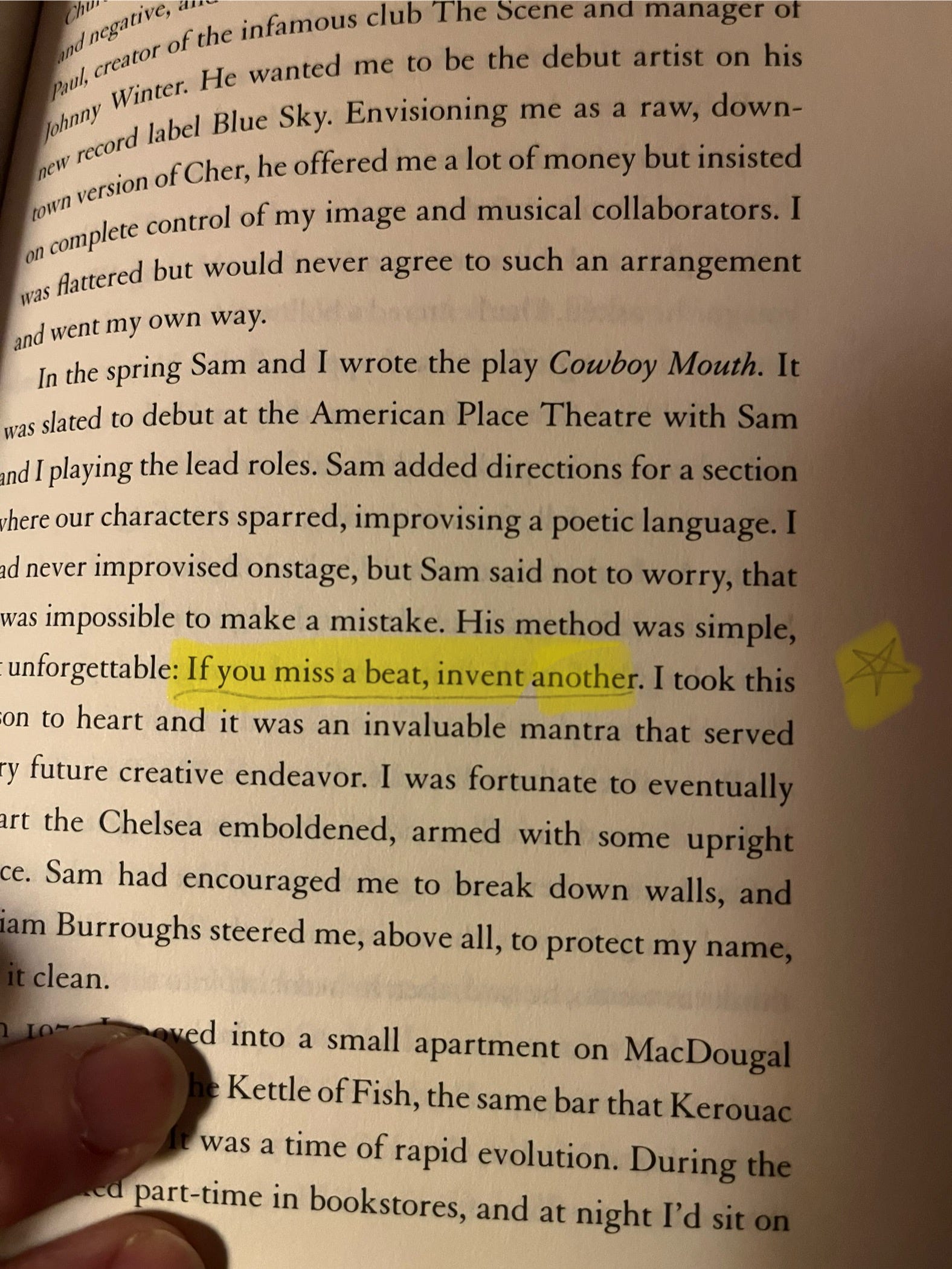
Sam Shepard’s advice that has served her a lifetime. We could all take a memo.

When I read of Patti’s childhood, I feel embraced by love, recalling my own best parts of childhood. She writes like no one I’ve read—she’s as idiosyncratic on the page as on vinyl, and it’s just wonderful.

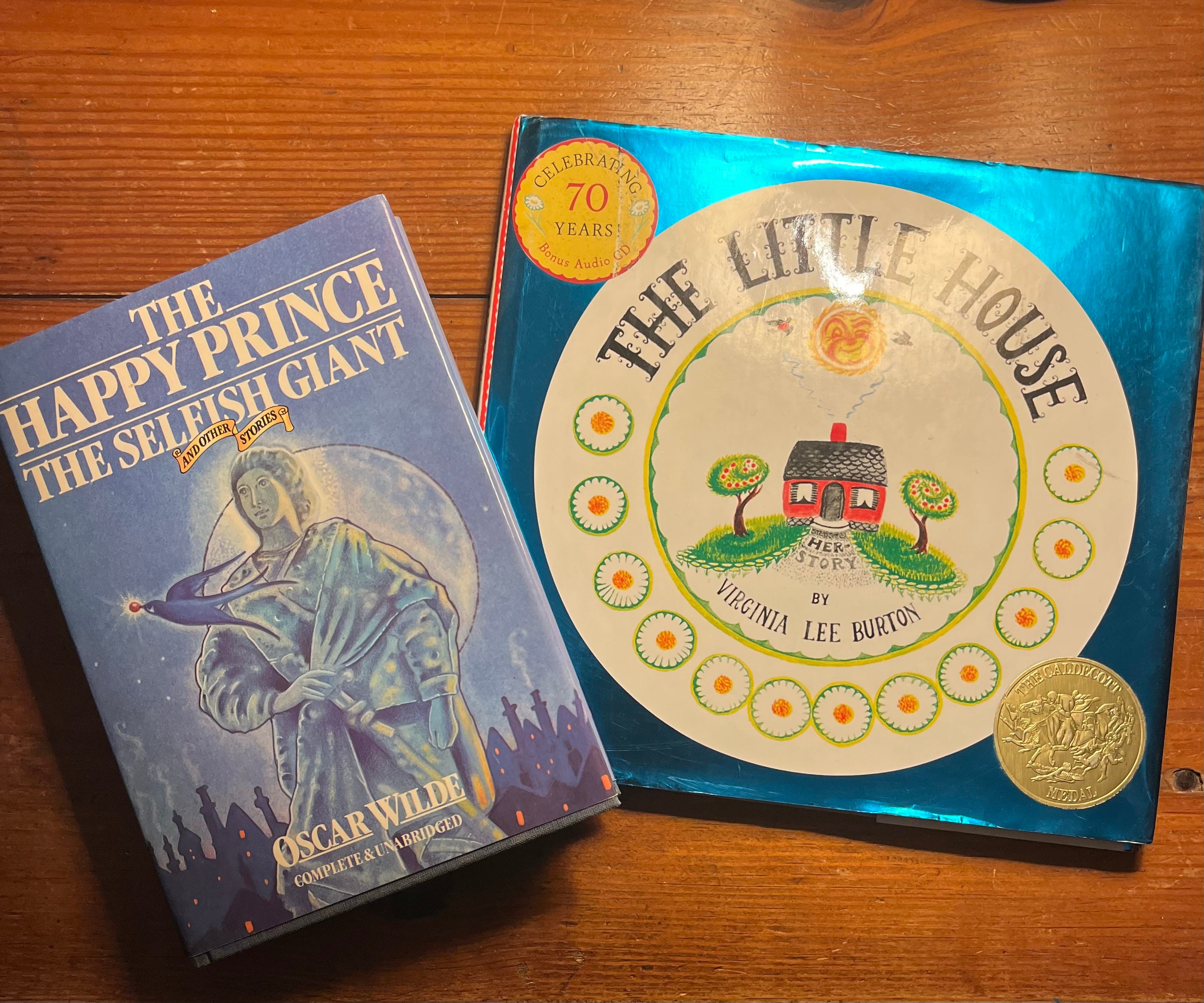
One of Smith’s childhood memories is of reading Oscar Wilde’s “fairy tale,” “The Selfish Giant.” When I became obsessed with Oscar Wilde at age 15, my mom gave me a collection of his stories for children, so I reread this particular tale the other night. I remember that I was turned off by the religious turn the tale took; but Smith spent part of her youth as a Jehovah’s Witness and took religion seriously, until she couldn’t anymore. By contrast, I grew up free from religion as a part of my life but still had questions about God. (Are You There, God? It’s Me, Margaret was a favorite book.) But I knew the feeling of that first book, that first story, the one that sparked the love of reading, the need to read more.

Patti Smith’s favorite story, “The Selfish Giant,” and mine, The Little House.. What’s yours?

I know, I feel, I see how important reading is—for so many reasons beyond the stuff you learn. I was thinking about my cousin’s surprise at seeing a family reading together; now I imagine it’s families scrolling on phones, and while that is not dissimilar, the act is different. Scrolling is not meditation, somehow, but something that distances people. (There’s data on this.) There’s a calmness that comes when engaging quietly with print text. Something in the tactile element and the way our brains have spent centuries adjusting to the act of reading, and even better, surrounded by some books that everyone can see on display—it’s a shared experience even when it’s solitary. It’s not about algorithms, is what I mean.

And Patti Smith is so different from me, reading her memoir reminds me that sharing the particulars of our lives can lead to universals, in that we see ourselves as human. But I can love that Patti and I share a love of something Wildean, even if mine is his whole creative life. And like me, Smith has touchstone artists—hers Diego Rivera and Arthur Rimbaud; mine Katharine Hepburn and Virginia Woolf. Their art gave us our own humanity, opened the gate, turned on a light, pick a metaphor.

It’s such a lousy time to be human right now—“lousy” is hardly the word—and yet I know I need to walk around grateful. By some miracle on Friday, for example, I found my way through to finishing a major project at work, could see my way to the end, I mean, and was so relieved, that as I took my afternoon walk I fairly floated. It’s such a human thing. Even Patti Smith makes the finishing of her tour—a 50th anniversary tour as a superstar—sound so human, and then she had a tooth seen to at the dentist, talked about moderating a talk back after the opening of the new Frankenstein and talking to Guillermo Del Toro like he’s a person, because he is, an artist like her, but a person. Creatives living their creative lives pausing at moments to scream, “Fuck Trump.” Like the rest of us.

We’re all doing our best, getting on with the work of our worlds. Loving our friends, our families, telling them that. Expressing gratitude for a good chair, a coat that keeps us warm, a hat that stays on in the wind. An orange. A book.

I’ll ruminate on all the horrors of our country again soon—I think I’m waiting for an idea of what we need to do, besides not quit. Remember was Sam said to Patti, “If you miss a beat, invent another.”

Sending love,

Miss O’

East 3rd Street, NYC, should you like to visit there.

A Life in the Theater

On character, tragic flaws, and hope

Nov 09, 2025

On November 9, 2010, 1st Lt. Robert M. Kelly, USMC, was killed in Afghanistan. Robert had been a student of mine at Gar-Field High School in Woodbridge, Virginia, along with his older brother, John, both of them the sons of Gen. John Kelly (Maj. Kelly, when I first knew him; I attended the ceremony when he became Col. Kelly). Both John and Robert were in the Drama Club, and very different kids, John doing technical theater (lighting), Robert hanging around until he scored a legendary turn as Juliet in The Complete Works of William Shakespeare Abridged (with a cast not of three but of thousands) his senior year, a performance that caused his father to laugh harder than I’d ever seen him do. Interestingly, son John (now a colonel in the USMC himself) was naturally funnier, but ironically it was Robert’s relative seriousness and deeply felt empathy that made him a great comic actor.

I got the news of Robert’s death 15 years ago through missed connections all day, brother John trying to reach me, my return calls back going to voicemail; I thought something might have happened to Alan, another former student and John’s best friend; finally I got hold of Alan while at a play lab at the Pythian on the Upper West Side, where cell reception as terrible and I had to go out to the street to reckon with the truth. I didn’t know Robert had even been deployed; apparently it was a sudden decision to send his unit over, and maybe only a week had passed since his arrival, an IED doing the job.

Robert’s funeral and burial at Arlington, just eleven years after his graduation, seven years after I’d left teaching and had moved to New York, was attended by well over a hundred people, many from Gar-Field, teachers, students, friends, parents, along with his family. Hard to process even now. I was reminded of all this yesterday when my friend and retired department chair Tom texted to remind me, thinking only ten years had gone by. (I knew it was longer because my cell phone had been a flip phone. Isn’t that a particularly millennial reason to remember a date?)

So tragedy is on the brain this morning.

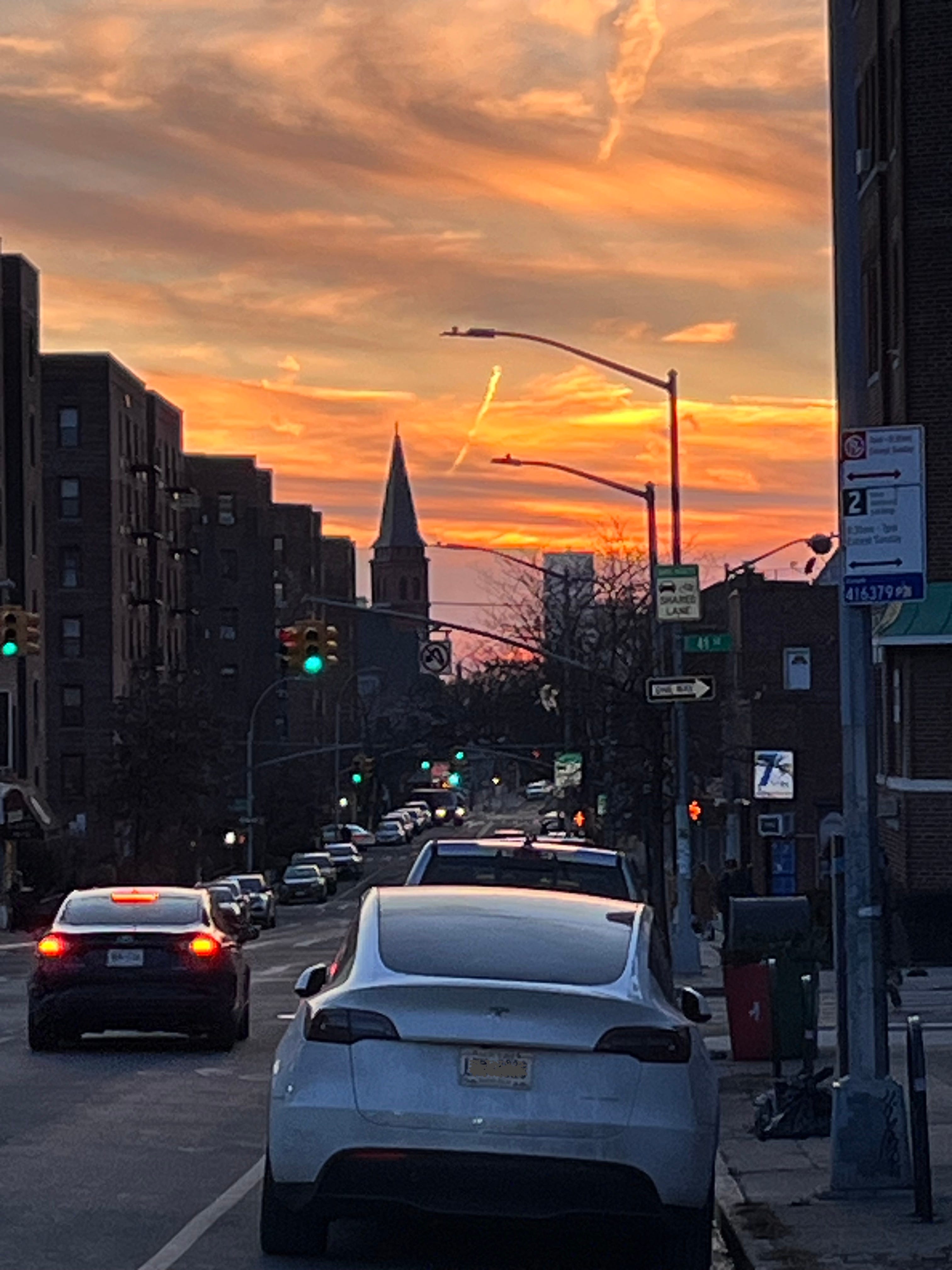
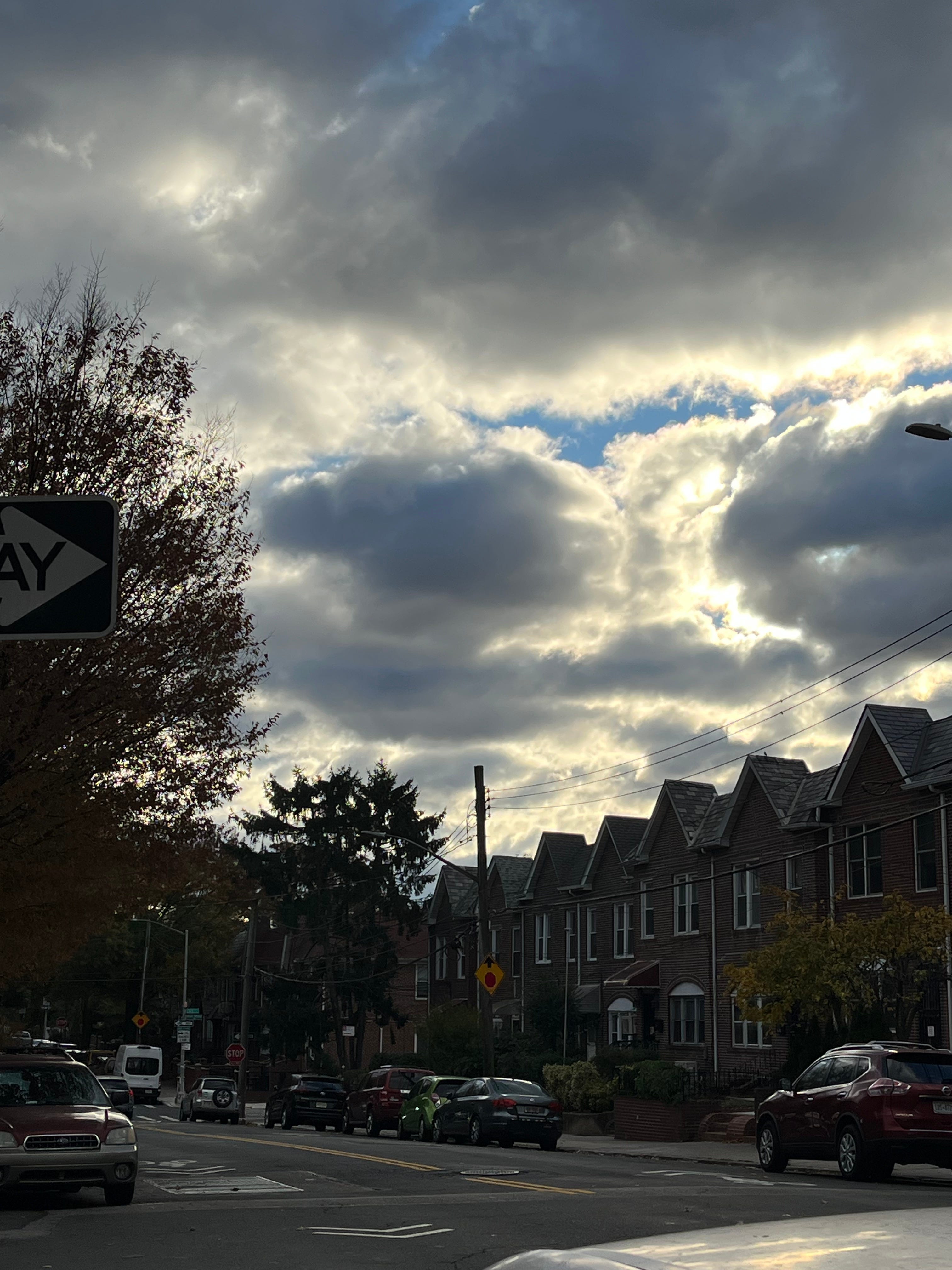
Biblical sky drama over Queens.

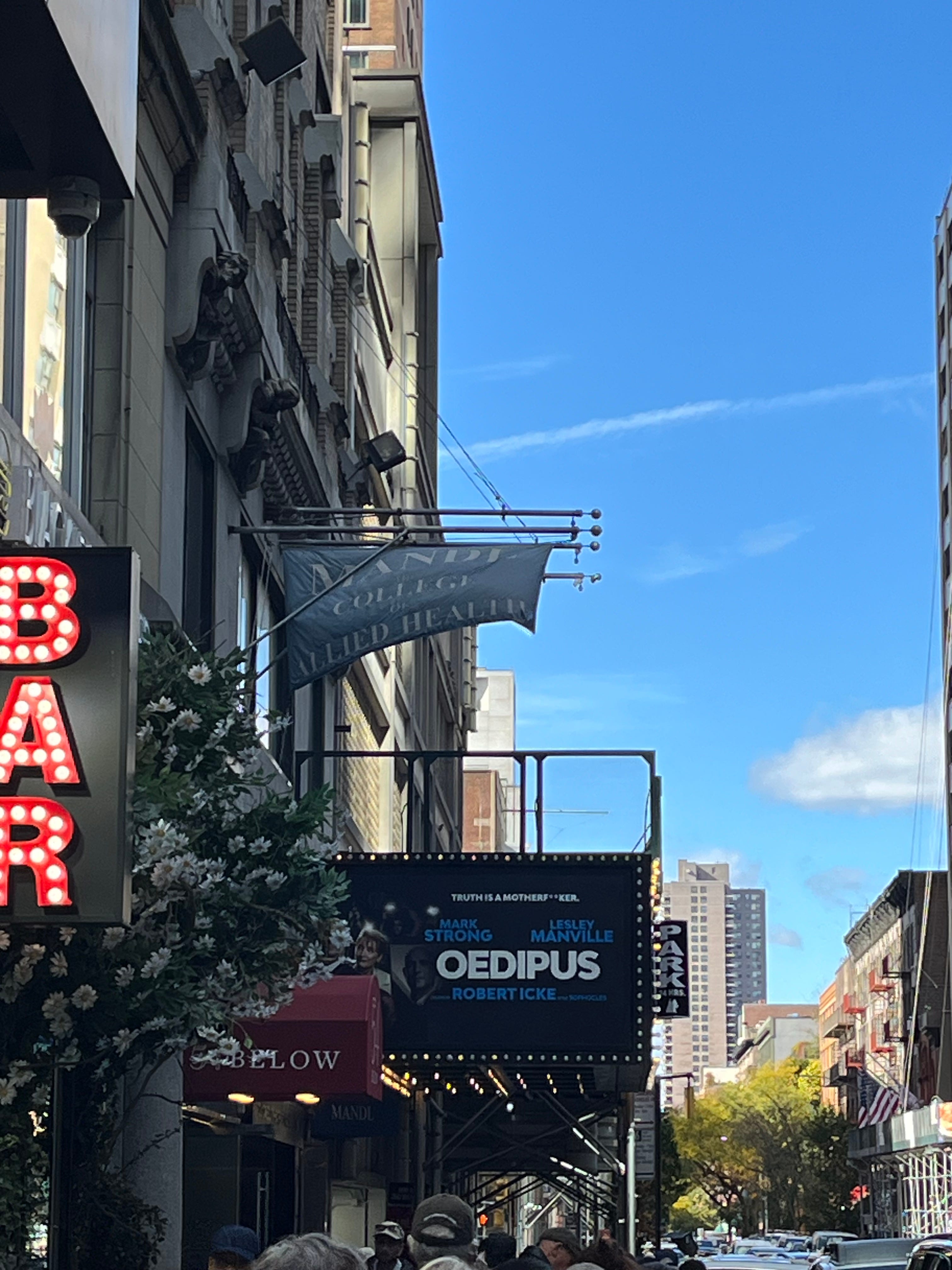
Last Saturday I went to see a West End-Broadway transfer production of Oedipus, a new adaptation and direction by Robert Icke (say Ike), with friends Frances and Jim, who got the tickets for us (or else I might have foolishly missed it). The lesson of Oedipus is, famously, “One always meets one’s fate in the path one takes to try to avoid it.” In the Greek version, the Oracle at Delphi prophesizes that the baby born to King Laius and Jocasta will one day kill his father and marry his mother; Jocasta then, to spare her son, orders her servant to kill the baby. Instead, the loving servant places the baby in the woods, where he is found by an older couple from the country who raise him as their own, no one the wiser. Until eighteen years go by…

In this update, Mark Strong plays Oedipus as a political candidate on the night of a highly consequential election (intimations of Trump v. Democracy), and all the action takes place during the two hours between polls closing and the announcement of the winner (a big clock on the stage counting down—Aristotle in Poetics says that any good drama should play out in no more nor less than two hours, and Icke takes on the challenge). In a filmed sequence as the show’s opening exposition, a confident, sexy Oedipus, standing outside what looks to be the British Parliament building, tells the press that he knows people question why he, a foreigner, should lead them, and he promises (without warning to anyone in his circle) to “release my birth certificate.” It brings up Obama, Mamdani, all the prejudices of our times, and if you know the story of Oedipus, it’s the perfect setup for an adaptation. (Icke must have shrieked and shaken with freakout when he thought of it—hoping no one else saw that obvious and genius connection up to now.)

Oedipus—handsome, smart, gifted, loving, and progressive—has one fatal flaw: hubris. He really believes he is in complete control, fully in possession of himself, knows who he is, knows who everyone is in his life. The next two hours unravel in the revelations we know from the Greek tragedy, all so believable and so timely, with Lesley Manville’s Jocasta ripping your heart out, her (updated for our more enlightened times, shades of Epstein) story of being raped by old Laius at 13, forced to give up the baby to die because he’s married; Laius later marrying her and leaving her a widow who later meets Oedipus, falls wildly in love, and marries him, giving him three children, she then in middle age. At the play’s opening, Oedipus is 52; Jocasta, we only later realize, is 65; their children are college age. In short order, despite a landslide victory, their children are about to lose everything, Jocasta her life, and the nation the promise of a brilliant leader. (The best part was sitting next to someone who didn’t know the story—lots of people don’t—and hearing the gasp.)

How does any brain process such a trauma? Frances and Jim and I staggered through the tourist minefield that is Times Square to the quiet of an Italian restaurant to process it, all of truly gutted, Aristotle’s catharsis manifest. In enduring tragedy, and in catharsis, we not only heal, we are cleansed.

A cleansing view, fall in Central Park.

This morning I watched a YouTube video sent by my friend Ryan last night of researcher and “No. 1 Brain Scientist” Jill Bolte Taylor in conversation with podcaster Steven Bartlett, talking about the “four characters” in our brain’s left and right hemispheres. As a result of a stroke at age 37 in 1996, Bolte Taylor’s Harvard-ladder academic career ended, and the next eight years were about recovering the functionality of her left hemisphere, the part of our brains that does numbers, controls language, helps us plan and think. During those eight years, she worked to use her right hemisphere to help her rebuild the cellular connections in the left, and the result was a huge new life focused on even deeper brain work while living on a boat and not in a lab, connected to nature and to the universe, using her whole brain. I highly recommend the video, which I watched at 4:30 this morning (because old), and her “four characters” of the brain put me in mind of not only all our society’s conflicts but also of all the characters necessary to have an effective drama:

1. Character One: Left side, thinking: the planner, analyzer, counter, linguist

2. Character Two: Left side, emotional: the grudge holder, trauma re-liver, pain protector

3. Character Three: Right side, emotional: the explorer, the curious one, the playful one

4. Character Four: Right side, thinking: the connector of experiences, keeper of wisdom

Just as a drama needs all these characters for conflict and resolution (my take), humans need all four in balance to be whole. I took loads of notes, and if you watch the video, you can too, but Bolte Taylor’s message of a society out of balance resonated most with me. Most of our lives seem to be spent lived only on the Left side, she says, holding grudges and reliving trauma as we strive for perfection and knock ourselves out to make money. It’s killing our brain cells, it’s killing us individually, and it’s killing the planet.

To wit: Sec. of Defense (he says “War” but it’s not official) Pete Hegseth announced this week that the United States is no longer a peace-seeking nation, but rather, our military preparation will be solely focused on wars. We know from Republican spokespeople, such as Russell Vought, JD Vance, and Elon Musk, that “empathy is weakness” (a negation of the brain’s right hemisphere) is a guiding principle for their politics. The Conservative Movement is totally, then, left-hemisphere in the brain, focused on self-interest, self-protection, generational trauma on a tape loop. It’s not sustainable, but it has to be gotten through and past, somehow.

What I think Conservatives fear most about education, about learning the truth about our history, is what the play Oedipus shows so shockingly: when you uncover the truth about yourself, you are destined for destruction. But what the audience learns is that no life is an honest life if it’s built on lies, when your armor is a birth certificate and the woman who raised you as your mother, and lied about it, thinks it’s “only paper.” And I’m struck by all these paradoxes—the fear we have of knowing the truth, and yet the impossibility of living an honest, full, happy life without it.

As your Miss O’ has long said, if your belief system cannot withstand challenges to the point that your response is to stifle and even kill to stop those challenges, you don’t have a belief system—you only have fear.

What Oedipus lacks is balance—for him, in his ignorance, life has been pretty great. He is empathetic but only intellectually. (I think this same hubris applies to a lot of America’s Liberals, if I’m honest.) Oedipus’s mistake, his hubris, was to be blindly fearless, blindly on the side of the common man (because he was raised by fine, working class parents) without knowing his own life’s truth—he was the product of rape by a lecherous pedophile of a king, and he married his own mother because of the coverup. At the end of the play, Oedipus blinds himself, and as the cult-prophet Teiresias tells him, when you learn, you will go blind; and when you are blind, you will see properly.

In a similar way, Jill Bolte Taylor’s stroke—the near-total collapse of the brain of a preeminent brain scientist—made her work expand into realms she could not have imagined during her eight years of recovery.

And this all got me thinking again:

We have to release the Epstein files. Virginia Giuffre’s death cannot be in vain.

We have to embrace our nation’s original sin, slavery, teach it properly, reckon with it, so our nation can progress in smarter, healthier ways.

We must demand the resignation of Pete Hegseth, and work to be a peaceable nation, so that there are no more 1st Lt. Robert Kellys dying on foreign soil; and you’ll pardon me for not grieving Dick Cheney.

This is a heavy lot for a Sunday morning.

I’m sitting here on this November day, in my kitchen rocker, worried again about whether or not I need a new refrigerator (thermostat being weird) and a new Mac (battery not fully charging), seeing it’s after 9 AM and I really need to dress and go out and about before it rains. And these mundanities of life require our attention, our presence, to live fully, ever balanced against all those huge mega truths.

On my personal day on Friday, I found myself in Saint Patrick’s Cathedral on Fifth Avenue, lighting candles (one for my mom, one for my friend Richard’s mom, and a third for the ancestors), which I hope was not hypocritical from irreligious me. It was nice to sit and meditate in the midst of the most famous cathedral in the biggest city with the most consequential mayoral election perhaps ever, and be present to my mom and memory.

The next time I’m there, I’ll light a candle for Robert.

Sending love and balance,

Miss O’

The Art of Making Art

A millimeter matters

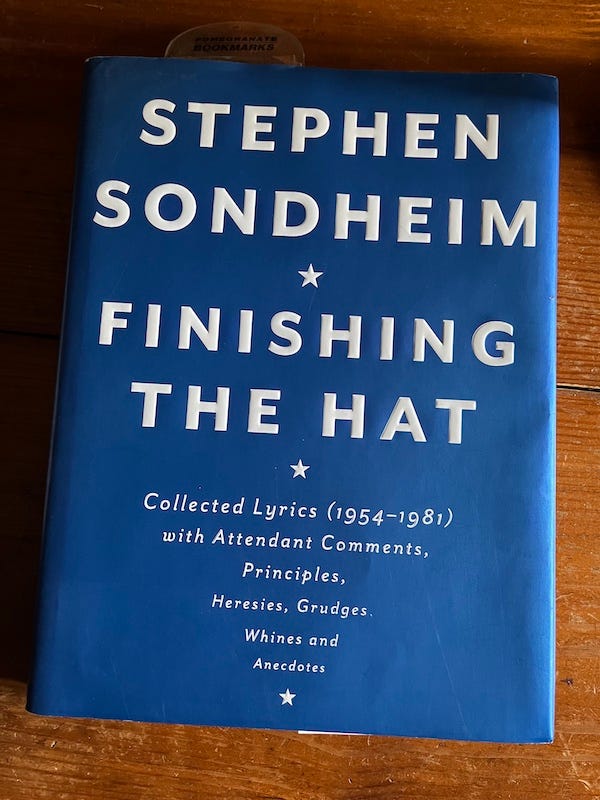
I just want to say that the luxury of owning a personal library is that not only do I feel cozy all the time, but I get to take evening tours and pick out volumes for bedtime reading. (Growing up, the O’Hara kids were about the only kids in the neighborhood with family bookcases, thanks to our mom, Lynne, having college textbooks, novels, and antique books to display and read.) Even now my number of volumes surprises some people, but I think, who wouldn’t want books around them? They are my closest friends. I saw an interview with Nora Ephron who said everyone asked of her family, “What are you doing with all these books?” (We live in a country like that now.) There’s no reason to finish a volume I peruse, or even read straight through. Sometimes I do that, but many times I just open a chapter and see what it says. If it’s not speaking to me, I flip around. Try another book. Like literary cocktails. It’s fun. This week I’ve been seriously rereading Finishing the Hat, Stephen Sondheim’s first volume of lyrics from his shows, 1953-1981, and so far I’m sticking with it.

When Stephen Sondheim died in 2021, I felt as if I’d lost a friend. Though I wasn’t sure how I felt about his work for a long time, you must know that the key to falling in love with a theater writer or composer is seeing the work, and in a splendid production. It really changes everything. He had three principles that guided his life’s work:

“God is in the details.”

“Less is more.”

“Content dictates form.”

I love that Stephen himself admittedly didn’t always follow them, but we give ourselves a little grace; nobody is perfect. And he himself had favorite lyrics that other people don’t seem to care for. He endured his share of flops and lousy reviews. And he just kept going. Thank god.

In an interesting coincidence, though sometimes I think it’s a bit more divine than that, these associative adventures, I’m also trolling PBS (while we have it) for documentaries and happened on two short ones. First, Marguerite: From the Bauhaus to Pond Farm about master potter Marguerite Wildenhain who, along with her husband, escaped the Nazis and made her way to California to teach pottery; and second, Finding Edna Lewis, about famed chef of 1950s Café Nicholas on E. 53rd St., cookbook author, and unsung mother of the farm-to-table movement, Edna Lewis.

And you might night think that Stephen Sondheim, Marguerite Wildenhain, and Edna Lewis couldn’t have much if anything in common, but you know what? God is in the details. Buckle up.

I’m not really going to recap all their work. But those rules up there apply.

“God is in the details.” Marguerite’s great contribution to many potters was, according to one student, “teaching us how to see.” For example, she’d have each potter make ten or twelve of the exact same pitcher or vase (since potters usually mass produce their work). The student would line them up on a board, and Marguerite of Pond Farm would walk and look and say, of maybe the third one, “This is good,” and of the eighth one, “This is good.” To the student they looked identical. Then she would point out a millimeter of difference in the rim, or the handle, the difference between being beautiful and merely serviceable (I think of the human face). God is in the details. It changed everything for students. (I’m obsessed by details when I direct a show, but not so much when I write, because I’m not an artist when I write.)

“Less is more.” Chef Edna Lewis grew up in Freetown, Virginia. In the Great Migration that took her to New York, she made a living cooking for artists, and word of her home cooking spread. She became an accidental star chef when she partnered (silently, as a Black woman) with two gay men to open Café Nicholas on E. 53rd Street, creating wonderful Southern cooking for writers like Truman Capote, Tennessee Williams, and Gore Vidal. Lewis believed that food should be seasonal and that the ingredients should speak for themselves. Nothing should be overly prepared, overly seasoned, or fancy. You might call it simple home cooking except that her dishes were both gorgeous and delicious, prepared by someone who knew what she was about.

“Content dictates form.” In the theater, the writing and the intent dictate whether something is a play or musical; or whether it’s theater at all. In pottery, the intended use of the vessel dictates the size and shape. In cooking, the ingredients at hand dictate the kind of meal it will be. I’ve been mulling that principle over, and not to get all metaphorical or analogous, but I have to go a little political here. Content (greedy, sociopathic, ignorant bastards) dictates (!) form (evil shit show).

Speaking for myself, I wish I had the talent to be a playwright or a novelist or a poet. I haven’t done theater in years because it’s a collaborative art (it’s not like I can walk around my apartment and “direct”), and collaborating is something I never have time to figure out. But for whatever reason, ever since I was a kid and started writing, I’ve felt I had an obligation to study news events, internalize them, and interpret them for everyone. I don’t enjoy it, necessarily, and will never make a living at it, but I can’t seem to help myself. When asked in high school by the “gifted and talented” program advisor, Mrs. Hubbard, why I kept a journal, I told her I saw myself as a chronicler of my time. She snorted disdain. Years later, when I related that anecdote to my first professor at the Bread Loaf School of English (a summer master’s program designed for teachers), Prof. Cazden snorted almost identically. It was uncanny.

Somewhere in our lives, no doubt, we’ve been made to feel less than. (Both teachers (graduates of Bryn Mawr and Radcliff, respectively) told me without apology, one overtly, the other hoping I’d take her meaning, that I just wasn’t smart enough to be there, whatever that meant. It’s not like I was stupid, exactly, but it’s annoying for brilliant educators like them, I guess, to be around the merely bright when there are geniuses to teach. You know how it is. My response was to say nothing, and my revenge was, I stayed and decided to belong. I really learned a lot. And it all worked out, because as it turns out, they were wrong. Never let them tell you not to dream.)

And so it is that, to this day, I keep feeling this pull to chronicle my times, though to what end I don’t know. I’m not smart enough to solve much—my teachers weren’t wrong about me not being a genius—but you can’t do nothing, in times like these. (Chuck Schumer, is this on?) I try to chronicle what I see and still hold on to the world I want to live in, the world I want us to build. First, obviously, it involves shipping all these the MAGA Nazis from their demented reality show, White House USA, to some tropical island where they live in golden mansions and go on staged hunts with all the guns of their wet dreams and watch all the porn they want without the Covenant Eyes app to pester them. And leave all of us sweet, normal people alone. And let us raise their children.

Until that blessed day, or until I get smarter, I read and write and dream. It’s what we do.

Once more, with feeling, something we can all learn from:

“God is in the details.”

“Less is more.”

“Content dictates form.”

~ The three guiding principles of genius Stephen Sondheim

Love or something like it,

Miss O’

Dabble

Ramblings from around the apartment

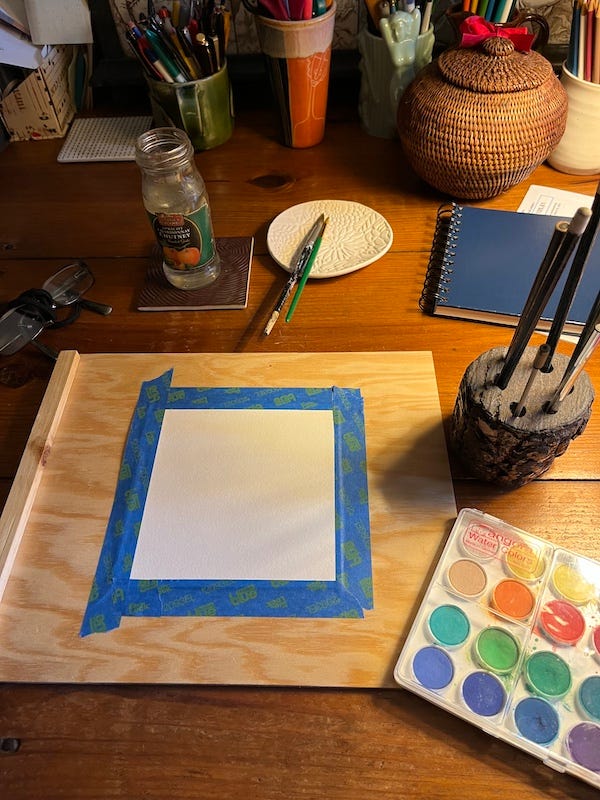
Hello, angel. How are you today? This morning I water-colored a card for a friend and mailed it at the post office, stopped by the store for a few items, and picked up 2-for-1 day-old cheese danishes at the Romanian bakery. A chilly, soft, overcast morning, nothing to rush for. I think the saddest part of any day for me—when I’m standing in the kitchen, making coffee maybe, or in my rocker starting to write in my journal—is the moment I remember I have a phone, and I have to check it. (That said, I called by parents, Bernie and Lynne, for our weekly Saturday morning visit. Grateful to still be able to do that.)

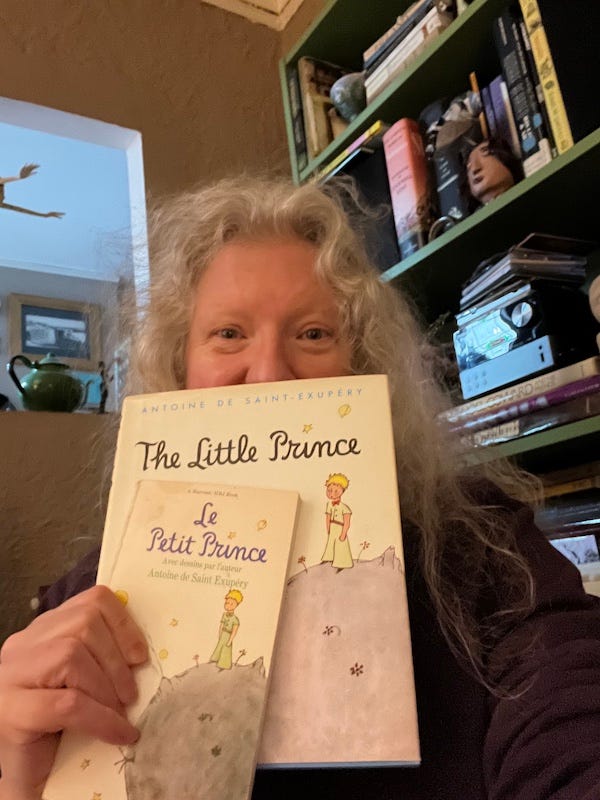
I miss landlines and answering machines, before telemarketers and scammers, of course. I miss being unreachable. I miss quiet. That said, the other day I happened on a documentary called The Miracle of The Little Prince, about the ways in which the book by Antoine de Saint-Exupéry provides a universal story that is being translated into languages that are facing extinction. The cultures where this is happening, not identified except by languages, include lives in landscapes from deep desert to heavy snows of the north, near Finland. The filmmaker focuses long on the landscapes, the quiet, an unending quiet, the monotony of caring for a few animals, searching for water, making tea. I don’t know if I could do that kind of quiet anymore.

If you haven’t read The Little Prince, I recommend it. I’ve found that there are two kinds of people (though as the late Tom Robbins said, “There are two kinds of people: people who believe in two kinds of people, and people who don’t”): Little Prince people and Winnie-the-Pooh people. I think pretty much everyone relates to Charlie Brown, but those other two philosophical guys are extremes. I know people who love neither, but there’s usually a line over which they step in favor of one or the other. Dorothy Parker summed it up for me in her New Yorker column “The Constant Reader” when, in her review of The House at Pooh Corner, the reviewer wrote,

“ ‘Tiddely what?’ said Piglet.” (He took, as you might say, the very words out of your correspondent’s mouth.)

“ ‘Pom,’ said Pooh. ‘I put that in to make it more hummy.’ ”

And it is that word “hummy,” my darlings, that marks the first place in “The House at Pooh Corner” at which Tonstant Weader Fwowed up.

The adorable and hummy Loggins and Messina song notwithstanding, I’m with Dot.

I first read Le Petit Prince in my French class my senior year of high school, in the original French, bien sur, and I was enchanted. (I bought a hard copy in English around the same time, 1982, and know this because neither book has a universal price code on it, so they’re pretty old.) Essentially the character of the Little Prince is a desert hallucination by the writer and pilot Saint-Exupéry, who was persuaded to write a children’s book when he lived in Quebec. His books, by the way, were banned in Occupied France; he died in a crash during the war in 1944, when his plane went down for unknown reasons. I like to think the Little Prince greeted him.

A pilot who writes books, or a writer who pilots planes. I was thinking today about the habits we dabble in, like writing, water coloring, or collecting books. Preparing to draw my friend’s card to watercolor, I reached for this pencil holder that holds my art pencils I got for Scenic Design in college. One year, my dad made us kids (or maybe just me and Pat) pencil holder out of the trunk of the Christmas tree. I don’t know how he got the idea. But he drilled holes for pencils, stained it and varnished it (preventing shedding and splinters), and I still use it.

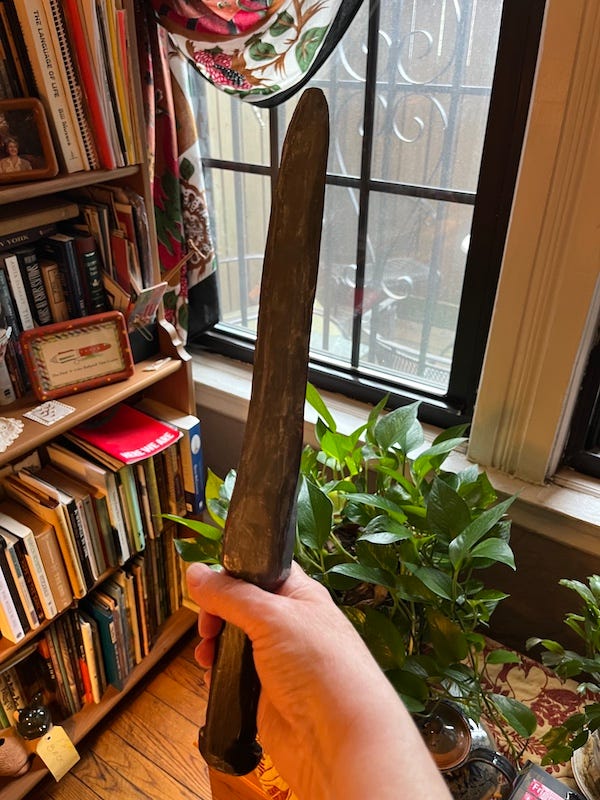
Another time he made all my brothers Zorro swords, and I didn’t get one because I’m a girl, so he whittled me a dagger. My mom painted the handle black and the blade red (for Halloween); I later repainted it silver to use a prop in a play, I think. I still have that, too.

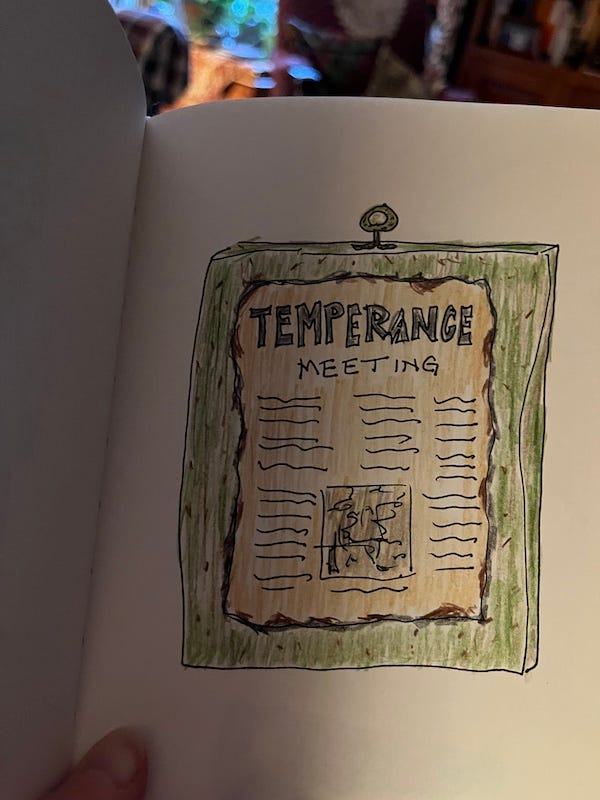
In those years, my mom was doing a lot of decoupages. Little of it survives, unfortunately. She started by making a plaque for her Uncle Phil, a recovered alcoholic, whiskey bottle collector, and former bootlegger (along with his two brothers, including my grandfather) in the 1920s. She made one for us, too, this one antiqued green to go with our house’s color palette. It’s currently rotting in my brother Jeff’s storage unit, but I remember it well.

I love how my mom burned the edges. She made all kinds of things back then, all atop our washing machine covered in newspaper. Ca. 1975

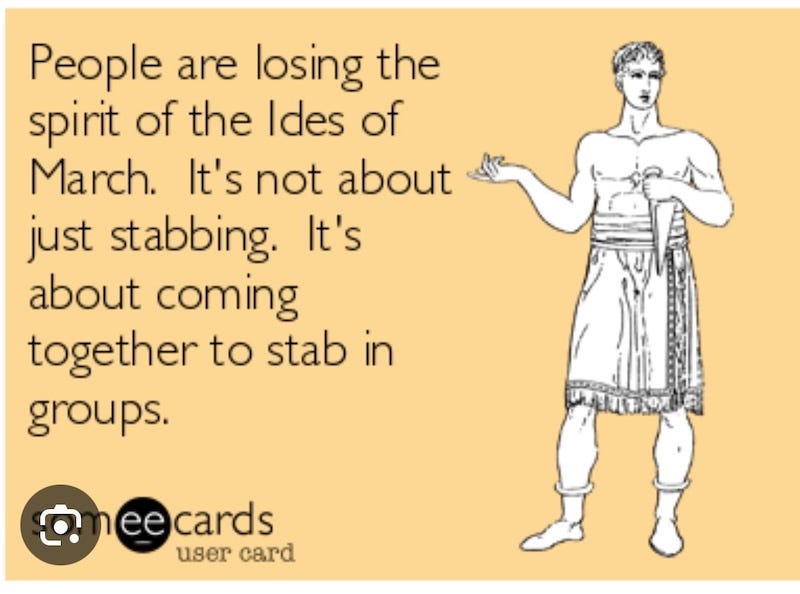
So this is Miss O’ giving my mind a rest from the world today, mostly. What are you taking stabs at this Ides of March?

Hello? Brutus?

Sending love from Queens,

Miss O’

A Work in Progress, Part 1

To my three readers–Hi, Anna!–I’ve been working on a play for a couple of years that I think would actually make a good TV series in these seriously troubled times. The title is up for grabs. Here’s part of Act 1.

Love, Lisa

WAVY DAVY’S PERPETUAL SOUP HOUSE KITCHEN

A PLAY by Lisa O’Hara

ACT I, SCENE 1

[AT RISE: Marv is typing at a laptop in a coffee shop. PHIL is sitting at the table sipping coffee and reading a book. They are in their 60s.]

MARV: I want to tell this story with unflinching honesty.

PHIL: “Unflinching honesty.” So, what is “flinching honesty”?

MARV: [beat] Why do you do this, Phil?

PHIL: [beat] Because I care about meaning, Marv. What is “unflinching” honesty if there’s no opposite? If you are honest, you are honest. Why do you qualify it like a Book World critic? Are you worried what they will think? There’s no they, Marv. Only the truth.

MARV: There you go, Phil. [picking up an old argument, not necessarily his] We all know there’s a They and you know who they are, but you don’t really, do you, and that’s the maddening part. No, it’s not them [pointing] though that would be convenient for your politics, right? And how can They be playing you and playing them, those others on the opposite side as you…

PHIL: …the flinching ones…

MARV: …all the while taking all the fucking money? It’s like the aliens we all know exist, and so how is it no one has ever spilled that secret? So that’s how They operate, and it’s so fucking pissing fucked up. [MUSIC, good blues rock]

PHIL: Who are you right now? [MARV smiles. So does PHIL.]

SCENE 2

[Projected: 1988]

JUNIE: [outside the scene, stirring a big pot of soup, tasting, adding spices] Marv pulled up to the curb of the Leave It to Beaver street in Annandale, Virginia, in his used Ford Grenada, a color of brown no car should come in, and I remember he put it in park though he was always unsure about turning off the engine because of the other times it cut out, or just didn’t go, like when we were on Rt. 123 with our friends Gary and Phil, Marv flooring the gas for uphill acceleration and didn’t nothin’ happen, and he was screaming…

MARV: [looking up from laptop] Here’s some advice, kids. If you have to buy a car, don’t buy a used car, and if you have to buy a used car, don’t buy a Ford, and if you have to buy a Ford, don’t by a Grenada, and if you have to buy a Grenada, don’t buy a brown one!

JUNIE: But on this day, a humid but decent early summer day perfumed by freshly mown grass, Marv was not terrified we’d get rundown by a semi. He was beaming, glowing, about to show his bride, his love, me, their, our, new house. [MARV beams] Yes, on this July day in 1988, at the age of 38, he, Marvin Allen Frischberg, had done the thing he’d sworn on his bell-bottom jeans and tie-dye tee shirt at the 1968 Democratic National Convention he’d never do: use his earnings from a steady job in American government

MARV: …all this, thanks to the fuckin’ man, of all things…

JUNIE: … to further suckle on the teat of American corporate capitalism by entering into a life phase of home ownership with a woman to whom he was wed. But there we were. And Marv was exhilarated.

[In shadow, a jubilant MAN gets out of a car; a WOMAN next to him stares out.]

JUNIE: Next to Marv in the used brown Ford Grenada was that very bride, aptly named June, Junie to everyone; together, what thirteen, fourteen years, married by our friend Kenny, dead of AIDS four years that August, who’d gotten a Universal Life certification out of the back of Rolling Stone to perform the ceremony, was it really nine years before, in the backyard of Gary’s “communal” house on Glebe Road…

MARV: [typing in cafe] …just a few miles outside the District. When Junie said, “Where are we?” I said, “Our house,” thinking total Graham Nash, and my Joni, my Junie, unclicked the barely operational seat belt, opened the passenger door, and…I shit you not, she began vomiting to the point of dry heaves…

JUNIE: And I was thinking, The Dry Heaves would be a great name for a band.

MARV: I was sure that Junie was really pregnant this time, and I was overcome with joy.

JUNIE: [lifting a ladle] Who wants soup?

SCENE 3

[Music. Projected:] 1973

[PHIL and MARV, aged 23 or so, are playing chess at the kitchen table in the Arlington, Virginia, kitchen on Glebe Road. It’s the first Watergate Summer. PHIL has just check-mated MARV again. GARY, also 23, who owns the house with his mother, enters from the kitchen with a bowl of soup and a stack of saltines.]

GARY: [setting down his bowl and crackers on a TV tray] You know who they are? I am they. I run the fucking world. I’ll prove it. [GARY uses the remote to turn off the Watergate hearings on television; he turns to flip on PHIL’s remote control stereo invention to turn on the radio, then flips it off. He then flips on another remote control to pull down the shade on the west-setting sun.]

PHIL: My inventions are useful.

GARY: I read all about this stuff! [GARY points to his stacks of Popular Mechanics magazines, his copies of National Review, his stack of articles from the Washington Star; possibly these are projected.] You think none of this matters, and that these bogus Senate hearings matter, okay, you’re wrong, but okay. You know what really runs all this? [gestures to room, to the world] Computers! Have you seen Phil’s computer room? Everything in the world will be run from those computers if we aren’t careful.

MARV: [lifting a pawn to move into position, first using it as a microphone] But who’s the man behind the computer? Who are you, Phil? What is your agenda?

PHIL: [into the “microphone” before Marv places it in position on the board; speaking now into his knight before positioning it] I’m nobody, frankly. I have no agenda. Just chaos for its own sake. That’s your they, Gary. And you can’t stop me, I mean them, I mean us. I’m two moves away from “check” for those playing at home. And so are the Watergate prosecutors. [Slams the knight onto the board. Marv quickly moves to capture the knight.]

GARY: Fuck you. [He turns on a tall, loud metal standing fan, directs it toward his chair, sits and eats.]

PHIL: [moving his queen] Language. Check.

[The phone rings, a ring in the living room and another ring from the kitchen, behind them. Note: All telephones of this period are black, heavy, rotary, and land lines. The kitchen phone is a wall unit.]

JUNIE: [from the kitchen; remains offstage until entrance] Hello?

[Beat, as Phil, listening, turns off the loud fan with another remote, Marv studies the board, and Gary stuffs crackers and soup.]

JUNIE: [gently, really asking] Davy, sweetie, are you high?

[PHIL laughs so hard he tips the whole board over. Marv moves to clean it up.]

CAROL ONE: [entering from hall wearing a mini dress and block heels and carrying a pocketbook, calls] Gary! Gary, I had to walk from the bus stop. Walk, Gary, again. God it’s hot. [Kicks off her shoes, throwing one at Gary; sees game.] Gee, I wonder who’s winning, Phil? Marv, why do you even try? Seriously, Gary, this is bullshit. Are you enjoying your late lunch?

GARY: [eats, hasn’t looked up] You. Said. Five. It’s three.

CAROL ONE: The firm closed early today, the bosses are taking a long weekend on the Eastern Shore.

GARY: And I would divine this how exactly? Why didn’t you call?

CAROL ONE: The line was busy all day. And I told you yesterday. Twice.

GARY: That motherfucking party line. I’m so sick of it.

JUNIE: Okay. Just a second. [calling out from kitchen] Can anyone drive me to the restaurant?

PHIL: I would but I won’t have time, sorry.

MARV: I would but no car. [ALL look at GARY, who doesn’t look up.]

JUNIE: Davy, no one is going to drive into the District now. I can try a bus. [beat] Okay, I’ll be ready.

[JUNIE enters. She is a Breck girl, an earth mother, Joni, and Janis, and Georgia O’Keeffe, depending on the lighting of the moment and who is looking.]

JUNIE: [going to the basement door] Darnell’s coming to get me in Davy’s car. Can someone get me later?

MARV: [gets up after placing chess pieces in a box, goes to Junie, presses into her and kisses her neck; she yields instantly] Come here for a minute. [They disappear into the basement, shutting the door.]

CAROL ONE: Give you any ideas, lover? [CAROL unbuttons her dress, straddles Gary in his chair. PHIL takes no notice as he checks his watch, finds his keys.]

GARY: Come off it, Carol! My mother will be home any minute.

PHIL: Okay, kids, time for my shift. Enjoy your Friday evening not having to write tomorrow’s top headlines.

GARY: For that rag that has it out for Nixon. What other lies are you going to print about him tonight?

PHIL: Gary, until you can admit you are bent, you will always be an angry little fascist.

GARY: Take it back.

PHIL: Which part?

GARY: Fuck you. Carol, let’s go. [Grabs her hand, heads upstairs. Carol squeals.]

[Screen door slamming is heard. GLADYS, a woman in her 50s, but with a full embrace of polyester, enters, carrying groceries, goes into the kitchen.]

GLADYS: Hi, Phil. Heading off? [PHIL kisses her cheek, jangles keys, and exits; GLADYS from kitchen.] What’s all this soup? It’s maybe a hundred degrees out there. Who’s watching the stove? Where is everyone? [Vague sounds of pounding, mattress springs, faint moans emerge from upstairs and basement; GLADYS, appearing oblivious, goes to living room and uses the remote to turn on radio full blast, and scene. The song is, perhaps, Charlie Rich “Behind Closed Doors” or Marvin Gaye “Let’s Get It On” or David Bowie “Space Oddity” or Barry White “I’m Gonna Love You Just a Little More, Baby” or another hit of the summer that you think fits the mood.]

SCENE 4

[The bustling kitchen of a restaurant, same late afternoon of 1973, a small black and white TV set with antennae shows Watergate hearings, end of day reportage, muffled sound. Two assistants, MARTIN and FRANKIE, watch as they chop vegetables, etc., and DAVY prepares to show JUNIE how to pull pin bones from fish. DAVY is a white man of 24 or so, in chef attire, a shorter Rock Hudson-meets-rock star whom his friends call “artistic.” DARNELL, a sweet, observant Black man, about 19, comes from the back carrying a white coat or apron, which he puts on.]

JUNIE: [standing amidst the chaos] Why am I here, sweetie? I don’t understand fine dining.

DAVY: [handing Junie an apron and guiding her to the sink] You are tonight’s pin bone wizard. Wash your hands. Mike’s out sick, and of all nights it’s a fish Friday, but here we are, and you are an artist, an angel with a needle, I need an artist. There are your tweezers, down there is the prepared fish—all you do is pull out the bones.

JUNIE: [putting on apron, walking over from the sink with dish cloth] Davy, sweetie, you do know that I push a needle in

DAVY: [takes dish cloth from her] But you also take the pins out, and hurry, dear one, hurry, dinner starts at 6 PM. Chop, chop. [Turns off television set, demands] Martin! Frankie! Those Jell-O salads won’t unmold themselves! [They follow Davy into the next room.]

JUNIE: [opens the cooler and screams] Holy mother of pearl, my poor fingers…

DARNELL: I can help you. [They begin removing bones.] Each filet has about ten. Or twenty. [DARNELL smiles. JUNIE is meticulous, like an artist, as DARNELL points, supervises. Beat. Beat.]

DAVY: [offstage] Faster, faster, faster!

[JUNIE pulls a final bone as DARNELL transfers that fish to a waiting cooler and then lifts a new fish onto the board for JUNIE to attack. DAVY enters. He looks around, and plants a kiss on DARNELL’s neck as DARNELL turns and gives DAVY his lips. JUNIE, laser focused and very quick now, doesn’t notice. They separate as MARTIN and FRANKIE push backwards through the swinging doors bearing trays of perfectly molded green Jell-O with cabbage and carrots. Scene.]

SCENE 5

Davy’s Soup Rules [Projected, with music, and VO possibly.]

  1. READ THE RULES BEFORE YOU FUCKING TOUCH THIS POT.
  2. I AM NOT FUCKING KIDDING.
  3. Keep stove burner on LOW!
  4. Use the stainless steel pot only!
  5. Water only!
  6. Fresh vegetables only!
  7. NO MEAT! NO FISH! NO POULTRY! NO!
  8. NO STARCH! That includes NO POTATOES, NO PEAS, NO BEANS. NO!
  9. Herbs and salt OK.
  10. Stir occasionally.
  11. Keep lid on when not stirring or serving.
  12. Serve soup atop whatever starch or fish or meat makes you horny for life.

Act I, Scene 6

[SCENE: Kitchen table on Glebe, 1974; linoleum and chrome and four matching chairs and three mismated ones. MARV, PHIL, GARY, and DAVY sit with various mugs and Tupperware glasses. PHIL with a national paper, reading, begins to snort out a chuckle.]

PHIL: [reading] “Spiro Agnew disbarred.”

DAVY: Was he now.

GARY: I think Agnew got a rotten deal.

PHIL: The Maryland appeals court called him, “morally obtuse.”

MARV: [a mock scolding] Language, Phil!

DAVY: But can a sitting elected official really be the subject of an indictment? Isn’t a president, or a vice president, the moral equivalent of a king?

MARV: The morally obtuse equivalent. Yes. [DAVY and PHIL chuckle.]

GARY: This nonsense is spiraling out of control. If they can come after Nixon, and Agnew, they can come after anyone…

PHIL: Maybe. If I made enough money to pay taxes, I’d pay them.

MARV: Except for the war taxes.

DAVY: Fuck the war taxes.

PHIL: Do you, Gary?

GARY: Do I what? [beat as others look at him] Any money I make is money I earn.

MARV: In cash, who’s to know?

[Junie interrupts waving an envelope.]

JUNIE: Hey, Gary.

GARY: Is that the rent?

PHIL: Your tax-free rent, oh Landlord.

DAVY: Do we Deep Throat him?

GARY: That’s your department.

DAVY: I’m here, I’m queer, but at least I pay my taxes. Mostly.

JUNIE: [observing; giggles] I… [stops her thought] … who wants soup?

DAVY: You what? You what? I saw that giggly gleam in your eye. You have the best face when you get an idea.

MARV: I feel art coming.

PHIL: [reaches to press MARV toward table, looks behind him] Art? Art who?

[Lights change, special light on JUNIE. VOICES fade out as music rises, e.g., “Eve of Destruction.” Collage art with painted photo or painting of the four friends around the kitchen table; gradually superimposed on each face are high school photos, ca. 1965. MARV, PHIL, GARY, and DAVY are fifteen years old.]

PHIL: [reading] The British Invasion is upon us.

DAVY: To say nothing of the Russians and the North Vietnamese.

GARY: You’re saying we shouldn’t fight the commies? The commies can go to hell.

MARV: [imitating GLADYS] Language!

PHIL: Now, boys, no politics at the table. [He gives a sieg heil, glances toward GARY while looking at MARV; locates a deck of cards.]

GARY: [looks under table] Mom?

DAVY: Beatles or Stones?

ALL: Beatles.

MARV: Acoustic Dylan or electric Dylan?

ALL: All the Dylans!

 [PHIL deals cards; Davy takes out a baggy of weed as Gary finds rolling papers, if possible, Dylan’s “Subterranean Homesick Blues” comes up, possibly a record put on by one of them.]

ALL: [singing as they pass a joint, play poker] “Look out kid
It’s somethin’ you did
God knows when
But you’re doin’ it again
You better duck down the alley way
Lookin’ for a new friend
The man in the coon-skin cap
By the big pen
Wants eleven dollar bills
You only got ten”

[Light shifts to JUNIE. VOICES fade out as music rises, Chubby Checker “The Twist,” lights change. Art montage superimposes school photos, ca. 1960. MARV, PHIL, GARY, and DAVY are ten years old.]

PHIL: [reading, carefully] “Richard Leaky…”

MARV: “Leaking?”

PHIL: [giggles, repeats] “Leaky… discovers our human ancestors in Africa.”

DAVY: [drawing his idea of one] And they are really, really old. [Shows picture to PHIL]

MARV: Not as old as dinosaurs. [Looks at Davy’s drawing.]

GARY: My dad says I am not a Negro.

MARV: What does that mean?

GARY: [shrugs] Dad says we are Americans and not Negroes from Africa.

PHIL: They don’t want you anyway, Gary. You can’t even twist. [twists]

MARV: [imitating his mother] Now, boys! That dance is immoral!

DAVY: How can anyone know where humans came from?

GARY: My dad says it’s aliens.

PHIL: So are we Americans or aliens?

DAVY: I think it could be aliens. I must be an alien. I just know it.

MARV: Where did the aliens come from?

[Light on JUNIE. Music changes. Tennessee Ernie Ford, “Ballad of Davy Crockett.” Montage: Collage art with photo or painting of the four friends around the kitchen table; gradually superimposed on each face is a first grade black and white photo ca. 1955. Lights change. MARV, PHIL, GARY, and DAVY are now six years old.]

PHIL: [looking at a comic book] My dad says they are cancelling Red Ryder.

DAVY: They are? How come?

GARY: My dad says Red Ryder got a rotten deal.

PHIL: My dad said Red got “damn boring.”

MARV: [imitating his mother] Language! [The boys giggle.]

GARY: This comic cancelling stuff is crazy! It’s not fair. It’s all gonna be like Batman, and I can’t stand Batman. Stupid capes!

DAVY: I only like comics where the men wear capes.

PHIL: You like the capes!

MARV: I think a man in a mask and a cape fighting crime is neato.

GARY: Matt Dillon wears a mask, but he doesn’t wear a cape, and Gunsmoke is still neat.

DAVY: You mean the Long [sic] Ranger wears a mask.

[Lights out on BOYS and up on table in 1974, the MEN playing cards, smoking, changing the lyrics to songs, perhaps. Lights separately on JUNIE gazing on finished work of a large, full collage of the eras of friendship. Song collage, closing perhaps with Joni Mitchell’s “The Circle Game”: “And the seasons they go round and round/ And the painted ponies go up and down/ We’re captive on a carousel of time…”]

DAVY: [entering with a bowl of munchies; to “My Boyfriend’s Back”] “My boyfriend’s black and there’s gonna be trouble, hey ma, hey ma, my boyfriend’s black…”

[CAROL ONE, enters with Lysol.]

CAROL ONE: You are terrible.

PHIL: [entering with a bong; to “Hey, Jude”] “Hey, doob, I want you bad,/ take my dad’s bong, and make it better…”

CAROL ONE: You think you are so cute.

GARY: [sees clock; grabbing bong and waving away smoke, takes Lysol from CAROL ONE.] My mom’s gonna be home soon, you guys.

MARV: [Three Dog Night’s “Mama Told Me Not to Come,” to GARY] “Mama told me not to come…” [MARV, PHIL, and DAVY join in, dancing, as music gains in volume.]

[JUNIE, smiling, holds her gaze on this scene as BLACKOUT.]

Act I, Scene 7

[Kitchen at Glebe Road, 1977. At table are two Vietnam vets, ROGER and MARK, both white men around age 30, in motorcycle gear. JUNIE ladles out soup into mismated mugs and brings them to the table where spoons and napkins are placed. GLADYS enters, smoking a cigarette, coughing, greeting the men.]

GLADYS: So how does Junie know you?

ROGER: Well, she was at one of our gatherings, to help veterans. Junie offered to do a poster for our meetings. And then we saw her at Safeway that time. Started talking.

GLADYS: You both live in Arlington?

MARK: Yes, ma’am. Appreciate the soup.

ROGER: Well, Mark’s closer to D.C. than I am. You know, a lot of people spit on the veterans.

GLADYS: Well, not Junie, she lost a brother, you know.

MARK: That’s what we hear.

GLADYS: That was 1966, ’67, wasn’t it? I mean, no sooner shipped over, wasn’t it?

[Lights up on area, living room, somewhere in Arlington, Virginia, ca. 1965, TIM MACNEIL in uniform, his father COL. DONALD MACNEIL in khakis, and his mother VIVIAN MACNEIL pose for a photograph. His sister JUNE, aged 17, takes the photo. After the flash goes off, VIVIAN begins weeping; TIM comforts her. COL. MACNEIL pats his son’s shoulder, picks up his kit; TIM hugs JUNE, goes with his father. VIVIAN pours a drink.]

MARK: So during Rolling Thunder, huh.

JUNIE: 1967. Yeah. [She pauses, only continues as others look to her for more information.] Tim enlisted as soon as war was declared. [Adding, unusually] Our dad was career Army.

ROGER: How old?

JUNIE: Eighteen, almost nineteen.

MARK: How old were you?

JUNIE: Seventeen.

GLADYS: Irish twins.

JUNIE: [picking up a loaf] Bread?

[MARV enters with satchel.]

MARV: Hello.

GLADYS: We have company. Marvin, meet Roger and Mark.

JUNIE: Soup?

MARV: Oh, right, the guys from the meeting. How ya doin’?

GLADYS: [to MARV] You know, it’s odd, isn’t it, that none of you boys served. [To MARK and ROGER, who pause in their eating.]

MARV: We didn’t. [Taking soup from JUNIE, to MARK and ROGER] I know I said this the other week, but I protested against the war. Our friend Phil was 4F for his flat feet. Davy was queer, but they wouldn’t believe him, so he went to school and was an art teacher for a while. I went to college and taught math—my parents came over during the Holocaust, and my mom would’ve gone nuts if I’d gone off to fight, but even still….

ROGER: What’s the Holocaust?

MARV: [patiently, instructively] Hitler’s genocide of Jews. Mostly Jews, but also homosexuals, resistance fighters…obviously not as known as it should be. Something like six million Jews were killed.

MARK: So you’re a Jew? [MARV looks up.] It’s cool. I don’t think I’ve, you know, ever talked to one before. That I knew of.

[PHIL enters, followed by GARY, in mid-discussion.]

GARY: So you’re saying that you actually think Carter has any fucking shot at all of getting peace in the…

PHIL: Oh, hello.

GLADYS: Gary, language, not in front of company. [PHIL and MARV grin without looking at each other.]

Copyright Lisa L. O’Hara 2023-2025. All rights reserved.

Last-Minute Saves: Completing the Assignment

On Friday at work, on a Zoom call with the “team” and managers and the director of the division and a program “author” who is guiding our work, there was a pause after 40 minutes of presentation and feedback from the author to ask questions. I asked a good question, one I really wanted the answer to. The author relished answering it. I asked clarifying questions, and he answered those. It was hard to read my director’s face, but I know the team was glad of the questions, given the “Directly to you” notes on the Chat feature of Zoom, “Great question,” “I’m so glad you asked that,” etc.

When I left the meeting, I said to myself, “Well, Lisa, once again you may have saved your job.” What I asked—after months of keeping my head down and being quiet as we embarked on this new project—and how the author answered, may well indeed have provided a breakthrough for what will make the next version of the product really special and useful for teachers and students.

My whole life, I reflected this afternoon, has been a series of last-minute saves.

When I was a Christmas tree shearer one summer in the Blue Ridge Mountains, for example, I was having a hard time keeping up, and my rows, though sheared well enough, took me twice as long as others on the crew to complete. After several days of this that first week, I determined to keep pace with a woman next to me, because she was a good shearer and very fast. And keep pace I did. I learned the next day that one of our other crew members had been fired for slow work and because “his trees weren’t good enough.” The crew chief, Sharon, I’m sure would have fired me too, and it would have killed my spirit. Something inside me saved me from this fate.

In a writing workshop in my senior summer of graduate school, after a mediocre first attempt at a short story, and a second attempt that my professor felt was as good as it would get and not in need of a workshop, I wondered if I’d ever write a third and final piece worthy of the work everyone else was doing. I was certainly vocal—participating, challenging, encouraging—and if I’m going to talk that much about how I receive writing, surely I should write something worth reading. And one evening in my dorm room overlooking the lawns at sunset just after supper, I found myself writing in a blaze, a fictional account of my great grandmother’s life in Iowa. It all came in one night, with a crucial misspelling my professor mentioned in the dining hall at breakfast after he’d read the story prior to the day’s workshop. I raced to the computer lab and did the ol’ Control/Find, and I could tell he was pleased by my passion. A student in the workshop gave me a bottle of wine before class, “For the best story of the summer.” How did this happen?

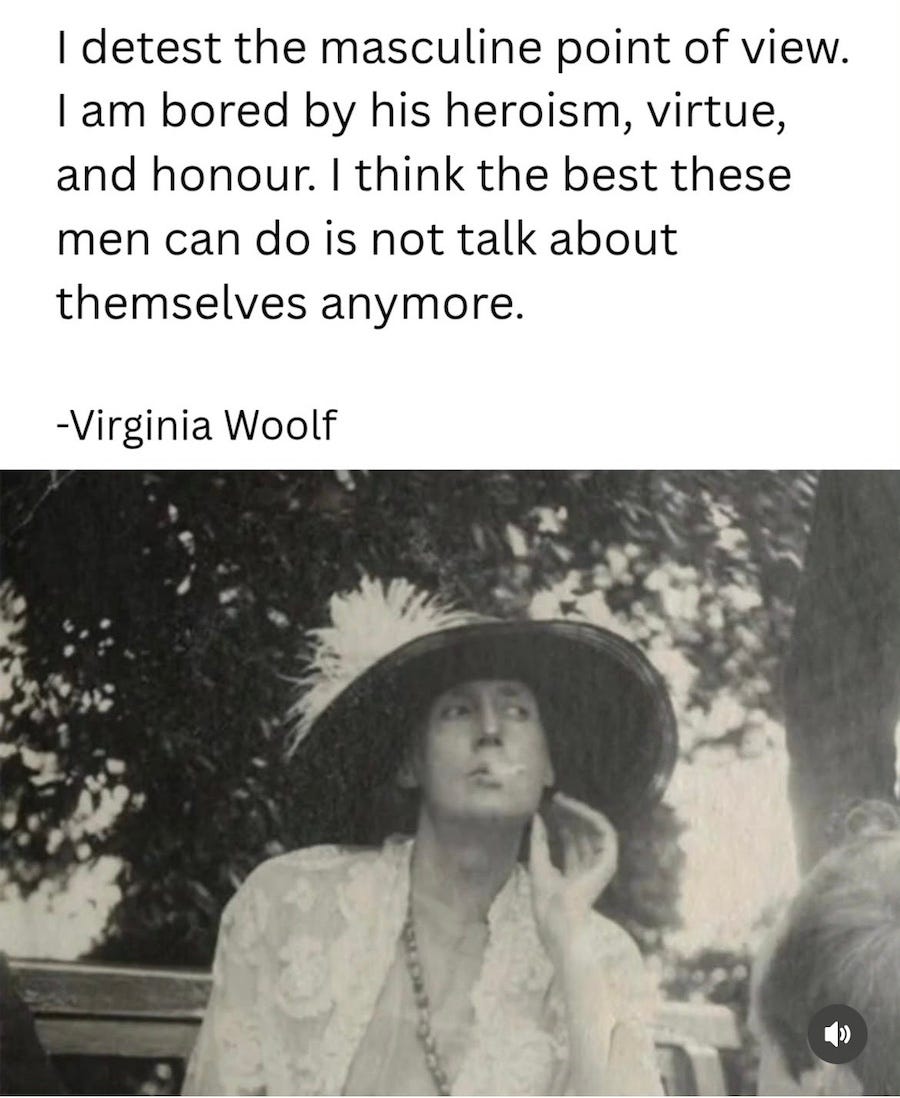
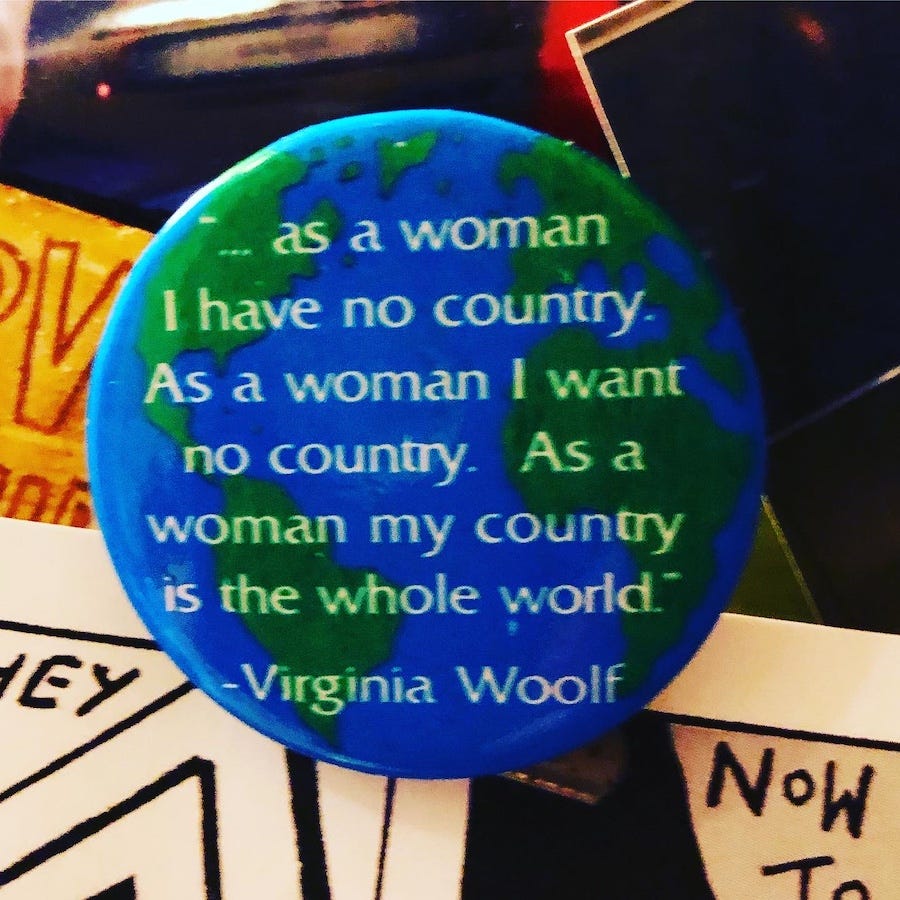
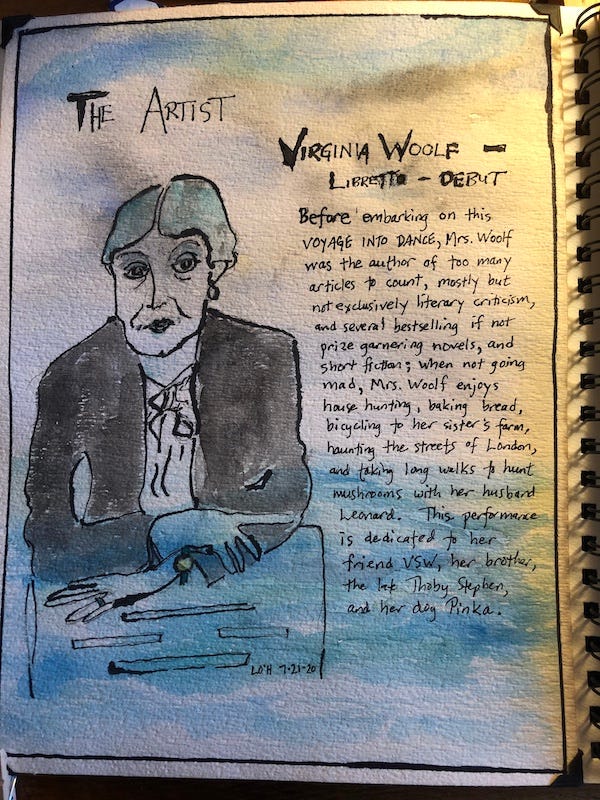
I had a similar save in my second summer of graduate school at the Oxford campus. I was studying Virginia Woolf with an eminent Exeter College scholar who also taught James Joyce. After reading a collection of short fiction, Jacob’s Room, and Mrs. Dalloway, I had to produce my first paper. What would I write about? I decided it had to be Mrs. Dalloway, but what about it? I had no idea. I just couldn’t think. That evening, my friend Anna, who was taking a different course focus that summer, came by my room to see if I still wanted to go to the cinemas and see Howards End, just released, starring Emma Thompson, Anthony Hopkins, and Helena Bonham Carter. I told her my dilemma. “When is it due?” she asked. “Tomorrow,” I said. I sighed. “Let’s just go to the movies.” She was stunned. “No, really,” I said, gathering my things, getting my keys, “because I’m not going to figure it out just sitting here.”

We went to an 8 PM showing, I’m sure, because dinner in Hall was at 6 PM. And it was there, at Howards End, that the key to Mrs. Dalloway unlocked: Emma Thompson and her now husband Anthony Hopkins have learned that Emma’s sister Helena Bonham Carter is pregnant out of wedlock. In the garden, Emma is seated as Anthony paces, determining what is best to do. Emma keeps trying to get up, to go to her sister, to try to take action based on her own conscience. To stop her, to take control, the paternal hands of Anthony Hopkins press and press on his wife’s shoulders to keep her seated, to keep her in the garden.

And my mind exploded: there is a scene in Mrs. Dalloway that had puzzled me as to why it was there at all, which is a luncheon to which a certain Lady Bruton has invited Richard Dalloway, Clarissa’s husband, and a doctor (who is treating Clarissa’s nerves). Lady Bruton has a letter she wants to write to the London Times, and her point of view on the issue is liberal, one might say, and feminist. Yet by the end of lunch, the two men have explained to her what she really means, “Oh, do I?” she says, which is the opposite of her original point, and they write the letter for her. Those paternal hands pressing her feminist shoulders to keep her in the chair in the garden. I was saved.

You might look at these saves and think, it’s just a job, or just a class, or just a paper—it’s easy to diminish the experiences, I guess, but that’s not fair to anyone living this life. This is about that thing inside us, the thing that knows and opens and doesn’t fear, that does the work but also lets go to allow the “thing” to come, to be.

It was this that I witnessed in the person of Vice President Kamala Harris at the Presidential Debate on Tuesday night, September 12, 2024. She found the “thing” to rattle the motherfucker Donald Trump: the small size and demonstrable boredom attending his rallies. And from that moment on he was toast.

Lost because of that moment and its aftermath of verbal carnage, lost on the American press, as usual, was Harris’s masterful grasp of complex policy issues, foreign and domestic, none with easy solutions but with clear and important ideas to address and solve problems. After nine years, on the other hand, a clearly demented Trump revealed that as to replacing Obamacare, he has “concepts of a plan.” (As veteran retired high school teacher Tim Walz recounted this at a rally in Grand Rapids, Michigan, “My students had better excuses than that for not doing the work.”) Harris laughed.

Kamala Harris, Tim Walz, and I are all the same age. Born in 1964, we are the last year of the Baby Boom, the year before Gen X. As a result, we were both the responsible adults in the room even as children and also the last feral children out playing till dark all summer long; and, in addition, we get all the Monty Python jokes. I feel this in them, the kinship of that cross-section, people who do the work of the grownups but are loose enough to allow the realness to be and with humor. It’s helped sustain Harris and Walz in their brilliant and varied careers, I have no doubt. It’s done the same for me in my less brilliant but no less varied careers, too. Being adult and being real and being funny: it’s saved us.

With Harris and Walz and that generational realness, we have a chance to save this country. We can save it. Let’s save it.

Love,

Miss O’

Miss O’ recognizes, nay, feels, all these teacher faces. Credit to @AnandWrites