When I was in sixth grade, in Mrs. Sims’s class, I remember David Elmore talking about what his father chose to give up for Lent. Mrs. Sims had asked which kids observed Lent, about which I knew nothing. David said with a grin that his father always gave up watermelon. Mrs. Sims remarked, “But that’s not in season now,” and David said, “That’s why he gives it up!” And several students laughed. I always felt left out on religious topics, often because I didn’t know it was religion they were talking about, and I didn’t practice any.
I guess my mom, Lynne, (I think I told you her lapsed Catholic story) explained Lent to me when I got home and asked her. It represents the forty days Jesus Christ wandered in the desert (why?), she explained, as if I followed; and so to commemorate that, we give something up for Lent for the 40 days before Easter (which “resurrection” date is still chosen to be the first Sunday after the fourth full moon after the winter solstice/Christmas because Pagan parties rule). Okay?
I asked my mom what she gave up. “When I was a kid, I gave up candy,” she said, since back in the 1930s and ’40s, candy was a penny, so even in relative poverty, kids could usually afford an occasional candy. “But I cheated,” she said, and saved up for Smith Brothers’ Cough Drops instead. “I told myself it was medicine.”
But deep down she knew. I think about why we do these rituals of personal sacrifice when so many people around the world have to sacrifice, with no say in the matter.
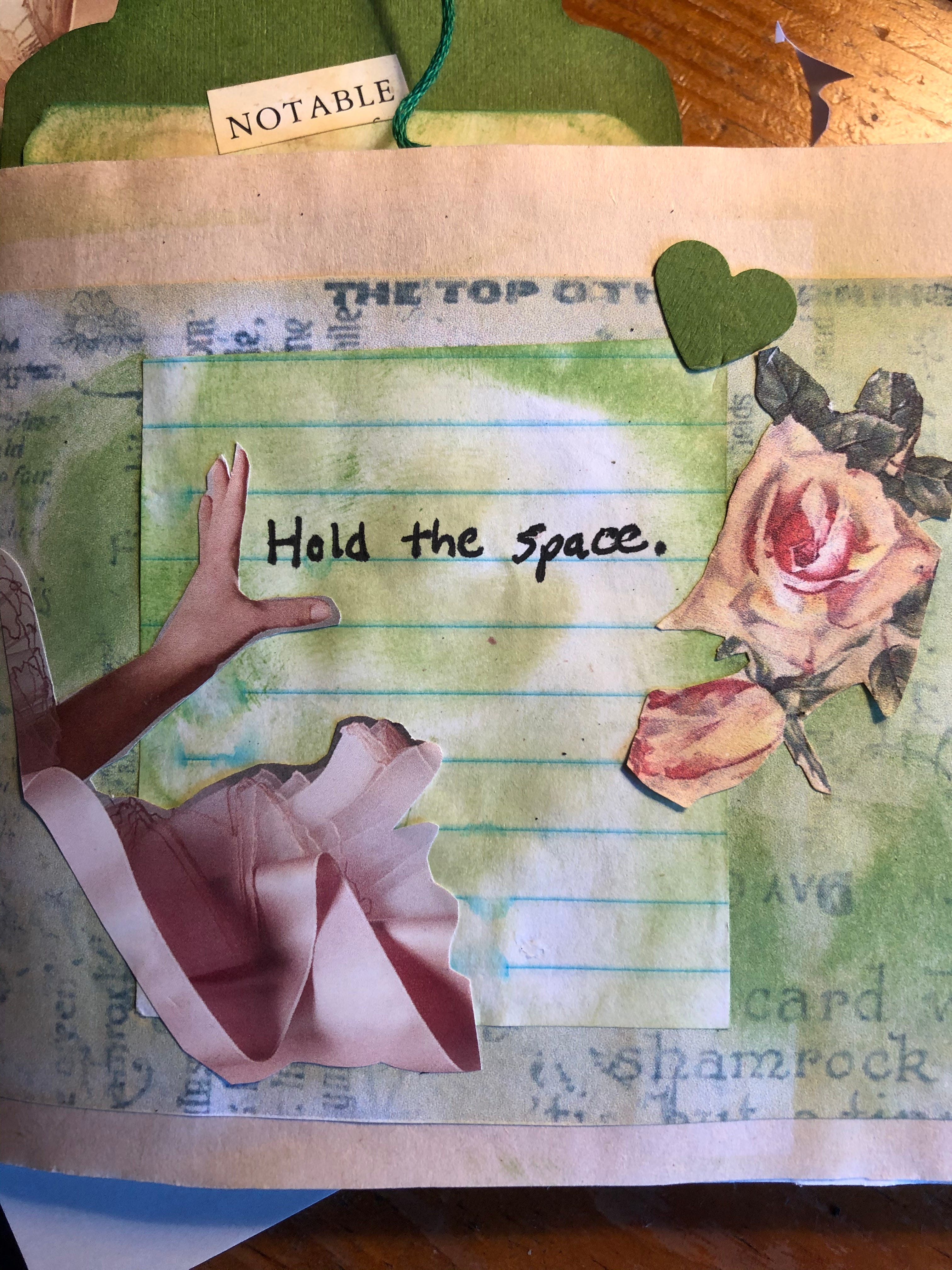
Collage in readiness for St. Patrick’s Day, and the St. Pat’s Day for All Parade here in Queens, the real celebration.
When I first started practicing Lent I was in middle school, then, and I gave up Doritos. Later it was all junk food. Lucky child. In my grown years it’s been media of all kinds, but this year I don’t dare give up media as the nation’s democracy collapses daily. This year, I had no idea what to give up. I barely eat junk, or drink, or indulge in anything beyond sleep. I thought I’d give up sloth trying to exercise more.
As if in answer to my dilemma, my friend Tom sent me a Substack this morning, which I very much recommend, because heaven knows I’m not religious, and I found it moving and intelligent and inspiring. Here’s a snippet, followed by the link:
If you feel disoriented, you are not weak. If you feel angry, you are not unfaithful. If you feel grief in your body, tightness in your chest, exhaustion in your bones, tears that come without warning, you are not dramatic.
You are paying attention.
And paying attention is a spiritual practice that this culture actively discourages.
“We are not entering Lent with neat spiritual goals. We are entering Lent with social dis-ease lodged in our chests. With rage we don’t know what to do with. With helplessness that threatens to harden into cynicism. With the terrible knowledge that people are suffering right now, and we are implicated in systems that enable it.
“So how do we hold it all at once?
“First, we stop pretending that spiritual discipline is separate from public life.”
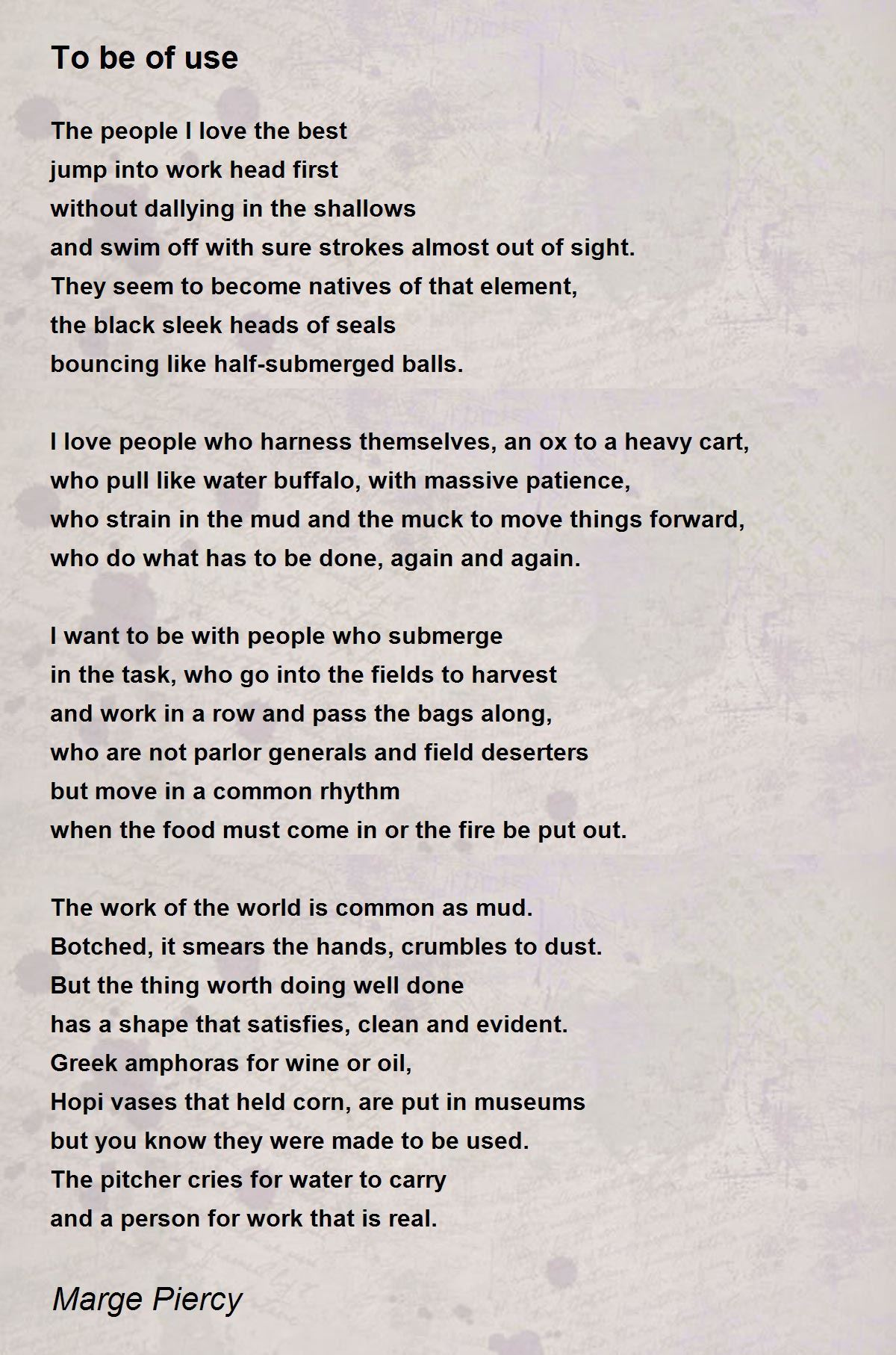
There it is. So this season, I’m paying attention with my whole body, giving up fear and freezing and being utterly selfish. It’s a goal, an attempt at a practice. I wrote and called both senators today, as I do every week, but now it will be every day for 40 days. I will send money wherever it can do good. I will take walks and try to engage more. I’m trying to be of use.
To be of use, should that interest you where our democratic republic is concerned, you might consider doing some Lenten lifting, if you aren’t already, which I know you are. Here’s something to know, by the way, about the SAVE Act (from poet Robert Arnold), which act you absolutely should want to stop, though ironically it will hurt Republican women the most.
There’s much to do. Gather your strength. Have a cough drop.
O, I have suffered With those that I saw suffer. (Miranda, The Tempest, Act I Scene 2)
I read this week that the tech bruhs, so called in current parlance, see the world as being divided into two classes of people: the thinkers and the scrollers. While they, the Thinking Class, devote themselves to higher learning, philosophy, and deep work, affording the same wealth of life experience and cashflow to their offspring, they themselves are engineering the planet so that the rest of us, by which I gather they mean the 99% and our offspring, are relegated to the Scrolling Class, those who work as drones and merely consume whatever they, the Thinkers, put out for profit.
It’s all very Brave New World, a novel I read in high school and can’t shake. Will you be made into an Alpha or an Epsilon? Will you even know? And even if you are an Alpha, watch out if you forget to take your soma (“the opiate of the masses” that replaces religion) and have an original thought. All hell will break loose, and the only antidote is a rebel copy of Shakespeare.
My library was dukedom large enough. (Prospero, The Tempest, Act 1 Scene 2)
This week the Trump Administration, illegally as usual, dismantled the U.S. Department of Education, spreading all the allocated funds around (which legally only Congress can do, but Republicans) to different departments, so K-12 education is now under the U.S. Department of Labor. Huh? In a seemingly unrelated development, the Trump Administration also demoted a bunch of educational degrees to “nonprofessional,” meaning people pursuing nursing, say, or teaching, will not be able to take out unlimited loans to attain a degree. Not only were the listed degrees for women-dominated professions, the professions listed were those whose members are legally bound to report suspected child abuse. If no one is educated to take those jobs…
Are you following? The Pedo-in-Chief is terrified of the release of the Epstein Files, and his Secretary of Education, Linda McMahon, whose husband Vince McMahon was set to go on trial amid accusations of child sexual abuse until a Chicago judge paused the case last December when Linda was announced as Trump’s pick for her new position. Meanwhile, Trump’s former “spiritual advisor” was arrested for child rape and plead guilty. In a call-in show I heard a snippet of this week, a caller demanded to know what was “wrong” about child rape.
The cumulative effect of all this during a single week has made me a bit of an emotional wreck, but it was an independent journalist on Instagram who formally linked all these pieces for me. From Love Ethic Yoga:
Moving K-12 education to the Department of Labor while red states are removing child labor laws & dropping the age of consent to 12 or 14 is a calculated move. The leaders of these departments are pedo📁files or pedo apologists. This is NOT coincidence.
Uneducated children are easy prey. Hungry children are easy prey. Homeless children are easy prey. Unaccompanied minors are easy prey.
These predators are baiting the water. They’re creating the proverbial “fish in a barrel”. Yes, privatization is part of this but we cannot forget how many pedos are in this current admin. We cannot let them get away with this.
I got ill—I mean, Trump and his people are transparently, openly constructing a world where child sexual abuse is normalized, institutionalized, and unstoppable. These “men” want all young women and girls (40% of whom between the ages of 15-44 want to leave the United States, I saw in a recent poll) under their complete control in order to force-breed children, for either labor on behalf of or the sexual pleasure of (white Christian) men. Once the children “age out,” a term I learned on Law and Order: SVU, they will be, one presumes, forced to push through their trauma with slave labor, living in one of the concentration camps being constructed all over the United States.
Utah’s planned mega-shelter should be like a jail for homeless people, one widely embraced group says
This is the Brave New United States of America, friends.
It’s more than hard to take—it’s impossible. This insanity has to stop. We need to see handcuffs and prison bars on the right people, and soon. We know this.
I can’t take in everything—you can’t either. So while I know there’s Israel’s defiance of the ceasefire, and Russia’s wish-list labeled a “peace agreement” by Trump and Rubio (rejected, thank goodness) by Zelensky; protests in Charlotte and Raleigh over ICE raids; so much, so much, my god, it was the children and their protectors I focused on, “offloading” the rest, more or less.
This week on a work Zoom call, a colleague mentioned that there is always work or training or something that we simply have to “offload.” It’s not a term I knew—but I got it. You just pass that conceptual understanding to someone, maybe a spouse who gets plumbing or a coworker who is good at Excel, and you don’t worry about trying to learn that thing, much less master it. You only have the capacity for so much, and recognizing that is not a bad thing. (That said, we all have to trust in our capacity to learn new things, and try to do that, even though in my early 60s I’m finding that I have to immerse myself with the focus of a monk to his devotions to do something as complex and unintuitive as Jira (if you don’t know, don’t ask), say, but it’s reassuring to know that I can still do it, if more painstakingly.)
Speaking of offloading: I no longer have a creative life in the recognizable sense. I’m sorry about it, but between taking care of family, holding grief, learning new things on the job, and this fucking administration’s atrocities, I had to let something go, and that was it—and it’s no great loss to the world, obviously. That out of the way, I’d like to celebrate the achievements of women artists whom I know as friends. In a world, and more specifically a nation, that doesn’t value women, children, innocence, creativity, or truth, here’s some art you need.
Read Amanda Quaid’s debut poetry collection No Obvious Distress, which explores her (still) young life with Stage IV metastatic mesenchymal chondrosarcoma (learning the pronunciation of which seems to be more trouble from some people than her years of treatment, so say the name) in all the ways;
Read Anna Citrino’s fourth collection, Stories We Didn’t Tell, which explores the unspeakable hardships and abuses of her American prairie women ancestors, based on the poet’s decades of research, in rich language;
Watch Patricia E. Gillespie’s documentary, The Secrets We Bury, which I saw at IFC here in New York in its premiere screening this week, about a true crime, told with love and empathy and not sensationalism;
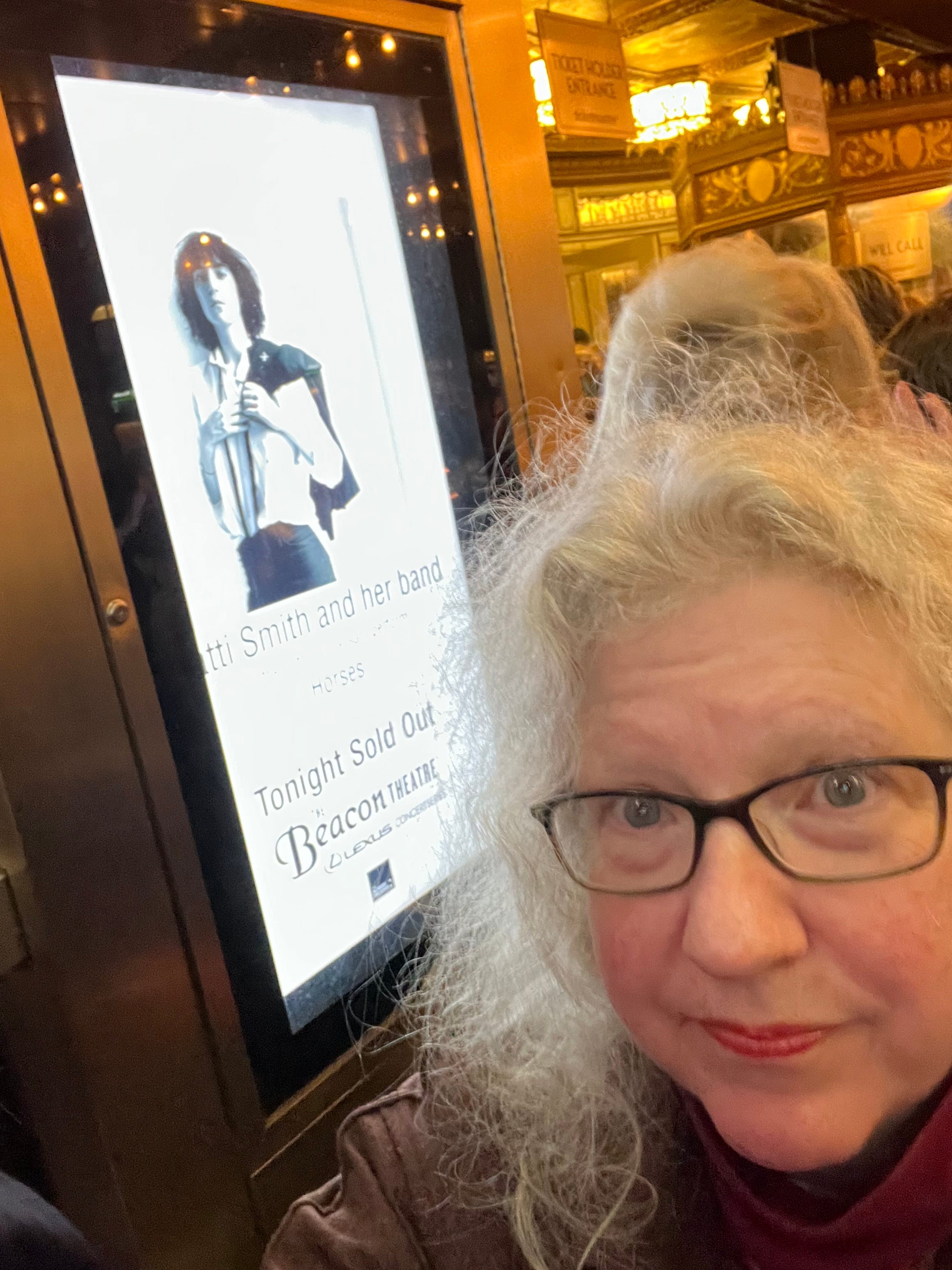
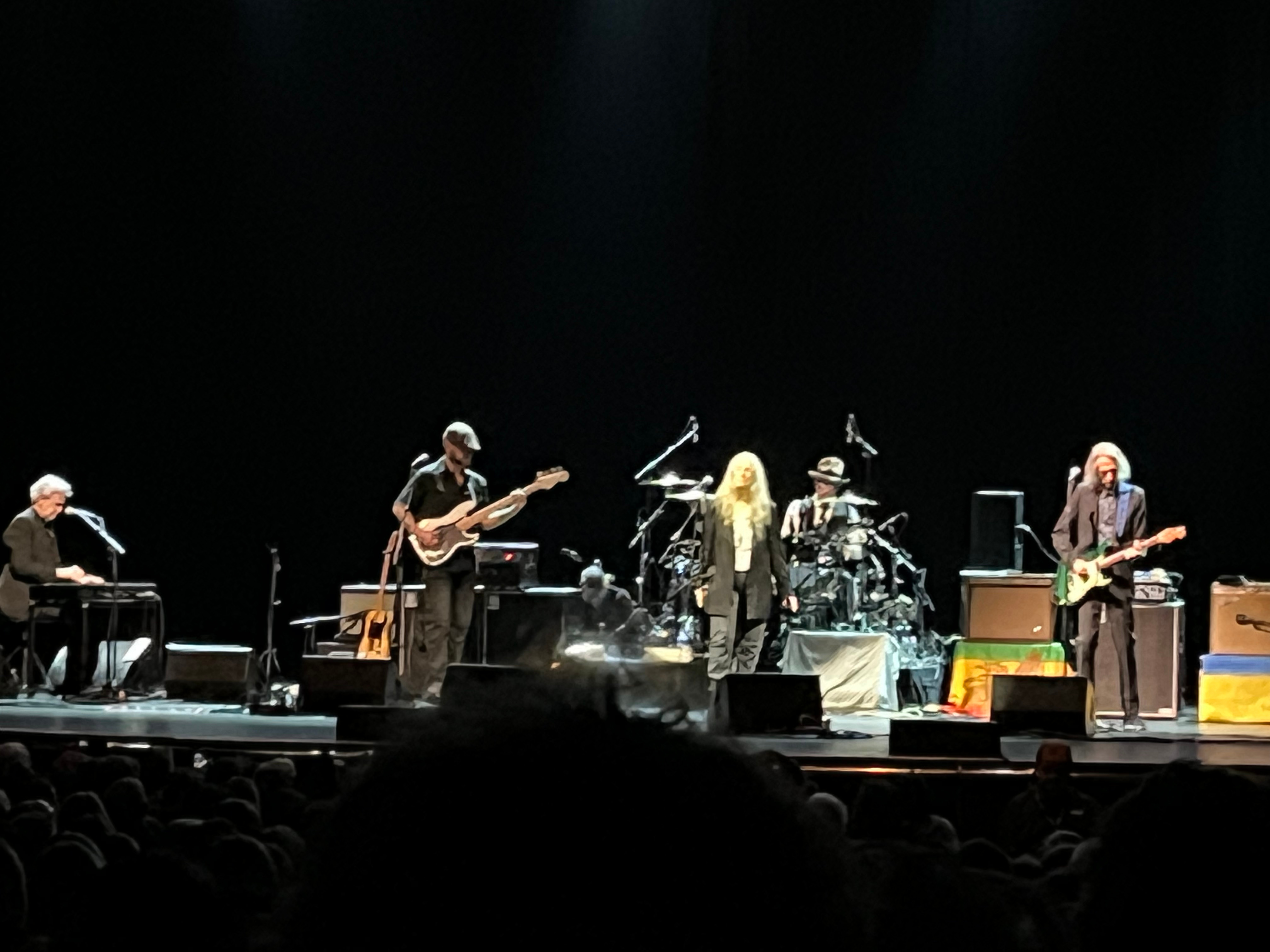
Listen to Patti Smith’s Horses (1975). (Envy me my Row X seat at The Beacon Theater on Broadway Friday night in New York City to see Patti Smith and her Band play the shit out of Horses in its 50th Anniversary Year, plus encores of classics. Patti also spat, twice, and it was glorious.)
So lest you think Miss O’ has given up on art, I haven’t, and I hope you haven’t either. There is nothing on this earth as satisfying as a creative act, something you can point to and say, “I made that.” There was nothing, and now there’s something, and I did it. And the world is more colorful and right and full than it was before you created that thing, however small, even making a smile happen on a stranger’s face in a notebook store, which I did on Friday night before the concert. I did that. That thing, there? You did that. Not AI, not engineered by some tech bruh, or ordered on you by some basement-dwelling podcaster or a bottom feeder in Washington. You. Just you.
Let’s stop scrolling together and get seriously radical in creative community. Take a moment to read. To be quiet. And then connect.
Here’s Mr. Rogers on the value silence from Charlie Rose, which is a clip I hope you watch. “My, it’s a noisy world,” he says, and it is. There’s more he goes on to say from his 1994 book, You Are Special, including about his professor, Dr. William Orr, who told him, “You know Fred, there is one thing that evil cannot stand, and that is forgiveness.” Take a minute with that. As a reader, Rogers says that the white spaces between the paragraphs are more important than the text, by which he means that if you aren’t using silence to reflect on what you are reading, you are missing the point of the endeavor. You can see more clips of Fred Rogers here. “A great gift an adult can give to a child is to let the child see what you love in front of them.” Whether it’s car repair, lawn maintenance, playing cello, fixing things, reading, singing, cooking, telling stories, dancing, whatever it is (note: what you love, not what you exploit)—that is the gift. I think I try to do that in life—to show love of life in greeting others. It’s tiny—I’m not a worldwide creative power like Patti Smith—but really it’s about being present, as Rogers says, moment to moment (and it’s the most important work in rehearsing a show, as shown me by director Maureen Shea). Doing things even a little larger than ourselves, then, in presence, is the point. Mr. Rogers only cared to be recognized if it made a child feel special—Fred Rogers liked “not the fancy people,” but regular people, and he aspired to “be the best receiver I can ever be—graceful receiving of what someone gives us; we’ve given that person a wonderful gift.”
Miss O’ most gracefully received.
The play I’ve been quoting here interstitially, The Tempest, is my favorite Shakespeare play; in some ways it’s like a compilation reel of all his best ideas, and his final play and only original plot, his retirement play. I’ve seen four productions of it—at the Globe in London, with Vanessa Redgrave as Prospero (it was awful); at the Shakespeare Theater in Washington, D.C., directed by Garland Wright, which still ranks as the top theater experience of my life (even after seeing Hamilton and Gypsy with Patti LuPone); one at Classic Stage Company downtown, with Mandy Patinkin (okay); and the fourth at St. Ann’s Warehouse, an all-women cast set in a women’s prison, directed by Phyllida Lloyd, with Harriet Walter as Prospero (fantastic). The most famous speech of the play, by Prospero, comes in Act IV, and I always think of it when eras end, as well as even a simple good thing, and especially a life:
Our revels now are ended. These our actors, As I foretold you, were all spirits and Are melted into air, into thin air; And, like the baseless fabric of this vision, The cloud-capp’d towers, the gorgeous palaces, The solemn temples, the great globe itself, Yea, all which it inherit, shall dissolve, And, like this insubstantial pageant faded, Leave not a rack behind. We are such stuff As dreams are made on: and our little life Is rounded with a sleep. (Prospero, The Tempest, Act 4 Scene 1)
In the final act of the play, Prospero’s daughter newly in love sees all the possibility of life, and this is from where Aldous Huxley took his dystopian novel’s title:
O, wonder! How many goodly creatures are there here! How beauteous mankind is! O brave new world, That has such people in’t. (Miranda, The Tempest, Act 5, Scene 1)
Sure, love is wildly naive, but it’s the beginning of everything. There’s a new world to be made. Let’s stop the fucking fuckers and do that.
Sending love, philosophy, music, poetry, creativity, all the good church,
Miss O’
The People Have the Power: Patti Smith and her band, The Beacon Theater, NYC, 11/21/25, the 50th Anniversary of Horses. Photo by LO”H. This was church.
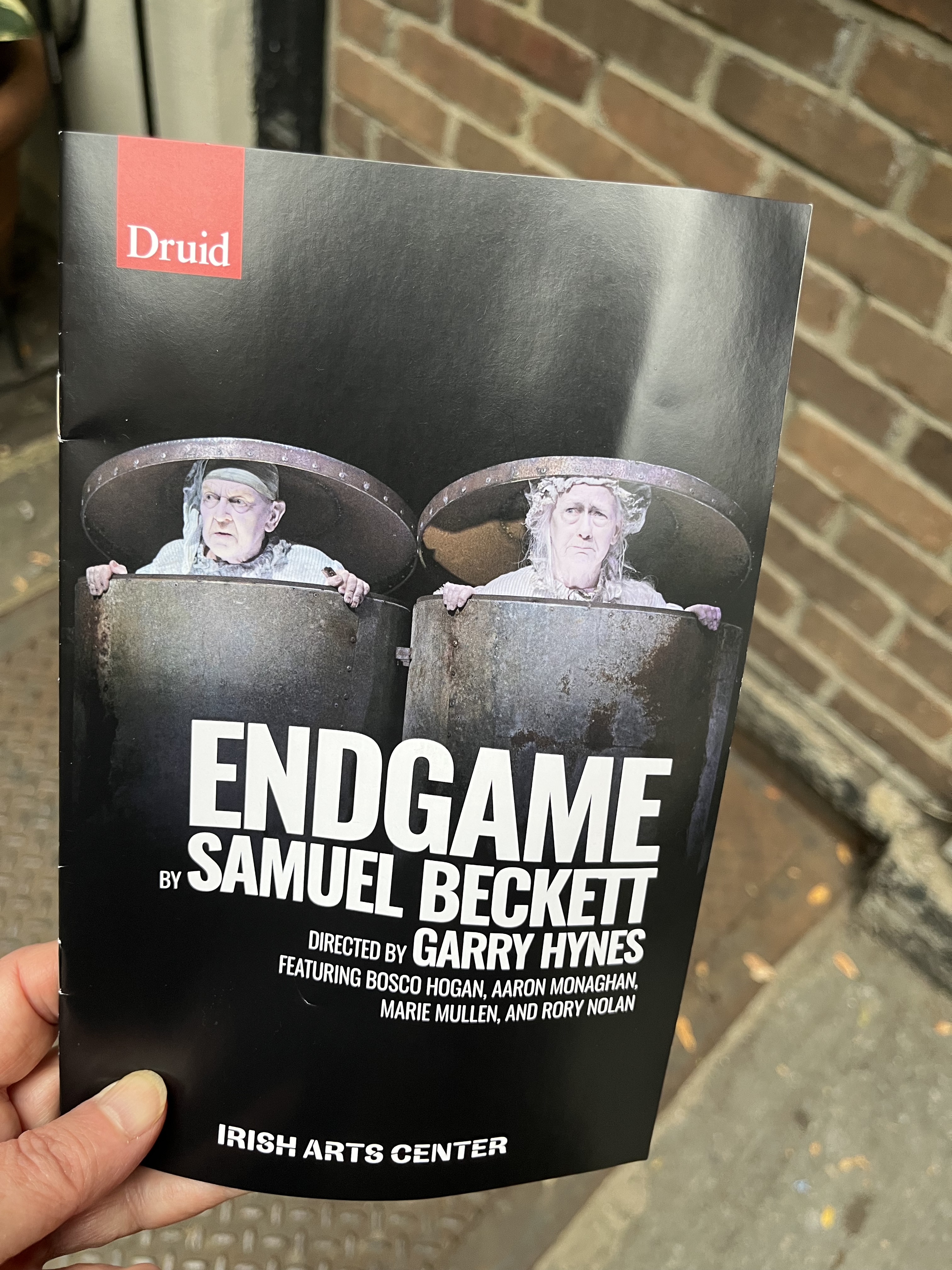
~ the blind Hamm after blowing his whistle, greeting the entrance of his servant, Clov, Endgame by Samuel Beckett
The characters in Beckett’s Endgame, which I saw Saturday at Irish Arts Center here in New York, presented by Druid, a theater company based in Ireland, are in an apocalyptic waiting game in some kind of shelter, starving, without painkillers, waiting for death. Hamm’s blindness and lameness keep him confined to a lounge chair, while his parents, Nagg and Nell, are confined to separate rusty garbage cans, waiting for death like their son.
It’s a funny play, and compelling, and of course, sadly, perfectly appropriate for the American moment. I look at Trump of the shit-filled diapers, bloated and slurring, demented and wobbly, barking orders to tear down the East Wing and kill fisherman at sea and send $40 billion of our taxpayer dollars to bail out Argentina even as he bars the release of any of the $6 billion in reserve for SNAP in case of government shutdown and oversees the tripling of our health insurance premiums, causing millions to lose coverage. His spending so much waste, the Republicans so much garbage.
“You pollute the air,” says Trump of our nation’s workers and immigrants and women, as he orders the dumping of toxic East Wing waste onto a public park golf course outside D.C., to prevent regular people from golfing, and distracts from the Epstein files, so shocked was he that his best friend of 15 years, Jeffrey Epstein, kept files on his best friend Donald J. Trump.
SNAP benefits are set to expire November 1, and without a deal from the Republicans, all working Americans will struggle to afford not only food but also any health insurance at all. To provide help for this coming starvation and health apocalypse, your Miss O’ wants to encourage you to donate to your local food pantries, if you can, whatever you can afford. Here in New York City, where I can only hope Mamdani wins the mayoral race, I gave a bunch more bucks to the following organizations. You can check your local areas for similar opportunities, if you want. The worst thing you can do is nothing.
City Harvest
City Meals on Wheels
Bowery Mission
God’s Love We Deliver
Sunnyside Community Center
While visiting my dad in Virginia a couple of weeks ago for the first time since my mom, Lynne, died, I gathered up all her clothes, shoes, and accessories in the closets and drawers, and Bernie (who was so sad looking at them) and I donated them. We do what we can, whatever our griefs.
I haven’t published on WordPress for some time—I haven’t been of a mind to play the role of teacher, each day being the next level of crazy in America. I’m sickened and lost most of the time. It’s hard to imagine Thanksgiving and Christmas, let alone my favorite, Halloween, what with ICE agents throwing teargas at children in a Halloween parade in Chicago. How is any of this happening? It appears that the Washington Post is this close to shuttering its print division, hastened along by owner Bezos, the slogan “Democracy dies in darkness” turning out to be a promise. After 60+ years as a subscriber, my dad sees his morning paper razor thin, formerly robust Metro, Sports, and Style sections combined into one slender one, few ads; his delivery lady has gone from dozens of deliveries, to ten, to two in our entire neighborhood since Bezos took over the paper. This seems to be intentional: Bezos’s lost 75,000 digital subscribers, too. It’s just a matter of time now, the owner ready to light his big cigar with the last of the masthead as he boards his newest yacht.
The billionaires are the 1% that are bringing our country, our world, down. Full stop. Blackout the system, give to your food banks, save all your pennies, tighten the belts, hunker down. It’s gonna be a long, hard winter.
But you know what? We can do this. Bernie and Lynne were born into the Great Depression. We always cut our toothpaste tubes in half to scrape the last of the paste onto brushes, had leftover night on Fridays, lived on peanut butter and jelly when we had to. You can do it too. And you can have laughs and play cards and read books rather than use power on devices. And say grace. The real kind.
Love your neighbors through this crazy Republican endgame.
“Man did not weave the web of life, he is merely a strand in it. Whatever he does to the web he does to himself.”
~ Chief Seattle, ca. 1885
From one of my notebooks, a favorite memory of Miss O’s childhood springs.
Hey, dear. Just a few thoughts this first evening of spring. How is your Thursday?
In the PBS series The Power of Myth, Campbell opens one of the episodes (which I started watching again on television just now) by reading this letter.
The president in Washington sends word that he wishes to buy our land. But how can you buy or sell the sky; the land? The idea is strange to us. If we do not own the freshness of the air and the sparkle of the water how can you buy them? Every part of this earth is sacred to my people. Every shining pine needle, every sandy shore, every mist in the dark woods, every meadow, every humming insect, all are holy in the memory and experience of my people. We know the sap that courses through the tree as we know the blood that courses through our veins. We are part of the earth and it is part of us. Perfumed flowers are our sisters; the bear, the deer, the great eagle – these are our brothers. The rocky crests; the juices in the meadow; the body heat of the pony and man all belong to the same family. The shining water that moves in the streams and rivers is not just water but the blood of our ancestors. If we sell you the land you must remember that it is sacred. Each ghostly reflection in the clear water of the lakes tells of events and memories in the life of my people. The water murmurs with the voice of my father’s father. The rivers are our brothers. They quench our thirst, they carry our canoes and feed our children so you must give to the rivers the kindness you would give any brother.
If we sell you our land remember that the air is precious to us; that the air shares its spirit with all the life that it is supports. The wind that gave our grandfather his first breath also receives his last sigh. The wind also gives our children the spirit of life. So if we sell you our land you must keep it apart and sacred as a place where man can go to taste the wind that is sweetened by the meadow flowers. Will you teach your children what we have taught our children – that the earth is our Mother? What befalls the earth befalls all the sons of the earth. This we know: that the Earth does not belong to man; man belongs to the Earth. All things are connected like the blood that unites us all. Man did not weave the web of life, he is merely a strand in it. Whatever he does to the web he does to himself. One thing we know; our god is also your god. The Earth is precious to him and to harm the Earth is to heap contempt on its creator.
Your destiny is a mystery to us. What will have happen when the buffalo are all slaughtered and the wild horses tamed. What will happen when the secret corners of the forest are heavy with the scent of many men and the view of the ripe hills is blotted by talking wires? Where will the thicket be? Gone. Where will the eagle be? Gone. And what is it to say goodbye to the swift pony and the hunt? The end of living and the beginning of survival.
When the last red man has vanished with his wilderness and his memory is only the shadow of a cloud moving across the prairie, will these shores and forests still be here? Will there be any of the spirit of my people left? We love this land as a newborn loves his mother’s heartbeat. So if we sell you our land, love it as we have loved it. Care for it as we have cared for it. Hold in your mind the memory of the land as it is when you have receive it. Preserve the land for all children and love it as god loves us all. We are part of the land. You too are part of the land. This Earth is precious to us. It is also precious to you. One thing we know; there is only one god. No man, be he red man or white, can be apart. We are brothers after all.
This postcard arrived today from my friend Anna in California. How lovely is this?
I was thinking today, for some reason, about how President Biden’s dream, “a cancer moonshot,” he called it, the super-funding of cancer research, was one of the first things Musk’s DOGE defunded; how one of the first of Trump’s deportees was a ten-year-old girl with brain cancer, arrested in an ER in Texas before she could be treated.
If there is a web of life—if what men do to the web, they do to themselves—then perhaps Republicans are a cancer disintegrating the web. Are Republicans a living cancer? Cancer cells, after all, were all once healthy cells. Once a cancer cell begins to convince other cells to join the cancer train, they kill the host. How to convince healthy cells not to turn to cancer? How to convince sick-minded humans to join the planetary brotherhood? How do we enact this cancer moonshot?
Can town halls be a start? Can our voices, together, mend us? How to find our voice?
Campbell tells us that everyone needs a certain hour of day, a certain place, where you can “simply experience and bring forth who you are and what you might be.” A sacred place of incubation. The Native Americans thought of all this earth as a sacred place, all of earth as a place for incubation. Most of us settle for a chair.
It occurs to me on this first day of spring that we all need a breath, a chance to replenish. I hope all these American town halls during the congressional recess are healing some of these wounds, or bringing all this cancer to the fore so the therapy and medicine of sense and empathy can be applied.
Musk and Trump and their acolytes consider anyone who is imperfect, ill, disabled, infirm, aged, or in need in any way to be simply unworthy of life, “parasites,” Musk calls them. It’s a stupid thing to say, especially from a man whose faulty Tesla tanks are being recalled all over the world. After all, everyone is only temporarily healthy, everyone has limitations, but Musk and Christian White Nationalists preach that “empathy is weakness.” In the real world, in real life, empathy is strength, connection, depth of soul, necessary for our mutual survival. Duh.
We know this. We have to cure this cancer.
NYT reporter Serge Kovaleski and the moment Trump’s presidential bid should have ended. I’ll never understand how it didn’t. (“Friends” came on my Facebook wall to defend Trump using their Christianity. “Lisa, I’m a Christian.” I didn’t have any idea how to respond beyond, “Are you high?”)
For a little refresh, let me leave you on the equinox with an affirming poem by an old, white, actual Christian man who knew how to love of all things on earth.
For rose-moles all in stipple upon trout that swim;
Fresh-firecoal chestnut-falls; finches’ wings;
Landscape plotted and pieced – fold, fallow, and plough;
And áll trádes, their gear and tackle and trim.
All things counter, original, spare, strange;
Whatever is fickle, freckled (who knows how?)
With swift, slow; sweet, sour; adazzle, dim;
He fathers-forth whose beauty is past change:
Praise him.
Source: Gerard Manley Hopkins: Poems and Prose (Penguin Classics, 1985)
We have to love the dappled things, and also the cancerous ones, the dangerous, the cruel. It’s the hardest part of being human. Suffering is life, after all. Transformation takes time. But there is, somehow, transformation.
When your government wipes your history from its sites
Good morning, sweetie. At 5 AM I saw a text from my friend Susan, a humor piece from McSweeney’s:
IT’S A SHAME WE HAVE TO BETRAY OUR ALLIES, STARVE THE POOR, HALT SCIENTIFIC PROGRESS, DESTROY THE ENVIRONMENT, AND ELIMINATE THE FREEDOMS ENSHRINED IN THE BILL OF RIGHTS, BUT AT LEAST MY INVESTMENT PORTFOLIO IS ALSO TANKING
It would be truly laughable if it weren’t really happening.
From one of Miss O’s little notebooks. Musings.
As you know, I live with a disturbed mind, born as I was a middle brow Cassandra, driven mad at times by unwanted prescience, the way (for example) even as I was moved by and marveling at Hamilton and Suffs on Broadway (some ten years apart), I knew they were not celebrations but elegies. It’s not for no reason that I felt that way: those shows bookended the beginnings of not one but two Trump terms.
As testament to my madness, I’ve found myself laughing at our Senate all these weeks, both Democrats as well as Republicans, holding all those “confirmation hearings,” because somehow the Democrats couldn’t see (and still can’t) what all the rest of us outside the Capitol Bubble could and can, that these nominees are being sent in to dismantle and erase our democratic republic. Senate Minority “Leader” and traitor Chuck Schumer (D-NY) is genuinely baffled as to why he had to cancel his “book tour” due to threats. House Minority “Leader” Hakeem “I don’t know” Jeffries (D-NY) had to cancel his little book tour, too. These two “leaders” haven’t been successfully doing shit to defend the republic for years (what did they even write about?), and yet think now is the time to take victory laps. They have, essentially, erased themselves from history even as Trump’s minions of white supremacy literally erase the achievements of women, Blacks, Native Americans, and all other minorities from all government databases.
In further erasure, Secretary of Defense Pete Hegseth has fired all women and Blacks from senior military leadership. Today I read that the Dept. of “Justice” has given President Trump the green light to fire all women from leadership positions in government. Trump humpers have no sense of history. It’s so childish, isn’t it—like the way kids think their mom won’t notice the broken vase if they put a tee shirt over it—only now the stakes are life and death, civilization vs. barbarism.
There is a poetic technique called erasure, in which the poet takes an existing text—something out-of-print, say, an old book, or a magazine—and maybe circles the words that strike her fancy or uses a pen to mark out words she isn’t drawn to. Whatever words remain can be shaped into a poem, using the words in the order she finds them, or rearranged. (Poet Amanda Gorman has a section of her collection, Call Us What We Carry, dedicated to this technique.)
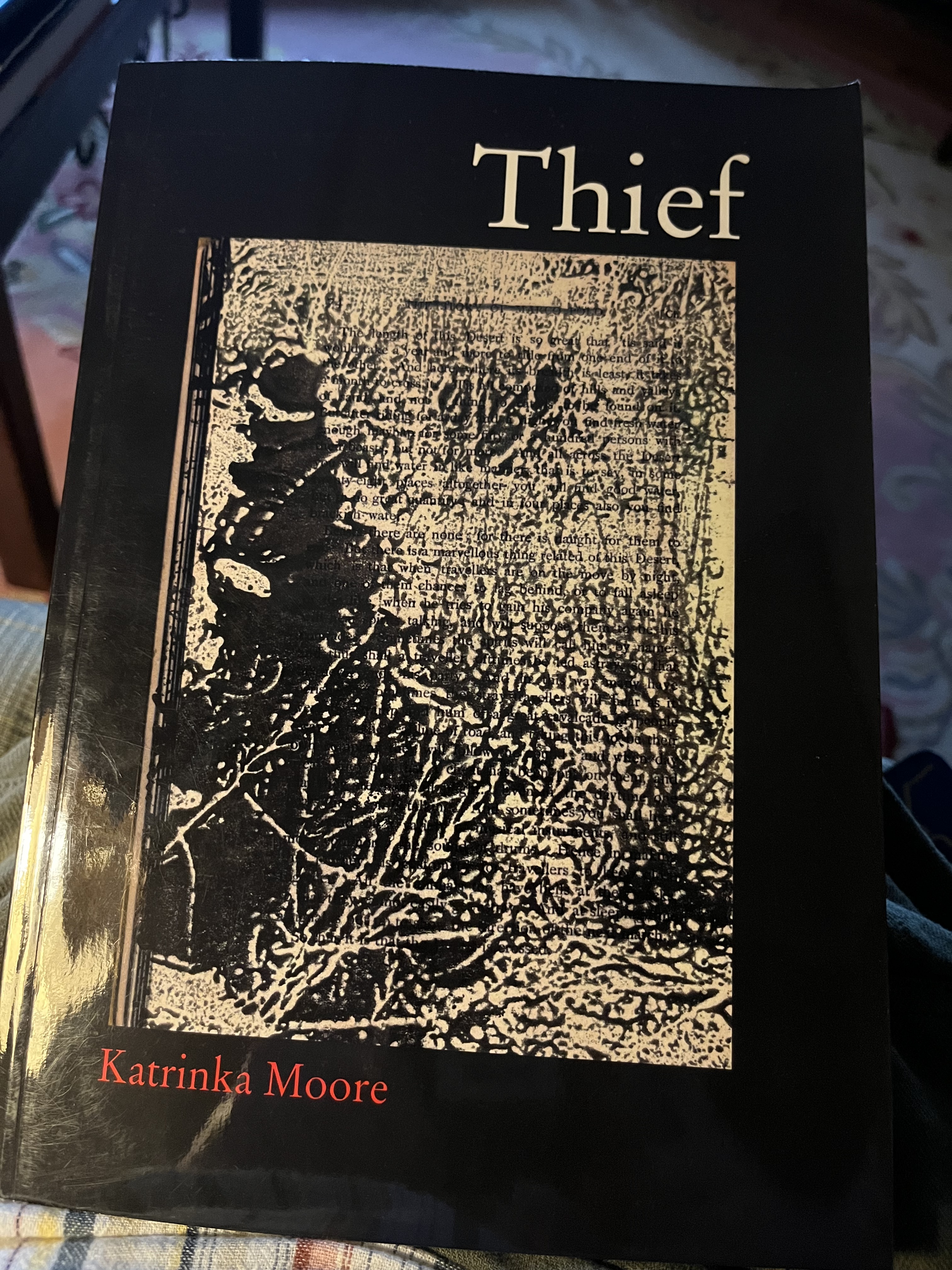
My friend Katrinka Moore has a collection of poems inspired by this technique, and it’s still my favorite of her many books, Thief. In a few places, she reveals not only the found poem but the process.
From Thief by Katrinka MooreBlazeVOX [books], Buffalo, NY, excerpted here to encourage you to buy it.
I think a technique like erasure shows us that do what we will to erase a text, there is something still to draw us in, a word we simply cannot let go of, another word, language that helps us reveal something new. The text is not the same, but nor is it lost.
Aren’t there parts of your life you’d like to erase? I have quite a list. Or have you thought you’d erased something, and then one morning, out of a dream, or from a knock on the door or a text on the phone, there it is, the past? Because that’s how life works, isn’t it?
Reading Joseph Campbell, as you know I have been, I’m reminded how mythology teaches us that no amount of annihilation, erasure, or running away can move us past the past, or past guilt, or spare us a reckoning. The story of Oedipus (whom the Oracle of Delphi prophesied would kill his father and marry his mother, and so whose parents cast him out as a baby, only to have him adopted and live to do that very thing), to take one example, teaches that one meets one’s fate in the path one takes to try to avoid it. You’d think humans would catch on; but in the West we have lost our mythologies.
To take another example, the First Council at Nicaea in 325 A.D. tried to force Christianity into tight constraints of how to believe and worship, and cast out and buried the so-called Gnostic Gospels, especially the Gospels of Thomas and Mary Magdalene, whose testimonies of Jesus’s teachings could not have run more in opposition to the Nicene religious oppression that is what the world now knows as Christianity. (If God is in your pocket, and if everyday men and women can equally teach and preach, you don’t need a patriarchy or a church; and you realize how truly radical Jesus was, and how close to the Buddha, to erase authoritarianism.)
But those Gnostic Gospels were uncovered in 1945 in Nag Hammadi, Egypt, because you know what? Try to erase what you will, the truth surfaces. Anyone who has suffered a trauma knows it has to be dealt with someday. There are only so many boxes you can keep putting in the closet before the closet explodes. Pick a metaphor.
Like Christianity, whatever was intended, our democracy (however imaginative) was founded on genocide, on slavery, on the subjugation of women. Do what they can to erase a people and history, people survive, history will out. Do what they can to shackle, people break free. You can’t erase that spirit. How is it that oppressors still think, in 2025, that erasure means obliteration? Yet we can’t quite erase authoritarians, either. We are all thieves, I guess, stealing what we can to make our worlds, always a price to be paid. Ask Prometheus. But some thieves are righteous. Ask Jean Valjean.
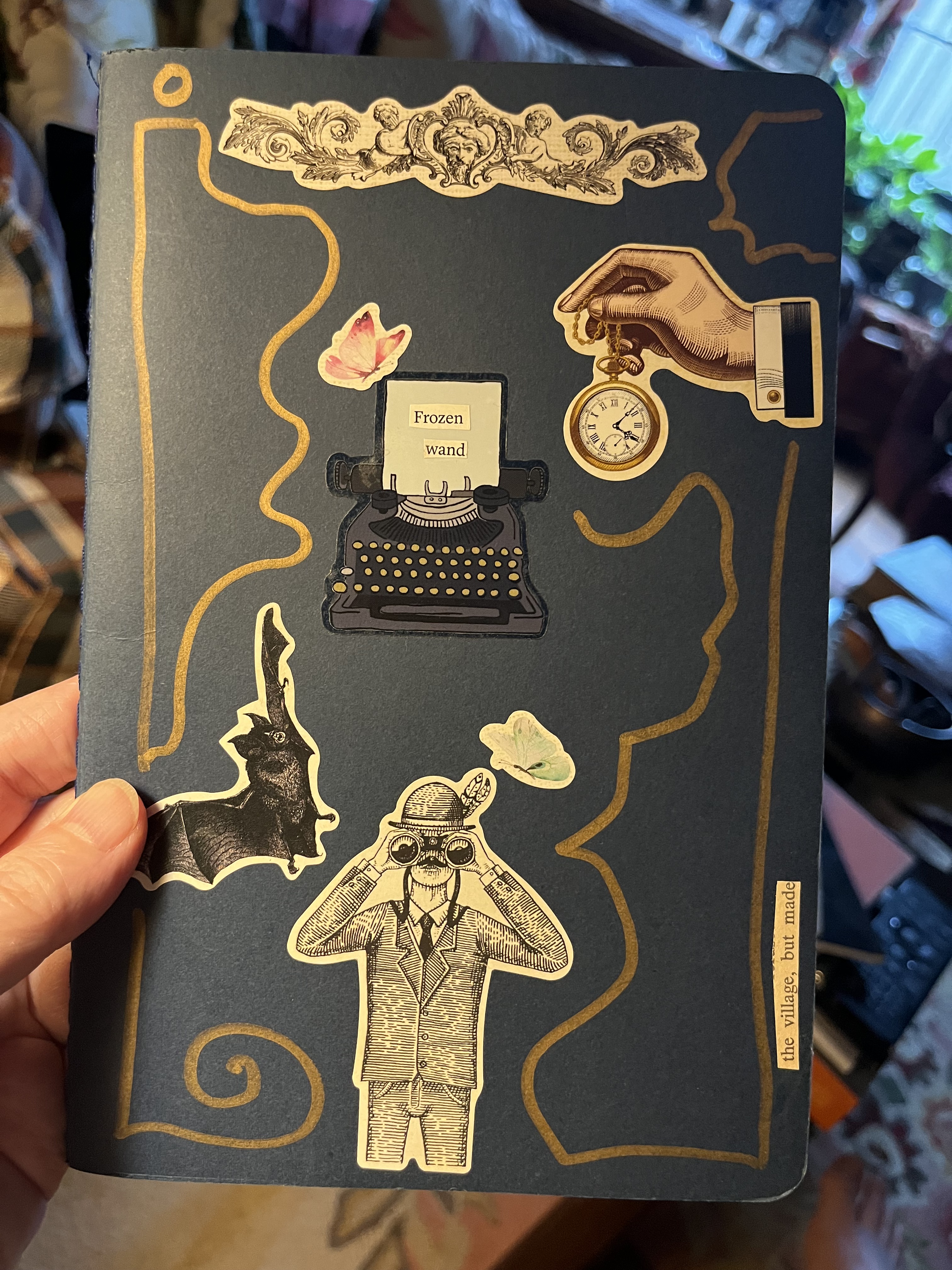
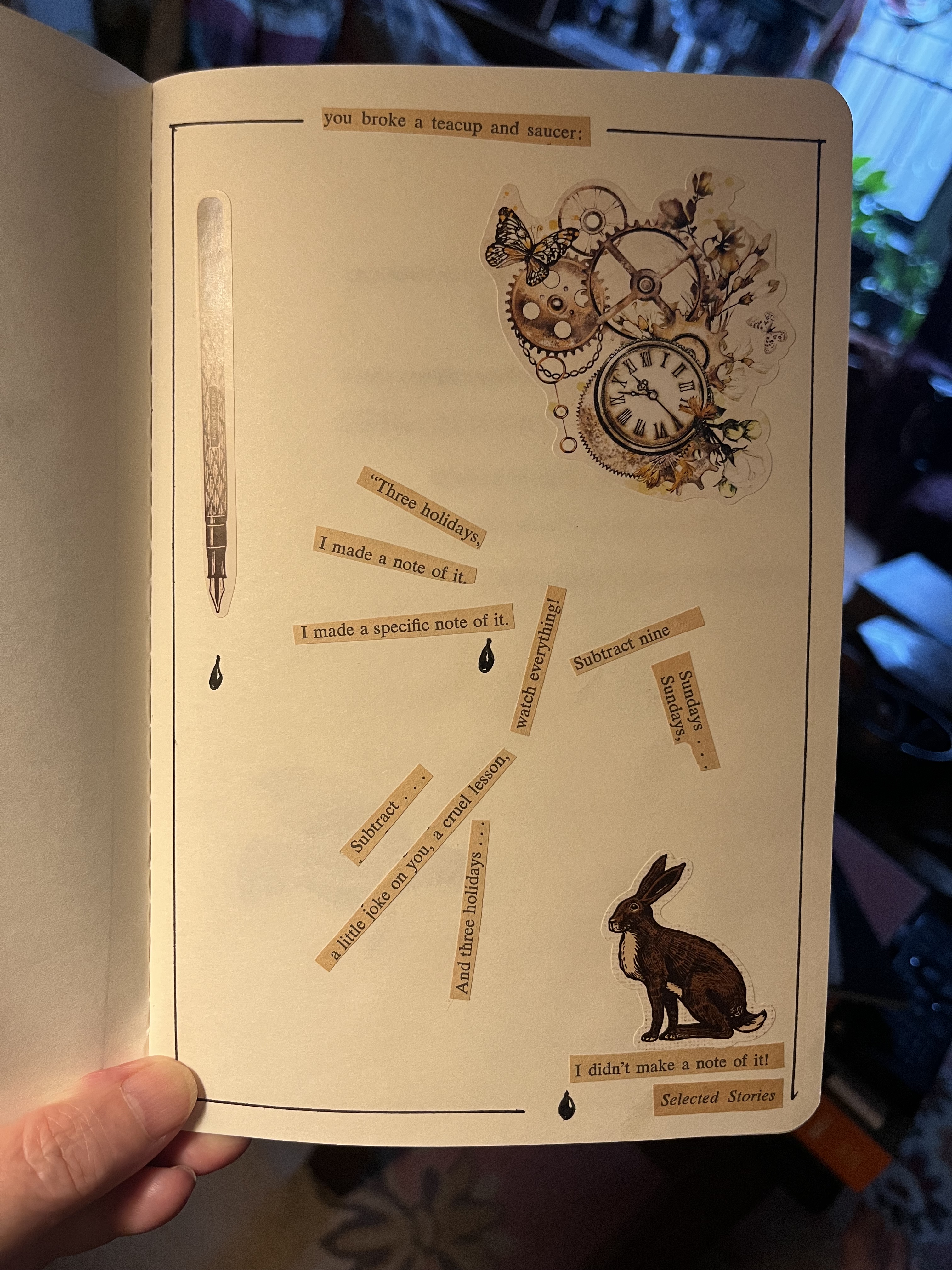
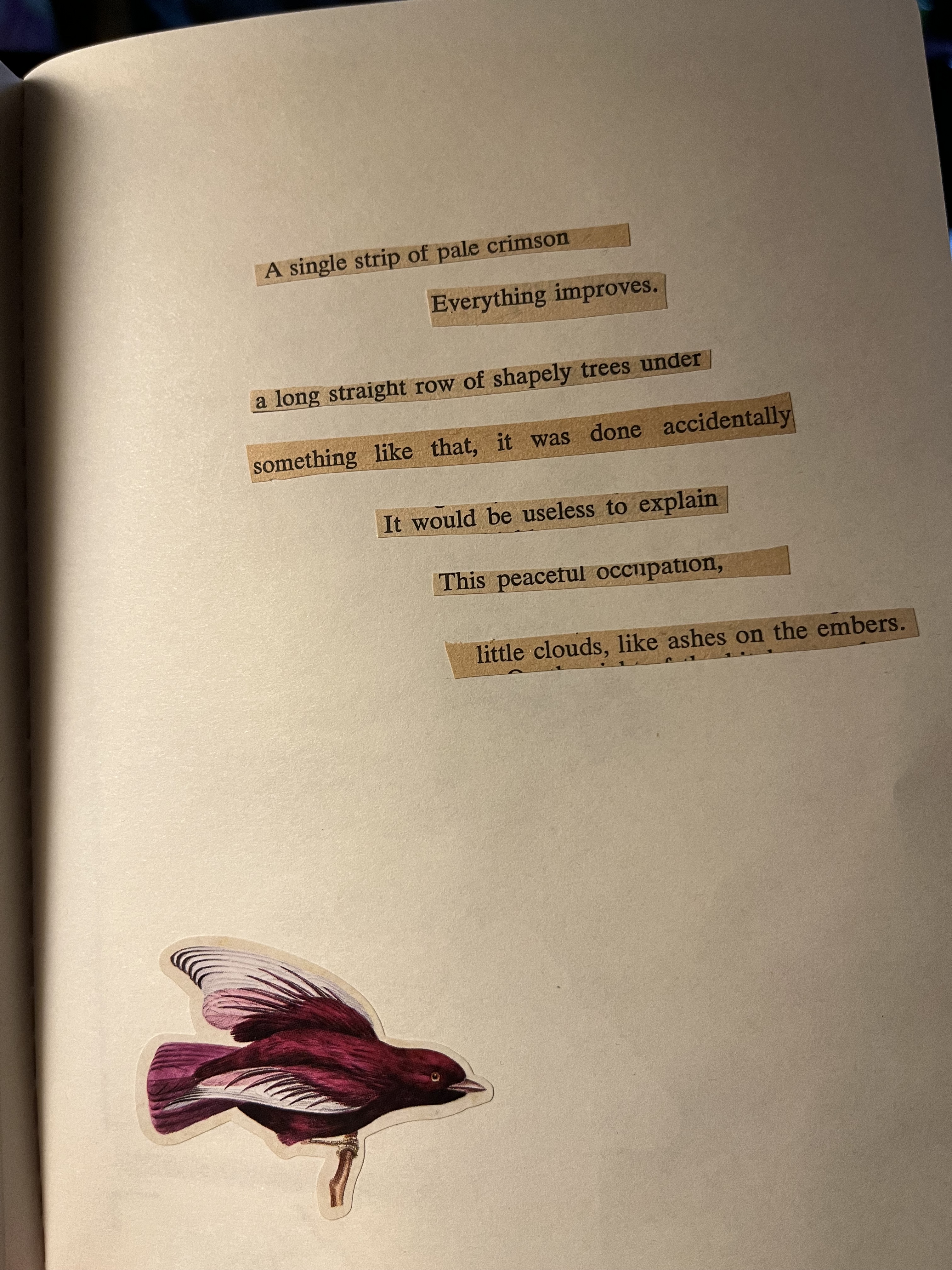
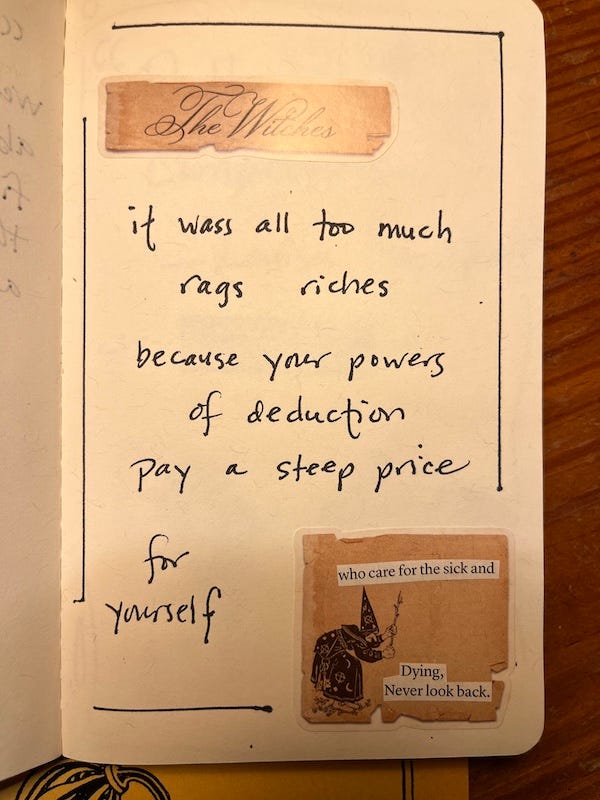
In one of my little notebooks, I took an erasure poem I made and illustrated it; I did a second one with cut out words. There’s something calming about the process, I think, because of what is revealed in our attraction to certain words. Should you try it, and I hope you do, let me know what you reveal.
Sunday morning around 9:30 AM, errands around Queens: An old Chinese woman in a wheelchair stuck in a groove of the automatic door of a grocery store, when the pusher popped the chair over it, and then I saw he was an old Chinese man, quite small, evidently her husband. How do we do it, we wretched creatures, I thought. And yet off they went, continuing to the next errand. Ahead was a 30-ish brown-skinned man, Arab maybe, with red highlights in his closely shorn hair, new-looking boots and navy pants, rubbing a scratcher with a coin, eagerly, turning this way and that as he scratched. What does he want the money for? Beyond him was an old fat lady like myself, except that her big hair, sans hat, was dyed brassy reddish brown, roots in her center part, and I wondered what kind of a person I would be if I were the sort who dyed her gray hair. (And when I saw this woman I experienced a rippling puddle of a memory of a dear poet friend, who had dyed her hair (this was years and years ago now) a dark brown before I arrived at her apartment, where I found her panicked with a violent rash around her neck and ears, and she needed me to take her to the Urgent Care clinic; and I remember being sort of relieved, because she was always so smart and strong-minded and perfect, that I finally got to see her humanized, even if only by an allergic reaction.)
Further walking for the second set of groceries (the first round involving a 5 pound sack of flour and chicken thighs and cans of broth) found me passing a tall, slender young man (gay, I’d say) upright in a navy pea coat, hands in pockets, and a young woman in a short parka and pom pom hat, both of them white, he talking of sound engineers and an orchestra, her saying “yeah.” As I passed them, I couldn’t help noticing that, between 50th Avenue and 48th Avenue, 45th Street looks a lot better than 46th Street, and I have to wonder why.
Sometimes I think in poems.
At the Liquors Store on Greenpoint
You know there’s a son in Italy, or a daughter
Trying to explain to their dad, or grandad,
That no one needs wine bottles this heavy,
That the same 750 ml of wine can be delivered
In bottles with a third the amount of green glass,
That it’s a waste of resources, a needless expense
For red wine $13.99 American,
And that the grandfather, or father, is misting over
For a time when the full weight of any endeavor was
Worth its weight in green glass, in wine, in gold.
Cracking Up 1, A Self Destroyed
Yesterday I learned that a dear old friend’s 48-year-old son took his own life on New Year’s Day. Nearly a decade ago he had a complete mental break, coincidentally occurring the day I was driving country roads out to visit them all from New York. It was a shocking episode that led, after a long hospitalization and months of tests, to a diagnosis of treatment-resistant schizophrenia. An author of a dozen books and hundreds of scholarly articles, a professor and head of an MFA writing program, a happily married husband and gentleman farmer from a great family, he showed no signs of anything like a coming collapse, simply no warning. The deterioration of his brain led him to, among many other awful changes, divorce his loving wife, who never knew what hit her; retreat to a cabin with a dog; try to write only to find the voices telling him to smash his laptop. There’s much more to this story, deeper, harder, uglier; also moments of great success, almost normalcy, too; until his brain became, according to the mutual friend who messaged me yesterday, a doctor herself, “treatment refractory.” I’m still in shock myself, and a few texts exchanged with his mom, my friend, after she didn’t answer the phone, told me she was still in shock, too, also full of rage over mental health services and the lack of them in our country, still after 100 years to know better we still don’t really act better on what we know. (Even in New York City, once again, the mayor has begun institutionalizing homeless people against their will based on nothing but, say, a police officer’s random gut reaction.) I think about how immediately all of the life you have known can be destroyed, and quickly; or horribly slowly; or in the blink of an eye at the hands of the ignorant and stupid.
Cracking Up 2, A Self Recovered
On the other side of that mountain, my friend Chuck Tripi, a poet, just published his third collection of poems, Wander Where They Will,and this is something to celebrate. Chuck himself has come through a great deal, and out of catastrophe many years ago, Chuck moved from airline pilot to poet, creating a wonderful poetry collective in the Paulinskill Poetry Project in New Jersey and publishing two collections I just love, Carlo and Sophia and Killer Pavement Ahead.
The year before Covid, Chuck’s beloved wife Barbara, a poet and photographer, died. After Barbara died, Chuck struggled in many ways while living in an assisted living facility when Covid hit. I spoke to him on the phone only once, and he was a shell of himself; he never thought he’d leave the place alive let alone write again. So this volume is nothing short of miraculous. I wouldn’t mention any of the particulars of Chuck’s life except that he has now poured his experience into this new volume, which is a heartbreaker because of the lucidity of his lines. Chuck’s is a soul that inspires me in its expansiveness and generosity, sure, but goddamn this man dives deep into every emotion that scares the shit out of most of us, and I love him for it.
Cracking Up 3, A House Divided
What is there to say about the Republican Party, so transparently craven, selfish, hateful, dangerous? A week of a shit show without shame that debased the United States in every new low, lows beyond what we thought was the nadir of January 6, 2020. But no. In his pursuit of the Speakership, Rep. Kevin McCarthy (R-CA) gave away whatever it took to win, including the dissolution of the House Ethics Committee, which promise didn’t seem to make the cut as of yet. The spectacle is only beginning, in that no one in the Republican Party is in office to serve anyone except themselves and to do whatever it takes to hurt Democrats. (I just don’t get why a Constitutionally guaranteed free press would deliver Republican lies as equivalent to Democratic facts.) The Republicans have created the wedge that is cracking us up. The press helps them, as does the worst of the Christian Church.
Here’s what makes me crazy: Like the Republican Party, the Church asks for your money to help them keep their institution going, while expecting you to solve all your problems with prayer. Why do so many people—who would have enough but don’t because they fall all over themselves to pour out all their tithes into the coffers of church pastors for whom no amount will ever be enough, apparently, to buy their flock into heaven—never learn? And they transfer that addiction to tithing over to their elected officials.
Deliver us from the ignorant and the stupid and the mean, those who would destroy because they can.
Here we are, after a month of binge eating and binge drinking, coupled with this desolation of spirit, and I can’t help wondering about why we think food will fill the well where a soul should be. For me, poetry is a balm. Why is it we keep failing to heed all those millennia of lessons and poems?
Cracking Up 4, Enough is not Enough
So many posts on social media, including my own, ask for nothing more out of 2023 than for everything to calm the fuck down. Just…boring. Be boring. Just for a while. Boring is not sustainable, of course, because boring makes us sleepy. I feel like there’s not enough energy to feed on right now. Why do nearly all the musical artists now sound like they are falling asleep in mid verse? Ref: See Billie Eilish and that cute trio on Instagram, great talents all but but but. I like my music to make me dance, to wake me up, to quicken my blood and mind. And I love a soft song as much as the next person, but mostly I enjoy music that makes me feel something, even sadness, but not music that makes me want to give up. As the poets show us, there is a needed tension between longing and fulfillment, catastrophe and recovery, repentance and redemption, Tom and Jerry. Where was I?
In my travels I came across this quote:
“The restlessness in the human heart will never be finally stilled by any person, project, or place. The longing is eternal. This is what constantly qualifies and enlarges our circles of belonging. There is a constant and vital tension between longing and belonging. Without the shelter of belonging, our longings would lack direction, focus, and context; they would be aimless and haunted, constantly tugging the heart in a myriad of opposing directions. Without belonging, our longing would be demented. As memory gathers and anchors time, so does belonging shelter longing. Belonging without longing would be empty and dead, a cold frame around emptiness. One often notices this in relationships where the longing has died; they have become arrangements, and there is no longer any shared or vital presence. When longing dies, creativity ceases. The arduous task of being a human is to balance longing and belonging so that they work with and against each other to ensure that all the potential and gifts that sleep in the clay of the heart may be awakened and realized in this one life.”
― John O’Donohue, Eternal Echoes
The way that Chuck was able to turn his tragedies into art, I want the nation to be reborn out of the dregs. I want to see myself and others find something deep in us to create something life affirming out of our shocks and agonies. Here’s my horoscope for December of 2022, and I want it to guide me into 2023.
Horoscopes by Rob Brezsny
Week of December 1st, 2022
TAURUS
(April 20-May 20)
Of all the objects on earth, which is most likely to be carelessly cast away and turned into litter? Cigarette butts, of course. That’s why an Indian entrepreneur named Naman Guota is such a revolutionary. Thus far, he has recycled and transformed over 300 million butts into mosquito repellant, toys, keyrings, and compost, which he and his company have sold for over a million dollars. I predict that in the coming weeks, you will have a comparable genius for converting debris and scraps into useful, valuable stuff. You will be skilled at recycling dross. Meditate on how you might accomplish this metaphorically and psychologically.
The year 2023 has already hit us with a lot of debris. I feel like our souls, like our earth and our politics, are stuffed with detritus that threatens to overwhelm us, and most of us don’t know what to do with it.
I shouldn’t presume—I guess I mean my soul feels sort of shredded up or filled with too much of the wrong stuff or distracted. It’s a shame and shock to let all the shit crack us, er me, into bits, if there is anything within out power to change that, because not everyone is given a choice. All we can do is use what we have and try to make something. I’ll keep you posted.
(FYI: I started my 2023 blog with a new web address, missoshow.com, committing to my WordPress experience by paying for the privilege of posting. It seems time. I thought about changing the blog name to The Miss O’ Show: Reading Glasses. We’ll see.)
Miss O’s bathroom reminder not to be late. For whatever.
Pass the Data
The other day I heard a learned philosopher discoursing on self-knowledge. While we used to engage in self-exploration through meditation, sports, or art, for example, Yuval Noah Harrari asks what it means, then, “when this process is outsourced to a Big Data algorithm?” That line stopped me hard. Where Eliot’s J. Alfred Prufrock measured out his life in coffee spoons, how many of us measure out our lives, our wellness, and our worth in “likes”? in “steps”? in money earned, spent, and saved? in mileage on the bike? in states or countries visited? in our biometric numbers for sugar, cholesterol, weight, percentage of body fat, calories consumed, points earned? lays sought and found on a sex app? books read? shows seen? tweets twatted? MAKE IT STOP.
One way I measure out my mental health and self-worth is through the laughs I generate in others, and judging from that last few years of meager blog posts, posts on social media, and reactions the few times I’ve seen others in person, I am in rough shape. I don’t think this post bodes well for wit, and for that, one of my three or four readers, I apologize.
The most important measure of my mental health for me is my capacity to weep at beautiful songs, singers, poetry, movie moments, pictures, and other acts of human decency. I was just listening to the Barbara Streisand/Judy Garland duet “Happy Days/Get Happy” and found myself in tears. So, check. (I hadn’t thought about the ways in which I might bring others to tears, but I think that happens out of my capacity to irritate more than, you know, move someone by making something beautiful.
You Laughed at an Image
My first boyfriend*, from back in high school, got back in touch recently. He has been with his wife, a fellow artist, happily for 32 years. When they eloped after living together for almost a decade, I mailed them a toaster. They totally got it. He began reaching out to old friends, he said, in the wake of Covid, and on the cusp of age 60 next year. I told him that I myself have actually paid for a ticket to my 40th high school reunion. I am going with two buddies of mine since second grade; my old bf’s was last year, and he said, “MAGA vibe, super spreader event; pass.” Probably true here too, but friend Carl promises it’s really a reunion of friends from elementary and middle school, and it will be fun. Okay.
The best part of the reconnect has been the ART share, in multiple texts; the meme share; the political jokes. According to the data, I laugh and heart a lot, so that must be good. My inner life, I mean. Should I dig deeper?
*Note: I never had any boyfriends. Sure, I went out with two guys in high school, and steadily, and talked about marriage with another guy, but I was ABOVE BOYFRIENDS. And still am. Why? Dunno. Let me ask an algorithm. “You laughed at an image.” I guess I’m fine.
Weekly Report: Your screen time was down 11% last week.
Weekly Report: Your sense of self-worth was down 25% last week and continues to plummet.
Weekly Report: 99.9% of Republicans blame all girls under age 11 who are pregnant for being too hot to resist.
Weekly Report: Humans are fucking up the planet and are fucking fucked but only about 25% of Americans fucking believe it’s fucking true, and YOU are one of them.
Weekly Report: 100% of meals in America contain tough nuts.
Anything else to REPORT? I mean, there it IS.
Work It Out for Yourself
My Queens basement flooded again yesterday afternoon. Only one inch of rain in an hour. What the hell? Last September my last chance for a vacation for the foreseeable future (and what would have been my first in three years) was swamped over by drain overflow in the wake of Hurricane Ida. My last real vacations were in 2018 in California, Lake George, and here in NYC when friends came for a week to visit. The year 2019 was WORK, the year 2020 was WORK + Covid; 2021 same. But Labor Day week friends and I were going to make a break for Lake George again…and Ida. Since then, my parents, while still sharp and okay, have grown frailer. I spent 5 weeks there this spring to help my dad after a surgery, and help my 85-lb mother, too. Lucky to be able to do it—the sad residual benefit of the pandemic is that we have this new way of working, remotely. And wow does it make me feel remote—from others, from myself. A lot of us are at the point of wondering why we work at all—so many of our jobs are just humans trying to plug the holes and reduce the problems inflicted on humans by the humans who are doing the jobs in other companies and institutions and there is no bottom. Why aren’t we just growing food, singing a little, dancing, and cooking again? What happened? Boredom?
And don’t get me started on the rat infestation at my co-op building, or the super going on vacation and the back-up falling through and me being the only person not afraid of the rats, so this gray-haired fat lady will be sweeping up (including the dead rats) and hauling garbage out for the next two weeks. And temps in the 90’s. This is how I will die. And so what, really?
The opening phrase of the first poem of my friend Jean LeBlanc’s latest collection of poetry, our pitiful metaphors, is, “Work it out for yourself:” and the first time I read it I just about threw the book across the room. I was so tired, you see. I don’t want to be challenged or taunted or berated. I don’t want to work it out for myself. Just tell me my horoscope, give me the meds, the diet plan, the answer. Why is this hard?
“we inflict upon the cosmos our pitiful metaphors.”
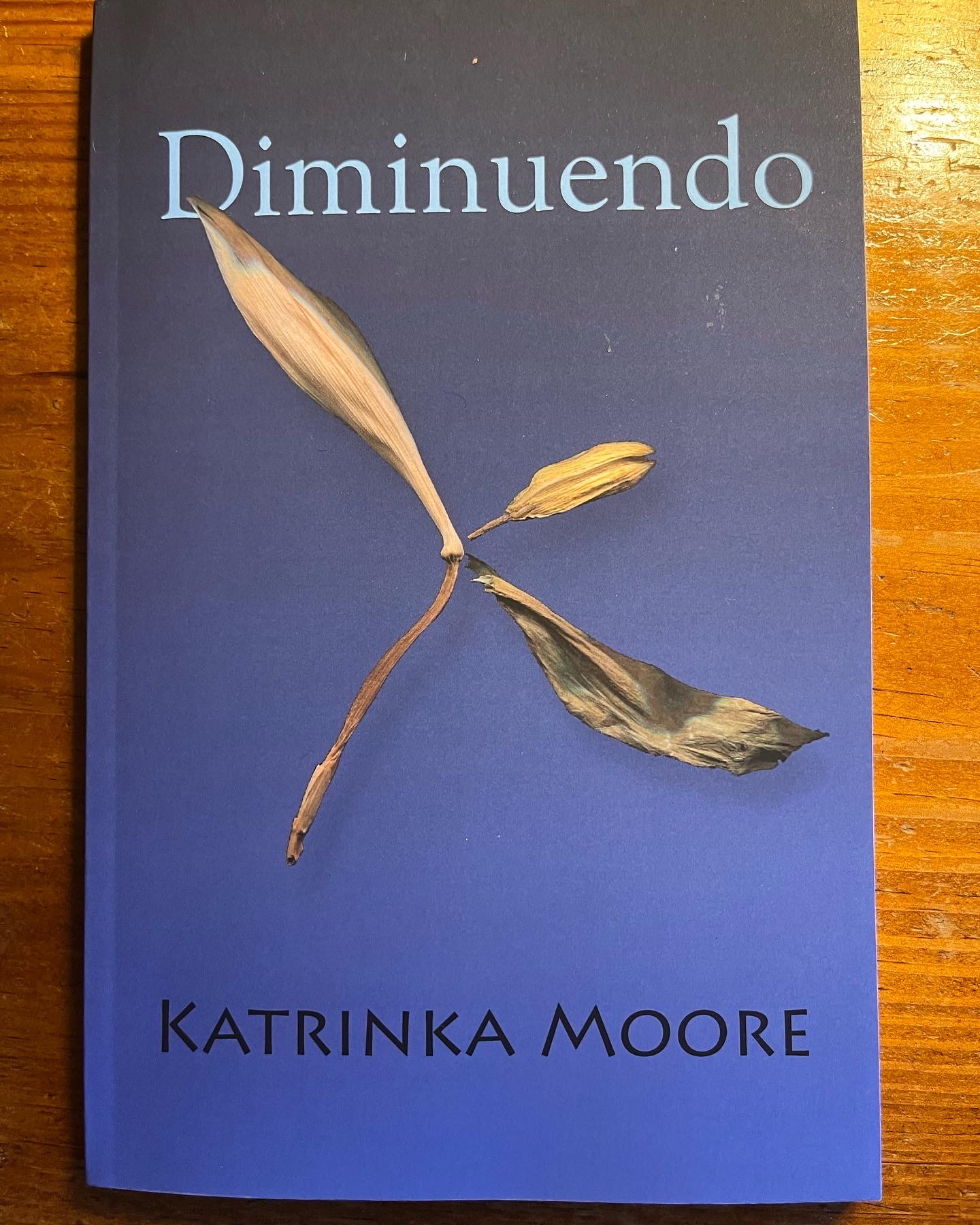
I reread the collection this morning, after putting all the flood-soaked towels in the laundromat washer, which sounds like a pretty easy task, until you factor in moving all the shit in the basement mudroom to get the heavy duty cart out, lining it will a big plastic bag, filling it in four trips from bathroom shower to trash alley carrying the drenched textiles, heaving the laden cart up the stairs, locking the gate (dragging it over swollen concrete—is nothing just a thing?—and pushing it all to the facility; followed by returned the cart to the basement, etc. It’s laden with sadness, this poetry collection; arguments, missed connections, and loss. I find myself wrestling with all the terrible beauty. I contrast it with our friend Anna’s collection, Buoyant, about the joys of scuba diving, the poems’ speakers filled with wonder; and our friend Katrinka Moore’s latest collection, Diminuendo, which returns again and again to the sensation of floating, hovering, and the feeling of being connected tenuously by the thinnest of strands.
“When at last the great animal arrives/ out of the primordial past, mouth wide” (“Grace”)“but I make my way out. when/ I can. The fetch of space” (“Thin Places”)
There are moments these past few years when I’ve felt held together by only the thinnest of strands; known that I am forever and always having to work it out for myself; and also given a reprieve with moments of wonder, as this week with the first color images from the Webb Space Telescope.
I made the mistake of texting my despair post-flood yesterday to a friend who said, “Fuck, Lisa. Get help. Call 988.” I remembered the first time I went to therapy years ago, my therapist Goldye said, in response to my skepticism about going to a therapist when I have friends: “Our friends don’t care about our pain. They will say whatever it takes to make you okay so we can all go to the movies.”
Walking in Midtown Manhattan. Look up.
And this is why you walk your neighborhoods, write stuff, draw a little, and don’t share your pain with anyone, not even friends; why we have to turn to the poets, the artists, the musicians in our darkest hours. People have their own shit to deal with, and they don’t need yours. It’s a lonely truth in a lonely world.
Sending love and poetry, somehow. Bless those poets.

















 The Miss O' Show (Teacher's Edition)