This would have been 36, 37 years ago now, in the fall, the first year I moved out to Highway 644 in Appomattox, Virginia, the little yellow house—I told you this story—and my heat source was now a wood stove. My teaching colleague and neighbor Jeanne drove me and her trusty German shepherd Ton-Ton, struggling in her final year with hip dysplasia, in her truck just barely into the woods by Nixola Guill’s house, back just behind the old clapboard church that the historical society would later that year move to a “historic village.” It was just getting on dusk, and our plans had gotten waylaid by one thing and another, but the fact was Jeanne’s family was out of light wood, and I was going to need it too, if I wanted to get a fire going properly. This is the stuff sold as “Georgia flatwood” in cabiney catalogues, but what it is is old pine stumps, the pitch of which has turned into pure kerosene. Talk about a fire starter.
I don’t know who owned the land (and no doubt we were trespassing), but the forest was deciduous, changing over from pine to hardwood. As a result, the pine trees lost light, began dying, and the place had become loaded with pine stumps. Jeanne had noticed the abundance of them in one of her walks; it was getting on the time of year she had to put the dogs in blaze orange vests and wear one herself, early hunters out illegally, too, so our trespass was nothing, what with perfectly good lightwood just going to waste.
Jeanne pointed out the wide gully leading from deep in the woods to behind the church. “That was a road at one time,” she explained; walking in the woods with a biologist and native Virginian was always instructive. In fact, my four years living in that county could not have been a smaller life or a bigger education. I’ve written about it in places, but this is about wandering through woods at dusk. We’d walk, locate a stump, take a shovel, and dig; so old was the wood that it only took a little digging and some tugging to pull the stumps up. “Smell that,” Jeanne said. Oh, yes, there’s that kerosene smell. Jeanne’d brought along a couple of large burlap sacks to fill and that we did, dragging the sacks back to the truck, as Truman Capote might say, lugging the stumps like a kill.
By the time the dragging began, it was fully dark. You don’t think you can see in the dark, but you can. Because of the gully on our right, we knew which direction to walk in, and we also kept well to the left of the gully so we didn’t tumble in. It was cold now; supper sounded good. Do you know that feeling? And the tingle of wood smoke filled the air all around, all the stoves of the wide-apart neighbors commencing their roars. Lifting those sacks into the back of the truck, and Ton-Ton too, getting inside the cab, pulling out onto the road for the short drive to Jeanne’s driveway, I can’t tell you how alive I felt. Her husband would chop up a stump for me that evening to take back to my own stove down the road, where I’d go right after supper.
I get teary thinking about this, the exhilaration of that evening, one that felt like many hours but couldn’t have been more than one. A friend, woods, a dog, a truck, a purpose, and that dusky light, the promise of supper when the work is done. It’s all you need.
Back in my young teaching days in the late 1900s, people enjoyed their experiences without the press of photographic documentation. I miss those days.
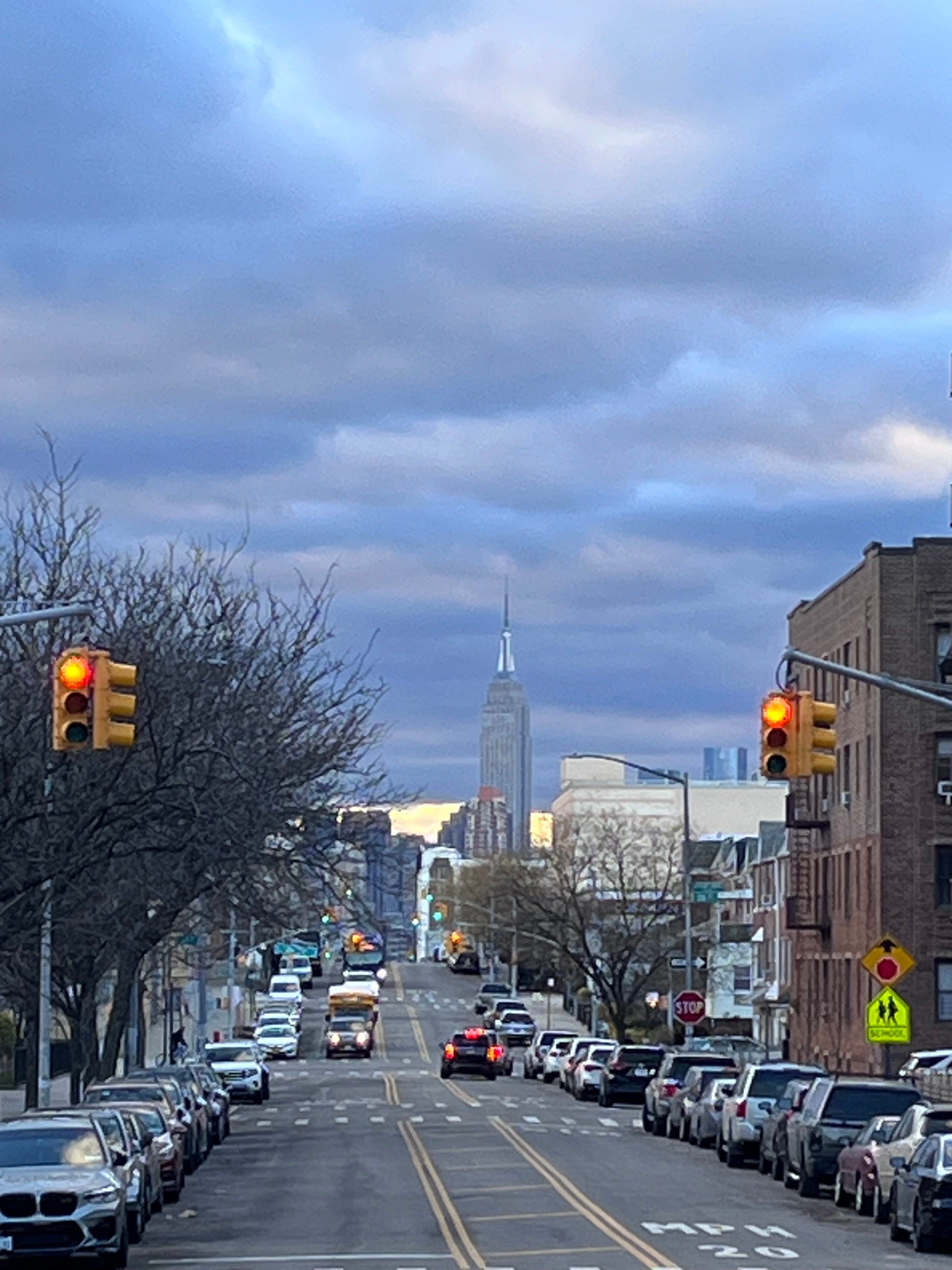
And walking around Queens this evening, that’s exactly where my sense memory went. And I thought I’d take you on a memory walk with me, in case you needed a reminder that there is not only a way into the woods, but also a way out, even in the dark, and if you pay attention and stay present, you’ll find it.
When I take my evening walk about in my Queens neighborhood, and maybe I’ve written about this before—this is the age, but I sort of marvel that I’m of it.
I can’t help marveling that for a truly odd woman, odd since birth, who never really belonged anywhere or with any group for as long as I can remember (and lucky enough to find loads of friends just like me), I have still managed to make a life in a range of locations, learning through walking, greeting everyone I make eye contact with, with “Hi.” I’m not stupid, but my experience has been that as Anne Frank said in her diary, most people really are basically good.
It’s hard to feel like that today.
Trigger happy white men are freely enjoying acting our all their Nazi fantasies, their blood lust, on ordinary sweet Americans, and they know they can do it with impunity. It won’t matter if anyone is charged for the murder of the Minnesota poet/wife/mom whose van was in an ICE agent’s way, because Trump will pardon him. This is America now. Until these men rape, kill, pillage, torture, torment, destroy everything human and decent to the point of over-satiation, they won’t rest. And they won’t stop, not really, ever, because their rage is superfueled by their increasing cruelty.
I remember seeing footage of the earliest days of the war Russia has waged on Ukraine, where confused and under-equipped Russian baby soldiers pointed weapons at and were utterly baffled by old people walking out of their houses to shoo them away, like flies, and they went. That didn’t last long. Three years later, the war is no closer to ending.
America will soon be under siege, too, I guess, by its own kill-happy MAGA citizens. It’s so hard to fathom how quickly it all went to hell. And how long we will have to endure this is anyone’s guess. General Stephen Miller all but came all over himself on CNN the other night as he talked about raw power, how he had it now, and would never give up that “raw iron” he was, in his dreams, holding in his pants.
Even harder to reckon with is the fact that we have absolutely no Democratic leadership to meet this nation’s defining moment. Not even a retired military official will break protocol. Trump has zero real opposition outside ordinary citizens doing their best to keep democracy going. It’s lonely and it’s terrifying. And now, deadly.
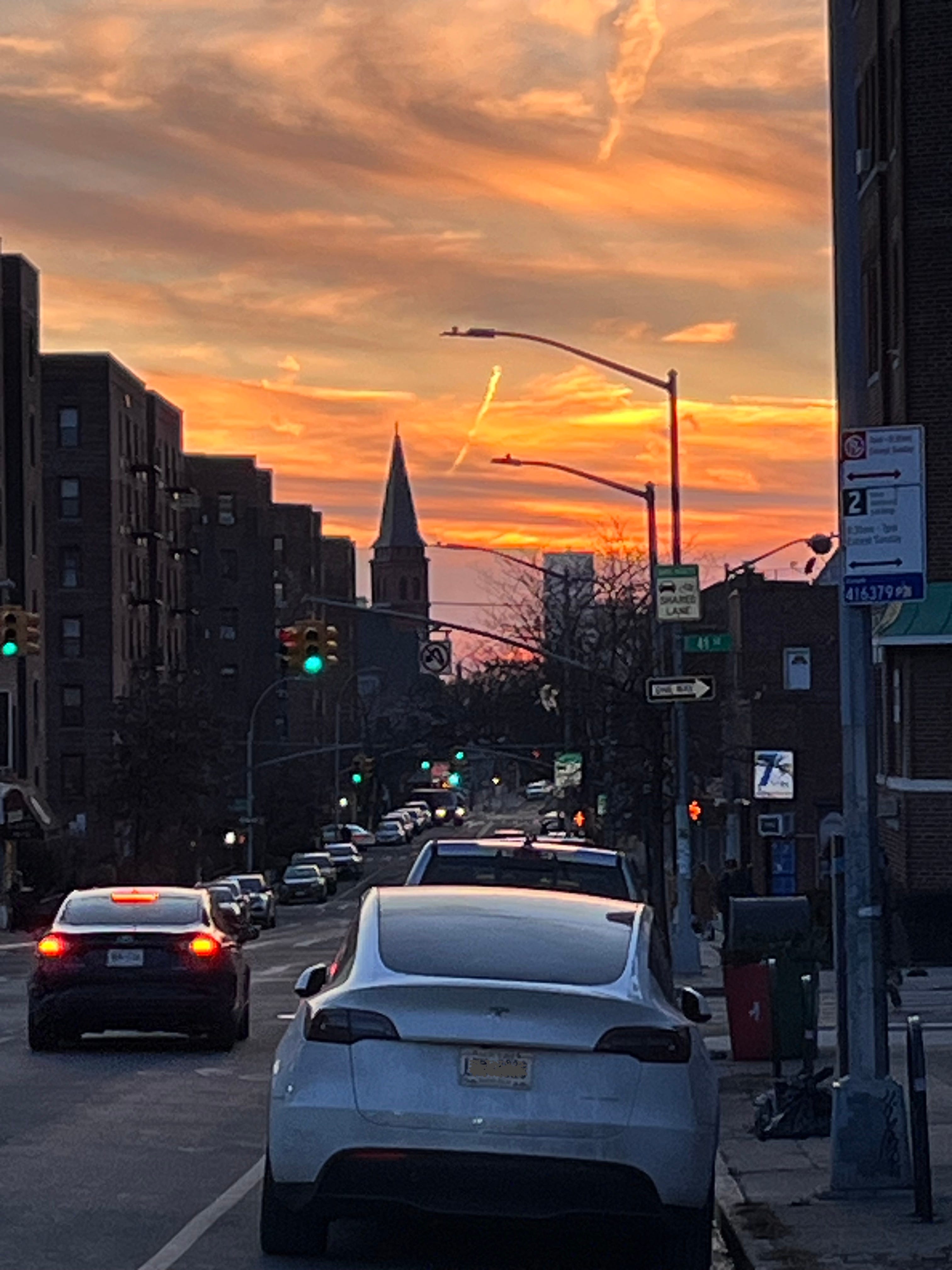
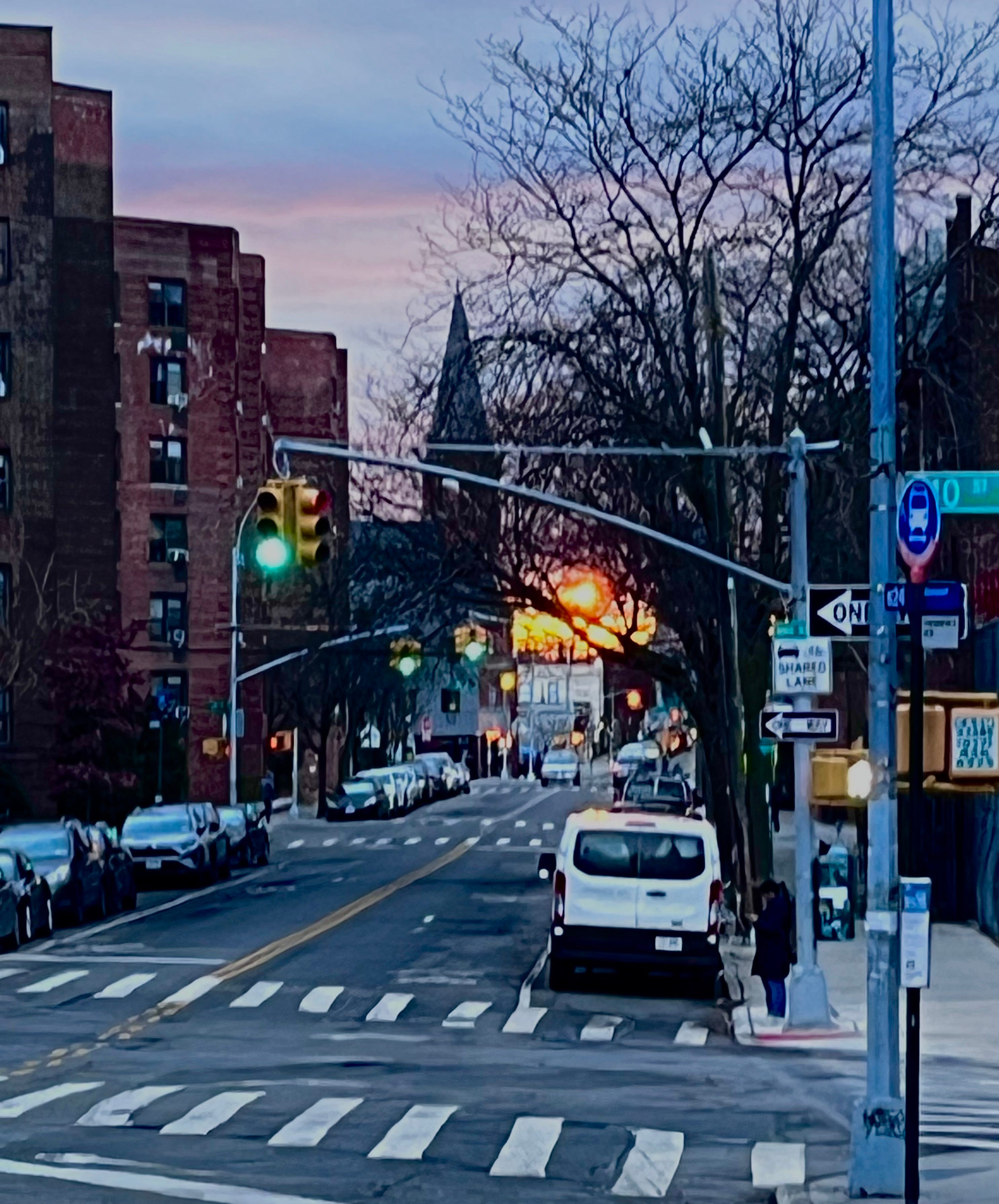
So here I was this evening, after a half hour of wracking sobs, making myself dress well and go out into the world in search of dinner to bring home, marveling at the sky.
And I began remembering other skies, the seasonal skies of many walks, from early adolescence on, when you start going outside yourself—the wild Virginia sky of my childhood neighborhood after a hail storm; a playground sky of Biblical proportions, the light coming down from behind the clouds, as I played basketball with middle school friends; windswept blue drama during Hurricane Andrew in the eye of that storm in rural Central Virginia; half blue, half black clouds with rain to dodge walking across the Virginia Tech campus; an otherworldly dark orange sunset in Vermont during summer in graduate school; the still-light sky of London at 11 PM in summer; the perfect dusk of summer parks in Oxford; so many skies.
In all my walking in places as disparate as Woodbridge, Blacksburg, Appomattox, Vermont, Oxford, Spriggs Road, California, Iowa, London, and New York City, alone as I always am, I’m of it. Always of it. The sky never lets me feel abandoned. And so it is that I seem always to be from places, eventually, regardless of my oddness.
I’m too deeply, darkly sad to write anything else tonight.
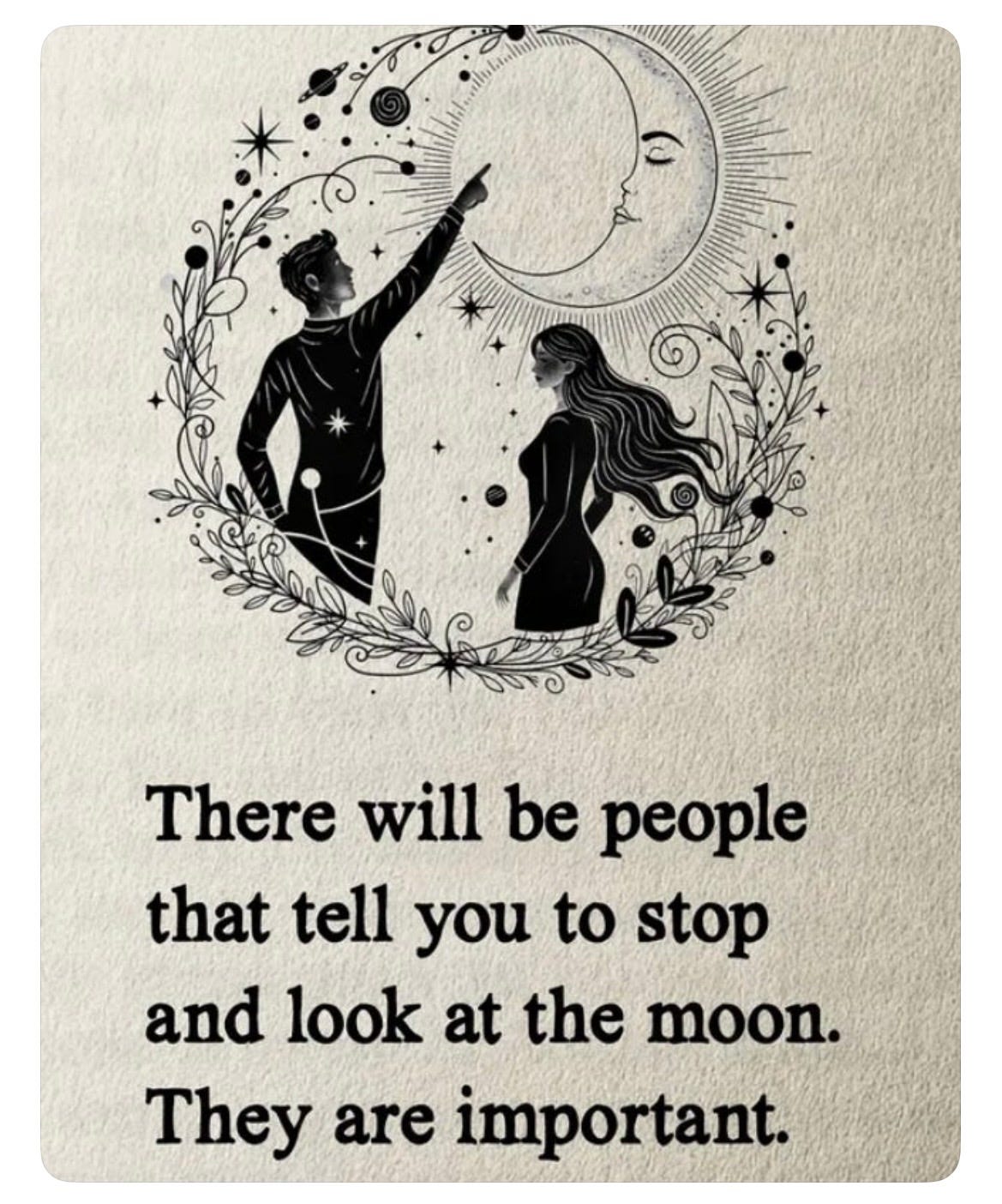
As if on cue, my friend Tom sent me this:
Yes, they are.
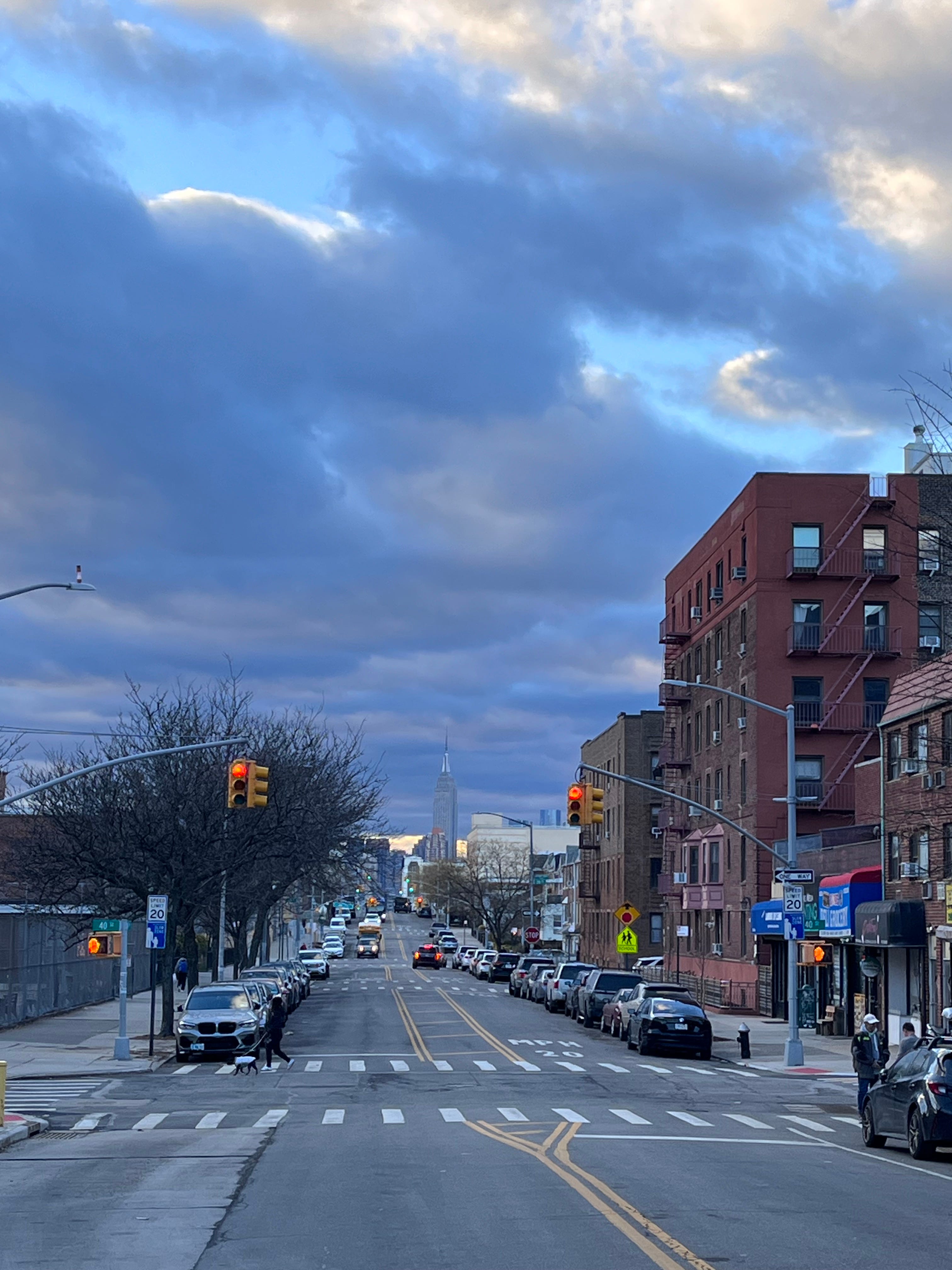
I’m sending you these:
Once at the beach around midnight in Nags Head, North Carolina, a few decades back, I heard a mother, probably the same age as the Minnesota ICE murder victim, say to her eager child on just arriving, “Let’s not gather shells at nighttime. Look at the moon.” And what a moon it was.
Look at the sky. Don’t let the fucking fuckers take away your sky.
It takes a while to come down from the ledge, to decompress, when taking a vacation. All I had to decompress from, in my immediate life, was dealing with some personal grief, healing a hand from surgery, and unfeeling a job with lots of confusions in the odds and ends of finishing a project. It’s an embarrassment of riches, my little life. Somehow I feel I should do a roll call of global suffering to rationalize my own breaks in this life, but I’ll spare you that guilt.
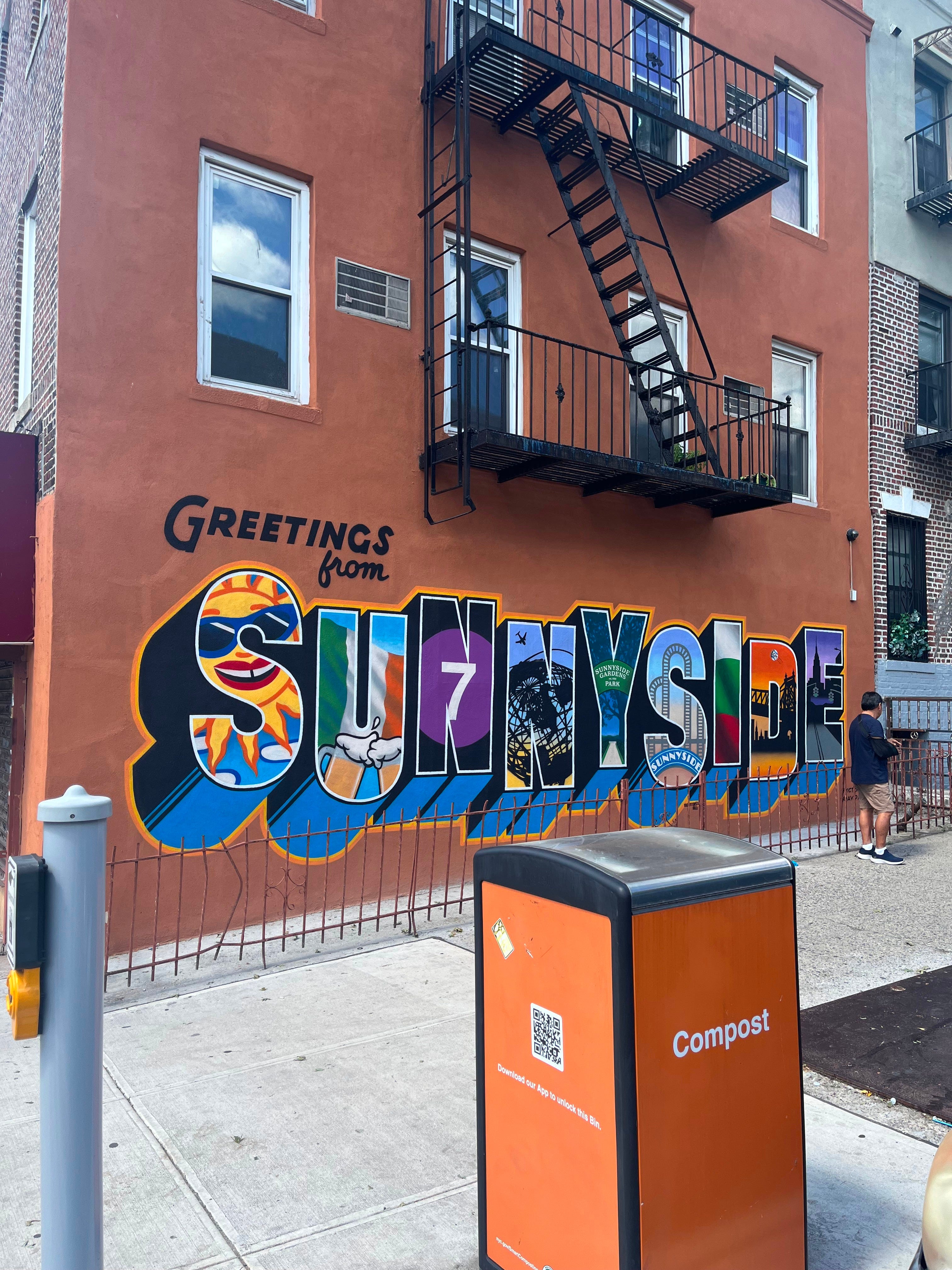
Monday, Labor Day, I hung out in the neighborhood. Walked about. Hey, the mural’s back.
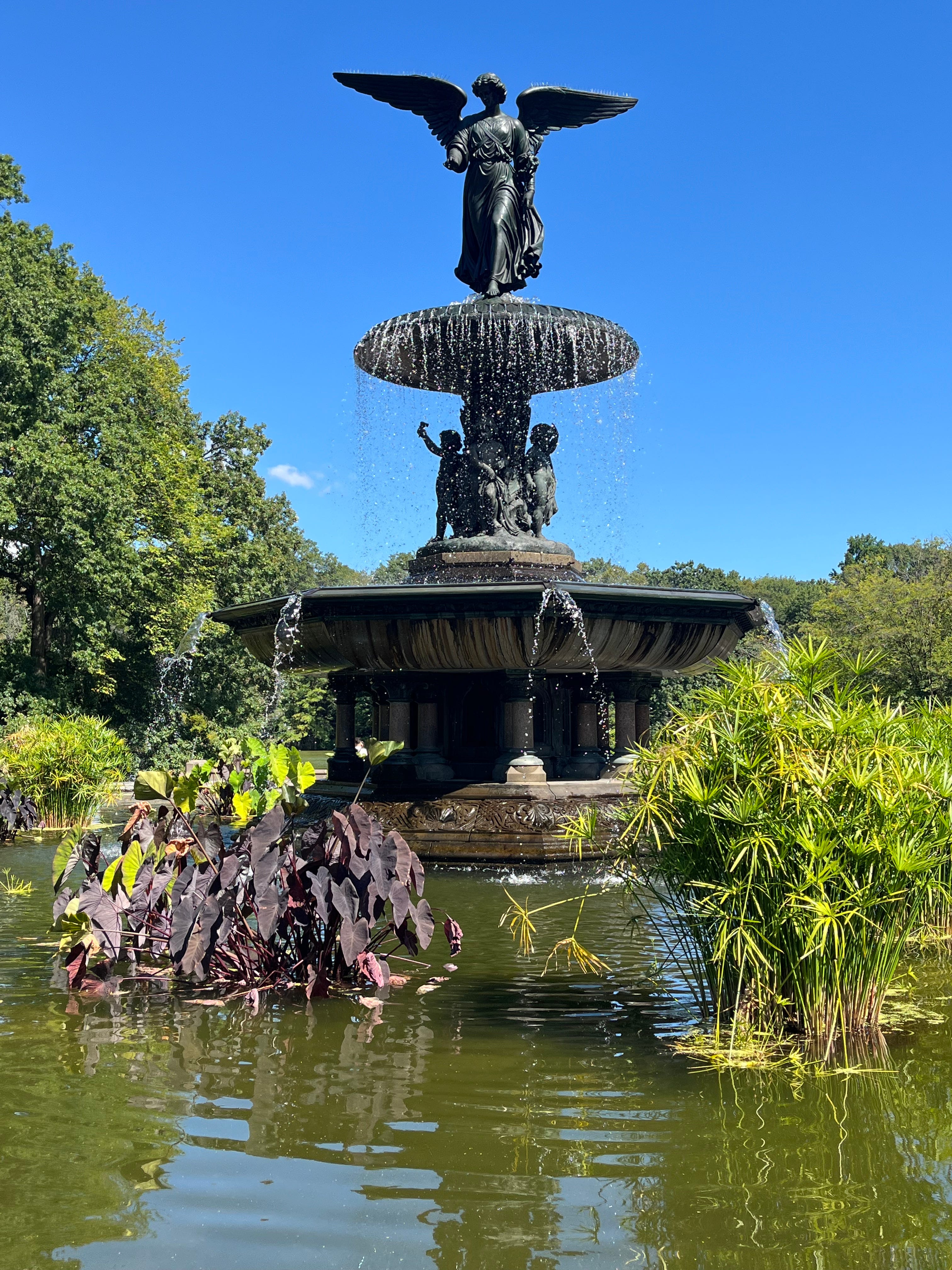
Tuesday, I headed to Central Park and the Metropolitan Museum via the N Train to 5th Avenue/59th Street. Here, I am going to complain. One cannot walk two yards, from the Plaza Hotel, to the lake; from the Sheep’s Meadow to the Literary Walk and Bethesda Fountain, without 1) choppers overhead; 2) food carts of overpriced water; 3) vendors of every imaginable item of tourist shit blocking the view of the American elms; and 4) bad saxophones/pan pipes. Assaults to the senses all, so all you can do is look up.
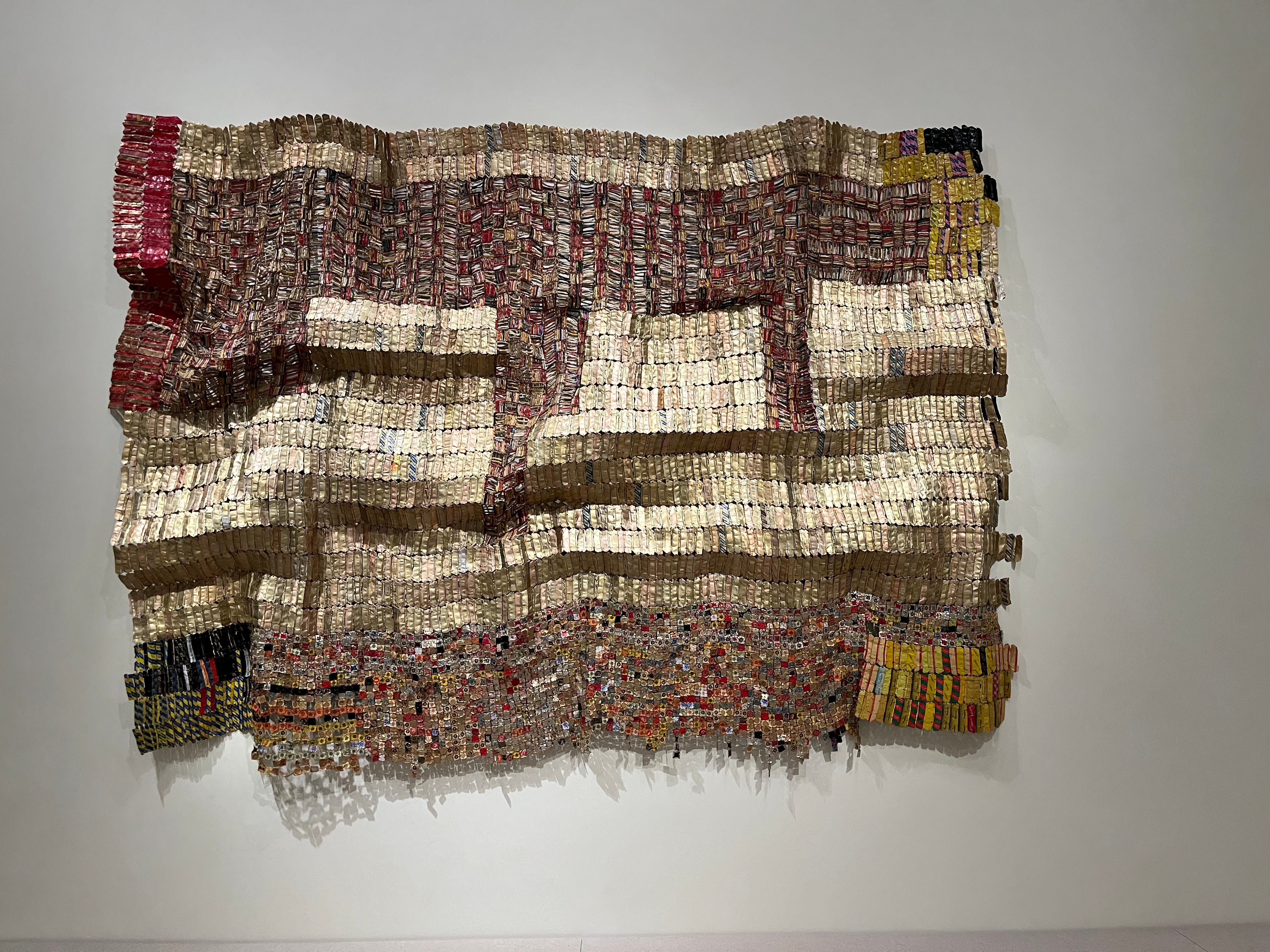
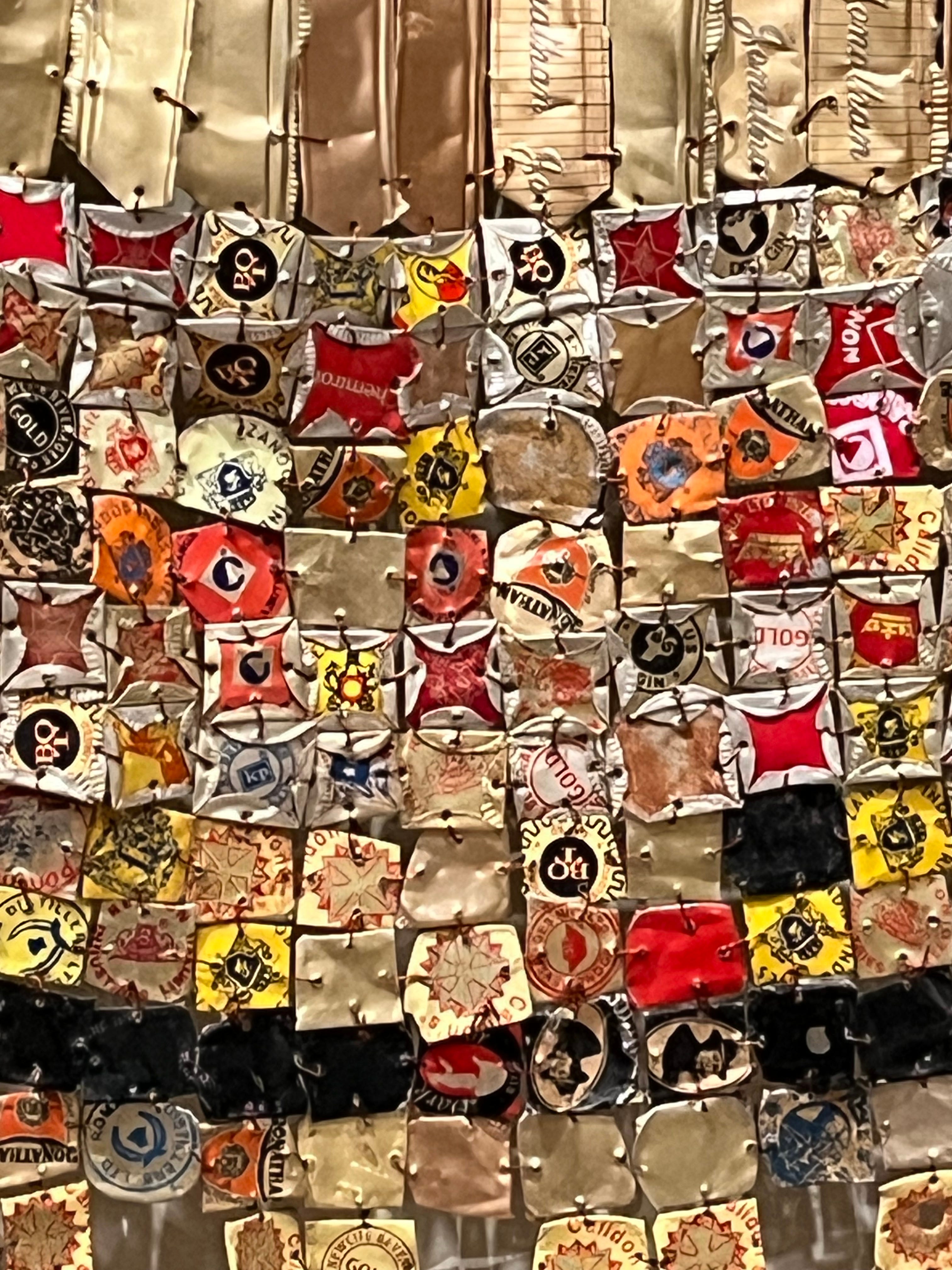
While at the Met, I visited a couple of favorite pieces. First, the El Anatsui:
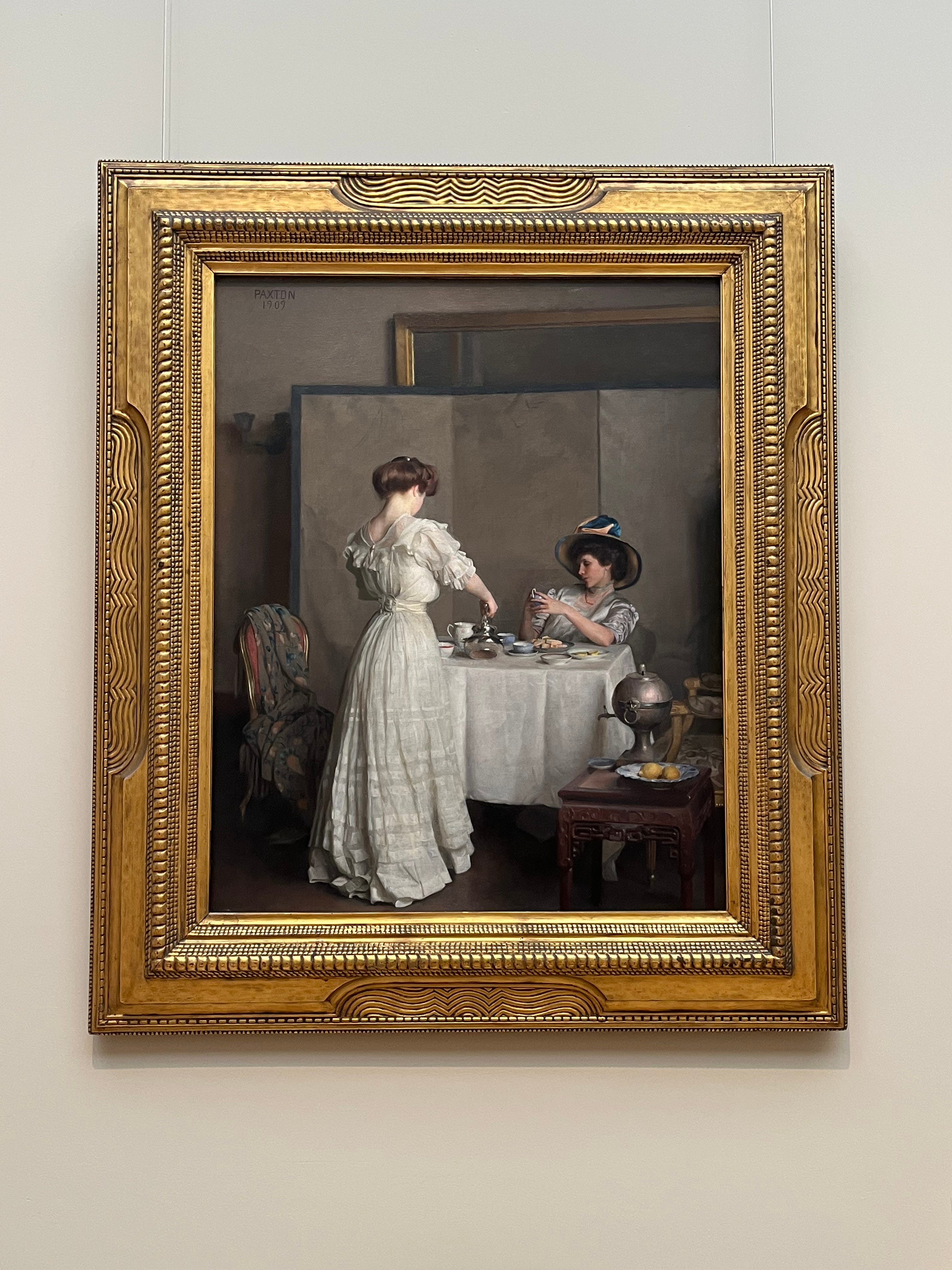
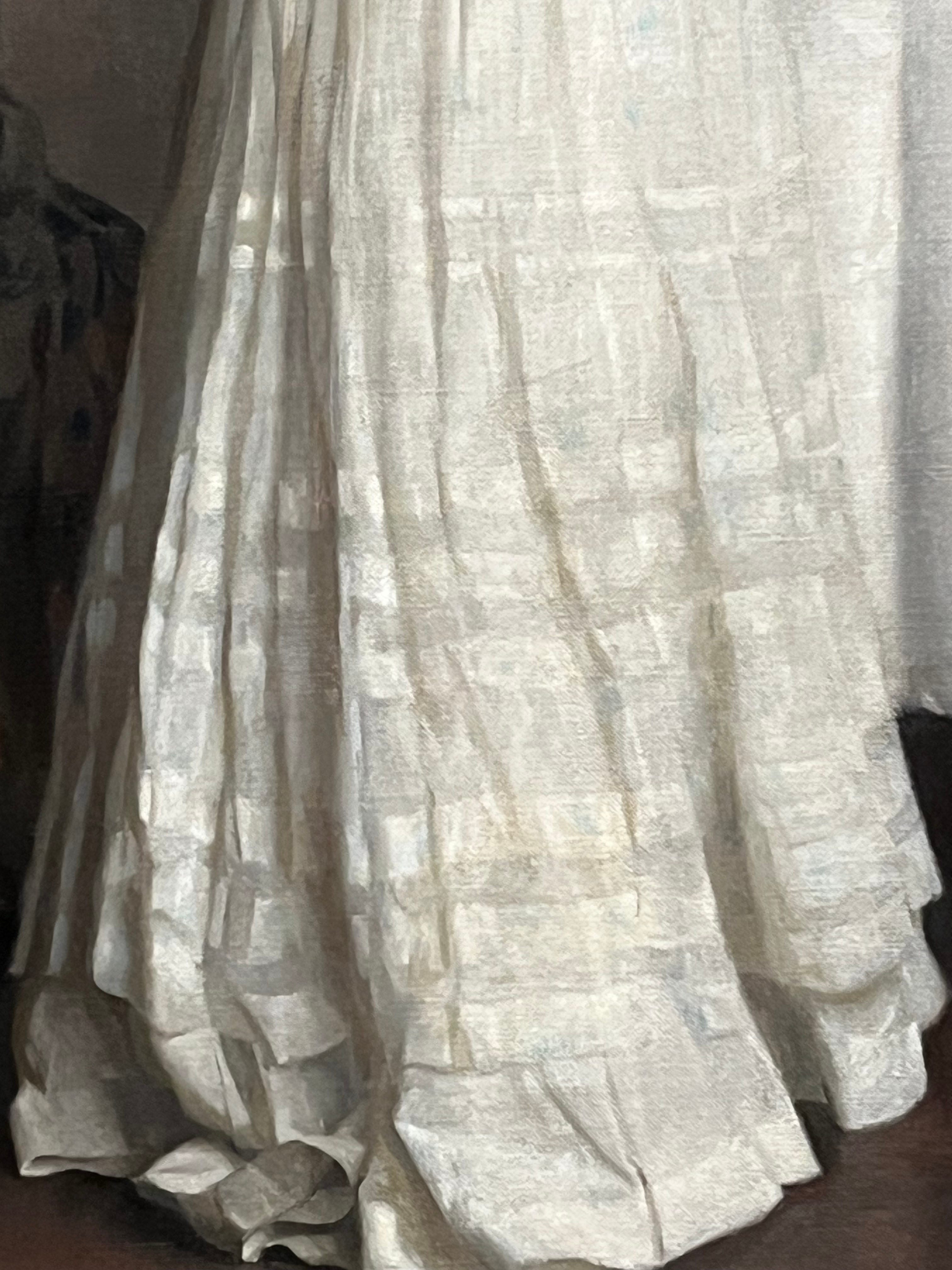
Then Paxton’s tea girls:
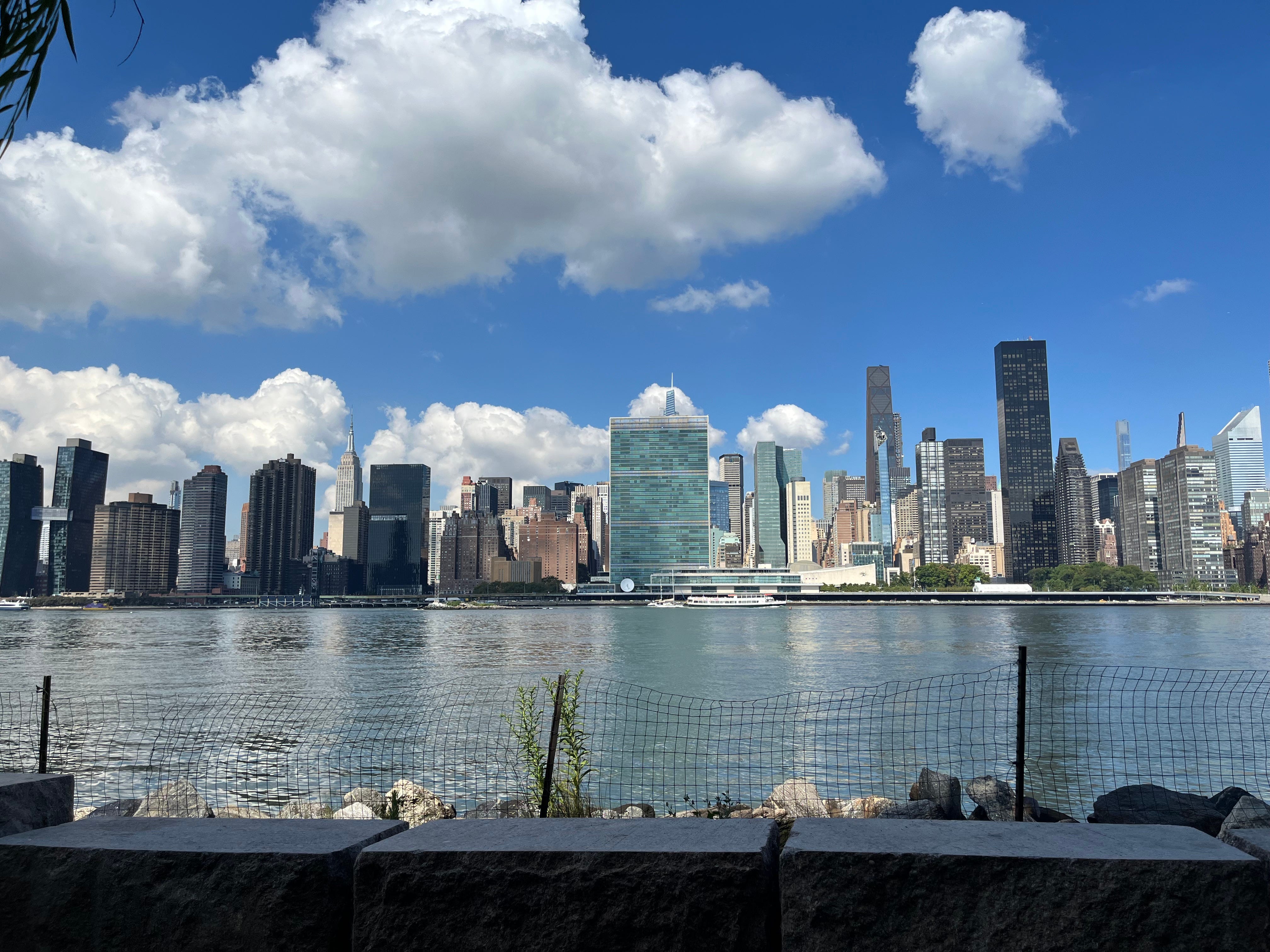
Grateful but still feeling edgy, on Wednesday I thought maybe I what I needed was water; the Rockaways were a couple hours away, but hey, the East River is down the road:
Close. But not feeling shiny yet.
Thursday, I rested.
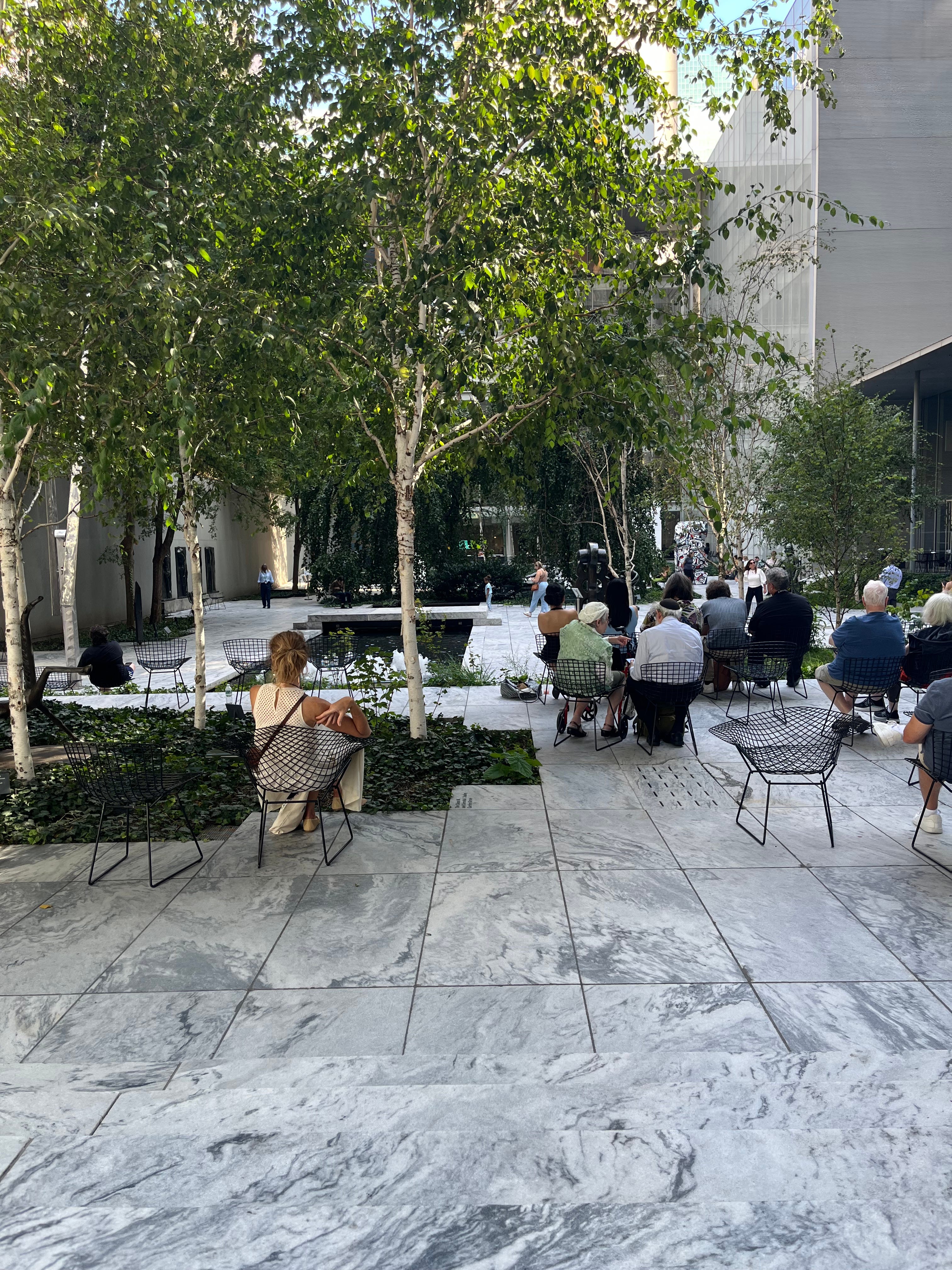
Friday, I joined my friend Cathy to meet a former colleague in the city for lunch, and it was reviving. As I was only a block from MoMA, after lunch I parted from my friends and headed in.
Bingo.
The cap on the beat:
Perfect. Breezy, calm, cool.
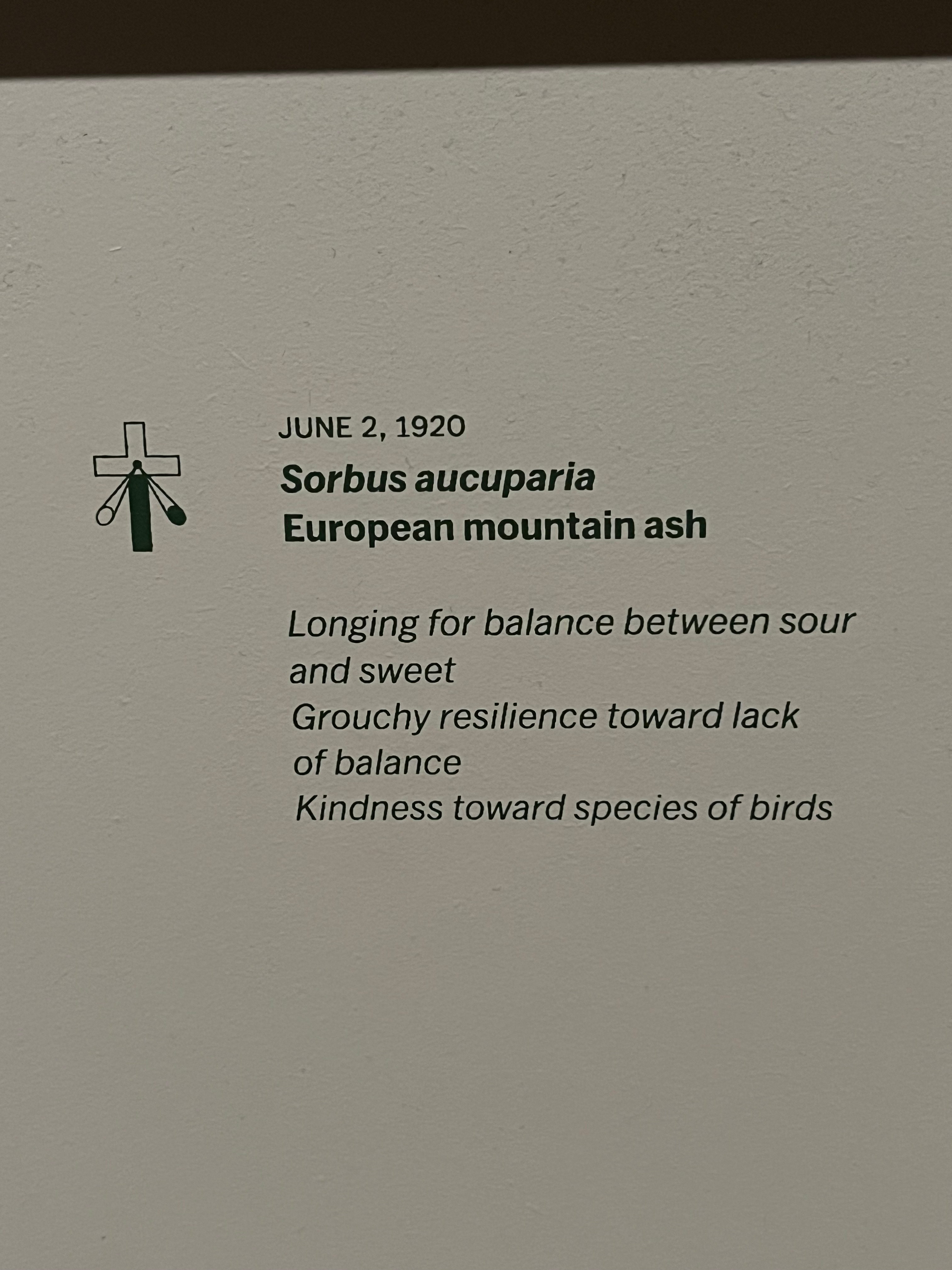
When you can’t have it all, settle for grouchy resilience. And quiet marble.
If you’re around my age and had a television growing up, you remember Sunday nights on NBC with Mutual of Omaha’s Wild Kingdom, which premiered (I read) in 1963 (you can still see the modern take on Animal Planet). It came on before The Wonderful World of Disney, which didn’t interest me—I think we turned it over to Hee Haw. Anyway, the show presented visits to the wild places of Earth, and Marlin Perkins (the zoologist host) and Jim Fowler (who seemed to do the real work) offered insights and commentary. It filled you with wonder, but more than that, for me, danger. I contrast that experience with once I have had as an adult watching Sir David Attenborough on PBS’s Nature programs, where the presenter expresses awe, delight, curiosity, and gratitude, all at once. Both programs came of age during fairly early television, with black and white cameras (or, in my case, a black and white television) to color. In Attenborough’s case, I learned from a documentary I watched last night that he’s won awards for all the phases of camera technology development, up to age 88!, beginning with black and white cameras, followed by color photography, to HD, 3-D, and now 4DX—the most advanced technology we have, most recently using animations and acting to tell the story, ironically, of animals of the past.
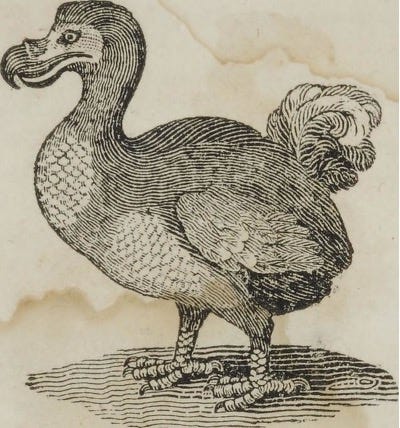
It’s here that I have to compare Attenborough to Thomas Bewick (say Buick), the 18th-19th century engraver whose engraved illustrations of British birds as well as many other animals gave the world its first affordable visuals, ones average people hadn’t had before. (I’ve mentioned in earlier posts that I recently read a book about Bewick’s life.) Watercolors and oil paintings of animals were in private collections and printed only in the most expensive editions, so common people in villages and towns might who had only heard about a camel for example, could see one. One famous flightless bird, the Dodo, for example was one such creature Bewick engraved. That bird of legend had gone extinct even before Bewick’s day, and it’s a bird that Attenborough also talks about in the 4DX in the last show he did in 2016, Museum Alive. (He’sstill alive, by the way, at 98. Bewick would be 271.)
Bewick’s Dodo, best guess based on maritime descriptions of the time and other people’s sketches. The one in the British Natural History Museum is a composite guess using the body and feathers of other birds. What is it about white men that their first impulse on seeing any unknown creature is to kill it?
Both Attenborough and Bewick love/loved wild places, wildlife. They love/loved working in their preferred mediums, television and engraving, respectively, and to use their arts to share this wonder with the world, with the common audience.
All this gets me thinking about all the ways we illustrate and instruct on the world around us, and how we used to unite around the common cause of our shared planet. When Rachel Carson’s book, Silent Spring, came out in the 1962, the one thing that everyone upset and focused them on ecology and caring was the possibility of the loss of songbirds.
Imagine that. If you have had the pleasure of sitting in my parents’ bird sanctuary of a suburban backyard, let me assure you can sit on that patio swing for hours and never be bored. Once all the birds forget you are there, it’s a party, the best kind of show.
Lately, America and the world have become focused on a collection of primates but not for the biodiversity and wonder and joy they bring. Instead, it’s a nature Reality Show from Hell.
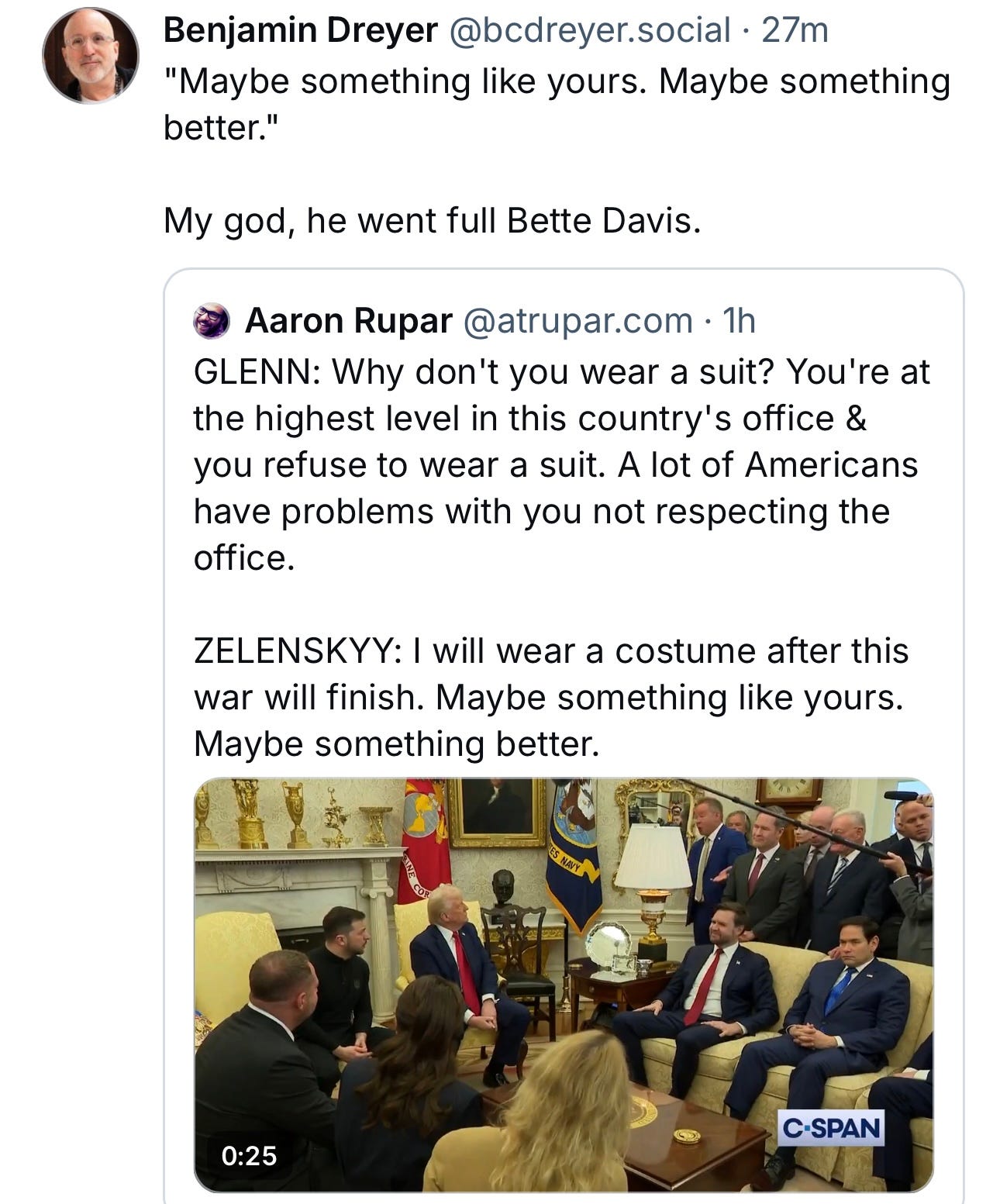
Yesterday, as the world watched, any sentient human cringed. Vance and Trump’s treatment of President Zelenskyy of Ukraine was beyond the beyond, trying to leverage their own favor-currying of Putin by placing the beholden Zelenskyy in front of right-wing American television cameras and reporters, to cow him, as if this man has not been enduring full-scale war for three years trying to save the democracy he loves. Lights,cameras? Bullying? 1) Have they no shame? 2) Are they high? 3) Fuck them.
Like nature at one time, democracy had been a common global cause for many, many years, but no more. President Zelenskyy is like the compelling, knowledgeable zoologist visiting a new kind of American wild kingdom in a television series, facing two aggressive and deeply stupid primates who exist only in captivity. It was, as you know, horrifying to watch.
President Zelenskyy prevailed. I hope he wins this war; he’s already won history. I don’t want Ukraine or him to go extinct.
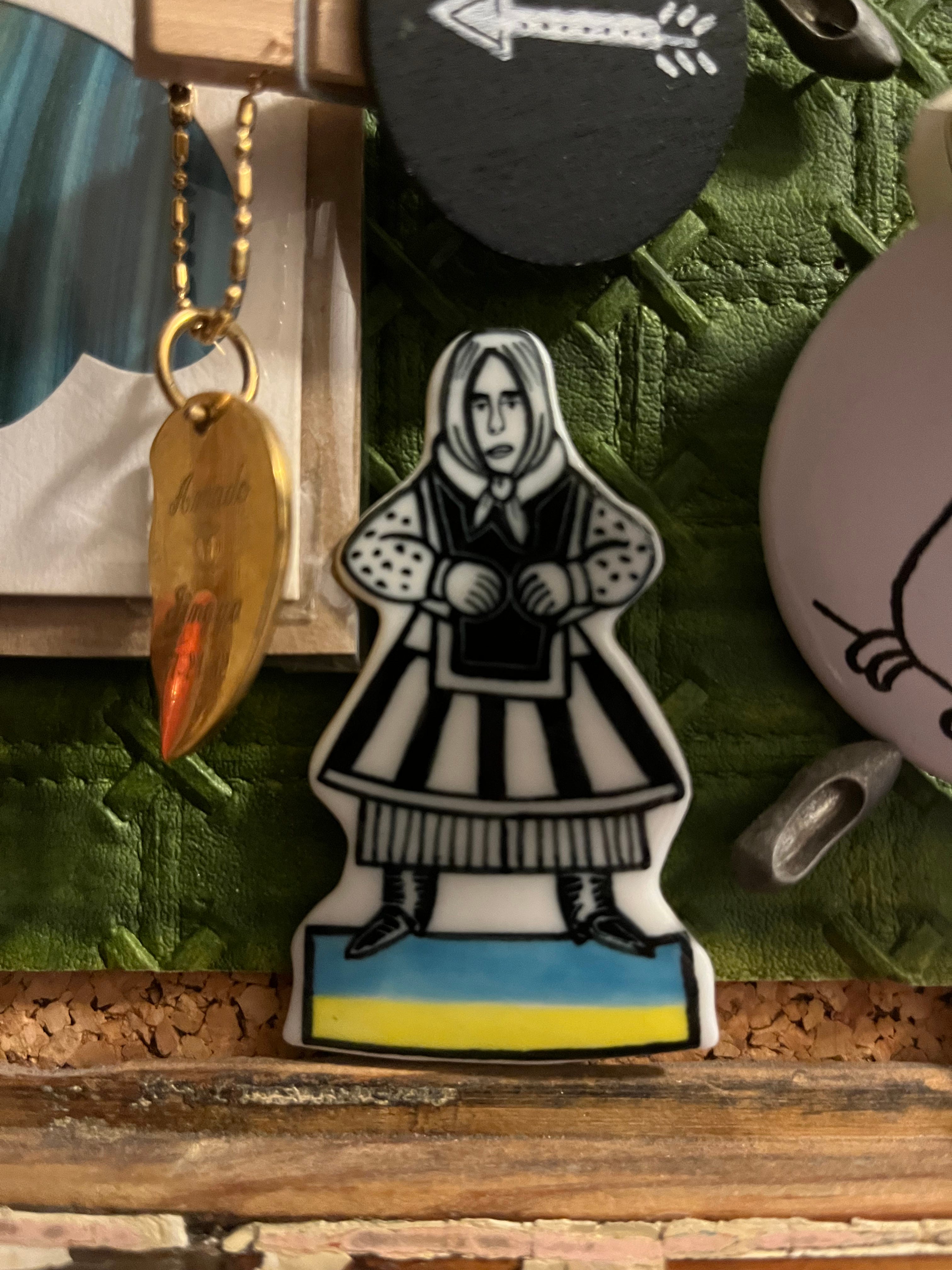
All of this is just to say, Slava Earth, Slava Ukraine.
Home bulletin board detail. Queens kitchen.
Until the next episode of the Trump Wild Kingdom Shit Show, do beautiful things, somehow.
When I was in sixth grade, I learned about Lent and the practice of giving up something you really enjoy for 40 days. Something to do with Jesus wandering in a desert, David Elmore said. But what I was taken by was the idea of the discipline, of sacrifice. I thought hard. What would I sacrifice? My mom, Lynne, told me, shaking her head as she owned her hypocrisy, “I gave up candy, but I’d buy Smith Brothers Cough Drops, because they didn’t count.” Recognizing the trap of the generalist (“candy”), I gave up, very specifically, Doritos. (Fritos didn’t count.) Sainthood within easy grasp notwithstanding, I expanded the practice, over the years, to encompass all junk food. Can I hear a so what?
Somewhere along the Lents it did finally dawn on me that such a sacrifice was, I don’t know, lame. What is the sacrifice (Doritos? seriously?) really for, you know? Inspired by a “reading deprivation” exercise in The Artist’s Way, I realized that Lent could be an opportunity to tune out noise and make a discovery. So for Lent this year, as Miss O’ has for many other years, I gave up the distraction that is media; and in the past several years it’s been social media and sometimes also television. It really is instructive, these periods of deprivation, restful and oddly energizing.
One thing that Doritos and media have in common, by the way, is that both are engineered to be addictive. I have an addictive personality. I have to be really careful about drinking, for example, so in the past few years I’ve given that up, too, or at least drinking at home. I can drink if I’m out with people I know, which includes my bartenders at the Globe Tavern. I earned those stouts (all six over 40 days). At least I was off Facebook and Instagram, bitches.
What I get out of all this modern-day desert wandering is the happiest thing imaginable: I enjoy 40 days of a quiet mind. It’s amazing what you read, see, and consider when you aren’t scrolling a phone. This Lent gave me a surprise in the form of a different, and yet familiar quiet, a kind of memory of quiet.
Walking on the Moon
On March 22, 2023, Google made a doodle that caught my eye, and link leading to link by art gallery by video by article by book sent me down a mime rabbit hole: the miraculous Marcel Marceau, who would have turned 100 this year! I have a brief collegiate history as a mime, saw him perform live in 1986 at Virginia Tech, saw/heard him lecture the next day—mesmerizing, so brilliant. I wrote a blog about it (among other things—it’s buried in the middle) once. And here I am again.
Just full out, let me say this before I say more about Marceau: Marceau’s character, Mr. Bip, has a history, a reason for being, far deeper than easy caricatures might suggest. Marceau explains about it in a Wallenberg lecture from 2001, when he was 78 and receiving the Raoul Wallenberg Medal for the work he did during WWII as a teenager. Marceau (born Marcel Mangel) himself a Jew whose father had been deported to Auschwitz never to return, helped save dozens of orphaned Jewish children and others by leading them to the Swiss border as part of the French Resistance. Marceau’s part of the lecture begins at the 39-minute mark, and you can learn about his life from his own lips.
I want to tell you, I love mime, and I love Marcel Marceau. So let me just say that what happened to mime in the United States took his beautiful art form and made it into a parody, a travesty of silly imitation because in America we got no sense of history. Marceau’s white face, first of all, harkens back to the French Pierrot figure, and it was young Marcel’s wish to reclaim French culture after the Nazi occupation; Mr. Bip is named in honor of Pip, the protagonist of a beloved Dickens novel, Great Expectations. And it all started with seeing a Charlie Chaplin silent film with his father when little Marcel was seven years old turned the young Marcel into a mimic and the Little Tramp became his hero (but not one he merely imitated as a mature artist). Marceau was born to pantomime, he felt; it was universal, he believed—storytelling that transcended race and ethnicity and culture, found famously in the Orient and also in some form on most every continent; it was an art that could bring us together in love and humanity. Mr. Bip, his everyman, had terrible troubles, but he never lost his hope. Before every adventure, humorous and tragic, Bip removes his opera hat, smells the red flower that decorates it, sets down the hat, and tries. Bip tries and tries and tries.
Throughout the years Marceau lived his art, he taught, (and he loved to teach) at his school in Paris, what he called the grammar of mime, the techniques, and the arts that inform it, like fencing, ballet, acrobatics, and juggling. Nowhere in his teaching is there a dictum that to be a mime you must wear a white face, black and white clothes, and pretend to push against an invisible wall for no reason. Marceau wanted new artists to create new mimeodramas, new stories, new characters. He wanted his art to grow and not be mummified in museums.
Mime is the art of making the visible invisible, Marceau says. I interpret this to mean that his white face, red lips, and black eyebrows as well as his white and gray sailor costume disappear into the lights as he becomes a judge, a prosecutor, the defense, and the defendant in “The Trial.” Mime is also the art of making the invisible visible, as you are sure you are in a fully realized courtroom instead of a bare stage when you watch this same drama, or seeing a universe while witnessing the birth of the world in “The Creation of the World.” Having seen both the video and the live performance, I will tell you the live version is far more magical and transporting, but I am so grateful to have these videos to sharpen my memories. In this video of “The Cage,” Marceau expresses his hopes for what his art can do. I’m grateful for the videos, but speaking from experience, Miss O’ can tell you they can’t hold a candle to the electric experience of seeing Marceau live.
I learned in my searches that Marceau adored Michael Jackson, “a poet,” he said, who loved Chaplin (Marceau’s early hero) and Marceau, learning how to “walk against the wind” and turning it into the moonwalk. Marceau loved that. That is what an artist does—takes the old teachings and makes them new. A planet of imitators will not do. (Painters study Rembrandt and Van Gogh and Picasso, but no one would tolerate a mere mimic; there was only one Marilyn Monroe, as it should be.) And I think I felt this in my limited artist’s heart as I myself learned mime and performed. Why a white face? Because that’s what you do. Why? So I drew a line around my white face and added rosy cheeks, but it never felt authentic. Marceau would agree. I needed to find my own character for my own reasons, to tell my own stories that might be also universal. Still, I have never lost my training, still aware of how all the movements of the body articulate and what those movements can convey emotionally. I still love the art, this art of silence which is really so much more.
Miss O’ and Debbie Hodges in Roanoke ca. 1986. We saw Marceau together, and before the show two odd things happened: 1) hearing an announcement that the show had to be delayed because the (wait for it) sound system had not yet arrived; and 2) Debbie turning to me, voice quavering: “Lisa, I just saw something beautiful, but I don’t understand it.” What? “That woman, being helped by the the usher. She’s blind. Lisa, it’s a pantomime.” Thus began a cascade of laughter, and tears. Ah, humanity.
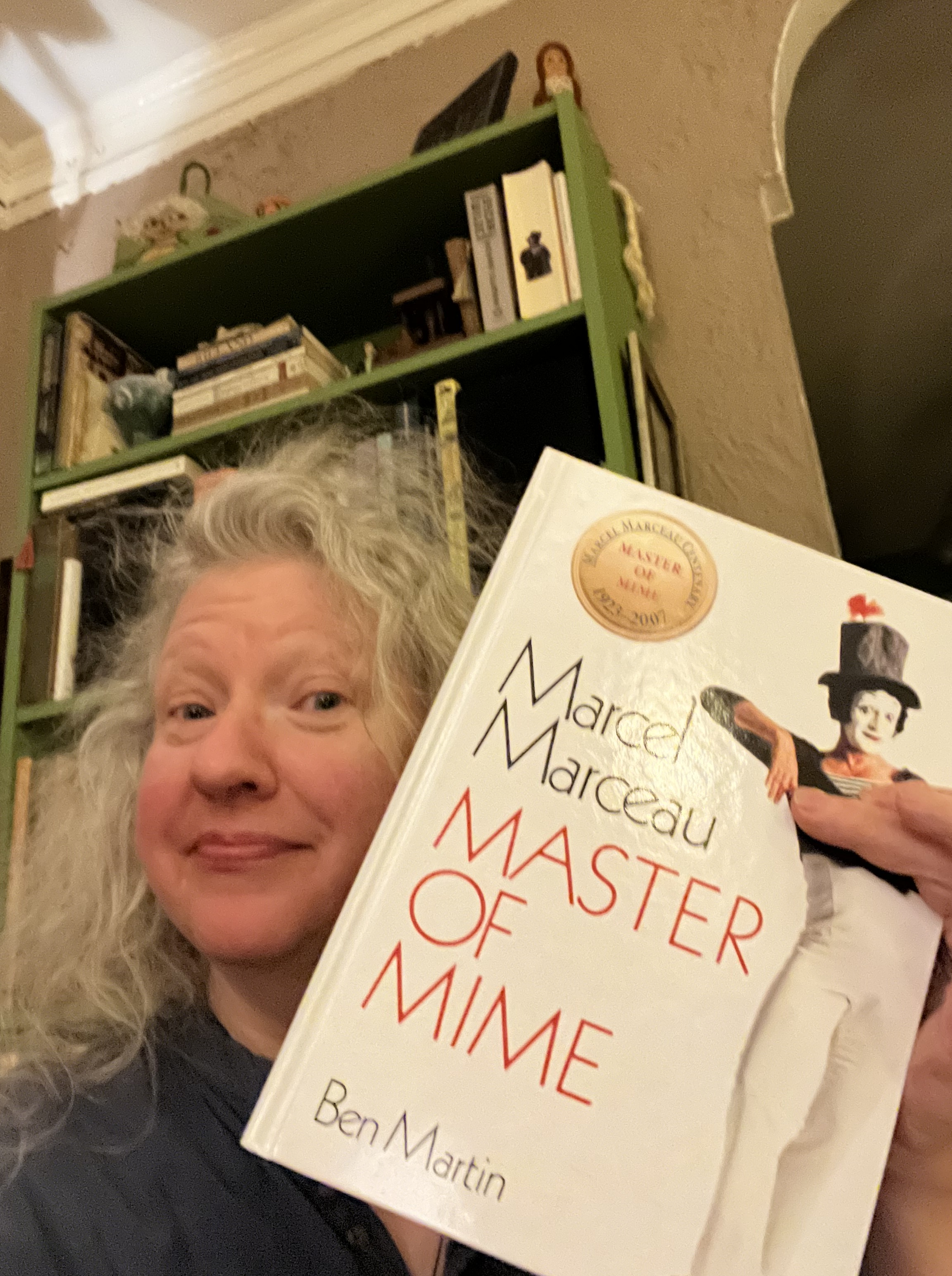
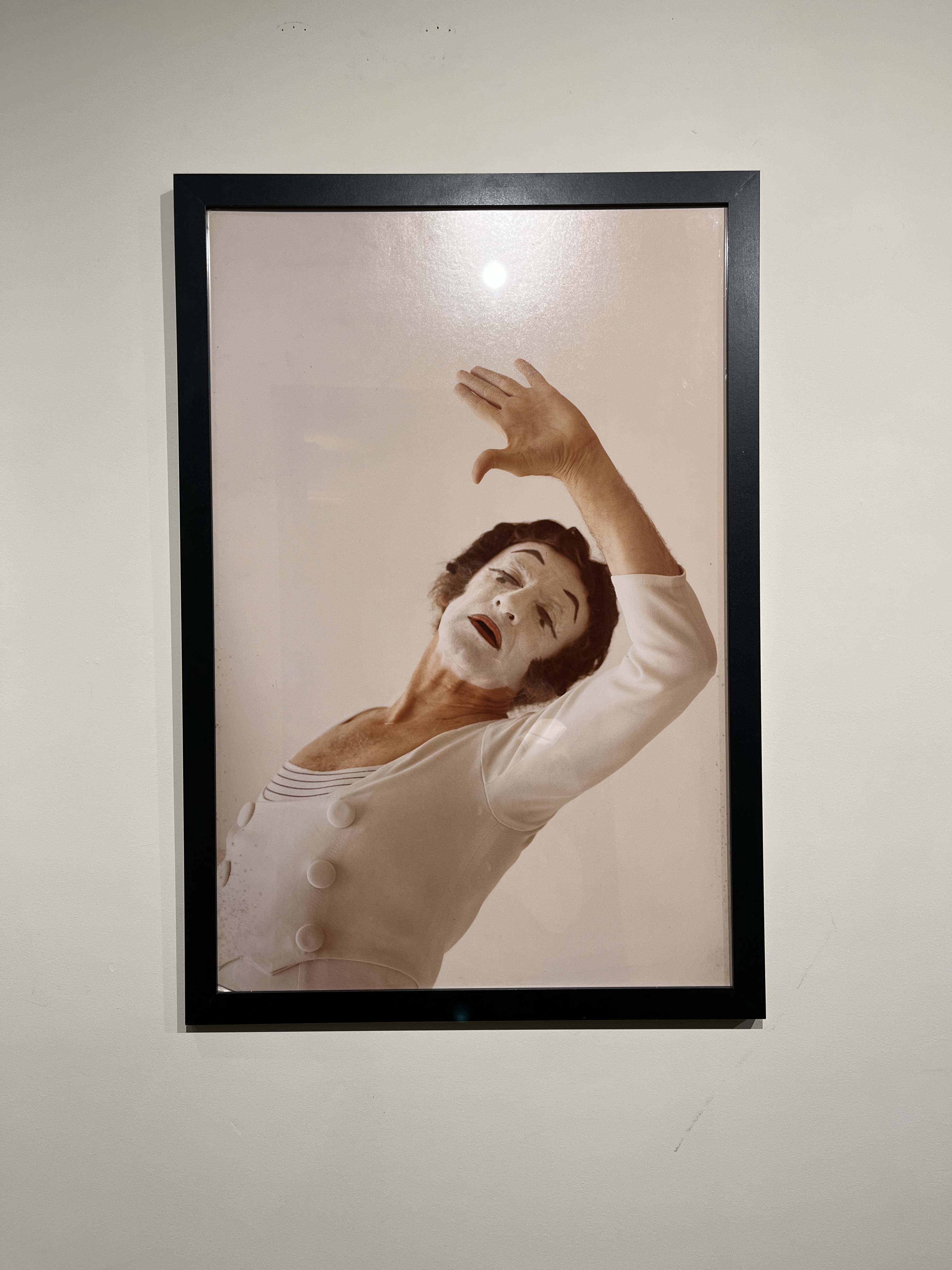
So imagine my joy as a result of the click on the Google doodle to find out 1) NYC has a National Arts Club on Gramercy Park South, which is free; and 2) said space has an exhibition of Marceau portraits by photographer Ben Martin. And imagine my joy at finding out the book is back in print, and that on Thriftbooks I could find two other books by Marceau, including one with his own paintings and one co-authored by a man I actually know, all on the art of mime. To learn more about tis wonderful artist, there is a 2022 documentary that Miss O’ dreams will come to New York City.
“One must think like a heroto behave like a merely decent human being.” ~ May Sarton, Journal of a Solitude, 1973
Bip is the hero of his own story, and in moving through the world heroically, he is a decent creature and shares with us his decency. (Miss O’ notes here that feeling oneself to be a hero is not the same as feeling oneself to be God. Gods are monsters. Take a memo.)
Marcel Marceau, photographed by Ben Martin in 1973. Originally supposed to be a piece for Life Magazine, the project never came off because the magazine folded. So Martin made it into a book. Photo by LO’H, National Arts Club, NYCMarcel Marceau, photographed by Ben Martin in 1973. Marceau was initially against Martin’s project, as he was sure he would look absurd in still pictures and not in performance. He was wrong. Photo by LO’H, National Arts Club, NYC
On Being, in Mimicry
I realize something every time I latch obsessively onto a form of study, such as mime, I begin to see reflections of that obsession in everything; in this case during Lent, mime was suddenly everywhere. The art of mime, of mimicry for survival, is in fact all around us, and I lucked into specific connections (well, we luck into things when we are looking, don’t you think?). Listening to the podcast On Being recently, I heard about the work of Janine Benyus for the first time. She helps companies learn to use the tools of nature, the natural processes of successful living things, to solve their manmade engineering and environmental problems. Isn’t that fascinating? She herself never understood why it wasn’t simply obvious to follow nature’s lead. Since childhood, Benyus had loved wild spaces, and was traumatized the first time she saw bulldozers destroy her wild lots, where she knew all the creatures and plants by their names and habits. I myself grew up catty corner from a huge vacant (we say “vacant” when there are no humans living there, you notice that?) lot that was anything but empty: filled with a creek, rocks, a dirt lot for kickball, pine trees, grasses, and blackberry thickets. When I was in my 20s, a developer bought the lot and turned it into houses, cemented up the creek bed and fenced it off with high chainlink—it was horrifying. And that sadness made me remember the old McNeil sisters who used to pick those blackberries—all that land had been once their father’s farm, and now they shared a house on Kentucky Avenue in a huge subdivision. And that made me remember that before that, it was Native American land. And before that, a wild place for all the creatures. This endless cycle of taking over, of colonizing, is really painful when you tune into it, in ways small and large. (Marcel Mangel grew up in Strasbourg, in Alsace-Lorraine, which was sometimes German, sometimes French, in the struggles to own territory, to annex, to conquer, and we all know what that led to.)
In her book Biomimicry (on my booklist now) Benyus explores how humans have ignored the ways in which nature can teach us, that because humans see themselves as having “dominion” over the earth, we think we have to do all the thinking. And our thinking is often sheer stupidity; and that stupidity is killing the planet. Benyus talks about this without malice, with love and hope, though. Podcast host Krista Tippett read aloud from the last page of the book, showing there is hope for solving the problems we have created for our world:
“The good news is that we’ll have plenty of help. We are surrounded by geniuses. They are everywhere with us breathing the same air, drinking the same round river of water, moving on limbs built from the same blood and bone. Learning from them will take only stillness on our part, a quieting of the voices of our own cleverness. Into this quiet will come a cacophony of earthly sounds, a symphony of good sense.”
~ Jane Benyus, Biomimicry
I thought of Benyus’s continued hope this stillness, and it put me in mind again of Marceau, of Bip. In the quiet of his performances, Marceau elicited a cacophony of earthly sounds, perhaps in musical accompaniment, by Bach, say, but always also the laughter, gasps, and applause of human beings. Marceau played at life, at dreams in the hope a symphony of good sense, but more than that, a symphony of love.
From Benyus’s trauma of seeing her wild space bulldozed through past the topsoil to Marcel Mangel’s witness to Nazi persecution down to his own father’s deportation and murder—both made art out of it, science out of it, education out of it. Their work is and was marginal, and made more important and beautiful and necessary because of that. We all do our best thinking doodling on the margins, don’t we?
Vanity of Vanities, All Is Vanity
“The whole point of Jesus’s life was not that we should become exactly like him, but that we should become ourselves in the same way he became himself. Jesus was not the great exception but the great example.”
– Carl Jung
On Easter Sunday, people post, “He is Risen,” that sort of thing. When people fall into idolatry, worship, they may also slip into an inauthentic imitation, or a glory of themselves in the religion rather than the religion in themselves.
I don’t understand worship. I understand curiosity and passion, and I understand a desire to learn. We lose great art, great thought, great science, it seems to me, when we see imitation all around us. Education, enlightenment, and exposure to new ideas are supposed to help us become who we are, generate more new ideas, new hopes and dreams, new beauty.
I think mime died out (which is not to say it’s dead) for two reasons: 1) it’s unbelievably hard to do well; and 2) everyone tried to be Marceau. This is a shame. Marcel Marceau wanted to teach people mime because he loved his art, not because he wanted a planet covered in white-faced pale imitations of himself. He loved Michael Jackson because Jackson (white-faced and pale though he became) took a lesson in walking against the wind and turned it into the moonwalk; Jackson elevated the form and made it personal. Similarly, Jesus didn’t ask for a planet full of imitators and power mongers to “spread his word” (his apostles did that); he (lowercase human pronoun) wanted people (as I read it) to simply live in a radically alternative way: love over hate, kindness over violence, the love of all over the love of money, equity for all (women, men, whatever) over huge power of some over the rest. It’s not difficult. But it feels impossible to accomplish, like walking against the wind.
The nature all around us, the earth that holds us—how does this not feel like our true mother, our closest companion, our guide, our lover, our teacher, our friend? Why do we push it off, push against it and each other?
Let us, like Bip, don our opera hat proudly every day, dressed up with a fresh flower on top, the scent of which we smell with delight before we move to walk against the wind into the world to do the best we can.
Silence is about attention. An audience may break that silence with response. Something inward goes outward. I say that because most everyone now can be seen staring silently into a phone, scrolling dead-eyed, a quiet trance of habit that isn’t what I mean by silence at all. With Marceau’s art, silence is about concentration, the mime’s attention to the art in emotion, and the audience’s attention to the performance. If we mimic anything in this life, let it be the nature around us, and the artist’s attention to his art. And another’s kindness.
Love, somehow, to all.
Miss O’ with Bip. National Arts Club, NYC, special exhibition of photos by Ben Martin.







 The Miss O' Show (Teacher's Edition)