Offloading our hearts and minds, tempest-tossed, and the salve of art

O, I have suffered
With those that I saw suffer.

(Miranda, The Tempest, Act I Scene 2)

I read this week that the tech bruhs, so called in current parlance, see the world as being divided into two classes of people: the thinkers and the scrollers. While they, the Thinking Class, devote themselves to higher learning, philosophy, and deep work, affording the same wealth of life experience and cashflow to their offspring, they themselves are engineering the planet so that the rest of us, by which I gather they mean the 99% and our offspring, are relegated to the Scrolling Class, those who work as drones and merely consume whatever they, the Thinkers, put out for profit.
It’s all very Brave New World, a novel I read in high school and can’t shake. Will you be made into an Alpha or an Epsilon? Will you even know? And even if you are an Alpha, watch out if you forget to take your soma (“the opiate of the masses” that replaces religion) and have an original thought. All hell will break loose, and the only antidote is a rebel copy of Shakespeare.

My library was dukedom large enough.
(Prospero, The Tempest, Act 1 Scene 2)

This week the Trump Administration, illegally as usual, dismantled the U.S. Department of Education, spreading all the allocated funds around (which legally only Congress can do, but Republicans) to different departments, so K-12 education is now under the U.S. Department of Labor. Huh? In a seemingly unrelated development, the Trump Administration also demoted a bunch of educational degrees to “nonprofessional,” meaning people pursuing nursing, say, or teaching, will not be able to take out unlimited loans to attain a degree. Not only were the listed degrees for women-dominated professions, the professions listed were those whose members are legally bound to report suspected child abuse. If no one is educated to take those jobs…

Are you following? The Pedo-in-Chief is terrified of the release of the Epstein Files, and his Secretary of Education, Linda McMahon, whose husband Vince McMahon was set to go on trial amid accusations of child sexual abuse until a Chicago judge paused the case last December when Linda was announced as Trump’s pick for her new position. Meanwhile, Trump’s former “spiritual advisor” was arrested for child rape and plead guilty. In a call-in show I heard a snippet of this week, a caller demanded to know what was “wrong” about child rape.

The cumulative effect of all this during a single week has made me a bit of an emotional wreck, but it was an independent journalist on Instagram who formally linked all these pieces for me. From Love Ethic Yoga:

Moving K-12 education to the Department of Labor while red states are removing child labor laws & dropping the age of consent to 12 or 14 is a calculated move. The leaders of these departments are pedo📁files or pedo apologists. This is NOT coincidence.

Uneducated children are easy prey.
Hungry children are easy prey.
Homeless children are easy prey.
Unaccompanied minors are easy prey.


These predators are baiting the water. They’re creating the proverbial “fish in a barrel”. Yes, privatization is part of this but we cannot forget how many pedos are in this current admin. We cannot let them get away with this.

I got ill—I mean, Trump and his people are transparently, openly constructing a world where child sexual abuse is normalized, institutionalized, and unstoppable. These “men” want all young women and girls (40% of whom between the ages of 15-44 want to leave the United StatesI saw in a recent poll) under their complete control in order to force-breed children, for either labor on behalf of or the sexual pleasure of (white Christian) men. Once the children “age out,” a term I learned on Law and Order: SVU, they will be, one presumes, forced to push through their trauma with slave labor, living in one of the concentration camps being constructed all over the United States.

Utah’s planned mega-shelter should be like a jail for homeless people, one widely embraced group says

This is the Brave New United States of America, friends.

It’s more than hard to take—it’s impossible. This insanity has to stop. We need to see handcuffs and prison bars on the right people, and soon. We know this.

I can’t take in everything—you can’t either. So while I know there’s Israel’s defiance of the ceasefire, and Russia’s wish-list labeled a “peace agreement” by Trump and Rubio (rejected, thank goodness) by Zelensky; protests in Charlotte and Raleigh over ICE raids; so much, so much, my god, it was the children and their protectors I focused on, “offloading” the rest, more or less.

This week on a work Zoom call, a colleague mentioned that there is always work or training or something that we simply have to “offload.” It’s not a term I knew—but I got it. You just pass that conceptual understanding to someone, maybe a spouse who gets plumbing or a coworker who is good at Excel, and you don’t worry about trying to learn that thing, much less master it. You only have the capacity for so much, and recognizing that is not a bad thing. (That said, we all have to trust in our capacity to learn new things, and try to do that, even though in my early 60s I’m finding that I have to immerse myself with the focus of a monk to his devotions to do something as complex and unintuitive as Jira (if you don’t know, don’t ask), say, but it’s reassuring to know that I can still do it, if more painstakingly.)

Speaking of offloading: I no longer have a creative life in the recognizable sense. I’m sorry about it, but between taking care of family, holding grief, learning new things on the job, and this fucking administration’s atrocities, I had to let something go, and that was it—and it’s no great loss to the world, obviously. That out of the way, I’d like to celebrate the achievements of women artists whom I know as friends. In a world, and more specifically a nation, that doesn’t value women, children, innocence, creativity, or truth, here’s some art you need.

  • Read Amanda Quaid’s debut poetry collection No Obvious Distress, which explores her (still) young life with Stage IV metastatic mesenchymal chondrosarcoma (learning the pronunciation of which seems to be more trouble from some people than her years of treatment, so say the name) in all the ways;
  • Read Anna Citrino’s fourth collection, Stories We Didn’t Tell, which explores the unspeakable hardships and abuses of her American prairie women ancestors, based on the poet’s decades of research, in rich language;
  • Watch Patricia E. Gillespie’s documentary, The Secrets We Burywhich I saw at IFC here in New York in its premiere screening this week, about a true crime, told with love and empathy and not sensationalism;
  • Listen to Patti Smith’s Horses (1975). (Envy me my Row X seat at The Beacon Theater on Broadway Friday night in New York City to see Patti Smith and her Band play the shit out of Horses in its 50th Anniversary Year, plus encores of classics. Patti also spat, twice, and it was glorious.)

So lest you think Miss O’ has given up on art, I haven’t, and I hope you haven’t either. There is nothing on this earth as satisfying as a creative act, something you can point to and say, “I made that.” There was nothing, and now there’s something, and I did it. And the world is more colorful and right and full than it was before you created that thing, however small, even making a smile happen on a stranger’s face in a notebook store, which I did on Friday night before the concert. I did that. That thing, there? You did that. Not AI, not engineered by some tech bruh, or ordered on you by some basement-dwelling podcaster or a bottom feeder in Washington. You. Just you.

Let’s stop scrolling together and get seriously radical in creative community. Take a moment to read. To be quiet. And then connect.

Here’s Mr. Rogers on the value silence from Charlie Rose, which is a clip I hope you watch. “My, it’s a noisy world,” he says, and it is. There’s more he goes on to say from his 1994 book, You Are Special, including about his professor, Dr. William Orr, who told him, “You know Fred, there is one thing that evil cannot stand, and that is forgiveness.” Take a minute with that. As a reader, Rogers says that the white spaces between the paragraphs are more important than the text, by which he means that if you aren’t using silence to reflect on what you are reading, you are missing the point of the endeavor. You can see more clips of Fred Rogers here. “A great gift an adult can give to a child is to let the child see what you love in front of them.” Whether it’s car repair, lawn maintenance, playing cello, fixing things, reading, singing, cooking, telling stories, dancing, whatever it is (note: what you love, not what you exploit)—that is the gift. I think I try to do that in life—to show love of life in greeting others. It’s tiny—I’m not a worldwide creative power like Patti Smith—but really it’s about being present, as Rogers says, moment to moment (and it’s the most important work in rehearsing a show, as shown me by director Maureen Shea). Doing things even a little larger than ourselves, then, in presence, is the point. Mr. Rogers only cared to be recognized if it made a child feel special—Fred Rogers liked “not the fancy people,” but regular people, and he aspired to “be the best receiver I can ever be—graceful receiving of what someone gives us; we’ve given that person a wonderful gift.”
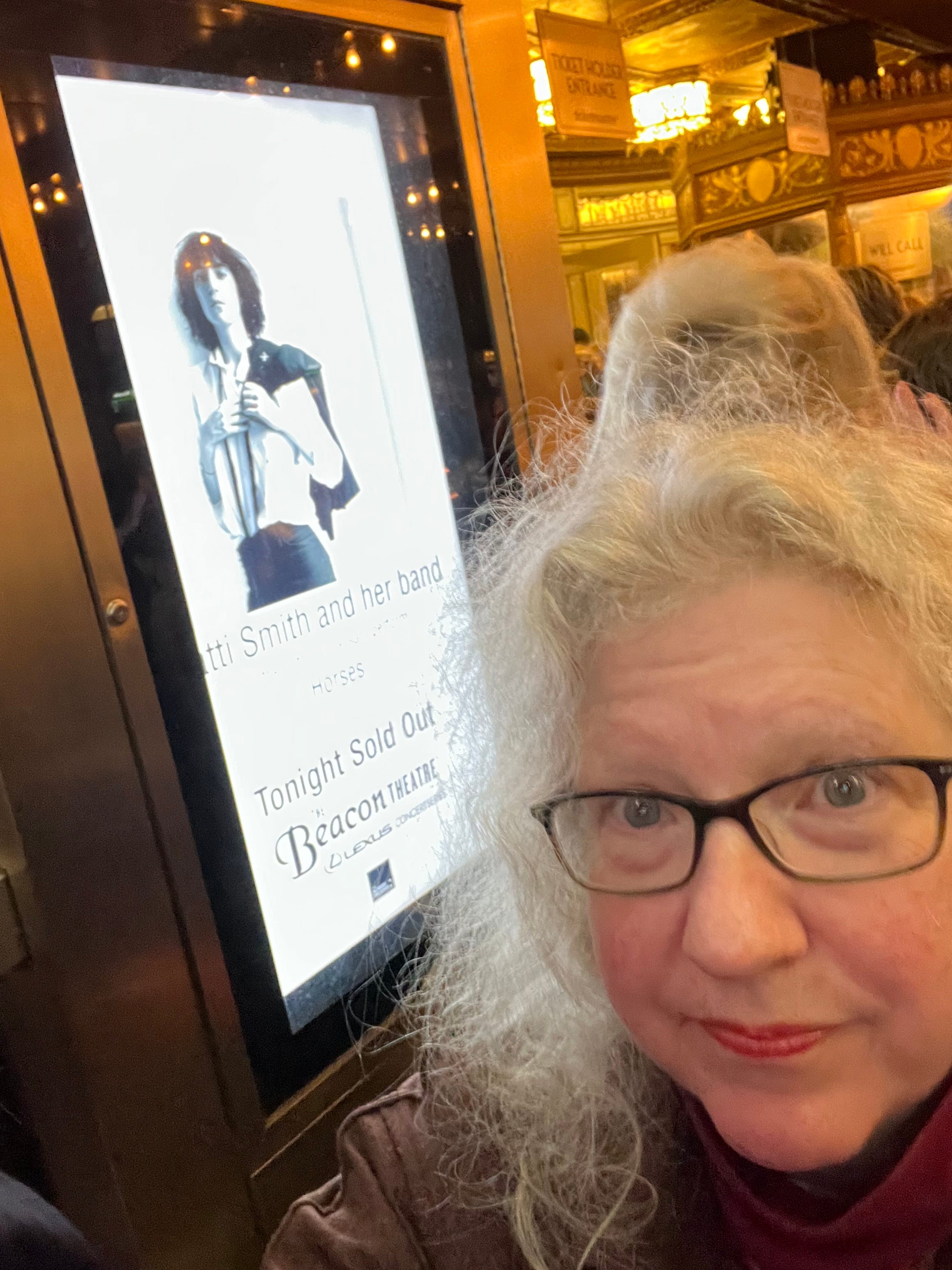
Miss O’ most gracefully received.

The play I’ve been quoting here interstitially, The Tempest, is my favorite Shakespeare play; in some ways it’s like a compilation reel of all his best ideas, and his final play and only original plot, his retirement play. I’ve seen four productions of it—at the Globe in London, with Vanessa Redgrave as Prospero (it was awful); at the Shakespeare Theater in Washington, D.C., directed by Garland Wright, which still ranks as the top theater experience of my life (even after seeing Hamilton and Gypsy with Patti LuPone); one at Classic Stage Company downtown, with Mandy Patinkin (okay); and the fourth at St. Ann’s Warehouse, an all-women cast set in a women’s prison, directed by Phyllida Lloyd, with Harriet Walter as Prospero (fantastic). The most famous speech of the play, by Prospero, comes in Act IV, and I always think of it when eras end, as well as even a simple good thing, and especially a life:

Our revels now are ended. These our actors,
As I foretold you, were all spirits and
Are melted into air, into thin air;
And, like the baseless fabric of this vision,
The cloud-capp’d towers, the gorgeous palaces,
The solemn temples, the great globe itself,
Yea, all which it inherit, shall dissolve,
And, like this insubstantial pageant faded,
Leave not a rack behind. We are such stuff
As dreams are made on: and our little life
Is rounded with a sleep.

(Prospero, The Tempest, Act 4 Scene 1)

In the final act of the play, Prospero’s daughter newly in love sees all the possibility of life, and this is from where Aldous Huxley took his dystopian novel’s title:

O, wonder!
How many goodly creatures are there here!
How beauteous mankind is! O brave new world,
That has such people in’t.

(Miranda, The Tempest, Act 5, Scene 1)

Sure, love is wildly naive, but it’s the beginning of everything. There’s a new world to be made. Let’s stop the fucking fuckers and do that.

Sending love, philosophy, music, poetry, creativity, all the good church,

Miss O’
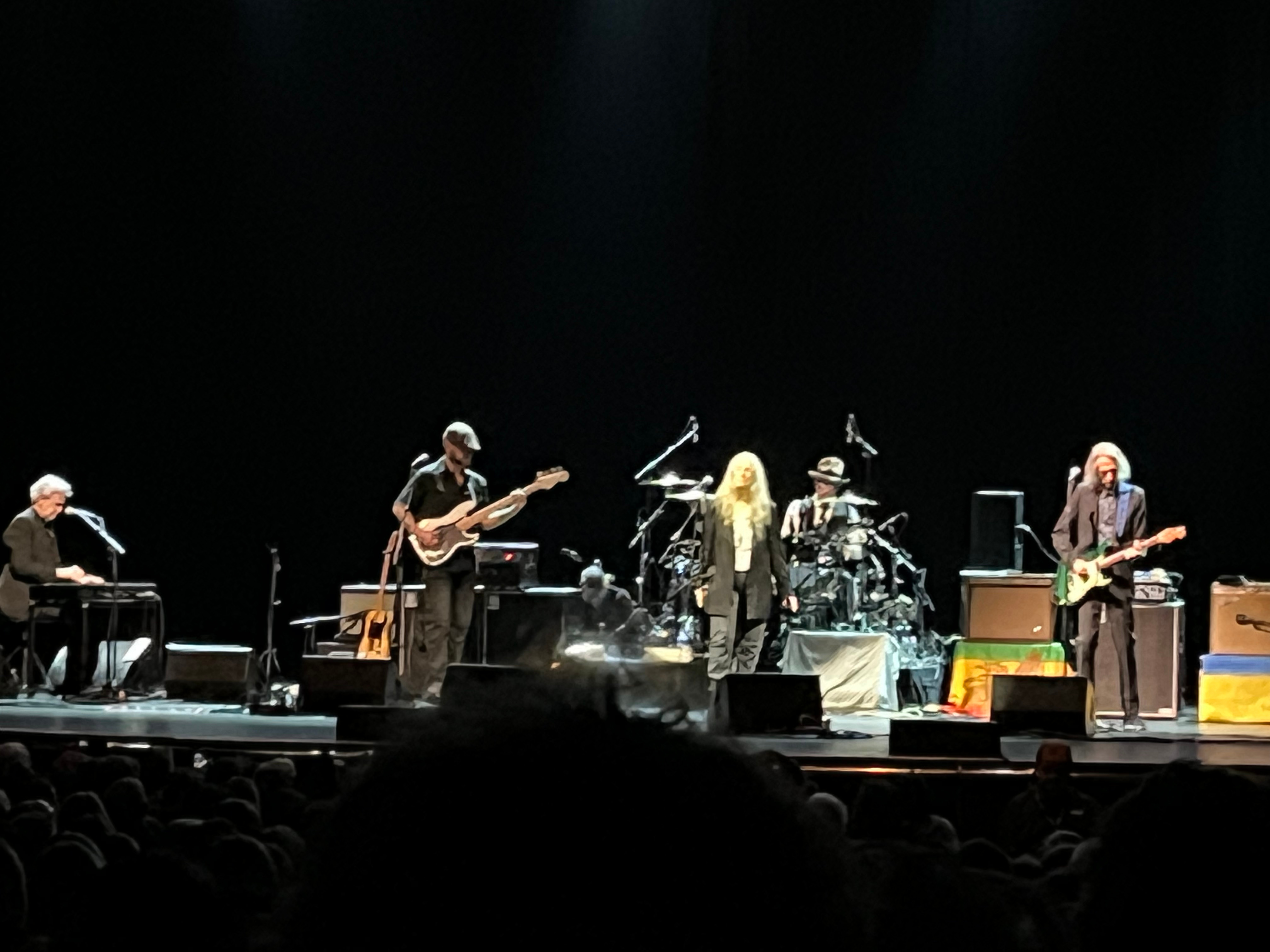
The People Have the Power: Patti Smith and her band, The Beacon Theater, NYC, 11/21/25, the 50th Anniversary of Horses. Photo by LO”H. This was church.

Erasure Augmentation Fragmentation

Fragmentation Erasure Augmentation

I learned

in channel flipping

David Bowie assembled phrases and words

on strips of paper

cut from texts or written out

by hand

strips

arranged

at random

his listeners

called them lyrics

Bowie called it fragmentation

performed it to music

we danced

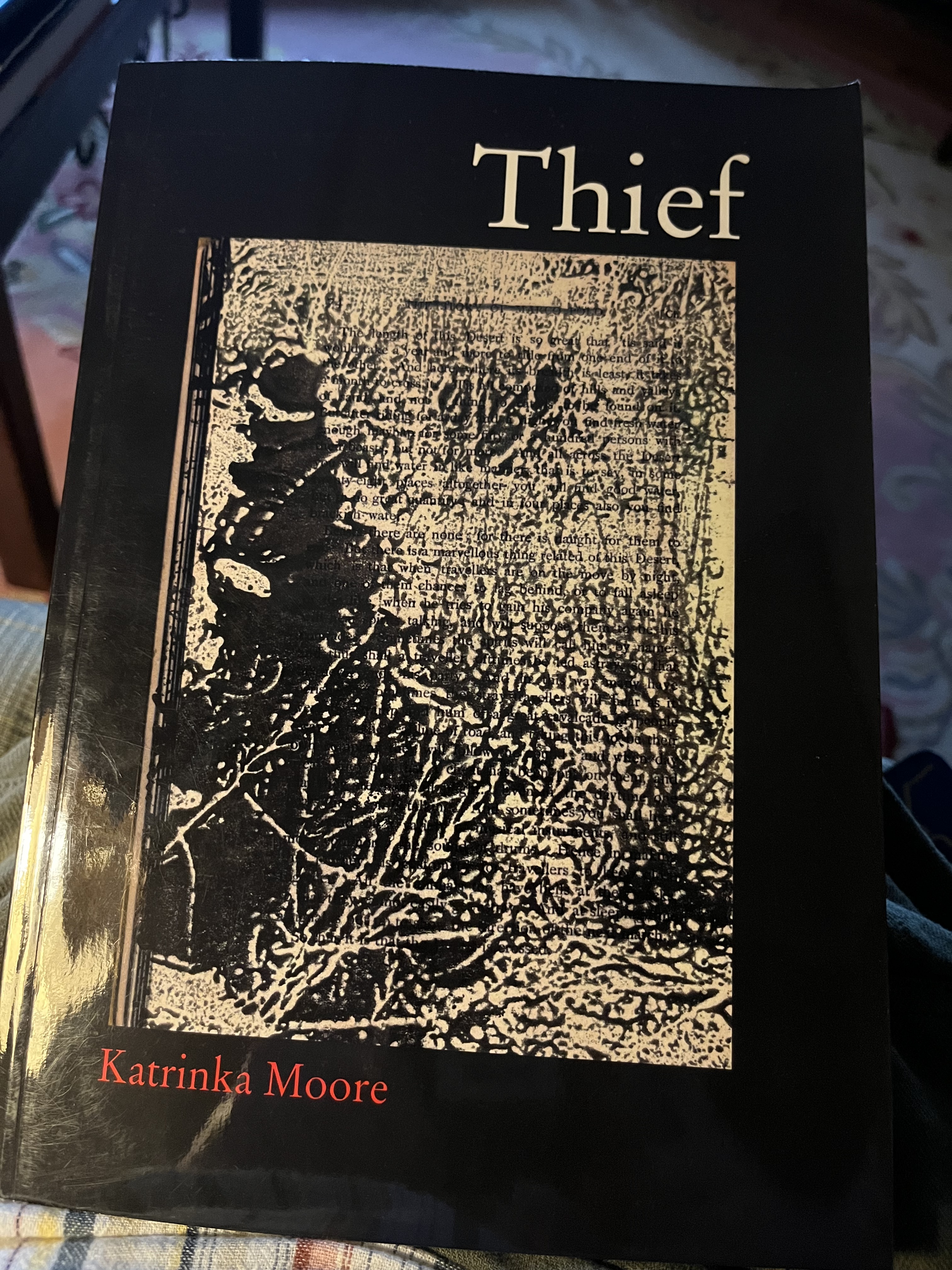
Katrinka Moore’s Thief

assemblage

poetry

taken from texts

through the process of erasure

makes meaning

different

same

fragmentation

makes you resee

text inside text in potential

and you find yourself

trying it out too


Earthquakes lightning strikes volcanic eruptions

flash floods and flash mobs

instead of FEMA

overrun by

concentration camp

guards worth more than teachers

pledge allegiance

pedophiles more revered

than field workers


In fragmentation

our country

our short attention spans

short circuited by shock

no common culture

no common causes

only

my tower of Babel


Our task

to augment with words

fill join complete connect

the empty spaces

make beautiful meaning

uncovering in the erasure

what was erased

only better


It’s not stealing

if the words and spaces move you

if the word spaces make you cry

if the words spaces open

the possible

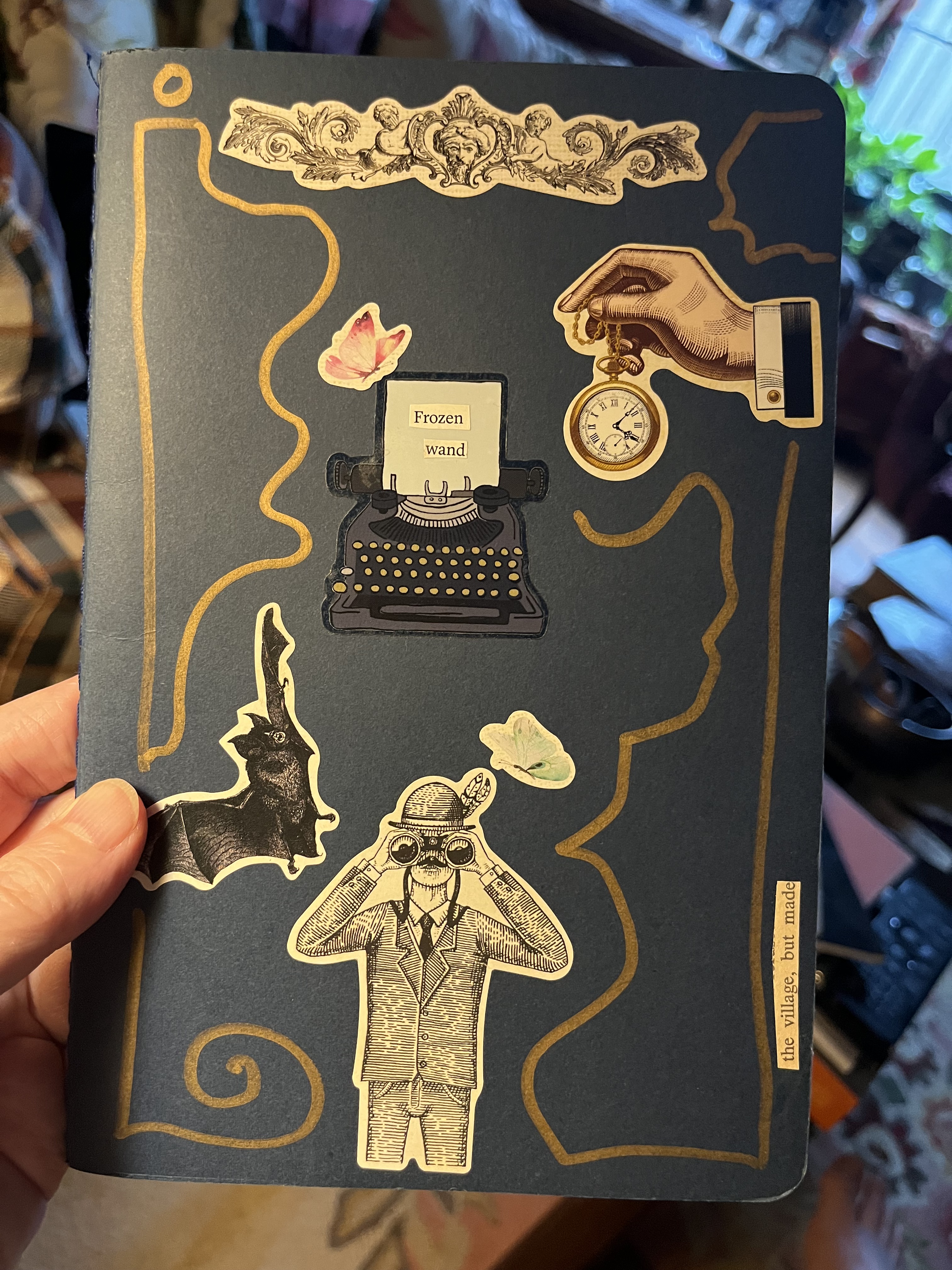
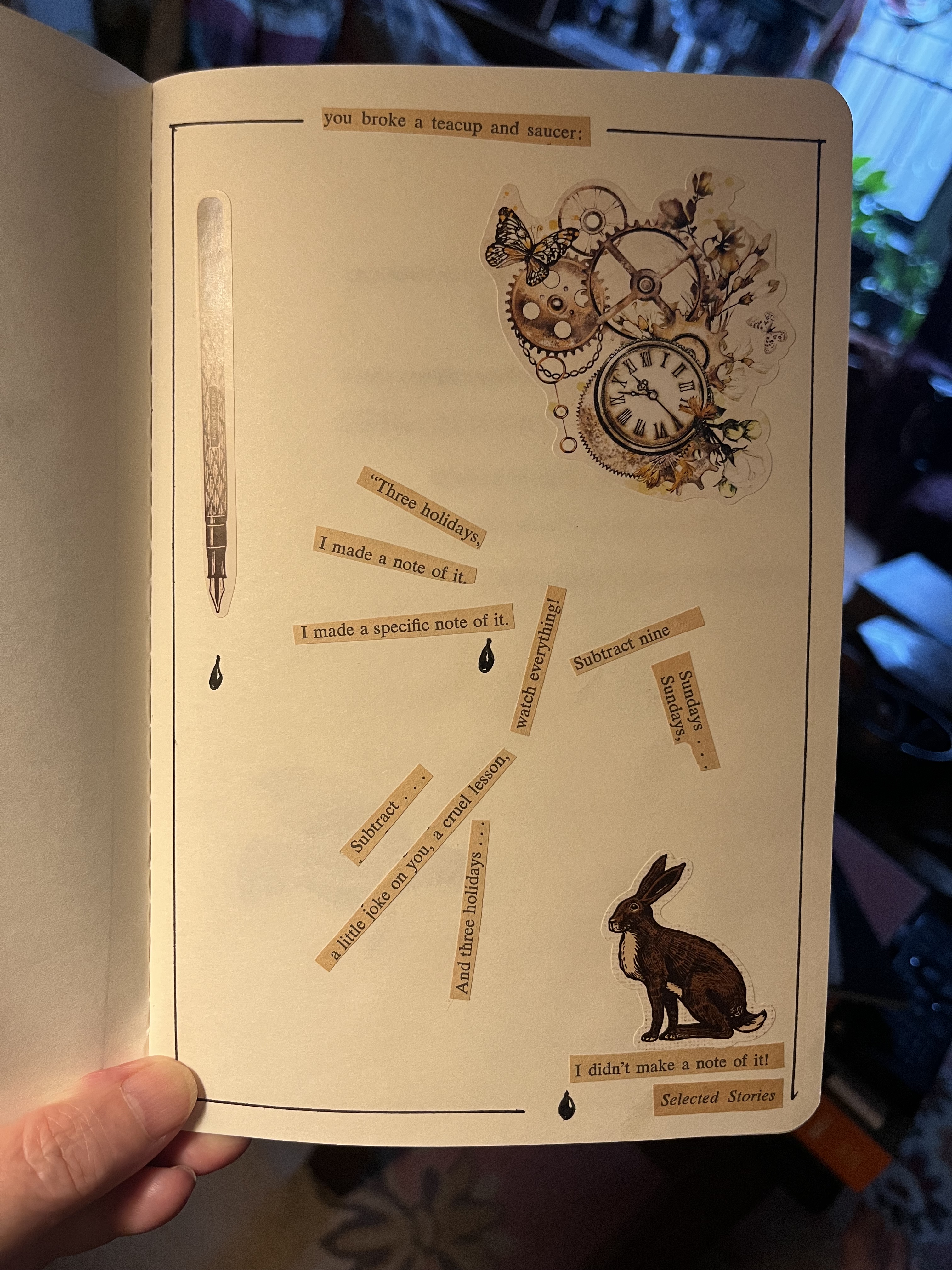
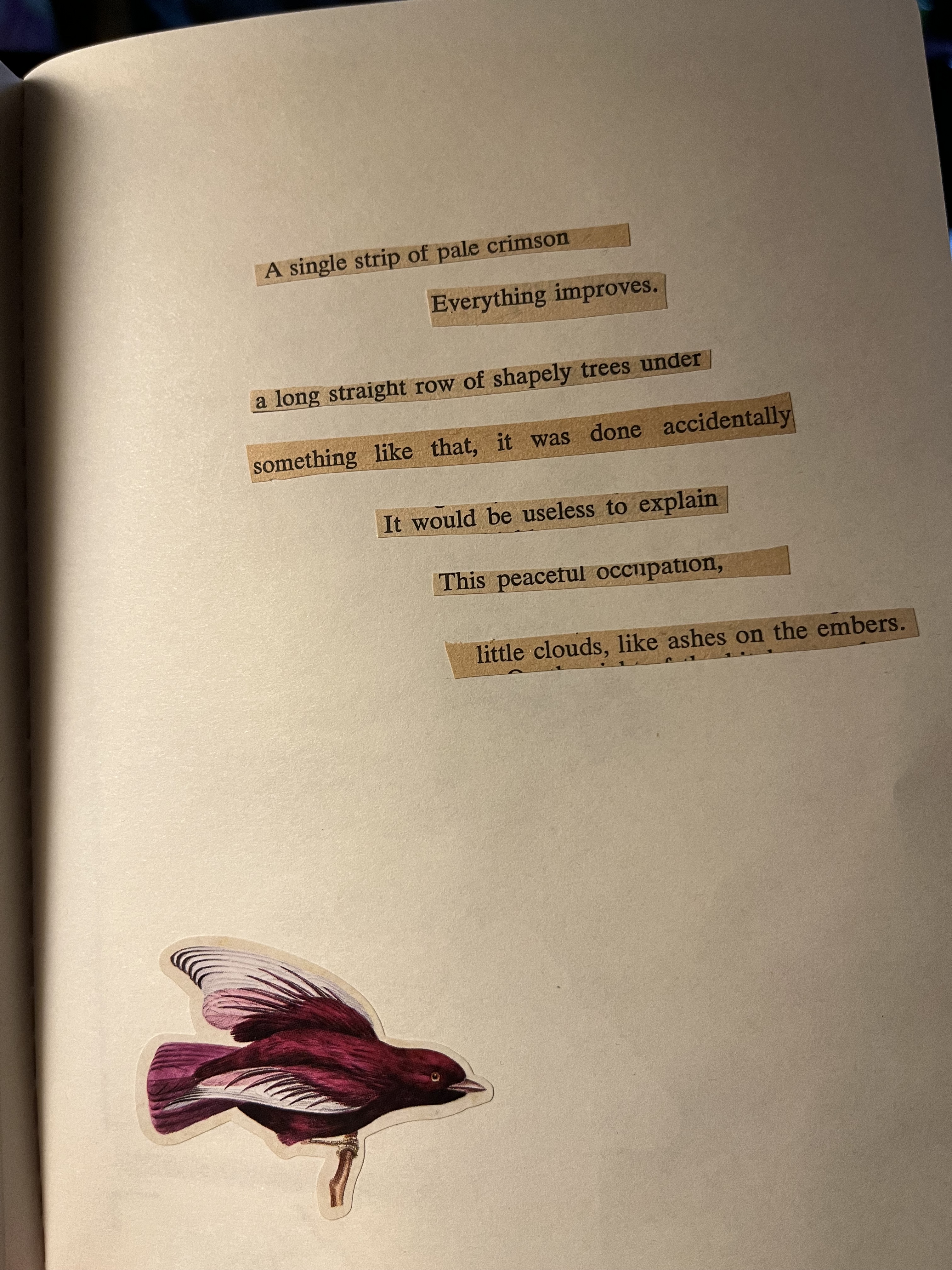
Miss O’s Fragmentation Booklet, with apologies and gratitude to Anton Chekhov

Artists

anticipate

are attuned to

act out

splintering fracturing factioning

the fragmenting

all our children will know

of this life

this world

is hate heat hardship

or is it

cut a strip

erase

augment

give it a good beat

hold it out to me

let’s dance

In memoriam, Andrea Gibson, 1975-2025.

Some Art Belongs in the Kitchen

Art as Independence Day

I started this missive sitting in my Queens living room, hours after the Big Beautiful Bill passed the House, again, and for all time; windows open, ceiling fan going, storms on and off, listening to The Land of Hope and Dreams Tour, Bruce Springsteen live in Manchester, May 14, 2025. God I love this artist, wobbly voice and all—all the artistry is fully there, the heart, the defiance of authoritarianism, the humor, the joy. Bruce is all that is good in America, or was, or can be. Can you imagine anyone—any sentient working American human choosing to throw their lot in with a monster like that whiny nepo baby Trump poser president over a true American like Springsteen, son of working class Irish and Italians, creator of some of the greatest songs of the 20th and 21st centuries, who is living out a true and mythic American Dream—rock star—through his own talent and hard work? I really can’t.

And here we are.

I know I’ve written about this before, about the importance, culturally in America, of The Ed Sullivan Show. From the 1950s to the 1970s, Ed presented an hour-long weekly variety show that had it all—the ridiculous magic tricks and comedy of low vaudeville to Broadway musical moments, opera, and popular music all the way to the Rolling Stones; the performers were whites, Blacks, Hispanics, young and old, men and women, everyone. It was a total melting pot of America, and it was in all the living rooms of anyone who could afford to own a television set and all their visiting friends who couldn’t. Common culture. Sure, there was the KKK and horrific shit all around, but no one really looked down on or was suspicious of anyone for loving both Johnny Cash and Leonard Bernstein. There was room and respect for both.

And no one, or few, back in the day, really didn’t want their kids to get an education. Thanks to public education, I read, the literacy rate was 80% by 1875. And that is an extraordinary achievement. All that advancement, one we have taken for granted, now could rapidly change.

Look, I know there are snobs all around, hurting others’ feelings, from Meryl Streep’s dissing wrestling on an awards broadcast to Donald Trump’s hatred of anything culinary beyond fast food. But the thing is, the free radio and the free television allowed equal access to all the art, so-called high and low—regardless of where you came from, you were allowed to discover and enjoy cartoons and classic films, sitcoms and crime dramas, bluegrass and jazz and opera. Whatever. Libraries made books free to read. Schools had kids do art shows. Everybody could go.

The shame of “high art,” as it’s often framed (as it were), from painting to classical music, is that all the plush carpet and crystal seems designed to make viewers and audiences either of it or not of it. The maestro Leonard Bernstein, a Jewish bisexual composer and conductor and communist, wanted to open up all that classical music to everyone, and did so with his New York Philharmonic family and children’s concerts, radio broadcasts, and a television variety show, too.

Sure, some music feels right in symphony halls, some on back porches; some art is best encountered while in the care of a museum, and some art fits just right on the wall of a bar. I want to live in a country where all of that is okay with everyone, and everyone enjoys access.

A few years ago, I bought some art by my talented friend Jodi Chamberlain. One thing she suggested about her current work, and which I passed on to my friends for whom I’d bought her pieces as gifts, “My art does really well in kitchens.”

And it really does. It’s a very cool thing to recognize about one’s work. You might think all art belongs in a curated living room, but really a kitchen is a totally wonderful place to have art. It’s underrated as a location.

Julia Child by Jodi Chamberlain, ca. 2022, collage, ink, color on paper.
My friend Richard with his new art, perfect for dishwashing contemplation.

The arts are and ever were the great civilizers, with civilization coming from the Latin root, “civilis,” meaning “relating to a citizen,” and also, “courteous.” Hence, civilized. There’s a thought. At some point not long ago, the National Endowment for the Arts became a Republican cudgel, the arts being blamed for all of the problems of a world that included (gasp) everyone. Sesame Street was radical in teaching all children letters and numbers, Mister Rogers too kind and loving. You know, un-American. Unlike blood sucking billionaires, who paradoxically fund a lot of the arts, so there’s that.

Back in October of 2020, when Trump (whose idiocy had killed some one million citizens during Covid) was running for re-election, Bruce Springsteen read Elayne Griffin Baker’s poem on his radio show, the poem that begins, There’s no art in this White House, and his reading is as important as Baker’s words:

There’s no art in this White House.

There’s no literature, no poetry, no music.

There are no pets in this White House, no loyal man’s best friend, no Socks the family cat, no kids’ science fairs.

No time when the president takes off his blue suit red tie uniform and becomes human, except when he puts on his white shirt and khaki pants uniform and hides from the American people to play golf.

There are no images of the First Family enjoying themselves together in a moment of relaxation.

No Obamas on the beach in Hawaii moments, or Bushes fishing in Kennebunkport.

No Reagans on horseback, no Kennedys playing touch football on the Cape.

Where’d that country go?

Where did all the fun, the joy and the expression of love and happiness go?

We used to be the country that did the Ice Bucket Challenge and raised millions for charity.

We used to have a President that calmed and soothed the nation instead dividing it, and a First Lady who planted a garden instead of ripping one out.

We are rudderless and joyless.

We have lost the cultural aspects of society that make America great.

We have lost our mojo, our fun, our happiness, our cheering on of others.

The shared experience of humanity that makes it all worth it.

The challenges and the triumphs that we shared and celebrated.

The unique can-do spirit that America has always been known for.

We are lost.

We have lost so much in so short a time.

– Elayne Griffin Baker

Art is where it starts, where life starts, where civility starts: without a love of the arts, there is no love of humanity. Without an appreciation of human craftsmanship, there’s no respect for any human endeavor beyond destruction. Wrecking balls are easy—the toys of little boys.

And once again, in 2025, we are lost; not only lost, utterly unmoored and alone out at sea, morally, ethically, practically. It’s horrible.

Bruce Springsteen is my favorite kind of artist because his music can reach anyone; he can play dive clubs, massive stadiums, and Broadway with equal facility. All the great artists can do this. And great artists want all the audiences, every cross section, to join in. In Putting It Together, James Lapine’s memoir of the creation of the Broadway musical Sunday in the Park with George, one of the actors recalled seeing Johnny Cash in the front row of one of the previews, and they all were excited and also worried he’d leave after intermission—and so happy when he didn’t! I love that. Thinking of that musical—one of everyone’s favorite movie scenes is the Art Institute of Chicago montage of Ferris Bueller’s Day Off, featuring the pointillist painting on which Sunday in the Park is based. Art, as director John Hughes knew, really is for everyone; in an interview, Hughes called that museum his “refuge” as a kid.

You know who doesn’t want everyone to engage with art? The autocrats, the controllers, the fascist creeps. They will do anything they can to prevent you, the people, from knowing about, engaging with, or being moved by art. Because they are afraid of it. Books, drag shows, finger painting, Broadway. The autocrats are terrified of art, I think, because they might have a feeling they cannot name or control, and there won’t be a starving refugee nearby to take it out on when they do.

I have this fantasy of rounding up all the MAGA leaders and the Heritage Foundation cultists and the architects of “America First” redux, putting them all in Depend diapers, tying them to lounge chairs, muzzling their mouths, and forcing them to watch and listen to loads of cultural things that would both expand and nourish their souls, like all day and all night. Bruce Springsteen live, obviously; David Bowie singing “Fame” on Soul Train; Matthew Bourne’s Swan Lake; Yo-Yo Ma playing Bach; maybe the documentary Toni Morrison: The Pieces I Am, the classic film Casablanca, James Baldwin on Dick Cavett; so many singers and musicians, surely Nina Simone; Hamilton. There is just SO MUCH joy to be had. I might open with Mister Rogers talking to them all from his old shows, telling them about love, to look for the helpers. Close with Johnny Cash’s video “Hurt.” On a loop until their hearts explode.

Their empire of dirt, indeed.

I just watched again the American Masters episode on Janis Ian, whose song “Society’s Child,” written at age 13 about an interracial relationship ca. 1962, was a revelation to me. Ian toured Apartheid South Africa in the late ’80s with an integrated band and demanding integrated audiences and hotels—and she got them. Though punished for two years by the United Nations, she said she didn’t believe in cultural boycotts because who knows whose heart might be changed by the music. Apartheid ended in 1994, and who’s to say her art didn’t help that along?

Too many in America fear information as well as art. It’s important to remember that art is not about information, it’s about wonder, about contemplation, reflection. Mister Rogers talks about that. All the noise of this world. There’s such meanness, too. Art can be such a restorative. Why can’t people focus on all that beauty and wonder and just leave poor immigrants alone? Because we know, don’t we, that if these malcontents and malicious assholes had art in their lives, they might be less afraid of learning all kinds of things, and they’d be more peaceful, maybe. All I know is that all my circles of friends and family love cultural things, and we are fun and kind people who never ever think of new ways to kill and cage “other” people. Go, us.

So on this Independence Day, perhaps our last, I’m going to meditate on a way of life that makes me happy, filled with art and music and funny people. Art takes you outside yourself as a way of going back inside yourself, only deeper, and you come out again, only different, better. And then you do it again.

Art by Jodi Chamberlain, ca. 2022, Covid times tourists, NYC

Remind your friends, art is everywhere, at all kinds of prices, and you can put your art finds anywhere you want. Go get some art. Move it around. Try out all the rooms.

Miss O’s kitchen, with assorted art.

Maybe start in the kitchen.

Love,

Miss O’

A Vision’s Just a Vision if It’s Only in Your Head

The state of the art of putting us (back) together

It’s Sunday in America, a new, greater America, where already thanks to tariffs, grocery and drugstore shelves are going bare, especially of paper products, because most of our wood for paper comes from (check notes) Canada. So. Fucking. Great. When I’m not freaking out about the country, I focus my mind on art. Then I remember that Trump, who is clearly not really running the country, decided to spend his valuable time to get “elected” by the “board” to head the Kennedy Center, which just two days ago quietly cancelled all LGBTQ+ Pride events for 2025. But because this is Trump, his own big Kennedy Center celebration of his First 100 Days sees him ousted from that same Kennedy Center for “contract violations.” You can make this up.

But really, this shit show is serious. In an interview on Democracy Now, Maria Ressa (6-minute mark), recipient of the Nobel Peace Prize, draws disturbingly urgent parallels between the behavior of the Trump and his administration and former president of the Philippines Rodrigo Duterte, now in the custody of the International Criminal Court (ICC). Trump only learns from the best people. Ressa concludes that if Trump and his FBI and his ICE aren’t reined in by summer, our democracy will be obliterated and most likely for good. She’s just following history.

And the more I read and listen, the more correct I feel I was back in 2020 when I told all the liberals, who are as addicted to Trump as the MAGA who drink his blood, that they/we need to ignore the Big (Burger) King and target the minions who do his bidding, target the structures, and more than that, message the alternatives in actionable, relatable ways, not from On High. For however well-meaning AOC and Bernie are in their Farewell to Democracy tours, and Cory Booker for his stand-ins and sit-ins, they have no actual strategy for saving the country; they do not think like generals, and we need generals right now.

I read about a recent viral Facebook post claiming that Liz Cheney penned a letter saying, “Dear Democratic Party, I need more from you. You keep sending emails begging for $15, while we’re watching fascism consolidate power in real time.” According to Snopes and PolitiFact, there’s no evidence that Cheney wrote it, but you can tell that the average Democrat who probably did is trying hard to get our party’s attention, because Democratic Leaders are so sure they don’t need We, the People, for advice, only cash.

I’ve been trying to understand the Democratic Leadership’s “vamp until ready” stasis. In the theater, the orchestra pit plays music over, and over, or “vamp,” at moments of a show, to cover a set change. In the case of the U.S., there’s a regime change, or a shift from a presidency to a regime, and if this were a show, it would be as if instead of playing bars of music on repeat, the orchestra itself was replacing instruments with jack hammers and table saws.

I mentioned in my last missive that I’ve been rereading Sondheim’s lyric memoirs, and the other night I came across this, and it made me think of the floundering Democrats:

“The point of a tryout is to fix a show, and by the end of the Chicago run, we should have been making changes in the scenes and the songs and the staging. But we couldn’t, because the day after the show opened, Hal [Prince, director] had to go to Germany to receive an award and then leave for vacation. Not that he thought the show was in perfect shape when he left; he simply felt that whatever changes we wanted to make could be accomplished on paper and put into practice later when we went back into rehearsal for the Washington engagement….

“It was a serious miscalculation. We were all experienced enough to know that the time to fix a show is when it’s still raw, before it has started to become slick and rigid, when no one, neither the creators nor the performers, not to mention the audience is satisfied. Without constant attention while a show is taking shape, it doesn’t need many performances before it becomes so efficient that what’s bad becomes acceptable.”

— Stephen Sondheim on the making of the show Bounce, 2003 (from Look, I Made a Hat, 2011, p. 270)

Kids, I think to myself, we don’t have a lot of time to fix this democracy. We have to attack now, while it’s all still raw, while the chaos is still real and awful. Do not relent. Call and email your representatives, keep talking to friends. I long for leadership, but it’s not forthcoming.

As we watch our prices rise and shelves empty because shipments cease, as more and more all of us can only focus on basic survival, the energy for revolution will wane—I think that’s what the MAGA Men and their little MAGA Barbies are banking on—and it can’t. We still have to do that work inside ourselves and push it out.

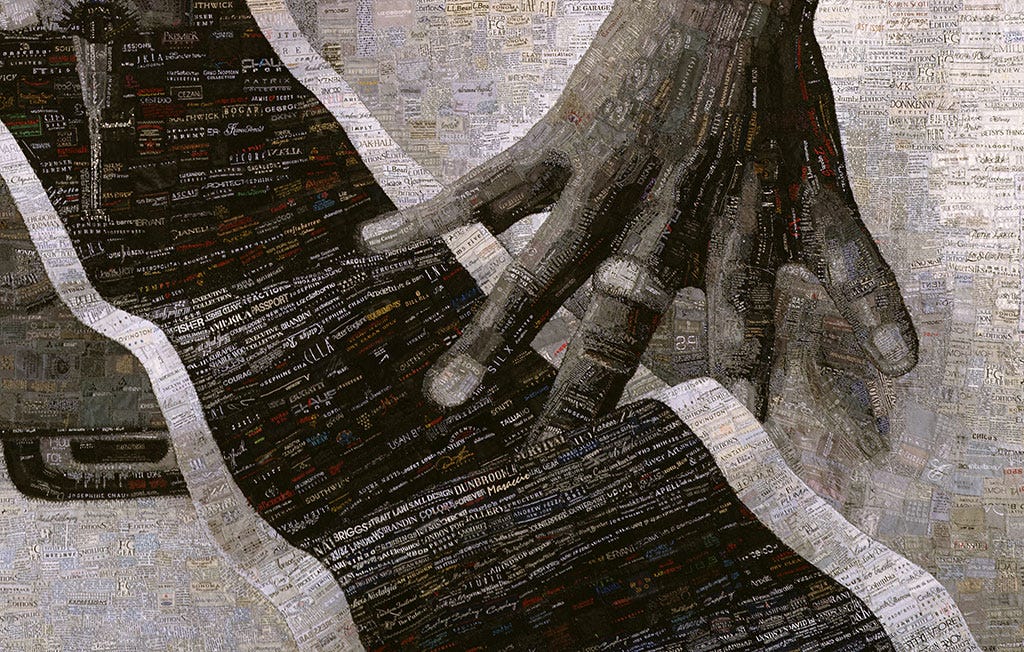
This week, I happened on an episode of Craft in America on Public Television (soon to be RIP unless we stop it, somehow), in which I saw a quilt artist—that’s right, the photo below is of a quilt. The quilt was based on a photograph of a Nicaraguan garment worker in a sweat shop.

Portrait of a Textile Worker, Quilt by Teresa Agnew

On artist Teresa Agnew, from Craft in America:

“Terese Agnew’s work has evolved from sculpture to densely embroidered quilts by a process she calls drawing with thread. Her themes are environmental and social. Her most notable quilt to date is the Portrait of a Textile Worker, constructed of thousands of clothing labels stitched together, contributed by hundreds of sympathetic individuals, labor organizations, Junior League members, students, retired and unemployed workers, friends, family and acquaintances worldwide. The resulting image is about the exploitation and abuse of laborers, the by-products of globalization and the insatiable American appetite for goods.”

The quilt was created using solely garment labels. Zoom in.

I learned that Agnew found her P.O. box filled day after day with volunteer labels, mostly from people she didn’t know, all women, all who believed in her vision for this piece, her purpose, her message, and in this art form. All these people came together, and Agnew didn’t even know how they learned she was working on the piece.

I think of that artist, and I think of Sondheim, on the road with three iterations of a show that started as Wise Guys, and become Bounce, a decade later finished as Road Show, bit by bit, putting it together, as it were, because it was something he and his collaborators believed in.

If so many people can work that hard to make art that matters, can’t we call work together to demand a nation, a planet, we all want to live on? As Sondheim says,

A vision’s just a vision if it’s only in your head.

If no one gets to see it, it’s as good as dead.

America, your Miss O’ is looking at all of us and thinking, “We need a do-over, a rethink.” Fast. We overproduce all the wrong stuff, overconsume the wrong stuff, overwork in the wrong ways, overpay for the most basic things, like healthcare and rent, and overthink everything about the past instead of overthinking for the present and the future. We need to take all these scattered feelings and thoughts and make, build a national living quilt from all the tattered bit and leftovers, craft it for warmth and strength and beauty for generations and generations.
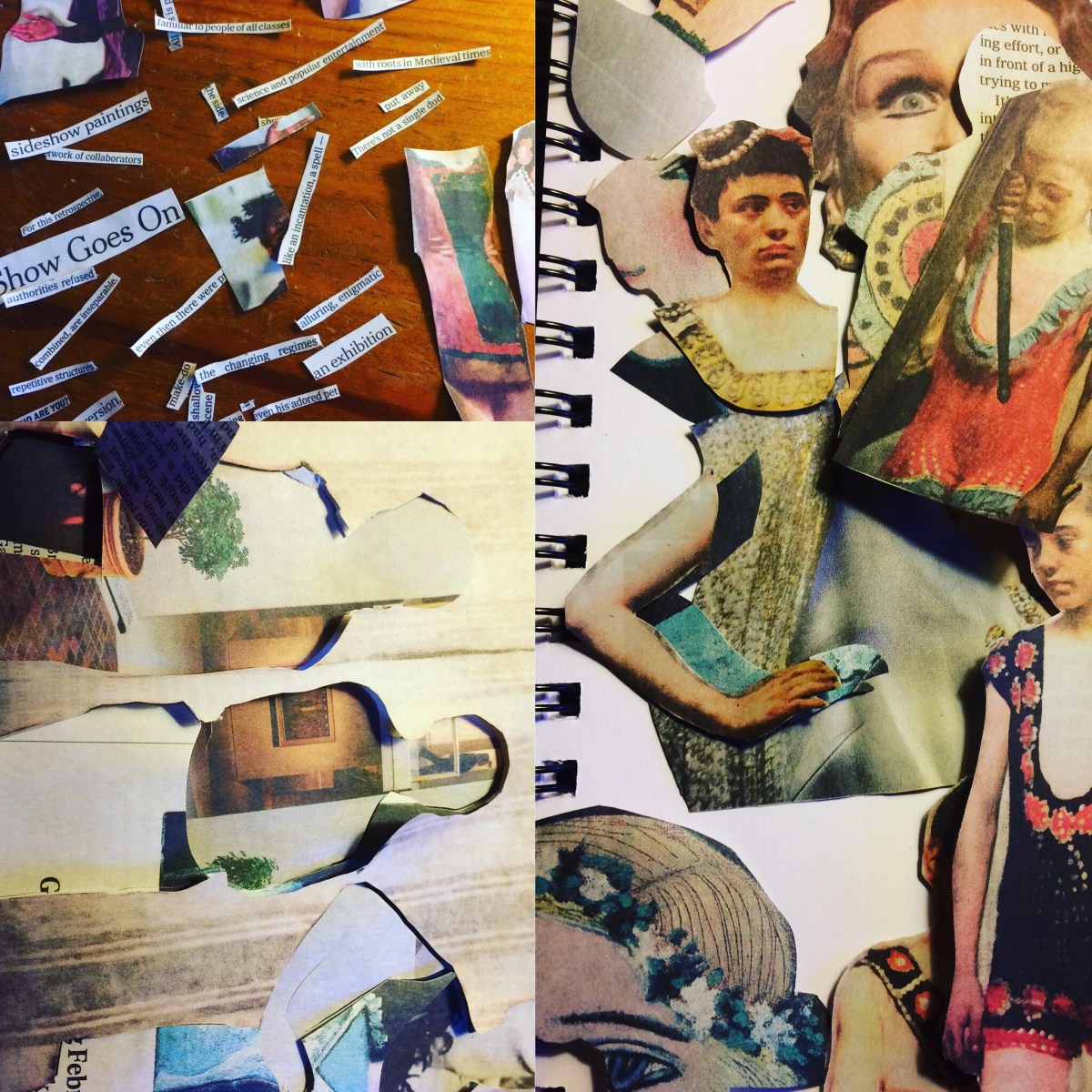
How many metaphors can you handle this Sunday?

It’s still spring, we are still alive. More to do. Let’s do it.

Sending love to all,

Miss O’

Not Waiting for Directions (Home)

When you just want to do it yourself but can’t

“Dear Saint Anthony, look around, something’s lost and can’t be found.”

~ Catholic prayer to the patron saint of, among other things, lost objects

“When evil-doing comes like falling rain, nobody calls out ‘stop!’”

~ Bertolt Brecht

“Never start a piece with a quotation.”

~ Nora Ephron

Do you have the feeling that we are all living through a Kafka short story? “The Trial,” perhaps, or “The Refusal,” maybe? When I was home in Virginia the other week, I asked my brother Jeff if he’d ever read Ray Bradbury’s “The Sound of Thunder,” and when I recounted the plot, he realized he once saw a bad movie version; and it came up because, as we caught the latest news out of America, I mentioned that I keep looking for a smashed butterfly on my shoe.

For some reason, I got on a mailing list for Catholic charities and I often receive “free gifts” of amulets and charms and bracelets and necklaces of St. Anthony. Coincidentally, he’s my favorite patron saint.

Like me, in addition to those stories, maybe you are thinking of that Twilight Zone episode, “It’s a Good Life,” where that evil kid keeps wishing everyone who displeases him away to the cornfield, and no one will stop him out of fear, and also love, because his parents choose to save him and let the rest of the world disappear. In the same way, Trump bastardizes the Kennedy Center even as he plans to close or demolish the Museum of African American History, and Musk eyes selling off the National Gallery treasures to “save money.” Wishing all our history away to the cornfield. And, echoing Brecht, there’s no one to stop them.

Or is there? Reading historian Heather Cox Richardson the other day was a tiny balm, as she recounts recent events and sees shifting winds. I’ll take it.

Your Miss O’ has been lying low these past weeks, visiting aged parents, aging brothers, a young nephew and vibrant sister-in-law. Also watching birds, smelling lilac in bloom, watching red azaleas pop, walking around my childhood block in drizzle. In addition to watching classic movies and “Harriet Tubman” on PBS and “Poetry in America” episodes with brother Jeff during the week, I caught A Complete Unknown on my last night, the weekend nephew James visited. James just wouldn’t go to sleep in his designated living room, what with all the excitement generated by middle-aged relatives, so he happily sort of watched the movie with the grownups, not understanding any of it. Fortunately, there’s no nudity and little in the way of bad language, but at the point where Joan Baez gets out of her bed where Bobby Dylan is sleeping, only in her underwear and a tank top, four-year-old James commented, “She forgot to put on her pants.” Uncle Jeff chucked, “He doesn’t miss anything, does he?”

If you haven’t seen that Dylan bio pic, for me the most interesting storyline was the one featuring Pete Seeger, played beautifully by Edward Norton. The movie helped me understand this mystery surrounding the rift that formed between Dylan and his early supporter and champion Seeger. Their link was Woody Guthrie, suffering from Huntington’s chorea at the movie’s opening, the disease never named or explained, as Hollywood does. I won’t belabor the plot, but essentially when Dylan went electric at the Newport Folk Festival, Seeger was dismayed and dejected, not because he hated rock, but because it was the end of his dream. For years and years, Seeger saw in Guthrie, and in the work of folk musicologist Alan Lomax and in folk musicians like Joan Baez and Odetta, the opportunity to proclaim a unifying voice in American music. Amidst the turmoil of the civil rights movement and the communist accusations of HUAC, the folk music movement offered the possibility of a true common ground across race and social class and political affiliation, youth and old age. In Dylan, Seeger saw the last piece of his dream, a young, galvanizing voice, filled with unendingly creative songs of love and political revolution, fresh and original but also connected to our American past.

But Bob Dylan was an artist first, an individual all the way, with no interest in marches or politics, not really, and not at all interested in unifying a nation. The rest is history, Highway 61 Revisited, and unending tension and turmoil in America. This is not Bob Dylan’s fault. Pete Seeger meant well, too, but no single person can make us all believe one “us” to be true.

No one, alone, can fix it.

But if something can unify a people, it’s probably music that comes as close as anything. Music and food. Music and food and complaining about noise.

On Thursday morning this week, around 8:30, as I was working when I heard this high-pitched BEEP BEEP BEEP [beat] BEEP BEEP BEEP. Smoke alarm? Tow truck? Work truck backing up? After about 15 minutes of this blaring through my window, I decided to take a walk hoping the cause of the noise would resolve. One 20-minute walk later, I could still hear the beeps from two blocks away. I went on a fact-finding mission. Where I live is like a mixing bowl of sound—finding the source was a confusion to me. I called 311—a wasted half hour of the operator’s frustrated inability to locate where I was on the city map. Feeling crazy at this point, I texted my co-op group, and neighbor Chris took over, agreed with me it was in a trash bag, rummaged, found the culprit—a discarded smoke alarm!—and smashed it. Oh, blessed relief.

In the midst of ICE raids in America destroying families, there are still annoyances like that, you know what I mean? It’s the thing I’ve never understood, not since I watched the 6-day war on Walter Cronkite’s 6 o’clock news when I was James’s age: what are human beings thinking when they annihilate other humans? We have enough little daily problems, don’t we?

If noise rage occasionally unifies us, language never seems to be able to, because as poet Nikki Giovanni said, too many people try to speak English rather than speak through it. Saturday morning, I had to go get bloodwork and urine testing done for my physical this week. Earlier in the week, I’d received an email that my neighborhood LabCorp office “has closed.” Full stop. I was so bummed—the next closest one is in Jackson Heights, about five subway stops away. Instead, the email continued in the next paragraph, there will be a new office…wait. It’s the same address, but one floor up. God I hate it when people can’t fucking communicate. What the email should have said is, “The second floor LabCorp office is closing for two days in order to relocate to the third floor.” Do you see the difference? Why is this hard? Because it is.

When I arrived at 7:45 for my scheduled 8:00 AM appointment, I saw a packed waiting room—highly unusual, but the office is “new,” so one makes allowances. One man there had a son, probably eleven or twelve and clearly on the autism spectrum, chasing him around, keeping him out of lab rooms, out of the hallway. I went to self check in kiosk but saw this sign:

So I went to the window to check in, as directed. The nurse behind the glass, short, dyed black hair, officious—clearly overwhelmed (like her male counterpart) by the double duty of being a receptionist and the technician, came out to the kiosk and said, “Give me your ID, I’ll do it,” and I pointed to the sign, saying, “If it works, I can do it…,” but she was clearly focused on finishing the check in. Again, I pointed out the sign directing us to go to the window. Did she take it down? No. She straightened it. (My seat being nearby, I spent the next 45 minutes explaining to everyone who came in, “It works, ignore the sign.”)

Between the lying sign, the autistic child flying around, the woman who was denied a pregnancy blood test because she didn’t have a doctor’s order, the men needing drug tests for their jobs, and the seats all facing forward staring into the abyss, I felt I was in some kind of play. Not really Kafka, but rather, Samuel Beckett. I was in a Beckett play. I love to see plays but it’s not always great to live them.

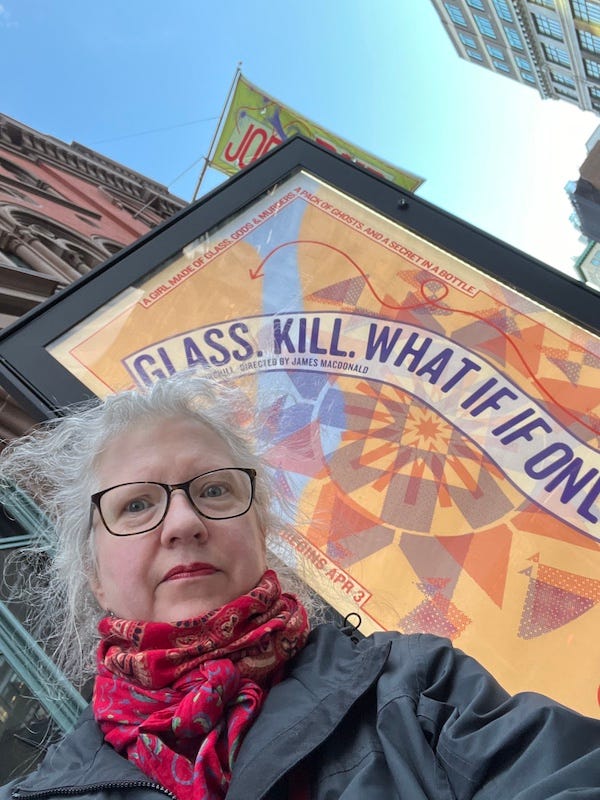
True to my heart, to cheer myself earlier this week, I went to The Public Theater to see a collection of short plays by one of my favorite playwrights, Caryl Churchill. As only an artist can, she captures me in this time, even in America. I think the titles say it all.

And that’s the latest. How’ve you been?

Love to all, somehow,

Miss O’

Food, Home, Music

Ways we see some sense, in lists of three

Babies, like you, I am about to simultaneously explode and collapse from rage, numbness, boredom with the stupid, and Dorothy Parker’s “What fresh hell is this?” pounding in my ears, I mean for the LOVE of GOD.

Look, we all of us—all of us—every mother lovin’ one of us—white, brown, black, all the colors; man, woman, trans, all the genders; short, tall, medium, all the heights; ambulatory, prostheticized, wheelchair-bound, all the abilities; Euro, African, American, Indigenous, Indian, Chinese, Korean, all the places; Jewish, Muslim, Christian, Buddhist, Hindu, all the faiths–love three things, and I mean LOVE:

1. good food;

2. a comfortable home; and

3. music, whatever that music is.

Watch Home Town on HGTV and tell me you wouldn’t want Ben and Erin to help you make a home for yourself; walk past any bakery in the morning and try to pretend you don’t smell that bread; hear a catchy tune on a radio at the laundromat and not pause and bop. You can’t. Because roots as old as the Big Bang, baby, give us a common consciousness. Eat it.

And for some reason, too many whites in this country think ONLY THEY should have any of those desires, those sensory experiences, those moments. This is insane, it’s psychotic. How do we shake sense into these racist, bereft, sociopaths? Those “Frozen People”? They have become new gold standards for the worst of humanity. Somebody, quick, sick a porch swing, Dolly Parton, and fresh peaches on ’em.

I wish we could cook it out, dance it out, whatever this psychosis is, everybody walking into and out of a Wayfair commercial to create that fulfilling home, and combine all of it into community. It’s all so basic.

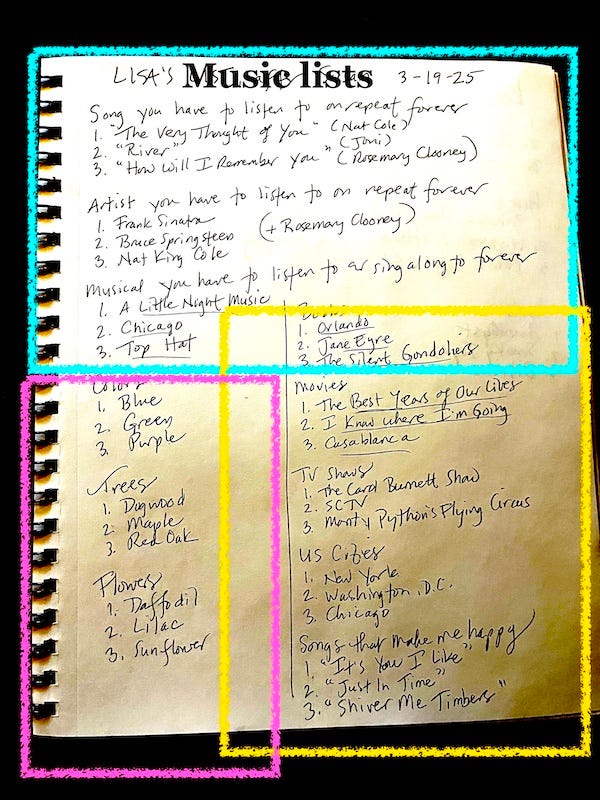
Inspired by my friend Susan, who got me making Lists of Three (various categories) and sharing them with her the other night; and colleagues who want to have a Zoom social and talk food, I have listed my dream meals, in honor of Thing One we all love. You’ll pardon me if I’m feeling a need to be elaborate.

Dream Meals

1. Breakfast: my dad’s cheese omelet with American cheese, cooked in bacon grease, with biscuits from The Red Truck bakery in Warrenton, Virginia; coffee from Baruir in Queens.

2. Lunch: the brown bread, Stilton cheese, and tomato chutney Ploughman’s lunch, from the pub in Kent, England, 1992, followed by a cup of Yorkshire tea.

3. Dinner: The fried chicken and collard greens from Mama Dips in Chapel Hill, North Carolina; the hush puppies and sweet tea from the midcentury diner near Seagrove, NC; my mom’s potato salad (sweet relish is the key); fresh-from-the-garden baked sweet potatoes (the way my Appomattox landlady Margaret Stokes from Chesapeake made them), and ice cold fresh sliced tomatoes from the garden.

P.S. Dessert: childhood next door neighbor Frances Christie’s homemade apple pie with the all-butter crust and fresh apples from the Blue Ridge in Virginia.

Dream Home

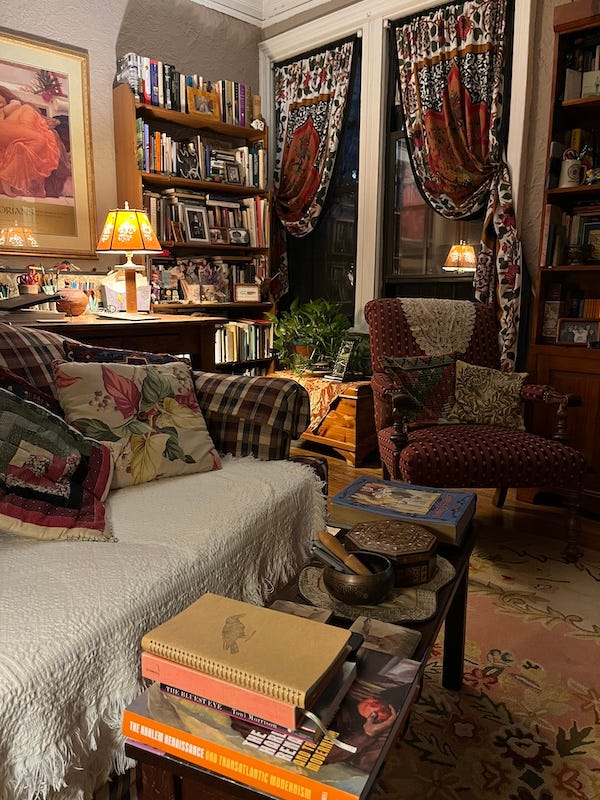
Very grateful to have been able to build this, over many years, across many lives and houses:

Dream Music

There’s so much not on here, but what can you do? The categories force you to go with your gut. I even surprised myself. (When I lived in my basement during 2017-18, while a friend took my main floor bedroom as she recovered from breast cancer surgery, I missed street noise so much that I found I had to play music on low to sleep. Those CDs? Tony Bennett, The Rodgers and Hart Songbook, and Rosemary Clooney, Songs from the Girl Singer. Every night for nine months. And on the list down there, Rosie was an afterthought; Tony didn’t even make the cut. How?)

Does this get your brain percolating? With a hat tip again to Susan for inspiring me to start remembering all the foods, homes, songs, as well as people and places I like, and the experiences I’ve lived: here’s a little challenge to you, my reader:

In the comments, if you want, give us a List of Three of whatever, no explanations needed, just a label and a list of three. Let’s inspire each other. Let’s connect. Let’s take some recommendations. See what happens.

I could really use reminders of our common humanity. How about you?

Love, love, love,

Miss O’

An Ordinary Day

On missing days of normalcy, and making them

It’s an ordinary Saturday in Queens, which is to say “ordinary” if you aren’t thinking about the fascism. (I really can’t get over the way that Meta bleeps “Nazi” and “swastika” from videos, or that posters have to insert an * somewhere in each of those words so the post passes muster, even as Elon’s and Bannon’s sieg heils are fine.) I am waiting on a 7 Train, only to learn it’s not going all the way to Manhattan, so I have to switch the N or W, so my mind does a little adjustment. It’s all good.

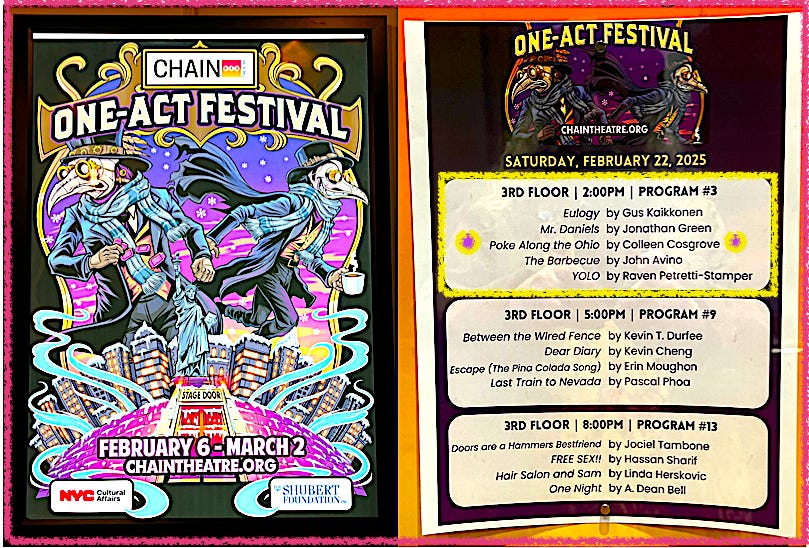
There used to be moments when, as my friend George puts it, it seems Americans are simply going to be inconvenienced to death. Now, unfortunately, and for a long foreseeable future, we are under threat of annihilation. But today, I’m heading to The Chain Theater at 312 W. 36th Street in Manhattan to see the 2 PM installment of their rolling rep One Act Play Festival, and today I don’t want to think about annihilation.

When I arrived at Times Square/42nd Street, I walked through Golda Meir Plaza, struck again that in the 1970s we had female leaders like Meir of Israel and Indira Gandhi of India, Thatcher in ’80s Britain, and that the United States couldn’t even manage one woman in 250 years, choosing an avowed white supremacist dictator, twice, over a highly qualified, democratic woman. And here we are, I think, wondering as I keep walking what will happen to the bust of Meir.

First, I have to go to the ATM, and for some reason my card chip will never work to open the door; another customer, a man in a hood, has a card that opens the door; he engages in no talk. I go in behind him, and I realize I’m shaking. I find I’m afraid to use the machine until I see him at the other machine, and really getting money; I finish before he does, even having to enter my PIN twice to get it right. Odd, having the shakes like that. Or not so odd. Frankly, that’s as fearful as I want to be in life.

It’s nice out, 40s, sun. I walk down 7th Avenue, taking it in, struck again how I can always spot a tourist. I am of New York City, I move that way, more grounded, a bubble of insulation and also awareness. I was a tourist for 20 years before I moved here, so I don’t mean this as criticism or praise; it just is.

I arrive a half hour before the play festival is to start. I see Mary, the director of my friend Colleen’s play, in the crowded lobby, and we hug. I check in at the desk, my friend Tom having bought our tickets online. Our friends David and Barry are also coming, and learning the afternoon is sold out, I go in when the house opens and save us a row, as it’s general seating. An older woman in the row behind me is doing the same thing. (It’s always funny to me how everyone who enters a general seating situation somehow believes they will get to sit alone, empty of audience members around them, and they look at my saved seats with resentment.) The boys show up just before 2 PM, so we don’t get to visit much, and they don’t have time to go out after. I seem to be the only person I know in the city who has nothing but time. Ah, well. Still, being in this community even for a brief time is comforting and energizing. Hopeful.

For the uninitiated: Attending a play festival of new work, especially one-acts, can be a crapshoot. I’ve attended many of these, both as a high school director and as an audience member in New York, and too often only two out of the five or six are well-written, and only one or two are well-acted and directed, and often it’s not the same set of two. So imagine my delight—I knew Colleen’s would be adorable because I’d read the stage directions for it at a workshop—when all five were simply excellent.

The common theme—and this was a really thoughtful grouping—was aging and death. This might sound awfully close to that annihilation I was avoiding, but it wasn’t the case. The first play was a monologue, a 60-year-old son eulogizing his father at the funeral; the second, two old people on the E Train platform; the third an older man trying to make a deal with Death; the fourth was Colleen’s (a play inspired by seeing a plaque in Evanston, Indiana, along the Ohio River, where President-elect James K. Polk was to have stopped his steamship and didn’t disembark), with an old woman (Colleen) and her grandson in 1854, the year Lincoln was really getting started; and the last a gay couple, older men, one who has, we see gradually, dementia. And all of these were by turns serious, funny, sweet, surprising. And ultimately, ordinary, in the best sense. Life lived.

I’ve realized lately that what I crave most in my music, my art, my nature, and my life, even, is ordinariness. I don’t want the surreal, the challenging, the wildly surprising. I get too much of that in unending loops in American society now, breathless, mean, chaotic, and all that hate and chaos, while not remotely sustainable, will be unending for four years at the very least, and if we all don’t stroke out and live to see another election, we may see a divine revolution. Until then, I want mundanity as a life theme.

For example, here’s a task of basic maintenance.
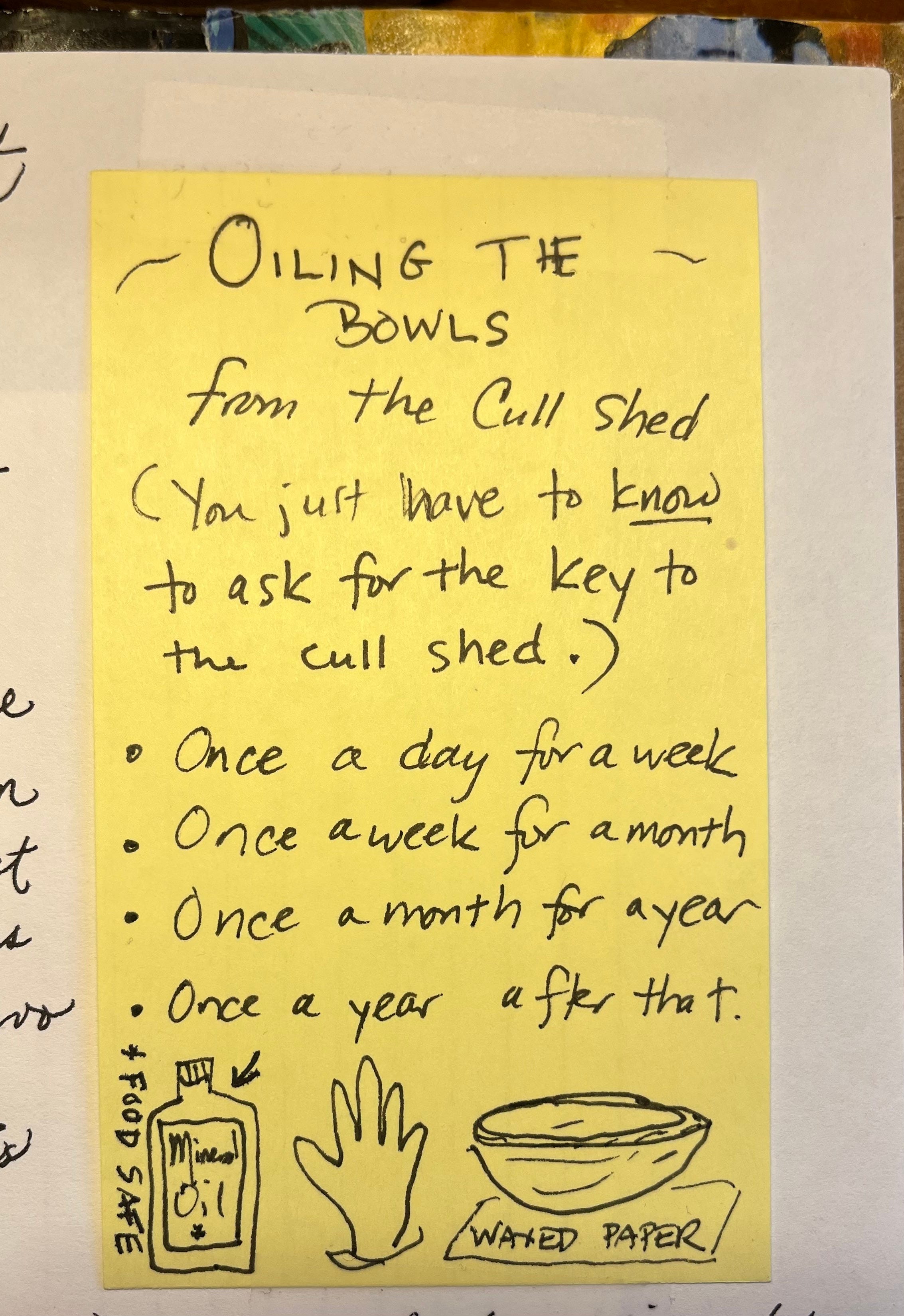
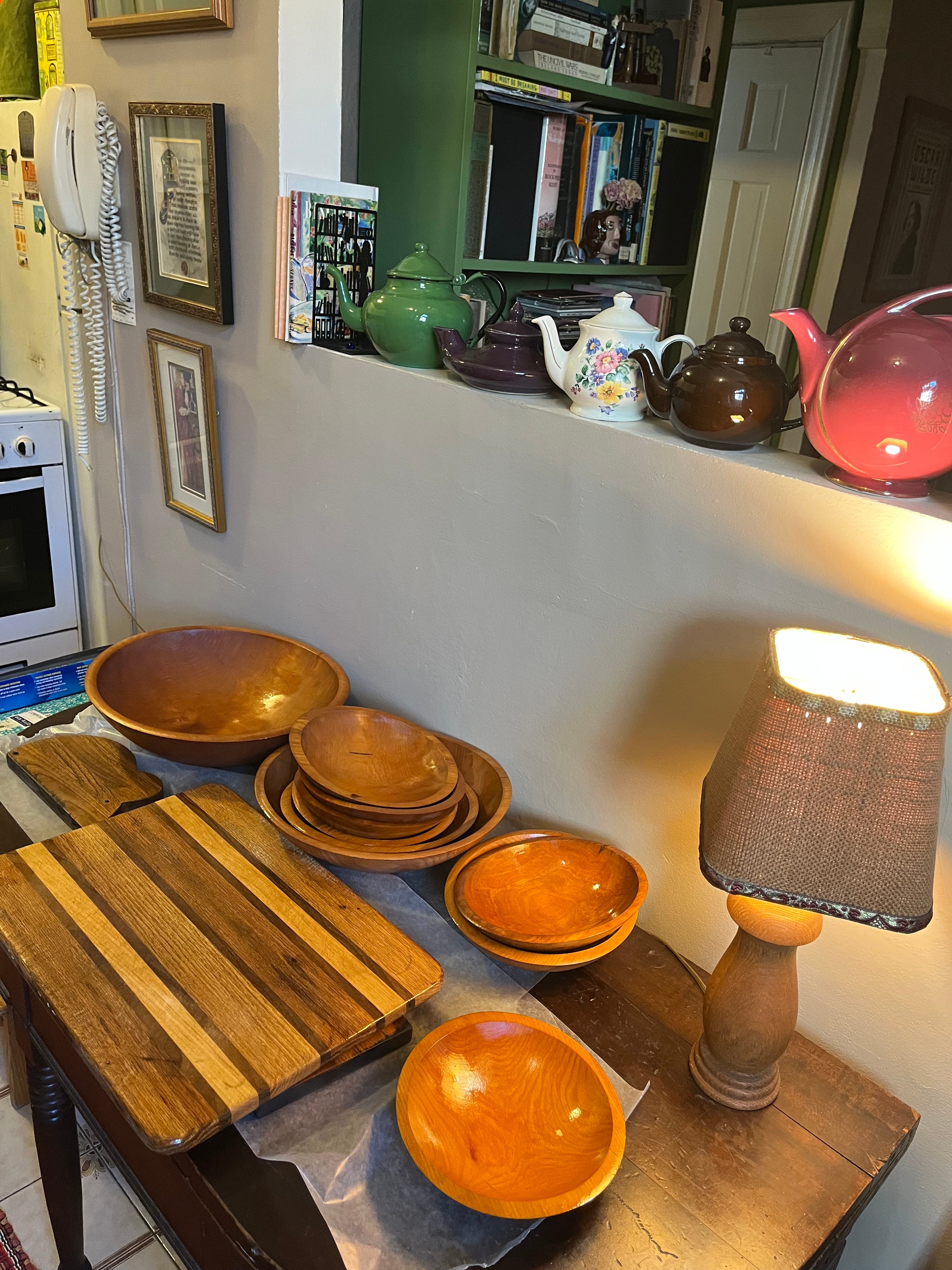
Simple chores. I did the annual bowl oiling during my lunch break one day since I work from home. So restful. Once the oil soaks in, they’re good to go for a year. I oil the cutting boards at least twice a year. Isn’t it nice to focus on that?

As another mundane activity, before leaving for the subway with a half hour to spare once dressed (I took care to pick my ensemble and accessories, knowing no one else would actually care, but it’s my inside feeling that counts), I noticed that I have a lot of loose knobs on my two dressers. One dresser requires a Philips head and one a flathead screwdriver. I keep these in a pitcher by the door—I like to have my tools ready at hand. Knob by knob, I tightened them. In doing this I noticed a few scratches, so I went to my tool closet and found the wax wood filler pencil. And I filled the scratches, and it’s funny how the more you fix the more you see.

And this by the way task was really satisfying. You know what I mean? And centering, before heading out into the chaos of New York’s mass transit.

Why do we have to exist in all this rage and war and hate and aggression and greed and chaos? We all have knobs that need tightening. Why, just because of a few psychotic, damaged men who cannot be satisfied or fulfilled by all the money and power in the world, do all the rest of us have to suffer for all time? Why do other people, people with absolutely no hope at all of either wealth or power, follow them, go psycho with them, and go after all the rest of us? Don’t THEY have knobs?

From the web.

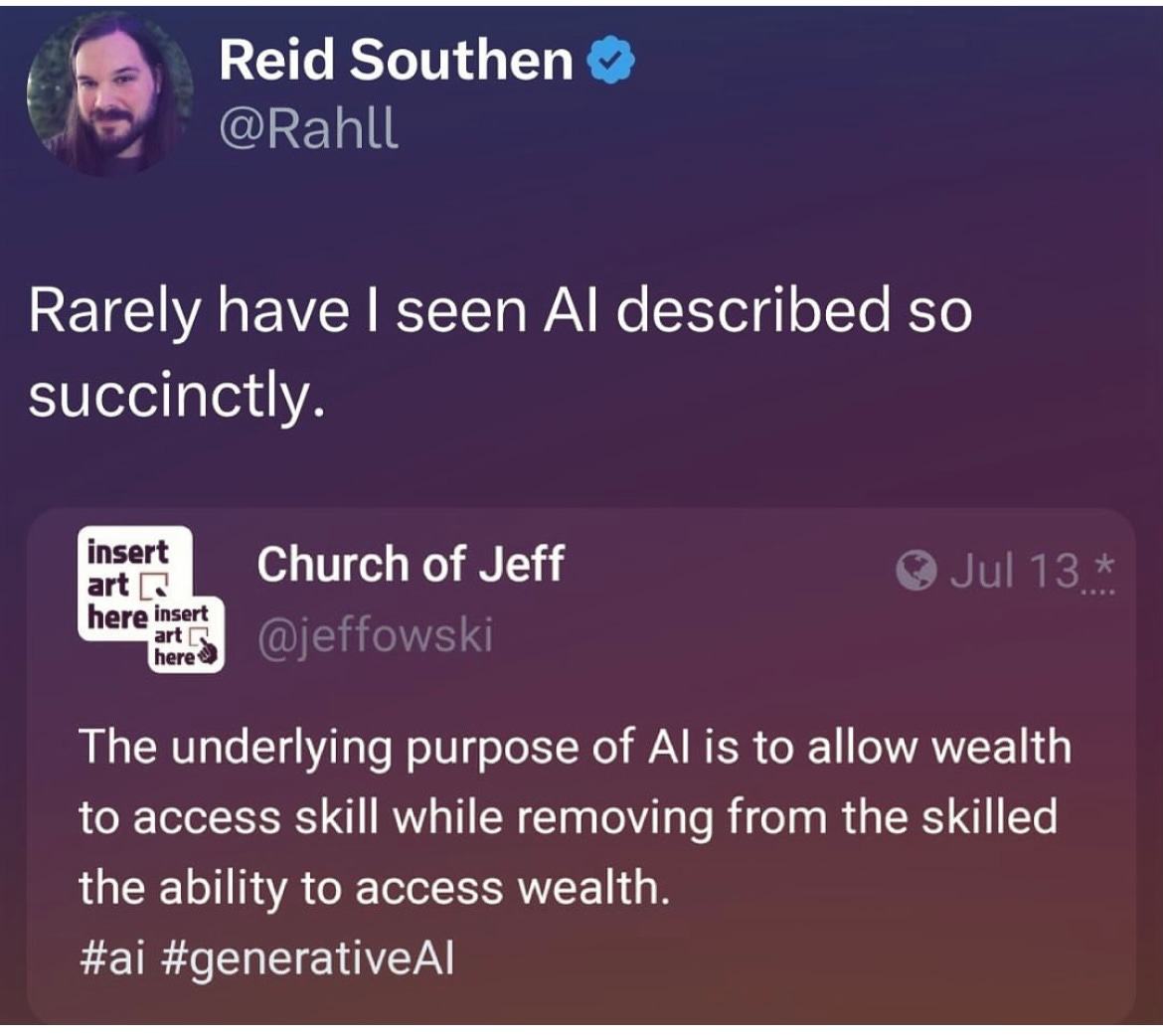
I was thinking too about AI, how the goal is to replace humans, to erase humanity, and that AI cannot tighten knobs. How are we to cope with the attempted erasure of culture, of women’s sovereignty, of black and brown people, of the earth itself, when this desire for annihilation is beyond lunacy? Why can’t we be? Being is hard enough. Knobs come loose. Why can’t we work together to solve real problems?

From the web.

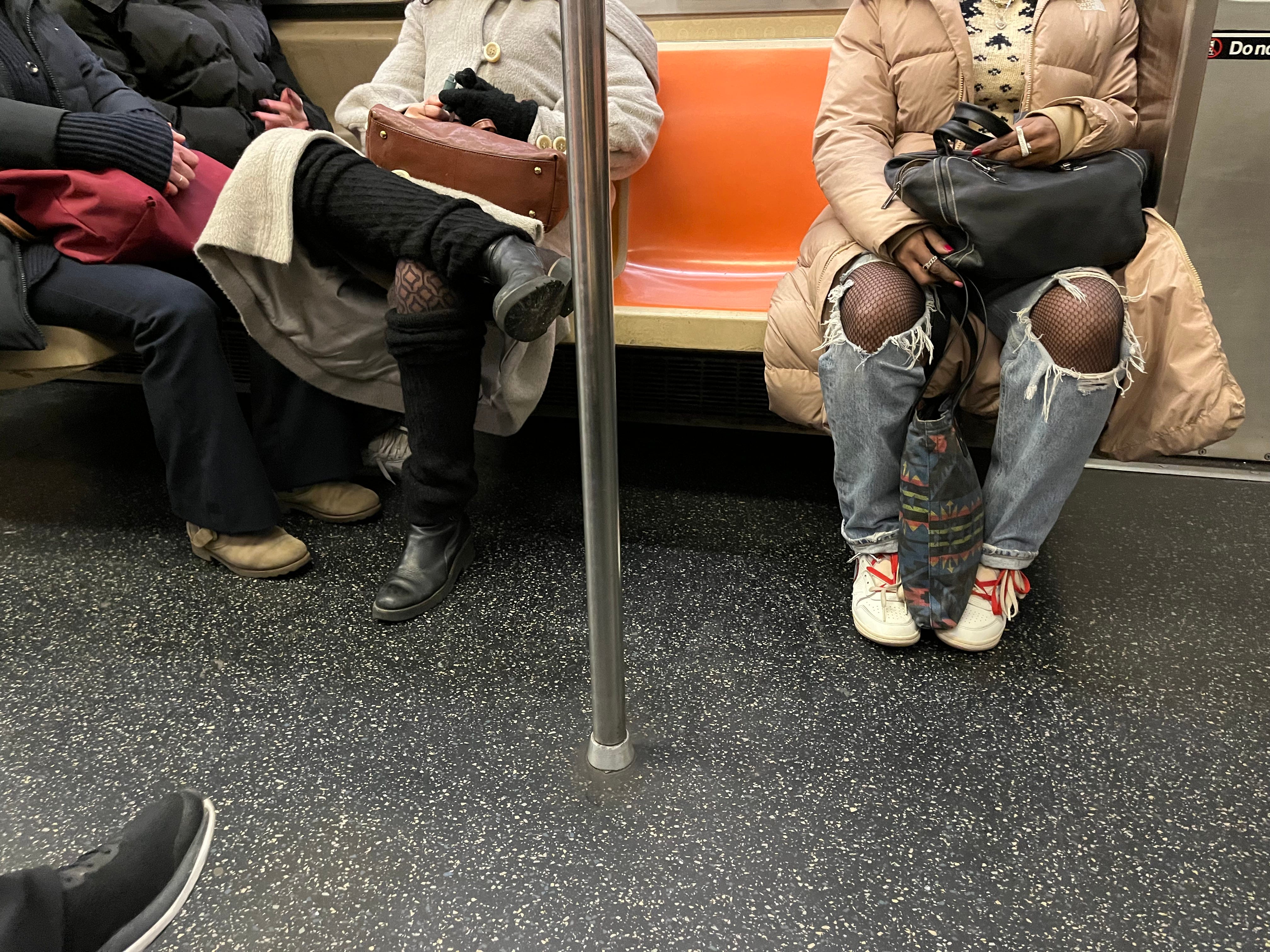
To cope with the whole mess, as I brace for some kind of war, I’m taking more and more pleasure in the very ordinary, like watching people on the subway.

A Study of Knees and Nylons. N Train to Queens. LO’H 2025

I know I can’t be alone in these chaotic feelings. How are you coping? In addition to doing chores, seeing art, and attending the occasional rally, I’m calling politicians and listening to Nina Simone. Followed by Yo-Yo Ma. You?

In the meantime, don’t be a stranger.

Sending love from whatever fresh hell this is,

Miss O’

A Work in Progress, Part 1

To my three readers–Hi, Anna!–I’ve been working on a play for a couple of years that I think would actually make a good TV series in these seriously troubled times. The title is up for grabs. Here’s part of Act 1.

Love, Lisa

WAVY DAVY’S PERPETUAL SOUP HOUSE KITCHEN

A PLAY by Lisa O’Hara

ACT I, SCENE 1

[AT RISE: Marv is typing at a laptop in a coffee shop. PHIL is sitting at the table sipping coffee and reading a book. They are in their 60s.]

MARV: I want to tell this story with unflinching honesty.

PHIL: “Unflinching honesty.” So, what is “flinching honesty”?

MARV: [beat] Why do you do this, Phil?

PHIL: [beat] Because I care about meaning, Marv. What is “unflinching” honesty if there’s no opposite? If you are honest, you are honest. Why do you qualify it like a Book World critic? Are you worried what they will think? There’s no they, Marv. Only the truth.

MARV: There you go, Phil. [picking up an old argument, not necessarily his] We all know there’s a They and you know who they are, but you don’t really, do you, and that’s the maddening part. No, it’s not them [pointing] though that would be convenient for your politics, right? And how can They be playing you and playing them, those others on the opposite side as you…

PHIL: …the flinching ones…

MARV: …all the while taking all the fucking money? It’s like the aliens we all know exist, and so how is it no one has ever spilled that secret? So that’s how They operate, and it’s so fucking pissing fucked up. [MUSIC, good blues rock]

PHIL: Who are you right now? [MARV smiles. So does PHIL.]

SCENE 2

[Projected: 1988]

JUNIE: [outside the scene, stirring a big pot of soup, tasting, adding spices] Marv pulled up to the curb of the Leave It to Beaver street in Annandale, Virginia, in his used Ford Grenada, a color of brown no car should come in, and I remember he put it in park though he was always unsure about turning off the engine because of the other times it cut out, or just didn’t go, like when we were on Rt. 123 with our friends Gary and Phil, Marv flooring the gas for uphill acceleration and didn’t nothin’ happen, and he was screaming…

MARV: [looking up from laptop] Here’s some advice, kids. If you have to buy a car, don’t buy a used car, and if you have to buy a used car, don’t buy a Ford, and if you have to buy a Ford, don’t by a Grenada, and if you have to buy a Grenada, don’t buy a brown one!

JUNIE: But on this day, a humid but decent early summer day perfumed by freshly mown grass, Marv was not terrified we’d get rundown by a semi. He was beaming, glowing, about to show his bride, his love, me, their, our, new house. [MARV beams] Yes, on this July day in 1988, at the age of 38, he, Marvin Allen Frischberg, had done the thing he’d sworn on his bell-bottom jeans and tie-dye tee shirt at the 1968 Democratic National Convention he’d never do: use his earnings from a steady job in American government

MARV: …all this, thanks to the fuckin’ man, of all things…

JUNIE: … to further suckle on the teat of American corporate capitalism by entering into a life phase of home ownership with a woman to whom he was wed. But there we were. And Marv was exhilarated.

[In shadow, a jubilant MAN gets out of a car; a WOMAN next to him stares out.]

JUNIE: Next to Marv in the used brown Ford Grenada was that very bride, aptly named June, Junie to everyone; together, what thirteen, fourteen years, married by our friend Kenny, dead of AIDS four years that August, who’d gotten a Universal Life certification out of the back of Rolling Stone to perform the ceremony, was it really nine years before, in the backyard of Gary’s “communal” house on Glebe Road…

MARV: [typing in cafe] …just a few miles outside the District. When Junie said, “Where are we?” I said, “Our house,” thinking total Graham Nash, and my Joni, my Junie, unclicked the barely operational seat belt, opened the passenger door, and…I shit you not, she began vomiting to the point of dry heaves…

JUNIE: And I was thinking, The Dry Heaves would be a great name for a band.

MARV: I was sure that Junie was really pregnant this time, and I was overcome with joy.

JUNIE: [lifting a ladle] Who wants soup?

SCENE 3

[Music. Projected:] 1973

[PHIL and MARV, aged 23 or so, are playing chess at the kitchen table in the Arlington, Virginia, kitchen on Glebe Road. It’s the first Watergate Summer. PHIL has just check-mated MARV again. GARY, also 23, who owns the house with his mother, enters from the kitchen with a bowl of soup and a stack of saltines.]

GARY: [setting down his bowl and crackers on a TV tray] You know who they are? I am they. I run the fucking world. I’ll prove it. [GARY uses the remote to turn off the Watergate hearings on television; he turns to flip on PHIL’s remote control stereo invention to turn on the radio, then flips it off. He then flips on another remote control to pull down the shade on the west-setting sun.]

PHIL: My inventions are useful.

GARY: I read all about this stuff! [GARY points to his stacks of Popular Mechanics magazines, his copies of National Review, his stack of articles from the Washington Star; possibly these are projected.] You think none of this matters, and that these bogus Senate hearings matter, okay, you’re wrong, but okay. You know what really runs all this? [gestures to room, to the world] Computers! Have you seen Phil’s computer room? Everything in the world will be run from those computers if we aren’t careful.

MARV: [lifting a pawn to move into position, first using it as a microphone] But who’s the man behind the computer? Who are you, Phil? What is your agenda?

PHIL: [into the “microphone” before Marv places it in position on the board; speaking now into his knight before positioning it] I’m nobody, frankly. I have no agenda. Just chaos for its own sake. That’s your they, Gary. And you can’t stop me, I mean them, I mean us. I’m two moves away from “check” for those playing at home. And so are the Watergate prosecutors. [Slams the knight onto the board. Marv quickly moves to capture the knight.]

GARY: Fuck you. [He turns on a tall, loud metal standing fan, directs it toward his chair, sits and eats.]

PHIL: [moving his queen] Language. Check.

[The phone rings, a ring in the living room and another ring from the kitchen, behind them. Note: All telephones of this period are black, heavy, rotary, and land lines. The kitchen phone is a wall unit.]

JUNIE: [from the kitchen; remains offstage until entrance] Hello?

[Beat, as Phil, listening, turns off the loud fan with another remote, Marv studies the board, and Gary stuffs crackers and soup.]

JUNIE: [gently, really asking] Davy, sweetie, are you high?

[PHIL laughs so hard he tips the whole board over. Marv moves to clean it up.]

CAROL ONE: [entering from hall wearing a mini dress and block heels and carrying a pocketbook, calls] Gary! Gary, I had to walk from the bus stop. Walk, Gary, again. God it’s hot. [Kicks off her shoes, throwing one at Gary; sees game.] Gee, I wonder who’s winning, Phil? Marv, why do you even try? Seriously, Gary, this is bullshit. Are you enjoying your late lunch?

GARY: [eats, hasn’t looked up] You. Said. Five. It’s three.

CAROL ONE: The firm closed early today, the bosses are taking a long weekend on the Eastern Shore.

GARY: And I would divine this how exactly? Why didn’t you call?

CAROL ONE: The line was busy all day. And I told you yesterday. Twice.

GARY: That motherfucking party line. I’m so sick of it.

JUNIE: Okay. Just a second. [calling out from kitchen] Can anyone drive me to the restaurant?

PHIL: I would but I won’t have time, sorry.

MARV: I would but no car. [ALL look at GARY, who doesn’t look up.]

JUNIE: Davy, no one is going to drive into the District now. I can try a bus. [beat] Okay, I’ll be ready.

[JUNIE enters. She is a Breck girl, an earth mother, Joni, and Janis, and Georgia O’Keeffe, depending on the lighting of the moment and who is looking.]

JUNIE: [going to the basement door] Darnell’s coming to get me in Davy’s car. Can someone get me later?

MARV: [gets up after placing chess pieces in a box, goes to Junie, presses into her and kisses her neck; she yields instantly] Come here for a minute. [They disappear into the basement, shutting the door.]

CAROL ONE: Give you any ideas, lover? [CAROL unbuttons her dress, straddles Gary in his chair. PHIL takes no notice as he checks his watch, finds his keys.]

GARY: Come off it, Carol! My mother will be home any minute.

PHIL: Okay, kids, time for my shift. Enjoy your Friday evening not having to write tomorrow’s top headlines.

GARY: For that rag that has it out for Nixon. What other lies are you going to print about him tonight?

PHIL: Gary, until you can admit you are bent, you will always be an angry little fascist.

GARY: Take it back.

PHIL: Which part?

GARY: Fuck you. Carol, let’s go. [Grabs her hand, heads upstairs. Carol squeals.]

[Screen door slamming is heard. GLADYS, a woman in her 50s, but with a full embrace of polyester, enters, carrying groceries, goes into the kitchen.]

GLADYS: Hi, Phil. Heading off? [PHIL kisses her cheek, jangles keys, and exits; GLADYS from kitchen.] What’s all this soup? It’s maybe a hundred degrees out there. Who’s watching the stove? Where is everyone? [Vague sounds of pounding, mattress springs, faint moans emerge from upstairs and basement; GLADYS, appearing oblivious, goes to living room and uses the remote to turn on radio full blast, and scene. The song is, perhaps, Charlie Rich “Behind Closed Doors” or Marvin Gaye “Let’s Get It On” or David Bowie “Space Oddity” or Barry White “I’m Gonna Love You Just a Little More, Baby” or another hit of the summer that you think fits the mood.]

SCENE 4

[The bustling kitchen of a restaurant, same late afternoon of 1973, a small black and white TV set with antennae shows Watergate hearings, end of day reportage, muffled sound. Two assistants, MARTIN and FRANKIE, watch as they chop vegetables, etc., and DAVY prepares to show JUNIE how to pull pin bones from fish. DAVY is a white man of 24 or so, in chef attire, a shorter Rock Hudson-meets-rock star whom his friends call “artistic.” DARNELL, a sweet, observant Black man, about 19, comes from the back carrying a white coat or apron, which he puts on.]

JUNIE: [standing amidst the chaos] Why am I here, sweetie? I don’t understand fine dining.

DAVY: [handing Junie an apron and guiding her to the sink] You are tonight’s pin bone wizard. Wash your hands. Mike’s out sick, and of all nights it’s a fish Friday, but here we are, and you are an artist, an angel with a needle, I need an artist. There are your tweezers, down there is the prepared fish—all you do is pull out the bones.

JUNIE: [putting on apron, walking over from the sink with dish cloth] Davy, sweetie, you do know that I push a needle in

DAVY: [takes dish cloth from her] But you also take the pins out, and hurry, dear one, hurry, dinner starts at 6 PM. Chop, chop. [Turns off television set, demands] Martin! Frankie! Those Jell-O salads won’t unmold themselves! [They follow Davy into the next room.]

JUNIE: [opens the cooler and screams] Holy mother of pearl, my poor fingers…

DARNELL: I can help you. [They begin removing bones.] Each filet has about ten. Or twenty. [DARNELL smiles. JUNIE is meticulous, like an artist, as DARNELL points, supervises. Beat. Beat.]

DAVY: [offstage] Faster, faster, faster!

[JUNIE pulls a final bone as DARNELL transfers that fish to a waiting cooler and then lifts a new fish onto the board for JUNIE to attack. DAVY enters. He looks around, and plants a kiss on DARNELL’s neck as DARNELL turns and gives DAVY his lips. JUNIE, laser focused and very quick now, doesn’t notice. They separate as MARTIN and FRANKIE push backwards through the swinging doors bearing trays of perfectly molded green Jell-O with cabbage and carrots. Scene.]

SCENE 5

Davy’s Soup Rules [Projected, with music, and VO possibly.]

  1. READ THE RULES BEFORE YOU FUCKING TOUCH THIS POT.
  2. I AM NOT FUCKING KIDDING.
  3. Keep stove burner on LOW!
  4. Use the stainless steel pot only!
  5. Water only!
  6. Fresh vegetables only!
  7. NO MEAT! NO FISH! NO POULTRY! NO!
  8. NO STARCH! That includes NO POTATOES, NO PEAS, NO BEANS. NO!
  9. Herbs and salt OK.
  10. Stir occasionally.
  11. Keep lid on when not stirring or serving.
  12. Serve soup atop whatever starch or fish or meat makes you horny for life.

Act I, Scene 6

[SCENE: Kitchen table on Glebe, 1974; linoleum and chrome and four matching chairs and three mismated ones. MARV, PHIL, GARY, and DAVY sit with various mugs and Tupperware glasses. PHIL with a national paper, reading, begins to snort out a chuckle.]

PHIL: [reading] “Spiro Agnew disbarred.”

DAVY: Was he now.

GARY: I think Agnew got a rotten deal.

PHIL: The Maryland appeals court called him, “morally obtuse.”

MARV: [a mock scolding] Language, Phil!

DAVY: But can a sitting elected official really be the subject of an indictment? Isn’t a president, or a vice president, the moral equivalent of a king?

MARV: The morally obtuse equivalent. Yes. [DAVY and PHIL chuckle.]

GARY: This nonsense is spiraling out of control. If they can come after Nixon, and Agnew, they can come after anyone…

PHIL: Maybe. If I made enough money to pay taxes, I’d pay them.

MARV: Except for the war taxes.

DAVY: Fuck the war taxes.

PHIL: Do you, Gary?

GARY: Do I what? [beat as others look at him] Any money I make is money I earn.

MARV: In cash, who’s to know?

[Junie interrupts waving an envelope.]

JUNIE: Hey, Gary.

GARY: Is that the rent?

PHIL: Your tax-free rent, oh Landlord.

DAVY: Do we Deep Throat him?

GARY: That’s your department.

DAVY: I’m here, I’m queer, but at least I pay my taxes. Mostly.

JUNIE: [observing; giggles] I… [stops her thought] … who wants soup?

DAVY: You what? You what? I saw that giggly gleam in your eye. You have the best face when you get an idea.

MARV: I feel art coming.

PHIL: [reaches to press MARV toward table, looks behind him] Art? Art who?

[Lights change, special light on JUNIE. VOICES fade out as music rises, e.g., “Eve of Destruction.” Collage art with painted photo or painting of the four friends around the kitchen table; gradually superimposed on each face are high school photos, ca. 1965. MARV, PHIL, GARY, and DAVY are fifteen years old.]

PHIL: [reading] The British Invasion is upon us.

DAVY: To say nothing of the Russians and the North Vietnamese.

GARY: You’re saying we shouldn’t fight the commies? The commies can go to hell.

MARV: [imitating GLADYS] Language!

PHIL: Now, boys, no politics at the table. [He gives a sieg heil, glances toward GARY while looking at MARV; locates a deck of cards.]

GARY: [looks under table] Mom?

DAVY: Beatles or Stones?

ALL: Beatles.

MARV: Acoustic Dylan or electric Dylan?

ALL: All the Dylans!

 [PHIL deals cards; Davy takes out a baggy of weed as Gary finds rolling papers, if possible, Dylan’s “Subterranean Homesick Blues” comes up, possibly a record put on by one of them.]

ALL: [singing as they pass a joint, play poker] “Look out kid
It’s somethin’ you did
God knows when
But you’re doin’ it again
You better duck down the alley way
Lookin’ for a new friend
The man in the coon-skin cap
By the big pen
Wants eleven dollar bills
You only got ten”

[Light shifts to JUNIE. VOICES fade out as music rises, Chubby Checker “The Twist,” lights change. Art montage superimposes school photos, ca. 1960. MARV, PHIL, GARY, and DAVY are ten years old.]

PHIL: [reading, carefully] “Richard Leaky…”

MARV: “Leaking?”

PHIL: [giggles, repeats] “Leaky… discovers our human ancestors in Africa.”

DAVY: [drawing his idea of one] And they are really, really old. [Shows picture to PHIL]

MARV: Not as old as dinosaurs. [Looks at Davy’s drawing.]

GARY: My dad says I am not a Negro.

MARV: What does that mean?

GARY: [shrugs] Dad says we are Americans and not Negroes from Africa.

PHIL: They don’t want you anyway, Gary. You can’t even twist. [twists]

MARV: [imitating his mother] Now, boys! That dance is immoral!

DAVY: How can anyone know where humans came from?

GARY: My dad says it’s aliens.

PHIL: So are we Americans or aliens?

DAVY: I think it could be aliens. I must be an alien. I just know it.

MARV: Where did the aliens come from?

[Light on JUNIE. Music changes. Tennessee Ernie Ford, “Ballad of Davy Crockett.” Montage: Collage art with photo or painting of the four friends around the kitchen table; gradually superimposed on each face is a first grade black and white photo ca. 1955. Lights change. MARV, PHIL, GARY, and DAVY are now six years old.]

PHIL: [looking at a comic book] My dad says they are cancelling Red Ryder.

DAVY: They are? How come?

GARY: My dad says Red Ryder got a rotten deal.

PHIL: My dad said Red got “damn boring.”

MARV: [imitating his mother] Language! [The boys giggle.]

GARY: This comic cancelling stuff is crazy! It’s not fair. It’s all gonna be like Batman, and I can’t stand Batman. Stupid capes!

DAVY: I only like comics where the men wear capes.

PHIL: You like the capes!

MARV: I think a man in a mask and a cape fighting crime is neato.

GARY: Matt Dillon wears a mask, but he doesn’t wear a cape, and Gunsmoke is still neat.

DAVY: You mean the Long [sic] Ranger wears a mask.

[Lights out on BOYS and up on table in 1974, the MEN playing cards, smoking, changing the lyrics to songs, perhaps. Lights separately on JUNIE gazing on finished work of a large, full collage of the eras of friendship. Song collage, closing perhaps with Joni Mitchell’s “The Circle Game”: “And the seasons they go round and round/ And the painted ponies go up and down/ We’re captive on a carousel of time…”]

DAVY: [entering with a bowl of munchies; to “My Boyfriend’s Back”] “My boyfriend’s black and there’s gonna be trouble, hey ma, hey ma, my boyfriend’s black…”

[CAROL ONE, enters with Lysol.]

CAROL ONE: You are terrible.

PHIL: [entering with a bong; to “Hey, Jude”] “Hey, doob, I want you bad,/ take my dad’s bong, and make it better…”

CAROL ONE: You think you are so cute.

GARY: [sees clock; grabbing bong and waving away smoke, takes Lysol from CAROL ONE.] My mom’s gonna be home soon, you guys.

MARV: [Three Dog Night’s “Mama Told Me Not to Come,” to GARY] “Mama told me not to come…” [MARV, PHIL, and DAVY join in, dancing, as music gains in volume.]

[JUNIE, smiling, holds her gaze on this scene as BLACKOUT.]

Act I, Scene 7

[Kitchen at Glebe Road, 1977. At table are two Vietnam vets, ROGER and MARK, both white men around age 30, in motorcycle gear. JUNIE ladles out soup into mismated mugs and brings them to the table where spoons and napkins are placed. GLADYS enters, smoking a cigarette, coughing, greeting the men.]

GLADYS: So how does Junie know you?

ROGER: Well, she was at one of our gatherings, to help veterans. Junie offered to do a poster for our meetings. And then we saw her at Safeway that time. Started talking.

GLADYS: You both live in Arlington?

MARK: Yes, ma’am. Appreciate the soup.

ROGER: Well, Mark’s closer to D.C. than I am. You know, a lot of people spit on the veterans.

GLADYS: Well, not Junie, she lost a brother, you know.

MARK: That’s what we hear.

GLADYS: That was 1966, ’67, wasn’t it? I mean, no sooner shipped over, wasn’t it?

[Lights up on area, living room, somewhere in Arlington, Virginia, ca. 1965, TIM MACNEIL in uniform, his father COL. DONALD MACNEIL in khakis, and his mother VIVIAN MACNEIL pose for a photograph. His sister JUNE, aged 17, takes the photo. After the flash goes off, VIVIAN begins weeping; TIM comforts her. COL. MACNEIL pats his son’s shoulder, picks up his kit; TIM hugs JUNE, goes with his father. VIVIAN pours a drink.]

MARK: So during Rolling Thunder, huh.

JUNIE: 1967. Yeah. [She pauses, only continues as others look to her for more information.] Tim enlisted as soon as war was declared. [Adding, unusually] Our dad was career Army.

ROGER: How old?

JUNIE: Eighteen, almost nineteen.

MARK: How old were you?

JUNIE: Seventeen.

GLADYS: Irish twins.

JUNIE: [picking up a loaf] Bread?

[MARV enters with satchel.]

MARV: Hello.

GLADYS: We have company. Marvin, meet Roger and Mark.

JUNIE: Soup?

MARV: Oh, right, the guys from the meeting. How ya doin’?

GLADYS: [to MARV] You know, it’s odd, isn’t it, that none of you boys served. [To MARK and ROGER, who pause in their eating.]

MARV: We didn’t. [Taking soup from JUNIE, to MARK and ROGER] I know I said this the other week, but I protested against the war. Our friend Phil was 4F for his flat feet. Davy was queer, but they wouldn’t believe him, so he went to school and was an art teacher for a while. I went to college and taught math—my parents came over during the Holocaust, and my mom would’ve gone nuts if I’d gone off to fight, but even still….

ROGER: What’s the Holocaust?

MARV: [patiently, instructively] Hitler’s genocide of Jews. Mostly Jews, but also homosexuals, resistance fighters…obviously not as known as it should be. Something like six million Jews were killed.

MARK: So you’re a Jew? [MARV looks up.] It’s cool. I don’t think I’ve, you know, ever talked to one before. That I knew of.

[PHIL enters, followed by GARY, in mid-discussion.]

GARY: So you’re saying that you actually think Carter has any fucking shot at all of getting peace in the…

PHIL: Oh, hello.

GLADYS: Gary, language, not in front of company. [PHIL and MARV grin without looking at each other.]

Copyright Lisa L. O’Hara 2023-2025. All rights reserved.

Summer Stock in a Heat Wave

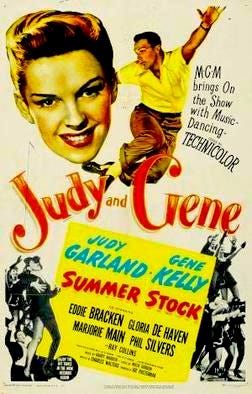
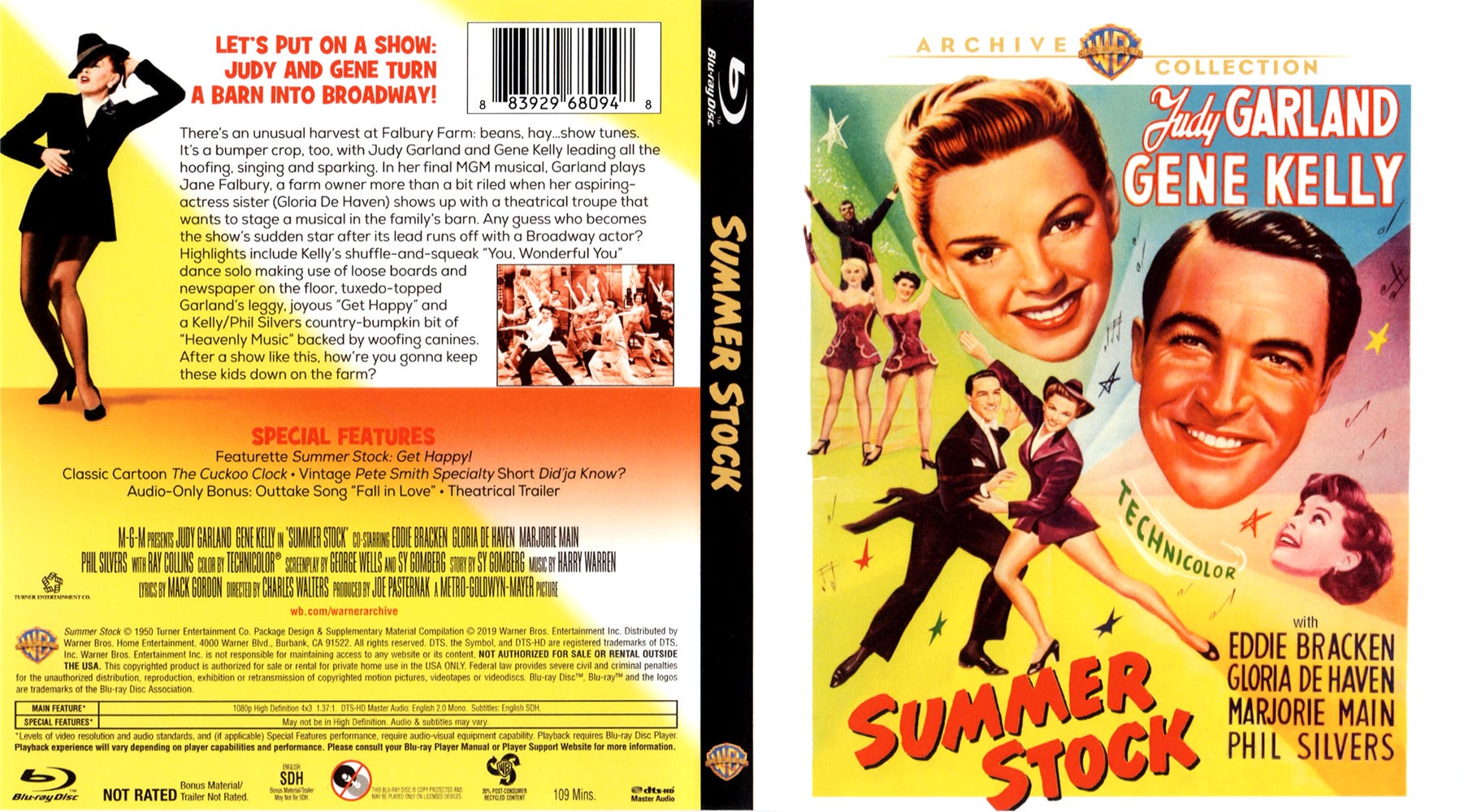
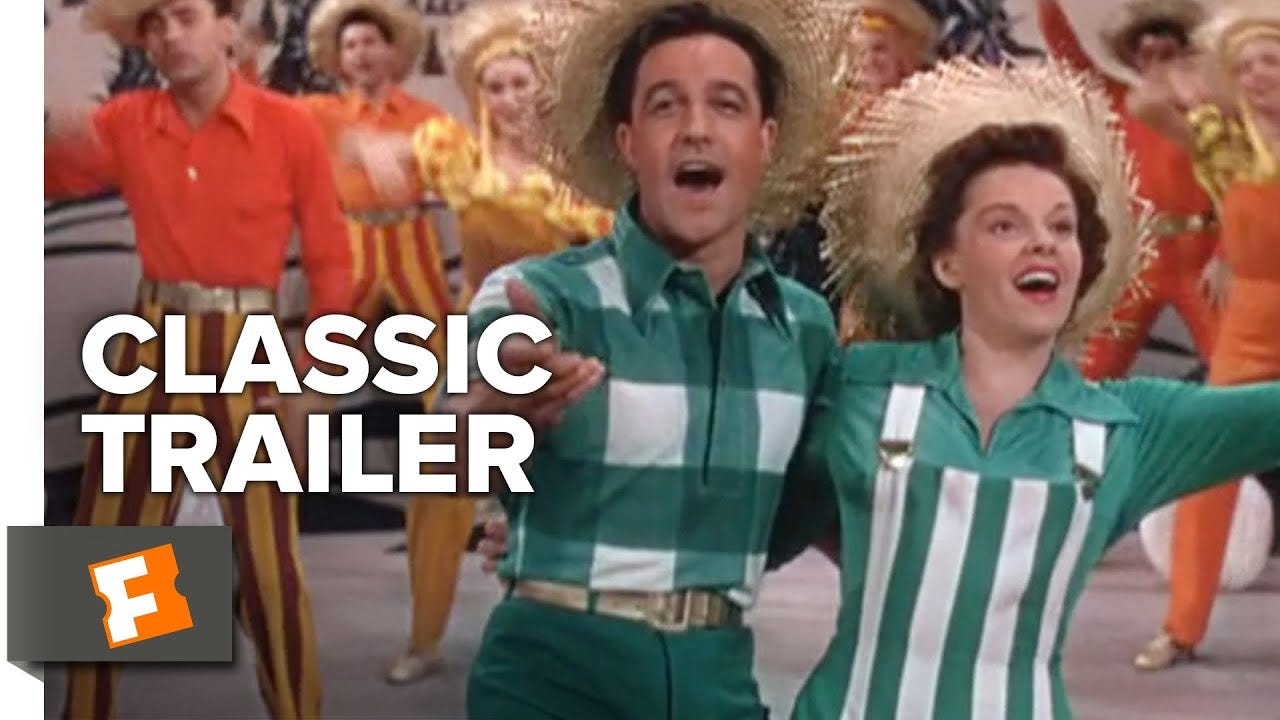
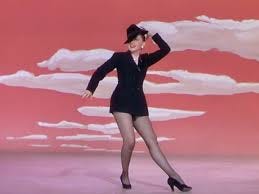
First of all, I have come to love this movie. Second of all, whenever Summer Stock, an MGM musical from 1950, appears on TCM the host always notes that 1) it’s Judy Garland’s last MGM musical; 2) this is one of the lesser MGM musicals; 3) Gene Kelly signed on in a less prominent role as a favor to his friend Judy who gave him his start; 4) Judy was obese at the time of filming; and 5) Judy’s iconic “Get Happy” number was filmed after production closed, and she’d “slimmed down.” It really sets you up to watch the film with a “pity” and “I guess I have nothing better to do” mindset, right? The movie deserves so much more of an intro boost, and maybe someday Miss O’ will be famous enough to be a guest who can explain all this to Ben Mankiewicz; in the meantime, I’ll introduce it to you.

Get Happy

When I was a kid in the 1970s, I fell in love with movie musicals that showed up on TV on the weekends, usually on syndicated channels, and spent hours and hours memorizing them. This was a confusing exercise. Interrupted as they were with commercials every three to five minutes, the movie plots were pretty much impossible to follow. For example, the opening song of Summer Stock, “If You Feel Like Singing, Sing,” follows the camera over “Falbury Farm” to Judy in her room to singing in the shower to putting on her farm clothes, and as she makes her bed, she learns from her housekeeper Marjorie Main that “Frank and Zeb” are “dressed in their Sunday clothes,” and…cue commercial for Ginsu knives. The next scene was probably Judy going to the kitchen, saying, “I don’t blame them,” and you think, “Huh?” Years later, watching the film uncut on TCM you realize that the network cut out the scene where Frank and Zeb quit their jobs, and how unsuccessful the farm has been, in order to make room for more commercials while my child head spun.

Another plot point that made the movie impossible for a kid to follow on syndicated Sundays is that Judy’s character, Jane Falbury, changes her mind solidly three times about allowing the show to continue in her barn. It’s totally reasonable that she does this, unless between mind changes a network cuts dialogue to insert commercials for Koons Ford used trucks, Ding Dongs, and Aqua Net.

As a result, Summer Stock was lost on me on my first viewing, whereas musicals like The Wizard of Oz, Anchors Aweigh, and Singin’ in the Rain, though no more complicated in their plots, had more understandable and entertaining musical numbers for a kid like me.

What led to me write about this little musical gem (because it is) has to do with summer boredom during a heatwave her in New York City. Right now my job is really slow, and I’m not ungrateful for that, but it’s hard to concentrate on anything with little in the way of deadlines attached while still being tethered to my laptop. To give myself some company, I look for movies to run on a loop when I can’t find procedurals like Law and Order in reruns, and Summer Stock came up On Demand. Over a dozen viewings later, I have this mature, wonderfully acted movie memorized, and more than that, I watched it with different lenses trained on it that might be interesting to, I don’t know, someone. Here we go.

Judy Garland’s Body

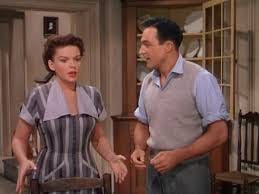
Here are a couple of photo stills from the film to help you understand how fat Judy was during filming:

If, like me, you are squinting to see a woman whose body is listing toward morbid obesity, welcome to seeing a normal woman like a normal person. Since The Wizard of Oz, during the filming of which MGM Studios put their young star on a diet of amphetamines, it’s the first movie where Judy’s body is what I’d call womanly. Healthy, even. In her many films, from The Harvey Girls to Meet Me in St. Louis, from The Pirate to Easter Parade to The Good Old Summertime, I see a Judy who is thin, and it’s a little unnerving how thin when you see her body is also covered in layers of period garb. In fact, not really since For Me and My Gal, her first picture playing an “adult” woman character (opposite Gene Kelly, whom she’d seen on Broadway in Pal Joey and championed to be her leading man in that film, thus starting his career), could I recall seeing Judy Garland in modern dress. Summer Stock is also the first movie in years with Judy in short hair—a hint of the hair she will style in more elegant ways in the 1960s. In Summer Stock, the body type works since Judy plays a farmer and a sort of old maid, and after filming completed and her contract was up, Judy’s career came to standstill, morbidly obese by studio standards and washed up at age 27.

The MGM Circle Game

Judy started out her career proper has Andy Hardy’s love interest in the Mickey Rooney franchise of movies in the 1930s, most famously Babes in Arms, where the kids entered the realm of movie legend when they found a barn and put on a spectacular show despite the town’s disapproval and the doubt of their families. I don’t know if it was deliberate that Judy Garland ended her MGM career on a farm set, hearkening back to where she found stardom in The Wizard of Oz, and inside a plot with a “let’s get ourselves a barn and put on a show” where she got her start, but it’s really kinda nice.

In Summer Stock, Judy Garland is no longer a sidekick ingenue in search of a show, or a waif who dreams of a world beyond the rainbow over Kansas. This Judy plays Jane Falbury, and she owns the farm (in a small community in what appears to be Upstate New York or Connecticut). Early on, we learn that the farm has been unsuccessful, Jane is engaged to Orville (son of the farm supply store owner Mr. Wingait), and her younger sister Abigail is due back from New York City that afternoon. And what do you know, Abigail surprises her sister with Joe Ross (Gene Kelly), the director of a new Broadway show looking for an out-of-town place to play, along with all his cast, crew, and sets. In the process of figuring out whether the show folk will get to make this happen, Jane’s housekeeper Ess (Marjorie Main) reveals that Jane and Abigail had dance lessons all their young lives, and Gene sees Judy do a little dance in the kitchen. Fireworks ensue!

Why Watch It?

Sure, there’s a predictable plot, tempers flare, people burst into song, love ensues, and a star is born, but the emotional world of this musical is more mature than in other movies, a maturity that resonates with the Miss O’ who still loves musicals a grown-up. This movie opens to reveal a woman who is comfortable in her body, who loves to sing and sings great, who without question runs a farm, and who genuinely loves her life. She is independent in the important ways and wants no rescue, no change. But you get the feeling that despite her four-year engagement to childhood friend Eddie Bracken, Judy/Jane has never known love. Orphaned young at some point, her entire life has been devoted to raising her sister and keeping the farm going. She doesn’t resent it. And she doesn’t realize that she’s been missing a thing until that devilish smile in the form of Gene Kelly arrives to shake her up. Gene and Judy are emotional equals. They spar, they compromise, they fall in love, sure.

But what strikes me most in this movie is that leading man Gene Kelly is a supporting player. The film is totally Judy’s. And the result is an uncharacteristically light and lovely Gene Kelly. Not that he isn’t wonderful in his films. But here he is not wildly aggressive or ego-driven, he has nothing to prove, and he doesn’t have to carry the picture. He’s not a ham. The dances are staged by Nick Castle, though Gene probably choreographed his solo routines, so he’s not carrying that load, either. His role as the show’s director Joe Ross is totally believable, and Gene plays his rages and fibs and falling in love with a master’s touch of humanity. He’s totally equal to Judy on screen, but it’s Judy’s movie, and his performance is the better for it. I think it’s one of his best.

In addition, it seems to me that however “lesser” this musical is in the canon, this is an important film in Gene Kelly’s development as a choreographer. In some of the dance numbers you can see the seeds of even more iconic numbers to come. For example, the staging of “You Wonderful You” with Judy presages “Our Love Is Here to Stay” with Leslie Caron in An American in Paris (1951) and “You Were Meant for Me” with Debbie Reynolds in Singin’ in the Rain (1952). Other dances in the film show classic Kelly moves he will use even more imaginatively in those later films, like the matador move, the airplane move. It’s fun when you realize this because of the order the movies come in. And you are a total movie musical nerd recalling these notes from memory.

Judy’s range as Jane is something she usually doesn’t get to display in other films—fully human, grown up, shifting from joy to concern to rage to apology to thoughtfulness to bargaining, with ease. And what makes Judy such a superb actress is that she is fully present in every scene, with every actor, no matter the roll. Her emotions are both raw and in control, and as a woman in late middle age, I connected with this character as I don’t generally get to do in musicals. Twelve-year-old me would never have enjoyed the vulnerable and tender moments between Judy and Gene, especially in “You Wonderful You” and “Friendly Star.”

The supporting cast is a Who’s Who of some of the finest character actors ever on screen: Ray Collins, Eddie Bracken, Phil Silvers, Marjorie Main, and Hans Conreid, as well as up-and-comers Gloria De Haven and Carleton Carpenter, and an ensemble of wonderful dancers. (One of those key dancers is Jeanne Coyne, married then to Stanley Donen (who will go on to co-direct Singin’ in the Rain with Kelly two years later), who was one of Gene Kelly’s dance assistants. Both people divorced by the late 1950s, Kelly and Coyne married in 1960. I think that’s sweet.)

Still, there are curious things in the filming that make me realize Summer Stock was not a top priority in the MGM perfection department. Charles Walters’s fine direction notwithstanding, there are couple of clumsy edits, unusually sloppy for MGM, both featuring Judy. In addition, as I mentioned, “Get Happy” was added in a re-edit of the film post-production, and great as that number is—possibly her best on screen—it doesn’t quite jibe with the rest of the proceedings. Also, after several viewings I finally paid attention to the final credits, where a noticed an actress named Nita Bieber “as Sarah Higgins.” And I’m like, who? So I deduced in subsequent viewings that this was the dancer who wears glasses and is always reading and has one featured dance moment; and I inferred there was probably a story for her that ended up on the cutting room floor, surely for the best. Her screen card may have remained for contractual reasons, or possibly out of laziness.

And when critics all point out that Garland is “obviously” thinner in the added number (and I noticed that the scenic background at least is in an earlier part of the film), I have to say I don’t see it. “Get Happy” is the only number where we see Judy’s legs, and on a 4’11” frame even five pounds would be a lot, as if it matters. And throughout the film, Judy dances like a dream, and dances a lot, and is clearly in great physical shape. I don’t know why critics feel compelled to talk about her weight. I really hate that. Judy Garland is simply great.

You might think Judy deserved a better or more glamorous movie send-off as her contract expired. The studio, which her talent literally helped make great, got her hooked on pills and then got mad when their work horse wasn’t able to perform and had no-show days on films such as The Barkleys of Broadway, where she was replaced by Ginger Rogers (in her last appearance, and only one in color, with Fred Astaire), and Annie Get Your Gun, where she was replaced by Betty Hutton. (Hutton told TCM host Robert Osborne that the crew of that film resented her terribly for taking Judy’s part, which is unfair, of course; by all accounts I’ve read, the crew at MGM loved Judy Garland.)

But I’d like to say that I think this lovely, mature, sweet, goofy musical treat, a kind of retrospective of all the films of Judy’s great MGM career, is a perfect movie for the middle aged, for the summer. If you need something to take your mind off the unutterable evils swirling nonstop around us, you might try the pretty, tender, talented world of Summer Stock (commercial-free on TCM). In the meantime, you might take a look at the duet arrangement Judy made of her iconic “Get Happy” with Barbra Streisand’s “Happy Days Are Here Again.” The number that keeps on giving.

Love to all.

Jazz Age

“I’m just going to read one of the things you said. You were talking about the evolution of science and then of physics in particular: ‘The deeper revelation’ of physics in our time — and it has just kept going in that way that was evolving right at the end of the 20th century — ‘The deeper revelation is one of undivided wholeness, in which the observer is not separable from what is observed. Or, in Heisenberg’s words, ‘‘The common division of the world into subject and object, inner world and outer world, body and soul is no longer adequate.”’ And then you said, ‘Is this physics or theology, science or religion? At the very least, it is poetry.’”

Krista Tippett, quoting her guest Barbara Brown Taylor, On Being, April 2, 2023

I haven’t written in a while. Right now, I’m busy cleaning my apartment in preparation for good company and being a sweat factory during the hottest days in the recorded history of the planet, and I’m finding it hard to get really excited about anything, and I don’t mean this meanly. I mean, we’re in the middle of the Sixth Mass Extinction, so if you, who are no doubt going about your business, have ever wondered whether or not people noticed the Roman Empire fall, we now know that the answer is, “Not really.”

View down W. 53rd Street during AQI 400 day in NYC. Photo by LO’H.

As a result of this hyper awareness of planetary death, this morning I had this sudden vision of Rep. Jim Jordan (R-OH)—the disrespectful wearer of shirt sleeves and insolent spewer of nonsense and censurer of Rep. Adam Schiff (D-CA)—standing waste deep in a raging flood, screaming above the din, “Hunter Biden!” followed by “Abortion!” followed by “No gays!” followed by “What abuse?” just as the waters reach his chin; he is circled by small rafts of the last of the eager reporters, holding out their recording iPhones to catch his every word as the last iceberg melts completely as they are all dragged under, disappearing into the muddy current.

What in the actual hell is the matter with these people?

To open up my heart to hope, I wash my kitchen floor and outer cabinets, sink, fridge, stove, reminding myself to be oh so grateful for the relative ease of my life, remembering how hard I try not to turn on my air conditioning to try to offer this to the planet. As I stream rivulets down my face and body through this work-as-prayer, I listen to episodes of On Being with Krista Tippett and learn something.

We all need a go-to for grounding. It’s philosophy and theatre that center me. My theatre this week was seeing the ballet Giselle performed by American Ballet Theater (ABT) at the Metropolitan Opera House at Lincoln Center. Too beautiful, and ballet is not the usual thing for me to see. I keep trying to expand my culture, so thanks to my friend Tom Miller for asking me to go. As for philosophy, On Being guests Barbara Brown Taylor and Ruth Wilson Gilmore were my philosopher activist humans for learning.

Other Ways of Seeing

Years ago, back in 2016, in the before times, I eagerly sought a documentary about one of my favorite writer-artist-critic-philosophers, John Berger, famous for this book and TV series Ways of Seeing. The film, made in part by and featuring Berger’s friend Tilda Swinton, was called The Seasons in Quincy. It was sort of not that good, as I recall, but surely made with love if not skill. (There is one sequence in particular that caused the audience at Film Forum in New York, where I saw it, to break into cascading “harumphs” and derisive chortles: Swinton, cutting and peeling apples for a pie, seems to be having a fluid conversation with Berger in his farmhouse kitchen in France, but each quick cut back to Swinton shows apples going from peeled to unpeeled, the bowl of slices one moment full, the next empty, then half full; continuity ain’t no joke to serious urban filmgoers.) Berger died shortly after it came out, aged 90, so it was good to have a love letter compendium of his greatest contributions to culture, and I’m not sorry I saw it. Possibly, too, were I watch it again, I would be less critical for that reason.

Sidebar about Tilda Swinton: her performance in Sally Potter’s Orlando is just a marvel. One of my favorite of Virginia Woolf’s novels, my gateway drug in fact, this is a singularly fascinating adaptation of Orlando (1928!). Gender is jazz now.

From the exhibition at the New York Public Library of Woolf items. Photo by LO’H

One moment in the documentary The Seasons in Quincy that stands out for me: Berger on music. The scene is odd, a contrived gathering of current, younger philosophers gathered seemingly to pay tribute to the old man (not that Berger sees it that way), Berger says that he sees salvation of the future happening through a surprising thing: “Maybe we live in a time when the truth is most easily told in song.” The others look at him, at each other (is it fair to say, with pity?), without assent, as I remember it. Well, their silence seems to say, the old man has finally lost it, still living in the ’60s.

I took from Berger’s comment something else, whatever he intended, which is that in song we find our truths, our joys and sorrows, and our collective experience most fully expressed and shared across generations and backgrounds—not that truth is easy, but that in genres from jazz to hip hop to rock, from protest ballads to power love ballads the truth of being human is most understandably told, making connection most universally possible, which is not to say most useful if changing the status quo legislatively is the aim of art. Sometimes you just need to dance it out.

I was reading and listening to blogs by Patti Smith on Substack, on poet musicians like Lou Reed—the innovator jazz artists like Coltrane, Pollack—all the theatrical forms, the rehearsed forms, forms she took part in with great collaborators. Smith—can I call her Patti?—is another philosopher artist who is helping me transition, I hope more gracefully than I might have, into old age.

Feeling the Rhythm

Look at our world now, our Earth—seasons are jazz—there’s a form we used to know, an expectation, an order, but depending on the results of the latest continued human interference, the changing weather patterns, daffodils can bloom in February. You know. The poems are changing, the dance, the music. Or they should.

The 20th Century was dedicated to the annihilation of man; the 21st Century to replacement of humans as a species. Might be good for the plants and animals.

The trouble with zoos.

And blogs.

And I wish I was a poet so I could stop writing long sentences about all this shit.

So much death and dying. Yet life, too. Promises of joy. The sweet Cochranes are coming from Scotland to stay for a couple of weeks. My friend Colleen wrote a play called Dickens Packs Her Bags, and I’m participating in the reading.

Jazz is life.

Why can’t I concentrate to read a book? (I did finish Harvey Fierstein’s memoir, I Was Better Last Night, and I’m rereading it. His life is inspiring art jazz.)

I can’t quite listen to The Velvet Underground this week for some reason, so I’m back to my Apple Music “Lisa O’s Ecclective Faves” Playlist. It’s pretty great.

Maybe I’ll reread Orlando. Right now, I’ll listen to Bruce.

I was tryin’ to find my way home
But all I heard was a drone
Bouncing off a satellite
Crushin’ the last lone American night
This is radio nowhere, is there anybody alive out there?
I was spinnin’ ’round a dead dial
Just another lost number in a file
Dancin’ down a dark hole
Just searchin’ for a world with some soul
This is radio nowhere, is there anybody alive out there?
Is there anybody alive out there?
I just want to hear some rhythm
I want a thousand guitars
I want pounding drums
I want a million different voices speaking in tongues
This is radio nowhere, is there anybody alive out there?
Is there anybody alive out there?
I was driving through the misty rain
Yeah searchin’ for a mystery train
Boppin’ through the wild blue
Tryin’ to make a connection with you
This is radio nowhere, is there anybody alive out there?
Is there anybody alive out there?
I just want to feel some rhythm
I just want to feel your rhythm

~ Bruce Springsteen, “Radio Nowhere,” from Magic

Here’s to whatever is giving you joy, purpose, meaning, love.