Last night I dreamed I came out of the room where I sleep when I’m at my parents’ house, but it was my bed here in Queens, and my very aged, dead mother sat before a bright computer screen at the living room desk in the dark, her alert face blue-lit and her thin hands wildly flying over the keyboard, flying up and over the keys, eyes focused but expressionless. She was wearing a version of her blue pajamas. “Mom?” I needed to tell her she was dead, she didn’t need to do this, and I pulled myself awake. It was disturbing, seeing that tiny body, so pale and shriveled, working on a computer, which she never did, and so frantically.
I have dreams like that quite a bit since my mom died, unnerving dreams at times. And it’s easy to feel confused then, and afraid.
This evening on YouTube I caught NPR legend Terri Gross on Colbert talking about her husband’s death and a dream she had about him, in which she turned to him to remind him he was dead, and he vanished. Stephen then told Terri about a dream he had after his mom died, where he told her a similar thing, “Mom, why are you here?” and that she was dead; she also vanished. Stephen’s mother’s dream words before she vanished were, “Oh good. It’s the only way you’ll stay awake.” Terri asked what he thought that meant, and she suggested that his mother’s words meant what her husband’s presence meant in her own dream: you need to live life. By that I gather, when you admit the death, when you face that loss, you can awaken to your own life again. It was a wonderfully tender, adult conversation between two artists, two humans, one I hope everyone, somehow, can see during this horrible week. I needed it.
During their exchange, I found myself teary, and the dream I had last night came back to me. What was my mom telling me? I think my mother was telling me to write my life. Lynne had no interest in my acting, my teaching, or my writing. “That’s your thing,” she’d say. But here she was in death telling me, maybe, or showing me, that I need to keep writing, and even writing about her. Maybe it’s a better dream than first appeared, maybe. Nothing to be afraid of, and in fact quite the opposite.
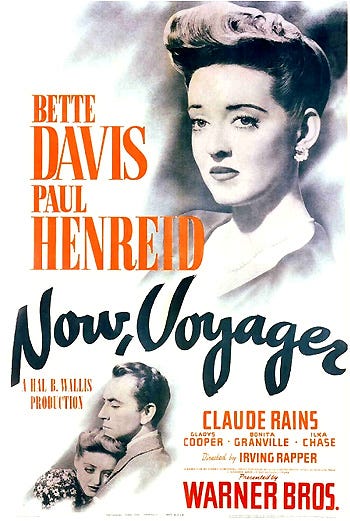
As I do when it’s on demand on TCM, I watched Now, Voyager with Bette Davis and Paul Henreid for the many, manyeth time, and the feelings I have about it change over viewings and years, but whatever qualms or critiques, I can’t help loving Charlotte’s journey as Camille. Unconventionally, Charlotte Vale finds a purpose for her life, waking out of years of emotional abuse to become her own woman. Her most important moment of self-discovery comes during a renewed fight with her mother, when Charlotte is able to say honestly, “You see, Mother, I’m not afraid.” In addition to Max Steiner’s score, her guide out of the sanitarium and into the world was that Whitman quotation, presented to her by Dr. Jaquith. She can sail forth to seek and find; she can do anything she wants now. She can become. “I’m not afraid.”
When I saw the new footage today of Renee Good in her car via the “body cam” or phone of Jonathan Ross, the ICE “agent” who shot Ms. Good in cold blood in the face at least three times through her windshield as she left the scene, something became plain to me: that Renee Good, who by all accounts, including her wife’s, was nothing if not kind, “pure sunshine”—that the only thing Good did wrong was be true to her name and her Christian faith.
She was not afraid.
She said kindly to the officer, “It’s okay, I’m not mad at you.” And Ross opened fire. “Fuckin’ bitch!” he screamed.
I saw an interview with a pastor who was arrested by ICE and was asked over and over again, “Are you afraid?” “Are you afraid now?” And that (true) follower of Jesus said simply, “I’m not afraid,” and you could tell it was driving the ICE thugs to murderous rage. To what end? What do they think this rage at good people gives them?
I look at all the people posting, all the people protesting, all the people still out in their neighborhoods. We aren’t afraid. We are grieving, we are traumatized, we are experiencing all this horror together, we’ve all known loss, been visited by death in dreams, and we aren’t afraid. You know why? Because, whatever our faith or origin, we know who we are. And we are learning more all the time. We seek, we find, and it’s interesting to note that the Bible quotation as we know it doesn’t stop there. Let me close out with a little Gnostic Gospel of Thomas who said, “Seek and you shall find. When you find, you will become troubled. When you are troubled, you will be astonished, and rule over all things.” I’m not a Christian; I study all the faiths, and that feels universal to me.
I hope you have the dreams you need tonight.
Sending love,
Miss O’
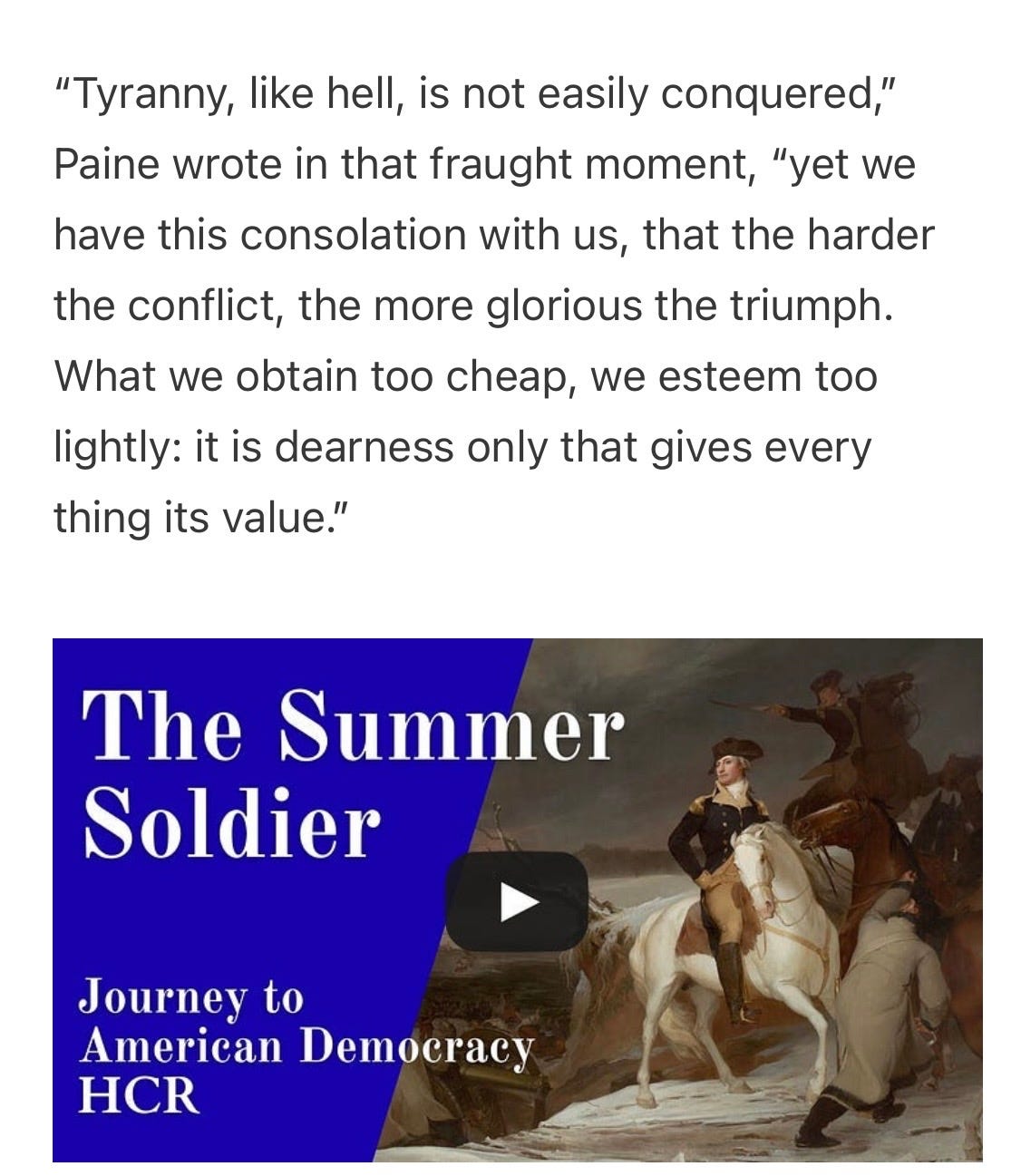
P.S. A few words from Thomas Paine, whose pamphlet Common Sense was published in January of 1776. This later reminder from Paine, when the rebellion seemed its most hopeless, “These are the times that try men’s souls,” via Heather Cox Richardson:
Back when I was a high school English teacher, and a kid would say the craziest thing, I used to joke, “Someday, when I do my one-woman show, The Miss O’ Show, I will share this moment.” When blogs became a thing, I came late to the game on Blogger in 2011 with The Miss O’ Show, where I used the space mostly to write about teaching and creating curriculum, but it veered into political lectures and observations. I lost my way, and I stopped. Around that time, I found WordPress, and thought I’d start fresh with The Miss O’ Show (Teacher Edition). When I lost my way there, too (because what was I teaching?), I moved over to Substack (duplicating posts) with The Miss O’ Show: Reading Glasses. I’m still not sure what is what or what for. This morning when I searched “The Miss O’ Show,” the first thing that came up was a skin care guru named Olivia, no apostrophe, whose videos are called The Miss O Show. Well, darn.
It seems it’s time to give up my handle, but since I own the domain name missoshow for those blogs on Blogger, WordPress, and Substack, I may as well keep them, understanding that with AI, what we know as writing (like reading in the age of audio books) may be destined to become old school, not unlike the shift from cave paintings to papyrus, from scrolls to bound books. Only this time, humans have created artificially intelligent communication and search technology that requires the sacrifice of all our potable water to cool the engines, causing humanity (and indeed life itself) to die off possibly as early as 2027. (When asked about this in an interview, fascist and Palantir Technologies founder Peter Thiel merely mumbled something to the effect of, “So?” God we’re dumb.)
Nature will out, and it’s reassuring. Queens.
Looking at our increasing human lust for self-immolation, tied now inextricably to the way Thiel’s tech eats all our words online in order to cause the end of earth through endless iterations of regurgitation, not unlike the end of Mr. Creosote in Monty Python’s The Meaning of Life, the act of writing feels increasingly weird. On my way to Joe’s Pub in the East Village the other evening, I went into the Strand Bookstore on Broadway, as one does, and was overwhelmed as usual by all the volumes I’ll never read, classic and contemporary, on every subject you can imagine, enveloped wall to wall by self-referential merch. What are humans even doing? We’ve never known so much, and absorbed less; or should I say, lived less? Or should I just shut up? Should all of us?
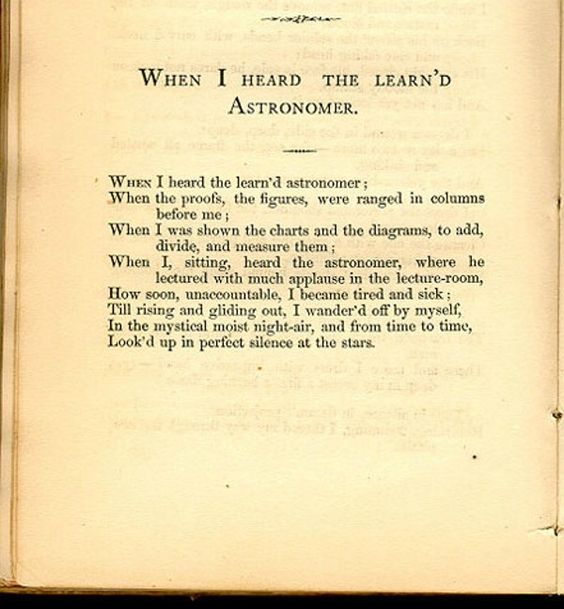
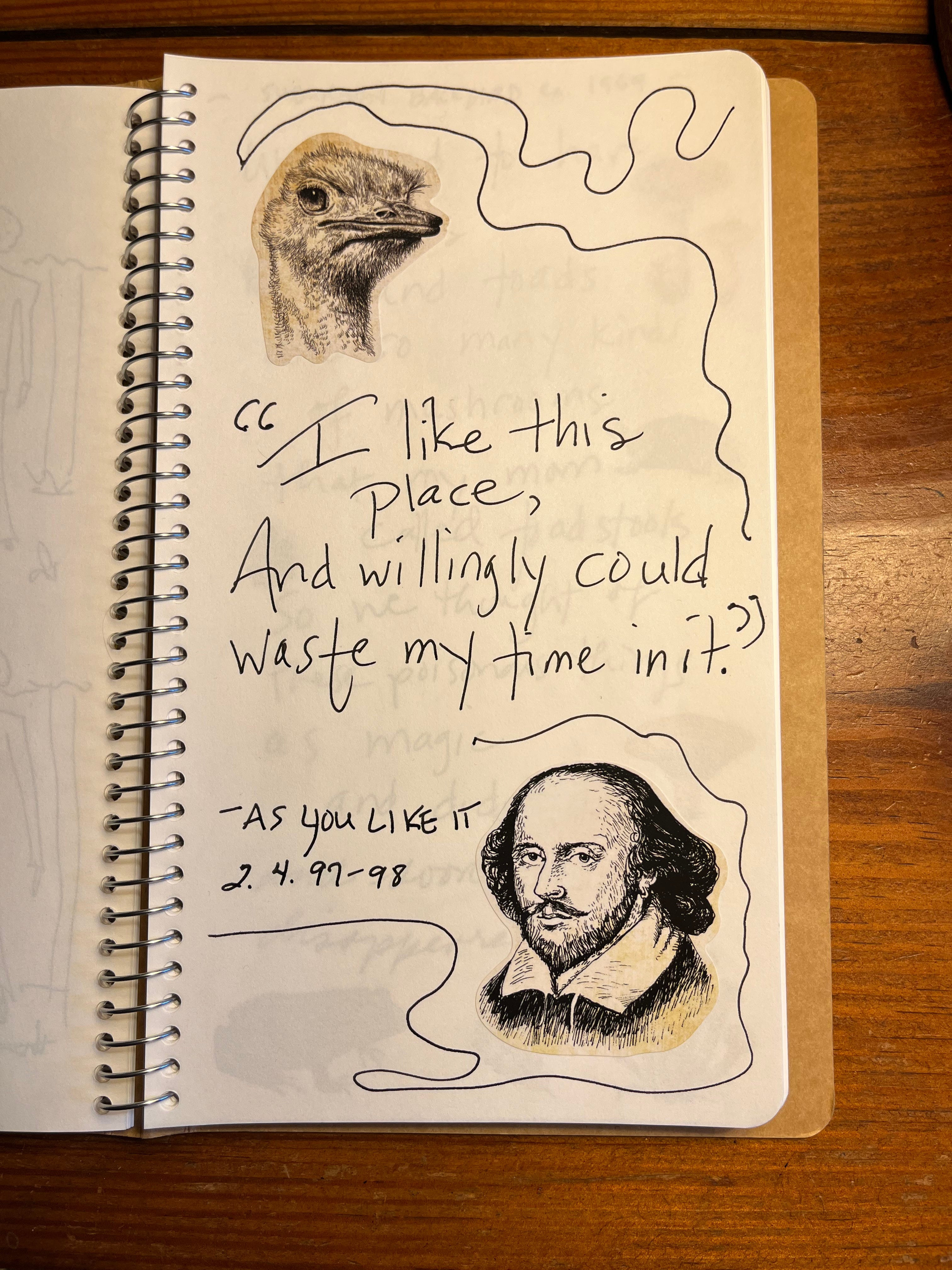
And then I reread Whitman:
This poem always comes to mind when I get nauseated by the too-muchness of it all, all the data and breaking news; all the self-care videos and nonstop commercials; all the words.
In Union Square, before heading to the Strand, I found one of my favorite artists, Akassa, two of whose works I own, just to say hello. It was Thursday, and I remembered it was his Union Square day. He remembered me, and smiled, and there he was with even more beautiful work, and the first thing I said when he asked how I was was, “My Mom died June 5,” and he was so sympathetic I got teary. I tell most everyone that, not because I want sympathy so much as connection, to bring us to the real, the now, the human, the living, the alive. And we shared that. And leaving the Strand, walking into the first cool air in a week in New York City and my first time walking New York for itself since coming back June 11, I became present to an overcast dusk that reminded me of London, a man walking toward me, feeling for something in his pocket, then turning abruptly around, crossing the street to go back, I think, to Wegman’s in Astor Place. I found myself hoping he found it, whatever it was. Something about the way he searched, realized, and turned was recognizable and immediate, if you know what I mean. I miss observing like this.
I was early to Joe’s Pub, so after picking up my ticket I headed around the corner on E. 4th Street to the pub Swift, where I haven’t been since at least before Covid. The last time I was there was an early summer afternoon, where I read Patti Smith’s M Train while sneaking Lower East Side deli knish out of a paper sack as I sipped a Smithwick’s (which they no longer serve, I see). (Sidebar: Outside my window just now I heard a little girl say, “Why?” and her daddy reply, “Because people don’t usually order pizza at eight in the morning, babe,” and I found myself thinking, “But we eat it cold out of the fridge then, so that little girl is not wrong, is she?” My upstairs neighbor, Debbie, just went out to roll the compost bin around to the other side of our building, her self-selected Saturday chore to help the co-op, while I remain in a bed I’ve been in since last evening at 6 PM, because lately bed is the only place I want to be. But life goes.)
So back to Swift, I watched the bartenders working hard at pouring the draft pints of Guinness; I looked at the barstools filled with white bruhs in blue button-down shirts or similar, not one conversation worth eavesdropping on, finished up and left. Outside, I see I missed a sudden downpour. At the Public, I used the restroom, passing a very tall young woman at the mirror, brushing and brushing some kind of foundation powder into her face, and she was still at it after I flushed and washed my hands and dried my hands and went out the door. What is that about? I wonder. It’s funny being in my sixties, a plump old broad no one looks at anymore if they ever did, and they never did, and no amount of foundation powder was going to give them a better view, it’s all so surface and silly. Inside Joe’s Pub, still quite early, I ordered my drinks from my server, Izzy, a slender young man with a friendly face and joyful afro. “Izzy, I’m a cheap date,” I said, showing my Supporter ticket (giving me 15% off). “My mom died a few weeks ago, and this is my first night out since.” Izzy expressed condolences to my weepy eyes and said, “You are in for a good night! Is this your first time seeing…” and I said, “I’d only come out for Justin Vivian Bond—I see all of Mx. Viv’s shows.” I ordered my two-drink minimum, tonight a bourbon cocktail and a club soda, and on return, Izzy brought me also a glass of prosecco, “on me.” And I got weepy again; Izzy checked on me during the evening, and I was so grateful for that kindness. (And of course my tip paid for the drink.)
Sipping and sitting at a Joe’s Pub couch table with four other people, strangers to me, all so nice, a lesbian couple, a gay man and his trans woman friend, I felt as contented as I had in ages. The band came out, Viv entered through the house, singing joy as if to say, fuck the fucking fuckers. There really is nothing like music; the longer I live the surer I am that aside from the glories of the natural world, the only other thing that really matters is making and listening and dancing to music. I believe that it’s the only human-made creation that will live on; the only true human meaning there is to make in this life comes in musical form.
Justin Vivian Bond and band with their final installment of The Well of Loneliness (Tribute to Lesbian Songwriters) Series, “Well, Well, Well.” Joe’s Pub, NYC, June 26, 2025
Music is our one human universal. My youngest nephew, James, is four, and as we O’ siblings spent the week attending to our dying mother, Mike related how James won’t let him play recorded songs when they are outside, explaining, “I want to listen to bird music.” I used to hold infant James up to the O’ kitchen window to watch the birds at the feeder, and still one of his favorite things to do at Grandma and Grandpa’s house is to help Grandpa feed the birds, scooping seed into the feeders and watching his grandpa hang the feeders back up so the birds will return. The week my mom, James’s beloved grandma, died, the backyard was filled with young cardinals, the cardinal being the spiritual bird, the sign of a loved one who has died. It was comforting. Sitting outside the Monday after Lynne died, her grandson Cullen visiting us, a female cardinal kept joining the circle. Hi, Mom.
The last video I showed my mom before she began the long fade out under hospice care was one of James saying, “Hi, Grandma! I love you! It’s James!” Lying in bed next to my mom, I held the phone up so she could watch, and she put out her hand to interact with it, touching James with her finger and saying, “You’re so cute, you little squirt,” and smiling. I told Mike about it. When I asked Mike what he was going to tell James about his grandma’s death, he told me this: The week after Lynne died, Mike said to James, “You little squirt,” and James said, “That’s what Grandma called me before she went to live with the angels,” so that’s how Mike had told him, “but,” James added, “we’ll always be connected.” Mike and his wife had read a book to James that explained we are always connected to those we love by an invisible string, and the little squirt took it to heart.
James’s response to the death of his grandma reminds me that words, stories, books, that writing itself really matters if one is to live fully as a human being. That listening and talking and reading and writing will always matter as long as there are sentient humans to take it in. Bird music and human music are music, and we need them both at different times. It’s the human made, the human felt, the human heard and seen that lifts us. The making, the doing, the experiencing. Death, after all, is not artificial.
Miss O’ is trying to figure out how to return to words, and which blog gets which arrangement of them and to what end in this crazy end of times. In the meantime, I sleep all I can and try to replenish, or something, grateful for all the long conversations I’ve had on the phone lately (especially with my friend Cindy, who needs to write her life story, or I will), and the joy of a well-tended playlist.
Thoughts from the produce aisle of a grocery store
Yesterday after I published my latest post, I walked to the grocery store to pick up vegetables for some kind of Italian wedding soup I had an idea for as a meal for my friends on Sunday (today). I took a hand basket and walked the outer aisle for celery (check), carrots (check), spinach (check), and was turning to find an onion when I noticed a young man (Black, slender) putting back a prewashed spinach container when he saw the expiration date. “Too soon?” I asked, as I do. “I can’t eat all that by tomorrow,” he said. “You know,” I said, and he turned to listen because I do have an arresting teacher voice, “you can always blanche what’s left, now you can’t do that with these other lettuces,” I gestured, “and put in a baggie and freeze it.” He tilted his head thoughtfully, “I never knew that.” I said, my gray braids on full display as it was too warm for a hat, “That is what the age buys you.” I could see there was no more to be said. Would he do it? Who knows. I turned to find my onion.
I also wanted to pick up unsalted pistachios. In this store, the nuts are in not one, not two, but five different locations (at least) in the produce section. I think the idea is to surprise you everywhere with a nutty idea, or maybe it’s just easier to stash them under the fruit and vegetable displays, but it took me several trips around to find the right stand. I saw the young man walked back and forth looking at the prewashed leafy greens, and just before I located my nuts, the man made a point of walking by me to say, “I’m going to try it,” and I raised my arms high and cried, “Success!”
Here’s what I know about learning after 38 years in education and editing: learning never happens at the moment of impact. I’ve told you this many times, but as with all wisdom, it bears repeating. You tell someone something, teach it, and then you have to allow the student to sort of internalize it, reflect on it, and decide how they will respond. We are a very impatient society, we want it all now, in America. I was like that as a young teacher, expecting that because I told them, whatever it was, it would stick. Later you learn that because you are rushing on to another concept, you have to repeat the lesson, on whatever it was, periodically, just to jar a student’s memory.
And it got me thinking how neither Republicans nor Democrats leave time for reflection. What Republicans do is pick one or two messages and repeat, repeat, repeat, repeat, repeat. They hammer those two messages home for a month; once implanted, they pick two more messages and repeat and repeat until those are implanted. After a short time, their base has four or six messages—blame Blacks, blame Democrats, no taxes, no abortions, no schools, no immigrants—to glom onto until the election cycle is over.
Democrats, by contrast, have a more nuanced base, and they don’t appreciate that enough. Repeated messages on a finite number of things—Trump is unhinged, Project 2025 is bad, women need bodily autonomy—don’t land because they are not elaborated on sufficiently, but also because Dem leaders don’t remember that the base is also being bombarded with lies that they have to think about how to counter.
No one has time for reflection in either political scenario.
A good politician, I think, needs to behave like an experienced teacher. Miss O’ didn’t just say to the young man, “You can freeze it.” I explained how: “You can blanche it, and put it in a baggy, and freeze it.” And because we both had shopping to do, and no lives were in the balance, I left it at that. He had time to reflect, and I suspect Miss O’s continued presence in the produce department, on the hunt for what he had no idea, but still present, reminded him he could keep thinking about what he’d been taught.
Telling anyone once, without reinforcement, is like not telling them at all.
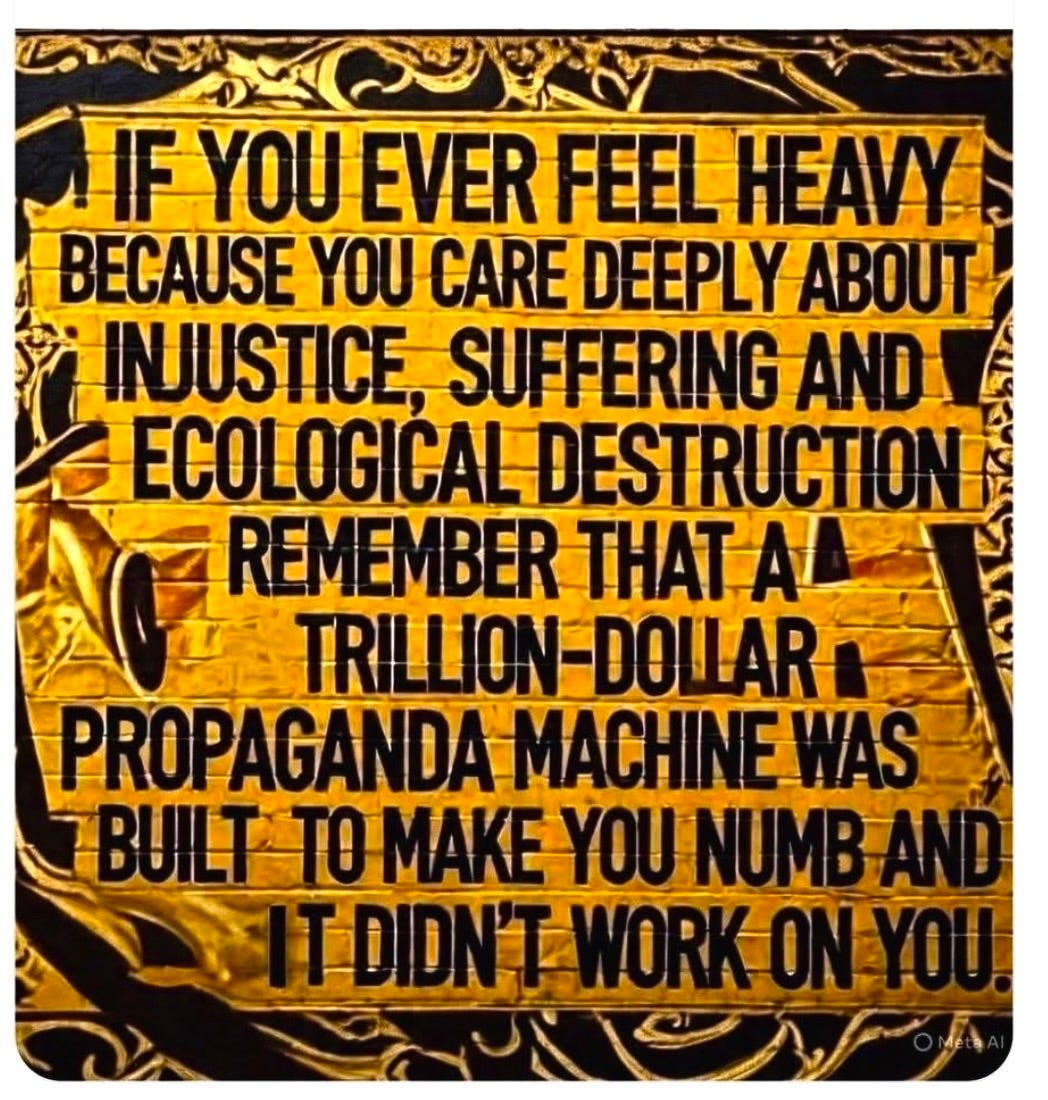
Telling them too many times, without evidence or example, is propaganda.
If this democracy is to survive—and it all hinges on Ukraine, one Eastern European nation, defeating not one but two allied superpowers—the United States and Russia—we have to figure out how to message to the American people.
Our legacy press, now almost fully allied with Trump, is useless.
Independents on social media can only do so much.
But I keep remembering that the American Revolution was won on horseback, word by word by word, passed along when people had time to think, when they weren’t distracted by anything that didn’t mean survival.
So all the ick news first, aside from all the Musk-Trump criminal dismantling of every living institution in America so that it’s close to unrecognizable (taking over the Kennedy Center? The National Archives? closing what Department?), I learned at work this week that the two editors I supervise applied for a transfer to another (lately resurrected) department where they’d previously worked because they can do what they are best at there (I choose to believe it’s not about me) and got it, and that I will have to finish a huge project probably alone, the timing being what it is; then, at my ophthalmologist’s office for a checkup, I learned that not only am I at the beginning (and still reversible) stages of diabetic retinopathy, but also that I owe an outstanding balance of nearly $500 (of deductible-meeting crap) from visits over the past four years because their billing department never sent me the bills; and then I learned from my CPA that my company inexplicably failed to take out the correct amount of tax (and all week I’ve tried to correct it for this year, but the system doesn’t work, and we no longer have humans working in HR (take that in) and I am screaming into screens) and so instead of getting a refund, I in fact owe some $1,500; and the tendinitis in my write-hand (punnyha ha) wrist is so bad still after three months, medicines, and PT, that I would have to spring for a cortisone shot (sweet, sweet relief after the injection site pain and, obviously, the bill). Poor fucking me.
Thank you, internet.
But one day this week—I think it was the eye appointment day, Wednesday, when I returned home with dilated eyes and shock at hemorrhaging money—on the way into the city, a Black female conductor announced at every stop (because the N-W-R-Q lines still do not have recorded voices to announce stops, and I love that) something to this effect: “Ladies and gentlemen, let the passengers off first, let’s help each other out, everybody, let the people off first before you try to get on. Move into the middle, people, help everyone out, we’re all together here.” Love her heart. On the way back to Queens that same day, a Black male conductor did much the same, adding on occasion, “It’s not about the price of groceries, everybody, just help each other out here and move all the way into the car.” This same conductor also used the intercom to explain the location of every staircase, connection, and elevator at every single stop. A total doll.
And if you are like me, you can’t help but look up and down the train car, men, women, children, every color and shape and gender and age and religion and background and profession, staring into phones, or not; bundled up, world weary, and it hits you all over again that the reason “white middle America” is afraid of brown and black shadows is because they literally have no idea how New York works. It’s not perfect, never that, but it works. Look at us. Us. Right here in this train car, crowded, or not, for miles of stops along our way. Not yelling at or killing each other. All of us just being.
Also in my travels, I found myself thinking about a poet friend who lives in a rural area, who years ago, when I mentioned how much I loved the movie Lost in Translation could only grunt in disgust. When I asked why, she said of the lead characters, “All they did was squander an opportunity to see Japan.” I had to think for a second, because I was remembering the filming of Bill Murray’s whisky commercial, the Tokyo karaoke bar, the hotel bar nights, Scarlett Johannson’s quiet excursion to a Japanese garden and learning flower arranging, and of course the hilarious trip to the ER so Bill Murray can get Scarlett’s broken toe seen to—all these relationships and stories they will have to tell about, or not, when they return home. What did my friend mean, “squandered”? I started thinking. I guess another view is they didn’t really do all that much…and then it hit me. I said, not at all angry, but with a sense of discovery, “You’ve never traveled outside the country, have you?” She looked at me suspiciously, and slowly shook her head, as if her response to a movie shouldn’t depend on having had the experience. More to the point, though, she had almost never, within or out of the country, traveled alone. And there it is.
What was lost in translation for her in watching Lost in Translation is the feeling of sudden paralysis brought on by the jetlag stupor you feel combined with being quickly overstimulated in a new place while on no sleep, while being both excited by the prospects and daunted by selecting the best thing to do right now. The one universal is a bed (never one you can check into before 3:00 PM) and a bar or cafe, and heading to either one can give you a chance to sort of recover your wits (if you know how to manage the currency), but when you are alone with no one to bounce ideas off of, being in a new city, whatever the language, can be pretty isolating. One time, visiting London, I spent nearly one entire first day just sitting alone on a bench in Tavistock Square, where Virginia and Leonard Woolf had lived (in a no longer existing building, bombed out in WWII), underdressed (a cold day for summer) and disoriented, and in those days, a teetotaler. I could barely make myself try to find a place to have tea. If I did eat or have tea, I don’t remember. I remember a white-gray sky, damp chill air, and just watching people against green trees and grass and gray buildings.
Did I squander my first day in London? Not at all. Oddly, that first day of “doing nothing” is still the one I remember most vividly and fondly, whatever the discomfort and confusion. I was there, in the heart of London, on my own, unremarkable, on an ordinary day. Not bad.
As a result of my many NYC train treks this week, it also dawned on me that perhaps the reason I needed to leave Facebook, finally, was that my life in New York can be one of overstimulation even on the dullest days, and that Facebook had become more overstimulation, not sure which way to look, who I’m forgetting to check in on, that sort of thing. Maybe I’m just not wired for all that anymore. I know that many people can simply sit on a virtual Facebook bench and do nothing, or idly and dispassionately watch the goings on, not unlike I did in Tavistock Square or Scarlett and Bill did in Tokyo. You do you, as the kids say. However we engage, or don’t, we are all in it together, so move to the middle of car and let everybody onto the train. And remember to give people their space (remarkably, New Yorkers do know how to give you yours, even by a fraction of an inch, and if only the whole country could cotton on, that would be great). After all, everyone here with you is simultaneously present in a pubic place and also living a very private drama of their own.
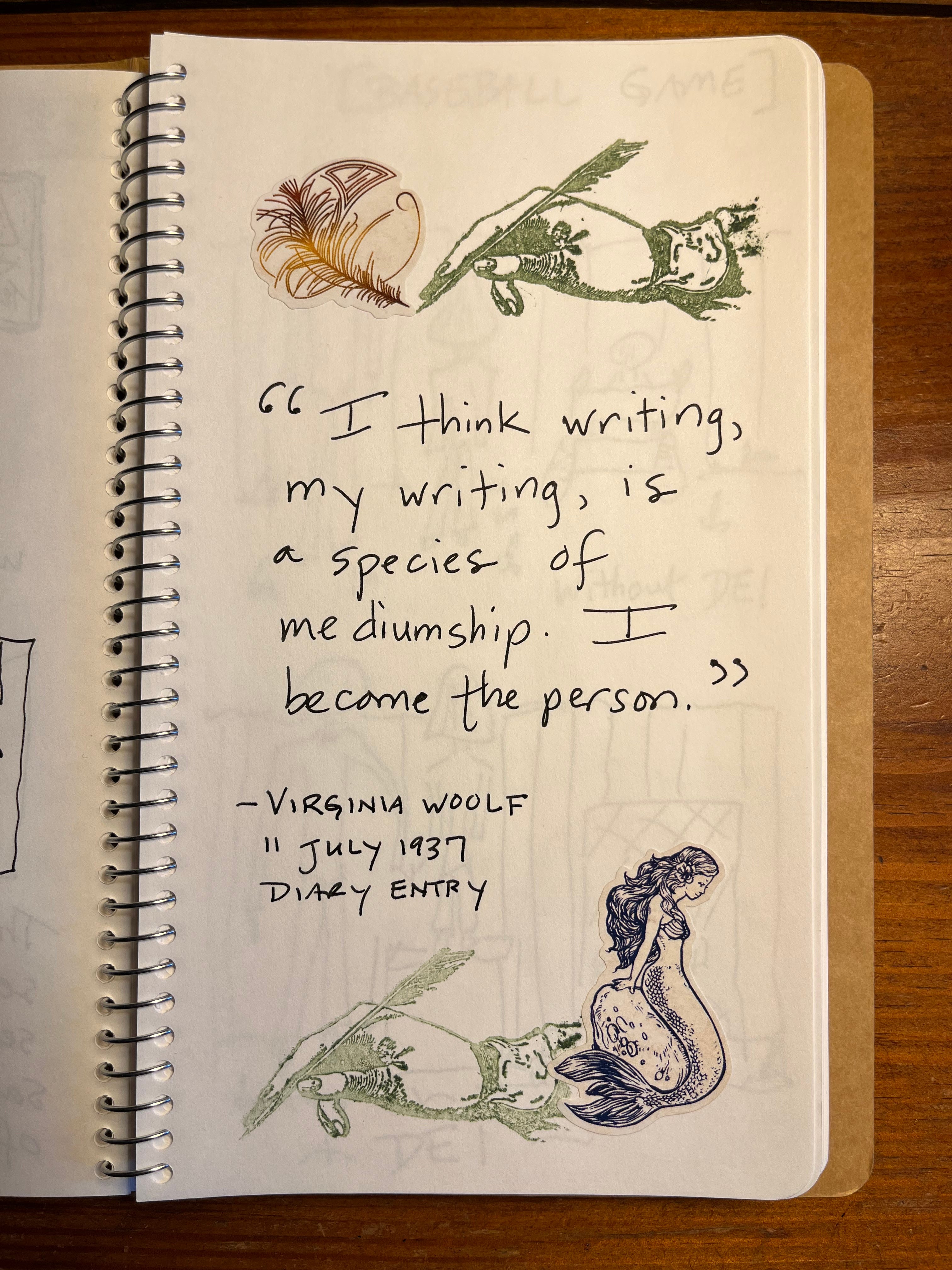
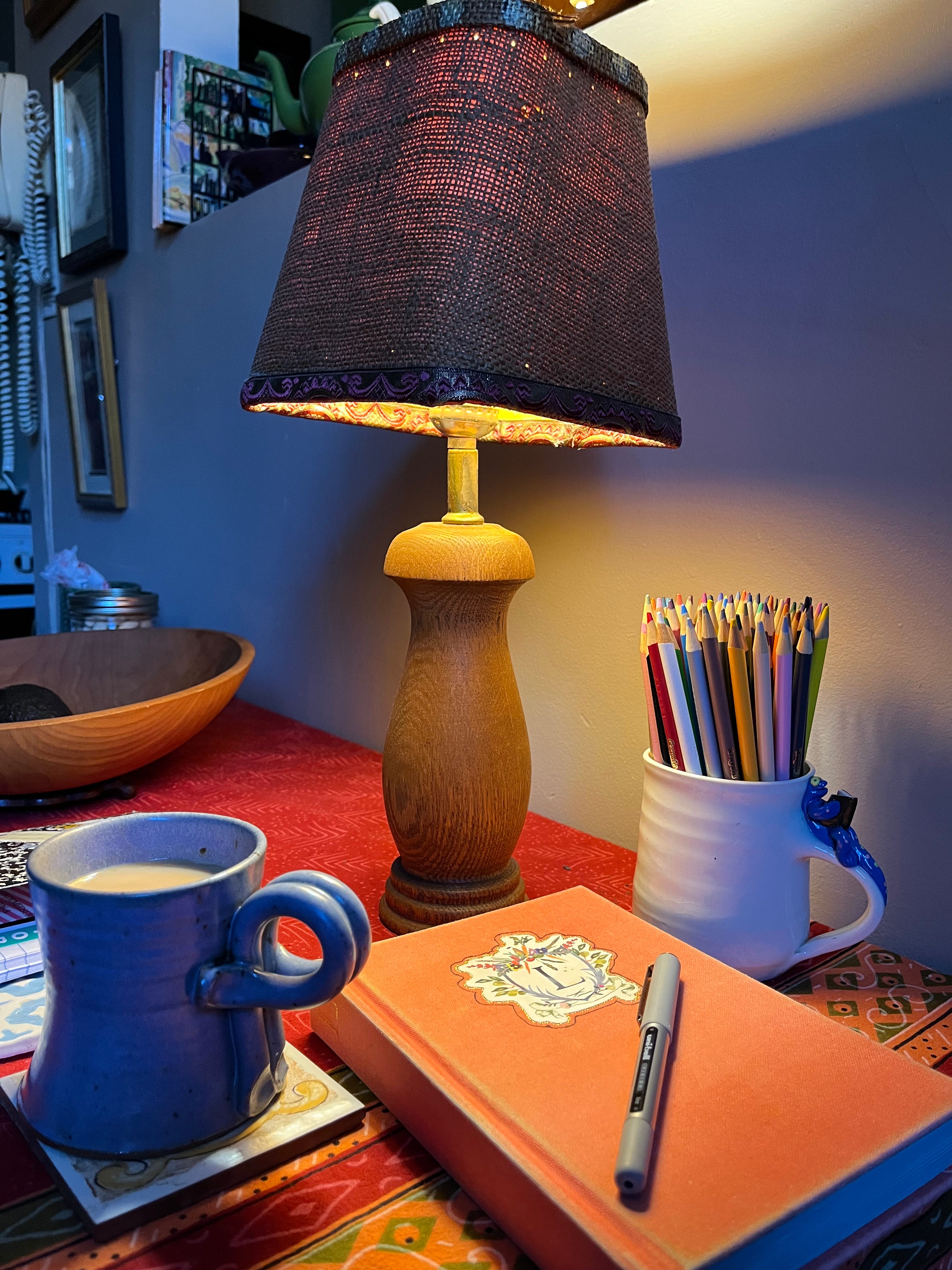
One of Miss O’s many, many notebooks.
All of this is just to say, dear friend, given all that you are going through in your personal life and against whatever landscape this letter finds you, I know that you may merely glance at or dip into this post, and I completely understand. Thanks for reading at all, and whatever you do, don’t strain yourself. Enjoy your Sunday. Let me hear from you when you get a chance.
P.S. A few weeks ago I published part of a play I’ve been working on, but I don’t know if WordPress is the best outlet for me. Thanks to all who read it, in any case!
I’m sitting in my kitchen this Sunday, January 12, 2025, a week before the inauguration of the End of Times, feeling lucky and grateful to have a kitchen, and a rocker, and coffee, and art supplies; and despite some aches and pains (and as far as I know), my health. I was able to take a warm shower last night, and sleep in a warm bed covered in Irish knitted blankets and clean sheets. I awoke a little late this weekend morning because I could. The day is a cold, crisp, blue sky winter day in New York City, and by the grace of a good job (still in education after 37 years) and having bought my apartment 20 years ago instead of, say, last week, I get to live here, and affordably. Knock wood.
What I’m wondering about today, all these blessings notwithstanding given the wretched suffering of humans and the planet’s ecosystems as a result of sociopathic, capitalist policies and general stupidity, is whether or not I should continue using social media to communicate. (How privileged am I?) But really what I’m wondering is to do with the point of this whole tower of Babel, all of us voicing our views all the time via TikTok, Facebook, Twitter (X), Instagram, BlueSky, Substack, Medium, Blogger, WordPress, pick a platform. We can write, text, photograph, video, podcast, share it out en masse. So many of us with so much to say. Who is the audience? And to what end? I’m probably overthinking this.
I know from “stats,” for example, that after roughly 24 people “open” this post, approximately two people will read past the first two paragraphs. Possibly one person will finish the whole post. I suspect that person is almost always the same person, occasionally joined by one or two others. One occasional reader will “like” this post on Facebook without having read it (I know because the “like” comes within seconds of posting it) so as to be encouraging. One person may “like” the post at the source, such as on Substack or WordPress. I have “followers” on these sites, and “likes” are swell, but I have to say that none of this is what I’m after when I publish a piece.
Love Letters
As I’ve written before in many blog posts few have read, I write blogs because I miss writing longform letters. Whenever I was feeling really lost and out of sorts back in my youthful teaching days, for example, I would reflect on how many letters I’d sent and received in recent weeks. This would lead to me sitting down to type letters on my Smith-Corona (no carbons, so none of my long letters survive, I suspect), one to four pages, maybe six, single-spaced, on colorful letter paper, to five or six recipients at a go. Every letter had a different voice, subject, and slant, given the audience. Sometimes I included a folded article from The New Yorker or the Washington Post. By Sunday evening, after writing letters between grading stacks of papers—those letters addressed, stamped, and stickered with a return address and something pretty—I was a new girl. Monday morning I’d mail the letters from the school office where I taught, and I could feel breath return to my body. Letters meant connection to the wider world, to the hearts of my friends. I gave them pieces of my heart, and when I posted, I felt that my heart regenerated, times two.
The coming weeks ensured a return post from nearly all the recipients, from, say, my one living grandmother in Council Bluffs, Iowa; my former landlady and other friends in Central Virginia; my former costume design professor at Virginia Tech; my Bread Loaf friends in Massachusetts, New Jersey, Vermont, Tennessee, and Kuwait (or wherever she was teaching internationally that year). I no longer recall what I wrote in those letters, but I still have all the letters I received back. They fill half a closet, shoe boxes within boxes, and I treasure them as one would rare artifacts. I suspect that my trove may well be the last of the letters that humans will ever see, certainly over 60 years in America in the late 20th to 21st centuries. But that isn’t why I keep them. They are reminders of the ways we filled one another’s hearts, and deeply, once. To me every letter is a love letter.
The Social Network
One thing I’ve become sad about in the past decade is how social media, including texting, has been used as a replacement for letters and personal conversations. I no longer get that Pavlov’s dogs “warm feeling” when I hear the arrival of mail dropping through the slot. Junk in the form of requests from charities, a catalog, a flyer from a theater, a medical bill—these are all I can expect. When I do get personal mail—as small package, a postcard, or a card for an occasion—I do relish the note, usually very short, and mostly respond in kind. And I do love my sibling text threads; and some texting is an important way of writing brief letters with some old friends, so there is that.
We all have shorter attention spans, of course, technological “advances” being what they are, causing our brains to have been rewired to be more in line with ADHD tech developers (my personal theory) and less so with the slower and more deeply thinking (though not necessarily genius-level) people like me. Still, I think there is something to be said for being able to be quiet, and deep, and I miss it.
But what I am missing, more specifically, is the forging and maintaining of intimacy.
Instead of enjoying deep communion with friends, I, more often than not, provide and receive sound bites and sermons and memes. It’s all fun and games, however deeply felt our stories and rants, however witty or sweet or artful the picture posts. Less and less, I’m feeling that my life can be “both/and” when it comes to deep connection and social media on a platform. My brain and my heart feel frayed, like an old quilt, maybe, that I stopped really valuing and only look at out of habit.
Time Travels
I look at how the letters my parents received dwindled once they reached their 40s, when they and all their friends “back home” became busy with lots of children, school programs, second jobs; when aunts and uncles began dying. Distance and lack of time prevent us from keeping up with everyone; it’s life, and “everyone” is too many. It’s why we have reunions every decade or make special trips once or twice in our lives, or every Christmas, to reconnect with old friends. We also used to call people on the phone for a daily chat, or to faraway relatives on special occasions, but those calls were rare. I think my dad only called his mother two or three times a year, families then still mindful of the Depression and the charges for long distance. By contrast, when I was a teenager, I could stay on the phone for hours with a friend I’d seen all day at school. You remember.
While the invention of social media has afforded us a chance to quickly and easily locate, “friend,” and play voyeur into the lives of dozens, hundreds, thousands of long-lost chums and recent acquaintances, and to share our own photos and points of view, I’m wondering if it has been worth sacrificing depth for breadth, or when it started to feel like a sacrifice. I ask because I have never been lonelier in my life.
Possibly this is because I am sixty, and live alone (I am self-aware enough to realize I’m too odd to live any other way), and even if I weren’t single, I would be right back where my parents were, never hearing from anyone either, even if this isn’t 1973. I don’t want to devolve into nostalgia.
But what has happened in the past decade is that too many formerly intimate friends have relied on their social media posts—posts sent out to dozens, hundreds, and even thousands of friends or followers—as their sole means of communication with me, Miss O’ lumped among the throng. I stopped even texting some friends when the reply became, “Don’t you read by Facebook?” or took the form of an emoji, a heart or a unicorn, say, as if to express, “What makes you think you are so special that I would take time out of my active life to respond only to you personally?”
I had become a unicorn, but not special in the way of that creature so that anyone would want to seek me out. Have I done this to other friends? (Was it something I said?) A few years ago, I withdrew myself from a group text thread of friends when I realized that no one responded to anything I wrote. One friend said later, “I’m sorry that’s your perception.” No, that was the reality, as I saw the receipts. The good thing that came out of it was a restored one-on-one friendship with two of those people, much more personal and real, if you know what I mean. And more me, more fulfilling.
I will say, as far as media goes, the technology that is Zoom has been a godsend, and was especially so during Covid. Two couples, Anna and Michael in California and Frances and Jim in New Jersey, joined me for long, long conversations every few weeks during all those unlimited-use months during 2020-2021. We talked, read excerpts of books aloud, moved our computers to the kitchen to fix dinner or experiment with new cocktails, gave each other tours of our homes. In a culture that really isn’t into letter writing that much, now me included, Zoom became our way of sharing and connecting when there was no other way to get together.
So My Friend Susan Announced She’s Leaving Facebook
This was the spark of today’s blog. Susan is the kind of person who uses social media in the best way. She shares her family stories and adventures with the perfect amount of wit and detail that it’s like you are sitting at the kitchen table with her. She makes 2,000 people at a time feel that way, and it’s a real gift. I used to share fun little moments in New York City, and even self-published a little eBook to compile them (at the request of my friend Becca), but more and more my own use of the platform has turned into political screeds against stupidity. To the two-dozen sweet people who regularly nod in agreement with one or more of those posts, I am glad we can commiserate.
Because of the current state of society and disappearance of anything resembling an objective corporate press, we currently have political reasons for questioning the use of social media. “Meta,” for example, has announced this new “anti-censorship” policy, as “X” has done, which really boils down to “Feel free to yell ‘Fire!’ in a crowded theater” (which I learned as a student in Mr. Hart’s fifth grade class is illegal as well as immoral). This is why Susan is leaving. I asked, “Have you considered writing a blog?”
The Open Blog Culture
Blog culture can be so much pissing in the wind, I guess, but there’s something rather dear about it, I think. Those of us so inclined can pour out our hearts in longform letters without postage. (Note: several of my artistic writer friends find my blogs unreadable or disappointingly un-writerly, etc., and my view is that they wouldn’t send back a critique of a letter, now, would they? So. Maybe sit on that and spin. I say that with love.) And while I still make personal cards with collages and quotations, and send short notes periodically, I will say writing a blog post fills the need I feel (mostly, though I feel it less and less, finding I have less and less to say, or at any rate to say to you, my friend(s)) to write a complete idea, or to explore an idea as completely as I have the mind to in the moment. However, while this act sorts my brain, my heart does not regenerate, not exactly. I do miss that.
Let me hear from you, should you feel that, too, but not on Facebook. I think that one will have to go. I will do a gradual release, though; it’s the only way I hear about deaths, for example, or childhood friends and former students in success or distress. I like Instagram, but the only posts I see in my feed—all my own doing because I “followed” them—include political news about He That Shall Not Be Named, and only one or two sweet photos from actual dear friends. I tried BlueSky, but it’s become all-HTSNBN-all-the-time, too. No one, it seems, knows how to get off that ride, and no amount of posting my distress about that is going to change anything. I feel my brain atrophying just thinking about it.
All that time I spend worrying on social media—what else might I be doing instead?
Now it’s noon, and I need to go for a long walk and see what’s doing in the neighborhood. Maybe I’ll call somebody later, who knows. What about you?
Sending love,
Miss O’
P.S. I have another blog on Substack, and have duplicated the posts. However, I think I will use this space to do more creative work. Will see what happens–and thanks for reading, in any case.
In my room, the world is beyond my understanding; But when I walk I see that it consists of three or four hills and a cloud.
Surface Chair
Years ago, my friend Tom and his partner were moving and downsizing, and he sold me a delicious olive green wing chair (which I foolishly gave away when I later moved to New York and I miss it still). On first seeing the chair, which was solid and plain, in my house, my friend Chuck remarked, “Now it just needs a couple of bright pillows!” When walking the shops of Fredericksburg, Virginia, I found two expensive hand-painted pillows, with an accent of that very olive green, that did just the trick. I thought of all this just now as I pulled down my bed covers and shifted one of those very pillows to the side so as not to crush it in my sleep.
So much of life and living is surface, a chair you buy and lose, the bright pillows you spend so much money on to decorate the chair, the casual remark that caused you to elevate your home decorating aesthetic beyond solid colors into bright patterns of possibility. All surface thoughts, yes, but more than the surface shifts. Doesn’t it?
II
From my balcony, I survey the yellow air, Reading where I have written, “The spring is like a belle undressing.”
Surface Friend
Thursday afternoon, I texted my dear friend Cindy who lives on Maui to ask what was happening and if she and her family were safe, and they were, as the fires were not on her part of the island, but oh how she was grieving the loss of Lahaina. She then texted, “Did you know that Tammy [a fellow student and actor from Virginia Tech days in the 1980s] passed?” I did those things we do now: looked up Tammy’s obituary online; wrote a tribute memory; posted of her death in a social media alumni group. I really had only a surface relationship with Tammy, acting with her in a Summer Arts Festival production of Andre Gregory’s adaptation of Alice in Wonderland the few months before I started my teaching career. We took to walking home together on the nights after rehearsals and performances, as neither of us had cars, and her place was my halfway point. She’d kiss my cheek, wish me “safe home,” a phrase I didn’t know. She graduated the year I was a freshman, and by the summer I got to know her had waitressed and auditioned in New York City for three years and lived with a Russian boyfriend named Roman who wouldn’t go down on her because he didn’t understand what “the magic button” was, which was not where women bleed and pee, and her favorite city memory was Roman pushing her around the East Village in an abandoned shopping cart in the cold wee hours after the bar where they worked closed for the night, her legs sticking up out of the cart while he spun her around on the deserted streets and she screamed and laughed. That’s what I know about Tammy. And can’t forget.
Surface memories as lasting as love.
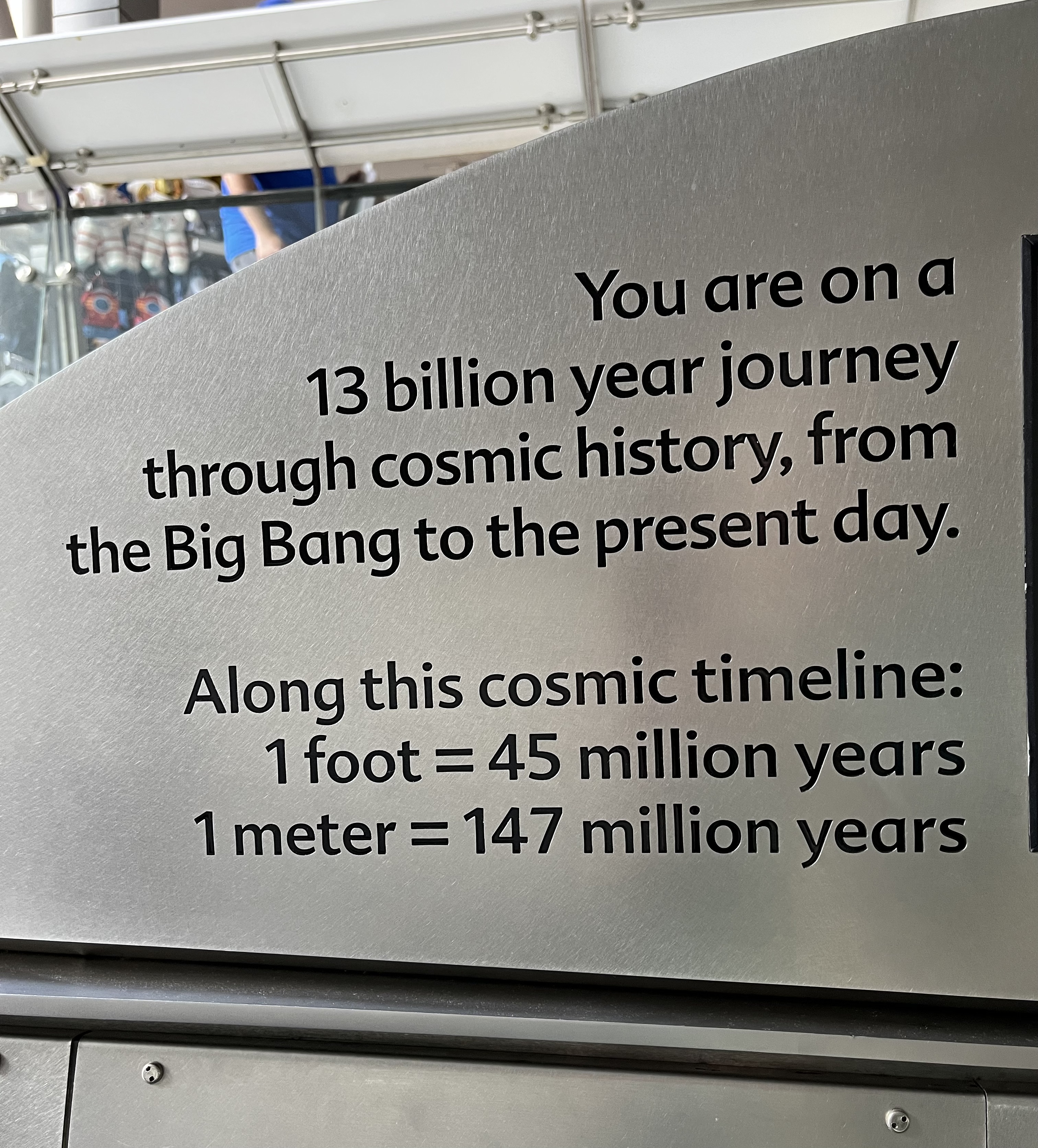
At the Planetarium, American Museum of Natural History. Photo by LO’H
III
The gold tree is blue, The singer has pulled his cloak over his head. The moon is in the folds of the cloak.
Surface Life
Sometimes I think I have only ever known surfaces, surface friendships, surface news, surface travels, surface nature, surface career, surface artistry, surface feelings, surface disaster, surface stories. So of course I dread. I obsess over decorating a home, oddly, that almost no one sees, an art project for an audience of one, knowing it and I could be lost at any time, and it’s so much fog, really. I see spots I missed when I dusted today. And what should I have to show for all this care and attention? Is there anything inside me deeply affected by bright pillows on a muted chair? Is there anything that can emerge out of me that will deeply affect the world? And what of all this death?
Three or four memories and a cloud. Is there much more we can expect?
Sending love out to everyone who needs it, even from my surface, to help you absorb whatever was your loss in life this week.
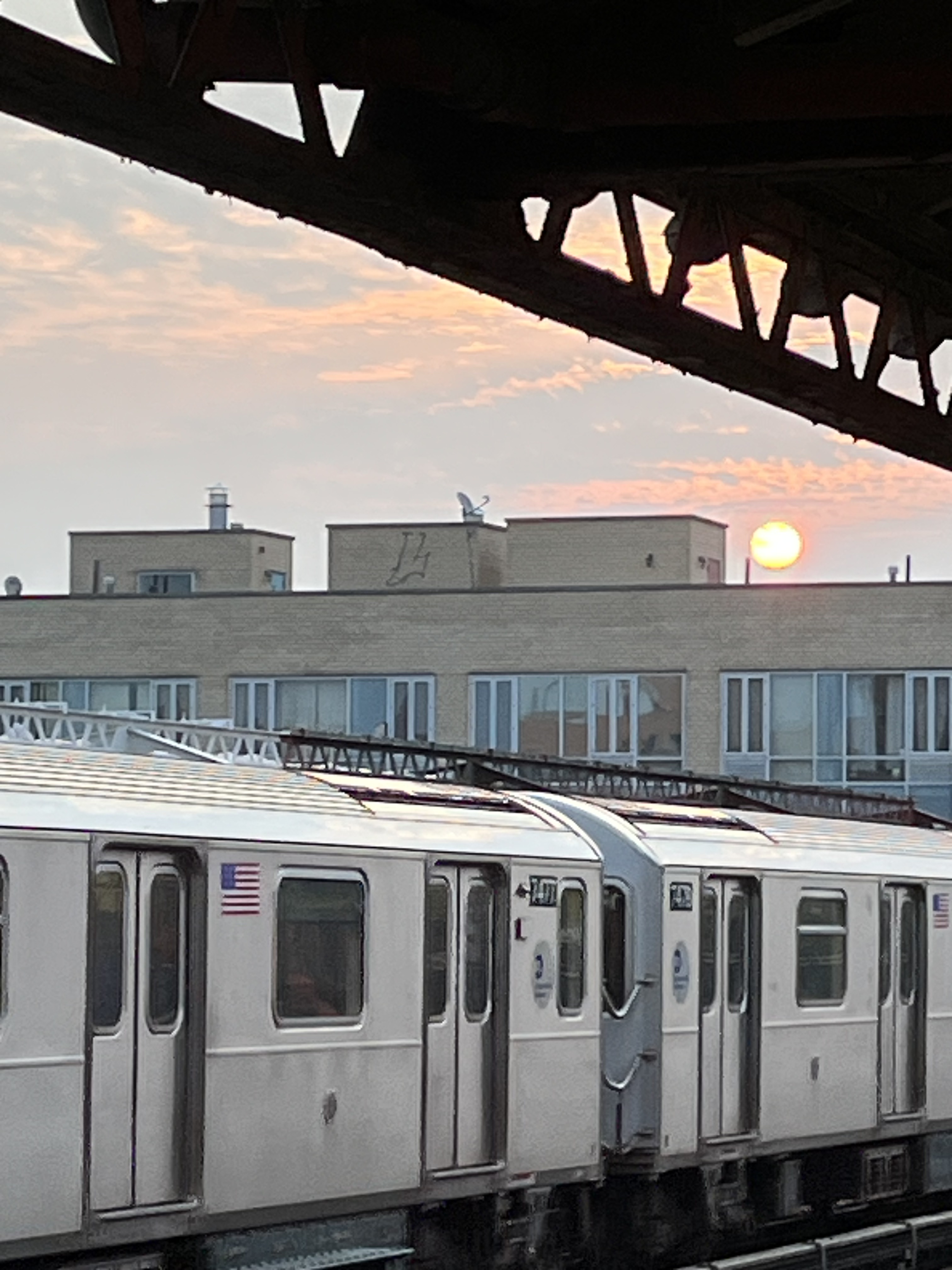
Morning from the 82nd Street Subway Station. A couple of cars and a sun Photo by LO’H








 The Miss O' Show (Teacher's Edition)