Slaying the Dragons

More thoughts on our national monsters

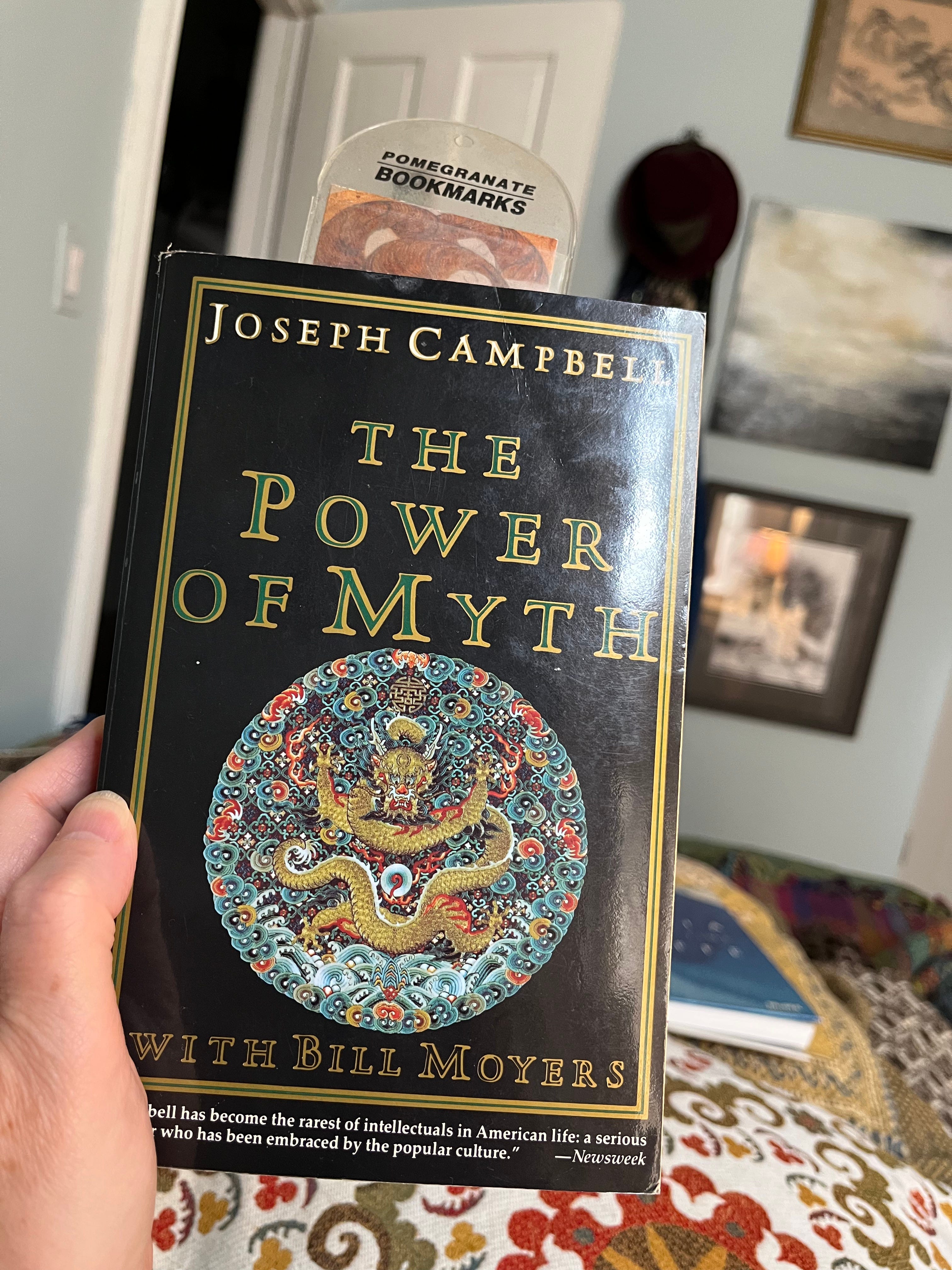
Hi, dear one. In my last post, I related how I’d recently read a book, Monsters: A Fan’s Dilemma by Claire Dederer, and this week, by a serendipitous coincidence, PBS streaming has rereleased a series from 1987, The Power of Myth, a conversation between Bill Moyers and the great mythologist Joseph Campbell, who sadly died not long after the final interview. You can also get the companion book, created because the 6-hour series (filmed at George Lucas’s Skywalker Ranch) couldn’t contain all the insights.

Moving from monsters to dragons felt like a natural progression. Also, in another moment of serendipity, I had a conversation this week about the work of Patsy Rodenburg, a voice teacher and acting coach, and her work The Second Circle. All of this makes sense together in my mind, so we’ll see how I do.

In a society such as ours in 2025, I wondered what Joseph Campbell might be able to help me with. As it turns out, plenty. Bill Moyers is a great host, comfortable asking naïve questions, and while for the intelligentsia it’s tempting to make fun of him, he gets wonderful answers. Moyers, by the way, was President Johnson’s Chief of Staff and later Press Secretary (he called Johnson “fifteen of the most interesting men I ever met”); he is smart and educated (and still with us at age 90) as well as attuned to society, but he’s at ease with not knowing and relishes seeking to understand (which I find are the key qualities missing from today’s journalists as well as citizens).

In one episode of The Power of Myth, Campbell explains Star Wars as one of the most recent (then) examples of the hero’s journey (there’s a whole episode on that; Campbell’s work inspired Lucas) and what that mythology tells us. Myths, he explains, including hero’s journeys, are not about seeking meaning in life, but rather about experiencing life. Moyers and Campbell talk of the ways in which people follow church doctrine, for example, to guide them, or follow strict rules and procedures rather than their own instincts. Often, heroes have to abandon what they thought they knew to get through the challenges.

They talk of the struggle with temptations presented by the serpents (found in every culture) where there is an expected way to live, the tension between the body and the mind, between desire and outside rules. At one point, Moyers reflects on ordinary people’s lives and the hero’s journey, especially the moment that Luke Skywalker, in a life and death struggle with Vader, chooses not to go over the dark side.

Of this dramatic choice of good over evil Moyers says, feeling secure in himself, “But that isn’t what happens in my life.”

And Campbell quickly counters, “You bet it does. If the person doesn’t listen to the demands of his own spiritual and heart life, and insists on a certain program, you’re gonna have a schizophrenic crack up. The person has put himself off-center. He has aligned himself with a programmatic life. And it’s not the one the body’s interested in at all. The world is full of people who have stopped listening to themselves.”

I don’t know about you, but it seemed to me this perfectly described this American moment.

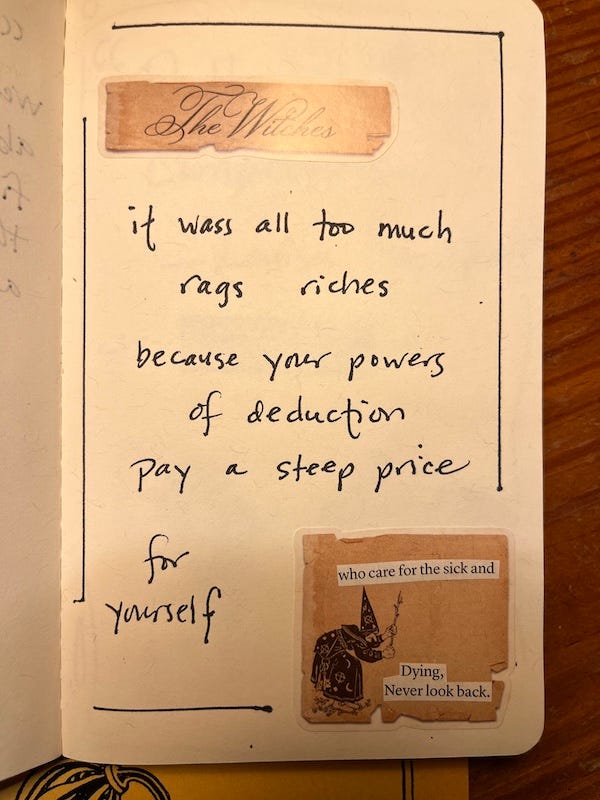
Campbell and Moyers also talk about dragons, and Campbell’s take on dragons is fascinating to me—they guard. “The European dragon,” Campbell explains, “guards things in his cave, and what he guards are heaps of gold and virgins, two things, gold and virgins, and he can’t make use of either of them, but he just guards. There’s no vitality of experience…” In psychological terms, you’re binding yourself to your own ego, if you are dragon. (Campbell contrasts the negative European dragon with the “great and glorious” Chinese dragon—two very different things.) The dragon in us is our ego, “What I want, what I believe, what I see,” Campbell says, and “it might be too small.” To slay it, “you have to follow your bliss,” by which he means your true nature.

The Europeans, who colonized so much of earth, then, are based in a culture that fights those who hoard gold and virgins, and yet the heroes don’t fight the dragon for any other reason than to the take the gold and the virgins for themselves. Another perfect metaphor for America.

Campbell wouldn’t say that deciding to destroy others is anyone’s actual “bliss.” Annihilation of the innocent, the hoarding of gold, and rape of women cannot be bliss, because I see dead eyes in Trump, in Musk, in Speaker Johnson, in Vance. They are without souls let alone hearts. Anyone with access to their own hearts would follow President Zelenskyy anywhere because anyone can see Zelenskyy is Luke Skywalker; it’s not about him, this war, it’s about saving a country he loves. You may think that doing what you love “doesn’t save the world,” only yourself; but Campbell says that by saving yourself, you save the world. “An influence of a vital person vitalizes. There’s no doubt about it.” Otherwise, the world is a wasteland. Slava Ukraine.

“An ego that sees a ‘thou’ is not the same ego that sees an ‘it.’”

mythology scholar Joseph Campbell on the difference between the relationship Indigenous people had with buffalo (“thou”) and that which the white man had with buffalo (“it”); see also, Putin with Ukrainians

Last week my friend Keith, an actor and writer, was in town working on contract negotiations for his union, and we met for dinner on Third Avenue Thursday evening. The dinner time changed from 5:30 to 7:30, so around 6:40 I left Queens for Grand Central, going down toward the back of the 7 Train to be nearer the Third Avenue/42nd Street exit when I arrived at the station. When I entered the car, there in the corner was a bearded man, quite filthy and disheveled and resembling Rip Torn, a faded red towel safety pinned like a cape around a grimy white tee shirt fragment. He was talking to himself in animated tones about a woman who was in pain, her feet, I think, and the narrative was taking place at a hospital. He’d caused the car to reek, though not many people were bothered. I was, though, so when I sat down in the only available seat, I casually rummaged in my cloth sling bag for a mask. (Since Covid, the option of wearing a mask allows us to give smelly people some grace, to not embarrass them by pulling collars up over our noses, or to have to beat an exit to run to the next car at the next stop; in NYC in summer, it’s not uncommon for one person’s stench to clear out a subway car and leave it empty at every stop for a whole day. Pro tip: NEVER get on an empty subway car on an otherwise full train; everyone does it. Once.)

Over dinner, Keith and I talked about many subjects, from poetry to opera to politics, when he mentioned he was going to Portugal to study with renowned voice teacher and acting coach Patsy Rodenburg, whose work I love. In a quick but inadequate summary, I can tell you that Rodenburg (whom I first heard of in an interview on NPR and saw later on video from Michael Howard Studios in New York) noticed over the years that she could distill actors’ energy into three “circles”: inward directed (First Circle), outer directed (Third Circle), and perfectly present (Second Circle). We need all three circles, and all three circles have their uses, but to be an effective actor, you must live in the second circle of true intimacy, fully present.

You see this in life—First Circle, the people scrolling their phones, or the cashier who won’t look at you; and on the other extreme, Third Circle, the salesmen, politicians on the campaign trail, preachers greeting parishioners. Miss O’ lives in second circle, as do many of my friends. Second circle can be unnerving to people who are not, as Campbell would say, able to follow their bliss. People who need a doctrine to cling to—the Ten Commandments, Project 2025, even the Rule of Law. Any doctrine can be leveraged for good or evil when people are not in Second Circle. (Trump, I suspect, lunges between First and Third circles all the time, which creates a violent imbalance. He hasn’t been in Second since infancy, where we are all in harmony.)

And this brings me to a deeper truth, perhaps the most unsettling to me. In the United States, we have no more rituals (beyond, what, morning coffee?), no mythologies, no common culture to bind us together. If we could be honest, tell the truth about our origins, all the complexities of colonization, genocide, slavery, revolution, enlightenment, the uses and abuse of Christianity, all of it—we could formulate a national mythology and enact rituals to guide us to growth and build further understanding. American Idol is the best we can do? The spectacle of competing for money and fame? Has The Apprentice taught us nothing?

At one point, Campbell uses our architecture to tell us who we are in the U.S. in the modern age. In Salt Lake City, he notes by way of example, first the Temple was the tallest structure (religion), then the Capitol dome (politics), and now the Office Building that handles the economic affairs of both is the tallest and biggest edifice (commerce). It’s the Symbol of modern life. What does this mean for us? “You can’t predict what a myth is going to be any more than you can predict what you are going to dream tonight. Myths and dreams come from the same place.” What is the new American dream?

In six weeks, we citizens watched helplessly, and Democratic leadership spinelessly, as Donald Trump destroyed 250 years of American law and governance, wiping out the mythology of a nation. Listening to Campbell, I gained historical perspective. Though Moyers switches quickly, in editing, away from his point, Campbell does passionately remind us that Indigenous people, in a mere ten years, lost everything in the way of their rituals, their sacred dependence on the buffalo, their freedom, their land, and thousands of years of a way of life. Like that.

We’re in the process of losing a few hundred years’ worth. It’s nothing by comparison. It’s just ours. And “ours” was never “everyone’s.” If we are honest.

Our struggle now (if there is an “us”) is recognizing the difference between the seductive serpent, the dragon to slay, and the vital person. Everyone made fun of Hillary Clinton when she said, “We have to change hearts and minds,” mocking her with, “It can’t be done.” Of course it can be done. As my theater hero Joseph Chaikin said, it isn’t done “en masse, but one by one by one by one.” We each do our best to be alive, and our aliveness brings life to the world. Moyers brings this around to the importance of teachers, of which group Campbell was a member. The therapists, the storytellers, the healers, the helpers, the educators: we help bolster the world, prepare our heroes, vitalize the works.

Coda: Keith walked me to the Grand Central around 10:00 PM, and I descended the stairs from the Third Avenue entrance. Down on the platform, I walked to where an old man, a blues and rock electric guitarist, played a history of the Beatles and Jimi Hendrix as two other musicians looked on. We thanked him, gave him a few dollar bills. When the train pulled in, we got on the car, and I smelled a familiar smell. I looked down the car and there, in the same seat with the same two-liter bottle of Mountain Dew, was the same schizophrenic man. What are the odds? Weirdly, this sort of thing happens to me a lot in New York. But think of any number of small things that could have happened differently—the time I left home; or the time we left the restaurant; where I stood on the platform either way. It’s remarkable.

I pulled out my mask. The man sat alone, no longer chattering away but looking at us, lost; I think he vaguely recognized my hat. A needy citizen ignored, an “it” instead of a “thou,” someone else’s problem. The American ego.

I don’t know why, but thinking of all these stories and our ordinary workaday lives, I hear Pigpen’s voice in A Charlie Brown Christmas, when Linus points out that the dirt and dust on Pigpen could be from the soils carried across the ocean from ancient Egypt, to which Pigpen, adjusting his costume says, “Sorta makes you have a little more respect for me, doesn’t it?” Maybe Peanuts feels like it could be a start for our mythology, if we tried. We could do a lot worse.

(Thanks, internet.)

I do go on. Happy Sunday. I really should get out of bed.

Love,

Miss O’

Miss O’ Booking It: On Groundhog Day in 2025, Reflections on Black History Month

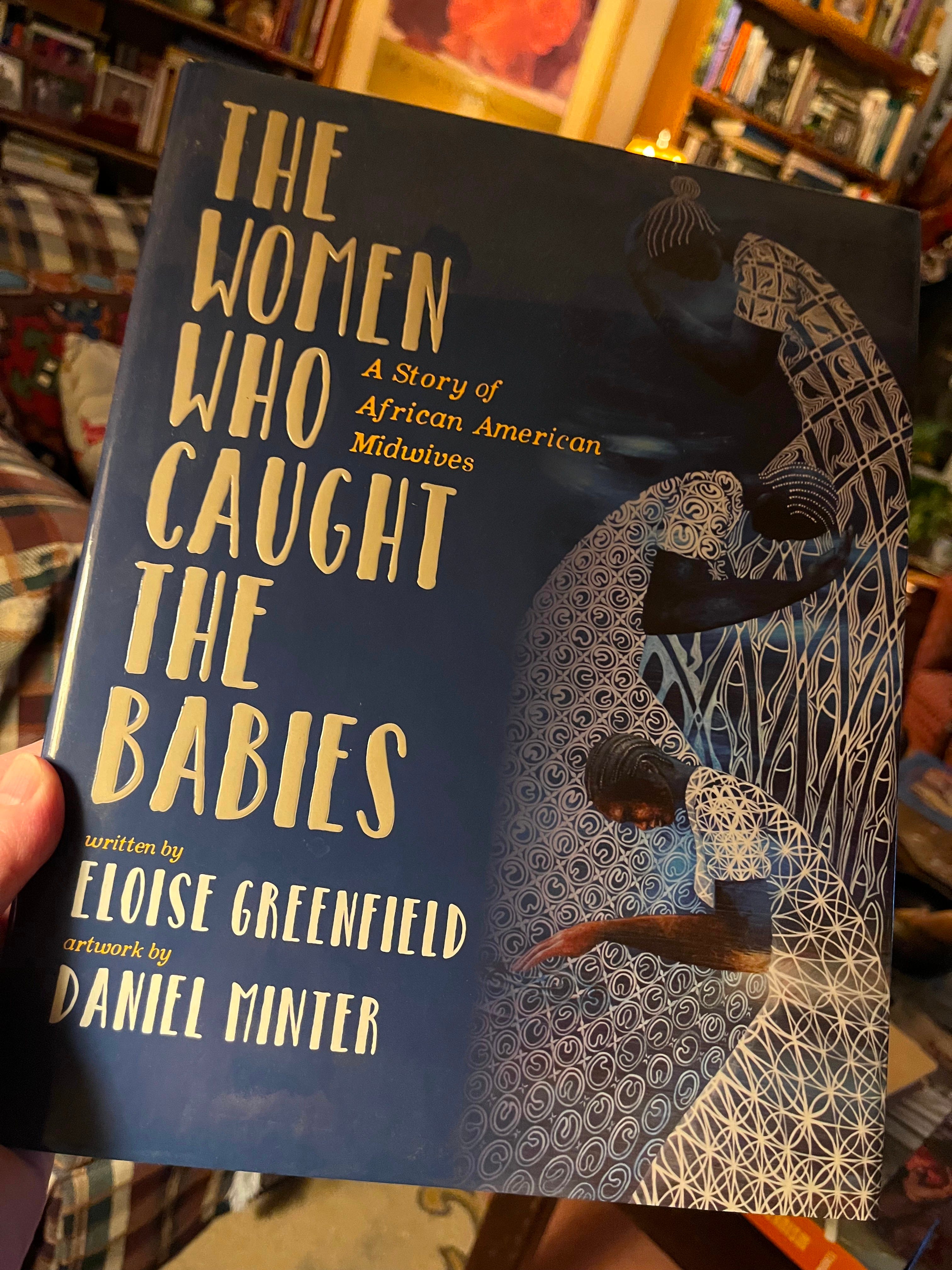
Last night I looked around at my personal library, and I decided that for Black History Month, I will post pictures of the books I own, starting with children’s books I love.

I can’t explain how the story, the format, and the pictures accomplish their miracle, but I cannot read this book without laughing and ugly crying. It’s beautiful
Such a surprising and wonderful subject, beautifully told and rendered.
What we as humans should all share. Come on, now.

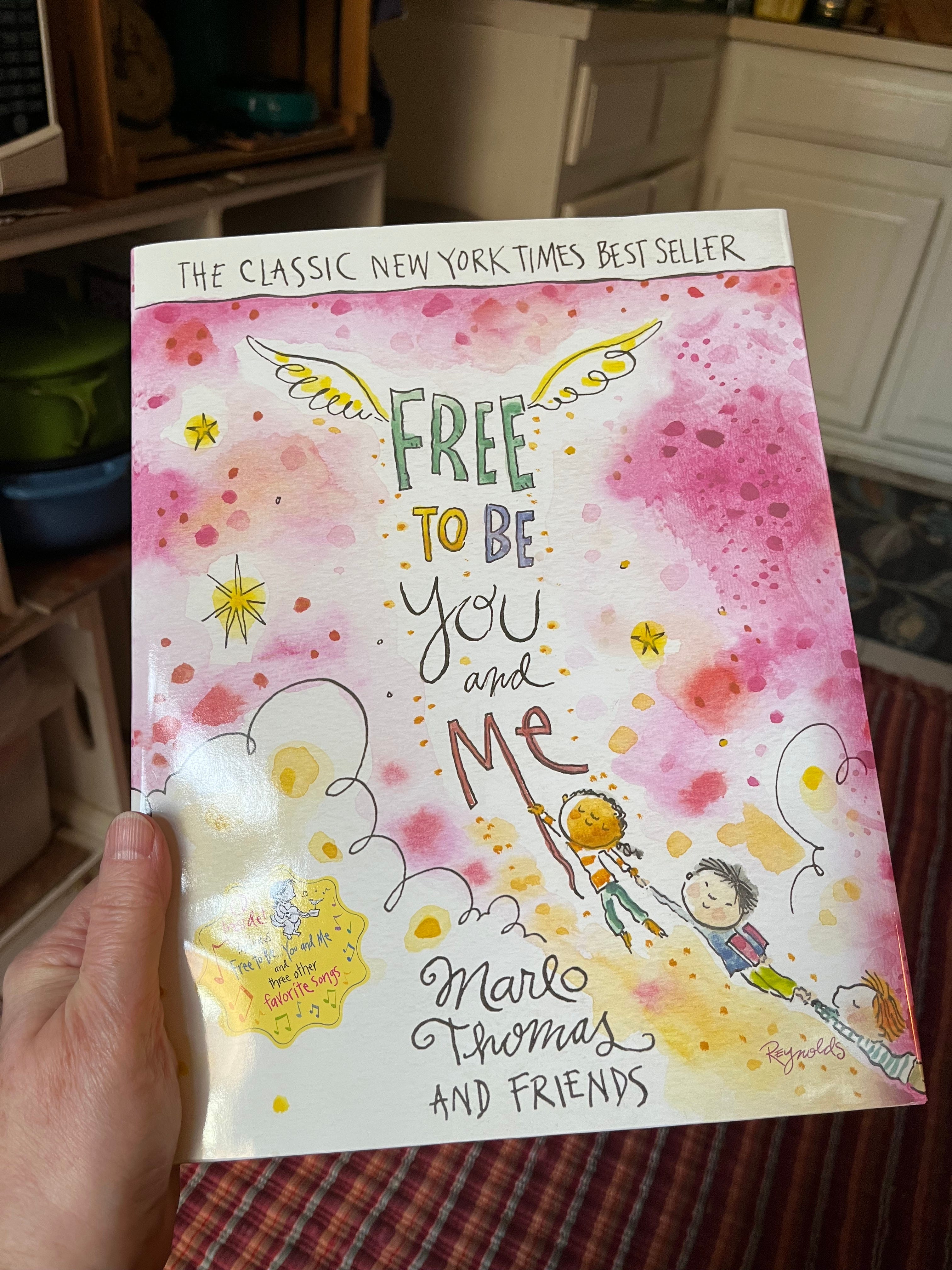
In pulling these wonderful books out to reread (and I’ve never understood why great books have to be categorized into “children’s books”) and suggest for you, I also happened on my 50th anniversary copy of Free to Be You and Me.

Back in 1972, Free to Be You and Me, both a record album and book, became national bestsellers. I know I’ve written about this before: the album, played in elementary and middle school classrooms all over, the book on library shelves, featured “Marlo Thomas and Friends,” and her friends included Mel Brooks, Alan Alda, Lucille Clifton, Judy Blume, Carl Reiner, Shel Silverstein, and many other wonderful talents. In 2002, however, about the 50th anniversary of this remarkable celebration of diversity in community, the publisher was silent. Why? Because the MAGA millions would have demanded the banning of the book, would have stormed the publisher’s offices, maybe, so ignorant, angry, and fanatical in their hatred of anyone not white and male, had this group become.

I don’t know about you, but today, February 2, 2025, I feel like I’m living through the classic American movie Groundhog Day. This lunatic country can’t seem to move the hell on, grow up, be joyful, and get a goddamned grip on itself. In 1972, coming out of the peace and love movements that emerged out of civil rights and voting rights struggles, antiwar protests, extreme violence by our police and military on peaceful American citizens, Free to Be You and Me was this joyful, light, funny, and also serious clarion call for all of us to see the wisdom, really, of children, of artists. Love people. Learn about them. Celebrate the good. Sing, read, play, dance it out. Do you work. Have fun doing it. Look at us now.

In my Creative Drama class in middle school, Miss Graves played this record over and over, using it to teach about the many ways to tell a story.

When Ronald Reagan was elected to the presidency in 1980 (ironically, his catch phrase was “There you go again”), all the promise of progress embodied by President Jimmy Carter not only came to a screeching halt, but we went back 80 years. Groundhog Day, all over again. The journey of Phil Connors (Bill Murray) is our American story.

When President Barack Obama was elected by a solid majority in 2008, and his inauguration was attended by the largest crowd ever seen, then and to this day, I ugly cried with relief. Finally, I hoped, we were moving on, like that time Bill Murray’s Phil finally has a great date with Andie MacDowell.

But it doesn’t take, that great date, and Phil just fucks it all up again, day after Groundhog Day, because he can’t seem to learn anything about how to be a better man.

We elected Trump. Twice. See what I mean?

All of President Joe Biden’s progress is being undone. Trump’s administration and all federal offices will no longer celebrate Black History Month or Juneteenth; the CDC has taken down all information about LGBTQ+ acceptance or health; these fuckers think they can simply erase all the progress, all the humanity, all the education of two generations.

Phil’s fucked up Groundhog Day yet again. “I got you, babe.”

But you know what? Remember in that movie how Phil has to go to rock bottom, to day after day after repeated day including numerous violent attempts at suicide, before it finally occurs to him that aside from feeling like a hopeless immortal god, he might, you know, use this gift of eternal life to learn piano, say, to save lives, to make friends, to bring his coworkers coffee, to invest in the community?

I think it’s vital to our survival to remember the message of that perfect movie, that for each of us, life is Groundhog Day. You wake up, you begin, and you can live it the same way you did yesterday and the day before that, or you can begin anew, grow, find joy, and have a good time in your personal hell. I’m not saying it’s easy.

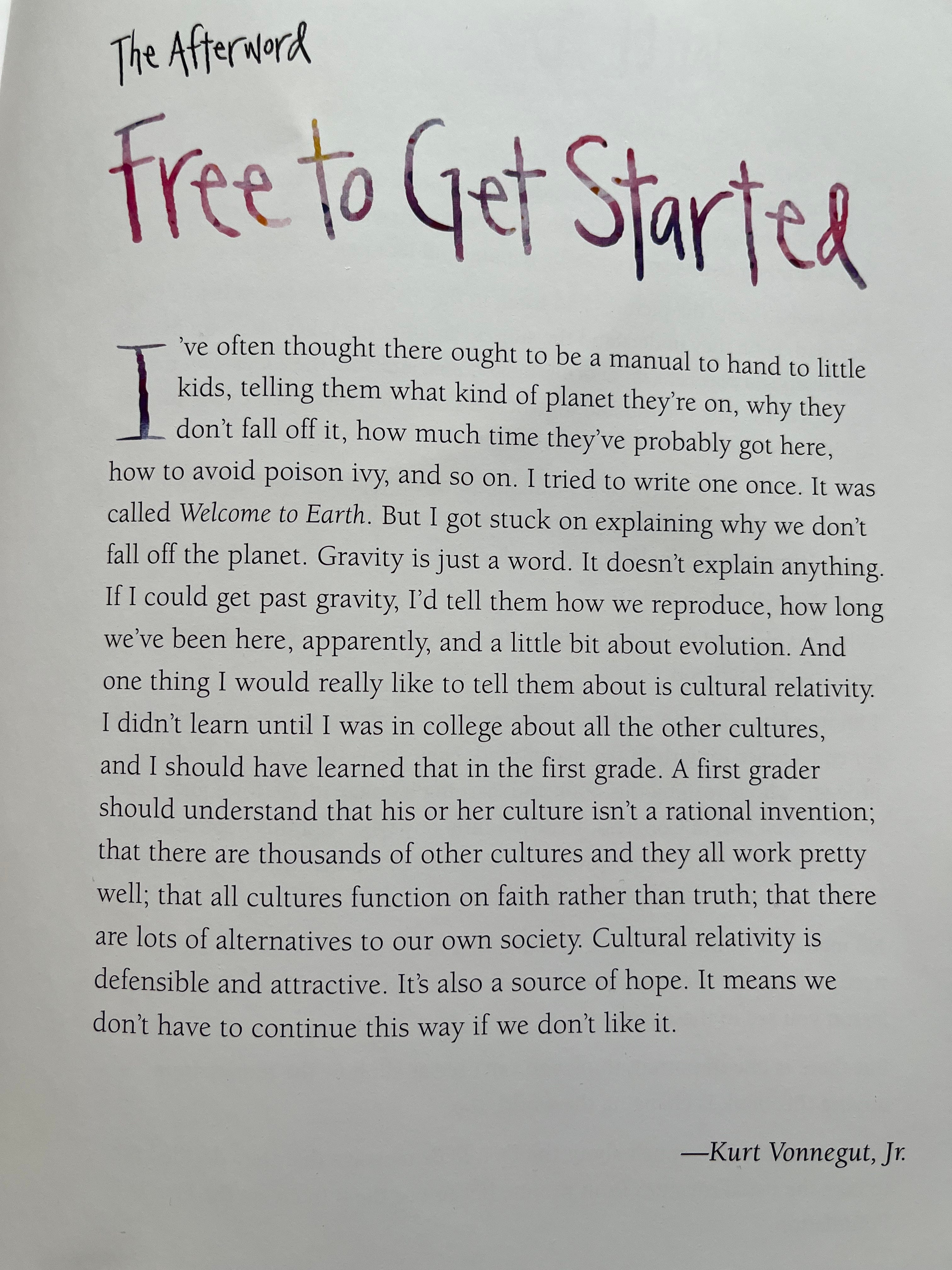
Kurt Vonnegut, Jr., one of the finest writers and minds this country ever produced, lived through the horrors of WWII and produced Slaughterhouse-Five, or, The Children’s Crusade: A Duty-Dance with Death in 1969, five years after I was born and three years before Free to Be You and Me, for which he wrote the afterword:

Into the second day of this Black History Month, on this Groundhog Day, I hope we realize we don’t have to continue this way if we don’t like it.

Sending love,

Miss O’

P.S. The Ed Sullivan Show, on the air from 1948 until 1971, when I was 7, was this marvelous compendium and showcase of all the wacky and beautiful and radiant stuff what was our common culture. For Black History Month, I’d like to close with “Pata Pata” by Miriam Makeba, should you need to celebrate living.

Last-Minute Saves: Completing the Assignment

On Friday at work, on a Zoom call with the “team” and managers and the director of the division and a program “author” who is guiding our work, there was a pause after 40 minutes of presentation and feedback from the author to ask questions. I asked a good question, one I really wanted the answer to. The author relished answering it. I asked clarifying questions, and he answered those. It was hard to read my director’s face, but I know the team was glad of the questions, given the “Directly to you” notes on the Chat feature of Zoom, “Great question,” “I’m so glad you asked that,” etc.

When I left the meeting, I said to myself, “Well, Lisa, once again you may have saved your job.” What I asked—after months of keeping my head down and being quiet as we embarked on this new project—and how the author answered, may well indeed have provided a breakthrough for what will make the next version of the product really special and useful for teachers and students.

My whole life, I reflected this afternoon, has been a series of last-minute saves.

When I was a Christmas tree shearer one summer in the Blue Ridge Mountains, for example, I was having a hard time keeping up, and my rows, though sheared well enough, took me twice as long as others on the crew to complete. After several days of this that first week, I determined to keep pace with a woman next to me, because she was a good shearer and very fast. And keep pace I did. I learned the next day that one of our other crew members had been fired for slow work and because “his trees weren’t good enough.” The crew chief, Sharon, I’m sure would have fired me too, and it would have killed my spirit. Something inside me saved me from this fate.

In a writing workshop in my senior summer of graduate school, after a mediocre first attempt at a short story, and a second attempt that my professor felt was as good as it would get and not in need of a workshop, I wondered if I’d ever write a third and final piece worthy of the work everyone else was doing. I was certainly vocal—participating, challenging, encouraging—and if I’m going to talk that much about how I receive writing, surely I should write something worth reading. And one evening in my dorm room overlooking the lawns at sunset just after supper, I found myself writing in a blaze, a fictional account of my great grandmother’s life in Iowa. It all came in one night, with a crucial misspelling my professor mentioned in the dining hall at breakfast after he’d read the story prior to the day’s workshop. I raced to the computer lab and did the ol’ Control/Find, and I could tell he was pleased by my passion. A student in the workshop gave me a bottle of wine before class, “For the best story of the summer.” How did this happen?

I had a similar save in my second summer of graduate school at the Oxford campus. I was studying Virginia Woolf with an eminent Exeter College scholar who also taught James Joyce. After reading a collection of short fiction, Jacob’s Room, and Mrs. Dalloway, I had to produce my first paper. What would I write about? I decided it had to be Mrs. Dalloway, but what about it? I had no idea. I just couldn’t think. That evening, my friend Anna, who was taking a different course focus that summer, came by my room to see if I still wanted to go to the cinemas and see Howards End, just released, starring Emma Thompson, Anthony Hopkins, and Helena Bonham Carter. I told her my dilemma. “When is it due?” she asked. “Tomorrow,” I said. I sighed. “Let’s just go to the movies.” She was stunned. “No, really,” I said, gathering my things, getting my keys, “because I’m not going to figure it out just sitting here.”

We went to an 8 PM showing, I’m sure, because dinner in Hall was at 6 PM. And it was there, at Howards End, that the key to Mrs. Dalloway unlocked: Emma Thompson and her now husband Anthony Hopkins have learned that Emma’s sister Helena Bonham Carter is pregnant out of wedlock. In the garden, Emma is seated as Anthony paces, determining what is best to do. Emma keeps trying to get up, to go to her sister, to try to take action based on her own conscience. To stop her, to take control, the paternal hands of Anthony Hopkins press and press on his wife’s shoulders to keep her seated, to keep her in the garden.

And my mind exploded: there is a scene in Mrs. Dalloway that had puzzled me as to why it was there at all, which is a luncheon to which a certain Lady Bruton has invited Richard Dalloway, Clarissa’s husband, and a doctor (who is treating Clarissa’s nerves). Lady Bruton has a letter she wants to write to the London Times, and her point of view on the issue is liberal, one might say, and feminist. Yet by the end of lunch, the two men have explained to her what she really means, “Oh, do I?” she says, which is the opposite of her original point, and they write the letter for her. Those paternal hands pressing her feminist shoulders to keep her in the chair in the garden. I was saved.

You might look at these saves and think, it’s just a job, or just a class, or just a paper—it’s easy to diminish the experiences, I guess, but that’s not fair to anyone living this life. This is about that thing inside us, the thing that knows and opens and doesn’t fear, that does the work but also lets go to allow the “thing” to come, to be.

It was this that I witnessed in the person of Vice President Kamala Harris at the Presidential Debate on Tuesday night, September 12, 2024. She found the “thing” to rattle the motherfucker Donald Trump: the small size and demonstrable boredom attending his rallies. And from that moment on he was toast.

Lost because of that moment and its aftermath of verbal carnage, lost on the American press, as usual, was Harris’s masterful grasp of complex policy issues, foreign and domestic, none with easy solutions but with clear and important ideas to address and solve problems. After nine years, on the other hand, a clearly demented Trump revealed that as to replacing Obamacare, he has “concepts of a plan.” (As veteran retired high school teacher Tim Walz recounted this at a rally in Grand Rapids, Michigan, “My students had better excuses than that for not doing the work.”) Harris laughed.

Kamala Harris, Tim Walz, and I are all the same age. Born in 1964, we are the last year of the Baby Boom, the year before Gen X. As a result, we were both the responsible adults in the room even as children and also the last feral children out playing till dark all summer long; and, in addition, we get all the Monty Python jokes. I feel this in them, the kinship of that cross-section, people who do the work of the grownups but are loose enough to allow the realness to be and with humor. It’s helped sustain Harris and Walz in their brilliant and varied careers, I have no doubt. It’s done the same for me in my less brilliant but no less varied careers, too. Being adult and being real and being funny: it’s saved us.

With Harris and Walz and that generational realness, we have a chance to save this country. We can save it. Let’s save it.

Love,

Miss O’

Miss O’ recognizes, nay, feels, all these teacher faces. Credit to @AnandWrites

On Orlando and Transitions

Meditations on Transgender Humans

From the NYPL exhibit on Virginia Woolf, 2023. Photo by LO’H

A couple of years ago, the social media posts of “Sam,” a young gay man in his 30s, the beloved former student of a late teacher friend of mine, began shifting from a fun social and work life to marking a life in transition. First, Sam shared multiple moves, the most alarming (to me) was a move (for work) to a dangerously bigoted Southern state, where he was determined to make a go, build a community, and change hearts and minds. As life there, despite his best efforts, became less and less tolerable, he found himself in transit yet again, back to a major city in his home state. Shortly after this move, about which he detailed his joyful creation of a new home with the help of many friends, he began including pictures of himself in “feminine” clothes and accessories (pictures that reminded me of Tom Wilkinson’s character in the landmark film Normal.) Not long after, Sam formally announced that he was beginning a formal transition from “male” (assigned at birth) to “female,” which Sam said was the gender he had always felt he was. What has followed includes his documenting phases of this journey, including legal name and gender changes on his/her/their identification cards, photo records of a shift from pants to dresses and in a face in full makeup, the results of their hormone treatments, and most recently and significantly, a diary of their gender reassignment surgery, their plastic surgery to make their face more feminine, and the post-op difficulties that are part of the process.

For my own part, as an advocate and ally of the LGBTQ+ community, I have found watching this process overall to be troubling. Because I haven’t understand the source of my feelings, and because I still don’t know how best to be supportive in an honest way, I made a decision not to “heart” Sam’s posts, but instead to follow them at a distance, as it were, while working on myself to get a handle on what “transgender” means and how best to understand my muddled response to it.

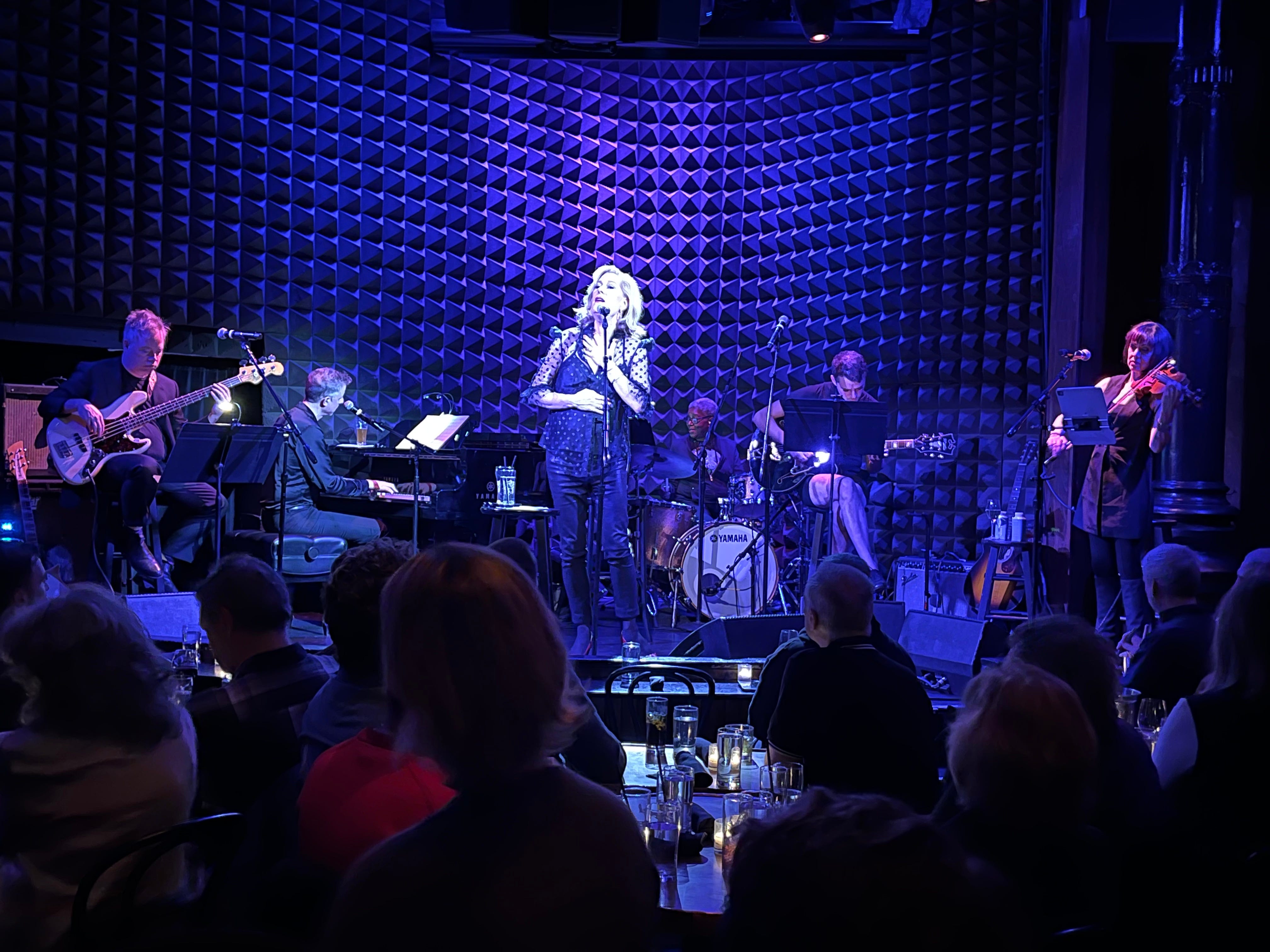
The start of my own encounters with this cultural shift began by seeing cabaret. One of my favorite live performers in New York is Justin Vivian Bond, who as Justin Bond made a name in the downtown cabaret scene (and later, on Broadway, where I first saw them) in the character of singer Kiki DuRane in the duo Kiki and Herb, with Kenny Mellman as the always supportive Herb on piano. When Bond made a decision to present as female and then transition (with hormone treatments, but forgoing gender reassignment surgery), I remember items in New York magazines taking the famously cross-dressing Bond to task, saying, “Vivian? Now you’re going too far,” that sort of thing. Mr. Bond became Mx. Bond, doubled down on their activism, and used music and humor to include the story of transition into their act. “Am I he, she? I don’t know what I am,” Mx. Viv said at Joe’s Pub one night during a tribute to Judy Collins, who was there to introduce Bond and their band; Judy had used feminine pronouns, asking, “Am I using the right ones?” and in response, Viv (who presents tipsy as part of the act) said he/she/they didn’t really care either way. At the time, the idea of changing pronouns was a fairly recent idea, and we were all on shaky ground. Why not acknowledge that?

Justin Vivian Bond in performance at Joe’s Pub, November 2023. Photo by LO’H.

As a society, we have all been, in fact, transitioning to a new, amorphous world where gender isn’t rigid. In response to this change I think (no doubt subconsciously), expectant parents began staging “gender reveal” parties, as if to say, “My child will know exactly who he, or she, is,” which we know now may or may not be the case. And sure, as with any movement, some kids may declare themselves to be other than the gender their genitals indicate, but the truth is nothing about gender fluidity is new. For example, as a child ca. 1920, and for at least two years until she was 14, actress Katharine Hepburn insisted that the family call her “Jimmy,” and she wore boys’ clothes and had her hair cut short. Her family just went along, and why not? But there is a darker side to this, too, because her older brother Tom (who wasn’t “manly” enough, some biographers have suggested, for Hepburn’s father) committed suicide at age 16; young Kath found him hanging in a closet. As a family, the Hepburns never spoke of it again. And I can’t help thinking that while a daughter, still, can present as a tomboy, there is, still, no society space for a young boy to present as a girl for a while, try that out; let alone for either to transition.

What was troubling me about Sam’s transition had to do with a vague feeling, and I mean to be honest here, of repulsion toward the idea. Why? Why was I feeling this? Did I not quite believe him, suspect he was being exhibitionistic to be, say, a sensational social media influencer? It crossed my mind. But I don’t think he’s lying. The problem was with me, and I decided I had to understand—what I could easily accept in Mx. Viv, I struggled with in Sam, I realized, because Sam is someone I have actually known since he was a teenager. My internal conflict was much closer to what the parents and friends of trans youth might feel than I at first acknowledged. All this is really to do with gender as a societal construct, which (I see now), I’d had the good luck never to have to worry about.

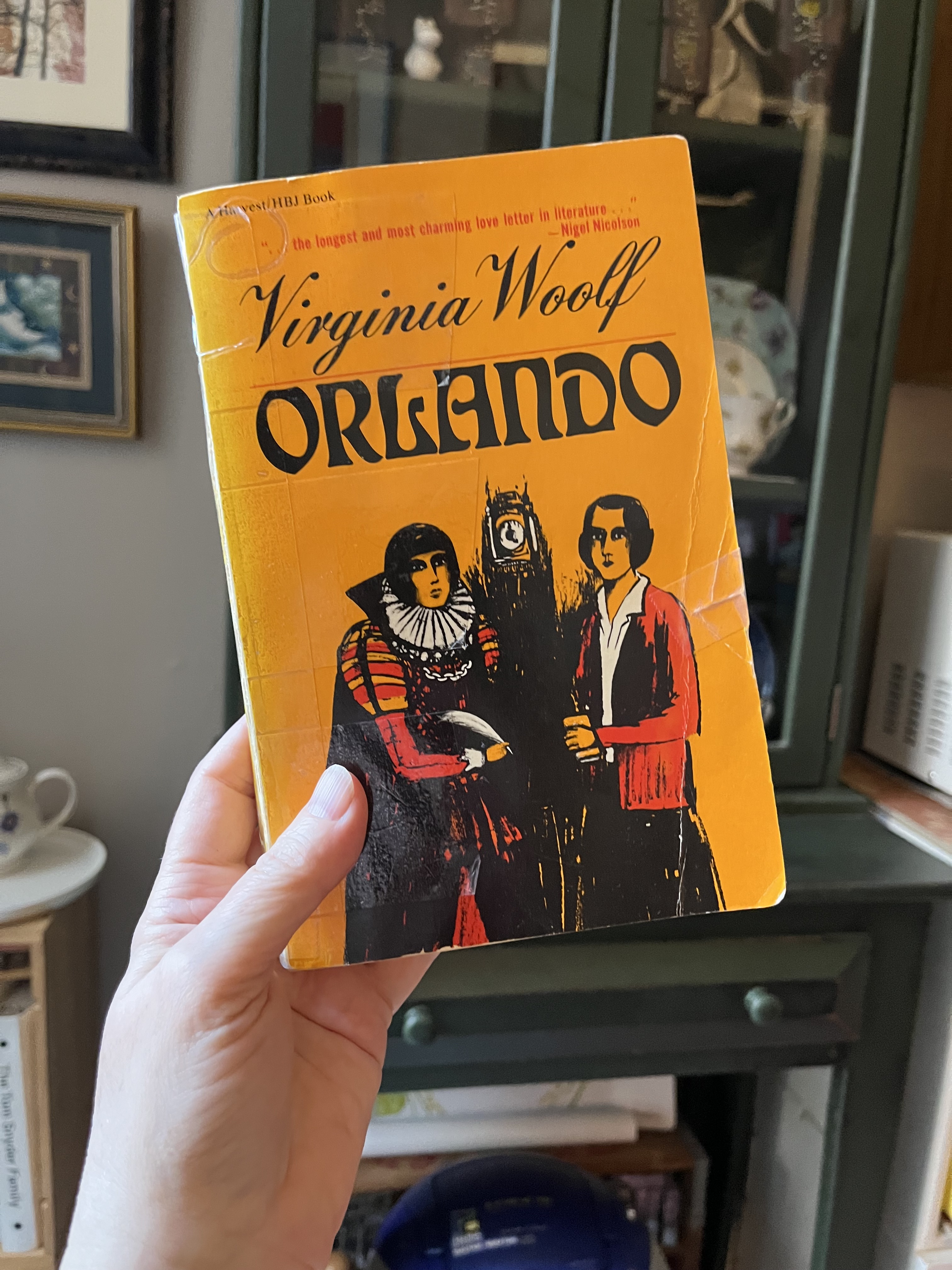
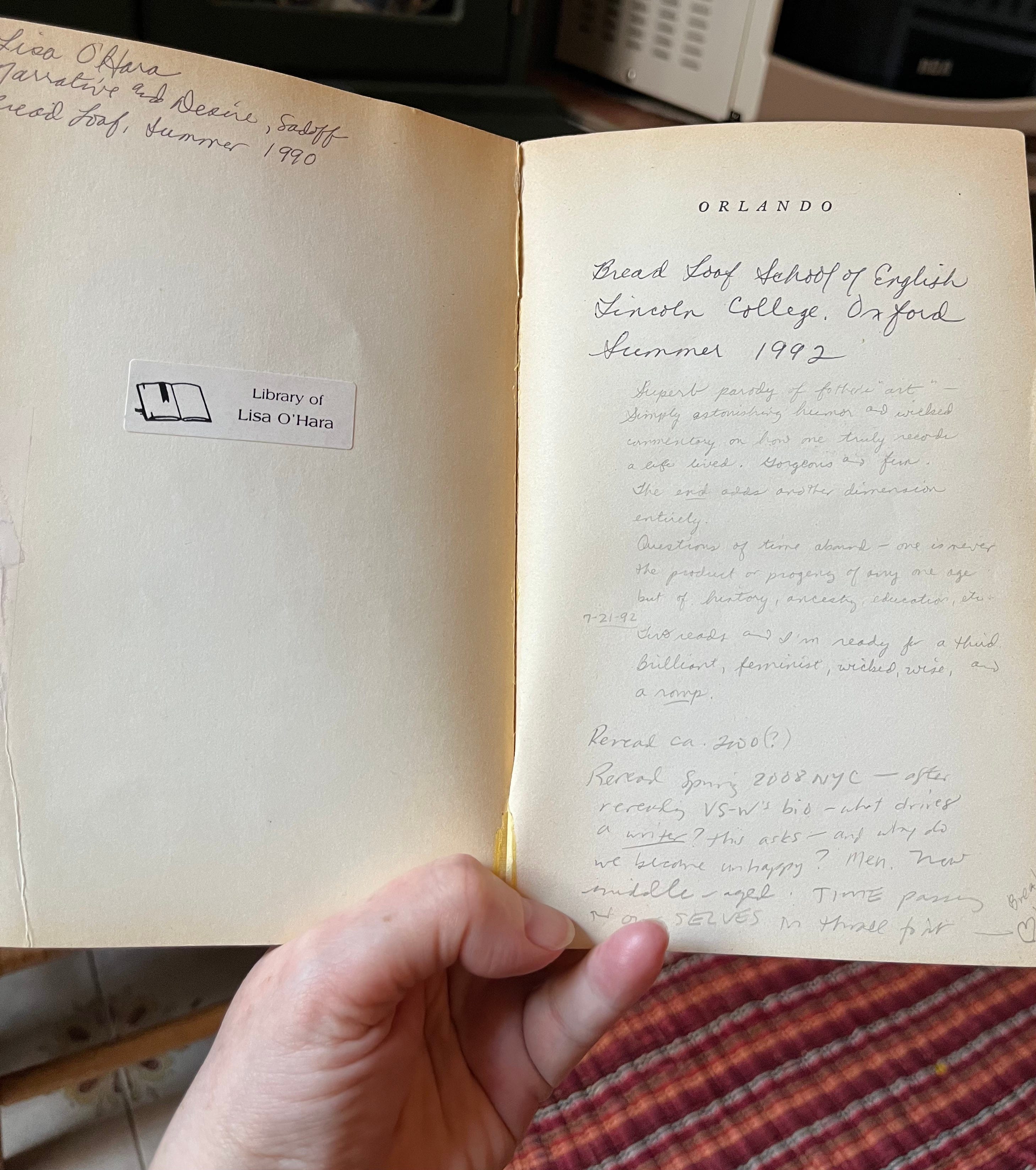
The well-worn copy itself.

The first novel I read that centered gender is Virginia Woolf’s Orlando: A Biography, which I decided to reread. Because I read with a pencil in hand, having conversations with my books, I see this must be my 6th reading of the full novel. (The only time I didn’t record impressions was in rereading it prior to studying in London in 2000, where I went three days ahead of classes so I might haunt Bloomsbury.) Each reading had a different purpose or at least caused me to come away with distinct, and distinctly limited, impressions. First, I was wowed by Woolf’s imagination—so different from that stultifying attempt to read To the Lighthouse in college; later, the more I learned about Woolf’s life, I was charmed by how her novel parodied her father’s profession as editor and writer of the Dictionary of National Biography in England. But more profoundly, Woolf’s novel was a deep reimagining of the life of her lover, for a brief period, and dear friend Vita Sackville-West. I’ve read the novel, then, over 30 years and with many discoveries, but this was the first time I read it with an intention: while I’d enjoyed the fantasy element of Orlando changing from a man to a woman over some 350 years, up the “present moment,” aged 36 in 1928, I had never thought about this gender change more than intellectually. Yes, we see what it’s like to be a woman vs. a man over time, and that somehow Orlando having had female lovers is still okay by the novel’s end, which is quite an achievement in modernism. But what am I missing?

The record of my rereadings. Do you do this?

Books become different because we become different readers, which is why rereading is so important. This particular revisiting was prompted by a movie. Back in the early winter I went to Film Forum here in New York to see Orlando: My Political Biography, a documentary in which several trans people were interviewed about their encounters with this novel, how it became their identity bible, how it helped them survive. Because I had no personal reason to connect with the novel on that level, I’d never read it that way (and these readers needed none of the backstory of Woolf and West to find the novel both revolutionary and comforting).

But now I had Sam and Mx. Viv (as well as my friend’s grandchild, now completing middle school as a boy); I’d seen the latest in a series of American horror stories, this the story of a nonbinary student in Oklahoma beaten to death in a high school restroom by (gender-assigned) girls, the student’s head smashed in over and over and over against the floor. Where does this hatred, this viciousness, come from? Where is all this fear coming from? Could reading Orlando again help me figure something out?

Woolf’s novel was (as Nigel Nicolson, the younger son of Vita Sackville-West, said) obviously a “love letter” to Virginia’s friend Vita, who when her father died learned she could not inherit the family estate Knole because she was a woman; so the famous estate went to her second cousin Edward (who had had nothing to do with the place unlike Vita, who’d loved and cared for it and kept it running all her life), who in turn sold it to the National Trust. Vita was bereft. In addition, Vita was bisexual, married to another bisexual, Harold Nicolson, and lived her life more or less as a man in her independence. Hers was quite a complicated life story in any era, but especially in 1928, when the book was published. Woolf’s novel was a spectacular best seller.

One might well ask, How did Woolf get away with it? In her infinite genius, she went full-on fantasy, beginning Orlando’s life back in time, when Queen Elizabeth I gifted Knole (fictionalized in the novel) to Thomas Sackville, Vita’s ancestor, and when Orlando (of the title) was a boy of 16. By taking Orlando through the ages—via the voice of a biographer-narrator who confesses to being as mystified as the reader at the changes, saying simply, “but that is what happened, what can I do”—Woolf subverts the gender transition though time transition. Readers are kept off balance through humorous descriptions of the awkwardness of the gender transition, exploring the mores and their differences for men and women through the ages. Orlando embraces, finally, her many selves, her genders, over all the centuries, coming to the present moment as a poet, a wife, a mother, a woman in the 20th Century.

The novel, as a note to those of you enticed (I hope) to read it, is not without ugliness—casual bigotry and acceptance of colonialism shockingly run throughout—which shows that no author, however enlightened in many areas, can be expected to be enlightened in all areas. But as Woolf’s biographer-narrator might say, “Difficult though this is, it’s what happened, and so we must record it.”

I must say, this journey of the past few years has been deeply affecting. I had never really thought about being a cisgender woman attracted to men since birth; I’ve had to ask myself if I was ever attracted to women, and yes, I have been—but only once I remember, as it happened oddly, suddenly, and then the feeling passed, in the audience of a theater maybe 15 years ago. I was in perimenopause at that time, I think, increasing in testosterone—was that it? Who knows? But it was real. Why did it hit me as something wrong? Why must anyone be tormented for having healthy sexual feelings, loving feelings, for our fellow beings; for wanting to express what is inside us in honest ways? Why do we continue to insist on gender reveals, coming outs? I used to wear dresses as well as pants; now I wear exclusively pants. I began dressing as a man, I guess, but with scarves and jewelry; and as a woman in America I can do this. Why can’t anyone of any gender simply discover and express themselves honestly?

“When this happened, Orlando heaved a sigh of relief, lit a cigarette, and puffed for a minute or two in silence. Then she called hesitatingly, as if the person she wanted might not be there, ‘Orlando?’ For if there are (at a venture) seventy-six different times all ticking in the mind at once, how many different people are there not— Heaven help us all having lodgment at one time or another in the human spirit? Some say two thousand and fifty-two. So that it is the most usual thing in the world for a person to say, directly they are alone, Orlando? (if that is one’s name) meaning by that, Come, come! I’m sick to death of this particular self. I want another.”
~ Orlando, page 308 (HBJ edition)

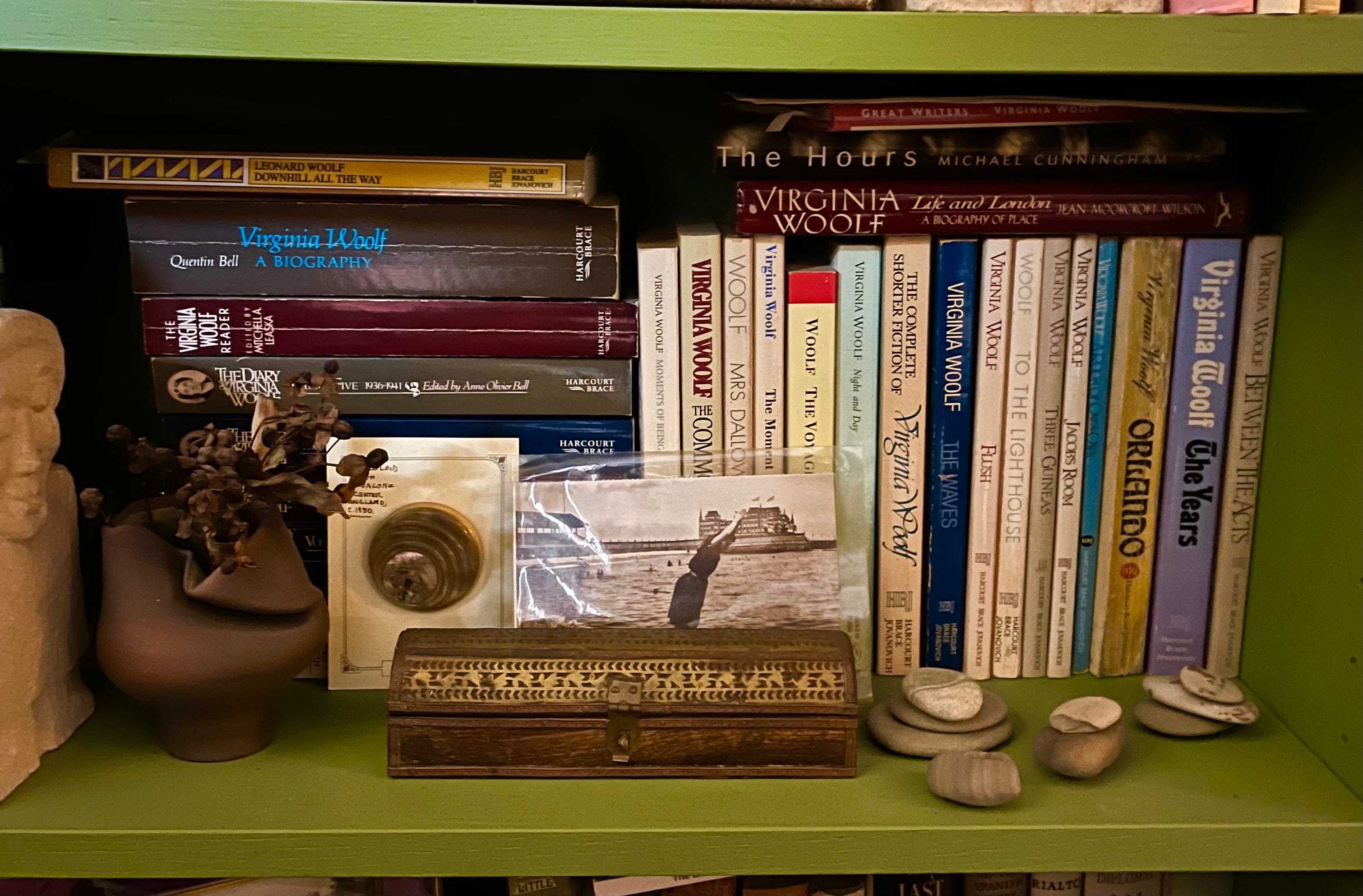
Miss O’s Woolf shelf, partial view. Essays, letters, diaries, and especially her fiction: Virginia Woolf remains my favorite writer. Orlando, taped and glued together many times over, was my gateway.

And this is where I am in this moment, today, the 10th of March in the year 2024, writer, artist, editor, daughter, sister, friend, woman. What about you?

Love, in all its forms,

Miss O’