
More thoughts on our national monsters
Hi, dear one. In my last post, I related how I’d recently read a book, Monsters: A Fan’s Dilemma by Claire Dederer, and this week, by a serendipitous coincidence, PBS streaming has rereleased a series from 1987, The Power of Myth, a conversation between Bill Moyers and the great mythologist Joseph Campbell, who sadly died not long after the final interview. You can also get the companion book, created because the 6-hour series (filmed at George Lucas’s Skywalker Ranch) couldn’t contain all the insights.
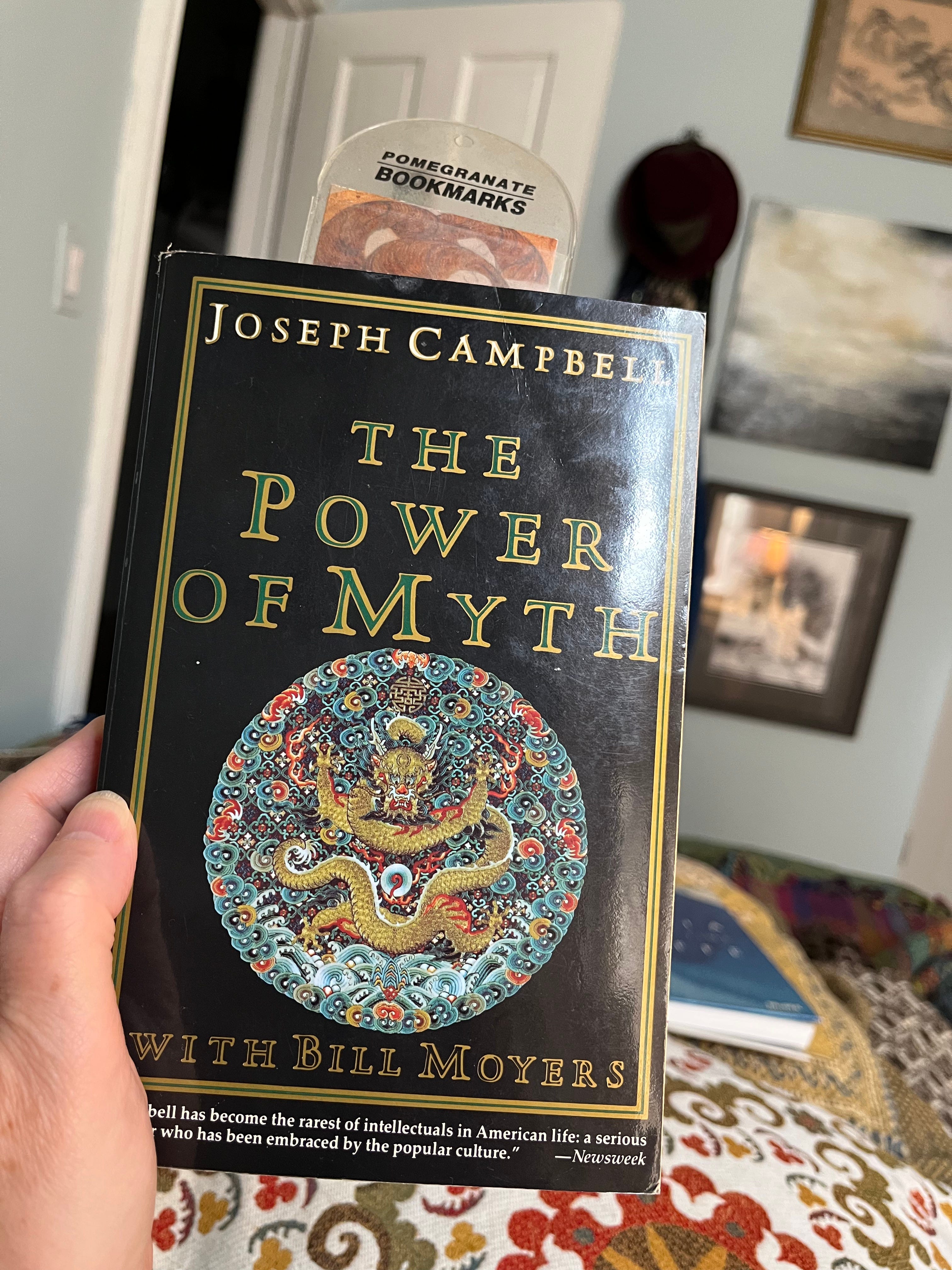
Moving from monsters to dragons felt like a natural progression. Also, in another moment of serendipity, I had a conversation this week about the work of Patsy Rodenburg, a voice teacher and acting coach, and her work The Second Circle. All of this makes sense together in my mind, so we’ll see how I do.
In a society such as ours in 2025, I wondered what Joseph Campbell might be able to help me with. As it turns out, plenty. Bill Moyers is a great host, comfortable asking naïve questions, and while for the intelligentsia it’s tempting to make fun of him, he gets wonderful answers. Moyers, by the way, was President Johnson’s Chief of Staff and later Press Secretary (he called Johnson “fifteen of the most interesting men I ever met”); he is smart and educated (and still with us at age 90) as well as attuned to society, but he’s at ease with not knowing and relishes seeking to understand (which I find are the key qualities missing from today’s journalists as well as citizens).
In one episode of The Power of Myth, Campbell explains Star Wars as one of the most recent (then) examples of the hero’s journey (there’s a whole episode on that; Campbell’s work inspired Lucas) and what that mythology tells us. Myths, he explains, including hero’s journeys, are not about seeking meaning in life, but rather about experiencing life. Moyers and Campbell talk of the ways in which people follow church doctrine, for example, to guide them, or follow strict rules and procedures rather than their own instincts. Often, heroes have to abandon what they thought they knew to get through the challenges.
They talk of the struggle with temptations presented by the serpents (found in every culture) where there is an expected way to live, the tension between the body and the mind, between desire and outside rules. At one point, Moyers reflects on ordinary people’s lives and the hero’s journey, especially the moment that Luke Skywalker, in a life and death struggle with Vader, chooses not to go over the dark side.
Of this dramatic choice of good over evil Moyers says, feeling secure in himself, “But that isn’t what happens in my life.”
And Campbell quickly counters, “You bet it does. If the person doesn’t listen to the demands of his own spiritual and heart life, and insists on a certain program, you’re gonna have a schizophrenic crack up. The person has put himself off-center. He has aligned himself with a programmatic life. And it’s not the one the body’s interested in at all. The world is full of people who have stopped listening to themselves.”
I don’t know about you, but it seemed to me this perfectly described this American moment.
Campbell and Moyers also talk about dragons, and Campbell’s take on dragons is fascinating to me—they guard. “The European dragon,” Campbell explains, “guards things in his cave, and what he guards are heaps of gold and virgins, two things, gold and virgins, and he can’t make use of either of them, but he just guards. There’s no vitality of experience…” In psychological terms, you’re binding yourself to your own ego, if you are dragon. (Campbell contrasts the negative European dragon with the “great and glorious” Chinese dragon—two very different things.) The dragon in us is our ego, “What I want, what I believe, what I see,” Campbell says, and “it might be too small.” To slay it, “you have to follow your bliss,” by which he means your true nature.
The Europeans, who colonized so much of earth, then, are based in a culture that fights those who hoard gold and virgins, and yet the heroes don’t fight the dragon for any other reason than to the take the gold and the virgins for themselves. Another perfect metaphor for America.
Campbell wouldn’t say that deciding to destroy others is anyone’s actual “bliss.” Annihilation of the innocent, the hoarding of gold, and rape of women cannot be bliss, because I see dead eyes in Trump, in Musk, in Speaker Johnson, in Vance. They are without souls let alone hearts. Anyone with access to their own hearts would follow President Zelenskyy anywhere because anyone can see Zelenskyy is Luke Skywalker; it’s not about him, this war, it’s about saving a country he loves. You may think that doing what you love “doesn’t save the world,” only yourself; but Campbell says that by saving yourself, you save the world. “An influence of a vital person vitalizes. There’s no doubt about it.” Otherwise, the world is a wasteland. Slava Ukraine.
“An ego that sees a ‘thou’ is not the same ego that sees an ‘it.’”
– mythology scholar Joseph Campbell on the difference between the relationship Indigenous people had with buffalo (“thou”) and that which the white man had with buffalo (“it”); see also, Putin with Ukrainians
Last week my friend Keith, an actor and writer, was in town working on contract negotiations for his union, and we met for dinner on Third Avenue Thursday evening. The dinner time changed from 5:30 to 7:30, so around 6:40 I left Queens for Grand Central, going down toward the back of the 7 Train to be nearer the Third Avenue/42nd Street exit when I arrived at the station. When I entered the car, there in the corner was a bearded man, quite filthy and disheveled and resembling Rip Torn, a faded red towel safety pinned like a cape around a grimy white tee shirt fragment. He was talking to himself in animated tones about a woman who was in pain, her feet, I think, and the narrative was taking place at a hospital. He’d caused the car to reek, though not many people were bothered. I was, though, so when I sat down in the only available seat, I casually rummaged in my cloth sling bag for a mask. (Since Covid, the option of wearing a mask allows us to give smelly people some grace, to not embarrass them by pulling collars up over our noses, or to have to beat an exit to run to the next car at the next stop; in NYC in summer, it’s not uncommon for one person’s stench to clear out a subway car and leave it empty at every stop for a whole day. Pro tip: NEVER get on an empty subway car on an otherwise full train; everyone does it. Once.)
Over dinner, Keith and I talked about many subjects, from poetry to opera to politics, when he mentioned he was going to Portugal to study with renowned voice teacher and acting coach Patsy Rodenburg, whose work I love. In a quick but inadequate summary, I can tell you that Rodenburg (whom I first heard of in an interview on NPR and saw later on video from Michael Howard Studios in New York) noticed over the years that she could distill actors’ energy into three “circles”: inward directed (First Circle), outer directed (Third Circle), and perfectly present (Second Circle). We need all three circles, and all three circles have their uses, but to be an effective actor, you must live in the second circle of true intimacy, fully present.
You see this in life—First Circle, the people scrolling their phones, or the cashier who won’t look at you; and on the other extreme, Third Circle, the salesmen, politicians on the campaign trail, preachers greeting parishioners. Miss O’ lives in second circle, as do many of my friends. Second circle can be unnerving to people who are not, as Campbell would say, able to follow their bliss. People who need a doctrine to cling to—the Ten Commandments, Project 2025, even the Rule of Law. Any doctrine can be leveraged for good or evil when people are not in Second Circle. (Trump, I suspect, lunges between First and Third circles all the time, which creates a violent imbalance. He hasn’t been in Second since infancy, where we are all in harmony.)
And this brings me to a deeper truth, perhaps the most unsettling to me. In the United States, we have no more rituals (beyond, what, morning coffee?), no mythologies, no common culture to bind us together. If we could be honest, tell the truth about our origins, all the complexities of colonization, genocide, slavery, revolution, enlightenment, the uses and abuse of Christianity, all of it—we could formulate a national mythology and enact rituals to guide us to growth and build further understanding. American Idol is the best we can do? The spectacle of competing for money and fame? Has The Apprentice taught us nothing?
At one point, Campbell uses our architecture to tell us who we are in the U.S. in the modern age. In Salt Lake City, he notes by way of example, first the Temple was the tallest structure (religion), then the Capitol dome (politics), and now the Office Building that handles the economic affairs of both is the tallest and biggest edifice (commerce). It’s the Symbol of modern life. What does this mean for us? “You can’t predict what a myth is going to be any more than you can predict what you are going to dream tonight. Myths and dreams come from the same place.” What is the new American dream?
In six weeks, we citizens watched helplessly, and Democratic leadership spinelessly, as Donald Trump destroyed 250 years of American law and governance, wiping out the mythology of a nation. Listening to Campbell, I gained historical perspective. Though Moyers switches quickly, in editing, away from his point, Campbell does passionately remind us that Indigenous people, in a mere ten years, lost everything in the way of their rituals, their sacred dependence on the buffalo, their freedom, their land, and thousands of years of a way of life. Like that.
We’re in the process of losing a few hundred years’ worth. It’s nothing by comparison. It’s just ours. And “ours” was never “everyone’s.” If we are honest.
Our struggle now (if there is an “us”) is recognizing the difference between the seductive serpent, the dragon to slay, and the vital person. Everyone made fun of Hillary Clinton when she said, “We have to change hearts and minds,” mocking her with, “It can’t be done.” Of course it can be done. As my theater hero Joseph Chaikin said, it isn’t done “en masse, but one by one by one by one.” We each do our best to be alive, and our aliveness brings life to the world. Moyers brings this around to the importance of teachers, of which group Campbell was a member. The therapists, the storytellers, the healers, the helpers, the educators: we help bolster the world, prepare our heroes, vitalize the works.
Coda: Keith walked me to the Grand Central around 10:00 PM, and I descended the stairs from the Third Avenue entrance. Down on the platform, I walked to where an old man, a blues and rock electric guitarist, played a history of the Beatles and Jimi Hendrix as two other musicians looked on. We thanked him, gave him a few dollar bills. When the train pulled in, we got on the car, and I smelled a familiar smell. I looked down the car and there, in the same seat with the same two-liter bottle of Mountain Dew, was the same schizophrenic man. What are the odds? Weirdly, this sort of thing happens to me a lot in New York. But think of any number of small things that could have happened differently—the time I left home; or the time we left the restaurant; where I stood on the platform either way. It’s remarkable.
I pulled out my mask. The man sat alone, no longer chattering away but looking at us, lost; I think he vaguely recognized my hat. A needy citizen ignored, an “it” instead of a “thou,” someone else’s problem. The American ego.
I don’t know why, but thinking of all these stories and our ordinary workaday lives, I hear Pigpen’s voice in A Charlie Brown Christmas, when Linus points out that the dirt and dust on Pigpen could be from the soils carried across the ocean from ancient Egypt, to which Pigpen, adjusting his costume says, “Sorta makes you have a little more respect for me, doesn’t it?” Maybe Peanuts feels like it could be a start for our mythology, if we tried. We could do a lot worse.

I do go on. Happy Sunday. I really should get out of bed.
Love,
Miss O’


 The Miss O' Show (Teacher's Edition)