A Life in the Theater

On character, tragic flaws, and hope

Nov 09, 2025

On November 9, 2010, 1st Lt. Robert M. Kelly, USMC, was killed in Afghanistan. Robert had been a student of mine at Gar-Field High School in Woodbridge, Virginia, along with his older brother, John, both of them the sons of Gen. John Kelly (Maj. Kelly, when I first knew him; I attended the ceremony when he became Col. Kelly). Both John and Robert were in the Drama Club, and very different kids, John doing technical theater (lighting), Robert hanging around until he scored a legendary turn as Juliet in The Complete Works of William Shakespeare Abridged (with a cast not of three but of thousands) his senior year, a performance that caused his father to laugh harder than I’d ever seen him do. Interestingly, son John (now a colonel in the USMC himself) was naturally funnier, but ironically it was Robert’s relative seriousness and deeply felt empathy that made him a great comic actor.

I got the news of Robert’s death 15 years ago through missed connections all day, brother John trying to reach me, my return calls back going to voicemail; I thought something might have happened to Alan, another former student and John’s best friend; finally I got hold of Alan while at a play lab at the Pythian on the Upper West Side, where cell reception as terrible and I had to go out to the street to reckon with the truth. I didn’t know Robert had even been deployed; apparently it was a sudden decision to send his unit over, and maybe only a week had passed since his arrival, an IED doing the job.

Robert’s funeral and burial at Arlington, just eleven years after his graduation, seven years after I’d left teaching and had moved to New York, was attended by well over a hundred people, many from Gar-Field, teachers, students, friends, parents, along with his family. Hard to process even now. I was reminded of all this yesterday when my friend and retired department chair Tom texted to remind me, thinking only ten years had gone by. (I knew it was longer because my cell phone had been a flip phone. Isn’t that a particularly millennial reason to remember a date?)

So tragedy is on the brain this morning.
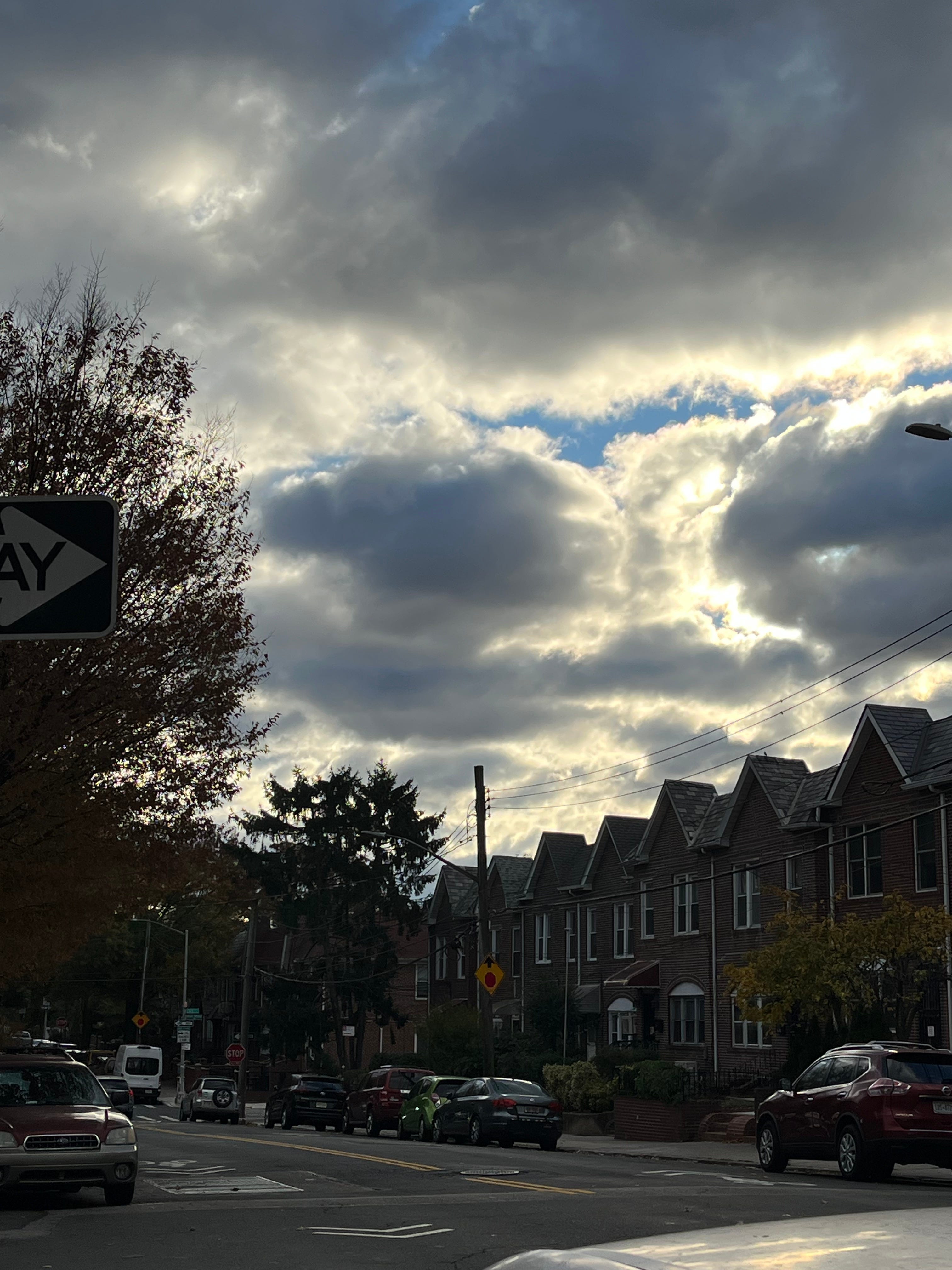
Biblical sky drama over Queens.

Last Saturday I went to see a West End-Broadway transfer production of Oedipus, a new adaptation and direction by Robert Icke (say Ike), with friends Frances and Jim, who got the tickets for us (or else I might have foolishly missed it). The lesson of Oedipus is, famously, “One always meets one’s fate in the path one takes to try to avoid it.” In the Greek version, the Oracle at Delphi prophesizes that the baby born to King Laius and Jocasta will one day kill his father and marry his mother; Jocasta then, to spare her son, orders her servant to kill the baby. Instead, the loving servant places the baby in the woods, where he is found by an older couple from the country who raise him as their own, no one the wiser. Until eighteen years go by…
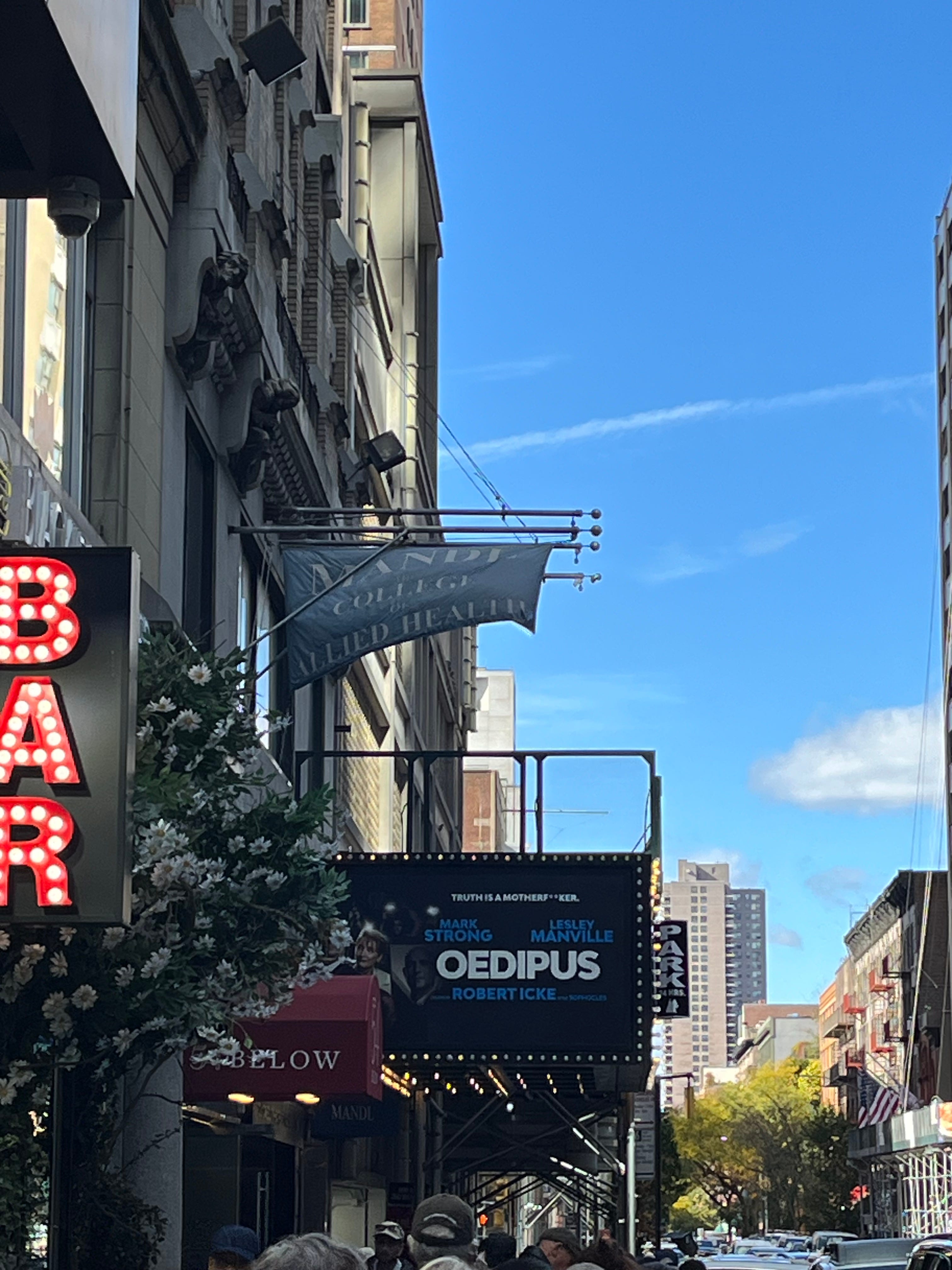
In this update, Mark Strong plays Oedipus as a political candidate on the night of a highly consequential election (intimations of Trump v. Democracy), and all the action takes place during the two hours between polls closing and the announcement of the winner (a big clock on the stage counting down—Aristotle in Poetics says that any good drama should play out in no more nor less than two hours, and Icke takes on the challenge). In a filmed sequence as the show’s opening exposition, a confident, sexy Oedipus, standing outside what looks to be the British Parliament building, tells the press that he knows people question why he, a foreigner, should lead them, and he promises (without warning to anyone in his circle) to “release my birth certificate.” It brings up Obama, Mamdani, all the prejudices of our times, and if you know the story of Oedipus, it’s the perfect setup for an adaptation. (Icke must have shrieked and shaken with freakout when he thought of it—hoping no one else saw that obvious and genius connection up to now.)

Oedipus—handsome, smart, gifted, loving, and progressive—has one fatal flaw: hubris. He really believes he is in complete control, fully in possession of himself, knows who he is, knows who everyone is in his life. The next two hours unravel in the revelations we know from the Greek tragedy, all so believable and so timely, with Lesley Manville’s Jocasta ripping your heart out, her (updated for our more enlightened times, shades of Epstein) story of being raped by old Laius at 13, forced to give up the baby to die because he’s married; Laius later marrying her and leaving her a widow who later meets Oedipus, falls wildly in love, and marries him, giving him three children, she then in middle age. At the play’s opening, Oedipus is 52; Jocasta, we only later realize, is 65; their children are college age. In short order, despite a landslide victory, their children are about to lose everything, Jocasta her life, and the nation the promise of a brilliant leader. (The best part was sitting next to someone who didn’t know the story—lots of people don’t—and hearing the gasp.)

How does any brain process such a trauma? Frances and Jim and I staggered through the tourist minefield that is Times Square to the quiet of an Italian restaurant to process it, all of truly gutted, Aristotle’s catharsis manifest. In enduring tragedy, and in catharsis, we not only heal, we are cleansed.

A cleansing view, fall in Central Park.

This morning I watched a YouTube video sent by my friend Ryan last night of researcher and “No. 1 Brain Scientist” Jill Bolte Taylor in conversation with podcaster Steven Bartlett, talking about the “four characters” in our brain’s left and right hemispheres. As a result of a stroke at age 37 in 1996, Bolte Taylor’s Harvard-ladder academic career ended, and the next eight years were about recovering the functionality of her left hemisphere, the part of our brains that does numbers, controls language, helps us plan and think. During those eight years, she worked to use her right hemisphere to help her rebuild the cellular connections in the left, and the result was a huge new life focused on even deeper brain work while living on a boat and not in a lab, connected to nature and to the universe, using her whole brain. I highly recommend the video, which I watched at 4:30 this morning (because old), and her “four characters” of the brain put me in mind of not only all our society’s conflicts but also of all the characters necessary to have an effective drama:

1. Character One: Left side, thinking: the planner, analyzer, counter, linguist

2. Character Two: Left side, emotional: the grudge holder, trauma re-liver, pain protector

3. Character Three: Right side, emotional: the explorer, the curious one, the playful one

4. Character Four: Right side, thinking: the connector of experiences, keeper of wisdom

Just as a drama needs all these characters for conflict and resolution (my take), humans need all four in balance to be whole. I took loads of notes, and if you watch the video, you can too, but Bolte Taylor’s message of a society out of balance resonated most with me. Most of our lives seem to be spent lived only on the Left side, she says, holding grudges and reliving trauma as we strive for perfection and knock ourselves out to make money. It’s killing our brain cells, it’s killing us individually, and it’s killing the planet.

To wit: Sec. of Defense (he says “War” but it’s not official) Pete Hegseth announced this week that the United States is no longer a peace-seeking nation, but rather, our military preparation will be solely focused on wars. We know from Republican spokespeople, such as Russell Vought, JD Vance, and Elon Musk, that “empathy is weakness” (a negation of the brain’s right hemisphere) is a guiding principle for their politics. The Conservative Movement is totally, then, left-hemisphere in the brain, focused on self-interest, self-protection, generational trauma on a tape loop. It’s not sustainable, but it has to be gotten through and past, somehow.

What I think Conservatives fear most about education, about learning the truth about our history, is what the play Oedipus shows so shockingly: when you uncover the truth about yourself, you are destined for destruction. But what the audience learns is that no life is an honest life if it’s built on lies, when your armor is a birth certificate and the woman who raised you as your mother, and lied about it, thinks it’s “only paper.” And I’m struck by all these paradoxes—the fear we have of knowing the truth, and yet the impossibility of living an honest, full, happy life without it.

As your Miss O’ has long said, if your belief system cannot withstand challenges to the point that your response is to stifle and even kill to stop those challenges, you don’t have a belief system—you only have fear.

What Oedipus lacks is balance—for him, in his ignorance, life has been pretty great. He is empathetic but only intellectually. (I think this same hubris applies to a lot of America’s Liberals, if I’m honest.) Oedipus’s mistake, his hubris, was to be blindly fearless, blindly on the side of the common man (because he was raised by fine, working class parents) without knowing his own life’s truth—he was the product of rape by a lecherous pedophile of a king, and he married his own mother because of the coverup. At the end of the play, Oedipus blinds himself, and as the cult-prophet Teiresias tells him, when you learn, you will go blind; and when you are blind, you will see properly.

In a similar way, Jill Bolte Taylor’s stroke—the near-total collapse of the brain of a preeminent brain scientist—made her work expand into realms she could not have imagined during her eight years of recovery.

And this all got me thinking again:

We have to release the Epstein files. Virginia Giuffre’s death cannot be in vain.

We have to embrace our nation’s original sin, slavery, teach it properly, reckon with it, so our nation can progress in smarter, healthier ways.

We must demand the resignation of Pete Hegseth, and work to be a peaceable nation, so that there are no more 1st Lt. Robert Kellys dying on foreign soil; and you’ll pardon me for not grieving Dick Cheney.

This is a heavy lot for a Sunday morning.

I’m sitting here on this November day, in my kitchen rocker, worried again about whether or not I need a new refrigerator (thermostat being weird) and a new Mac (battery not fully charging), seeing it’s after 9 AM and I really need to dress and go out and about before it rains. And these mundanities of life require our attention, our presence, to live fully, ever balanced against all those huge mega truths.

On my personal day on Friday, I found myself in Saint Patrick’s Cathedral on Fifth Avenue, lighting candles (one for my mom, one for my friend Richard’s mom, and a third for the ancestors), which I hope was not hypocritical from irreligious me. It was nice to sit and meditate in the midst of the most famous cathedral in the biggest city with the most consequential mayoral election perhaps ever, and be present to my mom and memory.
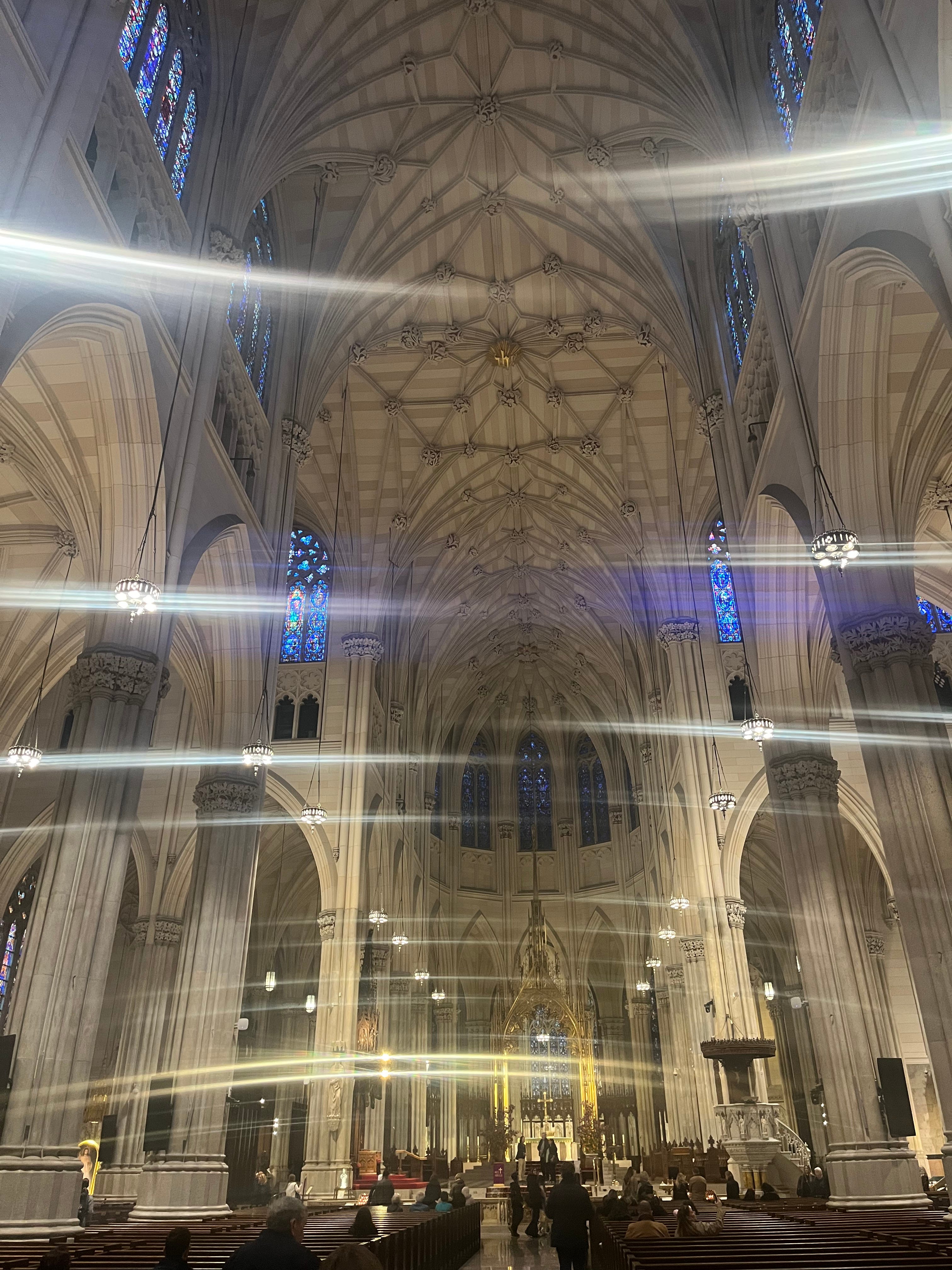
The next time I’m there, I’ll light a candle for Robert.

Sending love and balance,

Miss O’

Jazz Age

“I’m just going to read one of the things you said. You were talking about the evolution of science and then of physics in particular: ‘The deeper revelation’ of physics in our time — and it has just kept going in that way that was evolving right at the end of the 20th century — ‘The deeper revelation is one of undivided wholeness, in which the observer is not separable from what is observed. Or, in Heisenberg’s words, ‘‘The common division of the world into subject and object, inner world and outer world, body and soul is no longer adequate.”’ And then you said, ‘Is this physics or theology, science or religion? At the very least, it is poetry.’”

Krista Tippett, quoting her guest Barbara Brown Taylor, On Being, April 2, 2023

I haven’t written in a while. Right now, I’m busy cleaning my apartment in preparation for good company and being a sweat factory during the hottest days in the recorded history of the planet, and I’m finding it hard to get really excited about anything, and I don’t mean this meanly. I mean, we’re in the middle of the Sixth Mass Extinction, so if you, who are no doubt going about your business, have ever wondered whether or not people noticed the Roman Empire fall, we now know that the answer is, “Not really.”

View down W. 53rd Street during AQI 400 day in NYC. Photo by LO’H.

As a result of this hyper awareness of planetary death, this morning I had this sudden vision of Rep. Jim Jordan (R-OH)—the disrespectful wearer of shirt sleeves and insolent spewer of nonsense and censurer of Rep. Adam Schiff (D-CA)—standing waste deep in a raging flood, screaming above the din, “Hunter Biden!” followed by “Abortion!” followed by “No gays!” followed by “What abuse?” just as the waters reach his chin; he is circled by small rafts of the last of the eager reporters, holding out their recording iPhones to catch his every word as the last iceberg melts completely as they are all dragged under, disappearing into the muddy current.

What in the actual hell is the matter with these people?

To open up my heart to hope, I wash my kitchen floor and outer cabinets, sink, fridge, stove, reminding myself to be oh so grateful for the relative ease of my life, remembering how hard I try not to turn on my air conditioning to try to offer this to the planet. As I stream rivulets down my face and body through this work-as-prayer, I listen to episodes of On Being with Krista Tippett and learn something.

We all need a go-to for grounding. It’s philosophy and theatre that center me. My theatre this week was seeing the ballet Giselle performed by American Ballet Theater (ABT) at the Metropolitan Opera House at Lincoln Center. Too beautiful, and ballet is not the usual thing for me to see. I keep trying to expand my culture, so thanks to my friend Tom Miller for asking me to go. As for philosophy, On Being guests Barbara Brown Taylor and Ruth Wilson Gilmore were my philosopher activist humans for learning.

Other Ways of Seeing

Years ago, back in 2016, in the before times, I eagerly sought a documentary about one of my favorite writer-artist-critic-philosophers, John Berger, famous for this book and TV series Ways of Seeing. The film, made in part by and featuring Berger’s friend Tilda Swinton, was called The Seasons in Quincy. It was sort of not that good, as I recall, but surely made with love if not skill. (There is one sequence in particular that caused the audience at Film Forum in New York, where I saw it, to break into cascading “harumphs” and derisive chortles: Swinton, cutting and peeling apples for a pie, seems to be having a fluid conversation with Berger in his farmhouse kitchen in France, but each quick cut back to Swinton shows apples going from peeled to unpeeled, the bowl of slices one moment full, the next empty, then half full; continuity ain’t no joke to serious urban filmgoers.) Berger died shortly after it came out, aged 90, so it was good to have a love letter compendium of his greatest contributions to culture, and I’m not sorry I saw it. Possibly, too, were I watch it again, I would be less critical for that reason.

Sidebar about Tilda Swinton: her performance in Sally Potter’s Orlando is just a marvel. One of my favorite of Virginia Woolf’s novels, my gateway drug in fact, this is a singularly fascinating adaptation of Orlando (1928!). Gender is jazz now.

From the exhibition at the New York Public Library of Woolf items. Photo by LO’H

One moment in the documentary The Seasons in Quincy that stands out for me: Berger on music. The scene is odd, a contrived gathering of current, younger philosophers gathered seemingly to pay tribute to the old man (not that Berger sees it that way), Berger says that he sees salvation of the future happening through a surprising thing: “Maybe we live in a time when the truth is most easily told in song.” The others look at him, at each other (is it fair to say, with pity?), without assent, as I remember it. Well, their silence seems to say, the old man has finally lost it, still living in the ’60s.

I took from Berger’s comment something else, whatever he intended, which is that in song we find our truths, our joys and sorrows, and our collective experience most fully expressed and shared across generations and backgrounds—not that truth is easy, but that in genres from jazz to hip hop to rock, from protest ballads to power love ballads the truth of being human is most understandably told, making connection most universally possible, which is not to say most useful if changing the status quo legislatively is the aim of art. Sometimes you just need to dance it out.

I was reading and listening to blogs by Patti Smith on Substack, on poet musicians like Lou Reed—the innovator jazz artists like Coltrane, Pollack—all the theatrical forms, the rehearsed forms, forms she took part in with great collaborators. Smith—can I call her Patti?—is another philosopher artist who is helping me transition, I hope more gracefully than I might have, into old age.

Feeling the Rhythm

Look at our world now, our Earth—seasons are jazz—there’s a form we used to know, an expectation, an order, but depending on the results of the latest continued human interference, the changing weather patterns, daffodils can bloom in February. You know. The poems are changing, the dance, the music. Or they should.

The 20th Century was dedicated to the annihilation of man; the 21st Century to replacement of humans as a species. Might be good for the plants and animals.

The trouble with zoos.

And blogs.

And I wish I was a poet so I could stop writing long sentences about all this shit.

So much death and dying. Yet life, too. Promises of joy. The sweet Cochranes are coming from Scotland to stay for a couple of weeks. My friend Colleen wrote a play called Dickens Packs Her Bags, and I’m participating in the reading.

Jazz is life.

Why can’t I concentrate to read a book? (I did finish Harvey Fierstein’s memoir, I Was Better Last Night, and I’m rereading it. His life is inspiring art jazz.)

I can’t quite listen to The Velvet Underground this week for some reason, so I’m back to my Apple Music “Lisa O’s Ecclective Faves” Playlist. It’s pretty great.

Maybe I’ll reread Orlando. Right now, I’ll listen to Bruce.

I was tryin’ to find my way home
But all I heard was a drone
Bouncing off a satellite
Crushin’ the last lone American night
This is radio nowhere, is there anybody alive out there?
I was spinnin’ ’round a dead dial
Just another lost number in a file
Dancin’ down a dark hole
Just searchin’ for a world with some soul
This is radio nowhere, is there anybody alive out there?
Is there anybody alive out there?
I just want to hear some rhythm
I want a thousand guitars
I want pounding drums
I want a million different voices speaking in tongues
This is radio nowhere, is there anybody alive out there?
Is there anybody alive out there?
I was driving through the misty rain
Yeah searchin’ for a mystery train
Boppin’ through the wild blue
Tryin’ to make a connection with you
This is radio nowhere, is there anybody alive out there?
Is there anybody alive out there?
I just want to feel some rhythm
I just want to feel your rhythm

~ Bruce Springsteen, “Radio Nowhere,” from Magic

Here’s to whatever is giving you joy, purpose, meaning, love.

Of Mime and Men

The (Almost Lost) Art of Silence

When I was in sixth grade, I learned about Lent and the practice of giving up something you really enjoy for 40 days. Something to do with Jesus wandering in a desert, David Elmore said. But what I was taken by was the idea of the discipline, of sacrifice. I thought hard. What would I sacrifice? My mom, Lynne, told me, shaking her head as she owned her hypocrisy, “I gave up candy, but I’d buy Smith Brothers Cough Drops, because they didn’t count.” Recognizing the trap of the generalist (“candy”), I gave up, very specifically, Doritos. (Fritos didn’t count.) Sainthood within easy grasp notwithstanding, I expanded the practice, over the years, to encompass all junk food. Can I hear a so what?

Somewhere along the Lents it did finally dawn on me that such a sacrifice was, I don’t know, lame. What is the sacrifice (Doritos? seriously?) really for, you know? Inspired by a “reading deprivation” exercise in The Artist’s Way, I realized that Lent could be an opportunity to tune out noise and make a discovery. So for Lent this year, as Miss O’ has for many other years, I gave up the distraction that is media; and in the past several years it’s been social media and sometimes also television. It really is instructive, these periods of deprivation, restful and oddly energizing.

One thing that Doritos and media have in common, by the way, is that both are engineered to be addictive. I have an addictive personality. I have to be really careful about drinking, for example, so in the past few years I’ve given that up, too, or at least drinking at home. I can drink if I’m out with people I know, which includes my bartenders at the Globe Tavern. I earned those stouts (all six over 40 days). At least I was off Facebook and Instagram, bitches.

What I get out of all this modern-day desert wandering is the happiest thing imaginable: I enjoy 40 days of a quiet mind. It’s amazing what you read, see, and consider when you aren’t scrolling a phone. This Lent gave me a surprise in the form of a different, and yet familiar quiet, a kind of memory of quiet.

Walking on the Moon

On March 22, 2023, Google made a doodle that caught my eye, and link leading to link by art gallery by video by article by book sent me down a mime rabbit hole: the miraculous Marcel Marceau, who would have turned 100 this year! I have a brief collegiate history as a mime, saw him perform live in 1986 at Virginia Tech, saw/heard him lecture the next day—mesmerizing, so brilliant. I wrote a blog about it (among other things—it’s buried in the middle) once. And here I am again.

Just full out, let me say this before I say more about Marceau: Marceau’s character, Mr. Bip, has a history, a reason for being, far deeper than easy caricatures might suggest. Marceau explains about it in a Wallenberg lecture from 2001, when he was 78 and receiving the Raoul Wallenberg Medal for the work he did during WWII as a teenager. Marceau (born Marcel Mangel) himself a Jew whose father had been deported to Auschwitz never to return, helped save dozens of orphaned Jewish children and others by leading them to the Swiss border as part of the French Resistance. Marceau’s part of the lecture begins at the 39-minute mark, and you can learn about his life from his own lips.

I want to tell you, I love mime, and I love Marcel Marceau. So let me just say that what happened to mime in the United States took his beautiful art form and made it into a parody, a travesty of silly imitation because in America we got no sense of history. Marceau’s white face, first of all, harkens back to the French Pierrot figure, and it was young Marcel’s wish to reclaim French culture after the Nazi occupation; Mr. Bip is named in honor of Pip, the protagonist of a beloved Dickens novel, Great Expectations. And it all started with seeing a Charlie Chaplin silent film with his father when little Marcel was seven years old turned the young Marcel into a mimic and the Little Tramp became his hero (but not one he merely imitated as a mature artist). Marceau was born to pantomime, he felt; it was universal, he believed—storytelling that transcended race and ethnicity and culture, found famously in the Orient and also in some form on most every continent; it was an art that could bring us together in love and humanity. Mr. Bip, his everyman, had terrible troubles, but he never lost his hope. Before every adventure, humorous and tragic, Bip removes his opera hat, smells the red flower that decorates it, sets down the hat, and tries. Bip tries and tries and tries.

Throughout the years Marceau lived his art, he taught, (and he loved to teach) at his school in Paris, what he called the grammar of mime, the techniques, and the arts that inform it, like fencing, ballet, acrobatics, and juggling. Nowhere in his teaching is there a dictum that to be a mime you must wear a white face, black and white clothes, and pretend to push against an invisible wall for no reason. Marceau wanted new artists to create new mimeodramas, new stories, new characters. He wanted his art to grow and not be mummified in museums.

Mime is the art of making the visible invisible, Marceau says. I interpret this to mean that his white face, red lips, and black eyebrows as well as his white and gray sailor costume disappear into the lights as he becomes a judge, a prosecutor, the defense, and the defendant in “The Trial.” Mime is also the art of making the invisible visible, as you are sure you are in a fully realized courtroom instead of a bare stage when you watch this same drama, or seeing a universe while witnessing the birth of the world in “The Creation of the World.” Having seen both the video and the live performance, I will tell you the live version is far more magical and transporting, but I am so grateful to have these videos to sharpen my memories. In this video of “The Cage,” Marceau expresses his hopes for what his art can do. I’m grateful for the videos, but speaking from experience, Miss O’ can tell you they can’t hold a candle to the electric experience of seeing Marceau live.

I learned in my searches that Marceau adored Michael Jackson, “a poet,” he said, who loved Chaplin (Marceau’s early hero) and Marceau, learning how to “walk against the wind” and turning it into the moonwalk. Marceau loved that. That is what an artist does—takes the old teachings and makes them new. A planet of imitators will not do. (Painters study Rembrandt and Van Gogh and Picasso, but no one would tolerate a mere mimic; there was only one Marilyn Monroe, as it should be.) And I think I felt this in my limited artist’s heart as I myself learned mime and performed. Why a white face? Because that’s what you do. Why? So I drew a line around my white face and added rosy cheeks, but it never felt authentic. Marceau would agree. I needed to find my own character for my own reasons, to tell my own stories that might be also universal. Still, I have never lost my training, still aware of how all the movements of the body articulate and what those movements can convey emotionally. I still love the art, this art of silence which is really so much more.

Miss O’ and Debbie Hodges in Roanoke ca. 1986. We saw Marceau together, and before the show two odd things happened: 1) hearing an announcement that the show had to be delayed because the (wait for it) sound system had not yet arrived; and 2) Debbie turning to me, voice quavering: “Lisa, I just saw something beautiful, but I don’t understand it.” What? “That woman, being helped by the the usher. She’s blind. Lisa, it’s a pantomime.” Thus began a cascade of laughter, and tears. Ah, humanity.

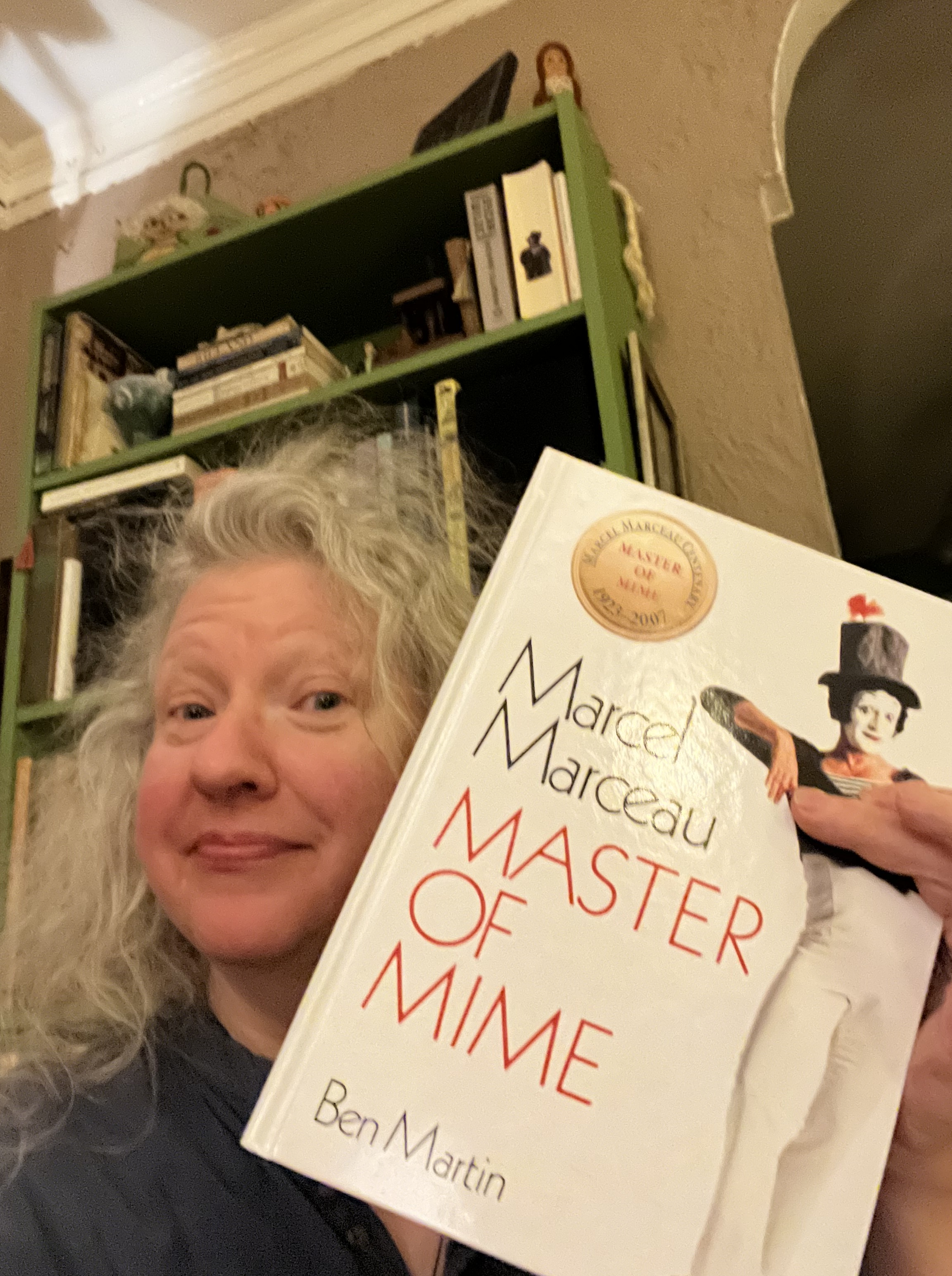
So imagine my joy as a result of the click on the Google doodle to find out 1) NYC has a National Arts Club on Gramercy Park South, which is free; and 2) said space has an exhibition of Marceau portraits by photographer Ben Martin. And imagine my joy at finding out the book is back in print, and that on Thriftbooks I could find two other books by Marceau, including one with his own paintings and one co-authored by a man I actually know, all on the art of mime. To learn more about tis wonderful artist, there is a 2022 documentary that Miss O’ dreams will come to New York City.

“One must think like a hero to behave like a merely decent human being.”
~ May Sarton, Journal of a Solitude, 1973

Bip is the hero of his own story, and in moving through the world heroically, he is a decent creature and shares with us his decency. (Miss O’ notes here that feeling oneself to be a hero is not the same as feeling oneself to be God. Gods are monsters. Take a memo.)

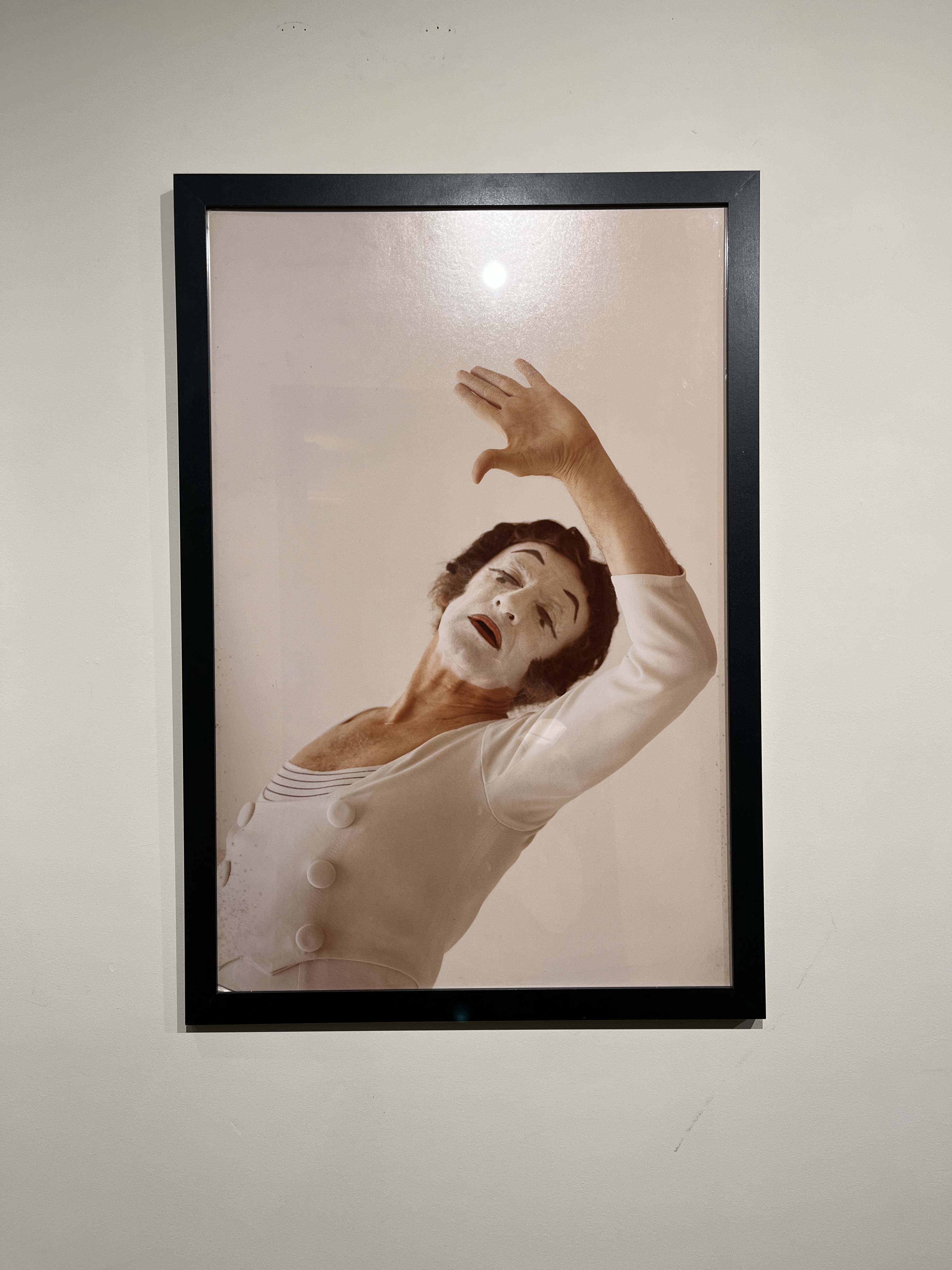
Marcel Marceau, photographed by Ben Martin in 1973. Originally supposed to be a piece for Life Magazine, the project never came off because the magazine folded. So Martin made it into a book.
Photo by LO’H, National Arts Club, NYC

Marcel Marceau, photographed by Ben Martin in 1973. Marceau was initially against Martin’s project, as he was sure he would look absurd in still pictures and not in performance.
He was wrong. Photo by LO’H, National Arts Club, NYC

On Being, in Mimicry

I realize something every time I latch obsessively onto a form of study, such as mime, I begin to see reflections of that obsession in everything; in this case during Lent, mime was suddenly everywhere. The art of mime, of mimicry for survival, is in fact all around us, and I lucked into specific connections (well, we luck into things when we are looking, don’t you think?). Listening to the podcast On Being recently, I heard about the work of Janine Benyus for the first time. She helps companies learn to use the tools of nature, the natural processes of successful living things, to solve their manmade engineering and environmental problems. Isn’t that fascinating? She herself never understood why it wasn’t simply obvious to follow nature’s lead. Since childhood, Benyus had loved wild spaces, and was traumatized the first time she saw bulldozers destroy her wild lots, where she knew all the creatures and plants by their names and habits. I myself grew up catty corner from a huge vacant (we say “vacant” when there are no humans living there, you notice that?) lot that was anything but empty: filled with a creek, rocks, a dirt lot for kickball, pine trees, grasses, and blackberry thickets. When I was in my 20s, a developer bought the lot and turned it into houses, cemented up the creek bed and fenced it off with high chainlink—it was horrifying. And that sadness made me remember the old McNeil sisters who used to pick those blackberries—all that land had been once their father’s farm, and now they shared a house on Kentucky Avenue in a huge subdivision. And that made me remember that before that, it was Native American land. And before that, a wild place for all the creatures. This endless cycle of taking over, of colonizing, is really painful when you tune into it, in ways small and large. (Marcel Mangel grew up in Strasbourg, in Alsace-Lorraine, which was sometimes German, sometimes French, in the struggles to own territory, to annex, to conquer, and we all know what that led to.)

In her book Biomimicry (on my booklist now) Benyus explores how humans have ignored the ways in which nature can teach us, that because humans see themselves as having “dominion” over the earth, we think we have to do all the thinking. And our thinking is often sheer stupidity; and that stupidity is killing the planet. Benyus talks about this without malice, with love and hope, though. Podcast host Krista Tippett read aloud from the last page of the book, showing there is hope for solving the problems we have created for our world:

“The good news is that we’ll have plenty of help. We are surrounded by geniuses. They are everywhere with us breathing the same air, drinking the same round river of water, moving on limbs built from the same blood and bone. Learning from them will take only stillness on our part, a quieting of the voices of our own cleverness. Into this quiet will come a cacophony of earthly sounds, a symphony of good sense.”

~ Jane Benyus, Biomimicry

I thought of Benyus’s continued hope this stillness, and it put me in mind again of Marceau, of Bip. In the quiet of his performances, Marceau elicited a cacophony of earthly sounds, perhaps in musical accompaniment, by Bach, say, but always also the laughter, gasps, and applause of human beings. Marceau played at life, at dreams in the hope a symphony of good sense, but more than that, a symphony of love.

From Benyus’s trauma of seeing her wild space bulldozed through past the topsoil to Marcel Mangel’s witness to Nazi persecution down to his own father’s deportation and murder—both made art out of it, science out of it, education out of it. Their work is and was marginal, and made more important and beautiful and necessary because of that. We all do our best thinking doodling on the margins, don’t we?

Vanity of Vanities, All Is Vanity

“The whole point of Jesus’s life was not that we should become exactly like him, but that we should become ourselves in the same way he became himself. Jesus was not the great exception but the great example.”

– Carl Jung

On Easter Sunday, people post, “He is Risen,” that sort of thing. When people fall into idolatry, worship, they may also slip into an inauthentic imitation, or a glory of themselves in the religion rather than the religion in themselves.

I don’t understand worship. I understand curiosity and passion, and I understand a desire to learn. We lose great art, great thought, great science, it seems to me, when we see imitation all around us. Education, enlightenment, and exposure to new ideas are supposed to help us become who we are, generate more new ideas, new hopes and dreams, new beauty.

I think mime died out (which is not to say it’s dead) for two reasons: 1) it’s unbelievably hard to do well; and 2) everyone tried to be Marceau. This is a shame. Marcel Marceau wanted to teach people mime because he loved his art, not because he wanted a planet covered in white-faced pale imitations of himself. He loved Michael Jackson because Jackson (white-faced and pale though he became) took a lesson in walking against the wind and turned it into the moonwalk; Jackson elevated the form and made it personal. Similarly, Jesus didn’t ask for a planet full of imitators and power mongers to “spread his word” (his apostles did that); he (lowercase human pronoun) wanted people (as I read it) to simply live in a radically alternative way: love over hate, kindness over violence, the love of all over the love of money, equity for all (women, men, whatever) over huge power of some over the rest. It’s not difficult. But it feels impossible to accomplish, like walking against the wind.

The nature all around us, the earth that holds us—how does this not feel like our true mother, our closest companion, our guide, our lover, our teacher, our friend? Why do we push it off, push against it and each other?

Let us, like Bip, don our opera hat proudly every day, dressed up with a fresh flower on top, the scent of which we smell with delight before we move to walk against the wind into the world to do the best we can.

Silence is about attention. An audience may break that silence with response. Something inward goes outward. I say that because most everyone now can be seen staring silently into a phone, scrolling dead-eyed, a quiet trance of habit that isn’t what I mean by silence at all. With Marceau’s art, silence is about concentration, the mime’s attention to the art in emotion, and the audience’s attention to the performance. If we mimic anything in this life, let it be the nature around us, and the artist’s attention to his art. And another’s kindness.

Love, somehow, to all.

Miss O’ with Bip. National Arts Club, NYC, special exhibition of photos by Ben Martin.