I awoke this morning from a dream involving peacock feathers, in a kind of thrift shop where I see a bright green minidress on a dress form, adorned with giant peacock-style feathers at the bust. I’m supposed to be gathering up all the green and peacock-inspired pieces—tulle, shoes, costume jewelry—to create an ensemble, but somehow I keep leaving everything in this shop, which is mostly in some kind of garden behind a sort of little house-turned-shop, and I keep having to return and return, as we do in dreams, unable to finish anything, odd people intruding, cousins, all conservatives, one wearing a burgundy faux fur coat with white fur trim and a hood that I had in middle school as she reads the paper while standing in a dirt-floor vestibule and I explain that I am for abortion rights.
On waking, as I do upon each waking in the past decade, I wonder how long the planet has left; AI models say 19 years at the outset before humans are extinct. And I wonder how it is 2026 and we are as a species still bombing one another, and how all these so-called geniuses with all their resources are so super-excited to hasten the end of life on our glorious pale blue dot, why that dream of total annihilation, that ruthless use of power, is so alluring, our world’s end so inevitable for them. It’s hard to get up and start each day knowing how many horrible humans are out there among us abusing, killing, raping, starving, imprisoning all the really sweet people. You know.
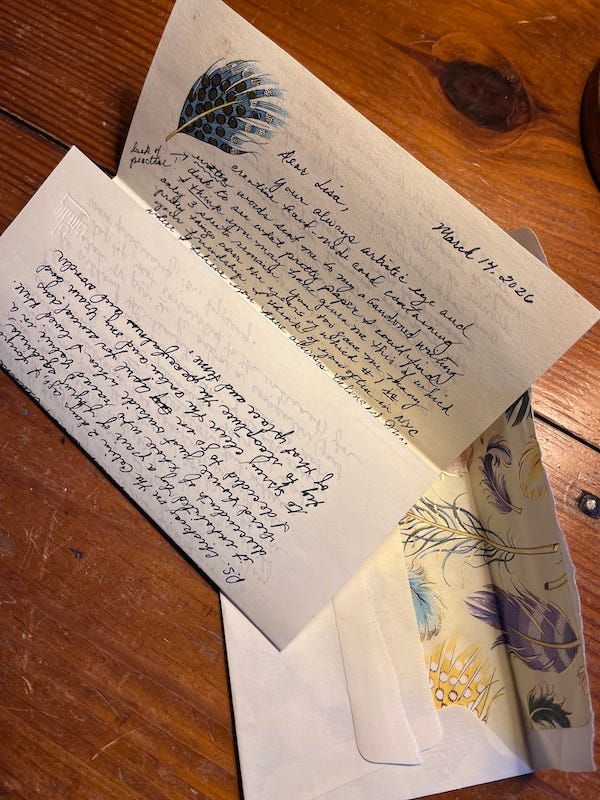
Yesterday I received the most beautiful thing in the mail: an actual handwritten letter from an old friend.
From the stationery (a homophone I learned to spell correctly, differentiating it from stationary, in 7th grade, and memorized because letters mattered so much to me) to the greeting to the P.S., the back-front sharing of life moments in ink in the present tense remains for me a treasure, even seeing a hand-addressed envelope in the hallway in front of the mail slot still brings a little rush of warmth.
One thing that troubled me was that this letter from Central Virginia was postmarked GREENSBORO, NC, and that postmark is ominous. Louis DeJoy, who inexplicably is still the postmaster general, has been working to ensure that local postal facilities are no longer processing mail, but gathering it up, shipping it on trucks to facilities hundreds of miles away for that postal stamp, causing delays of days and weeks. I realized that were my friend to mail in her November ballot, say, it would take over a week at best to reach the elections office in her very own town. And by then, it could be too late to be counted, since a new USPS policy states that the postmarked date no longer counts as the actual date for submission of any legal document, from tax returns to ballots. In addition, these delays mean that Americans may no longer receive time-sensitive legal notices on time, such as summonses for jury duty or traffic tickets, causing fines and even arrests.
More fodder for the private prison complex system of forced labor, I guess; more private property to seize and take from the rest of us. (The U.S. Postal Service, created by Benjamin Franklin so that Americans had a little government in their lives every day, now reflects exactly our government, doesn’t it, as in almost no governance at all. As my friend George reminds me, “We are all going to be inconvenienced to death.”)
All that from receiving a nice letter. Because nothing is nice anymore. Nothing can ever simply be anymore, that is, without deep discipline of the mind to take in the moment.
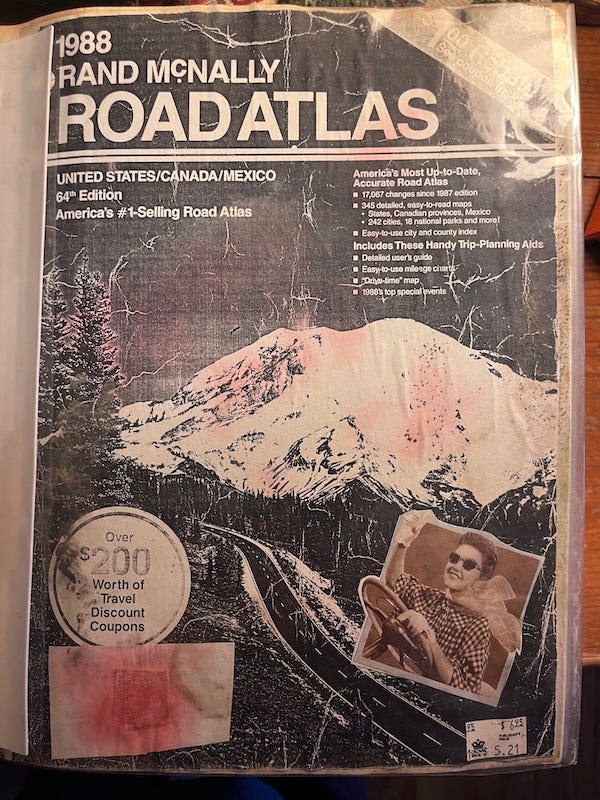
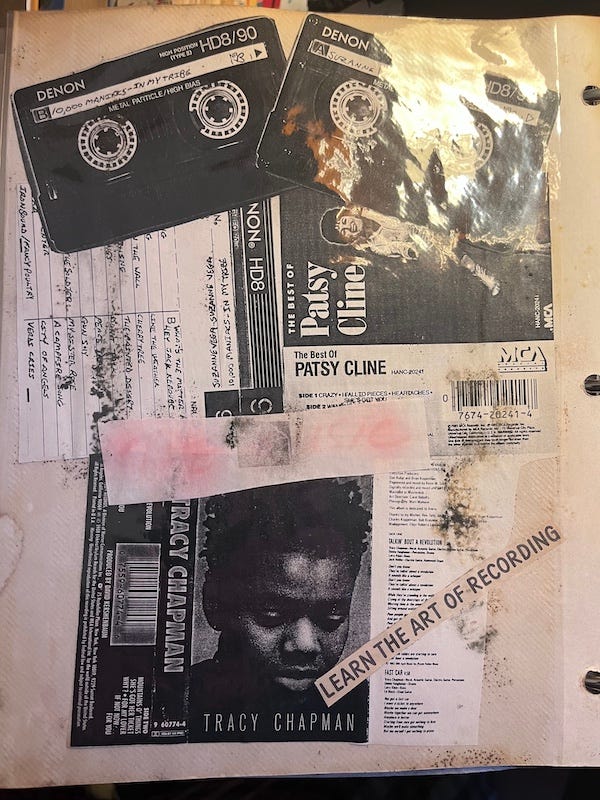
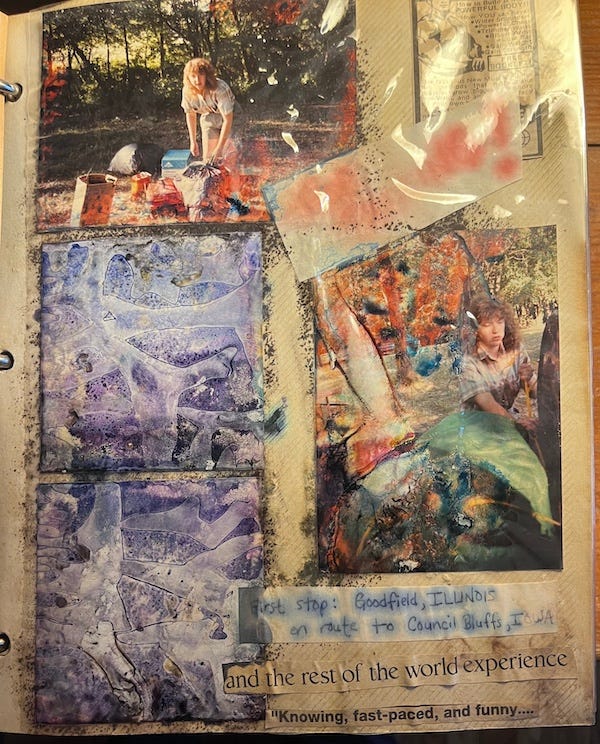
Last week an old college friend, D, came to visit with one of her grown daughters, whom I hadn’t seen since she was a toddler. Back in 1988, my friend accompanied me on a cross-country odyssey, back when you used paper maps and had no cell phones (and the sign on leaving Barstow, CA, for AZ said, “NOTHING FOR 150 MILES” and you drove onward); the entire month-long trip cost us $200, including 89¢/gallon gas for a Toyota truck that got 35 miles to the gallon; and $2.00/night camp grounds when we weren’t in the beds in the houses of relatives. Food was cheap—a full chicken dinner might be $4.95, and we could split it. On return, I made an album, photocopying the road atlas cover, the tapes, cutting out ad tag lines, headlines, and images from the local newspaper or magazines to comment on the photos.
The impetus for this trip was an invitation to the first O’Hara Family Reunion, in Nebraska; plans were thrown together; my mom, Lynne, bought me a KOA Campground Directory, which guided us to cheap accommodations. Also, I had just survived my first year of teaching, and it was my first summer off not working in any way since I was maybe 13. I don’t know how I was ever that brave. My brave friend D made it possible.
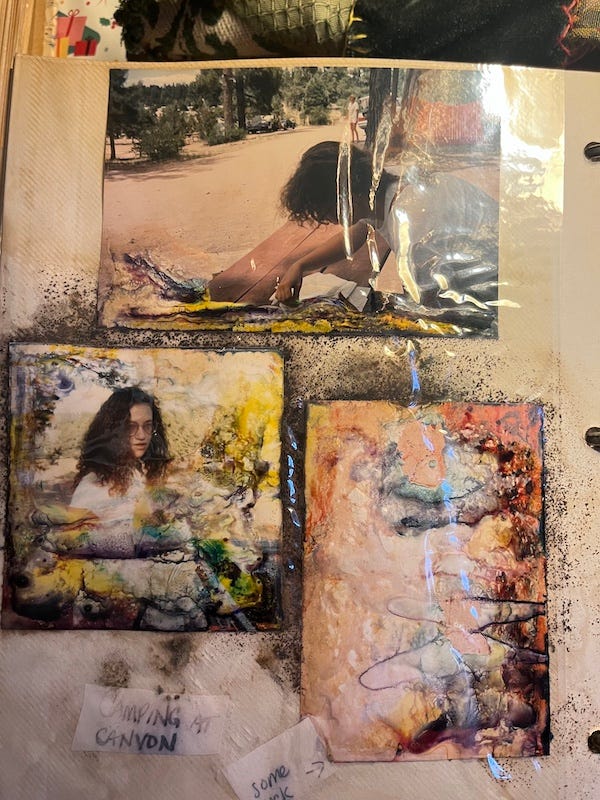
And in 2003, when I moved from Virginia to New York City, I accidentally took my box of curated collage-photo albums to my sister’s basement (instead of my parents’ house) to store, where she had a one-time-only flood that miraculously only destroyed that one cross-country trip album. (D, a practicing witch, said when I told her, “You’re welcome.”) Moldy and blurred to oblivion though it was, I didn’t have the heart to get rid of that album, but upon seeing the horror, D convinced me last week to do that—I snapped a few pages for memory first, and indeed, tossed the hunk of mildew and mold into a plastic bag and out to the trash.
I miss the intimacy of letters and albums. We live in a bizarro world of mass surveillance and public disclosure of our innermost worries and thoughts—but it’s not really new: any of us who worked in drugstores and photo-mats knows that workers kept copies of customers’ intimate pictures to share and discuss, so it’s not as if our camera photos were really private, though perhaps only our postal worker and roommates knew about our private mail from return addresses if not contents.
I remember mentioning once to a writer friend that I kept all the letters ever sent to me—I’ve told you this—and I mean all of them. I’m the keeper of the letters—and I saw her face cloud and shift to panic. What private things had she revealed to me? her face said. I’m sure nothing; I, on the other hand, was a font of confession, and ironically no one has saved letter one written by me. It’s too bad, really, as I wrote really good letters; but perhaps the confessions are best left to the landfill.
This weekend I may go into my closet and begin culling the dozens and dozens of shoeboxes filled with correspondence. On the other hand, given that we are going extinct in 19 years, I probably won’t.
And so, to start another morning at the edge of the end of the world, with love,
So all the ick news first, aside from all the Musk-Trump criminal dismantling of every living institution in America so that it’s close to unrecognizable (taking over the Kennedy Center? The National Archives? closing what Department?), I learned at work this week that the two editors I supervise applied for a transfer to another (lately resurrected) department where they’d previously worked because they can do what they are best at there (I choose to believe it’s not about me) and got it, and that I will have to finish a huge project probably alone, the timing being what it is; then, at my ophthalmologist’s office for a checkup, I learned that not only am I at the beginning (and still reversible) stages of diabetic retinopathy, but also that I owe an outstanding balance of nearly $500 (of deductible-meeting crap) from visits over the past four years because their billing department never sent me the bills; and then I learned from my CPA that my company inexplicably failed to take out the correct amount of tax (and all week I’ve tried to correct it for this year, but the system doesn’t work, and we no longer have humans working in HR (take that in) and I am screaming into screens) and so instead of getting a refund, I in fact owe some $1,500; and the tendinitis in my write-hand (punnyha ha) wrist is so bad still after three months, medicines, and PT, that I would have to spring for a cortisone shot (sweet, sweet relief after the injection site pain and, obviously, the bill). Poor fucking me.
Thank you, internet.
But one day this week—I think it was the eye appointment day, Wednesday, when I returned home with dilated eyes and shock at hemorrhaging money—on the way into the city, a Black female conductor announced at every stop (because the N-W-R-Q lines still do not have recorded voices to announce stops, and I love that) something to this effect: “Ladies and gentlemen, let the passengers off first, let’s help each other out, everybody, let the people off first before you try to get on. Move into the middle, people, help everyone out, we’re all together here.” Love her heart. On the way back to Queens that same day, a Black male conductor did much the same, adding on occasion, “It’s not about the price of groceries, everybody, just help each other out here and move all the way into the car.” This same conductor also used the intercom to explain the location of every staircase, connection, and elevator at every single stop. A total doll.
And if you are like me, you can’t help but look up and down the train car, men, women, children, every color and shape and gender and age and religion and background and profession, staring into phones, or not; bundled up, world weary, and it hits you all over again that the reason “white middle America” is afraid of brown and black shadows is because they literally have no idea how New York works. It’s not perfect, never that, but it works. Look at us. Us. Right here in this train car, crowded, or not, for miles of stops along our way. Not yelling at or killing each other. All of us just being.
Also in my travels, I found myself thinking about a poet friend who lives in a rural area, who years ago, when I mentioned how much I loved the movie Lost in Translation could only grunt in disgust. When I asked why, she said of the lead characters, “All they did was squander an opportunity to see Japan.” I had to think for a second, because I was remembering the filming of Bill Murray’s whisky commercial, the Tokyo karaoke bar, the hotel bar nights, Scarlett Johannson’s quiet excursion to a Japanese garden and learning flower arranging, and of course the hilarious trip to the ER so Bill Murray can get Scarlett’s broken toe seen to—all these relationships and stories they will have to tell about, or not, when they return home. What did my friend mean, “squandered”? I started thinking. I guess another view is they didn’t really do all that much…and then it hit me. I said, not at all angry, but with a sense of discovery, “You’ve never traveled outside the country, have you?” She looked at me suspiciously, and slowly shook her head, as if her response to a movie shouldn’t depend on having had the experience. More to the point, though, she had almost never, within or out of the country, traveled alone. And there it is.
What was lost in translation for her in watching Lost in Translation is the feeling of sudden paralysis brought on by the jetlag stupor you feel combined with being quickly overstimulated in a new place while on no sleep, while being both excited by the prospects and daunted by selecting the best thing to do right now. The one universal is a bed (never one you can check into before 3:00 PM) and a bar or cafe, and heading to either one can give you a chance to sort of recover your wits (if you know how to manage the currency), but when you are alone with no one to bounce ideas off of, being in a new city, whatever the language, can be pretty isolating. One time, visiting London, I spent nearly one entire first day just sitting alone on a bench in Tavistock Square, where Virginia and Leonard Woolf had lived (in a no longer existing building, bombed out in WWII), underdressed (a cold day for summer) and disoriented, and in those days, a teetotaler. I could barely make myself try to find a place to have tea. If I did eat or have tea, I don’t remember. I remember a white-gray sky, damp chill air, and just watching people against green trees and grass and gray buildings.
Did I squander my first day in London? Not at all. Oddly, that first day of “doing nothing” is still the one I remember most vividly and fondly, whatever the discomfort and confusion. I was there, in the heart of London, on my own, unremarkable, on an ordinary day. Not bad.
As a result of my many NYC train treks this week, it also dawned on me that perhaps the reason I needed to leave Facebook, finally, was that my life in New York can be one of overstimulation even on the dullest days, and that Facebook had become more overstimulation, not sure which way to look, who I’m forgetting to check in on, that sort of thing. Maybe I’m just not wired for all that anymore. I know that many people can simply sit on a virtual Facebook bench and do nothing, or idly and dispassionately watch the goings on, not unlike I did in Tavistock Square or Scarlett and Bill did in Tokyo. You do you, as the kids say. However we engage, or don’t, we are all in it together, so move to the middle of car and let everybody onto the train. And remember to give people their space (remarkably, New Yorkers do know how to give you yours, even by a fraction of an inch, and if only the whole country could cotton on, that would be great). After all, everyone here with you is simultaneously present in a pubic place and also living a very private drama of their own.
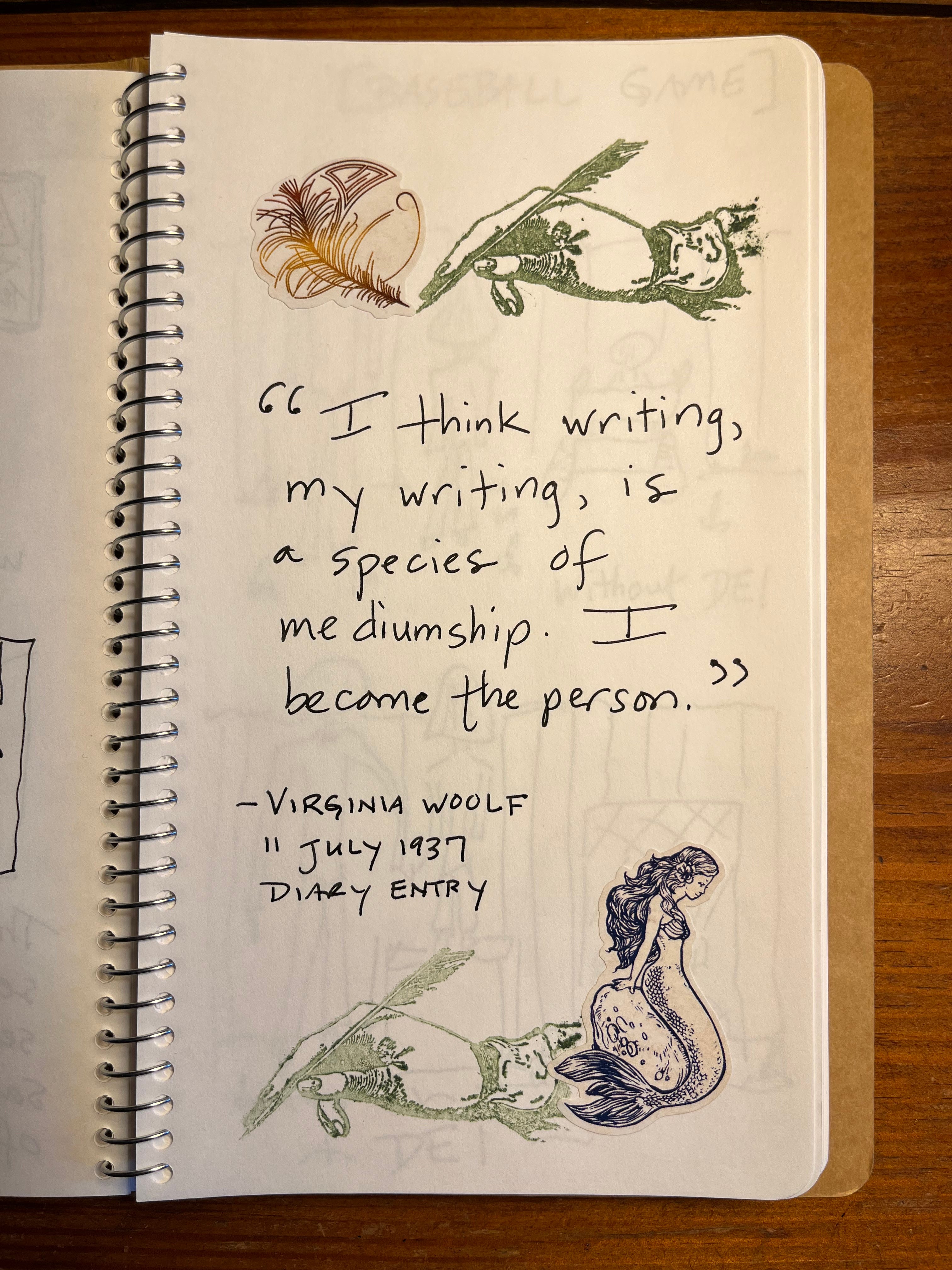
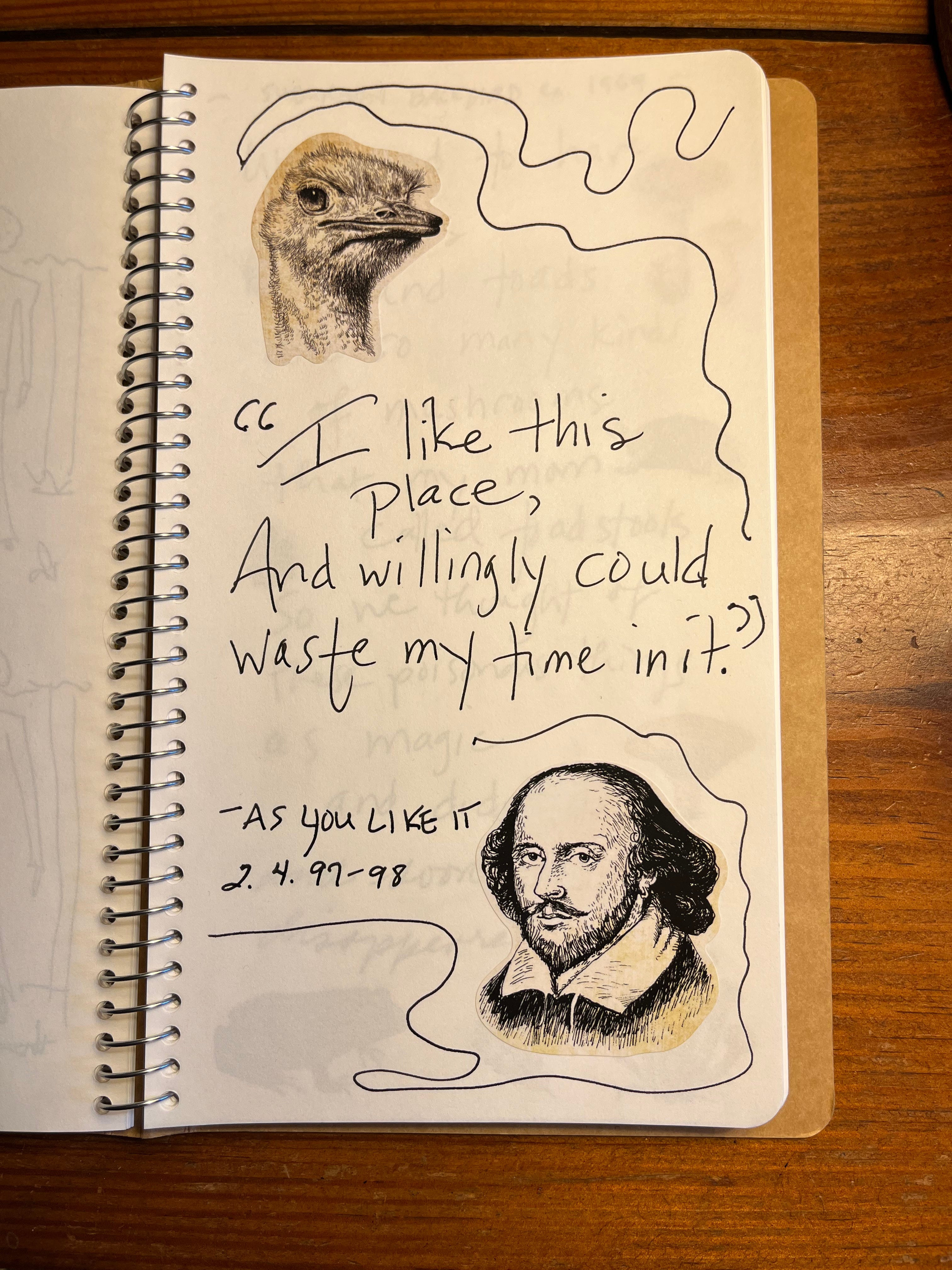
One of Miss O’s many, many notebooks.
All of this is just to say, dear friend, given all that you are going through in your personal life and against whatever landscape this letter finds you, I know that you may merely glance at or dip into this post, and I completely understand. Thanks for reading at all, and whatever you do, don’t strain yourself. Enjoy your Sunday. Let me hear from you when you get a chance.
P.S. A few weeks ago I published part of a play I’ve been working on, but I don’t know if WordPress is the best outlet for me. Thanks to all who read it, in any case!
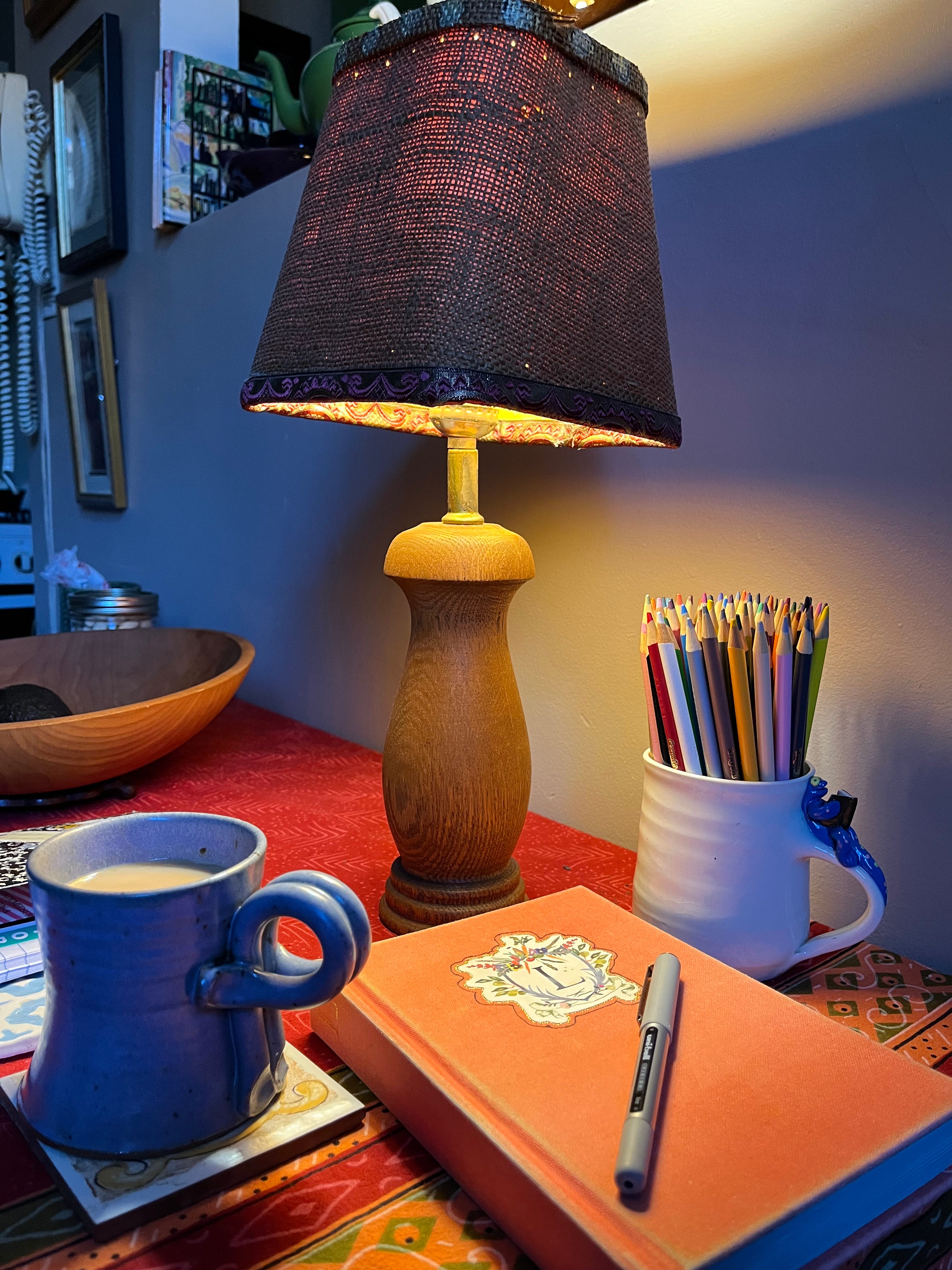
I’m sitting in my kitchen this Sunday, January 12, 2025, a week before the inauguration of the End of Times, feeling lucky and grateful to have a kitchen, and a rocker, and coffee, and art supplies; and despite some aches and pains (and as far as I know), my health. I was able to take a warm shower last night, and sleep in a warm bed covered in Irish knitted blankets and clean sheets. I awoke a little late this weekend morning because I could. The day is a cold, crisp, blue sky winter day in New York City, and by the grace of a good job (still in education after 37 years) and having bought my apartment 20 years ago instead of, say, last week, I get to live here, and affordably. Knock wood.
What I’m wondering about today, all these blessings notwithstanding given the wretched suffering of humans and the planet’s ecosystems as a result of sociopathic, capitalist policies and general stupidity, is whether or not I should continue using social media to communicate. (How privileged am I?) But really what I’m wondering is to do with the point of this whole tower of Babel, all of us voicing our views all the time via TikTok, Facebook, Twitter (X), Instagram, BlueSky, Substack, Medium, Blogger, WordPress, pick a platform. We can write, text, photograph, video, podcast, share it out en masse. So many of us with so much to say. Who is the audience? And to what end? I’m probably overthinking this.
I know from “stats,” for example, that after roughly 24 people “open” this post, approximately two people will read past the first two paragraphs. Possibly one person will finish the whole post. I suspect that person is almost always the same person, occasionally joined by one or two others. One occasional reader will “like” this post on Facebook without having read it (I know because the “like” comes within seconds of posting it) so as to be encouraging. One person may “like” the post at the source, such as on Substack or WordPress. I have “followers” on these sites, and “likes” are swell, but I have to say that none of this is what I’m after when I publish a piece.
Love Letters
As I’ve written before in many blog posts few have read, I write blogs because I miss writing longform letters. Whenever I was feeling really lost and out of sorts back in my youthful teaching days, for example, I would reflect on how many letters I’d sent and received in recent weeks. This would lead to me sitting down to type letters on my Smith-Corona (no carbons, so none of my long letters survive, I suspect), one to four pages, maybe six, single-spaced, on colorful letter paper, to five or six recipients at a go. Every letter had a different voice, subject, and slant, given the audience. Sometimes I included a folded article from The New Yorker or the Washington Post. By Sunday evening, after writing letters between grading stacks of papers—those letters addressed, stamped, and stickered with a return address and something pretty—I was a new girl. Monday morning I’d mail the letters from the school office where I taught, and I could feel breath return to my body. Letters meant connection to the wider world, to the hearts of my friends. I gave them pieces of my heart, and when I posted, I felt that my heart regenerated, times two.
The coming weeks ensured a return post from nearly all the recipients, from, say, my one living grandmother in Council Bluffs, Iowa; my former landlady and other friends in Central Virginia; my former costume design professor at Virginia Tech; my Bread Loaf friends in Massachusetts, New Jersey, Vermont, Tennessee, and Kuwait (or wherever she was teaching internationally that year). I no longer recall what I wrote in those letters, but I still have all the letters I received back. They fill half a closet, shoe boxes within boxes, and I treasure them as one would rare artifacts. I suspect that my trove may well be the last of the letters that humans will ever see, certainly over 60 years in America in the late 20th to 21st centuries. But that isn’t why I keep them. They are reminders of the ways we filled one another’s hearts, and deeply, once. To me every letter is a love letter.
The Social Network
One thing I’ve become sad about in the past decade is how social media, including texting, has been used as a replacement for letters and personal conversations. I no longer get that Pavlov’s dogs “warm feeling” when I hear the arrival of mail dropping through the slot. Junk in the form of requests from charities, a catalog, a flyer from a theater, a medical bill—these are all I can expect. When I do get personal mail—as small package, a postcard, or a card for an occasion—I do relish the note, usually very short, and mostly respond in kind. And I do love my sibling text threads; and some texting is an important way of writing brief letters with some old friends, so there is that.
We all have shorter attention spans, of course, technological “advances” being what they are, causing our brains to have been rewired to be more in line with ADHD tech developers (my personal theory) and less so with the slower and more deeply thinking (though not necessarily genius-level) people like me. Still, I think there is something to be said for being able to be quiet, and deep, and I miss it.
But what I am missing, more specifically, is the forging and maintaining of intimacy.
Instead of enjoying deep communion with friends, I, more often than not, provide and receive sound bites and sermons and memes. It’s all fun and games, however deeply felt our stories and rants, however witty or sweet or artful the picture posts. Less and less, I’m feeling that my life can be “both/and” when it comes to deep connection and social media on a platform. My brain and my heart feel frayed, like an old quilt, maybe, that I stopped really valuing and only look at out of habit.
Time Travels
I look at how the letters my parents received dwindled once they reached their 40s, when they and all their friends “back home” became busy with lots of children, school programs, second jobs; when aunts and uncles began dying. Distance and lack of time prevent us from keeping up with everyone; it’s life, and “everyone” is too many. It’s why we have reunions every decade or make special trips once or twice in our lives, or every Christmas, to reconnect with old friends. We also used to call people on the phone for a daily chat, or to faraway relatives on special occasions, but those calls were rare. I think my dad only called his mother two or three times a year, families then still mindful of the Depression and the charges for long distance. By contrast, when I was a teenager, I could stay on the phone for hours with a friend I’d seen all day at school. You remember.
While the invention of social media has afforded us a chance to quickly and easily locate, “friend,” and play voyeur into the lives of dozens, hundreds, thousands of long-lost chums and recent acquaintances, and to share our own photos and points of view, I’m wondering if it has been worth sacrificing depth for breadth, or when it started to feel like a sacrifice. I ask because I have never been lonelier in my life.
Possibly this is because I am sixty, and live alone (I am self-aware enough to realize I’m too odd to live any other way), and even if I weren’t single, I would be right back where my parents were, never hearing from anyone either, even if this isn’t 1973. I don’t want to devolve into nostalgia.
But what has happened in the past decade is that too many formerly intimate friends have relied on their social media posts—posts sent out to dozens, hundreds, and even thousands of friends or followers—as their sole means of communication with me, Miss O’ lumped among the throng. I stopped even texting some friends when the reply became, “Don’t you read by Facebook?” or took the form of an emoji, a heart or a unicorn, say, as if to express, “What makes you think you are so special that I would take time out of my active life to respond only to you personally?”
I had become a unicorn, but not special in the way of that creature so that anyone would want to seek me out. Have I done this to other friends? (Was it something I said?) A few years ago, I withdrew myself from a group text thread of friends when I realized that no one responded to anything I wrote. One friend said later, “I’m sorry that’s your perception.” No, that was the reality, as I saw the receipts. The good thing that came out of it was a restored one-on-one friendship with two of those people, much more personal and real, if you know what I mean. And more me, more fulfilling.
I will say, as far as media goes, the technology that is Zoom has been a godsend, and was especially so during Covid. Two couples, Anna and Michael in California and Frances and Jim in New Jersey, joined me for long, long conversations every few weeks during all those unlimited-use months during 2020-2021. We talked, read excerpts of books aloud, moved our computers to the kitchen to fix dinner or experiment with new cocktails, gave each other tours of our homes. In a culture that really isn’t into letter writing that much, now me included, Zoom became our way of sharing and connecting when there was no other way to get together.
So My Friend Susan Announced She’s Leaving Facebook
This was the spark of today’s blog. Susan is the kind of person who uses social media in the best way. She shares her family stories and adventures with the perfect amount of wit and detail that it’s like you are sitting at the kitchen table with her. She makes 2,000 people at a time feel that way, and it’s a real gift. I used to share fun little moments in New York City, and even self-published a little eBook to compile them (at the request of my friend Becca), but more and more my own use of the platform has turned into political screeds against stupidity. To the two-dozen sweet people who regularly nod in agreement with one or more of those posts, I am glad we can commiserate.
Because of the current state of society and disappearance of anything resembling an objective corporate press, we currently have political reasons for questioning the use of social media. “Meta,” for example, has announced this new “anti-censorship” policy, as “X” has done, which really boils down to “Feel free to yell ‘Fire!’ in a crowded theater” (which I learned as a student in Mr. Hart’s fifth grade class is illegal as well as immoral). This is why Susan is leaving. I asked, “Have you considered writing a blog?”
The Open Blog Culture
Blog culture can be so much pissing in the wind, I guess, but there’s something rather dear about it, I think. Those of us so inclined can pour out our hearts in longform letters without postage. (Note: several of my artistic writer friends find my blogs unreadable or disappointingly un-writerly, etc., and my view is that they wouldn’t send back a critique of a letter, now, would they? So. Maybe sit on that and spin. I say that with love.) And while I still make personal cards with collages and quotations, and send short notes periodically, I will say writing a blog post fills the need I feel (mostly, though I feel it less and less, finding I have less and less to say, or at any rate to say to you, my friend(s)) to write a complete idea, or to explore an idea as completely as I have the mind to in the moment. However, while this act sorts my brain, my heart does not regenerate, not exactly. I do miss that.
Let me hear from you, should you feel that, too, but not on Facebook. I think that one will have to go. I will do a gradual release, though; it’s the only way I hear about deaths, for example, or childhood friends and former students in success or distress. I like Instagram, but the only posts I see in my feed—all my own doing because I “followed” them—include political news about He That Shall Not Be Named, and only one or two sweet photos from actual dear friends. I tried BlueSky, but it’s become all-HTSNBN-all-the-time, too. No one, it seems, knows how to get off that ride, and no amount of posting my distress about that is going to change anything. I feel my brain atrophying just thinking about it.
All that time I spend worrying on social media—what else might I be doing instead?
Now it’s noon, and I need to go for a long walk and see what’s doing in the neighborhood. Maybe I’ll call somebody later, who knows. What about you?
Sending love,
Miss O’
P.S. I have another blog on Substack, and have duplicated the posts. However, I think I will use this space to do more creative work. Will see what happens–and thanks for reading, in any case.
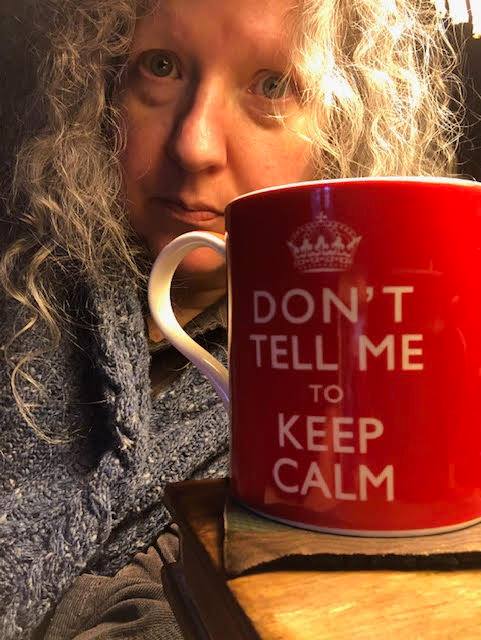
Miss O’ in New Jersey ca. 2012; photo by George Lightcap
Yesterday evening I emailed short notes to two of my dearest friends to 1) apologize for not writing much, as one does; and 2) to ask after their life events. (Not to keep you in the dark: one set of spouses, in their eighties, has had loads of health issues this year; the other set of spouses, hovering around age seventy, just sold their longtime California home and closed this week on another, even drier, California home, one that is smaller, one-story, much less land to tend, and in walking distance to simple amenities, like a grocery store.)
I expressed to both halves of these respective spousal sets that I have felt, for want of a better word, deserted. Is that the word I want? I feel deserted as at a railway station, as if I’m supposed to be headed somewhere and there are no trains, or as if someone has forgotten to pick me up after a long journey; deserted by things as disparate as companionship, comradeship, an artistic muse, a sense of mission, original ideas, and the national shared practice of democracy. That’s quite a list.
When I wrote this to my friend Anna, she suggested I write a short blog post on the subject of desertion, and that felt exactly right.
Other Desert[ed] Places
First of all, I feel deserted by the practice of writing letters. Just so, long and deep conversations have deserted me. Other than Tom and Anna (my friends noted above), everyone else I’ve been in regular contact with for years tends to speak in memes and emojis, maybe links to articles at most. I respond in kind, mirroring what I receive. I know that many people are pressed for time in general and have dozens of people with whom they are in communication, whether friends or family or work colleagues. I never want to assume I should be somehow special. (Many of us have felt deserted by even our closest friends once they married, had kids, and made new parent friends.)
“Didn’t you see my post?” Deep connection has been supplanted by observational strings, er, threads, on Facebook. Several friends noted that it’s just easier to share their lives all at once rather than in individual letters to, say, me. In my own posting life, general observations shifted from “life in New York” to “politics all the time” when 1) Humans of New York started up, doing what I did far better and more deeply than I was, and with pictures; and 2) I saw the coming of a deep fascism with the election of the black president. (Big Tell for me: At President Obama’s first State of the Union Address, Justice Samuel Alito, who was in view of the camera, on several points about threats to our democracy, shook his head and said, “That’s not true.” I’d never seen a partisan justice at such a speech. Related: then-Speaker John Boehner (R-OH) wouldn’t look at the president, saying in an interview, “I can’t even look at him.”) All that open racism shocked me. Racism was, truly, the only explanation. I had to go on the offensive, deepen my understanding of racism, post like hell. Right?
In 2012, I voted for Obama’s re-election, Mitch McConnell (R-KY) became Senate Majority Leader, and a month later I released by e-book compilation of social media observations, Easier to Live Here: Miss O’ in New York City.
Now what? The nation was growing in chaos, and my sense of joy at living in New York began deserting me. This was 2013. My playwright’s lab disbanded; my first professional work project as a staff member at my work went to press and I felt sort of “done” with that job after seven years but couldn’t afford to leave; I was assigned to Grand Jury Duty at Kew Gardens in Queens for the entire month of September (with the disheartening revelation that Miss O’ may well have been the smartest person in the room, and that shouldn’t ever be the case), and that same month I began a deep but doomed love affair that would consume my heart for the next nine years, until learning, belatedly after a final breakup, of his death. (One of many blessings of this dear but complicated man was that he was not on social media.)
Desert[ed] Depths
The joy of knowing others doesn’t really come about in 140-character or 280-character posts, memes, emojis, GIFs. All these little sparkly things are fine, I guess, once you have a long-standing relationship of some kind—all good friendships develop their own shorthand, and in that context these digital digeridoos seem to me to be the equivalent of my friend Cindy’s old habit of looking at me, dropping an eyelid, and miming a cigarette to the lips when someone was about to pontificate or otherwise be an asshole. Without a word spoken, I would double over with laughter. I often act out the same gesture as a touchstone. A good meme can do that, too, and it’s funnier when you know the sender from your heart; but if I’m honest, it’s empty when that’s all there is.
Second of all, I feel deserted by stillness. This morning, for example, I woke before dawn to find the all-night party music from somewhere was still on in full force. The school playground next door now has LED stadium lights that are blinding our complex in the name of “security.” I can’t seem to find calm. (Tell it to Ukraine. See what I mean?)
just a mass of contractions
I miss a mind quiet enough to read longform New Yorker articles in one sitting. I miss a body quiet enough to sit still and play a new album all the way through, listening to every song. Then playing it again, this time reading lyrics and liner notes and credits. Then playing it through a third time. Vinyl was even better because you could play the A-side three times, and then the B-side three times, and then listen to the whole thing once through. My friend Lynda Crawford, a playwright, wrote on Facebook that she missed listening to records the way we used to—one friend would buy the record, and everyone would come over and sit on the floor and we’d play it, and talk about it. I remember doing that with a 45 RPM of Helen Reddy’s hit “Think I’ll Write a Song” on the A-side, and then playing “Angie Baby” on the B-side, and my mom, Lynne, coming upstairs and saying to me and my friend Peggy, “Who is that? Is that still Helen Reddy? Now that is a good song.” She was right. But we all had to hear the song three times.
Now, I hear you saying, “But Miss O’, you can still do those things.” (Still. Hmmmm.) Yes, I can, in theory. But I have Twitter to scroll. I might miss something. I have Facebook to check. What if a “friend” liked my post? What if no one liked it? (Should I edit it?) What if someone died and I didn’t realize it? What if what if what if what if what if what fucking IF. FOMO. (I’ve had to look that acronym up I think each time I’ve seen it in New YorkMagazine, which feels less and less relevant each issue. The best one in the past few years was an issue dedicated to Jerry Saltz and his quest to be a great artist. More of THAT.) Where was I?
The truth in all this is that I am deeply sick of feeling deserted by…something…somehting I cannot seem to touch with my soul, my heart.
Desert[ed] Hearts
Friends have lost family in the past two years. Last year, a poet friend lost his beloved wife to a stroke; two weeks ago a dear neighbor lost his brother suddenly to a heart attack; this week, another friend lost his beloved wife to lung cancer. Part of this is, we are all aging, my friends and neighbors and I. But the loss isn’t less. The feeling of desertion stings.
President Biden, who lost a son to brain cancer seven years ago, gave a speech Thursday night—possibly one of those historically great ones—defending democracy against fascism, and the three major networks and PBS deserted him and the American people by refusing to air it. (The next day, as if to reinforce this sense of desertion, newspapers seemed to support the wounded fascist MAGAs over the 70% of Americans who want to preserve the democratic union.)
And when all this happens, all this sudden and deep emotion, I seem to shut down. I don’t know how to help anyone, to help the country. I feel deserted by my mind.
In her deep empathy, Anna said in response to my feelings of desertion and perpetual waiting, “Seems like a lot of us are waiting for an unknown something. I wonder if we should just act as if what we’re waiting for is going to arrive or has arrived.”
That’s what President Biden has chosen to do—to act as if the People want democracy, are willing to vote to preserve it—and meanwhile, he is just legislating like hell, bringing down inflation, addressing global warming, championing women, the whole bit, like tomorrow is not only coming but is already here.
So, to paraphrase Helen Reddy, I thought I’d write this blog, one in which I act as if what I was waiting for was the impetus to write a blog. After all, the worst thing we can do is nothing.






 The Miss O' Show (Teacher's Edition)