
When you just want to do it yourself but can’t
“Dear Saint Anthony, look around, something’s lost and can’t be found.”
~ Catholic prayer to the patron saint of, among other things, lost objects
“When evil-doing comes like falling rain, nobody calls out ‘stop!’”
~ Bertolt Brecht
“Never start a piece with a quotation.”
~ Nora Ephron
Do you have the feeling that we are all living through a Kafka short story? “The Trial,” perhaps, or “The Refusal,” maybe? When I was home in Virginia the other week, I asked my brother Jeff if he’d ever read Ray Bradbury’s “The Sound of Thunder,” and when I recounted the plot, he realized he once saw a bad movie version; and it came up because, as we caught the latest news out of America, I mentioned that I keep looking for a smashed butterfly on my shoe.

Like me, in addition to those stories, maybe you are thinking of that Twilight Zone episode, “It’s a Good Life,” where that evil kid keeps wishing everyone who displeases him away to the cornfield, and no one will stop him out of fear, and also love, because his parents choose to save him and let the rest of the world disappear. In the same way, Trump bastardizes the Kennedy Center even as he plans to close or demolish the Museum of African American History, and Musk eyes selling off the National Gallery treasures to “save money.” Wishing all our history away to the cornfield. And, echoing Brecht, there’s no one to stop them.
Or is there? Reading historian Heather Cox Richardson the other day was a tiny balm, as she recounts recent events and sees shifting winds. I’ll take it.
Your Miss O’ has been lying low these past weeks, visiting aged parents, aging brothers, a young nephew and vibrant sister-in-law. Also watching birds, smelling lilac in bloom, watching red azaleas pop, walking around my childhood block in drizzle. In addition to watching classic movies and “Harriet Tubman” on PBS and “Poetry in America” episodes with brother Jeff during the week, I caught A Complete Unknown on my last night, the weekend nephew James visited. James just wouldn’t go to sleep in his designated living room, what with all the excitement generated by middle-aged relatives, so he happily sort of watched the movie with the grownups, not understanding any of it. Fortunately, there’s no nudity and little in the way of bad language, but at the point where Joan Baez gets out of her bed where Bobby Dylan is sleeping, only in her underwear and a tank top, four-year-old James commented, “She forgot to put on her pants.” Uncle Jeff chucked, “He doesn’t miss anything, does he?”
If you haven’t seen that Dylan bio pic, for me the most interesting storyline was the one featuring Pete Seeger, played beautifully by Edward Norton. The movie helped me understand this mystery surrounding the rift that formed between Dylan and his early supporter and champion Seeger. Their link was Woody Guthrie, suffering from Huntington’s chorea at the movie’s opening, the disease never named or explained, as Hollywood does. I won’t belabor the plot, but essentially when Dylan went electric at the Newport Folk Festival, Seeger was dismayed and dejected, not because he hated rock, but because it was the end of his dream. For years and years, Seeger saw in Guthrie, and in the work of folk musicologist Alan Lomax and in folk musicians like Joan Baez and Odetta, the opportunity to proclaim a unifying voice in American music. Amidst the turmoil of the civil rights movement and the communist accusations of HUAC, the folk music movement offered the possibility of a true common ground across race and social class and political affiliation, youth and old age. In Dylan, Seeger saw the last piece of his dream, a young, galvanizing voice, filled with unendingly creative songs of love and political revolution, fresh and original but also connected to our American past.
But Bob Dylan was an artist first, an individual all the way, with no interest in marches or politics, not really, and not at all interested in unifying a nation. The rest is history, Highway 61 Revisited, and unending tension and turmoil in America. This is not Bob Dylan’s fault. Pete Seeger meant well, too, but no single person can make us all believe one “us” to be true.
No one, alone, can fix it.
But if something can unify a people, it’s probably music that comes as close as anything. Music and food. Music and food and complaining about noise.
On Thursday morning this week, around 8:30, as I was working when I heard this high-pitched BEEP BEEP BEEP [beat] BEEP BEEP BEEP. Smoke alarm? Tow truck? Work truck backing up? After about 15 minutes of this blaring through my window, I decided to take a walk hoping the cause of the noise would resolve. One 20-minute walk later, I could still hear the beeps from two blocks away. I went on a fact-finding mission. Where I live is like a mixing bowl of sound—finding the source was a confusion to me. I called 311—a wasted half hour of the operator’s frustrated inability to locate where I was on the city map. Feeling crazy at this point, I texted my co-op group, and neighbor Chris took over, agreed with me it was in a trash bag, rummaged, found the culprit—a discarded smoke alarm!—and smashed it. Oh, blessed relief.
In the midst of ICE raids in America destroying families, there are still annoyances like that, you know what I mean? It’s the thing I’ve never understood, not since I watched the 6-day war on Walter Cronkite’s 6 o’clock news when I was James’s age: what are human beings thinking when they annihilate other humans? We have enough little daily problems, don’t we?
If noise rage occasionally unifies us, language never seems to be able to, because as poet Nikki Giovanni said, too many people try to speak English rather than speak through it. Saturday morning, I had to go get bloodwork and urine testing done for my physical this week. Earlier in the week, I’d received an email that my neighborhood LabCorp office “has closed.” Full stop. I was so bummed—the next closest one is in Jackson Heights, about five subway stops away. Instead, the email continued in the next paragraph, there will be a new office…wait. It’s the same address, but one floor up. God I hate it when people can’t fucking communicate. What the email should have said is, “The second floor LabCorp office is closing for two days in order to relocate to the third floor.” Do you see the difference? Why is this hard? Because it is.
When I arrived at 7:45 for my scheduled 8:00 AM appointment, I saw a packed waiting room—highly unusual, but the office is “new,” so one makes allowances. One man there had a son, probably eleven or twelve and clearly on the autism spectrum, chasing him around, keeping him out of lab rooms, out of the hallway. I went to self check in kiosk but saw this sign:

So I went to the window to check in, as directed. The nurse behind the glass, short, dyed black hair, officious—clearly overwhelmed (like her male counterpart) by the double duty of being a receptionist and the technician, came out to the kiosk and said, “Give me your ID, I’ll do it,” and I pointed to the sign, saying, “If it works, I can do it…,” but she was clearly focused on finishing the check in. Again, I pointed out the sign directing us to go to the window. Did she take it down? No. She straightened it. (My seat being nearby, I spent the next 45 minutes explaining to everyone who came in, “It works, ignore the sign.”)
Between the lying sign, the autistic child flying around, the woman who was denied a pregnancy blood test because she didn’t have a doctor’s order, the men needing drug tests for their jobs, and the seats all facing forward staring into the abyss, I felt I was in some kind of play. Not really Kafka, but rather, Samuel Beckett. I was in a Beckett play. I love to see plays but it’s not always great to live them.
True to my heart, to cheer myself earlier this week, I went to The Public Theater to see a collection of short plays by one of my favorite playwrights, Caryl Churchill. As only an artist can, she captures me in this time, even in America. I think the titles say it all.
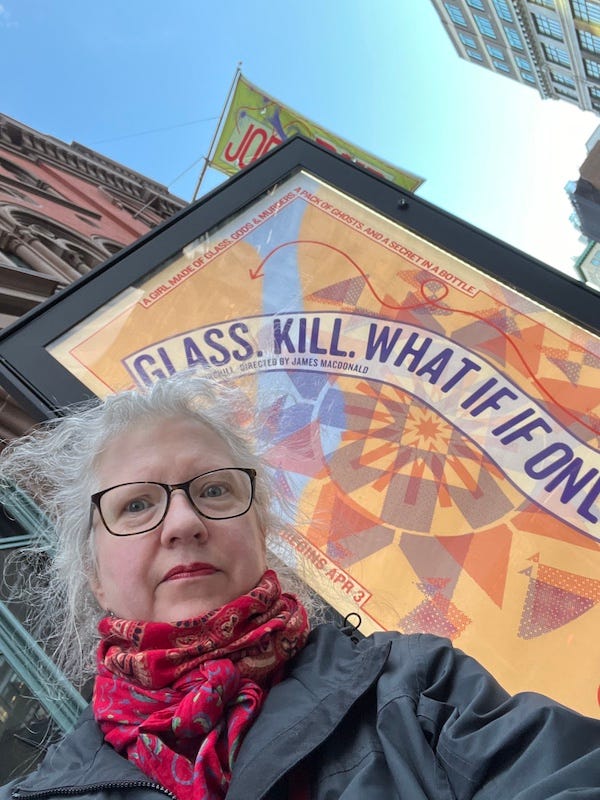
And that’s the latest. How’ve you been?
Love to all, somehow,
Miss O’



 The Miss O' Show (Teacher's Edition)