What Would You Like for Crunch?

A few reflections on my mom, Lynne

Lynne died almost two months ago, on June 5. The other day I had an email from my friend Anna, who told me she thinks of my mom when she’s looking for something crunchy to go with her meal. When Lynne packed a little lunch for me to take on the train, a gesture she stopped doing in the five or six years before she died (not through lack of love but lack of energy), she’d ask, “What would you like for crunch?” (It usually came down to carrots or Cheez-Its or chips.) My mom was a strikingly picky eater, something I didn’t think much about, but noticed more than I was consciously aware of. In her last couple of years, down to 80 pounds and not out of bed too often, I’d see my dad, Bernie, running up and down the stairs from the bedroom, reheating her plates of small meals in the microwave—if the temperature was too cold, she’d stop eating, and desperate for his wife to eat, Bernie would warm it up. My brother Jeff is the same way—the food has to be the right temperature or he doesn’t want it.

By contrast, Bernie eats his spinach right of the can he just opened; I eat leftover Chinese chicken and broccoli out of the container from the fridge. Hot, cold, lukewarm (sidebar: I just realized I have no idea where lukewarm came from, so you’re welcome), it’s food. That said, both my dad and I have to have our coffee steaming hot or we don’t want it.

But one thing we O’s all agree on is that each meal should have a contrast of textures—something with a good chew, something soft, something with crunch. A little salt, a little sweet. I imagine that any human would agree on that—it’s something that makes grilled chicken nachos (topped with melted cheese, black beans, guacamole, salsa, and sour cream) a perfect dish (and luckily I enjoy them even as they get a bit soggy and cool over a long visit with friends).

And really, in a world of so few universals, you’d think we could agree that one of life’s great pleasures and purposes is to have the food we love, the way we want it, when we need it. After clean air and fresh water, and right before safe shelter, fine nourishing food of appropriate temperature and texture and taste is right up there. I find it sickening that anyone could deliberately starve any creature. I can’t stop thinking about this, and Lynne would feel it, too.

For whatever pleasures or pickinesses Lynne experienced in eating or not eating, she saw as one of her prime duties the feeding of her young. “So you have a ham sandwich on whole wheat and a Clementine,” she’d say, putting the Glad bag and napkin into the paper sack. “What do you want for crunch?”

I love that this stuck with Anna. Lynne seems to stay with people, and mostly through my stories. I’m glad I tell stories.

My friend Colleen sent me a card a few weeks back, offering condolences for the death of my mom, and remarked in the card that when I talked of her and told stories, I spoke of her as “Lynne,” never as “Mom” or “my mother,” and Colleen wondered why that was. Talking to my dad recently, I relayed this observation and said, “I always saw Mom as a person first, and my mother only incidentally.” He thought that made sense. I see Bernie the same way, a person first. They both made it clear from the beginning of all their kids’ lives that their marriage came first. “You kids can go to hell,” my dad said more than once during various moments of his children’s sometimes troubled adolescences, “all I need is your mother.” And it was true.

Back in 2022, my dad had surgery for the first time at age 88 to remove a mass (non-cancerous as it turned out) in his colon. This would turn out to the be the last year that Lynne was really mobile, and even then it was limited. Here’s from my sketchbook of that time:
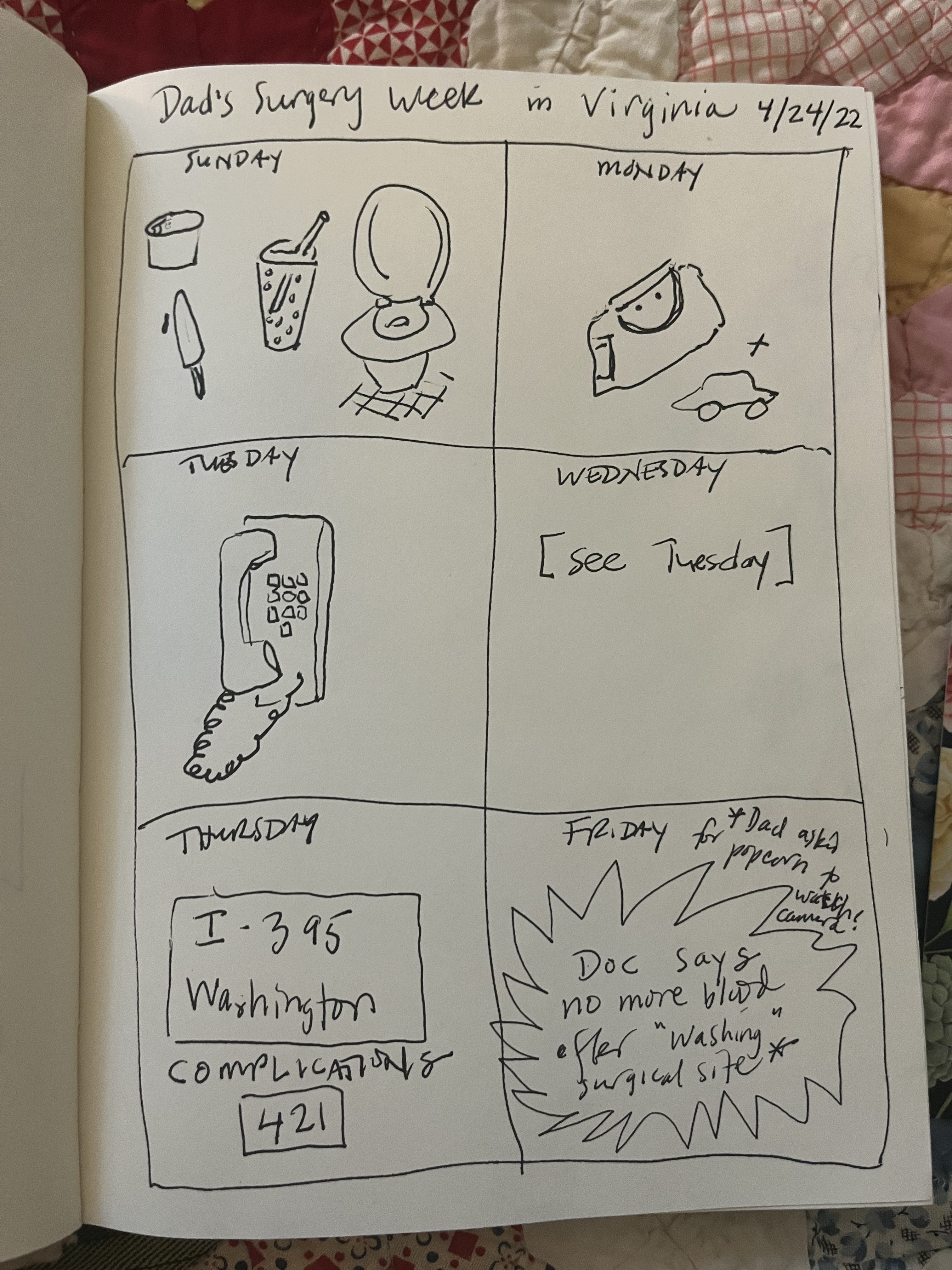
I told you this I’m sure, but before I took the train down to Virginia from New York the week of the surgery, Lynne asked, “Why are you coming?” My brother Jeff lives with them, but he works a labor job, and as an editor I can work from anywhere. She still didn’t see the point. I knew that after a major operation that there was no way Bernie could lift, open, or otherwise help with anything, and that my mom was too weak to turn doorknobs. (I’m not kidding: years ago my father (who is a neat freak, so this was hard for him, I know) started leaving all the closet doors ajar, and even made the toilet paper hang long so it would be easy for his wife to reach; it wasn’t until after Lynne died that I realized why all that was.) And if you are waiting for your parents to realize they need you, that is not happening. So you go. A few days after my arrival, Lynne looked at me hard and said, “How did you know?”

During his recovery, in Bernie’s unstoppable neat freak rush (he is famous in the family for breaking and chipping every plate, glass, cup, mug, ornament, you name it, that he touches), he broke a precious object. Poor Lynne had a vase she was really fond of, at least 50 years old, and one morning I came downstairs to hear Lynne yelling, “How on earth did you break that?” And Bernie is yelling, “Well I had to pull the shade down,” and she’s yelling, “Why? There are curtains there, and I really loved that little vase.” It had been nearly 60 years of suffering the sloppiness, and yet all the love, you know?

So I went online, and I searched. And it took some time, but I found it. The exact same vase. I gave it to them for their 59th wedding anniversary. Neither of them even noticed its return. Ha, ha.
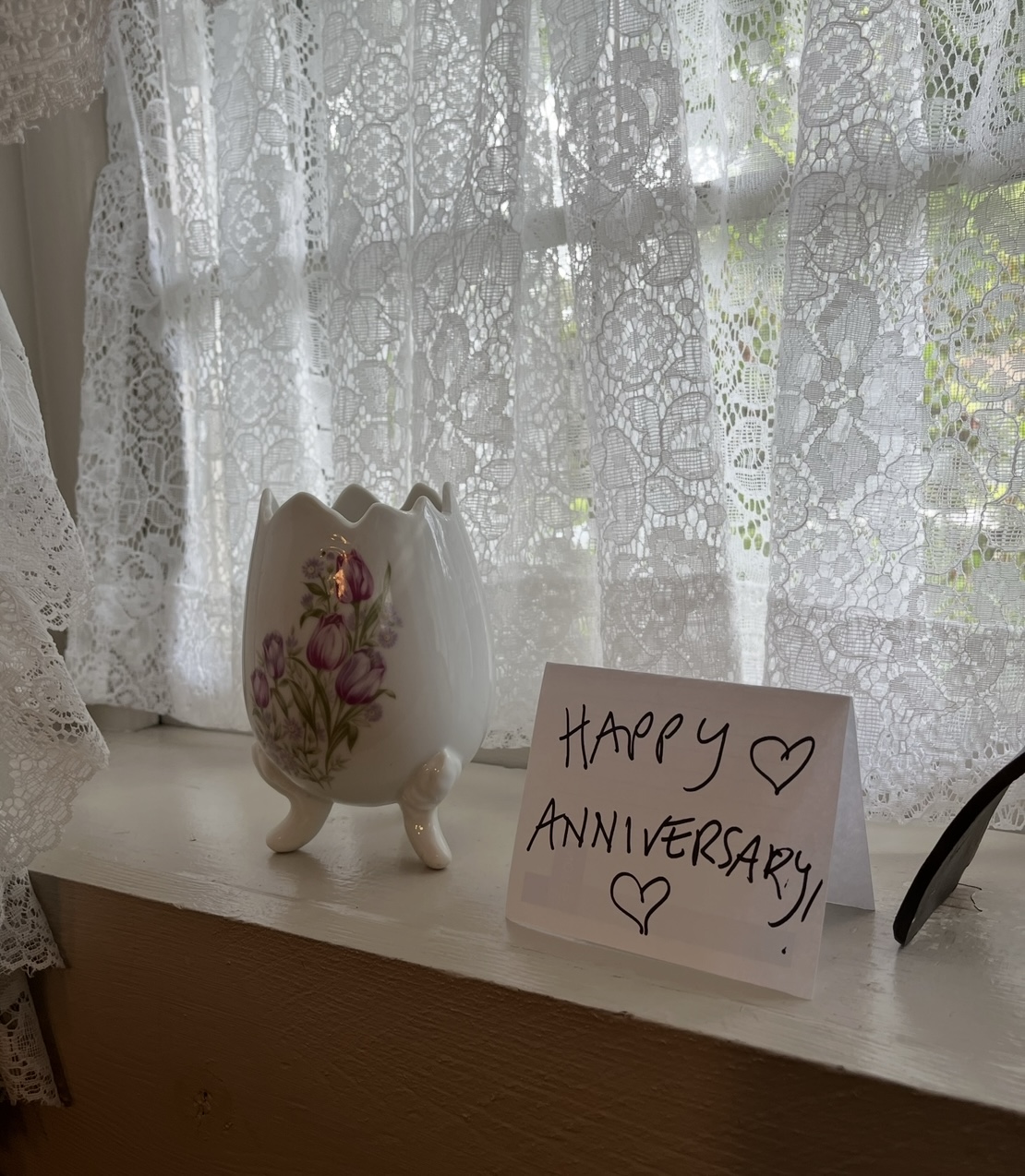
The best reason for Google.

Bernie and Lynne. I knew people growing up—good buddies and neighbors—who would say that their mom or their dad was their “best friend.” I found that creepy. Once when I was in middle school, or maybe early high school, Lynne said to me out of the blue, “You don’t care that we aren’t friends, do you?” I didn’t hesitate in saying, “No,” because Lynne raised her kids to be independent creatures, even as she fed and bathed us and took us to the dentist twice a year. It worked for the O’s.

At a reunion of my dad’s side of the family out in Iowa and Nebraska nearly 30 years ago, my youngest brother Mike told a girl cousin (one of 37 living) that we weren’t really raised with hugs. She asked, “How do you raise kids without hugs and kisses?” When we got to our Uncle Al’s farm, five of her six children walking toward our cousin’s Aunt Lynne, who walked purposefully to greet us with a wave and a back pat, Mike said, “We don’t hug, do we Lynne,” and our mom declared in perfect time, “No we don’t.” Our cousin gaped.

Hugs and kisses are nice, but some of the most screwed up people I’ve known in my life had all of that and a mom or dad for a best friend. You know. Every family is different, the needs are different, no one does it perfectly. The hot and cold, the bitter and sweet, the soft and the crunchy—I’m grateful for the textures Lynne brought to our lives, for the nourishment she gave, for the smarts she had. We may not have been smothered in kisses, but because of her, the O’Hara kids know injustice when we see it, and we are not afraid to call it out.

Crunch.

Sending love,

Miss O’
Food, Home, Music

Ways we see some sense, in lists of three

Babies, like you, I am about to simultaneously explode and collapse from rage, numbness, boredom with the stupid, and Dorothy Parker’s “What fresh hell is this?” pounding in my ears, I mean for the LOVE of GOD.

Look, we all of us—all of us—every mother lovin’ one of us—white, brown, black, all the colors; man, woman, trans, all the genders; short, tall, medium, all the heights; ambulatory, prostheticized, wheelchair-bound, all the abilities; Euro, African, American, Indigenous, Indian, Chinese, Korean, all the places; Jewish, Muslim, Christian, Buddhist, Hindu, all the faiths–love three things, and I mean LOVE:

1. good food;

2. a comfortable home; and

3. music, whatever that music is.

Watch Home Town on HGTV and tell me you wouldn’t want Ben and Erin to help you make a home for yourself; walk past any bakery in the morning and try to pretend you don’t smell that bread; hear a catchy tune on a radio at the laundromat and not pause and bop. You can’t. Because roots as old as the Big Bang, baby, give us a common consciousness. Eat it.

And for some reason, too many whites in this country think ONLY THEY should have any of those desires, those sensory experiences, those moments. This is insane, it’s psychotic. How do we shake sense into these racist, bereft, sociopaths? Those “Frozen People”? They have become new gold standards for the worst of humanity. Somebody, quick, sick a porch swing, Dolly Parton, and fresh peaches on ’em.

I wish we could cook it out, dance it out, whatever this psychosis is, everybody walking into and out of a Wayfair commercial to create that fulfilling home, and combine all of it into community. It’s all so basic.

Inspired by my friend Susan, who got me making Lists of Three (various categories) and sharing them with her the other night; and colleagues who want to have a Zoom social and talk food, I have listed my dream meals, in honor of Thing One we all love. You’ll pardon me if I’m feeling a need to be elaborate.

Dream Meals

1. Breakfast: my dad’s cheese omelet with American cheese, cooked in bacon grease, with biscuits from The Red Truck bakery in Warrenton, Virginia; coffee from Baruir in Queens.

2. Lunch: the brown bread, Stilton cheese, and tomato chutney Ploughman’s lunch, from the pub in Kent, England, 1992, followed by a cup of Yorkshire tea.

3. Dinner: The fried chicken and collard greens from Mama Dips in Chapel Hill, North Carolina; the hush puppies and sweet tea from the midcentury diner near Seagrove, NC; my mom’s potato salad (sweet relish is the key); fresh-from-the-garden baked sweet potatoes (the way my Appomattox landlady Margaret Stokes from Chesapeake made them), and ice cold fresh sliced tomatoes from the garden.

P.S. Dessert: childhood next door neighbor Frances Christie’s homemade apple pie with the all-butter crust and fresh apples from the Blue Ridge in Virginia.

Dream Home

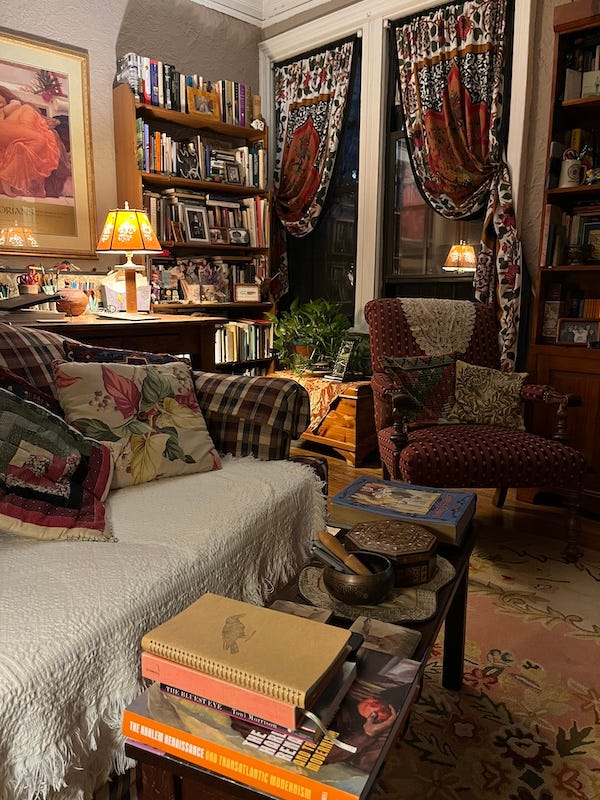
Very grateful to have been able to build this, over many years, across many lives and houses:

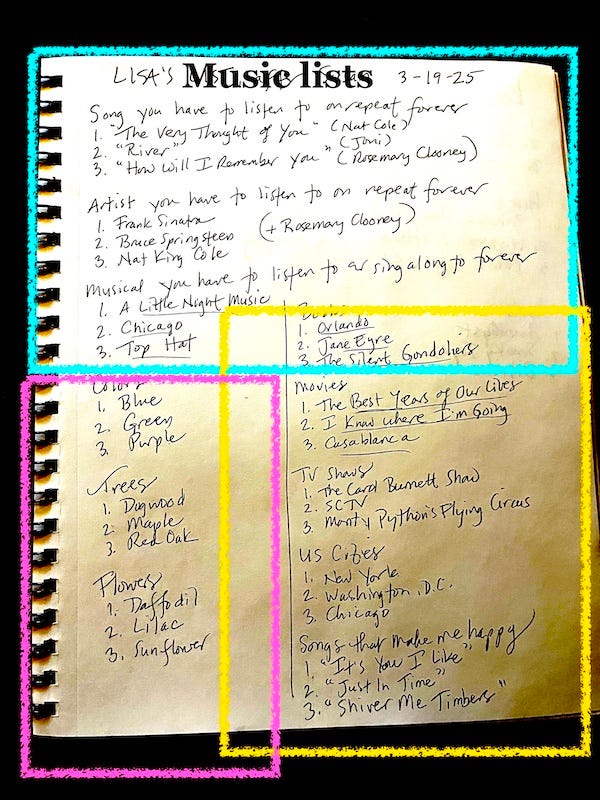
Dream Music

There’s so much not on here, but what can you do? The categories force you to go with your gut. I even surprised myself. (When I lived in my basement during 2017-18, while a friend took my main floor bedroom as she recovered from breast cancer surgery, I missed street noise so much that I found I had to play music on low to sleep. Those CDs? Tony Bennett, The Rodgers and Hart Songbook, and Rosemary Clooney, Songs from the Girl Singer. Every night for nine months. And on the list down there, Rosie was an afterthought; Tony didn’t even make the cut. How?)

Does this get your brain percolating? With a hat tip again to Susan for inspiring me to start remembering all the foods, homes, songs, as well as people and places I like, and the experiences I’ve lived: here’s a little challenge to you, my reader:

In the comments, if you want, give us a List of Three of whatever, no explanations needed, just a label and a list of three. Let’s inspire each other. Let’s connect. Let’s take some recommendations. See what happens.

I could really use reminders of our common humanity. How about you?

Love, love, love,

Miss O’

Spreading Salt

On snow, ways we remember, and my mom’s cooking

Making Lasagna

I was sitting here thinking of my mom, Lynne, a couple of years back, before she fell and started a slow downhill slide, which continues, tough old bird of 90 that she now is.

I think this was a year ago, we were out in the playroom, an addition to our small but sturdy house that was put on when I was in fourth grade. To access it you have to walk through the utility room from the little alcove by the kitchen. The kitchen ever was and remains comically small and impractical by HGTV standards. I watched my now 80-lb. mother determinedly making her famous lasagna in an oddly small Pyrex rectangular dish, with the intention of feeding a family of seven adults and a toddler. I don’t know if the bigger dish had broken or what; but she spent all morning at it before my brother Mike, his wife, and the newest grandchild, and our other out-of-state brother Pat arrived to visit from North Carolina and Florida for a weekend. Mom had sent my dad to the store for lasagna noodles, cheeses; they boiled and drained the noodles, cooked al dente; she painstakingly opened the various packages of cheeses, using a knife, so slowly; she had her signature tomato sauce on the stove to warm up from the freezer. The slowness of her movements just hurt to watch. I think I was the only on watching. See, no one asked for this lasagna, one of her handful of truly great dishes, but you could see she felt she should make it, perhaps for one last time, who knows, age being what it is, for her family. She didn’t look happy about it, but neither did she want my help.

When they all arrived, my mother was still putting the lasagna together. As I say, this seemed to go on for hours. She was missing the action, you know, the way mothers do, alone in kitchens. Finally, I went in and tried to get her to come out to the playroom to be with all of us, with the son and grandson and her other son, and me and Jeff, there to see her. At some point, she and my dad decided to put the lasagna in the oven, even though it was too early to eat, even for an early dinner.

The upshot is, it way overbaked, shriveled into a barely edible shadow of its former self; and it seemed to be a couple of layers lower than usual, as it was, as if she’d forgotten something. We ate it; I remember my mother’s face, her shoulders shrunk, all that work, the end without the joy and plumpness of abundance. And for some reason, just now, it came back to me, that moment, and I fell to weeping. Now I have to think about why.

Well Butters

I’ve written about this before, my invented term for people who cannot accept a story that you tell on your terms. They have to correct you. Sometimes they are correcting a story they were never part of in the first place, which is a trait my mom has. Sometimes they correct your memory of time in a certain geography, because they share that geography and don’t have the memory you do, or experience a place or event in a way different from you.

My mom, Lynne, for example, is a story corrector, a well-butter. I was telling her once about visiting a retired teacher-scientist friend who’d built a cabin in the woods on her family’s farm. Her kids were grown and gone, her husband ran the farm as usual, and she lived alone with her dog in the cabin, which she did for a year. She kept a journal, spent her days studying the ecosystem, reading Thoreau and Edward Abbey, doing experiments, and simply living. When I returned from my first visit, my mom wanted to know how she bathed. “Oh, she doesn’t. She might go for two weeks not washing at all,” and my mom admonished, “Well, but that’s a lie. Now, Lisa, don’t say things like that. Of course she bathes!” Mom left the room, a well-butter: “Well, but that’s a lie…,” and I turned to my brother Jeff: “No it’s not.” I know, he said.

Now, do I contradict my mother? No, I do not. I think about it, I reflect on it. I try to understand it. Because I’m insane, and a writer.

To take another example: if I say to a New Yorker friend, “I love New York! I love the energy, the art, the theater, the people watching,” that friend may quickly interrupt to say, “Well, but Lisa, the city is filthy, people are homeless, some can barely make rent, and who has money to see shows?” It’s Yes And. It’s both. This doesn’t have to be an argument.

And so, I do not argue with this well-butter. I say, “So where do you want to eat?”

Sometimes it’s just about differences in lived experience. The other day, I said to my friend Colleen, who has been a constant resident of two NYC boroughs since the late 1970s, that I missed snow, lost now to global warming. She looked puzzled, saying, “Well, but it’s not like New York was ever a snow city,” and I disagreed. “My whole memory of living here is that from December to April there’s snowpack,” I said, and Colleen looked at me like I had two heads. I didn’t argue, but instead asked, “Would you like some tea?”

The Snows of Memory

Now, why are our memories of snow in New York City so different, Colleen’s and mine? I’ve been reflecting, because I am insane, because I am a writer.

For one, I lived my first 39 years in Virginia, where there is maybe one big snow storm every few years, a little ice once in a while (I was a student and a teacher and lived for snow days in both iterations of my life, and we didn’t get to use that many), so that might account for some of the difference—that by comparison, any regularity of snow seems like “a lot.”

But I think another reason is more practical: Colleen has only ever rented her apartments, and so there is staff to shovel and salt (which is not to say reliably), and New York City is mad efficient at this in most places, especially Manhattan (it blew my mind when I first experienced it, how most everything still runs no matter what). By contrast, my tiny Queens co-op apartment building (since I bought in 2005) has never had a super who could be relied on to shovel snow, so (to avoid a citation) I and my upstairs neighbor Debbie used our own shovels and did it ourselves. As a board member, I ordered 12 bags of salt a year, for a solid 8 years, and we used nearly all of it every year, and I know this because I spread the salt myself. (By comparison, one or two bags of salt have held for the last three winters.)

In addition, I have muscle memory, walking the half mile to the subway every morning for 16 winters (before Covid), navigating the corner of 40th Street and 47th Avenue with great care because that building’s landlord never shoveled; and I constantly had my boots repaired at Drago Shoe Repair in Penn Station because of salt damage and puddle leaks. I felt every inch of the winters, and I also loved it, because I love winter. I am crazy about cold temperatures, battling the subzero winds, and I find snowfall a reason for rejoicing, at least when I’m not battling depression (always not wanting people to die). Colleen, by contrast, finds winter a misery, hates snow, hates cold, lives for summer heat; and I would suggest that a healthy mind like hers might slip into denial of weather you hate while you wait for the green splendors of summer. And because, in addition to all of the above, I can say with certainty that our last major snowstorm of any duration took place in 2016, and that was 8 years ago, I can also say with confidence that I am not crazy to say, I miss snow.

Back to Lasagna

So why was it so painful to remember my mom’s failed lasagna one winter ago? It’s one meal. No one else who was there may remember it at all, including the hunched shoulders, the strain of it, the sad face, all that work only to end up overcooked out of confusion, a change in routine. Like you, I’m sure, I’m starting to see her lasagna as a metaphor for a life lived, a life ending.

I have almost continuous memories of my mom making lasagna, or feel I do, because I loved it and enjoyed it so much—all the leftover noodles, the extra cheese I ate with them. But in truth, it was a dish she couldn’t have made above two or three times a year. For one, it was labor intensive, and there were four kids at home, she babysat neighbor kids, and by the time I was 15 she was back working full time (as a bookstore manager); next, it was expensive (with all her specific cheeses and special sauce—a secret), growing in size from a square Pyrex pan to a large rectangular one; and because we all loved it, there was almost none left over, and leftovers were always the Saturday night meal. So in actuality, in my 18 years under that roof, I had at most 40 large servings of lasagna. Is that enough? Never.

When I was home at Christmas, working from there for one week and on vacation for two, my mom spent a lot of time going through her recipe folder. She made her perfect macaroni and cheese for me—another agonizing effort, but she was determined. She showed me where all the important recipes were. (She also showed me where all the important sentimental things were in her dresser.) These things have to be done if we are to keep any family traditions going; I’m the only one who is interested, really, but that is only because I am the one preparing for the end. In time, my younger brothers will care, too. For now, I’m the keeper of the recipes.

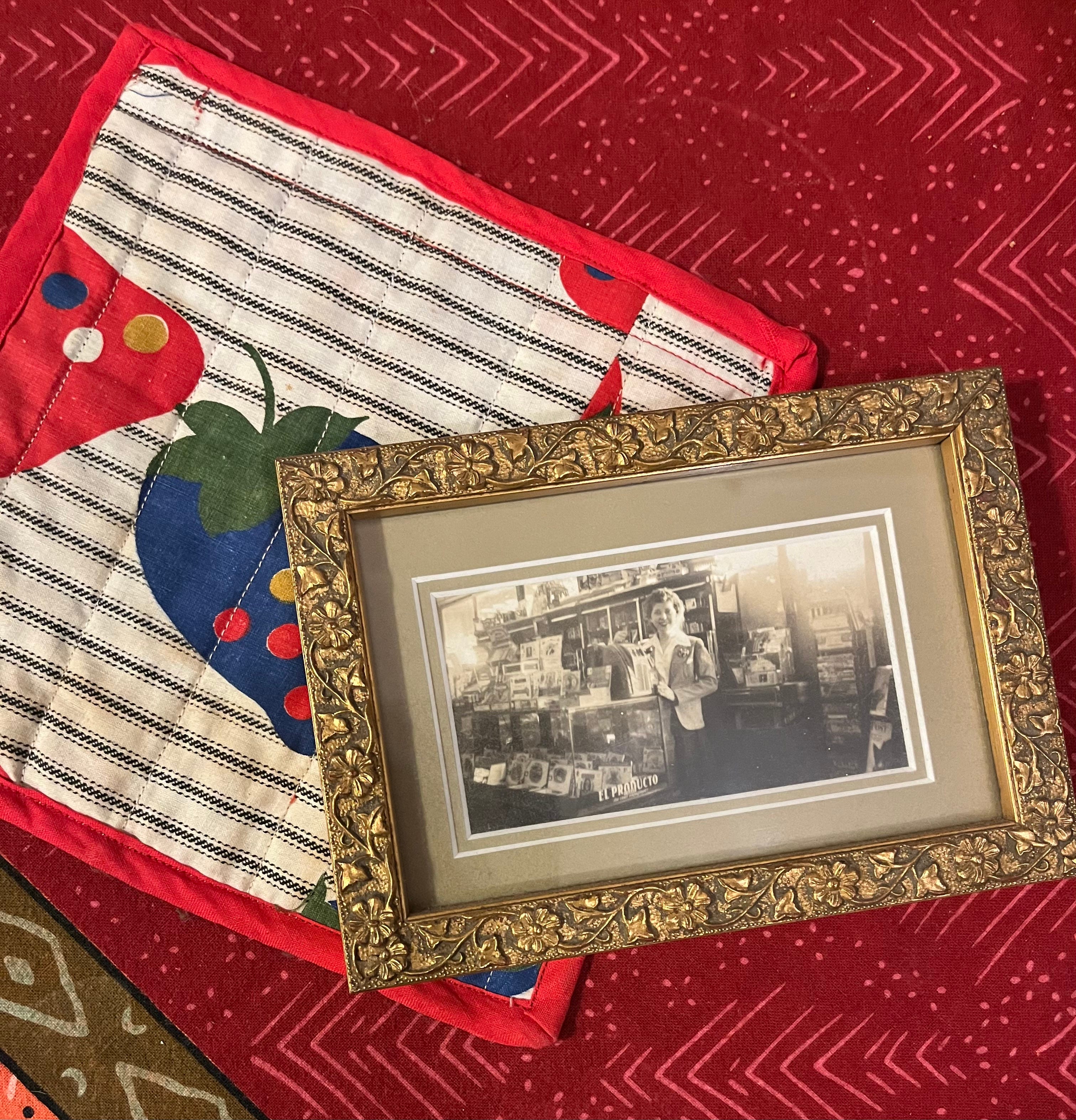
No one’s memory is perfect—I’d never pretend it was. But there is a decline that is sad and scary to see: one more was my mom holding a worn, torn potholder she wouldn’t let me throw out, saying, “My mother made this.” I looked at my brother Jeff. Idiotically, I said, “No, Mom, she didn’t make that one; I have the ones she made at my house.” She stared at the generic blue potholder again. “No,” she insisted, “my mother made this.” And she gripped it so tight it brought tears to my eyes, but only later when I recalled it, because I realized, My mom needed to touch her mom again, even if she’s spent most of her life saying she hated her; they are so close to meeting again, you see; amends need to be made, memories held.

Still life with potholder and my grandma, ca. 1945. Photo by LO’H

What am I on about? Life ends in old age if we are lucky. See it for what it is. We remember what we need to remember, okay? And we can tell our own stories, thanks, and we don’t need anyone correcting us. Watch, listen. And just say, “Oh.”

Love,

Miss O’