On What Occasion Do You Lie?

Telling truths on Presidents Day

“I cannot tell a lie.”

~ George Washington, First American President

Ironically, this famous quote is itself a lie (how American), but more on that later.

The magazine Vanity Fair (to which I no longer subscribe) includes, as the last page of each issue, The Proust Questionnaire, a set of questions originally asked and answered by novelist Marcel Proust and now used to learn more about the globe’s favorite obsession, celebrities. The questionnaire has some interesting questions, and some shallow ones, but the answers can be revealing. I’m often struck, for example, by the way powerful men, even decent ones like George Clooney, answer #12: What is the quality you most like in a man? “Loyalty.” As a woman I read this as, Truth telling is a deal breaker. As for #13, What is the quality you most like in woman? men generally respond, “Patience” or some other subservient thing. It’s interesting, if limited.

Interesting, If Limited could be the title of my memoir.

Walking around the neighborhood, I found myself thinking of Question #9, which is, On what occasion do you lie? Often the celebrity of the month who has chosen this particular question among the many, will respond, “To spare someone’s feelings.” Fair enough.

But speaking as a fairly honest person who has lied on numerous occasions while also valuing truth, I wondered if any of the situations in which I lied had something in common. I’d like to say something pithy, see, when it’s time for my Vanity Fair moment, so let me note just a few examples, categorize them, and see if I can find the common ground.

1. Once in second grade, Mrs. Angle—I’ve told you this story—asked us after nap time with our heads down on our desks if anyone had a dream they’d like to share. I raised my little hand and got up in front of the class and, making it all up (obviously) to entertain my friends, described how we all went to Egypt to see the tomb of Tutankhamen. I pointed, “Juanita was there,” and again, “Ingrid was there,” and Mrs. Angle snapped, “You’re lying. Sit down.”

2. On a high school field trip during my sophomore year, to take the singers and pit orchestra to a neighboring high school to perform scenes from South Pacific as a promotion for our production, our sponsors, Mrs. Combs and Mr. Carnohan, realized they’d forgotten to send home permission slips with us kids. Only when the bus driver asked if they had them did they realize. I stepped up quickly, “Give me ten minutes.” I had everyone write out a permission slip on paper we all collected from someone’s notebook, and I signed each slip in chameleon-like handwriting. Mrs. Combs looked stunned, but she took my pile and off we went.

3. When I’m late for something, like work, I have blamed the subway (and have been caught out by a colleague and supervisor on the same line) because I’d rather not say, “I have IBS and had to run back home halfway to the stop because I needed to shit again.” (Finally, I just told the truth. No one asked after that.)

4. I once helped make a company-wide Answer Key set, compiled for the whole floor of my 2 Penn Plaza office, when this one president took over and, to prove his power, spent easily $100K to create something like 30 separate “learning modules” complete with “tests” on corporate “life” and business, modules that included short films, voice overs, and reading material on slide presentations, and if you didn’t get all the answers correct on each test, you had to start over, the whole module. We had massive publishing deadlines at the time, our nerves hanging by a thread. To what end are we doing this? But your job was on the line. A few of us—no doubt my idea—began printing out all our 100% test answer sheets which we labeled by module, punched holes, and stuck them in an unmarked three-ring binder. and set it on a file cabinet in our pod We didn’t even hide it. Eventually even our supervisors, to say nothing of executives and vice presidents, began ambling and ultimately marching over our pod to get the book, because 1) these tests were useless to our work; 2) the president was doing it to be a dick; 3) he would be out on his ass soon enough (they always are) once he was eligible for that golden parachute—we endured a period of a few years in which a succession of dicks who were pushed out of one company division and over to ours until they could retire. It was not fun. And yet, our important work—work that corporate didn’t in the least understand—somehow went on, great as usual. Hmmm. Who’s the parasite, Elon? (And how do I really feel?)

5. When the famous Westway Diner on 9th Avenue was taken over by new management maybe six or eight years ago—all the old-school career waiters replaced, the desk staff and chefs gone, the classic booths and tiles plowed under for white and gray blah—I happened in to check it out, and in addition to the place being bereft of atmosphere, the food sucked. “How did you like it?” the aggressive manager asked me about inedible spinach pie, which was a block of bone dry phyllo with almost no filling. “Mmmm,” I said, not wanting the poor new chef to get canned. Let someone else tell them; consider this a funeral donation. (It’s since recovered.)

What do all these occasions have in common? Well, they are lies of convenience, I guess, trying to smooth something over, or using deceit to help out friends or struggling folks; on reflection, I tell few lies just to save my ass. That’s how I was brought up. But I’m not stupid enough to believe that always being honest is smart. As my friend’s Montenegrin immigrant father used to say, “Honest and stupid are two brothers.”

I’ll tell you what the lies don’t have in common: No lives are in the balance for the telling of them. While I don’t condone lying or deceit as a lifestyle, sometimes lies save lives, and you have to keep your hand in. Ask the enslaved; ask women being beaten by abusive husbands; ask Tina Turner running away from Ike. Ask Jews during the Holocaust. Ask the French Resistance. And as we are entering a different era now, hearkening back to those dark times, we all may need to reset our moral compasses. We are back to Nazi Germany, friends, and “truth” for them, ain’t truth for us.

Thinking about coded language and other “lies,” and this being Presidents Day, I recalled a Chaucer class I took in graduate school 30 years ago, and my professor, John Fleming of Princeton, wanted to teach the class about Medieval iconography—you know, the images in all those beautifully illuminated manuscripts with the stories in calligraphy and the illustrations in gold leaf and lapis blue. Those illustrations, we learned, were included not only for their beauty but to guide the illiterate, because unless you were nobility or clergy, you didn’t read. So, what did the images mean? You see a lion, a rose, stuff like that. How would anyone get a whole story from a picture?

To demonstrate, Prof. Fleming drew these images in simple lines on the chalkboard:
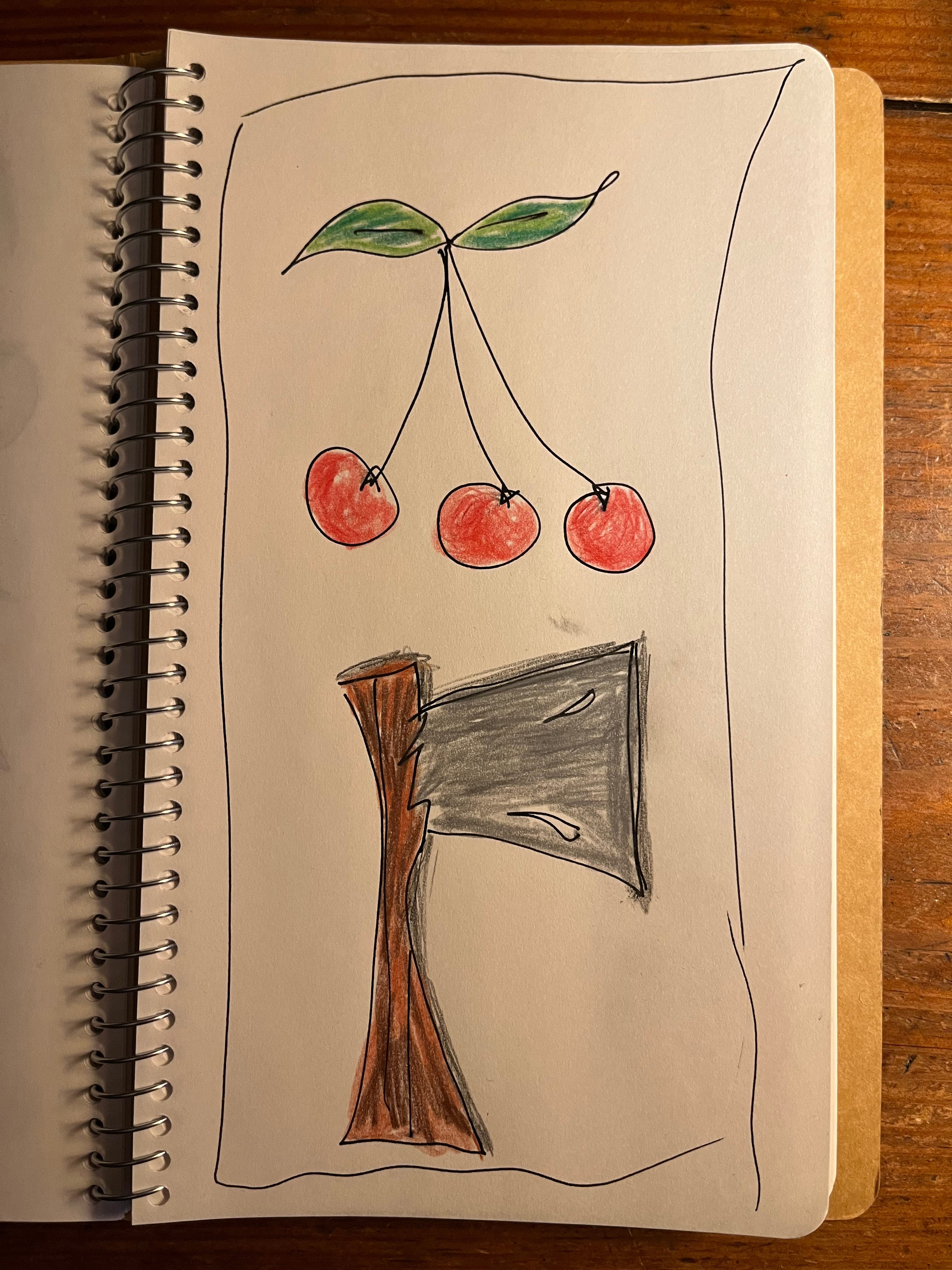
“What is this story?” Fleming asked. My classmates, attending the Bread Loaf School of English from all over the country and the world, sat dumbfounded. I couldn’t believe it. See, I talked a lot, and I was practicing restraint, but finally I raised my hand.

“It’s George Washington and the cherry tree. I cannot tell a lie, Father, I chopped down that cherry tree.”

The class turned to me and looked at me like I had two heads. Fleming barked a happy laugh.

I explained to the still-lost class that I grew up in Virginia, up the highway from Parson Weems’s house, Weems being the man who wrote the fable about wee George, and a few miles down from Mount Vernon.

Fleming then went on to explain that this is a perfect example of how and why iconography—the use of simple symbolic images to represent a whole story—works in places that share a common culture.
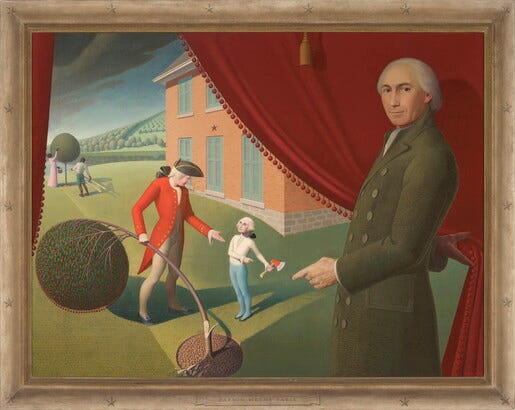
To learn more this Presidents Day about this fable, you can check out the Carter Museum and learn about Grant Wood’s portrait, pulling back the curtain on the myth. In 1800, Weems published The Life of Washington, which is well-known as the source for many myths about the first president. Written just a year after Washington’s death, it includes the story of six-year-old George admitting to chopping down a cherry tree and another about Washington praying at Valley Forge.

Who chopped down that cherry tree? asks George’s father, according to Parson Weems, who wrote, “Young George bravely said, ‘I cannot tell a lie… I did cut it with my hatchet.’ Washington’s father embraced him and declared that his son’s honesty was worth more than a thousand trees.”

Why create this myth about an already mythological figure, even by 1800? I guess to impress upon America’s youth the importance of honesty. But what to do when you learn the story is in fact made up?

Growing up as I say, along the Richmond Highway between the home of Parson Weems and Washington’s home of Mount Vernon, I learned this fable in elementary school, but I never learned about Washington, the enslaver. Not in high school, not in college. I remember a California friend visiting Mount Vernon with me and saying, “I thought this was just a myth,” meaning the whole plantation, the first American president, all of it. And it’s easy to see how anyone not from the historical grounds of colonial America might feel that way, or wouldn’t be shocked to see a slave auction block landmarked in Fredericksburg or Williamsburg, given the American tendency to mythologize the successes and sweep the ugly truths under our antique hooked rugs.
And really, the more we keep digging, and the more lenses we train on our history, the more truths we uncover, the more lies we reveal—the more interesting and complex and real our history becomes. It’s discomfiting, sure, horrifying at times, but isn’t it exciting, too? Isn’t truth worth seeking? How else to make this nation truly free?

This is where we turn to our artists.

To explore perhaps America’s greatest “Lives of the Presidents” cover-ups, the relationship between Thomas Jefferson and his enslaved “mistress” Sally Hemings, Pulitzer Prize-winning playwright Suzan-Lori Parks premiered her play Sally and Tom at The Public Theater last year. The premise of the play is a community theater putting on a play about these historical figures while the leads are in a relationship. I loved the show, and I was fortunate enough to be there on a talk-back night. In attendance that night were several of the descendants of Thomas Jefferson and Sally Hemings and their families, as verified by DNA. I couldn’t believe I was having this chance to witness history. To watch as these family members meet one another after the show (many were sitting in the row in front of me) and walk up onto the stage—the set’s back wall covered in all of their names in the final reveal—to take photos with their phones, made me weep. (I think it would be a fascinating way to end the actual play.) It was wondrous, too seeing truth all up there like that. The theater was filled with love in the midst of revelations. That’s what art does.
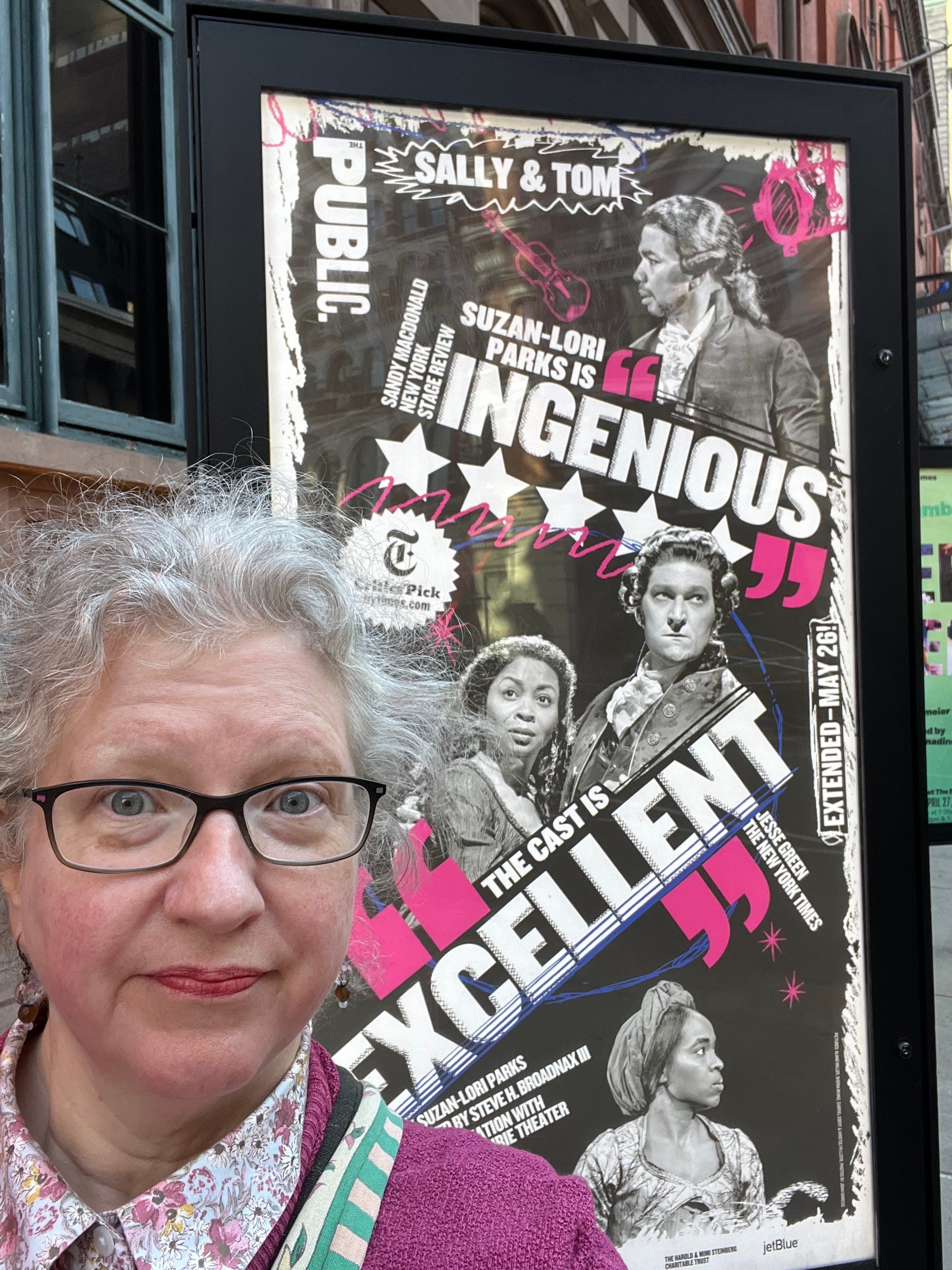
Miss O’ outside The Public Theater, April, 2024.

And I think also of that incredible painting by Titus Kaphar, “The Myth of Benevolence,” offering another way that art can reveal a deep truth in a way no historical record ever can, exposing long-hidden damage and forcing us to confront it. (Click on the link to see the entire painting and learn its story.)

A whole story from a picture. American iconography.

Detail, Titus Kaphar, “Behind the Myth of Benevolence” https://www.culturetype.com/2018/03/28/titus-kaphar-and-ken-gonzales-day-explore-unseen-narratives-in-historic-portraiture-in-new-national-portrait-gallery-exhibition/

On what occasion do you lie? I look at the American story, then and now, and it’s seeded with lies and corruption, so many lies, you have to wonder, Can it ever come clean? How do we answer for it? These are the questions we all should ask and answer now. If we don’t, whom do we think we’re protecting?

On what occasion do you lie? Ask Gil Scott Heron, famous for saying “the revolution will not be televised,” meaning it happens inside us, speaks volumes about the impact of lies in the linked poem; and Kendrick Lamar, whose brilliantly coded and performed all-Black Superbowl Halftime Show blew me away. The enslaved lived in world of code. They had to lie about learning to read, for godsakes. Pretend to go along, to get along.

On what occasion do you lie? Ask women who have been sexually assaulted and been made to keep quiet or lose their careers. Ask the men who keep pretending nothing happened. Ask Sally Hemings.

On what occasion do you lie? There are real reasons to lie, moral, ethical reasons. To protect the ones we love. To save our neighbors. We are having to think hard about that now.
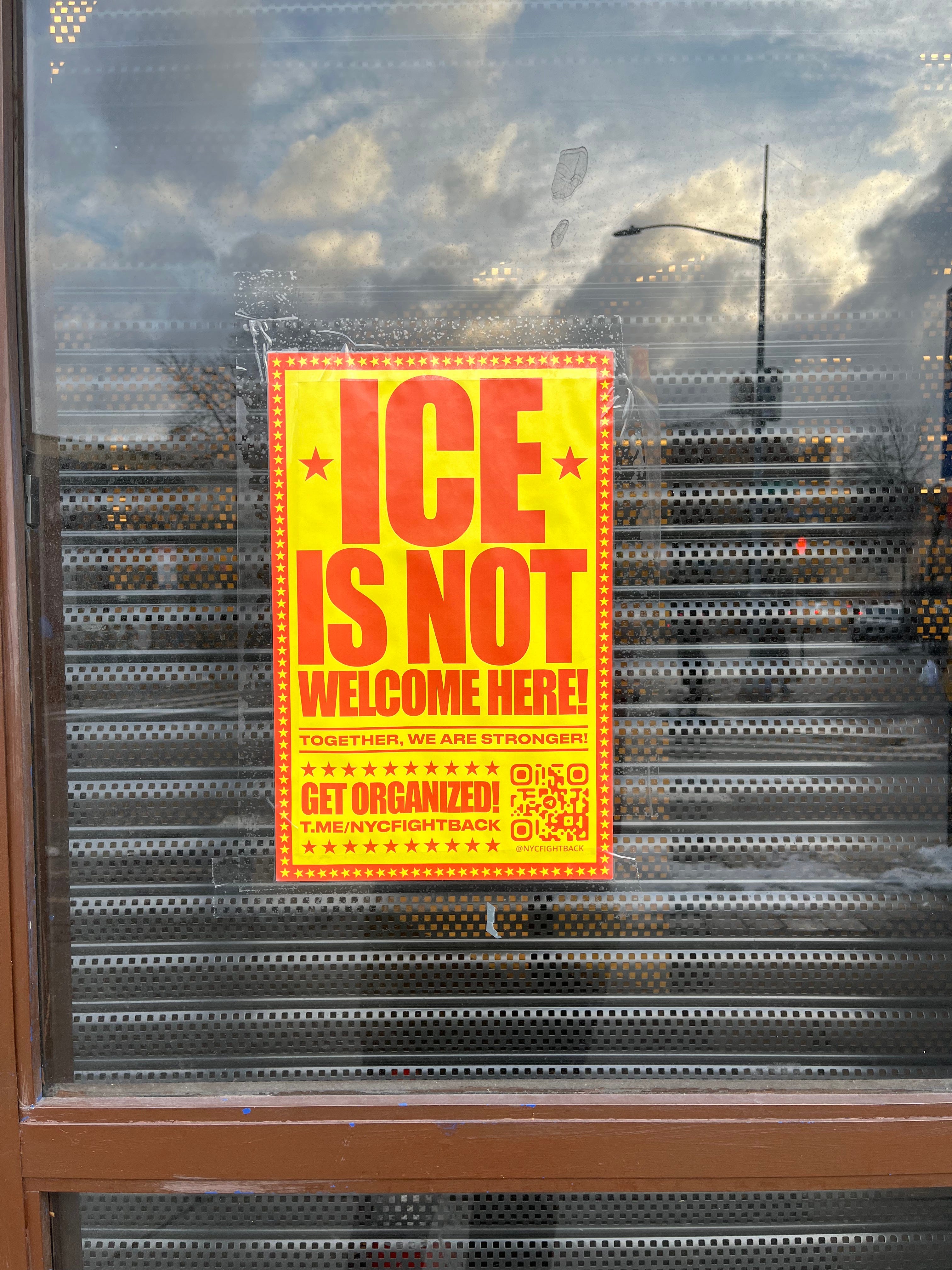
Republican lawmakers (that’s rich) want AOC arrested for teaching Americans and immigrants their rights. Photo by Miss O’ in her Queens neighborhood.

Because let’s face it: here in the United States, we are in a crisis of government amorality. We have a lying Republican party (no more rule of law); a lying president (pick a campaign promise, and yes, Project 2025 was the plan all along); a lying vice president (his autobiography exposed as a sham); a lying Supreme Court (see Roe v. Wade, which all declared, under oath, “settled law”); and liars heading every cabinet position (no, trans people are not the cause of America’s problems; and Putin is not America’s friend, Tulsi). We have liars in the Department of Justice and Homeland Security (immigrants are not remotely the cause of most crime; being brown is not a crime). We have liars heading the F.B.I. (the Democrats are not the enemies of America). It’s all lying all the time, now, and their truths are even worse. The freedom of Western Europe is now in the balance, as Vice President J.D. Vance admonished the “values” of those democratic nations this weekend, in essence praising the rise of fascism in France and Germany and also capitulating to Russia’s desire for empire. On the campaign trail, Vance said “democracy” but meant, we know now, “totalitarianism” (Europe is not America’s enemy, nor are Panama, Canada, or Greenland; our actual enemies are transparently heading our own government.)
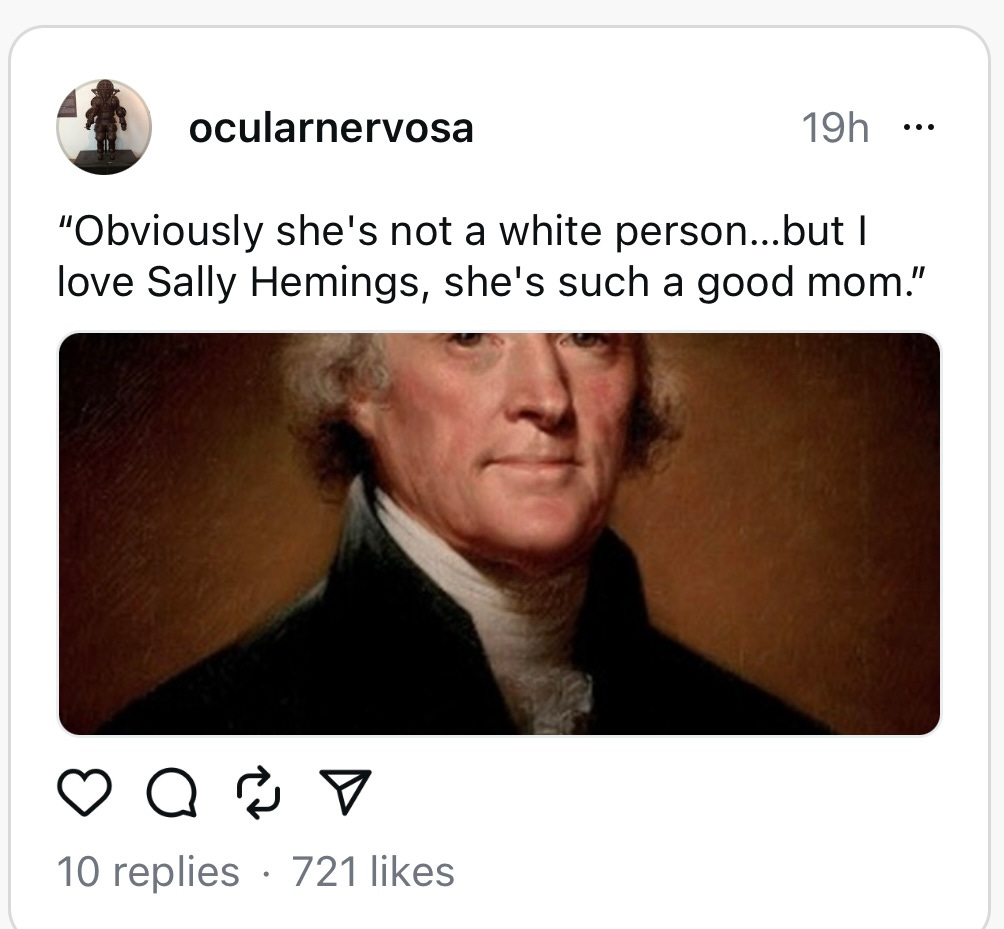
Past and present collide: JD Vance on his brown wife; I’ve heard Vance refer to their children as “her” kids. Look at the mental gymnastics and self-delusion of Vance, who denies his wife and children, and smiles.

To think that all of today’s stuff started with asking a simple question.

Identifying lies is not the same as responding to the world that supports those lies. There’s a very cool blog on Substack called The Pamphleteer by Lady Libertie, and she is focused on how we negotiate this new era. Check out “So You’ve Been Invaded: a French Resistance Guide for the U.S.” Pretending comes with the territory of survival. Marcel Marceau, for example, as a teenager pretended to be a camp leader, while his real job was to smuggle Jewish children across the border to freedom; he used the art of mime to teach the children silence as they walked. It’s not really lying if it’s saving lives, and the people you are lying to are venal.

Happy Presidents Day in America, 2025, everybody!

Sending love,

Miss O’
She Knows Just Enough to Be Obnoxious

A Daughter’s Care

Information Dispensary

Years ago, I was visiting an elderly friend in Virginia, a former landlady whose dear husband had died a couple of years before. Her wonderful, caring daughter, a school nurse by profession, had just left to return to her own house next door, having checked on her mother’s food, water, and meds situation, dispensing advice to us about this or that, and after she’d departed, my friend turned to me and said, “Merry knows just enough to be obnoxious.” It wasn’t that Merry was incorrect about her information, but it was rather the authority with which Merry dispensed the information that made her mother cringe.

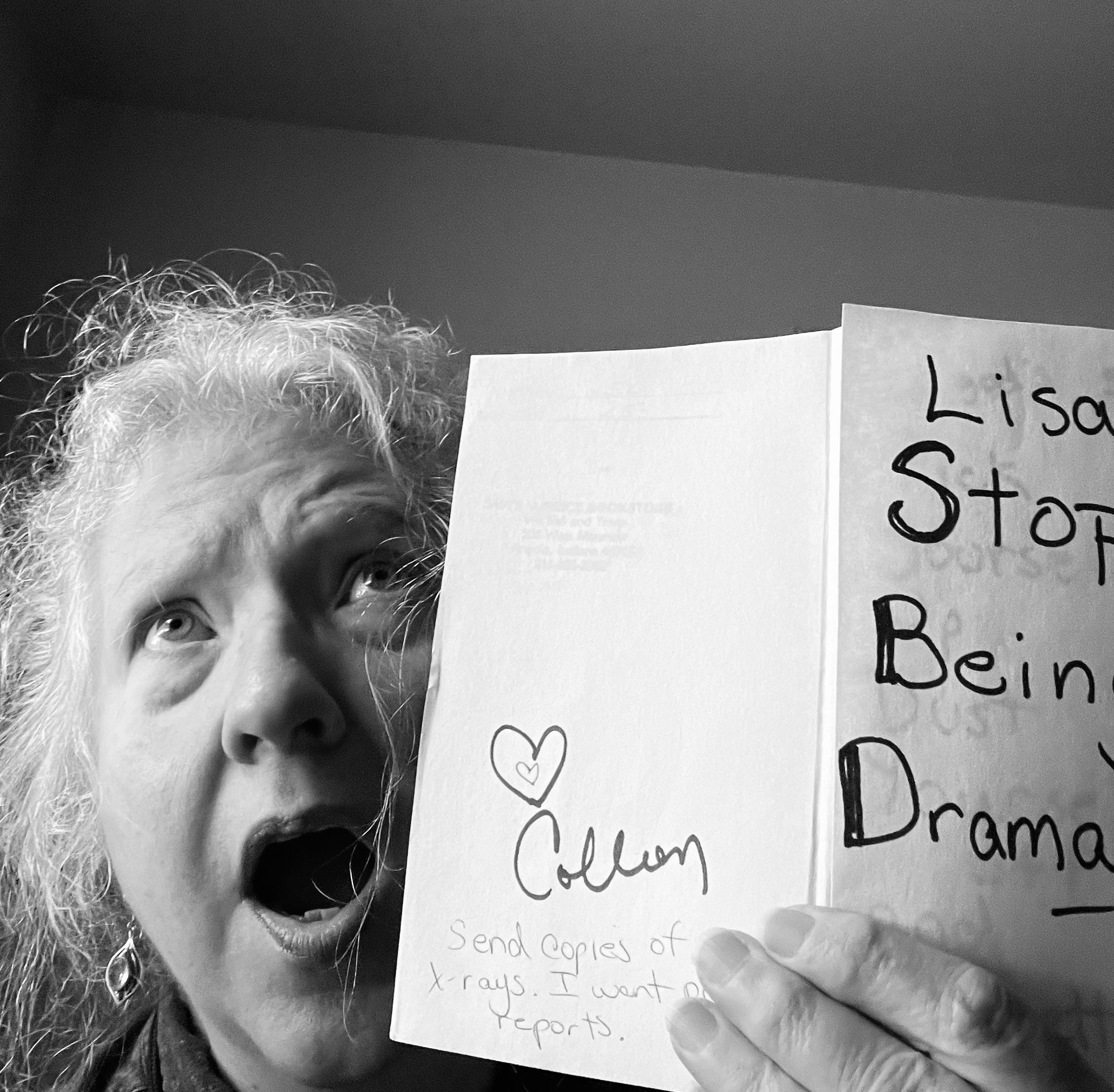
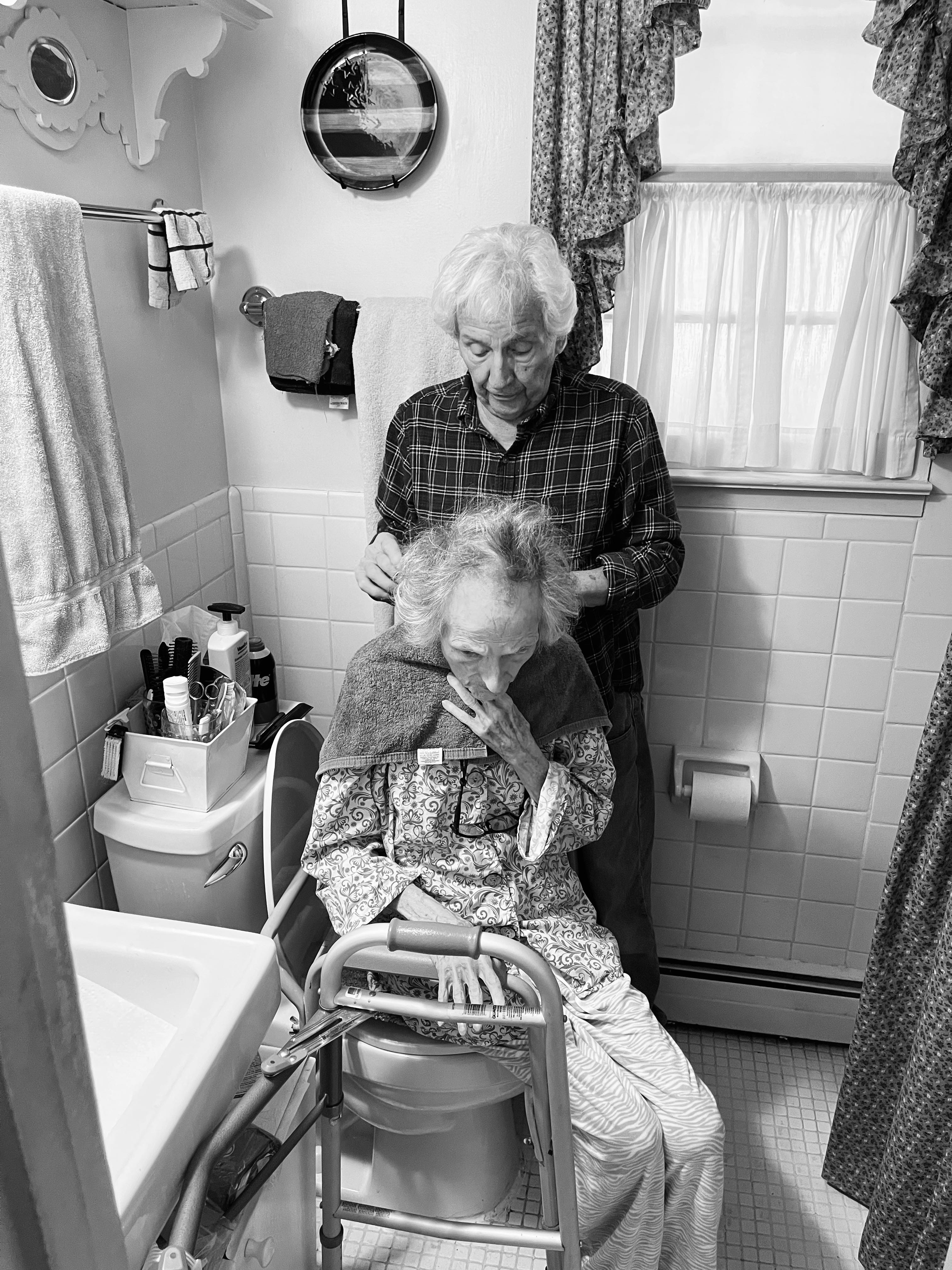
In the past weeks, I’ve seen that same reaction grow increasingly in my own mother, Lynne, who derisively calls me “Dr. O’Hara” when I hold up her water cup to take a sip. This morning she said, quite viciously, “Anything to shut you up.” That’s fine, I said. As best as I can gauge, my 80-pound mom drinks approximately one (measuring) cup of water a day, at most two. She sleeps nearly all the time, feels groggy and frustrated by her inability to wake up, so my pushing her to sip that dreaded water gives her the biggest rises of her day. The second great rise comes when I push her to drink (half, approx. 170 calories’ worth) of an Ensure. My mother is consuming approximately 500 calories a day, at best, as near as I can figure it. A bite of muffin here, a half a PBJ there, a bite of meat, a spoonful of potatoes, sometimes a few slices of pear, some Wheat Thins. My mom’s lack of appetite is a result of dehydration, and she’s dehydrated because, as for too many of us, dehydration does not register as thirst by the time the sleepiness or nausea sets in. And so it goes. It really doesn’t take a medical degree to know this, but the last thing medical professionals do is talk about food and water in the healing process, which is why idiot daughters like Lisa have to step in. It’s obnoxious.

Over the past couple of weeks, my mom—once her hip fracture more or less healed, the physical therapy began working, and her relative independence grew (she can now walk through the laundry room to the bathroom on her walker and use the toilet, all unassisted)—seems to have more or less decided (as of this writing) to accept stasis, which means, I guess, “give up.” She will be 90 in January, should she live that long (and I’m more than willing to be astonished by a sudden rally; just yesterday she asked her husband to trim her hair “with the scissors on the righthand side of your dresser, not the rusty ones on the left,” so who knows?).

I was talking to my half-sister Sherry yesterday, whose own mother is dying by inches, of Alzheimer’s, in a care facility (a housing decision she and our brother Craig had to make after their mom fell and broke her hip earlier this year), about my situation. Sherry worked in a retirement community for 20 years before herself retiring last year, so between caring for the residents and for her mother, she has seen a lot. In addition, Sherry worships my mom, so anything Sherry offers as advice, I know comes from experience and great love. Essentially, “if Lynne just wants to go to sleep,” Sherry advised in her soothing and practical-sounding North Carolina accent, “you have to let her. This is never getting any better.” On top of that, just before our talk yesterday, our dad had admitted to me that he had felt “messed up” in his head (how long? I asked; about a week, he said), which explained a lot about his more-erratic-than-usual behavior; and our brother Jeff was trying get him to go to the hospital though the old man was resisting. I told Sherry that I was concerned it was another ministroke, and I began choking up a bit, “We don’t know what to do, because he won’t do anything,” and Sherry said, practically and kindly, “Let him stroke out and end it. It’s all you can do when you’ve tried everything else.” (Coda: Jeff suggested, “Dad, do you think it’s vertigo?” My mom had said the same thing. As I was talking to Sherry, our dad knocked on my door and said, “I think it’s vertigo,” a chronic condition he’s had for about 15 years (one that caused my parents to have to stop traveling, after the third canceled trip due to the condition) but had not experienced for at least a year. We forget these things. So Dad took motion sickness medication, and within a half hour felt like himself. Crisis averted. And with that, Sherry and I began to talk about ourselves, our own trials, life in general, and find humor in getting on with it. I still can’t seem to get that humor into my writing, but my dear friends send me funny things.)

Death by Inches

On the Wednesday before my dad’s 90th birthday, during my fifth week here, my mom moving around a little better, the med situation stabilized (a fool’s belief, as it turned out, but life is moment to moment, you know), I made plans to go out for the first time, to lunch at 12:30 with my friend and former English department chair, Tom, meeting in a halfway-point town. Typically for schoolteachers, former and otherwise, Tom was an hour and a half early. He texted me at 11:00 AM that he had parked, it was “only four-hour parking” (teachers follow rules), and could I please “get here as soon as you can.” So I quickly changed clothes, grabbed my bag and my dad’s keys, said bye to the folks, and headed out to the family pick-up truck. Upon starting, I saw that the brake light was on, meaning the fluid was low. I went back inside, told my dad, who said it was fine. Incredulous, I headed back out; he followed me, said to pull the truck up into the driveway from the street, and as I stepped off the curb to do that, I somehow pitched forward, landing wrong on my right ankle, and then my left, banging a knee in the process, lying on the street behind the truck. A young Hispanic couple in a passing pick-up truck quickly stopped, had seen me fall, and the man got out and came over and asked if they could help, so kind. My dad came out just then with the brake fluid, saw me there, and whatever I may have tried to deny, I knew I had to go to the ER. I phoned Tom to beg off our lunch date, got into the car (thank goodness Bernie can still drive) (knock wood), and had my aged dad drop me off in front, where I inched into the ER on foot. (“Would you like a wheelchair?” Yes.) Five hours later, X-rayed (two sprains and a fractured foot), an air cast on one leg, a “combat boot” on the other, I called my brother Jeff to bring me home.

Now here is comedy: barely able to walk—and walk I must—I am unable to do basic caregiving; but more than that, I can’t return to New York until I’m fully healed, and sprains take weeks. New York is totally, utterly a walking city. Uber is expensive, cabs are expensive, and traffic is a nightmare (and one doesn’t Uber for two blocks up and back to the grocery store). I travel with a heavy backpack (containing my personal laptop and charger as well as toiletries and a few clothes), along with a small satchel containing my work computer, books for my job, my rain jacket, umbrella, and one extra pair of shoes (sneakers for walks, dressier slip-ons in case—just last year I had a funeral to go to). Probably 50 lbs. total. I was supposed to return to NYC October 8.

And just when you think maybe you can go back to your life, even for a few days, unexpected injury aside, you can’t: I found my father was wandering upstairs the other day carrying my mother’s pill case (the one I set up for them), confused about a missing pill—yelling at me, angry because “I never had any problem before,” that is before I, his daughter, set up this system. (I know just enough to be obnoxious.) If you’ll recall from a previous post—because this story is fucking fascinating, isn’t it?—for nearly a week after Lynne returned home, Bernie hadn’t given either of them their morning or evening meds; when I asked him what he gave them, and when, he couldn’t remember; and having had three ministrokes, Bernie is supposed to take one low dose aspirin every day (in addition to his blood pressure and cancer meds). He’d forgotten all about it until I reminded him. In addition, he’s been having panic attacks about food—after a lifetime in food service, including being a short order cook in the Air Force, a produce manager, and a meatcutter; he cooked half our meals during our growing up, and his panic performance each day over what to make for dinner could be a cabaret act. No amount of my brother and I saying, “we don’t care, we are grown people, just take care of you and mom” will make him understand that he doesn’t have to pack Jeff’s lunch every morning or cook his breakfast (he doesn’t cook for me, for the record, because I’ve always been independent; Bernie used to boast to all his friends that I raised myself). He screamed at me earlier in the week, when I told him not to worry about what to have for dinner, “I have people to feed!” When I told him he just had himself and mom to feed, that Jeff and I will be fine, he got even angrier. I came upstairs to write this, and told poor, long-suffering Jeff that I don’t know what to do, because this isn’t about food but his confusion. (And, as it turned out, vertigo.)

Our parents are our providers. It’s all they know. So, what I’ve finally come to understand, is that if he’s not providing, my dad doesn’t know how to co-exist with his grown children in the same house. But that’s just a small part of his anxiety. The main thing, of course, is this: life as Bernie’s known it over 60 years of marriage is ending. The great love of his life and his reason for living is slowing dying, dying by inches. He himself is physically strong but his brain could explode at any moment. It’s all coming to a close, all of the years getting out of poverty, the struggles and laughs, working toward a middle-class existence, raising your kids, building a solid life. It’s ending. And all his obnoxious daughter can do, really, is bear witness.

And all that I, that daughter, want right now, and no kidding, is to be able to take a walk around the block in the autumn wind. That’s it.

TV Dystopia, by Meters

This week, all over the media, we see how Hamas attacked Israel, another pogrom to wipe out Jews. Israel retaliated, another pogrom to wipe out Palestinians. We live in a dystopian world. To use weaponry instead of intellect and heart to settle differences is to show oneself to be the basest form of life. Moment to moment, day to day, Hamas (a terrorist group not to be confused with actual Palestinians) and Israel inch toward an unstoppable end; I am nearly 60 years old, and these horrors make up some of my earliest childhood memories, watching the 6-Day War on the CBS Evening News with Walter Cronkite.

And you realize that all those casualties of war now and over decades and centuries, all these displaced victims, are simply people who are trying to work, get married, give birth, take care of their kids, and care for their dying parents, and somehow plan for the future. Moment to moment, day to day.

And the people who perpetrate all this violence (see also: Russia against Ukraine, the U.S. against Iraq, pick a war) have no real ideas about governance, fair distribution of resources, or the creation of a loving and useful society. Raw power only spends itself and burns out until the next arms race, and the world’s sadists glory in the destruction while the loving ones rebuild, over and over and over and over again. (I have no solutions; I know just enough to be obnoxious.)

Last weekend, Jeff printed out my parents’ monthly bank statements so our mom can review them between naps. On Tuesday, Bernie got his partials replaced at the dentist, creating the illusion of a full mouth of teeth that can chew. Two days ago, with cold weather coming, Bernie got out the vacuum cleaner with the hose attachment and vacuumed all around the furnace; he replaced the battery in the downstairs thermostat. The next morning, I found him cleaning his electric shaver. Later today, he will make a batch of Lipton Noodle Soup for his wife. And have some himself.

And so the days go by. My ankles throb with pain. The evacuation orders go out overseas. I don’t know how to explain why, given that terrorist bombs aren’t (currently) dropping on our solid little suburban American house, I am yet so fragile, so weepy; why this relative ease feels so hard. I feel I am ridiculous. My parents’ hard-working life has come down to little more than consumption of media and packaged food and medications; yelling at their obnoxious daughter even as they are grateful for her help; and waiting for the end of it all, they hope, together. I think that is what troubles me—that there seems to be nothing but waiting right now. That this is what too much of life is—filling in the time between activities needed for life to continue as we wait to die; my shock that Beckett so clearly knew what he was about when he wrote Waiting for Godot. An old theater joke, “My life is a Pinter pause,” comes to mind. And the last line of that Sartre play: Nous continuons.

Until next time, with love to my two readers,

Miss O’

Under Covid of Darkness

I’m on Day 12 of Covid, contracted I think on the New York City Subway System, being the only masked person around coughers and sneezers; or else in the brief unmasked walk from Port Authority to the subway entrance on 7th Avenue. However one gets it (only 5 days into my bivalent vaccine, I wasn’t yet efficacious) it’s been a helluva bedridden ride of waves of all the various Covid symptoms I’ve read about. As a result of the positive test (taken a few days prior to heading to Virginia for my 40th high school reunion, with a sore throat and runny nose, oh shit), I’ve found myself living in bed and relying on the kindness of my friend Cathy and her husband and son, who check in daily, pick up takeout for me and a few groceries. I’ve been subsisting on V8, apples, brown rice, beans, some Chinese soups, and tea. And The Graham Norton Show via YouTube. I tested positive again after five days, and again after ten (though a lighter line), so I’ll try again on Wednesday, which will be a full two weeks plus one day. I’m running out of tests. But at least I’m dressing for the day again.

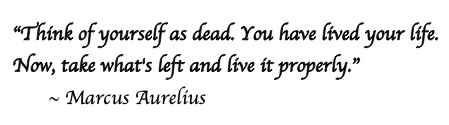
Recently I (in my return to social media after a three-month hiatus) saw that above quote on Harvey Fierstein’s Facebook wall in the context of gaining sobriety, but I truly appreciate this in the context of Covid recovery. I have not been living my life properly in the past few years. I am a recluse agonizing over rising fascism, without intelligence or talent enough to do anything useful to stop it. As of November 8, when the Republicans take over and impeach Biden and Harris, install the Speaker of the House as president, hang Pelosi, and deploy the military to overrun the liberal cities and imprison all of us…because I think that is more likely than not to happen should Republicans take the House and Senate…it will be too late to do more. Ain’t that a kick in the head?

Amidst the coming end of democracy as a concept, I’ve also been thinking about age, how we change, or don’t. It’s all part of the mix of my brain fog.

Reflections on the High School Reunion I Missed 

My friends Mark and Carl urged me to go, so I signed up, and then I got Covid, as I somehow knew I would, so I kept myself awake that night to find out who they got to see.

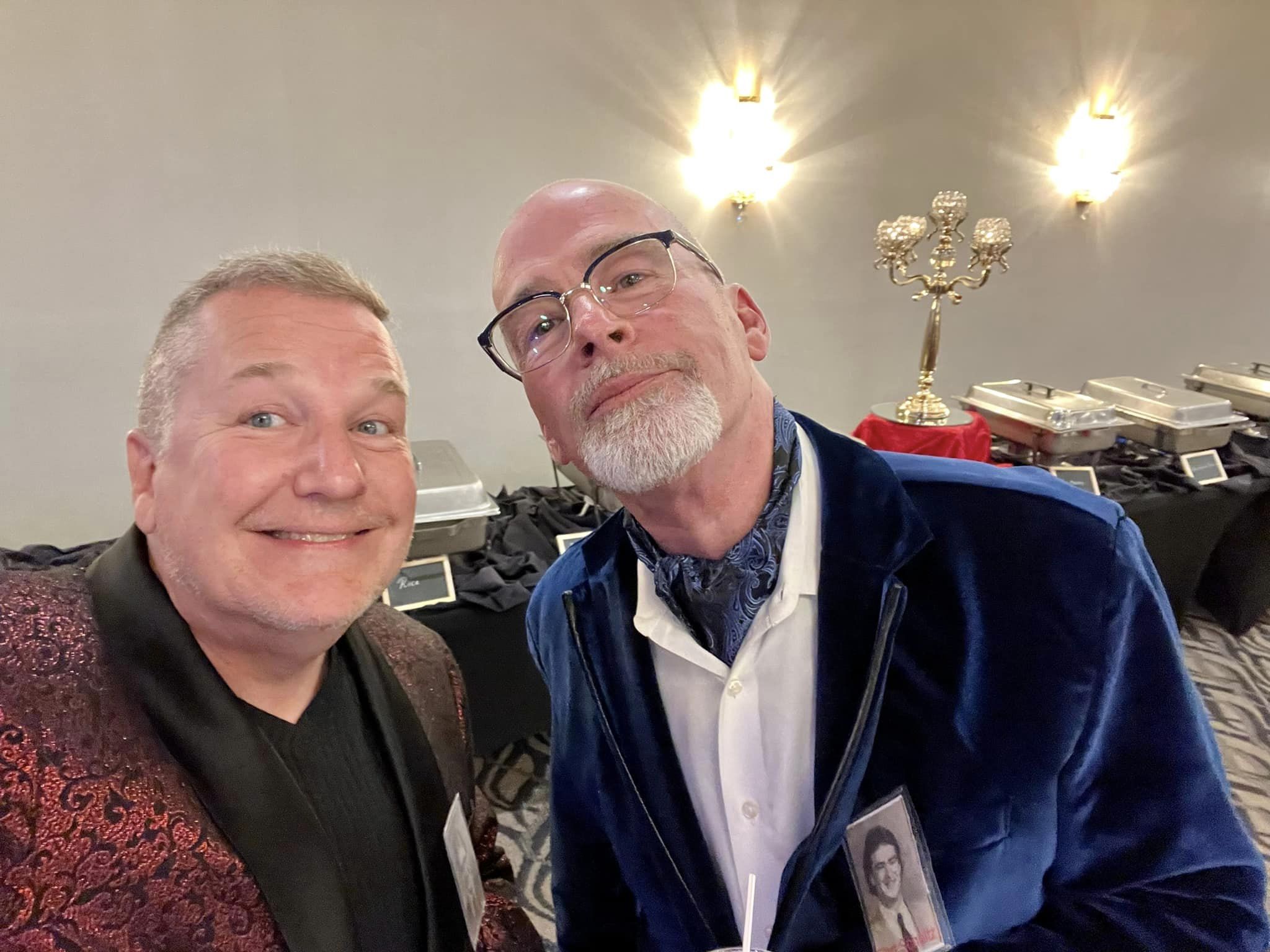
The boys sweetly texted me pictures of the kids (who are all 58), many of whom I’ve known since childhood—the Arrington twins; Juanita the piano prodigy and probably the smartest kid I knew. Then there was Janet, who was voted most talented from a high school senior class of 1,000—still a tall drink of water, same long blonde hair, a toned and tan former gymnast who could still fit into her show choir ensemble and her high-kick team dress and wow them all with a smile, the one who gives you hope. Lots of people for whom high school may or may not have been a blast, as they say, were there, too.  

Prior to the reunion, I posted on our page the following memory, wondering if everyone was hoping we’d “sing”:

Lisa O’ and Mark Robinson, ca. 1981, promoting the Junior Variety Show we hosted, and more recently.
Friends since 2nd grade, or thereabouts, Mark and Carl and I were always somehow involved in music, our last outing together ca. 2018 found us singing karaoke, “I Love the Nightlife,” in Rehoboth Beach. As Mark reminds us, three separate people said we were great. So.

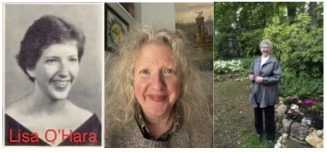
I sent along to them a sickbed selfie, and it caused me to reflect on aging; when I attended a group 50thbirthday party years ago, my brother Jeff took a photo. When I posted it on Facebook, my friend Jen said, “Don’t take this the wrong way, but you were born to be 50.” I think I was. However, it was the last photo in which I looked like myself, a Lisa O’ anyone would recognize. A couple of years ago I became old—see sickbed selfie. It was time.

Miss O’ at 18, 58, and 50. I blame lovers of Trump.

I loved all the pictures Mark was sending, but I didn’t understand his constant texts: “EVERYONE is asking about you!” I responded first with a “Ha!” comment thingy. But he persisted. And I couldn’t understand this sentiment because I was such a dull kid, not a standout at anything; just kinda skated through school, tried to be helpful, did my work, did a few plays, stayed out of trouble, head down, big laugher at the jokes of funnier people. 

And you realize that all of us, whatever we thought ourselves, were part of one another’s stories, and that we are somehow still dear to one another, part of one another’s memories. We all can’t be beautiful or stay young, whatever that is, and what is even the point of the concern? In the end the Republicans will gun it down.

I recently read this definition of Beauty: “the adherence to the balance and structure of the Universe.” Seen that way, most of us can feel just fine.

Vanity: Reflections of a Royal Philosopher, from Ecclesiastes, 2-11

It’s Sunday, so here’s a little of the Bible that most American Christians (given their actions in favor of dead mothers and gunned down children and their worship of a narcissistic, unapologetic adulterer, conman, and cheat) clearly haven’t read, but a surprising number of my Jewish, agnostic, and atheist friends have.


The words of the Teacher, the son of David, king in Jerusalem.

Vanity of vanities, says the Teacher,

vanity of vanities! All is vanity.

What do people gain from all the toil

at which they toil under the sun?

A generation goes, and a generation comes,

but the earth remains for ever.

The sun rises and the sun goes down,

and hurries to the place where it rises.

The wind blows to the south,

and goes round to the north;

round and round goes the wind,

and on its circuits the wind returns.

All streams run to the sea,

but the sea is not full;

to the place where the streams flow,

there they continue to flow.

All things are wearisome;

more than one can express;

the eye is not satisfied with seeing,

or the ear filled with hearing.

What has been is what will be,

and what has been done is what will be done;

there is nothing new under the sun.

10 

Is there a thing of which it is said,

‘See, this is new’?

It has already been,

in the ages before us.

11 

The people of long ago are not remembered,

nor will there be any remembrance

of people yet to come

by those who come after them.

The friend who posted this on her wall asked: “So, like, what EVEN is the point.”

The existential questions are the worst. What I’ve never understood, when I look at all the guns and people threatening people over their race or gender, for example, is that if this is all we know—this time on earth, this life—why would anyone choose to spend it glorifying themselves, playing the lottery, and spreading misery? And that leaves the rest of us in a power struggle with those people, scratching for our bits of joy where we find them. There’s a great play called Every Brilliant Thing I saw a few years back at Barrow Street in Greenwich Village, about a little boy who goes on a quest to try to help his depressed mother—and he finds the joy in himself. Love people, find the joy, eat the chocolate. Do your best.

We all have regrets and most of us know that those regrets, as excruciating as they can be, are the things that help us lead improved lives. Or, rather, there are certain regrets that, as they emerge, can accompany us on the incremental bettering of our lives. Regrets are forever floating to the surface… They require our attention. You have to do something with them. One way is to seek forgiveness by making what might be called living amends, by using whatever gifts you may have in order to help rehabilitate the world.” – Nick Cave

This quote can be found on the website The Marginalian, curated by Maria Popova. She shares ideas from artists, their quotes, and then her own reflections. What Cave got me longing for, or reminding me of, is the idea of being an artist. I really wonder what that must be like. (Whatever light I have in potential, I learned years ago, must be kept hidden or it upsets too many people; you have to trust me on this.) At least my one real joy as I age is that I can still enjoy art. 

Art does have the ability to save us, in so many different ways. It can act as a point of salvation, because it has the potential to put beauty back into the world. And that in itself is a way of making amends, of reconciling us with the world. Art has the power to redress the balance of things, of our wrongs, of our sins… By “sins,” I mean those acts that are an offence to God or, if you would prefer, the “good in us” — that live within us, and that if we pay them no heed, harden and become part of our character. They are forms of suffering that can weigh us down terribly and separate us from the world. I have found that the goodness of the work can go some way towards mitigating them.” – Nick Cave

In my search for more about suffering and surviving it, I happened on a couple of TED Talks that only pissed me off. On Being with Krista Tippett, now defunct in terms of its old format but still out there, is a good bet. Still, when I go hunting to try to understand all the shit, I find things that exhaust as well as inspire. 

Ultimately, Bruno Latour (1947-2022), the scholar who passed last week, took nothing for granted: not science, not society, not even “reality” or “existence.”

The Nation header on Facebook

And I realized, reading that banner, how TIRED I am of reality and the lunacy of existence—the realization that we’re all stuck in an overwhelming cycle of …

In the meantime, life goes on, somehow. 

Preoccupations on Reflection

In my last blog post I paid tribute to the remarkable theater artist and teacher Maureen Shea, who died unexpectedly in September of this year. Shortly after posting, my old Virginia Tech friend Todd located and “liked” this Facebook post from 2020, I guess because of the attached photograph he must have recalled. Todd was very close to Maureen, too. Here is the post, in full:

Miss O’, ca. 1987. I’m posting it because I have always hated this picture, but kept it because mentor Maureen Shea is in the background, on the left on the hill, in a cast, and it does capture a moment in time. Oddly, this is often other people’s favorite photo of me whenever, back in the old days, we’d flip through one another’s photo albums.
Similarly—and stay with me here—while I was the favorite and most beloved teacher of some students, I was just as often the most reviled and dreaded teacher of other students; and still others didn’t even remember being in my class when I’d say hello to them as seniors. Think of them as pro / no / undecided voters.
Here’s my point: Yesterday I saw the “well, I’m not voting for Biden if it’s Harris” posts begin. Here we go, I thought, 2016 redux, “but her emails,” any excuse to not vote a woman into office. Because I believe, truly, however evolved people think they are, that that is what it comes down to. These folks can rationalize it all they want, but it comes down to misogyny. They’d rather end democracy, keep Bill Barr and Trump and Miller, and destroy the Supreme Court and even the planet, for the rest of their children’s natural lives, than vote for a woman—for whatever her “sin” is, it’s always one hundred times worse than the sins of the men who are caging children and denying a pandemic and allowing Russians to own our elections and put bounties on the heads of our soldiers in the field.
America, don’t do that; don’t be that voter all over again.
Because let’s face it: I’ve always hated this photo of myself, and yet I now have to admit I am adorable in it. All those years of self-loathing, and for what? 

It’s 2022, and here we are AGAIN. Voters, Americans, for fuck’s sake: Do the work, love the people, be good to the earth, find a purpose, appreciate art. Get over yourself. And vote Democrat. 

Until they take it away, use what you got.

Desert[ed] Solitaire

Miss O’ in New Jersey ca. 2012; photo by George Lightcap

Yesterday evening I emailed short notes to two of my dearest friends to 1) apologize for not writing much, as one does; and 2) to ask after their life events. (Not to keep you in the dark: one set of spouses, in their eighties, has had loads of health issues this year; the other set of spouses, hovering around age seventy, just sold their longtime California home and closed this week on another, even drier, California home, one that is smaller, one-story, much less land to tend, and in walking distance to simple amenities, like a grocery store.)

I expressed to both halves of these respective spousal sets that I have felt, for want of a better word, deserted. Is that the word I want? I feel deserted as at a railway station, as if I’m supposed to be headed somewhere and there are no trains, or as if someone has forgotten to pick me up after a long journey; deserted by things as disparate as companionship, comradeship, an artistic muse, a sense of mission, original ideas, and the national shared practice of democracy. That’s quite a list. 

When I wrote this to my friend Anna, she suggested I write a short blog post on the subject of desertion, and that felt exactly right. 

­­­­­­­­­Other Desert[ed] Places

First of all, I feel deserted by the practice of writing letters. Just so, long and deep conversations have deserted me. Other than Tom and Anna (my friends noted above), everyone else I’ve been in regular contact with for years tends to speak in memes and emojis, maybe links to articles at most. I respond in kind, mirroring what I receive. I know that many people are pressed for time in general and have dozens of people with whom they are in communication, whether friends or family or work colleagues. I never want to assume I should be somehow special. (Many of us have felt deserted by even our closest friends once they married, had kids, and made new parent friends.)

“Didn’t you see my post?” Deep connection has been supplanted by observational strings, er, threads, on Facebook. Several friends noted that it’s just easier to share their lives all at once rather than in individual letters to, say, me. In my own posting life, general observations shifted from “life in New York” to “politics all the time” when 1) Humans of New York started up, doing what I did far better and more deeply than I was, and with pictures; and 2) I saw the coming of a deep fascism with the election of the black president. (Big Tell for me: At President Obama’s first State of the Union Address, Justice Samuel Alito, who was in view of the camera, on several points about threats to our democracy, shook his head and said, “That’s not true.” I’d never seen a partisan justice at such a speech. Related: then-Speaker John Boehner (R-OH) wouldn’t look at the president, saying in an interview, “I can’t even look at him.”) All that open racism shocked me. Racism was, truly, the only explanation. I had to go on the offensive, deepen my understanding of racism, post like hell. Right?

In 2012, I voted for Obama’s re-election, Mitch McConnell (R-KY) became Senate Majority Leader, and a month later I released by e-book compilation of social media observations, Easier to Live Here: Miss O’ in New York City.

Now what? The nation was growing in chaos, and my sense of joy at living in New York began deserting me. This was 2013. My playwright’s lab disbanded; my first professional work project as a staff member at my work went to press and I felt sort of “done” with that job after seven years but couldn’t afford to leave; I was assigned to Grand Jury Duty at Kew Gardens in Queens for the entire month of September (with the disheartening revelation that Miss O’ may well have been the smartest person in the room, and that shouldn’t ever be the case), and that same month I began a deep but doomed love affair that would consume my heart for the next nine years, until learning, belatedly after a final breakup, of his death. (One of many blessings of this dear but complicated man was that he was not on social media.)

Desert[ed] Depths

The joy of knowing others doesn’t really come about in 140-character or 280-character posts, memes, emojis, GIFs. All these little sparkly things are fine, I guess, once you have a long-standing relationship of some kind—all good friendships develop their own shorthand, and in that context these digital digeridoos seem to me to be the equivalent of my friend Cindy’s old habit of looking at me, dropping an eyelid, and miming a cigarette to the lips when someone was about to pontificate or otherwise be an asshole. Without a word spoken, I would double over with laughter. I often act out the same gesture as a touchstone. A good meme can do that, too, and it’s funnier when you know the sender from your heart; but if I’m honest, it’s empty when that’s all there is. 

Second of all, I feel deserted by stillness. This morning, for example, I woke before dawn to find the all-night party music from somewhere was still on in full force. The school playground next door now has LED stadium lights that are blinding our complex in the name of “security.” I can’t seem to find calm. (Tell it to Ukraine. See what I mean?)

just a mass of contractions

I miss a mind quiet enough to read longform New Yorker articles in one sitting. I miss a body quiet enough to sit still and play a new album all the way through, listening to every song. Then playing it again, this time reading lyrics and liner notes and credits. Then playing it through a third time. Vinyl was even better because you could play the A-side three times, and then the B-side three times, and then listen to the whole thing once through. My friend Lynda Crawford, a playwright, wrote on Facebook that she missed listening to records the way we used to—one friend would buy the record, and everyone would come over and sit on the floor and we’d play it, and talk about it. I remember doing that with a 45 RPM of Helen Reddy’s hit “Think I’ll Write a Song” on the A-side, and then playing “Angie Baby” on the B-side, and my mom, Lynne, coming upstairs and saying to me and my friend Peggy, “Who is that? Is that still Helen Reddy? Now that is a good song.” She was right. But we all had to hear the song three times.

Now, I hear you saying, “But Miss O’, you can still do those things.” (Still. Hmmmm.) Yes, I can, in theory. But I have Twitter to scroll. I might miss something. I have Facebook to check. What if a “friend” liked my post? What if no one liked it? (Should I edit it?) What if someone died and I didn’t realize it? What if what if what if what if what if what fucking IF. FOMO. (I’ve had to look that acronym up I think each time I’ve seen it in New York Magazine, which feels less and less relevant each issue. The best one in the past few years was an issue dedicated to Jerry Saltz and his quest to be a great artist. More of THAT.) Where was I?

The truth in all this is that I am deeply sick of feeling deserted by…something…somehting I cannot seem to touch with my soul, my heart.  

Desert[ed] Hearts

Friends have lost family in the past two years. Last year, a poet friend lost his beloved wife to a stroke; two weeks ago a dear neighbor lost his brother suddenly to a heart attack; this week, another friend lost his beloved wife to lung cancer. Part of this is, we are all aging, my friends and neighbors and I. But the loss isn’t less. The feeling of desertion stings.

President Biden, who lost a son to brain cancer seven years ago, gave a speech Thursday night—possibly one of those historically great ones—defending democracy against fascism, and the three major networks and PBS deserted him and the American people by refusing to air it. (The next day, as if to reinforce this sense of desertion, newspapers seemed to support the wounded fascist MAGAs over the 70% of Americans who want to preserve the democratic union.)

And when all this happens, all this sudden and deep emotion, I seem to shut down. I don’t know how to help anyone, to help the country. I feel deserted by my mind.

In her deep empathy, Anna said in response to my feelings of desertion and perpetual waiting, “Seems like a lot of us are waiting for an unknown something. I wonder if we should just act as if what we’re waiting for is going to arrive or has arrived.” 

That’s what President Biden has chosen to do—to act as if the People want democracy, are willing to vote to preserve it—and meanwhile, he is just legislating like hell, bringing down inflation, addressing global warming, championing women, the whole bit, like tomorrow is not only coming but is already here.

So, to paraphrase Helen Reddy, I thought I’d write this blog, one in which I act as if what I was waiting for was the impetus to write a blog. After all, the worst thing we can do is nothing.

Take a memo. 

A handy meme from johnpavlovitz.com

The Bouncing Balls of Eunuchs

Sex and the American Nazi

Ballsy. This is a product (one of a number of other such actual products in 2022 America) being hawked on television commercials for the shaving of men’s ball sacks. And the mechanism doesn’t leave a “ball smell.” Huh? “Save Your Sack from Summer.” (Whatever happened to, I don’t know, bathing?)

It’s not that I’m squeamish. A child of the 70s, I spent my youth being bombarded with ads for Massengill Disposable Douche (a useless product designed to dupe women into thinking they can simply rinse out semen to prevent pregnancy; as well as for men who fear the smell of menses) and Kotex (a very necessary product). But ads for Venus by Gillette, now showing women, quite graphically on television commercials, using a razor to shave their pubic hair (another purely cosmetic thing), is really troubling me. Oh, and Bush Balm. So I sat down to write to figure out why. 

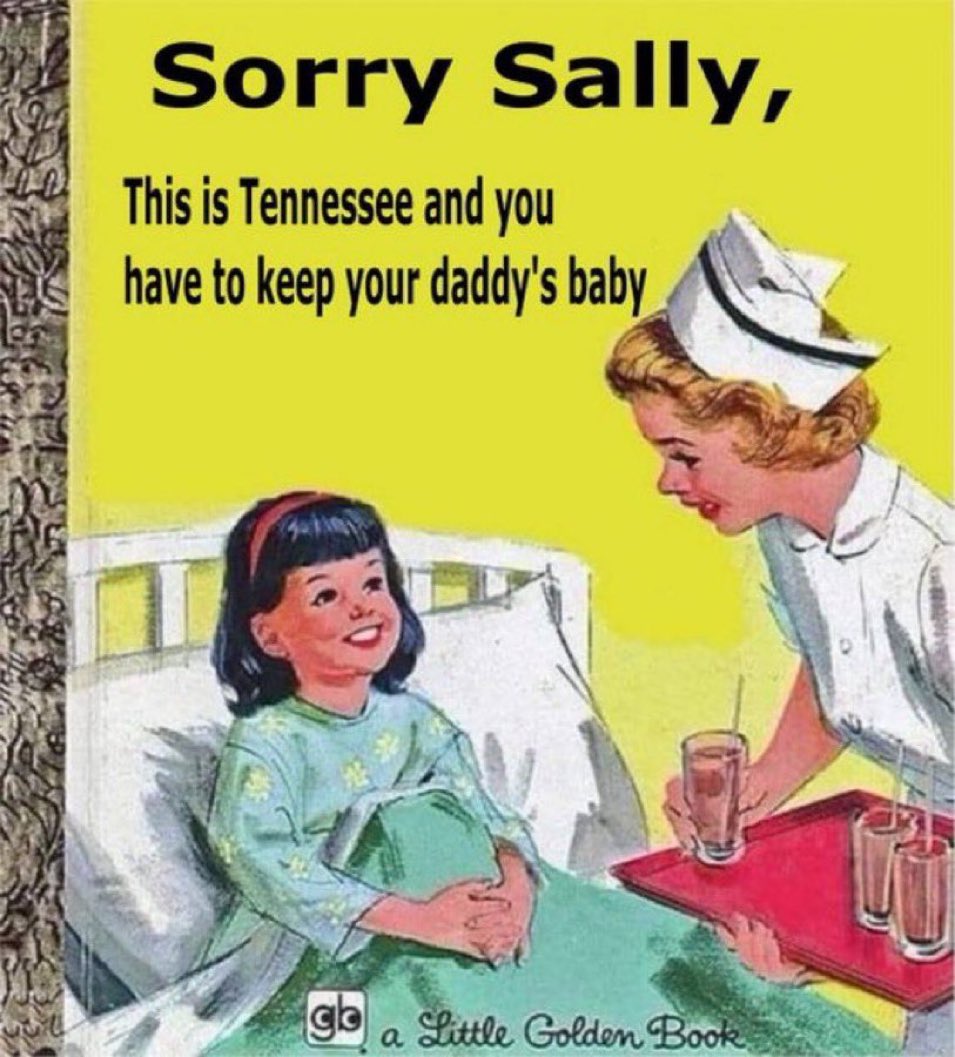
Here it is: It’s 2022 and a 10-year-old rape victim in the Midwest cannot legally obtain an abortion since the overturning of Roe v. Wade. And child marriage is back on the table. Child labor, too. See also, the other extreme: The forcing of the aged back to work and the ending of retirement thanks to “Sen.” Rick Scott (R-FL).

The United States in 2022

Note to readers: It’s gonna get really ugly now.

Follow Middle Age Riot on Instagram and Twitter, if you want.

The end of Roe v. Wade is another “beginning of the end” situation in the U.S., sure. And the smoothest sacks and pubes in the world won’t change that. But that’s not totally what’s eating at me, not just the power over women and the hygiene distractors. There’s a larger, deeper sickness happening. The other week “Rep.” Matt Gaetz (R-FL) said that ugly women don’t have to worry about abortions. Hearing that brought up in me tears of rage—that level of open misogyny from a man accused of child rape who has yet to be indicted for it, though is wingman has taken a plea and gone to prison (and when called out on it the next day, he doubled down).

“Republican Rep. Matt Gaetz, who is under federal investigation for alleged sex trafficking of a 17-year-old girl, is under fire on social media after making fat-phobic and misogynist remarks about abortion rights activists to an audience of college students on Saturday, calling people protesting in support of abortion “disgusting.”

“’Have you watched these pro-abortion, pro-murder rallies?” the Florida congressman asked the teenagers gathered at the Turning Point USA Student Action Summit in Tampa, Florida.

“’The people are just disgusting. Why is it that the women with the least likelihood of getting pregnant are the ones most worried about having abortions? Nobody wants to impregnate you if you look like a thumb,” Gaetz commented.

“’These people are odious from the inside out. They’re like 5′ 2″, 350 pounds, and they’re like, “Give me my abortions or I’ll get up and march and protest.” And I’m thinking —march? You look like you got ankles weaker than the legal reasoning behind Roe v. Wade,’ he said to a cheering crowd.”

This is a U.S. Statesman of the Republican Party in 2022.
New motto: “Odious from the inside out.”

Speaking of insecure male U.S. Republican statesmen: Back in the spring, “Sen.” Josh “Runs with Fist” Hawley (R-MO) denounced child pornographers so vociferously and so weirdly out of context and proportion during the Judge Ketanji Brown hearings, that it caused Miss O’ to wonder when Anonymous will hack into Hawley’s home computer.

Runs with Fist
Shits with Bricks (seen on the internet)

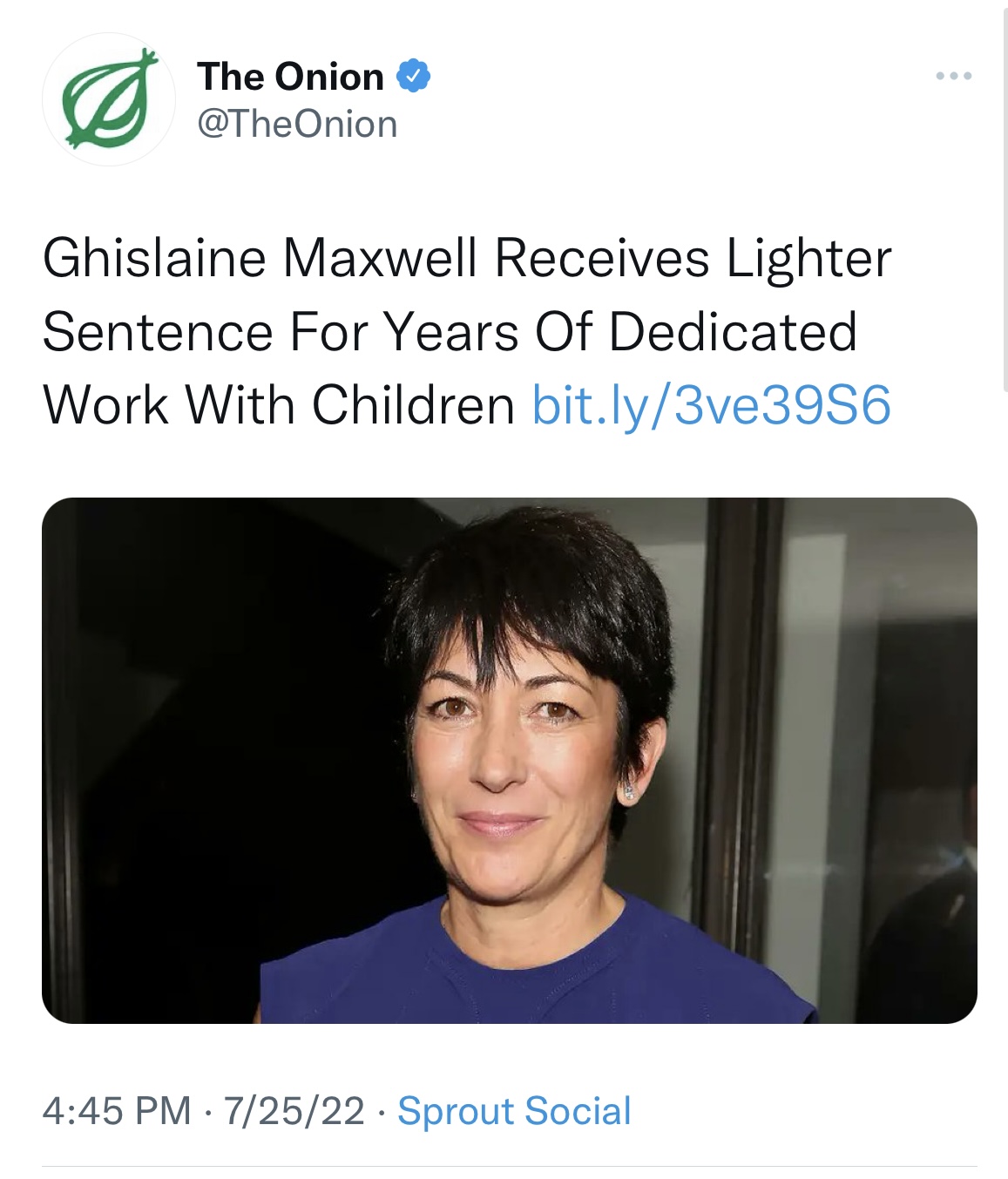
Meanwhile, Ghislaine Maxwell, a convicted sex trafficker, is moved to a cushy minimum-security prison with yoga. Because otherwise I guess she releases the names of all those powerful white, male johns.

New Republican Motto: Men gotta be MEN, and real men can only get it up for trafficked young girls, ammirite?

And all of this hateful humping hubbub is from a bunch of schoolyard bullies who don’t feel “manly.” Who see everything as a threat to their “masculinity,” from balls that aren’t smooth and tan, to erections they can’t hold, to games they never understood and couldn’t play.  

But indoctrinating actual armies of white supremacists is not the actual problem.

And it only gets creepier every day.

Poke Her with the Soft Cushions

I awoke this morning remembering a summer day when my parents repurposed the feather-stuffed cushions on my mom’s fancy sofa—this light sort of champagne brocade-upholstered sleeper in the upstairs living room of our small split-level house with no real room for romping, so that room was sort of the place to do Play-Doh and draw on the walls (which we also had to help scrub), so naturally that fancy sofa from my mom’s days as a single naval officer got ruined in pretty short order; but rather than throw out the whole thing, my parents figured they could buy those zippered pillow cases made of striped ticking and stuff them (they went on to use these pillows for probably 20 years, by the way). I was a kid, maybe 9 or 10, when they laid out old sheets in the backyard, my dad split the cushions with a knife, and they tried to figure out how to transfer the feathers—millions of teeny tiny gray feathers—into the ticking. We kids chased the feathers that flew, but impressively most of them made it into stuffing, enough for four pillows, I think. 

I don’t recall my dad wondering aloud if this activity—or for that matter, diapering his babies, cooking family meals, or reading the paper—supported and even glorified his “masculinity.” I feel confident, too, that my dad, who worked six days a week, sometimes two jobs, and yet always made time to make popcorn and play with his kids, had no time for shaving his balls or worrying about their smell. He’d have to wonder about men who had that kind of time on their hands.

That feather pillow stuff was around the time my mom got into decoupage, making all kinds of projects, burning edges of paper prints, gluing and varnishing them onto prepared painted and antiqued wood plaques or stools. It was really nice. And I remember a lot of felt crafts for Halloween, too, and making Christmas ornaments (at school and at home). My dad, a meat cutter (there’s your masculinity, Tucker), got into making his own sausage (!) and used to bring casings home from work (he could buy them wholesale), and we’d do that once a month or so. 

So at age 10 I remember going to a lot of local carnivals, fort-building, making a treehouse; all us trying out being tough with toy cowboy guns and holsters; Malibu Barbie vans and building blocks, and Tonka trucks in the dirt, while my parents made food for cookouts in the backyard or a Prince William National Forest; neighbors coming over. Beer and soda. Good Humor Ice Cream treats.

I don’t remember getting raped, is what I’m saying. I don’t remember people getting shot all the time, and never entire classrooms full of children. Sex, rape, semi-automatic slayings—even when reported, none of this was remotely normalized for casual conversation among our elected leaders in the 1970s. I’m not saying bad things didn’t happen. I’m aware that my white parents worked hard to make the shift from working class to middle class in America and faced fewer obstacles doing it than their black and brown counterparts; and I’m also aware that plenty of my classmates grew up in trailer parks or in otherwise reduced circumstances. I was often shocked by white porcelains toilets the bowls of which were stained brown; layers of dust on the white oak floors, grease and grime on all the surfaces in the kitchen. And you heard about things, you know; you heard yelling, you had to wonder.

A girl relative of mine, who was white, was raped at the age of 9 back in the 1960s; being prepubescent, the perpetrator had to split her with a knife to enter her. She told her mom, “A man peed in me.” The police didn’t put much effort into looking for the man, who was most certainly a white school janitor, so no one was prosecuted; her family moved instead. Girls have never been valued much, unless their victimhood could serve as an excuse to lynch a Black man or shoot someone. (Men are so emotional, you know. Is that masculine? I think it’s shit.)

So I don’t want to sound absurdly naïve. When we look at the historical Republican Party (and forget Dixie-crats, who only went Democrat to veer away from Republican Lincoln), they totally and loudly advocated for the mass murder of Black children; the mass rape and murder of Black women; the mass lynching or incarceration of Black men to use as legalized slave labor.

See its present spokesman, Rep. Marjorie Taylor Greene (R-GA)

Lately, however, these same Republicans have upped the stakes. We now have an entire political party, on TV and in the newspapers in 2022, pushing for the normalization of child rape (er, marriage), child sex trafficking, child labor. I can’t recall an elected representative in my childhood defending child mass murder, but that’s the case now. It’s not as if I didn’t see violence on TV, but the violence was often righteous, however a news anchor framed it: Black people tired of being targets, being kept down or segregated into project housing, being kept out of power; hippies protesting the war in Viet Nam; workers striking for fair wages; women out in force demanding equal rights; gays demanding to be seen in Pride parades.

The work never stops.

But here was a turning point: I remember when the “anti-abortion movement” started, ca. 1977 or so, and young Catholic school friends went to march on Washington, girls all, girls who’d never even been kissed. They’d cry abstractedly about unborn babies, these girls who were barely of age to babysit. I found it baffling.

Found on the internet; sorry I can’t credit the meme genius.

And that “pro-life” movement, I’ve come to believe, moved the idea of sexualized children (and not the prosecuting of Catholic priests for the molesting of boys; because it’s never been about what they did to the girls, even though the kids I knew who were molested by their priests were girls, but girls don’t count, see), rape, incest, and the oppression of women front and center in the news, and began normalizing the fucking of children and girls and women of childbearing years as both something of prurient interest and something to punish through forced birth; while simultaneously othering the sex of consenting adults of whatever gender.

So. Sick. Of. Male. “Leadership.” So over it.

When I was 10 years old, I played with dolls, acted out my own versions of I Dream of Jeannie and The Brady Bunch; had a crush on David Cassidy; ran barefoot all summer jumping off swings; when my arms and legs got sticky it was from melting popsicles rather than a man’s semen. And I know this kind of growing up is still possible. About the best parents I know are two gay men who limit their kids’ access to television, social media, video games, and sitting around. Their kids play. I texted them to say hi and see what was up. The boy, in middle school, was devastated because his favorite frozen treat, Choco Taco, had been discontinued. (Meanwhile Greta Thunberg gave up her childhood to protest the inaction of governments to stem global heating.) If it were up to Republicans, this sweet kid wouldn’t exist at all.

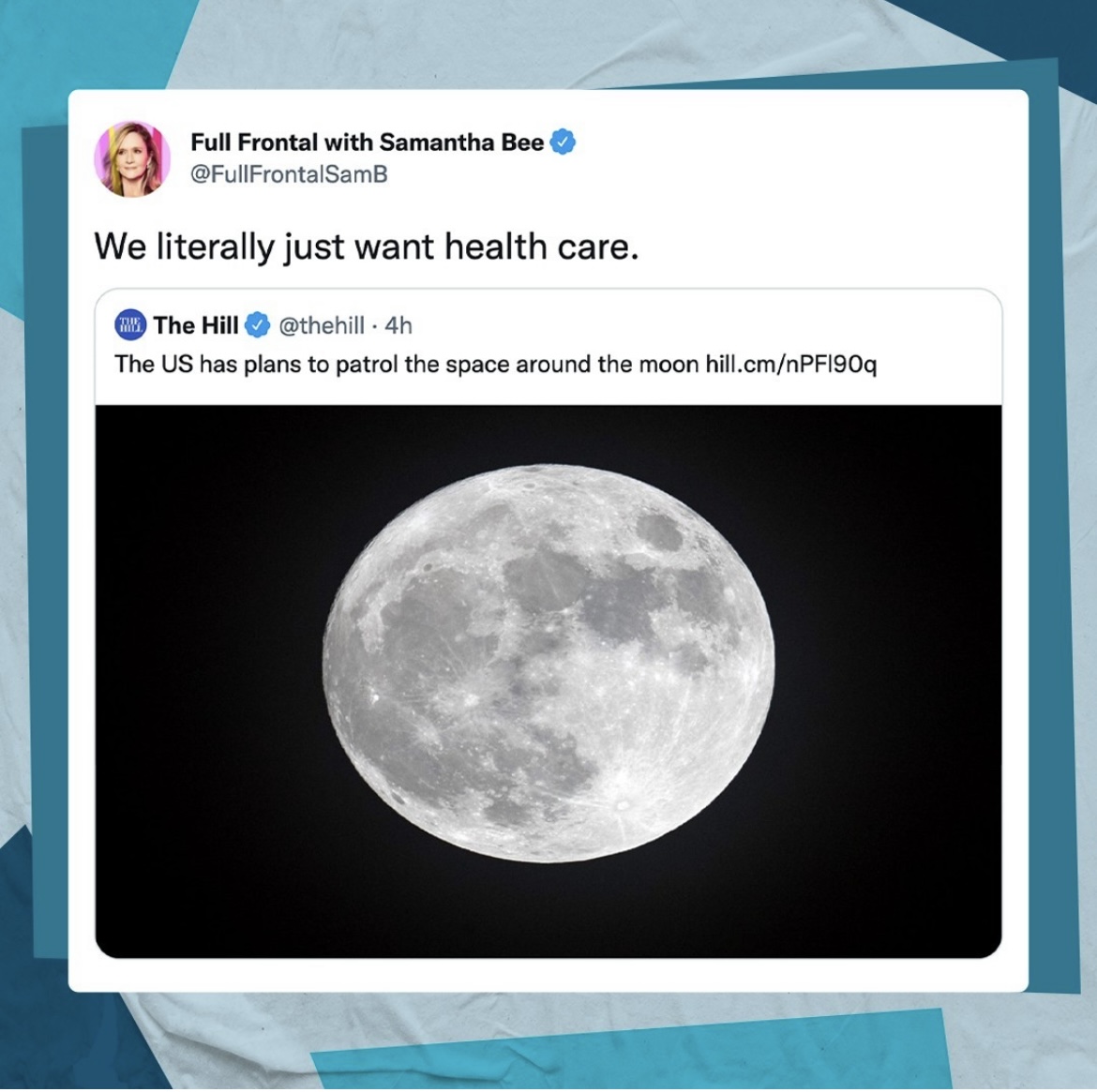
Full Frontal with Samantha Bee was CANCELLED suddenly
by TBS under new management.
That’s the price of being a popular woman with a strong voice in America.
WOMEN: Start your own networks. OTHER WOMEN: Support them.

Why do Republicans want our women to have no autonomy? Our kids to have no childhoods? Our citizens no vote? Our people no freedom? Why do they want America to be a hellscape of mass murder and rape; floods and wildfires? Why do Republicans mock the very real problems and those who wish to solve them? I think they are diseased. They need help. But first, like any addicts, they need to admit they have a problem. We all know that men who have to pay for sex most likely aren’t any good at it; they know nothing of love, of intimacy, of seduction. They want to “take” a woman, rape a woman, and it makes them feel “powerful.” (Matt Gaetz, an alleged predator of teen girls, seeks children, doesn’t he, because they won’t know how bad he is at sex? Do all these Republican men have to use Nazism to rule because they are really bad at leading?)

Fascists pretend and propagate their inflated, insane idea of “masculinity” because they have no idea of the work it takes to be fully human. It’s not about masculine and feminine, guys. It’s about being a connected human being. It’s about leaving eighth grade, about growing up.

It’s at times like this that I want, at the age of 58, to be able to cross my arms out in front of me, flick my head, and blink all the toxicity away. Instead, I’ll be seeing you out on the streets and at the polls. Because that’s what adults should be doing, when they aren’t, you know, too busy shaving their balls and pubes for the sex they aren’t having. 

From Instagram.

Objects Found and Lost

It’s Hot Up Here

Miss O’s childhood sidewalk, summers ca. 1960s to ’70s (skates, bike, and bare feet not pictured)

New York City, like most of the planet, has been enveloped in a heat wave for the past couple of weeks. Until around 4:30 this morning, at 82 degrees and 68% humidity, I’d managed to avoid turning on my air conditioning (I know this sounds pompous, but fuck it: I figure it’s the least I can do for the earth). But yesterday, walking to and from the farmer’s market, I heard or saw a half dozen ambulances, and not counting Covid or other catastrophes the only other times you experience that here are during heat waves—heat stroke victims who live on the eighth floor, say, and can’t afford to own or run an air conditioner (55%-70% of our incomes are spent on rent here). Friday evening I was pulling garbage to put out for my co-op apartment complex (only 17 units, could be worse with a super on vacation), and even with help and being fully hydrated I had to stop to get more water, rest, breathe. And I had to wear a mask for the smell, and latex gloves (that became filled with sweat), so that didn’t help. The air quality is bad, too. Oil, engines, machines. I awoke in wee hours today, as I say, hearing my 88-year-old mother’s words on the phone yesterday, “Don’t die,” and broke my vow. Sure, I’ll live another day in the mid to upper 90s, but to what end?

In the trash room, Miss O’ fights with the bad recycling.
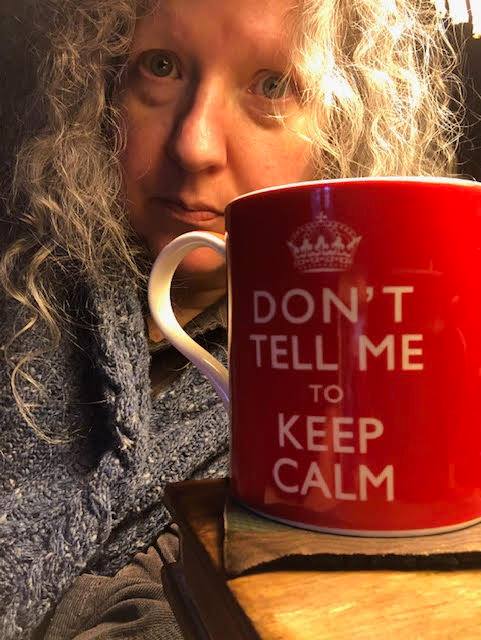
Calm My Ass

Scrolling through the ol’ Instagram at 5 AM as I drank ice water and waited for the cool air to kick in, I came across an ad for a popular meditation app. There are three signs, it flashed up in meaningful words, that I might be “emotionally detached”:

  1. Neglecting your needs or depriving yourself of pleasures
    [Warning: lack of parallelism coming up. -ed.]
  2. You are numbing yourself with social media, food, or alcohol
  3. You feel inadequate and alone

So…Tuesday? Because isn’t this everyone on the planet who is guided by love, at this point? (Note: All kinds of five-star ratings and quotations came up, too, encouraging me to “face my fears” and “become a new person”…by, what, shutting off?) I mean, did you watch the eighth Jan. 6 hearing? I think Rep. Elaine Luria (D-VA) summed up the week’s news well with this tweet:

Take a lesson, people.

This app ad got me realizing that in fact I don’t want to be peaceful. Far from it. I want a fire in my belly. I want to feel engaged, alert, excited. I’m tired of feeling tired, sick, inert. This world is on fire. I want to make the dogs bark.

Angela Sidney, Life Lived Like a Story, 1990, p. 156
University of Nebraska Press, 1990. These women are true warriors.

The Voice

Question from a friend and blog reader: “All your blogs have a very specific rhythm and pattern. Is that intentional?”

Answer: Yes. [Shakes head.] (Also, No. [Nods.])

I also responded, “I’m not sure it’s pleasing. I play with moments.” 

I think a voice one “hears” in a letter or blog (which for me is a kind of letter) is as particular as a speaking voice. I think there is an expectation with writing that writers will mix it up a little. Certainly, in my speaking voice, I can become a little bit Southern (from my Virginia background), or a little Midwestern (my folks), or randomly Cockney (natural mimic), depending on my mood and who I’m with. But really, Lisa O’ has one speaking voice. And over time, I’ve developed one writing voice, and I find it only varies when I am writing, say, dialogue for characters. I think it’s okay. (I knew a wonderful professor, Andrea Lunsford, at Bread Loaf who introduced herself at seminars by saying, “As my granny used to say, ‘Andrea, you have a loud but by no means pleasing voice.'”) I mean, you always know it’s a Keith Haring work, or a Georgia O’Keeffe painting, no signature required. And I don’t think you have to be that level of genius to have your own style and say many things within it.

A few years ago, a friend’s son (and he’s my friend, too) and his boyfriend at the time visited my home in Queens. He later told me that I had a very specific aesthetic. When I asked what it was, he paused and thought (we were standing in the Brooklyn Museum, looking at the Judy Chicago installation “The Dinner Party”) and he said, “Dimly lit whimsy.” He smiled. 

I think that describes me, my life, my talents, and my writing, too.

Dimly Lit Whimsy

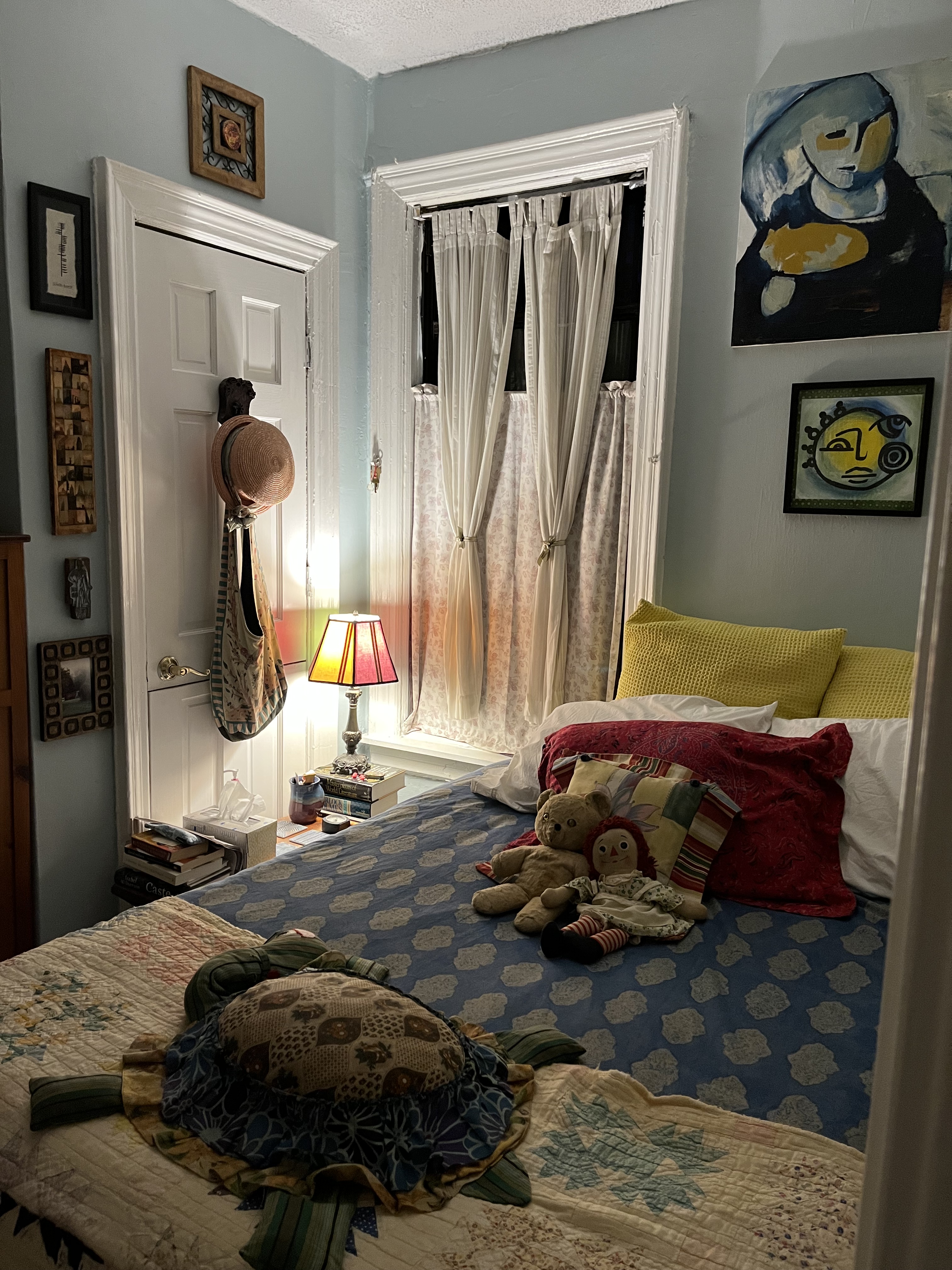
I play with moments. My home aesthetic is born of arranging found and received objects, such as cards and gifts and rocks and pins and books, into vignettes. I play with moments, dimly lit. (I’m not sure I illuminate anything.) Each item in my place came to me at one moment or another, and I assemble and reassemble these moments on my shelves like a story, as I do in my mind, or in a blog post. If I make any “art,” this is about it. I’m not sure there’s any there, there, to paraphrase Gertrude Stein. I wish I were capable of greater depth, of making real art, for example, but I’m limited to the appreciation of, and at best the arranging/displaying of, the art that others make. (Flashing Sign #3, in red, “inadequate and alone”; very few people see it.) 

Miss O’ at home, with foot.
Whenever I look at pictures of Georgia O’Keeffe’s home in Abiquiu, New Mexico, however, I find myself dreaming that I was that person, content with one lovely stone, a clean old bone, a simple wood slab of a table, white walls, bright natural light, maybe two wooden chairs, a desk, a sculpture, one painting.

From Architectural Digest

The way I live, in reality, couldn’t be more the opposite of that. I’m not entirely sure why. Something about a need to feel cozy, to not lose a single memory.

More dimly lit whimsy, with original art from all over, arranged just so.

When I started blogging several years ago, on Blogger, I made it my weekly task to hold in my mind all the disparate things that caught my whimsy and use the writing task to arrange a sort of pastiche/synthesis (since the post-modern world is essentially collage) to see if I could find the connective tissue (sorry—mixed media, mixed metaphors) to somehow point to solutions for the troubles of the world. It all came down to education. Everything does. Not merely knowing a lot or being smart, but rather making connections among the things we learn to try to do something with it, to use it, to put in service to something. 

I’m not sure that I accomplish anything, and yet I persist, as I’ve noted before. I had a high school friend who always introduced himself with his IQ, 185, and when I reconnected with him decades later, he was still doing that, as if stuck on a tape loop. (Am I stuck on a tape loop? See also, “feeling alone and inadequate.”) Where do we find the inspiration to grow and change?

Speaking of tape loops, I often return to this little gem. Sir Peter Brook died 7/2/22 at age 97.
(For best results, substitute “Life” for “Theatre.”)

Dimly lit whimsy: More and more I find myself writing in the dark.  Less and less to say. Amidst so much chaos, so much violence, so many opinions, causing, ironically, so much isolation, where to? And like me, I suspect we all desire not so much “quiet” inside ourselves as stability in our outer lives.

From Instagram.

I believe this is important. Without stability in our most basic living, it’s hard to become outer directed. And if we don’t create a stable center and combine with a contained fire of purpose, the nihilists win.

Seen on the web. People are funny.

In the meantime, as that fucking app reminds us, we eat, we drink. Possibly we read. We watch the January 6 hearings. We vote. Stream a show to binge watch. But there has to be more inside us. And it wants to come out.

So here’s a call to action, to us good, caring folks who need to get off our asses and do what needs to be done, somehow. Right after this heat wave passes.

Lawn chair in O’Yard, ca. 1970s. Doodle by Miss O’, who reminds you
to conserve energy and stay hydrated. For all of us.

Word Clouds

A commercial for an orange tube-y snack food shows a hip hop artist waving his fingers across bricks in an urban landscape and a colorful mural appears; he passes a child playing plastic buckets and the boy is now sitting at a red and chrome full drum kit. The plain glass buildings all begin shimmering in color. 

Because in America, at least, you can’t enjoy anything, not even a junk food treat, unless you are changing the world. And it’s not enough to have a tasty bite. You have to gorge on a whole fucking bloomin’ onion, loaded nachos, and whipped cream on the dessert, with a table filled with family or friends, or why did you bother to go out? 

And it’s not enough to enjoy the 4th of July with a sparkler; you need to listen to the incessant sounds of explosions all over Queens and watch the aftermath of a mass shooting of 30 spectators watching a parade in a small town in Illinois.

Art by Rebecca Morgan, as seen on Instagram

And I don’t know about you, but this kind of “go big or go home” bullshit is starting to give Miss O’ more than hives.

What’s the Meaning of All This?

Back in 1964, philosopher Marshall McLuhan famously said: 

“The medium is the message. This is merely to say that the personal and social consequences of any medium – that is, of any extension of ourselves – result from the new scale that is introduced into our affairs by each extension of ourselves, or by any new technology.”

Fifty-eight years ago, McLuhan also said, “Ours is a brand-new world of all-at-onceness.” Director Mike Nichols, in an interview in the 1990s, talks about how much McLuhan got right, though McLuhan seemed to be dropped from our consciousness. (I say “to be dropped” because we live in a disposable culture.) People used to receive information at different times, Nichols noted, and in different forms—newspapers, letters, magazines, telegraph, newsreels. News used to reach people weeks or months, or years, after an event occurred. The Emancipation Proclamation, signed in 1863, did not reach enslaved people in Texas until June 19, 1865, and deliberately so—the goal being to keep this from them for as long as possible so the farmers could get another harvest out of the enslaved for free.

With TV, we all saw the Kennedy assassination aftermath play out immediately, for example. Nichols, speaking of the challenges of directing new scripts, pointed out that because exciting real events—from assassinations to the moon landing to wars—come to us in real time, fiction just can’t measure up. And so now instead of deep, simple human stories to sell tickets, we reach for Superheroes and Armageddon for entertainment.

Nothing seems to be enough to sate us. The news media and its audience now hear of mass shootings and barely register an “oh, god,” just before the yawn; you see that it’s getting increasingly harder to satisfy our sensory desires. Overloading on porn and all its vulgar unrealism is why all those Incels (involuntary celibates) can get no pleasure from sex with women. The medium is the message: sex isn’t about intimacy, but rather gratification and power.

“We shape our tools, and then our tools shape us.”

~ Marshall McLuhan

Understanding Media: The Extensions of Man 1964

Miss O’ Wonders

Query: What message are Americans told, by one another, is the message of America?

Response: Freedom.

Query: If your culture’s primary tools (or mediums) are guns, unmediated information highways, evangelical Christianity, and self-proclaimed “influencers,” what is the actual message?

Miss O’s Current Response: The message is that one ideology pushed by a lone individual’s power to kill or influence others is the single most valued aspect of the culture.

It’s a question of lenses.

A philosophy professor of mine once taught about hedonism. He said people misunderstand it, thinking a hedonist is someone who debauches and can’t get enough of pleasure. In fact, Prof. Smith said, “A hedonist is supposed to get an orgasm from bread and water.” Hedonists in fact set up a philosophy with forced, unsustainable expectations for actual humans. Bread and water will never be orgasmic, however nourishing, unless you are first dying of starvation and thirst. 

From Instagram

In its latest attempt at a national philosophy, America has set up a forced, unsustainable set of messages for Americans through the medium of video, meaning we all see and hear these messages. 

  • First, we are supposed to place the needs and desires of the individual above society, unless that individual is Black/brown, poor, and/or a woman. 
  • Next, we must yield to the power of guns and ones who wield them over any individual’s freedom to speak, assemble, worship, or report news, unless that person is a white male with shit tons of money. 

If the medium is an unmediated Medium, is the message that we are living in Babel?

I often spend whole mornings just deleting email junk so I can free up my email storage for more junk.

If the medium is an unstoppable garbage bin of random communications, is the message that there will be respite from the noise of humans and technology?

I have seen tweets of mine go mini-viral and had panic attacks.

I have tweeted, blogged, or posted on my wall things that I find vitally important and not one person agrees with me in even the form of a like.

I begin to value myself based on the mediums.

Which medium are we going to amplify? Which message will sound off and win in the end? Is there an end?

Is there anything duller and less surprising, however continually shocking, than American politics? Republicans can only stay on brand by grabbing power and rejecting anything democratic; the Democrats can only stay on brand by rejecting revolutionary progress and staying steady. 

If the medium is the message, what is the proper medium for politics? What is the MESSAGE of our political life?

I keep getting stuck on these questions. “Stalemate” comes to mind. “Bartleby the Scrivener,” too.

Because a stable democracy is dull copy for our hundreds of 24-hour cycle “news” outlets, whether on a cable network, local television, or a newspaper, the Big Stories I see are almost never to do with public good so much as public titillation for ratings or sales. (And now this commercial message.)

The collective message is what exactly? Consume mass quantities and die already?

I awoke this morning, the Fourth of July, 2022, as I have every morning for months, in a pit of despair. Between the climate crisis-induced collapse of an Italian glacier and the invasion of Ukraine, along with the naked Republican attempt at every level of government over the past three years to end our constitutional democracy—and a press that does little more than pass the popcorn—it’s hard to write anything, create anything, feel there’s any point. And as I stood in my hallway after the coffee, half naked, holding a bra, vacillating between putting on real clothes to leave my apartment so as not to listen to the lone skateboarder on the asphalt playground who decided to practice his tricks right next to my little abutting porch (knowing that will also be in for an endless night of illegal fireworks); and falling into a ball of lonely weeping, as I do rather a lot these days; I mercifully remembered I have friends. I texted everyone I love and care about that piece of art by Rebecca Morgan, up there, because they all would instantly get it, and they did. And they answered.

My friends Carl and Mark, buddies of mine since 2nd grade wrote back too. Both of them are gay. Carl lives in our home town; Mark lives in Delaware with this husband. In response to our group, Carl said, “Not feeling celebratory. Low key chill here. Cleaning and organizing.” Mark said, “America doesn’t deserve a birthday celebration this year 😤.” I said, “I’m writing a blog.” Carl said, “Excellent.  I hope you include my disappointment.” Mark sent his love, calling us, “MY FAMILY.” And that just broke me up. You know? That sudden burst or wave of love. And if I hadn’t broken the grip of depression, pushed past the despair by becoming outer directed, I suppose I would have started drinking wine at 10:30 AM and not really looked back.

And wine is a lousy medium for any message. Here are some better ones:

  1. Honeysuckle
Photos by Miss O’
  • Postcards to SCOTUS
Miss O’ uses up some postcards.

Most of our important commentary anymore comes through in the medium of satire, including comics, cartoons, and Comedy Central’s The Daily Show and TBS’s Full Frontal. The medium is the message: We treat our existential truths like jokes. The “breaking news” of the NYT is often the equivalent of “What happens to Jolly Ranchers when they stay all day in a hot car?” The medium—the paper of record—is the message, and that message is “accentuate the trivial and don’t mess with existential truth in between.”

Like millions in the world, I write what’s on my mind and post these ideas for free for all to see. I have no mediators. No one, not a partner or friend and certainly not a paid editor, is around to read behind me, suggest where I might improve, strengthen, or refocus. Nor does any publisher or advertiser pay me for my thoughts. 

And it’s still only one voice trying to mediate all the other voices and create a message that is coherent and true.

I still don’t know how to do it. Nevertheless I persist.

Miss O’ Makes a Word Cloud

On Turbulent Flow, Part 2

Ordinary Life, Queens

I wrote the paragraph below around March 5:

It was nearly 60 degrees in Queens yesterday; it’s snowing this morning. This has happened two weekends in a row. I’ve been thinking a lot recently about turbulent flow, the reasons for which I’ll get to, but first I’d like to open with an apology for my own flow: I used to be funny. I used to have a capacity to write about things in an energized and witty way. And then that one guy became “president” in 2016, the world turned upside down, as Americans started voting against their own best interests, hell, their senses, and in direct opposition to their self-proclaimed Christian faith, and called it righteous; Earth started turning on us in earnest in response to our neglect of our responsibility to be stewards of the planet, i.e. to not shit where we eat, and our abject failure to do this. I can’t walk down the aisle of a supermarket, department store, or dollar store and not think, “All this is heading directly to a landfill, and there are millions more aisles like this of packed shit none of us need, not a bit of it,” and I start weeping. 

Tile adorning my bookshelf, gift from Colleen Cosgrove 2022

Written around the same time:

This past Monday I spent part of the day chasing down a running toilet. I heard the telltale hiss, on for 15 seconds, off for 10 seconds, through some stack in my kitchen; down in the basement it was louder. It wasn’t my toilet—the source was somewhere else in the building. Around 8:30 AM I emailed my immediate neighbors in my small complex, and they too heard the hiss. A couple next door heard it at 11 PM the previous night, and all night, but had been too tired to do anything about it. Next, I sent a group email to the other 16 units: Hi, everyone…anyone got a running toilet? Some replied that they thought is was related to our dysfunctional boiler and steam heat hit and miss; but the fuel company guys (whom another board member—that’s right, I’m on the Board! —chased down at the same time) assured us there couldn’t be any connection. Running toilets are more than just annoying sounds; it’s a water leak and the money adds up. In a small complex like ours, it’s not something you can ignore, but we all want to, don’t we? So finally the culprit revealed herself in a private email to another Board member. Sheesh.

Later that week:

At the supermarket this afternoon, I introduce a little turbulence into the normal flow of a cashier’s day: My order comes to $21.86. I have a $50 bill I want to break, but I already have a lot of ones and pennies, so I give the cashier, a Muslim woman around age 40, I’d say, $52.01. She has finished bagging my groceries, placing them in the bags I brought (this act used to cause turbulence, but not any more, so that’s progress), and as I hand her my odd cash I explain, “I’d like even change.” She looks confused and says, as I suspected she would, “But your total is $21.86.” All I could say was, “Trust me.” “Okay…,” she says, and taps in 5-2-0-1. She turned to me with wide eyes after seeing “30.15” come up on the little screen. “How did you do that?” she asked. “I used to be a cashier, and back in my day we had to figure out the change up here,” I explained, gesturing to my head. I took my 10 and 20 and nickel and dime and put them in my wallet as she said, “I always tell my kids, you got to learn the math,” and I agree, saying, “This is when it comes in handy,” and we exchange “have-a-nice-days,” and I hope we will. Turbulence as magic.

Back to the present, March 20, 2022, the first day of spring. 

Tasks of Note:

Got my taxes done this week. For many years it was the EZ form for me—small income, no mortgage, as I was a lowly public schoolteacher who would never see $60K. Now in NYC, at a corporate job and with a co-op apartment, so many forms, I needed help. But what used to take me forever in the way of finding and pulling all the forms is just another task anymore, whatever the technology needs are to make it happen.

Washing coats and scarves, another task this week, used to be an event to me; now in my late fifties, I just wash the coats one day. Hang them up. Go on to the next task.

Baking sourdough bread and keeping up with a starter was something I found arduous in my twenties, since I moved a lot back then; in my late fifties and in one place for nearly 19 years, I think nothing of making my own bread with a starter. Toss in various kinds of flour, water, molasses, salt. Knead it, stick the round in a greased bowl, let it prove a couple of days. Feed the starter, keep it out to grab yeast from the air, stick it in the fridge. Stir it once in a while and feed it in preparation for the next loaf. Bake a loaf, cool, slice, freeze. Bread for a month. (Thanks to Anna’s husband Michael.)

How Ordinary Becomes Precious

Now imagine all those necessary complex and simple tasks under fire. Imagine the work of your everyday world under mortar shelling, your papers and photos and textiles destroyed, that collapse, life reduced to huddling in a basement for weeks on end, little water, little food, no power. I should have really imagined all this long ago—it should never have seemed “other”—but until Trump’s improbable rise and Putin’s recent mental crack-up, I guess I just didn’t realize how possible The End is now. How probable. And what’s worse is 40% of my own fellow citizens would take Putin’s side and kill people like me with abandon. Seeing the footage from Ukraine, in cities that look like New York, it’s surreal and all too real.

You’d think, with all the natural calamities that flesh is heir to, that in 2022 we’d have just fucking stopped war, that we’d unite globally to save the planet that we have trashed. Every generation, though, seems to become simultaneously more evil on the one hand and more evolved on the other. The divide widens. The turbulence increases.

On his death bed, the physicist Werner Heisenberg is reported to have said, “When I meet God, I am going to ask him two questions: Why relativity? And why turbulence? I really believe he will have an answer for the first.” (It’s quoted in Chaos by James Gleick, but I’ve read that the quote is probably apocryphal, so I guess that by continuing to possibly misquote or mis-attribute such a quote we only add to the chaos. We do not, however, lose the intelligence or humor of it, so does it matter? Dammit.)

Being in this Moment

I, the pagan Miss O’, follow blogger John Pavlovitz, a pastor and writer, who is himself a devout Christian whose political writings rail against the co-opters of faith as a means to destroy others and gain money, power, or fame for themselves. In one his blogs from 2020, “I Don’t Want Unity with Hateful People,” he writes:

I am not morally bound to make peace with a heart that dehumanizes other human beings because of the color of their skin, their nation of origin, their gender, their orientation. And to have embraced Donald Trump now, is to unapologetically brandish such a polluted heart; to be actively perpetuating inequity and stoking division and manufacturing discrimination in this very moment.

I steadfastly refuse such an alliance. I am a loud, conscientious objector in their war against the world.

More recently, Pavlovitz wondered why it is that all these “Christians” believe God will protect them from a deadly pandemic without the need for masks or vaccines, but somehow still feel the need to carry a concealed weapon everywhere they go. I mean, which is it?

The trick for the rest of us, then, the ones who wrestle with it all with compassionate hearts, is how to keep the flow of life going on a planet inhabited by not only good people but also by hateful, hypocritical, destructive people. In these moments of despair, many people turn to faith, but faith as a concept let alone practice has never appealed to me. So your Miss O’ has been doing some digging lately to better understand why that is.

Krista Tippett, who has been suggested to me so many times by dear friends that I have become a regular listener, replayed an episode from her podcast On Being which featured the Vietnamese Buddhist monk Thich Nhat Hanh, who died recently at age 95. Hanh was such a powerfully popular figure in spiritual circles that I decided I should give him the respect of a listen. In the interview, he explains that suffering—all this agony and despair—is part of the point. In Christianity, for example, people are promised that in death they will be sent to a place where there is no more suffering. Hanh does not accept this in his mindfulness practice.

Thich Nhat Hanh: Yeah, because I could not like to go to a place where there is no suffering. I could not like to send my children to a place where there is no suffering, because in such a place they have no ways to learn how to be understanding and compassionate. And the Kingdom of God is a place where there is understanding and compassion; and therefore, suffering should exist.

Tippett: That’s quite different from some religious perspectives, which would say that the Kingdom of God is a place where we’ve transcended suffering or moved beyond it.

Thich Nhat Hanh: Yes. And suffering and happiness, they are both organic, like a flower and garbage. If the flower is on her way to become a piece of garbage, the garbage can be on her way to becoming a flower. That is why you are not afraid of garbage.

(So, Miss O’ understands him, turbulence, suffering, garbage—it’s all part of the experience of living. )

Hanh continues:

I think we have suffered a lot during the 20th century. We have created a lot of garbage. There was a lot of violence and hatred and separation. And we have not handled — we don’t know how to handle the garbage that we have created, and then we would have a chance to create a new century for peace. That is why now it’s very important for us to learn how to transform the garbage we have created into flowers.

Tippett: I look at the violence that marked the world in the period when you were a young monk — there was the Cold War; there was a certain kind of violence and hostility. A lot of that has changed, has gone away, a lot of the terrible threats and the sources of the worst fighting. And now in its place we have new kinds of wars and new kinds of enemies. I’d be really interested in, as you look at this period of your lifetime, is there any qualitative difference between the violence that we have now and the violence that we had then? Is there anything like progress happening, or is it the same pattern that repeats itself?

Thich Nhat Hanh: Yeah, you are right. It’s the same pattern that repeats itself.

Tippett: And does that make you despair?

Thich Nhat Hanh: No, because I notice there are people who are capable of understanding, that we have enough enlightenment, and if only they come together and offer their light and show us the way, there is a chance for transformation and healing.

(And within weeks of the replay of this podcast, it’s worth noting, Putin invaded Ukraine, upping the garbage quotient exponentially.)

Miss O’s own qualm with the art of mindfulness is that it seems, somehow, incompatible with joy, humor, ecstasy, agitation, and fun, and synonymous with silence, chanting, bells, quiet, slowness, and dullness. This is not fair, and surely not accurate, but I’ve never heard an interview about the need for mindfulness that includes even one chuckle. And the second I hear Eastern chants and gongs, I think to myself, No.

And so it is that I’ve come to understand that humor is, essentially, a response to inner turbulence; that without this turbulence there would be no reason for humor, no reason to laugh, and life without laughter is…what? And where does faith fit in? And what about the role of art in our lives?

And like MAGIC, my friend Kevin Townley, a practicing Buddhist and teacher as well as actor and writer and Met Museum tour guide, came out this month with a wonderful, funny, deep, personal, and insightful book to help guide me to a new understanding: Look, Look, Look, Look, Look Again: Buddhist Wisdom reflected in 26 Artists. I’m only a third of the way through, because I’ve found I have to read it with my pencil. The best books require that—so many observations to underline and reflect on. “Most people who embark upon a spiritual path don’t do so because they’re feeling fabulous,” he writes. And I laughed out loud. And so I came to see that the reason religion or a practice of any kind seems negative to me is that people seek faith for a release from depressive habits and feelings. So it makes sense, really, that it was hard for me to equate Buddhism, as I said, with joy. Kevin manages to link his irreverent humor and love of art with his spiritual practice, and in writing about it he threads in joy and creates openings for skeptics like Miss O’. Thanks, Kevin.

Miss O’ holds her very own copy, and you can, too, if you want!

Why relativity? Why turbulence? Artists often seem to hold the key. There is a Ted Talk on the unexpected math behind Vincent Van Gogh’s The Starry Night, a painting I have seen in person at MoMA here in New York, but it’s usually so crowded I’ve never had a chance to really see it. This talk, written by Natalya St. Clair, will blow your mind. In turbulence, “Big eddies transfer their energy to smaller eddies, which do likewise at other scales…,” and scientists have discovered “that there is a distinct pattern of turbulent fluid structures…hidden in many of Van Gogh’s paintings.” Gogh know! Artists are the reason to live.

“Seek and Ye Shall Find, and then

…when you find, you will become troubled; when you become troubled, you will be astonished, and rule over all things.”

The Gospel of Thomas (one of the Gnostic Gospels that the papal crowd decided to pull out of the New Testament; because god forbid a person feel empowered without a pope to lead her)

So I have to wonder: could the purpose of turbulence be that there is beauty in turbulence? And without turbulence we have no beauty? That Hanh is right, that without suffering there can be no joy?

Last week I noticed the bird’s nest under my neighbor Bob’s second floor air conditioner, a nest that has been there every year for the past 18 years; the chirping heralded spring, and I remembered: baby birds are coming. Then two days ago I looked up and the nest had vanished. Wind? Rain? It’s happened before, somehow the nest is gone, but miraculously, resiliently, the house sparrows are not. There they were, out flitting on the fence, and I saw one fly back up with a small twig in its beak. Rebuilding.

Ukraine will be next. And the earth after that. Take a memo.

Card by Turkish paper marbling master that reminds me of the symbolic colors of Ukraine.

On Turbulent Flow — Part I

Turbulence, in science, is a chaotic fluid motion, unpredictable, as you see in the ocean surf or fast-running streams and rivers. My common sense tells me that all that wildlife in the water would help create that chaos, movements inside of the flow, but in any case, mathematically, there is no clear reason such a thing should occur. Why does turbulence exist?

I might well ask this question of life on Earth. Why are there psychotics? Why do some people create and believe in conspiracy theories that undermine forward motion and foment insanity in otherwise decent people?

Turbulence happens all the time, even in small ways. Every time a kid walked into my classroom, slamming books, grunting; or during class a kid called out, “this is a waste of my tax dollars,” the flow of the lesson was ruined. 

A friendship flows along, and then one friend neglects another in time of need. Or grows jealous.

Turbulence.

Why is there turbulence?

A (now ex-) friend (a racist, homophobe, and xenophobe with no capacity to grow one inch over thirty years, so I have limits), used to complain, “Life should be gossamer!” I used to counter, “I think that’s heaven, right?” Life is brutish, nasty, and short, full of trials sent to test us, suck it up, etc. I accepted that. 

Miss O’ ponders the Big Ideas.

So Why Can’t Everything Ever Just Calm the Fuck Down?

Now I’m stuck on this unsolvable mathematical problem, “Why turbulence?” Why is it that this one utterly unpredictable thing (as far as we know) cannot be solved or answered for? 

No, Seriously, What in the Actual Fuck?

So I begin here with an admission: Despite the turbulence of continuing life in Covid-land, I enjoyed 2021. Well, the first part of it. Lockdown or no, once Biden was inaugurated and the American Rescue Plan was passed, and positive things were in MOTION, progress, repair, I could breathe. For the first time in five years I could breathe.

But.

It’s 2022.

Manchin and Sinema and the Barr and Pompeo Rehabilitation Tours.

Trump has announced his candidacy and is out on the rally circuit.

All these seemingly paid Russian agents, like Carlson and Gabbard, are getting a media pass. A DOJ pass.

And.

The left, so-called, is losing again.

Again.

Again.

The planet, the country, the voice. 

And now Ukraine, a struggling and young democracy, is under assault by Russia out of Putin’s desire to recreate the Soviet Empire and to take its resources and thwart its democracy. As of this writing President Zelensky, a Jew, has asked to meet Putin in Jerusalem to try to broker peace. Putin does not want peace. He wants to rule the world. Putin is reportedly firing and arresting everyone around him, from ministers to generals, who has failed him, and he will doubtless have them all executed, er, report that they fell out of windows, with plenty more to take their places. You know, we all dream of a separate planet for all of them, while they dream of the annihilation of most of us, who are good, decent people. It’s the same old story. It’s Star Wars. Only now too many leaders of our planet root for Darth Vader without shame.

As Seen on the Internet.

Jerusalem

Singer-songwriter Dan Bern opens his song “Jerusalem” (which you can listen to here):

When I tell you that I love you
Don’t test my love
Accept my love, don’t test my love
‘Cause maybe I don’t love you all that much

It’s such a charming and funny opening to a song, and it’s merely a hint of greater things to come. While the song dates to the ‘90s, it may as well be written now. After a bit of a journey (and I hope you listened to it), the speaker offers the Big Reveal:

Everybody’s waiting for the Messiah
The Jews are waiting
Christians are waiting
Also the Muslims
It’s like everybody’s waiting
They been waiting a long time
I know how I hate to wait
Like even for a bus or something
An important phone call
So I can just imagine
How darned impatient
Everybody must be getting
So I think it’s time now
Time to reveal myself
I am the Messiah
I am the Messiah

Trump’s supporters, as we witnessed, came all over themselves (and that’s not vulgar hyperbole, as I saw women on camera saying that they’d welcome being raped by Trump, which isn’t rape then, is it?) and continue to do so when they found their Messiah in Trump, which is beyond baffling to sentient people. (Not really is this the case for all-powerful Putin, because he’s not interested in being a Messiah so much as being Voldemort.)

Oh, that Internet. (Sub in Picture of Donald Trump. -ed.)

So here is where Trump channels Dan Bern’s speaker in the latest media tours and rallies:

Yes I think you heard me right
I am the Messiah 

I was gonna wait til next year
Build up the suspense a little
Make it a really big surprise
But I could not resist
It’s like when you got a really big secret
You’re just bursting to tell someone
It was kinda like that with this
And now that I’ve told you
I feel this great weight lifted
Dr. Nusbaum was right
He’s my therapist
He said get it out in the open

Even the speaker of the lyrics has, like Trump, a fake doctor’s note of “all clear.” And, to make matters worse, Trump’s “message” is ever amplified by Right and Left alike, because everyone is, in fact, waiting for the Messiah. Everyone except those of us who just want to roll up our sleeves and for the love of fucking god do the WORK to SOLVE PROBLEMS.

What Is a Messiah?

If you, like me, ever found yourself in an Advanced Placement class or in some other Highly Challenging class, like Aristotelian Philosophy (which I, a theatre arts major, took in the hopes that we might talk about the Poetics, but if we ever did I was lost by then), you know the Boys Who Ruin Everything. They are the “smart,” or let’s say for the sake of accuracy, schmart boys, the boys obsessed with derailing every lecture, changing the subject to something they feel expert in (say, Plato, Pink Floyd, or Reagan), or comment derisively just because; and the teacher or professor of said course invariably proved incompetent to get the class back on anything like a sentient track. We see this behavior played out in today’s media in a frenzy, almost exclusively by the right-leaning Schmart Boys, whether it’s Cucker Tarlson on Fux or “Lincoln Republican/Never Trumper” Wick Rilson, have one thing in common: They have exactly zero ideas for how to make life better for anyone or for the planet. Zero! Nada! Ha, ha! Their joy—and it’s all over Twitter, all over Fux Nooze, is their GLEE at either supporting or amplifying via decrying the voices of hatred, doom, and Big Power. And also to knock down smart, capable women like Hillary Clinton (what larks! who does that skirt think she is?)—and maybe only Hillary Clinton—who are focused on solving actual problems, women who, as people in government, believe that government should identify and face a problem, discover the causes, and seek solutions that benefit the masses. How dull, these Schmart Boys shriek. (And yet if we need anything in government it’s more dull wonks who solve problems.) Let’s throw out “truth” bombs that make us look schmart!

Thanks, Internet. Because she really was.

And, right on cue once again, in 2022, despite the improvement in Covid numbers, the great jobs report, you name the success, the American news media are amplifying the voices of Trump, via Bill Barr and the American fascists via coverage of the trucker convoy and Russia’s Putin, and only criticizing Joe Biden and the Democrats.

Even Trevor Noah on The Daily Show joked (?) that the UAE wouldn’t ever have refused a call from Donald Trump, as they have from Biden, because Trump’s such a wild card, ha, ha! But now the Right is using this as a meme in their Twitter feeds (framed with a picture of the Black man back when he was “clean-cut”), further legitimizing Trump’s power and his right to take it back.

There are a few so-called “remorseful” Republicans, the faux-apologists (for not voting to impeach or convict, right, sure) like Rep. Adam Kitzinger (R-IL) who are only apologizing as they prepare for a run of their own, I suspect; and who still voted AGAINST the John Lewis Voting Advancement Act, the Violence Against Women Act, and who also are against a woman having control of her own body, and who have no problem with book banning.

So.

I don’t think it’s hyperbole to say we are in the midst of a global nervous breakdown. Putin is behaving like Dr. Evil in an Austin Powers movie and the media legitimizes him by calling him “president,” a self-conferred title, and by using Putin’s objectives to frame all their headlines, rather than the pain being felt by the Ukrainian people.

Republicans and Fascists and Authoritarians preach the Gospel of the Messiah. Their followers drink it like wine, munch it like manna. They convoy around it. They fall prostrate before it, and all the while their Messiah screws them up the ass, they weep tears of gratitude. 

You know who’s NOT a Messiah? President Zelensky. President Biden. President Obama. President Carter. Hillary Clinton. These are people ON THE GROUND, doing the work, fighting for right. So why aren’t our American Democrat politicians praised for their heart, focus, and hard work?

Because there’s a Messiah problem on the Left, too.

Democrats are ALSO looking for the Messiah. That’s how Obama got elected, and talented though he was, he wasn’t, SPOILER, a Messiah, and so many people were so disappointed! And who can forget the Bernie Bro cult that went on to derail Hillary Clinton’s election? Because if a candidate isn’t “likable” or “perfect,” which is to say “male,” and if the candidate isn’t anointed by the press and Dems alike, fuck her and let the world collapse. (Meanwhile Republicans get a total media free pass to thwart good work. It’s their accepted role as the Evil Nemesis to Good!)

Until we on the so-called “left,” which is almost “right-center” anymore, reckon with our own messianic desires and dispense with them, this absurd pattern of annoint-or-derail won’t change. Until we admit of and celebrate the humanity, fallibility, and glorious possibility of our talented Democratic candidates and move past the plea for perfect alignment, we destroy all hope.

At the close of Dan Bern’s “Jerusalem,” the speaker returns to the opening lines, but now he is speaking not as a man but as the Messiah:

When I tell you that I love you
Don’t test my love
Accept my love, don’t test my love
Cause maybe I don’t love you all that much

Anyone who calls himself a Messiah, is anything but. And maybe it’s the concept of a “messiah” that really is the greatest mind-fuck of all. Messiahs don’t have to accomplish anything; they just have to flatter to promote themselves. They don’t love anyone, really. Especially not you.

(Next time, Part II of Turbulent Flow will accentuate the positive. In the meantime:)

Selfishness: A Treatise on Me and You but Mostly for Me about You

April 18, 2020

“Selfishness must always be forgiven, you know, because there is no hope for a cure.”

Jane Austen, Mansfield Park (1814)

Years ago, after a friend of mine had been married for several months, her relatives and friends began asking, “So when are you having a baby?” And the longer time went on without a pregnancy, the more her relatives began muttering, “Oh. Selfish.” My friend teared up as she told me about it. She wanted to scream, “No—we tried and we can’t. Go to hell.”

So who in that story is in truth being “selfish”? If you aren’t sure, we may need to have a talk.

When I think of humans who are “selfish,” inevitably a few names spring to mind.

(Seen around the web.) The bartenders are just expressing their freedom. Right?

Selfishness Unmasked

So here’s what I really want to talk about: Yesterday, over walks and talks and viewings of various programs, I found myself reflecting on the concept of selfishness in the time of pandemic. So I guess what I want, selfishly, is to talk about selfishness and have you, my reader, reflect on it, too.

Your Miss O’, like you and the rest of the world, is living into a new year of an old pandemic; millions of us have perished, or lost loved ones, or endured the illness, or have somehow managed to avoid it, ever-present though it remains. Some who were infected merely “tested positive” and had little more than a loss of taste and smell and maybe sniffles (as with my brother Pat and his family, as well as a few of my friends). More often, people have had high fever, aches, and their breathing almost lethally compromised for weeks (one of my dear cousins is currently hanging on day by day; others I know have recovered; a few friends were touch and go for months; one friend died); or experienced near-lethal dehydration as a result of severe diarrhea (two close friends); others, quite young, died suddenly after throwing a blood clot, including those who had been otherwise asymptomatic. The disease is utterly different in different bodies, and over different amounts of exposure. For nearly half of the United States, the view of the pandemic, whatever the human cost, has shifted from “hoax” to “who cares?” These same Americans view this pandemic in the same way that they excuse war or mass shootings, as nature’s way of “culling the herd.” And these same people don’t bother with masks or social distancing, and not only because of a cavalier attitude toward health. In their view, any restriction on their personal liberty is the greatest evil that any person can experience. Even more evil than a gun massacre, they insist, is the law that would prevent any individual from committing that massacre.

And so it goes. And don’t get us started on vaccinations!

This week, I am getting my second dose of Moderna. I mask up and live every day hoping against hope that I can remain virus free long enough to get fully vaccinated. To many, this is me being selfish. All I want is to see my parents again for the first time in a year and a half; and meet my new baby nephew James, who (if I can make it to the end of May), will be just over 6 months old when I meet him. Have I been selfish to wait this long? Or have I been responsible?

On my 6-sibling text thread, besides enjoying adorable baby pictures, we’ve been reporting our vaccination updates. My sister Sherry works in a retirement home, so she was the first of us to be fully vaccinated. My brother Craig, who is taking care of his and Sherry’s mom, Ann, who has Alzheimer’s, was next—he and Ann both have theirs now; I finally qualified and have one dose down; then brother Jeff, who will get his second dose April 30; and my youngest brother Mike, dad of wee James, had his second dose on Saturday, leaving just his wife to finish hers. There was, however, one notable silence on this thread: My brother Pat.

This does not surprise me.

When Pat texted on Friday that he was going to be visiting my brother Jeff and our parents, I flew into my usual hyper-responsible panic: I texted Jeff and called my parents to advise them to wear masks and keep their distance from Pat; don’t go out with him, etc. My mom called him to query this, and he declared that Covid was nothing (he and his family were hardly sick), that he’s pissed that his wife is getting their son vaccinated just because the school and his sports teams won’t take him back unless he is, that it’s his choice, hardly anyone has really died relative to the world population, etc. My mother told him not to visit if he wasn’t going to be responsible about it. My brother was furious and didn’t visit after all. (No one said who told them, but Pat knows that I know and have challenged his anti-vaxxer views.) Query: Is it selfish or simply freedom not to tell the people you love that you are not vaccinated and never intend to be vaccinated against a deadly virus?

“SELFISH, adj. Devoid of consideration for the selfishness of others.”

Ambrose Bierce, The Devil’s Dictionary (1911)

First, is it in fact asking too much of one another to wear a mask in public, socially distance, and wash our hands regularly during a time when such actions could prevent mass death?

To me, such a question sounds absurd; even to ask it feels ridiculous. For at least half of America, these simple precautions, requested by leading epidemiologists, are in fact too much to ask. Why?

“It’s almost paradoxical that on the one hand they want to be relieved of the restrictions, but on the other hand they don’t want to get vaccinated. It just almost doesn’t make any sense.”

Dr. Anthony Fauci, discussing [the] vaccine hesitant

Second, is it too much to ask all eligible (that is to say, not allergic) Americans to get vaccinated against Covid? After all, polio and smallpox did not eradicate themselves. Children must be vaccinated by law to attend public school. As a society, I thought we had accepted this, and if we don’t, we move to a survivalist compound in Idaho or Texas and spend a life in hiding. Again, why is this request too bitter a pill to swallow?

On this same subject, people claim “reaction” as their reason for refusal; so if your personal child once had a bad reaction to a vaccine, does that mean we should not require vaccinations? Or, because I had a severe allergic reaction to penicillin as a child, should my family have lobbied to have penicillin banned from pharmacies? What if we had, and had won?

Third, is it fair or unfair of national or state governments to require a “vaccination passport” to travel? (My brother, for example, who loves Mexico, would, I think, get vaccinated if Mexico or the US required such a passport.) Or is this too much government in the name of preventing a virus from doing what it was born to do—kill as many of us as possible?

In other words—and not that environmentalism is on the minds of anti-vaxxers—are those of us who would prevent mass suffering and death, including our own—deaths that may in fact save the health of planet Earth—really the selfish ones?

What is the line between selfish and responsible, and what makes this line so difficult to navigate? I ask that because it seems to me this is the dilemma. Is denial easier to live with? If we don’t attend a church service or a wedding or a funeral or a birthday celebration due to Covid, are we being selfish (not making ourselves physically present to honor others), or are we, in fact, responsibly looking out for the greater good? Or is it both? If we deny them and ourselves a temporal pleasure with the idea of serving a greater longterm goal, is it worth the sacrifice? Or are we being fools?

Perhaps we should consult the healthcare professionals who haven’t seen their own families in a year. And the soldiers who go to war.

The Royal Treatment

Yesterday afternoon, I streamed the funeral of Prince Philip, the Duke of Edinburgh, via the BBC, listening to interesting history but able to fast forward to the essential ceremony, which was beautifully done—intimate, restrained, yet also grand. (Robin Givhan of The Washington Post captures it perfectly. )

It might seem odd to talk about privileged royals at a royal funeral in an essay that concerns selfishness in the time of a pandemic, but the broad sweep of history and the roles of those in power are part of the big story. To be unselfish in the big moments means, for example, sharing your personal grief with the larger world, accepting the condolences and comforts and kindness of the many with grace and gratitude even if you might wish to weep alone. In addition, for those of us who might not understand why a royal relic of a colonial era is deserving of this globally seen ritual, we have to be unselfish enough to try to understand the full picture.

If rituals remind us of how small we are in the scope of history, they can also reassure us that despite all evidence to the contrary, none of us is alone.

So many people have been missing the reassuring powers of rituals these past 13 months — especially the spiritual ones. They have not been able to attend religious services, and when they have, they’ve been reconfigured for safety. Perhaps they’ve been held outdoors. Communion has been transformed into a drive-through event. It has been impossible to extend the hand of fellowship, and there have been so few people in attendance that it hasn’t felt like fellowship at all.

And so Philip’s funeral was a reminder of what these rituals can do. They don’t erase the flaws in the deceased but they afford the public an opportunity to make peace with them. They’re about endings, but also renewal. During a time of emotional upheaval, they’re guardrails to keep people from tumbling over.

~ Robin Givhan, The Washington Post

Learn One, Try One, Teach One (Repeat)

In the end, the events of the past year have reminded me of the importance of our teachers. To take one example: Last night on Turner Classic Movies I watched again (for the first time in years) William Gibson’s The Miracle Worker starring Anne Bancroft as Anne Sullivan and that prodigy Patty Duke as the prodigious Helen Keller. To help bring to heel the ungovernable and tantrum-prone Helen—who since an illness at 19 months (possibly meningitis) had been blind and deaf—her parents have sent for a teacher; and while wrestling Helen to gain control and be effective, this teacher is doubted and questioned continually by Helen’s parents, “Why can’t you show some pity?” At one point in the film, Helen’s older half-brother (who had been on Anne’s side but sees the whole business to teaching Helen as a hopeless cause) asks Anne, “Why do you care if Helen learns or not?”

Any reasonable person watching this madness, this wrestling match, might easily wonder both of those things: Why fight this poor, wretched creature? and, Why do you care to try?

And I can tell you, as a teacher, that any teacher watching this film will offer in answer to anyone posing those questions, “Well, it’s obvious you aren’t a teacher.” Anne herself says it, that where there is one closed mind that is never opened, that’s a loss to the world, and so of course she must work to open that mind. (She spells into Helen’s hand, T*E*A*C*H*E*R, not ANNE, to introduce herself.) So, how much learning is “enough”? When Helen learns to sit at the table and fold her napkin, for example, instead of roaming the room eating off of everyone’s plates, the family is satisfied. What more is needed? Isn’t it enough that she obeys? Anne, the teacher, knows that obedience is not enough: Where there is only obedience without the knowing why, that’s a loss not only to the person, but also to the world. (As you know, of course, because of Anne Sullivan’s teaching persistence, Helen Keller went on to be one of the most inspirational activists for good that the world has known.) Selfishness may be born of ignorance more than anything else, and that is why education is key.

I’m sometimes messaged by friends on social media, following one of my usual posts on racial injustice, for example, “Why do you care so much about other people?” I don’t know; I never really thought about it. I just always did. I guess that’s why I became a teacher in the first place. What I find odd is that so many people who do not have the vocation to educate or help others, want selfishly to throw up obstacles to prevent the success of those of us who do. See also: voter suppression and climate change denial.

Selfishness, then, causes loss—first for the closed or untapped mind of the “selfish” person, sure; but ultimately, it is that other and more insidious selfish desire for “calm” and “order” without sacrifice or struggle (obedience without knowing why one obeys, nor caring), that makes the world the biggest loser of all. Why should we, as individuals, care about the world? The teacher says, How can you not?

In sum, anyone who claims not to understand why he/ she/ they must “obey” an order to be vaccinated against a deadly and highly contagious disease, or openly rebels against the order fully knowing and denying the consequences, is acting not righteously but selfishly—selfishly because, even with all the information to explain the why, he /she /they has chosen personal and unfounded belief over the greater good. Morally, this is simply wrong. So judgeth Miss O’.

I look back to Ambrose Bierce up there, who hit the mark where too many people today live: the idea that my asking you not to be selfish, makes me the selfish one. Teachers especially are imbued with just that kind of selfishness—the selfish need to unlock closed minds so that all of us may experience life in all its richness and complexity, and grapple with all the points of view so that we ourselves may grow and be more fully of service to those we love.

Ain’t it awful.