Constantly Living Uncertainty

On the insistence of the body

I used to write funny. I have an old blog to prove it, at least those few entries that were genuinely hilarious to the six or eight friends who read them. I also used to be way more outer directed, blogging about national catastrophes, global issues, the fate of the planet. Somehow, I could hold both hilarity and tragedy in my head as I typed.

Then I entered my 50s, that magical decade of the many phases of, say, menopause; the panic of Covid; the (unending) transparent criminal absurdity of Trump; the near-precipitous decline and recovery of many aging parents; the unexpected death of a longtime lover; the sudden dissolution of old friendships. What happened?

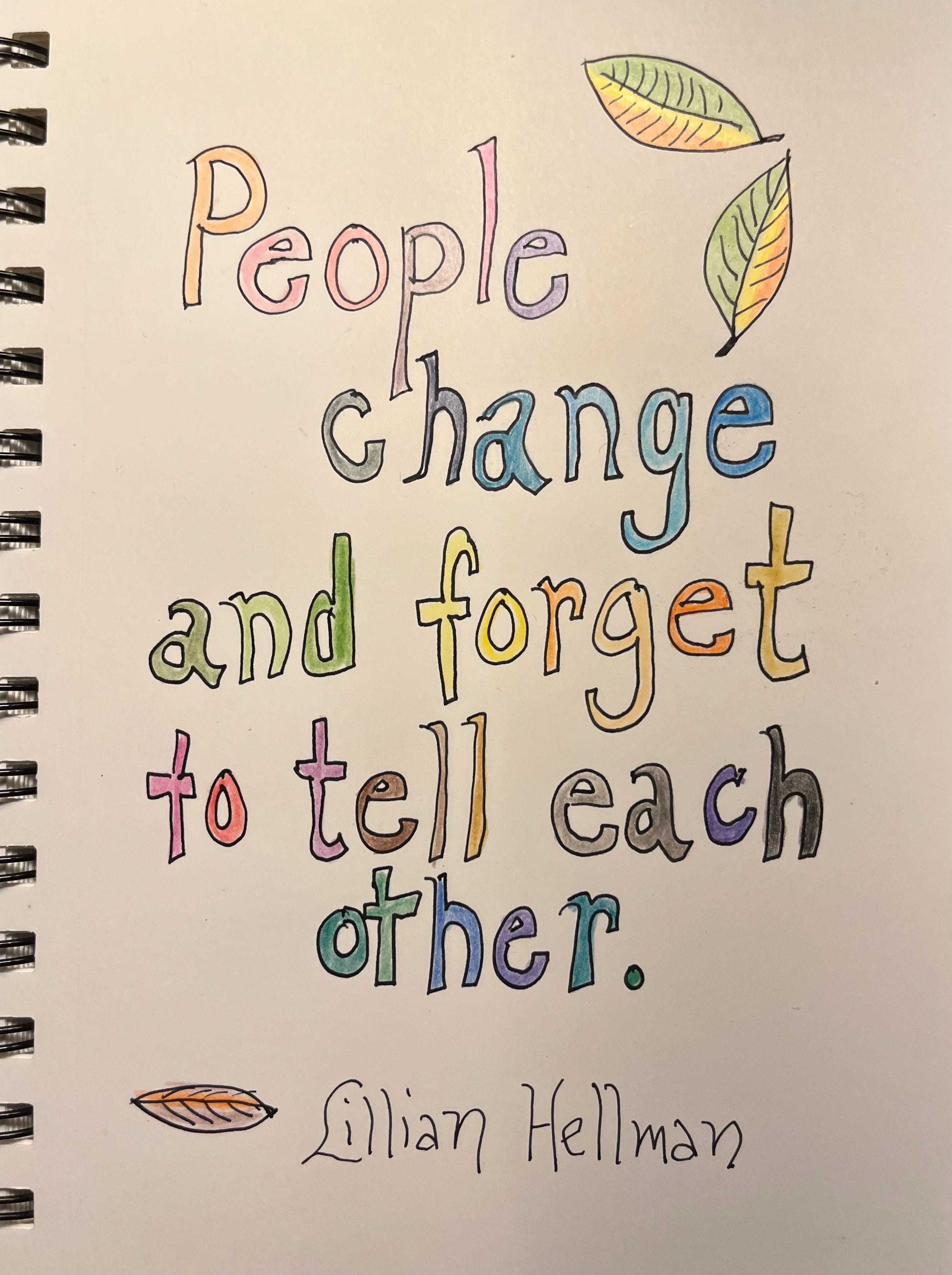
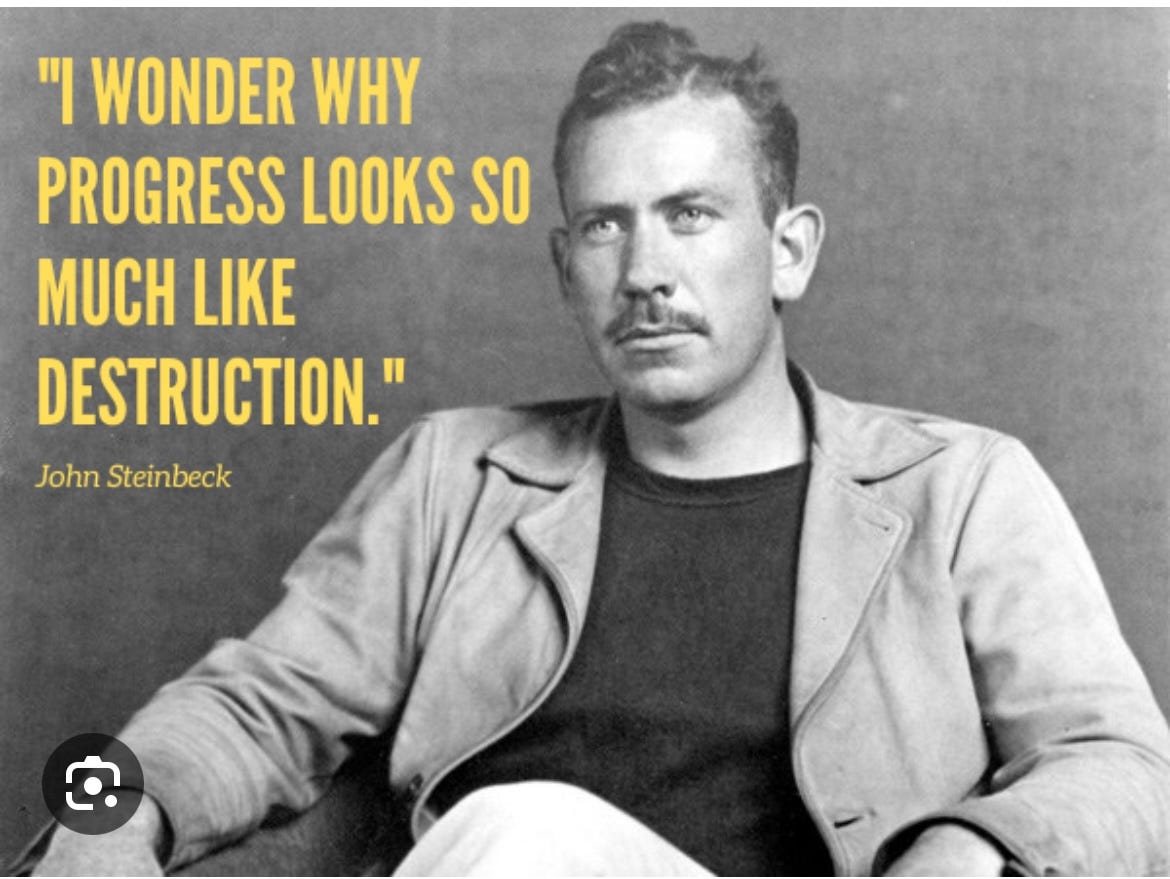
My favorite hip pocket quote; art by LO’H for Lilly, who framed it. I think we all could use this quote as we age. Feel free to make a copy if you want.

The greatest shock of this decade was the new insistence of the body. Beyond my menopause was the frozen shoulder, the two-week suffering through the symptoms of the global pandemic, the recurring sciatica (or is it stenosis?), the sprained ankles, the appearance of polyps in the colon,…it just doesn’t end, and it never will, not now. This is life forever.

And who am I kidding? It’s always been life, for everyone, for all time. How in the name of holy vaccinations did I just now come to realize that our macro bodies are at perpetual war with the micro world?

How did it just now occur to me, in the last year of my 50th decade, given global wars and global warming, the murder of migrants and children, rampant diseases like AIDS, and, I mean really knowing about all that, how did I just now really realize in my body that we are constantly living in this crazy nebulous place of, what the fuck and when? It seems most everyone I know and love has lately revealed that they are living with a condition which could, probably, eventually kill them, if an errant bus doesn’t get them first. To take two examples, I have my mysterious brain thing (the symptom is the numb left eye, MRI March 14); and my theater friend HD exclaimed over lunch at the West Bank Café last Saturday, “So, my prostate cancer…did I tell you that? Oh! I have cancer!” And we had to laugh.

Constantly Living Uncertainty

Our introductions to disease
an ultrarare sarcoma
late diagnosis melanoma
two types of diabetes

Those many swords of Damocles:
pulmonary fibrosis
multiple sclerosis
life-threatening allergies;

Cancer histories, predisposed:
colon bladder prostate breast
esophageal and the rest
the diagnoses presupposed.

How is it, knowing all of this,
How is it 
nous continuons?
To meet each day with coffee cups
Face the downs to find the ups
Fix the leaking kitchen drain
Wash the car despite the rain?

Dorothy Parker I ain’t, but sometimes only playing at verse gets me through. Verse, and Ella and Louis; or trying my hand at collage again; helping dear friends through grief; enduring yet a fourth colonoscopy in 15 years; weeping past control over the whole fucking world—feeling as deeply as I can, pushing through it, to see what comes out the other side.

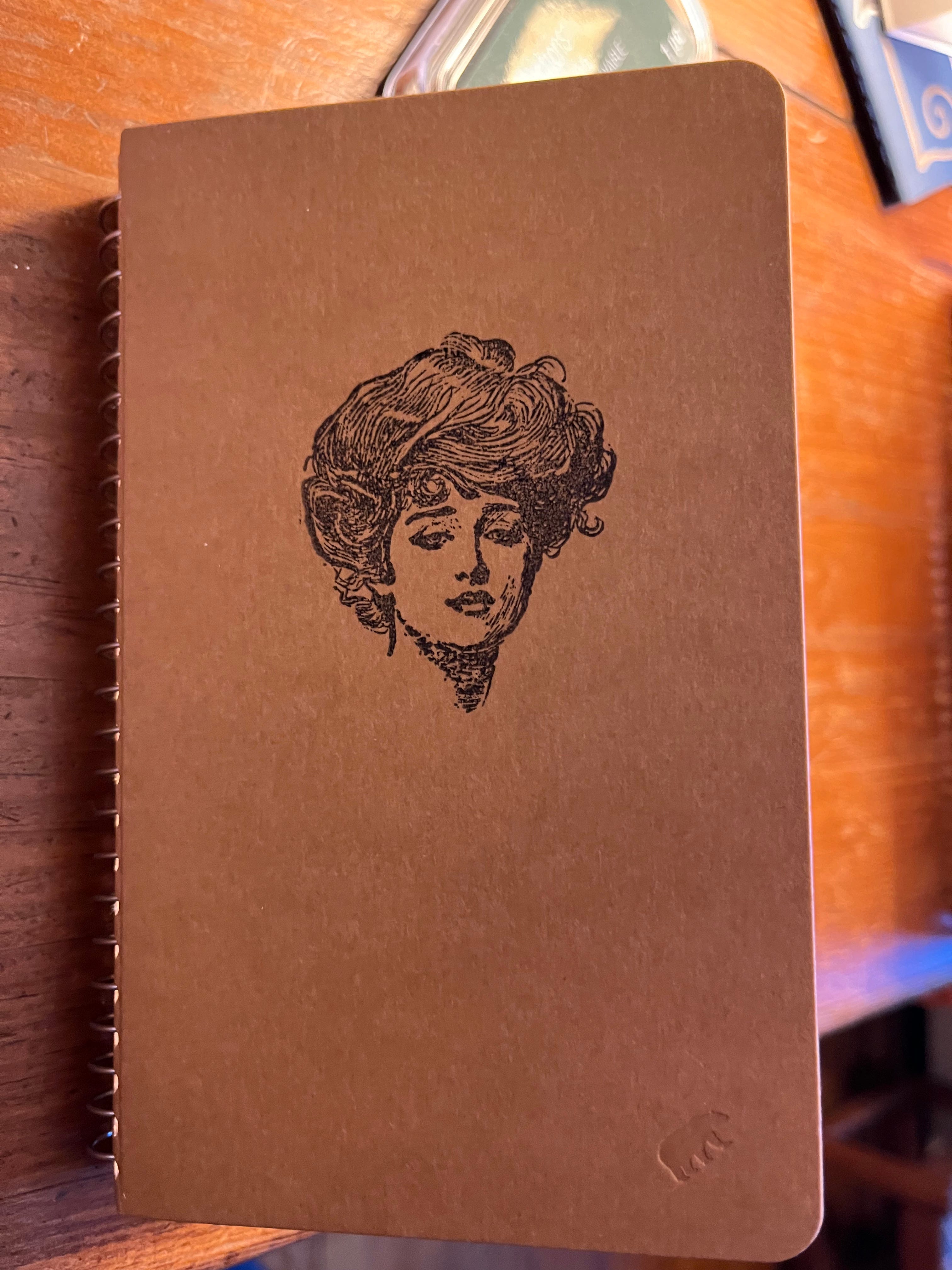
Latest sketchbook, this from the PS 1 MoMA gift shop; Gibson Girl stamp added by LO’H, courtesy Casey’s Rubber Stamp Shop, 11th Street, East Village, NYC

Here’s to uncertainty and unforeseeable change as our new normal, that was ever normal and never new. Will work on getting funny again. I so want to cheer you. In the meantime, don’t die.

Love,

Miss O’

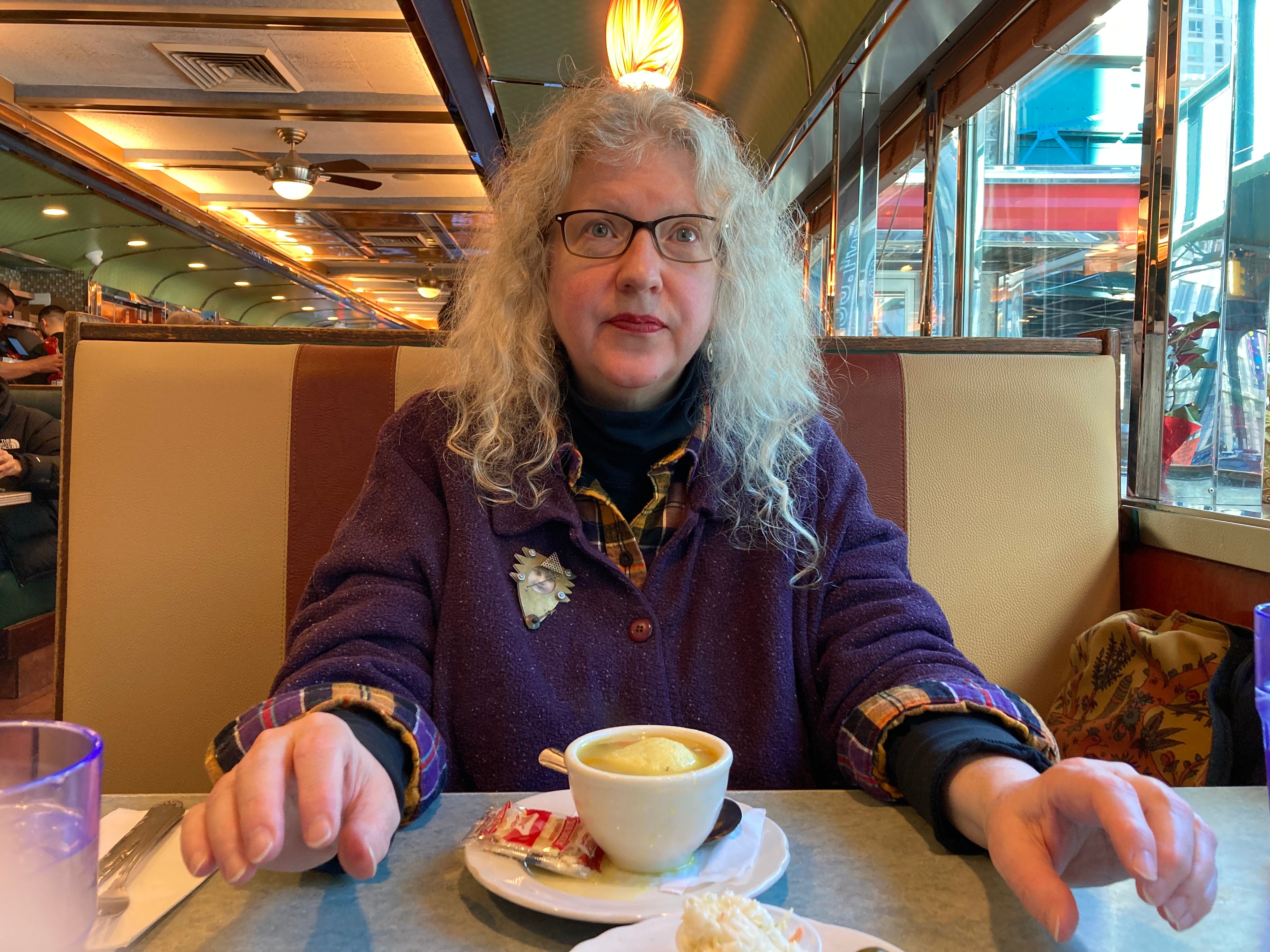
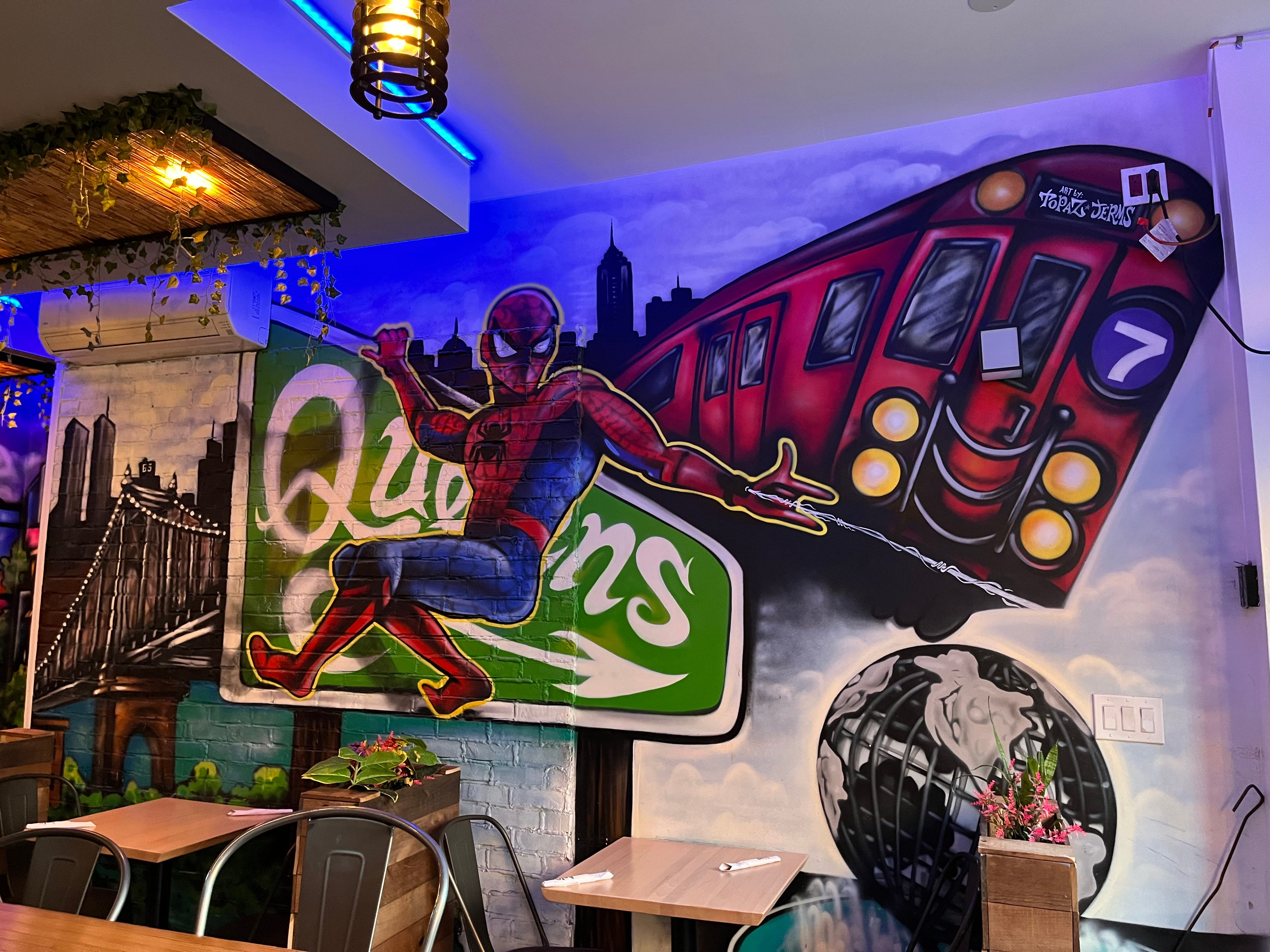
In the meantime, there matzoh ball soup. Photo by Lisa DiPetto, Court Square Diner, Queens.

Spreading Salt

On snow, ways we remember, and my mom’s cooking

Making Lasagna

I was sitting here thinking of my mom, Lynne, a couple of years back, before she fell and started a slow downhill slide, which continues, tough old bird of 90 that she now is.

I think this was a year ago, we were out in the playroom, an addition to our small but sturdy house that was put on when I was in fourth grade. To access it you have to walk through the utility room from the little alcove by the kitchen. The kitchen ever was and remains comically small and impractical by HGTV standards. I watched my now 80-lb. mother determinedly making her famous lasagna in an oddly small Pyrex rectangular dish, with the intention of feeding a family of seven adults and a toddler. I don’t know if the bigger dish had broken or what; but she spent all morning at it before my brother Mike, his wife, and the newest grandchild, and our other out-of-state brother Pat arrived to visit from North Carolina and Florida for a weekend. Mom had sent my dad to the store for lasagna noodles, cheeses; they boiled and drained the noodles, cooked al dente; she painstakingly opened the various packages of cheeses, using a knife, so slowly; she had her signature tomato sauce on the stove to warm up from the freezer. The slowness of her movements just hurt to watch. I think I was the only on watching. See, no one asked for this lasagna, one of her handful of truly great dishes, but you could see she felt she should make it, perhaps for one last time, who knows, age being what it is, for her family. She didn’t look happy about it, but neither did she want my help.

When they all arrived, my mother was still putting the lasagna together. As I say, this seemed to go on for hours. She was missing the action, you know, the way mothers do, alone in kitchens. Finally, I went in and tried to get her to come out to the playroom to be with all of us, with the son and grandson and her other son, and me and Jeff, there to see her. At some point, she and my dad decided to put the lasagna in the oven, even though it was too early to eat, even for an early dinner.

The upshot is, it way overbaked, shriveled into a barely edible shadow of its former self; and it seemed to be a couple of layers lower than usual, as it was, as if she’d forgotten something. We ate it; I remember my mother’s face, her shoulders shrunk, all that work, the end without the joy and plumpness of abundance. And for some reason, just now, it came back to me, that moment, and I fell to weeping. Now I have to think about why.

Well Butters

I’ve written about this before, my invented term for people who cannot accept a story that you tell on your terms. They have to correct you. Sometimes they are correcting a story they were never part of in the first place, which is a trait my mom has. Sometimes they correct your memory of time in a certain geography, because they share that geography and don’t have the memory you do, or experience a place or event in a way different from you.

My mom, Lynne, for example, is a story corrector, a well-butter. I was telling her once about visiting a retired teacher-scientist friend who’d built a cabin in the woods on her family’s farm. Her kids were grown and gone, her husband ran the farm as usual, and she lived alone with her dog in the cabin, which she did for a year. She kept a journal, spent her days studying the ecosystem, reading Thoreau and Edward Abbey, doing experiments, and simply living. When I returned from my first visit, my mom wanted to know how she bathed. “Oh, she doesn’t. She might go for two weeks not washing at all,” and my mom admonished, “Well, but that’s a lie. Now, Lisa, don’t say things like that. Of course she bathes!” Mom left the room, a well-butter: “Well, but that’s a lie…,” and I turned to my brother Jeff: “No it’s not.” I know, he said.

Now, do I contradict my mother? No, I do not. I think about it, I reflect on it. I try to understand it. Because I’m insane, and a writer.

To take another example: if I say to a New Yorker friend, “I love New York! I love the energy, the art, the theater, the people watching,” that friend may quickly interrupt to say, “Well, but Lisa, the city is filthy, people are homeless, some can barely make rent, and who has money to see shows?” It’s Yes And. It’s both. This doesn’t have to be an argument.

And so, I do not argue with this well-butter. I say, “So where do you want to eat?”

Sometimes it’s just about differences in lived experience. The other day, I said to my friend Colleen, who has been a constant resident of two NYC boroughs since the late 1970s, that I missed snow, lost now to global warming. She looked puzzled, saying, “Well, but it’s not like New York was ever a snow city,” and I disagreed. “My whole memory of living here is that from December to April there’s snowpack,” I said, and Colleen looked at me like I had two heads. I didn’t argue, but instead asked, “Would you like some tea?”

The Snows of Memory

Now, why are our memories of snow in New York City so different, Colleen’s and mine? I’ve been reflecting, because I am insane, because I am a writer.

For one, I lived my first 39 years in Virginia, where there is maybe one big snow storm every few years, a little ice once in a while (I was a student and a teacher and lived for snow days in both iterations of my life, and we didn’t get to use that many), so that might account for some of the difference—that by comparison, any regularity of snow seems like “a lot.”

But I think another reason is more practical: Colleen has only ever rented her apartments, and so there is staff to shovel and salt (which is not to say reliably), and New York City is mad efficient at this in most places, especially Manhattan (it blew my mind when I first experienced it, how most everything still runs no matter what). By contrast, my tiny Queens co-op apartment building (since I bought in 2005) has never had a super who could be relied on to shovel snow, so (to avoid a citation) I and my upstairs neighbor Debbie used our own shovels and did it ourselves. As a board member, I ordered 12 bags of salt a year, for a solid 8 years, and we used nearly all of it every year, and I know this because I spread the salt myself. (By comparison, one or two bags of salt have held for the last three winters.)

In addition, I have muscle memory, walking the half mile to the subway every morning for 16 winters (before Covid), navigating the corner of 40th Street and 47th Avenue with great care because that building’s landlord never shoveled; and I constantly had my boots repaired at Drago Shoe Repair in Penn Station because of salt damage and puddle leaks. I felt every inch of the winters, and I also loved it, because I love winter. I am crazy about cold temperatures, battling the subzero winds, and I find snowfall a reason for rejoicing, at least when I’m not battling depression (always not wanting people to die). Colleen, by contrast, finds winter a misery, hates snow, hates cold, lives for summer heat; and I would suggest that a healthy mind like hers might slip into denial of weather you hate while you wait for the green splendors of summer. And because, in addition to all of the above, I can say with certainty that our last major snowstorm of any duration took place in 2016, and that was 8 years ago, I can also say with confidence that I am not crazy to say, I miss snow.

Back to Lasagna

So why was it so painful to remember my mom’s failed lasagna one winter ago? It’s one meal. No one else who was there may remember it at all, including the hunched shoulders, the strain of it, the sad face, all that work only to end up overcooked out of confusion, a change in routine. Like you, I’m sure, I’m starting to see her lasagna as a metaphor for a life lived, a life ending.

I have almost continuous memories of my mom making lasagna, or feel I do, because I loved it and enjoyed it so much—all the leftover noodles, the extra cheese I ate with them. But in truth, it was a dish she couldn’t have made above two or three times a year. For one, it was labor intensive, and there were four kids at home, she babysat neighbor kids, and by the time I was 15 she was back working full time (as a bookstore manager); next, it was expensive (with all her specific cheeses and special sauce—a secret), growing in size from a square Pyrex pan to a large rectangular one; and because we all loved it, there was almost none left over, and leftovers were always the Saturday night meal. So in actuality, in my 18 years under that roof, I had at most 40 large servings of lasagna. Is that enough? Never.

When I was home at Christmas, working from there for one week and on vacation for two, my mom spent a lot of time going through her recipe folder. She made her perfect macaroni and cheese for me—another agonizing effort, but she was determined. She showed me where all the important recipes were. (She also showed me where all the important sentimental things were in her dresser.) These things have to be done if we are to keep any family traditions going; I’m the only one who is interested, really, but that is only because I am the one preparing for the end. In time, my younger brothers will care, too. For now, I’m the keeper of the recipes.

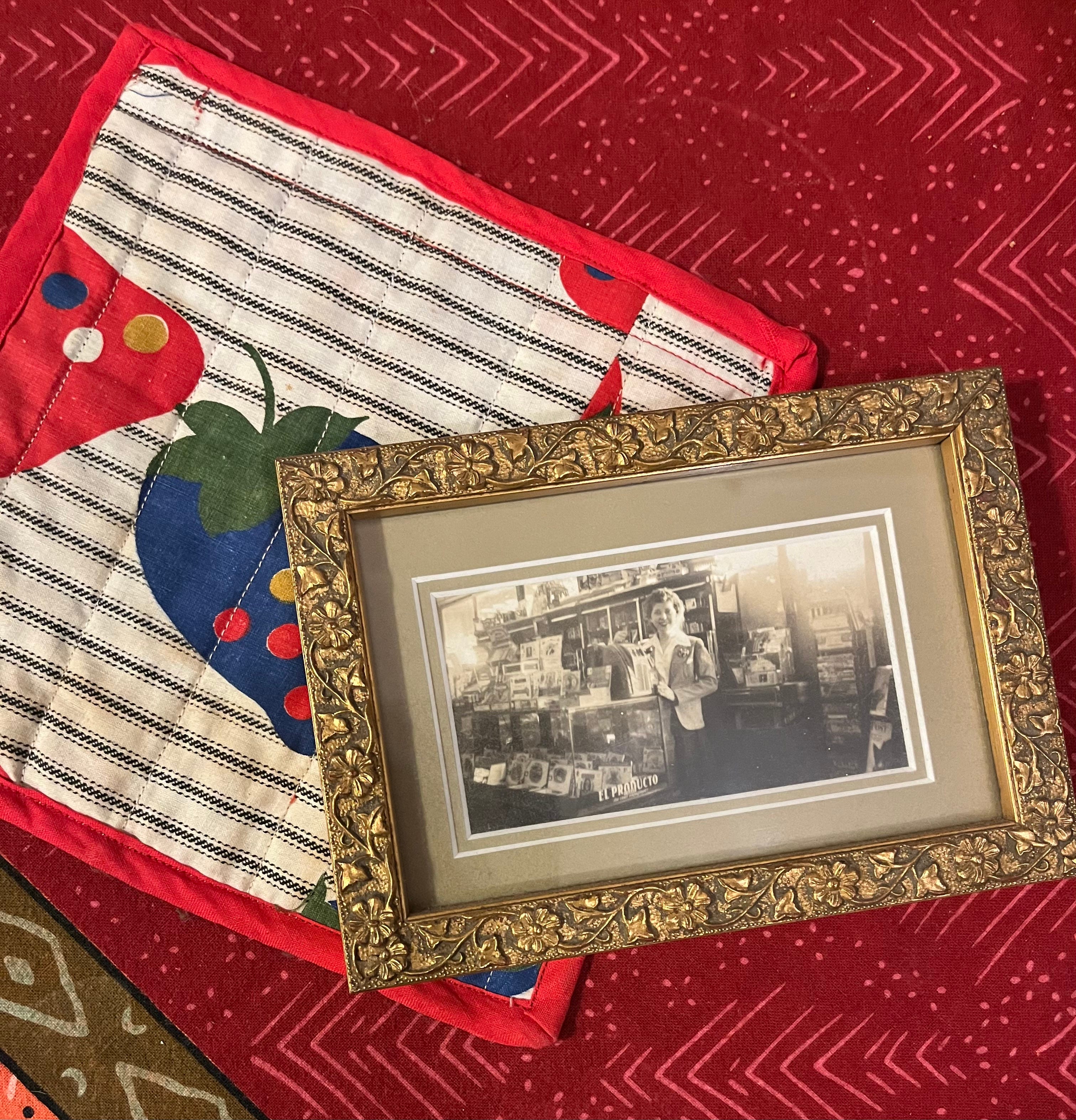
No one’s memory is perfect—I’d never pretend it was. But there is a decline that is sad and scary to see: one more was my mom holding a worn, torn potholder she wouldn’t let me throw out, saying, “My mother made this.” I looked at my brother Jeff. Idiotically, I said, “No, Mom, she didn’t make that one; I have the ones she made at my house.” She stared at the generic blue potholder again. “No,” she insisted, “my mother made this.” And she gripped it so tight it brought tears to my eyes, but only later when I recalled it, because I realized, My mom needed to touch her mom again, even if she’s spent most of her life saying she hated her; they are so close to meeting again, you see; amends need to be made, memories held.

Still life with potholder and my grandma, ca. 1945. Photo by LO’H

What am I on about? Life ends in old age if we are lucky. See it for what it is. We remember what we need to remember, okay? And we can tell our own stories, thanks, and we don’t need anyone correcting us. Watch, listen. And just say, “Oh.”

Love,

Miss O’

Transformation Diaries, Winter in New York City

January 2024

§  My mom, Lynne, is 90 years old today. Last night I forced myself to get out of the house on a damp, raw New York City evening and head to the theater to see Purlie Victorious before it closes, showing up at the Box Office at 5:45 PM or so to see if they had “anything for tonight,” and I indeed got a center orchestra seat. Magic. This morning I am thinking about transformation: how actors transform into characters; how young people transform into old people; how oppressed Black people transform into autonomous Black people; how racist white people too often never transform. But more to the point, how my depressed soul transforms in the presence of great art. How does this happen? Why is undergoing as well as witnessing transformation so necessary to our humanity? And why do we resist transformation?

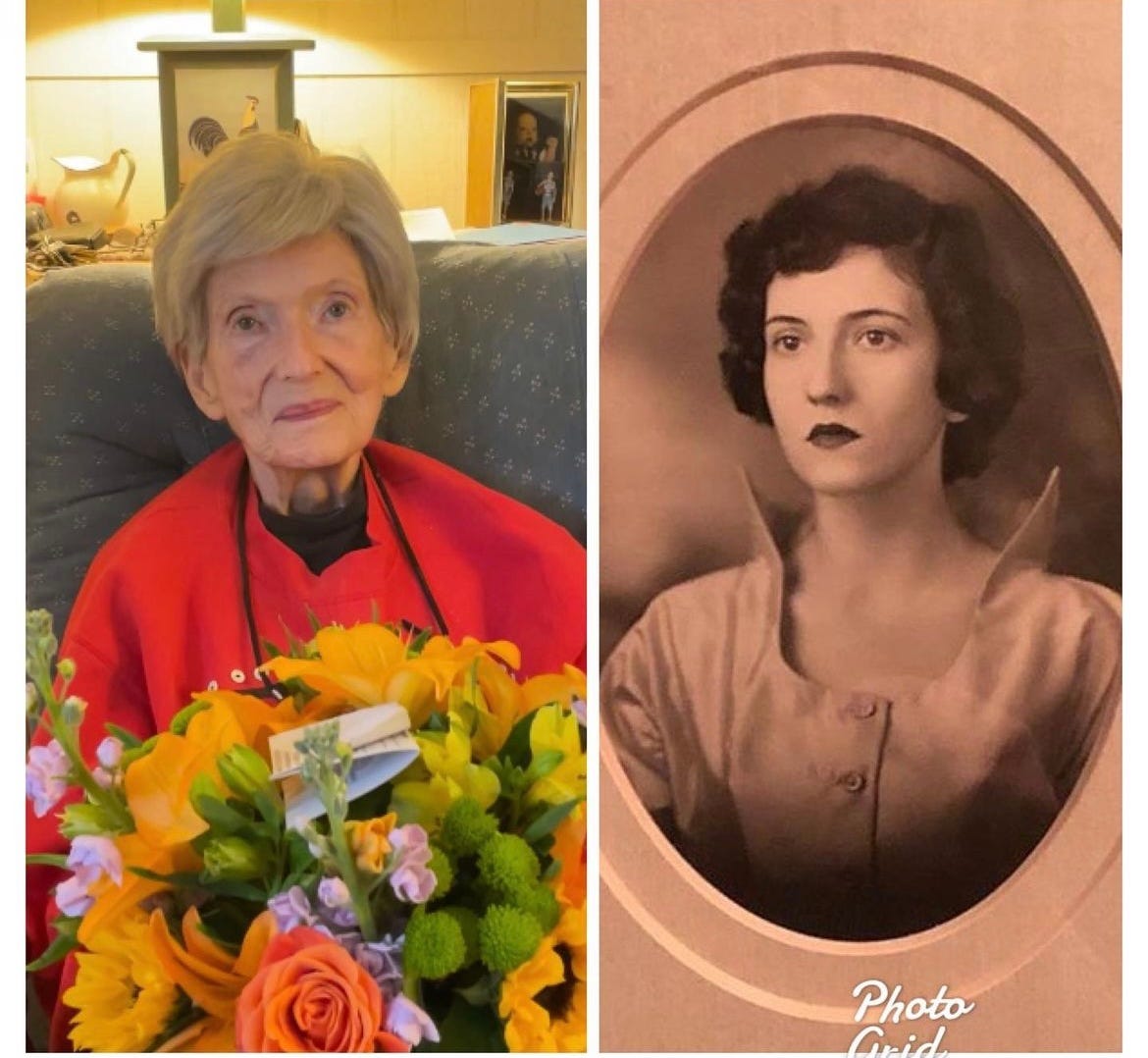
My mom, 2024 and 1952.
Perfection, the first Broadway revival of this play in 62 years.

§  Memories of transformation are often curious ones. When I was in 2nd grade, for example, Daphne O’Keefe brought in a Gallo wine jug melted over with rainbows of crayons. She was so proud of this show-and-tell object, explaining how she made it. She passed it round the class, and all I could think, confused, was, “What a waste of crayons.” Some transformations both small (see that wine jug) and large (see Tucker Carlson’s from “entitled Swanson Food trust-fund baby” turned “even richer Fox News personality” to “radicalized Russian-Putin ass kisser”) are lost on me. If transformations aren’t increasing your humanity or expanding your soul, what is the point? One woman’s wasted crayons may be another woman’s art (one man’s patriotism is another man’s treason?), and if the melting crayons make you happy, and you aren’t lying to yourself or hurting anyone in the process, melt way.

§  On my mind: Years ago, the now-famous comedian, podcaster, actor, and producer Tig Notaro was kind of doing okay as a mid-level comic, respected by her peers, booking enough gigs to make a living; one day she was diagnosed with Stage II breast cancer, and that evening she went on stage, “Hi, I have cancer…,” and her whole career changed. Soon after the diagnosis, her mother fell, hit her head, and died. Between a middling career, a double mastectomy, and burying her beloved mother, you’d think, “How did she keep going?” But it was the beginning of a transformational phase in Notaro’s life, one in which she became widely known and successful, met her wife, had a family, and is happier than she has ever been. Go know.

(Note: image found on the web..-ed.)

§  Scaffolding: It’s everywhere in New York City. You can’t walk a block or a street without walking under some at least once; I used to jokingly ask my friend, Richard, back when I visited the city, “When will it be done?” I return and return to this image of crumbling, but also of trying to repair—it takes such an absurdly long time; I want to walk around the city with a bull horn, “TRANSFORM ALREADY! BE DONE!” New York City’s Times Square was once glamorous and exciting, and then it became derelict and dirty, and then Disney moved in and transformed it into a theme park for tourists that makes me want to stab myself in the arm every time I walk through it, just to feel something more elevated than pissed off. Then I look around at the endless scaffolding in these high traffic areas, and “pissed off” is about all I will manage for a long time to come.

February, 2024

§  Since mid-January, my left eye has been arcing light, flashing, and also numb; in fact that quadrant of my head and face is sorta numb, too. I went to a neuro ophthalmologist today (after my regular ophthalmologist and primary care docs were stumped, and thank goodness a colleague had one, and that I talk about my life to other people who then often have suggestions, because appointments with specialists like that can take a year to get). This special eye-brain doctor (and I can’t believe how easily I spell “ophthalmologist” now) can determine for sure that your eye is in fact numb by sticking a sort of blunt pin in it and you not knowing she did that. She said, “I don’t like that.” She is, as promised by my colleague, a total doll, and has a very busy but well-run clinic; we scheduled the MRI (it’s in a month, the earliest appointment (which can take many months to get sometimes) and bloodwork, and follow up. “I don’t like that your eye is numb and that you have headaches,” she said, and then she looked into my face, “but we will solve it.” My life is either about to transform completely (my maternal grandmother died of a brain tumor at 60; I’m 60 in May), or just be inconvenienced. But it’s scary. I still haven’t told my family (older half-brother and sister caring for their mom with Alzheimer’s; my brother Jeff looking after 90-year-old parents; my brother Pat just lost his father-in-law), except for my youngest brother who also has eye issues, just in case I collapse or something so at least one person knows what’s going on. (I think six people read my blog, and none of them family.) My upstairs neighbor also knows, a few friends, and one colleague, so I’m covered. Will tell all.

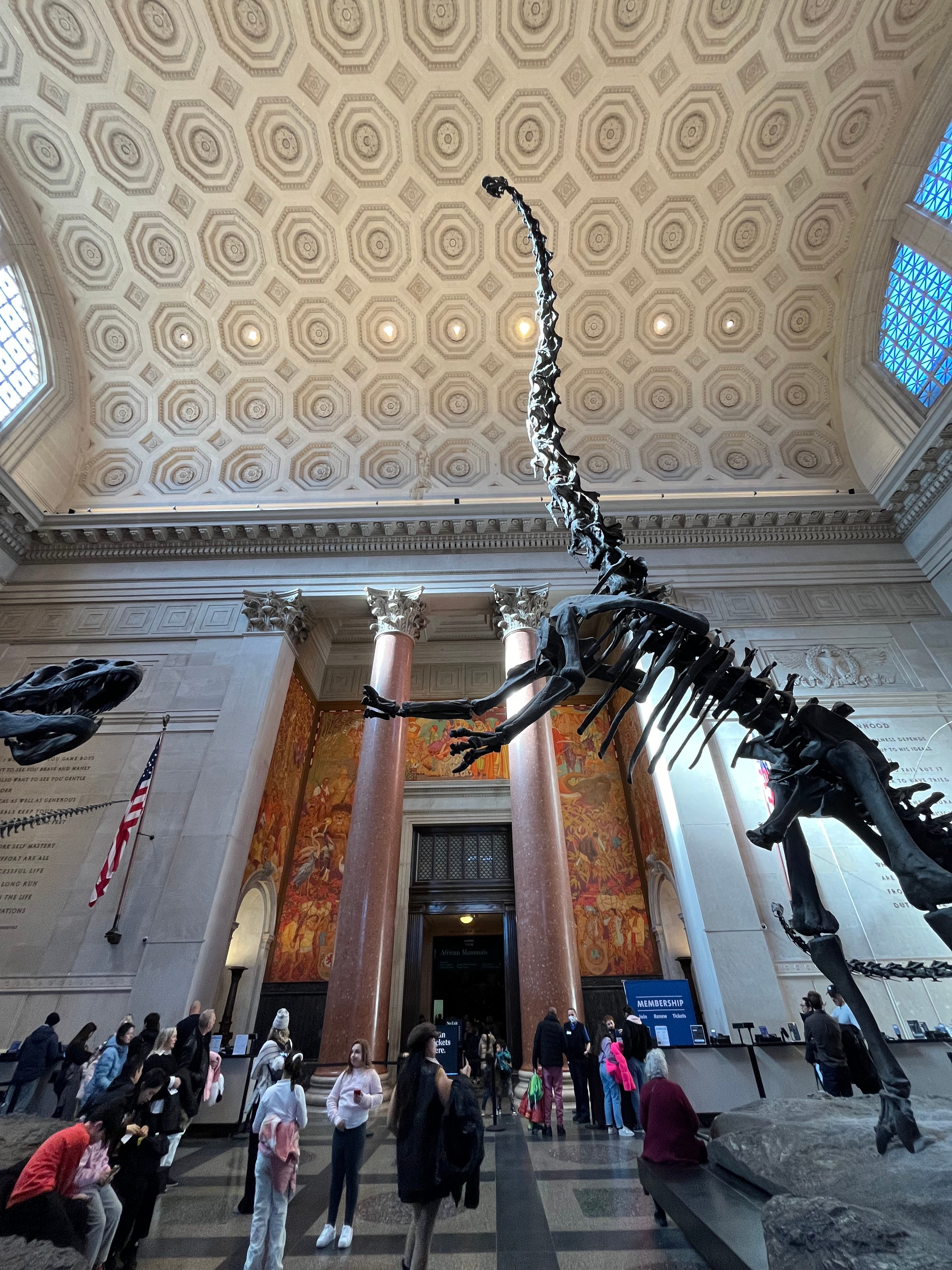
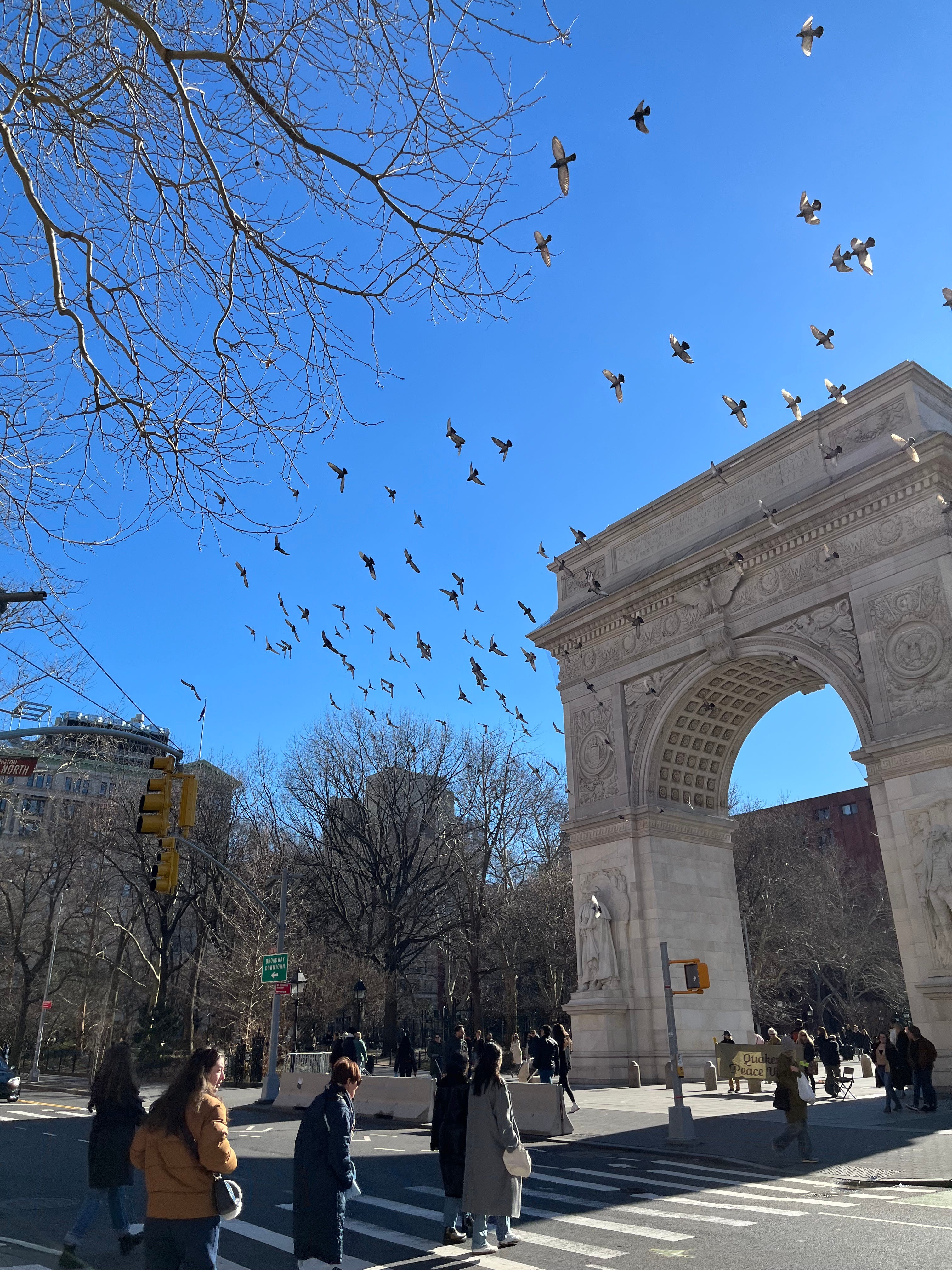
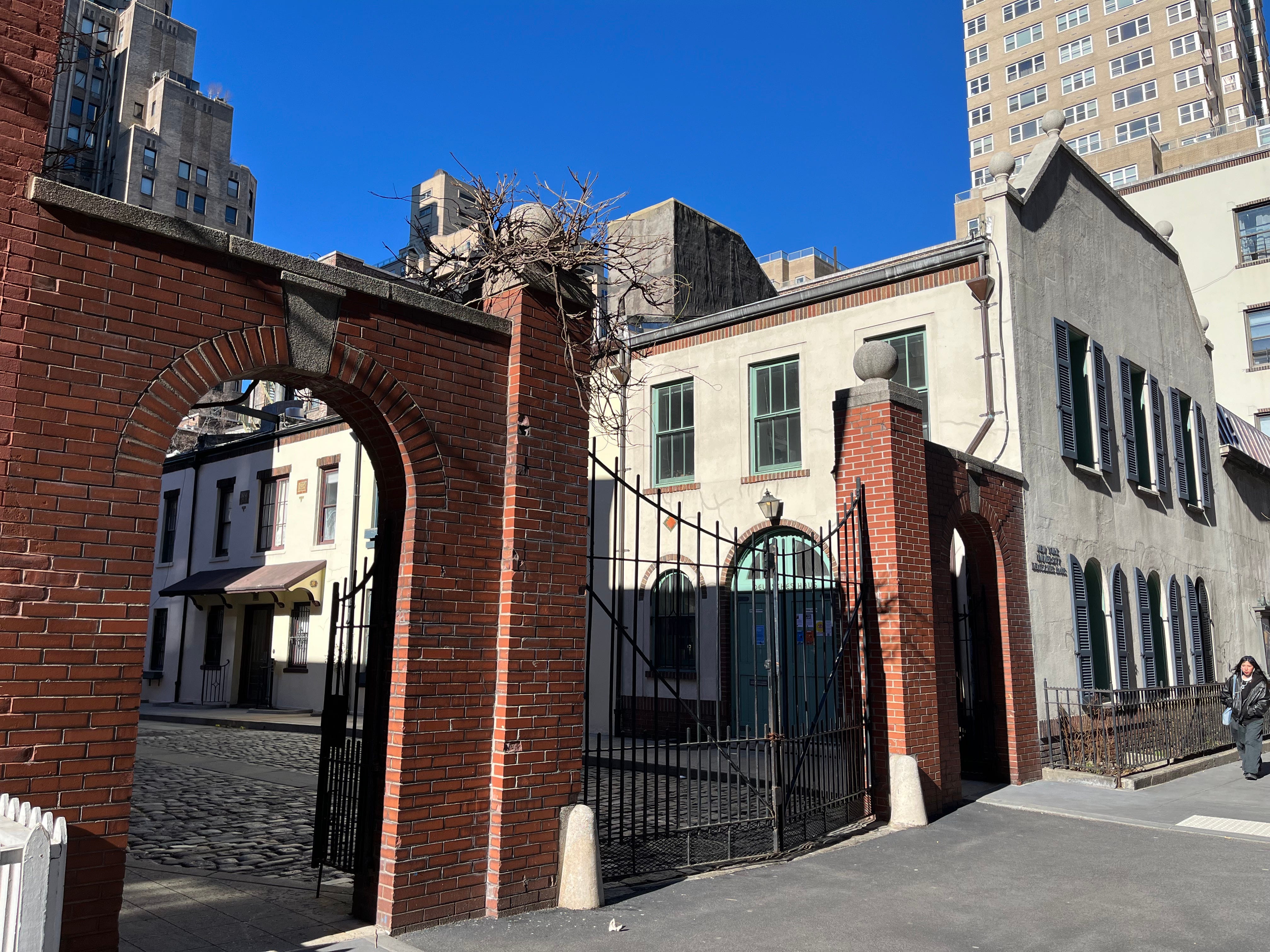
§  Sunday in New York, with photos: Grand Bazaar Flea Market (art purchase), American Museum of Natural History, Washington Square Park (with birds), Washington Square Mews (my favorite spot in New York, maybe), past Cooper Union, with lunch at Little Poland while you wait for the Rubber Stamp Store to open on East 11th St, near St. Mark’s Church, where you talk to Jimmy the owner, who has made all his own stamps since he became interested in coins in Ireland some 70 years ago, followed by a return to Queens and a binge of cocktails at Belo with the Cordero brothers Spencer, bartender, and Jonathan, owner. And all this, all this connection, is why we are alive, right? Republican motherfuckers be damned: we are here to transform each other and ourselves in creative, joyful ways. What else is the fucking point?

I love meeting new artists. Akasa was a doll.
AMNH is always cool.
Quite a show by pigeons.
The Mews make me calm.
Casey’s Rubber Stamp Store, E. 11th Street, NYC
The possibilities.
Belo, a fabulous Brazilian-American restaurant in Sunnyside, Queens. (All photos by LO’H)

§  My Aunt Lorraine died on Valentine’s Day. She was 98, my dad’s oldest sister, the second oldest in a complicated family. Lorraine was my Grandma Fern’s daughter from her first marriage; Fern married Frank O’Hara, a widower with four sons, two daughters dead in infancy, and his wife dead in childbirth with the second daughter. (Fern and Frank only married because she was three months pregnant with what would be the first of five children, my Uncle Don.) When Lorraine died, various siblings and cousins speculated on the order of the kids, so I clarified: Chet, Lorraine, Bob (note: Chet and Bob were sent to an orphanage after their mom died; then returned when Fern (not that much older than Chet) became their stepmother), the twins Alfred and Alvin (who were adopted by Frank’s childless sister Emily and her husband Walter Smith), Don, Nadine, Bernie (my dad), Mary, and Francis, Jr. Of the ten children in all (not counting Grandpa’s baby girls), then, my dad is the last survivor. (For reference, they were all alive but Bob when Obama was elected president in 2008; I remember this because I called Uncle Chet on his birthday just after the election, and I told him I was happy about the outcome. “So that’s the way you went, huh?” he asked. I did. “Well, I did too,” he said. “Now I loved Hillary, loved her,” and he had even driven her around Omaha when she came to campaign. And I expressed my condolences about Uncle Bob. If anyone tries to tell you that American families should be “traditional,” you just point them to Frank and Fern in Council Bluffs, Iowa, ca. 1930. Oh, and Lorraine and Chet were best friends all his life (he died over ten years ago), and no relation to one another at all; my dad was a half-brother to each. Got that?) Families are living, breathing, ever-changing, and eventually dying, ecosystems, transforming all the time. Or they are if they are healthy, even if they sometimes put the “fun” in “dysfunction.”

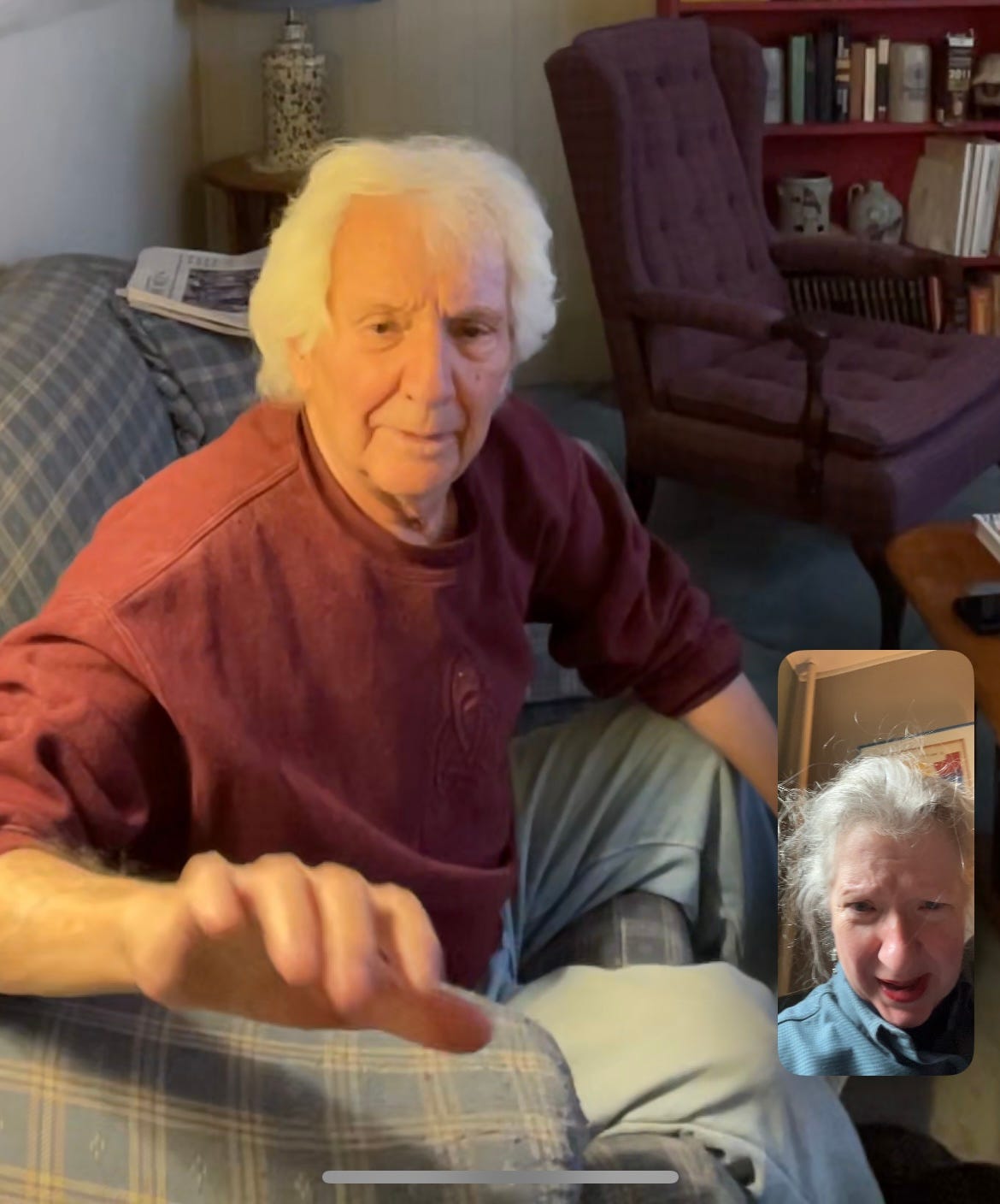
Over the phone this past week, I asked my dad, who turned 90 last October, for his memories of Lorraine, and he told me what he remembered. “When I was little,” he said, “Lorraine used to take me to over to Broadway [in Council Bluffs], when we lived on Avenue E, at Christmastime, when Santa came down. He always threw candy, and she’d help me, we’d run around and gather up all the candy we could. I think about that memory a lot, I don’t know why.” Here he laughed. “And it’s funny, because Santa was in a pick-up truck or something, and he threw hard candy, really threw it, and you wonder how nobody got hurt.”

Another memory: “I told you that story, about the time Dad [my Grandpa O’Hara], he worked on the railroad, you know, and they had a wine car there that was leaking, and all the men were catching that wine and drinking it all day. Dad came home smashed, yelling that he was gonna do this, gonna do that. And Lorraine—she was working at the bomber plant at the time, and muscular—she laid him out on his back in nothin’ flat and said, ‘You aren’t doin’ nothin’,’ and we all just cracked up.” And Lorraine’s first child, Patty (one of ten, two deceased), and my dad’s first niece (or nephew for that matter—is their a general term for that?), just celebrated her 77th birthday; my dad was 13, and he remembers coming home from school one day and seeing Lorraine holding her in her arms.

My cousin Kerry (Don’s older daughter) and I (Bernie’s younger daughter), I think, are the only ones who know who everyone is and the order they come in, from aunts and uncles to cousins; maybe my cousin Liz (Mary’s oldest daughter) knows. Lorraine’s daughter, Rita (one of twins, children 6 & 7 in the lineup), who called last week to tell me that her mom was in hospice care, confessed that she had no idea who any of my siblings were. (“How do you know everyone?” she asked. Because every Christmas the relatives put school pictures, labeled on the back, in the cards; and I memorized them, because I thought I was supposed to.) Rita and I became friends the year I went out for our Aunt Mary’s funeral (2012, I think), and her twin sister Ruthie had coincidentally just moved to the street where my Uncle Denny, my mom’s cousin (with whom I was staying), lived (are you following?), so Rita started giving me rides after gatherings, dropping off first me and then Ruthie. (Ruthie, by the way, has moved back to Kansas City to be near her kids; I have a nephew living there, but since no one would know him because they don’t know my half-sister, Sherry, why mention it?) Sending love to all of Aunt Lorraine’s loved ones in our ever-transfiguring families.

FaceTime with Bernie

§  Surprised by snow. Brown desolation to cheering plush white happens less and less frequently here in New York, and what does fall melts right away, so I went on walkabout and took photos. I was surprised how many folks were out doing just that on that chilly Saturday. I love when spring makes you beg for it.

Miss O’ in Queens

§  Sunday morning, bright blue and sunny, but chilly as winter should be. Time to head to the city, I think, to City Papery and buy some blank card stock, maybe spend the rest of President’s Weekend making some original cards for people using those rubber stamps up there for inspiration. First, I’ll post this blog. Love, Miss O’

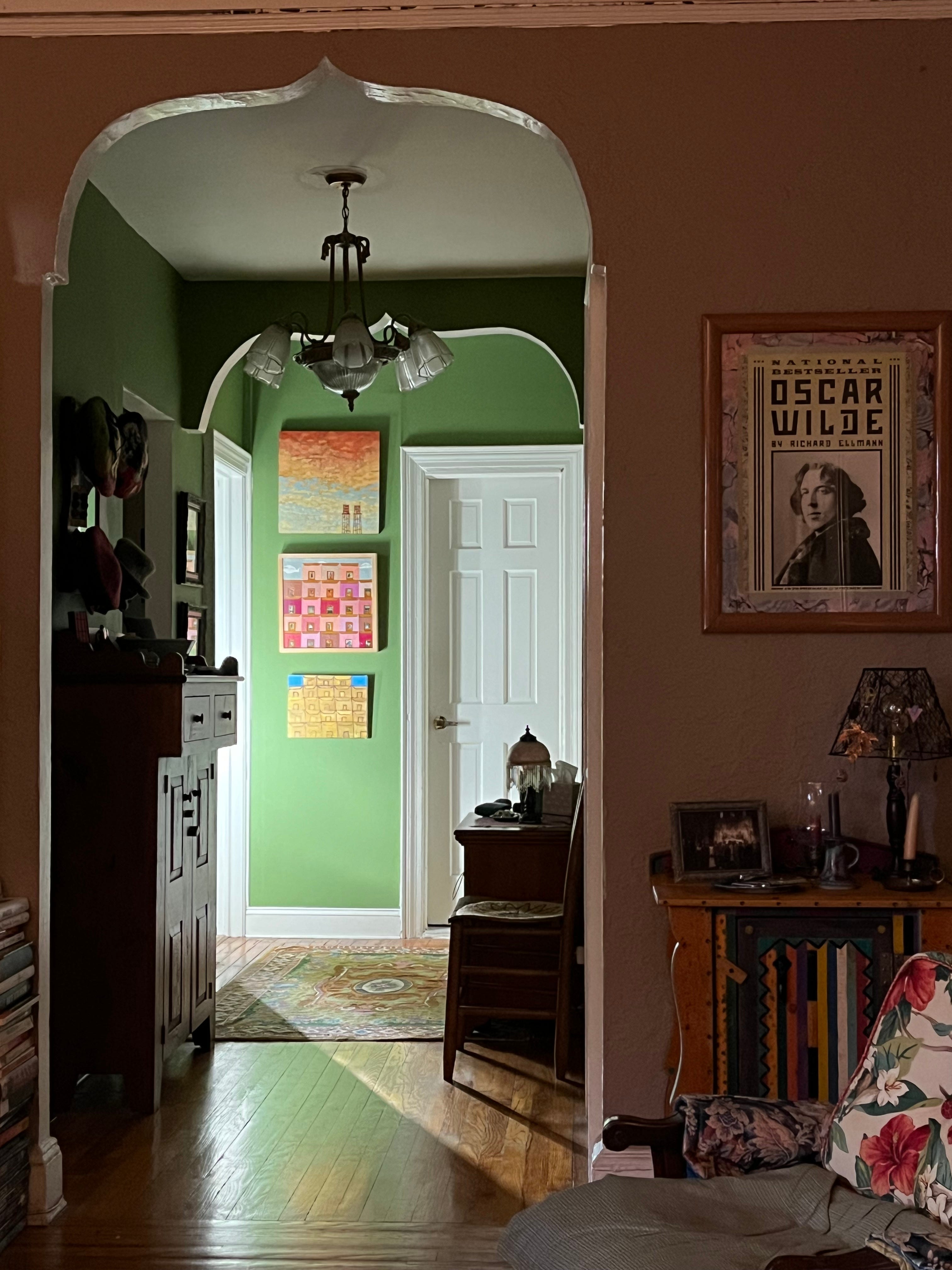
Miss O’s hallway, transformed each morning, when it’s sunny, by that shaft of light.
Color me grateful.

Vamp Until Ready

Playing for Time

Covering a Change

Back when I was a drama director, my school’s orchestra teacher, Mr. T, had to fill in as the conductor of the orchestra for The Music Man when not one band director but two had to bow out (one for a family tragedy, the other because he’d been asked to be an interim principal at another high school). Mr. T, who had strenuously avoided conducting kids in a pit, was a terrific conductor and teacher, but knew nothing about musical theater. One day in the library, where he’d tracked me down, he asked me about a bunch of music on the sheet. Those marks (Greek to me) turned out to be the opening of “Wells Fargo Wagon,” and just as Mr. T knew nothing about putting on a show, I knew nothing about reading music.

He asked, “You don’t need all this music, do you?”

Oh, yes, we do.

“Why? It’s a lot of music.”

Because all this intro music is covering a set change.

“Covering?”

Right—the orchestra plays while we do all this work behind the curtain, or on a darkened stage, and when the lights come up, the music stops. In fact (I explained to the perplexed Mr. T) we will probably need more than that, so you will need to pick a spot you can back up to and play it again. It’s called, Vamp until ready. (And here I sang a little, “Bum, bum, bum, bum” [key change] “bum bum bum bum…” and then, “Now the lights come up and Marion enters…and music fades….”)

To his credit, Mr. T listened, learned, and got it. I was really happy to work with him, and he was in turn grateful to conduct the pit, though once was enough (it’s a 10-week after school time commitment for no pay), because he’d had no idea what went into it or how interesting it was to watch a show evolve in rehearsals to performance. And since pit orchestras are among the biggest employers of musicians, even a high school production of The Music Man is real world work experience for the kids.

I was thinking one morning this week about that expression, “vamp until ready,” which I learned in college as a theatre major under the direction of the late, great Maureen Shea. I used to watch her direct even on shows I had nothing to do with, only one of which was a musical during my four years. (Sometimes, you only need one strong experience to bank away knowledge for a lifetime.) I’ve noticed that “vamp until ready” applies to my corporate work life, and by extension to my life in general right now, but oddly enough, also to world leaders; the question is, How long can we keep this up?

“Figure It Out”

Among the looniest takeaways from all the years of public or private education for Americans in general over the past many decades is the notion that teachers had nothing to do with our learning. Instead, too many who go on to adulthood, especially those who become “leaders,” are under the delusion that they themselves figured out how to read, write, calculate, observe, and think irrespective of the educators they had over the years; indeed, some believe they learned in spite of them (and however much we may not like a teacher, we learn that, don’t we?). Ergo, when these former students go on to lead projects for, say, the government or a corporation, they begin by telling you, the workers, about a vision, the market, and the research, and to explain your titles and roles in the creation of this new initiative or project.

And when you ask, “What do you want me to do, or how can I best be of service?” their standard answer is, all too frequently, “Figure it out.”

Or, worse, “I’ll know it when I see it.”

I believe this is because they, the leaders, know we have to create something, but beyond a pillowy, sparkly dream, they more or less have no idea how to execute it. Or, by contrast, they know exactly what they want to do and give innumerable lectures in meetings trying to get your buy in. Talk, talk, talk, talk, talk until blue in the face. And after two decades in corporate life, where I moved from worker bee to senior whatever, the same thing holds true, whatever the leadership style: No one in leadership gives a tinker’s damn what anyone on my level “thinks.” Nothing we “do” or “make” will ever be what they want because they have zero curiosity about what we on the ground are going through. Life as Monty Python sketch. So, in order not to go mad and to keep your salary and benefits, you learn that the best thing to do is “look busy,” or as we say in show biz, vamp until ready.

And one day, suddenly, the curtain will open, the lights will come up, and the leader will shout, “I need everyone on stage NOW.” And with the wave of a wand, the leader will tell you what they want you to do. Only now, instead of 12 months to make the product, you have one. And you’d better not fuck it up.

Work Until Living

Everything on earth is in crisis—the climate, the untold effects of war and natural disaster, governments taken over by the right-wing march to fascism—and where once we had (we thought) plenty of lead time to solve everything, the time has been lost primarily due to lack of capable leadership, or because good leaders have been thwarted by others devoid of curiosity and compassion and belief in something true. I’m looking at free-press publishers as well as mayors and governors and representatives and presidents. Even good leaders can’t move forward when no one else is cooperating. How many times must we quote “The Second Coming”? The best lack all conviction, while the worst / Are filled with passionate intensity.

But being a lowly worker bee, I can’t lead the world to victory over the latest crises. As a result, I find myself stuck with my own life to figure out. That’s where most of us are.

Where is my leader, I wonder, the one who will announce to me what I’m supposed to do and how I’m supposed to do it and what the deadline is? A lot of us could use a purpose, not life and death, maybe, not with stakes beyond what we can handle and live in joy at the same time, but I mean some kind of purpose that makes the work of living each day something beyond mere survival. Many people have love in their lives, a mate or children, to give them that level of desire for living. Most of us, however, do not. And that’s when we look to art, I guess, whether or not we have talent or direction.

I think, in fact, the worlds of business and government (and even puny human life) would do well to take a cue from the world of musical theater.

At the first production meeting for an upcoming show, the director (in charge of the whole shebang) sits with the musical director, set designer, lighting designer, costume designer, choreographer, and stage manager (and if at all possible the original authors, but I was never that lucky director) around a big table, scripts in hand. First, a good director will share the vision she has for the production. A really good director will move forward by genuinely asking each of the players assembled what they think about the script and score, looking at their preliminary sketches and notes. Next, an even better director listens to each person in turn, not as a courtesy but because she really wants to know what they think. The stage manager takes notes. Perhaps they break for tea and donuts. And if a director is excellent, she will tell back to each of the players all the ideas they shared that she would really like to incorporate. Then she will give them an assignment, which is to take everything they’ve talked about today and make adjustments to their previous ideas; this includes the director. And so the work goes. Ultimately, the director decides on the production concept and must make sure that all the pieces of the production, including performances, are working in concert (the setting not modern when the costumes are 19th century, say). All this work evolves over the course of, say, ten weeks, leading to the technical rehearsal with the performers. The tickets are sold, the show must go on.

Unlike world leaders faced with the problem of war or global warming, or a CEO launching a new, useful product in corporate America, in theater a leader is not allowed to go into denial, sit around making speeches or ringing hands or having drinks with other theater folks before deciding to finally start rehearsals a week before opening night.

There is in the theater what Dr. King called “the fierce urgency of now.” (How is this not true for too many when it comes to war and the planet, when the stakes couldn’t be higher?)

In the months or weeks leading up to an opening night of a show, the work has to be ongoing and purposeful (the theater is booked), the collaborations real (the tickets are sold), the director clearly in charge of pulling it all together. That’s the deal. A show might succeed or flop, but no one is setting out to fail. And the work in any case will help everyone involved be better trained for the next one. And there will always be a next one.

The theater process is worth studying, I think, because while the stakes often feel like life and death, because artists care so deeply about success, the truth is no one dies. All we ever have against us, whatever our job, is time. In the theater, every show needs two more weeks. Because we don’t have it, we go on, we work, we do our best. We don’t give up.

Shouldn’t that be everywhere? With everyone?

More and more, I’m wondering if I’m feeling a crushing sense of my own life off the rails because all around me I sense the director left the building; I feel this enormous lack of sentience, wisdom, and leadership in the larger world. It’s hard to think of my little life having value or meaning when the highest of stakes, life and death issues, are being played for farce among, say, elected Republicans in our House of Representatives, where the instigators receive no rebuke in the headlines (while “the slap” gets unending coverage). How long can we keep up this vamp before the audience in fact dies?

Troubling Deaf Heaven

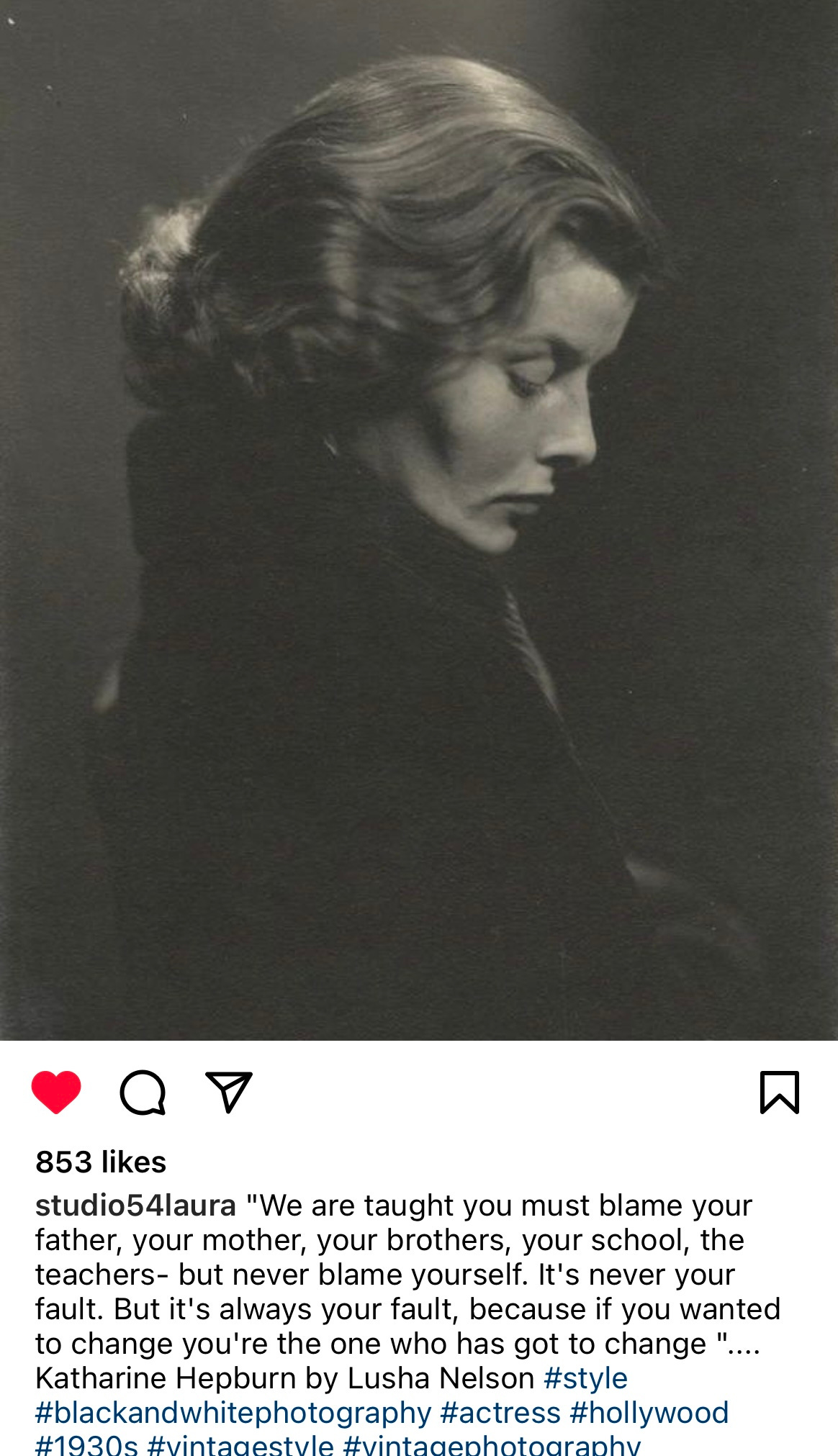
Yet in these thoughts myself almost despising,” haply I ran across this quote from my idol Katharine Hepburn via Instagram. She’s absolutely right—the only one who has to change in the above scenarios is I. Yet how, I wonder. And to what end?

Love or something like it, vamp 2-3-4,

Miss O’

Like Home There’s No Place

Ruminating on feelings of in between

Transition in Transit

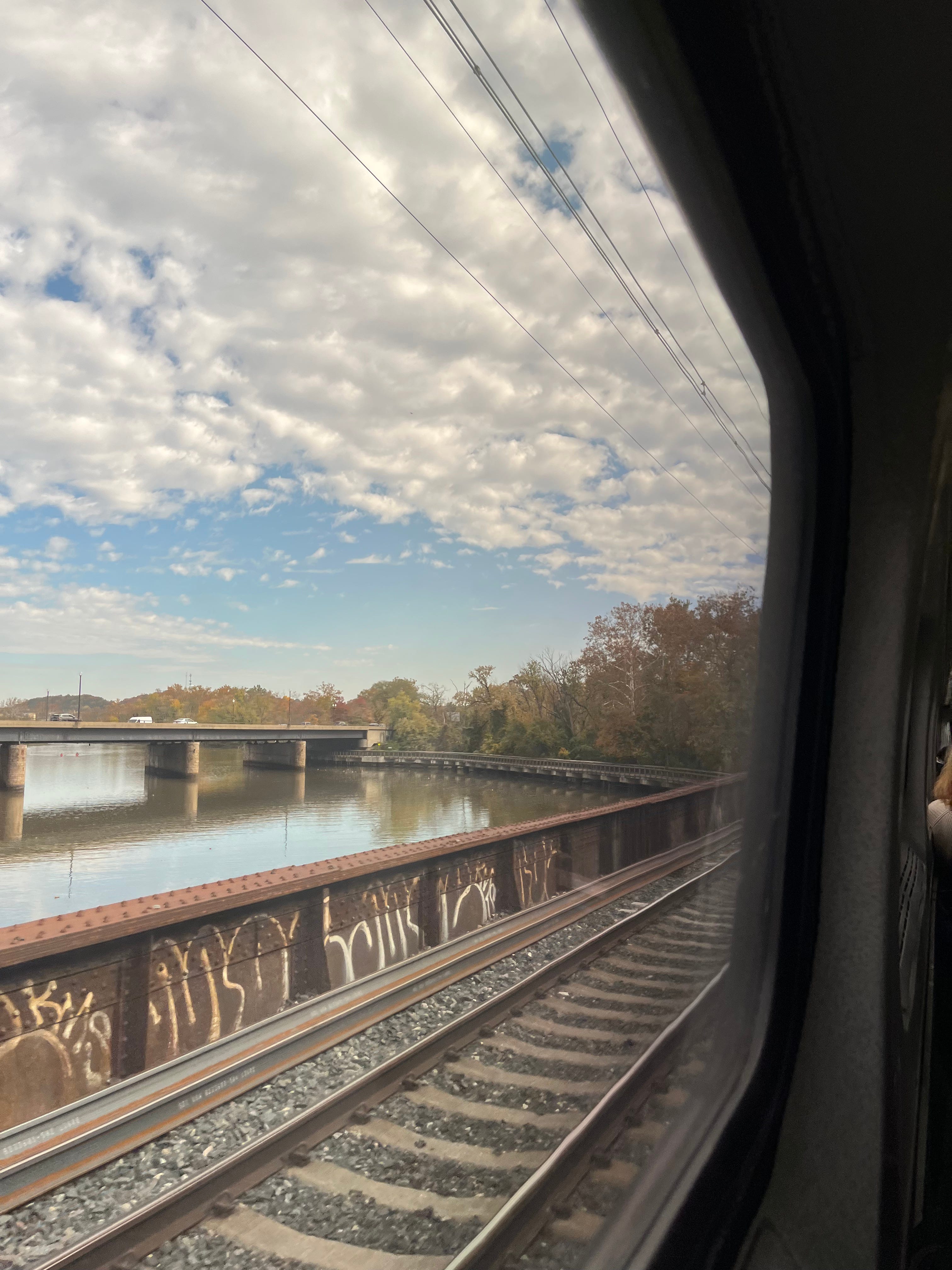
Somewhere in Maryland. Photo by LO’H.

Yesterday, I took Amtrak from Virginia to New York City, after two full months living in my parents’ house. (Bernie and Lynne are coming along, for however long they can.) Even though theirs is the house I grew up in, nearly all the aspects of it that made it home are gone or changed so significantly that it really feels like a different house. The 1960s offered a white house with green shutters, exposed asbestos tile floors on the half-basement level of the split foyer. During my growing up, when harvest gold industrial carpet took over the floors and steps and upstairs living room, so did the 1970s palette expand to bring in orange and avocado green and brown. In truth, my mom did this palette really tastefully and artfully, refinishing now tossed furniture pieces that I really miss, replaced in the late 1980s country makeover—suddenly a windfall of cash with no kids in college and two incomes allowed my mom to indulge her passion for blue and natural wood. The result is that I’ve known the present incarnation of their house only as a self-supported adult, so whatever there was of my home (my bedroom stuff pared down to a single large box back when I went to college), it’s no longer a built environment (objects of deep memory and family history notwithstanding) that I feel particular warmth for.

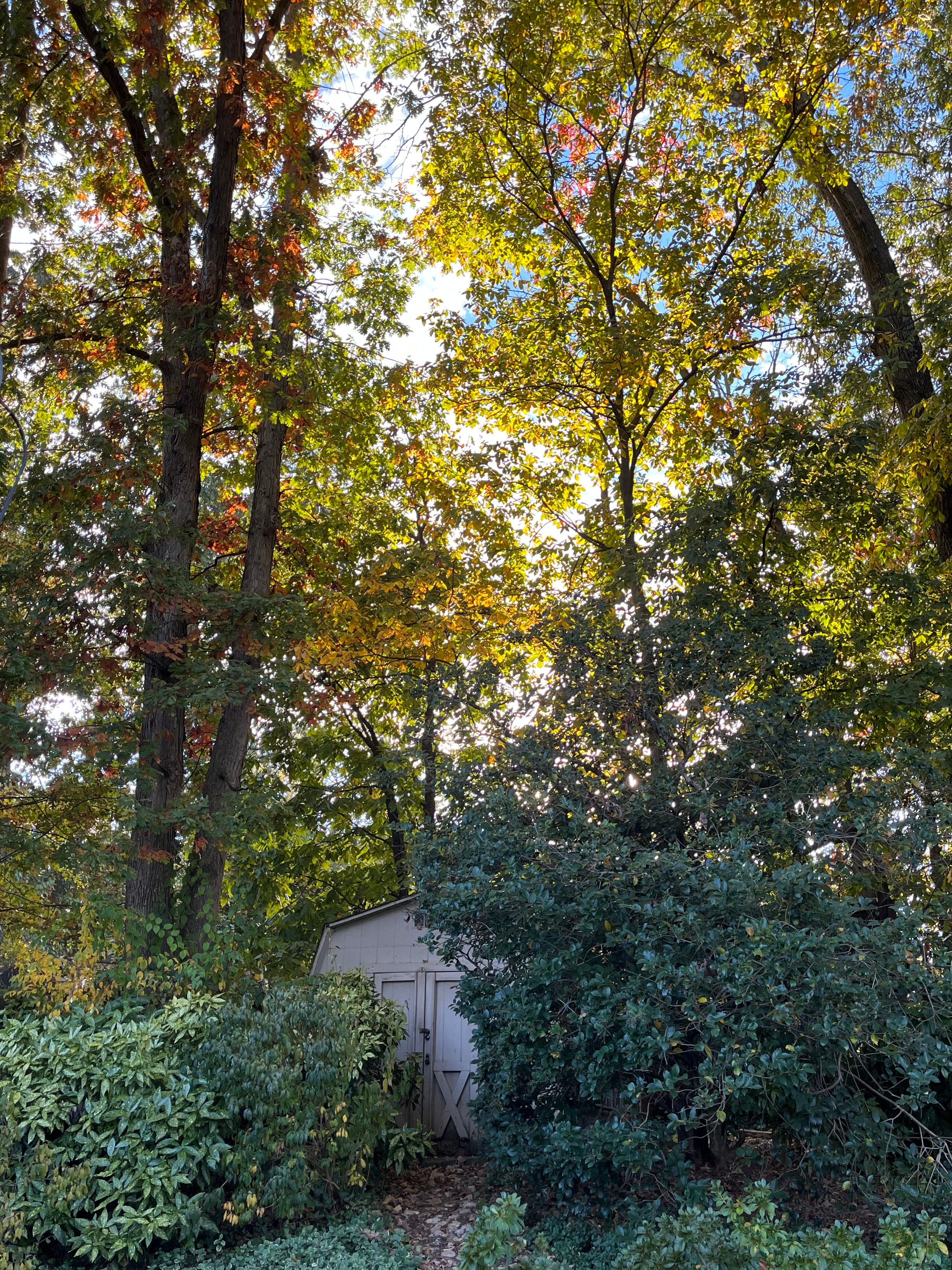
The curious thing is that my connection to the yard runs as deep as ever. The majority of my accessible childhood memories are tied up in grass, dirt, shrubs, trees; often, too, a swing set, a shed, a playhouse, a fort, though gone, appear as ghosts. I am always barefoot. The maple in the front yard has been my constant greeter for 59 years; the crepe myrtle, too. The oaks of various species in the backyard were there for decades before I was born, and the hickories have grown up with me. The holly trees, shrouded by the taller deciduous trees, have never gotten really large, but they are my age, at least. (I can still feel the prickly fallen leaves lodge in my heels.) It is to the yard that I want to go when I get home, to feel that I’m home.

Backyard. Photo by LO’H.

You Can Be Anyone You Want to Here

My Aunt Mary from Iowa said the above when she was standing on Canal Street, her first visit to New York, in 2004. I would add, “If you can make it here.” My home for the past 20 years has been a co-op apartment in a 90-year-old building in New York City’s borough of Queens. Coming off the train into Penn Station yesterday, wearing an air cast on my left leg (over my black travel slacks, to prevent a rash from the plastic—menopause has a been a blast, you guys) and a gray combat boot over my slacks on my right leg (for not one but two sprained ankles!), carrying a large sling bag, full backpack, and computer tote bag, not a single person gave a flying fuck. And that is the price you pay for all that freedom to be you doing you: supreme indifference to my personal human plight. I’m always agonizingly aware of my own complicity in this survival game as I pass homeless people without giving alms, in my rush, I think, which is really avoidance of culpability. For that reason, I don’t begrudge anyone racing past me up or down the dozen flights of stairs I had to take to find a working subway going in my direction (midtown was pure gridlock so any cab or Uber was pointless, unless I wanted to spend three hours getting back to Queens). All I know is that as I trudged past construction on 7th Avenue and 33rd Street that has literally been in progress for SEVEN FUCKING YEARS, with no end in sight; past orange cones and trash and and scaffolding and pilings and strollers and tourists walking past all the chain store banality that is 7th Avenue four abreast, down steps (foot-foot, foot-foot) where I have to inch past guys blissed out on weed; into the bowels of Times Square only to find out the 7 Train is not running; up the four flights of stairs (foot-foot, foot-foot) to the N Train (because the escalator up starts down by the 7 Train, and those stairs are blocked off and are being policed); and by now in the global warming October heat with the schlepping and the sore ankles and endless walking, shoved or ignored, and feeling by this point a little weepy, I really had to ask myself, seriously, “Why the fuck do I live here?”

And later, in my own bed, unable to sleep from ankle pain and the chill and recalling the stack of mail and all the unpacking and plugging in of laptops and texting people I’m back—I realized I really do hate living here. I have, as of November 1, been living in this apartment for 20 years. Of those two decades, only the first one was good. In 2013, my play lab ended, my work role changed to working essentially for a partner start-up, I had a miserable month of grand jury duty, and I met a man who gave me the deepest love and caused me more grief over the next decade than I want to speak about. And, post Covid, I have accomplished exactly zero as a creative person. As I now work exclusively “from home” (great for flexibility if not sociability), I see almost no one—a dinner here and there once or twice a month. My old building needs too much work. Global warming is creating a flood plain out of the city. And I’m going to be 60.

I turned on the light then, because I had this flash of memory, of going with my college friend Richard as his plus-one to his cousin’s wedding in New Hope, Pennsylvania, back in 1985 or so. The downtown was lit up at night, even in summer, with white fairy lights strung here and there. Everything about the place was joyful and cozy, people out and about, shop windows so inviting. This was like Blacksburg, home of our college, Virginia Tech, without the carousing drunk frat boys. Ever since, I have dreamed of living in a town that felt like that—creative and joyful and pleasant, but with diversity, room for the middle class, and lots of live music and dancing in parks and plazas in the summers. A community theater, concerts, art for people who lived where they worked.

I realize now that those places don’t exist ready made for me to walk into—an enchanted village in a story book that become real, like Brigadoon. Community like that, place like that, has to be built, and not presented as a gift. I have always worked very hard to create a life for myself everywhere I’ve lived. What is different now? I guess, looking at 60 and returning from nursing my parents as best I could, faced with two square feet of junk mail to sort (with unending gratitude to my upstairs neighbor, Debbie, who built that pile of junk mail, watered the plants, and ran the taps AND cleaned up my basement after it (mildly, mercifully) flooded with the remnants of Ian—see Brooklyn for reference)—I guess I’m really wondering about where I belong, what I do next, and how I do it. I feel, weirdly, totally lost.

On my way down the sidewalk near my apartment (all my gear by now giving me its full weight) past the playground, my eye caught a shiny object in the leaves along the chain-link—a New York driver’s license. I picked it up, someone on 41st Street. I’ll try to find him tomorrow, I thought. (This morning I strapped on my “casts” and went out in the rain over to his apartment building, buzzed his number, no answer, so I left it on the ledge above the buzzers—and then I spent the next two hours beating myself up for not thinking of MAILING it back to him.) It’s a small but common event for me in this vast city, helping a stranger in an odd way. Sometimes I wonder, given the last decade of my life, if all I’m really here for is not to be an “artist,” but really to be a clean-up crew of one, one human accident at a time. Maybe that’s who I am, and these notions that I should accomplish more are foolish expressions of ego.

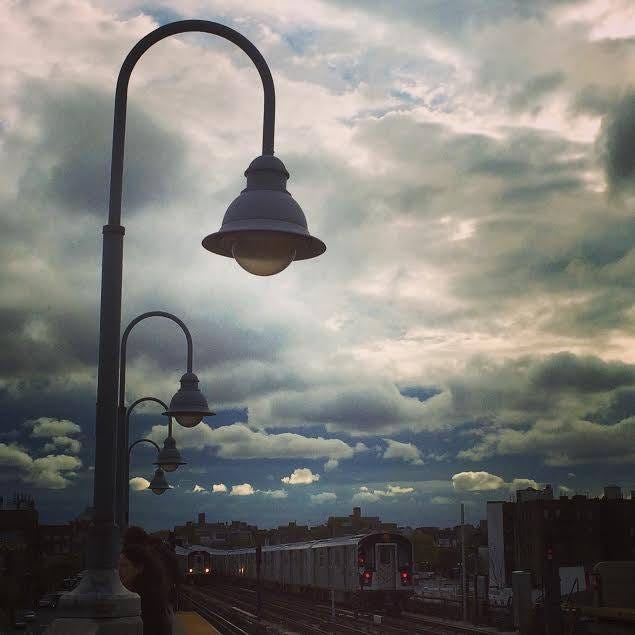
View from the 7 Train Platform, Queens. Photo by LO’H.

After all, unlike too many people, I have not one but two roofs to shelter under, at least for now. Trees to visit. Good neighbors. Friends, however much they are only available via text. It’s a crazy modern world, and there’s no good where to be unless we make it the way we like it. Where my next home will be or how I remake the one I’m in, I can’t know, but in my heart I know the search is on.

Hope you are feeling home in your own heart. I saw this quote on a meme recently, and it hit…home:

Home is not where you were born; home is where all your attempts to escape cease.

~ Naguib Mahfouz

Love to all.

Miss O’

Haven’t the Foggiest

On pleas, turnabouts, and new directions

Yesterday morning, Saturday, a week before I’m scheduled to return to New York (according to my latest in an ever-updating series of return Amtrak tickets), my mother, Lynne, still prone in bed in the playroom despite a light breakfast, sips of coffee, and blaring overheard lights, grumped to me and my dad from her near fetal position, “Would you leave me alone for a minute?” Sorry, Mom, I said, and out I went to get coffee; my dad remained, quiet, in a chair watching the very loud news. So it goes.

A few times during the last week, taking breaks from my own publishing job (where on Tuesday at the dining room table my computer died, had to order a new one via our help desk, get it FedExed to me, and return my old one, which I did, thanks to brother Jeff), I’d say, if I found her receptive, “You know, Mom, if you want to get dressed…,” and she’d say from under the covers, “Maybe tomorrow.” Friday evening, I’d told my dad and brother Jeff that I had a scheme: Since Dad O’ had bought bags of Halloween candy and baggies, and found the orange ribbon they always use, why don’t we set up in the dining room on Saturday morning and make the bags of treats they love to give out for Halloween, and make Mom O’ join us?

And, remarkably, we did that. (Generally, the jobs were as follows: Lynne (!) cut the lengths of ribbon, Bernie made the piles (one each of M & Ms, Snickers, KitKat, and Reece’s Cups), Jeff bagged, and Lisa tied them up. Sorry I couldn’t capture anything like fun, but we did have some nice little laughs, good memories. When sister Sherry called in the midst of this, Dad remembered Sherry and Craig (the children of my dad’s first marriage and who lived in Richmond) were in that house the first Halloween Bernie and Lynne and I lived there, in 1964, when county farmers (unbeknownst to my folks) would drop rural kids, piled into pick-up trucks, into all the new housing developments to trick-or-treat; as a result, the O’s quickly ran out of candy. Sherry (who was 7 or 8 then), who had a haul, said, “They can have some of mine,” and Dad wouldn’t let her. Sherry was born a doll. Dad said it’s the most kids they ever had for Halloween, even today.)

After we’d made 100 or so packets (my dad kept a tally sheet), my mom, Lynne, from this unaccustomed chair, said, “Now where do I go?” Her family had all gotten up to complete chores around the small house, my dad cooking up vegetables for ham and cabbage and peas porridge; Jeff to closet for the vacuum cleaner, I to the dust rag.

And in the midst of all this movement, Lynne made a decision. She decided to get dressed.

And, what is more significant, she wanted to get dressed in her room. Upstairs.

And she did that. For the first time in seven weeks, Lynne was in her room.

More astonishing, Lynne came back downstairs on her own, my dad bringing her walker as I watched her grab the railing with both hands, taking one step at a time, foot-foot, foot-foot.

She sat in her usual living room chair.

And it occurred to me later that that’s where her irritation had come from earlier in the morning—Lynne, whether she realized it or not, was making a Big Decision. And she chose life. At least, yesterday she did. We’ll see how it goes.

Anger Management

On Tuesday of this week, my brother Jeff texted me, “I’ll be home in a few minutes. Will explain when I get there.” As it turns out, he’d been fired, after 35 years, despite being the most skilled glass cutter in the shop, for mouthing off one too many times. Over a week of shock, sadness, back and forths with the HR guy, Jeff figuring out Cobra, etc., the shop boss (who’d overreacted and must have quickly realized the quality of worker he’d dismissed) told Jeff he maybe could come back, as a beginning apprentice (!), if he went to anger management. Of that suggestion, Jeff, who had expressed worry over what would happen to him at another job should he get one, was totally on board. “I’ve needed it for years,” he admitted. I told him how therapy saved my life 30 years ago, and Jeff has been looking into how to get started. (Sidebar: Bernie said to me yesterday, “Why does anyone need therapy? It’s common sense.” Says the man who screams at his family viciously at least once a week for no apparent reason. Jeff and Lisa come by their raging honestly, Pops—and I warned him not to therapy shame. “You’ve seen that commercial with the guy lifting weights who refuses help?” Yeah. “It’s like that.”) (Sidebar 2: I told Jeff I have an idea for a children’s book, Jeff Loses His Job, that could be one of a series to make our fortune, and we sat and thought of other possible titles to come. I’ll keep you posted.)

Meanwhile on the planet, the other day I read this headline:

Ukrainians Destroy Russian Tanks with Radio-controlled Toy Cars

And if this is how we can do war now, why not send toy cars and toy tanks into an arena, blow them up, and call it a war? Why are Israelis bombing real hospitals in Gaza? Why is Hamas carrying out real Jewish genocide in the name of the Palestinians? How in the actual fuck are the peoples of this earth STILL STILL STILL doing all this shit to one another, destroying Earth in the process? Do it with toys.

Given this week in life, I couldn’t help thinking that the humans of Earth could all use a course in Anger Management. I’m sending out this call for a global PSA.

Until everyone realizes life on Earth is about survival, cooperation, and governance (Republicans, is this on?), let’s let the monster trucks do all the destroying of one another, better still virtual trucks. What has been the point of any war on any scale in the past several thousand years but to assuage one man’s ego and make him feel a king? Because amid all that shit, we know that every single little human on this planet is fighting their own demons, their own personal battles, trying to survive as best they can.

Today, anyhow, let’s hear it for tiny victories, the small battles fought and won, without bloodshed and in the face of great uncertainty, one moment at a time.

She Knows Just Enough to Be Obnoxious

A Daughter’s Care

Information Dispensary

Years ago, I was visiting an elderly friend in Virginia, a former landlady whose dear husband had died a couple of years before. Her wonderful, caring daughter, a school nurse by profession, had just left to return to her own house next door, having checked on her mother’s food, water, and meds situation, dispensing advice to us about this or that, and after she’d departed, my friend turned to me and said, “Merry knows just enough to be obnoxious.” It wasn’t that Merry was incorrect about her information, but it was rather the authority with which Merry dispensed the information that made her mother cringe.

In the past weeks, I’ve seen that same reaction grow increasingly in my own mother, Lynne, who derisively calls me “Dr. O’Hara” when I hold up her water cup to take a sip. This morning she said, quite viciously, “Anything to shut you up.” That’s fine, I said. As best as I can gauge, my 80-pound mom drinks approximately one (measuring) cup of water a day, at most two. She sleeps nearly all the time, feels groggy and frustrated by her inability to wake up, so my pushing her to sip that dreaded water gives her the biggest rises of her day. The second great rise comes when I push her to drink (half, approx. 170 calories’ worth) of an Ensure. My mother is consuming approximately 500 calories a day, at best, as near as I can figure it. A bite of muffin here, a half a PBJ there, a bite of meat, a spoonful of potatoes, sometimes a few slices of pear, some Wheat Thins. My mom’s lack of appetite is a result of dehydration, and she’s dehydrated because, as for too many of us, dehydration does not register as thirst by the time the sleepiness or nausea sets in. And so it goes. It really doesn’t take a medical degree to know this, but the last thing medical professionals do is talk about food and water in the healing process, which is why idiot daughters like Lisa have to step in. It’s obnoxious.

Over the past couple of weeks, my mom—once her hip fracture more or less healed, the physical therapy began working, and her relative independence grew (she can now walk through the laundry room to the bathroom on her walker and use the toilet, all unassisted)—seems to have more or less decided (as of this writing) to accept stasis, which means, I guess, “give up.” She will be 90 in January, should she live that long (and I’m more than willing to be astonished by a sudden rally; just yesterday she asked her husband to trim her hair “with the scissors on the righthand side of your dresser, not the rusty ones on the left,” so who knows?).

I was talking to my half-sister Sherry yesterday, whose own mother is dying by inches, of Alzheimer’s, in a care facility (a housing decision she and our brother Craig had to make after their mom fell and broke her hip earlier this year), about my situation. Sherry worked in a retirement community for 20 years before herself retiring last year, so between caring for the residents and for her mother, she has seen a lot. In addition, Sherry worships my mom, so anything Sherry offers as advice, I know comes from experience and great love. Essentially, “if Lynne just wants to go to sleep,” Sherry advised in her soothing and practical-sounding North Carolina accent, “you have to let her. This is never getting any better.” On top of that, just before our talk yesterday, our dad had admitted to me that he had felt “messed up” in his head (how long? I asked; about a week, he said), which explained a lot about his more-erratic-than-usual behavior; and our brother Jeff was trying get him to go to the hospital though the old man was resisting. I told Sherry that I was concerned it was another ministroke, and I began choking up a bit, “We don’t know what to do, because he won’t do anything,” and Sherry said, practically and kindly, “Let him stroke out and end it. It’s all you can do when you’ve tried everything else.” (Coda: Jeff suggested, “Dad, do you think it’s vertigo?” My mom had said the same thing. As I was talking to Sherry, our dad knocked on my door and said, “I think it’s vertigo,” a chronic condition he’s had for about 15 years (one that caused my parents to have to stop traveling, after the third canceled trip due to the condition) but had not experienced for at least a year. We forget these things. So Dad took motion sickness medication, and within a half hour felt like himself. Crisis averted. And with that, Sherry and I began to talk about ourselves, our own trials, life in general, and find humor in getting on with it. I still can’t seem to get that humor into my writing, but my dear friends send me funny things.)

Death by Inches

On the Wednesday before my dad’s 90th birthday, during my fifth week here, my mom moving around a little better, the med situation stabilized (a fool’s belief, as it turned out, but life is moment to moment, you know), I made plans to go out for the first time, to lunch at 12:30 with my friend and former English department chair, Tom, meeting in a halfway-point town. Typically for schoolteachers, former and otherwise, Tom was an hour and a half early. He texted me at 11:00 AM that he had parked, it was “only four-hour parking” (teachers follow rules), and could I please “get here as soon as you can.” So I quickly changed clothes, grabbed my bag and my dad’s keys, said bye to the folks, and headed out to the family pick-up truck. Upon starting, I saw that the brake light was on, meaning the fluid was low. I went back inside, told my dad, who said it was fine. Incredulous, I headed back out; he followed me, said to pull the truck up into the driveway from the street, and as I stepped off the curb to do that, I somehow pitched forward, landing wrong on my right ankle, and then my left, banging a knee in the process, lying on the street behind the truck. A young Hispanic couple in a passing pick-up truck quickly stopped, had seen me fall, and the man got out and came over and asked if they could help, so kind. My dad came out just then with the brake fluid, saw me there, and whatever I may have tried to deny, I knew I had to go to the ER. I phoned Tom to beg off our lunch date, got into the car (thank goodness Bernie can still drive) (knock wood), and had my aged dad drop me off in front, where I inched into the ER on foot. (“Would you like a wheelchair?” Yes.) Five hours later, X-rayed (two sprains and a fractured foot), an air cast on one leg, a “combat boot” on the other, I called my brother Jeff to bring me home.

Now here is comedy: barely able to walk—and walk I must—I am unable to do basic caregiving; but more than that, I can’t return to New York until I’m fully healed, and sprains take weeks. New York is totally, utterly a walking city. Uber is expensive, cabs are expensive, and traffic is a nightmare (and one doesn’t Uber for two blocks up and back to the grocery store). I travel with a heavy backpack (containing my personal laptop and charger as well as toiletries and a few clothes), along with a small satchel containing my work computer, books for my job, my rain jacket, umbrella, and one extra pair of shoes (sneakers for walks, dressier slip-ons in case—just last year I had a funeral to go to). Probably 50 lbs. total. I was supposed to return to NYC October 8.

And just when you think maybe you can go back to your life, even for a few days, unexpected injury aside, you can’t: I found my father was wandering upstairs the other day carrying my mother’s pill case (the one I set up for them), confused about a missing pill—yelling at me, angry because “I never had any problem before,” that is before I, his daughter, set up this system. (I know just enough to be obnoxious.) If you’ll recall from a previous post—because this story is fucking fascinating, isn’t it?—for nearly a week after Lynne returned home, Bernie hadn’t given either of them their morning or evening meds; when I asked him what he gave them, and when, he couldn’t remember; and having had three ministrokes, Bernie is supposed to take one low dose aspirin every day (in addition to his blood pressure and cancer meds). He’d forgotten all about it until I reminded him. In addition, he’s been having panic attacks about food—after a lifetime in food service, including being a short order cook in the Air Force, a produce manager, and a meatcutter; he cooked half our meals during our growing up, and his panic performance each day over what to make for dinner could be a cabaret act. No amount of my brother and I saying, “we don’t care, we are grown people, just take care of you and mom” will make him understand that he doesn’t have to pack Jeff’s lunch every morning or cook his breakfast (he doesn’t cook for me, for the record, because I’ve always been independent; Bernie used to boast to all his friends that I raised myself). He screamed at me earlier in the week, when I told him not to worry about what to have for dinner, “I have people to feed!” When I told him he just had himself and mom to feed, that Jeff and I will be fine, he got even angrier. I came upstairs to write this, and told poor, long-suffering Jeff that I don’t know what to do, because this isn’t about food but his confusion. (And, as it turned out, vertigo.)

Our parents are our providers. It’s all they know. So, what I’ve finally come to understand, is that if he’s not providing, my dad doesn’t know how to co-exist with his grown children in the same house. But that’s just a small part of his anxiety. The main thing, of course, is this: life as Bernie’s known it over 60 years of marriage is ending. The great love of his life and his reason for living is slowing dying, dying by inches. He himself is physically strong but his brain could explode at any moment. It’s all coming to a close, all of the years getting out of poverty, the struggles and laughs, working toward a middle-class existence, raising your kids, building a solid life. It’s ending. And all his obnoxious daughter can do, really, is bear witness.

And all that I, that daughter, want right now, and no kidding, is to be able to take a walk around the block in the autumn wind. That’s it.

TV Dystopia, by Meters

This week, all over the media, we see how Hamas attacked Israel, another pogrom to wipe out Jews. Israel retaliated, another pogrom to wipe out Palestinians. We live in a dystopian world. To use weaponry instead of intellect and heart to settle differences is to show oneself to be the basest form of life. Moment to moment, day to day, Hamas (a terrorist group not to be confused with actual Palestinians) and Israel inch toward an unstoppable end; I am nearly 60 years old, and these horrors make up some of my earliest childhood memories, watching the 6-Day War on the CBS Evening News with Walter Cronkite.

And you realize that all those casualties of war now and over decades and centuries, all these displaced victims, are simply people who are trying to work, get married, give birth, take care of their kids, and care for their dying parents, and somehow plan for the future. Moment to moment, day to day.

And the people who perpetrate all this violence (see also: Russia against Ukraine, the U.S. against Iraq, pick a war) have no real ideas about governance, fair distribution of resources, or the creation of a loving and useful society. Raw power only spends itself and burns out until the next arms race, and the world’s sadists glory in the destruction while the loving ones rebuild, over and over and over and over again. (I have no solutions; I know just enough to be obnoxious.)

Last weekend, Jeff printed out my parents’ monthly bank statements so our mom can review them between naps. On Tuesday, Bernie got his partials replaced at the dentist, creating the illusion of a full mouth of teeth that can chew. Two days ago, with cold weather coming, Bernie got out the vacuum cleaner with the hose attachment and vacuumed all around the furnace; he replaced the battery in the downstairs thermostat. The next morning, I found him cleaning his electric shaver. Later today, he will make a batch of Lipton Noodle Soup for his wife. And have some himself.

And so the days go by. My ankles throb with pain. The evacuation orders go out overseas. I don’t know how to explain why, given that terrorist bombs aren’t (currently) dropping on our solid little suburban American house, I am yet so fragile, so weepy; why this relative ease feels so hard. I feel I am ridiculous. My parents’ hard-working life has come down to little more than consumption of media and packaged food and medications; yelling at their obnoxious daughter even as they are grateful for her help; and waiting for the end of it all, they hope, together. I think that is what troubles me—that there seems to be nothing but waiting right now. That this is what too much of life is—filling in the time between activities needed for life to continue as we wait to die; my shock that Beckett so clearly knew what he was about when he wrote Waiting for Godot. An old theater joke, “My life is a Pinter pause,” comes to mind. And the last line of that Sartre play: Nous continuons.

Until next time, with love to my two readers,

Miss O’

Bread and the Body

The Body in Transition

A friend texted me Saturday afternoon to ask when I will be writing another blog installment, after the previous post about caring for my folks, and I texted back, “Lather. Rinse. Repeat. There’s your blog.” What else is there to say? Day melts into day into day into day, as the days go by, every problem you thought you’d resolved (meds, meals, moving through exercise) back to square one, recalcitrance.

Sunday was a fragile day. I’d awakened about 1 AM, weeping, realizing how impossible it is for me to leave, trying to figure out if I should just sell my New York apartment and the bulk of my possessions and just move here, or try to wait it out. I don’t want to move back here. But I’m not sure what choice I have. I somehow got back to sleep for a few hours. Later, taking my dinner plate out into the playroom (where my parents live now), I startled my dad, whose Coke flew into the air. I set down my plate, went into the kitchen, got a went rag, wiped down the rug, and then picked my plate back up and walked back into the other room to eat. “You’re not staying?” my mom said. “Oh, come on,” my dad said. I didn’t know how to explain that the combination of the relentless overhead lights and the TV blaring at 100 (I am not kidding) and my mom barely eating and my dad so easily startled had caused me to begin weeping again, the result of being trapped in a bad movie that can only end after much more suffering to come.

I keep trying to find the humor in all this.

On Friday afternoon, around 4 PM, my parents, who had gone to bed at their usual time of 3 PM, were startled when they heard a knock at the back door of the playroom (their new bedroom-normal), and it was Justin the physical therapist. (On Wednesday, Justin had left before I could write down the time of his next visit (I was on a Zoom work call in the dining room), and my parents had said that there wouldn’t be another visit until next week.) To my surprise, my mom rallied, put on her nice wig, and went on the walks through the laundry room and kitchen, did the band stretches, made humorous comments. My brother and I, meanwhile, stayed stretched out and prone, Jeff on my mom’s lounge chair and I on the loveseat, watching Midsomer Murders. Justin came in with my dad to write his next visit on the calendar while I recorded that date in my phone, and I said to Justin, “I know that my brother and I look to you like geezers in our 50s, but inside we are just teenagers in our parents’ house.”

Oh, look. Found some humor.

I suppose that fact, of being a perpetual child, is why I don’t fully know how to be here, having also to do with the fact that on Saturday and Sunday, after her Friday late afternoon rally, my mom stayed in bed and barely moved except to walk on her walker to the bathroom a couple of times, and to sit up to nibble on what is probably at most 700 calories a day; I figure it’s closer to 500. I don’t know what to do, or how to get her and my dad to see that this starvation is why she is so tired. I just sound like a scold.

Not What It Used to Be

Calls from friends matter more than I would have imagined, like pictures of her baby grandson to my mother. I missed a call earlier this week from my friend Mark, a retired schoolteacher approaching age 80; I texted him; he texted back Sunday about a good time to call; I texted him that 7 PM would be a good time to call, and he called. (It’s all so complicated now, isn’t it?) He’d recently driven down from his home New Jersey to North Carolina to play piano for a former student’s wedding, and since he’d gone that far, he decided to continue down to South Carolina to visit a 92-year-old writing professor, a woman often described by the former director of the Bread Loaf School of English as “indefatigable.” But now Dixie tires easily, Mark said, though they had a very nice visit. The subject they found themselves coming back to, however, was not so nice: the deterioration of the place we all thrived in back in the 1980s and ’90s, Bread Loaf.

Unlike Mark and other friends, once I got my master’s degree in ’94 (and only returned in the summer of ’96 on an NEH grant for theater teachers, a return that made me know I was done with higher education), I had no real desire to visit. I like seeing people I love, but truth to tell, when I graduate an institution, I move on. Just as some Virginia Tech grads I knew became townies, some Bread Loafers returned to the Mountain, as we called it, in Ripton, Vermont, summer after summer to work there. I never felt that kind of attachment, though I dearly loved my time there.

The magic for me started with a brochure in my Appomattox P.O. box, one that showed a 30-ish blonde and bearded guy sitting on an Adirondack chair in a green meadow. The Bread Loaf School of English, located at the site of the famous Bread Loaf Writers Conference, boasted a wide array of classes, and required no thesis for its master’s program. In addition, the program only took place in the summers (five of them for a master’s) so that it could fulfill its mission to continue the education of working English teachers as well as writers. From the first arrival in my pickup truck (on my rural teacher scholarship, the big push I needed to apply in the first place), the creamy yellow-orange buildings with forest green trim, the meadow, the Green Mountains—all of it made me feel home. The added contraband view of electronics, including radios and televisions, and the discovery that there were no locks on the doors, made me weep with gratitude. A dining hall bell rang for the three very hearty meals each day, a room to sleep and study in, classes to attend, porches to sit on—all this and the ability to focus on growth instead of world worry was beyond a privilege. It was a lifeline for a Miss O’ that was a very lost soul at the time.

Over the years, as Mark went from Bread Loaf graduate (class of ’89) to administrative assistant (up until about 20 years ago, when his own parents required constant care) to regular visitor every August to play graduation, he has had to witness what feels to him like the deterioration of our beloved institution, degraded by the unavoidable advent of the personal laptop, personal printer, demand for internet access, and cellular service, and all the infrastructure updates these modern needs entailed. A change in administration brought a more hands-off, corporatized approach to the school, less benevolent parent who wants to see you thrive creatively, and more an efficient parent who makes sure you have clean shirts but otherwise keeps their distance. (Optional locks came to the doors my senior summer of ’94, when personal computers became more popular; permanent locks came about the following summer, after my time. I think of Robert Frost’s “Mending Wall,” wondering what we are walling/locking in or walling out.)

Metaphor Alert

The change to Bread Loaf from a kind of Brigadoon for teachers and literati became, as I talked to Mark, sort of analogous to the deterioration of my mom’s body; and the (understandable) lack of her hands-on nourishment of her children struck me as analogous to the (less understandable) demise of spiritual, personal, and creative nourishment at Bread Loaf and its former feeling of family and welcome and love of the human enterprises of reading, writing, and theater, of storytelling, of good talks, good walks, joy in nature, sunrises and sunsets, the heavy dewy mists after a late night of storytelling around the bonfire. We were there at a magical time, Mark and I agreed; were lucky to have been part of it when we were (though today’s students won’t know the difference, or what a difference of perspective they could be enjoying, given that there is no substantial shift from their everyday lives and the summer retreat, phones ever in hand). To continue this analogy, my mom moved from poverty to middle class prosperity; did better than her forebears but not without working for it; and there was a golden time, sort of, but that time is gone.

The big analogous questions: 1) Do I corporatize the care of my mom and dad? 2) Do I keep trying to force feed my mom? Finally, 3) Do I keep sending yearly donations to a corporatized Bread Loaf? Clearly these aren’t the same things, as for one, in my mom’s case she’s my mom, for crying out loud, and for now I remain on site; in the case of my school, it’s a place I’m not really responsible for, however much I’d like to help keep it going, though I haven’t been to Bread Loaf in 20 years and have no desire to see it again. Still, I want never to lose the feeling of deep connection and gratitude I have to both my upbringing and my education.

The analogy continues: just as the internet is never off now at Bread Loaf, the TV at I never off at my parents’ house. Like the internet for today’s generations, the television is for my parents their company, their connection to the world. It blares around 100 because of my dad’s hearing loss, so every conversation has to be had over the television; and by contrast, because of the radio silence, one witnesses very little in the way of conversation these days at Bread Loaf. With all this change, I guess, I get weepy, at moments, or get the shakes, not because of the inevitable (there is only one way this is going to end, after all) so much as that any possibility of preparing for it in anything like a meditative way is off the table.

There are other significant differences between my mom’s bodily changes and those of my beloved Bread Loaf. While I encountered the necessity of change at my parents’ house because of old age (an old age many don’t have the privilege of reaching or reaching in the relative comfort of their own home), Mark walked into the Bread Loaf community Barn this past summer, with its empty chairs, or one or two individual students sitting with a phone, no one in conversation, no one playing the piano; the snack bar for coffee and tea closed long ago, no fires lit in the fireplace, and no more dances there on Saturday nights, since people leave campus on the long weekends—no more Friday classes or planned weekend events, because the new administration, it seems, encourages people to get away. Fewer people to cook and clean for, I guess. That’s a choice the school made not because of an aged 100 years of the school’s existence, but because the human race appears to be done with bucolic life and the philosophical reflection that allows, at least for now.

Miss O’ in Queens, but the message remains the same.

I guess it’s an odd analogy, these two things, but it’s helping me think through change and luck and the necessity of moving on, of carving out a creative spiritual life despite or even because of this decay. Something has to rise from the noise and the ashes. Doesn’t it?

Sending love to all.
Miss O’

How It’s Going: Adventures in Eldercare

You Are Here

You don’t know where they keep, say, the batteries, the dust rag, sure, but really it’s about the morning and evening meds for both of them, your dad and your mom, both 89; and about the bills they pay online and by check, and online are they automated or not? (Only the credit card isn’t, but the trash bill has to be paid by check, and while you found the updated auto insurance policy you can’t find the bill, and right now your mom can’t remember how she pays it and your dad has never written a check in his life, since he has mom for that). Last year when you and your brother Jeff had to get them a new computer, and it was a large laptop, for some reason your mom could not seem to understand that the keyboard on the laptop does exactly the same things as the freestanding keyboard did, the screen is a screen, and the mouse is the same mouse, whereas your dad, who had avoided all things computer except to check emails, sort of, while standing by your mom, is now the email guy, if barely, but he doesn’t know anything about the bills. You see the desk, piled with clusters of old envelopes of bills in blue rubber bands, just as the downstair buffet is, and the console behind your mom’s chair, all labeled in your mom’s neat, fine point, all-caps script, some with notes like “KEEP,” but that doesn’t tell you why they are being kept, and your dad as no idea.

You then can’t help but notice that the kitchen and bathrooms could do with a cleaning and subbing in of fresh towels. In the linen closet in the small upstairs bathroom is a helter-skelter collection of sheets, pillow cases, and towels of all sizes, in some shade of blue or pink, most all of them frayed from 30+ years of use, and at the bottom of the closet are baskets of cleaning products and small appliances and tools and boxed tissues and rolls of toilet paper, none of which you can use for cleaning the sink the way you want to, since there’s no rag or sponge, because of course there isn’t. “It’s hanging on the towel rack in the downstairs bathroom,” your dad says, because when your dad cleans the bathrooms (your mom hasn’t been able to scrub or get down on the floor for a decade), he does them at the same time, see, so the rag ends up downstairs because he starts upstairs, see?

So then the meds. Dear god the meds. The morning ones for your dad are downstairs in the kitchen hutch, in a lidless round tin that once held Danish cookies, whereas his evening ones are loose bottles resting on his low dresser by the mirror; and all of your mom’s, the morning and the evening, are in the old Easter basket, atop the tall dresser by the TV, labels so smeared by your dad’s hand oils (within a week or so) that you have to strain to read them, even under and lamp and with your low Rx reading glasses. You ask, “What are these for?” and your dad says, “I don’t even know anymore,” so you study them, make lists. With a Sharpie fine-tip you find in the console behind your mom’s chair downstairs, you label “A.M.” and “P.M.” on each bottle, separating the bottles (and they aren’t really “bottles”?) by parent. On Amazon you order AM and PM weekly meds sorters, and when they arrive you take a Sharpie and write on each side of one, “LYNNE” and on each side of the other “BERNIE” (and on the one you got for yourself “LISA” which is weird because you, Reader, have some other name, probably, as do your parents, for that matter). You will need to sit with your dad to organize them. Note: Without the muscle memory of opening plastic bottles and walking from upstairs to down at the same time every morning, and downstairs to up at the same time every evening, your dad will spend weeks figuring out the new system, and he will take his evening meds in the morning and to forget to give your mom her meds at all; you realize you have to check on this and coach him. And when he does finally get the hang of it, his OCD kicks in and he refills WED AM as soon as he’s taken it, so you can’t tell if has actually taken them or not, and it takes three tries to get him to see what you mean. Now you realize you will have to check and actually ask him every morning and every evening if he and your mom actually took their life-saving medicines. Check.

Backstory, or Why I’m Doing This

The routine, see, is all new, because your 89-year-old mom tripped on a bathroom rug (the rugs the doctor told you to get rid of years ago but they are so pretty, and small, and what could go wrong?) in one of the world’s tiniest full bathrooms (second only to yours in New York City) in the middle of the night, fell, and cracked her hip. The EMTs had to get her down the stairs of a split foyer using a wheelchair. Almost 24 hours and a few tests later, your mom is transported from the local hospital to a more advanced medical center, where neither your brother Jeff (who lives in) nor your dad visit her for three days because each morning they’d call, her ladyship would declare, “Don’t drive over here! They are transferring me to rehab today,” so they didn’t, even after the second day when she called again at noon and said, “Haven’t you left yet?” because men. And when you finally arrive on Amtrak via subway from New York City (taking two days to put up the storm door, take down the AC unit, clear out the fridge, arrange for your wonderful upstairs neighbor to get the mail, water your plants, flush the toilet, and run the faucets once a week, and pack your work and home laptops and chargers and meds and a few changes of clothes) on the fourth morning of her hospital visit, you all drive over and you track down her nurse and you explain, “I’m her daughter from New York, my father and brother actually listened to her, because she runs the show, and we need to understand what is happening, and I’m so sorry,” and you explain this because you realize the nurse and doctor have assumed she has no one who cares about her, and of course they assume that and this is so, so not the case. And everyone feels terrible. Your mom really doesn’t seem to know what is going on.

First things first, you replace her matted gray wig with a combed-out silver wig, and your mom instantly feels a little better. The nurse has told you how your mom put on lipstick every day because “my husband will be here soon,” and after two days, they thought she had a negligent husband. You toss her matted wig in her “go bag,” a bag that each parent has and has needed more than once over the past few years.

You meet with the doc, figure out next steps—the fracture is inside the bone so there’s no operating they can do, it just has to heal on its own, but your mom only weighs 88 lbs. and wasn’t in great physical shape in terms of muscle mass to begin with, but at a rehab facility you know they are only going to work with her for 15 minutes once or twice a day, and you can do that at home, and be with her. Now your role gets really interesting.

You spend your first days home fielding calls from equipment suppliers and a managing nurse and the home care company to arrange all the caregiving. You have to help your dad, who will be 90 in October (and you had to take him to the ER last Christmas because he had a TIA, or ministroke, right in front of you, you running upstairs first to tell your mom, who is napping, which she has to do a lot these days, where you are going; and then spend the day in the ER with him, finally having to call your sweet brother to take over when he gets home from work because your head is so sick from not eating all day you need three ibuprofen), figure out how to get her to the bathroom on her walker and onto the raised toilet seat; and then your wonderful half-sister who worked in a retirement community until she herself retired, tells you to order a commode to keep by her bed, which you do, and it comes the very next day thanks to Medicare and their managed health care (the result of benefits your dad had from his 42-year union job, and thank the gods of unions, and why don’t we all have this level of care?) and is a godsend.

Oh, and the first thing you all did, by the way, before your mom got home via ambulance transport, was to figure out how to get her onto the main floor of the house, which is a sort of half basement with five steps down (note: never buy a split foyer), bolstering the foldout couch in the playroom addition with cot mattresses (after first trying to arrange cots and an air mattress in the little living room, which is closer to the bathroom), and removing all obstacles that you can, finding the sheets, figuring out blankets and pillows and all that. Will this work?

Pardon the Lack of Narrative Cohesion

And if all this information isn’t chronological it’s because it’s a jumble in your mind and a jumble in routine almost immediately and consistently, and that’s because you must spend all the time you can in the dining room on your work computer having Zoom meetings and trying to work on this new project for your income to keeping coming, while also remembering to take walks (you’ve done three in three weeks) when you can because of your ever increasing stenosis, but you don’t dare leave your dad alone with your mom because he has this tendency to go into the kitchen to cook, say, or want to go to the store or run another errand, convincing himself that your mom will be fine for 10 or 20 minutes (I mean, she’d be alone in the hospital room, he says, and you say, monitored), but his 20 minutes usually stretches to 45), so you have to run into the other room to be with her when he leaves (she always needs something, like water, which you have to remind her to drink constantly (and she’ll only do it if you put in a straw), and that’s just what life in an invalid state is), so you handle it, and then help him with the groceries when he gets home, and pause to pick up your mom’s water cup again and push it over toward her with the straw as you say, “Have some water,” while she screws up her lips and sighs; you have learned by now that to get your mom to do anything, you have to suggest it, count to ten, and watch your suggestion become her idea before she does it, and you are once again beyond grateful for your theater training to carefully observe without judgment, as if you were your mom. Now drink this Ensure. Sigh. Mom, you point out, you are down to 83 pounds. She drinks.

Yesterday your mom’s doctor called, and you put her on speaker; since you can’t get your mom to get up and exercise so she is strong enough to get to and into the car, her doc puts in an order for a wheelchair, which is fully covered by Medicare (which you learn when the supplier calls later, but there’s this rental contract coming online that you have to sign, and if the link is expired you can call this 800 number and someone will assist you, and your brother says, “Thank god you know how to talk to people because I could never do that,” and it’s just what people have to do sometimes, another reason everyone should take an acting class or be a teacher for a minute).

Your mom’s doctor, by the way, says the key thing, the main thing, and it’s not about wheelchairs: You can fight like hell and do the exercises and work to get better, or you can stay in bed and not get up. Both are reasonable options. They are. And the next day your mom seems determined to try all the exercises with the OT and the PT, and then the day after that she stays in bed, slack jawed with eyes closed, and barely eats. And the day after that is a blend. But your dad, with all the love in the world and more energy than most men of 60, cleans out her commode and walks behind her on her walker on her way through the laundry room to the bathroom, when she’s up for it, and all you can hope is that he doesn’t get another hernia or have a stroke. And, in the words of the great Kurt Vonnegut, Jr., so it goes.

And in the meantime, you sleep in a room that was once your first bedroom which is now a dusty junk storage room with a bed in the corner, the bedpost serving as a closet and the front edge of an old book- and medicine- and tissue box- cluttered dresser for your toiletries, collecting your dirty clothes on the floor next to your backpack and purse. And you can’t help thinking, in passing, that this could be your life for years, your apartment in New York a distant memory, possibly a place you never again inhabit even as you pay your bills. But you can’t live thinking like that. Moment to moment, day to day. You can fight like hell and do the exercises and work to get better, or you can stay in bed and not get up. Both are reasonable options. But not, not now, for you; you have one option only because people are depending on you. And it could be so, so much worse. And it will be. Just a matter of time.

(Note: In this crazy world, it would have been easy just to come down here and not tell anyone besides your immediate neighbors in New York, not your friends, not the people at your job; you could literally live anywhere and under any circumstances with no one the wiser. But if you feel you have to hide and protect your friends from the complexities of your life, I hate to break this to you, but you don’t have friends. There are times when we all feel friendless, so ask yourself, “Have I shared my life?” and if the answer is no, you risk losing all connection, so for the love of god, share, and for the love of god ask them about their lives, and want to know.)

Love and kisses, with all the gratitude in the world to friends who text.

Miss O’

We’ve All Done It

A brief exploration of recent moral dilemmas

My friend Cathy uses a phrase that I have found one of the most reassuring in this American life: “We’ve all done it.”

For example, last February I slipped and fell down my spiral staircase to the basement of my Queens apartment. I am usually, always, really, until then, so careful it’s absurd: “don’t die, don’t die, don’t die,” I chant, as I carry down recycling. Then on that morning, for whatever reason, I held onto no rail and thought I’d just pop down there and bammo, bruise city, swollen ankle, trip to the ER.

“We’ve all done it.”

And let’s face it: before you judge the bonehead accident of another person, it would not kill you to take a breath, think to yourself, “Have I done that, or something like it?” And then, reassuringly say to your friend, not the judgy thing, but the true thing: “We’ve all done it.” This, I feel sure, would be a really helpful thing to do and go a long way to calming both you and your friend.

Breathe. Who among us hasn’t left a stove burner on, forgotten to time something in the oven, or left coffee in the microwave for three days? And who among us didn’t try to sneak at least once into a movie for free? “We’ve all done it.”

But there’s a limit that also might be constructive to consider.

It occurred to me as I was washing the dishes just now (I spend a lot of time in the kitchen), thinking about how we’ve all gone a whole day and not bothered to wash one dish, that surely this phrase of reassurance does not always apply to all missteps.

Murder, say. Or insurrection. Or violating another’s right to life, liberty and the pursuit of happiness.

No.

So I’m writing today because I think this phrase, “We’ve all done it”—the thinking of it and considering it—might help a bunch of Americans right now who are either undecided about or outraged over former President Trump’s 91 indictments, arrest, and, finally, mugshot. Or say, the painting of swastikas on the houses of Black people in Montgomery, Alabama. Or, perhaps, the mass murder of Black people by a racist white supremacist in a store in Jacksonville, Florida. Or the lackadaisical attitude of sportscasters as people and players ran screaming during a mass shooting during a high school football game.

That phrase, “We’ve all done it,” may be the test you need as to whether, or not, a big ass really criminal crime might have been perpetrated as opposed to the human mistake.

I, speaking as an occasionally above average, certainly flawed human being, can honestly say about the charges of voter fraud, treason, intimidation, etc., to say nothing of the weekend’s racist attacks and mass murder, that I cannot utter the reassuring phrase, “We’ve all done it,” with anything like conviction.

On the contrary, some major convictions are what we need.

And don’t get me started on that GOP “debate.”

This has been a public service announcement on behalf of sane and sentient citizens everywhere. We’ve all done it…or have we? If we haven’t, and it’s not art, chances are it’s a big ass crime. And if you can’t tell the difference, you are the problem. See your ass in court, no doubt sooner than later.

Kisses from Miss O’.

Miss O’ has no claims to perfection, but Jesus Christ already.