In the late years of her life, ca. 1936-1938, writer Virginia Woolf was experimenting with a text that combined the novel form with the essay form. The result was, in the end, two books, the novel The Years (which began its life as The Pargiters), and the essay Three Guineas. I’ve read many of Woolf’s novels half a dozen times each—Mrs. Dalloway, To the Lighthouse, the Waves, Orlando—I’ve even read Flush twice (the biography of Elizabeth Barrett Browning’s dog, and it’s hilarious). I’ve read Jacob’s Room three times, I think, but the first time was the best, and Between the Acts at least twice; and the essay A Room of One’s Own I think four times through—I just finished it again recently and I think I finally got it all. It only took me 40 years.
Curiously, I have read her first two novels, The Voyage Out and Night and Day only once—they aren’t that interesting, though I might change my mind. The same goes for the The Years (though, ironically and not surprisingly, as it was a straight family chronicle, it was Woolf’s best selling book). I’ve also read Three Guineas only once think—all of that at Oxford in 1992, when I studied Woolf as part of my master’s. Be impressed. (I’ve also read her short fiction, only “Kew Gardens” and “The Mark on the Wall” standing out in memory.)
I have a brilliant writer friend who thinks Woolf writes the worst fiction known to man. I could not disagree more. But this same writer does not disagree with me that Virginia Woolf had one of the finest minds of the 20th century, and I’d say any century. As I’ve probably told you, for me Virginia Woolf renders the world precisely the way I experience it. Do with that what you will.
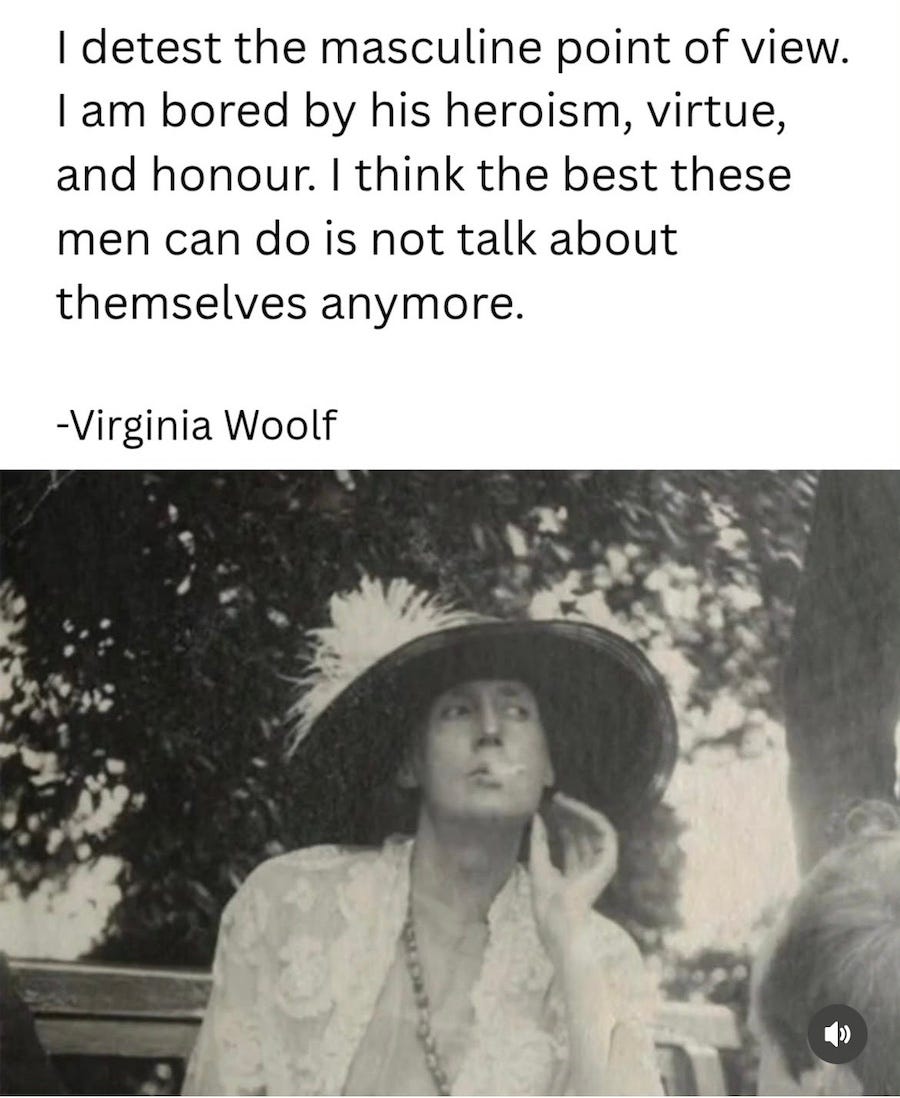
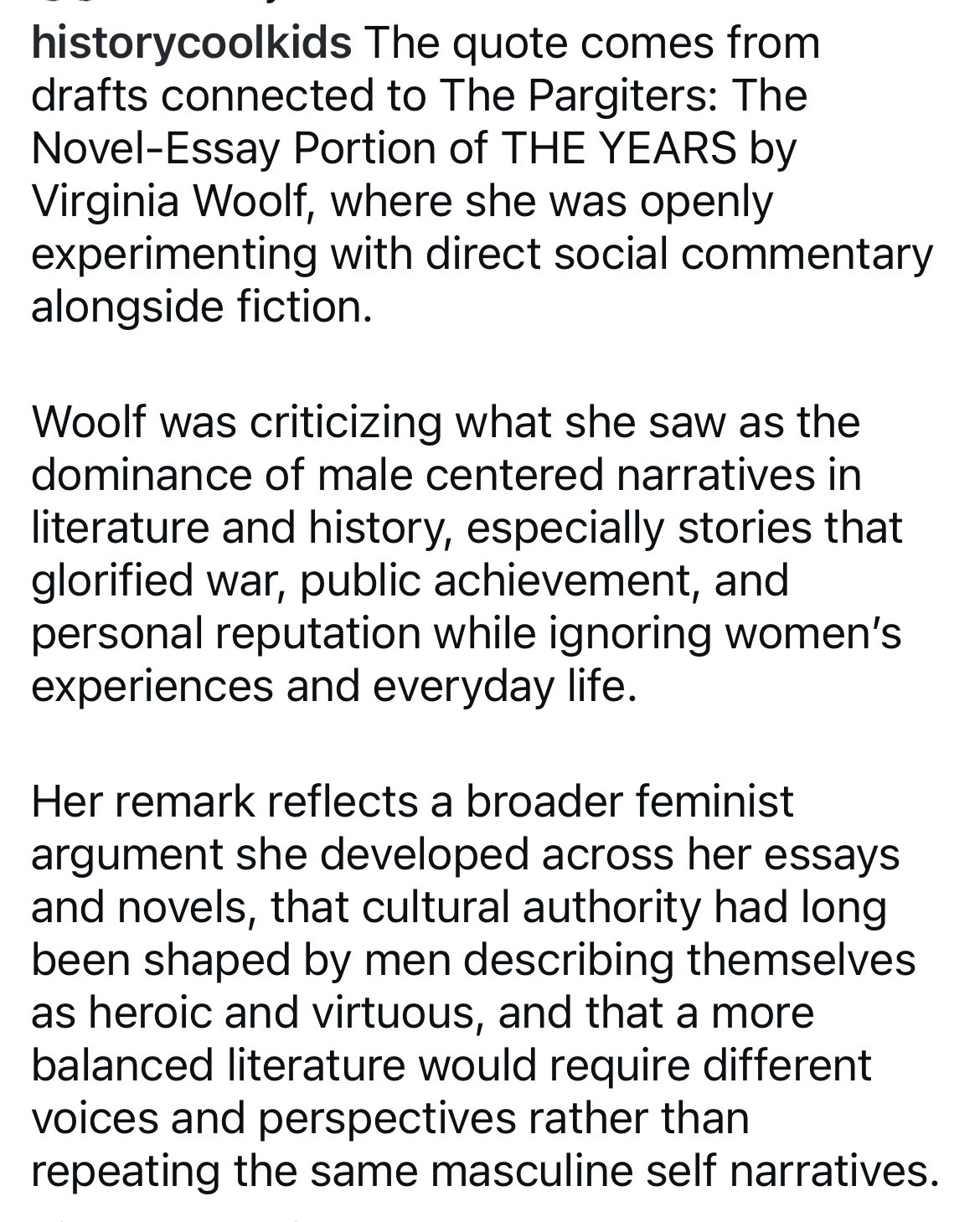
Today I ran across this post from HistoryCoolKids on Instagram, and it made me recall how important her pacifist essay Three Guineas (1938) is in the Woolf pantheon—that’s the essay the post refers to—and also how aware Woolf was that men are fucking everything up (this was around the beginning of the next great world war, England once again at the center):
The post text:
Teaching my Oxford class was tutor Jeri Johnson, herself a James Joyce scholar who for only that one summer taught both Joyce and Woolf (in separate courses); curious as to why she would be drawn to such polar opposite modernist writers, I did some research, in the time before Google, availing myself of the school library where I was teaching, and saw quickly that the writers were exact contemporaries, 1882-1941. How about that? (Note: if you want to blow away a professor, show up with a little tidbit like that and set the stage for your A.) I also learned that Woolf detested Joyce’s Ulysses, finding it vulgar (she’s not wrong, what with all the mentions of snot, for example, and masturbation); and the most important thing about Joyce’s book for me is that it inspired Woolf to write Mrs. Dalloway in answer: one day in a life in London, a woman’s life, in response to one day in the life of a man in Dublin. Both texts have richness, but Woolf’s is not designed to keep scholars arguing for a century, and that alone speaks to her quote up there.
When Jeri assigned Three Guineas to read, I entered class the next day filled with ideas, bookmarked pages, notes in the margins. The essay’s premise is that Woolf has been asked for three guineas (pounds) to give in donation, one guinea each per charity, and she’s deciding which cause deserves her money. In the course of essay, she arrives at the conclusion that her final guinea can never go to supporting men taking us to war. My four classmates (this being an Oxford-style tutorial affair), all women, declared the essay a failure and Woolf a “shrill” woman. I sat in silence. They went on about how “now was not the time to call for peace,” “Hitler on the rise,” etc. They were utterly dismissive, and all discussion was shut down. Jeri looked at me.
“Lisa,” she said, “you’ve been awfully quiet.” I looked up and stated, “I loved it.” Jeri started to smile, and thus encouraged, I went into my rapture: “This is a woman who knows she doesn’t have a lot of time…” and I began flipping to my bookmarks and reading my evidence. As I type this for you, I can feel myself in that little Oxford office, aged 26, sitting on the floor, speaking with a young woman’s ardor. No one else said anything. Class was over, Jeri assigned us something, and I was the last to file out. “Thank you,” she said, quietly. “You’re welcome,” I said, and left feeling that I’d found my own way and stood my ground intellectually for the first time in my academic life. That’s pretty cool.
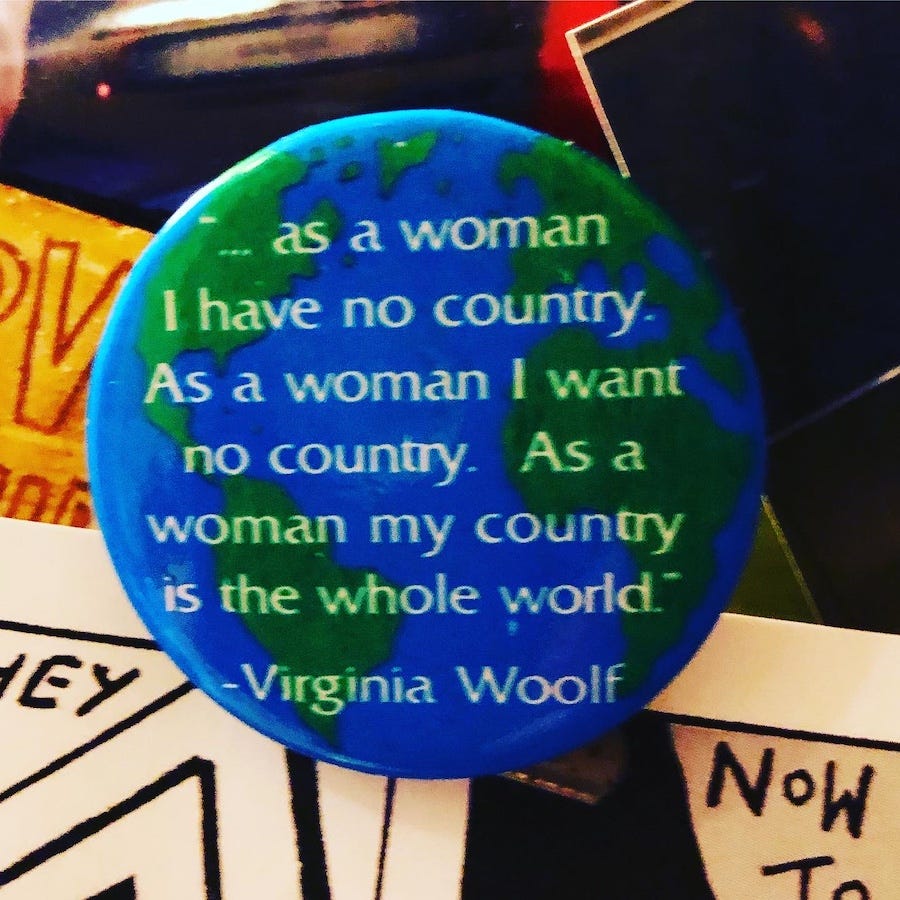
We are living in an age where the lies of men, the vulgarities of men, the warmongering and whore mongering and shit-peddling of men must finally end, or we all go down and forever.
Quote from Three Guineas, the button I wear to every protest.
This evening I’m embarking on a reread of both The Years and Three Guineas, because the mind of Woolf ca. 1936, when she began her work—seeing the writing on the wall in Germany—reminds me of myself and my female friends in 2026. Nearly a century on, men are still running and fucking up everything. I need fortification. We don’t have a lot of time.
Should you wish to start your own Woolf journey, as I think I’ve mentioned before, I recommend Mrs. Dalloway or Orlando—definitely not To the Lighthouse or The Waves; though I think they really are her masterpieces, it’s so hard to see why without a little primer. I speak from experience, take it or leave it.
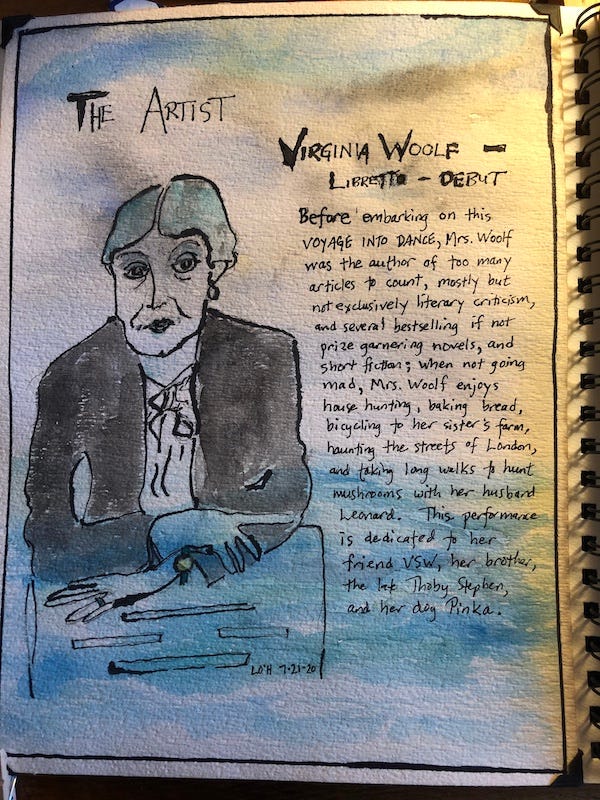
Woolf continues to inspire. The composer Max Richter and choreographer Wayne MacGregor created Woolf Works, which I saw on video during Covid from The Royal Ballet in Britain, and live in 2024 in New York. The only one of the three ballets that really works is based on Mrs. Dalloway, and I mention this because I’d love to see what women artists would do with the same material. You know. (I made this watercolor to show my friends who recommended the piece:)
Covid creation by LO’H, for those in the know. You come, too.
Sending you love and Woolf inspiration as antidote to all the maleness madness. Let me know how you get on.
From the NYPL exhibit on Virginia Woolf, 2023. Photo by LO’H
A couple of years ago, the social media posts of “Sam,” a young gay man in his 30s, the beloved former student of a late teacher friend of mine, began shifting from a fun social and work life to marking a life in transition. First, Sam shared multiple moves, the most alarming (to me) was a move (for work) to a dangerously bigoted Southern state, where he was determined to make a go, build a community, and change hearts and minds. As life there, despite his best efforts, became less and less tolerable, he found himself in transit yet again, back to a major city in his home state. Shortly after this move, about which he detailed his joyful creation of a new home with the help of many friends, he began including pictures of himself in “feminine” clothes and accessories (pictures that reminded me of Tom Wilkinson’s character in the landmark film Normal.) Not long after, Sam formally announced that he was beginning a formal transition from “male” (assigned at birth) to “female,” which Sam said was the gender he had always felt he was. What has followed includes his documenting phases of this journey, including legal name and gender changes on his/her/their identification cards, photo records of a shift from pants to dresses and in a face in full makeup, the results of their hormone treatments, and most recently and significantly, a diary of their gender reassignment surgery, their plastic surgery to make their face more feminine, and the post-op difficulties that are part of the process.
For my own part, as an advocate and ally of the LGBTQ+ community, I have found watching this process overall to be troubling. Because I haven’t understand the source of my feelings, and because I still don’t know how best to be supportive in an honest way, I made a decision not to “heart” Sam’s posts, but instead to follow them at a distance, as it were, while working on myself to get a handle on what “transgender” means and how best to understand my muddled response to it.
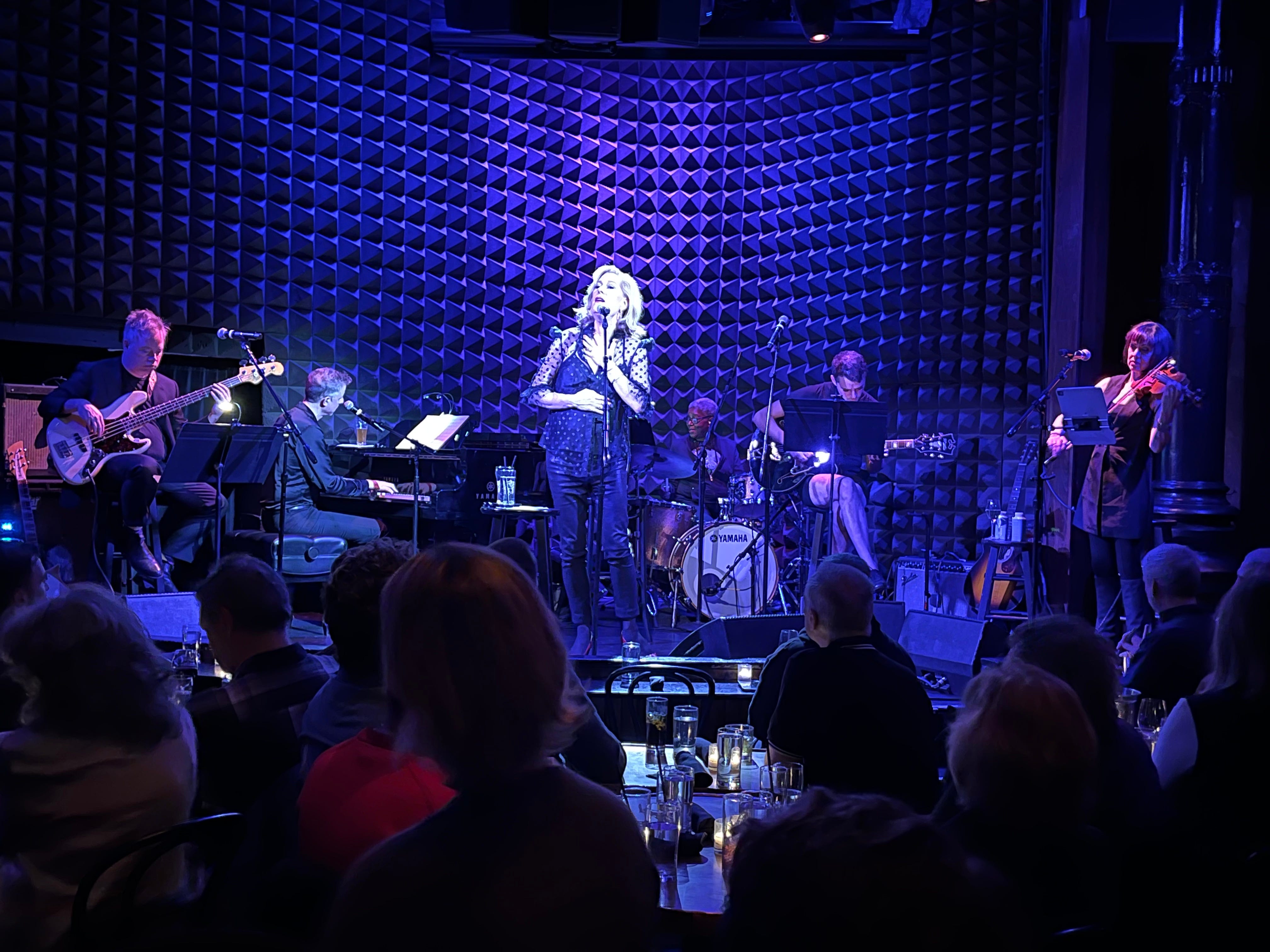
The start of my own encounters with this cultural shift began by seeing cabaret. One of my favorite live performers in New York is Justin Vivian Bond, who as Justin Bond made a name in the downtown cabaret scene (and later, on Broadway, where I first saw them) in the character of singer Kiki DuRane in the duo Kiki and Herb, with Kenny Mellman as the always supportive Herb on piano. When Bond made a decision to present as female and then transition (with hormone treatments, but forgoing gender reassignment surgery), I remember items in New York magazines taking the famously cross-dressing Bond to task, saying, “Vivian? Now you’re going too far,” that sort of thing. Mr. Bond became Mx. Bond, doubled down on their activism, and used music and humor to include the story of transition into their act. “Am I he, she? I don’t know what I am,” Mx. Viv said at Joe’s Pub one night during a tribute to Judy Collins, who was there to introduce Bond and their band; Judy had used feminine pronouns, asking, “Am I using the right ones?” and in response, Viv (who presents tipsy as part of the act) said he/she/they didn’t really care either way. At the time, the idea of changing pronouns was a fairly recent idea, and we were all on shaky ground. Why not acknowledge that?
Justin Vivian Bond in performance at Joe’s Pub, November 2023. Photo by LO’H.
As a society, we have all been, in fact, transitioning to a new, amorphous world where gender isn’t rigid. In response to this change I think (no doubt subconsciously), expectant parents began staging “gender reveal” parties, as if to say, “My child will know exactly who he, or she, is,” which we know now may or may not be the case. And sure, as with any movement, some kids may declare themselves to be other than the gender their genitals indicate, but the truth is nothing about gender fluidity is new. For example, as a child ca. 1920, and for at least two years until she was 14, actress Katharine Hepburn insisted that the family call her “Jimmy,” and she wore boys’ clothes and had her hair cut short. Her family just went along, and why not? But there is a darker side to this, too, because her older brother Tom (who wasn’t “manly” enough, some biographers have suggested, for Hepburn’s father) committed suicide at age 16; young Kath found him hanging in a closet. As a family, the Hepburns never spoke of it again. And I can’t help thinking that while a daughter, still, can present as a tomboy, there is, still, no society space for a young boy to present as a girl for a while, try that out; let alone for either to transition.
What was troubling me about Sam’s transition had to do with a vague feeling, and I mean to be honest here, of repulsion toward the idea. Why? Why was I feeling this? Did I not quite believe him, suspect he was being exhibitionistic to be, say, a sensational social media influencer? It crossed my mind. But I don’t think he’s lying. The problem was with me, and I decided I had to understand—what I could easily accept in Mx. Viv, I struggled with in Sam, I realized, because Sam is someone I have actually known since he was a teenager. My internal conflict was much closer to what the parents and friends of trans youth might feel than I at first acknowledged. All this is really to do with gender as a societal construct, which (I see now), I’d had the good luck never to have to worry about.
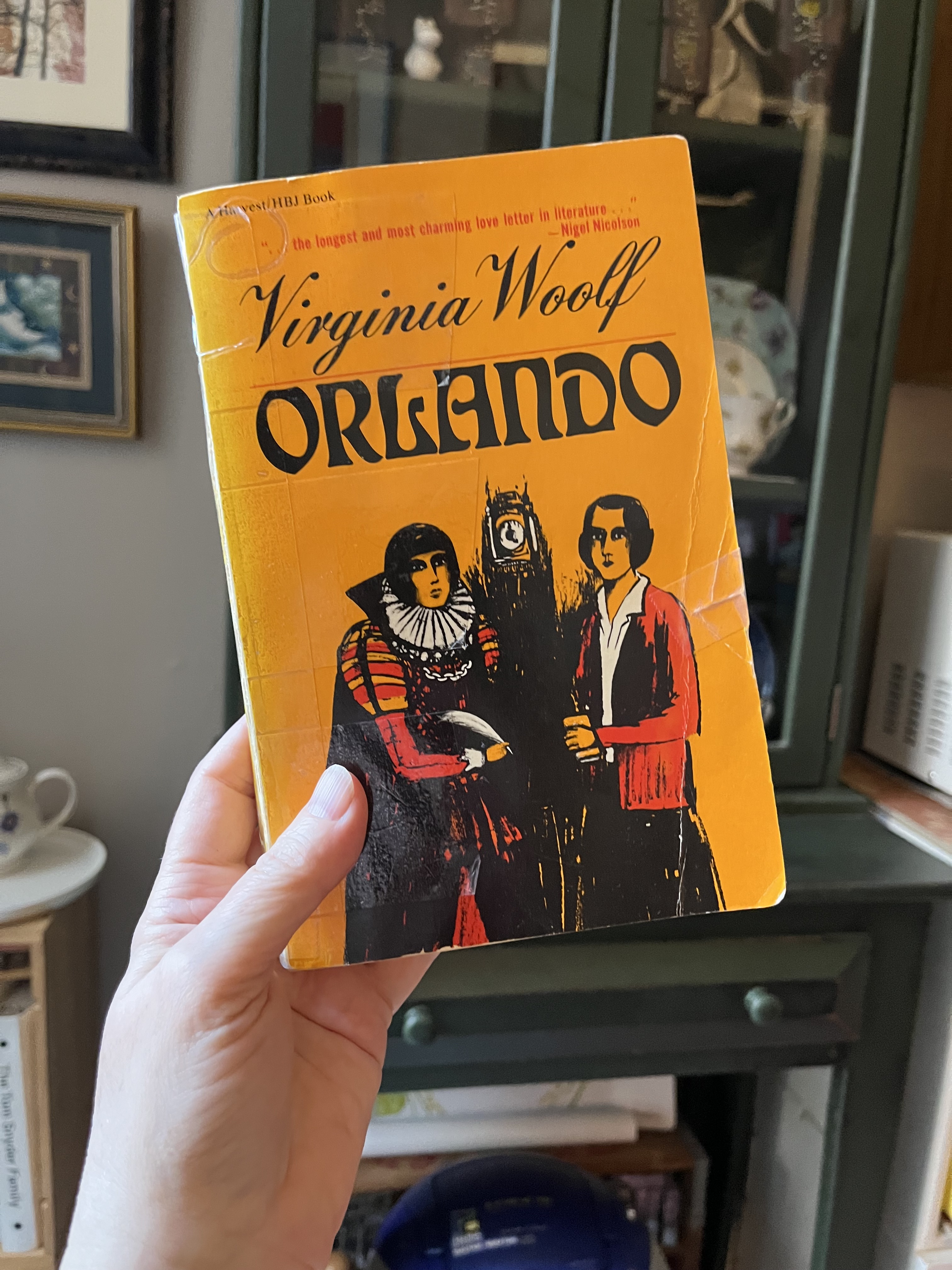
The well-worn copy itself.
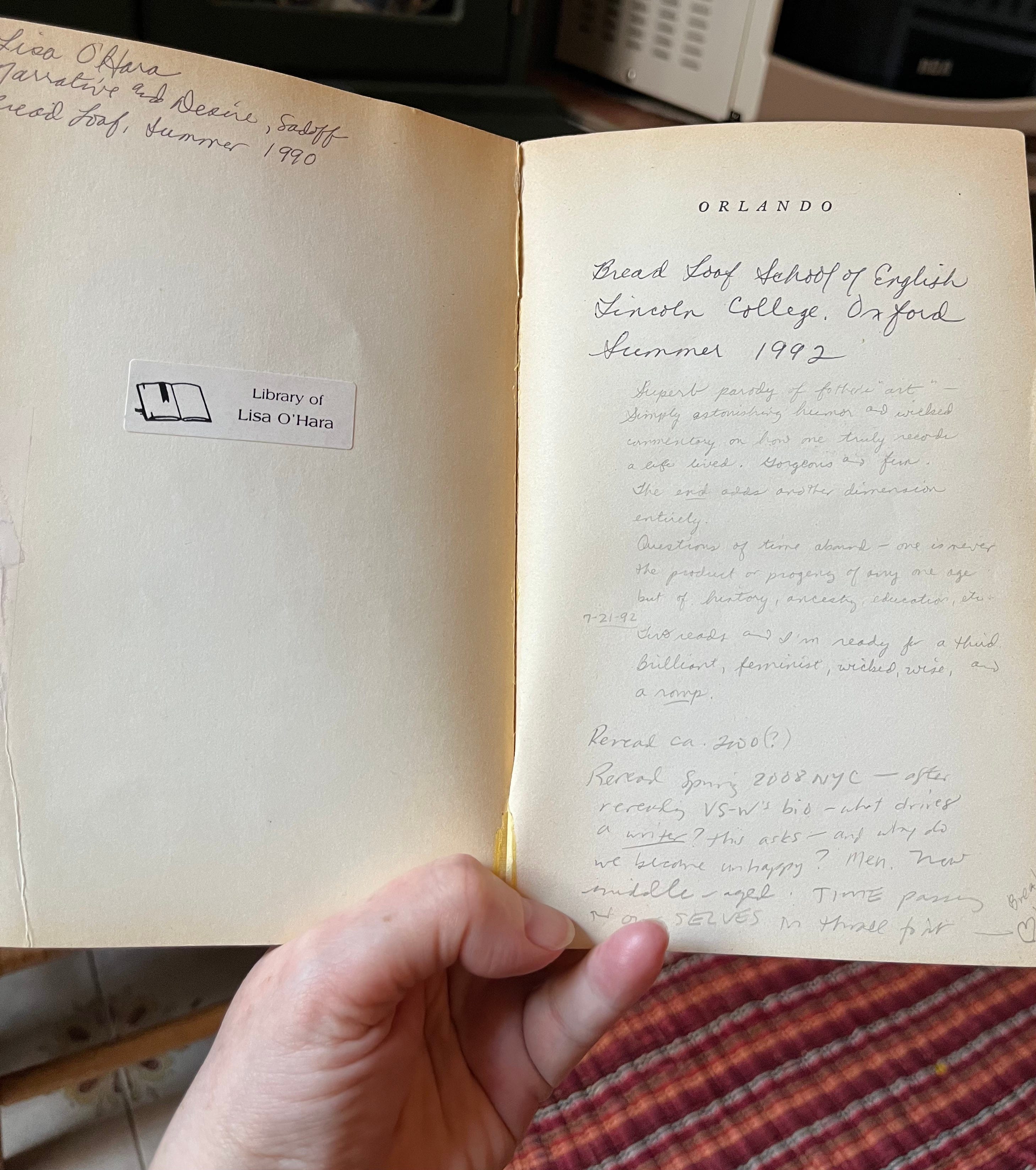
The first novel I read that centered gender is Virginia Woolf’s Orlando: A Biography, which I decided to reread. Because I read with a pencil in hand, having conversations with my books, I see this must be my 6th reading of the full novel. (The only time I didn’t record impressions was in rereading it prior to studying in London in 2000, where I went three days ahead of classes so I might haunt Bloomsbury.) Each reading had a different purpose or at least caused me to come away with distinct, and distinctly limited, impressions. First, I was wowed by Woolf’s imagination—so different from that stultifying attempt to read To the Lighthouse in college; later, the more I learned about Woolf’s life, I was charmed by how her novel parodied her father’s profession as editor and writer of the Dictionary of National Biography in England. But more profoundly, Woolf’s novel was a deep reimagining of the life of her lover, for a brief period, and dear friend Vita Sackville-West. I’ve read the novel, then, over 30 years and with many discoveries, but this was the first time I read it with an intention: while I’d enjoyed the fantasy element of Orlando changing from a man to a woman over some 350 years, up the “present moment,” aged 36 in 1928, I had never thought about this gender change more than intellectually. Yes, we see what it’s like to be a woman vs. a man over time, and that somehow Orlando having had female lovers is still okay by the novel’s end, which is quite an achievement in modernism. But what am I missing?
The record of my rereadings. Do you do this?
Books become different because we become different readers, which is why rereading is so important. This particular revisiting was prompted by a movie. Back in the early winter I went to Film Forum here in New York to see Orlando: My Political Biography, a documentary in which several trans people were interviewed about their encounters with this novel, how it became their identity bible, how it helped them survive. Because I had no personal reason to connect with the novel on that level, I’d never read it that way (and these readers needed none of the backstory of Woolf and West to find the novel both revolutionary and comforting).
But now I had Sam and Mx. Viv (as well as my friend’s grandchild, now completing middle school as a boy); I’d seen the latest in a series of American horror stories, this the story of a nonbinary student in Oklahoma beaten to death in a high school restroom by (gender-assigned) girls, the student’s head smashed in over and over and over against the floor. Where does this hatred, this viciousness, come from? Where is all this fear coming from? Could reading Orlando again help me figure something out?
Woolf’s novel was (as Nigel Nicolson, the younger son of Vita Sackville-West, said) obviously a “love letter” to Virginia’s friend Vita, who when her father died learned she could not inherit the family estate Knole because she was a woman; so the famous estate went to her second cousin Edward (who had had nothing to do with the place unlike Vita, who’d loved and cared for it and kept it running all her life), who in turn sold it to the National Trust. Vita was bereft. In addition, Vita was bisexual, married to another bisexual, Harold Nicolson, and lived her life more or less as a man in her independence. Hers was quite a complicated life story in any era, but especially in 1928, when the book was published. Woolf’s novel was a spectacular best seller.
One might well ask, How did Woolf get away with it? In her infinite genius, she went full-on fantasy, beginning Orlando’s life back in time, when Queen Elizabeth I gifted Knole (fictionalized in the novel) to Thomas Sackville, Vita’s ancestor, and when Orlando (of the title) was a boy of 16. By taking Orlando through the ages—via the voice of a biographer-narrator who confesses to being as mystified as the reader at the changes, saying simply, “but that is what happened, what can I do”—Woolf subverts the gender transition though timetransition. Readers are kept off balance through humorous descriptions of the awkwardness of the gender transition, exploring the mores and their differences for men and women through the ages. Orlando embraces, finally, her many selves, her genders, over all the centuries, coming to the present moment as a poet, a wife, a mother, a woman in the 20th Century.
The novel, as a note to those of you enticed (I hope) to read it, is not without ugliness—casual bigotry and acceptance of colonialism shockingly run throughout—which shows that no author, however enlightened in many areas, can be expected to be enlightened in all areas. But as Woolf’s biographer-narrator might say, “Difficult though this is, it’s what happened, and so we must record it.”
I must say, this journey of the past few years has been deeply affecting. I had never really thought about being a cisgender woman attracted to men since birth; I’ve had to ask myself if I was ever attracted to women, and yes, I have been—but only once I remember, as it happened oddly, suddenly, and then the feeling passed, in the audience of a theater maybe 15 years ago. I was in perimenopause at that time, I think, increasing in testosterone—was that it? Who knows? But it was real. Why did it hit me as something wrong? Why must anyone be tormented for having healthy sexual feelings, loving feelings, for our fellow beings; for wanting to express what is inside us in honest ways? Why do we continue to insist on gender reveals, coming outs? I used to wear dresses as well as pants; now I wear exclusively pants. I began dressing as a man, I guess, but with scarves and jewelry; and as a woman in America I can do this. Why can’t anyone of any gender simply discover and express themselves honestly?
“When this happened, Orlando heaved a sigh of relief, lit a cigarette, and puffed for a minute or two in silence. Then she called hesitatingly, as if the person she wanted might not be there, ‘Orlando?’ For if there are (at a venture) seventy-six different times all ticking in the mind at once, how many different people are there not— Heaven help us all having lodgment at one time or another in the human spirit? Some say two thousand and fifty-two. So that it is the most usual thing in the world for a person to say, directly they are alone, Orlando? (if that is one’s name) meaning by that, Come, come! I’m sick to death of this particular self. I want another.” ~ Orlando, page 308 (HBJ edition)
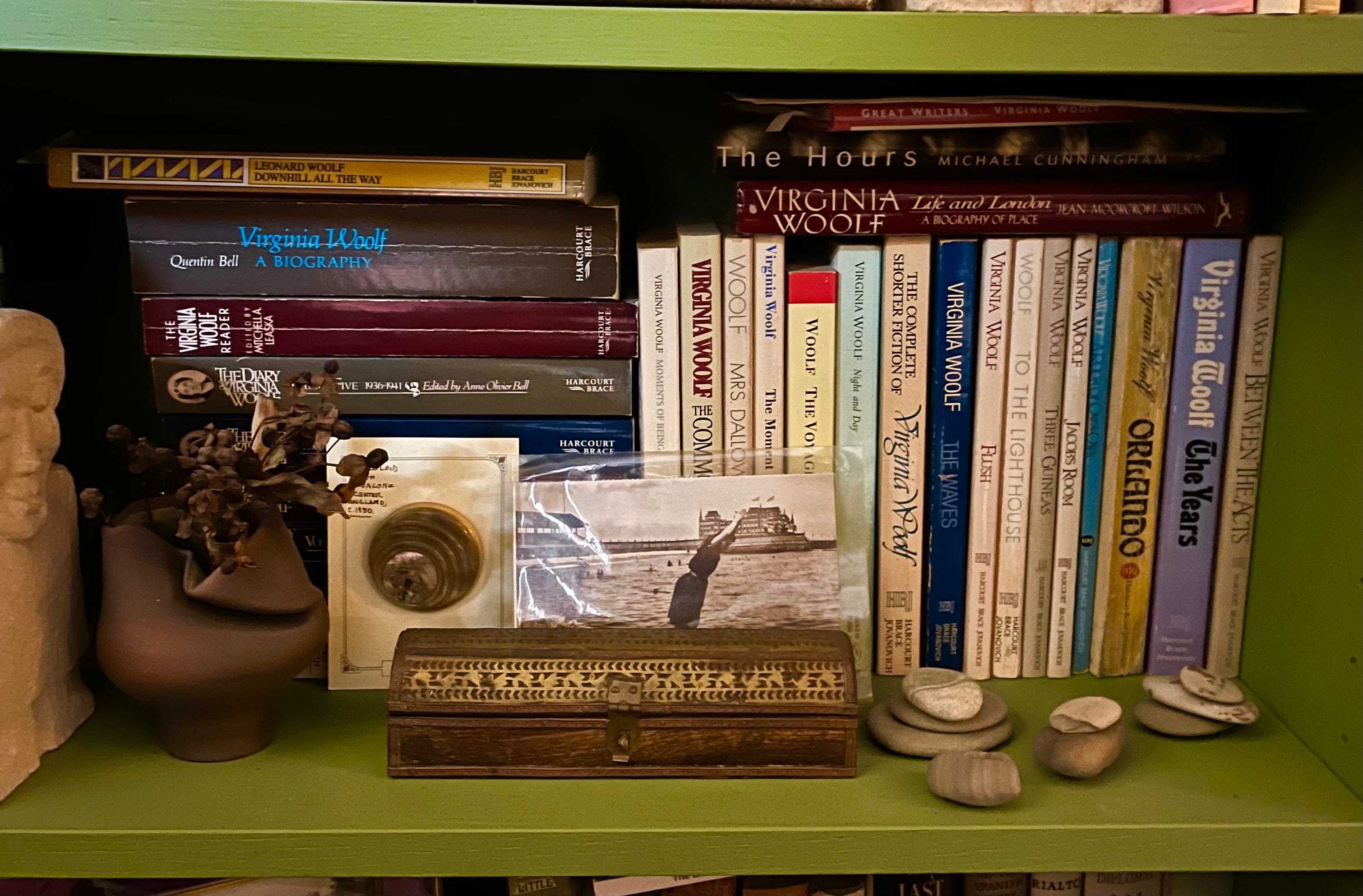
Miss O’s Woolf shelf, partial view. Essays, letters, diaries, and especially her fiction: Virginia Woolf remains my favorite writer. Orlando, taped and glued together many times over, was my gateway.
And this is where I am in this moment, today, the 10th of March in the year 2024, writer, artist, editor, daughter, sister, friend, woman. What about you?


 The Miss O' Show (Teacher's Edition)