
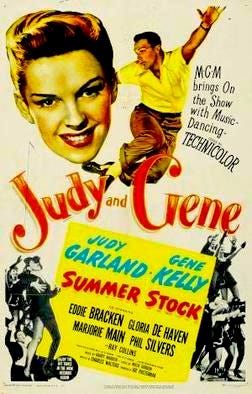
First of all, I have come to love this movie. Second of all, whenever Summer Stock, an MGM musical from 1950, appears on TCM the host always notes that 1) it’s Judy Garland’s last MGM musical; 2) this is one of the lesser MGM musicals; 3) Gene Kelly signed on in a less prominent role as a favor to his friend Judy who gave him his start; 4) Judy was obese at the time of filming; and 5) Judy’s iconic “Get Happy” number was filmed after production closed, and she’d “slimmed down.” It really sets you up to watch the film with a “pity” and “I guess I have nothing better to do” mindset, right? The movie deserves so much more of an intro boost, and maybe someday Miss O’ will be famous enough to be a guest who can explain all this to Ben Mankiewicz; in the meantime, I’ll introduce it to you.
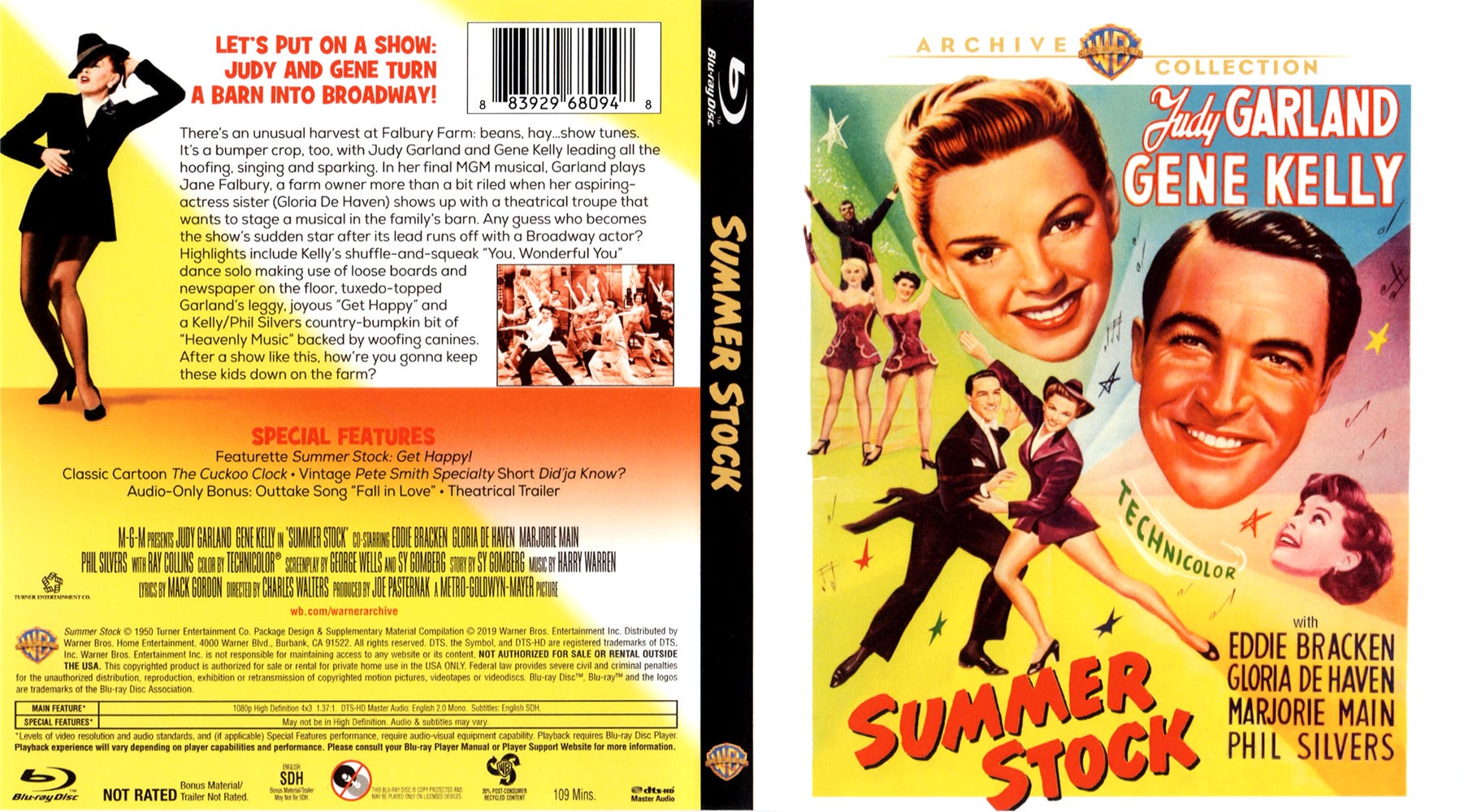
Get Happy
When I was a kid in the 1970s, I fell in love with movie musicals that showed up on TV on the weekends, usually on syndicated channels, and spent hours and hours memorizing them. This was a confusing exercise. Interrupted as they were with commercials every three to five minutes, the movie plots were pretty much impossible to follow. For example, the opening song of Summer Stock, “If You Feel Like Singing, Sing,” follows the camera over “Falbury Farm” to Judy in her room to singing in the shower to putting on her farm clothes, and as she makes her bed, she learns from her housekeeper Marjorie Main that “Frank and Zeb” are “dressed in their Sunday clothes,” and…cue commercial for Ginsu knives. The next scene was probably Judy going to the kitchen, saying, “I don’t blame them,” and you think, “Huh?” Years later, watching the film uncut on TCM you realize that the network cut out the scene where Frank and Zeb quit their jobs, and how unsuccessful the farm has been, in order to make room for more commercials while my child head spun.
Another plot point that made the movie impossible for a kid to follow on syndicated Sundays is that Judy’s character, Jane Falbury, changes her mind solidly three times about allowing the show to continue in her barn. It’s totally reasonable that she does this, unless between mind changes a network cuts dialogue to insert commercials for Koons Ford used trucks, Ding Dongs, and Aqua Net.
As a result, Summer Stock was lost on me on my first viewing, whereas musicals like The Wizard of Oz, Anchors Aweigh, and Singin’ in the Rain, though no more complicated in their plots, had more understandable and entertaining musical numbers for a kid like me.
What led to me write about this little musical gem (because it is) has to do with summer boredom during a heatwave her in New York City. Right now my job is really slow, and I’m not ungrateful for that, but it’s hard to concentrate on anything with little in the way of deadlines attached while still being tethered to my laptop. To give myself some company, I look for movies to run on a loop when I can’t find procedurals like Law and Order in reruns, and Summer Stock came up On Demand. Over a dozen viewings later, I have this mature, wonderfully acted movie memorized, and more than that, I watched it with different lenses trained on it that might be interesting to, I don’t know, someone. Here we go.
Judy Garland’s Body
Here are a couple of photo stills from the film to help you understand how fat Judy was during filming:
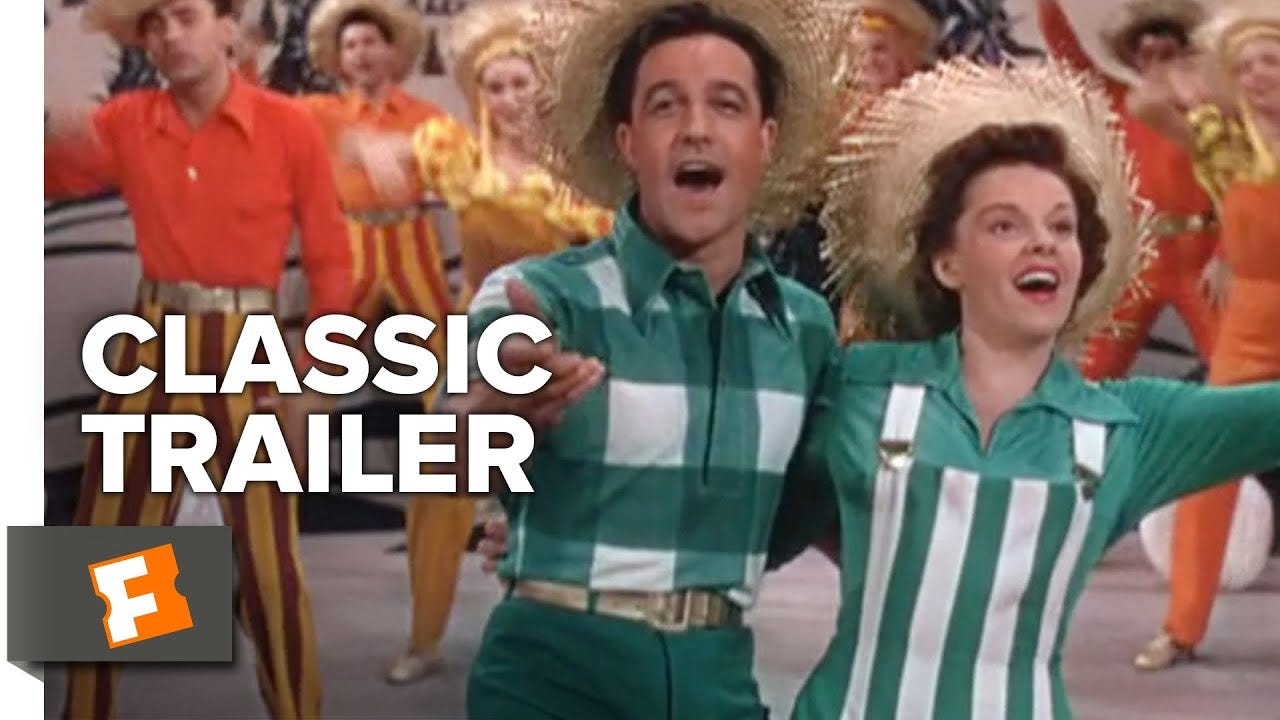
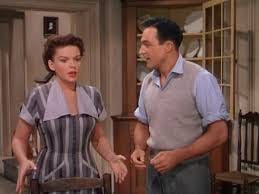
If, like me, you are squinting to see a woman whose body is listing toward morbid obesity, welcome to seeing a normal woman like a normal person. Since The Wizard of Oz, during the filming of which MGM Studios put their young star on a diet of amphetamines, it’s the first movie where Judy’s body is what I’d call womanly. Healthy, even. In her many films, from The Harvey Girls to Meet Me in St. Louis, from The Pirate to Easter Parade to The Good Old Summertime, I see a Judy who is thin, and it’s a little unnerving how thin when you see her body is also covered in layers of period garb. In fact, not really since For Me and My Gal, her first picture playing an “adult” woman character (opposite Gene Kelly, whom she’d seen on Broadway in Pal Joey and championed to be her leading man in that film, thus starting his career), could I recall seeing Judy Garland in modern dress. Summer Stock is also the first movie in years with Judy in short hair—a hint of the hair she will style in more elegant ways in the 1960s. In Summer Stock, the body type works since Judy plays a farmer and a sort of old maid, and after filming completed and her contract was up, Judy’s career came to standstill, morbidly obese by studio standards and washed up at age 27.
The MGM Circle Game
Judy started out her career proper has Andy Hardy’s love interest in the Mickey Rooney franchise of movies in the 1930s, most famously Babes in Arms, where the kids entered the realm of movie legend when they found a barn and put on a spectacular show despite the town’s disapproval and the doubt of their families. I don’t know if it was deliberate that Judy Garland ended her MGM career on a farm set, hearkening back to where she found stardom in The Wizard of Oz, and inside a plot with a “let’s get ourselves a barn and put on a show” where she got her start, but it’s really kinda nice.
In Summer Stock, Judy Garland is no longer a sidekick ingenue in search of a show, or a waif who dreams of a world beyond the rainbow over Kansas. This Judy plays Jane Falbury, and she owns the farm (in a small community in what appears to be Upstate New York or Connecticut). Early on, we learn that the farm has been unsuccessful, Jane is engaged to Orville (son of the farm supply store owner Mr. Wingait), and her younger sister Abigail is due back from New York City that afternoon. And what do you know, Abigail surprises her sister with Joe Ross (Gene Kelly), the director of a new Broadway show looking for an out-of-town place to play, along with all his cast, crew, and sets. In the process of figuring out whether the show folk will get to make this happen, Jane’s housekeeper Ess (Marjorie Main) reveals that Jane and Abigail had dance lessons all their young lives, and Gene sees Judy do a little dance in the kitchen. Fireworks ensue!
Why Watch It?
Sure, there’s a predictable plot, tempers flare, people burst into song, love ensues, and a star is born, but the emotional world of this musical is more mature than in other movies, a maturity that resonates with the Miss O’ who still loves musicals a grown-up. This movie opens to reveal a woman who is comfortable in her body, who loves to sing and sings great, who without question runs a farm, and who genuinely loves her life. She is independent in the important ways and wants no rescue, no change. But you get the feeling that despite her four-year engagement to childhood friend Eddie Bracken, Judy/Jane has never known love. Orphaned young at some point, her entire life has been devoted to raising her sister and keeping the farm going. She doesn’t resent it. And she doesn’t realize that she’s been missing a thing until that devilish smile in the form of Gene Kelly arrives to shake her up. Gene and Judy are emotional equals. They spar, they compromise, they fall in love, sure.
But what strikes me most in this movie is that leading man Gene Kelly is a supporting player. The film is totally Judy’s. And the result is an uncharacteristically light and lovely Gene Kelly. Not that he isn’t wonderful in his films. But here he is not wildly aggressive or ego-driven, he has nothing to prove, and he doesn’t have to carry the picture. He’s not a ham. The dances are staged by Nick Castle, though Gene probably choreographed his solo routines, so he’s not carrying that load, either. His role as the show’s director Joe Ross is totally believable, and Gene plays his rages and fibs and falling in love with a master’s touch of humanity. He’s totally equal to Judy on screen, but it’s Judy’s movie, and his performance is the better for it. I think it’s one of his best.
In addition, it seems to me that however “lesser” this musical is in the canon, this is an important film in Gene Kelly’s development as a choreographer. In some of the dance numbers you can see the seeds of even more iconic numbers to come. For example, the staging of “You Wonderful You” with Judy presages “Our Love Is Here to Stay” with Leslie Caron in An American in Paris (1951) and “You Were Meant for Me” with Debbie Reynolds in Singin’ in the Rain (1952). Other dances in the film show classic Kelly moves he will use even more imaginatively in those later films, like the matador move, the airplane move. It’s fun when you realize this because of the order the movies come in. And you are a total movie musical nerd recalling these notes from memory.
Judy’s range as Jane is something she usually doesn’t get to display in other films—fully human, grown up, shifting from joy to concern to rage to apology to thoughtfulness to bargaining, with ease. And what makes Judy such a superb actress is that she is fully present in every scene, with every actor, no matter the roll. Her emotions are both raw and in control, and as a woman in late middle age, I connected with this character as I don’t generally get to do in musicals. Twelve-year-old me would never have enjoyed the vulnerable and tender moments between Judy and Gene, especially in “You Wonderful You” and “Friendly Star.”
The supporting cast is a Who’s Who of some of the finest character actors ever on screen: Ray Collins, Eddie Bracken, Phil Silvers, Marjorie Main, and Hans Conreid, as well as up-and-comers Gloria De Haven and Carleton Carpenter, and an ensemble of wonderful dancers. (One of those key dancers is Jeanne Coyne, married then to Stanley Donen (who will go on to co-direct Singin’ in the Rain with Kelly two years later), who was one of Gene Kelly’s dance assistants. Both people divorced by the late 1950s, Kelly and Coyne married in 1960. I think that’s sweet.)
Still, there are curious things in the filming that make me realize Summer Stock was not a top priority in the MGM perfection department. Charles Walters’s fine direction notwithstanding, there are couple of clumsy edits, unusually sloppy for MGM, both featuring Judy. In addition, as I mentioned, “Get Happy” was added in a re-edit of the film post-production, and great as that number is—possibly her best on screen—it doesn’t quite jibe with the rest of the proceedings. Also, after several viewings I finally paid attention to the final credits, where a noticed an actress named Nita Bieber “as Sarah Higgins.” And I’m like, who? So I deduced in subsequent viewings that this was the dancer who wears glasses and is always reading and has one featured dance moment; and I inferred there was probably a story for her that ended up on the cutting room floor, surely for the best. Her screen card may have remained for contractual reasons, or possibly out of laziness.
And when critics all point out that Garland is “obviously” thinner in the added number (and I noticed that the scenic background at least is in an earlier part of the film), I have to say I don’t see it. “Get Happy” is the only number where we see Judy’s legs, and on a 4’11” frame even five pounds would be a lot, as if it matters. And throughout the film, Judy dances like a dream, and dances a lot, and is clearly in great physical shape. I don’t know why critics feel compelled to talk about her weight. I really hate that. Judy Garland is simply great.
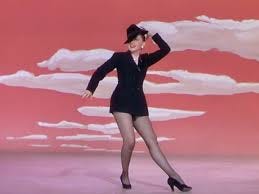
You might think Judy deserved a better or more glamorous movie send-off as her contract expired. The studio, which her talent literally helped make great, got her hooked on pills and then got mad when their work horse wasn’t able to perform and had no-show days on films such as The Barkleys of Broadway, where she was replaced by Ginger Rogers (in her last appearance, and only one in color, with Fred Astaire), and Annie Get Your Gun, where she was replaced by Betty Hutton. (Hutton told TCM host Robert Osborne that the crew of that film resented her terribly for taking Judy’s part, which is unfair, of course; by all accounts I’ve read, the crew at MGM loved Judy Garland.)
But I’d like to say that I think this lovely, mature, sweet, goofy musical treat, a kind of retrospective of all the films of Judy’s great MGM career, is a perfect movie for the middle aged, for the summer. If you need something to take your mind off the unutterable evils swirling nonstop around us, you might try the pretty, tender, talented world of Summer Stock (commercial-free on TCM). In the meantime, you might take a look at the duet arrangement Judy made of her iconic “Get Happy” with Barbra Streisand’s “Happy Days Are Here Again.” The number that keeps on giving.
Love to all.

 The Miss O' Show (Teacher's Edition)