The Woman Mind: A stroll in our political landscape

When I got off the 7 train in Queens last night around 11:45 PM, damp and chill after a wintry weather day (I’d gone into the city to see Harry Potter and the Cursed Child on Broadway last evening with a friend visiting from out of town, and all I could think during a scene showing Death Eaters, was “Oh, look, ICE,” but everyone else was just super excited that the grown up Draco Malfoy was being reprised by the movies’ Tom Felton—he was delightful), I crossed the boulevard to a bodega to pick up pita chips and hummus for a late night snack (the show was three hours long, dinner was five hours before). Inside the bodega were an assortment of loud males: one older white guy, very Queens working class; two Black guys around 30-40 years old; and a younger Hispanic guy. They were guys, if you know what I mean—you rarely see guys on television or in movies anymore, and I think this is a shame. Gym-cut, professionally groomed, and models of the self-care craze, actors today really have a hard time being interesting, but they do attract some chicks and the agents, and it’s all about the bucks.

Behind the counter was a young Middle Eastern cashier/manager (not really a guy type, more composed and elegant) staring at this one talkative Black guy standing by the white guy. I found my chips, my hummus, and when I went up to pay for them in this cramped deli area, I was barely noticed by the cashier; you could see that the talkative guy was either on something or off meds, was too-calmly ranting about something, and would not be talked down or moved off topic. I put my purchases up on the raised counter, but the cashier/manager kept his eyes fixed on the talkative guy; the old white guy was trying to be a casual peacemaker, but the cashier/manager said, “I don’t want to talk to that guy anymore,” his eyes wide, a little frightened, because that talkative guy was clearly this close to exploding, and the other two customers were really confused; they all seemed to know each other but it didn’t matter. I managed to get the purchase acknowledged, paid cash, tried to say, “I don’t need a bag,” but the stuff was being bagged on autopilot, eyes never on me, and I simply took it and my long-coming (but correct) change and booked it out the door and up the street.
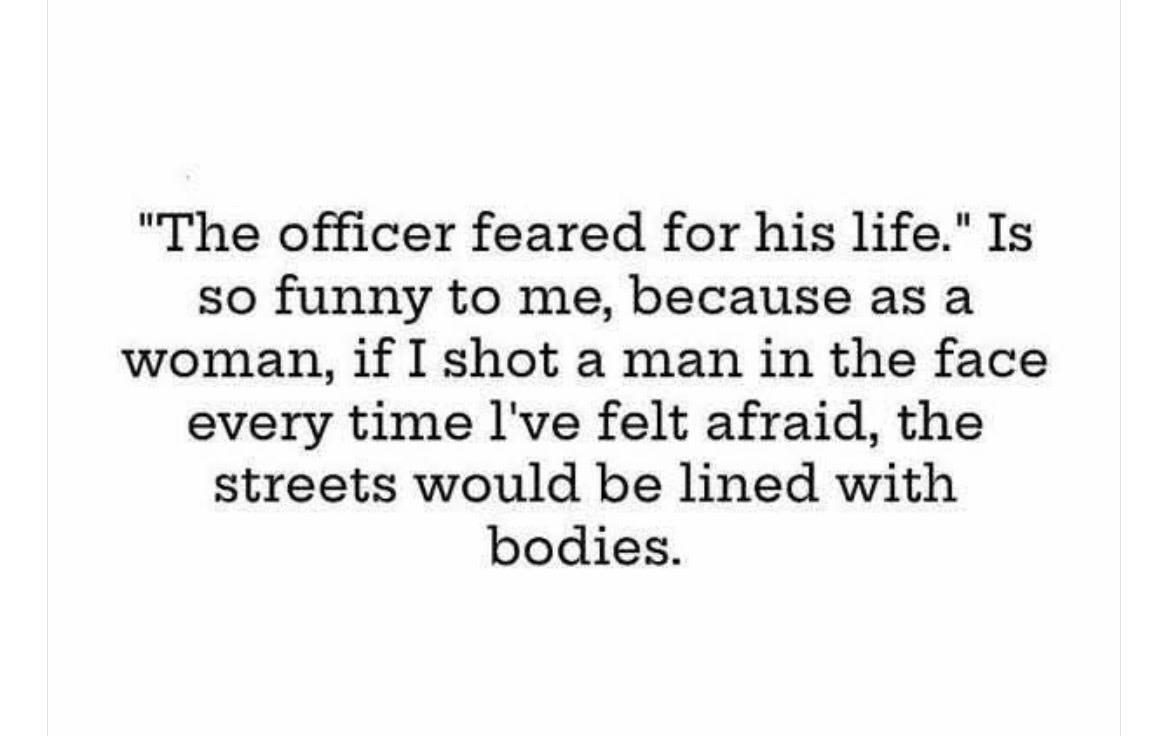
By the way, for the men reading this, this is what it’s like for women to live in the world all the time: because there is never not a threat of imminent violence, we have to stay vigilant; if we aren’t the targets of violence at a certain moment, it’s because we simply don’t exist (I can promise you not one of those men saw the old lady buying hummus) or there are other women experiencing violence somewhere in the vicinity. Even when women aren’t consciously thinking, “I’m about to raped,” we can’t walk down any street by day or night, or enter or leave our cars or homes, without knowing “this could be the day.” Renee Good’s murder is one of a string of these inevitable events; the officer will face no consequences (unfortunately for us the decent, the martyr role won’t stick, as Good was not only a woman but a liberal activist and a lesbian, and so America on the whole is okay with her murder).

Back to the bodega: if there’s an emotionally charged dispute of some kind going on, not even with yelling—and not one of these men registered the imminent threat except the cashier/manager, who has seen this too many times, no doubt, and me—all any woman would want to do is escape this. Guys (straight, I’d qualify) are, unfortunately, almost universally unteachable when it comes to these situations if they don’t have high level empathy already (in my limited life experience).

These males in the bodega were at once too blind, too self-involved, and too emotional to figure a way out of whatever this situation was, a situation which suggested at worst drug-addled paranoia, at best bruised ego, rather than any actual injustice. Petty stuff.
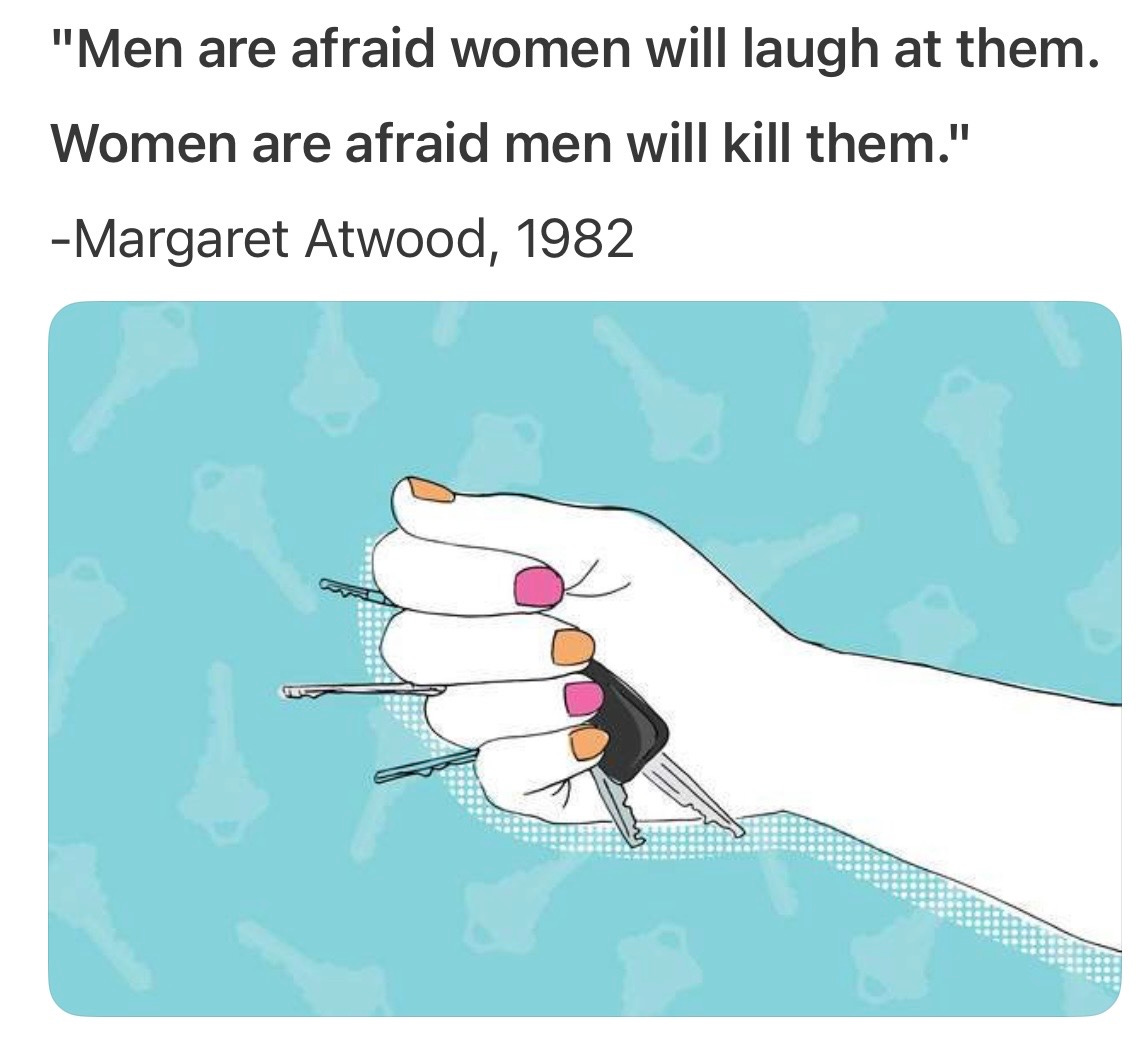
This morning, I happened on a post by a woman whose voice I’ve come to value deeply, a fabric artist named Orsola de Castro, who speaks sense on all matters of patriarchy, and today’s post seemed to dovetail with my late-night Queens bodega experience, by way of a totally different subject: AI. This has to do with temperament not just of “guys” up there but of educated “men” in suits. Patriarchy has a common thread of blind ego.

Male inventors, de Castro notes, have pushed women to the margins in the AI field, thinking (dubious word) that they can just throw money and ideas and tech at AI and it will naturally sort itself out, which is beyond stupid. Women are natural teachers; men are not. I’ll let Ms. de Castro explain:

(Meanwhile, as I type this, Microsoft Word keeps popping up to offer to “rewrite” my creative work for me, figuring some male tech guy’s coding can read and render my thinking better than I could. It’s not only tragic; it may in fact prove our annihilation as a species on this planet. This is not a digression.)

And women’s safety as well as freedom comes down to bodily autonomy and human (male) respect for that. In another post, Ms. de Castro uses pop music woo songs to discuss a view on ballad writing to bed women, that all that came about because patriarchy—not women, but patriarchy—put women in towers, in chastity belts, valued virginity over sensuality and then tied themselves, the men, into knots because they had no access to us women. And who’s fault is that?

By extension, as we sit by and watch these out-of-control U.S. patriarchs with no imagination or empathy or real intelligence whatsoever make scorched earth of our geopolitical alliances, we know the women were and have been right about everything—Hillary Clinton and Kamala Harris the most recent big examples: men on the whole are too emotional, too limited, too narcissistic, too greedy, too short-sighted to be in power. And the women, as leaders, would have acted with thoughtful decision, which is not to say perfection. No one is that. But women don’t fight the system, they dismantle it and rebuild it. See Jessie Cae on Instagram:

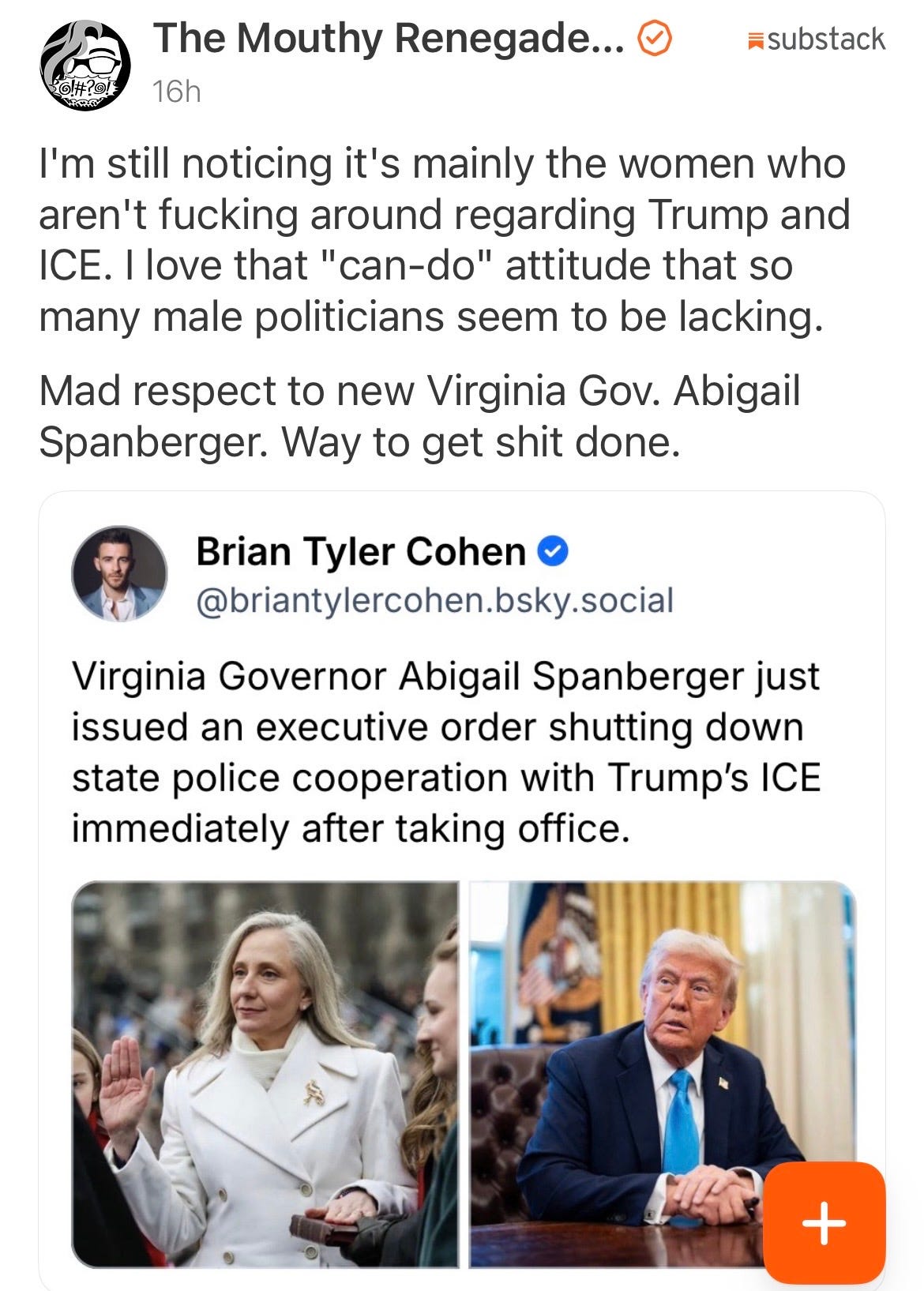
Gov. Abigail Spanberger (D-VA), the most recent example, was no sooner sworn in than she acted for the good of all, as per her office.
Something there is that doesn’t love the thought of a woman in power, even from other women, until they see a woman in power and she’s good at it. (Note: Kristi Noem is MAGA’s fantasy of a woman in power, in that she has none, but does the whole sexy swagger fantasy thing for the public at the altar of the Top Dog.)

Another post I saw on Instagram today had to do with what happens when a clueless patriarchal institution reaches out to take a pulse and is freaked by the response, their own work coming back to smite them:

Here’s real power, and power to the purpose: The key is providing what is sustainable. “Sustenance is the root of sustainability.” We have to stop “the eighty men in the one bus” with all the world’s money and return to the politics of caring. According to Vandana Shiva:

“Non-sustainability is violence against the earth,” Shiva says, and when the men’s only response is, “We’ll move to Mars instead,” I want to send them NOW.

Sending love on a rainy cold Sunday in New York during the revolution,

Miss O’
Screenshot

Erase

When your government wipes your history from its sites

Good morning, sweetie. At 5 AM I saw a text from my friend Susan, a humor piece from McSweeney’s:

IT’S A SHAME WE HAVE TO BETRAY OUR ALLIES, STARVE THE POOR, HALT SCIENTIFIC PROGRESS, DESTROY THE ENVIRONMENT, AND ELIMINATE THE FREEDOMS ENSHRINED IN THE BILL OF RIGHTS, BUT AT LEAST MY INVESTMENT PORTFOLIO IS ALSO TANKING

by TALIA ARGONDEZZI

It would be truly laughable if it weren’t really happening.

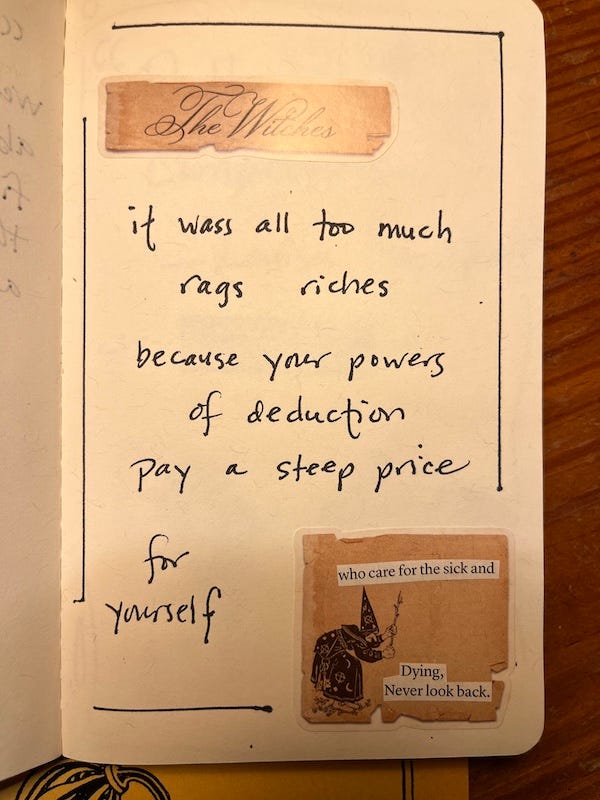
From one of Miss O’s little notebooks. Musings.

As you know, I live with a disturbed mind, born as I was a middle brow Cassandra, driven mad at times by unwanted prescience, the way (for example) even as I was moved by and marveling at Hamilton and Suffs on Broadway (some ten years apart), I knew they were not celebrations but elegies. It’s not for no reason that I felt that way: those shows bookended the beginnings of not one but two Trump terms.

As testament to my madness, I’ve found myself laughing at our Senate all these weeks, both Democrats as well as Republicans, holding all those “confirmation hearings,” because somehow the Democrats couldn’t see (and still can’t) what all the rest of us outside the Capitol Bubble could and can, that these nominees are being sent in to dismantle and erase our democratic republic. Senate Minority “Leader” and traitor Chuck Schumer (D-NY) is genuinely baffled as to why he had to cancel his “book tour” due to threats. House Minority “Leader” Hakeem “I don’t know” Jeffries (D-NY) had to cancel his little book tour, too. These two “leaders” haven’t been successfully doing shit to defend the republic for years (what did they even write about?), and yet think now is the time to take victory laps. They have, essentially, erased themselves from history even as Trump’s minions of white supremacy literally erase the achievements of women, Blacks, Native Americans, and all other minorities from all government databases.

In further erasure, Secretary of Defense Pete Hegseth has fired all women and Blacks from senior military leadership. Today I read that the Dept. of “Justice” has given President Trump the green light to fire all women from leadership positions in government. Trump humpers have no sense of history. It’s so childish, isn’t it—like the way kids think their mom won’t notice the broken vase if they put a tee shirt over it—only now the stakes are life and death, civilization vs. barbarism.

There is a poetic technique called erasure, in which the poet takes an existing text—something out-of-print, say, an old book, or a magazine—and maybe circles the words that strike her fancy or uses a pen to mark out words she isn’t drawn to. Whatever words remain can be shaped into a poem, using the words in the order she finds them, or rearranged. (Poet Amanda Gorman has a section of her collection, Call Us What We Carry, dedicated to this technique.)

My friend Katrinka Moore has a collection of poems inspired by this technique, and it’s still my favorite of her many books, Thief. In a few places, she reveals not only the found poem but the process.

From Thief by Katrinka Moore BlazeVOX [books], Buffalo, NY, excerpted here to encourage you to buy it.

I think a technique like erasure shows us that do what we will to erase a text, there is something still to draw us in, a word we simply cannot let go of, another word, language that helps us reveal something new. The text is not the same, but nor is it lost.

Aren’t there parts of your life you’d like to erase? I have quite a list. Or have you thought you’d erased something, and then one morning, out of a dream, or from a knock on the door or a text on the phone, there it is, the past? Because that’s how life works, isn’t it?

Reading Joseph Campbell, as you know I have been, I’m reminded how mythology teaches us that no amount of annihilation, erasure, or running away can move us past the past, or past guilt, or spare us a reckoning. The story of Oedipus (whom the Oracle of Delphi prophesied would kill his father and marry his mother, and so whose parents cast him out as a baby, only to have him adopted and live to do that very thing), to take one example, teaches that one meets one’s fate in the path one takes to try to avoid it. You’d think humans would catch on; but in the West we have lost our mythologies.

To take another example, the First Council at Nicaea in 325 A.D. tried to force Christianity into tight constraints of how to believe and worship, and cast out and buried the so-called Gnostic Gospels, especially the Gospels of Thomas and Mary Magdalene, whose testimonies of Jesus’s teachings could not have run more in opposition to the Nicene religious oppression that is what the world now knows as Christianity. (If God is in your pocket, and if everyday men and women can equally teach and preach, you don’t need a patriarchy or a church; and you realize how truly radical Jesus was, and how close to the Buddha, to erase authoritarianism.)

But those Gnostic Gospels were uncovered in 1945 in Nag Hammadi, Egypt, because you know what? Try to erase what you will, the truth surfaces. Anyone who has suffered a trauma knows it has to be dealt with someday. There are only so many boxes you can keep putting in the closet before the closet explodes. Pick a metaphor.

Like Christianity, whatever was intended, our democracy (however imaginative) was founded on genocide, on slavery, on the subjugation of women. Do what they can to erase a people and history, people survive, history will out. Do what they can to shackle, people break free. You can’t erase that spirit. How is it that oppressors still think, in 2025, that erasure means obliteration? Yet we can’t quite erase authoritarians, either. We are all thieves, I guess, stealing what we can to make our worlds, always a price to be paid. Ask Prometheus. But some thieves are righteous. Ask Jean Valjean.

In one of my little notebooks, I took an erasure poem I made and illustrated it; I did a second one with cut out words. There’s something calming about the process, I think, because of what is revealed in our attraction to certain words. Should you try it, and I hope you do, let me know what you reveal.

Sending love, unerasable,

Miss O’

On Orlando and Transitions

Meditations on Transgender Humans

From the NYPL exhibit on Virginia Woolf, 2023. Photo by LO’H

A couple of years ago, the social media posts of “Sam,” a young gay man in his 30s, the beloved former student of a late teacher friend of mine, began shifting from a fun social and work life to marking a life in transition. First, Sam shared multiple moves, the most alarming (to me) was a move (for work) to a dangerously bigoted Southern state, where he was determined to make a go, build a community, and change hearts and minds. As life there, despite his best efforts, became less and less tolerable, he found himself in transit yet again, back to a major city in his home state. Shortly after this move, about which he detailed his joyful creation of a new home with the help of many friends, he began including pictures of himself in “feminine” clothes and accessories (pictures that reminded me of Tom Wilkinson’s character in the landmark film Normal.) Not long after, Sam formally announced that he was beginning a formal transition from “male” (assigned at birth) to “female,” which Sam said was the gender he had always felt he was. What has followed includes his documenting phases of this journey, including legal name and gender changes on his/her/their identification cards, photo records of a shift from pants to dresses and in a face in full makeup, the results of their hormone treatments, and most recently and significantly, a diary of their gender reassignment surgery, their plastic surgery to make their face more feminine, and the post-op difficulties that are part of the process.

For my own part, as an advocate and ally of the LGBTQ+ community, I have found watching this process overall to be troubling. Because I haven’t understand the source of my feelings, and because I still don’t know how best to be supportive in an honest way, I made a decision not to “heart” Sam’s posts, but instead to follow them at a distance, as it were, while working on myself to get a handle on what “transgender” means and how best to understand my muddled response to it.

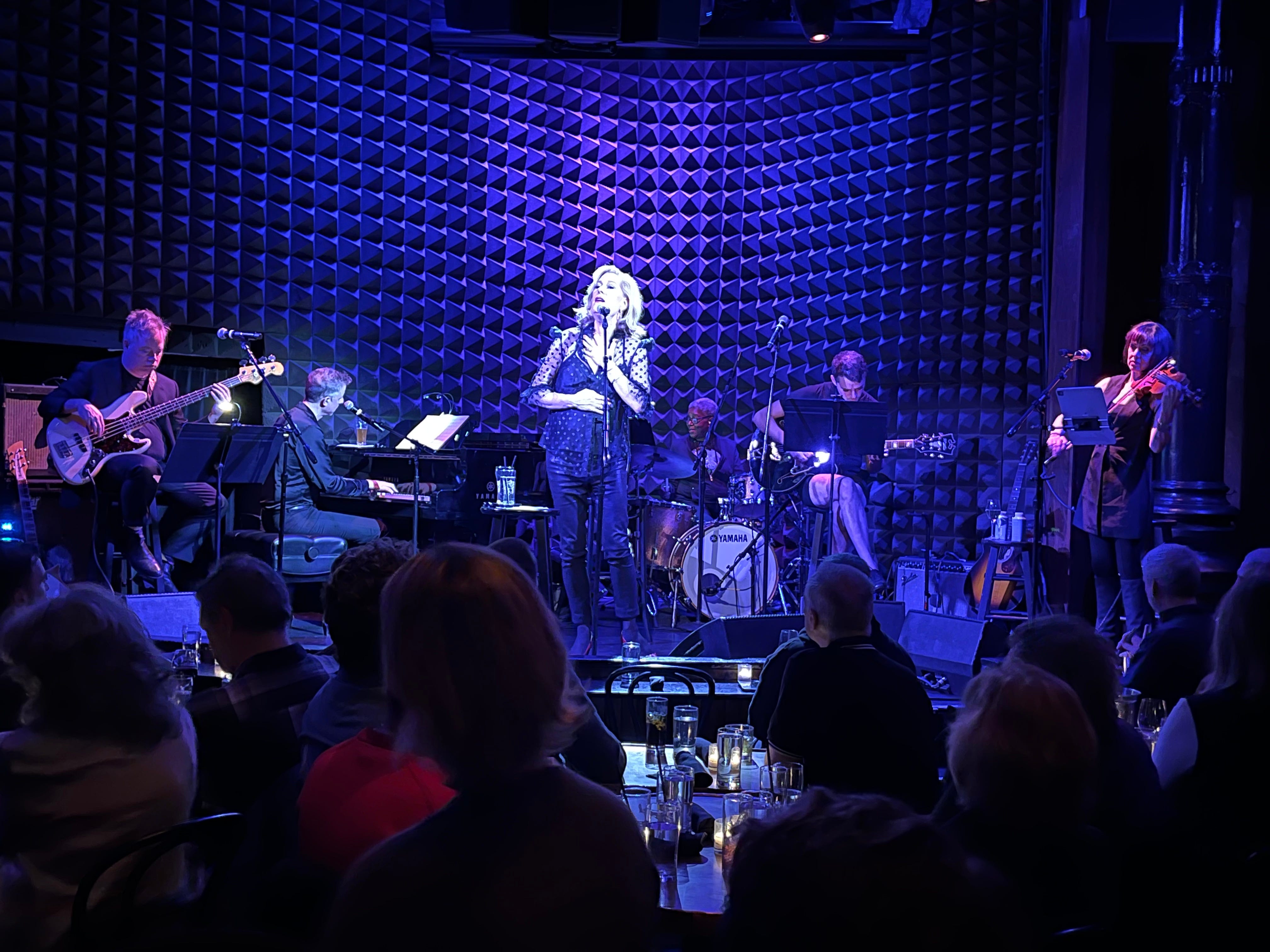
The start of my own encounters with this cultural shift began by seeing cabaret. One of my favorite live performers in New York is Justin Vivian Bond, who as Justin Bond made a name in the downtown cabaret scene (and later, on Broadway, where I first saw them) in the character of singer Kiki DuRane in the duo Kiki and Herb, with Kenny Mellman as the always supportive Herb on piano. When Bond made a decision to present as female and then transition (with hormone treatments, but forgoing gender reassignment surgery), I remember items in New York magazines taking the famously cross-dressing Bond to task, saying, “Vivian? Now you’re going too far,” that sort of thing. Mr. Bond became Mx. Bond, doubled down on their activism, and used music and humor to include the story of transition into their act. “Am I he, she? I don’t know what I am,” Mx. Viv said at Joe’s Pub one night during a tribute to Judy Collins, who was there to introduce Bond and their band; Judy had used feminine pronouns, asking, “Am I using the right ones?” and in response, Viv (who presents tipsy as part of the act) said he/she/they didn’t really care either way. At the time, the idea of changing pronouns was a fairly recent idea, and we were all on shaky ground. Why not acknowledge that?

Justin Vivian Bond in performance at Joe’s Pub, November 2023. Photo by LO’H.

As a society, we have all been, in fact, transitioning to a new, amorphous world where gender isn’t rigid. In response to this change I think (no doubt subconsciously), expectant parents began staging “gender reveal” parties, as if to say, “My child will know exactly who he, or she, is,” which we know now may or may not be the case. And sure, as with any movement, some kids may declare themselves to be other than the gender their genitals indicate, but the truth is nothing about gender fluidity is new. For example, as a child ca. 1920, and for at least two years until she was 14, actress Katharine Hepburn insisted that the family call her “Jimmy,” and she wore boys’ clothes and had her hair cut short. Her family just went along, and why not? But there is a darker side to this, too, because her older brother Tom (who wasn’t “manly” enough, some biographers have suggested, for Hepburn’s father) committed suicide at age 16; young Kath found him hanging in a closet. As a family, the Hepburns never spoke of it again. And I can’t help thinking that while a daughter, still, can present as a tomboy, there is, still, no society space for a young boy to present as a girl for a while, try that out; let alone for either to transition.

What was troubling me about Sam’s transition had to do with a vague feeling, and I mean to be honest here, of repulsion toward the idea. Why? Why was I feeling this? Did I not quite believe him, suspect he was being exhibitionistic to be, say, a sensational social media influencer? It crossed my mind. But I don’t think he’s lying. The problem was with me, and I decided I had to understand—what I could easily accept in Mx. Viv, I struggled with in Sam, I realized, because Sam is someone I have actually known since he was a teenager. My internal conflict was much closer to what the parents and friends of trans youth might feel than I at first acknowledged. All this is really to do with gender as a societal construct, which (I see now), I’d had the good luck never to have to worry about.

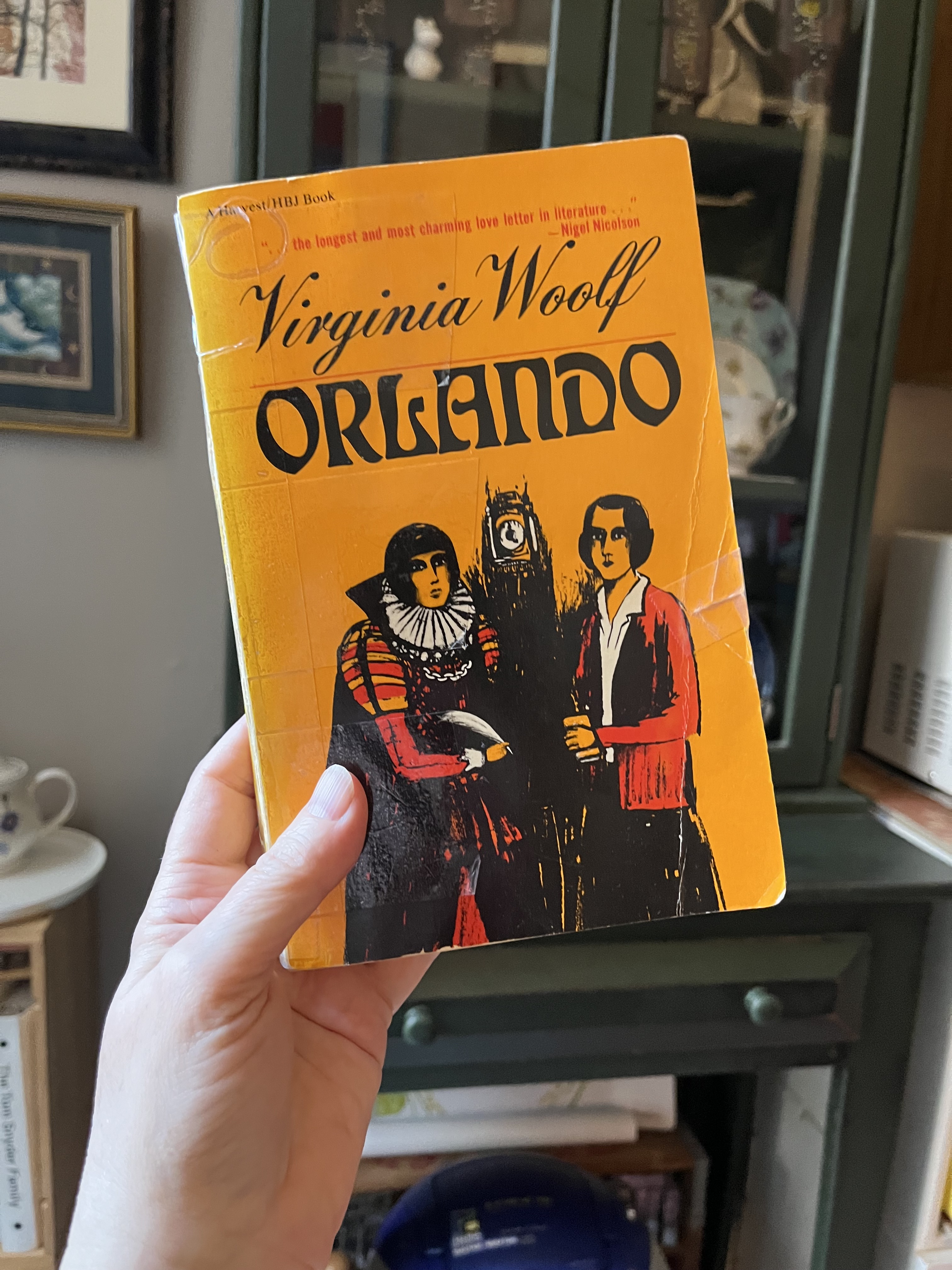
The well-worn copy itself.

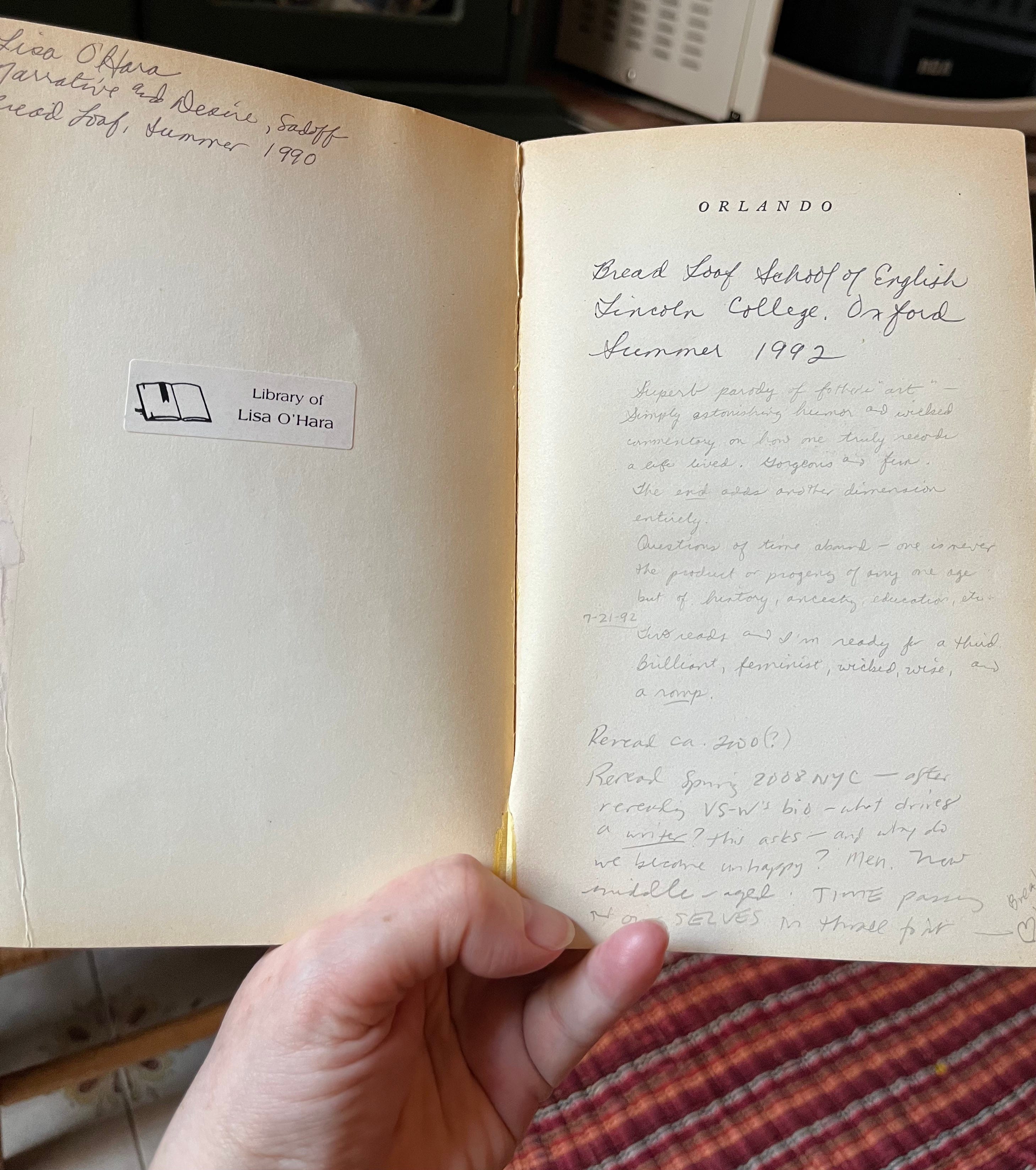
The first novel I read that centered gender is Virginia Woolf’s Orlando: A Biography, which I decided to reread. Because I read with a pencil in hand, having conversations with my books, I see this must be my 6th reading of the full novel. (The only time I didn’t record impressions was in rereading it prior to studying in London in 2000, where I went three days ahead of classes so I might haunt Bloomsbury.) Each reading had a different purpose or at least caused me to come away with distinct, and distinctly limited, impressions. First, I was wowed by Woolf’s imagination—so different from that stultifying attempt to read To the Lighthouse in college; later, the more I learned about Woolf’s life, I was charmed by how her novel parodied her father’s profession as editor and writer of the Dictionary of National Biography in England. But more profoundly, Woolf’s novel was a deep reimagining of the life of her lover, for a brief period, and dear friend Vita Sackville-West. I’ve read the novel, then, over 30 years and with many discoveries, but this was the first time I read it with an intention: while I’d enjoyed the fantasy element of Orlando changing from a man to a woman over some 350 years, up the “present moment,” aged 36 in 1928, I had never thought about this gender change more than intellectually. Yes, we see what it’s like to be a woman vs. a man over time, and that somehow Orlando having had female lovers is still okay by the novel’s end, which is quite an achievement in modernism. But what am I missing?

The record of my rereadings. Do you do this?

Books become different because we become different readers, which is why rereading is so important. This particular revisiting was prompted by a movie. Back in the early winter I went to Film Forum here in New York to see Orlando: My Political Biography, a documentary in which several trans people were interviewed about their encounters with this novel, how it became their identity bible, how it helped them survive. Because I had no personal reason to connect with the novel on that level, I’d never read it that way (and these readers needed none of the backstory of Woolf and West to find the novel both revolutionary and comforting).

But now I had Sam and Mx. Viv (as well as my friend’s grandchild, now completing middle school as a boy); I’d seen the latest in a series of American horror stories, this the story of a nonbinary student in Oklahoma beaten to death in a high school restroom by (gender-assigned) girls, the student’s head smashed in over and over and over against the floor. Where does this hatred, this viciousness, come from? Where is all this fear coming from? Could reading Orlando again help me figure something out?

Woolf’s novel was (as Nigel Nicolson, the younger son of Vita Sackville-West, said) obviously a “love letter” to Virginia’s friend Vita, who when her father died learned she could not inherit the family estate Knole because she was a woman; so the famous estate went to her second cousin Edward (who had had nothing to do with the place unlike Vita, who’d loved and cared for it and kept it running all her life), who in turn sold it to the National Trust. Vita was bereft. In addition, Vita was bisexual, married to another bisexual, Harold Nicolson, and lived her life more or less as a man in her independence. Hers was quite a complicated life story in any era, but especially in 1928, when the book was published. Woolf’s novel was a spectacular best seller.

One might well ask, How did Woolf get away with it? In her infinite genius, she went full-on fantasy, beginning Orlando’s life back in time, when Queen Elizabeth I gifted Knole (fictionalized in the novel) to Thomas Sackville, Vita’s ancestor, and when Orlando (of the title) was a boy of 16. By taking Orlando through the ages—via the voice of a biographer-narrator who confesses to being as mystified as the reader at the changes, saying simply, “but that is what happened, what can I do”—Woolf subverts the gender transition though time transition. Readers are kept off balance through humorous descriptions of the awkwardness of the gender transition, exploring the mores and their differences for men and women through the ages. Orlando embraces, finally, her many selves, her genders, over all the centuries, coming to the present moment as a poet, a wife, a mother, a woman in the 20th Century.

The novel, as a note to those of you enticed (I hope) to read it, is not without ugliness—casual bigotry and acceptance of colonialism shockingly run throughout—which shows that no author, however enlightened in many areas, can be expected to be enlightened in all areas. But as Woolf’s biographer-narrator might say, “Difficult though this is, it’s what happened, and so we must record it.”

I must say, this journey of the past few years has been deeply affecting. I had never really thought about being a cisgender woman attracted to men since birth; I’ve had to ask myself if I was ever attracted to women, and yes, I have been—but only once I remember, as it happened oddly, suddenly, and then the feeling passed, in the audience of a theater maybe 15 years ago. I was in perimenopause at that time, I think, increasing in testosterone—was that it? Who knows? But it was real. Why did it hit me as something wrong? Why must anyone be tormented for having healthy sexual feelings, loving feelings, for our fellow beings; for wanting to express what is inside us in honest ways? Why do we continue to insist on gender reveals, coming outs? I used to wear dresses as well as pants; now I wear exclusively pants. I began dressing as a man, I guess, but with scarves and jewelry; and as a woman in America I can do this. Why can’t anyone of any gender simply discover and express themselves honestly?

“When this happened, Orlando heaved a sigh of relief, lit a cigarette, and puffed for a minute or two in silence. Then she called hesitatingly, as if the person she wanted might not be there, ‘Orlando?’ For if there are (at a venture) seventy-six different times all ticking in the mind at once, how many different people are there not— Heaven help us all having lodgment at one time or another in the human spirit? Some say two thousand and fifty-two. So that it is the most usual thing in the world for a person to say, directly they are alone, Orlando? (if that is one’s name) meaning by that, Come, come! I’m sick to death of this particular self. I want another.”
~ Orlando, page 308 (HBJ edition)

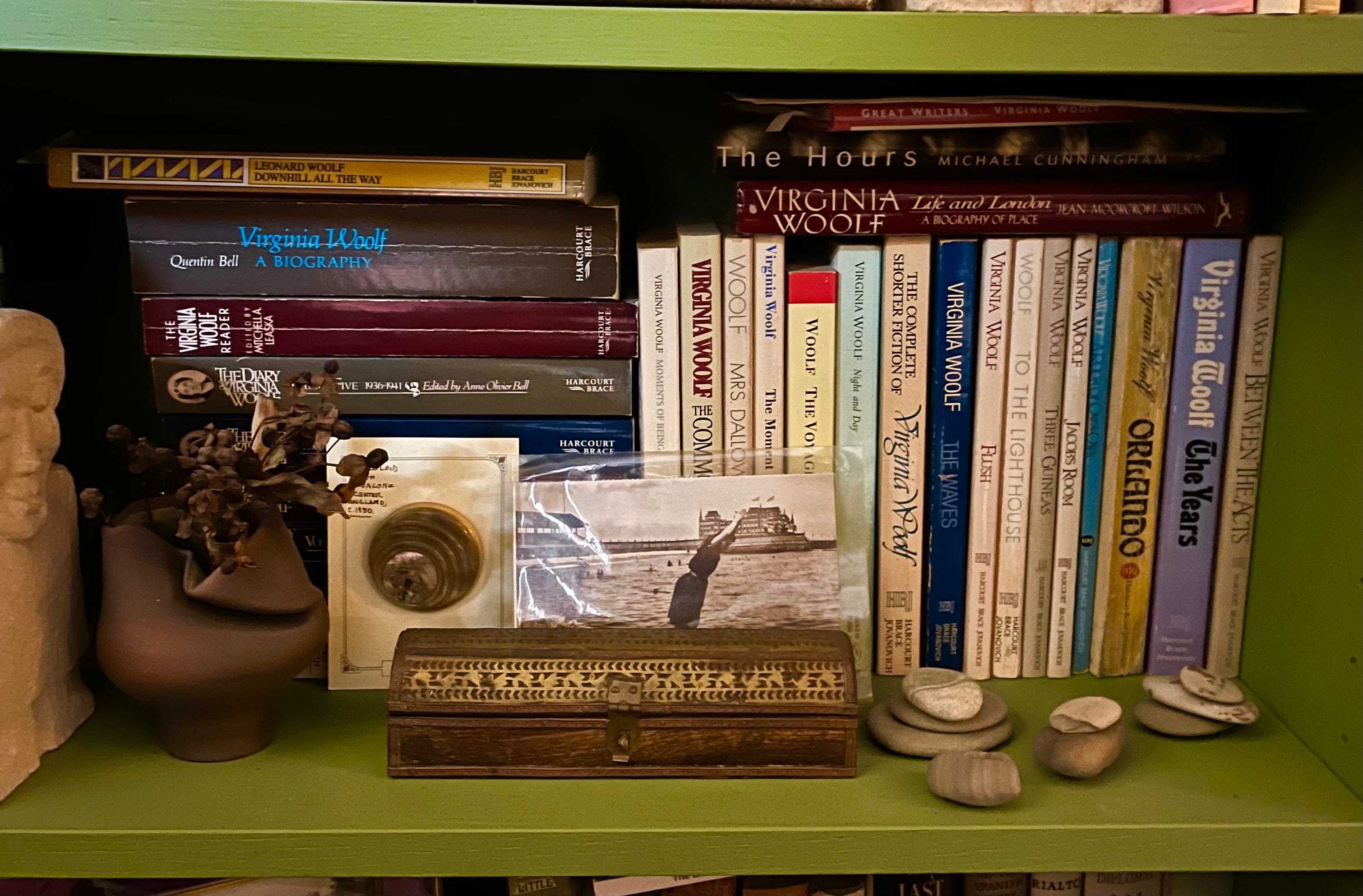
Miss O’s Woolf shelf, partial view. Essays, letters, diaries, and especially her fiction: Virginia Woolf remains my favorite writer. Orlando, taped and glued together many times over, was my gateway.

And this is where I am in this moment, today, the 10th of March in the year 2024, writer, artist, editor, daughter, sister, friend, woman. What about you?

Love, in all its forms,

Miss O’