Thoughts from the produce aisle of a grocery store
Yesterday after I published my latest post, I walked to the grocery store to pick up vegetables for some kind of Italian wedding soup I had an idea for as a meal for my friends on Sunday (today). I took a hand basket and walked the outer aisle for celery (check), carrots (check), spinach (check), and was turning to find an onion when I noticed a young man (Black, slender) putting back a prewashed spinach container when he saw the expiration date. “Too soon?” I asked, as I do. “I can’t eat all that by tomorrow,” he said. “You know,” I said, and he turned to listen because I do have an arresting teacher voice, “you can always blanche what’s left, now you can’t do that with these other lettuces,” I gestured, “and put in a baggie and freeze it.” He tilted his head thoughtfully, “I never knew that.” I said, my gray braids on full display as it was too warm for a hat, “That is what the age buys you.” I could see there was no more to be said. Would he do it? Who knows. I turned to find my onion.
I also wanted to pick up unsalted pistachios. In this store, the nuts are in not one, not two, but five different locations (at least) in the produce section. I think the idea is to surprise you everywhere with a nutty idea, or maybe it’s just easier to stash them under the fruit and vegetable displays, but it took me several trips around to find the right stand. I saw the young man walked back and forth looking at the prewashed leafy greens, and just before I located my nuts, the man made a point of walking by me to say, “I’m going to try it,” and I raised my arms high and cried, “Success!”
Here’s what I know about learning after 38 years in education and editing: learning never happens at the moment of impact. I’ve told you this many times, but as with all wisdom, it bears repeating. You tell someone something, teach it, and then you have to allow the student to sort of internalize it, reflect on it, and decide how they will respond. We are a very impatient society, we want it all now, in America. I was like that as a young teacher, expecting that because I told them, whatever it was, it would stick. Later you learn that because you are rushing on to another concept, you have to repeat the lesson, on whatever it was, periodically, just to jar a student’s memory.
And it got me thinking how neither Republicans nor Democrats leave time for reflection. What Republicans do is pick one or two messages and repeat, repeat, repeat, repeat, repeat. They hammer those two messages home for a month; once implanted, they pick two more messages and repeat and repeat until those are implanted. After a short time, their base has four or six messages—blame Blacks, blame Democrats, no taxes, no abortions, no schools, no immigrants—to glom onto until the election cycle is over.
Democrats, by contrast, have a more nuanced base, and they don’t appreciate that enough. Repeated messages on a finite number of things—Trump is unhinged, Project 2025 is bad, women need bodily autonomy—don’t land because they are not elaborated on sufficiently, but also because Dem leaders don’t remember that the base is also being bombarded with lies that they have to think about how to counter.
No one has time for reflection in either political scenario.
A good politician, I think, needs to behave like an experienced teacher. Miss O’ didn’t just say to the young man, “You can freeze it.” I explained how: “You can blanche it, and put it in a baggy, and freeze it.” And because we both had shopping to do, and no lives were in the balance, I left it at that. He had time to reflect, and I suspect Miss O’s continued presence in the produce department, on the hunt for what he had no idea, but still present, reminded him he could keep thinking about what he’d been taught.
Telling anyone once, without reinforcement, is like not telling them at all.
Telling them too many times, without evidence or example, is propaganda.
If this democracy is to survive—and it all hinges on Ukraine, one Eastern European nation, defeating not one but two allied superpowers—the United States and Russia—we have to figure out how to message to the American people.
Our legacy press, now almost fully allied with Trump, is useless.
Independents on social media can only do so much.
But I keep remembering that the American Revolution was won on horseback, word by word by word, passed along when people had time to think, when they weren’t distracted by anything that didn’t mean survival.
If you’re around my age and had a television growing up, you remember Sunday nights on NBC with Mutual of Omaha’s Wild Kingdom, which premiered (I read) in 1963 (you can still see the modern take on Animal Planet). It came on before The Wonderful World of Disney, which didn’t interest me—I think we turned it over to Hee Haw. Anyway, the show presented visits to the wild places of Earth, and Marlin Perkins (the zoologist host) and Jim Fowler (who seemed to do the real work) offered insights and commentary. It filled you with wonder, but more than that, for me, danger. I contrast that experience with once I have had as an adult watching Sir David Attenborough on PBS’s Nature programs, where the presenter expresses awe, delight, curiosity, and gratitude, all at once. Both programs came of age during fairly early television, with black and white cameras (or, in my case, a black and white television) to color. In Attenborough’s case, I learned from a documentary I watched last night that he’s won awards for all the phases of camera technology development, up to age 88!, beginning with black and white cameras, followed by color photography, to HD, 3-D, and now 4DX—the most advanced technology we have, most recently using animations and acting to tell the story, ironically, of animals of the past.
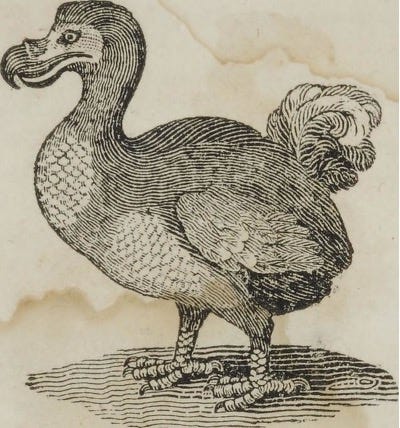
It’s here that I have to compare Attenborough to Thomas Bewick (say Buick), the 18th-19th century engraver whose engraved illustrations of British birds as well as many other animals gave the world its first affordable visuals, ones average people hadn’t had before. (I’ve mentioned in earlier posts that I recently read a book about Bewick’s life.) Watercolors and oil paintings of animals were in private collections and printed only in the most expensive editions, so common people in villages and towns might who had only heard about a camel for example, could see one. One famous flightless bird, the Dodo, for example was one such creature Bewick engraved. That bird of legend had gone extinct even before Bewick’s day, and it’s a bird that Attenborough also talks about in the 4DX in the last show he did in 2016, Museum Alive. (He’sstill alive, by the way, at 98. Bewick would be 271.)
Bewick’s Dodo, best guess based on maritime descriptions of the time and other people’s sketches. The one in the British Natural History Museum is a composite guess using the body and feathers of other birds. What is it about white men that their first impulse on seeing any unknown creature is to kill it?
Both Attenborough and Bewick love/loved wild places, wildlife. They love/loved working in their preferred mediums, television and engraving, respectively, and to use their arts to share this wonder with the world, with the common audience.
All this gets me thinking about all the ways we illustrate and instruct on the world around us, and how we used to unite around the common cause of our shared planet. When Rachel Carson’s book, Silent Spring, came out in the 1962, the one thing that everyone upset and focused them on ecology and caring was the possibility of the loss of songbirds.
Imagine that. If you have had the pleasure of sitting in my parents’ bird sanctuary of a suburban backyard, let me assure you can sit on that patio swing for hours and never be bored. Once all the birds forget you are there, it’s a party, the best kind of show.
Lately, America and the world have become focused on a collection of primates but not for the biodiversity and wonder and joy they bring. Instead, it’s a nature Reality Show from Hell.
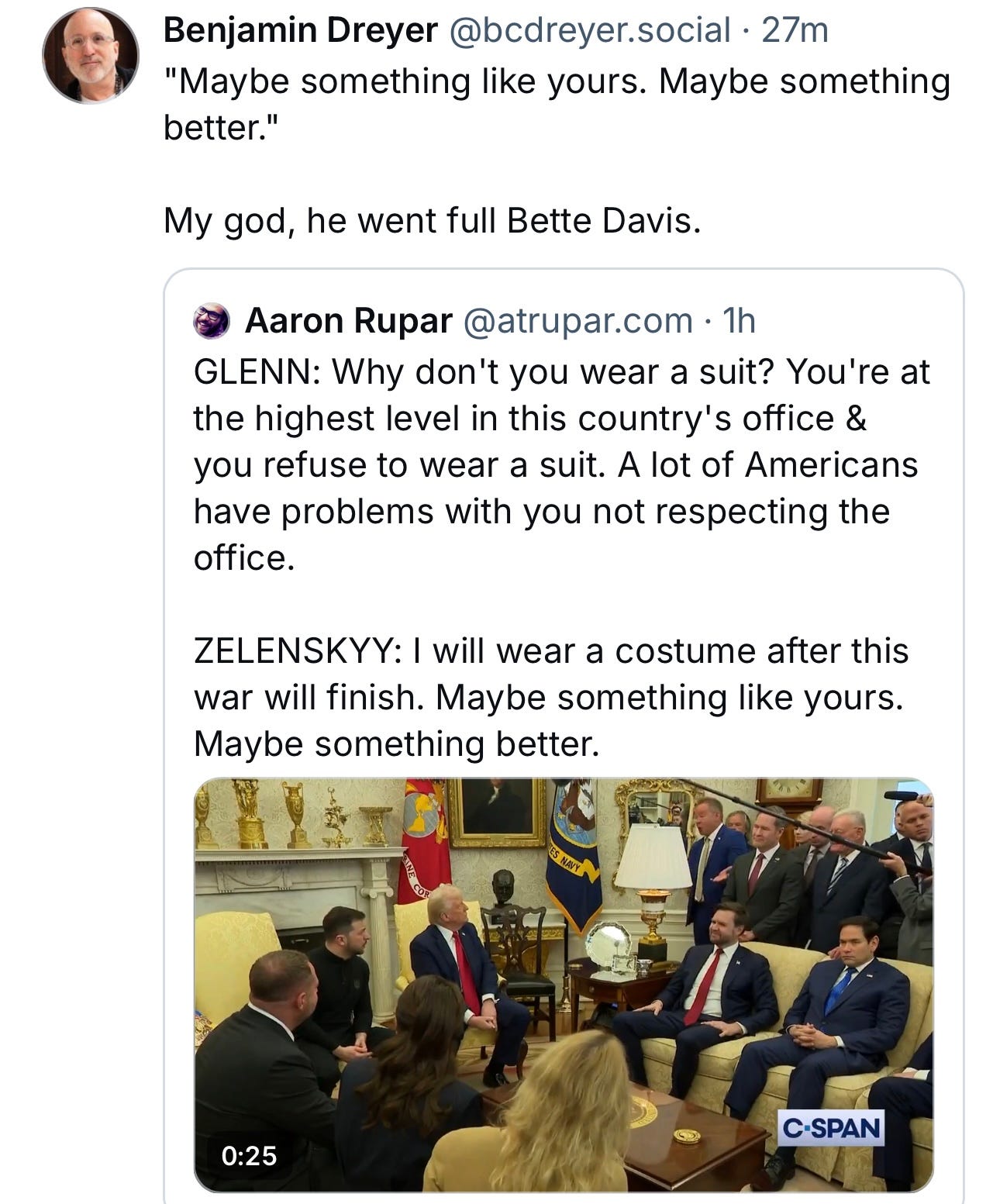
Yesterday, as the world watched, any sentient human cringed. Vance and Trump’s treatment of President Zelenskyy of Ukraine was beyond the beyond, trying to leverage their own favor-currying of Putin by placing the beholden Zelenskyy in front of right-wing American television cameras and reporters, to cow him, as if this man has not been enduring full-scale war for three years trying to save the democracy he loves. Lights,cameras? Bullying? 1) Have they no shame? 2) Are they high? 3) Fuck them.
Like nature at one time, democracy had been a common global cause for many, many years, but no more. President Zelenskyy is like the compelling, knowledgeable zoologist visiting a new kind of American wild kingdom in a television series, facing two aggressive and deeply stupid primates who exist only in captivity. It was, as you know, horrifying to watch.
President Zelenskyy prevailed. I hope he wins this war; he’s already won history. I don’t want Ukraine or him to go extinct.
All of this is just to say, Slava Earth, Slava Ukraine.
Home bulletin board detail. Queens kitchen.
Until the next episode of the Trump Wild Kingdom Shit Show, do beautiful things, somehow.
It was nearly 60 degrees in Queens yesterday; it’s snowing this morning. This has happened two weekends in a row. I’ve been thinking a lot recently about turbulent flow, the reasons for which I’ll get to, but first I’d like to open with an apology for my own flow: I used to be funny. I used to have a capacity to write about things in an energized and witty way. And then that one guy became “president” in 2016, the world turned upside down, as Americans started voting against their own best interests, hell, their senses, and in direct opposition to their self-proclaimed Christian faith, and called it righteous; Earth started turning on us in earnest in response to our neglect of our responsibility to be stewards of the planet, i.e. to not shit where we eat, and our abject failure to do this. I can’t walk down the aisle of a supermarket, department store, or dollar store and not think, “All this is heading directly to a landfill, and there are millions more aisles like this of packed shit none of us need, not a bit of it,” and I start weeping.
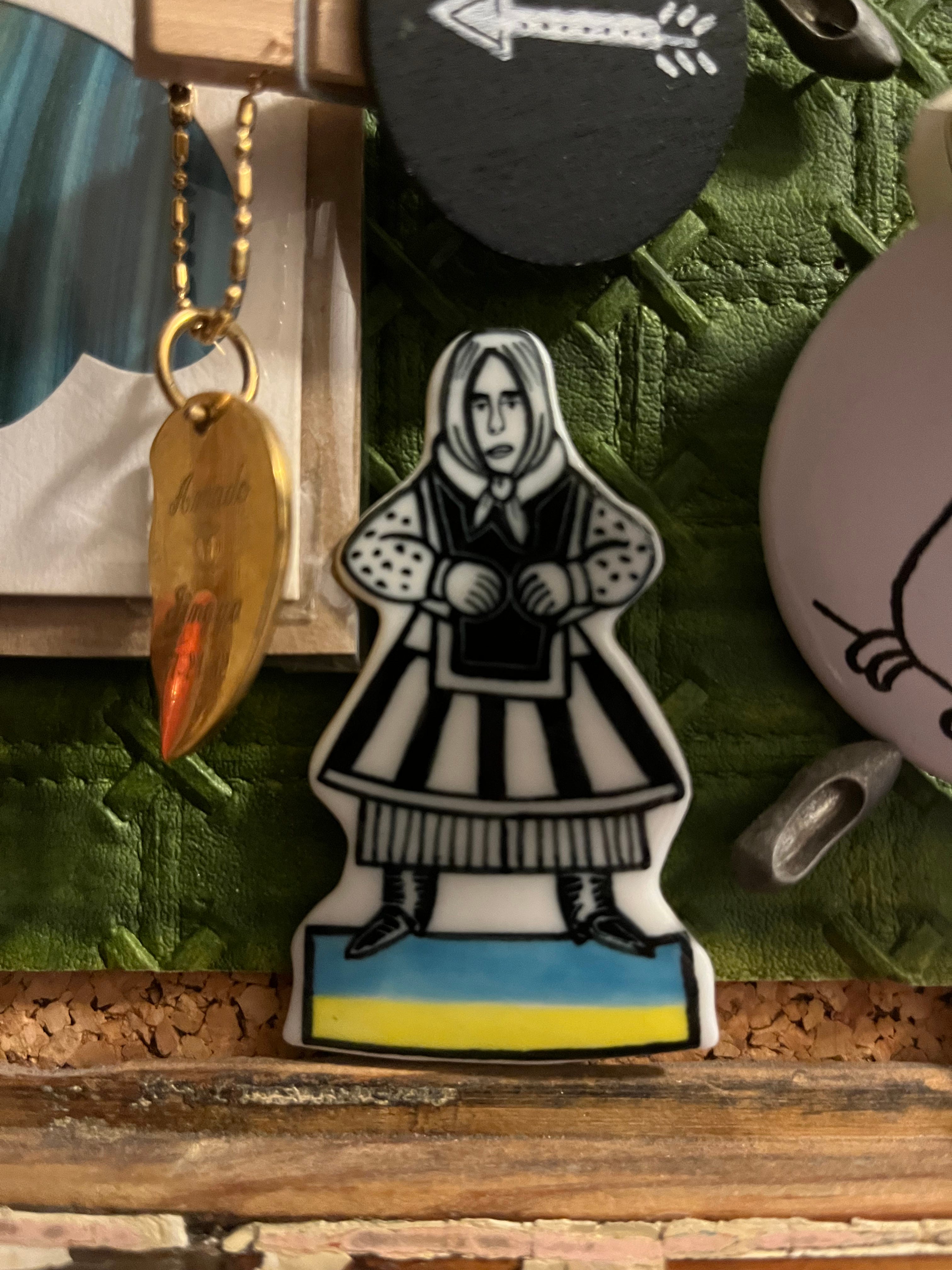
Tile adorning my bookshelf, gift from Colleen Cosgrove 2022
Written around the same time:
This past Monday I spent part of the day chasing down a running toilet. I heard the telltale hiss, on for 15 seconds, off for 10 seconds, through some stack in my kitchen; down in the basement it was louder. It wasn’t my toilet—the source was somewhere else in the building. Around 8:30 AM I emailed my immediate neighbors in my small complex, and they too heard the hiss. A couple next door heard it at 11 PM the previous night, and all night, but had been too tired to do anything about it. Next, I sent a group email to the other 16 units: Hi, everyone…anyone got a running toilet? Some replied that they thought is was related to our dysfunctional boiler and steam heat hit and miss; but the fuel company guys (whom another board member—that’s right, I’m on the Board! —chased down at the same time) assured us there couldn’t be any connection. Running toilets are more than just annoying sounds; it’s a water leak and the money adds up. In a small complex like ours, it’s not something you can ignore, but we all want to, don’t we?So finally the culprit revealed herself in a private email to another Board member. Sheesh.
Later that week:
At the supermarket this afternoon, I introduce a little turbulence into the normal flow of a cashier’s day: My order comes to $21.86. I have a $50 bill I want to break, but I already have a lot of ones and pennies, so I give the cashier, a Muslim woman around age 40, I’d say, $52.01. She has finished bagging my groceries, placing them in the bags I brought (this act used to cause turbulence, but not any more, so that’s progress), and as I hand her my odd cash I explain, “I’d like even change.” She looks confused and says, as I suspected she would, “But your total is $21.86.” All I could say was, “Trust me.” “Okay…,” she says, and taps in 5-2-0-1. She turned to me with wide eyes after seeing “30.15” come up on the little screen. “How did you do that?” she asked. “I used to be a cashier, and back in my day we had to figure out the change up here,” I explained, gesturing to my head. I took my 10 and 20 and nickel and dime and put them in my wallet as she said, “I always tell my kids, you got to learn the math,” and I agree, saying, “This is when it comes in handy,” and we exchange “have-a-nice-days,” and I hope we will. Turbulence as magic.
Back to the present, March 20, 2022, the first day of spring.
Tasks of Note:
Got my taxes done this week. For many years it was the EZ form for me—small income, no mortgage, as I was a lowly public schoolteacher who would never see $60K. Now in NYC, at a corporate job and with a co-op apartment, so many forms, I needed help. But what used to take me forever in the way of finding and pulling all the forms is just another task anymore, whatever the technology needs are to make it happen.
Washing coats and scarves, another task this week, used to be an event to me; now in my late fifties, I just wash the coats one day. Hang them up. Go on to the next task.
Baking sourdough bread and keeping up with a starter was something I found arduous in my twenties, since I moved a lot back then; in my late fifties and in one place for nearly 19 years, I think nothing of making my own bread with a starter. Toss in various kinds of flour, water, molasses, salt. Knead it, stick the round in a greased bowl, let it prove a couple of days. Feed the starter, keep it out to grab yeast from the air, stick it in the fridge. Stir it once in a while and feed it in preparation for the next loaf. Bake a loaf, cool, slice, freeze. Bread for a month. (Thanks to Anna’s husband Michael.)
How Ordinary Becomes Precious
Now imagine all those necessary complex and simple tasks under fire. Imagine the work of your everyday world under mortar shelling, your papers and photos and textiles destroyed, that collapse, life reduced to huddling in a basement for weeks on end, little water, little food, no power. I should have really imagined all this long ago—it should never have seemed “other”—but until Trump’s improbable rise and Putin’s recent mental crack-up, I guess I just didn’t realize how possible The End is now. How probable. And what’s worse is 40% of my own fellow citizens would take Putin’s side and kill people like me with abandon. Seeing the footage from Ukraine, in cities that look like New York, it’s surreal and all too real.
You’d think, with all the natural calamities that flesh is heir to, that in 2022 we’d have just fucking stopped war, that we’d unite globally to save the planet that we have trashed. Every generation, though, seems to become simultaneously more evil on the one hand and more evolved on the other. The divide widens. The turbulence increases.
On his death bed, the physicist Werner Heisenberg is reported to have said, “When I meet God, I am going to ask him two questions: Why relativity? And why turbulence? I really believe he will have an answer for the first.” (It’s quoted in Chaos by James Gleick, but I’ve read that the quote is probably apocryphal, so I guess that by continuing to possibly misquote or mis-attribute such a quote we only add to the chaos. We do not, however, lose the intelligence or humor of it, so does it matter? Dammit.)
Being in this Moment
I, the pagan Miss O’, follow blogger John Pavlovitz, a pastor and writer, who is himself a devout Christian whose political writings rail against the co-opters of faith as a means to destroy others and gain money, power, or fame for themselves. In one his blogs from 2020, “I Don’t Want Unity with Hateful People,” he writes:
I am not morally bound to make peace with a heart that dehumanizes other human beings because of the color of their skin, their nation of origin, their gender, their orientation. And to have embraced Donald Trump now, is to unapologetically brandish such a polluted heart; to be actively perpetuating inequity and stoking division and manufacturing discrimination in this very moment.
I steadfastly refuse such an alliance. I am a loud, conscientious objector in their war against the world.
More recently, Pavlovitz wondered why it is that all these “Christians” believe God will protect them from a deadly pandemic without the need for masks or vaccines, but somehow still feel the need to carry a concealed weapon everywhere they go. I mean, which is it?
The trick for the rest of us, then, the ones who wrestle with it all with compassionate hearts, is how to keep the flow of life going on a planet inhabited by not only good people but also by hateful, hypocritical, destructive people. In these moments of despair, many people turn to faith, but faith as a concept let alone practice has never appealed to me. So your Miss O’ has been doing some digging lately to better understand why that is.
Krista Tippett, who has been suggested to me so many times by dear friends that I have become a regular listener, replayed an episode from her podcast On Being which featured the Vietnamese Buddhist monk Thich Nhat Hanh, who died recently at age 95. Hanh was such a powerfully popular figure in spiritual circles that I decided I should give him the respect of a listen. In the interview, he explains that suffering—all this agony and despair—is part of the point. In Christianity, for example, people are promised that in death they will be sent to a place where there is no more suffering. Hanh does not accept this in his mindfulness practice.
Thich Nhat Hanh: Yeah, because I could not like to go to a place where there is no suffering. I could not like to send my children to a place where there is no suffering, because in such a place they have no ways to learn how to be understanding and compassionate. And the Kingdom of God is a place where there is understanding and compassion; and therefore, suffering should exist.
Tippett: That’s quite different from some religious perspectives, which would say that the Kingdom of God is a place where we’ve transcended suffering or moved beyond it.
Thich Nhat Hanh: Yes. And suffering and happiness, they are both organic, like a flower and garbage. If the flower is on her way to become a piece of garbage, the garbage can be on her way to becoming a flower. That is why you are not afraid of garbage.
(So, Miss O’ understands him, turbulence, suffering, garbage—it’s all part of the experience of living. )
Hanh continues:
I think we have suffered a lot during the 20th century. We have created a lot of garbage. There was a lot of violence and hatred and separation. And we have not handled — we don’t know how to handle the garbage that we have created, and then we would have a chance to create a new century for peace. That is why now it’s very important for us to learn how to transform the garbage we have created into flowers.
Tippett: I look at the violence that marked the world in the period when you were a young monk — there was the Cold War; there was a certain kind of violence and hostility. A lot of that has changed, has gone away, a lot of the terrible threats and the sources of the worst fighting. And now in its place we have new kinds of wars and new kinds of enemies. I’d be really interested in, as you look at this period of your lifetime, is there any qualitative difference between the violence that we have now and the violence that we had then? Is there anything like progress happening, or is it the same pattern that repeats itself?
Thich Nhat Hanh: Yeah, you are right. It’s the same pattern that repeats itself.
Tippett: And does that make you despair?
Thich Nhat Hanh: No, because I notice there are people who are capable of understanding, that we have enough enlightenment, and if only they come together and offer their light and show us the way, there is a chance for transformation and healing.
(And within weeks of the replay of this podcast, it’s worth noting, Putin invaded Ukraine, upping the garbage quotient exponentially.)
Miss O’s own qualm with the art of mindfulness is that it seems, somehow, incompatible with joy, humor, ecstasy, agitation, and fun, and synonymous with silence, chanting, bells, quiet, slowness, and dullness. This is not fair, and surely not accurate, but I’ve never heard an interview about the need for mindfulness that includes even one chuckle. And the second I hear Eastern chants and gongs, I think to myself, No.
And so it is that I’ve come to understand that humor is, essentially, a response to inner turbulence; that without this turbulence there would be no reason for humor, no reason to laugh, and life without laughter is…what? And where does faith fit in? And what about the role of art in our lives?
And like MAGIC, my friend Kevin Townley, a practicing Buddhist and teacher as well as actor and writer and Met Museum tour guide, came out this month with a wonderful, funny, deep, personal, and insightful book to help guide me to a new understanding: Look, Look, Look, Look, Look Again: Buddhist Wisdom reflected in 26 Artists.I’m only a third of the way through, because I’ve found I have to read it with my pencil. The best books require that—so many observations to underline and reflect on. “Most people who embark upon a spiritual path don’t do so because they’re feeling fabulous,” he writes. And I laughed out loud. And so I came to see that the reason religion or a practice of any kind seems negative to me is that people seek faith for a release from depressive habits and feelings. So it makes sense, really, that it was hard for me to equate Buddhism, as I said, with joy. Kevin manages to link his irreverent humor and love of art with his spiritual practice, and in writing about it he threads in joy and creates openings for skeptics like Miss O’. Thanks, Kevin.
Miss O’ holds her very own copy, and you can, too, if you want!
Why relativity? Why turbulence? Artists often seem to hold the key. There is a Ted Talk on the unexpected math behind Vincent Van Gogh’s The Starry Night, a painting I have seen in person at MoMA here in New York, but it’s usually so crowded I’ve never had a chance to really see it. This talk, written by Natalya St. Clair, will blow your mind. In turbulence, “Big eddies transfer their energy to smaller eddies, which do likewise at other scales…,” and scientists have discovered “that there is a distinct pattern of turbulent fluid structures…hidden in many of Van Gogh’s paintings.” Gogh know! Artists are the reason to live.
“Seek and Ye Shall Find, and then
…when you find, you will become troubled; when you become troubled, you will be astonished, and rule over all things.”
~ The Gospel of Thomas (one of the Gnostic Gospels that the papal crowd decided to pull out of the New Testament; because god forbid a person feel empowered without a pope to lead her)
So I have to wonder: could the purpose of turbulence be that there is beauty in turbulence? And without turbulence we have no beauty? That Hanh is right, that without suffering there can be no joy?
Last week I noticed the bird’s nest under my neighbor Bob’s second floor air conditioner, a nest that has been there every year for the past 18 years; the chirping heralded spring, and I remembered: baby birds are coming. Then two days ago I looked up and the nest had vanished. Wind? Rain? It’s happened before, somehow the nest is gone, but miraculously, resiliently, the house sparrows are not. There they were, out flitting on the fence, and I saw one fly back up with a small twig in its beak. Rebuilding.
Ukraine will be next. And the earth after that. Take a memo.
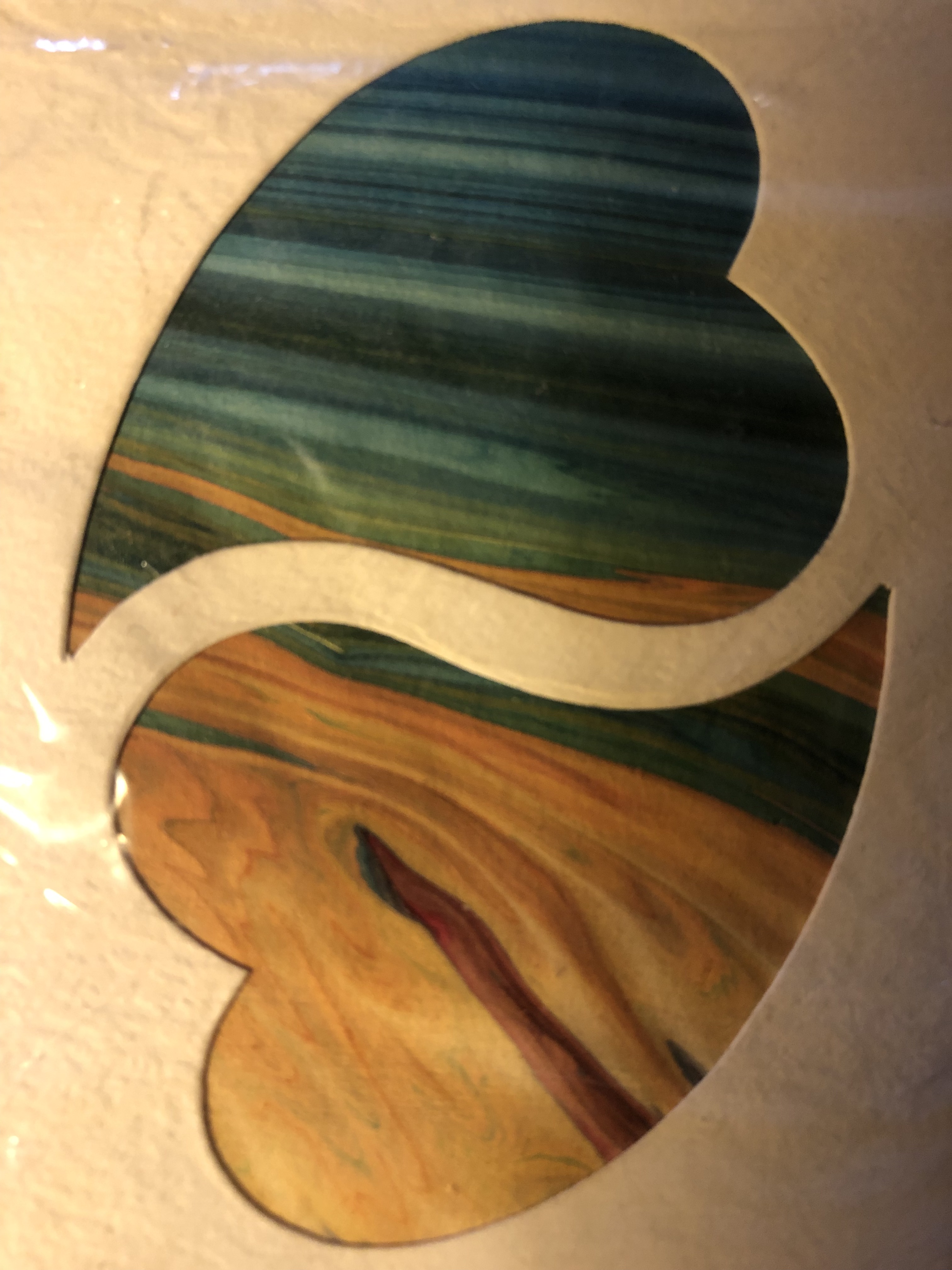
Card by Turkish paper marbling master that reminds me of the symbolic colors of Ukraine.





 The Miss O' Show (Teacher's Edition)