What Is Your Fox News?

Predictions for the End of the World

Back in late October of 2000, my Grandma O’Hara died. After her funeral in Iowa, back at my cousin Candy’s house, Candy asked me, “Just between us, who do you think should be president?” And I replied, without hesitation, “Al Gore. He’s so much more intelligent and aware of the problems we face. There’s no question.” Candy then left the kitchen, entered the living room filled with her siblings, kids, and nieces and nephews, and announced, “Lisa says Bush is too stupid to be president.” And from then on, none of them has spoken to me, not really, even at their own mother’s funeral. This isn’t about politics, unless we can all understand that this divide in America, playing out symbolically in Iowa v. New York City, is that politics equals values.

And what has happened since that moment of Candy’s announcement heard ’round the world, of course, is that my concerns were beyond well founded; and despite this, too many of my Iowa cousins (to take one demographic) are determined for the world to end, if for no other reason than the annihilation of me and my kind, even if it means the destruction of their own children. It’s a point of pride with them, this annihilation of me, and my dreams of America; and at the very least the “fuck you” to my education and my empathy is worth the destruction of the Constitution. They would literally rather have Putin’s Russian army take us over than vote for Al Gore or Hillary Clinton.

It’s about, I gather, a celebration of their Christ; so how can I stop the end of days? They will, no doubt, sing at my execution, for they have not only inherited but also earned the scorched and lifeless Earth. Kisses.

Seriously, though (and I was serious back there): What does the future hold?

0-6.jpg

It’s in the Cards

Many years ago in college, at a party, someone I’d just met was doing Tarot card readings. At that time I was always made nervous by anything approaching religion let alone the occult, as I had been hurt by too many liars and hypocrites, but I sat in as a fellow young actress, Raine, had her cards read. Raine was a graduate student in architecture, but her heart was pulling her to theater. When it came time for Raine to pose a question to the Tarot, she asked, “Will I ever make a beautiful drawing?” What struck me about the question was the very nature of it, based as it was in art and not in material gain or comfort, as with questions such as “Will I find true love?” or “Will I be rich?” asked by others at the same party. Raine had asked about her capacity to put beauty into the world; I’d never wondered such a thing. (As for the answer, the cards were mixed; the reader, as I recall, suggested that there was something muddled in the motivation for subject’s question; the card reading would leave us hanging.) It struck me in that moment that I would never be an artist. I felt a slight pang of loss, but some of us are not artists but rather worker bees, and that’s what I was. We produce honey, sure, and the comb might be kind of cool, but ultimately I would never stand out from any other bee. I realized I was okay with that, though I wasn’t sure how I was supposed to feel. I decided that a path of uninterrupted self-loathing surely had to be penance enough for all the people in my life I would (and continue to) disappoint.

0-10.jpg

So why do we want to visit the future? On a visit to Scotland recently, I was in a pub one night when a psychic was visiting. It was an announced event, and the room was filled with about two-dozen women, all working class, aged 18 to 70. The psychic was a man about 60 years old, I’d say, very handsome, lithe, sexy, and he had his routine down pat: He’d cross his arms, rub his chin with his hand, wrinkle up his face, push his groin out a bit (a seductive posture made safe because of his arms wrapped in front of himself), and tell you what the spirits were saying, “Does the name James mean anything to you?” (the names he noted were safe bets, this being Scotland), or “I’m getting something here about being in trouble, does that sound right?” (To that one a subject declared, “Oh, no, I haven’t been back to prison for ten years—that’s all behind,” and everyone chuckled.) “So you knew that, yeh?” he said, nodding. His use of “yeh?” after his statements made the subject complicit; most were willing to go along. He’d hit the mark often enough to impress his audience; for myself, the great part was getting to know the lives and characters of so many working class Scottish women—where would I have had such a chance? More than that, here were a bunch of women looking to a phony psychic for guidance in life in the form of entertainment. Hmmm.

Where have I seen that recently?

Future Perfect

I remember reading one of Virginia Woolf’s diaries in which she said at one point that she’d like to flip ahead thirty pages in her own diary to find out how all this (whatever it was) would turn out. Wouldn’t we all? Then again, when someone asked Audrey Hepburn how she and her compatriots kept going in Holland those five years under Nazi occupation and near starvation, she said something to the effect, “I suppose had we known it would last five years, we would have killed ourselves.”

Maybe the card readings have to remain ambiguous. Maybe a psychic’s tricks are all we can handle. Still, this manufactured suspense and the ensuing chaos may be the end of us all. Maybe we are supposed to end. Maybe the best thing that could happen to the earth is our human annihilation. But it’s the suffering that pains me, and that means the suffering of all wild life, all of nature.

I feel very worn down by the chaos, the duplicity, the willful ignorance—and I don’t know how to fix this. I can no longer write—it’s hard and frustrating because I have absolutely nothing to say about anything. It seems it’s all been said—watching the impeachment hearings showed us all quite clearly that President Trump and the Republicans are actively destroying our democracy, and yet Trump’s base is more determined than ever. They would actually prefer the end of the Constitution and a Russian invasion to the liberals having power. It’s insane. My friend Rob has practically lost his entire family to Fox News, and even as a gay man they choose Fox over him every time, seem utterly incapable of separating out from their hatred of whomever and whatever Fox News tells them to hate.

As I talked about this the other morning with Amelie, a dancer friend staying with me between sublets, I said, “But then I think everyone has a Fox News,” a source or place from which only rage can emerge. I realized that for our mutual friend Rob, for example, it’s all things Shakespeare—Rob hates Shakespeare—you’ve never seen anyone so enraged over it as he was at the intermission of what to me was a most perfect version of Cymbeline as we were seeing in Central Park. Rob, who is ADHD, just doesn’t understand Shakespeare, feels excluded from it, and becomes angry over it, and thinks no one should be doing it ever because it’s old. Only NEW work, he says, matters. “Why isn’t there more new work? Who needs to see this?” And when you counter that you could say the same about opera, classical music, classic Hollywood movies, he agrees that all that, too, should go. But what if I love it? What if it feeds my soul? Presumably, I need a new soul, as do all the people who watch Fox News. So where does that leave us? I would say, here: People’s lives are happening now, in the present; to embrace the art of the past for the nourishment of the soul shouldn’t cause us to seek the death of Black people, for instance, but it got me wondering: Are these impulses to a “Fox News” reaction, however different in outcomes, tied together?

Accessibility to the Dream in One Image: Compare Trump’s notes and Obama’s.

Almost 40% of America would prefer the president on the Right, who is on the left in the photo below, to the Black president, who’s personal notes are seen in the photo on the right. Take that in. NOTE: The “no quid quo pro” was spoken to Ambassador Gordon Sondland by the president himself, which means that if an indicted or accused criminal says, “I didn’t do it,” if he or she is Republican, we have to set him or her free. It’s the new America.

trump-obama.jpg
White House photographer Pete Souza compares and contrasts.

Why does the right prefer the disabled in their leadership to the brilliant? In his short story “Harrison Bergeron,” Kurt Vonnegut saw this coming, the lowering of all the expectations in the nation so that all is “fair,” that everyone has equal access; therefore, a unique genius, exceptional athletic ability, and the like, are not to be borne; we will have be given handicaps to prevent us from being too good or to beautiful or too curious—the mind control is high-pitched sounds—the burden of thinking for oneself no longer to be borne. And the Right calls the Left “politically correct.” NOTE: Every time a Republican speaks, just cough out, “Projection,” and keep walking.

Even in New York City, “Harrison Bergeron” is becoming a new normal. I look at the plans for the Brooklyn Botanic Garden [yes, Botanic, not Botanical, so at not to confuse it with the NY ones in the Bronx] that demolished this gorgeous stone terraced gardens on slope so as to make the slope accessible for wheel chairs and walkers. So, too, was the only natural area of forest razed and smoothed, so as to eliminate those pesky roots someone might trip over. Hell, a developer is building a condo that will obscure sunlight for the largest part of the day so the whole Garden is going to die anyway. Venice is under water. But let’s enable quid pro quo come hell or high water.

Is annihilation of beauty our goal? Is that why we’ve allowed 60% of wildlife to die off in the past 45 years? Are we afraid of anything that soars beyond our understanding? Even Christians are terrified of the teachings of Christ, because living by those teachings is so hard, requires so much of them, that it’s easier to throw money at a huckster preacher like Joel Osteen than to read and study and meditate and try to become a better human. We live in exhausting times.

The quick message that is killing us is “Consume.” Consume goods and more goods. Let your hatred consume you. The other week I went to see Bella Bella, by and starring Harvey Fierstein, wherein I learned how as a young attorney and civil rights advocate, Bella Abzug traveled to Mississippi to defend a black man accused of rape for having a consensual affair with a married white woman. Because she could get no accommodations she slept in the bus station or the ladies room, hiding her feet on the toilet seat when the security guards came around, and this went on for two years, as she went to the Supreme Court to get the guilty verdict overturned, won, only to have Mississippi re-indict him; won again, re-indicted again, and without waiting for another appeal they simply executed him in the town square. Those whites in power rigged up an electric chair with a generator, and 200 white people came to watch, sitting with picnic lunches and cheering. I wanted every member of Congress sitting next to black colleagues to have to watch this play. There are members of Congress who would cheer to this day. So would those Iowa cousins up there.

In the face of all that, Bella Abzug was a model of all the best women I know and have seen and revere.

0-7.jpg

Fox News demonstrates that the worst qualities of human beings—hatred, greed, jealousy, and lack of curiosity—are the qualities most needed to the devil’s work to succeed, in the name of Christ and the Constitution. In the Bible, Eve is “punished” by the God of Wrath for being curious—but it’s not punishment, is it? It’s the natural order of things—we all have to leave the Garden if we are to become all we can be. Christians who are not Christians but followers of preachers are told over and over the Old Testament story of how a woman tempted a man out of paradise, how repentance is the only way, and that it must come in dollar donations. And to be clear, Adam and Eve were white; Jesus was white; anything “good” is “white,” and I’ve about done had it with WHITE is RIGHT. Fuck white.

0-4.jpg

Interpretations of Events

How do you justify evil? To what do you turn to so that you can live with an atrocity? Or, worse, when is an atrocity not an atrocity? I think of women and babies. When a woman is raped and made pregnant, the Right asks, “What was she wearing?” and demands she keep the baby. No harm, no foul, right, Right? If a woman dies as a result of a back alley abortion, she deserved it. If a woman if fleeing for her life, gives birth, and has the baby taken from her by authorities…it’s okay, as long a the baby is brown.

The other day one of my many cousins, whom I’ll call Pam, had an exchange on Facebook wherein she called out Donald J. Trump as a piece of shit, and I concurred. Another cousin from another aunt and uncle, whom I’ll call Bonnie, came in to announce that Trump had done everything his base wanted, such as building a wall, pulling out of the Paris Climate Accord, moving the embassy to Jerusalem (after which Bonnie inserted a super happy emoji), and giving tax breaks to billionaires to “grow the economy.” All I could do was ask Bonnie, “Why do you think any of that is helpful?” to which she could only say, “I don’t have anything to prove, I’m just saying that’s why his base loves him.” Huh? My response, over several message bites, amounted to, “I hear you, but I’m telling you that none of the things you listed is useful to the nation or the planet; and how you can ignore all the destruction of his presidency is staggering to me, our loss of standing in the world as a global power not the least of it.” And…crickets.

0.png

When will I write something beautiful? How will I be of use before the end of times?

During the flight back from Scotland I watched a movie that resonated in a staggering way. Michael Shannon’s character in The Shape of Water, which won best picture of 2018, is, symbolically, rot. His body manifests the rot; his soul’s rot and mind’s rot are seen in his increasingly ruthless behavior, escalating in a quest for power no one above him will ever give him; when he fails to achieve the power he seeks, his only motive in continuing to live is revenge.

Sound familiar?

It has been ever thus: The Right is Rot. This is not to say that the Left is the Answer, only that the Left is not (yet) infected with rot. Possibly both sides will devolve into only Rot, with only the artists creating the beauty.

We all live a great tragedy.

0-5.jpg

Old Art in the Service of New Understanding

On Friday night after Thanksgiving, I went to the Public Theater to see a revival/reimagining of Tony Kushner’s A Bright Room Called Day (a title he decided on from a mishearing of “A Bridegroom Called Death”) a play from 1985 in reaction to Reagan, deeply prescient in its prediction of a Donald Trump in 2019, and updated by the playwright for that horror. The play chronicles the rise of Adolf Hitler and the Nazis from the perspective of a group of friends in Berlin from 1932 to 1933, and what is clear now, given the clarity of the parallels, is that there is no way to stop the fascism of America and its new ownership by Putin’s Russia. We can’t stop it. It only takes around 40% of the population to help fascism succeed, and the Republicans have it.

Those of us who see the nation’s and world’s end with profound clarity can only do what Kushner’s surrogate does in the play, and that is scream that he had to write the play “because I didn’t know what else to fucking do! I had to fucking DO something!” And this is exactly how Miss O’ feels. Though as for the fellow middle-aged New Yorkers in the audience that night, they could only sigh and comment, “I don’t know if I liked this play,” thus missing the point, thus confirming why the left cannot win this.

The end of the planet is nigh. There’s no stopping it, just as there was no stopping Adolf Hitler and his 37% “majority.” The Third Reich functioned efficiently for 12 years. Earth doesn’t have 12 years, however many millions are slated to die. I’m sick and sorry about it, and yet I know I will continue to try, despite this inevitability, to make a livable world; I know I can only continue to try. I’m sorry that too many of us won’t, sorry for my nephews, who likely won’t see age 40. Neither will your children, but somehow you won’t admit this. Your kids will hate you more than love you, but somehow, again, you won’t admit this. Apparently this is somebody’s god’s will; apparently the “winning” of “Donald J. Trump,” liar, thief, scoundrel, motherfucker, is, inexplicably, more important than the future of the voters’ children. It’s weird, to me. I mean, isn’t it insane?

0-9.jpg
A Handmaid’s Tale. (The Guardian.)

Philip Glass’s Akhnaten: Egypt of 1350 and America of 2020

At the close of this gorgeous and deeply moving opera, which I had the privilege of seeing at the Metropolitan Opera last night, a leader reforms Egypt, moving it away from polytheism and toward a monotheism that worships the Sun, the giver of life. The production features a master juggling troupe, whose skills of juggling the balls to the music end in the dropping of all of them as the pharaoh Akhnaten and his bride Nefertiti pay the ultimate price for not keeping a closer watch on the new world they have built, after spending 20 years in a bubble of their own love. The final scene of the play is the death, mummification, and ascension of Akhnaten and the continuation of a weary world in his wake. The jugglers crawl across the stage, pushing the dropped ball along, even as the curtain falls.

This opera left me reeling, with a burning question tied to Tony Kushner’s question of the night before: In the wake of the failings of leadership, who will pick up the ball, continue the work of the world, keep the music pulsing? Do you want to keep going?

You want that?

Okay.

So what are you going to fucking DO?

0-8.jpg

It’s NOT ENOUGH. It’s not. WE HAVE TO ACT.

WE HAVE TO THROW OUR BODIES AT IT.

To the death.

Love to all.

Miss O’


Is It My Imagination

Dispatches from NYC: Bad Change

January 19, 2019, New York City

It’s January in New York and there has been no snow. There is hardly snow anymore—hasn’t been for years now. When I first moved here, the snow started in December and there was snowpack until March. Walls of the stuff along Queens Boulevard; icy slush puddles of it at every Midtown intersection; banks of it along sidewalks on every side street. Arctic temperatures through it all. Now, in 2019, it rarely dips into the 20s let alone teens, and snow is limited to one storm that melts the next day. In the past few years we might have one or two nights in the single digits; no single-digit days, though. I like battling the winter elements and I miss this, since I moved to New York City to get away from the mildness of Virginia, in both weather elements and, by extension, intellectual life. Climate change of every kind.

Last night, another fairly mild winter night, being around 40 degrees, I walked down 7th Avenue after work with a friend whom I’ll call Betts. We walked under masses of scaffolding, nearly every other block; we passed loads of 20-somethings on their phones, sidestepped trash, passed somber slow people, and all the while Betts discoursed on his latest obsession, famed acting teacher Stella Adler. Betts has, in essence, created a Stella Adler character to tell these theater stories, including a way of enunciating and inflecting every word to become this woman, a New York Jew who made herself into an almost British grand dame,  an invented woman who made a living teaching other actors to make truth in their art. “And do you know WHY you failed?” Betts says at one point, as Stella. “NO ONE would use his OWN HANDKERCHIEF to wipe a counter!”

As Betts spoke about truth in art, about his sorrow that Stella, the creator of Brando, had not been his acting teacher, I told him that just the other week I’d had the first serious discussion about art I’d had in years. I’d just read a piece by critic-at-large Louis Menand in The New Yorker, the title of which I couldn’t recall (but it’s called “Faking It: Literary hoaxes and the ethics of authorship”), in which Menand explores the current hot-button issue in art, which amounts to a directive, not only for writers of nonfiction but also of fiction and drama: No one may write about something that he or she has not actually lived or experienced. The. End.

I told Betts that a playwright friend whom I’ll call Parker (Lola Parker Jones, who dropped the “Lola” when she figured out years ago that theaters are more likely to read your script and decide to produce it when they think you are a man; she says this remains true for her today: when they contact “him” and find out it’s a “her,” she can hear, following their initial enthusiasm, a hesitation, Hashtag Me Too) had a play recently produced at an esteemed NYC arts space, only to find that actors kept quitting over her reference to Islam in part of her fantastical play. She could just as easily have invented a religion, say Panoply, or something, but there wasn’t anything she said about misogyny inherent in Islam that was particularly controversial—no more so than discussing misogyny in Christianity should be controversial, and she herself was raised Catholic. The problem for the (nearly all non-Middle Eastern/nontraditional) cast was that they themselves were not Islamic, and therefore in those scenes felt they had no business pretending to be Islamic—this would amount to sacrilege for Muslims, they said, and just plain offensive to an audience. One by one, they quit, were replaced by others who quit, but finally Parker had a cast—though quite frankly, when I saw it, no one beyond the Arab actress in the lead seemed totally committed. It was a miserable experience for Parker. “When did this happen?” she asked me, and our friend Jessica, when we went to dinner after the final performance. “When did it become wrong to write from your imagination?” At this point I had not read the Menand piece, but as soon as I had, I sent it to Parker.

Desert City

On the walk to the snowless Village, I recounted this to Betts; as we paused in the dusk of a noisy 14th Street I said, “Can you imagine Stella Adler trying to teach actors today?” Betts sighed, glancing over at the collection of knit hat-covered heads bent over phone screens. Betts told me about Miss Adler’s work with Marlon Brando. When preparing for A Streetcar Named Desire, Brando decided on a certain pair of work boots to find Stanley Kowalski’s character—a working class Polish-American alpha male from New Orleans who had exactly zero in common with the sensitive, almost effeminate Native American Midwesterner Brando—and when Stella asked, “And how will you use these boots, Marlon?” Brando, feeling the boots and weight of the work Stanley did in those boots, slumped, and began walking with what would become the famous Stanley Kowalski slouch. A legend was born. And it got me thinking: As per this new fascism, er, fashion, in art in America today, Brando would be out. And presumably in 2019 Lin-Manuel Miranda would have to shelve Hamilton, as he himself was not a founding father or an Englishman, and, obvs (as the kids say), the “rap” angle would have to go. (But I don’t think the art world or the literary world cares much about musicals, and I suspect it’s because musicals are always and ever works of an imaginative mind. No one watches Anchors Aweigh! or Meet Me in St. Louis and asks, “But did that REALLY happen?” At my office, a few days before this walk and soon after reading the Menand piece, a group of fellow editors and I began chatting and then debating this very subject. I asked Mort, who is Jewish, “So should non-Jews play Jews?” Mort smiled his wry smile and said, “If they didn’t, you’d never be able to produce Fiddler on the Roof in Wisconsin.”)

It seems to me we live in deeply warped and troubling times: on the one hand, we seem to be demanding facts from our artists while expecting lies and hyperbole from our politicians; on the other hand, no one is supposed to be imaginative. And we have no public intellectuals to rally around. When I feel starved for intelligent and challenging discourse out loud, I Google “James Baldwin” and watch all the videos I can find—there was and is no one like him. Oh, what he would have done with Trump. Oh!

Greenwich Village, as Betts and I strolled in around 5 PM, was all but deserted, only a half dozen people at most wandering along any stretch of block. “Remember when this place used to be mobbed on Friday night?” Betts said, astonished at the bleakness. He pointed to one of Bloomberg’s friend’s luxury condo buildings, the one that replaced St. Vincent’s Charity Hospital, where AIDS patients sought treatment, and where many died, and where poet Dylan Thomas died after drinking a dozen whiskeys at The White Horse Tavern on Hudson Street. Listen to the silence: Other than Monster and the Duplex, there are no real clubs anymore; little to no live music (and what there is will cost $50 in cover and drinks, for an hour-fifteen, and time to go because there’s another set, here’s your coat), no hot spots, no dives (Cafe Riviera is closed now; every block has an empty space for (unaffordable) rent). All the art in New York, for that matter, feels “precious,” carefully curated, expensive, and timed-entry. Does anyone really care about new art? Even Parker’s play was only controversial among the newly arrived white young actors from hinterland college theater programs; the critics didn’t even come.

A certain laziness of mind, of spirit, I’ve said a thousand times, can be traced to Reagan, to the 1980s, where everyone began exercising to death, and added phones/screens to their lives, and where is the wild joy in that? We are so bored. We are so boring.

Bad Metaphor, with Pit Bull

Back around 1988 or so, I was teaching in a rural school district and a friend since high school came down to hold my hand while I tried to finish grading exams and finish averaging all the grades for the first semester of my life as a high school English teacher. On a visit to my crummy little apartment above a beauty shop in a downtown—and I use that term “downtown” denotatively only, this being a little Southern town—my old high school friend, whom I’ll call Keith (painter and founder of a college band called Bad Ego), brought me a sculpture—and I use that term denotatively only—he’d made. He was very excited to give it to me.

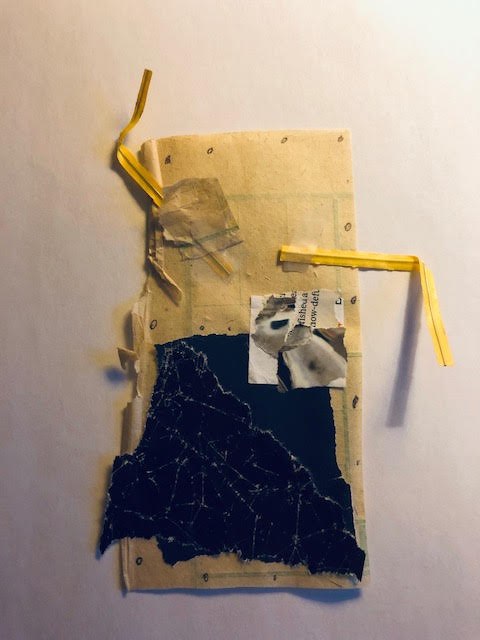
It was the laziness of it that struck me, even more than the ugliness: a 18″ x 48″ quarter ply board on a 2″ x 4″ frame, which he’d found at a construction site where he’d worked for about a month, half spray-painted blue, onto which he’d glued a Xerox of a pit bull from an encyclopedia page where he’d looked up something else. He drilled a couple of holes and shoved through some leftover copper pipe he picked up out of a dumpster on a job. I’m all for repurposing, but he held the pipe in place with brown plastic packing tape; the pipe fell a lot. Keith was wildly proud of this “art.” He was pumped to give it to me. I could only laugh. I hurt his feelings. Below is my collage interpretation of it, understanding that I sound like a judgmental dick:

unnamed.jpg

I left Keith’s “sculpture” behind when I moved away, a few years later, it being the last item, for which I literally had no room after four trips up and back in my pick-up truck to my new home; and Keith was devastated. Seriously never forgave me. And quite frankly, though I found his “sculpture” revolting, I still remember it all too vividly despite my rejection of it. Like trying to deny truth. The piece, as I see it now, was a metaphor for our friendship: it was something we never worked on, something we were lazy about, and which was often ugly. Similarly, he threw ugly things at me in terms of my intellect—I was not properly in thrall to his Marxism, I was a fool to think democratic government could ever matter, for example—and I sent the ugliness back at him in a letter that I knew would mean a permanent rift, us being too lazy to talk about it like adults, years later.

This is laziness built on boredom, on not listening, not engaging, not looking up and out and inward. Whatevs. Maybe Stella Adler could have coached us out of it.

Greenwich Village in New York City is apparently dead, for chrissakes. So what hope is there? New York City in 2019: Dinner at Elephant and Castle and strolling the aisles of Bigelow’s Pharmacy as the high points? Stella Adler would be bored stiff. Brando would never have come here. I don’t know how to energize this place anymore, or myself in it. It’s my latest challenge.

Where is art? What is truth? They’re as rare as snow in winter in New York City. Who’d have thought?

LO’H


This Is the Real Story

Featured on my kitchen wall is a framed series of five photos, one under the other, that depict me and two other women rolling down a green grassy hill. My friend, Patty, a professional framer, matted and framed this series for me many years ago, though why I wanted it, no one understood. I knew why, so really that’s all that mattered. And though it’s framed nicely, each time I look at it, I get stuck at the last two pictures. To me they are in the wrong order. The second to last one in the frame shows me and Roller No. 2 sitting up, my fists raised in triumph, my legs up, ready to do it again. The last one in the frame shows the Rollers 1, 2, and 3, passed out blissfully on the grass. The trouble is, the action happened in reverse of the order: We were passed out blissfully, and then we popped up and went back for one more roll. However, as Patty pointed out, anyone looking at the series would be aesthetically unsatisfied with that—she insisted that the three of us collapsed at the bottom of the hill was the right feeling of “this is the end.” I didn’t agree, but she was a terrific artist and very sure, and I just wanted to hold the memory, so I let her tell the story her way. It’s a story that, if you weren’t there, maybe made more sense.

Here is the real story: They were middle aged, these three women, and I had just turned 30, and we were teachers in graduate school for the summer. Three of us were housed in a large mansion-style dorm atop a big hill, and I had remarked on the day of our arrival, “This is a perfect hill for rolling.” I was wistful. The two women on my floor whom I mentioned up there, Anna (the photographer) and Suzanne (Roller No. 3), had no idea what I was talking about. Anna had grown up in California where there were no green rolling hills, and the same was true for Suzanne, whose landscape was Midwestern, up northern way. That very same evening—our first of the summer—Annie from Mississippi came up to the house on the hill, and from upstairs I heard her say, “This is a perfect hill for rolling!”

I flew through the door to the upper porch, where my room was set, leaned over the balustrade, and called, “Annie! Will you roll with me?”

Anna, from across the hall, called, “Wait for me!” and came out of her room with her camera.

Suzanne, next door, said, “You mean I get to SEE this?”

I said, “You have to DO it,” and we three raced down the stairs with that child-like rush of feelingas if, if you don’t hurry, your chance will be gone forever—and outside, where Annie and I taught Suzanne her options: either arms crossed over your chest, or arms outstretched over your head. We spread out. And…GO! Somehow in that flash of chaos, Anna had managed to capture, 1) me rolling alone; 2) a shot of Annie and Suzanne rolling; 3) all three of us from a crotch view, slightly blurred; 4) us three flopped on the ground, three pairs of jeans and shirts of pink (me), lavender (Annie) and purple tie-dye (Suzanne) all against that deep, luscious green; and 5) me bent in a V from my butt, arms and legs up, and Annie, sitting with arms back, her face in a smile, and we’re ready to go.

That is the real story, the real sequence, but because it doesn’t read as the usual narrative, or the most tightly constructed or aesthetically pleasing narrative, I’m the only one who would look at the series and be dissatisfied. Or would I? In truth, I don’t think anyone has really ever looked at it outside of me, because it’s not exactly a universal story, or even a “lovely” portrait of any person, or of nature.

So what does it mean to tell a story “the real” way? And does it even matter?

When I was in college studying to be a teacher—which is as antithetical as it sounds, for as every professor of “education” will acknowledge, nothing they are teaching will be useful for at least three years into teaching, when experience would make it make sense; and my own view is that what they should be teaching is how to write a bathroom pass and not lose your train of thought in an instructional moment—I was fortunate, and I mean beyond lucky, to have two guest professors when I took Psychology of Education I and II in summer school. I’ll call them Ms. Lettuce and Ms. Lovage (with apologies to Terrance McNally). Both teachers were invaluable to me, but Mrs. Lettuce was the person who got me thinking about the “real” story.

As a first-year teacher in a coal-mining town in West Virginia—a town and culture she’d never before encountered—and on her first day teaching first grade, Miss Lettuce decided to start off by reading to her students “The Story of the Three Little Pigs.” When she got to the first instance where the wolf “huffed and he puffed and blew the house down”—the house of straw—a little boy in the front row said, “That son of a bitch.”

Mrs. Lettuce turned to the class, most of us either gasping or giggling, and asked, “What do you think I should have done?”

You know what’s great about her question? THIS moment is exactly the thing that university departments of education never teach you, the kind of thing that will happen to every new teacher in every new school on every single new first day of school in America, now and then and forever: the kind of moment that makes you quit by the end of the first year, after day after day of these moments, with no story to guide you.

Several of us teachers-in-potential raised our little hands, either pontificating on why he needed a stern punishment and a meeting with his parents, or gently suggesting that the teacher rephrase the remark to something more appropriate and speak to him in private later. Mrs. Lettuce said, “Why didn’t any of you ask how the other children reacted? Did you assume they laughed or gasped, too?” And it made me think: Why don’t we ever stop to ask something as basic as that, about context, to step back and look at the whole picture? She continued, “When that little boy said, ‘That son of a bitch,’ all the other children nodded,” and here she mimicked their very solemn nods. “Now what do I do?” No one in my class said anything. “Because you see what’s going on here, don’t you?” she asked. And we didn’t. “If he said that, and the children agreed and accepted it, that tells me that everyone in this community, in this culture, talks that way, that all their parents talk that way. I saw immediately that if I corrected him, I’d be correcting all these people I didn’t know. And I am the outsider, remember.”

So what did she do?

“I said, ‘Would you excuse me for a moment?’ and I went out into the hall, closed the door, and laughed. When I got myself together, I went back in, and I said, ‘I’m sorry I had to step out,’ and finished reading the story. That’s all.”

What Mrs. Lettuce realized was that the story of this culture was not her story, and so not her story to alter. It was her story to learn. And she passed that story onto us. (And this story helped me stay for three years in an alien rural school system where, in the view of many, I had no business to be.)

And as to the reaction that the child back there expressed about the wolf, “That son of a bitch,” was he wrong to feel that way? In fact, children have an innate sense of morality. Vivian Paley, a Chicago teacher and great researcher of children, relates in one of her books (I don’t remember which, and I think it was Paley, so I hope I’m not misremembering) a similar experience of reading “The Three Little Pigs” to four-year-olds.

First, let’s recall the original Grimm’s fairytale: three pig brothers have to build homes, and the first pig builds with straw, the second with sticks, and the third with bricks. The terrible wolf blows down the first two houses, and eats the pigs, but he cannot destroy the house of bricks. That last pig lives. The wolf goes away. The end. The lesson: You need to work hard and take the time to build a sturdy house to protect yourself, or you will DIE.

But that isn’t the story most people in America know, and here is what Paley discovered by telling the version of the story in which no pigs die. She read the children what I’d call the Disney-fied version, where the brothers sing, “Who’s afraid of the Big Bad Wolf,” and when the wolf comes, the first brother runs to the house of sticks, and when the wolf comes again, the two brothers run to the house of bricks, and then the three brothers trick the wolf and boil him in a pot. Disney, who really wasn’t one to shy away from violence—I mean, who can forget the death of Bambi’s mother?—for some reason didn’t kill off the pigs. Without those deaths, what is the lesson? Go ahead and be a lazyass pig—your brother will save you. That is not a good lesson.

And Paley’s young students felt that. When Paley finished reading, the children looked dissatisfied. One child asked, a little fearfully, “Is that the real story?” Other children asked the same question. They’d heard another one, perhaps, but somehow this one just didn’t feel right. And Paley told them they were right, that there was another version. And they looked afraid, but they wanted to hear it; and she told them, and they cried when the first two pigs were eaten by the wolf, but they were satisfied with the story, because innately they knew that this was life, that this lesson mattered. They wanted to hear the real story.

I think that inside of these children, of all children, must be a hundred thousand years of genetic memory. No one taught those four-year-olds about narrative structure, or ethics, or what happens in “real life,” and yet instinctively they knew the real story, what the true story ought to be.

I think American adults in general have lost their way when it comes to our real story, our national story, and the reasons for this go back to the Puritans, as everything does, with a view of life as something to be dictated by religious patriarchy rather than lived and experienced deeply, connected to the natural world and our own intuitive, honest natures. And so, as there must be one narrative, one story, to publish in the history books (for humans are still in need of a story, whatever else happens), we pick and choose the pieces we want to include in our collective story, and by “we” I mean white men, the majority culture, in power. I don’t write this in acrimony. That is part of our real story.

But here is the shame: The American story is not just Founding Fathers with capital F’s, the colonists against the British; or the Wild West, with capital W’s, with wars of cowboys against Indians; or the Civil War—which in much of the white South is known still today as The War of Northern Aggression—or even only wars. These stories, too often, have been reduced, in the popular imagination (until most recently and blessedly, Hamilton), to vague tales about ragged coats and red coats, white hats and black hats, blue and grey: they’ve become bloodless, artificial. What gets lost in these acceptable history book narratives is the deep story of the People: the thrill of the exploration of the oceans and discovery of new worlds and also the savage destruction of native people and cultures and lands; the astonishing bravery and also the emotional brutality of the Puritans; the deep Christian convictions of early settlers and also the hypocrites who took advantage of those convictions for personal gain; the astonishing growth of agriculture to feed the world and also the enslavement of Africans to make that growth possible; the growth of industry and also the exploitation of immigrants and the earth to make that growth possible; westward expansion and also the utter destruction of the native way of life; and woven through all of this, the story of women taking part in and helping shape all of these stories, shoulder to shoulder with men, with nearly none of that story recorded. This story of America is one thing AND the other. The story is huge and vast and messy and complicated and fraught. It’s a continuing story.

If four-year-old American children aren’t afraid to hear “the real story,” why are the majority of grown American adults afraid to hear it? Why are certain hugely powerful media companies run by white men, for example, so afraid of “the real story,” the true story, of America that they feel they must create their own narratives, narratives in which there must be good guys and bad guys, and the only possible villains can be immigrants, Muslims, blacks, or women, and the only good is the continuation and protection of white male greed using repression and guns? All over the news, this is too often the only story, or the story that a few others try desperately to fight against. But it isn’t the real story, is it? We know that it’s not. What is the real story?

This sort of story manipulation doesn’t belong only to America, and it surely can’t be laid on Disney’s doorstep, or even at the threshold of the corporate headquarters of Fox News. This deliberate, inorganic story manipulation has only been possible in the last few thousand years out of many millennia, when because of agriculture and surplus, nomads began settling into villages, where, out of laziness, really, a few charismatic men began duping and robbing the workers and families of these villages, amassing wealth, and then hiring the men they’d robbed to make weapons and form armies, so they, the overlords, could take even more, scapegoating races of people and creating the massive military industrial complex—models of this dating back to the building of vast flotillas of all manner of ships, the breeding of horses for riding, and the forging of iron weaponry, all made for the sole purpose of carrying out large-scale warfare, among the men of Egypt and Greece and Rome; among Vikings and Saxons and the Angles and Normans; among tribes everywhere, really, when one goes deep into the stories.

That’s the real story of the People of Earth.

And the only way to change that story—because it simply isn’t sustainable, resources being what they are—is to shift the power dynamic, to decide, as a People, that the sociopathic-lazy man-warmonger narrative is not only wrong, it’s silly. We could be having so much real fun when we aren’t facing real, naturally occurring dangers. More to the point, we are, right now, for real, a People in Crisis, a climate crisis, brought on by global warming born of industrial ignorance and, of course, greed. You can trace most any problem to the grasping greed of a few bad men. Wouldn’t it be amazing if we turned our story—focused all our warrior energy—into working to salvage and heal and restore our Earth?

Here is the story:

Once there were three women, all teachers, two middle-aged and one just turned 30. The young woman, from the eastern plain, saw a deeply gray, dirty world that cried out to be cleaned, to be respected, to be enjoyed, and to be loved. She shared her vision with the woman from the western plain and the woman from the northern plain, who agreed, because they had been thinking the same thing. And from the southern plain came another woman teacher, middle-aged, who cried out, “This is a great world, and it needs cleaning!” And the youngest woman called out, “Will you clean it with me, Annie?” And so it was. Western Anna grabbed her camera, to tell the story of the Great Cleaning, and Northern Suzanne, who hadn’t cleaned before and wanted to learn, joined the women of the East and South, and together from all four directions the women grabbed their brooms and flew out into the world to clean it up and make it live, and to tell the story.

Here the storyteller shows the children the pictures that Anna had taken. The children notice that the person who framed the photos of the women in this story showed them flying out to clean the world, one by one, and the last photo is of them lying down, exhausted and finished with the work.

And here a child asks, a little fearfully, “Is that the real story?”

And here the storyteller pauses, and sees that she has to tell the truth.

“No. There is another version. Do you see that second to last picture? The one where they seem to be getting up to do it again? That comes last. You see, the work never ends. The story doesn’t end.”

And though the children were afraid at hearing this, and even cried, still they were satisfied. This was the real story.

IMG_1535.jpg
Photos by Anna Citrino; framing by Wilkins Myrick Frames and Fine Art; wall located in Queens, NY.


Under (Re)Construction

Walk on the Wild Side

We all have our usual routes—the ones we drive from home to work, or home to subway to work, or to the supermarket and drugstore. We all have our routines, from waking up to an alarm to go to the toilet and then make coffee or tea or diet Pepsi to get going in the morning, so we can get to work. We all have, that is to say, a basic expectation of how the ordinary day will, you know, hum along. And then New York City Department of Environmental Protection (DEP) will, say, without actual warning despite there being, probably, years of planning and scheduling, begin the months-long process of tearing up your ordinary neighborhood streets and walkways to dig deep to remove and replace water mains and sewage pipes laid, by the looks of it, at the time of the Holy Roman Empire. And you can’t complain, and shouldn’t, because water (as the kids phrase it now), so sure, you go without water from 8 AM to 4 PM a day or so, or more, here and there, over the long summer that is remarkably not that hot, and you have to figure out other ways to get to the subway, say, but that’s okay.

IMG_0054
Klassy.

In fact, it’s more than okay, because if you, like me, tend to walk up 40th Street each and every morning to the subway, and you find you have to walk up 39th Place instead, you may get the satisfaction of your year by seeing vans from NY1, the local television news affiliate, and even NBC news, parked outside on the corner of 48th Avenue to interview residents and condo owners of the building there who have begun to get past the mafia-style threats of glorified building super Neal Milano—that tall, Make-America-Great-Again hat-wearing, cigar chomping whack-job who wears his weirdness like a gun out of a holster—and turn the motherfucker in for harassment. “He’s dirt,” my super tells me, “and I hope all his years of crazy come raining down on him and the rest of his life is spent behind bars.” And you wouldn’t have this conversation about the jackass who has placed extraordinarily gaudy and violation-worthy high fencing around the building (a violation because in the event of a fire, the ground floor residents could never get out of their windows and over the fence to safety, and this is why there are regulations like fence height that to the inexperienced might seem arbitrary), the lobby filled with posters of swastikas, portraits of Hitler and Mussolini and Donald Trump (and a token poster of MLK so he can claim “historical themes”), and the crucifix over the front door right between the 10’ tall Uncle Sam statues and the posters on the doors threatening the arrest of anyone who does not live there (including posters along the side of the building,   with guns that say, “Nothing is worth your life,” and the letters of extortion Neal Milano sends demanding $100 for overnight guests and lobby notices sharing the sex lives of everyone there—and exactly where does he have all these cameras set up?*—and the LED light strips surrounding the perimeter that have been blinding the residents of all the surrounding buildings whose units look onto this monster condo, and meanwhile the elevator is broken all the time because that’s the price of protection). And giant American flags everywhere the eye can see.

IMG_9914
Actual Sighting, weeks before the NY1 Cameras were on the scene.

*(Note: Someone sent around forged NYPD Sexual Predator posters with Neal Milano’s picture on them, photocopied and pasted all up and down 39th Place and 40th Street (I saw them), which is how the story about him broke, and that is a shabby way to retaliate, isn’t it, for his being a Nazi, because those predator allegations are just rumors, like when his wife disappeared one day years ago, and no one ever knew where she went, and they said he probably killed her…like that. Bad form, rumors like that. Like the rumors of the lobby of this current complex, and, okay, those turned out to be true, but you know. You can’t believe everything you hear, can you?)

Neal Milano is the walking proof of the paraphrase that comes from Sinclair Lewis’s novel, It Can’t Happen Here, that when fascism comes to America it will come wrapped in a flag and carrying a cross. And chomping a big cigar.

You’d laugh except Jesus Christ this is not funny anymore.

In the taking of the circuitous route, whatever the inconvenience, one may see revealed rather startling truths. For example, Donald Trump’s unlikely and circuitous ascension to the highest office in the land has revealed that 35% of Americans are White Supremacists, or Nazis, as we used to call them, and should still call them but splitting hairs has become the number one media circus act. Fully one third of the United States, in fact, would prefer a Nazi Regime to a Constitutional Democracy, so apparently it not only can happen here, it is happening.

IMG_9916
Photo from the Nabe. Neal Milano did this, too, probably.

That is to say, 65% of us, roughly speaking, do not espouse Nazi feelings, and yet probably, at a guess, 20% of Americans, whatever their actual beliefs, are ignoring the whole sweep of history in the making while the remaining 45% are out protesting and calling their leaders and carrying all the stress of the national nervous breakdown of America in 2017. This is not exactly comforting. Only when it hits the ol’ wallet will the whole gang feel the stirrings of giving a good goddamn, and by then the oceans will begin swallowing us up. Maybe that’s what needs to happen, people say. It’s not my call, clearly, and I can’t tell you what to do, but “going with the flow,” just is not an option unless you think misery at best and annihilation at worst are not okay options, and they are not, unless you are a sociopath.

It’s Your Turn

The water mains here in my Queens neighborhood were, as I say, apparently laid during the time of the the crucifixion. And a couple thousand years later, my district’s number came up for pipe change. Also on the schedule this year were the removal of blighted trees and the trimming of branches around the power lines. Infrastructure maintenance on a schedule is a part of civilized, well-governed society that I personally appreciate, however bourgeois that makes me. (I was living here 13 years ago when the whole section of my borough when black and stayed that way for a month; the power lines underground, when removed, crumbled like dust in the hands of the workers—years of electrical appliance escalation that went untended to—so unless you really want to live like the mole people, having a functioning local, city, state, and federal government is pretty fucking awesome.)

A Total Eclipse of Our Hearts

When Barack Obama became the President of the United States in 2008, there was hope in my heart, in many, many hearts, for signs of societal growth, a reduction of racism, real change. Instead, over the next eight years, the deep-seated Nazi feelings of 35% of Americans, nearly all White, who wanted nothing more than to scapegoat and eliminate all Blacks, all non-Christians, all immigrants, all Hispanics, and all feminists, came out of the broom closet. White Supremacy is, of course, a cancer. It is one of the few things in life of which one can say, “This is totally, unquestionably, wrong.” And now that all of this cancer has been diagnosed for what it is, maybe a treatment can begin. Hearing Nazis say, literally, “The world would be perfect if only YOU weren’t in it” is akin to hearing cancer cells say, “This body would be perfect if only all the cells were cancerous.” Cancer kills the host. White Supremacists are killing the world.

Obama Eclipse
I miss him every day. (Seen on Instagram)

The invasion of American Nazis is made worse because so strong is the belief that White “Men” in power are all that is needed for life, these deluded cretins actually think they are gods who do not need water, food, other people, or a healthy planet. They actually believe they are above the whole story of mortality to say nothing of morality. No one with any sense or morality could follow such men, and yet 35% of Americans do.

This is our national nervous breakdown. As Hurricane Harvey batters Texas, a state of mostly Trump supporters and, sadly, white supremacists, and a state that doesn’t believe in federal aid, we await the first cries of “help us” as Trump promises this HUGE help that will likely never come and it won’t matter to anyone outside the victims on the scene, to be forgotten as the news cycle moves to the latest of the “fired.”

That is, unless you are a moral, kind, loving citizen of the United States, of your state, city, neighborhood, and home; unless you see a larger world, a deeper connection and interdependence, and you don’t blame anything or anyone for weakening your heart and resolve. Once we recognize the breakdown and the reasons for it, we have to find help. We have to be the help.

IMG_9970
Miss O’ finding help for all that ails her at Luna Parc in Sussex County, NJ.

As anyone with sense knows, you can throw all the Uncle Sam Statues and American flags and Trump campaign hats and swastikas and Confederate statues and crucifixes and North Korean missiles you want into the eye of a hurricane, onto a broken water main, at a melting glacier, at an oil spill, at a tornado, and it will do two things: Jack and Shit.

Until some voice of reason gets into the closed, sick minds of the 35% of Americans and the 20% that consists of apathetic lazy-asses who are determined to let sons of bitches drive the American bus over a cliff of chaos, we have to keep doing a little something. Today after tossing down some terrible news, I headed out to compost my food scraps at the local farmer’s market. I had to walk around the war zone that is Saturday water main construction and had some lovely views of 47th Avenue, which I really haven’t walked much. That was nice. Then I wrote this. So, little by little. Moment to moment. We’ll get there. Somehow.

In the meantime, however you can, and between acts of responsible citizenship…

IMG_0012
Luna Parc, NJ, by artist Ricky Boscarino

Re: Public

“Eighty percent of life is showing up.”
~ Woody Allen

IMG_9472
“Show Up: Collage by Miss O’, June 2017

Public:
From the Middle English publique, from Anglo-French, from Latin publicus; akin to  Latin populus people

First Known Use: 14th century

(Source: Merriam-Webster online)

Back when we the aspiring wrote our first serious essays for public view in high school, one of our classmates would have the novel idea (novel for a 15-year-old) of opening the essay with a dictionary definition of a key word, such as “stream” or “consciousness,” say, to start off the proceedings. Other eager writers, deeply impressed, would then copy this technique, and at some point during the year, after reading dozens of such openings, your teacher would write in red on your essay, “You might try another approach.” Deflated, for you were really excited to try out your brilliant classmate’s technique for yourself, you nonetheless pushed yourself to find a unique way into the next essay. The same happens when we in the theater direct classic plays: We can’t repeat the same old formulas when approaching a classic, because what was old needs to feel new again: Artists look at a work by, say, Shakespeare, and ask themselves, Why this play? Why now? What could we do to bring it to life in the modern age, make it contemporary and meaningful to today’s theater-goer? Sometimes it works, this novel approach, and sometimes not so much, but one of the best things about art, even if done without easy success, and maybe especially then, is that it gets us, the public, talking about it.

So with all that in mind, and given the current controversy over the Public Theater’s production of The Tragedy of Julius Caesar in Shakespeare in the Park in New York City (and can I get a “Hail, Caesar”?), it seems a definition is in order. According to the Merriam-Webster Dictionary online, here are the definitions of public:

Definition of public https://www.merriam-webster.com/dictionary/public

  1. 1a:  exposed to general view :  open b :  well-known,  prominent c :  perceptible,  material
  2. 2a:  of, relating to, or affecting all the people or the whole area of a nation or state public law b :  of or relating to a government c :  of, relating to, or being in the service of the community or nation
  3. 3a:  of or relating to people in general :  universal b :  general,  popular
  4. 4: of or relating to business or community interests as opposed to private affairs :  social
  5. 5: devoted to the general or national welfare :  humanitarian
  6. 6a:  accessible to or shared by all members of the community b :  capitalized in shares that can be freely traded on the open market —often used with go
  7. 7: supported by public funds and private contributions rather than by income from commercials public radio public television

Your Miss O’ here hasn’t seen the now internationally famous production (free and open to the public (see definition 3a) in Central Park, closing today as they prepare their next offering (A Midsummer Night’s Dream, with Melania as Titania; I kid! Ahem), but I did teach the play itself for all of my 15 years in public (see definitions 2a, 3a, 5, and 6a above) high schools, as an English teacher. The play has been taught nationally since the early 20th century, I learned, as a replacement for what used to be called Rhetoric, when public speaking (see definition 3a above) began disappearing from the school curriculum. Julius Caesar the play is, as was the man himself, fabulously political, which is often unwelcome in America lately because too many Citizens (or Plebians, in Caesar) aren’t terribly educated on the whole about civics (a Greek and Roman idea with a Latin root in the word). Schools, as we know, are competing with lots of stimuli from the public arena (see definition 1a above), and teachers more often than not are having “to fight to teach,” as Miss O’s colleague of many years, Mrs. Little, was often heard to say in the years before she retired.

So what is a public? What is a republic? And what do they have to do with a theater in New York City called The Public Theater? I read yesterday of all these protests attending the Public’s production, protests carried out by a public consisting of people who have probably not heard of the play outside of a vague memory of suffering through Mrs. Ayers’s triple-matching test one semester of their sophomore year of high school (I mean, what the hell?). Doubtless the protesters of the Public had never read the play with anything like understanding, let alone seen a live production, or even sat through the entire movie with Marlon Brando in the pivotal role of Marc Antony.

What they are missing—and what anyone up in arms (an idiom which was once quite literally about raising ones weapons) about this event is missing—is knowledge, both of the subject matter and the play. (One could say the same about most any public protest, for one should always know deeply the why of any protest.) It’s easy enough to Google both the man or the play in Wikipedia (and anyone reading this blog won’t need to, more than likely, which is the futility of writing blogs like this), but chances are that even still, most Americans probably know more lines from it than they realize:

Friends, Romans, Countrymen, lend me your ears…

…let slip the dogs of war…

Though last, not least in love… (“last but not least”)

Those might surprise you—these everyday things. Here are others, seen online:

Beware the ides of March.
(1.2.23), Soothsayer

Et tu, Brute? Then fall, Caesar!
(3.1.77), Cæsar

Friends, Romans, countrymen, lend me your ears;
I come to bury Cæsar, not to praise him.
The evil that men do lives after them;
The good is oft interred with their bones;
So let it be with Caesar.
(3.2.79-83), Antony

It was Greek to me.
(1.2.289), Casca

Cowards die many times before their deaths;
The valiant never taste of death but once.
(2.2.34), Cæsar

This was the noblest Roman of them all.
(5.5.75), Antony

Men at some time are masters of their fates:
The fault, dear Brutus, is not in our stars
But in ourselves, that we are underlings.
(1.2.146-8), Cassius

This was the most unkindest cut of all.
(3.2.193), Antony

Let’s carve him as a dish fit for the gods. (“a dish fit for a king”)
(2.1.173), Brutus

Not that I loved Cæsar less, but that I loved Rome more.
(3.2.23), Brutus

What Julius Caesar is, though, beyond the quotes, is a fascinating study in the greed for power desired by a few men who would lay waste to the land, their institutions, and the people they would lead in order to attain more of it. It’s a study, too, in the use of language, of rhetoric, to not only persuade but also hoodwink a crowd with conspiracy theory, getting the crowd to do the looting, killing, and army work in order to feed the hunger of one man’s desire for power. In other words, it’s an instructive play, and it’s a hard play, and its themes are and remain universal across civilized societies everywhere. And it took me years to understand it and to love it. That is Shakespeare for you. That is life for you.

The Public and the Republic

Should you care to, there’s a solid Wikipedia article on the meaning of republic, and it’s worth a look at the history. At the time the play is set, and in real life, Julius Caesar was the head of the Roman Republic, which republic was an exercise in representative government that carries over to our American Democratic Republic today. At the time Shakespeare’s play begins, Caesar was about to be crowned emperor by the people, and the concern of the play is, and remains, our own concern today: Can we have representative government of the people with a king in charge, however idolized by the general populus? And is assassination (a word that first appears in print in Shakespeare) of the man who would be king ever the right choice? (Hint: No.) And why are crowds so easily manipulated and so goddamned fickle? The rise of Marc Antony is especially chilling. If you read nothing else, read Act III of the play: The assassination, the aftermath—ring leader (and yet noble) Brutus’s hasty act and unrehearsed speech, Antony’s vengeful use of that speech in his own rhetoric to turn the crowd to “mutiny”; and finally, the shocking turn of the grieving Antony into the gleeful victor as the crowds tear away on a killing spree: “Mischief thou art afoot. Take thou what course thou wilt.” In Act IV, he has his own nephew killed. And we and the people learn the hard way: Great a speaker as he is, devoted to Caesar as he is, Antony is really only loyal to Antony.

Coming Up Trumps

Yet another Shakespeare play resembles the present age of American politics: it’s Richard III, only with a president who is infinitely less intelligent if no less mentally unstable than Richard. But what the two have in common is a desperate need for power, accolades, and above all loyalty. Watch Al Pacino’s wonderful documentary and filmed version of scenes from the play, Looking for Richard, and you’ll see what I mean. And another Shakespeare play that comes to mind, in a painfully diminished form, is King Lear, where the old king divides his empire among his three children, demanding from each supplication and eternal devotion. And we all know how that turned out. Or we should—and it’s why education and the arts matter, matter, matter. Goddammit anyway. Because if you’d just read Shakespeare, you’d see that not only have we seen all this before, we saw it in language so far elevated above the National Tweet it makes your head do a Spicer spin. And yet Shakespeare might make some people feel, you know, stupid, or put down, because anyone can understand a tweet. And isn’t that all we need?

Going Public

 Julius Caesar can be read as a warning parable to those who try to fight for democracy by undemocratic means. 
To fight the tyrant does not mean imitating him.” – Oskar Eustis

IMG_8705
Photo by Miss O’ from the Staten Island Ferry, June 2017

The Public Theater (see definitions 1-7 above) is a terrific institution (https://www.publictheater.org), if hit-or-miss in terms of quality, so that the same theater that gives you Hamilton and Fun Home also gives you David Byrne’s (“not ready for prime time at ALL” according to friends) Joan of Arc and, according to some reviews, this production of Julius Caesar (Read Oskar Eustis’s statement here: https://www.publictheater.org/Julius-Caesar/). As to hit-or-miss: Who cares? Life is hit-or-miss (just ask our president and his two ex-wives, and probably his current wife, to say nothing of the business owners he screwed over), and unlike those folks who tell you “life is not a dress rehearsal,” Miss O’ would argue that life is ever that. It’s an experiment, and it requires engagement, adjustments, rethinking, and, sometimes, new costumes to keep up with the fashions of the times. It’s also worth remembering that, as Oscar Wilde said (pardon the cliché), “Fashion is a thing so hideous we are forced to change it every six months.” And most politicians, too, can and do become hideous—hence the need for term limits.

Speaking of term limits, most plays have a limited, and often terminal, run. Modern productions reinvent classic plays for a new age, and they, too, have a limited run. And this president, provided we don’t have an assassination attempt, a military coup, or war to end all wars, will also have a limited run. He’ll be sent packing, or will leave of his own accord to start up a TV network, or die of heart failure in office, or walk clumsily out after Inauguration in eight years, red necktie beating his face, as he heads to his gold-plated jet for rich living in his Tower till the end of his days. It’s a crapshoot, and yet we have to keep playing craps.

How many ages hence
Shall this our lofty scene be acted over
In states unborn and accents yet unknown?

~ Cassius to Brutus, Act III, scene i, Julius Caesar
Translation: Karma is a BITCH.

The personal is political, as the feminists say, and the political becomes personal, in the best and worst ways, depending on the will of a fickle public. I took a trip to Ireland in April and noticed that there really was a pub, or public house, on every corner, and it’s not hard to see why. We could use a drink. The Irish know that as well as anyone.

IMG_9180
At Aggie’s Pub in Killea, Dunmore East, Ireland.

And a TRIP. Travel, for goodness sake. Travel. Get out of yourself. I can’t tell you how much better I felt about life, both during and after Ireland. Show up to life, sure, and then pay attention. And the more we, the people, can venture out and gather in public and LISTEN as well as protest, the better chance we’ll have to weather this latest political tempest. Ask Ireland about The Troubles, for crying out loud. This is nothing, I tell ya. And still we have to DO something about ours. So do that, and in a democratic way.


Sending love to all,

Miss O’

IMG_8948
The Ring of Kerry, view, Ireland. It took the Irish 400 years to gain their independence from Britain, the empire that captured and subjugated everything and everyone, except the little island next door. These are my kind of people.


Copping a Feel, or My Day as Donald Trump


Defying (the Center of) Gravity

A few weeks before the 2016 United States presidential election—around the time I realized that at least half my nation was willing to throw in with Trump rather than (according to friends’ posts on Facebook) elect “a card-carrying witch” or “new Lucifer”—I wanted to understand what could possibly make Donald Trump’s transparent lying, ignorance, narcissism, opportunism, corrupt business practices, three marriages, and well-documented misogyny and bigotry attractive to the average American voter. Sure, he was a rich white man—but I couldn’t understand how that could be enough.

So one morning, this white woman of 52 years of age, a New York City resident by way of suburban and rural Virginia, a former English and drama teacher of 15 years and now an editor for 13—a woman of modest means, good education, a white collar job, of parents who came out of the Depression-era Midwest to move from working poor into the middle class—decided to draw on my training as an actor, director, and theater teacher to be Donald Trump for a day.

TrumpMissO
We Are All One: Collage by Miss O’

This was, obviously, an imaginative exercise. Still, I lived it in my body as well as my mind. (Note: No pussies were grabbed in the carrying out of this exercise. –ed.)

First, I grabbed my phone and checked Twitter. Then I walked around my apartment to beckon my servants—butler, personal assistant, chambermaid, cook, and attorneys—or rather, they appeared—and I had to say nothing to any one of them. I was bathed, dressed, and fed (after having my food tasted by the chambermaid, for a friend of mine who used to work catering in the boxes at the U.S. Open told me that Trump always brought his own food, heavily guarded, and allowed no one to be in his suite outside of his own entourage).

As I went through these imaginary ablutions and rituals, I consciously changed my body (even as I stepped into my own corduroys, button-down man’s plaid dress shirt, socks, and boots, my earrings becoming cufflinks, I guess), entering into Trump’s center of gravity (and I located two: his hair and his hands). (NOTE: My own center of gravity is my knees. Everyone’s is different—ideally one wants to lead from the chest, and in acting class we would pull ourselves up and outward by an imaginary string from the sternum—and it’s a telling trait. My own center pegs me as a grounded person. I have a friend who led from her ever-present pocketbook over her shoulder (giving her a steely if insecure authority), another from his shoulders (maintaining or even fueling the illusion of being the athlete he once was), still another from, oddly, the bottom her the heels of her feet, making her quite upright but also loosey-goosey in her gait (and her personality was equally difficult to reconcile). When you rethink your center of gravity, it’s amazing how your walk changes.) I felt myself to be above the world (the hair pulling me up), and really cautious, no, suspicious (the hands pulling me down). The gait was by turns Neanderthal (hands at sides, little swing in the arms) and expansive (when the hands pulled the arms out). Now, I might have the center of gravity wrong—a case could be made for the back of the shoulders, pulling him down, but I think it’s just age and weight creating that stoop; or perhaps it’s his mouth, even his lips. He tips forward at the front of the hair swirl, and his limp arms remind me of Lennie in Of Mice and Men. It occurs to me that when Graydon Carter, then of his Spy magazine, made his “short-fingered vulgarian” comment, he noticed the size of Trump’s hands relative to his large head (for in my Costume Design and Rendering class in college I had to draw the human form in proportion, and learned that the length of the hands is about the same as the height of the head). It is Trump himself, by virtue of his use of the body, who causes this focus on his hand size. And to him, who is a vulgarian, size matters.

So in my body—taller, larger, head and hair the center, up and forward; hands and arms dropping my shoulders into a slight stoop when not in motion—I felt, and how to explain this—avaricious. I was greedy and without satiety. Moving through the world, with the sure knowledge that there was literally nothing I could not get away with—shit my bed, run down a couple of old people with my SUV; sexually assault married women or rape 13-year old girls at a party; bankrupt not only small businesses but also my own, with not only impunity but with the continued loan support of Deutsche Bank; give orders and have them carried out by lawyers to cover my tracks—I have to tell you I became aroused in my very loins. It was weird. I found—and I am truly not making this up—that I wanted sex—really wanted it—and felt that I was almost having it everywhere I was, as if I could climax in my office cubicle as I merely edited manuscript or in the pantry as I made a cup of tea. When you turn your daily grind into doing dangerous deals with international power brokers, the sky’s the limit.

By lunchtime was I drunk with the feeling of power. It’s no wonder Trump doesn’t need alcohol. Who would? And by mid-afternoon I was almost desperate for sex. No wonder he moves on any beautiful woman “like a bitch” and “takes what he wants.” The rush of all this became almost unbearable. And addictive. (A friend of mine tried cocaine once—and only once—and told me, “Lisa, you didn’t know you could feel that good—you cannot imagine how good you feel. But it lasts about a few seconds, and it’s gone. I just couldn’t go there.”) What a thrill ride I was giving myself, even as I moved through the day (like a bitch) typing, chatting with colleagues, microwaving my homemade soup (where’s my taster?), doing my dishes in the pantry sink (where’s my maid?), releasing my files (where’s my attorney?), and commuted through the streets and subways of Manhattan and Queens (you’re fired).

Goddammit, man, I lived the American Dream, and in the process was finally able to define what it has become: Absolute power and mammoth wealth, meaning complete freedom, complete autonomy, in thrall to no one—all MINE. While the rest of America lives for Happy Hour after work, buying scratch-offs and playing Powerball between putting the kids to bed and binge-watching Walking Dead, Donald J. Trump, son of a millionaire, rules the world and has since childhood. (A friend who grew up “on the other side of the Forest Hills tracks” remembers the teenage Donald Trump, a decade older than my friend, knocking over people and property in his red sports car and never having to so much as say he was sorry while his father paid the victims off.) So of course the adult Trump doesn’t have to bother with drink and drugs. He commits acts of sex and violence with the dedication of a Zen master in meditation, and why wouldn’t he?

One day as Trump is heady, and it really was enough—it has to be. Because there was no bottom to what he wanted.

Sweating It Out

The other night I went with my actor friend Ryan to Studio 54 to see Lynn Nottage’s new play, Sweat, which has transitioned to Broadway. The play is set in a Northeast steel town’s local bar, surrounding area, and prison, moving back and forth in time, to discover “what happened” on a pivotal day in the lives of these characters. We see here what for at least a century we have all known as the American Dream: a good steady union job, good benefits, a decent retirement, a trip to Atlantic City every once in a great while, a roof over our heads, our kids in school, and a good bar to hang out in a few nights a week with friends. The play, which Nottage wrote well before the 2016 election, is disturbingly prescient, hitting as it does on the disenfranchisement felt by blue collar white laborers who blame blacks and Hispanic immigrants for “taking” the jobs that are rightfully “ours,” even as their jobs are being outsourced to Mexico and beyond. The end of these union jobs leads to the downfall not only of the town’s economy but to the residents’ sense of identity. Racism, hate crime, opioid addiction, violence—all of it is here, but the decline is on a relatable human scale, in proportion to everyday American life, and stingingly painful in its inevitability.

The distance between the bar in this fictional American town to Trump Tower is probably less than 100 miles, but it may as well be another planet. And yet you know that a lot of the people in that town would have voted for Trump.

Everyone should see this play, especially white (and white collar) American liberals, the wearers of the pussy hats and the marchers in protests. I say this with love, because even without the hat, I’m one of those liberals.

And because of my little Trump exercise a few months back and seeing this play the other night—as well as my working class to middle class upbringing by my college-educated stay-at-home mom, Lynne, and a blue collar union job dad, Bernie—I think I finally get why those poor working class saps would throw in with Trump. It has to do with the way the American Dream morphed in the middle of the century. I also saw it played out on stage in the revival of Miss Saigon last Monday, as the Engineer sings “American Dream” (and what was a powerful moment alone on stage in the light devolved into humping a car and ogling show girls, and even more disturbing to me was the frenzy of applause that greeted the arrival of that car onstage). The Dream became only about money, greed, devouring, “having it all” equating not to a good job and benefits, education for our kids, going to college, and access to culture, but rather to complete autonomy. This imaginary isolationism, the new Nationalism, the desire to need no one, to include no one, to circle our wagons around “real” Americans is what killed that old Dream. What seems so obviously illusory and empty, not to mention hateful and dangerous, to people like me—white, liberal, educated, and urban—is not that at all to Trump voters.

Trump and, say, the character of Tracy in Sweat, have a lot in common: They like to feel powerful, free, and intoxicated. But take away Trump’s money and he’s a shell; take away Tracy’s union job and she’s nothing. Neither rich Trump nor working class Tracy has one curious bone in their respective bodies. They don’t read books or magazines, don’t want to know anyone outside their circle, have no compassion for others, and feel instantly threatened by change. And Trump’s “security” depends on thuggish tactics, from brutal business practices to legal threats, just as Tracy’s “security” of a union job historically depended on a Mafia to threaten the owners if they didn’t come around. The unions have no more Mob influence (and this is not a point in the play, this is me looking at history), and so the jobs go, and so too the Tracys of the world; and if Trump were to lose his shirt tomorrow, his soul would amount to a pile of watery meringue. No wonder their dominant emotion is fear.

When things don’t go the way Trump or Tracy want, they immediately assign blame to minorities and they act with violence. The difference is that a rich man like Trump will never suffer the consequences of his actions, his complacency, or his narcissism. A working class woman like Tracy will lose everything even as people just like her look to Trump for help. Trump will never notice as Tracy and her people head for addiction, prison, and destitution. (House Speaker Paul Ryan will soon call them “human waste” and treat them as less than the mud on his shoes.) “We’ll bring back jobs,” says the Right, and then they don’t, and then they say to their base, “Why are you lazy?” and the white workers point to immigrants, and the Right goes after immigrants and never bothers to bring back the jobs. Then they blame Obama. And so it goes.

So the Right Wing is about isolation and thuggishness. It’s self-interested and brutal. It’s about fear and scoring off the other guy. And no amount of luxury, no amount of benefits, will assuage that fear, because there are Others everywhere who want to take what they have.

The Left Wing—where unions used to land—is now about liberalism and togetherness. The dominant emotion is outrage. And no amount of gains in health, education, and welfare for all will assuage that outrage, because there’s another battle just around the corner.

I think it’s worth pointing out that nationalism on the Right shouldn’t be confused with self-reliance on the Left. It’s one thing to make yourself well-rounded, educated, and strong—able to grow your own food, build a house, and read books, too—and another to imagine that you really are “doing it all on your own.” Somebody grew the trees you made your house from, someone made the town where your fire station is, someone made your gun, harvested the seeds for your first planting, I could go one endlessly but please tell me you get the point. Henry David Thoreau’s mom washed his clothes, for Pete’s sake. So the very idea that there is a National We and it is self-selected for Perfection in Isolation is in no way connected with the idea of getting back to the Garden, unless your garden is paved in concrete and surrounded by armed guards marching in rhythm and pointing their rifles at your neighbors who don’t look like the American they want in the Garden.

Stopping to Help

A few weeks ago I read a piece in Esquire magazine called, “It’s the Power That Does Something to Me.” Here’s the title snip:

“[Trump] needs to drain the swamp of judges, too,” [a protestor] said. “I don’t care what he does. I’m behind him 100 percent. Put it this way: If he became a dictator, and they said, ‘We want him in forever,’ he’s my man. He’s in. I’ll never vote against him … I love his power … It’s the power that does something to me.”

It’s a deeply distressing article, not biased, just showing the people at the rally for who they are, what they feel, how they see the world and America and Trump. Reading it, I was simply beside myself with helplessness. I knew from my own little exercise up there why these sad, unemployed people were intoxicated by Trump’s power. What I don’t know how to show or tell them is what my (white liberal middle class) teacher/actor/writer self knows, which is that they would feel infinitely more satisfied not by fantasizing about Trump-style lottery wins or launching grenades at anonymous immigrants, but by having their hearts warmed and curiosity sparked by helping others, by listening to music, seeing art in a free museum, reading a good book—that the cumulative effect of loads of good human culture and walks in nature, combined with an actual job—and one poor guy who’s been unemployed said that Trump finally got him a job; that is, he was still unemployed, but now it was “just a matter of time”—would make all the difference.

Just typing that last paragraph makes me feel like a dope, because what liberals just will not understand is that not everyone needs to go to college to enjoy life, and that the liberal attitude is killing America, too. My dad had a great union job, and a hard one, as a meat cutter, and he was a high school dropout, and you have never met a man more content with his lot than Bernie O’Hara, who voted for Obama and Hillary. This nation has come to devalue not only basic manual laborers, but also highly skilled laborers such as meat cutters (just try it), plumbers, and electricians. Not only that, but also post-college degree skilled laborers such as dentists, doctors, and nurses, who are often immigrants now, to say nothing of teachers. Too many liberals seem to think that everyone should major in computer science or art history, and that nothing else in between matters, and the end result is this VOID of imagination and action when it comes to work, civics, culture, and kindness in this country.

I have no idea what to tell any of these people, right, left, or in between. We all know that it’s not possible to talk to or teach Donald Trump anything. But I still think there’s some hope for the average American, liberal or conservative.

Last week on my apparently unstoppable Broadway binge, I saw Come From Away, a musical about the town of Gander, Newfoundland, Canada, population 9,000, and how it took in 38 planes and 7,000 people after the events of 9/11, since the attack meant no flying into U.S. airspace, and Gander had a huge air base mostly unused since WWII. It’s such an unlikely story, but here’s a town—one town—that stopped EVERYTHING it was doing and tended to this emergency. They just DID it. I couldn’t stop sobbing for joy. How does such goodness happen? And who on EARTH imagined it as a musical? It was perfect.

When my old colleague Mrs. Martin would hear kids arguing to the point of coming to blows, she would firmly command, “Stop.” And often they would. “Stop.” I guess if I could do anything, it would be to say to all of America, “Stop.” Just STOP. Stop it. Now: Pull yourself together. Look around. Make an effort. What needs to be accomplished? STOP. No blame, no finger pointing, no lashing out, and no drinking. What needs to be DONE in a constructive way? Look at your community. What’s missing? Jobs? What industries do you want to attract? If you are unemployed or just civic-minded, can you gather people like yourself and begin researching that? Can you write your representatives, call a town hall, and get out there? Is your community lacking cleanliness, sanitation, beauty? Can you rally the troops for a good tidying of the town? Can you please, please be of use to somebody beyond yourself? Could you do that?

Coda

I spent five years, in college and a little beyond, as a smock-wearing cashier at a local department store, a kind of early K-mart. When I graduated and became a teacher, I didn’t see pride in the eyes of many of my co-workers, people who were raising their kids on their salaries there. I saw resentment. People who were secure in themselves, like my supervisor, couldn’t have been prouder, but not so more than a few of the floor people. “Don’t forget where you came from,” they’d remark, darkly. Perhaps they were projecting onto me their own failed dreams, or their real fear of education, seeing it as something that separates us rather than unites and helps us. I see that divide in our nation still, and it will kill us. We’d better work on that.

All I wanted to do back then was to teach kids, direct plays, have a little place to live, tea to drink, books to read, and to have my health in general. Well, that and worldwide fame just for being. Pretty simple. What Donald Trump and his Trumpers don’t understand, and maybe can’t, is that most of us are pretty happy with just that sort of life—solid basics, good friends, and a little more to shoot for. But in America, we also have to do due diligence. Things fall apart when you aren’t looking. No amount of contentment comes without serious engagement, and that kind of work can be a real pain in the ass sometimes. So does it hurt to be kind to people? Does it? The only thing We, the People, have to fear really is fear itself; that, and mindlessly placing our national trust into Trump’s tiny, fumbling, greedy hands.


A Wing and a Prayer

Spy Planes

Outside my street-level bedroom window just now, I heard a man’s flat voice, and then a woman sobbing deeply, suddenly.

“Oh my God, I’m so scared,” she cried. I looked out the window. Do I get involved?

She was sitting in the passenger seat of an open-doored SUV, her chestnut hair thick and wavy, her skin smooth and olive; the man next to her only seen from the back, and barely, bobbing his grey-curled head, was fiddling around with something in the backseat, the backseat door open and between them. Her body was limp, heavy, head hanging. He said something, twice, about “the baby.” She turned to look toward him, and sobbed again.

Her sobs came in a rich voice, velvety and agonized, past which I heard his relentless, flat, hard words speaking over her cries in monotone, unemotional and relentless, without comfort or attention to her pain. Her sobs only deepened.

This, thought I to myself, is the near-complete story of Woman in the World of Man.

img_8296
Collages in Progress, LO’H, NYC 2-18/19-17

“How the hell do I know why there were Nazis?
I don’t even know how the can opener works.”
~ Father of Woody Allen’s character Mickey Sacks, Hannah and Her Sisters

Family Trees

What makes women and men so different? An age old question.

Another age old question: What makes families so different? This sort of questioning is what happens when you reconnect to childhood memories on social media, and lately those connections have been made through politics almost exclusively.

Here’s yet a third age old question: What is the best way to be useful politically? Do you write a check, or do you throw your body at it?

I have several different memories of people around our neighborhood doing what was called “volunteering.” They led newspaper recycling drives, or, say, cleaned the litter from the corner acre lot with the wild stream and blackberry bushes where we kids played kickball and built forts and explored. I remember Mr. Scott from up the block stopping by our house one day during just such a clean-up effort, to ask for a jug of water, which my mom, Lynne, happily handed him—a glass container that had once held orange juice, a thing which people like my parents, who grew up during the Depression, saved for moments like this. Later, Mr. Scott stopped by to return it, with thanks. Because he grew up during the Depression, too.

As I brought the jug into the kitchen, which was a very short journey from the front door in our very small house, I asked my mom, “How come we never help with things like cleaning up or being on the PTA or doing newspaper drives?” And my mom regarded me through the blue haze of her ever-present Salem cigarette and said, “Honey, we don’t volunteer. We write checks.”

Knowing as I did how little money we had and how carefully my mom managed it, it seemed kind of crazy that we would “write checks,” but that’s what we did, five dollars here and there, when we had it. We carried old clothes and other items to the Salvation Army or the Good Will. But we didn’t get involved at the community level, not bodily. It just wasn’t us. I am still this way.


What the O’Haras did, though, was get to know new neighbors, person to person. White or black, poor or rich, a dozen kids from assorted fathers and mothers or a small traditional nuclear family, if you moved in within ten houses of us, we may not bring you a cake, exactly, but we waved from across the street. If we got a response, we—and I mean all of us, kids and parents, individually—would walk across the street and get to know you. We’d size you up, sure, while we told you the history of the house you were in. We welcomed you as one of our own, and this only stopped the first time you stole from us, and this happened often, and my mom would sit you down and explain to you, firmly but lovingly, that we could no longer trust you to be in our home, and she was deeply disappointed in you. “All you had to do was ask,” she’d remind you. And the door closed behind you forever. Though we still waved, asked how you were doing, and cared.

What the O’Haras also did, to borrow from poet Marge Piercy, was “dive into work head first.” Wherever we were—and I’m feeling a little Faulknerian narrating in the first person plural but it’s what I mean—and whoever you were, whether a stranger in the supermarket parking lot trying to put bags into your car, or a kid who dropped books in the hallway—we would, by instinct, reach out to help you. Many hands make light work. It’s no trouble. Glad to do it. Pay it forward. We do it with money, too. (My youngest brother, just last Christmas, bought a $25 gift card at Walmart after I’d checked out, and handed it to the harried-looking Hispanic woman behind us, laden with stuff, counting pennies. He simply said, “Merry Christmas,” and off we went.) It’s a way of being, is what I’m saying. When people ask us—and they do—why do you bother to help like that, we always ask, “How can you not?”

That said, as I said, we don’t volunteer to do community work. That’s where the Rachovs come in. The Rachov family (as I’ll call them) lived two streets over, five kids, one for every one of the O’Haras plus one, and we went to school with them all our lives, even into college. But while we knew them, and they were really nice, and Mrs. Rachov was easy to spot for her great height, her big smile, and her ever-present bandana covering her hair as she knocked on the door to collect newspapers for the annual drive, I remember them not being exactly approachable. As a family, they seemed sort of in love with each other, and we O’s were raised to be independent.

What got me thinking about them at all was that recently, by accident really, I reconnected with the oldest of the Rachov children on Facebook, a friend of a friend, a woman named Martina Benson. “I used to be Tina Rachov,” she wrote me. When I realized who she was, I admitted, “Your younger brother un-friended me a few years back.” In fact, that “friendship” with Kurt lasted about a week, his right-wing politics outraged by my crusade for voting rights (which outrage never ceases to amaze me in a democracy). Tina remarked, “Yeah, I have him blocked. And his oldest son. And my parents.” I wrote her what I remembered about her helpful family, and she said, sarcastically (as it turned out), “We were so warm and inclusive.” And it was then that I recalled that her mom’s ever-present smile was sort of dead-eyed when not directed toward her kids.

And that’s how all this got me thinking about the O’Haras, who, whatever our failings in terms of community involvement, always voted and always took in stray people who just didn’t know where to go. Until they stole from us, which they almost always did. The Rachovs, by contrast, gave to the community as a whole, but were not only insular but it turns out repelled by the individual people who made up their community. Growing up, Tina was always described by her brother Kurt as “the crazy one,” and he’d shake his head and smile sadly as we passed her walking alone down the road. Now I realize that however much the Rachovs modeled civic duty, it was crazy Tina, the oldest and a girl, who had an actual heart as well as awareness of and real kindness toward those who were different from her. Go know.

And yet, looking at what the O’s and R’s both accomplished, don’t we need both sorts of families, however crazy-making?

img_8304

Right Wing Meets Left Wing

Don’t we need both a right wing and a left wing if a bird is to fly?

Politically speaking, what makes the right wing and the left wing so different? Shouldn’t we want the same things, to fly in the same direction, toward food, warmth, safety?

What I really wanted to write about today was the three beliefs/qualities/ethos that separate the right wing from the left wing on this big-ass bird we call The Republic. It’s pretty basic.

  1. Private vs. Public

a. The Right Wing: The right wing believes in legislating private morality, such as sexuality, reproductive rights, and the freedom to act on one’s personal biases based on race and sex, for example; and leaving the policing of public works and rights, such as air and water quality, land use, food supplies, and basic rights of citizenship, up to private corporate entities. The right believes that limited, exclusive, and private access to personal wealth is the only path to true freedom, and that there is no such thing as a social contract. Only by blocking social progress, limiting access to public help, and inhibiting the personal freedom of the lowest of society can man be truly free, and very rich.

b. The Left Wing: The left wing believes in legislating policies over things we all share, such as air, water, health care, and food supplies, as well as basic rights of citizenship and equality that allow us to have the freedom to pursue our happiness and not hold back the happiness of others. The left above all wants to make sure we all have equal access to all public works, including things as seemingly disparate as clean water and the arts. Public is public, and the left believes it is protecting the social contract that keeps all of us not only functioning but also aspiring to greater heights. The left wants everyone to feel they are invested in the society, money be damned.

   2. The Myth of the Level Playing Field vs. Sharing the Wealth

a. The Right Wing: The right knows that it’s a level playing field, that all humans are born with the same rights, wealth, opportunities, and living situations, and that it’s up to each of us to make the most of what God has given us. Someone on the right will never, ever be okay with lowering his or her standard of living even a little tiny bit (unless it’s by spontaneous personal giving) in order to help the less fortunate, because there is no such thing. Therefore, whatever God sees fit to deliver to you—whether it’s extreme poverty or huge wealth, disasters or benefits of weather or health, an abusive home or nurturing environment—it’s all one and the same. One man’s suffering is no one else’s business, and certainly not the government’s. And the wealthier you are, the more God has blessed you, and so the easier you should have it in terms of rules and regulations.

b. The Left Wing: The left knows that it’s never been a level playing field, and that whatever you have been handed was nothing you asked for. Therefore, if you were born into extreme poverty, abuse, neglect, or other extenuating circumstances, there’s no reason in a country as vastly wealthy as the United States for citizens not to give someone a little help, at our collective taxpayer expense. A person on the left is always willing to lower his or her standard of living a little bit to help the least fortunate among us, because we know that at any moment, we could be in the same situation. God has nothing to do with it.

   3. Secular Government vs. Religious Government

a. The Right Wing: The right places personal religious belief at the center of their governed lives and policies. That religion may be Christianity or Corporate Capitalism, but it is never Judaism, Islam, Buddhism, or Other. In keeping with this placement of religion in their lives, the right believes it has the right to Play God, choosing who should live or die and how, whether at the hands of weapons, a lethal injection, or inside a woman’s womb. The right is very comfortable assuming the role and judgment of God.

b. The Left Wing: The left places empirical knowledge, including science, history, journalism, arts, and debate, at the center of their governed lives and policies. This placement does not preclude religious belief, but religion does not play a role in governing beyond belief in the freedom to practice that religion. The left, caught in that curious mix of human limitation, human responsibility, and openness to the unknowable, does not feel it has the right to assume the role of God, and does not feel comfortable choosing for others who has the right to live and who should die, and therefore wishes to prevent, through legislation, those would do violence to others via weapons, lethal injection, or preventing a woman from owning her own womb and body (any decision about which is between a woman and her god and her doctor), and those who would carry out private violence.

So you see the problem. Ain’t no way this bird can fly.

Straighten Up and Fly Right

The buzzard took the monkey for a ride in the air,
The monkey thought that ev’rything was on the square,
The buzzard tried to throw the monkey off his back,
The monkey grabbed his neck and said, “Now, listen, Jack,
Straighten up and fly right, straighten up and fly right,
Straighten up and fly right, cool down papa, don’t you blow your top.
Ain’t no use in divin’. What’s the use of jivin’?
Straighten up and fly right, cool down papa, don’t you blow your top.”
The buzzard told the monkey, “You’re choking me.
Release your hold and I’ll set you free.”
The monkey looked the buzzard right dead in the eye and said,
“Your story’s touching, but is sounds like a lie.”
Straighten up and fly right, straighten up and stay right,
Straighten up and fly right, cool down papa, don’t you blow your top.
~ Nat King Cole, “Straighten Up and Fly Right”

Different though the right wing is from the left wing, we are stuck to the body of one bird—this earth, this nation—and if the screaming eagle crashes into a glass ceiling or the rising sea or the shiny grill of an oncoming SUV, it’s because the right wing willfully denies and obstructs the talents and directional role of the left wing.

There used to be a time when you could say, “Hey, it’s BOTH wings,” but those days are gone. They began ending when Newt Gingrich took out a contract on America, and when the entire Republican Party made it its business to shut that whole thing down, that “thing” being government of, by, and for the People, and culminated in the election of Donald J. Trump, a president right out of Mad Magazine or a Marx Brothers movie.

There’s no denying the interrelationships among the right’s treatment of women, treatment of blacks, treatment of indigenous people, immigrants, and those of faiths beyond Christianity, treatment of the poor, and its treatment of the Constitution. The struggle toward a more perfect union is, for the right, answered in dissolution and apocalypse—an annihilation of their own creation. The ultimate Endgame. They cultivate the ignorant, whip them into a frenzy around a cult of personality, and set about “winning” through the destruction of such basic rights as access to free speech, access to voting, access to citizenship, equal rights for all citizens regardless of race or gender or religion, access to economic opportunity, and the right to an unpolluted natural world.

The left wants you to have equal access to affordable healthcare, jobs, citizenship rights, clean air and water, and education in a safe, secure, and inclusive nation. That’s about it.

Seriously. There’s no comparison between the two wings. Sure, the left wing is dull as ditchwater, but that ditchwater is potable, and if you need a ditch dug, they’ll help you dig that ditch.

All the feathers that cover the body of a bird make flight possible. When, say, a virus causes the bird to shed feathers of one entire wing, the bird goes nowhere but down. How far do you want me to stretch this analogy?

img_8307

Hope Is the Thing with Feathers

The other week on the 7 Train here in Queens, where I live, I got on a car and sat next to an old man with a large head, shoulders bent over as his fingers, with deeply dirty nails, who reached into a cellophane bag for sunflower seeds in the shells. He’d crack, open, extract, chew the seed, and discard the shells under his seat. I judged this. A glance at his parka and pants and shoes suggested he was not probably homeless, and tufts of hair in her ears notwithstanding, his thick grey hair was washed and he was clean, except for the nails. A laborer. His eyes, when his head turned in a shell-crack moment, were large and crinkly and kind looking. I returned to my book. So the ride went. Then halfway in the tunnel, he began to sing quite happily, openly, in a language I didn’t recognize—somewhere between Greek and Italian or Polish—and his singing was so rich and gentle and natural, one let it go, the way people do in New York. But still, you wonder. Then a young woman who was standing opposite him came over to stand next to him and said, “Are you Armenian?”

He stopped singing, and looked up, “Yes! Are you?”

She said, “My parents are. I recognized the language. I think I’ve heard that song.”

He said, “It’s my birthday.”

“Happy birthday,” the young woman said.

I turned toward him for the first time and said, “Happy birthday!” Then, “It’s my mother’s birthday, too.”

“It is?” the old man said. “Happy birthday to your mom!”

Just then we approached Grand Central Station, and he stood up with his bag and looked sheepishly under his seat. “I make a mess. But it’s my birthday.”

The young woman reassured him, “Don’t worry, they sweep it out at 34th Street.”

And off he went, smiling. I stood up to await the next stop. As the train moved on, I caught the eye of the young woman and told her, “Thanks for that. This is why I live in New York.”

She nodded, smiled. “That’s why I moved here.”

There is no greater freedom than having the freedom to move toward the pursuit of happiness.

If your personal happiness depends upon the destruction of other people who have never wished you harm, you are a problem.

But now, in an ironic twist, my personal happiness depends upon the destruction of an entire political party whose sole purpose is to destroy my happiness.

But we come at this impasse from different angles: The right wing thinks they have the right to stop the old Armenian man from eating sunflower seeds and singing on the 7 Train because it’s fucking annoying, and also he should be deported; whereas the left wing recognizes the old Armenian man as a person with eccentricities who, when not merely tolerated but engaged, turns out to be a delightful human to know, his deeply dirty nails revealing, with some imagination, his history of laboring to live in and serve this country.

It used to be I only got involved with people on a personal level, as on the train back there, and that I didn’t get involved at the community level, at least not bodily. It just wasn’t me. I am still this way. Except on January 21, when I did the Women’s March in New York City. It felt good. I’ve done it several times since.

img_8105
Miss O’ (right) with activist friend Colleen at the Women’s March, NYC, 1-21-17

What I’m saying is, people can change. If Miss O’ can change, the world can change.

So America: Make an effort. Talk to your neighbor AND throw your body at the problems. Mend these broken wings so we can take off like a big-ass bird.

And don’t be afraid if the pilots turn out to be a couple of women and an old Armenian man riding a train in New York. Indeed, the world should be so lucky.


I Am Not Your

I share with the painters the desire

To put a three-dimensional picture

On a one-dimensional surface

 ~ Nikki Giovanni, “Cotton Candy on a Rainy Day”

img_8239
Miss O’s Poetry Shelf #1

Dream

Dream: Tim Kaine needs two sets of pants, one under the other, in the shape of sweat pants, “does anyone sew?” and I say “I do” and I measure him—a pink oxford button down, gray slacks, and a belt—and I set about cutting the pants, front and back, out of black broadcloth, and I lay the cutouts, one atop another, on the floor—a colorless floor but like the looped industrial carpet that covered the addition on our house that went on when I was nine, thin carpet over concrete, no pad underneath, that sort of stretched out and bubbled over the years, the speckle of browns and tans and blacks developing ridges that could become rough terrain for matchbox cars. Looking at the cutout pants, I realize I don’t know how to make the second set to go underneath, a set in gray, and how to make sure they will both fit. The cutouts just lie there, flashing before me throughout the rest of the dream that involves my parents, a course catalogue for classes that I’m not sure why I’m taking, the order in which I’ve written them down is the order in which I’m taking them by days of the week, and I wonder if this is wise. I wonder if anyone else can sew and Lauren at work (who looks like Darla, a secretary from my old school) says she can do it, and I let her, though realizing I’m disappointing Felice and Richard, who would expect more of my costume training from college…yellows, creams, muted pastel shades…views turn to crowds inside and around the “house where I grew up,” which isn’t quite that, as it isn’t in dreams. One of my former students, Kristen, is teaching two of the classes (I know this by two different head shots of her, in soft-focus pastels, like a graduation shot in the ’70s), and I know I only signed up for one, and my mom tells me that instead I should take this science theory class by James someone, and I see it, upside-down in the catalogue, and sign up, feeling sure I’ve taken on too much. Books clasped to my chest, I begin walking and see Lauren in this floating throng of humans on a hilly street and wonder if she will finish Tim Kaine’s pants.

img_8238
Miss O’ with journal, on her porch in Queens

Mind Train Wreck

This morning, after recalling my dream, I began thinking about Patti Smith’s M Train, and how she dispensed with exposition for the most part, saying at one point that the last time she saw her friend Lou Reed was in a restaurant with “his wife, Laurie,” not explaining that “Laurie” is Laurie Anderson. This is Patti’s life, her mind, and she knows who everyone is. On one level, perhaps she figures you do, too, if you are reading her. One imagines her saying, should you counter that you, the reader, aren’t sure, “Look it up.”

I’m reading show business autobiographies right now, Patti done, and Bruce begun, and now too Noël Coward—this last a used copy (for it’s out of print) of all three of his personal writings, Present Indicative, published in 1937, Future Indefinite, published around 1954 (I think—look it up), and inserted in between these is Past Conditional, written in the 1950s but never published. I read autobiographies, and good biographies, for the pleasure of their company. “There is no Frigate like Book…,” wrote Emily Dickinson, who never traveled far from home. There’s an exhibit of her writings and things right now at the Morgan Library here in New York, and I need to head out there soon. Maybe today.

In addition to books and museums, I also try to use theater for diversion from these most surreal of times, and so went to see a play at Theater Row on 42nd Street yesterday, a two-hander that had been what Noël Coward would have called “a smash hit,” and my friend Colleen knew someone in the two-hander cast. Speaking for myself, I slept through a good deal of it. Nice set, but neither actor in it could act, and that’s always a problem. What do I mean by not being able to “act”? I mean, while they’ve clearly been trained, and they could speak, and walk, and say things in ways “distinct” to each “character,” still, from the beginning, neither really listened to or was present to the other. Over the course of the play, neither character, as performed here, grew or changed, though the script—an existential thing on what, I guess, amounts to things that unexpected encounters with strangers can teach us, and them, but I don’t really know what that was—intimates that they are better men for having met. As far as directing, I can’t see that there was much of that beyond the physical business, perhaps the blocking, but no character work that would illuminate this play. The only way a playwright gets away with work like this is by having actors such as Bill Nighy and Chiwetel Ejiofor (both of whom I saw in London in Blue Orange by Joe Penhall) play it—because their brilliant minds and actions fill in the gaps, and this play seemed to have many of those gaps. They talked a lot, these two, but didn’t say anything, if you see what I mean, though the goal of each was stated several times, “I am going to tell you the truth.” Okay then. But as Colleen said, “They turned out to be telling the truth the whole time, because they told us that.”

And if you can’t get at actual truth, why go to the theater? Or live in America?

So seeing this sad excuse for a show from England about straight white men meant that we missed the LGBT support protests down by Obama’s landmark-designated Stonewall Park by Christopher Street, but Colleen and I walked downtown in time to see the end, the dozens of barricades probably up for naught, as we made our way to Houston Street only to learn what everyone else outside Film Forum did, which is that the documentary I Am Not Your Negro is sold out forever. What else to do but search out a place to eat, and Colleen found us a Mexican joint “that I swear used to be Italian” on 7th Avenue, and delicious tacos and a 2-for-1 margarita special took the sting out of being let down, all around. Around us were young people, 20s, probably part of the protest, black, white, gay, straight, transplant New Yorkers with money, all eating Mexican.

If these colors don’t look right to you, you probably voted for Trump. You are probably like the Arizona women that my dad, Bernie, saw interviewed yesterday morning who thought Trump was doing “wonderful” and couldn’t understand why anyone was protesting.

img_8223
Miss O’ and Colleen, just passing through last night. It’s only about protecting the rights of millions of Americans. Why are they protesting?

A Heart-stopping Time of Staggering Ignorance

It’s Black History Month, which President Donald Trump “re-Christened” “National African American History Month,” because presidents do that, but this president seemed to think that Frederick Douglass, whose name he’d heard somewhere that day, must be still alive and “is being recognized more and more.” Given the massive size of this historical blunder from Trump,  I feel quite sure that there will be no Official White House screening of I Am Not Your Negro, also because this president chose, as his first movie screening after being inaugurated, Finding Dory. It’s right out of the Onion. I suppose I could Google Trump’s reasons for desiring that kid’s movie, but he doesn’t need reasons. He’s only eight years old, apparently. Too small to fill even Tim Kaine’s pants.

i-am-not-your-negro-web-playing
Now playing at Film Forum and theaters across the nation to sold-out houses.

In the meantime, while Uncle Donald and his buddies Sean and Kellyanne jangle more keys of stupidity before a gullible public, congressional Republicans are opening up previously protected parklands, 3.3 million acres of them, out west, to drilling for their oil company friends. (“Why are they protesting?”) And these same Republican minds voted to lift the EPA restrictions on how much coal waste the mining companies could dump into the rivers. There were two diesel pipeline spills into two Iowa rivers the other week. It’s only drinking water. So Trump will have his buddies start placing a pipeline under the pristine water source to the Indians out in the Dakotas. It’s not his drinking water. (“Why are they protesting?”)

It’s busy times in the business of restricting women’s rights, too. The president and congress are talking more abortion limitations and defunding Planned Parenthood. Oh, and restricting the rights of citizens and people with passports and green cards when traveling, like banning Muslims and diplomats who have ever traveled to Iran. And while expressing ignorance of race and raping our public lands and threatening our water supply and the House Republicans giving back gun rights to the severely mentally ill in the form of denying their information to the SS Administration for the purpose of background checks—in only two weeks all this hell broke loose—the Republicans feel good. They feel strong. And the good women of Arizona, as interviewed, have no idea what all the “liberal” fuss is about. This makes even the most determined-to-unify among us what to split off from this butt-ignorant third of the nation, but they live either by the Grand Canyon or have the best farmland, so we are beholden.

img_8213
Internet Meme making the rounds.

The New Yorker paints a rather bleak picture, and I’d like to think it’s a wake-up call.

16472958_10208212557259655_7907133817193315597_n

Dream Lover

It’s hard to get up in the morning. It’s hard to sleep through the night, so mostly I don’t. I’ve gained so much weight—yesterday morning I was sure I was living in a fat suit—that I don’t even know myself (where’s Conway to provide an alternative take on my image?). I guess I’m letting the terrorists win—and by “terrorists” I mean white Americans in the mold of Trump and of Timothy McVeigh. And American men in general: There’s no one scarier as far as I can see than a white American male in possession of a presidency or a firearm. In fact, 1500 American women a year are killed by their intimate American male partner (often white), as opposed to the (on average) 2 Americans by so-called jihadists, and to the 30,000 Americans who will be killed by guns, and mass killing victims mostly done in from the triggers of guns owned by white American men. But a white guy on my Facebook wall went on a tear while I took a break yesterday, going into minutia to do with a post about the repeal of the law on background checks, and mercifully a friend in the Justice Dept. corrected his views, and all I could do when I read this was lament that this dude cared more about inconvenience to a few mislabeled gun nuts, er, sorry, citizens, than for the 30,000 deaths per year by guns, the mass shootings done by the mentally ill white guys like him (meaning white and male, as far a I know not mentally ill, but hard to say). Where is our sense, where is our empathy as a nation? What are we teaching the kids? White male makes right?

723ccbcc7740261c17c18d56dadc61fe

Why I Get Up at All

First, I have to use the toilet. Second, I want coffee. Third, I have to get on with it because it’s only going to get worse, and I’ve had it pretty good up to now. I also enjoy listening to the birds. And seeing stuff grow out in nature. And around town. And then I get to write about it.

img_8208
Miss O’s daffodils, making an early break for it.

Today my mind feels like Nikki Giovanni’s “cotton candy on rainy day” which is to say, “the unrealized dream of an idea unborn,” but I have to go with it. And drink tea. And today, obviously,  I have to finish sewing Tim Kaine’s pants.

img_8173
Last week’s sink after taking back the Tea Party. To the china cupboard!


Read Us Like a Book

Today is Martin Luther King Day, and I am home with a holiday from work, able to write because of this great loss of life. So let us begin with him:

“Darkness cannot drive out darkness; only light can do that. Hate cannot drive out hate; only love can do that.”

~ Martin Luther King, Jr.

img_8062
61st St. Station, Woodside, Queens. Photo by Miss O’

“Never are voices so beautiful as on a winter’s evening, when dusk almost hides the body, and they seem to issue from nothingness with a note of intimacy seldom heard by day.”

~ Virginia Woolf, Night and Day

Public Theater

The other night, Friday, I went to the Public Theater’s Under the Radar Festival’s presentation of Lula Del Ray by Manual Cinema based in Chicago. Such an unusual and simple story—an adolescent girl living with her mom in a trailer in the desert in the 1960s at the time of the space launch—but its chief feature was that it was performed live, with musicians, actors, technicians, and overhead projectors. Remember those? Miss O’ used them as a teacher nearly every day. The result of the layered images and slowness and music was that you experienced a whole interior world, so that each moment—from swinging feet while sitting on a rock ledge, to sleeping in a hammock, to listening to a record of two young country stars—became significant.

img_8023
Public Theater. Photo by Miss O’

Before the show, sitting in the Martinson Theater at the Public with friends Heather and Bettina, we began talking politics, and I railed about the week’s events, including the votes to repeal the Affordable Care Act, which many Americans know as Obamacare, but don’t realize they are one and the same. So vociferous did I become, an older woman in front of me turned around, and I said, out loud to myself, “Lisa, shut up, you’re in a theater about to see a nice show, so please, just STOP with the politics!” And I laughed. I leaned down to the woman and said, “I am so sorry,” and she said, “I was just thinking that this is the conversation I have with my friends all the time.”

Taking moments to breathe: So important. Before the show, I’d picked up a turkey and brie Panini at a deli called Bully’s on Broadway, and had leaned against the Public’s stone facade to eat it. Outside in the chill dusk, staring into the buildings across the street, all that glorious architecture, made me calm but also inquisitive, contemplative. In one of the tall bright windows sat a slender young-looking woman in a sweater, short hair, bent over a desk, who appeared to be drawing. She did this steadily the whole time I chewed, slowly, bite after bite. New York is full of lives, millions of them, behind facades both material and emotional, working out things we can’t even imagine. Sometimes it’s nice to sit and contemplate only one of them, and I found it restful.

And as I write this I realize that my observation, of what was a kind of silhouette of a moment in a stranger’s life, was very much like seeing Lula Del Ray, and there was both emotional connection and distance, both cogitation and peace in each act. And this theater piece had something else: Romance—the romance of the desert, of being young, of listening to records, of space flight and flights of imagination. Also disillusionment, followed by, you know, growth. I miss romance. Thank goodness for books.

img_7945
The gift of books from friend Tom Corbin.

Writers Resist: Louder Together

“ORWELL KNEW”

~ Protest sign at PEN rally, January 15, 2017

So in this most UN-romantic of times in America, I want to write about “Writers Resist: Louder Together,” the PEN Rally for Free Expression I attended at the New York Public Library, one of many set for Sunday, January 15, 2017, at libraries across the country, but I can’t stop laughing to think of it. Before I explain, let me say that PEN is a great professional writers’ organization, and while I’ve never been a member, it’s famous for a lot of great work to do with the freedom of ideas. It’s expensive to join for most people, given that unless you can fully participate, and who has time, it acts essentially a charity to promote literacy for other people, a charity about which almost no one will ever hear, which says so much that is ill about this nation. And given how powerful PEN might be at time when President-elect Trump is talking about removing the White House Press Room, the disappointment I felt—no, the agitation and annoyance I experienced at this PEN event—were couched in irony.

First off, you should know that the vast majority of writers in the world are not speakers—neither are most people, but at least writers use words for a living. Writers are introverts, for the most part, so you see where this is going. They are more than a little freaked out by crowds. Volunteers at the event were not, therefore, really “people” people, so would ask us, either sheepishly or with irritation, “Are you a speaker? No? Then you need to be over there; this area is for speakers.” (I placed a semicolon in that last sentence because I do think writers would think of their speaking in terms of punctuation.)

So what did the organizers do with their speakers at this big RALLY FOR FREE EXPRESSION? Did they open with, say, a rousing contemporary song about the world today, sung by someone interesting in terms of body and background? No. They opened (one imagines to establish patriotism, however unimaginatively) with “The Star-Spangled Banner,” sung by a slender young white soprano with long blonde hair. You can’t make this up. Was the first speaker a rousing, stirring voice of a generation? No, it was long-lived Rep. Jerry Nadler, from Congress, greeting us on the plaza (this placement making it hard to see him) with a flat, well meant, and staggeringly rote commemoration of Dr. Martin Luther King, Jr., as a kind of invocation, but the sound system made it hard to hear him. Did PEN then have the speakers speak from the microphones placed high on the steps? Nope. Each speaker spoke from what appeared to be (at best glimpse) a handheld mike on the plaza level, where only a few dozen could get a view. I sighed as I stood in a small puddle, getting shoved by short old women in interesting hats trying to get a better view. Everyone around me was white. Everyone as far as my eye could see seemed to be white, until I saw two Asian women, one old, one young, to my right. Some clapping happened. Did any speaker within the first fifteen minutes of the event deliver a rousing call to demonstrate that “the pen is mightier than the sword” and that our voices together made us louder and stronger, and tell us this from high up? I must say no. No one around me could hear or see him/her/it, whenever. The crowd, with no trace of irony given the title of the event, kept crying, “Louder!” And no one in authority heard them.

img_8027
Miss O’ resists…screaming.

Was there anything amazing after the first fifteen minutes? I couldn’t tell you. I left the plaza and this surreal event and started walking up Fifth Avenue, muttering, “This is idiotic,” when I heard two white (of course) women about my age in front of me, talking good-naturedly about how they couldn’t hear anything and had decided to leave. I touched one on the arm. “Forgive me, but I couldn’t help overhearing, and I feel the same way.”

I went on as we paused there on the sidewalk, “I’m a theater person. How on earth can a group of introverts, one speaker more decrepit and whispery than the last, hold a rally? Why aren’t they talking from the top of the steps? Where was the big opener?” Here I mimed a cigarette and a New York rasp, “What they need is a director!” The women laughed, agreed, and at least this moment of communion felt real. I headed toward the subway steps at Bryant Park, contemplating my next move, when I heard the women laughing again, in agreement, repeating what I’d said. I felt a little bad, because here a great organization planned a vital rally, and all I could do was criticize. I don’t need Bread and Circuses (and this week I read that circuses are, finally, going the way of the vaudeville), but I expected ENERGY, and words expressed as ART, at a rally like this. It was strange. And, unlike the teeming world of the surrounding sidewalks, so, so, white.

In a quiet, internal response to all this, I, appropriately enough, found myself reciting Brooklyn-born poet Walt Whitman:

When I Heard the Learn’d Astronomer

BY WALT WHITMAN

When I heard the learn’d astronomer,

When the proofs, the figures, were ranged in columns before me,

When I was shown the charts and diagrams, to add, divide, and measure them,

When I sitting heard the astronomer where he lectured with much applause in the lecture-room,

How soon unaccountable I became tired and sick,

Till rising and gliding out I wander’d off by myself,

In the mystical moist night-air, and from time to time,

Look’d up in perfect silence at the stars.

F Train

Maybe I just needed to go and find my own voice for a while. So at Bryant Park I picked up the downtown F Train to 2nd Avenue and walked around the East Village, because that area of the city helps me think. It’s where I’ve always felt the most “at home” in New York, though I couldn’t tell you why.

img_8049
Photo by Miss O’

Something about the age of the city, the low-rise buildings, and bars and cafes and unexpected historical plaques; all the theater on E. 4th Street, from La Mama to KGB Bar and the Kraine, to the acclaimed New York Theater Workshop. I always sort of dream I’ll have a show in one of those places.

Back on Houston St., when I first got off the F Train, I’d stopped for a hot knish from a real deal Jewish deli before I’d wandered to E. 4th St. I had the bag in my hand when I made my way to Swift, a Hibernian pub (for the second time in as many days, since it’s not far from the Public), where a cracked-leather covered stool in an empty corner by the window allowed me to sneakily eat my contraband knish with a pint of Smithwick’s, and enjoy the light of the window to read more from Patti Smith’s simply lovely book, M Train. From this book (M is for mind) I’ve learned that this revolutionary rocker, fashion icon, iconoclast, and artistic legend has, over her life, wanted nothing more dreamily than to open her own café. These dreams of the simple and communal are not unusual, but they can be surprising in spectacular geniuses. A poet friend—perhaps the greatest living poet that almost no one knows about, Jean LeBlanc—would love nothing better than to have a little shop that sold original arts and crafts and other neat stuff, where she could write more poems as I looked out for shoplifters. We want that blend of society and solitude, the warmth of handmade things, and fresh, warm beverages. Sure, it’s cheaper to make coffee at home, or buy a six-pack of IPO, or eschew material possessions for asceticism, but where’s the romance in choices like that? And, boy, do we need a rebirth of romance.

img_8052
At Swift, E. 4th St. Photo by Miss O’

Something Curious

This week, as Onion-esque and Kafkaesque as it may seem, Donald J. Trump will be inaugurated as the 45th President of the United States. Rallies are scheduled, marches are happening across the country, and it’s all totally uncertain as to where this country is headed. And as horrified and depressed as I’ve been over the results of this election, I have to admit a curious thing:

I haven’t felt so alive to myself in my adulthood, as I do now, since the first summer I spent, at age 26, at the Bread Loaf School of English, my first summer of a five-summer graduate program. I’m 52, twice that age, and in having something to so clearly fight against, that my own values and morals, my ethos, my art, my friends and their safety—even the everyday sights of New York City—are at stake, my senses have been sharpened by the prospect of horrors to come, as a broadsword by a whetstone. I hope my pen proves mightier than any sword, or sling and arrow for that matter, from this sociopathic right wing. I tend to doubt it, but one must try.

 Burst Your Bubble

To white Christian America, the original bubble people, who ironically think that all of us who move to the Big City are in a bubble, when in fact we’ve BURST our bubbles to reinvent our lives and connect to disparate humans from all parts of the earth (thus perhaps making a new bubble, but WOW, what a bubble!), I say this:

Find some old movies about New York. Nice ones. Watch Annie Hall and Hannah and Her Sisters. Whatever you think of Woody Allen, the man is at his best when he focuses on women and the complications of relationships, because it frees him to examine with real curiosity the beauty and intricacies of New York City. With only white people, a handful of Jews, and with a brief appearance by a black, singer Bobby Short, and taking place in the distance of the 1970s and ‘80s, maybe you white small-town folks won’t freak out. It’s romantic, really. For Allen, it’s all about romance. Remember romance?

img_8056
From Queensboro Plaza, NYC. Photo by Miss O’

Curiouser and Curiouser

The way Lawrence Ferlinghetti was “waiting for a rebirth of wonder,” Miss O’ is awaiting a rebirth not only of romance, but of curiosity. I want to see people looking up and out, talking, listening, reading a fucking book. Collecting small objects of beauty, sending cards to one another, hearing live music, writing of our experiences, or at least sharing a good joke, before the joke on us is one we can’t laugh at anymore.

The most lacking thing for me, the observation that has been freaking me out more than a little of late, is vitriol spewed from mouths, or even hoarse laughter, accompanied by a total lack of affect in the eyes of Americans—a kind of deadness while the mouths move, however nastily or in mirth—and I demand to know, Where are the flashing eyes, where are the twinkles? It’s like inquisitiveness and connection to feeling never existed. While we all feel curiosity when it comes to gossip, say, wouldn’t it be lovely to be curious about why we feel and act as we do toward our fellow men and women and transgendered, and for that matter, PLANET? I think yes. Dammit!

So to all I say, Wake up, take up your pens, but also pick up your goddamned feet. Remember when your mom said, “GO OUTSIDE”? Go OUTSIDE. Go to a bar, to a café, for a walk around the neighborhood. Use your VOICE. Now go LOUDER. And also listen. Really LISTEN. And with love. Care deeply! And let me see the romance in your eyes.

Oh, and:

img_8053
Miss O’ appeals to you.

P.S. LINKS TO STUFF YOU CAN DO TO CHANGE YOURSELF AND THE WORLD

Pay attention to everything that changes in the political landscape, and write them down: https://medium.com/@Amy_Siskind/week-9-experts-in-authoritarianism-advise-to-keep-a-list-of-things-subtly-changing-around-you-so-4bc574668100#.7t60yqai7

Read some poetry:

https://www.poetryfoundation.org

And more about poetry from Jean LeBlanc:

http://jeanleblancpoetry.blogspot.com

Read about how books created Barack Obama:

Look at art:

http://www.metmuseum.org

Host a salon in your home:

https://en.wikipedia.org/wiki/Salon_(gathering)

Or meet at cafés:

https://en.wikipedia.org/wiki/Café_society

Dance more. I’m working on that.

https://www.aileyextension.com/instructors/quenia-ribeiro

And finally, this is how I feel when it comes to teaching America’s youth—this is loud, AND DIRTY, and it’s hilarious.

https://www.youtube.com/watch?v=GlKL_EpnSp8&app=desktop

TURN ON THE LIGHTS! DRIVE OUT THE DARK! Goodnight from Queens.

img_8058
61st St/Woodside, NYC. Photo by Miss O’

Returning to Standard Time

Time and Tidal Basin Wait for No Man

54fb371646e45_84511b

Two days after Christmas, I took Amtrak from Virginia to New York. The train stops at Washington, D.C.’s Union Station to change engines; in this direction the switch is from diesel to electric. All my life, D.C. was a presence, only around 20 miles away, and it was just a fact of life. I was proud of it, even after Nixon. In the 13 years I’ve lived in New York, I have always passed the Capitol Building, the Washington Monument, the Jefferson Memorial, and all the buildings in between, with such a deep heart and appreciation for the fact of democracy emerging and being sustained throughout all the genocides and chaos, through the transitions, the changes, the figuring it out. When Barack Obama was elected President of the United States in 2008, I had a feeling that something truly astonishing had happened: Americans had finally grown the fuck up.

Needless to say, I was more profoundly wrong than I knew. Eight years of representatives’ racist behaviors, countless black deaths, deliberate obstruction, loathesome primaries, and yet another questionable election day later, the ascension of President-elect Donald Trump effectively ends American democracy as we have known it (which is not a histrionic thing to say, given his promises to turn the nation to oligarchy, co-ruling with Putin, apparently). What Trump’s election has meant is that sitting in that train in D.C., even passing through and past the monuments, was for the first time an embarrassment to me, sickening even. I wanted away from that awful place. I’ve never felt like that before. Americans are terrible people. That’s how I felt.

11chappatte-master768

So what is it that has made Americans become even more terrible than I thought possible? I realized it’s because we have no standards anymore. We have bars, of course: An impossibly high one for liberals, and another set at “abyss” for conservatives. But what we no longer have is something my friend Tom recalls as “protocol.” Trump rolled all that over into a ditch from his first tweet after the election: bashing his opponent, the Electoral College, the citizens who voted for him, and the current president. Trump takes no prisoners, makes no distinctions between the people he will be sworn to serve and the oligarchs to whom he owes money. From his model, too, we have also eschewed the practice of basic etiquette. Politeness, by the way, is not insincerity; it’s discipline. And by the way, what the Republicans call “political correctness” is what we used to call “human decency.”

So what happened?

Next Station Stop

Back on the train: From Virginia into Union Station, I’d had both train seats to myself, but I knew it was about to fill up. Soon a bag was slung into the aisle seat beside me, and a slender, older white bald man in casual clothes, glasses, with two small backpacks, began arranging himself. A sideways glance revealed a rather large, clear droplet hanging from the tip of his nose. I instantly thought of Remains of the Day, where Anthony Hopkins’s butler father narrowly misses dropping such a drop into his master’s teacup. One should feel foolish to be grossed out by such a simple human thing, but I admit that I was. Then the man bent over to his backpack on the floor, gray with various zippers and compartments, and fiddled around for such a long time, slowly, clumsily, that I wondered if he were drunk. When he emerged with this phone, I glanced sideways again to see that the droplet still clung. I gripped by book, my brother Mike’s gift of Bruce Springsteen’s autobiography, Born to Run, and focused on “Italians.” (My other book was from my mom, Lynne: Trump Revealed, by journalists from the Washington Post, but I felt I’d, um, save that one for not-in-public reading, and with a scotch.) Mercifully, I caught a peripheral view of him using a tissue to wipe his nose, and then I took advantage of this moment to get up to use the restroom. It took him some time to get up, but he seemed very nice, if slightly incoherent. When I returned, there he was, bent over again, rifling through what looked like a near-empty pack, for what went on to be minutes. An older black lady, sitting across the aisle by herself, politely tapped the empty seat, for me to sit, and I said, “You’re a doll,” but I needed all my stuff. Finally, I tapped him on the shoulder, and he got up, and I went ahead and resumed my seat to read my book.

Now you might be wondering why I’m taking you through all this minutia. Before I tell you, you might know that this stranger then, without asking, but sort of apologizing, reached across me to plug in his phone, which took a long time, and I offered to change seats with him twice as he did this, but he insisted the cord would reach fine, which wasn’t my concern exactly. Then he proceeded to talk into his phone, using the microphone feature, to contact first the friend he was visiting; then a relative (wife? child?) to say he was on the train; and third was something to do with an appointment. Then he began to read his own book, which he had to rifle around for, of course. When his phone rang, he answered it, and spoke to what turned out to be a neurologist. In clear but rather careful speech he spoke to me directly for the first time, saying, “That was my neurologist. I must be driving you crazy, but I have Parkinson’s disease, and I needed to set up my next appointment.”

I knew something was wrong, but etiquette and discipline have taught me that one simply puts up with the quirks of others, for we have our own. (For instance, I ruffled one of those awful plastic bags as I ate a ham sandwich and peeled Clementines—and who knows what he had to hear and smell that was annoying to him.) Grown-ups take the long view. One hopes the annoying party might have the kindness to explain said quirks, and this man did. And his explanation was devastating, and humbling. Considering everything—poor motor skills, weakness, and at times unclear speech—his independent trip was a marvel to me.

He asked me about my book, and we began talking about music. He loved Dylan, and hates Trump, which was a relief, so I asked if he’d heard Patti Smith singing at the Nobel ceremony, “A Hard Rain’s A-Gonna Fall.” He had not, so I told him to watch it when he got a chance. He used the microphone (what a great thing) to look it up. I saw that under Patti Smith’s name was also the book, Just Kids, her memoir of her early days in New York City ca. 1970, and of her friendship with Robert Mapplethorpe. He had not read it, so he made a note of it. He missed a lot of the 1970s counter-culture stuff, he explained, because he was in, and training for, the Olympics.

Now you see how great it is be polite, and patient, and kind to strangers? In our mutual tolerance of each other’s quirks, we fell into a fabulous conversation. It turns out he was in the 1976 and 1980 Olympics (the latter boycotted “by that peanut farmer”), track and field. I asked, “Did you know Benita Fitzgerald?” “Oh, yeah! She’s great!” “She went to my high school, and her father was my guidance counselor. He just died a few years back—the dearest man.” “What do you know,” he said. So I asked, “Who are you?” And he had me Google “February 6, 1978, Sports Illustrated.” And there he was, on the cover:

81376284
Dick Beurkle on his big day; February 6, 1978.

“I had just gotten the world record in the mile,” he explained. WOW. “How long did you hold it?” I asked. A year, he said. And I don’t know what made me ask this, but given that after Muhammad Ali’s death it finally came out that his Parkinson’s was indeed related to his boxing days (it had previously been denied, I assume to prevent boxers from getting scared out of making money for white guys), I did ask, “Do you think your Parkinson’s is related to your being an athlete?”

He didn’t hesitate to answer. “It’s funny you ask that,” he said. “I have a lot of friends who are runners, guys a lot better than I was, all over the world. They all have Parkinson’s.” This revelation led to him telling about his therapies, including for speech. His really was quite clear, but he had to work hard on it. It’s understandable that he wants his grandchildren to become doctors rather than athletes. After all, what is most important? It’s hard, deciding on our standards, because we all have dreams, too.

Just Kids

Somehow we wound our talk back around to Patti Smith. My traveling companion Googled images for Just Kids, and said of the cover photo, “Are those her parents?” And I said, “No, that’s Patti and Robert,” and he said, “No way,” and then we saw the image of Patti Smith that was taken by Robert Mapplethorpe for the cover of Horses, her debut album. What extraordinary people they became.

just_kids_patti_smith_memoir_cover_art
Just Kids

Here, two confessions to you, not quite explained to my new friend Dick Buerkle (say Berk-lee) back there on the train: First, when I first saw the album cover of Patti Smith’s Horses around 1982 in Books, Strings, and Things in Blacksburg, VA (there not being any record stores where I grew up), I was fascinated by and terrified of her androgyny, just as I was of David Bowie, and also afraid of the rawness and inventiveness of the music. Second, when I read Just Kids, I found the story fascinating and the writing to be that of an earnest adolescent who hasn’t mastered the language, despite the fact that the book had won the National Book Award for Nonfiction. In both cases, coming from a deeply literary background and from a musical base that included composers like Gershwin and Kern, I wondered what had happened to standards. It’s like any old noise, or any stringing of words, or any way of dressing has nothing to measure up to—as if all of it were “okay” and anyone could horn in, and there were no protocols anymore. I find a lot of new art unnerving. But really, whose problem is that? Maybe it is Miss O’ who needs to learn something.

And here I want to point out that I see a profound difference between an artist breaking with protocol or standards in ART for the fuck of it, and a political leader breaking with protocol or standards in GOVERNANCE for the fuck of it. The artist is trying to discover herself, and that risk is appropriate, since no one else suffers, and it might be a flash in the pan. The political leader who does this is risking a nation’s welfare for generations to come. If you don’t understand that difference—and it took me a long time to appreciate artists properly, as well as leaders—or if you think Trump is “just another leader” and are okay with that, I will tell you this: I am going to break with etiquette and tell you I think you are a despicable human being. You need to grow the fuck up. Get some goddamned standards.

Standards

To get a world record in the mile, officials time the runners. That is, the humans participating and the humans running have to believe in time as a concept, agree to subject themselves to Kipling’s “unforgiving minute,” and abide by the time called. No one says, as Trump might, “Yeah, well I feel like I have the world record, so I do.” Seeing that Sports Illustrated cover up there caused me to think: In the post-truth world, will there be such a thing as world records, or winning times, or winners of games, ever again? People used to trust in physics, science, and fact-based news. Maybe sports is our last holdout for truth.  I do think Reality TV made a fake news world, and Trump led the charge. Now he’s the president, the man who doesn’t want anyone to know the real reality behind-the-scenes of his taxes, his show, his administration. C’mon, people: Trump’s about to run the American mile, and not in our shoes. Who’s measuring him? By what standards?

As I said, meeting Dick Buerkle reminded me of Muhammad Ali’s death from complications due to Parkinson’s, and also of all those NFL players who are dying from their chosen sport—nearly all because they weren’t fully aware of the risks they were taking. Maybe they would have done it anyway, their sports, and maybe they’d say it was worth the risk, but they will never know. It’s why we need standards, and need constant updates and cross checks. Standards save lives.

Just as knowledge of basic etiquette makes you comfortable anywhere,  so too do standards and protocols matter in every single facet of life, in every business, in every job, in every culture. Fact-based knowledge matters. Developing good standards based on knowledge, in order to protect the people and serve our general welfare, is something all of us adult humans need to care about, follow, review, and teach to the young. By contrast, we rely on artists to expand and test those society standards, and let’s face it: most of us probably know great art when we encounter it, even if we don’t understand it, or realize we know it. My first tip-off is my emotional response: almost always, it is extreme discomfort. Bruce Springsteen, for example, scared the shit out of me when I first heard “Adam Raised a Cain.” So I listened again. And again. I fell in love with that man. Go me.

So as I’m reading about artists’ lives, I’m reminded that the year 2016 brought us all too many deaths. It became almost farcical, there are the end, but at least Betty White is still with us. As is Patti Smith, who turned 70. And 2016 brought too many reprehensible and potentially fatal political and social upheavals to count. Donald Trump for four years, if not for life, tops the list. Whatever our different tastes and ideas, if we are sentient, we collectively felt these agonies, didn’t we? We are still in this together, right? (Not if the ebullient posts of conservatives are any measure. At least I have my friends.)

The deaths of David Bowie and Prince, former outliers, were universally mourned (except by humans living under cultural rocks), and Bob Dylan’s award of the Nobel Prize for Literature was universally hailed (I mean, in all the mags and op-eds I read)—as was Patti Smith’s singing for that most esteemed of human ceremonies. It’s funny that Dylan and Prince and Bowie and Smith, these rebels, these terrors, are now considered the singers of standards, really. They are mainstream. And they should be. Standards need to be tested, and they need to force us to make room for the new, sure: But acceptance comes, based on quality, and on service, and on real accomplishment and contribution to the culture. They grow us, these rebels in art. And they grow, too, personally; and into the stuff of legend for us. It’s awesome.

As we talked about music, I told Dick a story from my friend Cathy, a colleague and neighbor, who grew up in New York, and who once went with a friend to see punk rocker Patti Smith at the old CBGB club downtown, back before she was big a name. The two sat on an aisle, and Cathy’s friend put her feet up on the seat in front of her just as rebel artist Patti Smith made her entrance through the audience. Patti leaned down to Cathy’s friend and snarled, “Put your feet down.”

Dick asked me, “Was she serious?” Dead serious, I said. “I like her even more now,” Dick said, and I agreed. Patti Smith had standards.

Looking at the cover of Horses, there in miniature on Dick’s phone, I had to admit that I wished I could have been that cool. I always wanted to be that cool. “You’re pretty cool,” Dick said. Yeah, but not Patti-Smith-on-the-cover-of-Horses cool.

patti-smithhorseswide

I mean, I have standards.

We all should. Let’s work on that.

See you in the Resistance.

15672833_10210987223292451_217674380569032895_n
In Memoriam: Carrie Fisher. Reminding you–and I have no idea who took this photo–that no one loves Stormtroopers. No one roots for Stormtroopers. Ever.