
“The mass of men lead lives of quiet desperation.”
~ Henry David Thoreau, Walden
Last Saturday, March 28, around 2 PM, I made my way to Columbus Circle via the 7 and 1 Trains, avoiding barricades by walking along the sidewalk to 7th Avenue, where I easily slipped into the No Kings 3 March in New York City. I did the first march to Madison Square Park back in October, but missed No Kings 2 in January due to illness—but it’s when you see a woman with one leg use sticks to walk the full length of No Kings 3 that I feel embarrassed to have let a little flu and a sprained toe stop me last time.
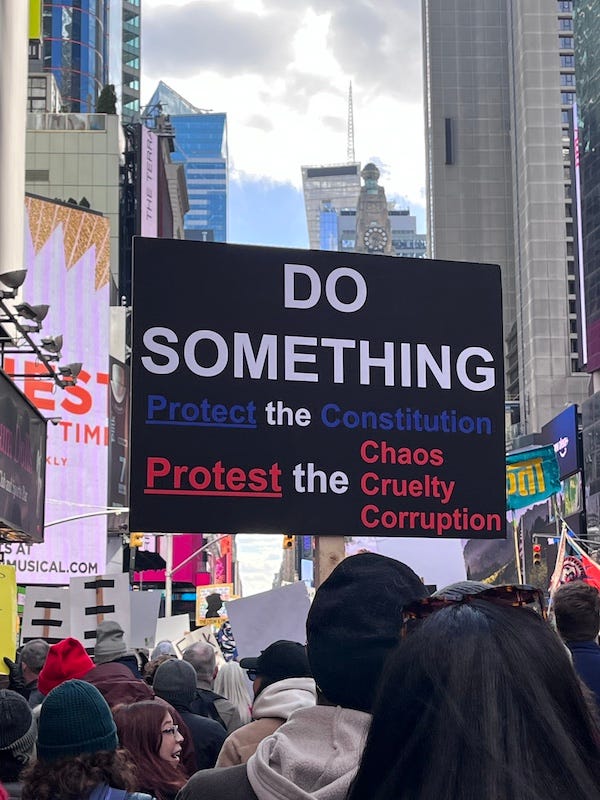
The march this time included many young people—almost none were in the first No Kings march, and I didn’t blame them, this is on us, the old—because they have skin in the game now, what with the draft being reinstated to fight idiotic wars started to help a pedophile* avoid jail; and the march included almost no people of color outside of a few Chinese and other Asian Americans—and that is as it should be, because this whole mess of a nation, of a world, is the fault of white people, full stop. It’s our mess to fix.
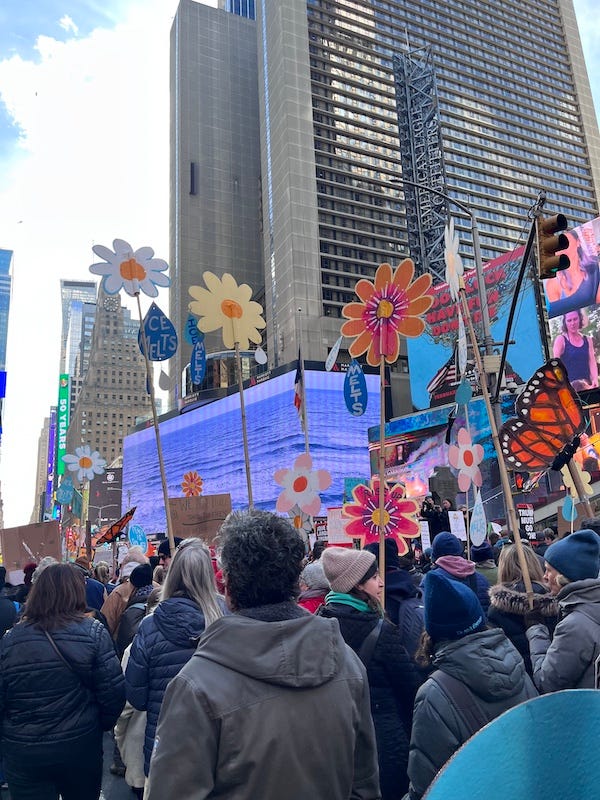
“Let us not underrate the value of a fact; it will one day flower in a truth.” ~ Henry David Thoreau, “Natural History of Massachusetts.” The Dial (July 1842)
On Monday night, in ideal timing, PBS aired the first of three episodes of Thoreau, a Ken Burns-produced (but not really his) documentary of the 19th century New England writer, naturalist, and abolitionist Henry David Thoreau, the guy you read in American Literature in 11th grade, about whose work my high school classmate Scott declared, “If I read one more word of Walden I’m going to Thoreau up.” The documentary might change even Scott’s mind about the importance of, and prescience of, Thoreau, who saw the damage that industrialization and unfettered capitalism were doing to human beings and to the earth and was determined to do something. I recommend the three-part series, streaming for free on PBS (the funding of which was saved by an Obama-appointed judge this week, another reason elections matter).
Thoreau succumbed to tuberculosis at the age of 44, having written works that inspired Gandhi (in an ironic twist, as Thoreau himself was inspired by Eastern religions) and Martin Luther King, Jr. One of the commentators notes that tuberculosis is “a wasting disease,” and I remembered that it used to be called consumption—now I get it, as it consumes all your bodily abilities and functions. Curiously, it occurs to me, our national consumption—of resources and useless crap alike—via capitalism, is wasting our planet, and I wonder if HDT saw that parallel.
This week too, in media bingeing via YouTube, I happened on a 1971 Dick Cavett interview with the theater legend Zero Mostel, most famous for playing Tevye in the original Fiddler on the Roof as well as the original Max Bialystock in the 1967 movie The Producers. From his entrance prior to being introduced, antically looming over Cavett’s shoulder, Mostel showed himself to an ungovernable guest, Cavett spending the next hour and a half never sure what Mostel would say or do, where he would wander, whether or not he’d actually perform “If I Were a Rich Man,” or answer interview questions at all. It’s great television, and particularly interesting to me because crazy though Robin Williams was on talk shows, he wasn’t dangerous the way Mostel was—and Mostel’s timing was knife’s edge right—he’d pull back the peculiar just in the nick of time, right before it became disturbing.
As it turned out, Mostel proved to be a great guest and shared terrific insights and anecdotes about his creative life, which began as a painter, working on murals for the WPA (Works Progress Administration) in the 1930s. I also learned that he and actor-director Burgess Meredith (Penguin on the 1960s Batman television series) invented the concept of Storytime Theater, performing James Joyce’s novel Ulysses as monologues (Mostel does two selections from it during the show); the group Elevator Repair Service (ERS) here in New York carries on this legacy—go know.
Like Thoreau, Mostel died relatively young, of heart failure at age 62 (the age I turn in May, I can’t help thinking). In Walden, Thoreau begins, “I went to the woods because I wished to live deliberately, to front only the essential facts of life, and see if I could not learn what it had to teach, and not, when I came to die, discover that I had not lived.” He says, “I wanted to live deep and suck out all the marrow of life,” and watching Mostel, I thought that Henry David would be delighted to see an unlikely compatriot.
These two marvelous men and the Thoreau series got me thinking: 1) men, the cis-gender hetero male human animals, should either be artists, philosophers, performers, farmers, laborers, or craftsmen, and that is it; 2) women** and gay men should handle all the politics, education, fiscal management, and societal responsibilities, and do whatever else they want of the male activities listed; 3) children should be able to roam free in the woods; *I never want to hear the word “pedophile” again, goddammit. (**Bondi and Noem types should be farm laborers, if they are lucky.)
I saw Nathan Lane on Colbert’s Late Night this week, talking about returning to Broadway in Death of a Salesman. Zero Mostel told Dick Cavett, who’d asked him his opinion about towering performances like Lee J. Cobb’s in the original Death of a Salesman, that Miller had sent Mostel the script first. Mostel’s thought on reading it was that the great French comic actor Michel Roux could do something wonderful with the part. But of course, Mostel said, “it was a typical Group Theater production,” and here he bent over, “Doom at the entrance,” and Mostel stood up, slumped, “Doom,” and he leaned over the small table into Cavett’s face, “Doom.” I knew exactly what he meant—everyone plays the end right away; Mostel’s casting idea made me think of Michael Scott in The Office, an ace salesman who had the opposite fate, promoted via the Peter Principle to a role of incompetence in management, thus creating comedy out of tragedy. Actors who play the part of Willy Loman, from Cobb to Dustin Hoffman to Brian Dennehy, end up hospitalized or at least cutting back from 8 shows a week to 6. “I’m on a death watch,” joked Lane (coincidentally the original Max Bialystock in the 2001 Broadway musical version of The Producers), who is playing all 8 so far. So now I’m intrigued to see what the cast and director Joe Mantello are doing with the play (which I saw just a couple of years ago in a revival with Wendell Pierce, a great actor, who played Willie as mentally ill out of the gate). I’ll let you know.
Exhaustion is upon us all. I awoke this morning with memory flashes of the dozens and dozens of times throughout my life that friends have looked at me as if I were a laboratory experiment gone wrong—not unlike the way Cavett looked at Mostel, but without the gentle bemusement. I remembered a quote my mom, Lynne, was fond of:
“The world is a looking-glass, and gives back to every man the reflection of his own face.” ~ William Makepeace Thackery, Vanity Fair

I wear my state of mind on my face, no question, and more often than not my mind is not the expected thing—it disturbs. It occurred to me, on waking and recalling the faces reflecting my face, that as April begins, your Miss O’ would do well to take a couple of weeks off the ol’ media, looking for some kind of resurrection of the soul. If I can’t find woods to walk in, I have the trees along 50th Avenue in Queens, anyway.
Hoping your spring brings you the renewal you need, with love,
Miss O’
 The Miss O' Show (Teacher's Edition)