
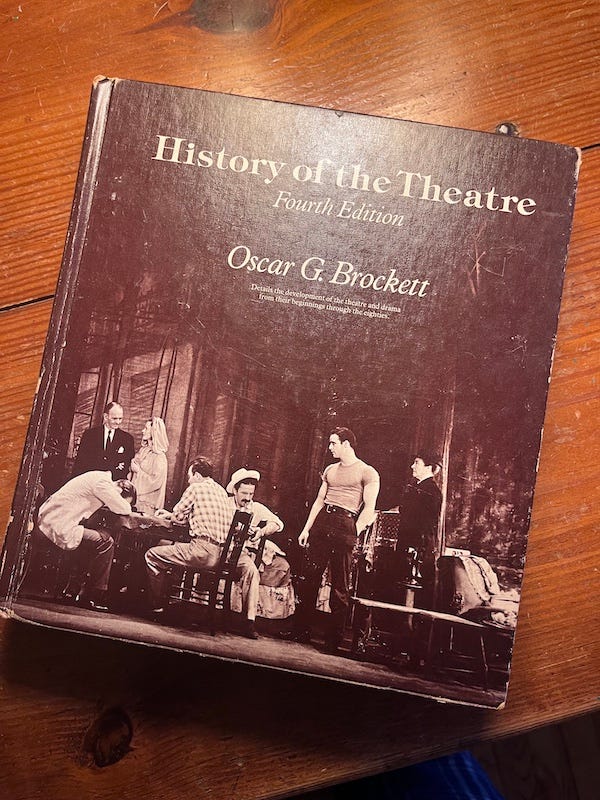
During my year of History of Theatre classes at Virginia Tech ca. 1983, Dept. Head Don Drapeau lectured about Western theater/re traditions that began in Greece, using the textbook History of Theatre (Fourth Edition, by the time I took the class) by Oscar G. Brockett. From the Greek and Roman multi-purpose arenas, we’d make our way through the Dark Ages to the Middle Ages and the Pageant Plays, where you’d come to realize that all theaters are essentially churches, which is to say, churches are theaters, built for audience and players. By the Renaissance, special buildings called theatres, (from the Greek amphitheatron, or “place with spectators all around”) were being constructed solely for the purpose of the thing that is a play. And at some point in a lecture, Don would intone, speaking about every theatre from the Rose to the Old Globe, “And it burned down.” Eventually, by the end of the second quarter, we students would complete his thought for him.
By the end of the third quarter, we could have changed it to “And it was demolished.”
As a theater-going New Yorker, you start memorizing the locations of all the major houses, Shubert Alley, the re-namings of long-standing places (The Brooks Atkinson is now The Lena Horne, for example); you absorb the history, how a row of old, beautiful theaters, including the legendary Morosco, was demolished to make way for the Marriott Marquis Hotel—and no hotel could look more impersonal or corporate, including the fast the glass elevators that speed you to the top floors. (Its only redeeming feature, the ready availability of restrooms on the fourth floor, is now a thing of the past, the doors locked. Because America is punitive by design.)
I have been revisiting theater history this week reading Historic Photos of Broadway: New York Theater, 1850-1970 by Leonard Jacobs, published in 2008. The book was given to me not long ago by my friend, Richard, a Broadway stage manager, when he saw me reading it at his house. (Lest I think he was being overly generous (or trying to dump a mediocre item), he told me that the year the book came out, two different people had gifted him a copy.) In photo after photo, you see old-time theater greats and photos of the theaters where they played, and the building narrative runs something like, “Built in 1926, demolished in 1936.” These stunning marble edifices, intricately carved, doodads all over, stunning interiors, painted ceilings (and you have to imagine the colors, as the photos are black and white)—each one gone inside of ten, twenty, or thirty years to make way for a concrete and glass office building.
So not only are the magnificent vessels of the performing arts built and demolished, when they were constructed at their height in the 1890s to the 1920s, America was both Gilded and also cultured; and then they all came down, the buildings and the people, in a crash with the Crash. Cue the wrecking balls.
The business of America is business. Really lousy business.
Page after page of these historic photos (along with captions heavy with dates and commentary, but oddly inconsistent in things like addresses or anecdotes), you see that only a few of these theater palaces survive and are still in use. “It was demolished.” And it got me wondering about the Western penchant for demolition—from Trump’s midnight teardown of White House East Wing and the coming teardown of The [Trump] Kennedy Center for the Performing Arts, to Israel’s U.S.-funded thermal bombing Gaza and the coming similar Israeli-U.S. treatment of Iran: what is it about Western culture that cannot bear the idea of anything as it is, taking its own time, whether it’s civilization or a meadow or The Morosco?
I think back to “It burned down.” With every innovation, from candles to gas lamps to limelight—theater owners saw money to be made by closing the roofs and playing both day and night; and with every chance of money to be made comes the risk of imminent destruction. Does this habit of money and tech rewire our brains? I think yes.
According to an article a friend sent me, the corporate-imposed use (by Microsoft and Google, etc.) of things like Copilot and ChatGPT and AI is also rewiring our brains to the point that very, very soon indeed humans will not be able to construct any original thought into a coherent sentence—even just the finishing of a text thought or correcting our spelling, via apps we didn’t ask for, is retraining us to rely on technology—demolishing us, as it were, to make way for data centers.
To what end? I ask this a lot.
All the nature, all the artistic work of architecture (as was), demolished by the Trumps of the world to make way for Towers in homage to themselves, wiping out what was, our history, our beauty, for ego. And we lose knowledge, too. Walking around Queens last weekend, my friend Cathy and I ran into our friends Lisa and Jodi, and Lisa remarked that something I once said about bricks got her paying attention to the way our many brick buildings are constructed. We pointed to the building across the street and showed Cathy. Here’s a photo to explain:
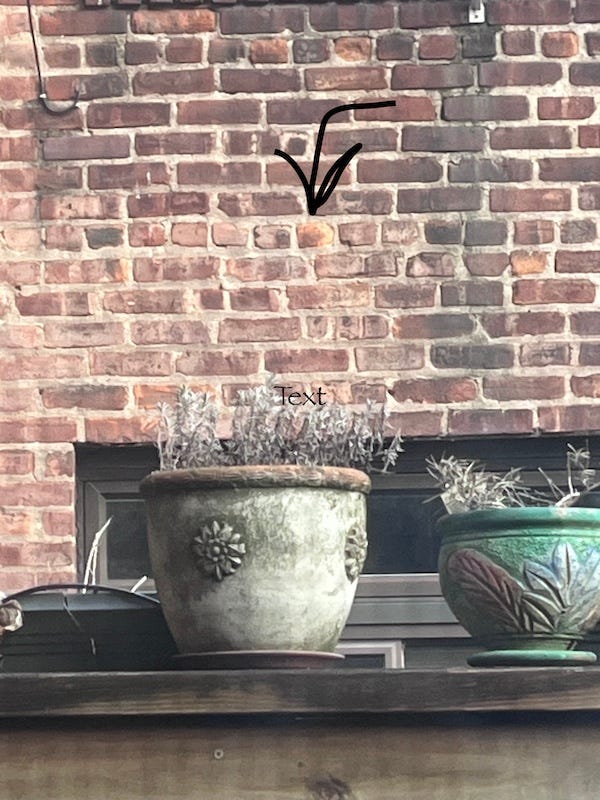
And I learned about this method of brick construction, done for stability, from my teacher friend Tommy many years ago. And from my friend Jim, who learned it from an architect friend, I learned that all the high-up doodads and sculptural features on fancy city buildings were created for the viewing pleasure of the people on the upper floors across the street. You know, with design and thought and attention to detail. I think about all these arts—carvings and mortar and bricks and marble and doodads in service to beauty as one enters a building devoted to other arts—and marvel at the cavalier attitude businessmen take to paying to demolish all this craft for the sake of a hideous concrete and glass tower to make money; I equally marvel that there are businesses devoted to doing this demolition without blinking. Money money.
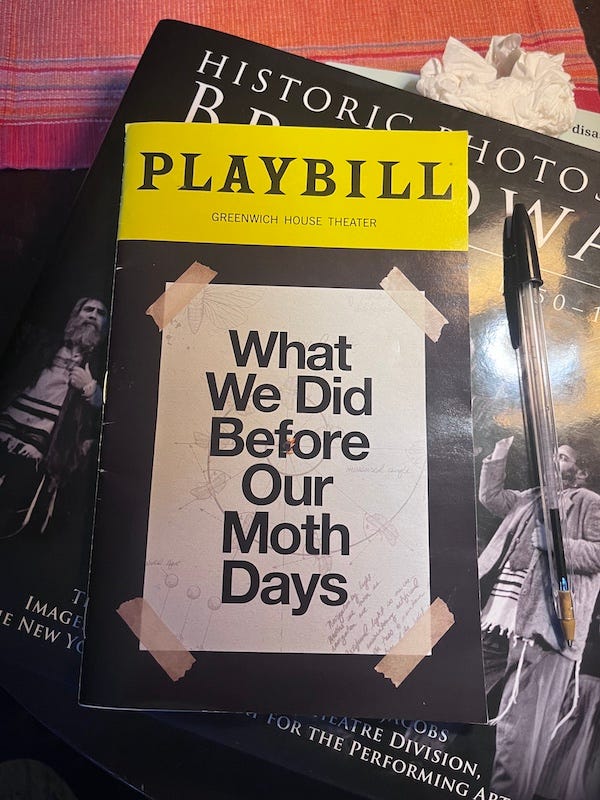
Sitting on the 7 Train to and from Manhattan last evening (and the night return) to see a play, I was among the few people daydreaming or observing; everyone else was on their phones or listening to something in their earbuds, and I got to thinking about all the ways we are demolishing our innermost selves so someone we will never know can make a shit ton of money.
One thing about this technology: I’m really glad that spellcheck often still misses “teh” and “aobut” for automated fixes. That will change. But I prefer to make my own corrections, and take my own daydream subway rides, and walk whenever possible to my destination—to feel that I still own my own mind, my own body, that I have a choice of experience and destiny. Until I, too, am demolished.
Sending love, somehow, on a Sunday morning from Queens,
Miss O’


 The Miss O' Show (Teacher's Edition)