A Vision’s Just a Vision if It’s Only in Your Head

The state of the art of putting us (back) together

It’s Sunday in America, a new, greater America, where already thanks to tariffs, grocery and drugstore shelves are going bare, especially of paper products, because most of our wood for paper comes from (check notes) Canada. So. Fucking. Great. When I’m not freaking out about the country, I focus my mind on art. Then I remember that Trump, who is clearly not really running the country, decided to spend his valuable time to get “elected” by the “board” to head the Kennedy Center, which just two days ago quietly cancelled all LGBTQ+ Pride events for 2025. But because this is Trump, his own big Kennedy Center celebration of his First 100 Days sees him ousted from that same Kennedy Center for “contract violations.” You can make this up.

But really, this shit show is serious. In an interview on Democracy Now, Maria Ressa (6-minute mark), recipient of the Nobel Peace Prize, draws disturbingly urgent parallels between the behavior of the Trump and his administration and former president of the Philippines Rodrigo Duterte, now in the custody of the International Criminal Court (ICC). Trump only learns from the best people. Ressa concludes that if Trump and his FBI and his ICE aren’t reined in by summer, our democracy will be obliterated and most likely for good. She’s just following history.

And the more I read and listen, the more correct I feel I was back in 2020 when I told all the liberals, who are as addicted to Trump as the MAGA who drink his blood, that they/we need to ignore the Big (Burger) King and target the minions who do his bidding, target the structures, and more than that, message the alternatives in actionable, relatable ways, not from On High. For however well-meaning AOC and Bernie are in their Farewell to Democracy tours, and Cory Booker for his stand-ins and sit-ins, they have no actual strategy for saving the country; they do not think like generals, and we need generals right now.

I read about a recent viral Facebook post claiming that Liz Cheney penned a letter saying, “Dear Democratic Party, I need more from you. You keep sending emails begging for $15, while we’re watching fascism consolidate power in real time.” According to Snopes and PolitiFact, there’s no evidence that Cheney wrote it, but you can tell that the average Democrat who probably did is trying hard to get our party’s attention, because Democratic Leaders are so sure they don’t need We, the People, for advice, only cash.

I’ve been trying to understand the Democratic Leadership’s “vamp until ready” stasis. In the theater, the orchestra pit plays music over, and over, or “vamp,” at moments of a show, to cover a set change. In the case of the U.S., there’s a regime change, or a shift from a presidency to a regime, and if this were a show, it would be as if instead of playing bars of music on repeat, the orchestra itself was replacing instruments with jack hammers and table saws.

I mentioned in my last missive that I’ve been rereading Sondheim’s lyric memoirs, and the other night I came across this, and it made me think of the floundering Democrats:

“The point of a tryout is to fix a show, and by the end of the Chicago run, we should have been making changes in the scenes and the songs and the staging. But we couldn’t, because the day after the show opened, Hal [Prince, director] had to go to Germany to receive an award and then leave for vacation. Not that he thought the show was in perfect shape when he left; he simply felt that whatever changes we wanted to make could be accomplished on paper and put into practice later when we went back into rehearsal for the Washington engagement….

“It was a serious miscalculation. We were all experienced enough to know that the time to fix a show is when it’s still raw, before it has started to become slick and rigid, when no one, neither the creators nor the performers, not to mention the audience is satisfied. Without constant attention while a show is taking shape, it doesn’t need many performances before it becomes so efficient that what’s bad becomes acceptable.”

— Stephen Sondheim on the making of the show Bounce, 2003 (from Look, I Made a Hat, 2011, p. 270)

Kids, I think to myself, we don’t have a lot of time to fix this democracy. We have to attack now, while it’s all still raw, while the chaos is still real and awful. Do not relent. Call and email your representatives, keep talking to friends. I long for leadership, but it’s not forthcoming.

As we watch our prices rise and shelves empty because shipments cease, as more and more all of us can only focus on basic survival, the energy for revolution will wane—I think that’s what the MAGA Men and their little MAGA Barbies are banking on—and it can’t. We still have to do that work inside ourselves and push it out.

This week, I happened on an episode of Craft in America on Public Television (soon to be RIP unless we stop it, somehow), in which I saw a quilt artist—that’s right, the photo below is of a quilt. The quilt was based on a photograph of a Nicaraguan garment worker in a sweat shop.

Portrait of a Textile Worker, Quilt by Teresa Agnew

On artist Teresa Agnew, from Craft in America:

“Terese Agnew’s work has evolved from sculpture to densely embroidered quilts by a process she calls drawing with thread. Her themes are environmental and social. Her most notable quilt to date is the Portrait of a Textile Worker, constructed of thousands of clothing labels stitched together, contributed by hundreds of sympathetic individuals, labor organizations, Junior League members, students, retired and unemployed workers, friends, family and acquaintances worldwide. The resulting image is about the exploitation and abuse of laborers, the by-products of globalization and the insatiable American appetite for goods.”

The quilt was created using solely garment labels. Zoom in.
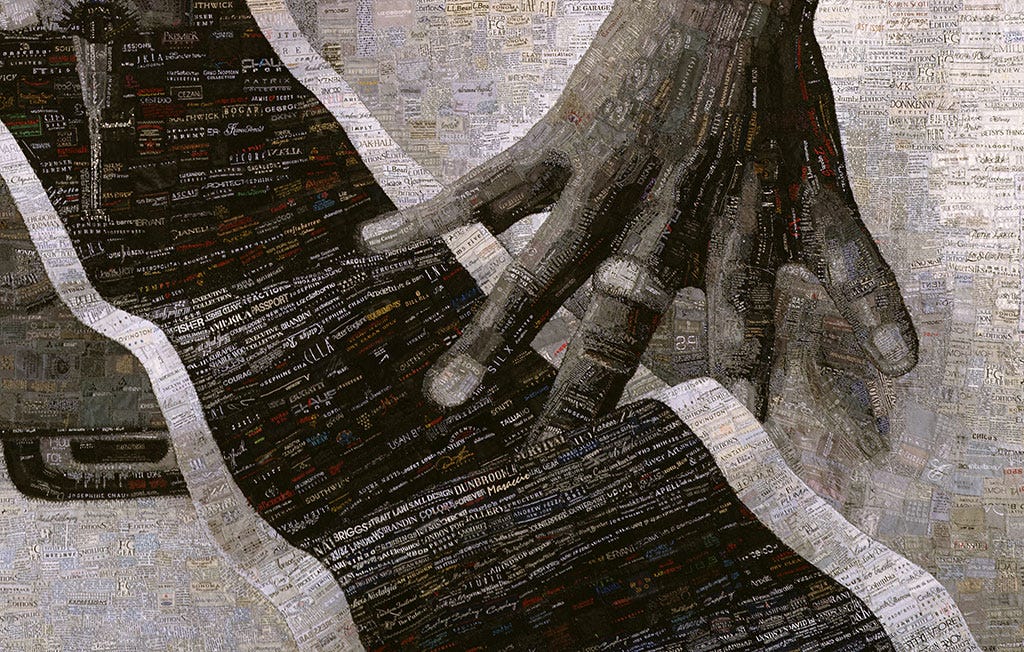
I learned that Agnew found her P.O. box filled day after day with volunteer labels, mostly from people she didn’t know, all women, all who believed in her vision for this piece, her purpose, her message, and in this art form. All these people came together, and Agnew didn’t even know how they learned she was working on the piece.

I think of that artist, and I think of Sondheim, on the road with three iterations of a show that started as Wise Guys, and become Bounce, a decade later finished as Road Show, bit by bit, putting it together, as it were, because it was something he and his collaborators believed in.

If so many people can work that hard to make art that matters, can’t we call work together to demand a nation, a planet, we all want to live on? As Sondheim says,

A vision’s just a vision if it’s only in your head.

If no one gets to see it, it’s as good as dead.

America, your Miss O’ is looking at all of us and thinking, “We need a do-over, a rethink.” Fast. We overproduce all the wrong stuff, overconsume the wrong stuff, overwork in the wrong ways, overpay for the most basic things, like healthcare and rent, and overthink everything about the past instead of overthinking for the present and the future. We need to take all these scattered feelings and thoughts and make, build a national living quilt from all the tattered bit and leftovers, craft it for warmth and strength and beauty for generations and generations.

How many metaphors can you handle this Sunday?

It’s still spring, we are still alive. More to do. Let’s do it.

Sending love to all,

Miss O’

Not Waiting for Directions (Home)

When you just want to do it yourself but can’t

“Dear Saint Anthony, look around, something’s lost and can’t be found.”

~ Catholic prayer to the patron saint of, among other things, lost objects

“When evil-doing comes like falling rain, nobody calls out ‘stop!’”

~ Bertolt Brecht

“Never start a piece with a quotation.”

~ Nora Ephron

Do you have the feeling that we are all living through a Kafka short story? “The Trial,” perhaps, or “The Refusal,” maybe? When I was home in Virginia the other week, I asked my brother Jeff if he’d ever read Ray Bradbury’s “The Sound of Thunder,” and when I recounted the plot, he realized he once saw a bad movie version; and it came up because, as we caught the latest news out of America, I mentioned that I keep looking for a smashed butterfly on my shoe.

For some reason, I got on a mailing list for Catholic charities and I often receive “free gifts” of amulets and charms and bracelets and necklaces of St. Anthony. Coincidentally, he’s my favorite patron saint.

Like me, in addition to those stories, maybe you are thinking of that Twilight Zone episode, “It’s a Good Life,” where that evil kid keeps wishing everyone who displeases him away to the cornfield, and no one will stop him out of fear, and also love, because his parents choose to save him and let the rest of the world disappear. In the same way, Trump bastardizes the Kennedy Center even as he plans to close or demolish the Museum of African American History, and Musk eyes selling off the National Gallery treasures to “save money.” Wishing all our history away to the cornfield. And, echoing Brecht, there’s no one to stop them.

Or is there? Reading historian Heather Cox Richardson the other day was a tiny balm, as she recounts recent events and sees shifting winds. I’ll take it.

Your Miss O’ has been lying low these past weeks, visiting aged parents, aging brothers, a young nephew and vibrant sister-in-law. Also watching birds, smelling lilac in bloom, watching red azaleas pop, walking around my childhood block in drizzle. In addition to watching classic movies and “Harriet Tubman” on PBS and “Poetry in America” episodes with brother Jeff during the week, I caught A Complete Unknown on my last night, the weekend nephew James visited. James just wouldn’t go to sleep in his designated living room, what with all the excitement generated by middle-aged relatives, so he happily sort of watched the movie with the grownups, not understanding any of it. Fortunately, there’s no nudity and little in the way of bad language, but at the point where Joan Baez gets out of her bed where Bobby Dylan is sleeping, only in her underwear and a tank top, four-year-old James commented, “She forgot to put on her pants.” Uncle Jeff chucked, “He doesn’t miss anything, does he?”

If you haven’t seen that Dylan bio pic, for me the most interesting storyline was the one featuring Pete Seeger, played beautifully by Edward Norton. The movie helped me understand this mystery surrounding the rift that formed between Dylan and his early supporter and champion Seeger. Their link was Woody Guthrie, suffering from Huntington’s chorea at the movie’s opening, the disease never named or explained, as Hollywood does. I won’t belabor the plot, but essentially when Dylan went electric at the Newport Folk Festival, Seeger was dismayed and dejected, not because he hated rock, but because it was the end of his dream. For years and years, Seeger saw in Guthrie, and in the work of folk musicologist Alan Lomax and in folk musicians like Joan Baez and Odetta, the opportunity to proclaim a unifying voice in American music. Amidst the turmoil of the civil rights movement and the communist accusations of HUAC, the folk music movement offered the possibility of a true common ground across race and social class and political affiliation, youth and old age. In Dylan, Seeger saw the last piece of his dream, a young, galvanizing voice, filled with unendingly creative songs of love and political revolution, fresh and original but also connected to our American past.

But Bob Dylan was an artist first, an individual all the way, with no interest in marches or politics, not really, and not at all interested in unifying a nation. The rest is history, Highway 61 Revisited, and unending tension and turmoil in America. This is not Bob Dylan’s fault. Pete Seeger meant well, too, but no single person can make us all believe one “us” to be true.

No one, alone, can fix it.

But if something can unify a people, it’s probably music that comes as close as anything. Music and food. Music and food and complaining about noise.

On Thursday morning this week, around 8:30, as I was working when I heard this high-pitched BEEP BEEP BEEP [beat] BEEP BEEP BEEP. Smoke alarm? Tow truck? Work truck backing up? After about 15 minutes of this blaring through my window, I decided to take a walk hoping the cause of the noise would resolve. One 20-minute walk later, I could still hear the beeps from two blocks away. I went on a fact-finding mission. Where I live is like a mixing bowl of sound—finding the source was a confusion to me. I called 311—a wasted half hour of the operator’s frustrated inability to locate where I was on the city map. Feeling crazy at this point, I texted my co-op group, and neighbor Chris took over, agreed with me it was in a trash bag, rummaged, found the culprit—a discarded smoke alarm!—and smashed it. Oh, blessed relief.

In the midst of ICE raids in America destroying families, there are still annoyances like that, you know what I mean? It’s the thing I’ve never understood, not since I watched the 6-day war on Walter Cronkite’s 6 o’clock news when I was James’s age: what are human beings thinking when they annihilate other humans? We have enough little daily problems, don’t we?

If noise rage occasionally unifies us, language never seems to be able to, because as poet Nikki Giovanni said, too many people try to speak English rather than speak through it. Saturday morning, I had to go get bloodwork and urine testing done for my physical this week. Earlier in the week, I’d received an email that my neighborhood LabCorp office “has closed.” Full stop. I was so bummed—the next closest one is in Jackson Heights, about five subway stops away. Instead, the email continued in the next paragraph, there will be a new office…wait. It’s the same address, but one floor up. God I hate it when people can’t fucking communicate. What the email should have said is, “The second floor LabCorp office is closing for two days in order to relocate to the third floor.” Do you see the difference? Why is this hard? Because it is.

When I arrived at 7:45 for my scheduled 8:00 AM appointment, I saw a packed waiting room—highly unusual, but the office is “new,” so one makes allowances. One man there had a son, probably eleven or twelve and clearly on the autism spectrum, chasing him around, keeping him out of lab rooms, out of the hallway. I went to self check in kiosk but saw this sign:

So I went to the window to check in, as directed. The nurse behind the glass, short, dyed black hair, officious—clearly overwhelmed (like her male counterpart) by the double duty of being a receptionist and the technician, came out to the kiosk and said, “Give me your ID, I’ll do it,” and I pointed to the sign, saying, “If it works, I can do it…,” but she was clearly focused on finishing the check in. Again, I pointed out the sign directing us to go to the window. Did she take it down? No. She straightened it. (My seat being nearby, I spent the next 45 minutes explaining to everyone who came in, “It works, ignore the sign.”)

Between the lying sign, the autistic child flying around, the woman who was denied a pregnancy blood test because she didn’t have a doctor’s order, the men needing drug tests for their jobs, and the seats all facing forward staring into the abyss, I felt I was in some kind of play. Not really Kafka, but rather, Samuel Beckett. I was in a Beckett play. I love to see plays but it’s not always great to live them.

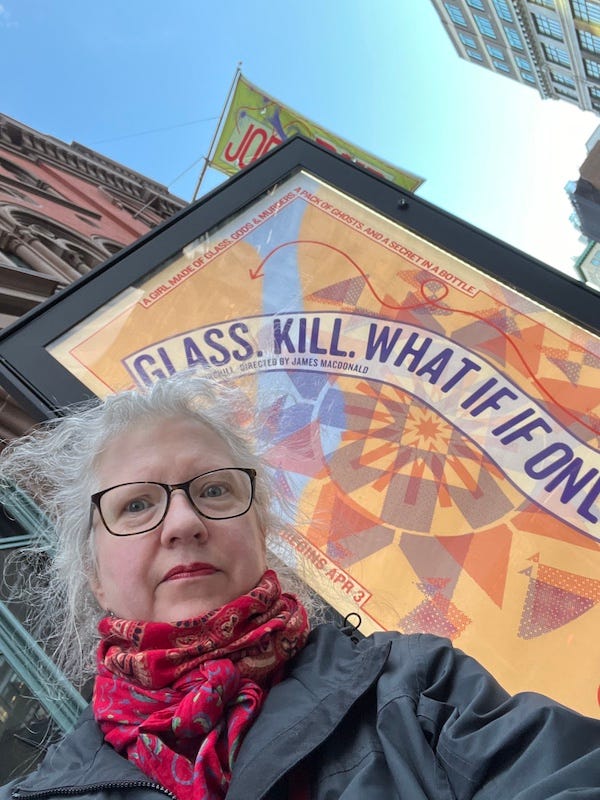
True to my heart, to cheer myself earlier this week, I went to The Public Theater to see a collection of short plays by one of my favorite playwrights, Caryl Churchill. As only an artist can, she captures me in this time, even in America. I think the titles say it all.

And that’s the latest. How’ve you been?

Love to all, somehow,

Miss O’

Et in Arcadia Ego

And in hell, too

Et in Arcadia Ego: The novelist Evelyn Waugh uses this as an epigraph for his novel, Brideshead Revisited. Made into a miniseries ca. 1981, Brideshead was devoured by me and several of my teachers in my senior year of high school, though trying to watch it again a few years back gave me hives, so slow and ponderous was it. This current response speaks to the ways we have all become impatient with time and feeling and characters’ internal lives, as well as with living itself. Today I was thinking about this quote, and Masterpiece Theater host Alistair Cooke when he talked about the interpretation of the epigraph. For a long time, Et in Arcadia Ego was interpreted as, “And in paradise, I,” as if to mean, how lucky I am to be in paradise; but that more recently, it could be said to mean, “Even in paradise, I,” meaning, even in paradise, you can’t get away from yourself, so to speak. Paradise won’t make you feel better if you aren’t already at peace with yourself.

And then of course there is Hell. Lots of people have had views (of it and on it). I’ve been a quote collector all my life, and one of the first quotes I wrote down in a high school notebook, which I gave away and wish I hadn’t, was by John Milton, from Paradise Lost: “The mind is its own place and in itself can make a heaven of hell, a hell of heaven.” My mom, Lynne, quoted that to me, and I had to write it down. Do you do that? It’s a certain kind of eccentricity, I’ve read, that need to ink the words of others, and then hold their words in our hearts.

My mom also gave me this quote from William Makepeace Thackery, from his novel Vanity Fair: “The world is a looking glass and gives back to every man the reflection of his own face.” I do think this is true. The other day a friend came over and relayed his mantra in these times, part of which is, “I am light,” and he’s noticed it’s working, that his light is manifesting, and that people are responding in kind. I’ve been carrying Milton and Thackery as my mantras since I was fourteen; I know their truth.

Last night Senator Cory Booker (D-NJ) ended a filibuster of 25 hours and 5 minutes, not reading mindlessly from an encyclopedia like the racist Strom Thurmond, whose record he defeated—ol’ Strom, who I remember being wheeled in post-stroke, incoherent, to “vote” for something that would hurt people (a rolling advert for term limits), filibustered in 1957 was trying to stop a vote on the Voting Rights Act, and he succeeded—but instead letters from actual people who are going to lose their very lives if Social Security ends. And that elected Black man beat that white man at his own game, and with righteousness.

This evening, I heard the Dow has already plunged to the point of total crash in anticipation of Trump global tariffs taking effect—the same type of tariffs that set off the Great Depression in 1930. (The tariffs on Russian goods? 0%. Trump is deliberately bringing America to its knees, to its end, at the demand, it seems, of Vladmir Putin. Why? It’s a shame we don’t have a free press to find out.)

This morning, I couldn’t stop crying. The whole morning, trying to work, I was wracked with sobs, for everyone—for all the migrants and college students and innocent humans whose editorials or simple tattoos are disappearing them into an El Salvador torture prison (and we have them, too, make no mistake) and soon it will be more and more and more and more and more of us. Never to return? Even after acknowledging, “mistakes were made,” ICE and Tom Homan and Trump couldn’t give the dogshit on your shoes. It’s all out of their hands, they say, as they reserve their special places in a hell in which I do not personally believe.

I’m sobbing over the gutting of the CDC, NIH, and branches of state health facilities, all of it, without a single national headline to cover it, the whole CDC facility in Atlanta shuttered today, hundreds, thousands of health professionals out of jobs, even as measles, tuberculosis, and other infectious diseases threaten epidemics due to vaccine ignorance.

How do you stop crying when you watch living hell unfold? My power walks are manic. My words here useless.

Talking of faces, of feelings, I think of Oscar Wilde, “A mask tells us more than a face.” What masks do you see in all this? Wilde also said, “Man is least himself when he talks in his own person. Give him a mask, and he will tell you the truth.” I think of Trump’s press secretary, who stands up straight and shouts louder to demonstrate she knows nothing of the rule of law, the mask that is the all-powerful Trump mouth. I think of all the Trump mouth masks, including Trump’s, that say not one true thing, while ironically telling you how it’s all truly going down.

No one—literally no one, including Senator Booker—has any idea how we stop this. No one has a clue how to make this stop. I have no magic quote to give you, even the great John Lewis’s “good trouble” feels weak. “Be the change you wish to see in the world”? Will Gandhi light that fire?

We, the People, have to do it. We have to throw our words at it, but mostly throw our bodies at it. When we can, how we can. There’s a voice out there, a voice we haven’t heard yet, that is going to rise above all this madness and help guide us. Senator Booker set the tone. But we can’t wait for the next voice.

This April 5, on the day of national protests, I will be on a train headed home to see my aged parents, and it’s long planned and needed, but I feel I’m letting down my country yet again. So I’m writing you this note to tell you I’ll be offline and quiet this next week, but not disconnected.

Be the light, be the love, be the change, be yourself, tell the truth, throw the words, and I’ll do it, too.

Love and light,

Miss O’