
Possessing words for the times
Hi, sweetie. What a Monday. Between ol’ Def. Sec. Pete texting secret plans for war with Yemen (wtf?) to the Atlantic magazine by mistake (in his defense, it’s hard to multitask when you’re drinking with both hands) and ol’ Pres. Donald explaining to the press that he has no idea what is happening in his administration (in his defense, it’s hard to lead the free world when you don’t give a shit), I’m not feeling exactly safe in the United States.

Words fail me. And yet here I am writing. If you don’t mind, I’ll write what I was going to write about despite our national security in the balance. Because my god, what else can I do?
One of the things in this life I care about most, beyond family and friends and air and water, is language. I’ve tried reading it, writing it, speaking through it, and acting with it. I edit it for my accidental living. There’s so much to try to express, and learning to do it is a lifelong process.
Back in the summer of 2018 or 2019, I think it was, my friend Colleen and I found ourselves doing open mic standup at QED in Astoria, Queens. I only signed up to make Colleen do it, because she is genuinely hilarious and had been making excuses. “I put my name in the bucket,” I told her one Sunday afternoon. She looked at me, “Now I have to do it.” Yep. Use those brainy words.
I am fearless and had a built-in schtick: “Hi, I’m Miss O’Hara, and I’ll be your teacher,” I spoke gently into the mic. “There is nothing you can say to me that a fifteen-year-old hasn’t already said, and with worse grammar.” The first time I introduced myself, I almost burst out laughing seeing all these mostly young white male comics sit up. They literally did that, and I know had no idea they had. I told grammar jokes for four minutes. I was the adorable old English teacher they all remembered having—though I was less of a comic than a palate cleanser between the groups of men, and a gray lady fluffer to set up Colleen’s natural genius.
I probably told you this story, but one Sunday, a young comic, very promising, was working on a routine he’d been practicing for a few Sundays, and it really was getting funnier. At one point he was describing a friend’s plight, crying out, “And his head was squozen…” as he gestured dramatically, and I couldn’t help myself. I began giggling, “Squozen,” I sputtered; and he called out, “Miss O’Hara, what should it be?” and I called, “Squeezed,” and he corrected, “Squeezed!” and finished the routine.
The next week, I saw he was there, and my name got picked from the hat before his did. “I’m Miss O’Hara and I’ll be your teacher,” I began. “Last week,” I breathed dramatically into the mic, “we had an unfortunate incident with a misused past participle.” I glanced at the young comic in his dark corner. “But really, if it’s freeze, froze, frozen, why isn’t it squeeze, squoze, squozen?” I went on to riff on the history of the English language, and needless to add, I killed.
Ha, ha.
But in truth, the venue notwithstanding, grammar is a subject that interests people, isn’t it? We all have questions. English grammar is, to me, a point of common ground. Everyone who comes into contact with English wants to understand the difference between lie and lay, for example, and which pronoun is correct in a compound construction, (me and her? her and I?) that sort of thing.
Here’s a sampling of stuff that we could all correct quickly, if I had a PSA / Schoolhouse Rock platform. This is all off the top of my 38-years-in-English-education head.
1. Her and I want a horse. (She wants a horse + I want a horse = She and I want a horse.)
2. Morty threw a javelin at him and I. (Morty threw a javelin at him + Morty threw a javelin at me = Morty threw a javelin at him and me.
3. This house has been her and I’s dream. (This house has been her dream + This house has been my dream = This house has been her and my dream. NOTE: Don’t say that. Say, This house has been a dream for both of us; or, a dream for her and me, or our dream. And if you must use possessive pronouns, use the correct ones. Doesn’t that feel good?)
4. Lie v. Lay
a. To lie is an intransitive verb. It takes no object. No nouns are harmed in sentences with lie. You lie somewhere; you lie down, you lie across the bed, you lie on the grass; also, you lie like a rug.
b. To lay is a transitive verb. It takes a direct object. You lay a slab of concrete, you lay the shawl on the chair, I lay me down to sleep, lay lady, lay. (NOTE: You lay down your arms, because you lay your arms down.)
c. NOW: here’s the key source of confusion. It’s the tenses.
i. LIE: Today he lies down, yesterday he lay down, tomorrow he will lie down, (over time) he has lain down on the same bed for years. LAY is the past tense of LIE. Crazy, right? And yes, the past participle is have lain.
ii. LAY: Today she lays the concrete slab, yesterday she laid the concrete slab, tomorrow she will lay the concrete slab, and (over time) she has laid concrete slabs for decades.
5. I’m sorry.
Does anyone die (die, died, will die, has died) if you misuse any of these pronouns or verb forms? One hopes not. But every time someone on television, in the media, on a stage, in politics, for example, says in public for the world to hear, “Him and I disagree,” our nation’s reputation deteriorates still further. I really do think the way we care for our language is a reflection of every other thing we care about. You know, like our children.
When we teach our language to our children, we are showing our children that we value that they express themselves. I know all this teaching language talk sounds ridiculous when we live in a nation that couldn’t care less about educating our children in language or anything else; and, worse, whose current government has no problem disappearing babies and children, or causing struggling mothers to die carrying unviable pregnancies, or saying that children with disabilities are unloved; and whose Republican leadership is embroiled in so many scandals involving arrests for child molestation it takes your breath away, gut punch after gut punch.
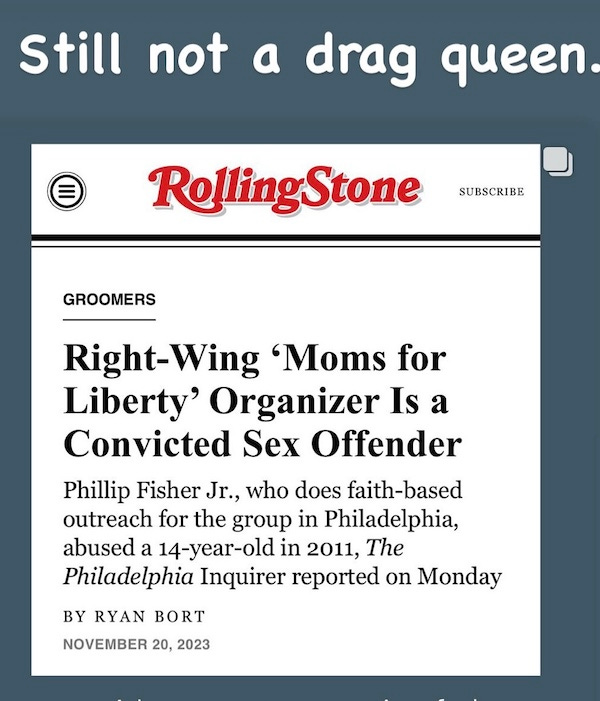
But let’s ban books? Close libraries? Libraries and personal bookshelves and story-times (drag and otherwise) connect all of us to what it means to be human. It’s stories, it’s language that does it. And obviously it doesn’t have to be English—I’ve sat enraptured listening to poems and stories by griots and Native storytellers, and in the audience of Italian operas, where I didn’t understand a word.
But since English is a primary language, and a lot of us speak and read it, I feel that the grammar, then—the learning of it, the doing of the exercises, the practicing of it—connects our national humanity, or can; we feel successful when we learn language and understand the grammar, because everything we learn, we will use in communicating with another person. (Note: AI will never feel good. You know that.)
And if connecting isn’t important, what is? I think I’ll hang out my shingle on a park bench and get started. Let’s talk.

Love or something like it, past, present, future, and tense,
Miss O’

 The Miss O' Show (Teacher's Edition)