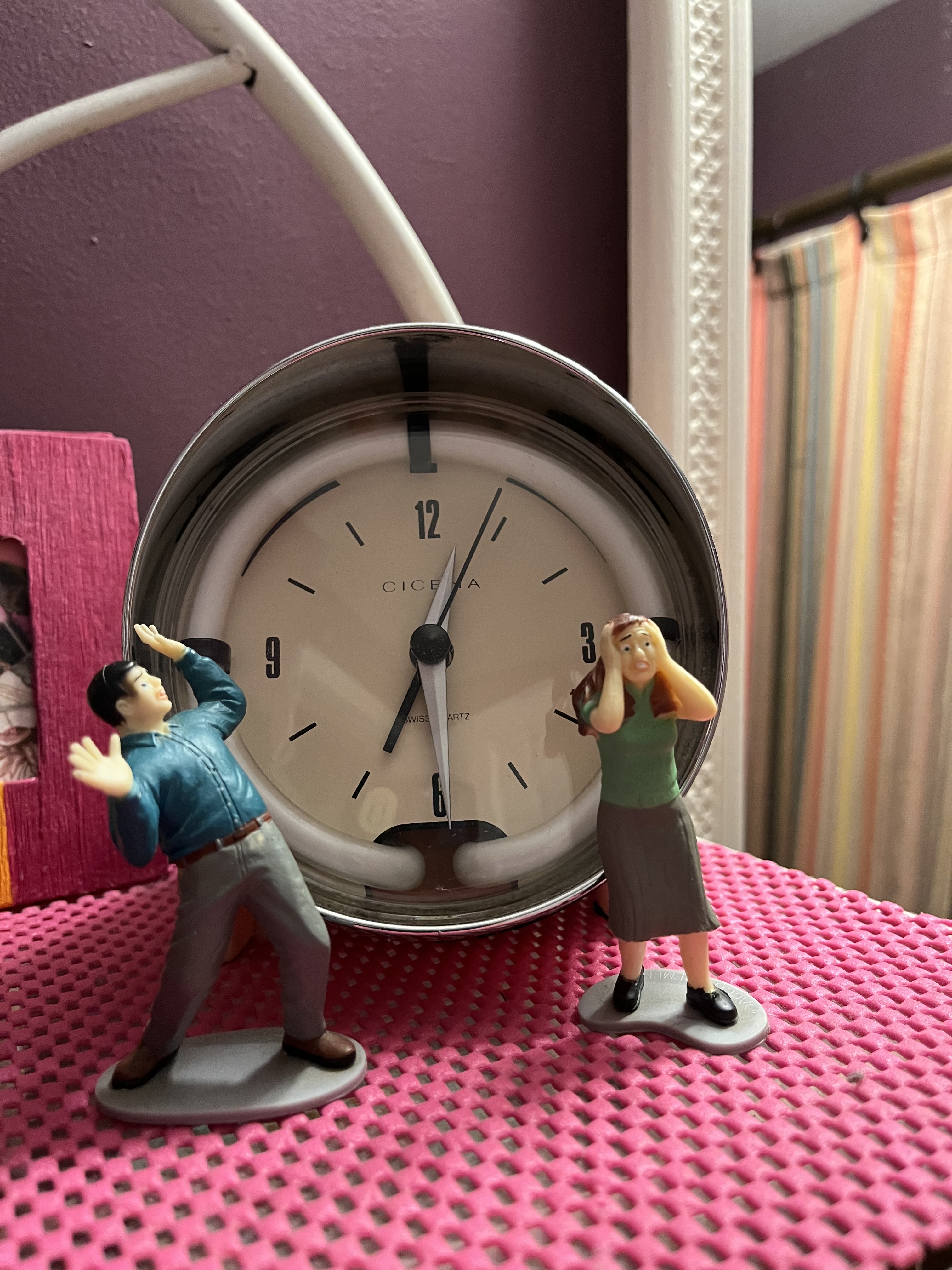
The Woman Mind: A stroll in our political landscape

When I got off the 7 train in Queens last night around 11:45 PM, damp and chill after a wintry weather day (I’d gone into the city to see Harry Potter and the Cursed Child on Broadway last evening with a friend visiting from out of town, and all I could think during a scene showing Death Eaters, was “Oh, look, ICE,” but everyone else was just super excited that the grown up Draco Malfoy was being reprised by the movies’ Tom Felton—he was delightful), I crossed the boulevard to a bodega to pick up pita chips and hummus for a late night snack (the show was three hours long, dinner was five hours before). Inside the bodega were an assortment of loud males: one older white guy, very Queens working class; two Black guys around 30-40 years old; and a younger Hispanic guy. They were guys, if you know what I mean—you rarely see guys on television or in movies anymore, and I think this is a shame. Gym-cut, professionally groomed, and models of the self-care craze, actors today really have a hard time being interesting, but they do attract some chicks and the agents, and it’s all about the bucks.

Behind the counter was a young Middle Eastern cashier/manager (not really a guy type, more composed and elegant) staring at this one talkative Black guy standing by the white guy. I found my chips, my hummus, and when I went up to pay for them in this cramped deli area, I was barely noticed by the cashier; you could see that the talkative guy was either on something or off meds, was too-calmly ranting about something, and would not be talked down or moved off topic. I put my purchases up on the raised counter, but the cashier/manager kept his eyes fixed on the talkative guy; the old white guy was trying to be a casual peacemaker, but the cashier/manager said, “I don’t want to talk to that guy anymore,” his eyes wide, a little frightened, because that talkative guy was clearly this close to exploding, and the other two customers were really confused; they all seemed to know each other but it didn’t matter. I managed to get the purchase acknowledged, paid cash, tried to say, “I don’t need a bag,” but the stuff was being bagged on autopilot, eyes never on me, and I simply took it and my long-coming (but correct) change and booked it out the door and up the street.
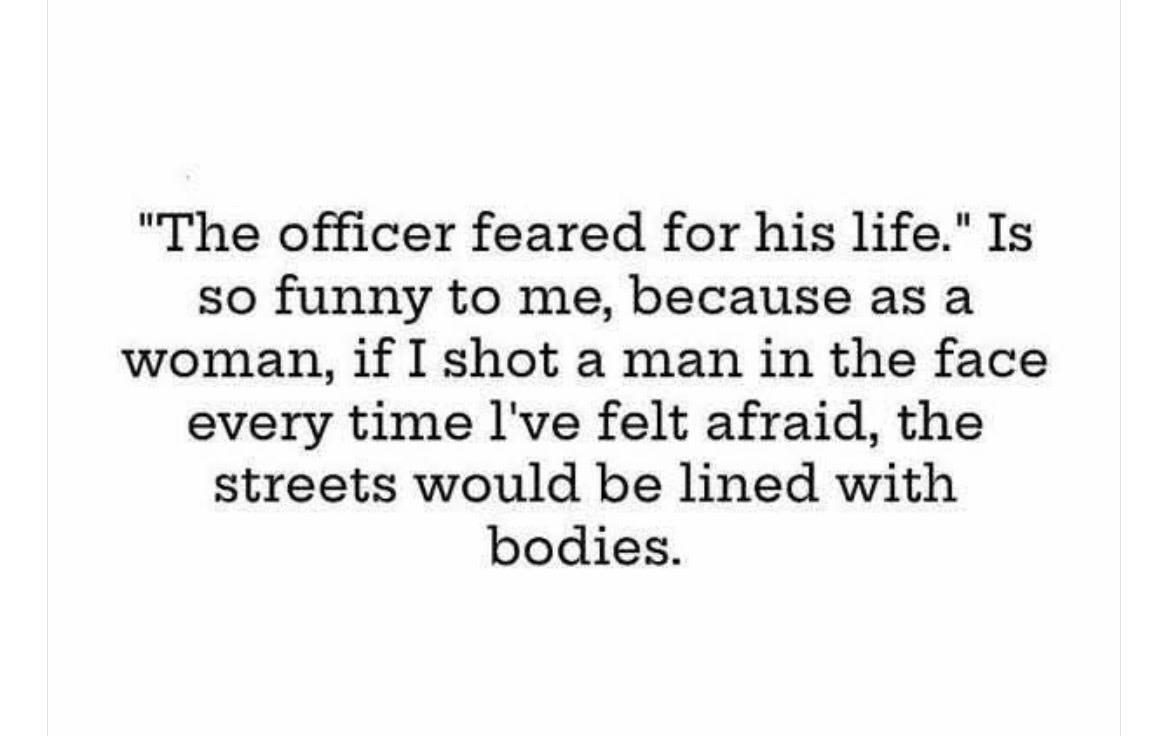
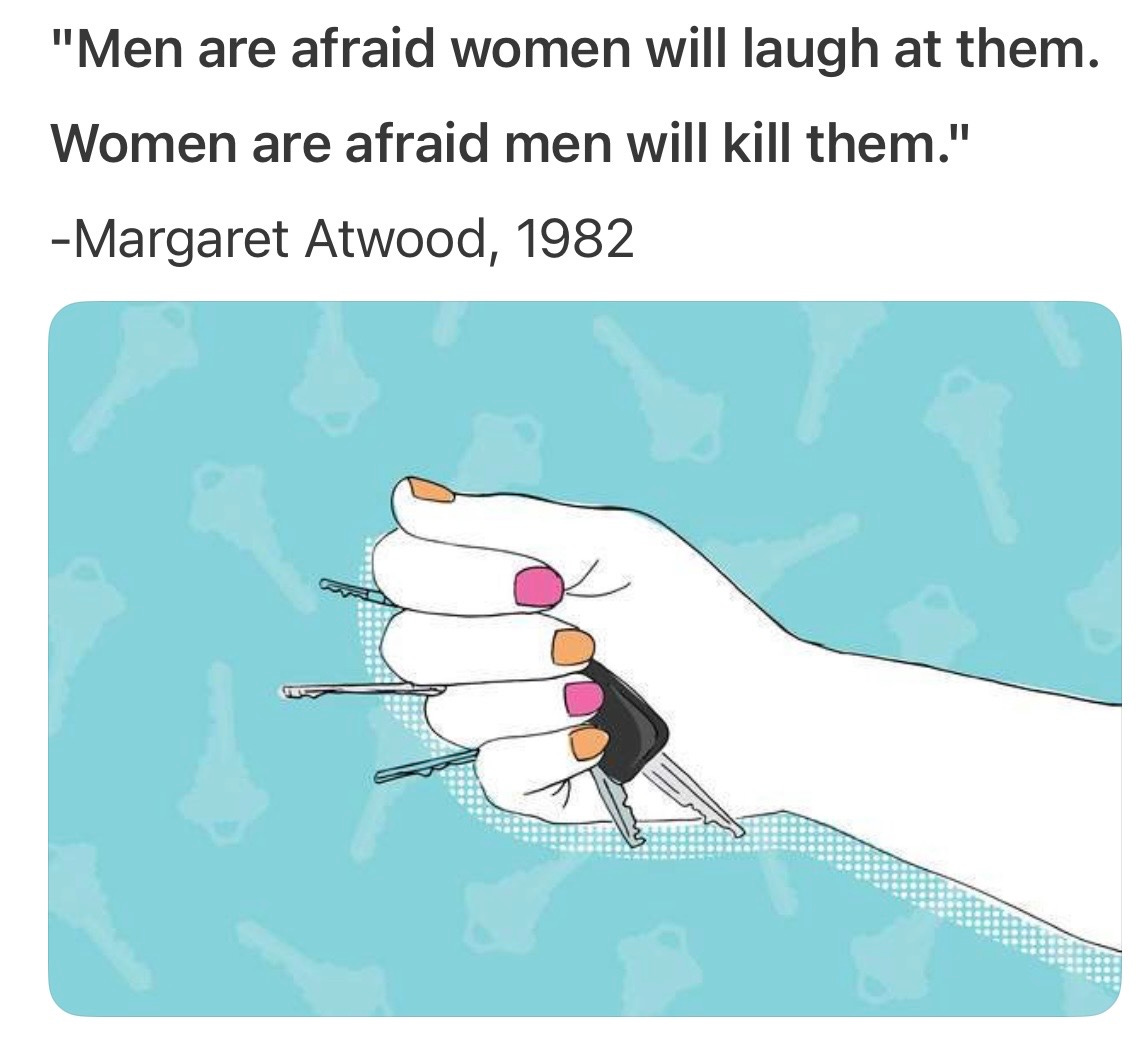
By the way, for the men reading this, this is what it’s like for women to live in the world all the time: because there is never not a threat of imminent violence, we have to stay vigilant; if we aren’t the targets of violence at a certain moment, it’s because we simply don’t exist (I can promise you not one of those men saw the old lady buying hummus) or there are other women experiencing violence somewhere in the vicinity. Even when women aren’t consciously thinking, “I’m about to raped,” we can’t walk down any street by day or night, or enter or leave our cars or homes, without knowing “this could be the day.” Renee Good’s murder is one of a string of these inevitable events; the officer will face no consequences (unfortunately for us the decent, the martyr role won’t stick, as Good was not only a woman but a liberal activist and a lesbian, and so America on the whole is okay with her murder).

Back to the bodega: if there’s an emotionally charged dispute of some kind going on, not even with yelling—and not one of these men registered the imminent threat except the cashier/manager, who has seen this too many times, no doubt, and me—all any woman would want to do is escape this. Guys (straight, I’d qualify) are, unfortunately, almost universally unteachable when it comes to these situations if they don’t have high level empathy already (in my limited life experience).

These males in the bodega were at once too blind, too self-involved, and too emotional to figure a way out of whatever this situation was, a situation which suggested at worst drug-addled paranoia, at best bruised ego, rather than any actual injustice. Petty stuff.
This morning, I happened on a post by a woman whose voice I’ve come to value deeply, a fabric artist named Orsola de Castro, who speaks sense on all matters of patriarchy, and today’s post seemed to dovetail with my late-night Queens bodega experience, by way of a totally different subject: AI. This has to do with temperament not just of “guys” up there but of educated “men” in suits. Patriarchy has a common thread of blind ego.

Male inventors, de Castro notes, have pushed women to the margins in the AI field, thinking (dubious word) that they can just throw money and ideas and tech at AI and it will naturally sort itself out, which is beyond stupid. Women are natural teachers; men are not. I’ll let Ms. de Castro explain:

(Meanwhile, as I type this, Microsoft Word keeps popping up to offer to “rewrite” my creative work for me, figuring some male tech guy’s coding can read and render my thinking better than I could. It’s not only tragic; it may in fact prove our annihilation as a species on this planet. This is not a digression.)

And women’s safety as well as freedom comes down to bodily autonomy and human (male) respect for that. In another post, Ms. de Castro uses pop music woo songs to discuss a view on ballad writing to bed women, that all that came about because patriarchy—not women, but patriarchy—put women in towers, in chastity belts, valued virginity over sensuality and then tied themselves, the men, into knots because they had no access to us women. And who’s fault is that?

By extension, as we sit by and watch these out-of-control U.S. patriarchs with no imagination or empathy or real intelligence whatsoever make scorched earth of our geopolitical alliances, we know the women were and have been right about everything—Hillary Clinton and Kamala Harris the most recent big examples: men on the whole are too emotional, too limited, too narcissistic, too greedy, too short-sighted to be in power. And the women, as leaders, would have acted with thoughtful decision, which is not to say perfection. No one is that. But women don’t fight the system, they dismantle it and rebuild it. See Jessie Cae on Instagram:

Gov. Abigail Spanberger (D-VA), the most recent example, was no sooner sworn in than she acted for the good of all, as per her office.
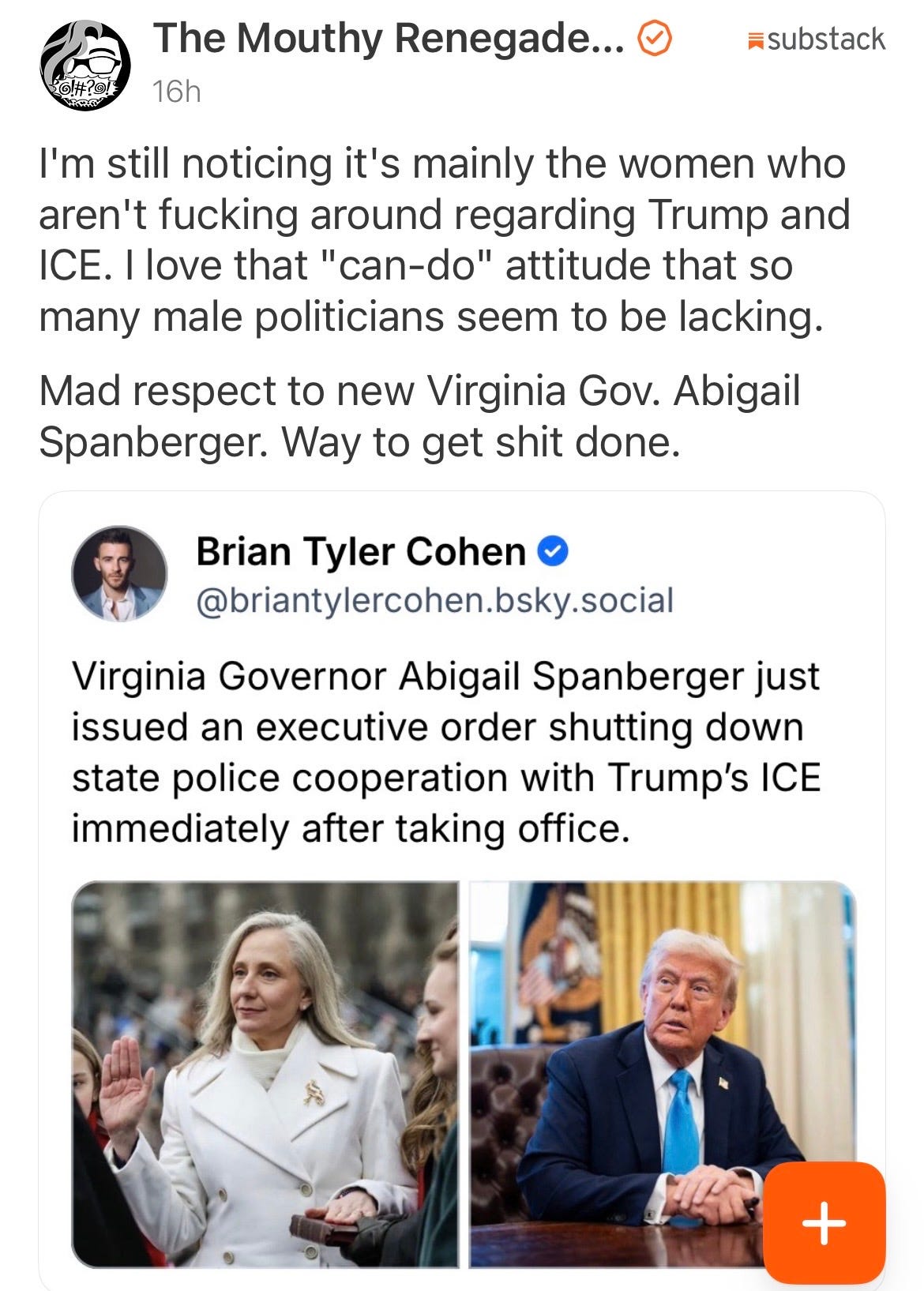
Something there is that doesn’t love the thought of a woman in power, even from other women, until they see a woman in power and she’s good at it. (Note: Kristi Noem is MAGA’s fantasy of a woman in power, in that she has none, but does the whole sexy swagger fantasy thing for the public at the altar of the Top Dog.)

Another post I saw on Instagram today had to do with what happens when a clueless patriarchal institution reaches out to take a pulse and is freaked by the response, their own work coming back to smite them:

Here’s real power, and power to the purpose: The key is providing what is sustainable. “Sustenance is the root of sustainability.” We have to stop “the eighty men in the one bus” with all the world’s money and return to the politics of caring. According to Vandana Shiva:

“Non-sustainability is violence against the earth,” Shiva says, and when the men’s only response is, “We’ll move to Mars instead,” I want to send them NOW.
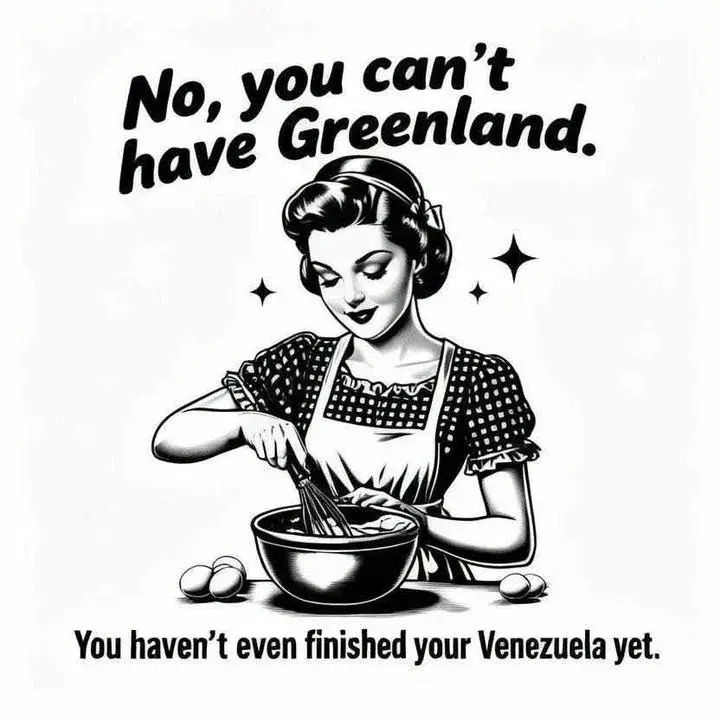
Sending love on a rainy cold Sunday in New York during the revolution,

Miss O’
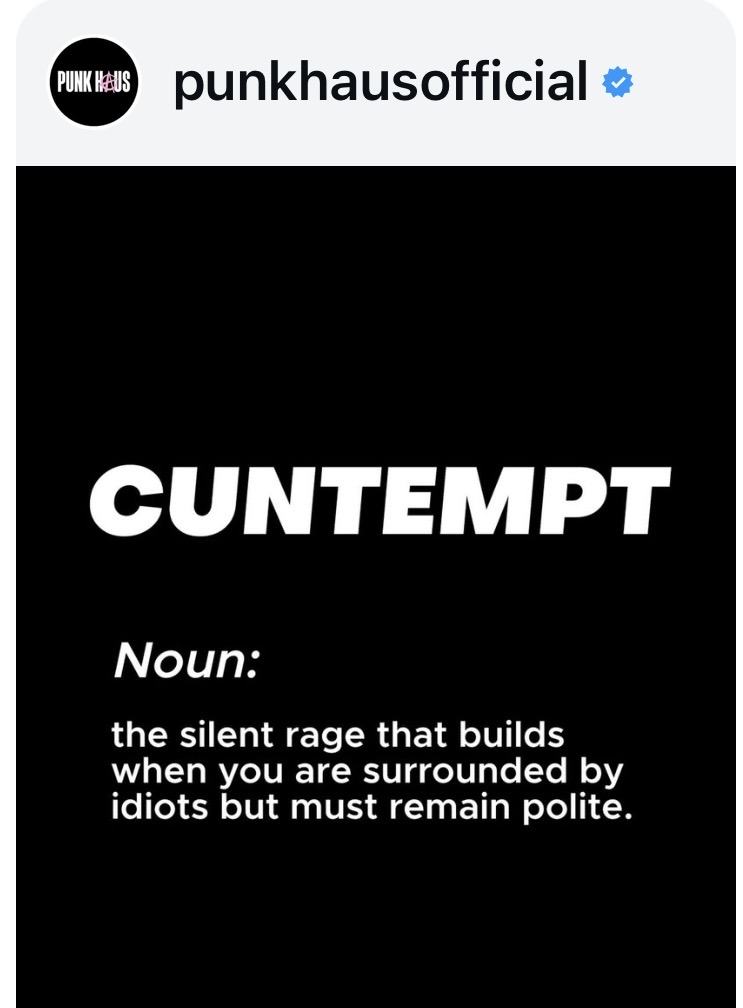
Screenshot

We Don’t Go to the Movies

Miss O’s bathroom reminder not to be late. For whatever.

Pass the Data

The other day I heard a learned philosopher discoursing on self-knowledge. While we used to engage in self-exploration through meditation, sports, or art, for example, Yuval Noah Harrari asks what it means, then, “when this process is outsourced to a Big Data algorithm?” That line stopped me hard. Where Eliot’s J. Alfred Prufrock measured out his life in coffee spoons, how many of us measure out our lives, our wellness, and our worth in “likes”? in “steps”? in money earned, spent, and saved? in mileage on the bike? in states or countries visited? in our biometric numbers for sugar, cholesterol, weight, percentage of body fat, calories consumed, points earned? lays sought and found on a sex app? books read? shows seen? tweets twatted? MAKE IT STOP.

One way I measure out my mental health and self-worth is through the laughs I generate in others, and judging from that last few years of meager blog posts, posts on social media, and reactions the few times I’ve seen others in person, I am in rough shape. I don’t think this post bodes well for wit, and for that, one of my three or four readers, I apologize.

The most important measure of my mental health for me is my capacity to weep at beautiful songs, singers, poetry, movie moments, pictures, and other acts of human decency. I was just listening to the Barbara Streisand/Judy Garland duet “Happy Days/Get Happy” and found myself in tears. So, check. (I hadn’t thought about the ways in which I might bring others to tears, but I think that happens out of my capacity to irritate more than, you know, move someone by making something beautiful.

You Laughed at an Image

My first boyfriend*, from back in high school, got back in touch recently. He has been with his wife, a fellow artist, happily for 32 years. When they eloped after living together for almost a decade, I mailed them a toaster. They totally got it. He began reaching out to old friends, he said, in the wake of Covid, and on the cusp of age 60 next year. I told him that I myself have actually paid for a ticket to my 40th high school reunion. I am going with two buddies of mine since second grade; my old bf’s was last year, and he said, “MAGA vibe, super spreader event; pass.” Probably true here too, but friend Carl promises it’s really a reunion of friends from elementary and middle school, and it will be fun. Okay.

The best part of the reconnect has been the ART share, in multiple texts; the meme share; the political jokes. According to the data, I laugh and heart a lot, so that must be good. My inner life, I mean. Should I dig deeper?

*Note: I never had any boyfriends. Sure, I went out with two guys in high school, and steadily, and talked about marriage with another guy, but I was ABOVE BOYFRIENDS. And still am. Why? Dunno. Let me ask an algorithm. “You laughed at an image.” I guess I’m fine.

Weekly Report: Your screen time was down 11% last week.

Weekly Report: Your sense of self-worth was down 25% last week and continues to plummet.

Weekly Report: 99.9% of Republicans blame all girls under age 11 who are pregnant for being too hot to resist.

Weekly Report: Humans are fucking up the planet and are fucking fucked but only about 25% of Americans fucking believe it’s fucking true, and YOU are one of them. 

Weekly Report: 100% of meals in America contain tough nuts.

Anything else to REPORT? I mean, there it IS.

Work It Out for Yourself

My Queens basement flooded again yesterday afternoon. Only one inch of rain in an hour. What the hell? Last September my last chance for a vacation for the foreseeable future (and what would have been my first in three years) was swamped over by drain overflow in the wake of Hurricane Ida. My last real vacations were in 2018 in California, Lake George, and here in NYC when friends came for a week to visit. The year 2019 was WORK, the year 2020 was WORK + Covid; 2021 same. But Labor Day week friends and I were going to make a break for Lake George again…and Ida. Since then, my parents, while still sharp and okay, have grown frailer. I spent 5 weeks there this spring to help my dad after a surgery, and help my 85-lb mother, too. Lucky to be able to do it—the sad residual benefit of the pandemic is that we have this new way of working, remotely. And wow does it make me feel remote—from others, from myself. A lot of us are at the point of wondering why we work at all—so many of our jobs are just humans trying to plug the holes and reduce the problems inflicted on humans by the humans who are doing the jobs in other companies and institutions and there is no bottom. Why aren’t we just growing food, singing a little, dancing, and cooking again? What happened? Boredom?

And don’t get me started on the rat infestation at my co-op building, or the super going on vacation and the back-up falling through and me being the only person not afraid of the rats, so this gray-haired fat lady will be sweeping up (including the dead rats) and hauling garbage out for the next two weeks. And temps in the 90’s. This is how I will die. And so what, really?

The opening phrase of the first poem of my friend Jean LeBlanc’s latest collection of poetry, our pitiful metaphors, is, “Work it out for yourself:” and the first time I read it I just about threw the book across the room. I was so tired, you see. I don’t want to be challenged or taunted or berated. I don’t want to work it out for myself. Just tell me my horoscope, give me the meds, the diet plan, the answer. Why is this hard?

“we inflict upon the cosmos our pitiful metaphors.”

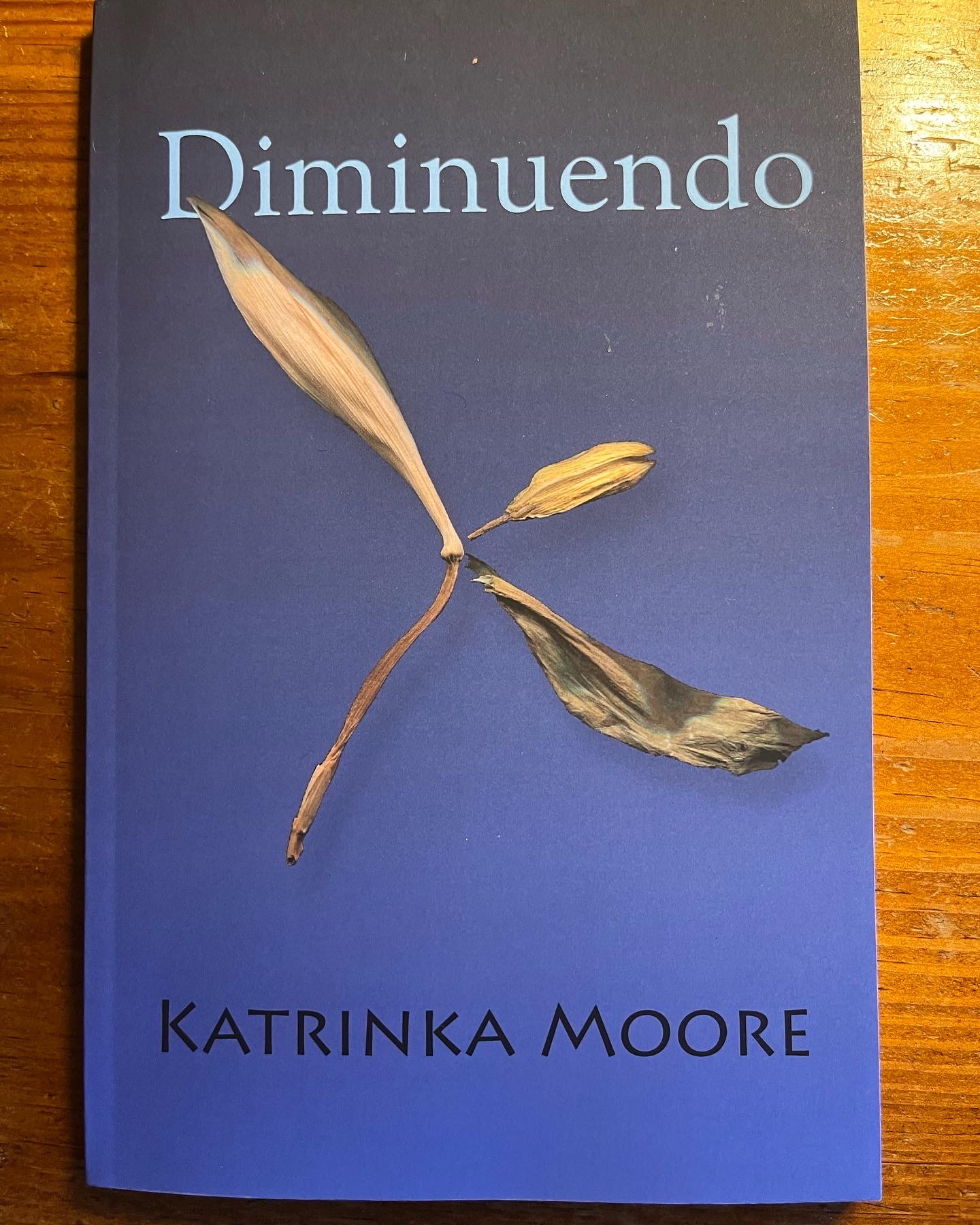
I reread the collection this morning, after putting all the flood-soaked towels in the laundromat washer, which sounds like a pretty easy task, until you factor in moving all the shit in the basement mudroom to get the heavy duty cart out, lining it will a big plastic bag, filling it in four trips from bathroom shower to trash alley carrying the drenched textiles, heaving the laden cart up the stairs, locking the gate (dragging it over swollen concrete—is nothing just a thing?—and pushing it all to the facility; followed by returned the cart to the basement, etc. It’s laden with sadness, this poetry collection; arguments, missed connections, and loss. I find myself wrestling with all the terrible beauty. I contrast it with our friend Anna’s collection, Buoyant, about the joys of scuba diving, the poems’ speakers filled with wonder; and our friend Katrinka Moore’s latest collection, Diminuendo, which returns again and again to the sensation of floating, hovering, and the feeling of being connected tenuously by the thinnest of strands. 

“When at last the great animal arrives/ out of the primordial past, mouth wide” (“Grace”)
“but I make my way out. when/ I can. The fetch of space” (“Thin Places”)

There are moments these past few years when I’ve felt held together by only the thinnest of strands; known that I am forever and always having to work it out for myself; and also given a reprieve with moments of wonder, as this week with the first color images from the Webb Space Telescope.

I made the mistake of texting my despair post-flood yesterday to a friend who said, “Fuck, Lisa. Get help. Call 988.” I remembered the first time I went to therapy years ago, my therapist Goldye said, in response to my skepticism about going to a therapist when I have friends: “Our friends don’t care about our pain. They will say whatever it takes to make you okay so we can all go to the movies.” 

Walking in Midtown Manhattan. Look up.

And this is why you walk your neighborhoods, write stuff, draw a little, and don’t share your pain with anyone, not even friends; why we have to turn to the poets, the artists, the musicians in our darkest hours. People have their own shit to deal with, and they don’t need yours. It’s a lonely truth in a lonely world.

Sending love and poetry, somehow. Bless those poets.

Miss O’s desk. Queens.