
Art Spiegelman, Mad Magazine, and my childhood
It’s a pretty wacky Sunday in America in May of 2025. I’m fidgity. Any piece of music I turn on only irritates me—everything sounds too bland, not vital enough, not insistent enough, not loud enough. I feel like I’m turning into a punk teenager at age 60. Even punk feels passe. I’m looking for a revolution.
I turned again to the PBS American Masters episode Art Spiegelman: Disaster Is My Muse, in which the Maus creator talks about EC (short for Educational Comics, later rebranded as Entertaining Comics), which published not only Mad Magazine but also horror comics like Tales from the Crypt, science fiction by Ray Bradbury, and pulp comics. Spiegelman realized that the horror comics were often by Jewish artists, and that this art was a way of responding to the Holocaust, a Holocaust that no one outside of the Jewish community knew about until the televised Adolf Eichmann trials in 1961. Spiegelman remarks that the key message of EC comics was, “Kid, the adults are lying to you.” This work gave Spiegelman the inspiration to write his classic Maus, using comics to relate the Holocaust experiences of his father. Access to EC and the way it reframed the world, Spiegelman concludes, most likely led directly to students his age protesting against the Vietnam War.
If you are wondering why Trump and his White Christian Nationalist MAGA want to end PBS and all art generally, look no further.
Now, I’m a radical sort of person, but a less assuming, duller radical you won’t find than Miss O’. It’s sad how boring we’ve all become in the white world. Still, the Spiegelman documentary got me thinking about the influences on my own thinking as a child of the 1970s. I’ve told you this. Born in 1964, I remember watching All in the Family when it debuted in 1971, Rowan and Martin’s Laugh-In in the late 1960s to early 70s, as well as the CBS news with Walter Cronkite every night and The Brady Bunch on Fridays. My family talked about every subject raised on these shows, including the “insipidity” of said Bunch, over dinner or between commercials. In addition to being the only kids in the neighborhood with bookcases, the O’Kids were, should they choose to be, informed. I chose to be, as best I could. And talk about a gamut of subject matter to assimilate—seriously, the 1970s was a great time for me to be a kid, though that wasn’t the case for plenty of other kids. That’s something I learned as I grew. As we do.
And I know I told you this story, how around 1976 or ’77, when I was eleven or twelve, and my tipsy parents would go up to bed on Saturday nights, I was allowed to stay up and watch The Carol Burnett Show by myself. I preferred to watch it with my parents, since they knew all the movie references and explained that the sketch “Funt and Mundane” was a parody of the Broadway legendary couple Lunt and Fontanne, stuff like that, but they gave me great tools to ask questions.
Around that time older boys in the neighborhood, the ones who turned me on to Mad Magazine, told me about other shows, late night fare, daring shows like Monty Python’s Flying Circus on Channel 5 at 11:00 PM; soon I discovered SCTV on my own on Channel 26 (PBS) at 11:30, adjusting the rabbit ears on the set; and then at midnight, I’d physically change the channel to 4 over to NBC’s Saturday Night Live in time for Weekend Update. At 1:00 AM, when many stations went to a test pattern, I’d go to bed. I had a good a thing going until my mom, Lynne, wandered downstairs one night to find me in the dark watching Monty Python. I felt like a criminal. My heart raced.
Lynne, taking over the yellow plaid lounge chair, lit a Salem from her ever-present pack and flicked the top back on her lighter (I can still smell the aromas of menthol and singed lighter fluid). “What are you watching?” she asked. I stammered out the title, trying to shrink on the herculon-upholstered loveseat in the plastic-paneled living room, staring hard at the black and white TV screen. “It’s from England,” I explained. The running sketch of this particular episode was called “Dennis Moore,” about an 18th century bandit who steals lupins from rich people in horse-drawn coaches. The theme song, my mother noted, was from the 1950s TV show, Robin Hood. Oh. By the end, Dennis Moore has taken all that the rich have and given it all to the poor, so the theme song changes from “he steals from rich, and gives to poor, Dennis Moore” to “he steals from the poor, and gives to the rich, stupid bitch.” When I heard “bitch” I thought, “OH NO, this is it, I am in so much trouble,” but Lynne was roaring. “What a brilliant satire of the British tax system,” she said, stubbing out her third or fourth cigarette. “You can watch this show whenever you want.” And she went back upstairs to bed.
And that was it. As a child, as you can see, I didn’t have much to rebel against. My only oppression was the constant fights over my looks—I didn’t have any, and let’s face it, few women do and we look just fine, and my mother was a great beauty. For all her feminism, my mom still fell into that trap of cosmetics and clothes make the woman, thinness is more important than intelligence, “you could be pretty if you tried.” I suffered emotionally over all this nonsense for far too many decades, until my early 30s, when thanks to my therapist I made peace with this particular impasse. I learned that the real sufferer was not me, but my mom. The 1950s did a number on too many women for too many years, oppressing them by making them insecure over their face, hair, nails, weight; but I am beyond fortunate that the artificial beauty thing was the only part of female silliness my mom bought into. Hence, Monty Python and an allowance to buy Mad Magazine.
Sidebar: I told you this story too, probably, how at 32 I lost my natural bloom. I realized this when female students started approaching me, “Miss O’Hara, can we give you a makeover?” When it reached the point of borderline harassment, I mentioned it to my mother (no longer a smoker, but you can picture the cigarette), who said in her sharp, firm voice, “I know you don’t want to hear this, but if you’d wear a little mascara and lipstick, they’d leave you alone.” I thought about it. To press the point, Lynne pointed out and really quite sagely, “Honey, you don’t wear makeup so people notice you, you wear it so they don’t.” Yes, that made total sense.
Oddly enough, I’d created a similar but differently angled line even in my late twenties. I was reminded of it this week when a friend visiting Virginia ran into one of my former students. She recalled the line I gave her when she’d asked why I don’t wear makeup. I said, “I’d rather stun them when I wear it than shock them when I don’t.” Lynne and I were both right. But I learned to keep lipstick in my pocket to refresh between classes (and I do that to this day), and sure enough, the kids never bothered me about my face again. (My hair is another story.)
That dark, twisted humor I loved—a humor that meant I gravitated more to boys than girls for friendship—drew me to a Topps bubblegum series called Wacky Packs, which my brother Pat also collected. I was obsessed with them, as the kids would say.



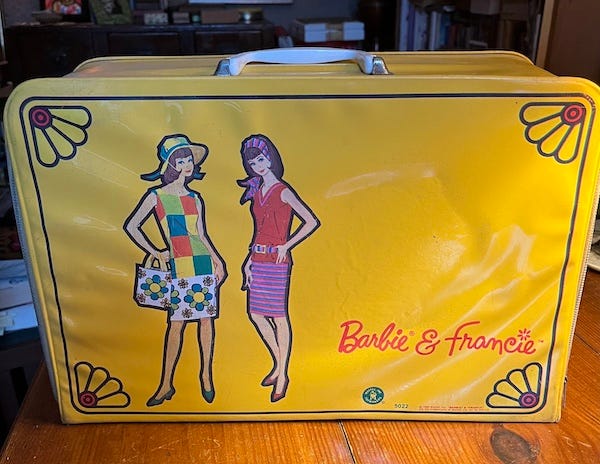
In the Spiegelman American Masters documentary, I learnedthat Art Spiegelman, who worked for Topps, created Wacky Packs! Wacky Packs was his art, his jokes. What a discovery! I figured I’d ruined my original Barbie and Francie suitcase by plastering the back of the suitcase with those stickers, but I now see it’s even better—and absolutely me, the girl who loved All in the Family and The Brady Bunch, Monty Python and Carol Burnett, Mad Magazine comics and Barbie.

We are, unbelievably, once again living in Holocaust-level dark times, this time in the United States, with Trump openly setting the timer on 250 years of American independence, and on Constitutional Democracy, to end on July 4, 2026, when DOGE expires, and when the 250th anniversary celebration committee expires; and the countdown clock will presumably be reset to 000 to mark the Trump takeover of America. Trump openly denies adherence to the Constitution, flaunts his freedom from the constraints of law, even spreads his lunatic desire to be Pope as well as president. This insanity is beyond the bounds even of The Onion, the inheritor of all the “Kid, the adults are lying to you” Spiegelman-era art.

And without artists like Art Spiegelman and the Monty Python troupe and Mad Magazine and Norman Lear, and contemporary creators like the Onion staff and Alison Bechdel, without that satire, that bite, these swipes at the sources of our dysfunction and the most horrific of status quos, I couldn’t survive. No one with sense and decency could.
I hope you are finding your solace on this Sunday, the art that soothes even as it steadies, energizes, and ignites you.
Sending love,
Miss O’
 The Miss O' Show (Teacher's Edition)